EP1895676A1 - Verfahren zur Ausweitung einer Funkabdeckung durch Steuerung der Ressourcenzuweisung für die drahtlose Kommunikation - Google Patents
Verfahren zur Ausweitung einer Funkabdeckung durch Steuerung der Ressourcenzuweisung für die drahtlose Kommunikation Download PDFInfo
- Publication number
- EP1895676A1 EP1895676A1 EP07014507A EP07014507A EP1895676A1 EP 1895676 A1 EP1895676 A1 EP 1895676A1 EP 07014507 A EP07014507 A EP 07014507A EP 07014507 A EP07014507 A EP 07014507A EP 1895676 A1 EP1895676 A1 EP 1895676A1
- Authority
- EP
- European Patent Office
- Prior art keywords
- sub
- channels
- mobile terminal
- transmission power
- channel
- Prior art date
- Legal status (The legal status is an assumption and is not a legal conclusion. Google has not performed a legal analysis and makes no representation as to the accuracy of the status listed.)
- Withdrawn
Links
Images



Classifications
-
- H—ELECTRICITY
- H04—ELECTRIC COMMUNICATION TECHNIQUE
- H04B—TRANSMISSION
- H04B7/00—Radio transmission systems, i.e. using radiation field
- H04B7/14—Relay systems
- H04B7/15—Active relay systems
- H04B7/155—Ground-based stations
-
- H—ELECTRICITY
- H04—ELECTRIC COMMUNICATION TECHNIQUE
- H04W—WIRELESS COMMUNICATION NETWORKS
- H04W52/00—Power management, e.g. Transmission Power Control [TPC] or power classes
- H04W52/04—Transmission power control [TPC]
- H04W52/30—Transmission power control [TPC] using constraints in the total amount of available transmission power
- H04W52/34—TPC management, i.e. sharing limited amount of power among users or channels or data types, e.g. cell loading
-
- H—ELECTRICITY
- H04—ELECTRIC COMMUNICATION TECHNIQUE
- H04W—WIRELESS COMMUNICATION NETWORKS
- H04W52/00—Power management, e.g. Transmission Power Control [TPC] or power classes
- H04W52/04—Transmission power control [TPC]
- H04W52/30—Transmission power control [TPC] using constraints in the total amount of available transmission power
- H04W52/34—TPC management, i.e. sharing limited amount of power among users or channels or data types, e.g. cell loading
- H04W52/343—TPC management, i.e. sharing limited amount of power among users or channels or data types, e.g. cell loading taking into account loading or congestion level
-
- H—ELECTRICITY
- H04—ELECTRIC COMMUNICATION TECHNIQUE
- H04W—WIRELESS COMMUNICATION NETWORKS
- H04W72/00—Local resource management
- H04W72/04—Wireless resource allocation
- H04W72/044—Wireless resource allocation based on the type of the allocated resource
- H04W72/0473—Wireless resource allocation based on the type of the allocated resource the resource being transmission power
Definitions
- Embodiments of the present invention may relate to a method for extending wireless link coverage. More particularly, embodiments of the present invention may relate to a method for extending wireless link coverage by controlling wireless communication resource allocation.
- Wireless link coverage is an important factor that affects efficiency of a mobile communication system.
- the wireless link coverage in the mobile communication system may be represented by a maximum distance between a mobile terminal and a base station that can support communication therebetween. If the wireless link coverage is too small, then mobility of a mobile terminal may be restricted. On the contrary, if the wireless link coverage is too large, then interference may be induced between neighboring cells.
- the wireless link coverage may be classified into downlink coverage, uplink coverage and system coverage according to a direction of signal transmission.
- the downlink coverage may be represented by a maximum distance between a base station and a mobile terminal, beyond which the mobile terminal can not sense signals from the base station.
- the uplink coverage may be represented by a maximum distance between a base station and a mobile terminal, beyond which the base station can not sense signals from the mobile terminal.
- System coverage may be represented by a maximum distance between a base station and a mobile terminal, beyond which the base station and the mobile terminal can not communicate with each other.
- the system coverage may be determined to be the smaller of the downlink coverage or the uplink coverage.
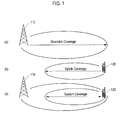
- FIG. 1 is a diagram illustrating downlink coverage, uplink coverage and system coverage.
- the downlink coverage corresponds to a range that can be reached by a signal from a base station 110.
- the uplink coverage corresponds to a range that can be reached by a signal from a mobile terminal 120.
- the factors for determining the coverage may include transmission power, Tx antenna gain, system bandwidth, Rx antenna gain, receiver sensitivity, fade margin, cable loss, etc.
- the system coverage may be limited by the uplink that may have a lower transmission power than or inferior components to the downlink.
- FIG. 1(c) shows an example of determining the system coverage as the uplink coverage that is smaller than the downlink coverage. As shown therein, when the system coverage is limited by the uplink coverage, the system coverage may be improved by extending the uplink coverage.
- a plurality of users may share media such as wireless channels that may be represented in a two-dimensional space consisting of time and frequency axes.
- the system may adjust efficiency of wireless communication by controlling sharing of such media.
- the mobile communication system may be classified into Code Division Multiple Access (CDMA), Time Division Multiple Access (TDMA), Frequency Division Multiple Access (FDMA), etc.
- CDMA Code Division Multiple Access
- TDMA Time Division Multiple Access
- FDMA Frequency Division Multiple Access
- a common characteristic of these access schemes is that they divide the wireless channels into combinations of time and frequency in order to control sharing of the wireless channels.
- a specialized method may be available to extend the wireless link coverage.
- Controllable factors for improving the uplink coverage may include transmission power, allocated bandwidth for data transmission, allocated time slots for data transmission, etc. Since other factors are fixed by hardware naturally and locally, it may be difficult and costly to make improvements with those factors.
- the transmission power, the allocated bandwidth and the time slots for data transmission, etc. have been considered to improve efficiency of the mobile communication system rather than to extend the wireless link coverage. Accordingly, there is a need to provide an efficient method for extending wireless link coverage without reducing efficiency of the mobile communication system.
- FIG. 1 is a diagram illustrating downlink coverage, uplink coverage and system coverage according to an example arrangement
- FIG. 2 illustrates a scheme for dividing wireless channels in an OFDMA mobile communication system
- FIG. 3 illustrates a method of allocating wireless resource according to an example arrangement and an example embodiment of the present invention
- FIG. 4 illustrates extending system coverage when a method of allocating wireless resource according to an example embodiment of the present invention is applied to the system
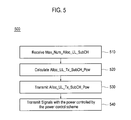
- FIG. 5 is a flow chart illustrating a wireless communication process that involves calculating a maximum transmission power per sub-channel at a mobile terminal according to an example embodiment of the present invention.
- FIG. 6 is a flow chart illustrating a wireless communication process that involves calculating a maximum transmission power per sub-channel at a base station according to an example embodiment of the present invention.
- FIG. 2 illustrates a scheme for dividing wireless channels in an Orthogonal Frequency Division Multiple Access (OFDMA) mobile communication system.
- OFDMA Orthogonal Frequency Division Multiple Access
- wireless channels may be represented in a two-dimensional space that includes a time axis 210 and a frequency axis 220.
- a plurality of users may share limited resources such as wireless channels to perform wireless communication with a base station.
- a resource allocation scheduler may allocate the wireless channels to each user while considering an amount of data to be transferred and channel environments.
- a symbol 230 may refer to a minimum unit in the time axis 210 and a sub-channel 240 may refer to a minimum unit in the frequency axis 220.
- the resource allocation scheduler may allocate a number of symbols and a number of sub-channels two-dimensionally in order to make a user perform wireless communication.
- a time period allocated for downlink transmission i.e., a downlink allocated period 250
- a time period allocated for uplink transmission i.e., an uplink allocated period 260
- the base station 110 may transmit signals (or data) to the mobile terminal 120.
- the base station 110 may transmit signals (or data) concurrently to a plurality of mobile terminals 120 by dividing the frequency channels.
- the mobile terminal 120 may transmit signals (or data) to the base station 110.
- a plurality of mobile terminals 120 may transmit signals (or data) concurrently by using different frequency channels.
- extra periods 270, 280 may exist for transition between downlink and uplink.
- Embodiments of the present invention may be used in any mobile communication system that uses wireless channels to divide channels along a time axis and a frequency axis.
- FIG. 2 illustrates the OFDMA mobile communication system in which the downlink allocated periods 250 and the uplink allocated periods 260 alternate, the mobile communication system may not use separate time periods for downlink transmission and uplink transmission.
- some mobile communication systems may provide orthogonality between wireless channels by dividing the channels along the frequency axis while using the same time periods.
- Embodiments of the present invention may be implemented in a mobile communication system that divides the wireless resources into a plurality of sub-channels and symbols along the frequency and time axes, respectively.
- FIG. 3 comparatively illustrates a method of allocating wireless resource according to an example arrangement and according to an example embodiment of the present invention.
- the wireless resource allocation for downlink and uplink may be performed two-dimensionally with a number of symbols 230 and a number of sub-channels 240.
- a two-dimensional allocation may be performed such as "4 sub-channels * 2 symbols" (B in FIG. 3) that includes 4 sub-channels and 2 symbols.
- the size of the allocated wireless channels (i.e., size of B) may be determined by a resource allocation scheduler according to an amount of data to be transferred and channel environments.
- the allocation scheme may vary according to the scheduler.
- the mobile terminal 120 may prepare the transmission power for transmitting the signals using all of the frequencies. For example, if 50 sub-channels and 20 symbols may be usable in the uplink, the mobile terminal 120 may prepare transmission power for transmitting the signals using 50 sub-channels at a same time.
- a method for allocating wireless resources may limit a maximum number of sub-channels when allocating the wireless resources for uplink. For example, when the amount of data to be transmitted by the mobile terminal 120 is 4 sub-channels * 2 symbols as shown in FIG. 3 (B in FIG. 3), the amount of data may be equal to 2 sub-channels * 4 symbols (A in FIG. 3). Therefore, when the transmission rate is not demanded to be high, the number of sub-channels may be limited to 2 while the amount of data to be transmitted by the mobile terminal 120 is maintained the same. When the number of sub-channels that the mobile terminal 120 may use to transmit data is limited, a power density per sub-channel may be improved.
- the transmission power of a mobile terminal is limited, the transmission power per sub-channel may be improved by limiting a number of sub-channels. Therefore, when a method for allocating wireless resources according to an example embodiment of the present invention may be used to limit the number of sub-channels that the mobile terminal may use to transmit data, the transmission power per sub-channel may be improved. Thus, the uplink coverage may also be improved.
- the system may be in an initial state before applying the method for allocating the wireless resources according to an example embodiment of the present invention.
- Tot_Num_UL_SubCH a maximum number of sub-channels allocable for the mobile terminal 120
- Max_Num_Alloc_UL_SubCH a maximum number of sub-channels allocable for the mobile terminal 120
- the values of TocNum_UL_SubCH and Max_Num_Alloc_UL_SubCH may initially be identical.
- the value of Max_Num_Alloc_UL_SubCH is identical to the value of Tot_Num_UL_SubCH (i.e., 50 in the example).
- Alloc_UL_Tx_SubCH_Pow Max_UL_Tx_Pow Max_Num_Alloc_UL_Sub CH
- Max_UL_Tx_Pow is 200mW and Max_Num_Alloc_UL_SubCH is 50 as in the above example
- Alloc_UL_Tx_SubCH_Pow may be 4mW.
- the state of the system may be updated.
- Tot_Num_UL_SubCH is 50
- Max_Num_Alloc_UL_SubCH may be limited to a predetermined value by the method of allocating the wireless resources according to an example embodiment of the present invention. For example, when Max_Num_Alloc_UL_SubCH is limited to 10, the value of maximum transmission power per sub-channel may be recalculated.
- the maximum power transmittable by the mobile terminal 120 i.e., Max_UL_Tx_Pow
- the maximum power allocable to a sub-channel i.e., Alloc_UL_Tx_SubCH_Pow
- the maximum transmission power per sub-channel may be increased. In the above example, the maximum transmission power per sub-channel is increased from 4mW to 20mW (5-fold increase).
- the number of sub-channels usable for the uplink is 50 as in the above example, if the maximum number of sub-channels that may be used to transmit data is limited to 5, then a 10-fold power gain may be obtained as compared to a case when the method according to embodiments of the present invention is not applied. If the data transmission rate is not required to be high, then the number of sub-channels that may be used to transmit data may be limited to be smaller. In such a case, the power gain may be greater.
- the uplink coverage may also be increased.
- the transmission power gain may be 2 times (i.e., 3dB).
- system coverage may also be increased by increasing the uplink coverage, which is a limitation factor for the system coverage.
- calculation of the maximum transmission power per sub-channel may be performed at the base station 110. Otherwise, the calculation may be performed at the mobile terminal 120 and a result of the calculation may then be transmitted to the base station 110.
- the mobile terminal 120 may transmit information on the maximum transmission power (i.e., Max_UL_Tx_Pow) to the base station 110.
- the base station 110 may transmit information on the total number of sub-channels usable for uplink (i.e., Tot_Num_UL_SubCH) and the maximum number of sub-channels allocable for the mobile terminal 120 (i.e., Max_Num_Alloc_UL_SubCH) to the mobile terminal 120.
- the value of Alloc_UL_Tx_SubCH_Pow may be used to update the parameters of the power control scheme of the base station 110.
- the applied uplink power may be the maximum power of the mobile terminal controllable during the power control. It may act as a critical value for the power control to prevent any power overflow of the mobile terminal.
- the power control scheme may include any of a number of various schemes that are widely used in the art.
- FIG. 5 is a flow chart illustrating a wireless communication process that involves calculating a maximum transmission power per sub-channel at a mobile terminal according to an example embodiment of the present invention. Other embodiments, operations and orders of operation are also within the scope of the present invention.
- the mobile terminal 120 receives a maximum number of sub-channels allocable for the mobile terminal 120 (i.e., Max_Num_Alloc_UL_SubCH) from the base station 110.
- the mobile terminal 120 calculates the maximum transmission power per sub-channel (i.e., Alloc_UL_Tx_SubCH_Pow) based on the value of Max_Num_Alloc_UL_SubCH received in operation 510 and the maximum transmission power of the mobile terminal 120 (i.e., Max_UL_Tx_Pow). The calculation is performed by dividing the value of Max_UL_Tx_Pow by the value of Max_Num_Alloc_UL_SubCH, as described above.
- the mobile terminal 120 transmits the value of Alloc_UL_Tx_SubCH_Pow calculated in operation 520 to the base station 110. Then, when the base station 110 receives the value and applies the value to the power control scheme to control the transmission power of the mobile terminal 120, the mobile terminal 120 transmits signals (or data) with the controlled power in operation 540.
- FIG. 6 is a flow chart illustrating wireless communication process that includes calculating maximum transmission power per sub-channel at a base station according to an example embodiment of the present invention. Other operations, orders of operations and embodiments are also within the scope of the present invention.
- the base station 110 receives the maximum transmission power of the mobile terminal 120 (i.e., Max_UL_Tx_Pow) from the mobile terminal 120.
- the base station 110 sets the maximum number of sub-channels allocable for the mobile terminal 120 (i.e., Max_Num_Alloc_UL_SubCH). The time sequence of operations 610 and 620 may be changed.
- the base station 110 calculates the maximum transmission power per sub-channel (i.e., Alloc_UL_Tx_SubCH_Pow) based on the value of Max_UL_Tx_Pow received in operation 610 and the value of Max_Num_Alloc_UL_SubCH set in operation 620. The calculation is performed by dividing the value of Max_UL_Tx_Pow by the value of Max_Num_Alloc_UL_SubCH, as described above.
- the base station 110 applies the value of Alloc_UL_Tx_SubCH_Pow calculated in operation 630 to update the parameters of the power control scheme so as to control the transmission power of the mobile terminal 120.
- wireless link coverage of a mobile communication system may be extended to provide better wireless environments.
- a method may be provided to extend wireless link coverage in a wireless communication system.
- the method may include limiting a number of allocable sub-channels to a predetermined value in allocating the wireless channels that include sub-channels and symbols.
- the method may also include calculating a maximum transmission power per sub-channel based on the limited number of allocable sub-channels and performing power control based on the calculated maximum transmission power per sub-channel.
- a method may also be provided to extend wireless link coverage in a wireless communication system that includes a base station and a mobile terminal.
- the method may be executed at the mobile terminal and may include receiving information on a maximum number of allocable sub-channels for the mobile terminal from the base station.
- the method may also include calculating the maximum transmission power per sub-channel based on the information and transmitting information on the calculated maximum transmission power per sub-channel to the base station.
- the method may include transmitting signals under power control based on the information on the maximum transmission power per sub-channel.
- a method may also be provided to extend wireless link coverage in a wireless communication system that includes a base station and a mobile terminal.
- the method may be executed at the base station and may include receiving information on transmittable maximum power of the mobile terminal from the mobile terminal and setting the maximum number of allocable sub-channels for the mobile terminal.
- the method may also include calculating the maximum transmission power per sub-channel of the mobile terminal based on the received information and the set maximum number of allocable sub-channels.
- the method may further include performing power control based on information on the maximum transmission power per sub-channel.
- any reference in this specification to "one embodiment,” “an embodiment,” “example embodiment,” etc. means that a particular feature, structure or characteristic described in connection with the embodiment is included in at least one embodiment of the present invention.
- the appearances of such phrases in various places in the specification are not necessarily all referring to the same embodiment.
Landscapes
- Engineering & Computer Science (AREA)
- Computer Networks & Wireless Communication (AREA)
- Signal Processing (AREA)
- Mobile Radio Communication Systems (AREA)
Applications Claiming Priority (1)
| Application Number | Priority Date | Filing Date | Title |
|---|---|---|---|
| KR1020060084173A KR100800915B1 (ko) | 2006-09-01 | 2006-09-01 | 무선 통신 자원 할당 제어를 통한 무선 링크 커버리지 확장방법 |
Publications (1)
| Publication Number | Publication Date |
|---|---|
| EP1895676A1 true EP1895676A1 (de) | 2008-03-05 |
Family
ID=38868285
Family Applications (1)
| Application Number | Title | Priority Date | Filing Date |
|---|---|---|---|
| EP07014507A Withdrawn EP1895676A1 (de) | 2006-09-01 | 2007-07-24 | Verfahren zur Ausweitung einer Funkabdeckung durch Steuerung der Ressourcenzuweisung für die drahtlose Kommunikation |
Country Status (3)
| Country | Link |
|---|---|
| US (1) | US20080057971A1 (de) |
| EP (1) | EP1895676A1 (de) |
| KR (1) | KR100800915B1 (de) |
Cited By (1)
| Publication number | Priority date | Publication date | Assignee | Title |
|---|---|---|---|---|
| WO2009133231A1 (en) * | 2008-04-29 | 2009-11-05 | Elektrobit Wireless Communications Oy | Communication method and a radio system |
Families Citing this family (2)
| Publication number | Priority date | Publication date | Assignee | Title |
|---|---|---|---|---|
| CN105704181A (zh) * | 2014-11-26 | 2016-06-22 | 国际商业机器公司 | 管理移动设备中的任务的方法和装置 |
| US11941455B2 (en) * | 2019-12-13 | 2024-03-26 | Micron Technology, Inc. | Shadow computations in base stations |
Citations (3)
| Publication number | Priority date | Publication date | Assignee | Title |
|---|---|---|---|---|
| EP0748075A2 (de) * | 1995-06-08 | 1996-12-11 | Canon Kabushiki Kaisha | Verfahren und Vorrichtung zur mehrfachen Kommunikation |
| US20040229621A1 (en) * | 2003-05-16 | 2004-11-18 | International Business Machines Corporation | Method and apparatus for load sharing in wireless access networks based on dynamic transmission power adjustment of access points |
| WO2005122515A1 (en) * | 2004-06-07 | 2005-12-22 | Intel Corporation | Multicarrier communication system and methods for link adaptation using uniform bit loading and subcarrier puncturing |
Family Cites Families (3)
| Publication number | Priority date | Publication date | Assignee | Title |
|---|---|---|---|---|
| US8023951B2 (en) | 2003-04-24 | 2011-09-20 | Nokia Siemens Networks Oy | Dynamic coverage and capacity solution for cellular radio network |
| KR20070041214A (ko) * | 2005-10-14 | 2007-04-18 | 삼성전자주식회사 | 무선 이동 통신 시스템에서 상향링크 스케줄링 방법 |
| US7804910B2 (en) * | 2006-08-08 | 2010-09-28 | Adaptix, Inc. | Systems and methods for wireless communication system channel allocation using international delay distortion |
-
2006
- 2006-09-01 KR KR1020060084173A patent/KR100800915B1/ko not_active Expired - Fee Related
-
2007
- 2007-07-19 US US11/826,955 patent/US20080057971A1/en not_active Abandoned
- 2007-07-24 EP EP07014507A patent/EP1895676A1/de not_active Withdrawn
Patent Citations (3)
| Publication number | Priority date | Publication date | Assignee | Title |
|---|---|---|---|---|
| EP0748075A2 (de) * | 1995-06-08 | 1996-12-11 | Canon Kabushiki Kaisha | Verfahren und Vorrichtung zur mehrfachen Kommunikation |
| US20040229621A1 (en) * | 2003-05-16 | 2004-11-18 | International Business Machines Corporation | Method and apparatus for load sharing in wireless access networks based on dynamic transmission power adjustment of access points |
| WO2005122515A1 (en) * | 2004-06-07 | 2005-12-22 | Intel Corporation | Multicarrier communication system and methods for link adaptation using uniform bit loading and subcarrier puncturing |
Cited By (4)
| Publication number | Priority date | Publication date | Assignee | Title |
|---|---|---|---|---|
| WO2009133231A1 (en) * | 2008-04-29 | 2009-11-05 | Elektrobit Wireless Communications Oy | Communication method and a radio system |
| GB2471442A (en) * | 2008-04-29 | 2010-12-29 | Elektrobit Wireless Comm Oy | Communication method and a radio system |
| US8064396B2 (en) | 2008-04-29 | 2011-11-22 | Elektrobit Wireless Communications Oy | Communication method and a radio system |
| GB2471442B (en) * | 2008-04-29 | 2012-05-23 | Elektrobit Wireless Comm Oy | Communication method and a radio system |
Also Published As
| Publication number | Publication date |
|---|---|
| KR100800915B1 (ko) | 2008-02-04 |
| US20080057971A1 (en) | 2008-03-06 |
Similar Documents
| Publication | Publication Date | Title |
|---|---|---|
| US8576738B2 (en) | Method, apparatus and system for sharing a subchannel | |
| EP2978167B1 (de) | Frequenzsprungverfahren für e-utra-aufwärtsverbindung | |
| EP2245894B1 (de) | Dynamische justierung des abwärtsstrecken-aufwärtsstreckenzuteilungsverhältnisses in drahtlosen tdd-systemen | |
| US8767697B2 (en) | TDD time slot splitting | |
| US6763009B1 (en) | Down-link transmission scheduling in CDMA data networks | |
| US8406158B2 (en) | Method for transmitting TDD frames with increased data payload | |
| KR101348055B1 (ko) | 하이브리드 자동 반복 요구(harq) 타이밍 결정 | |
| CN101867403B (zh) | 一种测量参考信号的多天线发送方法、终端 | |
| CN109478970B (zh) | 用于在无线通信系统中传输dmrs的方法和设备 | |
| US20060205412A1 (en) | System and method for controlling resource allocation in a multicell communication system | |
| CN108141825A (zh) | 一种功率控制方法和网络侧设备以及用户设备 | |
| EP2903194B1 (de) | Basisstation, drahtloses kommunikationsendgerät, drahtloses kommunikationssystem und verfahren für drahtlose kommunikation | |
| WO2008032560A1 (fr) | Système de communication mobile, station de base, station mobile et procédé de communication multiporteuse | |
| WO2020237534A1 (en) | Methods, devices and computer storage media for communication | |
| US12363696B2 (en) | Mobile station, base station, transmission method and receiving method | |
| US8019385B1 (en) | Load simulation for testing uplink of wireless networks | |
| EP1895676A1 (de) | Verfahren zur Ausweitung einer Funkabdeckung durch Steuerung der Ressourcenzuweisung für die drahtlose Kommunikation | |
| EP1919102A1 (de) | Übertragungsverfahren in einem TDD-System mit einer Schutzzeit mit variabler Länge | |
| US10305566B2 (en) | Methods and systems for transmitting information across a MIMO channel from a transmitter to a receiver | |
| JP5425576B2 (ja) | 移動局装置、送信電力調整方法および通信システム | |
| Kim et al. | Tiny MAP: An efficient MAP in IEEE 802.16/WiMAX broadband wireless access systems | |
| EP2702813A1 (de) | Vorrichtung und verfahren zur kommunikation mit mehreren benutzergeräten über ofdma | |
| JP4666186B2 (ja) | 無線通信システム、基地局、チャネル割当方法、プログラム | |
| CN120711517A (zh) | 用于上行传输的资源确定方法、电子设备及存储介质 | |
| CN101488947B (zh) | 一种数据传输方法及装置 |
Legal Events
| Date | Code | Title | Description |
|---|---|---|---|
| PUAI | Public reference made under article 153(3) epc to a published international application that has entered the european phase |
Free format text: ORIGINAL CODE: 0009012 |
|
| 17P | Request for examination filed |
Effective date: 20070724 |
|
| AK | Designated contracting states |
Kind code of ref document: A1 Designated state(s): AT BE BG CH CY CZ DE DK EE ES FI FR GB GR HU IE IS IT LI LT LU LV MC MT NL PL PT RO SE SI SK TR |
|
| AX | Request for extension of the european patent |
Extension state: AL BA HR MK YU |
|
| 17Q | First examination report despatched |
Effective date: 20080612 |
|
| AKX | Designation fees paid |
Designated state(s): DE FI FR GB SE |
|
| RAP1 | Party data changed (applicant data changed or rights of an application transferred) |
Owner name: LG-ERICSSON CO., LTD. |
|
| STAA | Information on the status of an ep patent application or granted ep patent |
Free format text: STATUS: THE APPLICATION IS DEEMED TO BE WITHDRAWN |
|
| 18D | Application deemed to be withdrawn |
Effective date: 20151215 |