EP1896056B2 - Verstärkte kollagenmatrix - Google Patents
Verstärkte kollagenmatrix Download PDFInfo
- Publication number
- EP1896056B2 EP1896056B2 EP06784588.3A EP06784588A EP1896056B2 EP 1896056 B2 EP1896056 B2 EP 1896056B2 EP 06784588 A EP06784588 A EP 06784588A EP 1896056 B2 EP1896056 B2 EP 1896056B2
- Authority
- EP
- European Patent Office
- Prior art keywords
- scaffold
- collagen
- fibrous structure
- polymeric fibrous
- solution
- Prior art date
- Legal status (The legal status is an assumption and is not a legal conclusion. Google has not performed a legal analysis and makes no representation as to the accuracy of the status listed.)
- Not-in-force
Links
- 102000008186 Collagen Human genes 0.000 title claims description 104
- 108010035532 Collagen Proteins 0.000 title claims description 104
- 229920001436 collagen Polymers 0.000 title claims description 104
- 239000000243 solution Substances 0.000 claims description 37
- 101001023988 Homo sapiens Growth/differentiation factor 5 Proteins 0.000 claims description 25
- 102100035379 Growth/differentiation factor 5 Human genes 0.000 claims description 24
- 239000011159 matrix material Substances 0.000 claims description 24
- 230000003014 reinforcing effect Effects 0.000 claims description 24
- 239000003102 growth factor Substances 0.000 claims description 23
- 102000004169 proteins and genes Human genes 0.000 claims description 23
- 108090000623 proteins and genes Proteins 0.000 claims description 23
- 239000003929 acidic solution Substances 0.000 claims description 12
- 238000000034 method Methods 0.000 claims description 12
- AEMRFAOFKBGASW-UHFFFAOYSA-N Glycolic acid Chemical compound OCC(O)=O AEMRFAOFKBGASW-UHFFFAOYSA-N 0.000 claims description 8
- JVTAAEKCZFNVCJ-UHFFFAOYSA-N lactic acid Chemical compound CC(O)C(O)=O JVTAAEKCZFNVCJ-UHFFFAOYSA-N 0.000 claims description 8
- 229920000642 polymer Polymers 0.000 claims description 7
- 238000001035 drying Methods 0.000 claims description 6
- -1 1- lactide Chemical compound 0.000 claims description 5
- 102000012422 Collagen Type I Human genes 0.000 claims description 4
- 108010022452 Collagen Type I Proteins 0.000 claims description 4
- 229920003232 aliphatic polyester Polymers 0.000 claims description 4
- 229920001577 copolymer Polymers 0.000 claims description 4
- 239000004310 lactic acid Substances 0.000 claims description 4
- 235000014655 lactic acid Nutrition 0.000 claims description 4
- 229920002988 biodegradable polymer Polymers 0.000 claims description 3
- 239000004621 biodegradable polymer Substances 0.000 claims description 3
- 238000004519 manufacturing process Methods 0.000 claims description 3
- VPVXHAANQNHFSF-UHFFFAOYSA-N 1,4-dioxan-2-one Chemical compound O=C1COCCO1 VPVXHAANQNHFSF-UHFFFAOYSA-N 0.000 claims description 2
- 229920001519 homopolymer Polymers 0.000 claims description 2
- 239000000178 monomer Substances 0.000 claims description 2
- YFHICDDUDORKJB-UHFFFAOYSA-N trimethylene carbonate Chemical compound O=C1OCCCO1 YFHICDDUDORKJB-UHFFFAOYSA-N 0.000 claims description 2
- PAPBSGBWRJIAAV-UHFFFAOYSA-N ε-Caprolactone Chemical compound O=C1CCCCCO1 PAPBSGBWRJIAAV-UHFFFAOYSA-N 0.000 claims description 2
- JJTUDXZGHPGLLC-QWWZWVQMSA-N (3r,6r)-3,6-dimethyl-1,4-dioxane-2,5-dione Chemical compound C[C@H]1OC(=O)[C@@H](C)OC1=O JJTUDXZGHPGLLC-QWWZWVQMSA-N 0.000 claims 1
- JJTUDXZGHPGLLC-ZXZARUISSA-N (3r,6s)-3,6-dimethyl-1,4-dioxane-2,5-dione Chemical compound C[C@H]1OC(=O)[C@H](C)OC1=O JJTUDXZGHPGLLC-ZXZARUISSA-N 0.000 claims 1
- 229930182470 glycoside Natural products 0.000 claims 1
- 150000002338 glycosides Chemical class 0.000 claims 1
- 210000001519 tissue Anatomy 0.000 description 27
- 235000018102 proteins Nutrition 0.000 description 20
- VEXZGXHMUGYJMC-UHFFFAOYSA-N Hydrochloric acid Chemical compound Cl VEXZGXHMUGYJMC-UHFFFAOYSA-N 0.000 description 14
- 210000004027 cell Anatomy 0.000 description 13
- WSFSSNUMVMOOMR-UHFFFAOYSA-N Formaldehyde Chemical compound O=C WSFSSNUMVMOOMR-UHFFFAOYSA-N 0.000 description 11
- 230000007935 neutral effect Effects 0.000 description 11
- 230000008439 repair process Effects 0.000 description 11
- 108091003079 Bovine Serum Albumin Proteins 0.000 description 10
- 239000012091 fetal bovine serum Substances 0.000 description 10
- 239000000835 fiber Substances 0.000 description 9
- 230000002378 acidificating effect Effects 0.000 description 7
- 229920001059 synthetic polymer Polymers 0.000 description 7
- 230000008569 process Effects 0.000 description 5
- 241000283690 Bos taurus Species 0.000 description 4
- 206010052428 Wound Diseases 0.000 description 4
- 208000027418 Wounds and injury Diseases 0.000 description 4
- 239000002253 acid Substances 0.000 description 4
- 238000004132 cross linking Methods 0.000 description 4
- 230000007547 defect Effects 0.000 description 4
- 239000000463 material Substances 0.000 description 4
- 238000001878 scanning electron micrograph Methods 0.000 description 4
- 239000002407 tissue scaffold Substances 0.000 description 4
- QTBSBXVTEAMEQO-UHFFFAOYSA-N Acetic acid Chemical compound CC(O)=O QTBSBXVTEAMEQO-UHFFFAOYSA-N 0.000 description 3
- WEVYAHXRMPXWCK-UHFFFAOYSA-N Acetonitrile Chemical compound CC#N WEVYAHXRMPXWCK-UHFFFAOYSA-N 0.000 description 3
- 210000000988 bone and bone Anatomy 0.000 description 3
- 210000000845 cartilage Anatomy 0.000 description 3
- 210000001612 chondrocyte Anatomy 0.000 description 3
- KRKNYBCHXYNGOX-UHFFFAOYSA-N citric acid Chemical compound OC(=O)CC(O)(C(O)=O)CC(O)=O KRKNYBCHXYNGOX-UHFFFAOYSA-N 0.000 description 3
- 238000004108 freeze drying Methods 0.000 description 3
- JJTUDXZGHPGLLC-UHFFFAOYSA-N lactide Chemical compound CC1OC(=O)C(C)OC1=O JJTUDXZGHPGLLC-UHFFFAOYSA-N 0.000 description 3
- 239000000203 mixture Substances 0.000 description 3
- 239000002244 precipitate Substances 0.000 description 3
- 230000000717 retained effect Effects 0.000 description 3
- RKDVKSZUMVYZHH-UHFFFAOYSA-N 1,4-dioxane-2,5-dione Chemical compound O=C1COC(=O)CO1 RKDVKSZUMVYZHH-UHFFFAOYSA-N 0.000 description 2
- IJGRMHOSHXDMSA-UHFFFAOYSA-N Atomic nitrogen Chemical compound N#N IJGRMHOSHXDMSA-UHFFFAOYSA-N 0.000 description 2
- 102000010834 Extracellular Matrix Proteins Human genes 0.000 description 2
- 108010037362 Extracellular Matrix Proteins Proteins 0.000 description 2
- NBIIXXVUZAFLBC-UHFFFAOYSA-N Phosphoric acid Chemical compound OP(O)(O)=O NBIIXXVUZAFLBC-UHFFFAOYSA-N 0.000 description 2
- QAOWNCQODCNURD-UHFFFAOYSA-N Sulfuric acid Chemical compound OS(O)(=O)=O QAOWNCQODCNURD-UHFFFAOYSA-N 0.000 description 2
- DTQVDTLACAAQTR-UHFFFAOYSA-N Trifluoroacetic acid Chemical compound OC(=O)C(F)(F)F DTQVDTLACAAQTR-UHFFFAOYSA-N 0.000 description 2
- 238000013459 approach Methods 0.000 description 2
- 230000003416 augmentation Effects 0.000 description 2
- 239000012867 bioactive agent Substances 0.000 description 2
- 229920000249 biocompatible polymer Polymers 0.000 description 2
- 239000012620 biological material Substances 0.000 description 2
- 230000015572 biosynthetic process Effects 0.000 description 2
- 210000004204 blood vessel Anatomy 0.000 description 2
- 239000007853 buffer solution Substances 0.000 description 2
- 238000000576 coating method Methods 0.000 description 2
- 238000003618 dip coating Methods 0.000 description 2
- LOKCTEFSRHRXRJ-UHFFFAOYSA-I dipotassium trisodium dihydrogen phosphate hydrogen phosphate dichloride Chemical compound P(=O)(O)(O)[O-].[K+].P(=O)(O)([O-])[O-].[Na+].[Na+].[Cl-].[K+].[Cl-].[Na+] LOKCTEFSRHRXRJ-UHFFFAOYSA-I 0.000 description 2
- 239000006185 dispersion Substances 0.000 description 2
- 210000002744 extracellular matrix Anatomy 0.000 description 2
- 239000008098 formaldehyde solution Substances 0.000 description 2
- 230000012010 growth Effects 0.000 description 2
- 230000035876 healing Effects 0.000 description 2
- 238000004128 high performance liquid chromatography Methods 0.000 description 2
- 102000046039 human GDF5 Human genes 0.000 description 2
- 230000008595 infiltration Effects 0.000 description 2
- 238000001764 infiltration Methods 0.000 description 2
- 230000014759 maintenance of location Effects 0.000 description 2
- 230000035800 maturation Effects 0.000 description 2
- 238000001000 micrograph Methods 0.000 description 2
- 238000002156 mixing Methods 0.000 description 2
- 238000006386 neutralization reaction Methods 0.000 description 2
- 230000000149 penetrating effect Effects 0.000 description 2
- 239000002953 phosphate buffered saline Substances 0.000 description 2
- 239000011148 porous material Substances 0.000 description 2
- 230000005855 radiation Effects 0.000 description 2
- 230000002787 reinforcement Effects 0.000 description 2
- 230000004044 response Effects 0.000 description 2
- 210000003491 skin Anatomy 0.000 description 2
- 238000002791 soaking Methods 0.000 description 2
- 210000004872 soft tissue Anatomy 0.000 description 2
- 238000005507 spraying Methods 0.000 description 2
- 230000008467 tissue growth Effects 0.000 description 2
- 238000011282 treatment Methods 0.000 description 2
- XLYOFNOQVPJJNP-UHFFFAOYSA-N water Substances O XLYOFNOQVPJJNP-UHFFFAOYSA-N 0.000 description 2
- 239000003643 water by type Substances 0.000 description 2
- KIUKXJAPPMFGSW-DNGZLQJQSA-N (2S,3S,4S,5R,6R)-6-[(2S,3R,4R,5S,6R)-3-Acetamido-2-[(2S,3S,4R,5R,6R)-6-[(2R,3R,4R,5S,6R)-3-acetamido-2,5-dihydroxy-6-(hydroxymethyl)oxan-4-yl]oxy-2-carboxy-4,5-dihydroxyoxan-3-yl]oxy-5-hydroxy-6-(hydroxymethyl)oxan-4-yl]oxy-3,4,5-trihydroxyoxane-2-carboxylic acid Chemical compound CC(=O)N[C@H]1[C@H](O)O[C@H](CO)[C@@H](O)[C@@H]1O[C@H]1[C@H](O)[C@@H](O)[C@H](O[C@H]2[C@@H]([C@@H](O[C@H]3[C@@H]([C@@H](O)[C@H](O)[C@H](O3)C(O)=O)O)[C@H](O)[C@@H](CO)O2)NC(C)=O)[C@@H](C(O)=O)O1 KIUKXJAPPMFGSW-DNGZLQJQSA-N 0.000 description 1
- LCSKNASZPVZHEG-UHFFFAOYSA-N 3,6-dimethyl-1,4-dioxane-2,5-dione;1,4-dioxane-2,5-dione Chemical compound O=C1COC(=O)CO1.CC1OC(=O)C(C)OC1=O LCSKNASZPVZHEG-UHFFFAOYSA-N 0.000 description 1
- SQDAZGGFXASXDW-UHFFFAOYSA-N 5-bromo-2-(trifluoromethoxy)pyridine Chemical compound FC(F)(F)OC1=CC=C(Br)C=N1 SQDAZGGFXASXDW-UHFFFAOYSA-N 0.000 description 1
- 208000010392 Bone Fractures Diseases 0.000 description 1
- BVKZGUZCCUSVTD-UHFFFAOYSA-L Carbonate Chemical compound [O-]C([O-])=O BVKZGUZCCUSVTD-UHFFFAOYSA-L 0.000 description 1
- 229920002134 Carboxymethyl cellulose Polymers 0.000 description 1
- 229920002101 Chitin Polymers 0.000 description 1
- 229920001287 Chondroitin sulfate Polymers 0.000 description 1
- VYZAMTAEIAYCRO-UHFFFAOYSA-N Chromium Chemical compound [Cr] VYZAMTAEIAYCRO-UHFFFAOYSA-N 0.000 description 1
- 102000029816 Collagenase Human genes 0.000 description 1
- 108060005980 Collagenase Proteins 0.000 description 1
- 238000003591 CyQUANT Cell Proliferation Assay Kit Methods 0.000 description 1
- 239000006144 Dulbecco’s modified Eagle's medium Substances 0.000 description 1
- 102000016942 Elastin Human genes 0.000 description 1
- 108010014258 Elastin Proteins 0.000 description 1
- 102000009123 Fibrin Human genes 0.000 description 1
- 108010073385 Fibrin Proteins 0.000 description 1
- BWGVNKXGVNDBDI-UHFFFAOYSA-N Fibrin monomer Chemical compound CNC(=O)CNC(=O)CN BWGVNKXGVNDBDI-UHFFFAOYSA-N 0.000 description 1
- 108010049003 Fibrinogen Proteins 0.000 description 1
- 102000008946 Fibrinogen Human genes 0.000 description 1
- 102000016359 Fibronectins Human genes 0.000 description 1
- 108010067306 Fibronectins Proteins 0.000 description 1
- 208000005422 Foreign-Body reaction Diseases 0.000 description 1
- SXRSQZLOMIGNAQ-UHFFFAOYSA-N Glutaraldehyde Chemical compound O=CCCCC=O SXRSQZLOMIGNAQ-UHFFFAOYSA-N 0.000 description 1
- 102000003886 Glycoproteins Human genes 0.000 description 1
- 108090000288 Glycoproteins Proteins 0.000 description 1
- 108010090254 Growth Differentiation Factor 5 Proteins 0.000 description 1
- 102000012966 Growth Differentiation Factor 5 Human genes 0.000 description 1
- 101710204282 Growth/differentiation factor 5 Proteins 0.000 description 1
- HTTJABKRGRZYRN-UHFFFAOYSA-N Heparin Chemical compound OC1C(NC(=O)C)C(O)OC(COS(O)(=O)=O)C1OC1C(OS(O)(=O)=O)C(O)C(OC2C(C(OS(O)(=O)=O)C(OC3C(C(O)C(O)C(O3)C(O)=O)OS(O)(=O)=O)C(CO)O2)NS(O)(=O)=O)C(C(O)=O)O1 HTTJABKRGRZYRN-UHFFFAOYSA-N 0.000 description 1
- 239000005057 Hexamethylene diisocyanate Substances 0.000 description 1
- 241000124008 Mammalia Species 0.000 description 1
- 102000004264 Osteopontin Human genes 0.000 description 1
- 108010081689 Osteopontin Proteins 0.000 description 1
- 229910019142 PO4 Inorganic materials 0.000 description 1
- 239000004952 Polyamide Substances 0.000 description 1
- 229920002732 Polyanhydride Polymers 0.000 description 1
- 229920001710 Polyorthoester Polymers 0.000 description 1
- 102000016611 Proteoglycans Human genes 0.000 description 1
- 108010067787 Proteoglycans Proteins 0.000 description 1
- 239000004809 Teflon Substances 0.000 description 1
- 229920006362 Teflon® Polymers 0.000 description 1
- 239000007983 Tris buffer Substances 0.000 description 1
- 101100472152 Trypanosoma brucei brucei (strain 927/4 GUTat10.1) REL1 gene Proteins 0.000 description 1
- 150000007513 acids Chemical class 0.000 description 1
- 229910000147 aluminium phosphate Inorganic materials 0.000 description 1
- 125000003277 amino group Chemical group 0.000 description 1
- 239000003242 anti bacterial agent Substances 0.000 description 1
- 229940088710 antibiotic agent Drugs 0.000 description 1
- 239000007864 aqueous solution Substances 0.000 description 1
- 238000003556 assay Methods 0.000 description 1
- 230000008901 benefit Effects 0.000 description 1
- 230000004071 biological effect Effects 0.000 description 1
- 230000000740 bleeding effect Effects 0.000 description 1
- 210000000601 blood cell Anatomy 0.000 description 1
- 239000000872 buffer Substances 0.000 description 1
- 230000003139 buffering effect Effects 0.000 description 1
- 150000001718 carbodiimides Chemical class 0.000 description 1
- 239000001768 carboxy methyl cellulose Substances 0.000 description 1
- 235000010948 carboxy methyl cellulose Nutrition 0.000 description 1
- 239000008112 carboxymethyl-cellulose Substances 0.000 description 1
- 230000010261 cell growth Effects 0.000 description 1
- 230000012292 cell migration Effects 0.000 description 1
- 238000003516 cell number determination Methods 0.000 description 1
- 230000036755 cellular response Effects 0.000 description 1
- 229940044683 chemotherapy drug Drugs 0.000 description 1
- 229940059329 chondroitin sulfate Drugs 0.000 description 1
- 229910052804 chromium Inorganic materials 0.000 description 1
- 239000011651 chromium Substances 0.000 description 1
- 230000001684 chronic effect Effects 0.000 description 1
- 239000011248 coating agent Substances 0.000 description 1
- 239000000512 collagen gel Substances 0.000 description 1
- 239000000515 collagen sponge Substances 0.000 description 1
- 229960002424 collagenase Drugs 0.000 description 1
- 239000002299 complementary DNA Substances 0.000 description 1
- 150000001875 compounds Chemical class 0.000 description 1
- 210000002808 connective tissue Anatomy 0.000 description 1
- 238000013270 controlled release Methods 0.000 description 1
- 239000003431 cross linking reagent Substances 0.000 description 1
- 238000001514 detection method Methods 0.000 description 1
- 238000011161 development Methods 0.000 description 1
- 230000018109 developmental process Effects 0.000 description 1
- 238000010586 diagram Methods 0.000 description 1
- 230000004069 differentiation Effects 0.000 description 1
- 238000009826 distribution Methods 0.000 description 1
- 230000002500 effect on skin Effects 0.000 description 1
- 229920002549 elastin Polymers 0.000 description 1
- 230000001747 exhibiting effect Effects 0.000 description 1
- 229950003499 fibrin Drugs 0.000 description 1
- 229940012952 fibrinogen Drugs 0.000 description 1
- 210000002950 fibroblast Anatomy 0.000 description 1
- 239000012530 fluid Substances 0.000 description 1
- 239000006260 foam Substances 0.000 description 1
- 238000009472 formulation Methods 0.000 description 1
- 239000012634 fragment Substances 0.000 description 1
- 230000004927 fusion Effects 0.000 description 1
- 150000004676 glycans Chemical class 0.000 description 1
- 239000001963 growth medium Substances 0.000 description 1
- 230000036541 health Effects 0.000 description 1
- 229920000669 heparin Polymers 0.000 description 1
- 229960002897 heparin Drugs 0.000 description 1
- RRAMGCGOFNQTLD-UHFFFAOYSA-N hexamethylene diisocyanate Chemical compound O=C=NCCCCCCN=C=O RRAMGCGOFNQTLD-UHFFFAOYSA-N 0.000 description 1
- 229920002674 hyaluronan Polymers 0.000 description 1
- 229960003160 hyaluronic acid Drugs 0.000 description 1
- 238000011534 incubation Methods 0.000 description 1
- 239000011261 inert gas Substances 0.000 description 1
- 208000014674 injury Diseases 0.000 description 1
- 210000003041 ligament Anatomy 0.000 description 1
- WSFSSNUMVMOOMR-NJFSPNSNSA-N methanone Chemical compound O=[14CH2] WSFSSNUMVMOOMR-NJFSPNSNSA-N 0.000 description 1
- 239000003068 molecular probe Substances 0.000 description 1
- 230000000921 morphogenic effect Effects 0.000 description 1
- 229910052757 nitrogen Inorganic materials 0.000 description 1
- 238000010899 nucleation Methods 0.000 description 1
- 235000015097 nutrients Nutrition 0.000 description 1
- 210000000056 organ Anatomy 0.000 description 1
- 230000000399 orthopedic effect Effects 0.000 description 1
- 230000000278 osteoconductive effect Effects 0.000 description 1
- 150000003891 oxalate salts Chemical class 0.000 description 1
- NBIIXXVUZAFLBC-UHFFFAOYSA-K phosphate Chemical compound [O-]P([O-])([O-])=O NBIIXXVUZAFLBC-UHFFFAOYSA-K 0.000 description 1
- 239000010452 phosphate Substances 0.000 description 1
- 239000008363 phosphate buffer Substances 0.000 description 1
- 229920001308 poly(aminoacid) Polymers 0.000 description 1
- 229920001606 poly(lactic acid-co-glycolic acid) Polymers 0.000 description 1
- 229920001281 polyalkylene Polymers 0.000 description 1
- 229920002647 polyamide Polymers 0.000 description 1
- 229920001184 polypeptide Polymers 0.000 description 1
- 229920001282 polysaccharide Polymers 0.000 description 1
- 239000005017 polysaccharide Substances 0.000 description 1
- 238000002360 preparation method Methods 0.000 description 1
- 108090000765 processed proteins & peptides Proteins 0.000 description 1
- 102000004196 processed proteins & peptides Human genes 0.000 description 1
- 238000012545 processing Methods 0.000 description 1
- 239000000047 product Substances 0.000 description 1
- WLMSZVULHUTVRG-UHFFFAOYSA-N prop-2-enoyl azide Chemical compound C=CC(=O)N=[N+]=[N-] WLMSZVULHUTVRG-UHFFFAOYSA-N 0.000 description 1
- 235000004252 protein component Nutrition 0.000 description 1
- 238000001742 protein purification Methods 0.000 description 1
- 230000008929 regeneration Effects 0.000 description 1
- 238000011069 regeneration method Methods 0.000 description 1
- 238000004007 reversed phase HPLC Methods 0.000 description 1
- 238000012216 screening Methods 0.000 description 1
- 239000001488 sodium phosphate Substances 0.000 description 1
- 229910000162 sodium phosphate Inorganic materials 0.000 description 1
- 239000007787 solid Substances 0.000 description 1
- 239000000126 substance Substances 0.000 description 1
- 238000001356 surgical procedure Methods 0.000 description 1
- 210000002435 tendon Anatomy 0.000 description 1
- BFKJFAAPBSQJPD-UHFFFAOYSA-N tetrafluoroethene Chemical compound FC(F)=C(F)F BFKJFAAPBSQJPD-UHFFFAOYSA-N 0.000 description 1
- WROMPOXWARCANT-UHFFFAOYSA-N tfa trifluoroacetic acid Chemical compound OC(=O)C(F)(F)F.OC(=O)C(F)(F)F WROMPOXWARCANT-UHFFFAOYSA-N 0.000 description 1
- 230000008733 trauma Effects 0.000 description 1
- RYFMWSXOAZQYPI-UHFFFAOYSA-K trisodium phosphate Chemical compound [Na+].[Na+].[Na+].[O-]P([O-])([O-])=O RYFMWSXOAZQYPI-UHFFFAOYSA-K 0.000 description 1
- 238000001291 vacuum drying Methods 0.000 description 1
- 230000002792 vascular Effects 0.000 description 1
Images

Classifications
-
- A—HUMAN NECESSITIES
- A61—MEDICAL OR VETERINARY SCIENCE; HYGIENE
- A61K—PREPARATIONS FOR MEDICAL, DENTAL OR TOILETRY PURPOSES
- A61K38/00—Medicinal preparations containing peptides
- A61K38/16—Peptides having more than 20 amino acids; Gastrins; Somatostatins; Melanotropins; Derivatives thereof
- A61K38/17—Peptides having more than 20 amino acids; Gastrins; Somatostatins; Melanotropins; Derivatives thereof from animals; from humans
- A61K38/18—Growth factors; Growth regulators
-
- A—HUMAN NECESSITIES
- A61—MEDICAL OR VETERINARY SCIENCE; HYGIENE
- A61L—METHODS OR APPARATUS FOR STERILISING MATERIALS OR OBJECTS IN GENERAL; DISINFECTION, STERILISATION OR DEODORISATION OF AIR; CHEMICAL ASPECTS OF BANDAGES, DRESSINGS, ABSORBENT PADS OR SURGICAL ARTICLES; MATERIALS FOR BANDAGES, DRESSINGS, ABSORBENT PADS OR SURGICAL ARTICLES
- A61L27/00—Materials for grafts or prostheses or for coating grafts or prostheses
- A61L27/40—Composite materials, i.e. containing one material dispersed in a matrix of the same or different material
- A61L27/44—Composite materials, i.e. containing one material dispersed in a matrix of the same or different material having a macromolecular matrix
- A61L27/48—Composite materials, i.e. containing one material dispersed in a matrix of the same or different material having a macromolecular matrix with macromolecular fillers
Definitions
- the present invention relates to a reinforced collagen scaffold. More specifically, it relates to a fiber-reinforced scaffold exhibiting neutralization capacity to enhance delivery of protein based bioactive agents which have a higher solubility under acidic conditions than at neutral pH.
- Tissue engineering is defined as the application of engineering disciplines to either maintain existing tissue structures or to enable new tissue growth. This engineering approach generally includes the delivery of a tissue scaffold that serves as an architectural support onto which cells may attach, proliferate, and synthesize new tissue to repair a wound or defect. Tissue scaffolds typically have high open-celled porosity to allow cell migration throughout the scaffold and also to allow important nutrient-bearing fluids to flow through the scaffold to maintain the health of the cells.
- Tissue engineering scaffolds that have been reported in the literature include meshes, woven structures, non-woven structures, knitted structures, three dimensional woven structures, sponges and foams.
- the scaffolds are typically made of materials that are biocompatible. Often, they are made of biodegradable materials. Biodegradable materials readily break down into small segments when exposed to moist body tissue. The segments then either are absorbed by the body, or passed by the body. More particularly, the biodegraded segments do not elicit permanent chronic foreign body reaction, because they are absorbed by the body or passed from the body, such that no permanent trace or residual of the segment is retained by the body. Ideally, the biodegradable tissue scaffolds degrade at approximately the same rate as the body synthesizes new tissue to repair the wound or defect.
- Biodegradable materials used in tissue engineering scaffolds may be either natural or synthetic. Often, polymers are used due to ease of processing and the ability to tailor their properties to match those of the native tissue in the repair site.
- Tissue scaffolds formed out of collagen have also been reported.
- Collagen is the major protein component of the extracellular matrix of all connective tissue, including skin, tendons, bones, cartilage, blood vessels and ligaments. It is well established that collagens play critical functions in establishing and maintaining the structure of human tissues.
- Collagen molecules consist of three polypeptide chains twined around one another to form triple helices. Twenty-five types of collagen have been discovered by protein purification, by cDNA and genomic DNA libraries screening, and bioinformatics. Type I collagen has been widely used as a biomaterial for biomedical applications for decades in such applications as injectable collagen formulations for soft tissue augmentation, hemostats for control of bleeding during surgery and after trauma, wound dressings and vascular graft coatings. It has also been used as a biodegradable carrier for controlled release of chemotherapy drug and antibiotics.
- collagen gels seeded with fibroblasts have been used as the "dermal" layer of the artificial skin sold under the tradename APLIGRAFT (Sandoz AG, Basel, Switzerland), and collagen sponges have been used as an osteoconductive carrier of bone morphogenic protein-2 (BMP-2) for spine fusion and the treatment of long bone fractures.
- APLIGRAFT Sandoz AG, Basel, Switzerland
- BMP-2 bone morphogenic protein-2
- Collagen based biomaterials have been formed into fibers, film, sheets, sponges and dispersions of fibrils. Many of these forms could be used as tissue engineering scaffolds in the repair or augmentation of body tissue. Generally, collagen is dispersed under acidic condition, in aqueous solution at pH of 2.0 and 3.2 and then the acidic collagen dispersion is formed into the final structure.
- Collagen though useful as a scaffold, lacks the mechanical integrity to support the tissue growing into the site of the defect. To address this issue, combinations of collagen and synthetic polymers have been reported. Collagen in solid forms can be combined with synthetic polymers, or collagen solutions can be applied to scaffolds formed of synthetic polymers. In the latter case, the synthetic polymer acts as a reinforcement for the collagen matrix.
- growth factors that promote host cells or implanted cells to carry out their function can be added to the scaffold. Addition of growth factors provides the capacity to direct cellular responses within or around the scaffold resulting in the ability to manipulate the type of tissue that is formed.
- Scaffolds that are able to retain growth factors of interest have particular advantage in tissue engineering. So, methods to bind growth factors to the scaffolds are desired to enhance the performance of the scaffold.
- tissue-engineering (TE) scaffolds are used to either maintain existing tissue structures or to enable new tissue growth.
- the scaffold serves as an architectural support onto which cells may attach, proliferate, and synthesize new tissue to repair a wound or defect.
- Scaffolds formed of synthetic polymers combined with acidic collagen solutions results in a reinforced collagen scaffolds with improved mechanical integrity when compared to collagen alone, while benefiting from the biological properties of the collagen.
- Protein-based growth factors that are highly soluble in acidic solutions, while marginally soluble at neutral or basic conditions, also can enhance the performance of reinforced collagen scaffolds, if the scaffolds are able to retain the growth factors.
- Tetsuya et al. discloses a collagen scaffold comprising a collagen matrix interspersed within a reinforcing fibrous polymeric structure, no substance having basic pH is present.
- WO01/66130 discloses a collagen matrix having basic pH, no reinforcing fibrous polymer is present.
- scaffolds formed of collagen matrix interspersed within synthetic polymer structures that are able to retain protein-based growth factors that are highly soluble in acidic solutions, while marginally soluble at neutral or basic conditions.
- the invention is a collagen scaffold.
- the scaffold comprises a collagen matrix having a basic pH.
- the collagen matrix is interspersed within a reinforcing polymeric fibrous structure and is obtainable by the process of the invention described herein.
- These scaffolds are able to retain protein-based growth factors that are highly soluble in acidic solutions, while marginally soluble at neutral or basic conditions.
- the invention is also a process to prepare a reinforced basic collagen scaffold.
- the process comprises the steps of applying a collagen solution having a pH of 8-12 to a reinforcing polymeric fibrous structure, and drying the solution to form a collagen matrix interspersed within the reinforcing polymeric fibrous structure.
- the scaffolds prepared by this process can exhibit neutralization capacity for delivery of proteins that have higher solubilities under acidic condition than at neutral pH conditions.
- the reinforced collagen scaffolds of the present invention are particularly useful for tissue engineering applications. Specifically, the scaffolds may find use for bone repair or soft tissue orthopedic indications. The scaffolds facilitate tissue infiltration for the repair or regeneration of diseased or damaged tissues.
- a bioactive agent such as a protein-based growth factor which is highly soluble in acidic solutions, while marginally soluble at neutral or basic conditions, is added to the reinforced collagen scaffold to facilitate an enhanced healing response, as evidenced by speed of repair or accelerated maturation of repair tissue.
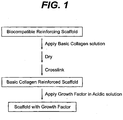
- FIG. 1 the process to prepare the reinforced collagen scaffolds is schematically shown. Briefly, a collagen solution having a pH of 8-12 is applied to the biocompatible reinforcing polymeric fibrous structure. The collagen solution is then dried, forming a collagen matrix within the polymeric fibrous structure. Optionally, the collagen matrix is then cross-linked. The result is a reinforced basic collagen scaffold. Finally, the protein-based growth factor that has been mixed into an acidic solution is impregnated into the reinforced collagen scaffold. The highly acid-soluble growth factor will precipitate onto the basic collagen matrix.
- the biocompatible reinforcing polymeric fibrous structure useful in the present invention may be in a variety of forms including, but not limited to, meshes, woven structures, non-woven structures, knitted structures, and three dimensional woven structures.
- the density and pore size distribution of the biocompatible reinforcing polymeric fibrous structure useful in the present invention is sufficient for the ingrowth of blood vessels and cells.
- Typical pore sizes range from about 75 to about 1,000 microns, with a preferable size range from about 100 to about 500 microns.
- the polymers may either be natural or synthetic, in the preferred embodiment, the biocompatible polymer is also biodegradable.
- Synthetic biodegradable biocompatible polymers are well known in the art. Such polymers are typically used to manufacture medical devices that are implanted in body tissue and absorb over time.
- suitable biocompatible, biodegradable polymers include polymers selected from the group consisting of aliphatic polyesters, poly(amino acids), copoly(ether-esters), polyalkylenes oxalates, polyamides, poly(iminocarbonates), polyorthoesters, polyoxaesters, polyamidoesters, polyoxaesters containing amine groups, poly(anhydrides), and blends thereof.
- Aliphatic polyesters include but are not limited to homopolymers and copolymers (random, block, segmented and graft) of monomers such as lactic acid, lactide(d, 1, meso and mixtures thereof), glycolic acid, glycolide, epsilon-caprolactone, trimethylene carbonate and p-dioxanone.
- Preferred polymers include copolymers of glycolic acid and lactic acid, such as those with a ratio of glycolic acid to lactic acid of 90/10 or 5/95.
- Naturally occurring biocompatible biodegradable polymers include, but are not limited to, glycoproteins, proteoglycans, polysaccharides, glycosamineoglycan (GAG) and fragment(s) derived from these components, elastin, laminins, decrorin, fibrinogen/fibrin, fibronectins, osteopontin, tenascins, hyaluronic acid, chondroitin sulfate, heparin, ORC, carboxymethyl cellulose, and chitin
- a basic pH collagen solution is applied to the biocompatible reinforcing polymeric fibrous structure. All types of collagens can be used.
- the basic pH collagen solution is formed by mixing collagen in a biocompatible basic buffer solution.
- Basic buffer solutions that could be used include phosphate, carbonate, BO 4 , and tris.
- the preferred base is a phosphate buffer.
- the concentration of buffer is below about 200 milliMolar because higher concentrations of base results in basic collagen matricies that have living tissue.
- the pH of the solution is in the range of 8 to 12, preferably from about 10 to about 11.5.
- the concentration of collagen in the base solution is in the range of about 0.01 milligrams/milliliter to about 50 milligrams/milliliter, preferably from about 1 milligrams/milliliter to about 10 milligrams/milliliter.
- the collagen solution is applied by any of a number of methods.
- Application methods include soaking, dip coating, and spray coating. Soaking will result in collagen solution penetrating deeply into, or even completely through, the biocompatible reinforcing polymeric fibrous structure. Dip coating and spray coating will result in collagen solution surface coating, or only partially penetrating into, the biocompatible reinforcing polymeric fibrous structure.
- the collagen scaffolds of this invention include those scaffolds where the collagen matrix has penetrated only a portion of the reinforcing polymeric fibrous structure.
- the collagen solution is then dried. Drying methods include, but are not limited to, vacuum drying (with or without heat), drying under heat, freeze-drying or lyophilization, and drying under an inert gas flow, such as a blanket of nitrogen.
- the preferred drying method is lyophilization, which will create a three dimensional collagen matrix with sufficient porosity and surface area for cell infiltration and growth.
- the collagen forms a matrix interspersed within the polymeric fibrous structure, yielding a reinforced basic collagen scaffold.
- the amount of collagen loaded onto the reinforcing polymeric fibers is between about 100 micrograms to about 50 milligrams per cubic centimeter of polymeric fibrous structure. The preferred range is between about 1 to about 10 milligrams per cubic centimeter of polymeric fibrous structure.
- the collagen matrix is cross-linked.
- Cross-linking of the collagen may be achieved in a number of different ways, including, but not limited to, chromium tanning, or use of a crosslinking agent, such as, but not limited to, formaldehyde, glutaraldehyde, hexamethylenediisocyanate, polyepoxy compounds, and carbodiimides.
- a crosslinking agent such as, but not limited to, formaldehyde, glutaraldehyde, hexamethylenediisocyanate, polyepoxy compounds, and carbodiimides.
- Additional crosslinking methods include acryl azide intermediate formation and physical treatments such as exposure to dry heat, ultraviolet radiation and/or gamma radiation.
- the preferred cross-linking technique is using formaldehyde vapor generated from a 5 to 40 percent formaldehyde solution at a temperature of 4 to 40°C for 5 minutes to 1 hour.
- a protein-based growth factor can be mixed into an acidic solution.
- the protein-based growth factor is highly soluble in acidic solutions, while marginally soluble at neutral or basic conditions.
- GDF5 is a protein that functions as a growth and differentiation factor. The protein may be found in its natural state in mammals. Naturally occurring human GDF5 may be modified, purified or otherwise treated to form human recombinant RH-GDF5, as further described herein and as those skilled in the art would understand. "Recombinant Human GDF5" will be referred to generically herein as RH-GDF5.
- Known HR-GDF5 proteins include BMP-14, CDMP-1 and MP52.
- the acidic solution of protein-based growth factor is formed by mixing the protein in a solution of water and a biocompatible acid.
- Acids that could be used include hydrochloric acid, acetic acid, sulfuric acid, phosphoric acid, and citric acid.
- the preferred acid is hydrochloric acid.
- the pH of the solution is in the range of about 2 to about 4, preferably from about 2.2 to about 3.5.
- the concentration of protein in the acid solution is in the range of about 0.001 milligrams/milliliter to about 20 milligrams/milliliter, preferably from about 0.01 milligrams/milliliter to about 1 milligrams/milliliter.
- the acidic solution of protein-based growth factor is impregnated into the reinforced basic collagen scaffold.
- the highly acid-soluble growth factor will precipitate onto the basic collagen.
- the result is a reinforced collagen scaffolds that are able to retain protein-based growth factors that are highly soluble in acidic solutions, while marginally soluble at neutral or basic conditions.
- GDF5 is precipitated onto the collagen surface as follows. GDF5 is dissolved in a 10 millimolar solution of Hydrochloric acid (HCl). GDF5 is highly soluble in this solution. However, GDF5 is relatively insoluble at neutral pH.
- the surface of the reinforced basic collagen scaffold possesses a basic pH with sufficient buffering capacity to neutralize the pH of the acidic GDF5 solution.
- the pH of the solution will approach neutral levels in the proximity of the solution/scaffold interface.
- the GDF5 will precipitate out of solution at this interface.
- the preferred range for the amount of protein on the scaffold is 0.01 to 3 micrograms per cubic centimeter of scaffold.
- the collagen scaffold of this invention is preferably completely biocompatible.
- the scaffold may be entirely bioabsorbable, partially bioabsorbable, or non-bioabsorbable.
- Example 1 Preparation of reinforced basic collagen scaffold.
- a dry lay non-woven needle punched reinforcing fibrous structure was made of poly(lactide-co-glycolide) (PLA/PGA) fibers.
- the fibers formed of a copolymer of lactide and gycolide with lactide to glycolide weight ratio of 10:90 (or 10:90 PLA/PGA) are sold under the tradename VICRYL sutures (Ethicon, Inc., Somerville, NJ).
- the non-woven reinforcing structure had a nominal density of 108 milligrams per cubic centimeter, and a thickness of 2.14 millimeters. The non-woven was cut to final dimensions of about 10 centimeters X 10 centimeters.
- Soluble type I collagen (Kensey Nash Corporation, Exton, PA) was dissolved in 10 milliMolar sodium phosphate solution (pH 10.6) at a concentration of 5 milligrams/milliliter.
- the non-woven reinforcement was placed in a TEFLON-coated mold and completely soaked with the basic collagen solution.
- the basic collagen solution soaked non-woven structure was then lyophilized in a Durastop ⁇ P freeze-drier (FTS Systems, Stone Ridge, NY] at -25°C, 100 millitorr vacuum for 1000 minutes.
- the result was a reinforced basic collagen scaffold, where the amount of type 1 collagen loaded onto the reinforcing PLA/PGA fibers is 5 micrograms per cubic centimeter of polymeric fibrous structure.
- the collagen was stabilized by crosslinking in a closed desiccator using formaldehyde vapor generated from a 37 percent formaldehyde solution for 1 hour. Residual formaldehyde was removed by placing the scaffold in a vacuum oven set at room temperature overnight. A section of the reinforced basic collagen scaffold was examined by a scanning electron microscope, and a micrograph of a cross-section of the scaffold is shown in Figure 2 . In this micrograph, the collagen matrix 14 is interspersed between the individual fibers 12 of the reinforced basic collagen scaffold 10.
- Example 2 Retention of GDF5 in the reinforced basic collagen scaffolds.
- Reinforced basic collagen scaffold formed as in Example 1, was cut into 10-millimeter diameter discs.
- a second dry lay non-woven needle punched reinforcing structure was made of 10:90 PLA/PGA fibers. This structure, however, was not soaked in basic collagen solution. This structure was also cut into 10-millimeter diameter discs.
- RH-GDF5 in the collected solution was detected by RP-HPLC using a Waters HPLC system (Waters Inc, Milford, MA).
- the running condition for the HPLC was: Column: Vydex C18; Mobile Phase A: 0.15 percent trifluoroacetic acid (TFA) in water; Mobile Phase B: 0.15 percent TFA in acetonitrile; Flow-rate: 1 milliliter/minute; Detection wavelength: 214 nanometers.
- Example 3 Cell attachment on reinforced basic collagen scaffolds.
- Reinforced basic collagen scaffold formed as in Example 1, were cut into 4-millimeter diameter discs. Scaffolds were washed with phosphate buffered saline (PBS) 3 times and air-dried for 1 hour.
- PBS phosphate buffered saline
- Bovine chondrocytes were isolated from young bovine shoulder. Bovine cartilage was digested overnight with collagenase (Worthington Biochemical Corporation, Lakewood, NJ) in Dulbecco's modified Eagle's medium (Invitrogen, Carlsbad, CA). Bovine chondrocytes were seeded statically on each disc with a seeding density of about 1 x 10 6 cells/scaffold.
- the scaffolds were cultured for 24 hours, 1 week, and 2 weeks periods. At each time period, the scaffolds were evaluated by DNA assay (CyQUANT Cell Proliferation Assay Kit; Molecular Probes, Eugene, OR) for cell number determination and by measuring the glycosamineoglycan (GAG) in the tissue. DNA content is directly translatable into the number of cells in each well, while GAG indicates matrix formation.
- DNA assay CyQUANT Cell Proliferation Assay Kit
- GAG glycosamineoglycan
- Table 1 shows the number of cells (in 10 6 cells/scaffold), while Table 2 shows GAG content (in micrograms/scaffold) for all the scaffolds tested.
- Table 1 Number of cells (X 10 -6 ) per scaffold Scaffold 1 Day 1 Week 2 Weeks Control (w/1% FBS) 1.0 ⁇ 0.1 1.3 ⁇ 0.2 2.1 ⁇ 0.1 Control (w/10% FBS) 1.1 ⁇ 0.1 1.3 ⁇ 0.1 1.9 ⁇ 0.3 GDF5 loaded (w/1% FBS) 1.3 ⁇ 0.1 2.4 ⁇ 0.1 4.8 ⁇ 0.2 GDF5 loaded (w/10% FBS) 0.9 ⁇ 0.1 2.0 ⁇ 0.1 3.8 ⁇ 0.1
- Table 2 GAG content (micrograms) per scaffold Scaffold 1 Day 1 Week 2 Weeks Control (w/1% FBS) 6.6 ⁇ 0.27 254 ⁇ 80 398 ⁇ 11 Control (w/10% FBS) 12.4 ⁇ 0.1 192 ⁇ 13 325 ⁇ 69 GDF5 loaded (w/1%FBS) 10.3 ⁇ 0.3 414 ⁇ 21 1939 ⁇ 42 GDF5 loaded (w/10% FBS) 1
Landscapes
- Health & Medical Sciences (AREA)
- Life Sciences & Earth Sciences (AREA)
- Chemical & Material Sciences (AREA)
- Engineering & Computer Science (AREA)
- Veterinary Medicine (AREA)
- Public Health (AREA)
- Medicinal Chemistry (AREA)
- General Health & Medical Sciences (AREA)
- Animal Behavior & Ethology (AREA)
- Epidemiology (AREA)
- Dermatology (AREA)
- Transplantation (AREA)
- Oral & Maxillofacial Surgery (AREA)
- Materials Engineering (AREA)
- Composite Materials (AREA)
- Zoology (AREA)
- Gastroenterology & Hepatology (AREA)
- Bioinformatics & Cheminformatics (AREA)
- Immunology (AREA)
- Pharmacology & Pharmacy (AREA)
- Proteomics, Peptides & Aminoacids (AREA)
- Materials For Medical Uses (AREA)
- Prostheses (AREA)
Claims (14)
- Verfahren zur Herstellung eines Kollagengerüstes, das die Schritte umfasst: i) Aufbringen einer Kollagenlösung mit basischem pH, die einen pH von 8 bis 12 besitzt, auf eine verstärkende polymere Faserstruktur und ii) Trocknen der Lösung, um eine Kollagenmatrix zu bilden, die in der verstärkenden polymeren Faserstruktur eingefügt ist.
- Verfahren zur Herstellung des Gerüstes nach Anspruch 1, wobei die Kollagenmatrix vernetzt ist.
- Kollagengerüst, das eine Kollagenmatrix mit einem basischem pH umfasst, wobei die Kollagenmatrix in einer verstärkenden polymeren Faserstruktur eingefügt ist, erhältlich durch das Verfahren nach Anspruch 1.
- Gerüst nach Anspruch 3, wobei die verstärkende polymere Faserstruktur in der Form eines Netzes, einer gewebten Struktur, einer nicht-gewebten Struktur, einer gewirkten Struktur, einer dreidimensionalen gewebten Struktur oder irgendeiner Kombination von diesen vorliegt.
- Gerüst nach Anspruch 4, wobei die verstärkende polymere Faserstruktur aus einem Polymer besteht, das biologisch abbaubar ist.
- Gerüst nach Anspruch 5, wobei das biologisch abbaubare Polymer ein aliphatischer Polyester ist.
- Gerüst nach Anspruch 6, wobei der aliphatische Polyester ein Homopolymer oder Copolymer von einem Monomer ist, das ausgewählt ist aus der Gruppe aus Milchsäure, d-Lactid, l-Lactid, meso-Lactid, Glykolsäure, Glykosid, epsilon-Caprolacton, Trimethylencarbonat und p-Dioxanon.
- Gerüst nach Anspruch 3, wobei die Kollagenmatrix aus einem Kollagen Typ I besteht.
- Gerüst nach Anspruch 8, wobei die Kollagenmatrix vernetzt ist.
- Gerüst nach Anspruch 3, wobei die Menge der Kollagenmatrix, die auf die verstärkende polymere Faserstruktur geladen ist, zwischen etwa 100 Mikrogramm bis etwa 50 Milligramm pro Kubikzentimeter der polymeren Faserstruktur beträgt.
- Gerüst nach Anspruch 3, wobei die Menge der Kollagenmatrix, die auf die verstärkende polymere Faserstruktur geladen ist, zwischen etwa 1 bis etwa 10 Milligramm pro Kubikzentimeter der polymeren Faserstruktur beträgt.
- Gerüst nach Anspruch 3, wobei das Gerüst weiter einen Wachstumsfaktor auf Proteinbasis umfasst, der in einer sauren Lösung löslich ist.
- Gerüst nach Anspruch 12, wobei die Menge des Wachstumsfaktors auf Proteinbasis im Kollagengerüst zwischen etwa 0,01 bis etwa 3 Mikrogramm pro Kubikzentimeter Gerüst beträgt.
- Gerüst nach Anspruch 13, wobei der Wachstumsfaktor auf Proteinbasis GDF5 ist.
Applications Claiming Priority (2)
| Application Number | Priority Date | Filing Date | Title |
|---|---|---|---|
| US11/156,092 US20060286144A1 (en) | 2005-06-17 | 2005-06-17 | Reinforced collagen scaffold |
| PCT/US2006/021753 WO2006138098A1 (en) | 2005-06-17 | 2006-06-05 | Reinforced collagen scaffold |
Publications (4)
| Publication Number | Publication Date |
|---|---|
| EP1896056A1 EP1896056A1 (de) | 2008-03-12 |
| EP1896056A4 EP1896056A4 (de) | 2009-04-08 |
| EP1896056B1 EP1896056B1 (de) | 2010-11-03 |
| EP1896056B2 true EP1896056B2 (de) | 2018-05-30 |
Family
ID=37570758
Family Applications (1)
| Application Number | Title | Priority Date | Filing Date |
|---|---|---|---|
| EP06784588.3A Not-in-force EP1896056B2 (de) | 2005-06-17 | 2006-06-05 | Verstärkte kollagenmatrix |
Country Status (4)
| Country | Link |
|---|---|
| US (1) | US20060286144A1 (de) |
| EP (1) | EP1896056B2 (de) |
| DE (1) | DE602006018007D1 (de) |
| WO (1) | WO2006138098A1 (de) |
Families Citing this family (33)
| Publication number | Priority date | Publication date | Assignee | Title |
|---|---|---|---|---|
| US20040151705A1 (en) | 2002-03-22 | 2004-08-05 | Shuichi Mizuno | Neo-cartilage constructs and a method for preparation thereof |
| US20040054414A1 (en) | 2002-09-18 | 2004-03-18 | Trieu Hai H. | Collagen-based materials and methods for augmenting intervertebral discs |
| US7744651B2 (en) | 2002-09-18 | 2010-06-29 | Warsaw Orthopedic, Inc | Compositions and methods for treating intervertebral discs with collagen-based materials |
| CN100394989C (zh) | 2002-11-15 | 2008-06-18 | 华沙整形外科股份有限公司 | 包含微粒状基于胶原材料的组合物的制药应用和包含所述组合物的滑膜关节 |
| CA2623106C (en) | 2005-09-19 | 2013-12-24 | Histogenics Corporation | Cell-support matrix having narrowly defined uniformly vertically and non-randomly organized porosity and pore density and a method for preparation thereof |
| US8118779B2 (en) | 2006-06-30 | 2012-02-21 | Warsaw Orthopedic, Inc. | Collagen delivery device |
| US8399619B2 (en) * | 2006-06-30 | 2013-03-19 | Warsaw Orthopedic, Inc. | Injectable collagen material |
| US9056151B2 (en) | 2007-02-12 | 2015-06-16 | Warsaw Orthopedic, Inc. | Methods for collagen processing and products using processed collagen |
| US20090004455A1 (en) * | 2007-06-27 | 2009-01-01 | Philippe Gravagna | Reinforced composite implant |
| US8932619B2 (en) * | 2007-06-27 | 2015-01-13 | Sofradim Production | Dural repair material |
| US20090054984A1 (en) | 2007-08-20 | 2009-02-26 | Histogenics Corporation | Method For Use Of A Double-Structured Tissue Implant For Treatment Of Tissue Defects |
| US8685107B2 (en) | 2007-07-03 | 2014-04-01 | Histogenics Corporation | Double-structured tissue implant and a method for preparation and use thereof |
| US9421304B2 (en) * | 2007-07-03 | 2016-08-23 | Histogenics Corporation | Method for improvement of differentiation of mesenchymal stem cells using a double-structured tissue implant |
| US20230277291A1 (en) * | 2007-07-06 | 2023-09-07 | Ocugen, Inc. | Method for use of a double-structured tissue implant for treatment of tissue defects |
| US8834578B2 (en) * | 2007-07-30 | 2014-09-16 | Sofradim Production | Bioresorbable implant |
| US8198087B2 (en) * | 2007-07-30 | 2012-06-12 | Sofradim Production Sas | Tissue engineering support |
| US20130116799A1 (en) | 2008-03-27 | 2013-05-09 | The Cleveland Clinic Foundation | Reinforced tissue graft |
| WO2009120966A2 (en) | 2008-03-27 | 2009-10-01 | The Cleveland Clinic Foundation | Reinforced tissue graft |
| US8790699B2 (en) | 2010-04-23 | 2014-07-29 | Warsaw Orthpedic, Inc. | Foam-formed collagen strand |
| US8460691B2 (en) | 2010-04-23 | 2013-06-11 | Warsaw Orthopedic, Inc. | Fenestrated wound repair scaffold |
| WO2012122044A2 (en) | 2011-03-04 | 2012-09-13 | Orthovita, Inc. | Flowable collagen-based hemostat and methods of use |
| CN103284814B (zh) * | 2013-06-04 | 2015-07-22 | 浙江大学 | 一种取向通道胶原支架制备方法及专用装置 |
| US9539363B2 (en) | 2014-04-24 | 2017-01-10 | Warsaw Orthopedic, Inc. | Collagen matrix |
| US10077420B2 (en) | 2014-12-02 | 2018-09-18 | Histogenics Corporation | Cell and tissue culture container |
| WO2016179089A1 (en) | 2015-05-01 | 2016-11-10 | Rensselaer Polytechnic Institute | Biomimetic nano-composite scaffold for enhanced bone healing and fracture repair |
| AU2016344019B2 (en) | 2015-10-30 | 2021-07-15 | New York Society For The Relief Of The Ruptured And Crippled, Maintaining The Hospital For Special Surgery | Suture sleeve patch and methods of delivery within an existing arthroscopic workflow |
| WO2017087676A1 (en) * | 2015-11-19 | 2017-05-26 | Tepha, Inc. | Methods to produce perforated collagen coated surgical meshes |
| US11357495B2 (en) | 2016-02-01 | 2022-06-14 | Medos International Sarl | Tissue augmentation scaffolds for use with soft tissue fixation repair systems and methods |
| US20170273680A1 (en) | 2016-02-01 | 2017-09-28 | DePuy Synthes Products, Inc. | Tissue augmentation tacks for use with soft tissue fixation repair systems and methods |
| US11484401B2 (en) | 2016-02-01 | 2022-11-01 | Medos International Sarl | Tissue augmentation scaffolds for use in soft tissue fixation repair |
| US20200197559A1 (en) * | 2017-08-24 | 2020-06-25 | Kci Usa, Inc. | Biomaterial and methods of making and using said biomaterial |
| CN114269262A (zh) * | 2019-08-19 | 2022-04-01 | 苏黎世医疗科技股份有限公司 | 可植入悬挂装置、组装装置和用于组装可植入悬挂装置的方法 |
| CN114808273A (zh) * | 2022-04-14 | 2022-07-29 | 深圳全棉时代科技有限公司 | Pla混棉水刺填充物及其生产工艺 |
Family Cites Families (9)
| Publication number | Priority date | Publication date | Assignee | Title |
|---|---|---|---|---|
| US3157524A (en) * | 1960-10-25 | 1964-11-17 | Ethicon Inc | Preparation of collagen sponge |
| US4066083A (en) * | 1976-06-03 | 1978-01-03 | Pentapharm A.G. | Sterile surgical collagen product |
| US6311690B1 (en) * | 1986-03-27 | 2001-11-06 | Gensci Orthobiologics, Inc. | Bone repair material and delayed drug delivery system |
| US7235527B2 (en) * | 1995-04-19 | 2007-06-26 | Biopharm Gesellschaft Zur Biotechnologieschen Entwicklung Von Pharmaka Mbh | Protein and process for producing the same |
| US5866165A (en) * | 1997-01-15 | 1999-02-02 | Orquest, Inc. | Collagen-polysaccharide matrix for bone and cartilage repair |
| US6179872B1 (en) * | 1998-03-17 | 2001-01-30 | Tissue Engineering | Biopolymer matt for use in tissue repair and reconstruction |
| JP2002527402A (ja) * | 1998-10-14 | 2002-08-27 | オークエスト インコーポレイテッド | Gdf−5を含む細胞外マトリックスで軟骨形成を誘発又は増強する方法。 |
| ES2272452T3 (es) * | 2000-03-09 | 2007-05-01 | Zimmer Orthobiologics, Inc. | Producto de anclaje biologico de tejido conectivo al hueso. |
| US6309454B1 (en) * | 2000-05-12 | 2001-10-30 | Johnson & Johnson Medical Limited | Freeze-dried composite materials and processes for the production thereof |
-
2005
- 2005-06-17 US US11/156,092 patent/US20060286144A1/en not_active Abandoned
-
2006
- 2006-06-05 DE DE602006018007T patent/DE602006018007D1/de active Active
- 2006-06-05 WO PCT/US2006/021753 patent/WO2006138098A1/en not_active Ceased
- 2006-06-05 EP EP06784588.3A patent/EP1896056B2/de not_active Not-in-force
Also Published As
| Publication number | Publication date |
|---|---|
| DE602006018007D1 (de) | 2010-12-16 |
| EP1896056A1 (de) | 2008-03-12 |
| US20060286144A1 (en) | 2006-12-21 |
| EP1896056B1 (de) | 2010-11-03 |
| WO2006138098A1 (en) | 2006-12-28 |
| EP1896056A4 (de) | 2009-04-08 |
Similar Documents
| Publication | Publication Date | Title |
|---|---|---|
| EP1896056B1 (de) | Verstärkte kollagenmatrix | |
| JP4522686B2 (ja) | 組織フラグメントを伴う生体相容性の支持骨格装置 | |
| Jiang et al. | Chitosan–poly (lactide-co-glycolide) microsphere-based scaffolds for bone tissue engineering: In vitro degradation and in vivo bone regeneration studies | |
| CN101945675B (zh) | 带涂层的组织工程支架 | |
| JP4623954B2 (ja) | 靭帯または腱の修復用の生体相容性の支持骨格装置 | |
| US8535719B2 (en) | Biohybrid elastomeric scaffolds and methods of use thereof | |
| US9687590B2 (en) | Double-structured tissue implant and a method for preparation and use thereof | |
| US20060233887A1 (en) | Bioactive material for use in stimulating vascularization | |
| WO1996010426A1 (fr) | Greffon osteoplastique | |
| US20110300203A1 (en) | Cartilage regeneration without cell transplantation | |
| Pok et al. | Biomaterials advances in patches for congenital heart defect repair | |
| EP0742020A2 (de) | Prothese enthaltend ohne chemische Reagenzien insolubilisiertes bioresorbierbares Material und Verfahren zu seiner Herstellung | |
| US11622892B2 (en) | Methods of making bioactive collagen wound care dressings | |
| US20090280154A1 (en) | Biodegradable Scaffold with ECM Material | |
| WO2009106642A1 (en) | Biosynthetic cartilaginous matrix and methods for their production | |
| Badylak et al. | The extracellular matrix as a biologic scaffold for tissue engineering | |
| US20130096610A1 (en) | Biopolymer microthreads with microscale surface topographies | |
| Santos Jr | Bioresorbable polymers for tissue engineering | |
| EP3934707B1 (de) | Biologisch abbaubares netzimplantat zur weichgewebereparatur, insbesondere zur hernienreparatur | |
| JP5839814B2 (ja) | Danceタンパク質含有徐放基材及び該徐放基材の製造方法 | |
| JP2005213449A (ja) | ゼラチンスポンジ | |
| JP2005211477A (ja) | 再生医療用支持体 | |
| Lin et al. | Surface modification of poly (ε‐caprolactone) porous scaffolds using gelatin hydrogel as the tracheal replacement | |
| CN101411878A (zh) | 一种在生物降解性材料上锚定生长因子的方法 | |
| KR100482651B1 (ko) | 조직공학용 천연/합성 하이브리드 담체 및 이의 제조방법 |
Legal Events
| Date | Code | Title | Description |
|---|---|---|---|
| PUAI | Public reference made under article 153(3) epc to a published international application that has entered the european phase |
Free format text: ORIGINAL CODE: 0009012 |
|
| 17P | Request for examination filed |
Effective date: 20071205 |
|
| AK | Designated contracting states |
Kind code of ref document: A1 Designated state(s): DE FR GB IE IT |
|
| DAX | Request for extension of the european patent (deleted) | ||
| RBV | Designated contracting states (corrected) |
Designated state(s): DE FR GB IE IT |
|
| DAX | Request for extension of the european patent (deleted) | ||
| RBV | Designated contracting states (corrected) |
Designated state(s): DE FR GB IE IT |
|
| A4 | Supplementary search report drawn up and despatched |
Effective date: 20090310 |
|
| GRAP | Despatch of communication of intention to grant a patent |
Free format text: ORIGINAL CODE: EPIDOSNIGR1 |
|
| GRAS | Grant fee paid |
Free format text: ORIGINAL CODE: EPIDOSNIGR3 |
|
| GRAA | (expected) grant |
Free format text: ORIGINAL CODE: 0009210 |
|
| AK | Designated contracting states |
Kind code of ref document: B1 Designated state(s): DE FR GB IE IT |
|
| REG | Reference to a national code |
Ref country code: GB Ref legal event code: FG4D |
|
| REG | Reference to a national code |
Ref country code: IE Ref legal event code: FG4D |
|
| REF | Corresponds to: |
Ref document number: 602006018007 Country of ref document: DE Date of ref document: 20101216 Kind code of ref document: P |
|
| PLBI | Opposition filed |
Free format text: ORIGINAL CODE: 0009260 |
|
| PLAF | Information modified related to communication of a notice of opposition and request to file observations + time limit |
Free format text: ORIGINAL CODE: EPIDOSCOBS2 |
|
| PLAX | Notice of opposition and request to file observation + time limit sent |
Free format text: ORIGINAL CODE: EPIDOSNOBS2 |
|
| 26 | Opposition filed |
Opponent name: COVIDIEN Effective date: 20110802 |
|
| REG | Reference to a national code |
Ref country code: DE Ref legal event code: R026 Ref document number: 602006018007 Country of ref document: DE Effective date: 20110802 |
|
| PLAF | Information modified related to communication of a notice of opposition and request to file observations + time limit |
Free format text: ORIGINAL CODE: EPIDOSCOBS2 |
|
| PG25 | Lapsed in a contracting state [announced via postgrant information from national office to epo] |
Ref country code: IT Free format text: LAPSE BECAUSE OF NON-PAYMENT OF DUE FEES Effective date: 20110605 |
|
| REG | Reference to a national code |
Ref country code: FR Ref legal event code: ST Effective date: 20120229 |
|
| PLBB | Reply of patent proprietor to notice(s) of opposition received |
Free format text: ORIGINAL CODE: EPIDOSNOBS3 |
|
| REG | Reference to a national code |
Ref country code: IE Ref legal event code: MM4A |
|
| REG | Reference to a national code |
Ref country code: DE Ref legal event code: R119 Ref document number: 602006018007 Country of ref document: DE Effective date: 20120103 |
|
| PG25 | Lapsed in a contracting state [announced via postgrant information from national office to epo] |
Ref country code: FR Free format text: LAPSE BECAUSE OF NON-PAYMENT OF DUE FEES Effective date: 20110630 Ref country code: DE Free format text: LAPSE BECAUSE OF NON-PAYMENT OF DUE FEES Effective date: 20120103 Ref country code: IE Free format text: LAPSE BECAUSE OF NON-PAYMENT OF DUE FEES Effective date: 20110605 |
|
| REG | Reference to a national code |
Ref country code: DE Ref legal event code: R073 Ref document number: 602006018007 Country of ref document: DE |
|
| REG | Reference to a national code |
Ref country code: DE Ref legal event code: R073 Ref document number: 602006018007 Country of ref document: DE |
|
| REG | Reference to a national code |
Ref country code: DE Ref legal event code: R074 Ref document number: 602006018007 Country of ref document: DE |
|
| PGRI | Patent reinstated in contracting state [announced from national office to epo] |
Ref country code: DE Effective date: 20120627 |
|
| REG | Reference to a national code |
Ref country code: DE Ref legal event code: R074 Ref document number: 602006018007 Country of ref document: DE Effective date: 20120630 |
|
| PGRI | Patent reinstated in contracting state [announced from national office to epo] |
Ref country code: IT Effective date: 20120630 |
|
| PGRI | Patent reinstated in contracting state [announced from national office to epo] |
Ref country code: FR Effective date: 20120829 |
|
| PLCK | Communication despatched that opposition was rejected |
Free format text: ORIGINAL CODE: EPIDOSNREJ1 |
|
| APBM | Appeal reference recorded |
Free format text: ORIGINAL CODE: EPIDOSNREFNO |
|
| APBP | Date of receipt of notice of appeal recorded |
Free format text: ORIGINAL CODE: EPIDOSNNOA2O |
|
| APAH | Appeal reference modified |
Free format text: ORIGINAL CODE: EPIDOSCREFNO |
|
| APBQ | Date of receipt of statement of grounds of appeal recorded |
Free format text: ORIGINAL CODE: EPIDOSNNOA3O |
|
| APAH | Appeal reference modified |
Free format text: ORIGINAL CODE: EPIDOSCREFNO |
|
| REG | Reference to a national code |
Ref country code: FR Ref legal event code: PLFP Year of fee payment: 11 |
|
| APBU | Appeal procedure closed |
Free format text: ORIGINAL CODE: EPIDOSNNOA9O |
|
| PLAY | Examination report in opposition despatched + time limit |
Free format text: ORIGINAL CODE: EPIDOSNORE2 |
|
| PLBC | Reply to examination report in opposition received |
Free format text: ORIGINAL CODE: EPIDOSNORE3 |
|
| PLAY | Examination report in opposition despatched + time limit |
Free format text: ORIGINAL CODE: EPIDOSNORE2 |
|
| REG | Reference to a national code |
Ref country code: FR Ref legal event code: PLFP Year of fee payment: 12 |
|
| PUAH | Patent maintained in amended form |
Free format text: ORIGINAL CODE: 0009272 |
|
| STAA | Information on the status of an ep patent application or granted ep patent |
Free format text: STATUS: PATENT MAINTAINED AS AMENDED |
|
| REG | Reference to a national code |
Ref country code: FR Ref legal event code: PLFP Year of fee payment: 13 |
|
| 27A | Patent maintained in amended form |
Effective date: 20180530 |
|
| AK | Designated contracting states |
Kind code of ref document: B2 Designated state(s): DE FR GB IE IT |
|
| REG | Reference to a national code |
Ref country code: DE Ref legal event code: R102 Ref document number: 602006018007 Country of ref document: DE |
|
| PGFP | Annual fee paid to national office [announced via postgrant information from national office to epo] |
Ref country code: FR Payment date: 20200512 Year of fee payment: 15 Ref country code: DE Payment date: 20200527 Year of fee payment: 15 |
|
| PGFP | Annual fee paid to national office [announced via postgrant information from national office to epo] |
Ref country code: GB Payment date: 20200527 Year of fee payment: 15 Ref country code: IT Payment date: 20200512 Year of fee payment: 15 |
|
| REG | Reference to a national code |
Ref country code: DE Ref legal event code: R119 Ref document number: 602006018007 Country of ref document: DE |
|
| GBPC | Gb: european patent ceased through non-payment of renewal fee |
Effective date: 20210605 |
|
| PG25 | Lapsed in a contracting state [announced via postgrant information from national office to epo] |
Ref country code: GB Free format text: LAPSE BECAUSE OF NON-PAYMENT OF DUE FEES Effective date: 20210605 Ref country code: DE Free format text: LAPSE BECAUSE OF NON-PAYMENT OF DUE FEES Effective date: 20220101 |
|
| PG25 | Lapsed in a contracting state [announced via postgrant information from national office to epo] |
Ref country code: FR Free format text: LAPSE BECAUSE OF NON-PAYMENT OF DUE FEES Effective date: 20210630 |
|
| PG25 | Lapsed in a contracting state [announced via postgrant information from national office to epo] |
Ref country code: IT Free format text: LAPSE BECAUSE OF NON-PAYMENT OF DUE FEES Effective date: 20210630 |