EP1897535A1 - Liquide substitue pour haemoflitration - Google Patents
Liquide substitue pour haemoflitration Download PDFInfo
- Publication number
- EP1897535A1 EP1897535A1 EP06076644A EP06076644A EP1897535A1 EP 1897535 A1 EP1897535 A1 EP 1897535A1 EP 06076644 A EP06076644 A EP 06076644A EP 06076644 A EP06076644 A EP 06076644A EP 1897535 A1 EP1897535 A1 EP 1897535A1
- Authority
- EP
- European Patent Office
- Prior art keywords
- blood
- mmol
- fluid
- haemofiltration
- citrate
- Prior art date
- Legal status (The legal status is an assumption and is not a legal conclusion. Google has not performed a legal analysis and makes no representation as to the accuracy of the status listed.)
- Withdrawn
Links
- 239000012530 fluid Substances 0.000 title claims abstract description 44
- 238000006467 substitution reaction Methods 0.000 title claims abstract description 35
- 238000002615 hemofiltration Methods 0.000 title claims abstract description 30
- 239000008280 blood Substances 0.000 claims abstract description 56
- 210000004369 blood Anatomy 0.000 claims abstract description 56
- KRKNYBCHXYNGOX-UHFFFAOYSA-K Citrate Chemical compound [O-]C(=O)CC(O)(CC([O-])=O)C([O-])=O KRKNYBCHXYNGOX-UHFFFAOYSA-K 0.000 claims abstract description 37
- 239000003978 infusion fluid Substances 0.000 claims abstract description 20
- 238000000034 method Methods 0.000 claims abstract description 19
- 238000001914 filtration Methods 0.000 claims abstract description 14
- BHPQYMZQTOCNFJ-UHFFFAOYSA-N Calcium cation Chemical compound [Ca+2] BHPQYMZQTOCNFJ-UHFFFAOYSA-N 0.000 claims description 11
- 229910001424 calcium ion Inorganic materials 0.000 claims description 10
- 238000011282 treatment Methods 0.000 claims description 9
- VEXZGXHMUGYJMC-UHFFFAOYSA-M Chloride anion Chemical compound [Cl-] VEXZGXHMUGYJMC-UHFFFAOYSA-M 0.000 claims description 6
- 239000003792 electrolyte Substances 0.000 claims description 6
- WQZGKKKJIJFFOK-GASJEMHNSA-N Glucose Natural products OC[C@H]1OC(O)[C@H](O)[C@@H](O)[C@@H]1O WQZGKKKJIJFFOK-GASJEMHNSA-N 0.000 claims description 5
- 239000008103 glucose Substances 0.000 claims description 5
- 238000004519 manufacturing process Methods 0.000 claims description 5
- 229910001415 sodium ion Inorganic materials 0.000 claims description 5
- 208000009304 Acute Kidney Injury Diseases 0.000 claims description 4
- 208000032843 Hemorrhage Diseases 0.000 claims description 4
- DGAQECJNVWCQMB-PUAWFVPOSA-M Ilexoside XXIX Chemical compound C[C@@H]1CC[C@@]2(CC[C@@]3(C(=CC[C@H]4[C@]3(CC[C@@H]5[C@@]4(CC[C@@H](C5(C)C)OS(=O)(=O)[O-])C)C)[C@@H]2[C@]1(C)O)C)C(=O)O[C@H]6[C@@H]([C@H]([C@@H]([C@H](O6)CO)O)O)O.[Na+] DGAQECJNVWCQMB-PUAWFVPOSA-M 0.000 claims description 4
- FYYHWMGAXLPEAU-UHFFFAOYSA-N Magnesium Chemical compound [Mg] FYYHWMGAXLPEAU-UHFFFAOYSA-N 0.000 claims description 4
- ZLMJMSJWJFRBEC-UHFFFAOYSA-N Potassium Chemical compound [K] ZLMJMSJWJFRBEC-UHFFFAOYSA-N 0.000 claims description 4
- 208000033626 Renal failure acute Diseases 0.000 claims description 4
- 201000011040 acute kidney failure Diseases 0.000 claims description 4
- 208000012998 acute renal failure Diseases 0.000 claims description 4
- 208000034158 bleeding Diseases 0.000 claims description 4
- 230000000740 bleeding effect Effects 0.000 claims description 4
- 239000011777 magnesium Substances 0.000 claims description 4
- 229910052749 magnesium Inorganic materials 0.000 claims description 4
- 239000011591 potassium Substances 0.000 claims description 4
- 229910052700 potassium Inorganic materials 0.000 claims description 4
- 239000011734 sodium Substances 0.000 claims description 4
- 229910052708 sodium Inorganic materials 0.000 claims description 4
- JLVVSXFLKOJNIY-UHFFFAOYSA-N Magnesium ion Chemical compound [Mg+2] JLVVSXFLKOJNIY-UHFFFAOYSA-N 0.000 claims description 3
- 208000034486 Multi-organ failure Diseases 0.000 claims description 3
- 230000004064 dysfunction Effects 0.000 claims description 3
- 229910001425 magnesium ion Inorganic materials 0.000 claims description 3
- 208000029744 multiple organ dysfunction syndrome Diseases 0.000 claims description 3
- 229910001414 potassium ion Inorganic materials 0.000 claims description 3
- 230000008085 renal dysfunction Effects 0.000 claims description 3
- 206010040047 Sepsis Diseases 0.000 claims description 2
- 230000001684 chronic effect Effects 0.000 claims description 2
- 230000015271 coagulation Effects 0.000 claims description 2
- 238000005345 coagulation Methods 0.000 claims description 2
- 238000007865 diluting Methods 0.000 claims description 2
- 210000000056 organ Anatomy 0.000 claims description 2
- 239000003814 drug Substances 0.000 claims 2
- 238000000338 in vitro Methods 0.000 claims 1
- OYPRJOBELJOOCE-UHFFFAOYSA-N Calcium Chemical compound [Ca] OYPRJOBELJOOCE-UHFFFAOYSA-N 0.000 description 27
- 229960005069 calcium Drugs 0.000 description 27
- 239000011575 calcium Substances 0.000 description 27
- 229910052791 calcium Inorganic materials 0.000 description 27
- 239000003146 anticoagulant agent Substances 0.000 description 10
- 229940127219 anticoagulant drug Drugs 0.000 description 10
- 230000009885 systemic effect Effects 0.000 description 9
- KRKNYBCHXYNGOX-UHFFFAOYSA-N citric acid Chemical compound OC(=O)CC(O)(C(O)=O)CC(O)=O KRKNYBCHXYNGOX-UHFFFAOYSA-N 0.000 description 6
- 239000012528 membrane Substances 0.000 description 6
- 239000000243 solution Substances 0.000 description 6
- 239000000706 filtrate Substances 0.000 description 5
- 101710205660 Calcium-transporting ATPase Proteins 0.000 description 4
- 101710134161 Calcium-transporting ATPase sarcoplasmic/endoplasmic reticulum type Proteins 0.000 description 4
- 230000010100 anticoagulation Effects 0.000 description 4
- 210000003462 vein Anatomy 0.000 description 4
- 208000013038 Hypocalcemia Diseases 0.000 description 3
- 229960002283 calcium glubionate Drugs 0.000 description 3
- YPCRNBPOUVJVMU-LCGAVOCYSA-L calcium glubionate Chemical compound [Ca+2].OC[C@@H](O)[C@@H](O)[C@H](O)[C@@H](O)C([O-])=O.[O-]C(=O)[C@H](O)[C@@H](O)[C@@H]([C@H](O)CO)O[C@@H]1O[C@H](CO)[C@H](O)[C@H](O)[C@H]1O YPCRNBPOUVJVMU-LCGAVOCYSA-L 0.000 description 3
- 150000001860 citric acid derivatives Chemical class 0.000 description 3
- 238000010790 dilution Methods 0.000 description 3
- 239000012895 dilution Substances 0.000 description 3
- 230000000705 hypocalcaemia Effects 0.000 description 3
- 150000002500 ions Chemical class 0.000 description 3
- 239000002904 solvent Substances 0.000 description 3
- 208000028399 Critical Illness Diseases 0.000 description 2
- 241000124008 Mammalia Species 0.000 description 2
- 230000017531 blood circulation Effects 0.000 description 2
- 210000004204 blood vessel Anatomy 0.000 description 2
- -1 citrate ester Chemical class 0.000 description 2
- 210000003191 femoral vein Anatomy 0.000 description 2
- 238000001631 haemodialysis Methods 0.000 description 2
- 230000028993 immune response Effects 0.000 description 2
- 238000001802 infusion Methods 0.000 description 2
- 238000001990 intravenous administration Methods 0.000 description 2
- 210000004731 jugular vein Anatomy 0.000 description 2
- 210000003734 kidney Anatomy 0.000 description 2
- 238000011045 prefiltration Methods 0.000 description 2
- 210000001321 subclavian vein Anatomy 0.000 description 2
- 239000000126 substance Substances 0.000 description 2
- 241001489705 Aquarius Species 0.000 description 1
- BVKZGUZCCUSVTD-UHFFFAOYSA-M Bicarbonate Chemical compound OC([O-])=O BVKZGUZCCUSVTD-UHFFFAOYSA-M 0.000 description 1
- HTTJABKRGRZYRN-UHFFFAOYSA-N Heparin Chemical compound OC1C(NC(=O)C)C(O)OC(COS(O)(=O)=O)C1OC1C(OS(O)(=O)=O)C(O)C(OC2C(C(OS(O)(=O)=O)C(OC3C(C(O)C(O)C(O3)C(O)=O)OS(O)(=O)=O)C(CO)O2)NS(O)(=O)=O)C(C(O)=O)O1 HTTJABKRGRZYRN-UHFFFAOYSA-N 0.000 description 1
- 206010062506 Heparin-induced thrombocytopenia Diseases 0.000 description 1
- 206010027423 Metabolic alkalosis Diseases 0.000 description 1
- NPYPAHLBTDXSSS-UHFFFAOYSA-N Potassium ion Chemical compound [K+] NPYPAHLBTDXSSS-UHFFFAOYSA-N 0.000 description 1
- FKNQFGJONOIPTF-UHFFFAOYSA-N Sodium cation Chemical compound [Na+] FKNQFGJONOIPTF-UHFFFAOYSA-N 0.000 description 1
- 241000251539 Vertebrata <Metazoa> Species 0.000 description 1
- 238000009825 accumulation Methods 0.000 description 1
- 230000001154 acute effect Effects 0.000 description 1
- 230000002429 anti-coagulating effect Effects 0.000 description 1
- 150000001720 carbohydrates Chemical class 0.000 description 1
- 235000014633 carbohydrates Nutrition 0.000 description 1
- 208000020832 chronic kidney disease Diseases 0.000 description 1
- 230000004087 circulation Effects 0.000 description 1
- 230000035602 clotting Effects 0.000 description 1
- 230000003247 decreasing effect Effects 0.000 description 1
- 238000000605 extraction Methods 0.000 description 1
- 239000000835 fiber Substances 0.000 description 1
- 230000004907 flux Effects 0.000 description 1
- 230000000322 hemodialysis Effects 0.000 description 1
- 229960002897 heparin Drugs 0.000 description 1
- 229920000669 heparin Polymers 0.000 description 1
- 239000012535 impurity Substances 0.000 description 1
- 230000000415 inactivating effect Effects 0.000 description 1
- 210000004185 liver Anatomy 0.000 description 1
- 230000007257 malfunction Effects 0.000 description 1
- 239000000203 mixture Substances 0.000 description 1
- 150000002772 monosaccharides Chemical class 0.000 description 1
- 230000037000 normothermia Effects 0.000 description 1
- 230000002093 peripheral effect Effects 0.000 description 1
- 230000002028 premature Effects 0.000 description 1
- 230000002035 prolonged effect Effects 0.000 description 1
- 239000002994 raw material Substances 0.000 description 1
- 238000012959 renal replacement therapy Methods 0.000 description 1
- 239000001509 sodium citrate Substances 0.000 description 1
- HRXKRNGNAMMEHJ-UHFFFAOYSA-K trisodium citrate Chemical compound [Na+].[Na+].[Na+].[O-]C(=O)CC(O)(CC([O-])=O)C([O-])=O HRXKRNGNAMMEHJ-UHFFFAOYSA-K 0.000 description 1
- 229940038773 trisodium citrate Drugs 0.000 description 1
- XLYOFNOQVPJJNP-UHFFFAOYSA-N water Substances O XLYOFNOQVPJJNP-UHFFFAOYSA-N 0.000 description 1
Images
Classifications
-
- A—HUMAN NECESSITIES
- A61—MEDICAL OR VETERINARY SCIENCE; HYGIENE
- A61K—PREPARATIONS FOR MEDICAL, DENTAL OR TOILETRY PURPOSES
- A61K9/00—Medicinal preparations characterised by special physical form
- A61K9/08—Solutions
-
- A—HUMAN NECESSITIES
- A61—MEDICAL OR VETERINARY SCIENCE; HYGIENE
- A61K—PREPARATIONS FOR MEDICAL, DENTAL OR TOILETRY PURPOSES
- A61K31/00—Medicinal preparations containing organic active ingredients
- A61K31/185—Acids; Anhydrides, halides or salts thereof, e.g. sulfur acids, imidic, hydrazonic or hydroximic acids
- A61K31/19—Carboxylic acids, e.g. valproic acid
-
- A—HUMAN NECESSITIES
- A61—MEDICAL OR VETERINARY SCIENCE; HYGIENE
- A61K—PREPARATIONS FOR MEDICAL, DENTAL OR TOILETRY PURPOSES
- A61K33/00—Medicinal preparations containing inorganic active ingredients
-
- A—HUMAN NECESSITIES
- A61—MEDICAL OR VETERINARY SCIENCE; HYGIENE
- A61K—PREPARATIONS FOR MEDICAL, DENTAL OR TOILETRY PURPOSES
- A61K33/00—Medicinal preparations containing inorganic active ingredients
- A61K33/14—Alkali metal chlorides; Alkaline earth metal chlorides
-
- A—HUMAN NECESSITIES
- A61—MEDICAL OR VETERINARY SCIENCE; HYGIENE
- A61K—PREPARATIONS FOR MEDICAL, DENTAL OR TOILETRY PURPOSES
- A61K33/00—Medicinal preparations containing inorganic active ingredients
- A61K33/42—Phosphorus; Compounds thereof
Definitions
- the invention relates to an aqueous substitution infusion fluid for haemofiltration and to the use of such fluid.
- Acute renal failure occurs in a large number of critically ill patients (about 20%) and is associated with increased morbidity and mortality ( about 50%), despite of modern renal replacement techniques.
- Continuous Haemofiltration is a continuous renal-replacement therapy (CRRT) widely used to treat patients with acute renal failure.
- CRRT continuous renal-replacement therapy
- CVVH continuous veno-venous haemofiltration
- CVVH the supply from and return to the blood of the patient is made via a venous access, using a blood pump to provide the driving force for the transport of blood from the patient into the filter and back to the patient.
- a haemofilter is used in CVVH.
- Such filter usually comprises a high flux semi-permeable membrane.
- the membrane may be a hollow-fibre membrane or it may be a flat membrane. It is connected to a patient's bloodstream by an extracorporeal circuit, during use.
- the semi-permeable membrane allows selective removal of substances (filtrate) in the blood to cross the membrane from the blood compartment into the filtrate compartment, mimicking the natural filtering function of a kidney. This leads to a considerable loss of fluid from the blood, which is removed as filtrate.
- a substitution infusion fluid is added to the blood stream in the extracorporeal circuit before it re-enters the patient's vein. Thereby, the blood volume of the patient is kept at a desired level.
- a anti-coagulant is needed to prevent premature clot formation and haemofilter dysfunction.
- Heparin is commonly used for that purpose, but carries a serious risk of bleeding complications and heparin induced thrombocytopenia. Therefore, in a subgroup of critically ill patients systemic anticoagulation is absolutely contra-indicated.
- citrate As an anticoagulant to reduce clogging of the filter and to prevent bleeding complications.
- citrate carries the risk of hypocalcaemia, when citrate is inappropriately or insufficiently counteracted by calcium infusion after passage of blood through the filter.
- citrate is converted to bicarbonate by the liver.
- continuous filtration techniques may attenuate a potentially harmful exaggerated immune response, particularly when high volume filtration (>6 l/hr) is used.
- type of anticoagulant may modulate immune responses, as known from biocompatibility studies in intermittent haemodialysis.
- USA 6,743,191 describes a substitution infusion fluid for a post-dilution hemofiltration process wherein citrate is used as an anticoagulant.
- the citrate anticoagulant is administered separately from the substitution fluid in a concentrated solution (typically over 100 mmol/l, according to the best mode in a concentration of 500 mmol/l).
- the inventors have realised that it is possible in haemofiltration to combine an anticoagulant and a substitution infusion fluid in a single composition.
- the present invention relates to an aqueous substitution infusion fluid for haemofiltration containing 1-50 mmol/l citrate.
- the fluid is essentially free of calcium ions, as calcium ions may form a complex with the citrate, thereby making it unavailable or at least less effective for acting as anticoagulant.
- carbohydrates are present, in particular glucose.
- the fluid is "aqueous" , i.e. water is the major solvent, preferably the only solvent. In principle one or more other solvents may be present, provided that these are physiologically acceptable.
- citrate includes fully ionised citrate (Cit 3- ) and any bound form of citrate, in particular any citrate complex, any citrate ester, any partially protonated citrate (HCit 2- and H 2 Cit - ) and fully protonated citrate (i.e. citric acid, H 3 Cit).
- the citrate is predominantly composed of citric acid and/or a citrate salt, in particular trisodium citrate.
- the invention relates to such fluid for medical use, in particular for treating a human or another mammal. More in particular, the invention relates to the use of an aqueous infusion fluid for haemofiltration comprising 1-50 mmol/l citrate and optionally one or more other electrolytes, like ions such as sodium, magnesium, potassium, chloride, and optionally glucose in the manufacture of an aqueous substitution infusion fluid for treatment of a subject suffering from a renal dysfunction, in particular an acute renal failure or a chronic renal insufficiency.
- the fluid of the invention may in particular be used in the manufacture of an aqueous substitution infusion fluid for treatment of a subject suffering from a dysfunction of an organ as a result of Sepsis or Multi Organ Failure (MOF).
- MOF Multi Organ Failure
- the invention relates a filtration process for blood, comprising adding an aqueous substitution infusion fluid for haemofiltration comprising 1-50 mmol/l citrate, and optionally one or more other electrolytes, like ions such as sodium, magnesium, potassium, chloride, and optionally glucose, to blood before the haemofilter ( i.e. Pre-dilution mode) and thereafter filtering the blood, by haemofiltration.
- an aqueous substitution infusion fluid for haemofiltration comprising 1-50 mmol/l citrate, and optionally one or more other electrolytes, like ions such as sodium, magnesium, potassium, chloride, and optionally glucose
- citrate is added to the blood in a relatively high flow rate, compared to a process wherein more concentrated anticoagulant is added.
- High flow rates e.g. of about 1-3 1. per hour
- low flow rates such as flow rates of a few ml. per hour.
- Suitable equipment for carrying out a process (comprising the use of a fluid) of the invention is known in the art.
- a Edwards Life Sciences Aquarius, Hospal Prisma/Prismaflex, or a Braun Diapact haemoflitration machine may be used.
- several Hemodialysis machines for chronic patient treatment are suitable, as will be understood by the skilled person.
- a subject may in particular be treated with a haemofiltration process of the invention comprising
- the process may in particular be a continuous haemofiltration, preferably a continuous veno-venous haemofiltration (CVVH).
- CVVH continuous veno-venous haemofiltration
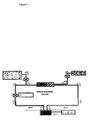
- FIG. 1 schematically shows a system that is particularly suitable for carrying out such a method.
- blood is extracted from a blood vessel of patient 1 and led to haemofilter 2 via a conduit.
- Suitable conduits are known in the art, for instance a double lumen catheter, such as an 11F double lumen catheter (Extraflow, Joline), may be used.
- the conduit is preferably inserted via a central vein, such as a jugular, subclavian or femoral vein.
- a blood pump 3 is normally used to pump the blood to the filter. Prior to entering the filter the substitution fluid is added to the blood from reservoir 4.
- the rate of the substitution fluid flow is preferably coupled to the blood flow.
- the fluid is added in a volume to volume ratio (fluid to blood) in the range of 1 : 4 to 1 : 5.
- the substitution fluid is preferably heated to about 37 °C or slightly higher, in particular to a temperature of 37-39 °C, in order to maintain normothermia in the subject.
- the filtered blood is returned to a blood vessel of the patient 1, preferably to a vein, more preferably via a central vein, such as a jugular, subclavian or femoral vein.
- a central vein such as a jugular, subclavian or femoral vein.
- the extraction and return may be accomplished via a single catheter.
- calcium ions should be added to the blood after filtering or administered directly intravenously to the subject in a sufficient amount to form a complex with excess citrate, in order to reduce the risk of hypocalcaemia reduced or even completely avoid the risk of hypocalcaemia.
- Calcium ions may be administered to the patient via a separate intravenous dosage unit 6, such as a calcium drip.
- a separate intravenous dosage unit 6 such as a calcium drip.
- the skilled person will be able to determine a suitable rate for the administration of calcium based on common general knowledge and the information disclosed herein.
- the volume ratio of the substitution solution to the calcium globionate is usually between 150 : 1 and 200 : 1 (based on a substitution fluid comprising about 13.3 mmol/l citrate). Suitable ratio's for other calcium and/or citrate concentration can be routinely calculated, from this.
- post filter ionised calcium (systemic ionised calcium) may be measured once ( e.g . after 1hr) or more often (intermittently or continuously) to assess the adequacy of anticoagulation. If desired, the flow rate of the substitution fluid and/or the calcium drip may be adjusted. See also the Example.
- the aqueous substitution infusion fluid should generally be safe to intravenously administer to a human, another mammal or another vertebrate, in particular a patient suffering from a renal dysfunction. Accordingly, it should be sterile and pyrogen-free such that it can be administered safely. As the substitution solution is given intra venously, it generally requires the quality mentioned in the European Pharmacopoeia standards.
- the pH of the infusion fluid should generally be sufficiently close to the pH of blood to avoid a too big change in pH after adding the fluid to the blood.
- the pH of the substitution solution is at least 4.5.
- the pH of the substitution fluid is up to 6.5 (pH is as measured in the fluid, using a pH electrode equilibrated at pH 4 and 7).
- the osmolarity of the fluid should be sufficiently low, to maintain a sufficiently low osmolarity of the blood, also after administration of the fluid.
- the osmolarity is essentially isotonic or hypotonic.
- the osmolarity is preferably about 300 mOsm/l or less.
- the osmolarity is usually at least 200 mOsm/l.
- a relatively low concentration of citrate preferably of about 40 mmol/l or less, in particular of 25 mmmol/l or less, more in particular of 20 mmol/l or less is considered advantageous in view of safety and/or prolonging the life-time of the filter.
- a relatively low concentration of anticoagulant is advantageous from a safety point of view, as there is a reduced risk of overdosing of citrate.
- overdosing of citrate is avoided by adding calcium after filtering the blood, but in practice often equipment is used wherein the dosage system for anticoagulant (pre-filter) and the dosage system for calcium (post-filter) are not controlled in combination.
- pre-filter pre-filter
- post-filter dosage system for calcium
- the present invention also allows use of citrate in a relatively low concentration (for values, see above), the risk of overdosing citrate upon malfunction of the calcium dosage system, is reduced, in comparison to a system wherein high concentrations of citrate are used.
- the citrate concentration preferably is at least 5 mmol/l, in particular at least 10 mmol/l.
- the fluid contains counter ions, in particular sodium ions. Further, preferably potassium ions and/or magnesium ions are present. Chloride is usually present to keep electrochemical balance.
- Sodium ions are usually present in a concentration of 50 mmol/l or more. Sodium ions are preferably present in a concentration of at least 100 mmol/l, more preferably in a concentration of at least 125 mmol/l. A concentration of at least 139 mmol/l is in particular preferred.
- the sodium ion concentration is usually 150 mmol/l or less, preferably 145 mmol/l or less.
- the concentration of potassium ion is usually at least 0.5 mmol/l, preferably at least 1.0 mmol/l. Usually the concentration is 5 mmol/l or less, preferably 4 mmol/l or less. If present, the concentration of magnesium ion is usually at least 0.25 mmol/l, preferably at least 0.4 mmol/l. Usually, the concentration is 1.25 mmol/l or less, preferably 1.0 mmol/l or less.
- the fluid is preferably essentially free of calcium ions, as calcium ions form a complex with citrate, thereby inactivating the anti coagulating function of citrate.
- trace amount of calcium ions may be present (e.g. as a result of their presence as an impurity in the raw materials used to prepare the fluid)
- the calcium ion concentration usually is less than 1.0 mmol/l, more in particular less than 0.5 mmol/l, preferably less than 0.1 mmol/l.
- a monosaccharide may be present in the fluid, preferably glucose. If present, the concentration is usually in the range of 1-15 mmol/l, preferably in the range of 3-10 mmol/l.
- the replacement solution is delivered pre filter (predilution mode).
- Patients on regional citrate anticoagulation have a separate intravenous calcium drip 6 ( Figure 1).
- calcium glubionate (0,225 mmol/ml), because this solution can be administered through a peripheral line.
- the rate of citrate infusion (and thus predilution fluid) is coupled to the blood flow.
- Post filter ionised calcium (systemic ionised calcium) is measured continuously, intermittently or initially and after a specific period of time ( e.g. after 1 hour) to assess the adequacy of anticoagulation.
- the citrate administration with this method is enough to produce an ionised calcium in the extracorporeal circuit lower than 0,3 mmol/l.
- the systemic calcium administration depends on the systemic ionised calcium as outlined in Tables 1 to 3.
- Table 1. Initial pump settings/Ionised calcium 1.0 - 1.1 mmol/l. Blood pump (ml/min) Citrate-substitution flow (ml/hr) Calcium pump (ml/hr) 140 1900 9,5 160 2100 10,5 180 2400 12 200 2700 13,5
Landscapes
- Health & Medical Sciences (AREA)
- Chemical & Material Sciences (AREA)
- Medicinal Chemistry (AREA)
- Pharmacology & Pharmacy (AREA)
- Epidemiology (AREA)
- Life Sciences & Earth Sciences (AREA)
- Animal Behavior & Ethology (AREA)
- General Health & Medical Sciences (AREA)
- Public Health (AREA)
- Veterinary Medicine (AREA)
- Inorganic Chemistry (AREA)
- External Artificial Organs (AREA)
Priority Applications (1)
| Application Number | Priority Date | Filing Date | Title |
|---|---|---|---|
| EP06076644A EP1897535A1 (fr) | 2006-08-30 | 2006-08-30 | Liquide substitue pour haemoflitration |
Applications Claiming Priority (1)
| Application Number | Priority Date | Filing Date | Title |
|---|---|---|---|
| EP06076644A EP1897535A1 (fr) | 2006-08-30 | 2006-08-30 | Liquide substitue pour haemoflitration |
Publications (1)
| Publication Number | Publication Date |
|---|---|
| EP1897535A1 true EP1897535A1 (fr) | 2008-03-12 |
Family
ID=38007238
Family Applications (1)
| Application Number | Title | Priority Date | Filing Date |
|---|---|---|---|
| EP06076644A Withdrawn EP1897535A1 (fr) | 2006-08-30 | 2006-08-30 | Liquide substitue pour haemoflitration |
Country Status (1)
| Country | Link |
|---|---|
| EP (1) | EP1897535A1 (fr) |
Cited By (1)
| Publication number | Priority date | Publication date | Assignee | Title |
|---|---|---|---|---|
| US8668825B2 (en) | 2008-09-09 | 2014-03-11 | Gambro Lundia Ab | Device and procedure for extracorporeal blood treatment |
Citations (3)
| Publication number | Priority date | Publication date | Assignee | Title |
|---|---|---|---|---|
| EP0101185A2 (fr) * | 1982-07-20 | 1984-02-22 | SHIMIZU SEIYAKU KABUSHIKI KAISHA also known as Shimizu Pharmaceutical Co., Ltd. | Composition de transfusion pour infusion par voie intraveineuse |
| DE19703816A1 (de) * | 1996-01-25 | 1997-08-07 | Schering Ag | Verbesserte konzentrierte Injektions- und Infusionslösungen für die intravasale Anwendung |
| WO2000064456A2 (fr) * | 1999-04-26 | 2000-11-02 | Pe Chou Chang | Liquide d'infusion de substitution et solution anticoagulante a base de citrate |
-
2006
- 2006-08-30 EP EP06076644A patent/EP1897535A1/fr not_active Withdrawn
Patent Citations (3)
| Publication number | Priority date | Publication date | Assignee | Title |
|---|---|---|---|---|
| EP0101185A2 (fr) * | 1982-07-20 | 1984-02-22 | SHIMIZU SEIYAKU KABUSHIKI KAISHA also known as Shimizu Pharmaceutical Co., Ltd. | Composition de transfusion pour infusion par voie intraveineuse |
| DE19703816A1 (de) * | 1996-01-25 | 1997-08-07 | Schering Ag | Verbesserte konzentrierte Injektions- und Infusionslösungen für die intravasale Anwendung |
| WO2000064456A2 (fr) * | 1999-04-26 | 2000-11-02 | Pe Chou Chang | Liquide d'infusion de substitution et solution anticoagulante a base de citrate |
Non-Patent Citations (3)
| Title |
|---|
| ASHTON D N ET AL: "RECENT ADVANCES IN CONTINUOUS RENAL REPLACEMENT THERAPY: CITRATE ANTICOAGULATED CONTINUOUS ARTERIOVENOUS HEMODIALYSIS", ANNA JOURNAL, THE ASSOCIATION, PITMAN, NJ,, US, vol. 18, no. 3, June 1991 (1991-06-01), pages 263 - 7,329, XP000978120, ISSN: 7650-0779 * |
| MACIAS W L: "CHOICE OF REPLACEMENT FLUID/DIALYSATE ANION IN CONTINUOUS RENAL REPLACEMENT THERAPY", AMERICAN JOURNAL OF KIDNEY DISEASES, W.B. SAUNDERS, PHILADELPPHIA, PA, US, vol. 28, no. 5, SUPPL 3, October 1996 (1996-10-01), pages S15 - S20, XP000978102, ISSN: 0272-6386 * |
| PALSSON R ET AL: "REGIONAL CITRATE ANTICOAGULATION IN CONTINOUS VENOVENOUS HEMOFILTRATION IN CRITICALLY ILL PATIENTS WITH A HIGH RISK OF BLEEDING", KIDNEY INTERNATIONAL, NEW YORK, NY, US, vol. 55, no. 5, May 1999 (1999-05-01), pages 1991 - 1997, XP000978115, ISSN: 0085-2538 * |
Cited By (1)
| Publication number | Priority date | Publication date | Assignee | Title |
|---|---|---|---|---|
| US8668825B2 (en) | 2008-09-09 | 2014-03-11 | Gambro Lundia Ab | Device and procedure for extracorporeal blood treatment |
Similar Documents
| Publication | Publication Date | Title |
|---|---|---|
| US12161791B2 (en) | Multipart fluid system and a system for regional citrate anticoagulation in an extracorporeal blood circuit | |
| US8795517B2 (en) | Machine readable medium embodying instructions for citrate anticoagulation system for extracorporeal blood treatments | |
| US8216172B2 (en) | Method of performing hemofiltration | |
| US6743191B1 (en) | Substitution infusion fluid and citrate anticoagulation | |
| Caruana et al. | Controlled study of heparin versus epoprostenol sodium (prostacyclin) as the sole anticoagulant for chronic hemodialysis | |
| KR102257246B1 (ko) | 구연산염 및 인산염을 포함하는 항응고 유체 | |
| Davenport | Replacement and dialysate fluids for patients with acute renal failure treated by continuous veno-venous haemofiltration and/or haemodiafiltration | |
| Golper et al. | Continuous venovenous hemofiltration for acute renal failure in the intensive care setting: Technical considerations | |
| Sigakis | 32. Renal Replacement Therapy |
Legal Events
| Date | Code | Title | Description |
|---|---|---|---|
| PUAI | Public reference made under article 153(3) epc to a published international application that has entered the european phase |
Free format text: ORIGINAL CODE: 0009012 |
|
| AK | Designated contracting states |
Kind code of ref document: A1 Designated state(s): AT BE BG CH CY CZ DE DK EE ES FI FR GB GR HU IE IS IT LI LT LU LV MC NL PL PT RO SE SI SK TR |
|
| AX | Request for extension of the european patent |
Extension state: AL BA HR MK YU |
|
| AKX | Designation fees paid | ||
| REG | Reference to a national code |
Ref country code: DE Ref legal event code: 8566 |
|
| STAA | Information on the status of an ep patent application or granted ep patent |
Free format text: STATUS: THE APPLICATION IS DEEMED TO BE WITHDRAWN |
|
| 18D | Application deemed to be withdrawn |
Effective date: 20080913 |