EP1897564A1 - Vorrichtung zur Desinfektion über den Luftweg, Substanz und entsprechende Verfahren - Google Patents
Vorrichtung zur Desinfektion über den Luftweg, Substanz und entsprechende Verfahren Download PDFInfo
- Publication number
- EP1897564A1 EP1897564A1 EP07356117A EP07356117A EP1897564A1 EP 1897564 A1 EP1897564 A1 EP 1897564A1 EP 07356117 A EP07356117 A EP 07356117A EP 07356117 A EP07356117 A EP 07356117A EP 1897564 A1 EP1897564 A1 EP 1897564A1
- Authority
- EP
- European Patent Office
- Prior art keywords
- substance
- active ingredient
- phenolic active
- disinfectant
- disinfecting
- Prior art date
- Legal status (The legal status is an assumption and is not a legal conclusion. Google has not performed a legal analysis and makes no representation as to the accuracy of the status listed.)
- Withdrawn
Links
Images
Classifications
-
- C—CHEMISTRY; METALLURGY
- C07—ORGANIC CHEMISTRY
- C07C—ACYCLIC OR CARBOCYCLIC COMPOUNDS
- C07C39/00—Compounds having at least one hydroxy or O-metal group bound to a carbon atom of a six-membered aromatic ring
- C07C39/24—Halogenated derivatives
- C07C39/44—Metal derivatives of an hydroxy group bound to a carbon atom of a six-membered aromatic ring
-
- A—HUMAN NECESSITIES
- A01—AGRICULTURE; FORESTRY; ANIMAL HUSBANDRY; HUNTING; TRAPPING; FISHING
- A01N—PRESERVATION OF BODIES OF HUMANS OR ANIMALS OR PLANTS OR PARTS THEREOF; BIOCIDES, e.g. AS DISINFECTANTS, AS PESTICIDES OR AS HERBICIDES; PEST REPELLANTS OR ATTRACTANTS; PLANT GROWTH REGULATORS
- A01N25/00—Biocides, pest repellants or attractants, or plant growth regulators, characterised by their forms, or by their non-active ingredients or by their methods of application, e.g. seed treatment or sequential application; Substances for reducing the noxious effect of the active ingredients to organisms other than pests
- A01N25/18—Vapour or smoke emitting compositions with delayed or sustained release
-
- A—HUMAN NECESSITIES
- A61—MEDICAL OR VETERINARY SCIENCE; HYGIENE
- A61L—METHODS OR APPARATUS FOR STERILISING MATERIALS OR OBJECTS IN GENERAL; DISINFECTION, STERILISATION OR DEODORISATION OF AIR; CHEMICAL ASPECTS OF BANDAGES, DRESSINGS, ABSORBENT PADS OR SURGICAL ARTICLES; MATERIALS FOR BANDAGES, DRESSINGS, ABSORBENT PADS OR SURGICAL ARTICLES
- A61L2/00—Disinfection or sterilisation of materials or objects, in general; Accessories therefor
- A61L2/16—Disinfection or sterilisation of materials or objects, in general; Accessories therefor using chemical substances
- A61L2/20—Gaseous substances, e.g. vapours
-
- A—HUMAN NECESSITIES
- A61—MEDICAL OR VETERINARY SCIENCE; HYGIENE
- A61L—METHODS OR APPARATUS FOR STERILISING MATERIALS OR OBJECTS IN GENERAL; DISINFECTION, STERILISATION OR DEODORISATION OF AIR; CHEMICAL ASPECTS OF BANDAGES, DRESSINGS, ABSORBENT PADS OR SURGICAL ARTICLES; MATERIALS FOR BANDAGES, DRESSINGS, ABSORBENT PADS OR SURGICAL ARTICLES
- A61L9/00—Disinfection, sterilisation or deodorisation of air
- A61L9/015—Disinfection, sterilisation or deodorisation of air using gaseous or vaporous substances, e.g. ozone
- A61L9/04—Disinfection, sterilisation or deodorisation of air using gaseous or vaporous substances, e.g. ozone using substances evaporated in the air without heating
- A61L9/12—Apparatus, e.g. holders, therefor
Definitions
- the present invention relates to disinfection devices by air capable of acting remotely without requiring direct contact with the surfaces to be treated.
- the present invention relates to an air disinfection device comprising on the one hand a disinfecting substance and, on the other hand, a diffusion means designed to diffuse by natural evaporation said disinfecting substance in the atmosphere surrounding said device .
- the present invention also relates to a disinfecting substance designed to be diffused into the atmosphere by natural evaporation.
- the present invention also relates to a method of manufacturing an air disinfection device in which a disinfecting substance is associated with a diffusion means designed to diffuse by natural evaporation said disinfecting substance in the atmosphere surrounding said device.
- the present invention finally relates to a method of producing a disinfectant substance designed to be diffused into the atmosphere by natural evaporation.
- the active ingredients used in the devices of the prior art are generally compounds which have one or more quaternary ammonium functions, such as benzylcoco alkyldimethyl ammonium chloride, better known under the trade name "Rhodoquat RP 80 ®” .
- the objects assigned to the invention are therefore intended to remedy the disadvantages mentioned above and to propose a new disinfection device by air that allows effective disinfection, while being environmentally friendly and the health of the user .
- Another object of the invention is to propose a new disinfection device which is particularly simple to manufacture and which has a competitive cost price.
- Another object of the invention is to propose a new disinfection device that is simple and compact design.
- Another object of the invention is to propose a new disinfection device whose longevity is optimized.
- Another object of the invention is to propose a new disinfecting substance that has an effective action by air, while being environmentally friendly and the health of the user.
- Another object of the invention is to propose a new disinfectant substance whose development is particularly simple and inexpensive, and whose implementation is particularly easy.
- Another object of the present invention is to propose a new method of manufacturing a disinfection device by air that allows to obtain an effective disinfection device and compatible with the environmental and health standards in force.
- Another object of the present invention is to provide a method of manufacturing a disinfection device whose implementation is simple and economically competitive.
- Another object of the present invention is to propose a new process for producing a disinfecting substance that has an effective action by air, while being environmentally friendly and the health of the user.
- an air disinfection device comprising on the one hand a disinfecting substance and, on the other hand, a diffusion means designed to diffuse by natural evaporation said disinfecting substance in the atmosphere surrounding said device, characterized in that said disinfecting substance comprises a phenolic active ingredient.
- the objects assigned to the invention are also achieved with the aid of a disinfecting substance designed to be diffused into the atmosphere by natural evaporation, characterized in that it comprises a phenolic active ingredient.
- the objects assigned to the invention are also achieved by means of a method of manufacturing an air disinfection device in which a disinfecting substance is associated with a diffusion means designed to diffuse by natural evaporation said disinfecting substance. in the atmosphere surrounding said device, characterized in that the disinfecting substance employed comprises a phenolic active ingredient.
- the objects assigned to the invention are finally achieved by means of a process for producing a disinfecting substance designed to be diffused into the atmosphere by natural evaporation, characterized in that it comprises a step during wherein a preparation is made comprising a phenolic active ingredient from which said disinfecting substance is made.
- the disinfection device by air according to the invention is intended to exert a disinfecting action, and more particularly bactericidal and / or fungicidal, on various objects without directly contacting the surfaces to be treated.
- the disinfection device 1 according to the invention is therefore different from contact disinfection devices such as spraying or immersion systems.
- the disinfection device 1 comprises on the one hand a disinfecting substance 2 and, on the other hand, a diffusion means 3 designed to diffuse by natural evaporation said disinfecting substance 2 into the atmosphere which surround said device 1.
- the disinfectant substance 2 is capable of exerting its bactericidal and / or fungicidal action while it is in the gaseous state, that is to say in the vapor phase in the atmosphere in which the object to be treated is bathed.
- natural evaporation is meant the phenomenon of release or passage in the vapor phase of the disinfecting substance 2 according to a natural phenomenon of diffusion.
- natural evaporation thus opposes " forced " evaporation, which would imply the implementation of a thermal mechanism such as heating and / or chemical by the creation of a reaction product gaseous (especially by combustion).
- the disinfectant substance 2 according to the invention is advantageously capable of vaporizing spontaneously and continuously at the normal temperature of use of the device, that is to say preferably at room temperature.
- the disinfecting substance 2 comprises a phenolic active ingredient, that is to say a molecule which carries at least one phenol group.
- the phenolic active ingredient is based on sodium 3-methyl-4-chlorophenolate, the formula of which is given below:
- the phenolic active ingredient confers on the disinfecting substance 2 a high efficacy of action both bactericidal and fungicidal, while being more respectful of the environment and the health of the users than the quaternary ammonium compounds of the prior art.
- sodium 3-methyl-4-chlorophenolate is almost harmless which makes it particularly suitable for consumer use.
- the phenolic active ingredient according to the invention is formed mainly and, even more preferably, almost exclusively sodium 3-methyl-4-chlorophenolate.
- this phenolic active ingredient may be supplied in the form of a commercially available preparation known under the trade name "PREVENTOL CMK-NA® ", hereinafter " Preventol®”, which usually contains 71% to 73%. % by weight of sodium 3-methyl-4-chlorophenolate.
- the disinfectant substance 2 contains 5% by weight of phenolic active ingredient, it will mean that said disinfectant substance 2 contains 5% of Preventol® preparation, ie about 3, 6% pure 3-methyl-4-chlorophenolate sodium.
- the disinfecting substance 2 comprises at least a first alcohol-type solvent with which the phenolic active ingredient is mixed, so that said disinfectant substance 2 forms a volatile solution at ambient temperature.
- a phenolic active ingredient which has a high vapor pressure at 20 ° C., and in particular greater than that of Rhodoquat RP 80 ®, is preferably selected first. This is particularly the case of Preventol®, whose vapor pressure at 20 ° C is of the order of 8 kPa.
- Preventol® in an alcohol-type solvent, a liquid having a high volatility is obtained, that is to say, it tends to modify, and in this case to increase, the vapor pressure of the phenolic active ingredient.
- said first solvent is ethanol.
- ethanol has a double advantage: on the one hand Preventol® is soluble in ethanol, and on the other hand ethanol is a chemical compound that is abundantly available and particularly inexpensive.
- the present invention is not limited to a particular use of the device 1, the latter is preferably designed and sized for the disinfection of articles of clothing.
- the device 1 according to the invention is preferably intended to be used in a closed or confined environment to disinfect and deodorize objects brought to be in contact with human skin, such as clothing or sports equipment (shoes , gloves, helmets and other shock protection, etc.)
- the device 1 according to the invention constitutes a disinfection device for shoes, the useful diffusion volume of which is generally between 500 cm 3 and 700 cm 3 , and of which the action is directed preferably, but not exclusively, against the bacterium Staphilococcus Epidermidis (bacteria present in the shoe) and the yeast Candida Albicans (mushroom present in the shoe).
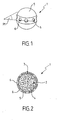
- the device 1 is substantially in the form of a sphere, the diffusion means 3 comprising a retention member 4 which is designed to be impregnated disinfectant substance 2 to gradually diffuse the phenolic active ingredient into the atmosphere.
- said retention member 4 is formed by a spongy and / or porous element such as a cellulose or cotton pad capable of being impregnated with the disinfecting substance 2.
- the disinfection device 1 also comprises a housing 5 which is arranged to contain the retention member 4.
- Said housing 5 is preferably substantially spherical and provided with one or several openings 6, or “vents ", to allow an exchange between the retention member 4 and the ambient air which is sufficient to ensure the effectiveness of disinfection.
- the device according to the invention is not limited to a particular shape or dimensions of housing, openings or retention member.
- the retention member 4 by means of a cotillon ball having a diameter of between 18 mm and 22 mm, housed in a housing of suitable external diameter and pierced with circular holes communication inside the case with the atmosphere.
- the openings 6 are adjustable, so that the user can choose the diffusion rate of the phenolic active ingredient by adjusting the exchange surface and / or the flow rate of air that comes to charge in active principle in contact with the retention member 4.
- the proportion by weight of the phenolic active ingredient (that is to say preventol®) in the disinfecting substance 2 is substantially between 1% and 20%, more preferably between 3% and 13%, and so particularly preferably greater than 5 (the latter value corresponding to about 3.6% of pure sodium 3-methyl-4-chlorophenolate).
- Preventol® A proportion of 5% of Preventol® was indeed clearly sufficient to meet the usual criteria of bactericidal and fungicidal efficacy.
- the disinfectant solution 2 contains between 5% and 8% by weight of Preventol®, or even 8% to 13% by weight to improve the efficiency of said device with constant bulk.
- the inventors have carried out compatibility tests by impregnating a cellulose spherical retaining member 22 with a diameter of 22 mm or two members 18 mm and 22 mm in diameter with a disinfecting substance 2 containing 5% of Preventol® and by placing it in contact with a copolyester shell.
- the retention elements When the retention elements are impregnated with 4 to 3 g and 2 g of the disinfectant substance 2, the shell cracks quickly and becomes unusable.
- a proportion of Préventol® of 5% by weight in the disinfectant solution therefore remains compatible with the use of copolyester shells, provided that the total quantity of disinfecting substance used (in mass) does not exceed a critical threshold.
- the casing 5 can be formed by a polypropylene shell, the inventors having discovered that this material is particularly resistant to attacks of the phenolic active ingredient, and in particular does not exhibit cracks when the Preventol® is used at high concentrations, even on the order of 12% or 13% by weight.
- the proportion by weight of the first solvent, and more precisely of ethanol, in the disinfectant substance 2 is preferably substantially between 25% and 35%, and particularly preferably substantially equal to 30%.
- the ethanol dosage is a compromise. Indeed, ethanol promotes the aerial diffusion of the phenolic active ingredient, which encourages the use in high proportion in the disinfectant substance 2, and in any case at least about 20% by weight to obtain sufficient volatility .
- the ethanol when its proportion by weight in the disinfectant substance 2 exceeds a critical threshold, determined empirically as being close to 30% to 35% by weight, it modifies the properties of the disinfecting substance 2, and in particular its density, so that it becomes practically impossible for the organ to retention 4 to impregnate said disinfectant 2 and contain it.
- the disinfecting substance 2 comprises at least one perfumed extract, such as a gasoline or an essential oil.
- the scented extract may exhale a smell of mint or lavender.
- the perfumed extract can naturally be used pure or supplied diluted in the form of a preparation available from perfumers.
- the olfactory effect obtained by the addition of a scented extract in the disinfectant substance 2 makes it possible to mask the odor of the phenolic active ingredient which is generally unpleasant.
- the combination of a disinfecting effect and a scenting effect also makes it possible to deodorize the treated area more effectively by imparting a more " fresh" scent to it.
- the proportion by weight of the scented extract in the disinfecting substance 2 is substantially less than or equal to 65%, particularly preferably between 20% and 40%, and even more preferably substantially equal to 30%. This latter value makes it possible to obtain an olfactory effect considered satisfactory while limiting the extra cost of manufacture generated by the use, even in a minimal amount, of a gasoline or an essential oil.
- the disinfecting substance 2 comprises a second solvent, the proportion by weight of which is substantially less than or equal to 65%, preferably of between 25% and 45%, and still more preferably of substantially 35%. .
- the second solvent and / or the perfumed extract make it possible to adjust the proportions by weight of the phenolic active ingredient and of the first solvent in the disinfecting substance 2, which makes it possible in particular not to exceed the critical content of ethanol beyond of which the retention of the disinfecting substance 2 by the retention member 4 becomes problematic, and / or the content of phenolic active ingredient from which the housing 5 is weakened by the attacks of said disinfecting substance.
- the second solvent and the scented extract preferably have a good compatibility with the casing 5, as well as a chemical compatibility which guarantees their mutual miscibility and their miscibility with the phenolic active ingredient as well as the first solvent.
- DEP diethylphthalate
- the second solvent is mainly formed of di-propylene glycol (" DPG ”) and, particularly preferably, that the second solvent is exclusively formed of DPG.
- DPG is a cheap solvent, whose safety is attested, and is universally used by perfumers.
- said DPG serves as a solvent for an essential oil, so that it is integrated with the scented extract.
- the present invention is not limited to a particular second solvent, which may in particular integrate other compounds, and for example be formed based on DPG mixed with DEP, the latter being present in a form and quantity compatible with the legal requirements in terms of health and safety of persons.
- the inventors have found that it is possible, since the base of the disinfecting solution 2 formed by Preventol® and ethanol was constituted, to dilute it by adding a sufficient amount of either the second solvent alone or a mixture of the second solvent and the scented extract.
- the proportions A and E are the most restrictive since they condition the functionality of the device 1. However, once fixed, they make it possible to define a range of values in which the concentrations S and P are likely to be chosen according to the from the manufacturer, provided that equality (i) is respected.
- Table 1 provides some nonlimiting examples of possible formulations of a disinfecting substance 2 according to the invention (values expressed in% by weight).
- Table 1 ⁇ / i> Example Preventol® (A) Ethanol (E) DPG (S) Perfume (P) 1 3 to 5 20 to 30 65 to 77 0 2 3 to 5 30 to 35 60 to 67 0 3 3 to 5 20 to 30 35 to 57 20 to 30 4 3 to 5 30 to 35 20 to 37 30 to 40 5 5 to 7 20 to 30 63 to 75 0 6 5 to 7 30 to 35 58 to 65 0 7 5 to 7 20 to 30 33 to 55 20 to 30 8 5 to 7 30 to 35 18 to 35 30 to 40 9 10 to 13 20 to 30 57 to 70 0 10 10 to 13 30 to 35 52 to 60 0 11 10 to 13 20 to 30 27 to 50 20 to 30 12 10 to 13 30 to 35 12 to 30 30 to 40 13 10 to 13 25 to 35 0 to 25 40 to 52 14 12 to 15 25 to 35 0 to 23 30 to 60
- the present invention also relates to the disinfectant substance 2 itself.
- Said disinfecting substance 2 according to the invention is designed to be diffused into the atmosphere by natural evaporation and comprises, according to an important characteristic, a phenolic active ingredient.
- said phenolic active ingredient is preferably based on sodium 3-methyl-4-chlorophenolate, and preferably predominantly, if not exclusively, formed of the latter compound.
- the disinfectant substance 2 according to the invention may naturally be subject to all the variations detailed above.
- the disinfectant substance 2 according to the invention may substantially have the following composition: 5% of Preventol®, 30% of ethanol as the first solvent, 30% of scented extract and % of di-propylene glycol as the second solvent.
- the disinfecting substance 2 according to the invention is preferably substantially free of water.
- the present invention also relates to a method of manufacturing an air disinfection device 1 in which a disinfecting substance 2 is associated with a diffusion means 3 designed to diffuse by natural evaporation said disinfecting substance into the atmosphere which Surrounding said device 1, the disinfecting substance 2 employed comprises, according to an important feature of the invention, a phenolic active ingredient.
- said phenolic active ingredient is based on sodium 3-methyl-4-chlorophenolate.
- the manufacturing method according to the invention preferably comprises a step during which a retention member 4 formed by a cancellous body of cellulose-type buffer is impregnated so as to constitute a reservoir of disinfecting substance which is then reported in a housing 5.
- Said manufacturing method preferably comprises a step during which the housing 5 is manufactured by producing a polymer shell, preferably a copolyester.
- Said shell may advantageously be formed by the combination of two half-shells obtained for example by molding.
- the invention also relates to a process for producing a disinfecting substance 2 designed to be diffused into the atmosphere by natural evaporation.
- the process for producing the disinfecting substance 2, which constitutes a method of "manufacturing" said disinfectant substance can advantageously be considered as a step in the manufacturing process of the above-mentioned device 1.
- the process for producing the disinfecting substance 2 comprises a step (a) during which a preparation comprising a phenolic active ingredient is prepared.
- Said phenolic principle is, within the meaning of the invention, intended to be found in the final composition of said disinfectant solution 2.
- the phenolic active ingredient used is based on sodium 3-methyl-4-chlorophenolate and is preferably predominantly, if not exclusively, formed from this compound.
- the phenolic principle will be in the form of solid Preventol®, with white to yellowish scales.
- the method of preparation then comprises a step (b) during which is incorporated, in particular by dissolution, Preventol® in ethanol to form a first mixture.
- the first mixture is then kept under stirring until it is perfectly homogenized.
- the first Preventol®-ethanol mixture is prepared during the production process prior to the addition of any other component.
- said first mixture is then added during a step (c), DPG or a mixture of DPG and perfume gasoline to obtain a second mixture.
- Said second mixture is kept stirring.
- the disinfecting substance 2 and the disinfection device 1 in accordance with the invention advantageously make it possible to use an active phase bactericidal and fungicidal formulation which can be substituted for the products of the prior art, exhibiting at least one efficacy. comparable as well as a better respect of the environment as of the health of the users.
- the device 1 according to the invention makes it possible to obtain interesting performances by reconciling effectiveness of action, increased longevity of the made of a better strength of the casing 5 forming its packaging, and absence of inconvenience, particularly olfactory, related to its implementation.
Landscapes
- Health & Medical Sciences (AREA)
- Life Sciences & Earth Sciences (AREA)
- Chemical & Material Sciences (AREA)
- General Health & Medical Sciences (AREA)
- Organic Chemistry (AREA)
- Veterinary Medicine (AREA)
- Public Health (AREA)
- Animal Behavior & Ethology (AREA)
- Epidemiology (AREA)
- Plant Pathology (AREA)
- Zoology (AREA)
- Environmental Sciences (AREA)
- Wood Science & Technology (AREA)
- Chemical Kinetics & Catalysis (AREA)
- General Chemical & Material Sciences (AREA)
- Dentistry (AREA)
- Engineering & Computer Science (AREA)
- Toxicology (AREA)
- Pest Control & Pesticides (AREA)
- Agronomy & Crop Science (AREA)
- Agricultural Chemicals And Associated Chemicals (AREA)
- Apparatus For Disinfection Or Sterilisation (AREA)
Applications Claiming Priority (1)
| Application Number | Priority Date | Filing Date | Title |
|---|---|---|---|
| FR0607736A FR2905272B1 (fr) | 2006-09-04 | 2006-09-04 | Dispositif de desinfection par voie aerienne, substance et procedes correspondants. |
Publications (1)
| Publication Number | Publication Date |
|---|---|
| EP1897564A1 true EP1897564A1 (de) | 2008-03-12 |
Family
ID=38229510
Family Applications (1)
| Application Number | Title | Priority Date | Filing Date |
|---|---|---|---|
| EP07356117A Withdrawn EP1897564A1 (de) | 2006-09-04 | 2007-09-03 | Vorrichtung zur Desinfektion über den Luftweg, Substanz und entsprechende Verfahren |
Country Status (2)
| Country | Link |
|---|---|
| EP (1) | EP1897564A1 (de) |
| FR (1) | FR2905272B1 (de) |
Citations (4)
| Publication number | Priority date | Publication date | Assignee | Title |
|---|---|---|---|---|
| US5863562A (en) * | 1995-05-30 | 1999-01-26 | Ciba Vision Corporation | Methods and composition for preserving media in the tip of a solution dispenser |
| FR2793692A1 (fr) * | 1999-05-21 | 2000-11-24 | Pierre Vasseur | Dispositif et procede de desinfection par voie aerienne |
| DE10318009A1 (de) * | 2003-04-19 | 2004-11-18 | Menno Chemie Vertriebsges. Mbh | Mittel zur Inaktivierung infektiöser Prionen |
| WO2004100666A1 (en) * | 2003-05-15 | 2004-11-25 | Arch Uk Biocides Limited | Antimicrobial composition containing a polymeric biguadine and a copolymer and use thereof |
-
2006
- 2006-09-04 FR FR0607736A patent/FR2905272B1/fr not_active Expired - Fee Related
-
2007
- 2007-09-03 EP EP07356117A patent/EP1897564A1/de not_active Withdrawn
Patent Citations (4)
| Publication number | Priority date | Publication date | Assignee | Title |
|---|---|---|---|---|
| US5863562A (en) * | 1995-05-30 | 1999-01-26 | Ciba Vision Corporation | Methods and composition for preserving media in the tip of a solution dispenser |
| FR2793692A1 (fr) * | 1999-05-21 | 2000-11-24 | Pierre Vasseur | Dispositif et procede de desinfection par voie aerienne |
| DE10318009A1 (de) * | 2003-04-19 | 2004-11-18 | Menno Chemie Vertriebsges. Mbh | Mittel zur Inaktivierung infektiöser Prionen |
| WO2004100666A1 (en) * | 2003-05-15 | 2004-11-25 | Arch Uk Biocides Limited | Antimicrobial composition containing a polymeric biguadine and a copolymer and use thereof |
Also Published As
| Publication number | Publication date |
|---|---|
| FR2905272A1 (fr) | 2008-03-07 |
| FR2905272B1 (fr) | 2010-11-12 |
Similar Documents
| Publication | Publication Date | Title |
|---|---|---|
| EP1060751A1 (de) | Vorrichtung zur gesteuerten Freigabe von einem flüchtigen organischen Material | |
| EP1214948A2 (de) | Antibakterielle Zusammensetzung zur Bekämpfung von in der Luft schwebenden Bakterien und entsprechendes Verfahren | |
| EP3237012B1 (de) | Besänftigende zusammensetzung für tiere mit mindestens einer fettsäure und nepetalacton | |
| WO1993014172A1 (fr) | Bombe a aerosols contenant des micro-capsules | |
| CN112672644B (zh) | 吸收促进剂、含有飞行害虫驱避香料的组合物,及飞行害虫驱避制品 | |
| CH652035A5 (fr) | Element de support gelifie pour dispositifs de diffusion de vapeurs d'agents assainissants. | |
| CA2352410C (fr) | Procede de lutte contre les parasites et arthropodes | |
| WO1997026020A1 (fr) | Nouvelle resine parfumee permettant la diffusion reguliere d'une composition parfumee complexe | |
| EP1919279B1 (de) | Durch verdunstung eine flüssige aktive substanz kontrolliert freisetzendes material und das material umfassendes mücken abweisendes armband | |
| FR2905272A1 (fr) | Dispositif de desinfection par voie aerienne, substance et procedes correspondants. | |
| EP3595732A1 (de) | Verwendung einer zusammensetzung mit 1,8-para-menthenthiol und 3-mercaptohexylacetat als geruchsmaskierer | |
| FR3110047A1 (fr) | Protection spatiale contre les insectes volants à base de 2-undécanone | |
| WO2017077946A1 (ja) | 倒立型揮散装置 | |
| EP0254621B1 (de) | Unentzündbares flüssiges Geruchsbeseitigungsmittel | |
| EP2244579A2 (de) | Gerät für die abwehr von haustierparasiten | |
| BE1009495A6 (fr) | Combinaison de fibres et d'un liant caoutchouteux, formant une couche souple et aeree. | |
| EP0888136B1 (de) | Aerosolbehälter mit flüssigem treibmittel zum parfümieren von umgebungsluft | |
| JP4778623B2 (ja) | 水洗トイレ用固形洗浄剤 | |
| CA2807247A1 (fr) | Composition desinfectante | |
| EP0701452A1 (de) | Verfahren fuer die diffusion eines riechenden stoffs | |
| FR2565109A1 (fr) | Compositions physico-chimiques appropriees aux evaporateurs de principes actifs volatils | |
| EP3784032A1 (de) | Flüssige formulierung für imker-smoker | |
| JP2006182817A (ja) | 薬剤徐溶性樹脂組成物及び該樹脂組成物を含む液体組成物 | |
| EP2990471A1 (de) | Stabile desinfektionslösung, die mikrokapseln enthält | |
| HK40074107A (en) | Absorption promotor, flying insect pest repellent fragrance containing composition, and flying insect pest repellent product |
Legal Events
| Date | Code | Title | Description |
|---|---|---|---|
| PUAI | Public reference made under article 153(3) epc to a published international application that has entered the european phase |
Free format text: ORIGINAL CODE: 0009012 |
|
| AK | Designated contracting states |
Kind code of ref document: A1 Designated state(s): AT BE BG CH CY CZ DE DK EE ES FI FR GB GR HU IE IS IT LI LT LU LV MC MT NL PL PT RO SE SI SK TR |
|
| AX | Request for extension of the european patent |
Extension state: AL BA HR MK YU |
|
| 17P | Request for examination filed |
Effective date: 20080911 |
|
| 17Q | First examination report despatched |
Effective date: 20081014 |
|
| AKX | Designation fees paid |
Designated state(s): AT BE BG CH CY CZ DE DK EE ES FI FR GB GR HU IE IS IT LI LT LU LV MC MT NL PL PT RO SE SI SK TR |
|
| RAP1 | Party data changed (applicant data changed or rights of an application transferred) |
Owner name: EUROSPHERE |
|
| RIN1 | Information on inventor provided before grant (corrected) |
Inventor name: VASSEUR, PIERRE ROGER |
|
| RAP1 | Party data changed (applicant data changed or rights of an application transferred) |
Owner name: IMPLUS EU |
|
| STAA | Information on the status of an ep patent application or granted ep patent |
Free format text: STATUS: THE APPLICATION IS DEEMED TO BE WITHDRAWN |
|
| 18D | Application deemed to be withdrawn |
Effective date: 20120117 |