EP1898331A2 - Procédé et dispositif destinés à l'exécution secondaire de processus - Google Patents
Procédé et dispositif destinés à l'exécution secondaire de processus Download PDFInfo
- Publication number
- EP1898331A2 EP1898331A2 EP07014334A EP07014334A EP1898331A2 EP 1898331 A2 EP1898331 A2 EP 1898331A2 EP 07014334 A EP07014334 A EP 07014334A EP 07014334 A EP07014334 A EP 07014334A EP 1898331 A2 EP1898331 A2 EP 1898331A2
- Authority
- EP
- European Patent Office
- Prior art keywords
- processing time
- thread
- processes
- scheduler
- threads
- Prior art date
- Legal status (The legal status is an assumption and is not a legal conclusion. Google has not performed a legal analysis and makes no representation as to the accuracy of the status listed.)
- Granted
Links
Images


Classifications
-
- G—PHYSICS
- G06—COMPUTING OR CALCULATING; COUNTING
- G06F—ELECTRIC DIGITAL DATA PROCESSING
- G06F21/00—Security arrangements for protecting computers, components thereof, programs or data against unauthorised activity
- G06F21/70—Protecting specific internal or peripheral components, in which the protection of a component leads to protection of the entire computer
- G06F21/71—Protecting specific internal or peripheral components, in which the protection of a component leads to protection of the entire computer to assure secure computing or processing of information
-
- G—PHYSICS
- G06—COMPUTING OR CALCULATING; COUNTING
- G06F—ELECTRIC DIGITAL DATA PROCESSING
- G06F21/00—Security arrangements for protecting computers, components thereof, programs or data against unauthorised activity
- G06F21/70—Protecting specific internal or peripheral components, in which the protection of a component leads to protection of the entire computer
- G06F21/71—Protecting specific internal or peripheral components, in which the protection of a component leads to protection of the entire computer to assure secure computing or processing of information
- G06F21/75—Protecting specific internal or peripheral components, in which the protection of a component leads to protection of the entire computer to assure secure computing or processing of information by inhibiting the analysis of circuitry or operation
- G06F21/755—Protecting specific internal or peripheral components, in which the protection of a component leads to protection of the entire computer to assure secure computing or processing of information by inhibiting the analysis of circuitry or operation with measures against power attack
-
- G—PHYSICS
- G06—COMPUTING OR CALCULATING; COUNTING
- G06F—ELECTRIC DIGITAL DATA PROCESSING
- G06F9/00—Arrangements for program control, e.g. control units
- G06F9/06—Arrangements for program control, e.g. control units using stored programs, i.e. using an internal store of processing equipment to receive or retain programs
- G06F9/46—Multiprogramming arrangements
- G06F9/48—Program initiating; Program switching, e.g. by interrupt
- G06F9/4806—Task transfer initiation or dispatching
- G06F9/4843—Task transfer initiation or dispatching by program, e.g. task dispatcher, supervisor, operating system
Definitions
- the field of the invention are methods for concurrently executing processes in portable data carriers, such as smart cards, or security modules permanently installed in a terminal, as well as corresponding tamper-resistant units.
- a time-independent power consumption can be ensured via a shunt resistor.
- just unneeded components such as a CRC checksum generator or random data coprocessor may be activated as input values to conceal power consumption.
- random random delays can be introduced or different processes in crypto-algorithms can be introduced into similar calculations, which are selected at random.
- NOP instructions are appropriately inserted into the instruction sequence to be executed for the comparison so that the actual processing time of the instruction sequence to be executed is independent of the input data of the comparison.
- the WO 2004/010300 A2 discloses a method for ensuring the execution of a program against attacks by radiation, in particular flashes of light.
- the processing time of a sequence of commands in a monolithic integrated electronic circuit, in particular a chip card, is monitored.
- CISC Complex Instruction Set Computer
- the processing time of an instruction varies between 2 and 11 clock cycles.
- a counter is started which triggers an interrupt upon scheduled execution of the sequence of instructions.
- the expected value of the program counter is stored in a variable.
- the actual value of the program counter is compared with the stored value when the interrupt is triggered. If there is a difference between the two values, an attack is concluded. So that even in branched sequences of instructions all branches have the same processing time, the programmer inserts in the branches a tuned number of NOP instructions.
- the target processing time can be selected smaller than a conventional processing time, which corresponds to a sum of the conventionally maximized partial processing times of successive subsections.
- the same sequence of instructions can be executed either as a safety-critical process with time compensation or as an uncritical process without time compensation. Overall, therefore, the performance can be improved if the instruction sequence is otherwise unnecessarily always executed with the constant but maximum processing time.
- the principle of balancing processing time by a central entity such as the scheduler also simplifies application programming. The programmer no longer has to match each possible execution path through his program.
- Random waiting times or additional, randomly selected processes can still be added, for example, to disguise the power consumption.
- the method can be used largely independently of the scheduling principle used.
- a fixed processing time for safety-critical processes is determined and preferably stored centrally, conventional scheduling can be used almost unmodified. For example, choosing a fixed processing time protects against development a dependence between processing time and safety-critical data is overlooked.
- FIG. 1 shows a quasi-parallel or concurrent execution 1 of several threads 2 to 10 according to the invention.
- the basic idea of the invention is to provide a processing time for security-critical threads which is monitored by the operating system and, in certain cases, filled up. However, this processing time must not depend on the safety-critical, processed data of the safety-critical thread.
- the security-critical, processed data of a PIN checking thread includes, for example, the entered PIN and the stored reference value, as well as the result of this check.
- FIG. 1 three execution strands are shown one above the other, in which the threads 2 to 10 are executed quasi-parallel.
- the same, fixed processing time t e is provided.
- a time difference ⁇ is added to this fixed processing time, so that, for example, the average processing time is constant.
- the time difference ⁇ can be positive and negative and must not depend on the safety-critical data processed in the thread.
- the two threads 2 and 6 start at the times 11 and 14, respectively, and are processed according to the times X1 and Y1 at the times 12 and 15, respectively. However, the operating system terminates the threads 2 and 6 only at the times 13 and 16, respectively, so that the processing times X1 + X2 and Y1 + Y2 are constant. During times X2 and Y2, the operating system or virtual machine performs a fill operation and does not need to provide computation time for threads 2 and 6.
- one interrupt can be programmed.
- the interrupts terminate threads 2 and 6 at times 13 and 16, respectively.
- the programming of an interrupt can be done, for example, by pre-allocating a counter with a number and by switching the counter from 11..11 to 00..00, the interrupt is triggered.
- Such a programmable interrupt source is present in most microprocessors, in particular microprocessors for chip cards.
- the times X2 and Y2 can be calculated from the counter readings at the times 12 and 15, respectively, and the set counter readings - usually 0 - at the times 13 and 16, respectively.
- each one Trigger interrupt when starting the threads 2 and 6 at the times 11 and 14 per timer can be programmed, each one Trigger interrupt at times 13 and 16. Only after the triggering of the corresponding interrupt are the threads 2 and 6 terminated.
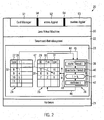
- FIG. 2 shows an inventive architecture of a chip card 20.
- the architecture comprises several layers:
- the hardware 21 is shown below, which typically has a CPU with random access memory RAM and a nonvolatile memory (NVM) as well as one or more I / O interfaces ,
- NVM nonvolatile memory
- Above is the example of a Java Virtual Machine (VM) 50, a card manager 51 and firewalls 54 separate applets 52 and 53 are shown above.
- VM Java Virtual Machine
- a card manager 51 and firewalls 54 separate applets 52 and 53 are shown above.
- a .Net VM can also be used.
- This invention relates to scheduler 23 in a multi-tasking smart card operating system 22 or scheduler 23 to a multithreaded virtual machine 50.
- the present invention is concerned with a specially-designed scheduler so that other components of the operating system or virtual machine are not considered .
- the scheduler 23 according to the invention can also be implemented in the Java Virtual Machine 50.
- the scheduler 23 comprises a thread type table 24, a thread table 25, and a scheduler 26.
- the scheduler 26 distributes the CPU time to the share threads listed in the thread table 25, based on the priorities indicated in the priority column 30. In this way, the active threads are processed quasi-parallel.
- Priority-based scheduling is represented by arrow 43.
- the arrow 43 points to the line in the thread table that corresponds to the thread currently being processed by the CPU. To the quasiparallel processing can reach the arrow 43 after a few milliseconds or microseconds change its position, so that another thread is processed further.
- FIGS. 2 to 5 show four different embodiments of the thread type and thread tables. To clarify the differences between these embodiments, thread types tables 24, 81 and 101 always show the same thread types 8 through 11. For the same reason, in the thread tables 25, 69, 89 and 109, the computing-willing threads with the IDs 5 to 7 are entered.
- thread type table 24 includes, among other things, a type column 27 and a time column 28.
- the entries in type column 27 are also referred to as thread IDs.
- type column 27 and time column 28 are four bits wide, so that values between 0 and 15, hexadecimal 0 or f can be stored in each case.
- the values in the time column indicate the maximum time scheduled for a particular thread.
- one or more of the possible values in time column 28 are reserved for threads having a fixed processing time.
- all odd values in the time column 28 are provided for tread types with a fixed processing time.
- the least significant bit (LSB) thus indicates whether it is a tread type with fixed processing time. In this case, the refilling operation shown in FIG. 1 is performed.
- a look-up table may also be used to determine processing times in seconds or clock cycles, or the time column is selected to be wider, for example, eight or 16 bits wide.
- an entry is made in the thread table 25.
- one or more cells from the entry in the thread type table 24 indicating the thread type of the thread to be created are copied to the thread table 25. For example, when creating line 37, entry 8 from thread type column 27, line 32, was copied to the corresponding column at line 37 of thread table 25, which is illustrated by arrow 47.
- each entry in the thread table 25 in the thread type column 31 contains the number of the thread type, that is, a reference to a row of the thread type table 24, it is not necessary to execute all entries, in particular not the entry f the time column 28 to copy from the thread type table 24 into the thread table 25. Only data that is needed frequently is copied. In rarely used Data presents the delay of accessing and eventual searching in the thread type table 24 is not a significant disadvantage.
- the cell offset indicates the difference between the beginning of the left or first cell of an entry and the beginning of cell X.
- a search is not necessary with this thread type table 24 organization.
- the scheduler 26 awards the computation time of the next available time slot to the highest-priority computationally willing thread.
- the reading out of the priorities is represented by an arrow 44.
- the next time slot is assigned to the thread with the ID 6 in line 37.
- the priorities are recalculated by the scheduler 26, which is represented by arrow 46.
- the maximum or fixed processing time specified in the time column 28 can be taken into account, which is illustrated by arrow 45.
- the estimated computation time which is not required, shown in FIG. 2, can be taken into account for the complete processing of the corresponding thread.
- the reading out of the priorities is represented by an arrow 44. In FIG.
- the next time slot is assigned to the thread with the ID 6 in line 37.
- the priorities are recalculated by the scheduler 26, which is represented by arrow 46.
- the scheduler 26 which is represented by arrow 46.
- the maximum or fixed processing time specified in the time column 28 can be taken into account, which is illustrated by arrow 45. Further can be taken into account, not shown in Figure 2, probably required rest of computing time for complete processing of the corresponding thread.
- n following time slots may be assigned to the n highest priority threads before the priorities are recalculated.
- n is a small integer such as 2, 3, 4, etc.
- step 39 the thread i is started and processed in step 40.
- step 41 after the processing of the thread i, the refill operation is performed while waiting until the fixed processing time t e has elapsed.
- the "fixed" processing time is interpreted only as a rough guideline. Rather, the hardware and programming effort is kept low in the scheduler that certain deviations from the processing time are allowed, which are due for example to the quasi-parallel processing of other threads.
- the processing time like a pseudo-random number, depends in a complex, discontinuous manner on further parameters.
- FIG. 3 illustrates another embodiment of a thread table 69.
- the thread table 69 also has a time column 70.
- the value from the time column 28 of the thread type table 24 to the corresponding line 67 in the time column 70 of FIG Thread table 69 which is represented by an arrow 71.
- the meaning of the values in the time column 70 corresponds to the meaning of the values in the time column 28.
- a thread type table is not necessary in this embodiment. Rather, the value in the time column 70 can also be passed to the initialization function as a parameter, for example, which takes over the starting of a new thread and the entry of a new line in the thread table 69:
- the thread table 69 in this embodiment does not need a thread type column 31.
- Figure 4 shows a very similar embodiment.
- the thread type table 81 and the thread table 89 comprise a fixed column 92 or 93 overwritten with f.
- This column is 1 bit wide and contains a 1 if it is a security-critical thread and 0 for other threads .
- the three most significant bits (MSB, most significant bits) of the time columns 28 and 70 shown in FIG. 3 have been taken over into the time columns 90 and 91, respectively.
- the LSB of the time columns 28 and 70 can be found in the fixed columns 92 and 93, respectively.
- Line 87 contains the safety-critical thread.
- FIG. 5 illustrates an embodiment in which the information as to whether it is a safety-critical thread is in the priority column 30.
- the scheduler can access the time column 110 in the thread type table 101 via the type column 31.
- a medium priority for safety-critical threads may be generated from information contained in the thread type table, as indicated by arrow 111.
- a thread type table is not necessary for the middle priorities if they are entered, for example, by the initialization function.
- line 107 is the safety-critical thread.
- the medium priorities are reserved for security-critical, fixed-time threads. These priorities are not changed by the scheduler 26. Each medium priority is assigned a fixed term, a term range, or an average term. It is important that the priorities reserved for security-critical threads are not at the edge of the priority range. Otherwise, only safety-critical threads would receive computation time, or safety-critical threads would not receive computation time if the scheduler 26 allocates computation time to the thread with the highest (or lowest) priority.
- Object-oriented programming allows the inheritance of properties or methods from parent objects to child objects. It does not specify how this inheritance is implemented.
- inheritance is made via a reference in the type column 31 to a row in the thread type table 24 or 101.
- the inheritance is done by copying cells from the time column 28 in FIG the time column 70 or from the time column 90 and the fixed column 92 in the time column 91 and the fixed column 93rd
- the information as to whether or not it is a safety-critical thread is stored independently of the priority.
- all compute threads may be at the same priority level and, at the same time, a padding operation may be performed for each thread from the subset of computable, safety-critical threads. If all threads are at the same priority level, it is no longer priority-based scheduling in the strict sense. This shows that the invention can also be usefully used in non-priority-based scheduling in order to conceal the processing time of safety-critical threads by filling operations.
- the computing-willing threads can also be managed in a queue instead of in thread tables 25, 69, 89 or 109.
- the queue may comprise, for each priority level, a static data structure called a list header, as well as a doubly linked list in which the computing willing threads of this priority level are managed.
- the double-linked lists contain a data structure known as a thread control block for each thread.
- a double-linked list can also include 0 threads.
- the queue may comprise a static, integer variable indicating the highest priority level in which a non-empty, double-linked list is located.
- the queue may contain a static Boolean variable indicating whether the priorities need to be recalculated.
- Each thread control block may contain the data of one row of the thread tables 25, 69, 89 or 109.
- multitasking-capable operating systems differ essentially by the delineation of the address space of the active processes of multithreading
- this invention can also be used in multitasking-capable operating systems be used.
- certain processes can be assigned a fixed time span. This can be done, for example, via configuration via the boot process.
- the functions Sigma0 () or init () specify that all child processes generated by the parent process "fixtime” run with a fixed period of time or an interval which is at least independent of safety-critical data. Accordingly, "fixtime” is a daemon process which is used according to the invention for checking authentication data.
- TPM Trusted Platform Modules
Landscapes
- Engineering & Computer Science (AREA)
- Theoretical Computer Science (AREA)
- Physics & Mathematics (AREA)
- Computer Hardware Design (AREA)
- Software Systems (AREA)
- General Engineering & Computer Science (AREA)
- General Physics & Mathematics (AREA)
- Mathematical Physics (AREA)
- Computer Security & Cryptography (AREA)
- Debugging And Monitoring (AREA)
Applications Claiming Priority (1)
| Application Number | Priority Date | Filing Date | Title |
|---|---|---|---|
| DE102006038879A DE102006038879A1 (de) | 2006-08-18 | 2006-08-18 | Verfahren und Vorrichtung zur nebenläufigen Ausführung von Prozessen |
Publications (3)
| Publication Number | Publication Date |
|---|---|
| EP1898331A2 true EP1898331A2 (fr) | 2008-03-12 |
| EP1898331A3 EP1898331A3 (fr) | 2010-04-14 |
| EP1898331B1 EP1898331B1 (fr) | 2015-11-11 |
Family
ID=38925544
Family Applications (1)
| Application Number | Title | Priority Date | Filing Date |
|---|---|---|---|
| EP07014334.2A Not-in-force EP1898331B1 (fr) | 2006-08-18 | 2007-07-20 | Procédé et dispositif destinés à l'exécution secondaire de processus |
Country Status (2)
| Country | Link |
|---|---|
| EP (1) | EP1898331B1 (fr) |
| DE (1) | DE102006038879A1 (fr) |
Families Citing this family (1)
| Publication number | Priority date | Publication date | Assignee | Title |
|---|---|---|---|---|
| DE102016009045A1 (de) * | 2016-07-25 | 2018-01-25 | Detlef Fischer | Zwischenschaltgerät und Betriebsverfahren dafür |
Citations (3)
| Publication number | Priority date | Publication date | Assignee | Title |
|---|---|---|---|---|
| US20030115478A1 (en) | 2000-04-06 | 2003-06-19 | Nathalie Feyt | Countermeasure method for a microcontroller based on a pipeline architecture |
| WO2004010300A2 (fr) | 2002-07-18 | 2004-01-29 | Axalto Sa | Procede securisant l'execution d'un programme contre des attaques par des radiations ou autres |
| WO2004081971A2 (fr) | 2003-03-12 | 2004-09-23 | Infineon Technologies Ag | Procede d'exploitation d'un microprocesseur et systeme de microprocesseur |
Family Cites Families (1)
| Publication number | Priority date | Publication date | Assignee | Title |
|---|---|---|---|---|
| US5574912A (en) * | 1990-05-04 | 1996-11-12 | Digital Equipment Corporation | Lattice scheduler method for reducing the impact of covert-channel countermeasures |
-
2006
- 2006-08-18 DE DE102006038879A patent/DE102006038879A1/de not_active Withdrawn
-
2007
- 2007-07-20 EP EP07014334.2A patent/EP1898331B1/fr not_active Not-in-force
Patent Citations (3)
| Publication number | Priority date | Publication date | Assignee | Title |
|---|---|---|---|---|
| US20030115478A1 (en) | 2000-04-06 | 2003-06-19 | Nathalie Feyt | Countermeasure method for a microcontroller based on a pipeline architecture |
| WO2004010300A2 (fr) | 2002-07-18 | 2004-01-29 | Axalto Sa | Procede securisant l'execution d'un programme contre des attaques par des radiations ou autres |
| WO2004081971A2 (fr) | 2003-03-12 | 2004-09-23 | Infineon Technologies Ag | Procede d'exploitation d'un microprocesseur et systeme de microprocesseur |
Also Published As
| Publication number | Publication date |
|---|---|
| EP1898331A3 (fr) | 2010-04-14 |
| DE102006038879A1 (de) | 2008-02-21 |
| EP1898331B1 (fr) | 2015-11-11 |
Similar Documents
| Publication | Publication Date | Title |
|---|---|---|
| DE102009033961A1 (de) | Emulation eines einmal programmierbaren Speichers | |
| DE10313318A1 (de) | Kontrollierte Ausführung eines für eine virtuelle Maschine vorgesehenen Programms auf einem tragbaren Datenträger | |
| DE102013213314A1 (de) | Hinterlegen mindestens eines berechenbaren Integritätsmesswertes in einem Speicherbereich eines Speichers | |
| DE60100363T2 (de) | Sequenznummerierungsmechanismus zur sicherung der ausführungsordnungs-integrietät von untereinander abhängigen smart-card anwendungen | |
| DE102006008248A1 (de) | Betriebssystem für eine Chipkarte mit einem Multi-Tasking Kernel | |
| EP1898331B1 (fr) | Procédé et dispositif destinés à l'exécution secondaire de processus | |
| DE112012004468B4 (de) | Anwendungs-Level-Spekulative-Verarbeitung | |
| DE102009042666B4 (de) | Hardware-Abstraktion in eingebetteten Systemen | |
| DE10064025A1 (de) | Verfahren mit einem bedingten deterministischen Rücksetzvektor für einen Mikroprozessor | |
| DE102012025416A1 (de) | Verfahren zum Betreiben eines portablen Datenträgers sowie ein solcher portabler Datenträger | |
| DE102019200599B4 (de) | Schaltung und verfahren zum verwalten von sprungvorhersageinformation für unterschiedliche kontexte | |
| EP1709534B1 (fr) | Execution d'un programme par une machine virtuelle | |
| EP1801696B1 (fr) | Machines virtuelles multifilières | |
| EP1543411A2 (fr) | Processeur comprenant des donnees explicites sur les informations a sauvegarder en cas de branchements vers un sous-programme | |
| DE102004011488A1 (de) | Schutz von Software gegen Angriffe | |
| DE102004058882A1 (de) | Erzeugen von Programmcode in einem Ladeformat und Bereitstellen von ausführbarem Programmcode | |
| DE102019117073A1 (de) | Elektronische einrichtung und verfahren zum steuern der funktionen einer elektronischen einrichtung | |
| DE102021102777A1 (de) | Verarbeitung von in einem speicher gespeicherter daten | |
| DE102022003789A1 (de) | Verfahren zum Ändern des Speicherinhalts eines Hauptspeichers eines Mikrocontrollers ohne separate Speicherverwaltungseinheit, Anwendung dessen, Mikrocontroller und Fahrzeug | |
| EP1516245A1 (fr) | Dispositif et procede pour traiter une sequence d'instructions de saut | |
| EP1638058A2 (fr) | Procédé de vérification d'un suppport de données avant l'installation d'un programme d'application | |
| WO2004104916A2 (fr) | Chargement d'un programme executable, dans un support de donnees portatif | |
| DE102005019260A1 (de) | Steuerung der Programmausführung in einem ressourcenbeschränkten System | |
| DE102021211591A1 (de) | Verfahren und Vorrichtung zum Verarbeiten von Daten | |
| DE102019009146A1 (de) | Elektronische einrichtung und verfahren zum steuern der funktionen einer elektronischen einrichtung |
Legal Events
| Date | Code | Title | Description |
|---|---|---|---|
| PUAI | Public reference made under article 153(3) epc to a published international application that has entered the european phase |
Free format text: ORIGINAL CODE: 0009012 |
|
| AK | Designated contracting states |
Kind code of ref document: A2 Designated state(s): AT BE BG CH CY CZ DE DK EE ES FI FR GB GR HU IE IS IT LI LT LU LV MC MT NL PL PT RO SE SI SK TR |
|
| AX | Request for extension of the european patent |
Extension state: AL BA HR MK YU |
|
| PUAL | Search report despatched |
Free format text: ORIGINAL CODE: 0009013 |
|
| AK | Designated contracting states |
Kind code of ref document: A3 Designated state(s): AT BE BG CH CY CZ DE DK EE ES FI FR GB GR HU IE IS IT LI LT LU LV MC MT NL PL PT RO SE SI SK TR |
|
| AX | Request for extension of the european patent |
Extension state: AL BA HR MK RS |
|
| 17P | Request for examination filed |
Effective date: 20101014 |
|
| 17Q | First examination report despatched |
Effective date: 20101109 |
|
| AKX | Designation fees paid |
Designated state(s): AT BE BG CH CY CZ DE DK EE ES FI FR GB GR HU IE IS IT LI LT LU LV MC MT NL PL PT RO SE SI SK TR |
|
| REG | Reference to a national code |
Ref country code: DE Ref legal event code: R079 Ref document number: 502007014380 Country of ref document: DE Free format text: PREVIOUS MAIN CLASS: G06F0021000000 Ipc: G06F0009480000 |
|
| RIC1 | Information provided on ipc code assigned before grant |
Ipc: G06F 21/71 20130101ALI20150520BHEP Ipc: G06F 9/48 20060101AFI20150520BHEP Ipc: G06F 21/55 20130101ALI20150520BHEP |
|
| GRAP | Despatch of communication of intention to grant a patent |
Free format text: ORIGINAL CODE: EPIDOSNIGR1 |
|
| INTG | Intention to grant announced |
Effective date: 20150629 |
|
| GRAS | Grant fee paid |
Free format text: ORIGINAL CODE: EPIDOSNIGR3 |
|
| GRAA | (expected) grant |
Free format text: ORIGINAL CODE: 0009210 |
|
| AK | Designated contracting states |
Kind code of ref document: B1 Designated state(s): AT BE BG CH CY CZ DE DK EE ES FI FR GB GR HU IE IS IT LI LT LU LV MC MT NL PL PT RO SE SI SK TR |
|
| REG | Reference to a national code |
Ref country code: GB Ref legal event code: FG4D Free format text: NOT ENGLISH |
|
| REG | Reference to a national code |
Ref country code: CH Ref legal event code: EP |
|
| REG | Reference to a national code |
Ref country code: IE Ref legal event code: FG4D Free format text: LANGUAGE OF EP DOCUMENT: GERMAN |
|
| REG | Reference to a national code |
Ref country code: AT Ref legal event code: REF Ref document number: 760766 Country of ref document: AT Kind code of ref document: T Effective date: 20151215 |
|
| REG | Reference to a national code |
Ref country code: DE Ref legal event code: R096 Ref document number: 502007014380 Country of ref document: DE |
|
| REG | Reference to a national code |
Ref country code: LT Ref legal event code: MG4D |
|
| REG | Reference to a national code |
Ref country code: NL Ref legal event code: MP Effective date: 20160211 |
|
| PG25 | Lapsed in a contracting state [announced via postgrant information from national office to epo] |
Ref country code: IT Free format text: LAPSE BECAUSE OF FAILURE TO SUBMIT A TRANSLATION OF THE DESCRIPTION OR TO PAY THE FEE WITHIN THE PRESCRIBED TIME-LIMIT Effective date: 20151111 Ref country code: LT Free format text: LAPSE BECAUSE OF FAILURE TO SUBMIT A TRANSLATION OF THE DESCRIPTION OR TO PAY THE FEE WITHIN THE PRESCRIBED TIME-LIMIT Effective date: 20151111 Ref country code: NL Free format text: LAPSE BECAUSE OF FAILURE TO SUBMIT A TRANSLATION OF THE DESCRIPTION OR TO PAY THE FEE WITHIN THE PRESCRIBED TIME-LIMIT Effective date: 20151111 Ref country code: IS Free format text: LAPSE BECAUSE OF FAILURE TO SUBMIT A TRANSLATION OF THE DESCRIPTION OR TO PAY THE FEE WITHIN THE PRESCRIBED TIME-LIMIT Effective date: 20160311 Ref country code: ES Free format text: LAPSE BECAUSE OF FAILURE TO SUBMIT A TRANSLATION OF THE DESCRIPTION OR TO PAY THE FEE WITHIN THE PRESCRIBED TIME-LIMIT Effective date: 20151111 |
|
| PG25 | Lapsed in a contracting state [announced via postgrant information from national office to epo] |
Ref country code: PL Free format text: LAPSE BECAUSE OF FAILURE TO SUBMIT A TRANSLATION OF THE DESCRIPTION OR TO PAY THE FEE WITHIN THE PRESCRIBED TIME-LIMIT Effective date: 20151111 Ref country code: PT Free format text: LAPSE BECAUSE OF FAILURE TO SUBMIT A TRANSLATION OF THE DESCRIPTION OR TO PAY THE FEE WITHIN THE PRESCRIBED TIME-LIMIT Effective date: 20160311 Ref country code: GR Free format text: LAPSE BECAUSE OF FAILURE TO SUBMIT A TRANSLATION OF THE DESCRIPTION OR TO PAY THE FEE WITHIN THE PRESCRIBED TIME-LIMIT Effective date: 20160212 Ref country code: LV Free format text: LAPSE BECAUSE OF FAILURE TO SUBMIT A TRANSLATION OF THE DESCRIPTION OR TO PAY THE FEE WITHIN THE PRESCRIBED TIME-LIMIT Effective date: 20151111 Ref country code: FI Free format text: LAPSE BECAUSE OF FAILURE TO SUBMIT A TRANSLATION OF THE DESCRIPTION OR TO PAY THE FEE WITHIN THE PRESCRIBED TIME-LIMIT Effective date: 20151111 Ref country code: SE Free format text: LAPSE BECAUSE OF FAILURE TO SUBMIT A TRANSLATION OF THE DESCRIPTION OR TO PAY THE FEE WITHIN THE PRESCRIBED TIME-LIMIT Effective date: 20151111 |
|
| REG | Reference to a national code |
Ref country code: FR Ref legal event code: PLFP Year of fee payment: 10 |
|
| PG25 | Lapsed in a contracting state [announced via postgrant information from national office to epo] |
Ref country code: CZ Free format text: LAPSE BECAUSE OF FAILURE TO SUBMIT A TRANSLATION OF THE DESCRIPTION OR TO PAY THE FEE WITHIN THE PRESCRIBED TIME-LIMIT Effective date: 20151111 |
|
| REG | Reference to a national code |
Ref country code: DE Ref legal event code: R097 Ref document number: 502007014380 Country of ref document: DE |
|
| PG25 | Lapsed in a contracting state [announced via postgrant information from national office to epo] |
Ref country code: EE Free format text: LAPSE BECAUSE OF FAILURE TO SUBMIT A TRANSLATION OF THE DESCRIPTION OR TO PAY THE FEE WITHIN THE PRESCRIBED TIME-LIMIT Effective date: 20151111 Ref country code: DK Free format text: LAPSE BECAUSE OF FAILURE TO SUBMIT A TRANSLATION OF THE DESCRIPTION OR TO PAY THE FEE WITHIN THE PRESCRIBED TIME-LIMIT Effective date: 20151111 Ref country code: SK Free format text: LAPSE BECAUSE OF FAILURE TO SUBMIT A TRANSLATION OF THE DESCRIPTION OR TO PAY THE FEE WITHIN THE PRESCRIBED TIME-LIMIT Effective date: 20151111 Ref country code: RO Free format text: LAPSE BECAUSE OF FAILURE TO SUBMIT A TRANSLATION OF THE DESCRIPTION OR TO PAY THE FEE WITHIN THE PRESCRIBED TIME-LIMIT Effective date: 20151111 |
|
| PLBE | No opposition filed within time limit |
Free format text: ORIGINAL CODE: 0009261 |
|
| STAA | Information on the status of an ep patent application or granted ep patent |
Free format text: STATUS: NO OPPOSITION FILED WITHIN TIME LIMIT |
|
| 26N | No opposition filed |
Effective date: 20160812 |
|
| PG25 | Lapsed in a contracting state [announced via postgrant information from national office to epo] |
Ref country code: SI Free format text: LAPSE BECAUSE OF FAILURE TO SUBMIT A TRANSLATION OF THE DESCRIPTION OR TO PAY THE FEE WITHIN THE PRESCRIBED TIME-LIMIT Effective date: 20151111 |
|
| PG25 | Lapsed in a contracting state [announced via postgrant information from national office to epo] |
Ref country code: BE Free format text: LAPSE BECAUSE OF NON-PAYMENT OF DUE FEES Effective date: 20160731 |
|
| REG | Reference to a national code |
Ref country code: CH Ref legal event code: PL |
|
| GBPC | Gb: european patent ceased through non-payment of renewal fee |
Effective date: 20160720 |
|
| PG25 | Lapsed in a contracting state [announced via postgrant information from national office to epo] |
Ref country code: MC Free format text: LAPSE BECAUSE OF FAILURE TO SUBMIT A TRANSLATION OF THE DESCRIPTION OR TO PAY THE FEE WITHIN THE PRESCRIBED TIME-LIMIT Effective date: 20151111 |
|
| PG25 | Lapsed in a contracting state [announced via postgrant information from national office to epo] |
Ref country code: LI Free format text: LAPSE BECAUSE OF NON-PAYMENT OF DUE FEES Effective date: 20160731 Ref country code: CH Free format text: LAPSE BECAUSE OF NON-PAYMENT OF DUE FEES Effective date: 20160731 |
|
| REG | Reference to a national code |
Ref country code: IE Ref legal event code: MM4A |
|
| PG25 | Lapsed in a contracting state [announced via postgrant information from national office to epo] |
Ref country code: GB Free format text: LAPSE BECAUSE OF NON-PAYMENT OF DUE FEES Effective date: 20160720 |
|
| REG | Reference to a national code |
Ref country code: DE Ref legal event code: R081 Ref document number: 502007014380 Country of ref document: DE Owner name: GIESECKE+DEVRIENT MOBILE SECURITY GMBH, DE Free format text: FORMER OWNER: GIESECKE & DEVRIENT GMBH, 81677 MUENCHEN, DE |
|
| REG | Reference to a national code |
Ref country code: FR Ref legal event code: PLFP Year of fee payment: 11 |
|
| PG25 | Lapsed in a contracting state [announced via postgrant information from national office to epo] |
Ref country code: IE Free format text: LAPSE BECAUSE OF NON-PAYMENT OF DUE FEES Effective date: 20160720 |
|
| PG25 | Lapsed in a contracting state [announced via postgrant information from national office to epo] |
Ref country code: LU Free format text: LAPSE BECAUSE OF NON-PAYMENT OF DUE FEES Effective date: 20160720 |
|
| REG | Reference to a national code |
Ref country code: AT Ref legal event code: MM01 Ref document number: 760766 Country of ref document: AT Kind code of ref document: T Effective date: 20160720 |
|
| PG25 | Lapsed in a contracting state [announced via postgrant information from national office to epo] |
Ref country code: AT Free format text: LAPSE BECAUSE OF NON-PAYMENT OF DUE FEES Effective date: 20160720 |
|
| PG25 | Lapsed in a contracting state [announced via postgrant information from national office to epo] |
Ref country code: CY Free format text: LAPSE BECAUSE OF FAILURE TO SUBMIT A TRANSLATION OF THE DESCRIPTION OR TO PAY THE FEE WITHIN THE PRESCRIBED TIME-LIMIT Effective date: 20151111 Ref country code: HU Free format text: LAPSE BECAUSE OF FAILURE TO SUBMIT A TRANSLATION OF THE DESCRIPTION OR TO PAY THE FEE WITHIN THE PRESCRIBED TIME-LIMIT; INVALID AB INITIO Effective date: 20070720 |
|
| PG25 | Lapsed in a contracting state [announced via postgrant information from national office to epo] |
Ref country code: MT Free format text: LAPSE BECAUSE OF FAILURE TO SUBMIT A TRANSLATION OF THE DESCRIPTION OR TO PAY THE FEE WITHIN THE PRESCRIBED TIME-LIMIT Effective date: 20151111 Ref country code: TR Free format text: LAPSE BECAUSE OF FAILURE TO SUBMIT A TRANSLATION OF THE DESCRIPTION OR TO PAY THE FEE WITHIN THE PRESCRIBED TIME-LIMIT Effective date: 20151111 |
|
| REG | Reference to a national code |
Ref country code: FR Ref legal event code: TP Owner name: GIESECKE+DEVRIENT MOBILE SECURITY GMBH, DE Effective date: 20180619 |
|
| REG | Reference to a national code |
Ref country code: FR Ref legal event code: PLFP Year of fee payment: 12 |
|
| PG25 | Lapsed in a contracting state [announced via postgrant information from national office to epo] |
Ref country code: BG Free format text: LAPSE BECAUSE OF FAILURE TO SUBMIT A TRANSLATION OF THE DESCRIPTION OR TO PAY THE FEE WITHIN THE PRESCRIBED TIME-LIMIT Effective date: 20151111 |
|
| PGFP | Annual fee paid to national office [announced via postgrant information from national office to epo] |
Ref country code: DE Payment date: 20200731 Year of fee payment: 14 Ref country code: FR Payment date: 20200727 Year of fee payment: 14 |
|
| REG | Reference to a national code |
Ref country code: DE Ref legal event code: R119 Ref document number: 502007014380 Country of ref document: DE |
|
| PG25 | Lapsed in a contracting state [announced via postgrant information from national office to epo] |
Ref country code: DE Free format text: LAPSE BECAUSE OF NON-PAYMENT OF DUE FEES Effective date: 20220201 |
|
| PG25 | Lapsed in a contracting state [announced via postgrant information from national office to epo] |
Ref country code: FR Free format text: LAPSE BECAUSE OF NON-PAYMENT OF DUE FEES Effective date: 20210731 |