EP1899404B1 - Poly(oxyde d'éthylène) fonctionnalisé en bout de chaîne et procédé pour la préparation d'un métal de transition ou sel de métal de transition de taille nanométrique utilisant celui-ci - Google Patents
Poly(oxyde d'éthylène) fonctionnalisé en bout de chaîne et procédé pour la préparation d'un métal de transition ou sel de métal de transition de taille nanométrique utilisant celui-ci Download PDFInfo
- Publication number
- EP1899404B1 EP1899404B1 EP06769190.7A EP06769190A EP1899404B1 EP 1899404 B1 EP1899404 B1 EP 1899404B1 EP 06769190 A EP06769190 A EP 06769190A EP 1899404 B1 EP1899404 B1 EP 1899404B1
- Authority
- EP
- European Patent Office
- Prior art keywords
- peo
- transition metal
- salt
- mol
- ethylene oxide
- Prior art date
- Legal status (The legal status is an assumption and is not a legal conclusion. Google has not performed a legal analysis and makes no representation as to the accuracy of the status listed.)
- Not-in-force
Links
- 229920003171 Poly (ethylene oxide) Polymers 0.000 title claims description 90
- -1 poly(ethylene oxide) Polymers 0.000 title claims description 56
- 238000000034 method Methods 0.000 title claims description 32
- 229910052751 metal Chemical class 0.000 title claims description 28
- 239000002184 metal Chemical class 0.000 title claims description 28
- 150000003839 salts Chemical class 0.000 title claims description 28
- 229910052723 transition metal Inorganic materials 0.000 title claims description 24
- 150000003624 transition metals Chemical class 0.000 title claims description 24
- 239000002105 nanoparticle Substances 0.000 title claims description 17
- 238000002360 preparation method Methods 0.000 title description 2
- 239000000203 mixture Substances 0.000 claims description 38
- 229920000642 polymer Polymers 0.000 claims description 34
- IAZDPXIOMUYVGZ-UHFFFAOYSA-N Dimethylsulphoxide Chemical compound CS(C)=O IAZDPXIOMUYVGZ-UHFFFAOYSA-N 0.000 claims description 27
- 239000002245 particle Substances 0.000 claims description 22
- XLYOFNOQVPJJNP-UHFFFAOYSA-N water Substances O XLYOFNOQVPJJNP-UHFFFAOYSA-N 0.000 claims description 22
- 239000002904 solvent Substances 0.000 claims description 21
- 150000001875 compounds Chemical class 0.000 claims description 17
- AOJJSUZBOXZQNB-TZSSRYMLSA-N Doxorubicin Chemical group O([C@H]1C[C@@](O)(CC=2C(O)=C3C(=O)C=4C=CC=C(C=4C(=O)C3=C(O)C=21)OC)C(=O)CO)[C@H]1C[C@H](N)[C@H](O)[C@H](C)O1 AOJJSUZBOXZQNB-TZSSRYMLSA-N 0.000 claims description 16
- 239000003999 initiator Substances 0.000 claims description 13
- OVBPIULPVIDEAO-LBPRGKRZSA-N folic acid Chemical group C=1N=C2NC(N)=NC(=O)C2=NC=1CNC1=CC=C(C(=O)N[C@@H](CCC(O)=O)C(O)=O)C=C1 OVBPIULPVIDEAO-LBPRGKRZSA-N 0.000 claims description 12
- FQPSGWSUVKBHSU-UHFFFAOYSA-N methacrylamide Chemical group CC(=C)C(N)=O FQPSGWSUVKBHSU-UHFFFAOYSA-N 0.000 claims description 12
- 229920001400 block copolymer Polymers 0.000 claims description 11
- 238000007306 functionalization reaction Methods 0.000 claims description 11
- QNILTEGFHQSKFF-UHFFFAOYSA-N n-propan-2-ylprop-2-enamide Chemical compound CC(C)NC(=O)C=C QNILTEGFHQSKFF-UHFFFAOYSA-N 0.000 claims description 11
- 229920000578 graft copolymer Polymers 0.000 claims description 10
- 239000000178 monomer Substances 0.000 claims description 10
- 229940124530 sulfonamide Drugs 0.000 claims description 10
- YMARZQAQMVYCKC-OEMFJLHTSA-N amprenavir Chemical compound C([C@@H]([C@H](O)CN(CC(C)C)S(=O)(=O)C=1C=CC(N)=CC=1)NC(=O)O[C@@H]1COCC1)C1=CC=CC=C1 YMARZQAQMVYCKC-OEMFJLHTSA-N 0.000 claims description 9
- 229960001830 amprenavir Drugs 0.000 claims description 9
- 229960004679 doxorubicin Drugs 0.000 claims description 9
- VHUUQVKOLVNVRT-UHFFFAOYSA-N Ammonium hydroxide Chemical compound [NH4+].[OH-] VHUUQVKOLVNVRT-UHFFFAOYSA-N 0.000 claims description 8
- 125000000524 functional group Chemical group 0.000 claims description 8
- IKDUDTNKRLTJSI-UHFFFAOYSA-N hydrazine hydrate Chemical compound O.NN IKDUDTNKRLTJSI-UHFFFAOYSA-N 0.000 claims description 8
- 229960004306 sulfadiazine Drugs 0.000 claims description 8
- SEEPANYCNGTZFQ-UHFFFAOYSA-N sulfadiazine Chemical compound C1=CC(N)=CC=C1S(=O)(=O)NC1=NC=CC=N1 SEEPANYCNGTZFQ-UHFFFAOYSA-N 0.000 claims description 8
- 150000003456 sulfonamides Chemical class 0.000 claims description 8
- 229910052744 lithium Inorganic materials 0.000 claims description 7
- 239000000463 material Substances 0.000 claims description 7
- 125000002496 methyl group Chemical group [H]C([H])([H])* 0.000 claims description 7
- 229960002135 sulfadimidine Drugs 0.000 claims description 7
- ASWVTGNCAZCNNR-UHFFFAOYSA-N sulfamethazine Chemical compound CC1=CC(C)=NC(NS(=O)(=O)C=2C=CC(N)=CC=2)=N1 ASWVTGNCAZCNNR-UHFFFAOYSA-N 0.000 claims description 7
- MBNVSWHUJDDZRH-UHFFFAOYSA-N 2-methylthiirane Chemical group CC1CS1 MBNVSWHUJDDZRH-UHFFFAOYSA-N 0.000 claims description 6
- IAYPIBMASNFSPL-UHFFFAOYSA-N Ethylene oxide Chemical compound C1CO1 IAYPIBMASNFSPL-UHFFFAOYSA-N 0.000 claims description 6
- OVBPIULPVIDEAO-UHFFFAOYSA-N N-Pteroyl-L-glutaminsaeure Chemical group C=1N=C2NC(N)=NC(=O)C2=NC=1CNC1=CC=C(C(=O)NC(CCC(O)=O)C(O)=O)C=C1 OVBPIULPVIDEAO-UHFFFAOYSA-N 0.000 claims description 6
- 239000003638 chemical reducing agent Substances 0.000 claims description 6
- SZVJSHCCFOBDDC-UHFFFAOYSA-N ferrosoferric oxide Chemical compound O=[Fe]O[Fe]O[Fe]=O SZVJSHCCFOBDDC-UHFFFAOYSA-N 0.000 claims description 6
- 239000011724 folic acid Chemical group 0.000 claims description 6
- 229960000304 folic acid Drugs 0.000 claims description 6
- 235000019152 folic acid Nutrition 0.000 claims description 6
- 239000001257 hydrogen Substances 0.000 claims description 6
- 229910052739 hydrogen Inorganic materials 0.000 claims description 6
- SETFNECMODOHTO-UHFFFAOYSA-N indisulam Chemical compound C1=CC(S(=O)(=O)N)=CC=C1S(=O)(=O)NC1=CC=CC2=C1NC=C2Cl SETFNECMODOHTO-UHFFFAOYSA-N 0.000 claims description 6
- 229950009881 indisulam Drugs 0.000 claims description 6
- 238000010551 living anionic polymerization reaction Methods 0.000 claims description 6
- 125000001997 phenyl group Chemical group [H]C1=C([H])C([H])=C(*)C([H])=C1[H] 0.000 claims description 6
- 229960002673 sulfacetamide Drugs 0.000 claims description 6
- SKIVFJLNDNKQPD-UHFFFAOYSA-N sulfacetamide Chemical compound CC(=O)NS(=O)(=O)C1=CC=C(N)C=C1 SKIVFJLNDNKQPD-UHFFFAOYSA-N 0.000 claims description 6
- ZZORFUFYDOWNEF-UHFFFAOYSA-N sulfadimethoxine Chemical compound COC1=NC(OC)=CC(NS(=O)(=O)C=2C=CC(N)=CC=2)=N1 ZZORFUFYDOWNEF-UHFFFAOYSA-N 0.000 claims description 6
- 229960000973 sulfadimethoxine Drugs 0.000 claims description 6
- 229960005158 sulfamethizole Drugs 0.000 claims description 6
- VACCAVUAMIDAGB-UHFFFAOYSA-N sulfamethizole Chemical compound S1C(C)=NN=C1NS(=O)(=O)C1=CC=C(N)C=C1 VACCAVUAMIDAGB-UHFFFAOYSA-N 0.000 claims description 6
- VLYWMPOKSSWJAL-UHFFFAOYSA-N sulfamethoxypyridazine Chemical compound N1=NC(OC)=CC=C1NS(=O)(=O)C1=CC=C(N)C=C1 VLYWMPOKSSWJAL-UHFFFAOYSA-N 0.000 claims description 6
- 229960004936 sulfamethoxypyridazine Drugs 0.000 claims description 6
- 229960002211 sulfapyridine Drugs 0.000 claims description 6
- GECHUMIMRBOMGK-UHFFFAOYSA-N sulfapyridine Chemical compound C1=CC(N)=CC=C1S(=O)(=O)NC1=CC=CC=N1 GECHUMIMRBOMGK-UHFFFAOYSA-N 0.000 claims description 6
- 229930012538 Paclitaxel Chemical group 0.000 claims description 5
- 108010059993 Vancomycin Chemical group 0.000 claims description 5
- 125000004435 hydrogen atom Chemical group [H]* 0.000 claims description 5
- 239000012454 non-polar solvent Substances 0.000 claims description 5
- 229960001592 paclitaxel Drugs 0.000 claims description 5
- 239000002798 polar solvent Substances 0.000 claims description 5
- 239000012266 salt solution Substances 0.000 claims description 5
- RCINICONZNJXQF-MZXODVADSA-N taxol Chemical group O([C@@H]1[C@@]2(C[C@@H](C(C)=C(C2(C)C)[C@H](C([C@]2(C)[C@@H](O)C[C@H]3OC[C@]3([C@H]21)OC(C)=O)=O)OC(=O)C)OC(=O)[C@H](O)[C@@H](NC(=O)C=1C=CC=CC=1)C=1C=CC=CC=1)O)C(=O)C1=CC=CC=C1 RCINICONZNJXQF-MZXODVADSA-N 0.000 claims description 5
- 229960003165 vancomycin Drugs 0.000 claims description 5
- MYPYJXKWCTUITO-UHFFFAOYSA-N vancomycin Chemical group O1C(C(=C2)Cl)=CC=C2C(O)C(C(NC(C2=CC(O)=CC(O)=C2C=2C(O)=CC=C3C=2)C(O)=O)=O)NC(=O)C3NC(=O)C2NC(=O)C(CC(N)=O)NC(=O)C(NC(=O)C(CC(C)C)NC)C(O)C(C=C3Cl)=CC=C3OC3=CC2=CC1=C3OC1OC(CO)C(O)C(O)C1OC1CC(C)(N)C(O)C(C)O1 MYPYJXKWCTUITO-UHFFFAOYSA-N 0.000 claims description 5
- GWEVSGVZZGPLCZ-UHFFFAOYSA-N Titan oxide Chemical compound O=[Ti]=O GWEVSGVZZGPLCZ-UHFFFAOYSA-N 0.000 claims description 4
- 229910052980 cadmium sulfide Inorganic materials 0.000 claims description 4
- 238000010526 radical polymerization reaction Methods 0.000 claims description 4
- 239000012279 sodium borohydride Substances 0.000 claims description 4
- 229910000033 sodium borohydride Inorganic materials 0.000 claims description 4
- RWSOTUBLDIXVET-UHFFFAOYSA-N Dihydrogen sulfide Chemical compound S RWSOTUBLDIXVET-UHFFFAOYSA-N 0.000 claims description 3
- LGRFSURHDFAFJT-UHFFFAOYSA-N Phthalic anhydride Natural products C1=CC=C2C(=O)OC(=O)C2=C1 LGRFSURHDFAFJT-UHFFFAOYSA-N 0.000 claims description 3
- 125000003368 amide group Chemical group 0.000 claims description 3
- JHIWVOJDXOSYLW-UHFFFAOYSA-N butyl 2,2-difluorocyclopropane-1-carboxylate Chemical group CCCCOC(=O)C1CC1(F)F JHIWVOJDXOSYLW-UHFFFAOYSA-N 0.000 claims description 3
- 229910052736 halogen Chemical group 0.000 claims description 3
- 150000002367 halogens Chemical group 0.000 claims description 3
- 125000004108 n-butyl group Chemical group [H]C([H])([H])C([H])([H])C([H])([H])C([H])([H])* 0.000 claims description 3
- QQONPFPTGQHPMA-UHFFFAOYSA-N propylene Natural products CC=C QQONPFPTGQHPMA-UHFFFAOYSA-N 0.000 claims description 3
- 125000002914 sec-butyl group Chemical group [H]C([H])([H])C([H])([H])C([H])(*)C([H])([H])[H] 0.000 claims description 3
- 125000000999 tert-butyl group Chemical group [H]C([H])([H])C(*)(C([H])([H])[H])C([H])([H])[H] 0.000 claims description 3
- 239000000908 ammonium hydroxide Substances 0.000 claims description 2
- VDQVEACBQKUUSU-UHFFFAOYSA-M disodium;sulfanide Chemical compound [Na+].[Na+].[SH-] VDQVEACBQKUUSU-UHFFFAOYSA-M 0.000 claims description 2
- 229910052737 gold Inorganic materials 0.000 claims description 2
- WXHIJDCHNDBCNY-UHFFFAOYSA-N palladium dihydride Chemical compound [PdH2] WXHIJDCHNDBCNY-UHFFFAOYSA-N 0.000 claims description 2
- 229910052697 platinum Inorganic materials 0.000 claims description 2
- 229910052709 silver Inorganic materials 0.000 claims description 2
- 229910052979 sodium sulfide Inorganic materials 0.000 claims description 2
- 229910006297 γ-Fe2O3 Inorganic materials 0.000 claims description 2
- NHUHCSRWZMLRLA-UHFFFAOYSA-N Sulfisoxazole Chemical compound CC1=NOC(NS(=O)(=O)C=2C=CC(N)=CC=2)=C1C NHUHCSRWZMLRLA-UHFFFAOYSA-N 0.000 claims 2
- 229960000654 sulfafurazole Drugs 0.000 claims 2
- 150000002431 hydrogen Chemical group 0.000 claims 1
- XUWVIABDWDTJRZ-UHFFFAOYSA-N propan-2-ylazanide Chemical compound CC(C)[NH-] XUWVIABDWDTJRZ-UHFFFAOYSA-N 0.000 claims 1
- MYPYJXKWCTUITO-LYRMYLQWSA-O vancomycin(1+) Chemical group O([C@@H]1[C@@H](O)[C@H](O)[C@@H](CO)O[C@H]1OC1=C2C=C3C=C1OC1=CC=C(C=C1Cl)[C@@H](O)[C@H](C(N[C@@H](CC(N)=O)C(=O)N[C@H]3C(=O)N[C@H]1C(=O)N[C@H](C(N[C@@H](C3=CC(O)=CC(O)=C3C=3C(O)=CC=C1C=3)C([O-])=O)=O)[C@H](O)C1=CC=C(C(=C1)Cl)O2)=O)NC(=O)[C@@H](CC(C)C)[NH2+]C)[C@H]1C[C@](C)([NH3+])[C@H](O)[C@H](C)O1 MYPYJXKWCTUITO-LYRMYLQWSA-O 0.000 claims 1
- OKKJLVBELUTLKV-UHFFFAOYSA-N Methanol Chemical compound OC OKKJLVBELUTLKV-UHFFFAOYSA-N 0.000 description 60
- WYURNTSHIVDZCO-UHFFFAOYSA-N Tetrahydrofuran Chemical compound C1CCOC1 WYURNTSHIVDZCO-UHFFFAOYSA-N 0.000 description 42
- 239000000243 solution Substances 0.000 description 40
- RTZKZFJDLAIYFH-UHFFFAOYSA-N Diethyl ether Chemical compound CCOCC RTZKZFJDLAIYFH-UHFFFAOYSA-N 0.000 description 33
- 239000000843 powder Substances 0.000 description 32
- LFQSCWFLJHTTHZ-UHFFFAOYSA-N Ethanol Chemical compound CCO LFQSCWFLJHTTHZ-UHFFFAOYSA-N 0.000 description 24
- XKRFYHLGVUSROY-UHFFFAOYSA-N Argon Chemical compound [Ar] XKRFYHLGVUSROY-UHFFFAOYSA-N 0.000 description 18
- 238000003756 stirring Methods 0.000 description 17
- HEMHJVSKTPXQMS-UHFFFAOYSA-M Sodium hydroxide Chemical compound [OH-].[Na+] HEMHJVSKTPXQMS-UHFFFAOYSA-M 0.000 description 15
- LCGLNKUTAGEVQW-UHFFFAOYSA-N Dimethyl ether Chemical compound COC LCGLNKUTAGEVQW-UHFFFAOYSA-N 0.000 description 14
- YXFVVABEGXRONW-UHFFFAOYSA-N Toluene Chemical compound CC1=CC=CC=C1 YXFVVABEGXRONW-UHFFFAOYSA-N 0.000 description 12
- 238000004458 analytical method Methods 0.000 description 12
- 238000006243 chemical reaction Methods 0.000 description 12
- 229940079593 drug Drugs 0.000 description 12
- 239000003814 drug Substances 0.000 description 12
- UHOVQNZJYSORNB-UHFFFAOYSA-N Benzene Chemical compound C1=CC=CC=C1 UHOVQNZJYSORNB-UHFFFAOYSA-N 0.000 description 11
- 239000012298 atmosphere Substances 0.000 description 11
- 239000012153 distilled water Substances 0.000 description 11
- 238000007745 plasma electrolytic oxidation reaction Methods 0.000 description 11
- 238000004626 scanning electron microscopy Methods 0.000 description 11
- 229910052786 argon Inorganic materials 0.000 description 9
- 239000007789 gas Substances 0.000 description 9
- 229910021578 Iron(III) chloride Inorganic materials 0.000 description 7
- 238000005227 gel permeation chromatography Methods 0.000 description 7
- RBTARNINKXHZNM-UHFFFAOYSA-K iron trichloride Chemical compound Cl[Fe](Cl)Cl RBTARNINKXHZNM-UHFFFAOYSA-K 0.000 description 7
- 238000005160 1H NMR spectroscopy Methods 0.000 description 6
- 238000001704 evaporation Methods 0.000 description 6
- 230000008020 evaporation Effects 0.000 description 6
- SQGYOTSLMSWVJD-UHFFFAOYSA-N silver(1+) nitrate Chemical compound [Ag+].[O-]N(=O)=O SQGYOTSLMSWVJD-UHFFFAOYSA-N 0.000 description 6
- VEXZGXHMUGYJMC-UHFFFAOYSA-N Hydrochloric acid Chemical compound Cl VEXZGXHMUGYJMC-UHFFFAOYSA-N 0.000 description 5
- 150000004703 alkoxides Chemical class 0.000 description 5
- 238000001914 filtration Methods 0.000 description 5
- 125000003396 thiol group Chemical group [H]S* 0.000 description 5
- OZAIFHULBGXAKX-UHFFFAOYSA-N 2-(2-cyanopropan-2-yldiazenyl)-2-methylpropanenitrile Chemical compound N#CC(C)(C)N=NC(C)(C)C#N OZAIFHULBGXAKX-UHFFFAOYSA-N 0.000 description 4
- KFZMGEQAYNKOFK-UHFFFAOYSA-N Isopropanol Chemical compound CC(C)O KFZMGEQAYNKOFK-UHFFFAOYSA-N 0.000 description 4
- MZRVEZGGRBJDDB-UHFFFAOYSA-N N-Butyllithium Chemical compound [Li]CCCC MZRVEZGGRBJDDB-UHFFFAOYSA-N 0.000 description 4
- 239000000047 product Substances 0.000 description 4
- MYPYJXKWCTUITO-LYRMYLQWSA-N vancomycin Chemical compound O([C@@H]1[C@@H](O)[C@H](O)[C@@H](CO)O[C@H]1OC1=C2C=C3C=C1OC1=CC=C(C=C1Cl)[C@@H](O)[C@H](C(N[C@@H](CC(N)=O)C(=O)N[C@H]3C(=O)N[C@H]1C(=O)N[C@H](C(N[C@@H](C3=CC(O)=CC(O)=C3C=3C(O)=CC=C1C=3)C(O)=O)=O)[C@H](O)C1=CC=C(C(=C1)Cl)O2)=O)NC(=O)[C@@H](CC(C)C)NC)[C@H]1C[C@](C)(N)[C@H](O)[C@H](C)O1 MYPYJXKWCTUITO-LYRMYLQWSA-N 0.000 description 4
- 0 *C1C(*)C2C3(CC3)C2C1 Chemical compound *C1C(*)C2C3(CC3)C2C1 0.000 description 3
- FSSPGSAQUIYDCN-UHFFFAOYSA-N 1,3-Propane sultone Chemical compound O=S1(=O)CCCO1 FSSPGSAQUIYDCN-UHFFFAOYSA-N 0.000 description 3
- IJGRMHOSHXDMSA-UHFFFAOYSA-N Atomic nitrogen Chemical compound N#N IJGRMHOSHXDMSA-UHFFFAOYSA-N 0.000 description 3
- 239000004342 Benzoyl peroxide Substances 0.000 description 3
- OMPJBNCRMGITSC-UHFFFAOYSA-N Benzoylperoxide Chemical compound C=1C=CC=CC=1C(=O)OOC(=O)C1=CC=CC=C1 OMPJBNCRMGITSC-UHFFFAOYSA-N 0.000 description 3
- VMQMZMRVKUZKQL-UHFFFAOYSA-N Cu+ Chemical compound [Cu+] VMQMZMRVKUZKQL-UHFFFAOYSA-N 0.000 description 3
- 229910021577 Iron(II) chloride Inorganic materials 0.000 description 3
- 239000002253 acid Substances 0.000 description 3
- 239000002246 antineoplastic agent Substances 0.000 description 3
- 238000010560 atom transfer radical polymerization reaction Methods 0.000 description 3
- 235000019400 benzoyl peroxide Nutrition 0.000 description 3
- 229910001873 dinitrogen Inorganic materials 0.000 description 3
- NMCUIPGRVMDVDB-UHFFFAOYSA-L iron dichloride Chemical compound Cl[Fe]Cl NMCUIPGRVMDVDB-UHFFFAOYSA-L 0.000 description 3
- 238000010550 living polymerization reaction Methods 0.000 description 3
- VMGSQCIDWAUGLQ-UHFFFAOYSA-N n',n'-bis[2-(dimethylamino)ethyl]-n,n-dimethylethane-1,2-diamine Chemical compound CN(C)CCN(CCN(C)C)CCN(C)C VMGSQCIDWAUGLQ-UHFFFAOYSA-N 0.000 description 3
- 239000007787 solid Substances 0.000 description 3
- 150000008053 sultones Chemical class 0.000 description 3
- NJMOHBDCGXJLNJ-UHFFFAOYSA-N trimellitic anhydride chloride Chemical compound ClC(=O)C1=CC=C2C(=O)OC(=O)C2=C1 NJMOHBDCGXJLNJ-UHFFFAOYSA-N 0.000 description 3
- 239000011782 vitamin Substances 0.000 description 3
- 229940088594 vitamin Drugs 0.000 description 3
- 229930003231 vitamin Natural products 0.000 description 3
- 235000013343 vitamin Nutrition 0.000 description 3
- YOCIJWAHRAJQFT-UHFFFAOYSA-N 2-bromo-2-methylpropanoyl bromide Chemical compound CC(C)(Br)C(Br)=O YOCIJWAHRAJQFT-UHFFFAOYSA-N 0.000 description 2
- CQQSQBRPAJSTFB-UHFFFAOYSA-N 4-(bromomethyl)benzoic acid Chemical compound OC(=O)C1=CC=C(CBr)C=C1 CQQSQBRPAJSTFB-UHFFFAOYSA-N 0.000 description 2
- OZAIFHULBGXAKX-VAWYXSNFSA-N AIBN Substances N#CC(C)(C)\N=N\C(C)(C)C#N OZAIFHULBGXAKX-VAWYXSNFSA-N 0.000 description 2
- LSNNMFCWUKXFEE-UHFFFAOYSA-M Bisulfite Chemical compound OS([O-])=O LSNNMFCWUKXFEE-UHFFFAOYSA-M 0.000 description 2
- CURLTUGMZLYLDI-UHFFFAOYSA-N Carbon dioxide Chemical compound O=C=O CURLTUGMZLYLDI-UHFFFAOYSA-N 0.000 description 2
- VEXZGXHMUGYJMC-UHFFFAOYSA-M Chloride anion Chemical compound [Cl-] VEXZGXHMUGYJMC-UHFFFAOYSA-M 0.000 description 2
- 229910004042 HAuCl4 Inorganic materials 0.000 description 2
- WHXSMMKQMYFTQS-UHFFFAOYSA-N Lithium Chemical compound [Li] WHXSMMKQMYFTQS-UHFFFAOYSA-N 0.000 description 2
- 229910006069 SO3H Inorganic materials 0.000 description 2
- 229910052783 alkali metal Inorganic materials 0.000 description 2
- 239000003708 ampul Substances 0.000 description 2
- 125000000129 anionic group Chemical group 0.000 description 2
- 239000012736 aqueous medium Substances 0.000 description 2
- 230000005587 bubbling Effects 0.000 description 2
- 235000011089 carbon dioxide Nutrition 0.000 description 2
- 125000003178 carboxy group Chemical group [H]OC(*)=O 0.000 description 2
- 238000006555 catalytic reaction Methods 0.000 description 2
- 238000007334 copolymerization reaction Methods 0.000 description 2
- 230000001747 exhibiting effect Effects 0.000 description 2
- 125000002887 hydroxy group Chemical group [H]O* 0.000 description 2
- 239000003446 ligand Substances 0.000 description 2
- 229920002521 macromolecule Polymers 0.000 description 2
- 239000008204 material by function Substances 0.000 description 2
- 239000011159 matrix material Substances 0.000 description 2
- 229920003213 poly(N-isopropyl acrylamide) Polymers 0.000 description 2
- 238000006116 polymerization reaction Methods 0.000 description 2
- 230000001376 precipitating effect Effects 0.000 description 2
- 238000007151 ring opening polymerisation reaction Methods 0.000 description 2
- 230000002194 synthesizing effect Effects 0.000 description 2
- 150000003722 vitamin derivatives Chemical class 0.000 description 2
- ILLHORFDXDLILE-UHFFFAOYSA-N 2-bromopropanoyl bromide Chemical compound CC(Br)C(Br)=O ILLHORFDXDLILE-UHFFFAOYSA-N 0.000 description 1
- OZGMODDEIHYPRY-UHFFFAOYSA-N 2-bromopropanoyl chloride Chemical compound CC(Br)C(Cl)=O OZGMODDEIHYPRY-UHFFFAOYSA-N 0.000 description 1
- RZVAJINKPMORJF-UHFFFAOYSA-N Acetaminophen Chemical compound CC(=O)NC1=CC=C(O)C=C1 RZVAJINKPMORJF-UHFFFAOYSA-N 0.000 description 1
- RYGMFSIKBFXOCR-UHFFFAOYSA-N Copper Chemical compound [Cu] RYGMFSIKBFXOCR-UHFFFAOYSA-N 0.000 description 1
- XDTMQSROBMDMFD-UHFFFAOYSA-N Cyclohexane Chemical compound C1CCCCC1 XDTMQSROBMDMFD-UHFFFAOYSA-N 0.000 description 1
- CPELXLSAUQHCOX-UHFFFAOYSA-N Hydrogen bromide Chemical group Br CPELXLSAUQHCOX-UHFFFAOYSA-N 0.000 description 1
- QAOWNCQODCNURD-UHFFFAOYSA-N Sulfuric acid Chemical compound OS(O)(=O)=O QAOWNCQODCNURD-UHFFFAOYSA-N 0.000 description 1
- 150000001340 alkali metals Chemical class 0.000 description 1
- 125000000217 alkyl group Chemical group 0.000 description 1
- 150000001412 amines Chemical class 0.000 description 1
- QGZKDVFQNNGYKY-UHFFFAOYSA-O ammonium group Chemical group [NH4+] QGZKDVFQNNGYKY-UHFFFAOYSA-O 0.000 description 1
- 150000008064 anhydrides Chemical group 0.000 description 1
- 238000012653 anionic ring-opening polymerization Methods 0.000 description 1
- 239000007864 aqueous solution Substances 0.000 description 1
- 230000031709 bromination Effects 0.000 description 1
- 238000005893 bromination reaction Methods 0.000 description 1
- KJNYWDYNPPTGLP-UHFFFAOYSA-L cadmium(2+);diacetate;hydrate Chemical compound O.[Cd+2].CC([O-])=O.CC([O-])=O KJNYWDYNPPTGLP-UHFFFAOYSA-L 0.000 description 1
- 229910052792 caesium Inorganic materials 0.000 description 1
- 150000001732 carboxylic acid derivatives Chemical class 0.000 description 1
- 239000003054 catalyst Substances 0.000 description 1
- 239000002872 contrast media Substances 0.000 description 1
- 238000007796 conventional method Methods 0.000 description 1
- 229920001577 copolymer Polymers 0.000 description 1
- 229910052802 copper Inorganic materials 0.000 description 1
- 239000010949 copper Substances 0.000 description 1
- 238000011161 development Methods 0.000 description 1
- 238000010790 dilution Methods 0.000 description 1
- 239000012895 dilution Substances 0.000 description 1
- 238000007876 drug discovery Methods 0.000 description 1
- 230000000857 drug effect Effects 0.000 description 1
- 239000003792 electrolyte Substances 0.000 description 1
- 239000000499 gel Substances 0.000 description 1
- 239000000017 hydrogel Substances 0.000 description 1
- 229910000037 hydrogen sulfide Inorganic materials 0.000 description 1
- UQSXHKLRYXJYBZ-UHFFFAOYSA-N iron oxide Inorganic materials [Fe]=O UQSXHKLRYXJYBZ-UHFFFAOYSA-N 0.000 description 1
- 235000013980 iron oxide Nutrition 0.000 description 1
- VBMVTYDPPZVILR-UHFFFAOYSA-N iron(2+);oxygen(2-) Chemical class [O-2].[Fe+2] VBMVTYDPPZVILR-UHFFFAOYSA-N 0.000 description 1
- UBJFKNSINUCEAL-UHFFFAOYSA-N lithium;2-methylpropane Chemical compound [Li+].C[C-](C)C UBJFKNSINUCEAL-UHFFFAOYSA-N 0.000 description 1
- WGOPGODQLGJZGL-UHFFFAOYSA-N lithium;butane Chemical compound [Li+].CC[CH-]C WGOPGODQLGJZGL-UHFFFAOYSA-N 0.000 description 1
- 238000004519 manufacturing process Methods 0.000 description 1
- VHRYZQNGTZXDNX-UHFFFAOYSA-N methacryloyl chloride Chemical compound CC(=C)C(Cl)=O VHRYZQNGTZXDNX-UHFFFAOYSA-N 0.000 description 1
- 239000000693 micelle Substances 0.000 description 1
- CTQNGGLPUBDAKN-UHFFFAOYSA-N o-dimethylbenzene Natural products CC1=CC=CC=C1C CTQNGGLPUBDAKN-UHFFFAOYSA-N 0.000 description 1
- 239000003960 organic solvent Substances 0.000 description 1
- MHYFEEDKONKGEB-UHFFFAOYSA-N oxathiane 2,2-dioxide Chemical compound O=S1(=O)CCCCO1 MHYFEEDKONKGEB-UHFFFAOYSA-N 0.000 description 1
- 229920000867 polyelectrolyte Polymers 0.000 description 1
- 229920001223 polyethylene glycol Polymers 0.000 description 1
- 230000000379 polymerizing effect Effects 0.000 description 1
- 229910052700 potassium Inorganic materials 0.000 description 1
- LPNYRYFBWFDTMA-UHFFFAOYSA-N potassium tert-butoxide Chemical compound [K+].CC(C)(C)[O-] LPNYRYFBWFDTMA-UHFFFAOYSA-N 0.000 description 1
- 239000002244 precipitate Substances 0.000 description 1
- 238000001556 precipitation Methods 0.000 description 1
- 229940002612 prodrug Drugs 0.000 description 1
- 239000000651 prodrug Substances 0.000 description 1
- 239000005297 pyrex Substances 0.000 description 1
- 239000000376 reactant Substances 0.000 description 1
- 238000012552 review Methods 0.000 description 1
- 229910052701 rubidium Inorganic materials 0.000 description 1
- 238000004513 sizing Methods 0.000 description 1
- 229910052708 sodium Inorganic materials 0.000 description 1
- 239000011734 sodium Substances 0.000 description 1
- 230000006641 stabilisation Effects 0.000 description 1
- 238000011105 stabilization Methods 0.000 description 1
- 239000007858 starting material Substances 0.000 description 1
- 125000000565 sulfonamide group Chemical group 0.000 description 1
- 125000000542 sulfonic acid group Chemical group 0.000 description 1
- 150000003467 sulfuric acid derivatives Chemical class 0.000 description 1
- YLQBMQCUIZJEEH-UHFFFAOYSA-N tetrahydrofuran Natural products C=1C=COC=1 YLQBMQCUIZJEEH-UHFFFAOYSA-N 0.000 description 1
- VOVUARRWDCVURC-UHFFFAOYSA-N thiirane Chemical compound C1CS1 VOVUARRWDCVURC-UHFFFAOYSA-N 0.000 description 1
- 125000002348 vinylic group Chemical group 0.000 description 1
- 238000010792 warming Methods 0.000 description 1
- 229920003169 water-soluble polymer Polymers 0.000 description 1
- 229910009112 xH2O Inorganic materials 0.000 description 1
- 229910052727 yttrium Inorganic materials 0.000 description 1
Classifications
-
- C—CHEMISTRY; METALLURGY
- C08—ORGANIC MACROMOLECULAR COMPOUNDS; THEIR PREPARATION OR CHEMICAL WORKING-UP; COMPOSITIONS BASED THEREON
- C08G—MACROMOLECULAR COMPOUNDS OBTAINED OTHERWISE THAN BY REACTIONS ONLY INVOLVING UNSATURATED CARBON-TO-CARBON BONDS
- C08G65/00—Macromolecular compounds obtained by reactions forming an ether link in the main chain of the macromolecule
- C08G65/34—Macromolecular compounds obtained by reactions forming an ether link in the main chain of the macromolecule from hydroxy compounds or their metallic derivatives
- C08G65/48—Polymers modified by chemical after-treatment
-
- C—CHEMISTRY; METALLURGY
- C08—ORGANIC MACROMOLECULAR COMPOUNDS; THEIR PREPARATION OR CHEMICAL WORKING-UP; COMPOSITIONS BASED THEREON
- C08G—MACROMOLECULAR COMPOUNDS OBTAINED OTHERWISE THAN BY REACTIONS ONLY INVOLVING UNSATURATED CARBON-TO-CARBON BONDS
- C08G65/00—Macromolecular compounds obtained by reactions forming an ether link in the main chain of the macromolecule
- C08G65/02—Macromolecular compounds obtained by reactions forming an ether link in the main chain of the macromolecule from cyclic ethers by opening of the heterocyclic ring
- C08G65/32—Polymers modified by chemical after-treatment
-
- A—HUMAN NECESSITIES
- A61—MEDICAL OR VETERINARY SCIENCE; HYGIENE
- A61K—PREPARATIONS FOR MEDICAL, DENTAL OR TOILETRY PURPOSES
- A61K47/00—Medicinal preparations characterised by the non-active ingredients used, e.g. carriers or inert additives; Targeting or modifying agents chemically bound to the active ingredient
- A61K47/30—Macromolecular organic or inorganic compounds, e.g. inorganic polyphosphates
- A61K47/34—Macromolecular compounds obtained otherwise than by reactions only involving carbon-to-carbon unsaturated bonds, e.g. polyesters, polyamino acids, polysiloxanes, polyphosphazines, copolymers of polyalkylene glycol or poloxamers
-
- A—HUMAN NECESSITIES
- A61—MEDICAL OR VETERINARY SCIENCE; HYGIENE
- A61K—PREPARATIONS FOR MEDICAL, DENTAL OR TOILETRY PURPOSES
- A61K47/00—Medicinal preparations characterised by the non-active ingredients used, e.g. carriers or inert additives; Targeting or modifying agents chemically bound to the active ingredient
- A61K47/50—Medicinal preparations characterised by the non-active ingredients used, e.g. carriers or inert additives; Targeting or modifying agents chemically bound to the active ingredient the non-active ingredient being chemically bound to the active ingredient, e.g. polymer-drug conjugates
- A61K47/51—Medicinal preparations characterised by the non-active ingredients used, e.g. carriers or inert additives; Targeting or modifying agents chemically bound to the active ingredient the non-active ingredient being chemically bound to the active ingredient, e.g. polymer-drug conjugates the non-active ingredient being a modifying agent
- A61K47/56—Medicinal preparations characterised by the non-active ingredients used, e.g. carriers or inert additives; Targeting or modifying agents chemically bound to the active ingredient the non-active ingredient being chemically bound to the active ingredient, e.g. polymer-drug conjugates the non-active ingredient being a modifying agent the modifying agent being an organic macromolecular compound, e.g. an oligomeric, polymeric or dendrimeric molecule
- A61K47/59—Medicinal preparations characterised by the non-active ingredients used, e.g. carriers or inert additives; Targeting or modifying agents chemically bound to the active ingredient the non-active ingredient being chemically bound to the active ingredient, e.g. polymer-drug conjugates the non-active ingredient being a modifying agent the modifying agent being an organic macromolecular compound, e.g. an oligomeric, polymeric or dendrimeric molecule obtained otherwise than by reactions only involving carbon-to-carbon unsaturated bonds, e.g. polyureas or polyurethanes
- A61K47/60—Medicinal preparations characterised by the non-active ingredients used, e.g. carriers or inert additives; Targeting or modifying agents chemically bound to the active ingredient the non-active ingredient being chemically bound to the active ingredient, e.g. polymer-drug conjugates the non-active ingredient being a modifying agent the modifying agent being an organic macromolecular compound, e.g. an oligomeric, polymeric or dendrimeric molecule obtained otherwise than by reactions only involving carbon-to-carbon unsaturated bonds, e.g. polyureas or polyurethanes the organic macromolecular compound being a polyoxyalkylene oligomer, polymer or dendrimer, e.g. PEG, PPG, PEO or polyglycerol
-
- B—PERFORMING OPERATIONS; TRANSPORTING
- B82—NANOTECHNOLOGY
- B82B—NANOSTRUCTURES FORMED BY MANIPULATION OF INDIVIDUAL ATOMS, MOLECULES, OR LIMITED COLLECTIONS OF ATOMS OR MOLECULES AS DISCRETE UNITS; MANUFACTURE OR TREATMENT THEREOF
- B82B3/00—Manufacture or treatment of nanostructures by manipulation of individual atoms or molecules, or limited collections of atoms or molecules as discrete units
-
- C—CHEMISTRY; METALLURGY
- C08—ORGANIC MACROMOLECULAR COMPOUNDS; THEIR PREPARATION OR CHEMICAL WORKING-UP; COMPOSITIONS BASED THEREON
- C08G—MACROMOLECULAR COMPOUNDS OBTAINED OTHERWISE THAN BY REACTIONS ONLY INVOLVING UNSATURATED CARBON-TO-CARBON BONDS
- C08G65/00—Macromolecular compounds obtained by reactions forming an ether link in the main chain of the macromolecule
- C08G65/02—Macromolecular compounds obtained by reactions forming an ether link in the main chain of the macromolecule from cyclic ethers by opening of the heterocyclic ring
- C08G65/26—Macromolecular compounds obtained by reactions forming an ether link in the main chain of the macromolecule from cyclic ethers by opening of the heterocyclic ring from cyclic ethers and other compounds
-
- C—CHEMISTRY; METALLURGY
- C08—ORGANIC MACROMOLECULAR COMPOUNDS; THEIR PREPARATION OR CHEMICAL WORKING-UP; COMPOSITIONS BASED THEREON
- C08G—MACROMOLECULAR COMPOUNDS OBTAINED OTHERWISE THAN BY REACTIONS ONLY INVOLVING UNSATURATED CARBON-TO-CARBON BONDS
- C08G65/00—Macromolecular compounds obtained by reactions forming an ether link in the main chain of the macromolecule
- C08G65/02—Macromolecular compounds obtained by reactions forming an ether link in the main chain of the macromolecule from cyclic ethers by opening of the heterocyclic ring
- C08G65/32—Polymers modified by chemical after-treatment
- C08G65/321—Polymers modified by chemical after-treatment with inorganic compounds
- C08G65/323—Polymers modified by chemical after-treatment with inorganic compounds containing halogens
-
- C—CHEMISTRY; METALLURGY
- C08—ORGANIC MACROMOLECULAR COMPOUNDS; THEIR PREPARATION OR CHEMICAL WORKING-UP; COMPOSITIONS BASED THEREON
- C08G—MACROMOLECULAR COMPOUNDS OBTAINED OTHERWISE THAN BY REACTIONS ONLY INVOLVING UNSATURATED CARBON-TO-CARBON BONDS
- C08G2261/00—Macromolecular compounds obtained by reactions forming a carbon-to-carbon link in the main chain of the macromolecule
- C08G2261/70—Post-treatment
- C08G2261/74—Further polymerisation of the obtained polymers, e.g. living polymerisation to obtain block-copolymers
Definitions
- the present invention relates to a chain-end functionalized poly(ethylene oxide) (PEO) and a process of preparing a nano-sized transition metal or metal salt using the same. More particularly, the present invention relates to a novel chain-end functionalized PEO prepared via living anionic polymerization of ethylene oxide and chain-end functionalization of the resulting polymer, as well as a simple method of preparing nano-sized transition metal or metal salt particles using the same that can be readily stabilized in aqueous media.
- PEO poly(ethylene oxide)
- polymeric electrolytes prepared by polymerizing vinylic monomers having a carboxylic acid, sulfonic acid, amine or ammonium group have been used as pH-responsive hydrogels ( Harland et al., "Polyelectrolyte Gels, Properties, Preparation, and Applications," ACS Symp. Series # 480, Am. Chem. Soc., 1992, Chap. 17, page 285 ).
- the conventional methods are disadvantageous since they must perform a number of reaction steps.
- the step of protecting one chain-end of PEO with a functional group such as a methyl group has to be carried out prior to the functionalization step of the other chain-end of PEO, thereby causing a low yield.
- a chain-end functionalized PEO selected from the group consisting of compounds of formulas (I) to (IV): wherein,
- a process of preparing a nano-sized transition metal or metal salt particle, using the poly(ethylene oxide) (PEO) defined above comprising: a) providing PEO having a number-average molecular weight (M n ) of 500 to 100,000 g/mol, preferably 1,000 to 20,000 g/mol, by living anionic polymerization of ethylene oxide using an alkyl lithium as an initiator; b) reacting the living PEO obtained in step a) with a functional material under high vacuum to obtain a compound of formula (I) or (II); c) among the compounds obtained in step b), reacting the compound of formula (I) wherein X is 2-bromoisobutyryl, 2-bromopropionyl or methacrylamide with N -isopropyl acrylamide or sulfonamide methacrylamide monomer in a solvent using a radical polymerization technique to obtain a graft or block copolymer of formula (III) or
- the present invention relates to a novel polymer-drug material such as a PEO-based polymer, and graft or block copolymer selected from the group consisting of compounds of formulas (I) to (IV), wherein various functional materials (e.g., vitamins and drugs such as an anti-cancer agent) are attached to the chain-end of PEO having a number-average molecular weight of 500 to 100,000 g/mol. Further, the present invention relates to a method of preparing nano-sized transition metal or metal salt particles using said chain-end functionalized polymer, wherein the particles are stabilized in the polymer matrix. wherein,
- the process of the present invention for preparing a nano-sized transition metal or metal salt particle, using the poly(ethylene oxide) (PEO) defined above comprises: a) providing PEO having a specific molecular weight by living polymerization of ethylene oxide using an alkyl lithium as an initiator; b) synthesizing a chain-end functionalized PEO; c) synthesizing a graft or block copolymer in an aqueous solution using the macromonomer or macroinitiator selected from the functionalized PEOs obtained in step b); and d) preparing transition metal or metal salt particles using the polymer obtained in step b) or c).
- a living PEO having a number- average molecular weight (M n ) of 500 to 100,000 g/mol may be obtained by living anionic polymerization of ethylene oxide monomer in a solvent at 20 to 60°C in the presence of an initiator.
- the molecular weight of the synthesized PEO can be controlled by varying the ratio of the amount of monomer to the concentration of initiator.
- the initiator used in step a) may be an alkyl lithium such as n -butyl lithium, sec-butyl lithium and t -butyl lithium, diiopropylamino lithium, or an alkyl or alkyl alkoxide alkali metal wherein lithium is replaced with an alkali metal such as Na, K, Cs and Rb.
- alkyl lithium is preferable.
- the solvent suitable for use in step a) includes a mixture of dimethyl sulfoxide (DMSO) and a polar (e.g., tetrahydrofuran) or non-polar (e.g., cyclohexane, benzene and toluene) solvent, wherein the volume ratio of the polar or non-polar solvent/DMSO is in the range from 90/10 to 70/30.
- DMSO dimethyl sulfoxide
- a polar e.g., tetrahydrofuran
- non-polar solvent e.g., cyclohexane, benzene and toluene
- the PEO chain-end functionalization step b) may be carried out by reacting the living PEO obtained in step a) with an acid solution (e.g., HCl/methanol and H 2 SO 4 /methanol), sultone (e.g., 1,3-propane sultone and 1,4-butane sultone), ethylene sulfide, propylene sulfide, trimellitic anhydride chloride, methacryloyl chloride, 2-bromoisobutyryl bromide, 2-bromopropionyl bromide or 2- bromopropionyl chloride, etc., under high vacuum.
- an acid solution e.g., HCl/methanol and H 2 SO 4 /methanol
- sultone e.g., 1,3-propane sultone and 1,4-butane sultone
- ethylene sulfide propylene sulfide
- trimellitic anhydride chloride methacrylo
- the solvent used in step b) may be benzene/DMSO or benzene/methanol/DMSO. Also, the functionalization step b) may be conducted at a temperature of 20 to 80°C for 6 to 48 hours.
- step b) diverse functional groups can be introduced quantitatively into the chain-end of PEO having a specific molecular weight to obtain a chain-end functionalized PEO of formula (I) or (II).
- the functional groups include, but not limited to: hydroxyl group (-OH), sulfonic acid group (-SO 3 H), thiol group (-SH), carboxyl group (-COOH), sulfonamide group (-SO 2 NH-), folic acid, doxorubicin, paclitaxel, vancomycin, and amprenavir.
- R, X, Y and n have the same meanings as defined above.
- the compound of formula (I) having a chain-end hydroxyl group (-OH) may be obtained, whereas the compound of formula (I) having a chain-end sulfonic acid (-SO 3 H) or thiol (-SH) group may be obtained, respectively, by reacting the living PEO with sultone (e.g., 1,3-propane sultone) or propylene sulfide monomer etc., and subsequently with an acid/methanol mixture.
- sultone e.g., 1,3-propane sultone
- step a) when the living PEO obtained in step a) is reacted with trimellitic anhydride chloride, followed by reacting the resulting PEO having an anhydride group with vitamin such as folic acid, drug such as doxorubicin, paclitaxel and vancomycin or sulfonamide-based drug such as amprenavir in a solvent, the compound of formula (II) having a chain-end drug group may be obtained.
- step c) for preparing a graft or block copolymer the PEO-based copolymer of formula (III) or (IV) exhibiting thermo- or pH-responsive properties may be obtained by radical polymerization using the macromonomer or macroinitiator selected from the chain-end functionalized PEOs obtained in step b).
- the block copolymer of formula (III) may be obtained by reacting the macroinitiator (e.g., the compound of formula (I) wherein X is 2-bromoisobutyryl or 2-bromopropionyl) with N-isopropyl acrylamide (NiPAM) or sulfonamide methacrylamide monomer such as sulfadiazine in a solvent in the presence of an initiator.
- the macroinitiator e.g., the compound of formula (I) wherein X is 2-bromoisobutyryl or 2-bromopropionyl
- NiPAM N-isopropyl acrylamide
- sulfonamide methacrylamide monomer such as sulfadiazine
- the graft copolymer of formula (IV) may be obtained by reacting the macromonomer (e.g., the compound of formula (I) wherein X is methacrylamide) with NiPAM, or sulfonamide methacrylamide monomer such as sulfadiazine in a solvent in the presence of an initiator (e.g., BPO or AIBN).
- an initiator e.g., BPO or AIBN
- R, R 1 , R 2 , R 3 , R 4 , R 5 , n, k and m have the same meanings defined above.
- the solvent suitable for use in step c) may be water, or a mixture of DMSO and a polar or non-polar solvent as used in step a).
- the initiator may be benzoyl peroxide (BPO), 2,2'-azobisisobutyronitrile (AIBN) or a copper-based atom transfer radical polymerization (ATRP) catalyst.
- the radical polymerization step c) may be conducted preferably at a temperature of 20 to 80 °C.
- step d) the chain-end functionalized polymer selected from the group consisting of the compounds of formulas (I) to (IV) obtained in steps b) and c) is dissolved in a solvent.
- An aqueous metal salt solution and a reducing agent are added thereto and allowed to react to obtain polymer-stabilized transition metal or metal salt particles having a nano-size in the range of 1 to 500 nm, preferably 1 to 100 nm.
- the concentration of an aqueous metal salt solution used as a starting material in preparing nano-sized metal or metal salt particles may be preferably in the range of 0.01 ⁇ 10 g/10 ml.
- the aqueous metal salt solution may be added in an amount to form the molar ratio of polymer to metal salt ranging from 100:1 to 1:1.
- the reaction temperature may be in the range of 5 to 70 °C, preferably 10 to 50 °C.
- the reducing agent includes ammonium hydroxide (NH 4 OH), hydrazine monohydrate (N 2 H 2 ), NaBH 4 , H 2 S, Na 2 S etc.
- the nano-sized transition metal or metal salt particles prepared in accordance with the present invention include, but not limited to, Au, Ag, Pt(II), Pd(II), CdS, TiO 2 , ⁇ -Fe 2 O 3 and Fe 3 O 4 particles. Also, the size and shape of the obtained metal or metal salt particles may be varied depending on the type of polymer used for stabilization of the particles.
- various functional groups including a drug can be effectively introduced into PEO having a specific molecular weight.
- the nano-sizing of transition metals and their salts such as metal sulfates (e.g., CdS and PbS) and iron oxides (e.g., Fe 3 O 4 ) can be easily achieved.
- the nano-sized metal or metal salt particles are obtained in a form of polymer-encapsulated particles wherein the polymer is a water-soluble PEO-based material. As such, they can be readily soluble in an aqueous medium as well as in an organic solvent.
- the present invention is capable of providing PEO-based polymers having a specific molecular weight and various functional groups at its chain-end via anionic living polymerization and subsequent chain-end functionalization. Also, the present invention is capable of simply preparing nano-sized transition metal or metal salt particles using the PEO-based polymer, wherein the particles are stabilized in water-soluble polymer matrix.
- Each reactant ampoule prepared separately was attached onto 1L-round bottom Pyrex flask with a hand torch and the air was evacuated therefrom by attaching to vacuum line.
- n -Butyl lithium (12 mmol) was delivered into the reactor using a syringe under an argon gas atmosphere, cooled to -78 °C using a dry ice/isopropanol bath, followed by removing the argon gas therein using a vacuum pump.
- 300 ml of purified benzene was distilled to the reactor cooled to - 78 °C using a dry ice/isopropanol bath, followed by warming to room temperature to be thoroughly dissolved therein.
- the resulting residue was dissolved in THF and precipitated in diethyl ether to obtain poly(ethylene oxide) (PEO).
- PEO poly(ethylene oxide)
- the obtained polymer was dried at room temperature under a vacuum oven for 48 hrs. Gel permeation chromatography (GPC) and 1 H-NMR analyses were performed.
- M n number-average molecular weight of the polymer was 2,200 g/mol and the conversion rate of EO to the polymer was not less than 100 mol%.
- the resulting product was recovered by precipitating it in diethyl ether, re-dissolved in THF and recrystallized from ethanol to obtain as powders.
- the number-average molecular weight of the obtained polymer was 5,100 g/mol based on a GPC analysis.
- the yield of chain-end thiolization was over 98 mol% based on a 1 H-NMR analysis.
- the THF-soluble portion was concentrated to obtain powders (PEO-Dox) as a dark brown solid.
- the obtained powder was a polymer drug of PEO having a doxorubicin group at its chain-end.
- the number-average molecular weight of the obtained polymer was 4,000 g/mol.
- the yield of chain-end functionalization was over 98 mol% based on a 1 H-NMR analysis.
- the Me 6 TREN (ligand, 0.25 mmol)/Cu(I)Br (0.25 mmol) mixture was added to the 250 ml flask containing the initiator. Then, the macromonomer and NiPAM solutions were added thereto simultaneously after 1 minute using a cannula and a syringe, respectively. The resulting mixture was stirred for 3 hrs at room temperature under an argon gas atmosphere. The reaction was terminated by adding an excess amount of HCl solution or by exposure to air. The resulting solution was precipitated in distilled water of 50 °C to obtain 4.5 g of powders. The number-average molecular weight of the obtained graft copolymer was 18,000 g/mol.
- the Me 6 TREN (ligand, 0.25 mmol)/Cu(I)Br (0.25 mmol) mixture was added to the 250 ml flask containing the initiator. Then, the macromonomer and MASX solutions were added thereto simultaneously after 1 minute using a cannula and a syringe, respectively. The resulting mixture was stirred for 3 hrs at room temperature under an argon gas atmosphere. The reaction was terminated by adding an excess amount of HCl solution. The resulting solution was precipitated in distilled water of pH 4.5 to obtain 4.9 g of powders. The number-average molecular weight of the obtained graft copolymer was 19,000 g/mol.
- Atom transfer radical polymerization was performed as follows using the PEO having a chain-end bromide group obtained by performing similar procedures as in Example 2 as an initiator.
- the MASX solution was added using a cannula, followed by polymerization for 2 hrs. The polymerization was terminated and the resulting solution was precipitated in an aqueous HCl solution to obtain powders. The powders were washed several times with HCl/methanol and dried in vacuum oven. The number-average molecular weight of the obtained block copolymer was 15,000 g/mol.
- Example 12 0.15 g of block copolymer (PEO-b-poly(sulfonamide)) obtained in Example 12 was put in 20 ml vial and thoroughly dissolved with 3 ml of DMF (99%). 1 ml of FeCl 3 solution (0.146 g of FeCl 3 /10 ml of DMF) was added thereto using a syringe. The mixture was slowly stirred for 10 minutes using a magnetic bar. The color of the solution in vial was brown. To the mixture, 1 ml of hydrazine monohydrate (N 2 H 2 , Wako Junyaku Co., 98%) was slowly added while stirring until the color thereof does not change any more.
- hydrazine monohydrate N 2 H 2 , Wako Junyaku Co.
- the resulting mixture was precipitated in an excess amount of methanol, filtered, washed and dried to obtain beige powders.
- the size of the powders was in the range of 2 to 20 nm based on a scanning electron microscopy (SEM) analysis.
- graft copolymer obtained in Example 11 0.15 g was put in 20 ml vial and thoroughly dissolved with 3 ml of DMF (99%). 1 ml of FeCl 3 solution (0.146 g of FeCl 3 /10 ml of DMF) was added thereto using a syringe and slowly stirred for about 10 minutes using a magnetic bar. The color of the solution was brown. To the mixture, 1 ml of hydrazine monohydrate (N 2 H 2 , Wako Junyaku Co., 98%) was slowly added as a reducing agent while stirring until the color thereof does not change any more.
- the resulting solution was precipitated in an excess amount of methanol, filtered, washed and dried to obtain beige powders.
- the size of the powders was in the range of 3 to 30 nm based on a SEM analysis.
- the size of the powders was in the range of 2 to 30 nm based on a SEM analysis.
- the method of the present invention is capable of simply preparing polymer-drug materials such as a PEO-based polymer and graft or block copolymer exhibiting pH- or thermo-responsive property, wherein various functional materials (e.g., vitamin, anti-cancer agent, sulfonamide material, etc.) are attached to the chain-end of PEO having a specific molecular weight. Further, the method of the present invention is capable of simply preparing nano-sized transition metal or metal salt particles having a size from 1 to 500 nm, preferably 1 to 100 nm, using said various chain-end functionalized PEO-based polymers. Thus, the method of the present invention can be advantageously used in development of new materials which are useful matrices for drug delivering system, e.g., a contrast agent and an anti-cancer agent simultaneously.
- various functional materials e.g., vitamin, anti-cancer agent, sulfonamide material, etc.
Landscapes
- Chemical & Material Sciences (AREA)
- Health & Medical Sciences (AREA)
- Medicinal Chemistry (AREA)
- Engineering & Computer Science (AREA)
- Organic Chemistry (AREA)
- Polymers & Plastics (AREA)
- Chemical Kinetics & Catalysis (AREA)
- Life Sciences & Earth Sciences (AREA)
- General Chemical & Material Sciences (AREA)
- General Health & Medical Sciences (AREA)
- Public Health (AREA)
- Veterinary Medicine (AREA)
- Epidemiology (AREA)
- Pharmacology & Pharmacy (AREA)
- Animal Behavior & Ethology (AREA)
- Bioinformatics & Cheminformatics (AREA)
- Nanotechnology (AREA)
- Inorganic Chemistry (AREA)
- Crystallography & Structural Chemistry (AREA)
- Manufacturing & Machinery (AREA)
- Proteomics, Peptides & Aminoacids (AREA)
- Medicinal Preparation (AREA)
- Addition Polymer Or Copolymer, Post-Treatments, Or Chemical Modifications (AREA)
- Macromonomer-Based Addition Polymer (AREA)
- Compositions Of Macromolecular Compounds (AREA)
- Polyethers (AREA)
- Graft Or Block Polymers (AREA)
- Other Resins Obtained By Reactions Not Involving Carbon-To-Carbon Unsaturated Bonds (AREA)
- Pharmaceuticals Containing Other Organic And Inorganic Compounds (AREA)
Claims (11)
- Poly(oxyde d'éthylène) (PEO) ayant une extrémité de chaîne fonctionnalisée choisie dans le groupe constitué par les composés de formules (I) à (IV) :


 dans lesquels R représente un groupe méthyle, n-butyle, sec-butyle ou tert-butyle,R1 et R5 représentent chacun indépendamment un atome d'hydrogène ou un groupe méthyle,R2 représente un groupe amide ayant un groupe fonctionnel choisi dans le groupe constitué par le N-isopropylamide, sulfabenzène, sulfisoxazole, sulfacétamide, sulfaméthisole, sulfadiméthoxine, sulfadiazine, sulfaméthoxy-pyridazine, sulfaméthazine, sulfisoimidine, sulfapyridine, indisulam et amprénavir,R3 représente un atome d'hydrogène, isobutylacrylonitryle, phényle ou un atome d'halogène,R4 représente phényle ou isobutylacrylonitryle,X représente propylène acide sulfonique, 2-bromoisobutyryle, 2-bromopropionyle, sulfure de propylène, méthacrylamide ou anhydride phtalique,Y représente sulfabenzène, sulfisoxazole, sulfacétamide, sulfamethizole, sulfadiméthoxine, sulfadiazine, sulfaméthoxy pyridazine, sulfaméthazine, sulfisoimidine, sulfapyridine, indisulam, amprénavir, acide folique, doxorubicine, paclitaxel ou vancomycine,n représente un nombre entier de 10 à 500,k représente un nombre entier de 1 à 10, etm représente un nombre entier de 5 à 50.
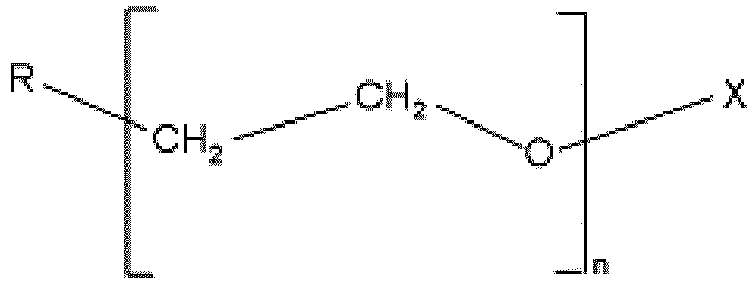
 - Procédé de préparation une nanoparticule d'un métal de transition ou d'un sel de celui-ci, utilisant le poly(oxyde d'éthylène) (PEO) ayant une extrémité de chaîne fonctionnalisée selon la revendication 1, comprenant :a) la fourniture d'un PEO ayant une masse moléculaire moyenne en nombre (Mn) de 500 à 100 000 g/mole par polymérisation anionique vivante de l'oxyde d'éthylène en utilisant un alkyl-lithium comme initiateur ;b) la réaction du PEO vivant obtenu dans l'étape a) avec un matériau de fonctionnalisation sous vide poussé pour obtenir un composé de formule (I) ou (II) ci-dessous;c) parmi les composés obtenus dans l'étape b), la réaction du composé de formule (I) dans laquelle X représente un groupe 2-bromoisobutyryle, 2-bromopropionyle ou méthacrylamide avec un monomère N-isopropylacrylamide ou sulfonamide méthacrylamide dans un solvant par polymérisation radicalaire pour obtenir un copolymère greffé ou séquencé de formule (III) ou (IV) ci-dessous ; etd) la réaction du polymère à base de PEO fonctionnalisé en bout de chaîne, choisi dans le groupe constitué par les composés des formules (I) à (IV) ci-dessous, obtenus dans les étapes b) et c), avec une solution aqueuse de sel métallique en présence d'un agent réducteur pour obtenir des particules de taille nanométrique de métal de transition ou de sel métallique de celui-ci, où les particules sont micellisées avec le polymère et ont une taille dans la gamme de 1 à 500 nm:



- Procédé selon la revendication 2, dans laquelle le solvant de l'étape a) est un mélange de DMSO et d'un solvant polaire ou un solvant non polaire.
- Procédé selon la revendication 2, dans laquelle le solvant de l'étape c) est l'eau, ou un mélange de DMSO et d'un solvant polaire ou un solvant non polaire comme dans l'étape a).
- Procédé selon la revendication 2, dans laquelle le solvant de l'étape d) est l'eau, ou un mélange de DMSO et d'un solvant polaire ou un solvant non polaire.
- Procédé selon la revendication 2, dans lequel, dans l'étape d), le poly(oxyde d'éthylène) (PEO) ayant une extrémité de chaîne fonctionnalisée et le métal de transition ou le sel de celui-ci sont mélangés dans un rapport molaire de 100:1 à 1:1.
- Procédé selon la revendication 2, dans lequel dans l'étape d), l'agent réducteur est choisi dans un groupe constitué par l'hydroxyde d'ammonium (NH4OH), l'hydrazine monohydratée (N2H2), NaBH4, H2O2, H2S et Na2S.
- Procédé selon la revendication 5, dans lequel, dans l'étape d), le poly(oxyde d'éthylène) (PEO) ayant une extrémité de chaîne fonctionnalisée est mis à réagir avec le métal de transition ou un sel de celui-ci à une température de 5 à 70°C.
- Nanoparticule d'un métal de transition ou d'un sel de celui-ci préparée selon un procédé selon la revendication 2, dans laquelle le métal de transition ou le sel de celui-ci est encapsulé par le poly(oxyde d'éthylène) (PEO) ayant une extrémité de chaîne fonctionnalisée selon la revendication 1.
- Nanoparticule d'un métal de transition ou d'un sel de celui-ci selon la revendication 9, dans laquelle le métal de transition ou le sel de celui-ci est choisi dans le groupe constitué par Au, Ag, Pt(II), Pd(II), CdS, TiO2, γ-Fe2O3 et Fe3O4.
- Nanoparticule d'un métal de transition ou d'un sel de celui-ci selon la revendication 9, ayant une taille dans la gamme de 1 nm à 500 nm.
Applications Claiming Priority (2)
| Application Number | Priority Date | Filing Date | Title |
|---|---|---|---|
| KR1020050061072A KR100626767B1 (ko) | 2005-07-07 | 2005-07-07 | 사슬 말단 기능성화된 폴리에틸렌옥사이드 및 이를 사용한나노 크기 전이금속 및 금속염의 제조 방법 |
| PCT/KR2006/002644 WO2007007976A1 (fr) | 2005-07-07 | 2006-07-06 | Poly(oxyde d'éthylène) fonctionnalisé en bout de chaîne et procédé pour la préparation d'un métal de transition ou sel de métal de transition de taille nanométrique utilisant celui-ci |
Publications (3)
| Publication Number | Publication Date |
|---|---|
| EP1899404A1 EP1899404A1 (fr) | 2008-03-19 |
| EP1899404A4 EP1899404A4 (fr) | 2009-09-09 |
| EP1899404B1 true EP1899404B1 (fr) | 2020-11-04 |
Family
ID=37628552
Family Applications (1)
| Application Number | Title | Priority Date | Filing Date |
|---|---|---|---|
| EP06769190.7A Not-in-force EP1899404B1 (fr) | 2005-07-07 | 2006-07-06 | Poly(oxyde d'éthylène) fonctionnalisé en bout de chaîne et procédé pour la préparation d'un métal de transition ou sel de métal de transition de taille nanométrique utilisant celui-ci |
Country Status (6)
| Country | Link |
|---|---|
| US (1) | US9005583B2 (fr) |
| EP (1) | EP1899404B1 (fr) |
| JP (1) | JP5097113B2 (fr) |
| KR (1) | KR100626767B1 (fr) |
| CN (1) | CN101253221B (fr) |
| WO (1) | WO2007007976A1 (fr) |
Families Citing this family (14)
| Publication number | Priority date | Publication date | Assignee | Title |
|---|---|---|---|---|
| KR20080104928A (ko) | 2007-05-29 | 2008-12-03 | 율촌화학 주식회사 | 암의 진단과 치료를 동시에 수행하는 항암제 |
| CN101679625B (zh) * | 2007-05-29 | 2013-06-26 | 栗村化学株式会社 | 链末端官能化的甲氧基聚乙二醇及其金属纳米颗粒 |
| KR100990861B1 (ko) * | 2008-02-26 | 2010-11-01 | 주식회사 제닉 | pH 응답성 폴리에틸렌 옥사이드계 공중합체 및 그 제조방법 |
| WO2010033226A1 (fr) * | 2008-09-17 | 2010-03-25 | Nektar Therapeutics | Conjugués inhibiteurs de protéase-oligomère |
| EP2391657A1 (fr) * | 2009-01-30 | 2011-12-07 | Philipps-Universität Marburg | Procédé de production de nanoparticules contenant du métal, enrobées de polymères et articles pouvant être obtenus à partir desdites nanoparticules |
| DE102009006942A1 (de) * | 2009-01-30 | 2010-08-05 | Philipps-Universität Marburg | Verfahren zur Herstellung von mit Polymeren umhüllten metallhaltigen Nanopartikeln und daraus erhältliche Partikel |
| JP5824686B2 (ja) * | 2011-05-24 | 2015-11-25 | センカ株式会社 | 温度応答性高分子微粒子及びその分散体の製造方法 |
| KR101330747B1 (ko) * | 2011-09-05 | 2013-11-18 | 주식회사한국큐텍 | 금속산화물 광촉매를 이용한 광역학적 암 치료제 제조방법 |
| KR101336232B1 (ko) * | 2011-12-27 | 2013-12-03 | 경희대학교 산학협력단 | 보론산기를 가지는 폴리에틸렌옥사이드계 블록공중합체 및 그에 의해 안정화된 산화철 나노입자 |
| KR101629771B1 (ko) | 2014-06-26 | 2016-06-13 | 피이오스페셜켐 주식회사 | 아자이드계 기능성 개시제를 이용한 양쪽 사슬말단에 이종의 기능성기가 도입된 폴리에틸렌옥사이드의 제조방법 |
| KR101629763B1 (ko) | 2014-06-26 | 2016-06-14 | 피이오스페셜켐 주식회사 | 프탈이미드계 기능성 개시제를 이용한 양쪽 사슬말단에 이종의 기능성기가 도입된 폴리에틸렌옥사이드의 제조방법 |
| KR20160066968A (ko) | 2014-12-03 | 2016-06-13 | 피이오스페셜켐 주식회사 | 치오아세테이트계 기능성 개시제를 이용한 양쪽 사슬말단에 기능성기가 도입된 폴리에틸렌옥사이드의 제조방법 |
| CN110922521A (zh) * | 2019-12-12 | 2020-03-27 | 广东六合新型建材有限公司 | 混凝土用抗吸附剂及其制备方法 |
| CN112979872A (zh) * | 2021-02-07 | 2021-06-18 | 中铝环保生态技术(湖南)有限公司 | 一种重金属捕捉剂的合成及应用 |
Family Cites Families (12)
| Publication number | Priority date | Publication date | Assignee | Title |
|---|---|---|---|---|
| US3476697A (en) * | 1965-05-28 | 1969-11-04 | Rohm & Haas | Linear polymers with polyfunctional telomers and derivatives thereof |
| US4483969A (en) * | 1983-06-30 | 1984-11-20 | Eastman Kodak Company | Emulsifiable polyester waxes |
| EP0497404A1 (fr) * | 1991-01-25 | 1992-08-05 | Dsm N.V. | Système d'émulsifiant interne à base d'unités d'oxyde d'alcoylène |
| JPH08165442A (ja) * | 1994-12-15 | 1996-06-25 | Kansai Paint Co Ltd | 屋外での汚れ防止性に優れた塗膜を形成できる塗料組成物 |
| US6692724B1 (en) * | 1999-10-25 | 2004-02-17 | Board Of Regents, The University Of Texas System | Ethylenedicysteine (EC)-drug conjugates, compositions and methods for tissue specific disease imaging |
| KR100346994B1 (ko) * | 2000-01-11 | 2002-07-31 | 한국과학기술연구원 | 술폰산화 폴리에틸렌옥사이드가 결합된 생체적합성 의료용금속 재료 및 이의 제조 방법 |
| US6530944B2 (en) * | 2000-02-08 | 2003-03-11 | Rice University | Optically-active nanoparticles for use in therapeutic and diagnostic methods |
| US6939564B2 (en) * | 2001-06-08 | 2005-09-06 | Labopharm, Inc. | Water-soluble stabilized self-assembled polyelectrolytes |
| GB0131112D0 (en) * | 2001-12-31 | 2002-02-13 | Univ London Pharmacy | Block copolymers |
| KR100453131B1 (ko) * | 2002-08-10 | 2004-10-15 | 율촌화학 주식회사 | 사슬 말단 기능성 고분자를 이용하여 안정화시킨 나노크기 금속 또는 금속염 및 이들의 제조 방법 |
| US7939170B2 (en) * | 2002-08-15 | 2011-05-10 | The Rockefeller University | Water soluble metal and semiconductor nanoparticle complexes |
| KR100511030B1 (ko) * | 2002-10-21 | 2005-08-31 | 한국과학기술연구원 | 혈액적합성 의료용 금속 재료 및 이의 제조 방법 |
-
2005
- 2005-07-07 KR KR1020050061072A patent/KR100626767B1/ko not_active Expired - Fee Related
-
2006
- 2006-07-06 CN CN2006800294973A patent/CN101253221B/zh not_active Expired - Fee Related
- 2006-07-06 WO PCT/KR2006/002644 patent/WO2007007976A1/fr not_active Ceased
- 2006-07-06 EP EP06769190.7A patent/EP1899404B1/fr not_active Not-in-force
- 2006-07-06 US US11/994,964 patent/US9005583B2/en not_active Expired - Fee Related
- 2006-07-06 JP JP2008520184A patent/JP5097113B2/ja not_active Expired - Fee Related
Non-Patent Citations (1)
| Title |
|---|
| None * |
Also Published As
| Publication number | Publication date |
|---|---|
| CN101253221B (zh) | 2013-03-20 |
| KR100626767B1 (ko) | 2006-09-25 |
| JP5097113B2 (ja) | 2012-12-12 |
| US9005583B2 (en) | 2015-04-14 |
| US20090142268A1 (en) | 2009-06-04 |
| CN101253221A (zh) | 2008-08-27 |
| JP2009500488A (ja) | 2009-01-08 |
| EP1899404A1 (fr) | 2008-03-19 |
| WO2007007976A1 (fr) | 2007-01-18 |
| EP1899404A4 (fr) | 2009-09-09 |
Similar Documents
| Publication | Publication Date | Title |
|---|---|---|
| EP2150568B1 (fr) | Méthoxy poly(éthylène glycol) à extrémité de chaîne fonctionnalisée et nanoparticules métalliques utilisant celui-ci | |
| EP1899404B1 (fr) | Poly(oxyde d'éthylène) fonctionnalisé en bout de chaîne et procédé pour la préparation d'un métal de transition ou sel de métal de transition de taille nanométrique utilisant celui-ci | |
| Zhang et al. | Polyion complex micelles possessing thermoresponsive coronas and their covalent core stabilization via “click” chemistry | |
| Ge et al. | Synthesis and supramolecular self-assembly of stimuli-responsive water-soluble Janus-type heteroarm star copolymers | |
| JPH0556774B2 (fr) | ||
| Öztürk et al. | Synthesis of block copolymer including polyepichlorohydrin and polyethylene glycol by “click” chemistry: evaluation of primary parameters of copolymerization | |
| Ievins et al. | Synthesis of hollow responsive functional nanocages using a metal–ligand complexation strategy | |
| Wang et al. | Dual thermo-responsive polyrotaxane-based triblock copolymers synthesized via ATRP of N-isopropylacrylamide initiated with self-assemblies of Br end-capped Pluronic F127 with β-cyclodextrins | |
| US8420771B2 (en) | PH-sensitive polyethylene oxide co-polymer and synthetic method thereof | |
| Dimitrov et al. | Triblock and Radial Star‐Block Copolymers Comprised of Poly (ethoxyethyl glycidyl ether), Polyglycidol, Poly (propylene oxide) and Polystyrene Obtained by Anionic Polymerization Initiated by Cs Initiators | |
| KR101336692B1 (ko) | 하이드라지드기를 가지는 폴리에틸렌옥사이드계 블록공중합체 및 그에 의해 안정화된 산화철 나노입자 | |
| Weiss-Maurin et al. | Direct one-pot synthesis of poly (ionic liquid) nanogels by cobalt-mediated radical cross-linking copolymerization in organic or aqueous media | |
| Mishra et al. | Synthesis and self-assembly properties of well-defined four-arm star poly (ε-caprolactone)-b-poly (N-vinylpyrrolidone) amphiphilic block copolymers | |
| US20120245244A1 (en) | Cleavable block copolymers, functionalized nanoporous thin films and related methods of preparation | |
| EP1688440B1 (fr) | Nouveau polymere hyper-ramifie | |
| Yuan et al. | Facile preparation of cancer-specific polyelectrolyte nanogels from natural and synthetic sugar polymers | |
| EP4707309A1 (fr) | Procédé de fabrication de sel de lithium organique, composition contenant ce sel de lithium organique, et polymère | |
| CN113621114B (zh) | 一种两亲性嵌段共聚物蠕虫状胶束及其制备方法和应用 | |
| Xiao et al. | Effect of temperature-responsive solution behavior of PNIPAM-b-PPEOMA-b-PNIPAM on its inclusion complexation with α-cyclodextrin | |
| JP7764064B1 (ja) | ゲル製造用組成物およびその利用 | |
| Liu et al. | Synthesis of double‐hydrophilic poly (methylacrylic acid)–poly (ethylene glycol)–poly (methylacrylic acid) triblock copolymers and their micelle formation | |
| CENGİZ | Preparation and Dual-Functionalization of Pendant Aldehyde and Azide-Bearing Hydrophilic Polymer | |
| Das et al. | Study of the Self-Aggregation Behaviour of Well-Defined Peo-Basedamphiphilic Tri-Block Copolymers and Their Ability as Metal Detectors |
Legal Events
| Date | Code | Title | Description |
|---|---|---|---|
| PUAI | Public reference made under article 153(3) epc to a published international application that has entered the european phase |
Free format text: ORIGINAL CODE: 0009012 |
|
| 17P | Request for examination filed |
Effective date: 20080115 |
|
| AK | Designated contracting states |
Kind code of ref document: A1 Designated state(s): AT BE BG CH CY CZ DE DK EE ES FI FR GB GR HU IE IS IT LI LT LU LV MC NL PL PT RO SE SI SK TR |
|
| DAX | Request for extension of the european patent (deleted) | ||
| RIN1 | Information on inventor provided before grant (corrected) |
Inventor name: HWANG, SOON GEUNBUHEUNG VILLA D-202 Inventor name: HONG, SOON MANSAMSUNG CHEONGDAM GONGWON APT. Inventor name: HWANG, SEUNG SANG,HAGYE 2-CHA HYUNDAI APT. Inventor name: RYU, HAN WOOKB Inventor name: KIM, JANG SEOP Inventor name: SHIN, DONG YOUN Inventor name: KIM, JI HEE, Inventor name: PARK, JOON HYEONG Inventor name: KWAK, SOONJONG, Inventor name: KIM, KWANG UNG, Inventor name: KIM, JUNGAHN |
|
| A4 | Supplementary search report drawn up and despatched |
Effective date: 20090806 |
|
| 17Q | First examination report despatched |
Effective date: 20120413 |
|
| DAX | Request for extension of the european patent (deleted) | ||
| STAA | Information on the status of an ep patent application or granted ep patent |
Free format text: STATUS: EXAMINATION IS IN PROGRESS |
|
| GRAP | Despatch of communication of intention to grant a patent |
Free format text: ORIGINAL CODE: EPIDOSNIGR1 |
|
| STAA | Information on the status of an ep patent application or granted ep patent |
Free format text: STATUS: GRANT OF PATENT IS INTENDED |
|
| RIN1 | Information on inventor provided before grant (corrected) |
Inventor name: HONG, SOON MAN Inventor name: KIM, JANG SEOP Inventor name: HWANG, SOON GEUN Inventor name: KIM, JUNGAHN Inventor name: KIM, KWANG UNG Inventor name: PARK, JOON HYEONG Inventor name: HWANG, SEUNG SANG Inventor name: RYU, HAN WOOK Inventor name: SHIN, DONG YOUN Inventor name: KIM, JI HEE Inventor name: KWAK, SOONJONG |
|
| INTG | Intention to grant announced |
Effective date: 20200616 |
|
| RAP1 | Party data changed (applicant data changed or rights of an application transferred) |
Owner name: YOUL CHON CHEMICAL CO., LTD. |
|
| GRAS | Grant fee paid |
Free format text: ORIGINAL CODE: EPIDOSNIGR3 |
|
| GRAA | (expected) grant |
Free format text: ORIGINAL CODE: 0009210 |
|
| STAA | Information on the status of an ep patent application or granted ep patent |
Free format text: STATUS: THE PATENT HAS BEEN GRANTED |
|
| AK | Designated contracting states |
Kind code of ref document: B1 Designated state(s): AT BE BG CH CY CZ DE DK EE ES FI FR GB GR HU IE IS IT LI LT LU LV MC NL PL PT RO SE SI SK TR |
|
| REG | Reference to a national code |
Ref country code: GB Ref legal event code: FG4D |
|
| REG | Reference to a national code |
Ref country code: CH Ref legal event code: EP |
|
| REG | Reference to a national code |
Ref country code: AT Ref legal event code: REF Ref document number: 1330754 Country of ref document: AT Kind code of ref document: T Effective date: 20201115 |
|
| REG | Reference to a national code |
Ref country code: DE Ref legal event code: R096 Ref document number: 602006059781 Country of ref document: DE |
|
| REG | Reference to a national code |
Ref country code: IE Ref legal event code: FG4D |
|
| REG | Reference to a national code |
Ref country code: NL Ref legal event code: MP Effective date: 20201104 |
|
| REG | Reference to a national code |
Ref country code: AT Ref legal event code: MK05 Ref document number: 1330754 Country of ref document: AT Kind code of ref document: T Effective date: 20201104 |
|
| PG25 | Lapsed in a contracting state [announced via postgrant information from national office to epo] |
Ref country code: FI Free format text: LAPSE BECAUSE OF FAILURE TO SUBMIT A TRANSLATION OF THE DESCRIPTION OR TO PAY THE FEE WITHIN THE PRESCRIBED TIME-LIMIT Effective date: 20201104 Ref country code: PT Free format text: LAPSE BECAUSE OF FAILURE TO SUBMIT A TRANSLATION OF THE DESCRIPTION OR TO PAY THE FEE WITHIN THE PRESCRIBED TIME-LIMIT Effective date: 20210304 Ref country code: GR Free format text: LAPSE BECAUSE OF FAILURE TO SUBMIT A TRANSLATION OF THE DESCRIPTION OR TO PAY THE FEE WITHIN THE PRESCRIBED TIME-LIMIT Effective date: 20210205 |
|
| PG25 | Lapsed in a contracting state [announced via postgrant information from national office to epo] |
Ref country code: IS Free format text: LAPSE BECAUSE OF FAILURE TO SUBMIT A TRANSLATION OF THE DESCRIPTION OR TO PAY THE FEE WITHIN THE PRESCRIBED TIME-LIMIT Effective date: 20210304 Ref country code: ES Free format text: LAPSE BECAUSE OF FAILURE TO SUBMIT A TRANSLATION OF THE DESCRIPTION OR TO PAY THE FEE WITHIN THE PRESCRIBED TIME-LIMIT Effective date: 20201104 Ref country code: BG Free format text: LAPSE BECAUSE OF FAILURE TO SUBMIT A TRANSLATION OF THE DESCRIPTION OR TO PAY THE FEE WITHIN THE PRESCRIBED TIME-LIMIT Effective date: 20210204 Ref country code: AT Free format text: LAPSE BECAUSE OF FAILURE TO SUBMIT A TRANSLATION OF THE DESCRIPTION OR TO PAY THE FEE WITHIN THE PRESCRIBED TIME-LIMIT Effective date: 20201104 Ref country code: SE Free format text: LAPSE BECAUSE OF FAILURE TO SUBMIT A TRANSLATION OF THE DESCRIPTION OR TO PAY THE FEE WITHIN THE PRESCRIBED TIME-LIMIT Effective date: 20201104 Ref country code: LV Free format text: LAPSE BECAUSE OF FAILURE TO SUBMIT A TRANSLATION OF THE DESCRIPTION OR TO PAY THE FEE WITHIN THE PRESCRIBED TIME-LIMIT Effective date: 20201104 Ref country code: PL Free format text: LAPSE BECAUSE OF FAILURE TO SUBMIT A TRANSLATION OF THE DESCRIPTION OR TO PAY THE FEE WITHIN THE PRESCRIBED TIME-LIMIT Effective date: 20201104 |
|
| REG | Reference to a national code |
Ref country code: LT Ref legal event code: MG9D |
|
| PG25 | Lapsed in a contracting state [announced via postgrant information from national office to epo] |
Ref country code: LT Free format text: LAPSE BECAUSE OF FAILURE TO SUBMIT A TRANSLATION OF THE DESCRIPTION OR TO PAY THE FEE WITHIN THE PRESCRIBED TIME-LIMIT Effective date: 20201104 Ref country code: SK Free format text: LAPSE BECAUSE OF FAILURE TO SUBMIT A TRANSLATION OF THE DESCRIPTION OR TO PAY THE FEE WITHIN THE PRESCRIBED TIME-LIMIT Effective date: 20201104 Ref country code: RO Free format text: LAPSE BECAUSE OF FAILURE TO SUBMIT A TRANSLATION OF THE DESCRIPTION OR TO PAY THE FEE WITHIN THE PRESCRIBED TIME-LIMIT Effective date: 20201104 Ref country code: EE Free format text: LAPSE BECAUSE OF FAILURE TO SUBMIT A TRANSLATION OF THE DESCRIPTION OR TO PAY THE FEE WITHIN THE PRESCRIBED TIME-LIMIT Effective date: 20201104 Ref country code: CZ Free format text: LAPSE BECAUSE OF FAILURE TO SUBMIT A TRANSLATION OF THE DESCRIPTION OR TO PAY THE FEE WITHIN THE PRESCRIBED TIME-LIMIT Effective date: 20201104 |
|
| REG | Reference to a national code |
Ref country code: DE Ref legal event code: R097 Ref document number: 602006059781 Country of ref document: DE |
|
| PG25 | Lapsed in a contracting state [announced via postgrant information from national office to epo] |
Ref country code: DK Free format text: LAPSE BECAUSE OF FAILURE TO SUBMIT A TRANSLATION OF THE DESCRIPTION OR TO PAY THE FEE WITHIN THE PRESCRIBED TIME-LIMIT Effective date: 20201104 |
|
| PLBE | No opposition filed within time limit |
Free format text: ORIGINAL CODE: 0009261 |
|
| STAA | Information on the status of an ep patent application or granted ep patent |
Free format text: STATUS: NO OPPOSITION FILED WITHIN TIME LIMIT |
|
| 26N | No opposition filed |
Effective date: 20210805 |
|
| PG25 | Lapsed in a contracting state [announced via postgrant information from national office to epo] |
Ref country code: NL Free format text: LAPSE BECAUSE OF FAILURE TO SUBMIT A TRANSLATION OF THE DESCRIPTION OR TO PAY THE FEE WITHIN THE PRESCRIBED TIME-LIMIT Effective date: 20201104 Ref country code: IT Free format text: LAPSE BECAUSE OF FAILURE TO SUBMIT A TRANSLATION OF THE DESCRIPTION OR TO PAY THE FEE WITHIN THE PRESCRIBED TIME-LIMIT Effective date: 20201104 |
|
| PG25 | Lapsed in a contracting state [announced via postgrant information from national office to epo] |
Ref country code: SI Free format text: LAPSE BECAUSE OF FAILURE TO SUBMIT A TRANSLATION OF THE DESCRIPTION OR TO PAY THE FEE WITHIN THE PRESCRIBED TIME-LIMIT Effective date: 20201104 |
|
| REG | Reference to a national code |
Ref country code: DE Ref legal event code: R119 Ref document number: 602006059781 Country of ref document: DE |
|
| REG | Reference to a national code |
Ref country code: CH Ref legal event code: PL |
|
| GBPC | Gb: european patent ceased through non-payment of renewal fee |
Effective date: 20210706 |
|
| PG25 | Lapsed in a contracting state [announced via postgrant information from national office to epo] |
Ref country code: MC Free format text: LAPSE BECAUSE OF FAILURE TO SUBMIT A TRANSLATION OF THE DESCRIPTION OR TO PAY THE FEE WITHIN THE PRESCRIBED TIME-LIMIT Effective date: 20201104 |
|
| REG | Reference to a national code |
Ref country code: BE Ref legal event code: MM Effective date: 20210731 |
|
| PG25 | Lapsed in a contracting state [announced via postgrant information from national office to epo] |
Ref country code: LI Free format text: LAPSE BECAUSE OF NON-PAYMENT OF DUE FEES Effective date: 20210731 Ref country code: GB Free format text: LAPSE BECAUSE OF NON-PAYMENT OF DUE FEES Effective date: 20210706 Ref country code: DE Free format text: LAPSE BECAUSE OF NON-PAYMENT OF DUE FEES Effective date: 20220201 Ref country code: CH Free format text: LAPSE BECAUSE OF NON-PAYMENT OF DUE FEES Effective date: 20210731 |
|
| PG25 | Lapsed in a contracting state [announced via postgrant information from national office to epo] |
Ref country code: IS Free format text: LAPSE BECAUSE OF FAILURE TO SUBMIT A TRANSLATION OF THE DESCRIPTION OR TO PAY THE FEE WITHIN THE PRESCRIBED TIME-LIMIT Effective date: 20210304 Ref country code: LU Free format text: LAPSE BECAUSE OF NON-PAYMENT OF DUE FEES Effective date: 20210706 Ref country code: FR Free format text: LAPSE BECAUSE OF NON-PAYMENT OF DUE FEES Effective date: 20210731 |
|
| PG25 | Lapsed in a contracting state [announced via postgrant information from national office to epo] |
Ref country code: IE Free format text: LAPSE BECAUSE OF NON-PAYMENT OF DUE FEES Effective date: 20210706 Ref country code: BE Free format text: LAPSE BECAUSE OF NON-PAYMENT OF DUE FEES Effective date: 20210731 |
|
| PG25 | Lapsed in a contracting state [announced via postgrant information from national office to epo] |
Ref country code: HU Free format text: LAPSE BECAUSE OF FAILURE TO SUBMIT A TRANSLATION OF THE DESCRIPTION OR TO PAY THE FEE WITHIN THE PRESCRIBED TIME-LIMIT; INVALID AB INITIO Effective date: 20060706 Ref country code: CY Free format text: LAPSE BECAUSE OF FAILURE TO SUBMIT A TRANSLATION OF THE DESCRIPTION OR TO PAY THE FEE WITHIN THE PRESCRIBED TIME-LIMIT Effective date: 20201104 |
|
| PG25 | Lapsed in a contracting state [announced via postgrant information from national office to epo] |
Ref country code: TR Free format text: LAPSE BECAUSE OF FAILURE TO SUBMIT A TRANSLATION OF THE DESCRIPTION OR TO PAY THE FEE WITHIN THE PRESCRIBED TIME-LIMIT Effective date: 20201104 |