EP1900170B1 - Procedure d'authentification rapide dans des reseaux de communication de donnees sans fil - Google Patents
Procedure d'authentification rapide dans des reseaux de communication de donnees sans fil Download PDFInfo
- Publication number
- EP1900170B1 EP1900170B1 EP05759721.3A EP05759721A EP1900170B1 EP 1900170 B1 EP1900170 B1 EP 1900170B1 EP 05759721 A EP05759721 A EP 05759721A EP 1900170 B1 EP1900170 B1 EP 1900170B1
- Authority
- EP
- European Patent Office
- Prior art keywords
- supplicant
- authentication
- authenticator
- identifier
- authentication server
- Prior art date
- Legal status (The legal status is an assumption and is not a legal conclusion. Google has not performed a legal analysis and makes no representation as to the accuracy of the status listed.)
- Expired - Lifetime
Links
Images





Classifications
-
- H—ELECTRICITY
- H04—ELECTRIC COMMUNICATION TECHNIQUE
- H04L—TRANSMISSION OF DIGITAL INFORMATION, e.g. TELEGRAPHIC COMMUNICATION
- H04L63/00—Network architectures or network communication protocols for network security
- H04L63/08—Network architectures or network communication protocols for network security for authentication of entities
-
- H—ELECTRICITY
- H04—ELECTRIC COMMUNICATION TECHNIQUE
- H04L—TRANSMISSION OF DIGITAL INFORMATION, e.g. TELEGRAPHIC COMMUNICATION
- H04L63/00—Network architectures or network communication protocols for network security
- H04L63/16—Implementing security features at a particular protocol layer
- H04L63/162—Implementing security features at a particular protocol layer at the data link layer
-
- H—ELECTRICITY
- H04—ELECTRIC COMMUNICATION TECHNIQUE
- H04W—WIRELESS COMMUNICATION NETWORKS
- H04W12/00—Security arrangements; Authentication; Protecting privacy or anonymity
- H04W12/04—Key management, e.g. using generic bootstrapping architecture [GBA]
- H04W12/043—Key management, e.g. using generic bootstrapping architecture [GBA] using a trusted network node as an anchor
-
- H—ELECTRICITY
- H04—ELECTRIC COMMUNICATION TECHNIQUE
- H04W—WIRELESS COMMUNICATION NETWORKS
- H04W12/00—Security arrangements; Authentication; Protecting privacy or anonymity
- H04W12/06—Authentication
- H04W12/062—Pre-authentication
-
- H—ELECTRICITY
- H04—ELECTRIC COMMUNICATION TECHNIQUE
- H04W—WIRELESS COMMUNICATION NETWORKS
- H04W12/00—Security arrangements; Authentication; Protecting privacy or anonymity
- H04W12/06—Authentication
- H04W12/069—Authentication using certificates or pre-shared keys
-
- H—ELECTRICITY
- H04—ELECTRIC COMMUNICATION TECHNIQUE
- H04L—TRANSMISSION OF DIGITAL INFORMATION, e.g. TELEGRAPHIC COMMUNICATION
- H04L63/00—Network architectures or network communication protocols for network security
- H04L63/08—Network architectures or network communication protocols for network security for authentication of entities
- H04L63/0807—Network architectures or network communication protocols for network security for authentication of entities using tickets, e.g. Kerberos
-
- H—ELECTRICITY
- H04—ELECTRIC COMMUNICATION TECHNIQUE
- H04W—WIRELESS COMMUNICATION NETWORKS
- H04W84/00—Network topologies
- H04W84/02—Hierarchically pre-organised networks, e.g. paging networks, cellular networks, WLAN [Wireless Local Area Network] or WLL [Wireless Local Loop]
- H04W84/10—Small scale networks; Flat hierarchical networks
- H04W84/12—WLAN [Wireless Local Area Networks]
Definitions
- the present invention generally relates to the field of telecommunications, particularly to data communications networks and, even more particularly, to wireless data communications networks, like those complying with the standard IEEE (Institute of Electrical and Electronics Engineers) 802.11. More specifically, the invention concerns a fast and secure authentication mechanism of wireless terminals in wireless data communications networks.
- Wi-Fi Wireless Fidelity
- Wi-Fi Wireless Fidelity
- the IEEE 802.11 standard available on the Internet for download via the URL: http://standards.ieee.org/getieee802/802.11.html (at the filing date of the present patent application), specifies the Medium Access Control (MAC) and physical (PHY) layers for devices capable of operation in the unlicensed Industrial, Scientific, and Medical (ISM) radio bands (2.4 GHz and 5 GHz).
- MAC Medium Access Control
- PHY Physical
- WLANs are however inherently less secure than conventional wired LANs, for the reason that they use radio as communication medium.
- a wireless network it is hard to control the exact extension range of the network; in the case of a company's WLAN, for example, the radio signal can easily get over the boundary of the company site and an attacker, with a suitable antenna, can passively monitor (“sniff', in jargon) network traffic without the need to access neither physically nor logically the network.
- IEEE 802.11i has defined an amendment to the original IEEE 802.11 standard, called IEEE 802.11i and commercially known as Wi-Fi Protected Access (WPA), which establishes a new security standard for Wi-Fi networks.
- WPA Wi-Fi Protected Access
- IEEE 802.11i relies on a port-based network access-control mechanism established in another, independent standard called IEEE 802.1X (IEEE standard for local and metropolitan area networks- port-based network exchange) for authentication and key distribution.
- IEEE 802.1X IEEE standard for local and metropolitan area networks- port-based network exchange
- the IEEE 802.1X relies on the Extensible Authentication Protocol (EAP - specified in the Request For Comment 3748, downloadable at www.ietf.org/rfc/rfc3748.txt at the filing date of the present patent application), an Internet Engineering Task Force (IETF) standard that defines a general-purpose authentication protocol built around a "challenge-response" communication paradigm, to support a wide variety of authentication mechanisms (called “EAP-types").
- IETF Internet Engineering Task Force
- the IEEE 802.1X includes a procedure for dynamic derivation of keys, on a per client and per session basis, embedded in the authentication method.
- the IEEE 802.11i standard establishes that, after performing the IEEE 802.1X authentication procedure, a key-agreement sequence based on messages of the type EAP Over LAN (EAPOL)-key takes place according to which, by means of a four-way handshake, a session encryption key can be derived starting from a Master Session Key (MSK).
- EAPOL EAP Over LAN
- the "actors" of the IEEE 802.1X framework are the "supplicant”, the "authenticator” and the "authentication server”.
- the supplicant is an entity, e.g . a wireless user terminal that seeks to be authenticated by an authenticator, e.g., an Access Point (AP) of the wireless network.
- an authenticator e.g., an Access Point (AP) of the wireless network.
- the supplicant wishing to use a service (MAC connectivity) offered via a port on the authenticator, needs to be authenticated via the authenticator to a central authentication server, which directs the authenticator about how to provide the service after successful authentication.
- MAC connectivity MAC connectivity
- the authenticator has two ports of access to the network: an "uncontrolled” port, always open to the authentication message transit, and a “controlled” port that is only open if the authentication procedure succeeds.
- the authenticator receives from the authentication server the coding keys, per client and per session, for the next data radio communications with the supplicant.
- the authentication server is an entity that provides an authentication service to one or more authenticators; it can be for example a RADIUS (Remote Authentication Dial-In User Service) server, a Kerberos server, a Diameter server etc..
- RADIUS Remote Authentication Dial-In User Service
- the implementation of the IEEE 802.11i standard has an impact on the management of the mobility of the wireless terminals, and particularly of the handoff procedures, i.e. those procedures managing the change of the point of access to the wireless network (change of access point) by a moving wireless terminal.
- the authentication sequence takes place after the association procedure, and this has a strong impact on the time required for the handoff.
- an authentication procedure towards the new access point is first performed, followed by an association procedure with the new access point, and, consequently, the de-association from the old access point.
- the adoption of the IEEE 802.11i standard has the consequence that, the 802.1X authentication procedure is performed after the open authentication and association procedure. Due to this, the computational burden inherent to the 802.1X authentication mechanism is entirely within the handoff, and this prevents from speeding up the handoff procedure while retaining a strong (i.e., computationally-intensive) authentication method; in other words, as long as the authentication method is kept strong, so as to ensure a high level of security, it is inherently computationally-intensive, and the handoff procedure thus takes a relatively long time.
- a strong (i.e., computationally-intensive) authentication method in other words, as long as the authentication method is kept strong, so as to ensure a high level of security, it is inherently computationally-intensive, and the handoff procedure thus takes a relatively long time.
- the standardization group IEEE 802.11f (“Recommended Practice for Multi-Vendor Access Point Interoperability via an Inter-Access Point Protocol Across Distribution Systems Supporting IEEE 802.11 Operation”) has proposed a solution exploiting the Inter-AP communication protocol (LAPP), whose aim is to maintain a secure association in respect of each wireless terminal, and let such an information be exchanged in a secure way by APs involved in a handoff.
- LAPP Inter-AP communication protocol
- US 2004/0240412 describes a method for pre-authenticating a pre-establishing key management on a roaming device prior to re-association to facilitate fast handoff.
- US 2004/0103275 discloses a solution in which the handoff of a wireless terminal is managed through a public-key mechanism.
- the Applicant observes that in case an AP is compromised, the current and next IEEE 802.11i PTK's (Pairwise Transient Keys) are no more secure. Moreover, for the Perfect Forward Secrecy (PFS) it would be necessary that the PMK (Pairwise Master Key) used for the handoff be calculated starting from a secret unknown and inaccessible to the AP. Furthermore, the solution involves in any case a significant delay in the handoff, caused by the IAPP communication between the two involved APs and the RADIUS server.
- PTK Perfect Forward Secrecy
- the Applicant observes that the APs need to maintain a security association, albeit possibly for a limited time, and this may cause a waste of resources, especially in those cases where the wireless terminal do not perform the handoff within that time, or in case the handoff is performed but after defined lifetime, with the consequence that the wireless terminal will have to perform a full authentication.
- each AP has to store the PMKs of the wireless terminals, irrespective of whether the terminals perform the handoff or not; due to this, should an AP be compromised in consequence of an attack it would allow the attacker to gain knowledge of the PMKs relating to other wireless terminals and, by simply sniffing the packets of the four-ways handshake, the attacker could derive the session keys PTKs.
- the Applicant observes that the temporary communication session key received by the mobile terminal during the re-authentication is only valid for a short period of time, after that, the mobile terminal must complete the normal mobile terminal authentication procedure through the RADIUS server.
- the wireless network uses a shared secret key known to all authentication portable wireless network node devices to encrypt data transmitted through the wireless backbone network. Due to that, in case a wireless network node device is compromised an attacker could be able to intercept all traffic transmitted in the wireless backbone.
- a compromised access point should not put at risk the secrecy of the preceding and following security associations, and thus the respective authentication keys; and only the authentication server and the access point to which a wireless terminal is connected at a given time should be assumed to be "trusted” entities, whereas all the other access points should not be assumed to be trusted.
- full there is meant the authentication procedure that shall take place at the first time a wireless terminal connects to the wireless network, during which all keys used for security purpose, such as encryption, are generated afresh in both the wireless terminal and the authentication server).
- the Applicant has devised a new, efficient and secure short authentication procedure useful for managing the handoffs.
- the Applicant has found that this procedure can also be applied to the full authentication procedure.
- the short authentication procedure according to the present invention comprises the generation of an authentication token based on a shared secret, shared by and available at the wireless terminal and the authentication server.
- a short authentication method as set forth in appended claim 1 for authenticating a supplicant in a wireless communications network including at least one authenticator and at least one authentication server, wherein the authenticator is adapted to interact with the authentication server for authenticating supplicants in order to conditionally grant thereto access to the wireless communications network.
- the method comprising:
- authentication there is intended any wireless network device performing (possibly inter-alia ) the function to enforce authentication to a requesting "supplicant", before allowing access to services that are accessible through it, as defined by the 802.1X standard.
- wireless device there is intended any devices equipped with a wireless communications interface.
- supplicant there is intended any wireless device, like a wireless user terminal, that plays the supplicant role as defined by the 802.1X standard.
- authentication server there is meant a network entity adapted to provide an authentication service to the authenticator, wherein such an authentication service authorizes or not the access to the network by the wireless device based on credentials provided by the latter.
- handoff there is finally meant any situation in which a wireless device changes the authenticator.
- the roles of the various entities, particularly that of authenticator and supplicant may be played by different devices, and one same device may play more than one role.
- the network's access points play the role of authenticators in respect of supplicants that are represented by wireless user terminals associated therewith.
- a generic access point plays the role of supplicant and of authenticator in respect of other access points of the backhaul network or in respect of supplicants represented by wireless terminals associated therewith.
- a Mobile Ad-hoc NETwork MANET
- the generic wireless user terminal in addition to playing the role of supplicant, also plays the role of authenticator in respect of other wireless user terminals.
- Another aspect of the present invention concerns a wireless communications network including:
- FIG. 1 a first scenario is schematically depicted in which a short authentication procedure according to an embodiment of the present invention, particularly for the management of handoffs, is advantageously used.
- a data communications network globally denoted by reference numeral 100, comprises a wireless network 105 according to the standard IEEE 802.11 (i.e., a Wi-Fi network or WLAN) 105 , attached to an infrastructured, wired data communications network 110 , including for example a wired LAN, a MAN (Metropolitan Area Network), a WAN (Wide Area Network), or a combination of two or more infrastructured networks.
- IEEE 802.11 i.e., a Wi-Fi network or WLAN
- WLAN Wireless Local Area Network
- the wireless network 105 provides wireless access to the infrastructured network 110.
- the wireless network 105 comprises a plurality of Access Points (APs), like the three APs 115a, 115b and 115c shown in the drawing.
- APs Access Points
- the APs have a first, wired network interface 120 , and a second, wireless (radio) network interface 125, particularly an IEEE 802.11 (WiFi) interface.
- a first, wired network interface 120 and a second, wireless (radio) network interface 125, particularly an IEEE 802.11 (WiFi) interface.
- WiFi IEEE 802.11
- the first network interface 120 for example an Ethernet interface, is exploited for connecting the APs to each other and to the infrastructured network 110 (possibly through one or more gateways, not shown in the drawing).
- the second, wireless network interface 125 is exploited for providing the wireless access to users of wireless user terminals (like portable personal computers, laptops, palmtops, PDAs, smartphones and like devices) equipped in turn with a wireless (particularly a Wi-Fi) network interface, such as the two wireless user terminals 130a and 130b shown in the drawing.
- wireless user terminals like portable personal computers, laptops, palmtops, PDAs, smartphones and like devices
- a wireless (particularly a Wi-Fi) network interface such as the two wireless user terminals 130a and 130b shown in the drawing.
- the wireless user terminals can connect to the wireless network 105 so as to communicate with each other, as well as to access the infrastructured network 110, e.g. for surfing the Internet.
- the wireless access network 105 can be defined as "static".
- the wireless user terminal 130b is assumed to be connected to the AP 115c, and to be not moving; the wireless user terminal 130a is instead assumed to be connected initially to the AP 115a, and to be moving, as suggested by the path denoted by reference numeral 135, so that the wireless user terminal 130a ends up being connected to the AP 115b: in the scenario of Figure 1 , such a change of AP constitutes a handoff.
- the wireless network 105 is further assumed to comply with the IEEE 802.11i standard, implementing the so-called Wireless Protected Access (WPA).
- WPA Wireless Protected Access
- the IEEE 802.11i standard exploits as a core element the IEEE 802.1X standard as far as authentication and key distribution are concerned.
- the IEEE 802.1X standard provides a port-based network access control mechanism.
- the IEEE 802.1X relies on the EAP, a protocol that permits a wide variety of authentication mechanisms (the EAP-types).
- the IEEE 802.1X standard further foresees a procedure, being part of the authentication mechanism, for dynamic derivation of keys, on a per client and per session basis.
- the actors of the IEEE 802.1X framework are the supplicant, the authenticator, and the authentication server.
- the role of the supplicant is played by a generic wireless user terminal, like the wireless user terminals 130a and 130b, that seeks to be authenticated by an AP, the latter acting as an authenticator, in order to use a service offered via a port on the authenticator (e.g., a MAC connectivity service).
- the supplicant needs to be authenticated via the authenticator to a central authentication server, denoted as 140 in Figure 1 , which is assumed to be located in the infrastructured network 110; the authentication server 140 provides to the authenticator directions about how to provide the service to the supplicant after successful authentication.
- the authenticator facilitates the authentication process of the supplicant; the authenticator works in pass-through mode between the supplicant and the authentication server, implementing the logical doors control mechanism.
- the authenticator has two access ports to the network: a so-called “uncontrolled” port, and a so-called “controlled” port.
- the uncontrolled port is always open to the authentication messages transit, whereas the controlled port only becomes open after the authentication procedure succeeds: at that time, the authenticator receives from the authentication server the coding keys, per client and per session, for the next data radio communications with the supplicant.
- the authentication server is an entity that provides an authentication service to an authenticator; the authentication server can for example be a RADIUS (Remote Authentication Dial-In User Service) server, a Kerberos server, a Diameter server etc., and can be a dedicated appliance (as in the exemplary case depicted in Figure 1 ) or be integrated ("co-located") in an authenticator.
- RADIUS Remote Authentication Dial-In User Service
- a secure communications channels is established therebetween, for example a ciphered and authenticated communications channel exploiting IP Security, or an SSL tunnel.
- IP Security IP Security
- SSL tunnel Such a secure communications channel allows the secure exchange of messages between the authenticator and the authentication server relating to the authentication of a supplicant.
- the EAP protocol is built around a so-called "challenge-response" communications paradigm.
- EAP Request messages EAP Response messages
- EAP Success messages EAP Success messages
- EAP Failure messages EAP Failure messages.
- an EAP Request message is sent to the supplicant indicating a challenge, and the supplicant replies using an EAP Response message.
- the other two messages notify the supplicant of the authentication procedure outcome.
- a generic wireless user terminal like the wireless user terminal 130a in Figure 1 , playing the role of supplicant in this scenario, associates with an AP, like the AP 115a, which plays the role of authenticator. If for example that is the first time that the wireless user terminal 130a tries to access the wireless network (possibly the first time after a disconnection from the network), the wireless user terminal 130a has to perform a full authentication procedure compliant with the IEEE 802.11i standard at the authentication server 140, through the AP (authenticator) 115a.
- the wireless user terminal (supplicant) 130a sends to the AP (authenticator) 115a an IEEE 802.11 Probe Request message.
- the AP replies sending to the wireless user terminal an IEEE 802.11 Probe Response message, including security parameters, and creates a physical link with that wireless user terminal.
- the wireless user terminal sends to the AP an IEEE 802.11 Open System Authentication Request message, to which the AP replies with an IEEE 802.11 Open System Authentication Response message.
- the wireless user terminal then sends to the AP an IEEE 802.11 Association Request message, and the AP replies sending back an IEEE 802.11 Association Response message, with the indication that the operation has been completed successfully.
- This procedure allows the wireless user terminal to be associated to the AP. Up to now, the "controlled" port of the AP is however still blocked, because the wireless user terminal is not yet authenticated.
- the wireless user terminal then sends to the AP an EAPOL Start message, and the AP replies sending back to the wireless user terminal an EAP Request / Identity message, requesting the wireless user terminal to provide its identity; in reply to this request, the wireless user terminal provides its identity, sending to the AP an EAP Response / Identity message, that is forwarded by the AP to the authentication server 140 (encapsulated in a message formatted according to the predetermined communication protocol, e.g. the RADIUS protocol).
- the authentication server then performs with the wireless user terminal, through the AP, the authentication procedure based on the EAP authentication method (EAP-Type) negotiated.
- EAP-Type EAP authentication method
- the authentication server sends to the wireless user terminal (through the AP) an EAP Success message, otherwise the authentication server sends an EAP Failure message.
- the (authentication) traffic passes through the uncontrolled port of the AP, and the controlled port remains blocked; after the authentication, the controlled port is unblocked, and the traffic passes therethrough.
- the wireless user terminal and the authentication server generate, each one at its own side, a pair of shared secrets, namely a Master Session Key (MSK), and an Extended Master Session Key (EMSK).
- the authentication server sends to the AP (authenticator) only the MSK, typically a 64 Bytes digital code; the MSK communicated by the authentication server to the authenticator is referred to as the "AAA-Key", where the triple A stands for Authentication, Authorization and Accounting.
- the authenticator exploits the received AAA-key (or a part of it, typically the first 32 Bytes, forming the so-called Pairwise Master Key - PMK) for generating (as a result of a four-way handshake procedure with the wireless user terminal) the ciphering keys which will be thereafter used for ciphering the communications between the wireless user terminal and the AP over the radio link.
- the authentication server and the wireless user terminal obtain, at their own sides and starting from the EMSK (i.e., the key that is not communicated to the authenticator) a further key, referred to as the Application-specific Master Session Key (AMSK).
- AMSK Application-specific Master Session Key
- the steps so far described refer to a full authentication procedure that the wireless user terminal has to perform at least the first time it connects to the wireless network.
- a further key AMSK' is generated based on the AMSK, for example taking a portion thereof, e.g. the first 32 Bytes; such a further key AMSK' will be exploited by the authentication server and the wireless user terminal for generating an AAA-key in a faster way compared to the full authentication.
- the key AMSK' will be exploited for carrying out a short authentication procedure in case of handoff of the wireless user terminal, like for example in case the wireless user terminal 130a, initially associated with the AP 115a, due to its movement enters in the area of coverage of the AP 115b, as will be described in greater detail in the following.
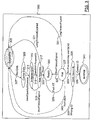
- Figures 2 , 3 and 4 there is schematically shown, in terms of state-transition diagrams of the different players involved, a short authentication procedure for managing the handoff, according to an embodiment of the present invention.
- Figure 2 relates to the operations performed by the generic wireless user terminal, playing the role of supplicant 200, involved in the handoff, in the example of Figure 1 the wireless user terminal 130a;
- Figure 3 relates to the actions performed by the generic AP, playing the role of authenticator 300, into whose coverage area the wireless user terminal enters, in the example of Figure 1 the AP 115b;
- Figure 4 relates to the actions performed by the authentication server 140.
- the initial state of the supplicant 200 is identified by 205 ( "Connecting" ); during its operation, the wireless user terminal 130a issues on a regular basis IEEE 802.11 Probe Request messages, in order to identify the presence of APs; APs like the AP 115a and the AP 115b in whose area of coverage the wireless user terminal 130a is located reply by sending thereto IEEE 802.11 Probe Response messages; based on the received IEEE 802.11 Probe Response messages, the wireless terminal 130a selects the new AP 115b as the new network's access point in substitution of the previous AP 115a.
- the wireless user terminal does not need issuing IEEE 802.11 Probe Request messages, being the APs that autonomously issue Beacon messages, based on which the wireless user terminal 130a selects the new AP 115b.
- the wireless user terminal may operate the selection based on the measurement of the radio quality of the messages received from the APs.
- the IEEE 802.11 Probe Response messages and the Beacon messages are used by the generic authenticators for indicating to the supplicants which authentication and data encryption mechanisms the authenticator supports.
- the IEEE 802.11 Probe Response messages and the Beacon messages include a message element, known in the art as Robust Security Network Information Element (RSNIE).
- RSSIE Robust Security Network Information Element
- the IEEE 802.11 Probe Response messages and/or the Beacon messages are advantageously exploited for informing the wireless user terminals about the fact that the generic authenticator supports the short authentication.
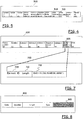
- RSNIE 500 The structure of an RSNIE 500 is schematically depicted in Figure 5 ; in that drawing, the numbers in parenthesis specify the length (in Bytes) of each field.
- the fields of the RSNIE 500 other than those relevant for the understanding of the invention embodiment being described will not be discussed in detail, being per-se known.
- the RSNIE 500 includes a field referred to as Authentication and Key Management (AKM) suite list 505, four Bytes long, whose value indicates the capability of the authenticator of handling one among several authentication methods (e.g ., authentication through Pre-Shared Key - PSK).
- the RSNIE 500 also includes a field referred to as RSN capabilities 510, two Bytes long, which in the art is used to describe peculiar capabilities of an authenticator, such as for example the capability of providing a pre-authentication mechanism.
- the fields of the RSNIE included in the IEEE 802.11 Probe Response messages and the Beacon messages are exploited for informing the wireless devices of the fact that a generic authenticator supports a short handoff authentication procedure.
- the AKM suite list field 505 can be exploited, by defining a dedicated AKM suite selector value to be added to an already existing list of values.
- the wireless user terminals reads in the AKM suite list field 505 that value, they understand that the authenticator supports the short authentication procedure and may decide to select it.
- the RSN capabilities field 510 is exploited; ten bits of the two Bytes of this field are in fact reserved and are currently not interpreted by a standard wireless user terminal; thus, these ten bits are available, and one of them can be exploited for providing to the wireless user terminal the desired indication that the authenticator supports the short handoff authentication.
- the use of the RSN capabilities field for informing of the support of the short authentication is a solution adapted to be used in any wireless network compliant to the IEEE 802.11i standard; on the contrary, the use of an AKM suite selector value is not suitable in general; for example, it is adapted to be used in a wireless network such as that depicted in Figure 1 , but not in the case of ad-hoc wireless networks, more generally wireless networks referred to as Independent Base Service Set (IBSS), in which the IEEE 802.11i standard does not provide for the support of more than one authentication mechanism; in that case, a single AKM suite selector value may be specified (which is the one corresponding to the full authentication method that should be performed in case of short authentication failure) since in an IBSS there is no mechanism to negotiate the AKM.
- IBSS Independent Base Service Set
- the wireless user terminal 130a i.e. the supplicant 200 performs a so-called "Open Authentication" procedure with the AP 115b, i.e. the authenticator 300: the supplicant sends to the authenticator an IEEE 802.11 Open System Authentication Request message, including an identifier DidD of the wireless user terminal 125a (event 207, "SefadDidD” ), and waits for a response from the authenticator (state 209, "Wait” ).
- an IEEE 802.11 Open System Authentication Request message including an identifier DidD of the wireless user terminal 125a (event 207, "SefadDidD” ), and waits for a response from the authenticator (state 209, "Wait” ).
- Figure 6 schematically shows the structure of a management message 600 according to the IEEE 802.11 standard, particularly a message of the type Open System Authentication class, and more particularly an IEEE 802.11 Open System Authentication Request referred above.
- the numbers in parenthesis specify the length (in Bytes) of each field.
- the fields of the message 600 other than those relevant for the understanding of the invention embodiment being described will not be discussed in detail, being per-se known.
- the message 600 includes a Frame Body field 605, of length variable from 0 up to 2312 Bytes.
- the Frame Body field 605 may in particular include one or more Information Elements.
- an Information Element 700 is exploited by the supplicant for including the identifier DidD.
- the Information Element 700 comprises an Element Identifier ( "Element ID” ) field 705, identifying the Information Element 700, a length field ( “Length” ) 710, specifying the length of the Information Element 700, and an Information field 715, wherein the identifier DidD is placed.
- the supplicant 200 re-sends the IEEE 802.11 Open System Authentication Request message, including the identifier DidD (state 213, “Resend”, and event 215, "SendDidD” ) , and keeps on waiting (returning to the "Wait” state 209).
- the transaction is considered failed (the management of the failed transaction will be described later).
- the authenticator 300 initially in a state 305 ( "Connecting” ), upon receipt of the IEEE 802.11 Open System Authentication Request message with the identifier DidD of the wireless user terminal 125a (event 307, "RcvDidD” ) , stores the received identifier DidD, for subsequent use (state 309, "Cache DidD” ) , then it replies to the supplicant 200 by sending an IEEE 802.11 Open System Authentication Response message, which is always positive, being the authentication, by definition, "open” (event 311, " SendOpenAuthSuccess ").
- the authenticator 300 After sending the IEEE 802.11 Open System Authentication Response message, the authenticator 300 activates and initializes the EAP (state 313, "Initialize EAP” ); similarly, the supplicant 200, upon receipt of the IEEE 802.11 Open System Authentication Response message (event 217, "Rcv Open Auth Success"), activates and initializes the EAP (state 219 , "Initialize EAP” ).
- the supplicant 200 sends to the authenticator 300 an EAPOL-Start message (event 221, "SendEAPOLStart” ), indicating the intention of the supplicant to start an EAP transaction.
- the supplicant 200 then waits for an EAP-Request / Identity message from the authenticator (state 223, "Wait EAP-Request / ID” ).
- the supplicant keeps on waiting until a first, shorter timeout expires (event 225, "ShortTimeoutExpired” ), then re-sends the EAPOL-Start message; in case a second, longer time out expires in vain (event 227, "LongTimeoutExpired” ) , the transaction is considered failed.
- the authenticator 300 (after receipt of the EAPOL-Start message from the supplicant, an event not shown in the state-transition diagram of Figure 3 , because considered implicit for the sake of simplicity), issues the EAP-Request / Identity message (event 315, "Send EAP-Request / ID” ), requesting the supplicant's identity; the authenticator then waits for a response (state 317, "Wait Response” ).
- the supplicant 200 sends the generated authentication token AT to the authenticator 300, including it in the EAP-Response / Identity response message (event 233, "SendAT” ). Afterwards, the supplicant waits for a response from the authenticator about the outcome of the authentication (state 235, "Wait EAPResponse” ) . In case of expiry of a timeout, or in case of unsuccessful outcome (event 237, " Failure / Timeout Expired” ), the transaction is considered failed.
- Figure 8 schematically depicts the structure of an EAP - Response / Identity message 800 according to an embodiment of the present invention; the fields making up the message will not be described in detail, being known per-se ; according to an embodiment of the present invention, the supplicant puts the generated authentication token AT in a field Type-Data 805 of the message.
- the authenticator 300 Upon receipt of the EAP-Response / Identity message from the supplicant (event 323, "RcvAT” ), the authenticator 300 starts the short authentication procedure of the supplicant 200 at the authentication server 140 (state 350, "Ready” ); this procedure is directed to obtain, from the authentication server, a valid authentication key in respect of the wireless user terminal 130a. It is underlined that the authenticator is authorized to request a valid authentication key (Fast-AAA-Key) to the authentication server only upon receipt of the authentication token AT from the supplicant.
- a valid authentication key Fast-AAA-Key
- the authenticator 300 forwards the received authentication token AT to the authentication server (event 325, "FwdAT” ), then waits for response from the authentication server (state 327, "Wait” ). In case a first, shorter timeout expires without receiving a response (event 329, "ShortTimeoputExpired” ), the authenticator 300 re-sends the authentication token AT, and keeps on waiting; in case of expiry of a second, longer timeout (event 331, "LongTimeoutExpired” ), the authenticator returns to the initial state 305.
- the authenticator 300 encapsulates the EAP - Response / Identity message including the authentication token AT received from the supplicant 200 within a message compliant to the AAA protocol used by the authenticator and the authentication server for communicating with each other, for example a RADIUS - Access Request message.
- FIG. 9 schematically depicts the structure of the RADIUS-Access Request message 900 by which the authenticator forwards to the authentication server the received authentication token AT.
- the fields making up the message will not be described in detail, being known per-se ; according to an embodiment of the present invention, the EAP-Response / Identity message 800 including the authentication token AT is encapsulated in a particular attribute defined by the standard for the transmission of the EAP messages over the RADIUS protocol.
- the authentication server 140 initially in an idle state (state 405, "Idle” ), receives the AAA-protocol message from the authenticator 300, encapsulating the EAP-Response / Identity message including the authentication token AT received from the supplicant 200 (event 407, "RcvAT” ).
- the authentication server 140 verifies the validity of the identifier AMSKID of the key AMSK, which identifier is part of the authentication token AT (state 409, "VerifyAMSKID" ); to this purpose, the authentication server may check whether the received AMSKID is included in the list of identifiers held at the authentication server (schematically shown in Figure 1 as a database 145).
- the authentication procedure fails (state 413, "Failure” ); the authentication server replies to the authenticator 300 by an EAP-Failure message (event 415, "SendEAP-Failure” ), and returns to the idle state 405.
- the authentication server retrieves the corresponding key AMSK, associated with the wireless user terminal involved in the handoff, and possibly takes the part AMSK' thereof (e.g., the first 32 Bytes), the same used by the supplicant 200 for calculating the authentication token AT.
- the authenticator On the authentication server side, the authenticator is identified by an identifier AS-Authid (such an identifier, similarly to the supplicant-side authenticator identifier Authid, is communicated by the authenticator to the authentication server).
- AS-Authid such an identifier, similarly to the supplicant-side authenticator identifier Authid, is communicated by the authenticator to the authentication server.
- the authentication server uses the key AMSK' derived from the locally-held key AMSK that corresponds to the identifier AMSKID included in the received authentication token, using the authentication server-side authenticator identifier AS-Authid, and using the random string RANDOM got from the received authentication token AT, the authentication server calculates the hash value: H AS ⁇ Authid , RANDOM , AMSK ′ where H is the same hash function used by the supplicant 200.
- the authentication server checks the validity of the hash value included in the received authentication token AT (state 419, "VerifyHash” ) by comparing it to the locally calculated hash value.
- the authentication procedure fails (state 413) and the authentication server sends to the authenticator the RADIUS Access-Reject message including an EAP-Failure message (event 415).
- the authenticator 300 receives from the authentication server the failure indication (event 343, "Rcv Failure” ) and forwards the EAP-Failure message to the supplicant that concludes the transaction (state 265).
- the authentication server has ascertained the authenticity of the authenticator (the AP), from one side, and of the supplicant (wireless user terminal), from the other.
- the authentication server checks whether the authenticator to which the wireless user terminal is connected is in effect the authenticator from which the authentication server has received the authentication token AT.
- a compromised authenticator may in fact present itself to the wireless user terminal using an identifier Authid different from the identifier AS-Authid by which that authenticator is recognized by the authentication server: if this happens, the two hash values differ.
- the authenticity of the wireless user terminal is instead ascertained through the key AMSK', which is available to the wireless user terminal only in case it has previously completed with success a full authentication operation.
- the authentication server generates a fast AAA key Fast-AAA-Key for the new communications session between the wireless user terminal 130a and the new AP 115b. It is underlined that such a key is generated in a fast way, without executing a full authentication procedure.
- the random string RANDOM used for calculating the identifier DidAS ensures that the generated identifier DidAS changes from session to session: thus, even if the authenticator is compromised, the identifier DidAS cannot be re-used for a subsequent short authentication procedure. Moreover, even if an attacker intercepted the wireless user terminal identity Did, which can be transmitted in clear during the full authentication procedure, and possibly even the random string RANDOM, such an attacker will not be in condition to derive the identity DidAS, because he/she does not know the key AMSK', being the latter only known to the wireless user terminal and to the authentication server, and never traveling.
- the authentication server sends to the authenticator an EAP-Success message, encapsulated in the RADIUS Access-Accept message, together with the generated key Fast-AAA-key and the identifier DidAS of the wireless user terminal (event 425, "SendEAPSuccess / Fast-AAA-Key and DidAS" ).
- the key Fast-AAA-key and the identity DidAS are sent as: Fast ⁇ AAA ⁇ Key , DidAS RADIUSKEY where by ⁇ RADIUSKEY there is meant that the argument within the parentheses is encrypted with the secret key RADIUSKEY shared by the authentication server and the authenticator.
- FIG. 10 schematically depicts, just by way of example, the structure of a RADIUS - Access Accept message 1000 (the fields making up the message will not be described in detail, being known per-se ) by which the authentication server sends to the authenticator the EAP-Success message, encapsulated as an attribute 1005 of the RADIUS - Access Accept message 1000.
- the RADIUS - Access Accept message 1000 also encapsulates two further attributes 1010 and 1015, the former corresponding to the generated key Fast-AAA-Key, the latter to the calculated identifier DidAS.
- the authenticator 300 receives from the authentication server the RADIUS Access-Accept message including the key Fast-AAA-key, the identifier DidAS of the wireless user terminal (event 333, "Rcv Fast-AAA-Key and DidAS" ) and the EAP-Success message. This is forwarded by the authenticator 300 to the supplicant.
- the supplicant waits for the start of the four-way handshake procedure (state 241, "Wait 4-Way” ).
- the authenticator 300 can now authenticate the wireless user terminal associated therewith; to this purpose, the authenticator checks whether the identifier DidD that the wireless user terminal has communicated to the authenticator coincides with the identifier DidAS received from the authentication server (state 335, "Verify Device ID” ).
- the short authentication procedure terminates (the authenticator returns to the initial state 305)
- the supplicant does not receive a notification of the start of the four-way handshake and when the timeout expires the transaction is considered failed (event 243, "Timeout expired” ).
- the authenticator and the supplicant each one at its own side, generate a ciphering key to be used for ciphering the communications over the radio link; if the authenticator has been compromised, so that the key Fast-AAA-Key available at the authenticator differs from the key Fast - AAA-Key calculated by the supplicant, the ciphering key generated by the supplicant is different from that generated by the authenticator, and the communications over the radio link will not be possible.
- the supplicant authenticates the authenticator.
- the database 145 managed by the authentication server 140 stores all the keys Fast-AAA-Key generated in respect of a given wireless device, associated with the respective key AMSK (or the part thereof AMSK' ) from which the keys Fast-AAA-Key are generated.
- the authentication server each time a new key Fast-AAA-Key is generated, checks whether the newly generated key coincides with a key in the database already generated in the past. In this way, in case an authentication token AT is received from a wireless device coincident with an authentication token already received in the past, leading to the generation of a key Fast-AAA-Key coinciding with one already generated, the authentication server takes this as a signal that an attack is possibly going on ( e.g., a so-called "replay" attack).
- the supplicant sends to the authenticator an IEEE 802.11 Probe Request message (event 267, "SendProbe” ) , and waits for an IEEE 802.11 Probe Response from the authenticator (state 249, "APProbe” ).
- the supplicant decrees that the AP is no more reachable (state 253, “APDown” ), that AP is deleted from the list of the known APs (event 255, "EraseAPfromAPListI ), and the supplicant returns to the initial state 205.
- timeout expiry events described in the foregoing might be replaced by notifications concerning the failure of some condition (for example, the invalidity of the identifier AMSKID decreed by the authentication server, and/or the incorrect hash value).
- Figure 11 depicts, schematically as in Figure 1 , another possible scenario in which the present invention can be applied.
- this scenario relates to a so-called ad-hoc network, which is a wireless network that does not require any fixed infrastructure.
- the generic wireless user terminal 1130 also acts as a router in respect of neighboring wireless user terminals, so as to allow the routing of messages from the originators to the intended destinations (usually, in a multi-hop fashion, due to the relatively limited range of radio coverage of the generic wireless user terminal).
- a generic wireless user terminal like the terminal 1130a in the drawing, during its movement (along a path 1135) typically faces a change of neighboring wireless user terminals.
- the generic wireless user terminal thus plays a double role of supplicant and authenticator.
- Some of the wireless user terminals 1130 may be multi-mode wireless devices, i.e . provided with one wireless interface 1125 for the communications with the other wireless user terminals, and one wireless interface 1120 for the access to a network 1150 which in turn, through an access point 115 provided with interfaces wireless 125 and wired 120, is connected to an external, infrastructured network 1110, like the Internet or a 3 rd generation mobile telephony network.
- the short handoff authentication procedure previously described is also useful for managing those cases in which the previously existing connections between the wireless user terminals 1130 need to be reconfigured due to the changes determined by the movement of the wireless user terminals; in such a case, the routing of messages needs to take into account the changed network configuration and should react to such changes as fast as possible, in order to let the generic wireless user terminal know, at each instant, which is the closest neighboring wireless user terminal to be used as a next hop for the message.
- the short authentication procedure described in the foregoing may be applied by two neighboring wireless user terminals to set up in a short time a security connection.
- the network is thus rendered self-configuring and self-healing, as far as security aspects are concerned, both against external attacks, and against attacks coming from the wireless user terminals: in fact, the generic wireless user terminal, when acting as an authenticator, cannot ask to the authentication server a valid authentication key unless it has preliminary received, from another wireless user terminal playing the role of supplicant, a valid authentication token.
- the authentication server can check whether the authenticator wireless user terminal from which the authentication token has been received coincides with that specified in the authentication token or it is an attacker.
- FIG. 12 Still another scenario in which the present invention is applicable is depicted in Figure 12 .
- the wireless access network 1205 has an ad-hoc structure, being a network of wireless access points devices 1215; the wireless access point devices 1215 are equipped with a double interface: a first wireless interface 1220a used for connecting to other wireless access point devices 1215, thereby forming a mesh of wireless access point devices constituting a wireless backbone, and a second wireless interface 1225 for allowing wireless user terminals 1230 to connect to the wireless network.
- At least some of the wireless access point devices are equipped with a further interface 1220b, by means of which there is realized a hardwired connection with the infrastructured network 110.
- the wireless access point devices alternatively play the role of supplicants and authenticators in respect of other wireless access point devices.
- the short authentication method allows automatically configuring, by sending an authentication token, the cryptographic key(s) necessary for communicating in a secure way with the neighboring wireless access point devices, avoiding to carry on, in respect of each of them, the full authentication procedure.
- the network typology of Figure 12 has the advantage that the deployment thereof is rather simple, especially compared to the deployment of a conventional Wi-Fi network, having an infrastructured wireless access, like in the case of Figure 1 . This reduces the costs for setting up such a network.
- the short authentication procedure simplifies the operations: a new wireless access point device needs perform the full authentication only once, in respect of a generic wireless access point device within the reach thereof; in order to authenticate to other wireless access points devices, the short authentication procedure is sufficient.
- the short authentication a plurality of fast authentication keys is generated, each one to be used in the communications between the generic pair of wireless access point devices.
- the device remaining isolated may simply perform a short authentication with a backup device, so as to set up a new connection.
- a short authentication method that allows for a fast, but nevertheless secure authentication procedure of supplicants for conditionally grant thereto access to the wireless communications network.
- the fast authentication procedure also takes into account the key binding problem, that is how to bind the authentication key to the authenticator (i.e. access point) identifier and supplicant (i.e ., wireless user terminal) identity.
- the proposed solution allows the authenticator to verify that the associated supplicant is the same for which it has received, from the authentication server, an authentication key.
- the proposed solution allows the supplicant to validate that the authenticator to which is associated, is the same the authentication server has sent the authentication key.
- the short authentication procedure has been described making reference to the management of a handoff (i.e., a situation in which a generic supplicant, e.g. a wireless user terminal, has already been authenticated by performing a full secure authentication), this is not to be construed as a limitation: more generally, the short handoff procedure according to the present invention may be used as well as the first time the supplicant connects to the network, in alternative to the longer, full authentication referred to above.
- a shorter authentication mechanism may be used to authenticate a supplicant, in alternative to the full IEEE 802.1 li authentication, provided that the supplicant and the authentication server share a secret, e.g. a code, a password, and the like, for example provided to the supplicant during a subscription phase to the wireless communications network.
- a method as described in the foregoing, exploiting a dedicated AKM suite selector or one or more available bits in the RSN capabilities field may be used for having the authenticators inform the supplicants of this further possible authentication mechanism.
Landscapes
- Engineering & Computer Science (AREA)
- Computer Security & Cryptography (AREA)
- Computer Networks & Wireless Communication (AREA)
- Signal Processing (AREA)
- Computer Hardware Design (AREA)
- Computing Systems (AREA)
- General Engineering & Computer Science (AREA)
- Mobile Radio Communication Systems (AREA)
Claims (25)
- Procédé d'authentification rapide pour l'authentification d'un demandeur dans un réseau de communication sans fil, ledit réseau de communication sans fil comprenant au moins un authentificateur (120 ; 1130 ; 1215) et au moins un serveur d'authentification (140), dans lequel l'authentificateur est adapté pour interagir avec le serveur d'authentification afin d'authentifier des demandeurs (130a, 130b ; 1130, 1130a ; 1230, 1215) de manière à leur accorder sous conditions un accès au réseau de communication sans fil, ledit procédé consistant à :- fournir un secret partagé, partagé par le demandeur et par le serveur d'authentification et disponible au niveau de ces derniers,- faire en sorte que le demandeur fournisse à l'authentificateur un jeton d'authentification (233), dans lequel ledit jeton d'authentification est basé sur ledit secret partagé disponible au niveau dudit authentificateur (231),- faire en sorte que l'authentificateur envoie le jeton d'authentification au serveur d'authentification (325),- faire en sorte que le serveur d'authentification établisse une authenticité du jeton d'authentification reçu en se fondant sur ledit secret partagé disponible au niveau dudit serveur d'authentification (409, 419, 423),- en cas d'établissement de l'authenticité du jeton d'authentification, faire en sorte que le serveur d'authentification génère une première clé d'authentification basée sur ledit secret partagé disponible au niveau dudit serveur d'authentification, et fournisse la clé d'authentification générée à l'authentificateur (425),- faire en sorte que le demandeur génère une seconde clé d'authentification basée sur ledit secret partagé (247) et- faire en sorte que le demandeur et l'authentificateur exploitent les première et seconde clés générées pour chiffrer les communications de l'un avec l'autre.
- Procédé selon la revendication 1, dans lequel l'authentificateur est adapté pour interagir avec le serveur d'authentification afin d'authentifier les demandeurs en se fondant sur une procédure d'authentification sécurisée, dans lequel ledit secret partagé est fondé sur une information générée par le demandeur et le serveur d'authentification au cours de ladite procédure d'authentification sécurisée.
- Procédé selon la revendication 2, dans lequel ledit jeton d'authentification comprend un identifiant du secret partagé, le serveur d'authentification exploitant l'identifiant de l'information de secret partagé pour récupérer le secret partagé disponible au niveau du serveur d'authentification.
- Procédé selon la revendication 3, dans lequel ledit jeton d'authentification comprend une première fonction de hachage ayant un argument de première fonction de hachage incluant ledit secret partagé.
- Procédé selon la revendication 4, dans lequel ledit argument de première fonction de hachage inclut un premier identifiant de l'authentificateur, communiqué par l'authentificateur au demandeur.
- Procédé selon la revendication 5, dans lequel le fait que le serveur d'authentification établisse l'authenticité du jeton d'authentification reçu inclut le fait que le serveur d'authentification applique ladite première fonction de hachage (419) à un argument incluant le secret partagé récupéré, la valeur aléatoire, et un second identifiant de l'authentificateur, communiqué par l'authentificateur au serveur d'authentification (325).
- Procédé selon la revendication 6, dans lequel ladite première clé d'authentification est générée en appliquant une seconde fonction de hachage à l'argument incluant le secret partagé récupéré, la valeur aléatoire et le second identifiant de l'authentificateur.
- Procédé selon la revendication 7, dans lequel ladite seconde clé d'authentification est générée en appliquant la seconde fonction de hachage à l'argument incluant le secret partagé, la valeur aléatoire et le premier identifiant de l'authentificateur.
- Procédé selon l'une quelconque des revendications 6 à 8, consistant en outre à :- faire en sorte que le demandeur fournisse à l'authentificateur un premier identifiant de demandeur, dans lequel ledit premier identifiant de demandeur est basé sur une identité de demandeur et le secret partagé :- faire en sorte que le serveur d'authentification génère et fournisse à l'authentificateur un second identifiant de demandeur, dans lequel ledit second identifiant de demandeur est basé sur ledit secret partagé et sur ladite identité de demandeur, l'identité de demandeur étant communiquée par le demandeur au serveur d'identification au cours de la procédure d'authentification sécurisée et- faire en sorte que l'authentificateur authentifie le demandeur en se fondant sur une correspondance établie entre le premier identifiant de demandeur et le second identifiant de demandeur (409).
- Procédé selon la revendication 9, dans lequel ledit premier identifiant de demandeur est généré par le demandeur en appliquant une troisième fonction de hachage à l'argument incluant ladite identité de demandeur et ledit secret partagé.
- Procédé selon la revendication 10, dans lequel ledit second identifiant de demandeur est calculé par le serveur d'authentification en appliquant la troisième fonction de hachage à l'argument incluant ladite identité de demandeur et ledit secret partagé.
- Réseau de communication sans fil comprenant :- au moins un serveur d'authentification (140),- au moins un authentificateur (120 ; 1130 ; 1215),- au moins un demandeur, dans lequel l'authentificateur est adapté pour interagir avec le serveur d'authentification afin d'authentifier le demandeur (130a, 130b ; 1130, 1130a ; 1230, 1215) de manière à leur accorder sous conditions un accès au réseau de communication sans fil,- un secret partagé, partagé par le demandeur et par le serveur d'authentification et disponible au niveau de ces derniers,dans lequel :- le demandeur est adapté pour fournir à l'authentificateur (233) un jeton d'authentification en se fondant sur ledit secret partagé disponible au niveau de l'authentificateur (231),- l'authentificateur est adapté pour envoyer le jeton d'authentification au serveur d'authentification (325),- le serveur d'authentification est adapté pour établir une authenticité du jeton d'authentification reçu en se fondant sur ledit secret partagé disponible au niveau du serveur d'authentification (409, 419, 423) et, dans le cas où l'authenticité du jeton d'authentification est établie, pour générer une première clé d'authentification basée sur ledit secret partagé disponible au niveau du serveur d'authentification, et pour fournir la clé d'authentification au dit authentificateur (425),et dans lequel :- le demandeur est en outre adapté pour générer une seconde clé d'authentification basée sur ledit secret partagé (247),- l'authentificateur et le demandeur sont adaptés pour exploiter les première et seconde clés d'authentification générées pour chiffrer les communications de l'un avec l'autre.
- Réseau de communication sans fil selon la revendication 12, dans lequel l'authentificateur est adapté pour interagir avec le serveur d'authentification afin d'authentifier les demandeurs en se fondant sur une procédure d'authentification sécurisée, dans lequel ladite information de secret est basée sur une information générée par le demandeur et le serveur d'authentification au cours de ladite procédure d'authentification sécurisée.
- Réseau de communication sans fil selon la revendication 13, dans lequel ledit jeton d'authentification comprend un identifiant du secret partagé, le serveur d'authentification étant adapté pour exploiter l'identifiant de l'information de secret partagé pour récupérer le secret partagé disponible au niveau du serveur d'authentification.
- Réseau de communication sans fil selon la revendication 14, dans lequel ledit jeton d'authentification comprend une première fonction de hachage ayant un argument de première fonction de hachage comprenant ledit secret partagé.
- Réseau de communication sans fil selon la revendication 15, dans lequel ledit argument de première fonction de hachage comprend un premier identifiant de l'authentificateur, communiqué au demandeur par l'authentificateur.
- Réseau de communication sans fil selon la revendication 16, dans lequel le serveur d'authentification est en outre adapté pour appliquer ladite première fonction de hachage (419) à un argument incluant le secret partagé récupéré, la valeur aléatoire, et un second identifiant de l'authentificateur, communiqué par l'authentificateur au serveur d'authentification.
- Réseau de communication sans fil selon la revendication 17, dans lequel la première clé d'authentification est générée en appliquant une seconde fonction de hachage à l'argument incluant le secret partagé récupéré, la valeur aléatoire et le second identifiant de l'authentificateur.
- Réseau de communication sans fil selon la revendication 18, dans lequel la seconde clé d'authentification est générée en appliquant la seconde fonction de hachage à l'argument incluant le secret partagé, la valeur aléatoire et le premier identifiant de l'authentificateur.
- Réseau de communication sans fil selon l'une quelconque des revendications 17 à 19, dans lequel :- le demandeur est en outre adapté pour fournir à l'authentificateur un premier identifiant de demandeur, dans lequel ledit premier identifiant de demandeur est basé sur une identité de demandeur et sur le secret partagé,- le serveur d'authentification est en outre adapté pour générer et fournir à l'authentificateur un second identifiant de demandeur, dans lequel ledit second identifiant de demandeur est basé sur ledit secret partagé et sur ladite identité de demandeur, l'identité de demandeur étant communiquée par le demandeur au serveur d'authentification au cours de la procédure d'authentification sécurisée et- l'authentificateur est en outre adapté pour authentifier le demandeur en se fondant sur une correspondance établie entre le premier identifiant de demandeur et le second identifiant de demandeur (409).
- Réseau de communication sans fil selon la revendication 20, dans lequel ledit premier identifiant de demandeur est généré par le demandeur en appliquant une troisième fonction de hachage à l'argument incluant ladite identité de demandeur et ledit secret partagé.
- Réseau de communication sans fil selon la revendication 21, dans lequel ledit second identifiant de demandeur est calculé par le serveur d'authentification en appliquant la troisième fonction de hachage à l'argument incluant ladite identité de demandeur et ledit secret partagé.
- Réseau de communication sans fil selon l'une quelconque des revendications 12 à 22, dans lequel ledit au moins un authentificateur est en relation de communication filaire avec le serveur d'authentification.
- Réseau de communication sans fil selon l'une quelconque des revendications 12 à 22, dans lequel le réseau de communication sans fil inclut un MANET (Mobile Ad-hoc NETwork) ou Réseau Ad-hoc mobile.
- Réseau de communication sans fil selon l'une quelconque des revendications 12 à 22, dans lequel le au moins un authentificateur comprend au moins un premier et un second authentificateurs, le premier étant en relation de communication filaire avec le serveur d'authentification et le second ayant une connexion sans fil avec le premier.
Applications Claiming Priority (1)
| Application Number | Priority Date | Filing Date | Title |
|---|---|---|---|
| PCT/EP2005/006977 WO2007000179A1 (fr) | 2005-06-29 | 2005-06-29 | Procedure d'authentification rapide dans des reseaux de communication de donnees sans fil |
Publications (2)
| Publication Number | Publication Date |
|---|---|
| EP1900170A1 EP1900170A1 (fr) | 2008-03-19 |
| EP1900170B1 true EP1900170B1 (fr) | 2017-11-15 |
Family
ID=35784672
Family Applications (1)
| Application Number | Title | Priority Date | Filing Date |
|---|---|---|---|
| EP05759721.3A Expired - Lifetime EP1900170B1 (fr) | 2005-06-29 | 2005-06-29 | Procedure d'authentification rapide dans des reseaux de communication de donnees sans fil |
Country Status (3)
| Country | Link |
|---|---|
| US (1) | US8621201B2 (fr) |
| EP (1) | EP1900170B1 (fr) |
| WO (1) | WO2007000179A1 (fr) |
Families Citing this family (59)
| Publication number | Priority date | Publication date | Assignee | Title |
|---|---|---|---|---|
| JP4663497B2 (ja) * | 2005-12-01 | 2011-04-06 | 株式会社日立製作所 | 情報処理システムおよび情報処理装置の割当管理方法 |
| US8023478B2 (en) * | 2006-03-06 | 2011-09-20 | Cisco Technology, Inc. | System and method for securing mesh access points in a wireless mesh network, including rapid roaming |
| DE102006036109B4 (de) * | 2006-06-01 | 2008-06-19 | Nokia Siemens Networks Gmbh & Co.Kg | Verfahren und System zum Bereitstellen eines Mesh-Schlüssels |
| JP5144679B2 (ja) * | 2006-12-19 | 2013-02-13 | テレフオンアクチーボラゲット エル エム エリクソン(パブル) | 通信ネットワークにおけるユーザアクセス管理 |
| KR101002799B1 (ko) * | 2007-03-21 | 2010-12-21 | 삼성전자주식회사 | 이동통신 네트워크 및 상기 이동통신 네트워크에서 이동 노드의 인증을 수행하는 방법 및 장치 |
| US10091648B2 (en) * | 2007-04-26 | 2018-10-02 | Qualcomm Incorporated | Method and apparatus for new key derivation upon handoff in wireless networks |
| KR101289133B1 (ko) | 2007-05-14 | 2013-07-23 | 삼성전자주식회사 | 이동 통신 시스템에서 보안키 생성 방법 및 장치 |
| US8571211B2 (en) * | 2007-05-14 | 2013-10-29 | Samsung Electronics Co., Ltd | Method and apparatus for generating security key in a mobile communication system |
| CN100553193C (zh) | 2007-10-23 | 2009-10-21 | 西安西电捷通无线网络通信有限公司 | 一种基于可信第三方的实体双向鉴别方法及其系统 |
| JP5328141B2 (ja) * | 2007-12-05 | 2013-10-30 | キヤノン株式会社 | 通信装置、通信装置の制御方法、コンピュータプログラム |
| JP5279296B2 (ja) * | 2008-02-22 | 2013-09-04 | キヤノン株式会社 | 通信装置、通信方法、プログラム、記憶媒体 |
| JP5270937B2 (ja) | 2008-03-17 | 2013-08-21 | キヤノン株式会社 | 通信装置及びその制御方法 |
| GB2458470A (en) * | 2008-03-17 | 2009-09-23 | Vodafone Plc | Mobile terminal authorisation arrangements |
| US8862872B2 (en) * | 2008-09-12 | 2014-10-14 | Qualcomm Incorporated | Ticket-based spectrum authorization and access control |
| US8548467B2 (en) * | 2008-09-12 | 2013-10-01 | Qualcomm Incorporated | Ticket-based configuration parameters validation |
| US9148335B2 (en) * | 2008-09-30 | 2015-09-29 | Qualcomm Incorporated | Third party validation of internet protocol addresses |
| CN103781066B (zh) * | 2008-12-17 | 2017-06-27 | 交互数字专利控股公司 | 无线发射/接收单元以及由其实施的方法 |
| US8826376B2 (en) * | 2009-03-10 | 2014-09-02 | Alcatel Lucent | Communication of session-specific information to user equipment from an access network |
| CN102006590A (zh) * | 2009-09-03 | 2011-04-06 | 中兴通讯股份有限公司 | 一种在wapi终端间实现直接通信的系统及方法 |
| CN101674182B (zh) | 2009-09-30 | 2011-07-06 | 西安西电捷通无线网络通信股份有限公司 | 引入在线可信第三方的实体公钥获取、证书验证及鉴别的方法及系统 |
| KR20110048974A (ko) * | 2009-11-04 | 2011-05-12 | 삼성전자주식회사 | 무선통신 시스템에서 마스터 세션 키를 갱신하기 위한 장치 및 방법 |
| KR101718096B1 (ko) * | 2009-12-01 | 2017-03-20 | 삼성전자주식회사 | 무선통신 시스템에서 인증방법 및 시스템 |
| US8630416B2 (en) * | 2009-12-21 | 2014-01-14 | Intel Corporation | Wireless device and method for rekeying with reduced packet loss for high-throughput wireless communications |
| US8489071B2 (en) * | 2010-10-27 | 2013-07-16 | Mobilesphere Holdings LLC | System and method for assuring identity on a mobile device |
| US9154953B2 (en) | 2010-12-10 | 2015-10-06 | At&T Intellectual Property I, L.P. | Network access via telephony services |
| US8650622B2 (en) * | 2011-07-01 | 2014-02-11 | Telefonaktiebolaget Lm Ericsson (Publ) | Methods and arrangements for authorizing and authentication interworking |
| US9258703B2 (en) * | 2011-07-05 | 2016-02-09 | Texas Instruments Incorporated | Method, system and computer program product for wirelessly connecting a device to a network |
| US9084111B2 (en) * | 2012-02-07 | 2015-07-14 | Aruba Networks, Inc. | System and method for determining leveled security key holder |
| EP2632196A1 (fr) * | 2012-02-24 | 2013-08-28 | Alcatel Lucent | Personnalisation initiale de carte intelligente |
| US8867514B2 (en) | 2012-03-20 | 2014-10-21 | Qualcomm Incorporated | System and method of infrastructure service discovery |
| US9226149B2 (en) * | 2012-04-18 | 2015-12-29 | Huawei Technologies Co., Ltd. | System and method for rapid authentication in wireless communications |
| EP2712222B1 (fr) * | 2012-09-25 | 2020-04-01 | Alcatel Lucent | Approvisionnement confidentiel de clés secrètes sur les ondes |
| US8910261B2 (en) * | 2012-09-28 | 2014-12-09 | Alcatel Lucent | Radius policy multiple authenticator support |
| US9282120B2 (en) * | 2013-02-01 | 2016-03-08 | Vidder, Inc. | Securing communication over a network using client integrity verification |
| US8966599B1 (en) | 2013-03-14 | 2015-02-24 | Amazon Technologies, Inc. | Automatic token renewal for device authentication |
| US9992017B2 (en) * | 2013-06-28 | 2018-06-05 | Telefonaktiebolaget L M Ericsson (Publ) | Encrypting and storing data |
| US10050955B2 (en) | 2014-10-24 | 2018-08-14 | Netflix, Inc. | Efficient start-up for secured connections and related services |
| US11533297B2 (en) * | 2014-10-24 | 2022-12-20 | Netflix, Inc. | Secure communication channel with token renewal mechanism |
| US11399019B2 (en) * | 2014-10-24 | 2022-07-26 | Netflix, Inc. | Failure recovery mechanism to re-establish secured communications |
| JP6380009B2 (ja) * | 2014-10-31 | 2018-08-29 | 株式会社リコー | 情報処理システム、認証方法、および情報処理装置 |
| US10034169B2 (en) | 2014-11-12 | 2018-07-24 | Qualcomm Incorporated | Method to authenticate peers in an infrastructure-less peer-to-peer network |
| WO2016111667A1 (fr) * | 2015-01-06 | 2016-07-14 | Intel Corporation | Authentification de dispositif dans la couche de liaison avant l'ouverture d'une connexion de données |
| JP6489835B2 (ja) * | 2015-01-09 | 2019-03-27 | キヤノン株式会社 | 情報処理システム、情報処理装置の制御方法、及びプログラム |
| US20160309523A1 (en) * | 2015-04-16 | 2016-10-20 | Qualcomm Incorporated | Reducing delay in attachment procedure with a network |
| CN106341233A (zh) | 2015-07-08 | 2017-01-18 | 阿里巴巴集团控股有限公司 | 客户端登录服务器端的鉴权方法、装置、系统及电子设备 |
| US10469262B1 (en) | 2016-01-27 | 2019-11-05 | Verizon Patent ad Licensing Inc. | Methods and systems for network security using a cryptographic firewall |
| US10791093B2 (en) * | 2016-04-29 | 2020-09-29 | Avago Technologies International Sales Pte. Limited | Home network traffic isolation |
| WO2017218694A1 (fr) * | 2016-06-14 | 2017-12-21 | Aerohive Networks, Inc. | Incorporation en continu de dispositif sans fil |
| US10778718B2 (en) * | 2016-09-16 | 2020-09-15 | Salesforce.Com, Inc. | Phishing detection and prevention |
| US10433163B2 (en) | 2016-09-19 | 2019-10-01 | Qualcomm Incorporated | Techniques for deriving security keys for a cellular network based on performance of an extensible authentication protocol (EAP) procedure |
| GB2555610B (en) * | 2016-11-04 | 2020-01-15 | Samsung Electronics Co Ltd | Data traffic management in a telecommunication network |
| CN110024325B (zh) * | 2016-11-26 | 2021-01-29 | 华为技术有限公司 | 用于设备之间mka协商的系统、方法和设备 |
| US10462124B2 (en) | 2016-12-30 | 2019-10-29 | Google Llc | Authenticated session management across multiple electronic devices using a virtual session manager |
| US10541992B2 (en) | 2016-12-30 | 2020-01-21 | Google Llc | Two-token based authenticated session management |
| US10554480B2 (en) | 2017-05-11 | 2020-02-04 | Verizon Patent And Licensing Inc. | Systems and methods for maintaining communication links |
| US11963007B2 (en) * | 2018-05-17 | 2024-04-16 | Nokia Technologies Oy | Facilitating residential wireless roaming via VPN connectivity over public service provider networks |
| WO2020023909A1 (fr) | 2018-07-27 | 2020-01-30 | GoTenna, Inc. | Routage de paquets à commande nulle vine™ à l'aide d'une inspection de paquets de données pour des réseaux maillés sans fil |
| CN111263364B (zh) * | 2018-12-03 | 2022-08-02 | 中国电信股份有限公司 | WiFi认证方法、系统、DNS服务器和计算机可存储介质 |
| US12425848B2 (en) | 2020-04-16 | 2025-09-23 | Beijing Xiaomi Mobile Software Co., Ltd. | Management frame transmission method, apparatus and storage medium |
Family Cites Families (12)
| Publication number | Priority date | Publication date | Assignee | Title |
|---|---|---|---|---|
| US5924040A (en) * | 1996-11-20 | 1999-07-13 | Telxon Corporation | Wireless communication system having base station with adjustable power transceiver for locating mobile devices |
| US6253325B1 (en) * | 1998-04-15 | 2001-06-26 | Hewlett-Packard Company | Apparatus and method for securing documents posted from a web resource |
| US6826686B1 (en) * | 2000-04-14 | 2004-11-30 | International Business Machines Corporation | Method and apparatus for secure password transmission and password changes |
| US6970853B2 (en) * | 2000-06-06 | 2005-11-29 | Citibank, N.A. | Method and system for strong, convenient authentication of a web user |
| WO2002091662A1 (fr) * | 2001-05-01 | 2002-11-14 | Vasco Data Security, Inc. | Utilisation et production d'une cle de session dans une connexion ssl |
| WO2002096151A1 (fr) * | 2001-05-22 | 2002-11-28 | Flarion Technologies, Inc. | Systeme d'authentification pour entites mobiles |
| US6748080B2 (en) * | 2002-05-24 | 2004-06-08 | Scientific-Atlanta, Inc. | Apparatus for entitling remote client devices |
| US7634230B2 (en) | 2002-11-25 | 2009-12-15 | Fujitsu Limited | Methods and apparatus for secure, portable, wireless and multi-hop data networking |
| US7275157B2 (en) | 2003-05-27 | 2007-09-25 | Cisco Technology, Inc. | Facilitating 802.11 roaming by pre-establishing session keys |
| US7974234B2 (en) * | 2004-10-22 | 2011-07-05 | Alcatel Lucent | Method of authenticating a mobile network node in establishing a peer-to-peer secure context between a pair of communicating mobile network nodes |
| US8996423B2 (en) * | 2005-04-19 | 2015-03-31 | Microsoft Corporation | Authentication for a commercial transaction using a mobile module |
| US8490169B2 (en) * | 2005-07-21 | 2013-07-16 | Ca, Inc. | Server-token lockstep systems and methods |
-
2005
- 2005-06-29 EP EP05759721.3A patent/EP1900170B1/fr not_active Expired - Lifetime
- 2005-06-29 US US11/922,781 patent/US8621201B2/en active Active
- 2005-06-29 WO PCT/EP2005/006977 patent/WO2007000179A1/fr not_active Ceased
Non-Patent Citations (1)
| Title |
|---|
| None * |
Also Published As
| Publication number | Publication date |
|---|---|
| WO2007000179A1 (fr) | 2007-01-04 |
| EP1900170A1 (fr) | 2008-03-19 |
| US8621201B2 (en) | 2013-12-31 |
| US20090217033A1 (en) | 2009-08-27 |
Similar Documents
| Publication | Publication Date | Title |
|---|---|---|
| EP1900170B1 (fr) | Procedure d'authentification rapide dans des reseaux de communication de donnees sans fil | |
| EP1955511B1 (fr) | Procede et systeme d'approvisionnement automatisé et securisé d'identifiants d'acces de service pour services en ligne | |
| EP1540878B1 (fr) | Protocoles d'authentification lies | |
| CN101371491B (zh) | 提供无线网状网络的方法和装置 | |
| JP4921557B2 (ja) | インフラストラクチャベースの無線マルチホップネットワークにおけるセキュリティ認証及び鍵管理方法 | |
| US7451316B2 (en) | Method and system for pre-authentication | |
| US7171555B1 (en) | Method and apparatus for communicating credential information within a network device authentication conversation | |
| US7760710B2 (en) | Rogue access point detection | |
| US8561200B2 (en) | Method and system for controlling access to communication networks, related network and computer program therefor | |
| US8923813B2 (en) | System and method for securing a base station using SIM cards | |
| US8312278B2 (en) | Access authentication method applying to IBSS network | |
| US20090208013A1 (en) | Wireless network handoff key | |
| AU2006266651B2 (en) | Authentication system and method thereof in a communication system | |
| US20090307483A1 (en) | Method and system for providing a mesh key | |
| US20050271209A1 (en) | AKA sequence number for replay protection in EAP-AKA authentication | |
| KR20070051233A (ko) | 이중 확장 가능 인증 프로토콜 방식을 사용하는 광대역무선 접속 통신 시스템에서 재인증 시스템 및 방법 | |
| Fantacci et al. | Analysis of secure handover for IEEE 802.1 x-based wireless ad hoc networks | |
| KR101023605B1 (ko) | 터널링된 전송계층보안 방식을 이용한 가입자 아이디 획득방법 | |
| Latze | Towards a secure and user friendly authentication method for public wireless networks |
Legal Events
| Date | Code | Title | Description |
|---|---|---|---|
| PUAI | Public reference made under article 153(3) epc to a published international application that has entered the european phase |
Free format text: ORIGINAL CODE: 0009012 |
|
| AK | Designated contracting states |
Kind code of ref document: A1 Designated state(s): AT BE BG CH CY CZ DE DK EE ES FI FR GB GR HU IE IS IT LI LT LU MC NL PL PT RO SE SI SK TR |
|
| 17P | Request for examination filed |
Effective date: 20080121 |
|
| DAX | Request for extension of the european patent (deleted) | ||
| 17Q | First examination report despatched |
Effective date: 20120801 |
|
| RAP1 | Party data changed (applicant data changed or rights of an application transferred) |
Owner name: TELECOM ITALIA S.P.A. |
|
| GRAP | Despatch of communication of intention to grant a patent |
Free format text: ORIGINAL CODE: EPIDOSNIGR1 |
|
| RIC1 | Information provided on ipc code assigned before grant |
Ipc: H04L 29/06 20060101AFI20170620BHEP Ipc: H04W 12/06 20090101ALI20170620BHEP Ipc: H04W 12/04 20090101ALN20170620BHEP |
|
| INTG | Intention to grant announced |
Effective date: 20170707 |
|
| RIC1 | Information provided on ipc code assigned before grant |
Ipc: H04W 12/06 20090101ALI20170628BHEP Ipc: H04W 12/04 20090101ALN20170628BHEP Ipc: H04L 29/06 20060101AFI20170628BHEP |
|
| GRAS | Grant fee paid |
Free format text: ORIGINAL CODE: EPIDOSNIGR3 |
|
| GRAA | (expected) grant |
Free format text: ORIGINAL CODE: 0009210 |
|
| AK | Designated contracting states |
Kind code of ref document: B1 Designated state(s): AT BE BG CH CY CZ DE DK EE ES FI FR GB GR HU IE IS IT LI LT LU MC NL PL PT RO SE SI SK TR |
|
| REG | Reference to a national code |
Ref country code: CH Ref legal event code: EP Ref country code: GB Ref legal event code: FG4D Ref country code: AT Ref legal event code: REF Ref document number: 947309 Country of ref document: AT Kind code of ref document: T Effective date: 20171115 |
|
| REG | Reference to a national code |
Ref country code: IE Ref legal event code: FG4D |
|
| REG | Reference to a national code |
Ref country code: DE Ref legal event code: R096 Ref document number: 602005053067 Country of ref document: DE |
|
| REG | Reference to a national code |
Ref country code: NL Ref legal event code: MP Effective date: 20171115 |
|
| REG | Reference to a national code |
Ref country code: LT Ref legal event code: MG4D |
|
| REG | Reference to a national code |
Ref country code: AT Ref legal event code: MK05 Ref document number: 947309 Country of ref document: AT Kind code of ref document: T Effective date: 20171115 |
|
| PG25 | Lapsed in a contracting state [announced via postgrant information from national office to epo] |
Ref country code: LT Free format text: LAPSE BECAUSE OF FAILURE TO SUBMIT A TRANSLATION OF THE DESCRIPTION OR TO PAY THE FEE WITHIN THE PRESCRIBED TIME-LIMIT Effective date: 20171115 Ref country code: FI Free format text: LAPSE BECAUSE OF FAILURE TO SUBMIT A TRANSLATION OF THE DESCRIPTION OR TO PAY THE FEE WITHIN THE PRESCRIBED TIME-LIMIT Effective date: 20171115 Ref country code: NL Free format text: LAPSE BECAUSE OF FAILURE TO SUBMIT A TRANSLATION OF THE DESCRIPTION OR TO PAY THE FEE WITHIN THE PRESCRIBED TIME-LIMIT Effective date: 20171115 Ref country code: ES Free format text: LAPSE BECAUSE OF FAILURE TO SUBMIT A TRANSLATION OF THE DESCRIPTION OR TO PAY THE FEE WITHIN THE PRESCRIBED TIME-LIMIT Effective date: 20171115 Ref country code: SE Free format text: LAPSE BECAUSE OF FAILURE TO SUBMIT A TRANSLATION OF THE DESCRIPTION OR TO PAY THE FEE WITHIN THE PRESCRIBED TIME-LIMIT Effective date: 20171115 |
|
| PG25 | Lapsed in a contracting state [announced via postgrant information from national office to epo] |
Ref country code: BG Free format text: LAPSE BECAUSE OF FAILURE TO SUBMIT A TRANSLATION OF THE DESCRIPTION OR TO PAY THE FEE WITHIN THE PRESCRIBED TIME-LIMIT Effective date: 20180215 Ref country code: AT Free format text: LAPSE BECAUSE OF FAILURE TO SUBMIT A TRANSLATION OF THE DESCRIPTION OR TO PAY THE FEE WITHIN THE PRESCRIBED TIME-LIMIT Effective date: 20171115 Ref country code: GR Free format text: LAPSE BECAUSE OF FAILURE TO SUBMIT A TRANSLATION OF THE DESCRIPTION OR TO PAY THE FEE WITHIN THE PRESCRIBED TIME-LIMIT Effective date: 20180216 |
|
| REG | Reference to a national code |
Ref country code: FR Ref legal event code: PLFP Year of fee payment: 14 |
|
| PG25 | Lapsed in a contracting state [announced via postgrant information from national office to epo] |
Ref country code: DK Free format text: LAPSE BECAUSE OF FAILURE TO SUBMIT A TRANSLATION OF THE DESCRIPTION OR TO PAY THE FEE WITHIN THE PRESCRIBED TIME-LIMIT Effective date: 20171115 Ref country code: SK Free format text: LAPSE BECAUSE OF FAILURE TO SUBMIT A TRANSLATION OF THE DESCRIPTION OR TO PAY THE FEE WITHIN THE PRESCRIBED TIME-LIMIT Effective date: 20171115 Ref country code: CZ Free format text: LAPSE BECAUSE OF FAILURE TO SUBMIT A TRANSLATION OF THE DESCRIPTION OR TO PAY THE FEE WITHIN THE PRESCRIBED TIME-LIMIT Effective date: 20171115 Ref country code: EE Free format text: LAPSE BECAUSE OF FAILURE TO SUBMIT A TRANSLATION OF THE DESCRIPTION OR TO PAY THE FEE WITHIN THE PRESCRIBED TIME-LIMIT Effective date: 20171115 Ref country code: CY Free format text: LAPSE BECAUSE OF FAILURE TO SUBMIT A TRANSLATION OF THE DESCRIPTION OR TO PAY THE FEE WITHIN THE PRESCRIBED TIME-LIMIT Effective date: 20171115 |
|
| REG | Reference to a national code |
Ref country code: DE Ref legal event code: R097 Ref document number: 602005053067 Country of ref document: DE |
|
| PG25 | Lapsed in a contracting state [announced via postgrant information from national office to epo] |
Ref country code: PL Free format text: LAPSE BECAUSE OF FAILURE TO SUBMIT A TRANSLATION OF THE DESCRIPTION OR TO PAY THE FEE WITHIN THE PRESCRIBED TIME-LIMIT Effective date: 20171115 Ref country code: RO Free format text: LAPSE BECAUSE OF FAILURE TO SUBMIT A TRANSLATION OF THE DESCRIPTION OR TO PAY THE FEE WITHIN THE PRESCRIBED TIME-LIMIT Effective date: 20171115 |
|
| PLBE | No opposition filed within time limit |
Free format text: ORIGINAL CODE: 0009261 |
|
| STAA | Information on the status of an ep patent application or granted ep patent |
Free format text: STATUS: NO OPPOSITION FILED WITHIN TIME LIMIT |
|
| 26N | No opposition filed |
Effective date: 20180817 |
|
| PG25 | Lapsed in a contracting state [announced via postgrant information from national office to epo] |
Ref country code: SI Free format text: LAPSE BECAUSE OF FAILURE TO SUBMIT A TRANSLATION OF THE DESCRIPTION OR TO PAY THE FEE WITHIN THE PRESCRIBED TIME-LIMIT Effective date: 20171115 |
|
| REG | Reference to a national code |
Ref country code: CH Ref legal event code: PL |
|
| REG | Reference to a national code |
Ref country code: BE Ref legal event code: MM Effective date: 20180630 |
|
| PG25 | Lapsed in a contracting state [announced via postgrant information from national office to epo] |
Ref country code: MC Free format text: LAPSE BECAUSE OF FAILURE TO SUBMIT A TRANSLATION OF THE DESCRIPTION OR TO PAY THE FEE WITHIN THE PRESCRIBED TIME-LIMIT Effective date: 20171115 Ref country code: LU Free format text: LAPSE BECAUSE OF NON-PAYMENT OF DUE FEES Effective date: 20180629 |
|
| REG | Reference to a national code |
Ref country code: IE Ref legal event code: MM4A |
|
| PG25 | Lapsed in a contracting state [announced via postgrant information from national office to epo] |
Ref country code: IE Free format text: LAPSE BECAUSE OF NON-PAYMENT OF DUE FEES Effective date: 20180629 Ref country code: CH Free format text: LAPSE BECAUSE OF NON-PAYMENT OF DUE FEES Effective date: 20180630 Ref country code: LI Free format text: LAPSE BECAUSE OF NON-PAYMENT OF DUE FEES Effective date: 20180630 |
|
| PG25 | Lapsed in a contracting state [announced via postgrant information from national office to epo] |
Ref country code: BE Free format text: LAPSE BECAUSE OF NON-PAYMENT OF DUE FEES Effective date: 20180630 |
|
| PG25 | Lapsed in a contracting state [announced via postgrant information from national office to epo] |
Ref country code: TR Free format text: LAPSE BECAUSE OF FAILURE TO SUBMIT A TRANSLATION OF THE DESCRIPTION OR TO PAY THE FEE WITHIN THE PRESCRIBED TIME-LIMIT Effective date: 20171115 |
|
| PG25 | Lapsed in a contracting state [announced via postgrant information from national office to epo] |
Ref country code: HU Free format text: LAPSE BECAUSE OF FAILURE TO SUBMIT A TRANSLATION OF THE DESCRIPTION OR TO PAY THE FEE WITHIN THE PRESCRIBED TIME-LIMIT; INVALID AB INITIO Effective date: 20050629 Ref country code: PT Free format text: LAPSE BECAUSE OF FAILURE TO SUBMIT A TRANSLATION OF THE DESCRIPTION OR TO PAY THE FEE WITHIN THE PRESCRIBED TIME-LIMIT Effective date: 20171115 |
|
| PG25 | Lapsed in a contracting state [announced via postgrant information from national office to epo] |
Ref country code: IS Free format text: LAPSE BECAUSE OF FAILURE TO SUBMIT A TRANSLATION OF THE DESCRIPTION OR TO PAY THE FEE WITHIN THE PRESCRIBED TIME-LIMIT Effective date: 20180315 |
|
| REG | Reference to a national code |
Ref country code: DE Ref legal event code: R079 Ref document number: 602005053067 Country of ref document: DE Free format text: PREVIOUS MAIN CLASS: H04L0029060000 Ipc: H04L0065000000 |
|
| P01 | Opt-out of the competence of the unified patent court (upc) registered |
Effective date: 20230529 |
|
| P02 | Opt-out of the competence of the unified patent court (upc) changed |
Effective date: 20230604 |
|
| PGFP | Annual fee paid to national office [announced via postgrant information from national office to epo] |
Ref country code: GB Payment date: 20240619 Year of fee payment: 20 |
|
| PGFP | Annual fee paid to national office [announced via postgrant information from national office to epo] |
Ref country code: DE Payment date: 20240617 Year of fee payment: 20 |
|
| PGFP | Annual fee paid to national office [announced via postgrant information from national office to epo] |
Ref country code: FR Payment date: 20240624 Year of fee payment: 20 |
|
| PGFP | Annual fee paid to national office [announced via postgrant information from national office to epo] |
Ref country code: IT Payment date: 20240628 Year of fee payment: 20 |
|
| REG | Reference to a national code |
Ref country code: DE Ref legal event code: R071 Ref document number: 602005053067 Country of ref document: DE |
|
| PG25 | Lapsed in a contracting state [announced via postgrant information from national office to epo] |
Ref country code: GB Free format text: LAPSE BECAUSE OF EXPIRATION OF PROTECTION Effective date: 20250628 |
|
| REG | Reference to a national code |
Ref country code: GB Ref legal event code: PE20 Expiry date: 20250628 |