EP1900701B1 - Procédé et dispositif pour la préparation d'un liant hydraulique - Google Patents
Procédé et dispositif pour la préparation d'un liant hydraulique Download PDFInfo
- Publication number
- EP1900701B1 EP1900701B1 EP08100076A EP08100076A EP1900701B1 EP 1900701 B1 EP1900701 B1 EP 1900701B1 EP 08100076 A EP08100076 A EP 08100076A EP 08100076 A EP08100076 A EP 08100076A EP 1900701 B1 EP1900701 B1 EP 1900701B1
- Authority
- EP
- European Patent Office
- Prior art keywords
- clinker
- silos
- mineralogical
- raw meal
- chemical composition
- Prior art date
- Legal status (The legal status is an assumption and is not a legal conclusion. Google has not performed a legal analysis and makes no representation as to the accuracy of the status listed.)
- Expired - Lifetime
Links
- 238000000034 method Methods 0.000 title claims description 27
- 239000011230 binding agent Substances 0.000 title claims description 9
- 238000002360 preparation method Methods 0.000 title description 4
- 235000012054 meals Nutrition 0.000 claims description 49
- 239000000203 mixture Substances 0.000 claims description 47
- 239000004568 cement Substances 0.000 claims description 34
- 239000002994 raw material Substances 0.000 claims description 33
- 239000000126 substance Substances 0.000 claims description 29
- 238000000227 grinding Methods 0.000 claims description 18
- 238000004458 analytical method Methods 0.000 claims description 17
- 239000000463 material Substances 0.000 claims description 15
- 238000011049 filling Methods 0.000 claims description 14
- 238000004519 manufacturing process Methods 0.000 claims description 8
- 230000001105 regulatory effect Effects 0.000 claims description 5
- 238000002485 combustion reaction Methods 0.000 claims description 4
- 238000009434 installation Methods 0.000 claims description 4
- 238000005194 fractionation Methods 0.000 claims description 3
- 238000012216 screening Methods 0.000 claims description 2
- 238000000605 extraction Methods 0.000 claims 5
- 238000012545 processing Methods 0.000 description 8
- 238000012937 correction Methods 0.000 description 6
- 238000003860 storage Methods 0.000 description 6
- XEEYBQQBJWHFJM-UHFFFAOYSA-N iron Substances [Fe] XEEYBQQBJWHFJM-UHFFFAOYSA-N 0.000 description 5
- UQSXHKLRYXJYBZ-UHFFFAOYSA-N Iron oxide Chemical compound [Fe]=O UQSXHKLRYXJYBZ-UHFFFAOYSA-N 0.000 description 4
- 238000011143 downstream manufacturing Methods 0.000 description 4
- 235000021180 meal component Nutrition 0.000 description 4
- 239000002245 particle Substances 0.000 description 4
- 238000005070 sampling Methods 0.000 description 4
- 239000000654 additive Substances 0.000 description 3
- 239000004927 clay Substances 0.000 description 3
- 229910052570 clay Inorganic materials 0.000 description 3
- 238000010304 firing Methods 0.000 description 3
- 239000000446 fuel Substances 0.000 description 3
- -1 marl Substances 0.000 description 3
- 238000003801 milling Methods 0.000 description 3
- 238000007873 sieving Methods 0.000 description 3
- 241000273930 Brevoortia tyrannus Species 0.000 description 2
- 235000019738 Limestone Nutrition 0.000 description 2
- 229910004298 SiO 2 Inorganic materials 0.000 description 2
- QAOWNCQODCNURD-UHFFFAOYSA-L Sulfate Chemical compound [O-]S([O-])(=O)=O QAOWNCQODCNURD-UHFFFAOYSA-L 0.000 description 2
- 230000000694 effects Effects 0.000 description 2
- 239000010881 fly ash Substances 0.000 description 2
- 239000010440 gypsum Substances 0.000 description 2
- 229910052602 gypsum Inorganic materials 0.000 description 2
- 229910052742 iron Inorganic materials 0.000 description 2
- 239000006028 limestone Substances 0.000 description 2
- 238000005259 measurement Methods 0.000 description 2
- 239000000047 product Substances 0.000 description 2
- 238000007711 solidification Methods 0.000 description 2
- 230000008023 solidification Effects 0.000 description 2
- 238000011144 upstream manufacturing Methods 0.000 description 2
- 239000002699 waste material Substances 0.000 description 2
- 229910018072 Al 2 O 3 Inorganic materials 0.000 description 1
- 241001504564 Boops boops Species 0.000 description 1
- 235000008733 Citrus aurantifolia Nutrition 0.000 description 1
- 235000011941 Tilia x europaea Nutrition 0.000 description 1
- 238000002441 X-ray diffraction Methods 0.000 description 1
- 239000000853 adhesive Substances 0.000 description 1
- 230000001070 adhesive effect Effects 0.000 description 1
- XAGFODPZIPBFFR-UHFFFAOYSA-N aluminium Chemical compound [Al] XAGFODPZIPBFFR-UHFFFAOYSA-N 0.000 description 1
- 229910052782 aluminium Inorganic materials 0.000 description 1
- PNEYBMLMFCGWSK-UHFFFAOYSA-N aluminium oxide Inorganic materials [O-2].[O-2].[O-2].[Al+3].[Al+3] PNEYBMLMFCGWSK-UHFFFAOYSA-N 0.000 description 1
- 238000013459 approach Methods 0.000 description 1
- 230000002238 attenuated effect Effects 0.000 description 1
- 229910001570 bauxite Inorganic materials 0.000 description 1
- 230000000295 complement effect Effects 0.000 description 1
- 239000002131 composite material Substances 0.000 description 1
- 239000000470 constituent Substances 0.000 description 1
- 238000001816 cooling Methods 0.000 description 1
- 230000001419 dependent effect Effects 0.000 description 1
- 238000009826 distribution Methods 0.000 description 1
- 239000010791 domestic waste Substances 0.000 description 1
- 238000001035 drying Methods 0.000 description 1
- 238000011156 evaluation Methods 0.000 description 1
- 239000012467 final product Substances 0.000 description 1
- 239000007789 gas Substances 0.000 description 1
- 229910052736 halogen Inorganic materials 0.000 description 1
- 150000002367 halogens Chemical class 0.000 description 1
- 229910052500 inorganic mineral Inorganic materials 0.000 description 1
- 238000012432 intermediate storage Methods 0.000 description 1
- 239000003077 lignite Substances 0.000 description 1
- 239000004571 lime Substances 0.000 description 1
- 239000011707 mineral Substances 0.000 description 1
- 235000010755 mineral Nutrition 0.000 description 1
- 239000004058 oil shale Substances 0.000 description 1
- 230000000737 periodic effect Effects 0.000 description 1
- 238000011158 quantitative evaluation Methods 0.000 description 1
- 239000004576 sand Substances 0.000 description 1
- 239000002893 slag Substances 0.000 description 1
- 150000003467 sulfuric acid derivatives Chemical class 0.000 description 1
- 239000011573 trace mineral Substances 0.000 description 1
- 235000013619 trace mineral Nutrition 0.000 description 1
- XLYOFNOQVPJJNP-UHFFFAOYSA-N water Substances O XLYOFNOQVPJJNP-UHFFFAOYSA-N 0.000 description 1
- 238000004876 x-ray fluorescence Methods 0.000 description 1
Images

Classifications
-
- C—CHEMISTRY; METALLURGY
- C04—CEMENTS; CONCRETE; ARTIFICIAL STONE; CERAMICS; REFRACTORIES
- C04B—LIME, MAGNESIA; SLAG; CEMENTS; COMPOSITIONS THEREOF, e.g. MORTARS, CONCRETE OR LIKE BUILDING MATERIALS; ARTIFICIAL STONE; CERAMICS; REFRACTORIES; TREATMENT OF NATURAL STONE
- C04B7/00—Hydraulic cements
- C04B7/36—Manufacture of hydraulic cements in general
- C04B7/361—Condition or time responsive control in hydraulic cement manufacturing processes
-
- B—PERFORMING OPERATIONS; TRANSPORTING
- B01—PHYSICAL OR CHEMICAL PROCESSES OR APPARATUS IN GENERAL
- B01F—MIXING, e.g. DISSOLVING, EMULSIFYING OR DISPERSING
- B01F35/00—Accessories for mixers; Auxiliary operations or auxiliary devices; Parts or details of general application
- B01F35/80—Forming a predetermined ratio of the substances to be mixed
- B01F35/82—Forming a predetermined ratio of the substances to be mixed by adding a material to be mixed to a mixture in response to a detected feature, e.g. density, radioactivity, consumed power or colour
-
- C—CHEMISTRY; METALLURGY
- C04—CEMENTS; CONCRETE; ARTIFICIAL STONE; CERAMICS; REFRACTORIES
- C04B—LIME, MAGNESIA; SLAG; CEMENTS; COMPOSITIONS THEREOF, e.g. MORTARS, CONCRETE OR LIKE BUILDING MATERIALS; ARTIFICIAL STONE; CERAMICS; REFRACTORIES; TREATMENT OF NATURAL STONE
- C04B7/00—Hydraulic cements
- C04B7/36—Manufacture of hydraulic cements in general
- C04B7/361—Condition or time responsive control in hydraulic cement manufacturing processes
- C04B7/362—Condition or time responsive control in hydraulic cement manufacturing processes for raw materials handling, e.g. during the grinding or mixing step
-
- F—MECHANICAL ENGINEERING; LIGHTING; HEATING; WEAPONS; BLASTING
- F27—FURNACES; KILNS; OVENS; RETORTS
- F27B—FURNACES, KILNS, OVENS OR RETORTS IN GENERAL; OPEN SINTERING OR LIKE APPARATUS
- F27B7/00—Rotary-drum furnaces, i.e. horizontal or slightly inclined
- F27B7/20—Details, accessories or equipment specially adapted for rotary-drum furnaces
- F27B7/42—Arrangement of controlling, monitoring, alarm or like devices
-
- F—MECHANICAL ENGINEERING; LIGHTING; HEATING; WEAPONS; BLASTING
- F27—FURNACES; KILNS; OVENS; RETORTS
- F27D—DETAILS OR ACCESSORIES OF FURNACES, KILNS, OVENS OR RETORTS, IN SO FAR AS THEY ARE OF KINDS OCCURRING IN MORE THAN ONE KIND OF FURNACE
- F27D19/00—Arrangements of controlling devices
-
- F—MECHANICAL ENGINEERING; LIGHTING; HEATING; WEAPONS; BLASTING
- F27—FURNACES; KILNS; OVENS; RETORTS
- F27D—DETAILS OR ACCESSORIES OF FURNACES, KILNS, OVENS OR RETORTS, IN SO FAR AS THEY ARE OF KINDS OCCURRING IN MORE THAN ONE KIND OF FURNACE
- F27D3/00—Charging; Discharging; Manipulation of charge
- F27D3/0033—Charging; Discharging; Manipulation of charge charging of particulate material
Definitions
- the invention relates to a method and an apparatus for producing a hydraulic binder from a plurality of raw material components, wherein the raw material components are ground into raw meal, the raw meal is burned in a firing system to clinker and finally the clinker is ground together with other Zumahlstoffen.
- These three ratios also called raw material modules, are, among other minor characteristics for the minor constituents, the main quality characteristics of the raw meal, as this set the main mineralogical phases of the cement clinker C3S, C2S, C3A and C4AF (in cement spelling) and thus the properties of the cement clinker to let.
- the properties of the clinker minerals but also alkalis, sulfates, halogens and other elements that are contained in lower mass fractions, essential.
- raw material processing must ensure the drying and homogeneity of the modules - expressed as a standard deviation from the desired average values.
- the cement clinker is today usually fired in a clinker production line consisting of preheater, calciner, rotary kiln and clinker cooler.
- the cement clinker is then by addition of a sulfate carrier as solidification regulator and other additives, such as granulated blastfurnace slag, fly ash, pozzolans, limestone and burned oil shale, to different Grind cements with their respective properties.
- a sulfate carrier as solidification regulator and other additives, such as granulated blastfurnace slag, fly ash, pozzolans, limestone and burned oil shale, to different Grind cements with their respective properties.
- the mentioned process stages raw material processing, clinker burning and cement grinding are each separated by bearings.
- These warehouses provide a stock of material to decouple the availability of one piece of equipment from the operational readiness of the other pieces of equipment.
- the fluctuations in the quality parameters are attenuated by the silo, especially between raw material processing and clinker burning, in order to achieve as constant as possible a quality of the raw meal.
- the quality characteristics of the individual process sections are checked by periodic sampling according to the individual process sections and the values determined are used in the sense of a control for changes to control variables material upstream.
- the most important for the final product cement, but not sole quality parameters are compressive strength as a function of time, solidification start and end, water claim to standard stiffness, sulfate resistance, etc.
- the raw material modules influence the mass ratio of the resulting clinker phases, which in turn have a primary influence on the cement properties.
- the precalculation of the clinker phases eg according to the method of Bogue, is only sufficiently reliable if the minor and trace elements are present in small quantities.
- the EP-A-0 995 726 describes a method for producing a hydraulic binder composed of a plurality of comminuted individual components, wherein the cement clinker and optionally further individual components are comminuted in a common milling device and then combined with at least one further individual component comminuted separately therefrom, wherein the combination takes place immediately after comminution the cement clinker is to take place without prior intermediate storage.
- the invention has for its object to provide a method and a plant, whereby the resulting from the bearing sizes long dead times are avoided and in addition there is the possibility of influencing the quality characteristics downstream to the material flow direction of the above-mentioned process steps.
- the raw material components are ground into raw meal, burned the raw meal in a firing system to clinker and finally ground the clinker together with other Zumahlstoffen.
- the clinker is analyzed in its mineralogical and / or chemical composition, wherein for the clinker in each case at least two separate clinker silos are provided, which are filled with clinker of different mineralogical and / or chemical composition and wherein the composition of the clinker to be ground is determined by controlled deduction depending on the analyzed composition of the clinker from one or more clinker silos.
- the inventive plant for producing a hydraulic binder of a plurality of raw material components consists essentially of a grinder for grinding the raw material components to raw meal, a firing system for burning the raw meal to clinker and a Zementmahlstrom for grinding the clinker, wherein at least one analysis device for analyzing the clinker in his mineralogical and / or chemical composition is provided. Furthermore, the system has a clinker silo, wherein at least two separate clinker silos are provided for each clinker. Via a control device, the clinker silos are filled depending on the mineralogical and / or chemical composition of the clinker. Furthermore, the composition of the clinker to be ground is determined by controlled control as a function of the analyzed composition of the clinker from one or more clinker silos via the control device.
- the mineralogical and / or chemical composition of the clinker is determined and used to control the withdrawal of the raw meal from the raw meal silos.
- the filling of the clinker silos and the deduction of the clinker from one or more clinker silos is regulated as a function of the desired mineralogical and / or chemical composition of the cement to be created.
- the different silos can be filled specifically for the storage of materials with different quality characteristics.
- the filling can take place either on the basis of a simple allocation of the material flow to a silo in the sense of a switch or also on the basis of a classification according to particle sizes or densities by sifting or sieving. As a result, the fact that cement clinker has a different grain size concentration of the clinker phases can be taken into account.
- the chemical / mineralogical sample analysis systems are arranged in front of the silos and behind the downstream process section and allow the decision on the silo (s) in which the sampled material is stored and on the basis of the measurements determined periodically before filling obtained quality characteristics after the downstream process section, the decision on the withdrawn from the individual silos material quantities.
- the results of the analysis in connection with filling time, filling quantity and filling place are temporarily stored for the further regulation.
- the method of X-ray diffractometry with the Rietveld quantitative evaluation and the X-ray fluorescence method for the determination of the raw material modules are usually used for the clinker phase determination.
- Other alternative or complementary methods are also possible.
- the individual silos or silo cells are geometrically advantageously designed such that a mass flow is ensured. This results in horizontal layers in the silo cells with known quality characteristics. By separating the storage according to quality characteristics and the controlled emptying of a It is possible for each individual cell to regulate the quality parameters in the downstream process in a targeted manner.
- the clinker silo can also be easily formed by a pile separated by walls or walls.
- sample analysis systems consist i.A. from the components sampling, sample preparation and measurement as well as a control and a software for the evaluation and analysis of the measured data.
- sampling may also include additional fractionators by density and / or grain size.
- the emptying of the individual raw meal silos can be regulated with the quality characteristics determined by the clinker sample analysis system. This can result in unpredictable changes by secondary fuels or secondary raw materials - e.g. Brown coal fly ash, tires, household waste - to which the clinker phases are regulated.
- Fig. 1 Overview shows a plant for the production of a hydraulic binder, in particular cement and cement clinker.
- an analysis device 15 for analyzing the raw material components may be provided in their mineralogical and / or chemical composition.
- a further analysis device 16 may be provided, with the help of which the mineralogical and / or chemical composition of the raw meal / raw meal components can be determined.
- the raw meal then passes to the raw meal silo 4, which consists of a variety of raw meal silos 4a-4h.
- the individual raw meal silos may be formed separately or combined as individual silo cells in multi-cell silos.
- the variety of raw meal silos asks for the possibility of filling them with raw meal of different mineralogical and / or chemical composition.
- individual raw material components 12a-12e can be at least partially ground separately and stored in separate raw meal silos.
- About the analyzer 16 is at any time on the composition of the material in the picture and can target the appropriate raw meal silos.
- the process section "clinker burning" usually comprises a preheater 21, a calciner 22, a rotary kiln 20 and a clinker cooler 23.
- Das Raw meal is withdrawn by targeted deduction of one or more raw meal silos 4a-4h in the desired composition and transported directly to the combustion plant 2.
- the raw meal withdrawn from the raw meal silos is thus not temporarily stored in a collecting silo.
- it is preheated in the preheater in countercurrent to the exhaust gases of the rotary kiln, precalcined in the calciner and finally fired in the rotary kiln to clinker.
- the cooling then takes place in the downstream clinker cooler 23.
- the mineralogical and / or chemical composition of the raw meal withdrawn from the raw meal silo is determined.
- the mineralogical and / or chemical composition of the clinker is determined in a further sampling and analysis device 25 arranged in or after the clinker cooler 23.
- the samples can be separated into fractions according to density and grain size.
- the fired clinker is fed to the clinker silo 5, which also consists of a plurality of clinker silos 5a-5g. Again, it is possible that the filling of the individual clinker silos and the deduction of the clinker from one or more clinker silos depending on the desired mineralogical and / or chemical composition of the cement to be created is regulated.
- An analysis device 26 determines the mineralogical and / or chemical composition of the clinker withdrawn from the clinker silo.
- the finished cement is in addition to the clinker continue from gypsum and other additives that are ground together in the cement grinding plant 3 in a mill 30.
- Vorbunker 31 additives
- 32 gypsum
- 33 clinker
- the individual components are withdrawn via dosing not shown in detail according to the desired composition and fed directly to the cement grinding plant 3.
- the ground cement arrives Finally, in the cement silo 6 and can be filled from there into suitable means of transport.
- the different clinker qualities can be stored in several Klinkervorbunkern and transported from there together with the other components to the mill.
- the analysis device 26 can then also be arranged between the pre-bunkers and the mill 30.
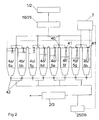
- the raw meal silo 4 is based on FIG. 2 described in more detail. However, the following description also applies to the clinker silo 5. In order to avoid unnecessary repetition, reference is therefore made below essentially to the raw meal silo installation 4. The reference numbers associated with the clinker silo 5 are also indicated behind the slash.
- the upstream process here the raw material preparation
- the downstream process here the clinker burning
- the raw meal or raw meal components ground in the raw material processing 1 are analyzed by the analysis device 16/25 in their mineralogical and / or chemical composition.
- the result of the analysis is communicated to a controller 7, which activates material switches 40 in order to determine the filling of a specific or several raw meal silos / clinker silos.
- the controller 7 further monitors via sensors 41 the level of each raw material silos / clinker silos.
- Each of the raw material silos has an associated Auslassdosierorgan 42 which can be targeted via the controller 7.
- one or more Auslassdosierorgane 42 are selectively controlled to perform a raw meal stream with a desired mineralogical and / or chemical composition to the subsequent clinker burning process.
- the Raw meal composition is determined by the analyzer 25/26 and optionally used to correct or readjust the outlet dosing members 42.
- the large number of raw meal silos or clinker silos increases the flexibility of the material composition. It is therefore also possible to effect a corresponding correction of the raw meal composition in the case of clinker burning at very short notice, for example when using other fuels. It is also possible to make the fastest possible change in the raw meal composition by analysis of the fired clinker. Furthermore, one can compensate for fluctuations in the clinker composition by targeted mixture of clinker from two or more clinker silos.
- the cement clinker has a different grain size of the clinker phases. It can therefore be provided that the analysis devices for determining the mineralogical and / or chemical composition of the raw meal / clinker take samples which are fractionated according to grain size and / or density. It is also conceivable to effect the filling of the raw meal silos / clinker silos according to grain size and / or density by fractionation by sieving or sifting. So in particular individual points 40 may be equipped with suitable screening or sighting means.
Landscapes
- Engineering & Computer Science (AREA)
- Chemical & Material Sciences (AREA)
- Ceramic Engineering (AREA)
- Mechanical Engineering (AREA)
- General Engineering & Computer Science (AREA)
- Materials Engineering (AREA)
- Structural Engineering (AREA)
- Organic Chemistry (AREA)
- Chemical Kinetics & Catalysis (AREA)
- Analysing Materials By The Use Of Radiation (AREA)
- Curing Cements, Concrete, And Artificial Stone (AREA)
- Disintegrating Or Milling (AREA)
- Preparation Of Clay, And Manufacture Of Mixtures Containing Clay Or Cement (AREA)
Claims (7)
- Procédé pour la fabrication d'un liant hydraulique à base de plusieurs composants en matériaux bruts (12a à 12e), les composants en matériaux bruts étant moulus en farine crue, la farine crue étant cuite en clinker, et le clinker étant finalement moulus avec d'autres substances de mouture, caractérisé en ce que
le clinker est analysé quant à sa composition minéralogique et / ou chimique,
il est prévu pour le clinker au moins deux silos de clinker séparés (5a à 5g), qui sont remplis avec du clinker de différente composition minéralogique et / ou chimique, et la composition du clinker à moudre est fixée par prélèvement contrôlé en fonction de la composition analysée du clinker en provenance d'un ou de plusieurs silos de clinker. - Procédé selon la revendication 1, caractérisé en ce que la composition minéralogique et / ou chimique du clinker est déterminée et est utilisée pour la commande du prélèvement de la farine crue hors des silos de farine crue (4a à 4h).
- Procédé selon la revendication 1, caractérisé en ce que le remplissage des silos de clinker et le prélèvement du clinker hors d'un ou de plusieurs silos de clinker (5a à 5g) sont réglés en fonction de la composition minéralogique et / ou chimique désirée pour le ciment à réaliser.
- Procédé selon l'une ou plusieurs des revendications précédentes, caractérisé en ce que, pour la détermination de la composition minéralogique et / ou chimique du clinker selon la granulométrie et / ou la densité, des échantillons fractionnés sont prélevés et analysés.
- Procédé selon l'une ou plusieurs des revendications précédentes, caractérisé en ce que le remplissage des silos de clinker (5a à 5g) selon la granulométrie et / ou la densité est effectué par fractionnement au moyen de tamis ou par triage.
- Procédé selon l'une ou plusieurs des revendications précédentes, caractérisée en ce que le clinker à moudre est amené directement à l'installation de broyage du ciment après le prélèvement contrôlé hors d'un ou de plusieurs silos de clinker.
- Installation pour la fabrication d'un liant hydraulique à base de plusieurs composants en matériaux bruts, avec un dispositif de mouture (14) pour moudre les composants en matériaux bruts en farine crue, avec un four à calciner (2) pour la cuisson de la farine crue en clinker, et une installation de broyage de ciment (3) pour moudre le clinker, caractérisée en ce que sont prévus
au moins un système d'analyse (25, 26) pour l'analyse du clinker quant à sa composition minéralogique et / ou chimique,
une installation de silos de clinker (5), deux silos de clinker séparés étant respectivement prévus pour le clinker,
et un dispositif de commande pour le remplissage des silos de clinker (5a à 5g) en fonction de la composition minéralogique et / ou chimique du clinker, et pour la fixation de la composition du clinker à moudre, par prélèvement en fonction de la composition analysée du clinker en provenance d'un ou de plusieurs silos (5a à 5g).
Applications Claiming Priority (2)
| Application Number | Priority Date | Filing Date | Title |
|---|---|---|---|
| DE10344040A DE10344040A1 (de) | 2003-09-23 | 2003-09-23 | Verfahren und Vorrichtung zur Herstellung eines hydraulischen Bindemittels |
| EP04765302A EP1663900B1 (fr) | 2003-09-23 | 2004-09-16 | Procede pour produire un liant hydraulique |
Related Parent Applications (1)
| Application Number | Title | Priority Date | Filing Date |
|---|---|---|---|
| EP04765302A Division EP1663900B1 (fr) | 2003-09-23 | 2004-09-16 | Procede pour produire un liant hydraulique |
Publications (2)
| Publication Number | Publication Date |
|---|---|
| EP1900701A1 EP1900701A1 (fr) | 2008-03-19 |
| EP1900701B1 true EP1900701B1 (fr) | 2009-04-15 |
Family
ID=34306041
Family Applications (2)
| Application Number | Title | Priority Date | Filing Date |
|---|---|---|---|
| EP04765302A Expired - Lifetime EP1663900B1 (fr) | 2003-09-23 | 2004-09-16 | Procede pour produire un liant hydraulique |
| EP08100076A Expired - Lifetime EP1900701B1 (fr) | 2003-09-23 | 2004-09-16 | Procédé et dispositif pour la préparation d'un liant hydraulique |
Family Applications Before (1)
| Application Number | Title | Priority Date | Filing Date |
|---|---|---|---|
| EP04765302A Expired - Lifetime EP1663900B1 (fr) | 2003-09-23 | 2004-09-16 | Procede pour produire un liant hydraulique |
Country Status (6)
| Country | Link |
|---|---|
| US (1) | US7976627B2 (fr) |
| EP (2) | EP1663900B1 (fr) |
| DE (3) | DE10344040A1 (fr) |
| ES (2) | ES2313056T3 (fr) |
| RU (1) | RU2346905C2 (fr) |
| WO (1) | WO2005030669A1 (fr) |
Families Citing this family (12)
| Publication number | Priority date | Publication date | Assignee | Title |
|---|---|---|---|---|
| DE102007025094A1 (de) * | 2007-05-30 | 2008-12-04 | Polysius Ag | Verfahren und Anlage zur Herstellung von Zement |
| WO2012038859A1 (fr) * | 2010-09-24 | 2012-03-29 | Flsmidth A/S | Procédé de réglage de la chimie du clinker |
| US20120221998A1 (en) * | 2011-02-24 | 2012-08-30 | Active Endpoints, Inc. | Screenflow designer with automatically changing view |
| LU92037B1 (fr) * | 2012-07-06 | 2014-01-07 | Wurth Paul Sa | Dispositif de depressuration d'un reservoir sous pression de stockage de matiere granuleuse ou pulverulente, et installation de distribution de matiere pulverulente par transport pneumatique comportant un tel dispositif |
| DE102014113548A1 (de) * | 2014-09-19 | 2016-03-24 | Thyssenkrupp Ag | Verfahren zur Herstellung eines Werkstoffs |
| DE102020100260A1 (de) | 2020-01-08 | 2021-07-08 | Thyssenkrupp Ag | Integriertes Verfahren zur Herstellung von Schwefelsäureprozess-geeigneter Schwefeldioxidqualität aus Kalziumsulfat/Phosphorgips aus der Phosphorsäureproduktion |
| DE102020100249A1 (de) | 2020-01-08 | 2021-07-08 | Thyssenkrupp Ag | Integriertes Verfahren zur kommerziellen und industriellen Verwertung von Kalziumsulfat unter Gewinnung von Seltenen Erden aus der Phosphorsäureproduktion |
| DE102020100241A1 (de) | 2020-01-08 | 2021-07-08 | Thyssenkrupp Ag | Verfahren zur Herstellung von Phosphorsäure und Klinkerprozess-geeigneter Kalziumsulfatqualität zur kommerziellen und industriellen Verwertung von Kalziumsulfat |
| DE102020100238A1 (de) | 2020-01-08 | 2021-07-08 | Thyssenkrupp Ag | Integriertes Verfahren zur kommerziellen und industriellen Verwertung von Kalziumsulfat aus der Phosphorsäureproduktion |
| DE102020100254A1 (de) | 2020-01-08 | 2021-07-08 | Thyssenkrupp Ag | Integriertes Verfahren zur Herstellung eines Baustoffs aus Phosphorgips |
| CN113731295A (zh) * | 2021-09-28 | 2021-12-03 | 中冶赛迪工程技术股份有限公司 | 配煤系统 |
| BE1032710B1 (de) | 2024-06-20 | 2026-01-26 | thyssenkrupp Polysius GmbH | Verfahren und Anlage zur Herstellung eines hydraulischen Bindemittels |
Family Cites Families (22)
| Publication number | Priority date | Publication date | Assignee | Title |
|---|---|---|---|---|
| US3233973A (en) | 1962-03-29 | 1966-02-08 | Fuller Co | Apparatus and method for processing material |
| DE1281818B (de) * | 1965-07-17 | 1968-10-31 | Rheinische Kalksteinwerke | Verfahren zum gleichzeitigen Mahlen mehrerer Rohstoffe unterschiedlicher Mahlbarkeit |
| US3401891A (en) * | 1966-10-25 | 1968-09-17 | Gen Electric | Control system for a closed circuit grinding system for finish cement |
| US3602488A (en) * | 1970-03-11 | 1971-08-31 | California Portland Co | Cement raw mix control apparatus and programming |
| US4026717A (en) * | 1975-09-08 | 1977-05-31 | Texas Industries, Inc. | Economical, finely controlled cement production |
| US4047434A (en) * | 1976-02-06 | 1977-09-13 | Dickey-John Corporation | Bin depth monitor |
| DE2855715C3 (de) * | 1978-12-22 | 1982-05-19 | Gebrüder Bühler AG, 9240 Uzwil | Getreidemühlenanlage zur Herstellung von Mehl |
| US4395290A (en) * | 1982-01-13 | 1983-07-26 | Gulf & Western Industries, Inc. | Method of manufacturing cement raw mix |
| SU1610213A1 (ru) * | 1988-11-21 | 1990-11-30 | Государственный Всесоюзный Институт По Проектированию И Научно-Исследовательским Работам "Южгипроцемент" | Установка дл обжига цементного клинкера |
| DE4447872C2 (de) * | 1994-08-12 | 2003-01-23 | Dyckerhoff Ag | Verfahren zur Herstellung einer Werktrockenmischung, Vorrichtung zur Durchführung des Verfahrens und Verwendung der nach dem Verfahren hergestellten Werktrockenmischung |
| DE4443400A1 (de) * | 1994-12-07 | 1996-06-13 | Mathieu Ernst Ulrich Dipl Ing | Herstellungsverfahren für Baustoffe |
| DE19602321A1 (de) * | 1995-02-13 | 1996-08-29 | Kleinholz & Co | Verfahren und Verwertung von Reststoffen bei der Zementherstellung |
| US5494515C1 (en) * | 1995-03-15 | 2002-01-22 | Texas Industries Inc | Method and apparatus for using blast-furnace slag in cement clinker production |
| DE19518958A1 (de) * | 1995-05-23 | 1996-11-28 | Krupp Polysius Ag | Verfahren und Anlage zur Aufbereitung einer Materialmischung |
| JPH11130484A (ja) | 1997-10-22 | 1999-05-18 | Mitsubishi Heavy Ind Ltd | セメント原料調合制御方法及び装置 |
| JPH11180742A (ja) * | 1997-12-18 | 1999-07-06 | Nippon Cement Co Ltd | セメントクリンカ製造方法 |
| DE19833447C2 (de) * | 1998-07-24 | 2002-06-06 | Wolfgang Hinkel | Verfahren und Vorrichtung zur Verwertung von Abfällen |
| EP0995726A1 (fr) * | 1998-10-19 | 2000-04-26 | E. Schwenk Zementwerke KG | Procédé et dispositif pour la fabrication de ciment hydraulique |
| WO2002022246A1 (fr) * | 2000-09-11 | 2002-03-21 | Thermo Gamma-Metrics | Systeme et procede destines a l'optimisation d'un melange |
| US6391105B1 (en) * | 2001-02-16 | 2002-05-21 | Lafarge Canada Inc. | Enhancement of cement clinker yield |
| DE10118142A1 (de) | 2001-04-11 | 2002-10-17 | Krupp Polysius Ag | Verfahren und Anlage zur Herstellung von gebranntem Gut |
| US20040157181A1 (en) * | 2003-02-11 | 2004-08-12 | Arnold John R. | Method for manufacturing cement clinker |
-
2003
- 2003-09-23 DE DE10344040A patent/DE10344040A1/de not_active Withdrawn
-
2004
- 2004-09-16 ES ES04765302T patent/ES2313056T3/es not_active Expired - Lifetime
- 2004-09-16 EP EP04765302A patent/EP1663900B1/fr not_active Expired - Lifetime
- 2004-09-16 ES ES08100076T patent/ES2322106T3/es not_active Expired - Lifetime
- 2004-09-16 WO PCT/EP2004/010403 patent/WO2005030669A1/fr not_active Ceased
- 2004-09-16 DE DE502004009376T patent/DE502004009376D1/de not_active Expired - Lifetime
- 2004-09-16 DE DE502004008424T patent/DE502004008424D1/de not_active Expired - Lifetime
- 2004-09-16 US US10/571,492 patent/US7976627B2/en not_active Expired - Fee Related
- 2004-09-16 RU RU2006110202/03A patent/RU2346905C2/ru not_active IP Right Cessation
- 2004-09-16 EP EP08100076A patent/EP1900701B1/fr not_active Expired - Lifetime
Also Published As
| Publication number | Publication date |
|---|---|
| ES2322106T3 (es) | 2009-06-16 |
| DE502004008424D1 (de) | 2008-12-18 |
| EP1663900B1 (fr) | 2008-11-05 |
| EP1663900A1 (fr) | 2006-06-07 |
| ES2313056T3 (es) | 2009-03-01 |
| DE10344040A1 (de) | 2005-04-14 |
| US20060288911A1 (en) | 2006-12-28 |
| EP1900701A1 (fr) | 2008-03-19 |
| RU2006110202A (ru) | 2006-08-10 |
| US7976627B2 (en) | 2011-07-12 |
| DE502004009376D1 (de) | 2009-05-28 |
| WO2005030669A1 (fr) | 2005-04-07 |
| RU2346905C2 (ru) | 2009-02-20 |
Similar Documents
| Publication | Publication Date | Title |
|---|---|---|
| EP1900701B1 (fr) | Procédé et dispositif pour la préparation d'un liant hydraulique | |
| EP3322534B2 (fr) | Procédé et agencement pour traitement et activation d'une matière première | |
| DE69627145T2 (de) | Verfahren und vorrichtung zur verwendung von hochofenschlacken bei der zementherstellung | |
| DE69516667T2 (de) | Verfahren und vorrichtung zur verwendung von stahlschlacken in zementherstellung | |
| EP0744682B1 (fr) | Procédé et installation pour le traitement d'un mélange de matières | |
| WO2020058247A1 (fr) | Procédé et système pour traiter un matériau qui contient du ciment | |
| DE102014113548A1 (de) | Verfahren zur Herstellung eines Werkstoffs | |
| DE102017114831A1 (de) | Verfahren zur Aufarbeitung von Flugasche sowie Anlage und Verfahren zur Herstellung von Zement | |
| DE19625538A1 (de) | Verfahren zur Herstellung von abgewohnten Gipskartonplatten u.ä. Reststoffen bei der Zementherstellung | |
| WO2019030226A1 (fr) | Procédé et installation de fabrication de ciment | |
| DE102021200561A1 (de) | Verfahren zum Betreiben einer Anlage zur Herstellung und/ oder Handhabung von Zementklinker | |
| EP3433597B1 (fr) | Appareil et procédé pour la détermination de resistance au broyage au moyen de mesure calorimétrique | |
| DE1646647C3 (de) | Verfahren zur Herstellung von Zement nach den Gips-Schwefelsäure-Verfahren in einem Drehofen | |
| WO2009043503A2 (fr) | Procédé et installation de fabrication de ciments à composants multiples | |
| EP4146609B1 (fr) | Procédé pour la préparation d'un composant de ciment réactif ou additif pour béton réactif | |
| DE102015119300A1 (de) | Verfahren zur Herstellung von Zementklinker | |
| EP3710413B1 (fr) | Procédé et installation de traitement thermique d'un matériau de départ dispersible et contenant des carbonates | |
| EP0550834A1 (fr) | Procédé pour la production d'un mélange asphaltique | |
| EP4281424B1 (fr) | Procédé de fonctionnement d'un système de production et/ou de manipulation de clinker de ciment | |
| EP4584025B1 (fr) | Séparateur électrostatique dans l'activation mécano-chimique | |
| BE1029040B1 (de) | Verfahren zum Betreiben einer Anlage zur Herstellung und/ oder Handhabung von Zementklinker | |
| BE1032880B1 (de) | Regelung einer Klinkerherstellung | |
| DE19745793A1 (de) | Verfahren zur Vorausbestimmung des Mahlwiderstandes von Mahlgut | |
| DE102023133380A1 (de) | Elektrostatischer Sichter in der mechano-chemischen Aktivierung | |
| Svinning et al. | Microstructure and properties of Portland cement, Part 1: Evaluation of the prediction models |
Legal Events
| Date | Code | Title | Description |
|---|---|---|---|
| PUAI | Public reference made under article 153(3) epc to a published international application that has entered the european phase |
Free format text: ORIGINAL CODE: 0009012 |
|
| AC | Divisional application: reference to earlier application |
Ref document number: 1663900 Country of ref document: EP Kind code of ref document: P |
|
| AK | Designated contracting states |
Kind code of ref document: A1 Designated state(s): DE ES FR IT |
|
| 17P | Request for examination filed |
Effective date: 20080212 |
|
| GRAP | Despatch of communication of intention to grant a patent |
Free format text: ORIGINAL CODE: EPIDOSNIGR1 |
|
| GRAS | Grant fee paid |
Free format text: ORIGINAL CODE: EPIDOSNIGR3 |
|
| AKX | Designation fees paid |
Designated state(s): DE ES FR IT |
|
| GRAA | (expected) grant |
Free format text: ORIGINAL CODE: 0009210 |
|
| AC | Divisional application: reference to earlier application |
Ref document number: 1663900 Country of ref document: EP Kind code of ref document: P |
|
| AK | Designated contracting states |
Kind code of ref document: B1 Designated state(s): DE ES FR IT |
|
| REF | Corresponds to: |
Ref document number: 502004009376 Country of ref document: DE Date of ref document: 20090528 Kind code of ref document: P |
|
| REG | Reference to a national code |
Ref country code: ES Ref legal event code: FG2A Ref document number: 2322106 Country of ref document: ES Kind code of ref document: T3 |
|
| PLBE | No opposition filed within time limit |
Free format text: ORIGINAL CODE: 0009261 |
|
| STAA | Information on the status of an ep patent application or granted ep patent |
Free format text: STATUS: NO OPPOSITION FILED WITHIN TIME LIMIT |
|
| 26N | No opposition filed |
Effective date: 20100118 |
|
| REG | Reference to a national code |
Ref country code: DE Ref legal event code: R082 Ref document number: 502004009376 Country of ref document: DE Representative=s name: RA U. PA VOLKMAR TETZNER; PA MICHAEL TETZNER; , DE |
|
| REG | Reference to a national code |
Ref country code: DE Ref legal event code: R082 Ref document number: 502004009376 Country of ref document: DE Representative=s name: RECHTSANW. UND PAT.-ANW. DR.-ING. DR.JUR. VOLK, DE Effective date: 20120131 Ref country code: DE Ref legal event code: R081 Ref document number: 502004009376 Country of ref document: DE Owner name: THYSSENKRUPP RESOURCE TECHNOLOGIES AG, DE Free format text: FORMER OWNER: POLYSIUS AG, 59269 BECKUM, DE Effective date: 20120131 Ref country code: DE Ref legal event code: R081 Ref document number: 502004009376 Country of ref document: DE Owner name: THYSSENKRUPP RESOURCE TECHNOLOGIES GMBH, DE Free format text: FORMER OWNER: POLYSIUS AG, 59269 BECKUM, DE Effective date: 20120131 Ref country code: DE Ref legal event code: R082 Ref document number: 502004009376 Country of ref document: DE Representative=s name: TETZNER & PARTNER MBB PATENT- UND RECHTSANWAEL, DE Effective date: 20120131 Ref country code: DE Ref legal event code: R081 Ref document number: 502004009376 Country of ref document: DE Owner name: THYSSENKRUPP INDUSTRIAL SOLUTIONS AG, DE Free format text: FORMER OWNER: POLYSIUS AG, 59269 BECKUM, DE Effective date: 20120131 |
|
| REG | Reference to a national code |
Ref country code: DE Ref legal event code: R082 Ref document number: 502004009376 Country of ref document: DE Representative=s name: RECHTSANW. UND PAT.-ANW. DR.-ING. DR.JUR. VOLK, DE |
|
| REG | Reference to a national code |
Ref country code: DE Ref legal event code: R082 Ref document number: 502004009376 Country of ref document: DE Representative=s name: RECHTSANW. UND PAT.-ANW. DR.-ING. DR.JUR. VOLK, DE Effective date: 20130626 Ref country code: DE Ref legal event code: R082 Ref document number: 502004009376 Country of ref document: DE Representative=s name: RECHTSANW. UND PAT.-ANW. DR.-ING. DR.JUR. VOLK, DE Effective date: 20130808 Ref country code: DE Ref legal event code: R081 Ref document number: 502004009376 Country of ref document: DE Owner name: THYSSENKRUPP RESOURCE TECHNOLOGIES GMBH, DE Free format text: FORMER OWNER: THYSSENKRUPP POLYSIUS AG, 59269 BECKUM, DE Effective date: 20130626 Ref country code: DE Ref legal event code: R081 Ref document number: 502004009376 Country of ref document: DE Owner name: THYSSENKRUPP RESOURCE TECHNOLOGIES GMBH, DE Free format text: FORMER OWNER: THYSSENKRUPP RESOURCE TECHNOLOGIES AG, 59269 BECKUM, DE Effective date: 20130808 Ref country code: DE Ref legal event code: R082 Ref document number: 502004009376 Country of ref document: DE Representative=s name: TETZNER & PARTNER MBB PATENT- UND RECHTSANWAEL, DE Effective date: 20130808 Ref country code: DE Ref legal event code: R082 Ref document number: 502004009376 Country of ref document: DE Representative=s name: TETZNER & PARTNER MBB PATENT- UND RECHTSANWAEL, DE Effective date: 20130626 Ref country code: DE Ref legal event code: R081 Ref document number: 502004009376 Country of ref document: DE Owner name: THYSSENKRUPP INDUSTRIAL SOLUTIONS AG, DE Free format text: FORMER OWNER: THYSSENKRUPP POLYSIUS AG, 59269 BECKUM, DE Effective date: 20130626 Ref country code: DE Ref legal event code: R081 Ref document number: 502004009376 Country of ref document: DE Owner name: THYSSENKRUPP INDUSTRIAL SOLUTIONS AG, DE Free format text: FORMER OWNER: THYSSENKRUPP RESOURCE TECHNOLOGIES AG, 59269 BECKUM, DE Effective date: 20130808 |
|
| REG | Reference to a national code |
Ref country code: DE Ref legal event code: R082 Ref document number: 502004009376 Country of ref document: DE Representative=s name: TETZNER & PARTNER MBB PATENT- UND RECHTSANWAEL, DE |
|
| REG | Reference to a national code |
Ref country code: DE Ref legal event code: R082 Ref document number: 502004009376 Country of ref document: DE Representative=s name: TETZNER & PARTNER MBB PATENT- UND RECHTSANWAEL, DE |
|
| REG | Reference to a national code |
Ref country code: DE Ref legal event code: R082 Ref document number: 502004009376 Country of ref document: DE Representative=s name: TETZNER & PARTNER MBB PATENT- UND RECHTSANWAEL, DE Effective date: 20140519 Ref country code: DE Ref legal event code: R081 Ref document number: 502004009376 Country of ref document: DE Owner name: THYSSENKRUPP INDUSTRIAL SOLUTIONS AG, DE Free format text: FORMER OWNER: THYSSENKRUPP RESOURCE TECHNOLOGIES GMBH, 59269 BECKUM, DE Effective date: 20140729 Ref country code: DE Ref legal event code: R082 Ref document number: 502004009376 Country of ref document: DE Representative=s name: TETZNER & PARTNER MBB PATENT- UND RECHTSANWAEL, DE Effective date: 20140729 |
|
| PGFP | Annual fee paid to national office [announced via postgrant information from national office to epo] |
Ref country code: ES Payment date: 20140923 Year of fee payment: 11 Ref country code: FR Payment date: 20140919 Year of fee payment: 11 |
|
| PGFP | Annual fee paid to national office [announced via postgrant information from national office to epo] |
Ref country code: IT Payment date: 20140924 Year of fee payment: 11 |
|
| PGFP | Annual fee paid to national office [announced via postgrant information from national office to epo] |
Ref country code: DE Payment date: 20141015 Year of fee payment: 11 |
|
| REG | Reference to a national code |
Ref country code: DE Ref legal event code: R119 Ref document number: 502004009376 Country of ref document: DE |
|
| PG25 | Lapsed in a contracting state [announced via postgrant information from national office to epo] |
Ref country code: IT Free format text: LAPSE BECAUSE OF NON-PAYMENT OF DUE FEES Effective date: 20150916 |
|
| REG | Reference to a national code |
Ref country code: FR Ref legal event code: ST Effective date: 20160531 |
|
| PG25 | Lapsed in a contracting state [announced via postgrant information from national office to epo] |
Ref country code: DE Free format text: LAPSE BECAUSE OF NON-PAYMENT OF DUE FEES Effective date: 20160401 |
|
| PG25 | Lapsed in a contracting state [announced via postgrant information from national office to epo] |
Ref country code: FR Free format text: LAPSE BECAUSE OF NON-PAYMENT OF DUE FEES Effective date: 20150930 |
|
| REG | Reference to a national code |
Ref country code: ES Ref legal event code: FD2A Effective date: 20161028 |
|
| PG25 | Lapsed in a contracting state [announced via postgrant information from national office to epo] |
Ref country code: ES Free format text: LAPSE BECAUSE OF NON-PAYMENT OF DUE FEES Effective date: 20150917 |