EP1900771A1 - Harzzusammensetzung - Google Patents
Harzzusammensetzung Download PDFInfo
- Publication number
- EP1900771A1 EP1900771A1 EP06757042A EP06757042A EP1900771A1 EP 1900771 A1 EP1900771 A1 EP 1900771A1 EP 06757042 A EP06757042 A EP 06757042A EP 06757042 A EP06757042 A EP 06757042A EP 1900771 A1 EP1900771 A1 EP 1900771A1
- Authority
- EP
- European Patent Office
- Prior art keywords
- isobutylene
- resin composition
- composition according
- block copolymer
- styrene
- Prior art date
- Legal status (The legal status is an assumption and is not a legal conclusion. Google has not performed a legal analysis and makes no representation as to the accuracy of the status listed.)
- Withdrawn
Links
Images
Classifications
-
- C—CHEMISTRY; METALLURGY
- C09—DYES; PAINTS; POLISHES; NATURAL RESINS; ADHESIVES; COMPOSITIONS NOT OTHERWISE PROVIDED FOR; APPLICATIONS OF MATERIALS NOT OTHERWISE PROVIDED FOR
- C09J—ADHESIVES; NON-MECHANICAL ASPECTS OF ADHESIVE PROCESSES IN GENERAL; ADHESIVE PROCESSES NOT PROVIDED FOR ELSEWHERE; USE OF MATERIALS AS ADHESIVES
- C09J153/00—Adhesives based on block copolymers containing at least one sequence of a polymer obtained by reactions only involving carbon-to-carbon unsaturated bonds; Adhesives based on derivatives of such polymers
-
- C—CHEMISTRY; METALLURGY
- C08—ORGANIC MACROMOLECULAR COMPOUNDS; THEIR PREPARATION OR CHEMICAL WORKING-UP; COMPOSITIONS BASED THEREON
- C08L—COMPOSITIONS OF MACROMOLECULAR COMPOUNDS
- C08L23/00—Compositions of homopolymers or copolymers of unsaturated aliphatic hydrocarbons having only one carbon-to-carbon double bond; Compositions of derivatives of such polymers
- C08L23/02—Compositions of homopolymers or copolymers of unsaturated aliphatic hydrocarbons having only one carbon-to-carbon double bond; Compositions of derivatives of such polymers not modified by chemical after-treatment
- C08L23/18—Homopolymers or copolymers of hydrocarbons having four or more carbon atoms
- C08L23/20—Homopolymers or copolymers of hydrocarbons having four or more carbon atoms having four to nine carbon atoms
- C08L23/22—Copolymers of isobutene; Butyl rubber; Homopolymers or copolymers of other iso-olefins
-
- C—CHEMISTRY; METALLURGY
- C08—ORGANIC MACROMOLECULAR COMPOUNDS; THEIR PREPARATION OR CHEMICAL WORKING-UP; COMPOSITIONS BASED THEREON
- C08L—COMPOSITIONS OF MACROMOLECULAR COMPOUNDS
- C08L53/00—Compositions of block copolymers containing at least one sequence of a polymer obtained by reactions only involving carbon-to-carbon unsaturated bonds; Compositions of derivatives of such polymers
-
- C—CHEMISTRY; METALLURGY
- C08—ORGANIC MACROMOLECULAR COMPOUNDS; THEIR PREPARATION OR CHEMICAL WORKING-UP; COMPOSITIONS BASED THEREON
- C08L—COMPOSITIONS OF MACROMOLECULAR COMPOUNDS
- C08L53/00—Compositions of block copolymers containing at least one sequence of a polymer obtained by reactions only involving carbon-to-carbon unsaturated bonds; Compositions of derivatives of such polymers
- C08L53/02—Compositions of block copolymers containing at least one sequence of a polymer obtained by reactions only involving carbon-to-carbon unsaturated bonds; Compositions of derivatives of such polymers of vinyl-aromatic monomers and conjugated dienes
- C08L53/025—Compositions of block copolymers containing at least one sequence of a polymer obtained by reactions only involving carbon-to-carbon unsaturated bonds; Compositions of derivatives of such polymers of vinyl-aromatic monomers and conjugated dienes modified
-
- C—CHEMISTRY; METALLURGY
- C09—DYES; PAINTS; POLISHES; NATURAL RESINS; ADHESIVES; COMPOSITIONS NOT OTHERWISE PROVIDED FOR; APPLICATIONS OF MATERIALS NOT OTHERWISE PROVIDED FOR
- C09J—ADHESIVES; NON-MECHANICAL ASPECTS OF ADHESIVE PROCESSES IN GENERAL; ADHESIVE PROCESSES NOT PROVIDED FOR ELSEWHERE; USE OF MATERIALS AS ADHESIVES
- C09J153/00—Adhesives based on block copolymers containing at least one sequence of a polymer obtained by reactions only involving carbon-to-carbon unsaturated bonds; Adhesives based on derivatives of such polymers
- C09J153/02—Vinyl aromatic monomers and conjugated dienes
- C09J153/025—Vinyl aromatic monomers and conjugated dienes modified
-
- C—CHEMISTRY; METALLURGY
- C09—DYES; PAINTS; POLISHES; NATURAL RESINS; ADHESIVES; COMPOSITIONS NOT OTHERWISE PROVIDED FOR; APPLICATIONS OF MATERIALS NOT OTHERWISE PROVIDED FOR
- C09K—MATERIALS FOR MISCELLANEOUS APPLICATIONS, NOT PROVIDED FOR ELSEWHERE
- C09K3/00—Materials not provided for elsewhere
- C09K3/10—Materials in mouldable or extrudable form for sealing or packing joints or covers
-
- C—CHEMISTRY; METALLURGY
- C08—ORGANIC MACROMOLECULAR COMPOUNDS; THEIR PREPARATION OR CHEMICAL WORKING-UP; COMPOSITIONS BASED THEREON
- C08K—Use of inorganic or non-macromolecular organic substances as compounding ingredients
- C08K2201/00—Specific properties of additives
- C08K2201/008—Additives improving gas barrier properties
-
- C—CHEMISTRY; METALLURGY
- C08—ORGANIC MACROMOLECULAR COMPOUNDS; THEIR PREPARATION OR CHEMICAL WORKING-UP; COMPOSITIONS BASED THEREON
- C08K—Use of inorganic or non-macromolecular organic substances as compounding ingredients
- C08K3/00—Use of inorganic substances as compounding ingredients
-
- C—CHEMISTRY; METALLURGY
- C08—ORGANIC MACROMOLECULAR COMPOUNDS; THEIR PREPARATION OR CHEMICAL WORKING-UP; COMPOSITIONS BASED THEREON
- C08L—COMPOSITIONS OF MACROMOLECULAR COMPOUNDS
- C08L2666/00—Composition of polymers characterized by a further compound in the blend, being organic macromolecular compounds, natural resins, waxes or and bituminous materials, non-macromolecular organic substances, inorganic substances or characterized by their function in the composition
- C08L2666/02—Organic macromolecular compounds, natural resins, waxes or and bituminous materials
-
- C—CHEMISTRY; METALLURGY
- C08—ORGANIC MACROMOLECULAR COMPOUNDS; THEIR PREPARATION OR CHEMICAL WORKING-UP; COMPOSITIONS BASED THEREON
- C08L—COMPOSITIONS OF MACROMOLECULAR COMPOUNDS
- C08L2666/00—Composition of polymers characterized by a further compound in the blend, being organic macromolecular compounds, natural resins, waxes or and bituminous materials, non-macromolecular organic substances, inorganic substances or characterized by their function in the composition
- C08L2666/02—Organic macromolecular compounds, natural resins, waxes or and bituminous materials
- C08L2666/04—Macromolecular compounds according to groups C08L7/00 - C08L49/00, or C08L55/00 - C08L57/00; Derivatives thereof
-
- C—CHEMISTRY; METALLURGY
- C09—DYES; PAINTS; POLISHES; NATURAL RESINS; ADHESIVES; COMPOSITIONS NOT OTHERWISE PROVIDED FOR; APPLICATIONS OF MATERIALS NOT OTHERWISE PROVIDED FOR
- C09K—MATERIALS FOR MISCELLANEOUS APPLICATIONS, NOT PROVIDED FOR ELSEWHERE
- C09K2200/00—Chemical nature of materials in mouldable or extrudable form for sealing or packing joints or covers
- C09K2200/02—Inorganic compounds
- C09K2200/0204—Elements
- C09K2200/0208—Carbon
-
- C—CHEMISTRY; METALLURGY
- C09—DYES; PAINTS; POLISHES; NATURAL RESINS; ADHESIVES; COMPOSITIONS NOT OTHERWISE PROVIDED FOR; APPLICATIONS OF MATERIALS NOT OTHERWISE PROVIDED FOR
- C09K—MATERIALS FOR MISCELLANEOUS APPLICATIONS, NOT PROVIDED FOR ELSEWHERE
- C09K2200/00—Chemical nature of materials in mouldable or extrudable form for sealing or packing joints or covers
- C09K2200/02—Inorganic compounds
- C09K2200/0239—Oxides, hydroxides, carbonates
-
- C—CHEMISTRY; METALLURGY
- C09—DYES; PAINTS; POLISHES; NATURAL RESINS; ADHESIVES; COMPOSITIONS NOT OTHERWISE PROVIDED FOR; APPLICATIONS OF MATERIALS NOT OTHERWISE PROVIDED FOR
- C09K—MATERIALS FOR MISCELLANEOUS APPLICATIONS, NOT PROVIDED FOR ELSEWHERE
- C09K2200/00—Chemical nature of materials in mouldable or extrudable form for sealing or packing joints or covers
- C09K2200/02—Inorganic compounds
- C09K2200/0243—Silica-rich compounds, e.g. silicates, cement, glass
-
- C—CHEMISTRY; METALLURGY
- C09—DYES; PAINTS; POLISHES; NATURAL RESINS; ADHESIVES; COMPOSITIONS NOT OTHERWISE PROVIDED FOR; APPLICATIONS OF MATERIALS NOT OTHERWISE PROVIDED FOR
- C09K—MATERIALS FOR MISCELLANEOUS APPLICATIONS, NOT PROVIDED FOR ELSEWHERE
- C09K2200/00—Chemical nature of materials in mouldable or extrudable form for sealing or packing joints or covers
- C09K2200/06—Macromolecular organic compounds, e.g. prepolymers
- C09K2200/0615—Macromolecular organic compounds, e.g. prepolymers obtained by reactions only involving carbon-to-carbon unsaturated bonds
- C09K2200/0617—Polyalkenes
-
- C—CHEMISTRY; METALLURGY
- C09—DYES; PAINTS; POLISHES; NATURAL RESINS; ADHESIVES; COMPOSITIONS NOT OTHERWISE PROVIDED FOR; APPLICATIONS OF MATERIALS NOT OTHERWISE PROVIDED FOR
- C09K—MATERIALS FOR MISCELLANEOUS APPLICATIONS, NOT PROVIDED FOR ELSEWHERE
- C09K2200/00—Chemical nature of materials in mouldable or extrudable form for sealing or packing joints or covers
- C09K2200/06—Macromolecular organic compounds, e.g. prepolymers
- C09K2200/0615—Macromolecular organic compounds, e.g. prepolymers obtained by reactions only involving carbon-to-carbon unsaturated bonds
- C09K2200/0632—Polystyrenes
-
- E—FIXED CONSTRUCTIONS
- E06—DOORS, WINDOWS, SHUTTERS, OR ROLLER BLINDS IN GENERAL; LADDERS
- E06B—FIXED OR MOVABLE CLOSURES FOR OPENINGS IN BUILDINGS, VEHICLES, FENCES OR LIKE ENCLOSURES IN GENERAL, e.g. DOORS, WINDOWS, BLINDS, GATES
- E06B3/00—Window sashes, door leaves, or like elements for closing wall or like openings; Layout of fixed or moving closures, e.g. windows in wall or like openings; Features of rigidly-mounted outer frames relating to the mounting of wing frames
- E06B3/66—Units comprising two or more parallel glass or like panes permanently secured together
- E06B3/673—Assembling the units
- E06B3/67326—Assembling spacer elements with the panes
- E06B3/6733—Assembling spacer elements with the panes by applying, e.g. extruding, a ribbon of hardenable material on or between the panes
-
- E—FIXED CONSTRUCTIONS
- E06—DOORS, WINDOWS, SHUTTERS, OR ROLLER BLINDS IN GENERAL; LADDERS
- E06B—FIXED OR MOVABLE CLOSURES FOR OPENINGS IN BUILDINGS, VEHICLES, FENCES OR LIKE ENCLOSURES IN GENERAL, e.g. DOORS, WINDOWS, BLINDS, GATES
- E06B3/00—Window sashes, door leaves, or like elements for closing wall or like openings; Layout of fixed or moving closures, e.g. windows in wall or like openings; Features of rigidly-mounted outer frames relating to the mounting of wing frames
- E06B3/66—Units comprising two or more parallel glass or like panes permanently secured together
- E06B3/673—Assembling the units
- E06B3/67339—Working the edges of already assembled units
- E06B3/67343—Filling or covering the edges with synthetic hardenable substances
Definitions
- the present invention relates to a resin composition excellent in gas barrier properties, mechanical strength and elasticity and further showing low gravity deformability even under high temperature conditions.
- the invention further relates to a sealant, in particular a hot melt sealant for a double glazing unit or a hot melt spacer for a double glazing unit, each comprising the resin composition.
- Sealants are widely used in automobiles and building materials as materials to seal joints to secure watertightness and/or airtightness. Sealants are required to provide high levels of airtightness and, in many cases, are required to have such characteristics as high elasticity and high mechanical strength, although the requirements may vary according to the intended use thereof.
- the double glazing unit generally comprises two or more glass panels, with a spacer inserted between two neighboring panels to maintain a given distance between them.
- a sealant is applied, for example, between the spacer and each glass panel, and the space between the glass panels is filled with such a gas as dry air, nitrogen, argon or sulfur hexafluoride, whereby such effects as thermal insulation, sound insulation and water condensation prevention, among others.
- Double glazing units are variegated in structure and, according to the structure thereof, various sealants are applied in various ways. As such sealants, mention may be made of hot melt adhesives, for instance.
- hot melt spacers are used as the spacers.
- the double glazing unit in which a hot melt material is used are double glazing units in which the spacer used is a material comprising a thermoplastic resin such as a vinyl chloride resin or an isobutylene polymer-based hot melt butyl with a desiccant incorporated therein (Patent Document 1).
- the above-mentioned isobutylene polymer-based hot melt butyl has such characteristics as gas barrier properties ensuring airtightness and watertightness, weather resistance and tackiness and therefore used frequently as a sealant for double glazing units. More specifically, in double glazing units having a structure in which an aluminum spacer containing a desiccant therein is used, the hot melt butyl is used, by the hot melt technique, as a primary sealant for mutually fixing the aluminum spacer and the glass panels or applied, by the hot melt technique, as a secondary sealant to the outside of the aluminum spacer, for instance.
- a material prepared by incorporating a desiccant in the hot melt butyl is applied as such, by the hot melt technique, to one end of a double glazing unit for use as a thermoplastic resin spacer.
- the role to be fulfilled by the hot melt butyl is in maintaining the airtightness resulting from the adhesion thereof to the glass panel.
- the hot melt butyl may be destructed, deformed or peeled off during a long period of use, with the result that the performance thereof may no longer be maintained and the airtightness may be lost in some cases.
- problems are sometimes produced by deformations caused by the force of gravity (gravity deformations) under high temperature conditions and insufficiencies of elasticity and mechanical strength, in particular.
- a known method for improving the thermal stability of hot melt butyl under high temperature conditions comprises adding a styrenic thermoplastic elastomer or thermoplastic resin (Patent Document 2).
- a styrenic thermoplastic elastomer or thermoplastic resin which is not an isobutylene-based one, may produce a problem, namely may reduce the gas barrier ability depending on the level of addition thereof.
- a material having both high elasticity and high mechanical strength while maintaining high gas barrier properties has been demanded.
- the invention relates to a resin composition which comprises an isobutylene-based polymer (A), an isobutylene-based block copolymer (B) comprising a polymer block (b1) the constituent monomer (s) of which is (are) an aromatic vinyl compound(s) and a polymer block (b2) the constituent monomer(s) of which is(are) isobutylene, and a filler (C).
- the isobutylene-based block copolymer (B) has a number average molecular weight of 30,000 to 300,000.
- the weight ratio (b2)/(b1) between the polymer block (b2) and polymer block (b1) in the isobutylene-based block copolymer (B) is 95/5 to 50/50.
- the isobutylene-based block copolymer (B) is a styrene-isobutylene block copolymer.
- the isobutylene-based block copolymer (B) is a styrene-isobutylene-styrene triblock copolymer.
- the above-mentioned filler (C) is at least one species selected from the group consisting of calcium carbonate and carbon black.
- the above resin composition further comprises a moisture-absorbing compound (D).
- the moisture-absorbing compound (D) is preferably at least one species selected from the group consisting of silica gel, alumina and zeolite.
- the above resin composition further comprises a styrenic thermoplastic elastomer other than the component (B).
- the invention further relates to a sealant which comprises the resin composition mentioned above. Further, the invention relates to a hot melt sealant for double glazing units which comprises the resin composition mentioned above. Furthermore, the invention relates to a hot melt spacer for double glazing units which comprises the resin composition mentioned above.
- the resin composition according to the invention comprises an isobutylene-based polymer (A), an isobutylene-based block copolymer (B) comprising a polymer block (b1) the constituent monomer(s) of which is(are)an aromatic vinyl compound and a polymer block (b2) the constituent monomer(s) of which is(are) isobutylene, and a filler (C).
- the isobutylene-based polymer (A) provides hot melt adhesive characteristics.
- the isobutylene-based block polymer (B) characteristically has high gas barrier properties owing to the occurrence of an isobutylene block, and rigidity owing to the occurrence of an aromatic vinyl compound-derived block and, as compared with the use of other thermoplastic elastomers, the use thereof is advantageous not only in that the watertightness and airtightness of the composition will not be impaired but also in that the composition will undergo only a slight extent of gravity deformation under high temperature conditions.
- the filler (C) provides rigidity.
- the isobutylene-based polymer (A) includes many commercial products generally marketed under the name polyisobutylene, polybutene or butyl rubber, for instance.
- polyisobutylene polybutene or butyl rubber
- Exxon's Vistanex LM-MS, MH, H or MML-80, 100, 120, 140, etc.
- Nippon Oil Corporation' s Tetrax 3T, 4T, 5T, 6T, etc.
- Polybutene (HV) Himol (4H, 5H, 6H, etc.)
- BASF's Oppanol B10, B12, B15, B50, B80, B100, B120, B150, B220, etc.
- Exxon's Butyl (007, 065, 068, 168, 268, 269, 365), among others.
- the isobutylene-based polymer (A) preferably contains isobutylene-derived constituent units in an amount of not smaller than 50 parts by weight, more preferably not smaller than 80 parts by weight, still more preferably not smaller than 90 parts by weight, per 100 parts by weight of the polymer, although such ranges have no particular restrictive meaning.
- the monomer other than isobutylene which may be contained in the isobutylene-based polymer (A) is not particularly restricted but may be any of those cationically polymerizable monomer components such as aromatic vinyl compounds, aliphatic olefins, alicyclic alkenes, dienes, vinyl ethers and ⁇ -pinene. These may be used singly or two or more of them may be used in combination.
- aromatic vinyl compounds there may be mentioned, among others, styrene, o-, m- or p-methylstyrene, ⁇ -methylstyrene, ⁇ -methylstyrene, 2,6-dimethylstyrene, 2,4-dimethylstyrene, ⁇ -methyl-o-methylstyrene, ⁇ -methyl-m-methylstyrene, ⁇ -methyl-p-methylstyrene, ⁇ -methyl-o-methylstyrene, ⁇ -methyl-m-methylstyrene, ⁇ -methyl-p-methylstyrene, 2,4,6-trimethylstyrene, ⁇ -methyl-2,6-dimethylstyrene, ⁇ -methyl-2,4-dimethylstyrene, ⁇ -methyl-2,6-dimethylstyrene, ⁇ -methyl-2,4-dimethylstyrene, o-, m-, m
- aliphatic olefins there may be mentioned ethylene, propylene, 1-butene, 2-methyl-1-butene, 3-methyl-1-butene, pentene, hexene, 4-methyl-1-pentene and octene, among others.
- alicyclic alkenes there may be mentioned cyclohexene, vinylcyclohexane and norbornene, among others. These may be used singly or two or more of them may be used in combination.
- diene compounds there may be mentioned, among others, butadiene, isoprene, hexadiene, cyclopentadiene, cyclohexadiene, dicyclopentadiene, divinylbenzene, ethylidenenorbornene and the like. These may be used singly or two or more of them may be used in combination.
- vinyl ethers there may be mentioned methyl vinyl ether, ethyl vinyl ether, (n- or iso-)propyl vinyl ether, (n-, sec-, tert- or iso-)butyl vinyl ether, methyl propenyl ether and ethyl propenyl ether, among others. These may be used singly or two or more of them may be used in combination.
- the number average molecular weight of the isobutylene-based polymer (A) is not particularly restricted but preferably is 1,000 to 300,000, in particular 10,000 to 100,000.
- the number average molecular weight, so referred to herein, of each polymer is the value determined on the polystyrene equivalent basis by gel permeation chromatography (GPC) using, for example, a Waters GPC system (column: Showa Denko's Shodex K-804 (polystyrene gel), mobile phase: chloroform).
- GPC gel permeation chromatography
- the aromatic vinyl compound(s) constituting the polymer block (b1) in the isobutylene-based block copolymer (B) is (are) not particularly restricted but includes or include those compounds enumerated hereinabove referring to the aromatic vinyl compounds.
- the polymer block (b1) the constituent monomer(s) of which is(are) an aromatic vinyl compound(s) may or may not contain units derived from another monomer or other monomers different from the aromatic vinyl compound(s).
- the aromatic vinyl compound-derived monomer units in the whole polymer block (b1) preferably amounts to at least 60% by weight, more preferably at least 80% by weight.
- the aromatic vinyl compound-derived monomer unit content in the whole polymer block (b1) is lower than 60% by weight, the cohesive force of the polymer block will unfavorably become reduced.
- the monomer(s) other than the aromatic vinyl compound(s) is (are) not particularly restricted but may be any monomer cationically copolymerized with the aromatic vinyl compound(s) but includes, for example, isobutylene, the above-mentioned aliphatic olefins, alicyclic alkenes, dienes, vinyl ethers and ⁇ -pinene and like monomers. These may be used singly or two or more of them may be used in combination.
- the polymer block (b2) the constituent monomer(s) of which is(are) isobutylene may or may not contain one or more other monomers than isobutylene.
- the proportion of the isobutylene in the whole polymer block (b2) is preferably not lower than 60% by weight, more preferably not lower than 80% by weight, from the viewpoint of gas barrier properties.
- the monomer(s) other than isobutylene is(are) not particularly restricted but may be any monomer cationically copolymerized with the isobutylene but includes, for example, the above-mentioned aromatic vinyl compounds, aliphatic olefins, alicyclic alkenes, dienes, vinyl ethers and ⁇ -pinene and like monomers. These may be used singly or two or more of them may be used in combination.
- the weight ratio between the polymer block (b2) the constituent monomer(s) of which is(are) isobutylene and the polymer block (b1) the constituent monomer(s) of which is (are) an aromatic vinyl compound(s) in the isobutylene-based block copolymer (B) is not particularly restricted but the ratio (b2)/(b1) is preferably 95/5 to 50/50, more preferably 95/5 to 60/40. In particular, from the viewpoint of the gravity deformation under high temperature conditions, a ratio of 85/15 to 65/35 is preferred.
- the number average molecular weight of the isobutylene-based block copolymer (B) is not particularly restricted but preferably is 30,000 to 300,000. In particular, from the viewpoint the gravity deformation possibility under high temperature conditions and from the hot melt workability viewpoint, it is preferably 50,000 to 150,000. As mentioned hereinabove, the number average molecular weight, so referred to herein, is the value on the polystyrene equivalent basis as determined by gel permeation chromatography.
- the proportion of the isobutylene-based block copolymer (B) in the resin composition according to the invention is not particularly restricted but preferably is 1 to 30 parts by weight, more preferably 5 to 20 parts by weight, per 100 parts by weight of the isobutylene-based polymer (A).
- proportion of the isobutylene-based block copolymer (B) is smaller, deformation tends to occur due to gravity under high temperature conditions and, when it is excessively high, the composition becomes excessively hard, possibly leading to decreases in adhesion, for example peeling at hot melt sealed sites.
- the structure of the isobutylene-based block copolymer (B) is not particularly restricted but may be a block copolymer having a linear, branched or starlike structure, for instance. It may be a diblock, triblock or multiblock copolymer.
- Preferred as the isobutylene-based block copolymer (B) are styrene-isobutylene block copolymers, in particular. Further, from the viewpoint of gravity deformation, elasticity and/or strength under high temperature conditions, styrene-isobutylene-styrene triblock copolymers are more preferred.
- the method for producing the isobutylene-based polymer (A) is not particularly restricted but any of the known polymerization methods can be used. Among them, an isobutylene-based monomer component is preferably polymerized in the presence of a compound represented by the general formula (1) given below so that a block copolymer with a controlled structure may be obtained.
- X represents a substituent selected from the group consisting of halogen atoms, alkoxyl groups containing 1 to 6 carbon atoms and acyloxyl groups containing 1 to 6 carbon atoms; R 1 , R 2 and R 3 each is a hydrogen atom, an aliphatic hydrocarbon group or an aromatic hydrocarbon group, and R 1 , R 2 and R 3 may be the same or different; and n represents a natural number of 1 to 6.
- the method for producing the isobutylene-based block copolymer (B) is not particularly restricted, either, the method comprising first polymerizing an isobutylene-based monomer component in the presence of a compound represented by the above general formula (1) and then further polymerizing an aromatic vinyl compound-based monomer component is preferred since an isobutylene-based block copolymer with a controlled structure can be obtained by that method.
- the halogen atoms mentioned above include chlorine, fluorine, bromine and iodine, among others.
- the above-mentioned alkoxyl groups containing 1 to 6 carbon atoms are not particularly restricted but include a methoxy group, an ethoxy group, and an n- or iso-propoxy group, for instance.
- the above-mentioned acyloxyl groups containing 1 to 6 carbon atoms are not particularly restricted but include, among others, an acetyloxy group and a propionyloxy group.
- the above-mentioned aliphatic hydrocarbon group is not particularly restricted but includes, for example, a methyl group, an ethyl group, and an n- or isopropyl group.
- the above-mentioned aromatic hydrocarbon group is not particularly restricted but includes, among others, a phenyl group and a methylphenyl group.
- the compound represented by the general formula (1) is to serve as an initiator and is considered to form a carbocation in the presence of a Lewis acid, for instance, to provide initiation sites for cationic polymerization.
- a Lewis acid for instance, to provide initiation sites for cationic polymerization.
- (1-Chloro-1-methylethyl)benzene is also known as ( ⁇ -chloroisopropyl)benzene, (2-chloro-2-propyl)benzene or cumyl chloride
- bis(1-chloro-1-methylethyl)benzene is also known as bis( ⁇ -chloroisopropyl)benzene, bis(2-chloro-2-propyl)benzene or dicumyl chloride
- tris(1-chloro-1-methylethyl)benzene is also known as tris( ⁇ -chloroisopropyl)benzene, tris(2-chloro-2-propyl)benzene or tricumyl chloride.
- the polymerization may be carried out in the presence of a Lewis acid catalyst as well.
- a Lewis acid catalyst may be any of those which can be used in cationic polymerization.
- metal halides as TiCl 4 , TiBr 4 , BCl 3 , BF 3 , BF 3 ⁇ OEt 2 , SnCl 4 , SbCl 5 , SbF 5 , WCl 6 , TaCl 5 , VCl 5 , FeCl 3 , ZnBr 2 , AlCl 3 and AlBr 3 ; and organometal halides such as Et 2 AlCl and EtAlCl 2 can be suitably used.
- TiCl 4 , BCl 3 and SnCl 4 are preferred considering their catalytic activity and ready commercial availability.
- the level of addition of the Lewis acid is not particularly restricted but can be selected considering the polymerization characteristics of the monomer(s) used or the polymerization concentration, among others.
- the Lewis acid can be used in an amount of 0.1 to 100 mole equivalents, preferably within the range of 1 to 50 mole equivalents, relative to the compound represented by the general formula (1).
- the polymerization may also be carried out in the presence of an electron donor component as well according to need.
- This electron donor component is considered to be effective in stabilizing the growing carbocation on the occasion of cationic polymerization, and the addition of an electron donor results in the formation of a polymer narrow in molecular weight distribution and controlled in structure.
- the electron donor component that can be used is not particularly restricted but includes, among others, pyridines, amines, amides, sulfoxides, esters, and metal compounds having a metal atom-bound oxygen atom.
- the production of the isobutylene-based polymer (A) and isobutylene-based block copolymer (B) by polymerization can be carried out in the presence of an organic solvent according to need, and any of those organic solvents which will not essentially disturb the cationic polymerization can be used without any particular restriction.
- halogenated hydrocarbons such as methyl chloride, dichloromethane, chloroform, ethyl chloride, dichloroethane, n-propyl chloride, n-butyl chloride and chlorobenzene; benzene and alkylbenzenes such as toluene, xylene, ethylbenzene, propylbenzene and butylbenzene; straight-chain aliphatic hydrocarbons such as ethane, propane, butane, pentane, hexane, heptane, octane, nonane and decane; branched aliphatic hydrocarbons such as 2-methylpropane, 2-methylbutane, 2,3,3-trimethylpentane and 2,2,5-trimethylhexane; alicyclic hydrocarbons such as cyclohexane, methylcyclohexane and ethylcyclohexan
- solvents are used either singly or in combination of two or more considering the balance among the polymerization characteristics of the monomer or monomers constituting the isobutylene-based polymer (A) and isobutylene-based block copolymer (B) to be used in accordance with the invention and the solubility of the polymers formed, among others.
- the amount of the solvent to be used is selected so that the polymer concentration may amount to 1 to 50% by weight, preferably 5 to 35% by weight, considering the viscosity of the polymer solution to be obtained and the ease of removing heat.
- the components are mixed up under cooling, for example at a temperature not lower than -100°C but lower than 0°C.
- a particularly preferred temperature range is within the range of -30°C to -80°C.
- the filler (C) is effective in improving the rigidity of the resin composition of the invention and is also effective in improving the shape retainability at temperatures during use and in preventing sagging during hot melt application.
- the filler (C) to be used is not particularly restricted but may be any of species known in the art.
- use may be made of at least one member selected from the group consisting of calcium carbonate, magnesium carbonate, fused silica, crystalline silica, diatomaceous earth, clays, talc, mica, kaolin, titanium oxide, zinc oxide, carbon black, bentonite, aluminum hydroxide, magnesium hydroxide, barium sulfate, calcium sulfate and the like.
- calcium carbonate and carbon black are preferred, and carbon black, which is effective in rigidity improvement at low addition levels, is particularly preferred.
- the level of addition of the filler (C) is not particularly restricted but preferably is 1 to 300 parts by weight, more preferably 50 to 150 parts by weight, per 100 parts by weight of the isobutylene-based polymer (A).
- the resin composition according to the invention may further contain a moisture-absorbing compound (D).
- a moisture-absorbing compound (D) there may be used zeolite, silica gel and alumina etc., and these may be used singly or two or more of them may be used in combination.
- Such a moisture-absorbing compound reduces the water vapor permeability of the resin composition according to the invention and can prevent the space sandwiched between glass panels of the double glazing unit from being fogged by moisture.
- the level of addition of the moisture-absorbing compound (D) is preferably 1 to 100 parts by weight per 100 parts by weight the isobutylene-based polymer (A).
- the resin composition according to the invention may further contain, as a processing aid, an aromatic vinyl-based thermoplastic elastomer other than (B).
- aromatic vinyl-based thermoplastic elastomer so referred to herein, there may be mentioned block copolymers composed of a block (s) the constituent monomers of which are an aromatic vinyl compound and a butadiene and/or isoprene block(s), and hydrogenation products derived therefrom.
- SBS species styrene-butadiene-styrene block copolymers
- SIS species styrene-isoprene-styrene block copolymers
- SEBS species styrene-(ethylene/butylene)-styrene block copolymers
- SEPS species styrene-(ethylene/propylene)-styrene block copolymers
- SEEPS species styrene-[ethylene-(ethylene/propylene)]-styrene block copolymers
- the resin composition according to the invention there may further be incorporated one or more of antioxidants, ultraviolet absorbers, light stabilizers, pigments, surfactants, flame retardants and so forth each at an appropriate addition level so long as the physical properties of the composition will not be sacrificed thereby.
- antioxidants ultraviolet absorbers, light stabilizers, pigments, surfactants, flame retardants and so forth each at an appropriate addition level so long as the physical properties of the composition will not be sacrificed thereby.
- antiblocking agents, antistatic agents, colorants, inorganic or organic antimicrobial agents and lubricants can also be incorporated.
- the method for producing the resin composition according to the invention is not particularly restricted but, for example, use may be made of the method comprising mechanical kneading using a melting vessel equipped with a roll, Banbury mixer, kneader or stirrer or using a single-screw or twin-screw extruder. On that occasion, heating may be made according to need. It is also possible to use the method comprising preparing a uniform solution, followed by solvent removal by distillation.
- the temperature should be not lower than the temperature at which the isobutylene-based block copolymer (B) melts but preferably is not higher than 260°C.
- the resin composition of the invention can be further molded according to need using a molding method and molding apparatus generally employed for thermoplastic resin compositions, for example by extrusion molding, injection molding, press molding or blow molding.
- the resin composition obtained in the above manner has high levels of gas barrier properties, elasticity and mechanical strength and shows only a slight extent of gravity deformation under high temperature conditions.
- the composition can be suitably used as a sealant, in particular as a hot melt sealant for double glazing units, or as a hot melt spacer material for double glazing units
- the resin composition according to the invention undergoes only a slight extent of gravity deformation under high temperature conditions and is higher in elasticity, mechanical strength and gas barrier properties as compared with the conventional compositions.
- the resin composition according to the invention can be suitably used as a sealant required to show high levels of elasticity, mechanical strength, gas barrier properties, and the like, in particular as a hot melt sealant for double glazing units, or as a hot melt spacer material for double glazing units.
- PIB1 Polyisobutylene (described in Production Example 1); PIB2: Polyisobutylene (product of BASF, product name: "Oppanol B12"); SIBS1: Styrene-isobutylene-styrene triblock copolymer 1 (described in Production Example 2; molecular weight of 60, 000; styrene block content of 30%); SIBS2: Styrene-isobutylene-styrene triblock copolymer 2 (described in Production Example 3; molecular weight of 120,000; styrene block content of 30%); SIBS3: Styrene-isobutylene-styrene triblock copolymer 3 (described in Production Example 4; molecular weight of 120,000; styrene block content of 13%); SIB: Styrene-isobutylene diblock copolymer (described in Production Example 5); SEBS: Styrene-(ethylene/butylene)
- each resin composition obtained was molded into sheets (width 20 mm x length 40 mm x thickness 6 mm) using a mold and a press molding machine (temperature set at 180°C).
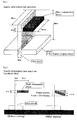
- a glass sheet (width 50 mm x length 50 mm x thickness 5 mm) was prepared and each test specimen sheet was caused to perpendicularly adhere to the glass surface, as shown in Fig. 1 .
- the glass sheet with the test specimen sheet adhering thereto was fixed vertically relative to the ground using a stand and then allowed to stand in a hot air drying chamber at 120°C (or 140°C) for 12 hours. After 12 hours of testing, the distance x (mm) of the position of the lower end of the test specimen sheet after heating from the original position was measured, as shown in Fig.
- the gravity deformation was evaluated based on the distance x (mm) measured after the above heating test according to the following criteria. Excellent: The distance x (mm) after the above heating test is shorter than 1 mm; Fair: The distance x (mm) after the above heating test is not shorter than 1 mm but shorter than 3 mm; Poor: The distance x (mm) after the above heating test is 3 mm or longer.
- a 0.9-mm-thick sheet was prepared from the composition obtained by hot pressing under conditions of 180°C.
- the sheet prepared was subjected to water vapor permeability measurement of the composition at 40°C and at 90% RH according to JIS Z 0208.
- a polymerization vessel (2-liter separable flask) was purged with nitrogen and then charged with 173 mL of ethylcyclohexane (molecular sieve-dried) and 519 mL of toluene (molecular sieve-dried) using a syringe.
- the polymerization vessel was cooled by immersion in a dry ice/methanol bath at -70°C and then connected with a pressure-resisting glass-made liquefied gas collector equipped with a three-way cock and containing 254 mL (2,690 mmol) of isobutylene monomer via a Teflon (registered trademark)-made feeding tube, and the isobutylene monomer was fed to the polymerization vessel under nitrogen pressure.
- 0.5 g (2.2 mmol) of p-dicumyl chloride and 0.37 g (4.3 mmol) of N,N-dimethylacetamide were added.
- the isobutylene-based polymer had a number average molecular weight of 70,000.
- a polymerization vessel (2-liter separable flask) was purged with nitrogen and then charged with 300 mL of n-hexane (molecular sieve-dried) and 432 mL of butyl chloride (molecular sieve-dried) using a syringe.
- the polymerization vessel was cooled by immersion in a dry ice/methanol bath at -70°C and then connected with a pressure-resisting glass-made liquefied gas collector equipped with a three-way cock and containing 153 mL (1,619 mmol) of isobutylene monomer via a Teflon (registered trademark)-made feeding tube, and the isobutylene monomer was fed to the polymerization vessel under nitrogen pressure. 0.50 g (2.2 mmol) of p-dicumyl chloride and 0.94 g (10.8 mmol) of N,N-dimethylacetamide were added.
- the isobutylene-based triblock copolymer (SIBS1).
- SIBS1 isobutylene-based triblock copolymer
- the isobutylene polymer before addition of styrene had a number average molecular weight of 42,000, and the block copolymer after polymerization of styrene had a number average molecular weight of 60,000.
- the weight ratio between the isobutylene-based polymer block (b2) and the styrene-based polymer block (b1) in the isobutylene-based block copolymer (B) was 70/30. This ratio can be determined by using the 1 H-NMR technique, and the value referred to herein was calculated from the ratio between the aromatic-due peak intensity and the aliphatic-due peak intensity.
- a polymerization vessel (2-liter separable flask) was purged with nitrogen and then charged with 302 mL of n-hexane (molecular sieve-dried) and 435 mL of butyl chloride (molecular sieve-dried) using a syringe.
- the polymerization vessel was cooled by immersion in a dry ice/methanol bath at -70°C and then connected with a pressure-resisting glass-made liquefied gas collector equipped with a three-way cock and containing 153 mL (1,619 mmol) of isobutylene monomer via a Teflon (registered trademark)-made feeding tube, and the isobutylene monomer was fed to the polymerization vessel under nitrogen pressure. 0.25 g (1.1 mmol) of p-dicumyl chloride and 0.47 g (5.4 mmol) of N,N-dimethylacetamide were added.
- the isobutylene-based triblock copolymer (SIBS2).
- SIBS2 isobutylene-based triblock copolymer
- the isobutylene polymer before addition of styrene had a number average molecular weight of 84,000, and the block copolymer after polymerization of styrene had a number average molecular weight of 120,000.
- the weight ratio between the isobutylene-based polymer block (b2) and the styrene-based polymer block (b1) in the isobutylene-based block copolymer (B) was 70/30. (This ratio was determined by using the 1 H-NMR technique as mentioned above.)
- a polymerization vessel (2-liter separable flask) was purged with nitrogen and then charged with 297 mL of n-hexane (molecular sieve-dried) and 427 mL of butyl chloride (molecular sieve-dried) using a syringe.
- the polymerization vessel was cooled by immersion in a dry ice/methanol bath at -70°C and then connected with a pressure-resisting glass-made liquefied gas collector equipped with a three-way cock and containing 190 mL (2,012 mmol) of isobutylene monomer via a Teflon (registered trademark)-made feeding tube, and the isobutylene monomer was fed to the polymerization vessel under nitrogen pressure. 0.25 g (1.1 mmol) of p-dicumyl chloride and 0.47 g (5.4 mmol) of N,N-dimethylacetamide were added.
- the isobutylene-based triblock copolymer (SIBS3).
- SIBS3 isobutylene-based triblock copolymer
- the isobutylene polymer before addition of styrene had a number average molecular weight of 104,000, and the block copolymer after polymerization of styrene had a number average molecular weight of 120,000.
- the weight ratio between the isobutylene-based polymer block (b2) and the styrene-based polymer block (b1) in the isobutylene-based block copolymer (B) was 87/13. (This ratio was determined by using the 1 H-NMR technique as mentioned above.)
- a polymerization vessel (500-ml separable flask) was purged with nitrogen and then charged with 84.9 mL of n-hexane (molecular sieve-dried) and 122.2 mL of butyl chloride (molecular sieve-dried) using a syringe.
- the polymerization vessel was cooled by immersion in a dry ice/methanol bath at -70°C and then connected with a pressure-resisting glass-made liquefied gas collector equipped with a three-way cock and containing 78.3 mL (828.8 mmol) of isobutylene monomer via a Teflon (registered trademark)-made feeding tube, and the isobutylene monomer was fed to the polymerization vessel under nitrogen pressure. 0.217 g (1.4 mmol) of cumyl chloride and 0.12 g (1.4 mmol) of N,N-dimethylacetamide were added.
- the reaction mixture was washed with two portions of water, the solvent fraction was distilled off, and the polymer obtained was dried under vacuum at 60°C for 24 hours to give the desired isobutylene-based diblock copolymer (SIB). It had a number average molecular weight of 48,000.
- a resin composition was prepared by melt-kneading 90 parts by weight of an isobutylene-based polymer PIB1 obtained in Production Example 1, 10 parts by weight of SIBS1, 40 parts by weight of calcium carbonate (Softon 3200, product of Shiraishi Calcium), 50 parts by weight of carbon black (Asahi Carbon #60HN, product of Asahi Carbon) and 10 parts of silica gel (Nipgel CX200, product of Tosoh Silica) on a Labo Plastomill kneader (product of Toyo Seiki Seisakusho) at a temperature set at 170°C for 10 minutes.
- This composition was evaluated for various physical characteristics by the methods described above. The results are shown in Table 1.
- a resin composition was prepared as described in Example 1 except that Oppanol B12 (product of BASF) was used as an isobutylene-based polymer (A). This composition was evaluated for various physical characteristics by the methods described above. The results are shown in Table 1.
- a resin composition was prepared as described in Example 1 except that the species and addition level of the isobutylene-based block copolymer (B) were changed as shown in Table 1. This composition was evaluated for various physical characteristics by the methods described above. The results are shown in Table 1.
- a resin composition was prepared as described in Example 1 except that the addition levels of the isobutylene-based polymer (A) and the isobutylene-based block copolymer (B) were changed as shown in Table 1. This composition was evaluated for various physical characteristics by the methods described above. The results are shown in Table 1.
- a resin composition was prepared as described in Example 1 except that a non-isobutylene-based block copolymer SEBS or SEEPS (referred to as a non-isobutylene-based block copolymer (B) ') was used in lieu of the isobutylene-based block copolymer (B) in Example 1 as shown in Table 1.
- This composition was evaluated for various physical characteristics by the methods described above. The results are shown in Table 1.
- composition according to the invention is superior in gravity deformation at high temperatures without being compromised in gas barrier properties.
- This resin composition can be suitably used as a sealant, in particular as a hot melt sealant for double glazing units, and as a hot melt spacer material for double glazing units.
- the resin composition according to the invention can be suitably used as a sealant required to show high levels of elasticity, mechanical strength, gas barrier properties, and the like, in particular as a hot melt sealant for double glazing units, or as a hot melt spacer material for double glazing units.
Landscapes
- Chemical & Material Sciences (AREA)
- Organic Chemistry (AREA)
- Chemical Kinetics & Catalysis (AREA)
- Health & Medical Sciences (AREA)
- Medicinal Chemistry (AREA)
- Polymers & Plastics (AREA)
- Engineering & Computer Science (AREA)
- Materials Engineering (AREA)
- Compositions Of Macromolecular Compounds (AREA)
- Joining Of Glass To Other Materials (AREA)
- Sealing Material Composition (AREA)
- Graft Or Block Polymers (AREA)
Applications Claiming Priority (2)
| Application Number | Priority Date | Filing Date | Title |
|---|---|---|---|
| JP2005166601 | 2005-06-07 | ||
| PCT/JP2006/311302 WO2006132230A1 (ja) | 2005-06-07 | 2006-06-06 | 樹脂組成物 |
Publications (2)
| Publication Number | Publication Date |
|---|---|
| EP1900771A1 true EP1900771A1 (de) | 2008-03-19 |
| EP1900771A4 EP1900771A4 (de) | 2009-03-25 |
Family
ID=37498431
Family Applications (1)
| Application Number | Title | Priority Date | Filing Date |
|---|---|---|---|
| EP06757042A Withdrawn EP1900771A4 (de) | 2005-06-07 | 2006-06-06 | Harzzusammensetzung |
Country Status (4)
| Country | Link |
|---|---|
| US (1) | US20080214717A1 (de) |
| EP (1) | EP1900771A4 (de) |
| JP (1) | JPWO2006132230A1 (de) |
| WO (1) | WO2006132230A1 (de) |
Cited By (5)
| Publication number | Priority date | Publication date | Assignee | Title |
|---|---|---|---|---|
| EP2166593A1 (de) * | 2008-09-18 | 2010-03-24 | tesa SE | Verfahren zur Kapselung einer elektronischen Anordnung |
| WO2010063579A1 (de) * | 2008-12-03 | 2010-06-10 | Tesa Se | Verfahren zur kapselung einer elektronischen anordnung |
| CN103917380A (zh) * | 2011-11-09 | 2014-07-09 | 住友橡胶工业株式会社 | 充气轮胎 |
| WO2018178850A1 (en) * | 2017-03-31 | 2018-10-04 | 3M Innovative Properties Company | Adhesive comprising polyisobutylene polymer and styrene isobutylene block copolymer |
| EP3601464A4 (de) * | 2017-03-31 | 2020-09-02 | 3M Innovative Properties Company | Haftstoff mit polyisobutylenpolymer mit niedrigem molekulargewicht und styrolisobutylenblockcopolymer |
Families Citing this family (3)
| Publication number | Priority date | Publication date | Assignee | Title |
|---|---|---|---|---|
| JP2008201931A (ja) * | 2007-02-21 | 2008-09-04 | Kaneka Corp | 樹脂組成物 |
| JP5247852B2 (ja) | 2010-11-05 | 2013-07-24 | 住友ゴム工業株式会社 | 空気入りタイヤの製造方法 |
| JP5225431B2 (ja) | 2010-12-06 | 2013-07-03 | 住友ゴム工業株式会社 | ストリップ、その製造方法および空気入りタイヤの製造方法 |
Family Cites Families (11)
| Publication number | Priority date | Publication date | Assignee | Title |
|---|---|---|---|---|
| JP3137505B2 (ja) | 1993-06-30 | 2001-02-26 | 東海興業株式会社 | 複層ガラス及びその製造方法 |
| EP0866096A4 (de) * | 1996-10-04 | 1999-10-20 | Kuraray Co | Thermoplastische polymerzusammensetzung |
| JPH11323069A (ja) * | 1998-05-20 | 1999-11-26 | Kanegafuchi Chem Ind Co Ltd | ガスケット材料 |
| JP2000119478A (ja) * | 1998-10-12 | 2000-04-25 | Kanegafuchi Chem Ind Co Ltd | ゴム組成物 |
| DE10015290A1 (de) * | 2000-03-28 | 2001-10-11 | Henkel Teroson Gmbh | Reaktives Schmelzstoff-Granulat für Isoliergals |
| JP4568455B2 (ja) * | 2001-07-11 | 2010-10-27 | 株式会社カネカ | 熱可塑性エラストマー組成物 |
| JP4705279B2 (ja) * | 2001-08-10 | 2011-06-22 | 株式会社カネカ | 熱可塑性エラストマー組成物 |
| JP2003192867A (ja) * | 2001-12-26 | 2003-07-09 | Kanegafuchi Chem Ind Co Ltd | 熱可塑性エラストマー樹脂組成物 |
| US6794449B2 (en) | 2002-04-11 | 2004-09-21 | Adco Products, Inc. | Hot melt pressure sensitive adhesive composition for attaching roofing membranes |
| JP2005105164A (ja) * | 2003-09-30 | 2005-04-21 | Kaneka Corp | 樹脂組成物からなる成形体および改質剤 |
| EP1743928A1 (de) * | 2004-03-26 | 2007-01-17 | Kaneka Corporation | Dichtstoffzusammensetzung |
-
2006
- 2006-06-06 WO PCT/JP2006/311302 patent/WO2006132230A1/ja not_active Ceased
- 2006-06-06 US US11/921,716 patent/US20080214717A1/en not_active Abandoned
- 2006-06-06 JP JP2007520113A patent/JPWO2006132230A1/ja active Pending
- 2006-06-06 EP EP06757042A patent/EP1900771A4/de not_active Withdrawn
Cited By (9)
| Publication number | Priority date | Publication date | Assignee | Title |
|---|---|---|---|---|
| EP2166593A1 (de) * | 2008-09-18 | 2010-03-24 | tesa SE | Verfahren zur Kapselung einer elektronischen Anordnung |
| US9627646B2 (en) | 2008-09-18 | 2017-04-18 | Tesa Se | Method for encapsulating an electronic arrangement |
| WO2010063579A1 (de) * | 2008-12-03 | 2010-06-10 | Tesa Se | Verfahren zur kapselung einer elektronischen anordnung |
| US8460969B2 (en) | 2008-12-03 | 2013-06-11 | Tesa Se | Method for encapsulating an electronic arrangement |
| CN103917380A (zh) * | 2011-11-09 | 2014-07-09 | 住友橡胶工业株式会社 | 充气轮胎 |
| EP2774779A4 (de) * | 2011-11-09 | 2015-10-07 | Sumitomo Rubber Ind | Luftreifen |
| US9902199B2 (en) | 2011-11-09 | 2018-02-27 | Sumitomo Rubber Industries, Ltd. | Pneumatic tire |
| WO2018178850A1 (en) * | 2017-03-31 | 2018-10-04 | 3M Innovative Properties Company | Adhesive comprising polyisobutylene polymer and styrene isobutylene block copolymer |
| EP3601464A4 (de) * | 2017-03-31 | 2020-09-02 | 3M Innovative Properties Company | Haftstoff mit polyisobutylenpolymer mit niedrigem molekulargewicht und styrolisobutylenblockcopolymer |
Also Published As
| Publication number | Publication date |
|---|---|
| JPWO2006132230A1 (ja) | 2009-01-08 |
| EP1900771A4 (de) | 2009-03-25 |
| US20080214717A1 (en) | 2008-09-04 |
| WO2006132230A1 (ja) | 2006-12-14 |
Similar Documents
| Publication | Publication Date | Title |
|---|---|---|
| EP1674432A1 (de) | Dichtungsmaterial für doppelverglasungsscheibe, umfassend eine harzzusammensetzung mit hervorragender gasbarriereeigenschft und hotmelt-klebrigkeit | |
| EP2634215B1 (de) | Blockcopolymerzusammentsetzung auf isobutylenbasis | |
| EP1900771A1 (de) | Harzzusammensetzung | |
| JP2001279051A (ja) | 加硫ゴム | |
| JP5271749B2 (ja) | タイヤ用インナーライナー | |
| JP3992526B2 (ja) | ウェットグリップ性を改良したゴム組成物 | |
| JPH11323069A (ja) | ガスケット材料 | |
| JP2003192867A (ja) | 熱可塑性エラストマー樹脂組成物 | |
| JP2007002886A (ja) | ガスケット用の熱可塑性エラストマー組成物及びガスケット | |
| JPWO2006132238A1 (ja) | 熱可塑性樹脂組成物 | |
| JPH11293083A (ja) | 熱可塑性樹脂組成物 | |
| JP2000038460A (ja) | シ―ト材料 | |
| JP2007211195A (ja) | 樹脂組成物 | |
| JP2003113287A (ja) | ウエットグリップ性を改良したゴム組成物 | |
| JP3878327B2 (ja) | 芳香族ビニル−イソブチレン系ブロック共重合体組成物 | |
| WO2019013298A1 (ja) | 臭素化ポリイソブチレン系重合体およびその製造方法 | |
| JP2002226665A (ja) | 熱可塑性エラストマー組成物 | |
| US20090043030A1 (en) | Resin Composition | |
| JP4382401B2 (ja) | 熱可塑性樹脂組成物 | |
| JP2003113286A (ja) | グリップ性の改良されたゴム組成物およびその製造方法 | |
| JP2000038494A (ja) | チュ―ブ材料 | |
| JP2007262424A (ja) | 熱可塑性エラストマー樹脂組成物 | |
| JP2006273682A (ja) | 複層ガラス | |
| JP5620783B2 (ja) | 空気入りタイヤ用インナーライナー用組成物および空気入りタイヤ用インナーライナー | |
| JP2007106960A (ja) | 樹脂組成物の製造方法 |
Legal Events
| Date | Code | Title | Description |
|---|---|---|---|
| PUAB | Information related to the publication of an a document modified or deleted |
Free format text: ORIGINAL CODE: 0009199EPPU |
|
| PUAI | Public reference made under article 153(3) epc to a published international application that has entered the european phase |
Free format text: ORIGINAL CODE: 0009012 |
|
| 17P | Request for examination filed |
Effective date: 20071219 |
|
| AK | Designated contracting states |
Kind code of ref document: A1 Designated state(s): AT BE BG CH CY CZ DE DK EE ES FI FR GB GR HU IE IS IT LI LT LU LV MC NL PL PT RO SE SI SK TR |
|
| DAX | Request for extension of the european patent (deleted) | ||
| DAX | Request for extension of the european patent (deleted) | ||
| A4 | Supplementary search report drawn up and despatched |
Effective date: 20090219 |
|
| STAA | Information on the status of an ep patent application or granted ep patent |
Free format text: STATUS: THE APPLICATION IS DEEMED TO BE WITHDRAWN |
|
| 18D | Application deemed to be withdrawn |
Effective date: 20090521 |