EP1900997A1 - Vorrichtung zur beleuchtung einer flüssigkristalltafel - Google Patents
Vorrichtung zur beleuchtung einer flüssigkristalltafel Download PDFInfo
- Publication number
- EP1900997A1 EP1900997A1 EP06780808A EP06780808A EP1900997A1 EP 1900997 A1 EP1900997 A1 EP 1900997A1 EP 06780808 A EP06780808 A EP 06780808A EP 06780808 A EP06780808 A EP 06780808A EP 1900997 A1 EP1900997 A1 EP 1900997A1
- Authority
- EP
- European Patent Office
- Prior art keywords
- reflecting
- diffuser plate
- liquid crystal
- crystal panel
- light
- Prior art date
- Legal status (The legal status is an assumption and is not a legal conclusion. Google has not performed a legal analysis and makes no representation as to the accuracy of the status listed.)
- Withdrawn
Links
Images


Classifications
-
- G—PHYSICS
- G02—OPTICS
- G02F—OPTICAL DEVICES OR ARRANGEMENTS FOR THE CONTROL OF LIGHT BY MODIFICATION OF THE OPTICAL PROPERTIES OF THE MEDIA OF THE ELEMENTS INVOLVED THEREIN; NON-LINEAR OPTICS; FREQUENCY-CHANGING OF LIGHT; OPTICAL LOGIC ELEMENTS; OPTICAL ANALOGUE/DIGITAL CONVERTERS
- G02F1/00—Devices or arrangements for the control of the intensity, colour, phase, polarisation or direction of light arriving from an independent light source, e.g. switching, gating or modulating; Non-linear optics
- G02F1/01—Devices or arrangements for the control of the intensity, colour, phase, polarisation or direction of light arriving from an independent light source, e.g. switching, gating or modulating; Non-linear optics for the control of the intensity, phase, polarisation or colour
- G02F1/13—Devices or arrangements for the control of the intensity, colour, phase, polarisation or direction of light arriving from an independent light source, e.g. switching, gating or modulating; Non-linear optics for the control of the intensity, phase, polarisation or colour based on liquid crystals, e.g. single liquid crystal display cells
- G02F1/133—Constructional arrangements; Operation of liquid crystal cells; Circuit arrangements
- G02F1/1333—Constructional arrangements; Manufacturing methods
- G02F1/1335—Structural association of cells with optical devices, e.g. polarisers or reflectors
- G02F1/1336—Illuminating devices
- G02F1/133602—Direct backlight
- G02F1/133604—Direct backlight with lamps
-
- G—PHYSICS
- G02—OPTICS
- G02F—OPTICAL DEVICES OR ARRANGEMENTS FOR THE CONTROL OF LIGHT BY MODIFICATION OF THE OPTICAL PROPERTIES OF THE MEDIA OF THE ELEMENTS INVOLVED THEREIN; NON-LINEAR OPTICS; FREQUENCY-CHANGING OF LIGHT; OPTICAL LOGIC ELEMENTS; OPTICAL ANALOGUE/DIGITAL CONVERTERS
- G02F1/00—Devices or arrangements for the control of the intensity, colour, phase, polarisation or direction of light arriving from an independent light source, e.g. switching, gating or modulating; Non-linear optics
- G02F1/01—Devices or arrangements for the control of the intensity, colour, phase, polarisation or direction of light arriving from an independent light source, e.g. switching, gating or modulating; Non-linear optics for the control of the intensity, phase, polarisation or colour
- G02F1/13—Devices or arrangements for the control of the intensity, colour, phase, polarisation or direction of light arriving from an independent light source, e.g. switching, gating or modulating; Non-linear optics for the control of the intensity, phase, polarisation or colour based on liquid crystals, e.g. single liquid crystal display cells
- G02F1/133—Constructional arrangements; Operation of liquid crystal cells; Circuit arrangements
- G02F1/1333—Constructional arrangements; Manufacturing methods
- G02F1/1335—Structural association of cells with optical devices, e.g. polarisers or reflectors
- G02F1/1336—Illuminating devices
- G02F1/133602—Direct backlight
- G02F1/133605—Direct backlight including specially adapted reflectors
-
- G—PHYSICS
- G02—OPTICS
- G02F—OPTICAL DEVICES OR ARRANGEMENTS FOR THE CONTROL OF LIGHT BY MODIFICATION OF THE OPTICAL PROPERTIES OF THE MEDIA OF THE ELEMENTS INVOLVED THEREIN; NON-LINEAR OPTICS; FREQUENCY-CHANGING OF LIGHT; OPTICAL LOGIC ELEMENTS; OPTICAL ANALOGUE/DIGITAL CONVERTERS
- G02F1/00—Devices or arrangements for the control of the intensity, colour, phase, polarisation or direction of light arriving from an independent light source, e.g. switching, gating or modulating; Non-linear optics
- G02F1/01—Devices or arrangements for the control of the intensity, colour, phase, polarisation or direction of light arriving from an independent light source, e.g. switching, gating or modulating; Non-linear optics for the control of the intensity, phase, polarisation or colour
- G02F1/13—Devices or arrangements for the control of the intensity, colour, phase, polarisation or direction of light arriving from an independent light source, e.g. switching, gating or modulating; Non-linear optics for the control of the intensity, phase, polarisation or colour based on liquid crystals, e.g. single liquid crystal display cells
- G02F1/133—Constructional arrangements; Operation of liquid crystal cells; Circuit arrangements
- G02F1/1333—Constructional arrangements; Manufacturing methods
- G02F1/1335—Structural association of cells with optical devices, e.g. polarisers or reflectors
- G02F1/1336—Illuminating devices
- G02F1/133602—Direct backlight
- G02F1/133611—Direct backlight including means for improving the brightness uniformity
Definitions
- the present invention relates to an illuminating device for a liquid crystal panel which illuminates a transmissive liquid crystal panel from behind.
- the transmissive liquid crystal panel needs an illuminating device (so-called backlight) which illuminates the transmissive liquid crystal panel from behind.
- the illuminating devices are also getting larger, and the number of the light sources (straight-tube type discharge lamps) used have continued to rise.
- the number of the discharge lamps is increased, power consumption of the illuminating device is also increased, and, as a result, power consumption of the display device with a liquid crystal panel and a illuminating device, and the TV receiver are also increased.
- Patent document 1 Japanese Patent Application Laid-Open No.2005-24746 .
- Patent document 1 Japanese Patent Application Laid-Open No.2005-24746 .
- two reflecting mirrors each of which has a semi-elliptical surface in cross-section are provided alongside each other in such a way that each other's ones of the focuses overlap each other, and light sources (discharge lamps) are disposed at the other focuses, whereby light reflected by each reflecting mirror forms an image of the light source at the overlapped one focuses, which makes believe as if another light source exists between the two light sources.
- the object of the present invention is to provide an illuminating device for a liquid crystal panel capable of reducing unevenness in brightness while preventing an increase of the thickness in an anteroposterior direction and reducing the number of the discharge lamps at the same time.
- the present invention relates to an illuminating device for a liquid crystal panel which illuminates a transmissive liquid crystal panel from behind, which includes a plurality of straight-tube type discharge lamps arranged roughly parallel to a back surface of the liquid crystal panel, a reflecting plate disposed behind the discharge lamps to reflect light emitted from the discharge lamps forward, and a plate-shaped diffuser plate disposed between the liquid crystal panel and the discharge lamps to diffuse incident light.
- the reflecting plate has a plurality of reflecting surfaces each of which has a parabolic shape in cross section in a direction perpendicular to an axis direction of the discharge lamps and is formed into a gutter shape along the axis direction of the discharge lamps to house each discharge lamp inside it. And, adjacent reflecting surfaces are connected to each other on a side nearer to the diffuser plate than the discharge lamps so as to form a pseudo light source by light collected near a connection point between the reflecting surfaces out of the emitted light from the discharge lamps.
- the pseudo light source is formed by the light collected near the connection point between the adjacent reflecting surfaces out of the light emitted from the discharge lamps, it is possible to increase the brightness between the adjacent discharge lamps and to reduce the unevenness in brightness. Furthermore, since the plurality of reflecting surfaces are connected to each other on a side nearer to the diffuser plate than the discharge lamps between adjacent two discharge lamps (in other words, each discharge lamp is housed inside the reflecting surface), it is possible to reduce the distance between the reflecting plate and the diffuser plate, as compared with the prior art, and to suppress the thickness dimension in the anteroposterior direction.
- an incline for reflecting the emitted light of the discharge lamp to the reflecting surface located outside the innermost part of the reflecting surface is formed at the innermost part of the reflecting surface which faces the discharge lamp.
- a distance between the reflecting plate and the diffuser plate that is, a distance between the connection point of the adjacent reflecting surfaces and the diffuser plate is set so that the reflected light which goes beyond the connection point and reflected by the back surface of the diffuser plate out of the emitted light of the discharge lamp housed inside one reflecting surface can be reflected by the reflecting surface located adjacent to the above one reflecting surface.
- the incline is extended to the outside of a projected area of the discharge lamp with respect to the innermost part of the reflecting surface.
- a discharge lamp support member for supporting the discharge lamp is provided at the innermost part of the reflecting surface which faces the discharge lamp.
- a diffuser plate support member which makes contact with the diffuser plate from the back surface side of the diffuser plate to support the diffuser plate is provided at the connection point of the reflecting surfaces in the reflecting plate.
- the illuminating device of this embodiment includes: a plurality of (twelve in this embodiment) straight-tube type discharge lamps 1 arranged roughly parallel to a back surface of the liquid crystal panel, a reflecting plate 2 disposed behind the discharge lamps 1 to reflect light emitted from the discharge lamps 1 forward (upward in FIG.
- a plate-shaped diffuser plate 3 disposed between the liquid crystal panel and the discharge lamps 1 to diffuse incident light
- a lighting device (not shown) for supplying power to the discharge lamps 1 (electrodes of the discharge lamps) through terminal pins 1 a provided at both ends of each discharge lamp 1 to illuminate the discharge lamp
- two circuit substrates 4 on which at least a part of the circuit parts for constituting the lighting device is mounted on and which are disposed on the back side of the reflecting plate 2
- a diffuser sheet 5 disposed in front of the diffuser plate 3
- a lens sheet 6 disposed in front of the diffuser sheet 5
- an optical sheet 7 disposed in front the lens sheet 6
- a holding frame 8 disposed in front of the optical sheet 7, and a metal frame 9 which sandwiches the diffuser plate 3 and the three sheets 5 to 7 between itself and the reflecting plate 2 through the holding frame 8 and sandwiches the liquid crystal panel (not shown) between itself and the holding frame 8 to hold the liquid crystal panel.
- Each discharge lamp 1 is a cold cathode fluorescent lamp having a rod-shaped glass tube, a pair of electrodes (not shown) provided both ends in the glass tube, and terminal pins 1 a each of which is connected to the electrode at its one end and is derived from the glass tube to the outside.
- a diameter of the glass tube is a few millimeters, and the entire length thereof is several dozen centimeters.
- the terminal pin 1 a is bent backward at a roughly right angle.
- the diffuser plate 3 is formed into a thin-walled flat-plate shape from a translucent material, such as acrylic resin.
- the diffuser plate 3 diffuses the light emitted from the discharge lamps 1 to apply the light forward, and it has hook-shaped cutouts 3a at respective four corners, and has recess parts 3b each of which is depressed inward at middle parts of respective edges in a direction perpendicular to the longitudinal direction.
- the circuit substrate 4 comprises a printed circuit board which is a strip-shaped insulated substrate on which a wiring pattern is printed, and circuit components (not shown) for constituting the lighting device e.g. an inverter circuit for lighting the discharge lamps 1 are mounted thereon.
- Connection parts 4a into which the terminal pins 1 a of the discharge lamps 1 are inserted are aligned and mounted at regular intervals on one end edge of the circuit substrate 4 in the longitudinal direction of the circuit substrate 4.
- Each connection part 4a has a housing with a insertion hole (not shown) into which the terminal pin 1 a is inserted, and a blade receiver (not shown) for receiving the terminal pin 1 a housed in the housing and inserted through the insertion hole.
- the terminal pin 1a is electrically connected to the lighting device through the blade receiver. Since such a lighting device is well-known, diagrammatic representation and explanation are omitted.
- the optical sheet 7 separates incident light into a perpendicular polarization component and a horizontal polarization component and transmits them to illuminate the liquid crystal panel.
- the diffuser sheet 5 mainly performs a deviation action of the outputted light from the diffuser plate 3 and a diffusion action of light retroreflected by the lens sheet 6.
- the lens sheet 6 mainly performs a deviation action of the outputted light from the diffuser sheet 5.
- Each of the three sheets 5 to 7 has cutouts and recess parts having the same shapes and the same dimensions as the cutouts and the recess parts of the diffuser plate 3 at the same positions as the diffuser plate 3. Since the function and the material and so on of these three sheets are well-known, a detailed explanation is omitted here.
- the holding frame 8 is a molding of synthetic resin having a rectangular frame shape, and is disposed on the front side of the optical sheet 7.
- the metal frame 9 is formed into a rectangular frame shape from a metal material such as aluminum, and is attached to the front side of the reflecting plate 2 through the holding frame 8 to support the liquid crystal panel between itself and the holding frame 8 and to support the diffuser plate 3 and the three sheets 5 to 7 between itself and the reflecting plate 2 through the holding frame 8.
- the metal frame 9 and the reflecting plate 2 may be connected to each other by an appropriate method, for example, by screws or caulking.
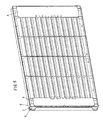
- the reflecting plate 2 is formed from PBT resin into a flat rectangular plate shape as a whole, and a plurality of reflecting surfaces 21 (twelve reflecting surfaces in FIGS. 3 ) each of which has a gutter shape are formed and arranged in generally parallel rows in the front surface of the reflecting plate except a peripheral frame part 20.
- Generally L-shaped positioning protrusions 22 which make contact with the cutouts 3a to position the diffuser plate 3 are formed at four corners of the front surface of the frame part 20.
- housing recesses 23 each of which is communicated with the reflecting surface 21 and houses an end of the discharge lamp 1 are formed on the front surface of both frame pieces 20a perpendicular to the longitudinal direction of the frame part 20 at generally regular intervals.
- Each housing recess 23 has a through hole 23a in a bottom surface (back surface) which anteroposteriorly penetrates the bottom surface, and as shown in FIGS. 4 and 5 , the terminal pin 1 a of the discharge lamp 1 is inserted into the through hole 23a in a state where the end of the discharge lamp 1 is housed in the housing recess 23. Furthermore, a plurality of discharge lamp supporters 25 are provided on an innermost part of the reflecting surface 21 for supporting the discharge lamp (see FIG. 4 ). As shown in FIG.
- the discharge lamp supporter 25 comprises a circular arc part 25a having a roughly circular arc shape (major arc shape) in cross section to house a tube wall of the discharge lamp 1 therein and to clip the tube wall, and a column part 25b which is vertically formed from the bottom surface of the housing recess 23 and is connected to the arc part 25a.
- the discharge lamp supporter 25 is integrally formed with the reflecting plate 2 from PBT resin.
- a holding plate 10 is attached to the front surface side of each frame piece 20a of the reflecting plate 2 to hold on the discharge lamp 1 housed in the housing recess 23 from the front side.
- the holding plate 10 is a molding of synthetic resin, and it has a strip-shaped main part 10a, a protruded wall 10b having a generally U shape in plan view which protrudes forward from a center part of the front surface of the main part 10a, and a plurality of holding pieces10c (twelve holding pieces in this embodiment) which protrude backward from a back side of the main part 10a and are inserted into respective housing recesses 23 (see FIGS. 3 and 4 ).
- Cylindrical holding members 11 having an opened gutter along an axis direction, respectively, are attached onto both ends of the discharge lamp 1, and when the holding plate 10 is attached to the frame piece 20a by an appropriate method, for example, by a screw or caulking, a distal end of each holding piece 10c makes contact with the holding member 11, and the discharge lamp 1 is indirectly held.
- the diffuser plate 3 is disposed on the front side of the holding plates 10 in such a way that the recess parts 3b make contact with the protruded walls 10b of the holding plates 10.
- the shape of the holding member 11 is not limited to a cylindrical shape, but it is preferable that it has a cylindrical shape because, when it has a cylindrical shape, the direction of the opened gutter is free at both ends of the discharge lamp 1, that is, it is not necessary to control an angle of the opened gutter, whereby it is easy to attach the holding member 11 to the terminal pin 1a.
- a plurality of diffuser plate support members 26 each which has a cone shape and makes contact with the diffuser plate 3 from a back surface side of the diffuser plate to support the diffuser plate 3 are integrally formed with the reflecting plate 2 from PBT resin (see FIGS. 1C and 4 ). By providing the diffuser plate support members 26, it is possible to support the diffuser plate 3 parallel to the reflecting plate 2.
- each of the reflecting surfaces 21 has a parabolic shape in cross section in a direction perpendicular to an axis direction (that is, a direction perpendicular to a paper surface of FIG. 1A ) of the discharge lamps 1 (that is, each of the reflecting surfaces 21 has a parabolic shape in cross section in a direction parallel to the paper surface of FIG. 1A ) and is formed into a gutter shape along the axis direction of the discharge lamp 1.
- Each discharge lamp is housed inside the reflecting surface 21 (preferably, at the focus of the parabola).
- Adjacent two reflecting surfaces 21 are connected to each other on a side nearer to the diffuser plate 3 than the discharge lamps 1 between adjacent two discharge lamps 1.
- a distance between the reflecting surfaces 21, and a positional relation among the reflecting surface 21, the diffuser plate 3, and the discharge lamp 1 are set so that a pseudo light source is formed by light collected near the connection point between the reflecting surfaces 21 out of the emitted light of the discharge lamps 1.
- adjacent two reflecting surfaces 21 are connected to each other on a side nearer to the diffuser plate than the discharge lamps between adjacent two discharge lamps 1 so that an angle (maximum incidence angle) ⁇ max which a straight line (a dashed line 102 in FIG. 1A ) that passes the connection point 21 a between the adjacent two reflecting surfaces 21 and a central axis of the discharge lamp 1 forms with a normal to the back surface (incidence surface) of the diffuser plate 3 is 70 degrees.
- the reflection property shown in FIG. 2 is a reflection property of the diffuser plate 3 which is a molding formed by an acrylic resin molding material made by Mitsubishi Rayon Co.,Ltd., (product name: ACRYPET (registered mark)).
- the diffuser plate 3 shows a similar property regardless of whether a light diffusing agent is added or not.
- the distance L between the reflecting plate 2 and the diffuser plate 3, that is, a distance between the connection point 21 a of the adjacent reflecting surfaces 21 and the diffuser plate 3 is set so that the reflected light (see full lines 100, 101 and a dashed line 102 in FIG. 1 A) which goes beyond the connection point 21 a and reflected by the back surface of the diffuser plate 3 out of the emitted light of the discharge lamp 1 housed inside one reflecting surface 21 can be reflected by the reflecting surface located adjacent to the above one reflecting surface 21 (in other words, by a part of the reflecting surface 21 which is located across the discharge lamp 1 and away from the connection point 21a).
- a protrusion part 24 having a triangular shape in cross section and protruding forward is formed along the axis direction of the discharge lamp 1 at the innermost part (at the bottom in FIG. 1A ) of each reflecting surface 21 which faces the discharge lamp 1, and a front surface of the protrusion part 24 is an incline 24a for reflecting the emitted light of the discharge lamp 1 to the reflecting surface located outside the innermost part. If the incline 24a is not formed, brightness near the discharge lamp 1 is increased by light reflected by the innermost part of a paraboloidal surface. However, as shown in FIG.
- a width of the incline 24a is set larger than a projected area of the discharge lamp 1 (that is, the diameter ⁇ of the discharge lamp 1) with respect to the innermost part of the reflecting surface 21, (in other words, it is preferable that the incline 24a is extended to the outside of the projected area of the discharge lamp.).
- the brightness near the connection point 21 a may be increased more than necessary.
- regular reflectance of portions other than the bottom portion of the reflecting surface 21 including the incline 24 is set to smaller than that of the bottom portion of the reflecting surface 21 by making a surface of the bottom portion of the reflecting surface 21 including the incline 24 a mirror plane and forming many concavities and convexities in the surface of the portion outside the bottom portion to form a diffusing surface. In this case, it is possible to prevent an undue increase in the brightness near the connection point 21 a, whereby it is possible to reduce the unevenness in the brightness more.
- acrylic resin is explained as a translucent material for forming the diffuser plate 3.
- a thermoplastic resin material such as polycarbonate resin, polyethylene terephthalate resin, ABS resin, ASA resin, AES resin, polypropylene resin, cyclic polyolefin resin, polystyrene resin, acrylic resin, methacryl-styrene copolymer, and polyethylene naphthalate resin, may be used.
- polycarbonate resin cyclic polyolefin resin, polystyrene resin, acrylic resin, or methacryl-styrene copolymer, which is capable of obtaining good balance between the translucency and the light diffusion property, is used.
- a light diffusion agent is added to the thermoplastic resin material to diffuse light.
- the light diffusion agent for example, an inorganic particle, such as oxidized titanium, barium sulfate, zinc oxide, magnesium oxide, calcium carbonate, and a hollow silica fine particle, or an organic particle, such as cross-linked styrene beads, cross-linked acrylic beads, silicon resin, and silicon rubber, may be used.
- various additive such as colorant, mold-releasing agent, filler, antioxidant, stabilizer, ultraviolet absorber, flame retardant, flame retardant auxiliary agent, impact modifier, lubricant, crystallization promoter, and so on may be blended, and an well-known additive can be used without limit.
- the diffuser plate 3 may be obtained by molding the thermoplastic resin material using a generally well-known molding method for the thermoplastic resin material, such as an injection molding process, an extrusion molding method, a compression molding method, a blow molding method, a transfer molding method, a vacuum molding method, and an injection method. However, from a viewpoint of productivity, it is preferable that an injection molding process or an extrusion molding method is used.
- the surface of the diffuser plate 3 may have a grain structure and so on so as to obtain a desired optical characteristic and a lamp balance and to prevent unevenness of the brightness due to contact with other parts.
- the forming method of the grain structure is not particularly limited, but a method which uses a die having a grain structure for molding, a method in which grain is formed by shot blast after molding may be included. Furthermore, in order to prevent adherence of dust which affects unevenness of the brightness, a film having an antistatic function may be formed on the surface. Such a film having the antistatic function can be formed by using a well-known method, such as spraying, roll coating, a dipping method, laminating, vacuum deposition method, and a sputtering method.
- diffuser plate 3 is a structure in which fine hollow cells are dispersed, or a structure in which continuous hollow parts are partly formed, there is a possibility that the light diffusion property is increased.
- the diffuser plate 3 is formed into a molding which is 2 millimeters in thickness from a thermoplastic resin material for example, all light transmittances at wavelengths of 450 to 800 nanometers is more than or equal to 50%.
- the reflecting plate 2 is formed from PBT resin
- a molding material of the reflecting plate 2 is not limited to PBT resin.
- a thermoplastic resin material is used.
- the reflecting plate 2 is formed by molding a thermoplastic resin material, such as polycarbonate resin, polybutylene terephthalate resin, polyethylene terephthalate resin, polypropylene resin, ABS resin, ASA resin, AES resin, 6-nylon resin, polysulfone resin, 9T nylon resin, cyclic polyolefin resin, acrylic resin, polyphthalamide resin, and polyethylene naphthalate resin.
- a thermoplastic resin material such as polycarbonate resin, polybutylene terephthalate resin, polyethylene terephthalate resin, polypropylene resin, ABS resin, ASA resin, AES resin, 6-nylon resin, polysulfone resin, 9T nylon resin, cyclic polyolefin resin, acrylic resin, polyphthalamide resin, and polyethylene naphthalate resin.
- polycarbonate resin or polybutylene terephthalate resin which can obtain a high light reflecting property when it is colored with white color, is used preferably.
- additives such as colorant, mold-releasing agent, filler, antioxidant, stabilizer, ultraviolet absorber, flame retardant, flame retardant auxiliary agent, impact modifier, lubricant, crystallization promoter, and so on may be blended to the thermoplastic resin material, and a well-known additive can be used without limit.
- a well-known additive can be used without limit.
- the colorant for example, an inorganic pigment, such as oxidized titanium, barium sulfate, zinc oxide, magnesium oxide, calcium carbonate, and a hollow silica fine particle, or an organic pigment; such as organic dye, cross-linked styrene beads, cross-linked acrylic beads, silicon resin, and silicon rubber, can be adduced.
- mold-releasing agent vegetable wax such as carnauba wax and rice wax, animal wax such as bees wax and lanolin, mineral wax such as montan wax, petroleum wax such as paraffin wax polyethylene wax, grease wax such as ricinus, derivative thereof, fatty acid, derivative thereof, can be adduced.
- filler fillers of various types and shapes can be adduced.
- fibrous filler such as glass fiber, carbon fiber, aramid fiber, metal fiber, asbestos, and whisker, nature or synthesis filler having a spherical shape, a plate-like shape, or an amorphous powder-particle-like shape, such as glass beads, glass flake, calcium carbonate, talc, mica, aluminum oxide, magnesium hydroxide, beryllium oxide, calcium silicate, clay, and metal powder.
- antioxidant phenolic compound such as 2,6-di-t-butyl-4-methyl phenol, tetrakis(methylene-3-(3,5-di-t-butyl-4-hydroxyphenyl)propionate)methane, tris(3,5-di-t-butyl-4-hydroxybenzyl)isocyanurate, sulphur system compound such as dilauryl-3,3'-thiodipropionate,dimyristyl-3,3'-thiodipropionate, and phosphorus compound such as tris nonylphenyl phosphate, distearyl pentaerythritol di phosphate, can be adduced.
- phenolic compound such as 2,6-di-t-butyl-4-methyl phenol, tetrakis(methylene-3-(3,5-di-t-butyl-4-hydroxyphenyl)propionate)methane, tris(3,5-di-t-
- benzotriazole series compound including 2-(2'-hydroxy-5'-methylphenyl)benzotriazole, benzophenone series compound such as 2,4-dihydroxybenzophenone, and phosphoric ester such as mono or distearyl phosphate and trimethyl phosphate.
- Such various additives can be used in conjunction with one another since synergistic effect may be obtained by combining two or more kinds.
- the additive which was explained as antioxidant may work as a stabilizer or an ultraviolet absorber.
- the additive which was explained as stabilizer may have an antioxidant effect and an ultraviolet absorption effect. That is, the above classification is expedient classification, and it does not mean to limit actions.
- ultraviolet absorber for example, benzophenone series ultraviolet absorber as typified by 2-hydroxy-4-n-dodecyloxybenzophenone, 2,2'-dihydroxy-4,4'-dimethoxybenzophenone, bis(5-benzoyl-4-hydroxy-2-methoxyphenyl)methane can be adduced.
- ultraviolet absorber for example, benzotriazole series ultraviolet absorber as typified by a condensation product of 2-(2'-hydroxy-5'-methylphenyl)benzotriazole, 2-(2'-hydroxy-3',5'-di-tert-amylphenyl)benzotriazole, 2-(2'-hydroxy-3',5'-bis( ⁇ , ⁇ '-dimethylbenzyl)phenylbenzotriazole, 2,2'methylenebis[4-(1,1,3,3-tetramethylbutyl)-6-(2H-benzotriazole-2-yl)phenol], and methyl-3-[3-tert-butyl-5-(2H-benzotriazole-2-yl)-4-hydroxyphenylpropionate-polyethyleneglycol can be adduced.
- the ultraviolet absorber for example, hydroxyphenyltriazine series compound, such as 2-(4,6-diphenyl-1,3,5-triazine-2-yl)-5-hexyloxyphenol, 2-(4,6-bis(2,4-dimethylphenyl)-1,3,5-triazine-2-yl)-5-hexyloxyphenol can be adduced.
- hydroxyphenyltriazine series compound such as 2-(4,6-diphenyl-1,3,5-triazine-2-yl)-5-hexyloxyphenol
- 2-(4,6-bis(2,4-dimethylphenyl)-1,3,5-triazine-2-yl)-5-hexyloxyphenol can be adduced.
- hindered amine light stabilizer as typified by bis(2,2,6,6-tetramethyl-4-piperidyl)sebacate, bis(1,2,2,6,6-pentamethyl-4-piperidyl)sebacate, tetrakis(2,2,6,6-tetramethyl-4-piperidyl)-1,2,3,4-butanetetracarboxylate, tetrakis(1,2,2,6,6-pentamethyl-4-piperidyl)-1,2,3,4-butanetetracarboxylate, poly[[6-(1,1,3,3-tetramethylbutyl)amino-1,3,5-triazine-2,4-diyl][(2,2,6,6-tetramethylpiperidyl)imino]hexamethylene[(2,2,6,6-tetramethylpiperidyl)imino]], polymethylpropyl3-oxy-[4-(2,2,6,6-tetramethyl)piperidinyl]
- the fire retardant is halogen series, phosphoester series, metallic salt series, red phosphorus, silicon series, or metallic hydrate series, and it also includes drop inhibitor.
- fluorescent bleach, light strage pigment, fluorescent dye, flow modifier, inorganic or organic antimicrobial, photocatalytic system antifoulant, impact modifier as typified by graft rubber, infrared ray absorbent, photochromic agent can be adduced.
- the reflecting plate 2 can may obtained by molding a thermoplastic resin material using a generally well-known molding method for the thermoplastic resin material, such as an injection molding process, an injection compression molding method, a gas-assist injection molding method, a gas-press injection molding method, a counter pressure injection molding method, a heat decomposition-type foaming molding method, a gas injection-type foaming molding method, an extrusion molding method, a compression molding method, a blow molding method, a transfer molding method, a vacuum molding method, and an injection method.
- a generally well-known molding method for the thermoplastic resin material such as an injection molding process, an injection compression molding method, a gas-assist injection molding method, a gas-press injection molding method, a counter pressure injection molding method, a heat decomposition-type foaming molding method, a gas injection-type foaming molding method, an extrusion molding method, a compression molding method, a blow molding method, a transfer molding method, a vacuum molding method, and an injection method.
- the surface of the reflecting plate 2 may be made to a burnished condition with high surface smoothing property or a half-frosted or a frosted condition in which a grain structure is formed so as to obtain a desired optical characteristic and lamp uniformity.
- the method for forming the grain structure is not particularly limited. For example, a method which uses a die having a grain structure for molding, and a method in which grain is formed by shot blast after molding may be adduced.
- reflecting plate 2 If an interior portion of reflecting plate 2 is formed into a structure in which fine hollow cells are dispersed, or a structure in which continuous hollow parts are partly formed, reflectance may be increased, a hiding property (which relates to prevention of light leakage) may be increased, and warpage may be reduced.
- the reflecting plate 2 is formed into a molding which is 2 millimeters in thickness from a thermoplastic resin material, all light reflectances at wavelengths of 450 to 800 nanometers is more than or equal to 95%.
- the reflecting plate 2 is formed from various synthetic resins
- the reflecting plate 2 may be formed by coating a steal plate.
- such a while reflecting surface can be also obtained by forming the reflecting surface by applying a powdered paint having a less volatilization component which is obtained by appropriately combining one or more polyester resins having acid number of 20 to 80, one or more solid epoxy compounds having epoxy equivalent of 99 to 2000, titanium oxide having a refractive index of 2.7 or more, and additives such as defoaming agent to one another.
- a powdered paint having a less volatilization component which is obtained by appropriately combining one or more polyester resins having acid number of 20 to 80, one or more solid epoxy compounds having epoxy equivalent of 99 to 2000, titanium oxide having a refractive index of 2.7 or more, and additives such as defoaming agent to one another.
Landscapes
- Physics & Mathematics (AREA)
- Nonlinear Science (AREA)
- Mathematical Physics (AREA)
- Chemical & Material Sciences (AREA)
- Crystallography & Structural Chemistry (AREA)
- General Physics & Mathematics (AREA)
- Optics & Photonics (AREA)
- Liquid Crystal (AREA)
- Planar Illumination Modules (AREA)
- Optical Elements Other Than Lenses (AREA)
- Devices For Indicating Variable Information By Combining Individual Elements (AREA)
Applications Claiming Priority (3)
| Application Number | Priority Date | Filing Date | Title |
|---|---|---|---|
| JP2005199293 | 2005-07-07 | ||
| JP2006177062A JP2007042613A (ja) | 2005-07-07 | 2006-06-27 | 液晶パネル用照明装置 |
| PCT/JP2006/313432 WO2007007621A1 (ja) | 2005-07-07 | 2006-07-05 | 液晶パネル用照明装置 |
Publications (2)
| Publication Number | Publication Date |
|---|---|
| EP1900997A1 true EP1900997A1 (de) | 2008-03-19 |
| EP1900997A4 EP1900997A4 (de) | 2010-06-02 |
Family
ID=37637015
Family Applications (1)
| Application Number | Title | Priority Date | Filing Date |
|---|---|---|---|
| EP06780808A Withdrawn EP1900997A4 (de) | 2005-07-07 | 2006-07-05 | Vorrichtung zur beleuchtung einer flüssigkristalltafel |
Country Status (7)
| Country | Link |
|---|---|
| US (1) | US7954969B2 (de) |
| EP (1) | EP1900997A4 (de) |
| JP (1) | JP2007042613A (de) |
| KR (1) | KR100969903B1 (de) |
| CN (1) | CN100594321C (de) |
| TW (1) | TWI340859B (de) |
| WO (1) | WO2007007621A1 (de) |
Cited By (1)
| Publication number | Priority date | Publication date | Assignee | Title |
|---|---|---|---|---|
| EP2068194A1 (de) * | 2007-12-07 | 2009-06-10 | Samsung Electronics Co., Ltd. | Rückbeleuchtungsanordnung und Anzeigevorrichtung damit |
Families Citing this family (14)
| Publication number | Priority date | Publication date | Assignee | Title |
|---|---|---|---|---|
| US20100073915A1 (en) * | 2007-01-15 | 2010-03-25 | Eiji Nittou | Lamp case, and backlight device and flat display device using it |
| US8960935B2 (en) * | 2007-01-31 | 2015-02-24 | Lg Display Co., Ltd. | Backlight unit and liquid crystal display device having the same |
| US8215793B2 (en) * | 2007-11-19 | 2012-07-10 | Sharp Kabushiki Kaisha | Backlight device |
| WO2010025583A1 (zh) * | 2008-09-04 | 2010-03-11 | Xiao Lifeng | 多功能光聚散板 |
| US8376578B2 (en) | 2009-06-12 | 2013-02-19 | Lg Innotek Co., Ltd. | Lighting device |
| US8721115B2 (en) * | 2010-05-28 | 2014-05-13 | Luxingtek, Ltd. | Light reflective structure and light panel |
| KR101868535B1 (ko) * | 2011-07-15 | 2018-06-20 | 엘지이노텍 주식회사 | 디스플레이 장치 |
| JP5937836B2 (ja) * | 2012-02-07 | 2016-06-22 | 株式会社小糸製作所 | 車両用灯具 |
| US20130208448A1 (en) * | 2012-02-15 | 2013-08-15 | Shenzhen China Star Optoelectronics Technology Co., Ltd. | Backlight Module |
| JP6286862B2 (ja) * | 2013-05-07 | 2018-03-07 | セイコーエプソン株式会社 | プロジェクター |
| KR20140140836A (ko) * | 2013-05-30 | 2014-12-10 | 엘지이노텍 주식회사 | 발광소자 패키지 |
| JP6177330B2 (ja) * | 2013-07-30 | 2017-08-09 | 堺ディスプレイプロダクト株式会社 | 光源装置及び表示装置 |
| WO2018066209A1 (ja) * | 2016-10-07 | 2018-04-12 | ソニー株式会社 | 発光装置、表示装置および照明装置 |
| CN108037612A (zh) * | 2017-11-30 | 2018-05-15 | 青岛海信电器股份有限公司 | 液晶显示装置 |
Family Cites Families (8)
| Publication number | Priority date | Publication date | Assignee | Title |
|---|---|---|---|---|
| JPH0731223Y2 (ja) | 1986-11-10 | 1995-07-19 | カシオ計算機株式会社 | バツクライト装置 |
| JPH07282612A (ja) | 1994-04-11 | 1995-10-27 | Citizen Watch Co Ltd | 照明装置 |
| US20020048176A1 (en) * | 2000-10-10 | 2002-04-25 | Ruda Mitchell C. | Cusp illuminator and flat panel illuminator made thereby |
| JP4639542B2 (ja) * | 2001-07-11 | 2011-02-23 | ソニー株式会社 | 面光源装置およびディスプレイ装置 |
| JP4147824B2 (ja) | 2002-06-06 | 2008-09-10 | セイコーエプソン株式会社 | 液晶表示装置 |
| JP2005024746A (ja) | 2003-06-30 | 2005-01-27 | Stanley Electric Co Ltd | バックライト用反射鏡 |
| KR20060047025A (ko) * | 2004-11-12 | 2006-05-18 | 삼성전자주식회사 | 개선된 지지대를 포함하는 백라이트 어셈블리 및 이를구비한 평판표시장치 |
| KR20060105346A (ko) * | 2005-04-04 | 2006-10-11 | 삼성전자주식회사 | 백라이트 유닛 및 이를 채용한 액정표시장치 |
-
2006
- 2006-06-27 JP JP2006177062A patent/JP2007042613A/ja not_active Withdrawn
- 2006-07-05 WO PCT/JP2006/313432 patent/WO2007007621A1/ja not_active Ceased
- 2006-07-05 EP EP06780808A patent/EP1900997A4/de not_active Withdrawn
- 2006-07-05 KR KR1020087002659A patent/KR100969903B1/ko not_active Expired - Fee Related
- 2006-07-05 US US11/994,724 patent/US7954969B2/en not_active Expired - Fee Related
- 2006-07-05 CN CN200680024709A patent/CN100594321C/zh not_active Expired - Fee Related
- 2006-07-07 TW TW095124985A patent/TWI340859B/zh not_active IP Right Cessation
Cited By (2)
| Publication number | Priority date | Publication date | Assignee | Title |
|---|---|---|---|---|
| EP2068194A1 (de) * | 2007-12-07 | 2009-06-10 | Samsung Electronics Co., Ltd. | Rückbeleuchtungsanordnung und Anzeigevorrichtung damit |
| US8104946B2 (en) | 2007-12-07 | 2012-01-31 | Samsung Electronics Co., Ltd. | Backlight assembly and display device having the same |
Also Published As
| Publication number | Publication date |
|---|---|
| US7954969B2 (en) | 2011-06-07 |
| US20090168404A1 (en) | 2009-07-02 |
| TW200707026A (en) | 2007-02-16 |
| KR20080033328A (ko) | 2008-04-16 |
| EP1900997A4 (de) | 2010-06-02 |
| KR100969903B1 (ko) | 2010-07-13 |
| JP2007042613A (ja) | 2007-02-15 |
| CN100594321C (zh) | 2010-03-17 |
| WO2007007621A1 (ja) | 2007-01-18 |
| CN101218464A (zh) | 2008-07-09 |
| TWI340859B (en) | 2011-04-21 |
Similar Documents
| Publication | Publication Date | Title |
|---|---|---|
| US7954969B2 (en) | Illuminating device for liquid crystal panel | |
| US7878690B2 (en) | Light diffusing plate and lighting device using it | |
| US7309149B2 (en) | Prism sheet, backlight assembly and liquid crystal display device having the same | |
| JP5286419B2 (ja) | 照明装置、表示装置、及びテレビ受信装置 | |
| US8827480B2 (en) | Lighting device, display device, and television receiver | |
| US20100309106A1 (en) | Display device and television receiver apparatus | |
| US20150124482A1 (en) | Light Source Device and Display Device | |
| US8690409B2 (en) | Backlight assembly and display apparatus having the same | |
| US20120176557A1 (en) | Lighting device, display device, and television receiver | |
| US8950926B2 (en) | Planar light source apparatus and display apparatus using the same | |
| US20120057330A1 (en) | Lighting device, display device and television receiver | |
| US20120176558A1 (en) | Lighting device, display device and television receiver | |
| US20120057096A1 (en) | Lighting device, display device and television receiver | |
| US20120013810A1 (en) | Lighting device, display device and television receiver | |
| JP7446065B2 (ja) | ディスプレイ装置 | |
| CN107966760B (zh) | 导光板组件、背光模组和显示装置 | |
| CN207586455U (zh) | 一种反射透镜及其超薄型背光模组 | |
| KR101948142B1 (ko) | 백라이트 유닛 및 그를 이용한 조명 시스템 | |
| KR20030008791A (ko) | 직하형 백라이트 어셈블리 및 이를 갖는 액정표시장치 | |
| KR20080041896A (ko) | 백라이트 어셈블리 | |
| US20110317080A1 (en) | Lighting device, display device and television receiver | |
| KR101867045B1 (ko) | 백라이트 유닛, 이를 이용한 디스플레이 장치 및 이를 포함하는 조명 시스템 | |
| JP2008047361A (ja) | 反射板及びそれを用いた液晶パネル用照明装置 | |
| HK1165531A (en) | Lighting device, display apparatus, and television receiver | |
| HK1170293A (en) | Lighting device, display apparatus, and television receiver |
Legal Events
| Date | Code | Title | Description |
|---|---|---|---|
| PUAI | Public reference made under article 153(3) epc to a published international application that has entered the european phase |
Free format text: ORIGINAL CODE: 0009012 |
|
| 17P | Request for examination filed |
Effective date: 20080108 |
|
| AK | Designated contracting states |
Kind code of ref document: A1 Designated state(s): DE FR GB |
|
| DAX | Request for extension of the european patent (deleted) | ||
| DAX | Request for extension of the european patent (deleted) | ||
| RBV | Designated contracting states (corrected) |
Designated state(s): DE FR GB |
|
| RAP1 | Party data changed (applicant data changed or rights of an application transferred) |
Owner name: PANASONIC ELECTRIC WORKS CO., LTD. |
|
| A4 | Supplementary search report drawn up and despatched |
Effective date: 20100503 |
|
| 17Q | First examination report despatched |
Effective date: 20120130 |
|
| RAP1 | Party data changed (applicant data changed or rights of an application transferred) |
Owner name: PANASONIC CORPORATION |
|
| STAA | Information on the status of an ep patent application or granted ep patent |
Free format text: STATUS: THE APPLICATION IS DEEMED TO BE WITHDRAWN |
|
| 18D | Application deemed to be withdrawn |
Effective date: 20120611 |