EP1901200A2 - Interrogateur RFID et procédé de commande d'un interrogateur RFID - Google Patents
Interrogateur RFID et procédé de commande d'un interrogateur RFID Download PDFInfo
- Publication number
- EP1901200A2 EP1901200A2 EP07106983A EP07106983A EP1901200A2 EP 1901200 A2 EP1901200 A2 EP 1901200A2 EP 07106983 A EP07106983 A EP 07106983A EP 07106983 A EP07106983 A EP 07106983A EP 1901200 A2 EP1901200 A2 EP 1901200A2
- Authority
- EP
- European Patent Office
- Prior art keywords
- period
- predetermined
- transmission
- electronic tag
- frequency
- Prior art date
- Legal status (The legal status is an assumption and is not a legal conclusion. Google has not performed a legal analysis and makes no representation as to the accuracy of the status listed.)
- Withdrawn
Links
Images



Classifications
-
- G—PHYSICS
- G06—COMPUTING OR CALCULATING; COUNTING
- G06K—GRAPHICAL DATA READING; PRESENTATION OF DATA; RECORD CARRIERS; HANDLING RECORD CARRIERS
- G06K7/00—Methods or arrangements for sensing record carriers, e.g. for reading patterns
- G06K7/0008—General problems related to the reading of electronic memory record carriers, independent of its reading method, e.g. power transfer
-
- G—PHYSICS
- G06—COMPUTING OR CALCULATING; COUNTING
- G06K—GRAPHICAL DATA READING; PRESENTATION OF DATA; RECORD CARRIERS; HANDLING RECORD CARRIERS
- G06K7/00—Methods or arrangements for sensing record carriers, e.g. for reading patterns
- G06K7/10—Methods or arrangements for sensing record carriers, e.g. for reading patterns by electromagnetic radiation, e.g. optical sensing; by corpuscular radiation
- G06K7/10009—Methods or arrangements for sensing record carriers, e.g. for reading patterns by electromagnetic radiation, e.g. optical sensing; by corpuscular radiation sensing by radiation using wavelengths larger than 0.1 mm, e.g. radio-waves or microwaves
- G06K7/10118—Methods or arrangements for sensing record carriers, e.g. for reading patterns by electromagnetic radiation, e.g. optical sensing; by corpuscular radiation sensing by radiation using wavelengths larger than 0.1 mm, e.g. radio-waves or microwaves the sensing being preceded by at least one preliminary step
- G06K7/10128—Methods or arrangements for sensing record carriers, e.g. for reading patterns by electromagnetic radiation, e.g. optical sensing; by corpuscular radiation sensing by radiation using wavelengths larger than 0.1 mm, e.g. radio-waves or microwaves the sensing being preceded by at least one preliminary step the step consisting of detection of the presence of one or more record carriers in the vicinity of the interrogation device
-
- G—PHYSICS
- G06—COMPUTING OR CALCULATING; COUNTING
- G06K—GRAPHICAL DATA READING; PRESENTATION OF DATA; RECORD CARRIERS; HANDLING RECORD CARRIERS
- G06K7/00—Methods or arrangements for sensing record carriers, e.g. for reading patterns
- G06K7/10—Methods or arrangements for sensing record carriers, e.g. for reading patterns by electromagnetic radiation, e.g. optical sensing; by corpuscular radiation
- G06K7/10009—Methods or arrangements for sensing record carriers, e.g. for reading patterns by electromagnetic radiation, e.g. optical sensing; by corpuscular radiation sensing by radiation using wavelengths larger than 0.1 mm, e.g. radio-waves or microwaves
- G06K7/10316—Methods or arrangements for sensing record carriers, e.g. for reading patterns by electromagnetic radiation, e.g. optical sensing; by corpuscular radiation sensing by radiation using wavelengths larger than 0.1 mm, e.g. radio-waves or microwaves using at least one antenna particularly designed for interrogating the wireless record carriers
- G06K7/10356—Methods or arrangements for sensing record carriers, e.g. for reading patterns by electromagnetic radiation, e.g. optical sensing; by corpuscular radiation sensing by radiation using wavelengths larger than 0.1 mm, e.g. radio-waves or microwaves using at least one antenna particularly designed for interrogating the wireless record carriers using a plurality of antennas, e.g. configurations including means to resolve interference between the plurality of antennas
Definitions
- the present invention relates to a technology for performing a carrier sensing for selecting, upon stipulation of a maximum continuous transmission period for continuously transmitting signals to an electronic tag and a minimum transmission termination period for terminating the signal transmission after lapse of the maximum continuous transmission period, an appropriate frequency to be used in the signal transmission during the minimum transmission termination period before transmitting a signal to the electronic tag.
- RFID radio frequency identification
- interrogators such as reader/writers, readers etc.
- responding devices such as electronic tags, wireless integrated-circuit (IC) tags, wireless tags, and RFID tags.
- IC integrated-circuit
- RFID tags for example, in a widely known RFID system, the reader/writers carry out product control by reading and writing data inside the electronic tags that are attached to products.
- the RFID system includes a plurality of reader/writers that are interfaces to communicate with the electronic tags. A correspondence is established between the electronic tags and the reader/writers. Each reader/writer communicates with the corresponding electronic tag, thereby enabling to read and write data in the electronic tag.
- each reader/writer carries out carrier sensing before starting communication and searches for an unused channel (frequency).
- the interference between the reader/writers can be avoided.
- a system which carries out the carrier sensing, regulates a maximum continuous transmission period that enables to continuously transmit signals and a minimum transmission termination period that terminates signal transmission after lapse of the maximum continuous transmission period. Because a reader/writer that is awaiting signal transmission can get a chance to acquire a channel during a transmission termination period of the reader/writer in the signal transmission, the channels can be evenly used.
- the electronic tag receives the signals from the multiple reader/writers. Due to this, the electronic tag is not able to receive data correctly, thus resulting in interference between the reader/writers and the electronic tag. Because the electronic tag does not have frequency selectivity, even if each reader/writer carries out the carrier sensing and transmits the signals using different frequencies, the electronic tag responds to the signals from any of the reader/writers.
- a radio-frequency-identification interrogator performs a communication-channel selecting process for selecting, upon stipulation of a maximum continuous transmission period to continuously transmit a signal to an electronic tag and a minimum transmission termination period to terminate a signal transmission after a lapse of the maximum continuous transmission period, an appropriate communication channel to be used in the signal transmission before the signal transmission to the electronic tag in the minimum transmission termination period.
- the radio-frequency-identification interrogator includes a nonresponse-ratio determining unit that determines, after starting the signal transmission, whether a ratio of number of nonresponses from the electronic tag exceeded a predetermined value in a first predetermined period; and a signal-transmission terminating unit that terminates, when it is determined that the ratio of the number of nonresponses from the electronic tag exceeded the predetermined value in the first predetermined period, the signal transmission to the electronic tag for a second predetermined period.
- the radio-frequency-identification interrogator performs, after a lapse of the second predetermined period, the communication-channel selecting process for restarting the signal transmission to the electronic tag.
- a method is for controlling a radio-frequency-identification interrogator that performs a communication-channel selecting process for selecting, upon stipulation of a maximum continuous transmission period to continuously transmit a signal to an electronic tag and a minimum transmission termination period to terminate a signal transmission after a lapse of the maximum continuous transmission period, an appropriate communication channel to be used in the signal transmission before the signal transmission to the electronic tag in the minimum transmission termination period.
- the method includes determining, after starting the signal transmission, whether a ratio of number of nonresponses from the electronic tag exceeded a predetermined value in a first predetermined period; terminating, when it is determined that the ratio of the number of nonresponses from the electronic tag exceeded the predetermined value in the first predetermined period, the signal transmission to the electronic tag for a second predetermined period; and performing, after a lapse of the second predetermined period, the communication-channel selecting process for restarting the signal transmission to the electronic tag.
- an RFID interrogator is used as an IC tag reader/writer (hereinafter, "a reader/writer") and electronic tags that are used as RFID responding devices are embedded in a passive type IC having a maximum communication distance of approximately several meters.
- Figs. 1 to 5 are schematics for explaining a general reader/writer based on an RFID technology that is the prerequisite of the embodiments.
- Fig. 1 is a schematic for explaining a control of multiple reader/writers.
- Each of reader/writers R/W1 to R/W4 corresponds to multiple IC tags.
- the reader/writers R/W1 to R/W4 communicate with the corresponding multiple IC tags.
- a single controller intensively controls the reader/writers R/W1 to R/W4.
- the multiple reader/writers can communicate with stipulated target IC.
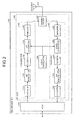
- Fig. 2 is a functional block diagram of the structure of a reader/writer 700.
- the reader/writer 700 is connected to a host computer and mediates a transaction of data between the host computer and the IC tag.
- the reader/writer 700 includes an RF unit 500 and a micro processing unit (MPU) 600 that generates a command that is transmitted to the IC tag, and analyzes a response that is received from the IC tag.
- the RF unit 500 includes a transmitter 100, a receiver 200, a local oscillator 300, and a coupling device 400 that uses an antenna 401 for transmitting and receiving the signals.
- the antenna 401 is connected to the RF unit 500.
- the transmitter 100 includes an encoder 101, an amplitude-modulation (AM) modulator 102, a filter 103, an up converter 104, and an amplifier 105.
- the encoder 101 encodes a command (including a read command and a write command) that is input from the MPU 600 by Manchester encoding.
- the AM modulator 102 determines strong and weak portions of amplitude of a carrier wave. By allotting "0" or "1" respectively to such differences of the amplitude, the AM modulator 102 carries out amplitude modulation of the command that is encoded by the encoder 101 such that the bit data can be transferred.
- the filter 103 selects a frequency of the carrier wave that is amplitude modulated by the AM modulator 102.
- the up converter 104 converts the frequency of the carrier wave that is selected by the filter 103 to a desired high frequency.
- the amplifier 105 amplifies a gain of the carrier wave that is converted to the high frequency by the up converter 104.
- the carrier wave that includes the amplified gain is transmitted from the antenna 401 via the shared device 400.
- the receiver 200 includes an amplifier 201, a down converter 202, a filter 203, an AM demodulator 204, and a decoder 205.
- the amplifier 201 amplifies a gain of a received carrier wave that is received from the antenna 401 via the shared device 400. Due to this, a weak received carrier wave is amplified.
- the down converter 202 converts the frequency of the carrier wave to a desired low frequency.
- the filter 203 selects the frequency of the carrier wave that is converted to the low frequency by the down converter 202.
- the AM demodulator 204 carries out amplitude demodulation and demodulates the analog signals from the bit data of the received wave.
- the decoder 205 decodes the data that is encoded by e.g. a FM0 encoding from baseband signals that are AM demodulated by the AM demodulator 204. An analog wave that is decoded by the decoder 205 is input into the MPU 600.
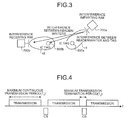
- Fig. 3 is a schematic for explaining the interference upon inclusion of the multiple reader/writers.
- an area r1 indicates a communication range of the reader/writer R/W 700a which will interfere the other reader/writers R/W 700b and the IC tag 800b.
- the area r1 includes an IC tag 800a.
- an area r2 indicates a communication range of the reader/writer R/W 700b which will interfere the other reader/writers R/W 700a and the IC tag 800a.
- the area r2 includes an IC tag 800b.
- the IC tag which is located in an area other than the area r1 that has the interference from the reader/writer R/W 700a. Due to this, the IC tag is not able to respond to a command from a reader/writer that is originally expected to communicate with the IC tag, thus resulting in the "interference between the reader/writer and the tag”. It is an objective of the present invention to eliminate the "interference between the reader/wrlter and the tag".
- Fig. 4 is a schematic for explaining a transmission duty and the carrier sensing. The transmission duty indicates the command transmission period from the reader/writer. The transmission duty is a process that selects the channel for the command transmission.
- the command transmission is terminated only during the minimum transmission termination period T 2 .
- the carrier sensing (CS) is carried out during the minimum transmission termination period T 2 .
- the reader/writer acquires the channel by the carrier sensing and again carries out the command transmission during the maximum continuous transmission period T 1 .
- the command transmission is terminated only during the minimum transmission termination period T 2 , and the CS is carried out.
- the reader/writer captures the channel using the carrier sensing and again carries out the command transmission during the maximum continuous transmission period T 1 .
- Fig. 5 is a flowchart of the carrier sensing process. As shown in Fig. 5, first the MPU 600 of the reader/writer 700 sets an initial channel (frequency) (step S101). Next, the MPU 600 measures received power of the received wave of the channel (step S102) and determines whether the received power of the received wave is less than or equal to a predetermined threshold value (for example, -74 dBm) (step S103).
- a predetermined threshold value for example, -74 dBm
- step S103 Upon the MPU 600 determining that the received power is less than or equal to the threshold value (step S103), the carrier sensing process moves to step S104. Upon the MPU 600 determining that the received power is larger than the threshold value (No at step S103), the carrier sensing process moves to step S109. Next, the MPU 600 randomly sets a back-off period that is a waiting period (step S104). The MPU 600 measures the received power during the back-off period that is set at step S104 (step S105).
- the MPU 600 determines whether the power measured during the back-off period is less than or equal to the threshold value (for example, -74 dBm) (step S106). Upon the MPU 600 determining that the received power is less than or equal to the threshold value (Yes at step S106), the carrier sensing process moves to step S107. Upon the MPU 600 determining that the received power is larger than the threshold value (No at step S106), the carrier sensing process moves to step S109.
- the threshold value for example, -74 dBm
- the MPU 600 transmits a command during a time period that is less than or equal to the maximum continuous transmission period T 1 .
- the MPU 600 terminates the command transmission during a time period that is more than or equal to the minimum transmission termination period T 2 (step S108).
- the carrier sensing process moves to step S101.
- the MPU 600 changes the channel (frequency) for the next carrier sensing at step S109. After a process of changing the channel is finished, the carrier sensing process moves to step S102.
- Fig. 6 is a functional block diagram of the structure of the MPU of the reader/writer according to an embodiment of the present invention.
- a structure of the reader/writer according to the embodiment other than the MPU is shown in Fig. 2.
- the MPU 600 includes a main controller 601, a transmitter 602, and a receiver 603.
- the main controller 601 controls the MPU 600.
- the main controller 601 includes a level measuring unit 601a, a nonresponse detecting unit 601b, an unused channel determining unit 601c, a channel setting unit 601d, a timeout period setting unit 601e, a transmission termination period setting unit 601f, a observation period setting unit 601g, and a transmission controller 601h.
- the level measuring unit 601a measures a level (output strength) of received signals (response signals) that are received from the IC tag, and outputs an individual measurement result to the unused channel determining unit 601c.
- the nonresponse detecting unit 601b detects a nonresponse from the IC tag during a timeout period.
- the nonresponse detecting unit 601b determines whether a ratio of a number of nonresponses of the IC tag during a timeout period exceeds a first predetermined value.
- the nonresponse detecting unit 601b also determines whether a ratio of a number of nonresponses of the IC tag during a second timeout period T check that is a fixed period at the end of the first timeout period exceeds a second predetermined value. Based on a determination result, upon determining that a timeout has occurred, the nonresponse detecting unit 601b adds 1 to a successive timeout count and outputs it to the timeout period setting unit 601e, the transmission termination period setting unit 601f, and the observation period setting unit 601g.
- the unused channel determining unit 601c searches for a channel of an unused frequency band and selects the channel.
- the channel setting unit 601d carries out a setting to allocate the channel selected by the unused channel determining unit 601c for the command transmission to the IC tag.
- Data of a set channel that is set by the channel setting unit 601d is output to the RF unit 500 for frequency setting.
- the timeout period setting unit 601e Based on the successive timeout count that is output by the nonresponse detecting unit 601b, the timeout period setting unit 601e sets the timeout period. If N to (number) is the successive timeout count, a timeout period T to (milliseconds) is calculated using the following expression. The timeout period setting unit 601e outputs the timeout period that is calculated by Equation (1) to the transmission controller 601h. [R] is a Gauss symbol and indicates a maximum integer that does not exceed a real number R.
- T to M to ⁇ ⁇ T + T init + T rnd
- M to [N to /T step ]
- N to is a successive timeout count
- T step is a constant
- ⁇ T is a constant that indicates an increment step value
- T init is a constant
- T rnd is a uniform random number such that 0 ⁇ T rnd ⁇ T rnd_max (where T rnd_max is a constant).
- T step Taking T step as “2”, ⁇ T as “10 to 20 milliseconds”, T init as “5 milliseconds”, and T rnd_max as “5 milliseconds” is desirable as an execution mode of Equation (1).
- the transmission termination period setting unit 601f sets a transmission termination period. If N to is the successive timeout count, a transmission termination period T sleep is calculated by the following expression.
- the timeout period setting unit 601e outputs the transmission termination period calculated by Equation (2) to the transmission controller 601h.
- T sleep T sleep_init / M to + 1 where M to is similar as Equation (1), and T sleep_init is a constant.
- the observation period setting unit 601g sets the observation period.
- the observation period T ct is calculated by Equation (3).
- the timeout period setting unit 601e outputs the observation period calculated by the following expression to the transmission controller 601h.
- T ct T sleep where T sleep is similar as in Equation (2).
- T rnd can be chosen according to a priority of the reader/writer, in other words, from a different range according to the successive timeout count N to .
- T rnd_max can differ according to the successive timeout count N to . If the different reader/writers having the same successive timeout count N to start the initial command transmission at the same timing, T to , T sleep , and T ct become the same, and the reader/writers semi permanently interfere with each other. However, due to different T rnd_max , occurrence of the aforementioned drawback can be reduced as much as possible.
- the transmission controller 601h Based on the timeout period T to set by the timeout period setting unit 601e, the transmission controller 601h detects a timeout according to a control command from an external device. The transmission controller 601h terminates the command transmission only during the transmission termination period T sleep that is set by the transmission termination period setting unit 601f. The transmission controller 601h outputs transmission control data of the command to the transmitter 602 to ensure that the timeout is repeatedly detected only during the observation period T ct that is set by the observation period setting unit 601g.
- the reader/writer After starting the command transmission by detecting the unused channel using the carrier sensing, upon detecting that communication with the IC tag cannot be carried out, the reader/writer assumes that interference has occurred with the IC tag and terminates the command transmission. Detection of the interference is explained below.
- the nonresponse detecting unit 601b evaluates whether the ratio of the number of nonresponses of the IC tag in response to the command from the reader/writer during the timeout period exceeds the first predetermined value. Based on the evaluation, if the ratio of the number of nonresponses of the IC tag is exceeding the first predetermined value, the nonresponse detecting unit 601b further calculates the ratio of the number of nonresponses of the IC tag during a second timeout period T check at the end of the timeout period T to for reconfirmation, and determines that the interference has been detected only if the ratio of the number of nonresponses of the IC tag exceeds the second predetermined value (the aforementioned process is called an interference detecting process).
- the reader/writer Upon detection of the interference, the reader/writer terminates the command transmission to the IC tag during the transmission termination period T sleep as a timeout process, and after lapse of the transmission termination period T sleep carries out the carrier sensing once again. If the interference is not detected, the interference detecting process is repeated from a start time of the command transmission during the observation period T ct . Because the interference detecting process is not carried out after the observation period T ct , the reader/writer that did not experienced the timeout during the observation period T ct can continue communication with the maximum continuous transmission period T 1 as the upper limit. However, if further communication is not necessary, the communication can also be ended before reaching the maximum continuous transmission period T 1 .
- the reader/writer Due to control based on Equation (1), because the timeout period T to of the reader/writer having a greater successive timeout count N to increases, the reader/writer is not easily timed out compared to other reader/writers having a lower value of the successive timeout count N to . Moreover, because the other reader/writers terminate the command transmission due to timeout, the reader/writer can increase a probability of getting a chance of the command transmission. Further, due to control based on Equations (2) and (3), the reader/writer having a greater successive timeout count N to increases a frequency of the carrier sensing and by limiting the observation period T ct reduces a possibility of getting timed out. Thus, the interference between the reader/writer and the IC tag can be autonomously avoided without the need to carry out complex settings each time a set up environment changes.
- the transmitter 602 exercises transmission control of a command that is transmitted from the host computer to the IC tag as the transmission data, and transmits the command to the RF unit 500.
- the receiver 603 distributes to the host computer as the received data, the received signals that are received from the IC tag via the RF unit 500.
- Fig. 7 is a flowchart of the carrier sensing process according to the embodiment. As shown in Fig. 7, first the channel setting unit 601d of the MPU 600 of the reader/writer 700 sets the initial channel (frequency) (step S201). Next, the level measuring unit 601a of the MPU 600 measures the received power of the received waves of the set channel (step S202) and determines whether the received power of the received waves is less than or equal to the threshold value (for example, -74 dBm) (step S203).
- the threshold value for example, -74 dBm
- the carrier sensing process moves to step S204.
- the carrier sensing process moves to step S208.
- the MPU 600 randomly sets the back-off period that is the waiting period (step S204).
- the level measuring unit 601a of the MPU 600 measures the received power during the back-off period that is set at step S204 (step S205).
- the level measuring unit 601a of the MPU 600 determines whether the measured power during the back-off period is less than or equal to the threshold value (for example, -74 dBm) (step S206). Upon determining that the received power is less than the threshold value (Yes at step S206), the carrier sensing process moves to step S207. Upon determining that the received power is not less than or equal to the threshold value (No at step S206), the carrier sensing process moves to step S208.
- the threshold value for example, -74 dBm
- the transmission controller 601h of the MPU 600 starts the command transmission.
- the non response detecting unit 601b of the MPU 600 determines whether the observation period T ct is yet to lapse, whether the ratio of the number of nonresponses of the IC tag during the timeout period T to is exceeding the first predetermined value, and whether the ratio of the number of nonresponses of the IC tag during the second timeout period T check is exceeding the second predetermined value (step S209).
- the carrier sensing process moves to step S210.
- the carrier sensing process moves to step S213.
- the nonresponse detecting unit 601b adds 1 to the timeout frequency N to .
- the MPU 600 sets the timeout period T to , the transmission termination period T sleep , and the observation period T ct (step S211).
- the MPU 600 terminates the command transmission during the transmission termination period T sleep (step S212).
- the carrier sensing process moves to step S201.
- the transmission controller 601h of the MPU 600 determines whether the maximum continuous transmission period T 1 has lapsed after starting the command transmission at step S207 (step S213). Upon the transmission controller 601h determining that the maximum continuous transmission period T 1 has lapsed (Yes at step S213), the carrier sensing process moves to step S214. Upon the transmission controller 601h determining that the maximum continuous transmission period T 1 has not lapsed (No at step S213), the carrier sensing process moves to step S209.
- the MPU 600 initializes the timeout period T to , the transmission termination period T sleep ,the observation period T ct , and the successive timeout count N to .
- the MPU 600 terminates the command transmission during a time period that is more than or equal to the minimum transmission termination period T 2 (step S215).
- the carrier sensing process moves to step S201.
- Fig. 8 is a schematic for explaining the operation during the timeout according to the embodiment.
- the reader/writer is timed out due to detection of interference in the first timeout period T to after carrying out the carrier sensing and starting the command transmission to the IC tag, and terminates the command transmission during the transmission termination period T sleep .
- the reader/writer starts the second command transmission by carrying out the carrier sensing immediately after lapse of the transmission termination period T sleep . Because the interference is not detected during the observation period T ct , the reader/writer communicates with the IC tag until the maximum continuous transmission period T 1 .
- Fig. 9 is a schematic for explaining the example of the operation (when three reader/writers are included) according to the embodiment.
- a first reader/wri ter includes an M to , of "1”
- a second reader/writer includes an M to of "0”
- a third reader/writer includes an M to of "0”.
- M to indicates a numerical value that increases according to the timeout frequency N to and is defined by Equation (1).
- the first reader/writer and the second reader/writer start the command transmission simultaneously, and are timed out together due to mutual interference. Because the third reader/writer starts the command transmission marginally later than the first reader/writer and the second reader/writer, the interference is not detected in the initial six interference detecting processes. Because the first reader/writer restarts the command transmission after the transmission termination period T sleep , the third reader/writer receives the interference and is timed out by the seventh interference detecting process.
- the second reader/writer restarts the command transmission after the transmission termination period T sleep , because the transmission termination period T sleep of the second reader/writer is greater than the transmission termination period T sleep of the first reader/writer, a time period that exceeds the observation period T ct lapses after the first reader/writer has already started the second command transmission, the second reader/writer detects the interference from the first reader/writer and is timed out again.
- the reader/writer having the greater successive timeout count N to can preferentially carry out the command transmission compared to the reader/writer having the smaller successive timeout count N to .
- each reader/writer uses a time-sharing operation that is based on autonomous control of each reader/writer to reduce the interference with the IC tag. Further, adaptive control of the reader/writers is also enabled such that the reader/writers automatically and autonomously adapt to the environment even if the set up environment changes.
- the constituent elements of the device illustrated are merely conceptual and may not necessarily physically resemble the structures shown in the drawings. For instance, the device need not necessarily have the structure that is illustrated.
- the device as a whole or in parts can be broken down or integrated either functionally or physically in accordance with the load or how the device is to be used.
- the process functions performed by the apparatus are entirely or partially realized by a program that is executed by a central processing unit (CPU) (or an MPU), a micro control unit (MCU) or by a hardware using wired logic.
- CPU central processing unit
- MCU micro control unit
- whether to terminate the signal transmission to the electronic tag during the fixed period is further determined during a fixed period at the end of a first predetermined period.
- the signal transmission of the RFID interrogator having a long first predetermined period can be carried out preferentially.
- whether the ratio of the number of nonresponses from the electronic tag during the first predetermined period has exceeded the predetermined value is repeatedly determined during a predetermined determination period.
- the signal transmission of the RFID interrogator having a short predetermined determination period can be carried out preferentially.
- the first predetermined period is decided according to a transmission termination frequency that causes the transmission to be terminated continuously during a second predetermined period.
- a possibility of the ratio of nonresponses from the electronic tag during the first predetermined period exceeding the predetermined value can be reduced in direct proportion to a continuous transmission termination frequency, and a preferential control of transmission termination according to the continuous transmission termination frequency is enabled.
- the second predetermined period is decided according to the continuous transmission termination frequency.
- the predetermined determination period is decided according to the continuous transmission termination frequency. Due to this, the predetermined determination period can be reduced in inverse proportion to the continuous transmission termination frequency. Thus, during the predetermined determination period, a number of determination results can be reduced in which the ratio of the number of nonresponses from the electronic tag during the first predetermined period has exceeded the predetermined value, and a preferential control of the transmission termination according to the continuous transmission termination frequency is enabled.
- the possibility of the ratio of nonresponses from the electronic tag during the first predetermined period exceeding the predetermined value can be reduced in direct proportion to the continuous transmission termination frequency.
- the preferential control of the transmission termination according to the continuous transmission termination frequency is enabled.
- the possibility of restarting the signal transmission to the electronic tag by quickly returning from the second predetermined period increases in direct proportion to the continuous transmission termination frequency.
- the preferential control of the transmission restart according to the continuous transmission termination frequency is enabled.
- the predetermined determination period can be reduced in direct proportion to the continuous transmission termination frequency. Due to this, during the predetermined determination period, the number of determination results can be reduced in which the ratio of the number of nonresponses from the electronic tag during the first predetermined period has exceeded the predetermined value. Thus, the preferential control of the transmission termination according to the continuous transmission termination frequency is enabled.
Landscapes
- Engineering & Computer Science (AREA)
- Physics & Mathematics (AREA)
- Toxicology (AREA)
- Health & Medical Sciences (AREA)
- Theoretical Computer Science (AREA)
- Artificial Intelligence (AREA)
- Computer Vision & Pattern Recognition (AREA)
- General Physics & Mathematics (AREA)
- General Health & Medical Sciences (AREA)
- Electromagnetism (AREA)
- Computer Networks & Wireless Communication (AREA)
- Near-Field Transmission Systems (AREA)
- Radar Systems Or Details Thereof (AREA)
Applications Claiming Priority (1)
| Application Number | Priority Date | Filing Date | Title |
|---|---|---|---|
| JP2006249832A JP4762093B2 (ja) | 2006-09-14 | 2006-09-14 | Rfid質問器およびrfid質問器制御方法 |
Publications (2)
| Publication Number | Publication Date |
|---|---|
| EP1901200A2 true EP1901200A2 (fr) | 2008-03-19 |
| EP1901200A3 EP1901200A3 (fr) | 2009-04-29 |
Family
ID=38787706
Family Applications (1)
| Application Number | Title | Priority Date | Filing Date |
|---|---|---|---|
| EP07106983A Withdrawn EP1901200A3 (fr) | 2006-09-14 | 2007-04-26 | Interrogateur RFID et procédé de commande d'un interrogateur RFID |
Country Status (3)
| Country | Link |
|---|---|
| US (1) | US7902982B2 (fr) |
| EP (1) | EP1901200A3 (fr) |
| JP (1) | JP4762093B2 (fr) |
Families Citing this family (9)
| Publication number | Priority date | Publication date | Assignee | Title |
|---|---|---|---|---|
| US20070257775A1 (en) * | 2006-04-28 | 2007-11-08 | Tatsuji Nishijima | Identification system and identification method |
| JP2008270978A (ja) * | 2007-04-17 | 2008-11-06 | Toshiba Tec Corp | 無線通信装置 |
| KR101478144B1 (ko) * | 2007-12-27 | 2015-01-02 | 삼성전자주식회사 | 알에프아이디 통신 방법 |
| JP5376886B2 (ja) * | 2008-09-30 | 2013-12-25 | 沖電気工業株式会社 | 無線送信装置、プログラム及び方法 |
| KR20110126481A (ko) * | 2010-05-17 | 2011-11-23 | 엘에스산전 주식회사 | Rfid 리더 |
| US8594121B2 (en) * | 2011-04-20 | 2013-11-26 | Qualcomm Incorporated | Cognitive radio spectrum sensor employing peak-to-average ratio as the signal feature |
| WO2012149869A1 (fr) * | 2011-05-03 | 2012-11-08 | 国民技术股份有限公司 | Procédé de communication, dispositif de communication et système de communication |
| US9667303B2 (en) * | 2015-01-28 | 2017-05-30 | Lam Research Corporation | Dual push between a host computer system and an RF generator |
| CN116762426A (zh) * | 2021-01-29 | 2023-09-15 | 华为技术有限公司 | 标签定位方法及装置 |
Family Cites Families (12)
| Publication number | Priority date | Publication date | Assignee | Title |
|---|---|---|---|---|
| US5640151A (en) * | 1990-06-15 | 1997-06-17 | Texas Instruments Incorporated | Communication system for communicating with tags |
| JPH10293824A (ja) * | 1997-04-18 | 1998-11-04 | Omron Corp | 識別システム及びデータ読取装置 |
| US6393457B1 (en) * | 1998-07-13 | 2002-05-21 | International Business Machines Corporation | Architecture and apparatus for implementing 100 Mbps and GBPS Ethernet adapters |
| US6917291B2 (en) * | 1998-10-26 | 2005-07-12 | Identec Solutions Inc. | Interrogation, monitoring and data exchange using RFID tags |
| US6643278B1 (en) * | 1999-03-23 | 2003-11-04 | Texas Instruments Incorporated | Wireless network circuits, systems, and methods for frequency hopping with reduced packet interference |
| US20020045956A1 (en) * | 2000-02-18 | 2002-04-18 | Kapitan Brian A. | Network distributed motion control system |
| US7253717B2 (en) * | 2000-11-29 | 2007-08-07 | Mobile Technics Llc | Method and system for communicating with and tracking RFID transponders |
| US6975206B2 (en) * | 2002-08-30 | 2005-12-13 | Intellectual Property, Llc | Method for communication between central terminal and multiple transponders |
| TWI290303B (en) * | 2003-06-20 | 2007-11-21 | Sunplus Technology Co Ltd | RFID communication system and search method thereof |
| US7817612B2 (en) * | 2003-07-29 | 2010-10-19 | Sony Corporation | Decentralized wireless communication system, apparatus, and associated methodology |
| JP4394007B2 (ja) * | 2005-01-13 | 2010-01-06 | 三菱電機株式会社 | リーダライタ装置 |
| US20070075838A1 (en) * | 2005-10-04 | 2007-04-05 | Symbol Technologies, Inc. | Method and apparatus for avoiding radio frequency identification (RFID) tag response collisions |
-
2006
- 2006-09-14 JP JP2006249832A patent/JP4762093B2/ja not_active Expired - Fee Related
-
2007
- 2007-04-26 EP EP07106983A patent/EP1901200A3/fr not_active Withdrawn
- 2007-04-27 US US11/790,790 patent/US7902982B2/en not_active Expired - Fee Related
Non-Patent Citations (1)
| Title |
|---|
| No Search * |
Also Published As
| Publication number | Publication date |
|---|---|
| JP2008072508A (ja) | 2008-03-27 |
| JP4762093B2 (ja) | 2011-08-31 |
| EP1901200A3 (fr) | 2009-04-29 |
| US7902982B2 (en) | 2011-03-08 |
| US20080068168A1 (en) | 2008-03-20 |
Similar Documents
| Publication | Publication Date | Title |
|---|---|---|
| EP1901200A2 (fr) | Interrogateur RFID et procédé de commande d'un interrogateur RFID | |
| US8653946B2 (en) | Passive RFID reader and operation control method therefor | |
| US8362879B2 (en) | Apparatus and method for integrated reader and tag | |
| JP4527636B2 (ja) | Rfid質問器及びデータ通信方法 | |
| JP2009518746A (ja) | 無線周波数識別(rfid)リーダの動作を最適化するための方法およびシステム | |
| EP2124167A1 (fr) | Dispositif d'interrogation, interrogateur RFID et procédé d'interrogation RFID | |
| WO2008072441A1 (fr) | Dispositif de communication sans fil | |
| US8344855B2 (en) | Radio frequency identification interrogator and method of operating the same | |
| CN107341525B (zh) | 交互通信装置、具备交互通信装置的系统及程序 | |
| CN101996301B (zh) | 通讯距离的控制方法及射频读卡装置 | |
| KR101239131B1 (ko) | 무선주파수인식 리더 및 그것의 이득 제어 방법 | |
| CN109726607B (zh) | 通信信道的切换方法及装置、存储介质、电子装置 | |
| CN109948407B (zh) | 用于识别通信调制解调器前级中的通信信号的设备和方法 | |
| EP1832999A1 (fr) | Dispositif de communication par étiquette et procédé de communication par étiquette | |
| KR100858053B1 (ko) | 수동형 rfid 리더기 및 이의 동작 제어 방법 | |
| Ferdik et al. | Ni pxie based uhf rfid reader | |
| JP5029304B2 (ja) | 受信装置、リーダライタ、非接触id通信システムおよび受信装置の受信方法 | |
| KR20070056816A (ko) | 무선주파수인식 시스템 | |
| Winkler et al. | Implementation of a receiver for an EPC tag emulator for performance evaluation | |
| JP2016218814A (ja) | 非接触通信装置 | |
| KR20070103618A (ko) | 무선 주파수 인식 시스템의 리더 및 그 제어 방법 | |
| JP4387399B2 (ja) | 無線識別タグの応答終点検出方法及び装置 | |
| KR102297144B1 (ko) | Rf 신호의 출력 제어가 가능한 전자 장치 및 그 작동 방법 | |
| JP2003223624A (ja) | 非接触icカード、応答方法、及びそのプログラム | |
| JP6473062B2 (ja) | 非接触通信装置 |
Legal Events
| Date | Code | Title | Description |
|---|---|---|---|
| PUAI | Public reference made under article 153(3) epc to a published international application that has entered the european phase |
Free format text: ORIGINAL CODE: 0009012 |
|
| AK | Designated contracting states |
Kind code of ref document: A2 Designated state(s): AT BE BG CH CY CZ DE DK EE ES FI FR GB GR HU IE IS IT LI LT LU LV MC MT NL PL PT RO SE SI SK TR |
|
| AX | Request for extension of the european patent |
Extension state: AL BA HR MK YU |
|
| PUAL | Search report despatched |
Free format text: ORIGINAL CODE: 0009013 |
|
| AK | Designated contracting states |
Kind code of ref document: A3 Designated state(s): AT BE BG CH CY CZ DE DK EE ES FI FR GB GR HU IE IS IT LI LT LU LV MC MT NL PL PT RO SE SI SK TR |
|
| AX | Request for extension of the european patent |
Extension state: AL BA HR MK RS |
|
| 17P | Request for examination filed |
Effective date: 20091026 |
|
| AKX | Designation fees paid |
Designated state(s): DE FR GB |
|
| 17Q | First examination report despatched |
Effective date: 20101110 |
|
| RIC1 | Information provided on ipc code assigned before grant |
Ipc: G06K 7/00 20060101AFI20130801BHEP Ipc: G06K 7/10 20060101ALI20130801BHEP |
|
| GRAP | Despatch of communication of intention to grant a patent |
Free format text: ORIGINAL CODE: EPIDOSNIGR1 |
|
| INTG | Intention to grant announced |
Effective date: 20130923 |
|
| STAA | Information on the status of an ep patent application or granted ep patent |
Free format text: STATUS: THE APPLICATION IS DEEMED TO BE WITHDRAWN |
|
| 18D | Application deemed to be withdrawn |
Effective date: 20140204 |