EP1901413A2 - System und Verfahren zur Batterieverwaltung - Google Patents
System und Verfahren zur Batterieverwaltung Download PDFInfo
- Publication number
- EP1901413A2 EP1901413A2 EP07115331A EP07115331A EP1901413A2 EP 1901413 A2 EP1901413 A2 EP 1901413A2 EP 07115331 A EP07115331 A EP 07115331A EP 07115331 A EP07115331 A EP 07115331A EP 1901413 A2 EP1901413 A2 EP 1901413A2
- Authority
- EP
- European Patent Office
- Prior art keywords
- battery
- ocv
- time
- voltage
- soc
- Prior art date
- Legal status (The legal status is an assumption and is not a legal conclusion. Google has not performed a legal analysis and makes no representation as to the accuracy of the status listed.)
- Withdrawn
Links
Images


Classifications
-
- H—ELECTRICITY
- H01—ELECTRIC ELEMENTS
- H01M—PROCESSES OR MEANS, e.g. BATTERIES, FOR THE DIRECT CONVERSION OF CHEMICAL ENERGY INTO ELECTRICAL ENERGY
- H01M10/00—Secondary cells; Manufacture thereof
- H01M10/42—Methods or arrangements for servicing or maintenance of secondary cells or secondary half-cells
- H01M10/48—Accumulators combined with arrangements for measuring, testing or indicating the condition of cells, e.g. the level or density of the electrolyte
-
- G—PHYSICS
- G01—MEASURING; TESTING
- G01R—MEASURING ELECTRIC VARIABLES; MEASURING MAGNETIC VARIABLES
- G01R19/00—Arrangements for measuring currents or voltages or for indicating presence or sign thereof
- G01R19/165—Indicating that current or voltage is either above or below a predetermined value or within or outside a predetermined range of values
- G01R19/16533—Indicating that current or voltage is either above or below a predetermined value or within or outside a predetermined range of values characterised by the application
- G01R19/16538—Indicating that current or voltage is either above or below a predetermined value or within or outside a predetermined range of values characterised by the application in AC or DC supplies
- G01R19/16542—Indicating that current or voltage is either above or below a predetermined value or within or outside a predetermined range of values characterised by the application in AC or DC supplies for batteries
-
- H—ELECTRICITY
- H02—GENERATION; CONVERSION OR DISTRIBUTION OF ELECTRIC POWER
- H02J—ELECTRIC POWER NETWORKS; CIRCUIT ARRANGEMENTS OR SYSTEMS FOR SUPPLYING OR DISTRIBUTING ELECTRIC POWER; SYSTEMS FOR STORING ELECTRIC ENERGY
- H02J7/00—Circuit arrangements for charging or discharging batteries or for supplying loads from batteries
- H02J7/80—Circuit arrangements for charging or discharging batteries or for supplying loads from batteries including monitoring or indicating arrangements
- H02J7/82—Control of state of charge [SOC]
-
- G—PHYSICS
- G01—MEASURING; TESTING
- G01R—MEASURING ELECTRIC VARIABLES; MEASURING MAGNETIC VARIABLES
- G01R31/00—Arrangements for testing electric properties; Arrangements for locating electric faults; Arrangements for electrical testing characterised by what is being tested not provided for elsewhere
- G01R31/005—Testing of electric installations on transport means
-
- G—PHYSICS
- G01—MEASURING; TESTING
- G01R—MEASURING ELECTRIC VARIABLES; MEASURING MAGNETIC VARIABLES
- G01R31/00—Arrangements for testing electric properties; Arrangements for locating electric faults; Arrangements for electrical testing characterised by what is being tested not provided for elsewhere
- G01R31/36—Arrangements for testing, measuring or monitoring the electrical condition of accumulators or electric batteries, e.g. capacity or state of charge [SoC]
- G01R31/3644—Constructional arrangements
- G01R31/3648—Constructional arrangements comprising digital calculation means, e.g. for performing an algorithm
-
- H—ELECTRICITY
- H02—GENERATION; CONVERSION OR DISTRIBUTION OF ELECTRIC POWER
- H02J—ELECTRIC POWER NETWORKS; CIRCUIT ARRANGEMENTS OR SYSTEMS FOR SUPPLYING OR DISTRIBUTING ELECTRIC POWER; SYSTEMS FOR STORING ELECTRIC ENERGY
- H02J7/00—Circuit arrangements for charging or discharging batteries or for supplying loads from batteries
- H02J7/14—Circuit arrangements for charging or discharging batteries or for supplying loads from batteries for charging batteries from dynamo-electric generators driven at varying speed, e.g. on vehicle
- H02J7/1423—Circuit arrangements for charging or discharging batteries or for supplying loads from batteries for charging batteries from dynamo-electric generators driven at varying speed, e.g. on vehicle with multiple batteries
-
- H—ELECTRICITY
- H02—GENERATION; CONVERSION OR DISTRIBUTION OF ELECTRIC POWER
- H02J—ELECTRIC POWER NETWORKS; CIRCUIT ARRANGEMENTS OR SYSTEMS FOR SUPPLYING OR DISTRIBUTING ELECTRIC POWER; SYSTEMS FOR STORING ELECTRIC ENERGY
- H02J7/00—Circuit arrangements for charging or discharging batteries or for supplying loads from batteries
- H02J7/80—Circuit arrangements for charging or discharging batteries or for supplying loads from batteries including monitoring or indicating arrangements
- H02J7/84—Control of state of health [SOH]
-
- Y—GENERAL TAGGING OF NEW TECHNOLOGICAL DEVELOPMENTS; GENERAL TAGGING OF CROSS-SECTIONAL TECHNOLOGIES SPANNING OVER SEVERAL SECTIONS OF THE IPC; TECHNICAL SUBJECTS COVERED BY FORMER USPC CROSS-REFERENCE ART COLLECTIONS [XRACs] AND DIGESTS
- Y02—TECHNOLOGIES OR APPLICATIONS FOR MITIGATION OR ADAPTATION AGAINST CLIMATE CHANGE
- Y02E—REDUCTION OF GREENHOUSE GAS [GHG] EMISSIONS, RELATED TO ENERGY GENERATION, TRANSMISSION OR DISTRIBUTION
- Y02E60/00—Enabling technologies; Technologies with a potential or indirect contribution to GHG emissions mitigation
- Y02E60/10—Energy storage using batteries
Definitions
- aspects of the present invention relate to a battery management system. More particularly, aspects of the present invention relate to a battery management system used in a vehicle using electrical energy.
- An electric vehicle uses an electric motor powered by electrical energy output by a battery. Since the electric vehicle mainly uses a battery formed by one battery pack including a plurality of rechargeable/dischargeable secondary cells, advantages thereof includes no emission gases and less noise.
- a hybrid vehicle commonly refers to a petrol-electric hybrid vehicle which uses petrol to power an internal-combustion engine and a battery to power an electric motor.
- hybrid vehicles that use an internal-combustion engine and fuel cells, and hybrid vehicles that use a battery and fuel cells have been developed.
- the fuel cells directly obtain electrical energy by generating a chemical reaction while hydrogen and oxygen are continuously provided.
- BMS battery management system
- the battery management system uses a data table containing relationship data of an open circuit voltage (OCV) to a state of charge (SOC) to estimate the SOC.
- OCV open circuit voltage
- SOC state of charge
- the OCV should be precisely measured so as to precisely calculate the SOC.
- the OCV may not be precisely measured due to polarization or internal resistance of the battery.
- a time to dissipate the polarization should be sufficient to precisely measure the OCV.
- the battery since an error in controlling the battery to be charged and discharged is generated when an error in calculating the SOC occurs, the battery may be overcharged or over-discharged, which seriously affects battery performance.
- aspects of the present invention has been made in an effort to provide a battery management system to more precisely estimate an open circuit voltage (OCV) and to establish a state of charge (SOC), and a driving method thereof.
- OCV open circuit voltage
- SOC state of charge
- a battery management system used to establish a state of charge (SOC) of a battery used in the battery management system includes a sensing unit and a micro control unit (MCU).
- the sensing unit measures a battery voltage
- the MCU measures a first time and a second time, detects first and second battery voltages that respectively correspond to the first and second times from the battery voltage, estimates an open circuit voltage (OCV) by the first and second voltages, and determines the SOC that corresponds to the OCV.
- the first time is a time when an effect of an internal resistance of the battery is eliminated
- the second time is a time after a predetermined period has passed from the first time to dissipate polarization caused by electrolyte diffusion.
- the MCU includes an OCV estimator and an SOC establishment unit.
- the OCV estimator estimates the OCV by using the first and second voltages, while the SOC establishment unit receives the OCV and establishes the SOC that corresponds to the OCV.
- the method includes: when the battery is not charged and discharged, a first time and a second time are measured, and a first battery voltage that corresponds to the first time and a second battery voltage that corresponds to the second time are detected; generating a linear equation having the first time, the first battery voltage, the second time, and the second battery voltage is generated; and an open circuit voltage (OCV) is estimated by using the linear equation.
- SOC state of charge
- the linear equation given as Y V ⁇ 2 - V ⁇ 1 1 T ⁇ 2 - 1 T ⁇ 1 * X + A (where, X denotes a parameter in 1 T ⁇ 1 , and Y denotes a parameter in voltage) is generated from a graph or slope that passes through coordinates 1 T ⁇ 1 ⁇ , V ⁇ 1 that correspond to the first time, and coordinates 1 T ⁇ 2 ⁇ , V ⁇ 2 that correspond to the second time, and a value of a Y-axis coordinate when an X-axis coordinate value is 0 is estimated as the OCV.
- the estimated OCV is received, a table for the SOC that corresponds to the OCV is used, and the SOC is established.
- a driving method of a battery management system to obtain a state of charge (SOC) of a rechargeable battery includes: measuring at least one time; detecting at least one voltage of the rechargeable battery that corresponds to the at least one time; determining an open circuit voltage (OCV) of the rechargeable battery based on the at least one time and the at least one voltage; and determining the SOC of the rechargeable battery that corresponds to the determined OCV.
- SOC state of charge
- a method to obtain a state of charge (SOC) of a rechargeable battery includes: detecting voltage of the rechargeable battery corresponding to time; determining an open circuit voltage (OCV) of the rechargeable battery using an inverse relationship of the time relative to the voltage; and determining the SOC of the rechargeable battery that corresponds to the determined OCV.
- SOC state of charge
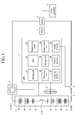
- FIG. 1 shows a diagram of a configuration of a hybrid vehicle system according to an aspect of the present invention.
- the hybrid electric vehicle system includes a battery management system 1, a battery 2, a current sensor 3, a cooling fan 4, a fuse 5, a main switch 6, a motor control unit (MTCU) 7, an inverter 8, and a motor generator 9.
- a battery management system 1 a battery 2
- a current sensor 3 a current sensor 3
- a cooling fan 4 a fuse 5
- main switch 6 a motor control unit (MTCU) 7, an inverter 8
- MTCU motor control unit
- the battery 2 includes a plurality of sub-packs 2a to 2h having a plurality of battery cells coupled in series to each other, an output terminal 2_OUT1, an output terminal 2_OUT2, and a safety switch 2_SW provided between the sub-pack 2d and the sub-pack 2e. While eight sub-packs 2a to 2h are shown as an example and each sub-pack is a group of a plurality of battery cells, aspects of the present invention are not limited thereto.
- the safety switch 2_SW is selectively turned on/off to guarantee the safety of a worker when performing operations on the battery or replacing the battery.
- the safety switch 2_SW is provided between the sub-pack 2d and the sub-pack 2e.
- the output terminal 2_OUT1 and the output terminal 2_OUT2 are coupled, for example, to the inverter 8.
- the current sensor 3 measures an output current value of the battery 2 and outputs the measured output current value to a sensing unit 10 of the BMS 1.
- the current sensor 3 may be a Hall current transformer using a Hall element to measure a current value and to output an analog current signal that corresponds to the measured current value.
- other types of current sensors are within the scope of the invention.
- the cooling fan 4 cools down heat generated by charging and discharging of the battery 2 in response to a control signal of the BMS 1, prevents the battery 2 from being deteriorated by a temperature increase, and prevents the charging and discharging efficiencies of the battery 2 from being deteriorated.
- the fuse 5 prevents an overcurrent, which may be caused by a disconnection or a short circuit of the battery 2, from being transmitted to the battery 2. That is, when an overcurrent is generated, the fuse 5 is disconnected to interrupt the current from overflowing and to isolate the battery 2 from the overcurrent.
- the main switch 6 turns on/off the battery in response to the control signal of the BMS 1 or a control signal of the MTCU 7 when an unusual phenomenon, such as an overvoltage, overcurrent, and/or overheating (a high temperature), occurs.
- an unusual phenomenon such as an overvoltage, overcurrent, and/or overheating (a high temperature)
- the BMS 1 includes a sensing unit 10, a micro control unit (MCU) 20, an internal power supply 30, a cell balance unit 40, a storage unit 50, a communication unit 60, a protection circuit unit 70, a power-on reset unit 80, and an external interface 90.
- the sensing unit 10 measures a voltage of the battery and transmits the sensed voltage to the MCU 20.
- a voltage at an output terminal of the battery will be referred to as a battery voltage.
- the MCU 20 detects a state of charge (SOC) of the battery 2 based on the battery voltage transmitted from the sensing unit 10, and generates information that informs of a state of the battery 2. Then, the MCU 20 transmits the generated information to the MTCU 7 of the vehicle. In addition, when the vehicle is stopped or driven at a fixed speed and the battery is not charged and discharged, the MCU 20 detects a first voltage V1 of a first time T1 and a second voltage V2 of a second time T2 to generate an equation, such as a linear equation (or a line equation). The MCU 20 uses the linear equation to estimate an open circuit voltage (OCV), and establishes (or estimates) the SOC that corresponds to the estimated OCV.
- OCV open circuit voltage
- the internal power supply 30 supplies power to the BMS 1 by using a backup battery.
- the cell balance unit 40 balances the state of charge of each cell. That is, cells sufficiently charged are discharged, and cells relatively less charged are further charged.
- the storage unit 50 stores data of the current SOC and a current state of health (SOH) of the battery when the power source of the BMS 1 is turned off.
- the communication unit 60 communicates with the MTCU 7 of the vehicle.
- the protection circuit unit 70 uses firmware to protect the battery 2 from shocks, overcurrents, low voltages, and/or the like.
- the power-on reset unit 80 resets the overall system when the power source of the BMS 1 is turned on.
- the external interface 90 couples BMS auxiliary devices, such as the cooling fan 4 and the main switch 6, to the MCU 20. While the cooling fan 4 and the main switch 6 are shown as the BMS auxiliary devices as examples, aspects of the present invention are not limited thereto.
- the MTCU 7 determines a torque state (or information) of the vehicle based on information of an accelerator, a brake, and a vehicle speed, and controls an output of the motor generator 9 so that the output corresponds to the torque state (or information). That is, the MTCU 7 controls a switching operation of the inverter 8, and controls the output of the motor generator 9 so that the output corresponds to the torque state and/or its information.
- the MTCU 7 receives the SOC of the battery 2 from the MCU 20 through the communication unit 60, and controls the SOC level of the battery 2 to be a target level (e.g., 55%).
- the MTCU 7 controls a switch of the inverter 8 to output power toward the battery 2 and charge the battery 2.
- the battery pack current (I) has a negative value (-).
- the MTCU 7 controls the switch of the inverter 8 to output the power toward the motor generator 9 and discharge the battery 2.
- the battery pack current (I) has a positive value (+). It is understood that the target level of the SOC to charge and/or discharge the battery may be any value.
- the inverter 8 controls the battery 2 to be charged and/or discharged in response to the control signal of the MTCU 7.
- the motor generator 9 uses the electrical energy of the battery to drive the vehicle based on the torque information transmitted from the MTCU 7.
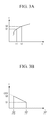
- FIG. 2 shows a schematic diagram of the MCU 20 of the battery management system as shown in FIG. 1, and FIGS. 3A and 3B show diagrams representing a relationship between times and battery voltages.
- the MCU 20 includes an OCV estimator 210, a data storage unit 230, and an SOC establishment unit 220.
- the OCV estimator 210 detects a battery voltage at the first time T1 and a battery voltage at the second time T2 using the battery voltage input from the sensing unit 10.
- the first time T1 corresponds to a time when the effect caused by internal resistance of the battery 2 is eliminated.
- the second time T2 corresponds to a time when a predetermined time passes from the time of solving (or dissipating) the polarization caused by electrolyte diffusion, after the effect of the resistance caused by the internal resistance is eliminated.
- the above times may be experimentally established.
- the times T1 and/or the T2 may simply be set and/or predetermined.
- the OCV estimator 210 uses the detected first battery voltage V1 and second battery voltage V2 to estimate the OCV, as discussed below.
- FIGS. 3A and 3B show diagrams representing a relationship between time and battery voltages according to aspects of the present invention.
- the OCV estimator 210 detects the first battery voltage V1 at the first time T1, and the second battery voltage V2 at the second time T2 after the predetermined time passes from the first time T1.
- the OCV estimator 210 takes the detected voltage-time information as represented by FIG. 3A and determines or obtains the voltage-time information as represented by a linear graph shown in FIG. 3B.
- the polarization is solved (or dissipated) and the battery voltage is stabilized as the time t passes.
- the time t is ideally unlimited (or approaches infinity)
- the polarization is completely solved (or dissipated), and the OCV may be precisely detected.
- the MCU 20 generates the linear equation (or the line equation) as discussed above.
- the OCV estimator 210 uses the linear equation and may estimate the OCV at an unlimited time (at infinity, for example). In this case, to detect (or estimate) the OCV at the time the battery is most stable, the OCV estimator 210 changes the graph shown in FIG. 3A to the graph shown in FIG. 3B. Accordingly, a line that passes through coordinates 1 T ⁇ 1 ⁇ , V ⁇ 1 that correspond to the first time T1 and coordinates 1 T ⁇ 2 ⁇ , V ⁇ 2 that correspond to the second time T2, are used so as to generate the linear equation. In FIG.
- X-axis coordinates have a parameter of 1 T and Y-axis coordinates have a parameter of the battery voltage (v). That is, in various aspects of the present invention, the battery voltage is inversely proportional to the square root of the time.
- the OCV estimator 210 uses Equation 1 and coordinates that correspond to the first and second times T1 and T2 to detect a value of a slope (a) in the linear graph shown in FIG. 3B, as shown below.
- a V ⁇ 2 + V ⁇ 1 1 T ⁇ 2 - 1 T ⁇ 1
- the OCV estimator 210 generates a linear equation (or a line equation) given as Equation 2 in the graph having the slope (a), and as shown in FIG. 3B, and as discussed below.
- Y V ⁇ 2 - V ⁇ 1 1 T ⁇ 2 - 1 T ⁇ 1 * X + A
- X denotes a parameter in 1 T which is obtained by converting from the time t
- Y denotes a parameter in voltage (v).
- the OCV estimator 210 when the time t goes to infinity as shown in FIG. 3B, a voltage value that corresponds to the Y-axis coordinate value becomes the open circuit voltage (OCV).
- OCV open circuit voltage
- a value of the Y-axis coordinate is estimated (or extrapolated) as the OCV when an X-axis coordinate value is 0 (because 1 T becomes 0 when time (T) becomes infinite) and the battery voltage is stabilized.
- the data storage unit 220 stores the battery state information. That is, the data storage unit 220 includes a data table of the SOC that corresponds to the OCV.
- the SOC establishment unit 230 receives the OCV from the OCV estimator 210, uses the data table of the SOC that corresponds to the OCV, and establishes the SOC that corresponds to the OCV.
- FIG. 4 shows a flowchart representing a method of operating the battery management system according an aspect of the present invention.
- the MCU 20 of the BMS 1 determines whether the battery is charged or discharged in operation S100. When it is determined in operation S100 that the battery is charged or discharged, the operation S100 is performed again. When it is determined in operation S100 that the battery is not charged or discharged, the first time T1 and the first battery voltage V1 that corresponds to the first time T1 are detected, and the second time T2 and the second battery voltage V2 that corresponds to the second time T2 are detected in operation S200.
- a graph (or line) that passes through coordinates 1 T ⁇ 1 ⁇ , V ⁇ 1 that correspond to the first time T1 and coordinates 1 T ⁇ 2 ⁇ , V ⁇ 2 that correspond to the second time T2 is formed, and a linear equation is generated as Equation 2 having the respective coordinates, in operation S300.
- a value A (the Y-intercept) of the Y-axis coordinate when an X-axis coordinate value is 0 is estimated (or determined) as an OCV in operation S400.
- the OCV estimated in operation S400 is received, and an SOC that corresponds to the OCV is established in operation S500 by using a data table of the SOC that corresponds to the OCV.
- the battery management system and the method for establishing the SOC by estimating the OCV As described, shown is the battery management system and the method for establishing the SOC by estimating the OCV.
- the first time T1 and the corresponding first battery voltage V1 are detected, the second time T2 and the corresponding second battery voltage V2 are detected, and a corresponding linear equation is generated.
- the OCV is then estimated using the generated linear equation.
- the SOC is established by using a data table of the SOC that corresponds to the OCV.
- the OCV may be estimated quickly and within a short time. Accordingly, the battery management system to precisely estimate the SOC and the driving method thereof may be provided.
- the battery management system for preventing the battery from being overcharged and over-discharged and the driving method thereof may be provided.
- elements of the method can be implemented as software and/or firmware for use with one or more processors and/or computers.
- a processor and/or computer readable medium maybe encoded with computer and/or processor-executable instructions for performing the method.
- aspects of the present invention may be implemented with any rechargeable battery system.
- aspects of the present invention may detect at least one voltage of the rechargeable battery that corresponds to the at least one time, to determine an open circuit voltage (OCV) of the rechargeable battery based on the at least one time and the at least one voltage, and to determine the SOC of the rechargeable battery that corresponds to the determined OCV.
- OCV open circuit voltage
Landscapes
- Engineering & Computer Science (AREA)
- Power Engineering (AREA)
- Physics & Mathematics (AREA)
- General Physics & Mathematics (AREA)
- Chemical Kinetics & Catalysis (AREA)
- Chemical & Material Sciences (AREA)
- Manufacturing & Machinery (AREA)
- Electrochemistry (AREA)
- General Chemical & Material Sciences (AREA)
- Secondary Cells (AREA)
- Electric Propulsion And Braking For Vehicles (AREA)
- Tests Of Electric Status Of Batteries (AREA)
- Charge And Discharge Circuits For Batteries Or The Like (AREA)
Applications Claiming Priority (1)
| Application Number | Priority Date | Filing Date | Title |
|---|---|---|---|
| KR1020060086916A KR100805116B1 (ko) | 2006-09-08 | 2006-09-08 | 배터리 관리 시스템 및 그 구동방법 |
Publications (2)
| Publication Number | Publication Date |
|---|---|
| EP1901413A2 true EP1901413A2 (de) | 2008-03-19 |
| EP1901413A3 EP1901413A3 (de) | 2012-04-04 |
Family
ID=38855039
Family Applications (1)
| Application Number | Title | Priority Date | Filing Date |
|---|---|---|---|
| EP07115331A Withdrawn EP1901413A3 (de) | 2006-09-08 | 2007-08-30 | System und Verfahren zur Batterieverwaltung |
Country Status (5)
| Country | Link |
|---|---|
| US (1) | US7684941B2 (de) |
| EP (1) | EP1901413A3 (de) |
| JP (1) | JP4472733B2 (de) |
| KR (1) | KR100805116B1 (de) |
| CN (1) | CN100585941C (de) |
Cited By (3)
| Publication number | Priority date | Publication date | Assignee | Title |
|---|---|---|---|---|
| FR2941053A1 (fr) * | 2009-01-15 | 2010-07-16 | Peugeot Citroen Automobiles Sa | Dispositif et procede d'estimation rapide de l'etat de charge d'une batterie d'un engin a moteur, a partir d'equations non lineaires |
| WO2013188415A3 (en) * | 2012-06-11 | 2014-02-06 | Panduit Corp. | Capacitor-based ups |
| EP2344900B1 (de) * | 2008-10-30 | 2018-07-18 | Commissariat à l'Energie Atomique | Verfahren zur bestimmung des ladungszustands einer batterie in einer lade- und entladephase |
Families Citing this family (28)
| Publication number | Priority date | Publication date | Assignee | Title |
|---|---|---|---|---|
| JP5163229B2 (ja) * | 2008-03-28 | 2013-03-13 | 新神戸電機株式会社 | 電池状態検知システムおよびこれを備えた自動車 |
| KR101187766B1 (ko) * | 2008-08-08 | 2012-10-05 | 주식회사 엘지화학 | 배터리 셀의 전압 변화 거동을 이용한 셀 밸런싱 장치 및 방법 |
| CN101488594B (zh) * | 2009-02-16 | 2011-07-13 | 中兴通讯股份有限公司 | 一种电池电源的管理方法 |
| DE102009045526A1 (de) * | 2009-10-09 | 2011-04-14 | SB LiMotive Company Ltd., Suwon | Verfahren zur Initialisierung und des Betriebs eines Batteriemanagementsystems |
| EP2355229A1 (de) * | 2010-02-08 | 2011-08-10 | Fortu Intellectual Property AG | Hochstrombatteriesystem und Verfahren zur Steuerung eines Hochstrombatteriesystems |
| CN102035000B (zh) * | 2010-11-29 | 2012-07-25 | 新源动力股份有限公司 | 一种燃料电池堆输出状态估计系统及估计方法 |
| US9407098B2 (en) | 2011-12-12 | 2016-08-02 | Apple Inc. | Determining a battery chemistry for a battery in a peripheral device |
| FR2987451A1 (fr) * | 2012-02-29 | 2013-08-30 | St Microelectronics Grenoble 2 | Dispositif de mesure de la tension a vide d'une batterie |
| JP5704108B2 (ja) * | 2012-03-30 | 2015-04-22 | トヨタ自動車株式会社 | 電池システムおよび推定方法 |
| DE102012207806A1 (de) * | 2012-05-10 | 2013-11-14 | Robert Bosch Gmbh | Verfahren zum Betreiben eines Batteriesystems, Batteriesystem und Kraftfahrzeug |
| FR2990766B1 (fr) * | 2012-05-15 | 2014-05-09 | Renault Sa | Systeme et procede correspondant d'estimation de l'etat de charge d'une batterie |
| CN104285156B (zh) * | 2012-05-15 | 2016-12-21 | 丰田自动车株式会社 | 锂离子电池系统以及锂离子电池的极化判别方法 |
| JP6066163B2 (ja) | 2012-05-17 | 2017-01-25 | 株式会社Gsユアサ | 開路電圧推定装置、状態推定装置及び開路電圧推定方法 |
| FR3006450B1 (fr) * | 2013-06-04 | 2015-05-22 | Renault Sa | Procede pour estimer l'etat de sante d'une cellule electrochimique de stockage d'energie electrique |
| KR102037378B1 (ko) | 2013-07-04 | 2019-10-28 | 에스케이이노베이션 주식회사 | 정전류시 soc 추정 방법, 장치, 이를 포함하는 배터리 관리 시스템 및 에너지 저장 시스템 |
| KR102079038B1 (ko) * | 2013-09-30 | 2020-02-19 | 현대모비스 주식회사 | 지능형 배터리 센서 장치 및 그 동작 방법 |
| JP6260812B2 (ja) * | 2013-12-05 | 2018-01-17 | パナソニックIpマネジメント株式会社 | 電池残存容量推定装置、電池残存容量判定方法及び電池残存容量判定プログラム |
| CN104714181B (zh) * | 2013-12-11 | 2017-10-27 | 广州汽车集团股份有限公司 | 一种获取电压与电池荷电状态关系的方法和系统 |
| KR102527326B1 (ko) | 2015-08-20 | 2023-04-27 | 삼성전자주식회사 | 배터리 충전 상태(SoC)를 예측하는 배터리 시스템 및 방법 |
| JP6365497B2 (ja) * | 2015-10-14 | 2018-08-01 | 株式会社オートネットワーク技術研究所 | 電流制御装置、電流制御方法及びコンピュータプログラム |
| US10436845B2 (en) * | 2016-03-01 | 2019-10-08 | Faraday & Future Inc. | Electric vehicle battery monitoring system |
| JP6645584B2 (ja) * | 2016-08-26 | 2020-02-14 | 株式会社豊田自動織機 | 蓄電装置 |
| US10338147B2 (en) * | 2016-10-31 | 2019-07-02 | Semiconductor Components Industries, Llc | Methods and apparatus for determining a relative state of charge of a battery |
| JP7401444B2 (ja) * | 2018-02-10 | 2023-12-19 | ヨウオン テクノロジー カンパニー、リミテッド | 電動アシスト自転車、その電源管理システム及び管理方法 |
| KR102844868B1 (ko) | 2019-10-18 | 2025-08-08 | 주식회사 엘지에너지솔루션 | 충전 상태 추정 장치 및 방법 |
| KR102851926B1 (ko) * | 2020-08-13 | 2025-08-27 | 주식회사 엘지에너지솔루션 | 배터리 관리 장치 및 방법 |
| KR102638180B1 (ko) * | 2021-11-03 | 2024-02-16 | 엘지전자 주식회사 | 에너지 저장장치 및 그 동작방법 |
| WO2023162274A1 (ja) * | 2022-02-28 | 2023-08-31 | 京セラ株式会社 | Soc推定装置、プログラム及びsoc推定方法 |
Citations (1)
| Publication number | Priority date | Publication date | Assignee | Title |
|---|---|---|---|---|
| US20020145430A1 (en) | 2001-02-23 | 2002-10-10 | Youichi Arai | Method and apparatus for estimating terminal voltage of battery, method and apparatus for computing open circuit voltage of battery, and method and apparatus for computing battery capacity |
Family Cites Families (6)
| Publication number | Priority date | Publication date | Assignee | Title |
|---|---|---|---|---|
| US6639385B2 (en) | 2001-08-07 | 2003-10-28 | General Motors Corporation | State of charge method and apparatus |
| JP3770137B2 (ja) | 2001-10-17 | 2006-04-26 | トヨタ自動車株式会社 | 車両用二次電池制御装置 |
| JP2004354050A (ja) * | 2002-05-14 | 2004-12-16 | Yazaki Corp | バッテリの充電状態推定方法及び開回路電圧推定方法、並びに、劣化度算出方法及び装置 |
| US6791464B2 (en) | 2002-10-28 | 2004-09-14 | Bppower Inc. | Apparatus of monitoring motor vehicle's electric power and method thereof |
| JP3714321B2 (ja) | 2002-11-25 | 2005-11-09 | 日産自動車株式会社 | 二次電池の充電率推定装置 |
| EP2270526A1 (de) * | 2003-07-09 | 2011-01-05 | Premium Power Corporation | Vorrichtung zum Überwachung und zur Ladung einer Ausgewählten Gruppe von Batterienzellen |
-
2006
- 2006-09-08 KR KR1020060086916A patent/KR100805116B1/ko not_active Expired - Fee Related
-
2007
- 2007-07-03 JP JP2007175312A patent/JP4472733B2/ja not_active Expired - Fee Related
- 2007-08-24 CN CN200710147713A patent/CN100585941C/zh not_active Expired - Fee Related
- 2007-08-30 EP EP07115331A patent/EP1901413A3/de not_active Withdrawn
- 2007-09-06 US US11/850,701 patent/US7684941B2/en not_active Expired - Fee Related
Patent Citations (1)
| Publication number | Priority date | Publication date | Assignee | Title |
|---|---|---|---|---|
| US20020145430A1 (en) | 2001-02-23 | 2002-10-10 | Youichi Arai | Method and apparatus for estimating terminal voltage of battery, method and apparatus for computing open circuit voltage of battery, and method and apparatus for computing battery capacity |
Cited By (5)
| Publication number | Priority date | Publication date | Assignee | Title |
|---|---|---|---|---|
| EP2344900B1 (de) * | 2008-10-30 | 2018-07-18 | Commissariat à l'Energie Atomique | Verfahren zur bestimmung des ladungszustands einer batterie in einer lade- und entladephase |
| FR2941053A1 (fr) * | 2009-01-15 | 2010-07-16 | Peugeot Citroen Automobiles Sa | Dispositif et procede d'estimation rapide de l'etat de charge d'une batterie d'un engin a moteur, a partir d'equations non lineaires |
| WO2013188415A3 (en) * | 2012-06-11 | 2014-02-06 | Panduit Corp. | Capacitor-based ups |
| US9966758B2 (en) | 2012-06-11 | 2018-05-08 | Panduit Corp. | Capacitor-based UPS |
| US10516263B2 (en) | 2012-06-11 | 2019-12-24 | Panduit Corp. | Capacitor-based UPS |
Also Published As
| Publication number | Publication date |
|---|---|
| KR100805116B1 (ko) | 2008-02-21 |
| EP1901413A3 (de) | 2012-04-04 |
| CN101141016A (zh) | 2008-03-12 |
| JP4472733B2 (ja) | 2010-06-02 |
| US20080065336A1 (en) | 2008-03-13 |
| US7684941B2 (en) | 2010-03-23 |
| JP2008064740A (ja) | 2008-03-21 |
| CN100585941C (zh) | 2010-01-27 |
Similar Documents
| Publication | Publication Date | Title |
|---|---|---|
| US7684941B2 (en) | Battery management system and driving method thereof | |
| EP1914559B1 (de) | Batterieverwaltungssystem und Verfahren zu dessen Ansteuerung | |
| US7800345B2 (en) | Battery management system and method of operating same | |
| EP1801604B1 (de) | Verfahren zur Kompensation des Ladungszustandes einer Batterie und damit ausgestattetes Batterieverwaltungssystem | |
| EP1801947B1 (de) | Verfahren zur Kompensation der Batterieladungszustand und Batterieverwaltungssystem | |
| US7684942B2 (en) | Battery management system and driving method thereof | |
| US7768235B2 (en) | Battery management system and method for automotive vehicle | |
| JP4949086B2 (ja) | バッテリー管理システムおよびその作動方法 | |
| EP1801606B1 (de) | Verfahren zum Ausgleich des Ladezustands einer Batterie, Batterieverwaltungssystem damit und Hybridfahrzeug mit dem Batterieverwaltungssystem | |
| EP1897772B1 (de) | Batterieverwaltungssystem und Antriebsverfahren | |
| US7652449B2 (en) | Battery management system and driving method thereof | |
| EP1777794B1 (de) | Batterieverwaltungssystem und Verfahren zur Feststellung des Ladezustandes einer Batterie | |
| KR20080033628A (ko) | 배터리 관리 시스템 및 그의 구동 방법 | |
| KR101117636B1 (ko) | 배터리의 soc추정 방법 및 이를 이용한 배터리 관리시스템 | |
| KR20070040065A (ko) | 배터리의 soc 추정 방법 및 이를 이용한 배터리 관리시스템 |
Legal Events
| Date | Code | Title | Description |
|---|---|---|---|
| PUAI | Public reference made under article 153(3) epc to a published international application that has entered the european phase |
Free format text: ORIGINAL CODE: 0009012 |
|
| 17P | Request for examination filed |
Effective date: 20070830 |
|
| AK | Designated contracting states |
Kind code of ref document: A2 Designated state(s): AT BE BG CH CY CZ DE DK EE ES FI FR GB GR HU IE IS IT LI LT LU LV MC MT NL PL PT RO SE SI SK TR |
|
| AX | Request for extension of the european patent |
Extension state: AL BA HR MK YU |
|
| RAP1 | Party data changed (applicant data changed or rights of an application transferred) |
Owner name: SAMSUNG SDI CO., LTD. |
|
| PUAL | Search report despatched |
Free format text: ORIGINAL CODE: 0009013 |
|
| AK | Designated contracting states |
Kind code of ref document: A3 Designated state(s): AT BE BG CH CY CZ DE DK EE ES FI FR GB GR HU IE IS IT LI LT LU LV MC MT NL PL PT RO SE SI SK TR |
|
| AX | Request for extension of the european patent |
Extension state: AL BA HR MK RS |
|
| RIC1 | Information provided on ipc code assigned before grant |
Ipc: G01R 31/36 20060101ALI20120229BHEP Ipc: H02J 7/00 20060101AFI20120229BHEP |
|
| RAP1 | Party data changed (applicant data changed or rights of an application transferred) |
Owner name: SAMSUNG SDI CO., LTD. |
|
| AKX | Designation fees paid |
Designated state(s): DE FR GB HU |
|
| STAA | Information on the status of an ep patent application or granted ep patent |
Free format text: STATUS: THE APPLICATION HAS BEEN WITHDRAWN |
|
| 18W | Application withdrawn |
Effective date: 20160616 |