EP1901434A1 - Schema d'entrelacement pour un 16APSK système codé par LDPC. - Google Patents
Schema d'entrelacement pour un 16APSK système codé par LDPC. Download PDFInfo
- Publication number
- EP1901434A1 EP1901434A1 EP07016673A EP07016673A EP1901434A1 EP 1901434 A1 EP1901434 A1 EP 1901434A1 EP 07016673 A EP07016673 A EP 07016673A EP 07016673 A EP07016673 A EP 07016673A EP 1901434 A1 EP1901434 A1 EP 1901434A1
- Authority
- EP
- European Patent Office
- Prior art keywords
- mod
- offset
- ldpc
- bits
- interleaving
- Prior art date
- Legal status (The legal status is an assumption and is not a legal conclusion. Google has not performed a legal analysis and makes no representation as to the accuracy of the status listed.)
- Ceased
Links
- 238000004891 communication Methods 0.000 claims description 21
- 238000000034 method Methods 0.000 claims description 12
- 238000004590 computer program Methods 0.000 claims 1
- 238000013459 approach Methods 0.000 abstract description 6
- 230000001788 irregular Effects 0.000 description 13
- 238000013507 mapping Methods 0.000 description 13
- 239000011159 matrix material Substances 0.000 description 10
- 238000009826 distribution Methods 0.000 description 4
- 230000007423 decrease Effects 0.000 description 3
- 230000006978 adaptation Effects 0.000 description 2
- 230000005540 biological transmission Effects 0.000 description 2
- 238000012986 modification Methods 0.000 description 2
- 230000004048 modification Effects 0.000 description 2
- 230000010363 phase shift Effects 0.000 description 2
- 101150012579 ADSL gene Proteins 0.000 description 1
- 102100020775 Adenylosuccinate lyase Human genes 0.000 description 1
- 108700040193 Adenylosuccinate lyases Proteins 0.000 description 1
- 238000007476 Maximum Likelihood Methods 0.000 description 1
- 125000002015 acyclic group Chemical group 0.000 description 1
- 230000003044 adaptive effect Effects 0.000 description 1
- 238000010276 construction Methods 0.000 description 1
- 238000010586 diagram Methods 0.000 description 1
- 238000002372 labelling Methods 0.000 description 1
- 230000000644 propagated effect Effects 0.000 description 1
- 238000011160 research Methods 0.000 description 1
Images



Classifications
-
- H—ELECTRICITY
- H03—ELECTRONIC CIRCUITRY
- H03M—CODING; DECODING; CODE CONVERSION IN GENERAL
- H03M13/00—Coding, decoding or code conversion, for error detection or error correction; Coding theory basic assumptions; Coding bounds; Error probability evaluation methods; Channel models; Simulation or testing of codes
- H03M13/03—Error detection or forward error correction by redundancy in data representation, i.e. code words containing more digits than the source words
- H03M13/05—Error detection or forward error correction by redundancy in data representation, i.e. code words containing more digits than the source words using block codes, i.e. a predetermined number of check bits joined to a predetermined number of information bits
- H03M13/11—Error detection or forward error correction by redundancy in data representation, i.e. code words containing more digits than the source words using block codes, i.e. a predetermined number of check bits joined to a predetermined number of information bits using multiple parity bits
- H03M13/1102—Codes on graphs and decoding on graphs, e.g. low-density parity check [LDPC] codes
- H03M13/1148—Structural properties of the code parity-check or generator matrix
-
- H—ELECTRICITY
- H03—ELECTRONIC CIRCUITRY
- H03M—CODING; DECODING; CODE CONVERSION IN GENERAL
- H03M13/00—Coding, decoding or code conversion, for error detection or error correction; Coding theory basic assumptions; Coding bounds; Error probability evaluation methods; Channel models; Simulation or testing of codes
- H03M13/03—Error detection or forward error correction by redundancy in data representation, i.e. code words containing more digits than the source words
- H03M13/05—Error detection or forward error correction by redundancy in data representation, i.e. code words containing more digits than the source words using block codes, i.e. a predetermined number of check bits joined to a predetermined number of information bits
- H03M13/11—Error detection or forward error correction by redundancy in data representation, i.e. code words containing more digits than the source words using block codes, i.e. a predetermined number of check bits joined to a predetermined number of information bits using multiple parity bits
- H03M13/1102—Codes on graphs and decoding on graphs, e.g. low-density parity check [LDPC] codes
-
- H—ELECTRICITY
- H03—ELECTRONIC CIRCUITRY
- H03M—CODING; DECODING; CODE CONVERSION IN GENERAL
- H03M13/00—Coding, decoding or code conversion, for error detection or error correction; Coding theory basic assumptions; Coding bounds; Error probability evaluation methods; Channel models; Simulation or testing of codes
- H03M13/31—Coding, decoding or code conversion, for error detection or error correction; Coding theory basic assumptions; Coding bounds; Error probability evaluation methods; Channel models; Simulation or testing of codes combining coding for error detection or correction and efficient use of the spectrum
-
- H—ELECTRICITY
- H03—ELECTRONIC CIRCUITRY
- H03M—CODING; DECODING; CODE CONVERSION IN GENERAL
- H03M13/00—Coding, decoding or code conversion, for error detection or error correction; Coding theory basic assumptions; Coding bounds; Error probability evaluation methods; Channel models; Simulation or testing of codes
- H03M13/35—Unequal or adaptive error protection, e.g. by providing a different level of protection according to significance of source information or by adapting the coding according to the change of transmission channel characteristics
- H03M13/356—Unequal error protection [UEP]
-
- H—ELECTRICITY
- H04—ELECTRIC COMMUNICATION TECHNIQUE
- H04L—TRANSMISSION OF DIGITAL INFORMATION, e.g. TELEGRAPHIC COMMUNICATION
- H04L1/00—Arrangements for detecting or preventing errors in the information received
- H04L1/004—Arrangements for detecting or preventing errors in the information received by using forward error control
- H04L1/0056—Systems characterized by the type of code used
- H04L1/0057—Block codes
- H04L1/0058—Block-coded modulation
-
- H—ELECTRICITY
- H04—ELECTRIC COMMUNICATION TECHNIQUE
- H04L—TRANSMISSION OF DIGITAL INFORMATION, e.g. TELEGRAPHIC COMMUNICATION
- H04L1/00—Arrangements for detecting or preventing errors in the information received
- H04L1/004—Arrangements for detecting or preventing errors in the information received by using forward error control
- H04L1/0056—Systems characterized by the type of code used
- H04L1/007—Unequal error protection
-
- H—ELECTRICITY
- H04—ELECTRIC COMMUNICATION TECHNIQUE
- H04L—TRANSMISSION OF DIGITAL INFORMATION, e.g. TELEGRAPHIC COMMUNICATION
- H04L1/00—Arrangements for detecting or preventing errors in the information received
- H04L1/004—Arrangements for detecting or preventing errors in the information received by using forward error control
- H04L1/0056—Systems characterized by the type of code used
- H04L1/0071—Use of interleaving
-
- H—ELECTRICITY
- H04—ELECTRIC COMMUNICATION TECHNIQUE
- H04L—TRANSMISSION OF DIGITAL INFORMATION, e.g. TELEGRAPHIC COMMUNICATION
- H04L27/00—Modulated-carrier systems
- H04L27/18—Phase-modulated carrier systems, i.e. using phase-shift keying
- H04L27/183—Multiresolution systems
-
- H—ELECTRICITY
- H04—ELECTRIC COMMUNICATION TECHNIQUE
- H04L—TRANSMISSION OF DIGITAL INFORMATION, e.g. TELEGRAPHIC COMMUNICATION
- H04L27/00—Modulated-carrier systems
- H04L27/18—Phase-modulated carrier systems, i.e. using phase-shift keying
- H04L27/186—Phase-modulated carrier systems, i.e. using phase-shift keying in which the information is carried by both the individual signal points and the subset to which the individual signal points belong, e.g. coset coding or related schemes
-
- H—ELECTRICITY
- H04—ELECTRIC COMMUNICATION TECHNIQUE
- H04L—TRANSMISSION OF DIGITAL INFORMATION, e.g. TELEGRAPHIC COMMUNICATION
- H04L27/00—Modulated-carrier systems
- H04L27/18—Phase-modulated carrier systems, i.e. using phase-shift keying
- H04L27/20—Modulator circuits; Transmitter circuits
- H04L27/2032—Modulator circuits; Transmitter circuits for discrete phase modulation, e.g. in which the phase of the carrier is modulated in a nominally instantaneous manner
- H04L27/2053—Modulator circuits; Transmitter circuits for discrete phase modulation, e.g. in which the phase of the carrier is modulated in a nominally instantaneous manner using more than one carrier, e.g. carriers with different phases
Definitions
- LDPC codes were first described by Gallager in the 1960s. LDPC codes perform remarkably close to the Shannon limit.
- a binary (N, K) LDPC code with a code length N and dimension K, is defined by a parity check matrix H of ( N-K ) rows and N columns. Most entries of the matrix H are zeros and only a small number the entries are ones, hence the matrix H is sparse.
- Each row of the matrix H represents a check sum, and each column represents a variable, e.g. a bit or symbol.
- the LDPC codes described by Gallager are regular, i.e. the parity check matrix H has constant-weight rows and columns.
- Regular LDPC codes can be extended to irregular LDPC codes, in which the weight of rows and columns vary.
- An irregular LDPC code is specified by degree distribution polynomials v(x) and c(x), which define the variable and check node degree distributions, respectively.
- the variables d v max and d c max are a maximum variable node degree and a check node degree, respectively
- v j ( c j ) represents the fraction of edges emanating from variable (check) nodes of degree j.
- FIG. 1 illustrates a parity check matrix representation of an exemplary irregular LDPC code of codeword length six.
- LDPC codes can also be represented by bipartite graphs, or Tanner graphs.
- Tanner graph one set of nodes called variable nodes (or bit nodes) corresponds to the bits of the codeword and the other set of nodes called constraints nodes (or check nodes) corresponds the set of parity check constrains which define the LDPC code.
- Bit nodes and check nodes are connected by edges. A bit node and a check node is said to be neighbors or adjacent if they are connected by an edge. Generally, it is assumed that a pair of nodes is connected by at most one edge.
- LDPC codes can be decoded in various ways, such as majority-logic decoding and iterative decoding. Due to the structures of their parity check matrices, LDPC codes are majority-logic decodable. Majority-logic decoding requires the least complexity and achieves reasonably good error performance for decoding, such as for LDPC codes with relatively high column weights in their parity check matrices (e. g. Euclidean geometry LDPC and projective geometry LDPC codes), whereas iterative decoding methods have received more attentions due to their better performance versus complexity tradeoffs. Unlike majority-logic decoding, iterative decoding processes the received symbols recursively to improve the reliability of each symbol based on constraints that specify the code.
- the iterative decoder uses the channel output as input, and generates reliability output for each symbol. Subsequently, the output reliability measures of the decoded symbols at the end of each decoding iteration are used as inputs for the next iteration. The decoding process continues until a certain stopping condition is satisfied. Then final decisions are made, based on the output reliability measures of the decoded symbols from the last iteration.
- iterative decoding algorithms can be further divided into hard decision, soft decision and hybrid decision algorithms.
- the corresponding popular algorithms are iterative bit-flipping (BF), belief propagation (BP), and weighted bit-flipping (WBF) decoding, respectively.
- BF belief propagation
- WBF weighted bit-flipping
- BP for LDPC codes is a kind of message passing decoding. Messages transmitted along the edges of the graph are log-likelihood ratio (LLR) log ⁇ p 0 p 1 associated with variable nodes corresponding to codeword bits. In this expression p 0 and p 1 denote the probability that the associated bit takes value 0 and 1, respectively.
- BP decoding has two steps, horizontal step and vertical step. In the horizontal step, each check node c m sends to each adjacent bit b n a check-to-bit message which is calculated based on all bit-to-check messages incoming to the check c m except the one from bit b n .
- each bit node b n sends to each adjacent check node c m a bit-to-check message which is calculated based on all check-to-bit messages incoming to the bit b n except the one from check node c m .
- irregular LDPC codes are among the best for many applications.
- Various irregular LDPC codes have been accepted or being considered for various communication and storage standards, such as DVB-S2/DAB, wireline ADSL, IEEE 802.1 In, and IEEE 802.16 [4][5]. While considering applying irregular LDPC codes to video broadcasting systems, one often encounter a trouble called error floor.
- the error floor performance region of an LDPC decoder can be described by the error performance curve of the system.
- the LDPC decoder system typically exhibits sharp decrease in error probability as the quality of the input signal improves.
- the resulting error performance curves are conventionally called waterfall curve and the corresponding region is called waterfall region. At some point, however, the decrease of error probability with input signal quality increase decreases.
- the resulting flat error performance curve is called error floor.
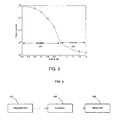
- FIG. 3 illustrates an exemplary frame error rate (FER) performance curve containing waterfall region 301 and error floor region 302 of an irregular LDPC code.
- FER frame error rate
- the invention discloses an interleaving approach in which for LDPC coded bits with any level of reliability, a portion of lower level modulation bits and a portion of higher level modulation bits are mapped. Given a specific structure of an LDPC code and the modulation method, the optimal portion of lower and higher level modulation bits can be determined through a theoretical algorithm called density evolution.
- a digital communications system to interleave bits in a 16ASPK modulation system with FEC code, comprising a transmitter to generate signal waveforms across a communication channel to a receiver, the transmitter having a message source to generate a set of discrete bits which has a corresponding signal waveform; and an LDPC encoder to generate signals from alphabet to a signal mapper, wherein interleaving is a non-consecutive mapping that generates the best threshold of corresponding LDPC codes predicted by density evolution.
- the LDPC codes in the invention have good threshold which reduce transmission power for a given FER performance.
- the threshold of an LDPC code is defined as the smallest SNR value at which, as the codeword length tends to infinity, the bit error probability can be made arbitrarily small.
- FIG. 1 is a parity check matrix representation of an exemplary irregular LDPC code of codeword length six.
- FIG. 2 illustrates a bipartite graph representation of the irregular LDPC code illustrated in FIG. 1.
- FIG. 3 illustrates an exemplary FER performance curve including waterfall and error floor region of an irregular LDPC code.
- FIG. 4 is an exemplary communications system which employs LDPC codes and interleavor/deinterleavor, according to an embodiment of the invention.
- FIG. 5 illustrates an exemplary transmitter in FIG. 4.
- FIG. 5 depicts an exemplary transmitter 401; 500 in the communications system of FIG. 4 which employs LDPC codes and interleaver.
- the LDPC encoder 502 encodes information bits from source 501 into LDPC codewords. The mapping from each information block to each LDPC codeword is specified by the parity check matrix (or equivalently the generator matrix) of the LDPC code.
- the LDPC codeword is interleaved and modulated to signal waveforms by the interleaver/modulator 503. These signal waveforms are sent to a transmit antenna 504 and propagated to a receiver shown in FIG. 6.
- FIG. 6 depicts an exemplary receiver 403; 600 in the communications system of FIG. 4 which employs LDPC codes and a deinterleaver.
- Signal waveforms are received by the receiving antenna 601 and distributed to demodulator/deinterleavor 602.
- Signal waveforms are demodulated by demodulator and deinterleaved by deinterleavor and then distributed to a LDPC decoder 603 which iteratively decodes the received messages and output estimations of the transmitted codeword.
- the deinterleaving rule employed by the demodulator/deinterleaver 602 should match with the interleaving rule employed by the interleaver/modulator 503. That is to say, the deinterleaving scheme should follow an anti-rule of the interleaving scheme.
- the optimal interleaving as the non-consecutive mapping arrangement which generate the best threshold of the corresponding LDPC code predicted by density evolution.
- the mapping logic is shown in FIG. 8.
Landscapes
- Engineering & Computer Science (AREA)
- Computer Networks & Wireless Communication (AREA)
- Signal Processing (AREA)
- Physics & Mathematics (AREA)
- Probability & Statistics with Applications (AREA)
- Theoretical Computer Science (AREA)
- Mathematical Physics (AREA)
- Error Detection And Correction (AREA)
Applications Claiming Priority (1)
| Application Number | Priority Date | Filing Date | Title |
|---|---|---|---|
| PCT/CN2006/002421 WO2008034286A1 (fr) | 2006-09-18 | 2006-09-18 | Schéma d'entrelacement pour système 16apsk codé par ldpc |
Publications (1)
| Publication Number | Publication Date |
|---|---|
| EP1901434A1 true EP1901434A1 (fr) | 2008-03-19 |
Family
ID=38565559
Family Applications (1)
| Application Number | Title | Priority Date | Filing Date |
|---|---|---|---|
| EP07016673A Ceased EP1901434A1 (fr) | 2006-09-18 | 2007-08-24 | Schema d'entrelacement pour un 16APSK système codé par LDPC. |
Country Status (4)
| Country | Link |
|---|---|
| US (1) | US8028219B2 (fr) |
| EP (1) | EP1901434A1 (fr) |
| TW (1) | TWI325259B (fr) |
| WO (1) | WO2008034286A1 (fr) |
Families Citing this family (11)
| Publication number | Priority date | Publication date | Assignee | Title |
|---|---|---|---|---|
| WO2008034287A1 (fr) * | 2006-09-18 | 2008-03-27 | Juntan Zhang | Schéma d'entrelacement pour système 32apsk codé par ldpc |
| US8230299B2 (en) * | 2006-09-18 | 2012-07-24 | Availink, Inc. | Interleaving scheme for an LDPC coded QPSK/8PSK system |
| US8370711B2 (en) | 2008-06-23 | 2013-02-05 | Ramot At Tel Aviv University Ltd. | Interruption criteria for block decoding |
| JP2012151676A (ja) * | 2011-01-19 | 2012-08-09 | Jvc Kenwood Corp | 復号装置および復号方法 |
| US9602137B2 (en) * | 2014-02-19 | 2017-03-21 | Samsung Electronics Co., Ltd. | Transmitting apparatus and interleaving method thereof |
| US10326471B2 (en) * | 2014-05-22 | 2019-06-18 | Electronics And Telecommunications Research Institute | Bit interleaver for low-density parity check codeword having length of 16200 and code rate of 3/15 and quadrature phase shift keying, and bit interleaving method using same |
| KR102287629B1 (ko) * | 2015-02-16 | 2021-08-10 | 한국전자통신연구원 | 길이가 64800이며, 부호율이 3/15인 ldpc 부호어 및 4096-심볼 맵핑을 위한 비트 인터리버 및 이를 이용한 비트 인터리빙 방법 |
| KR102287620B1 (ko) | 2015-02-16 | 2021-08-10 | 한국전자통신연구원 | 길이가 64800이며, 부호율이 2/15인 ldpc 부호어 및 1024-심볼 맵핑을 위한 비트 인터리버 및 이를 이용한 비트 인터리빙 방법 |
| US9847794B2 (en) * | 2015-05-19 | 2017-12-19 | Samsung Electronics Co., Ltd. | Transmitting apparatus and interleaving method thereof |
| CN107018113B (zh) | 2016-01-27 | 2020-01-31 | 华为技术有限公司 | 发射机、接收机和信号处理的方法 |
| US11043969B2 (en) * | 2019-11-12 | 2021-06-22 | SK Hynix Inc. | Fast-converging soft bit-flipping decoder for low-density parity-check codes |
Family Cites Families (8)
| Publication number | Priority date | Publication date | Assignee | Title |
|---|---|---|---|---|
| JPS60206284A (ja) | 1984-03-30 | 1985-10-17 | Nippon Hoso Kyokai <Nhk> | 静止画信号伝送方式 |
| JP3974712B2 (ja) | 1998-08-31 | 2007-09-12 | 富士通株式会社 | ディジタル放送用送信・受信再生方法及びディジタル放送用送信・受信再生システム並びにディジタル放送用送信装置及びディジタル放送用受信再生装置 |
| KR20020001039A (ko) | 2000-06-23 | 2002-01-09 | 서평원 | 인터넷 및 위성망을 이용한 인터넷 위성 방송 서비스 방법및 장치 |
| DE10134764A1 (de) | 2001-07-13 | 2003-01-30 | Deutsche Telekom Ag | Satelliten-Managementsystem für eine effiziente Auslastung der Transponderbandbreite |
| US7577207B2 (en) * | 2002-07-03 | 2009-08-18 | Dtvg Licensing, Inc. | Bit labeling for amplitude phase shift constellation used with low density parity check (LDPC) codes |
| WO2004006442A1 (fr) * | 2002-07-03 | 2004-01-15 | Hughes Electronics Corporation | Codage de codes a controle de parite basse densite, par matrice a controle de parite structuree |
| KR100996029B1 (ko) * | 2003-04-29 | 2010-11-22 | 삼성전자주식회사 | 저밀도 패리티 검사 코드의 부호화 장치 및 방법 |
| US7251769B2 (en) * | 2004-03-17 | 2007-07-31 | Lucent Technologies Inc. | Methods and apparatus for communication using generalized low density parity check codes |
-
2006
- 2006-09-18 WO PCT/CN2006/002421 patent/WO2008034286A1/fr not_active Ceased
- 2006-09-18 US US11/813,201 patent/US8028219B2/en not_active Expired - Fee Related
-
2007
- 2007-03-07 TW TW096107917A patent/TWI325259B/zh not_active IP Right Cessation
- 2007-08-24 EP EP07016673A patent/EP1901434A1/fr not_active Ceased
Non-Patent Citations (1)
| Title |
|---|
| LI Y ET AL: "BIT-RELIABILITY MAPPING IN LDPC-CODED MODULATION SYSTEMS", IEEE COMMUNICATIONS LETTERS, IEEE SERVICE CENTER, PISCATAWAY, NJ, US, vol. 9, no. 1, January 2005 (2005-01-01), pages 1 - 3, XP001211457, ISSN: 1089-7798 * |
Also Published As
| Publication number | Publication date |
|---|---|
| TWI325259B (en) | 2010-05-21 |
| TW200816732A (en) | 2008-04-01 |
| WO2008034286A1 (fr) | 2008-03-27 |
| US8028219B2 (en) | 2011-09-27 |
| US20110107183A1 (en) | 2011-05-05 |
Similar Documents
| Publication | Publication Date | Title |
|---|---|---|
| US8369448B2 (en) | Bit mapping scheme for an LDPC coded 32APSK system | |
| EP1901434A1 (fr) | Schema d'entrelacement pour un 16APSK système codé par LDPC. | |
| US8230299B2 (en) | Interleaving scheme for an LDPC coded QPSK/8PSK system | |
| US7802164B2 (en) | Apparatus and method for encoding/decoding block low density parity check codes having variable coding rate | |
| US7222284B2 (en) | Low-density parity-check codes for multiple code rates | |
| EP2088678B1 (fr) | Procédé et appareil pour coder et décoder un canal dans un système de communication utilisant des codes de contrôle de parité de faible densité | |
| EP1901433A1 (fr) | Famille de codes LDPC pour applications de diffusion de vidéo | |
| EP1701450A1 (fr) | Entrelacement de canal pour un système de communication utilisant des codes LDPC | |
| EP2510623B1 (fr) | Procédé et appareil de codage et décodage de canal dans un système de communication utilisant un code de contrôle de parité à faible densité | |
| US8301960B2 (en) | Interleaving scheme for an LDPC coded 32 APSK system | |
| KR20070112327A (ko) | 통신 시스템에서 신호 송수신 장치 및 방법 | |
| US7458003B2 (en) | Low-complexity, capacity-achieving code for communication systems | |
| EP1901438A2 (fr) | Schéma intercalé pour système QPSK/8PSK codé LDPC | |
| CN101150551B (zh) | 低密度奇偶校验编码的qpsk/8psk系统的交织方案 | |
| CN101150378B (zh) | 低密度奇偶校验编码的32apsk系统的交织方案 | |
| EP1901436A2 (fr) | Schéma de cartographie de bits pour système 16APSK codé LDPC | |
| CN101150550B (zh) | 交织低密度奇偶校验编码比特的方法、发射器和接收器 | |
| US7559010B2 (en) | Short length LDPC (Low Density Parity Check) code and modulation adapted for high speed Ethernet applications | |
| US20110173509A1 (en) | Bit mapping scheme for an ldpc coded 16apsk system | |
| CN101150377A (zh) | 用于低密度奇偶校验编码的32apsk系统的比特映射方案 | |
| HK1118990A (en) | An interleaving scheme for an ldpc coded 16apsk system | |
| HK1118989A (en) | An interleaving scheme for an ldpc coded 32apsk system | |
| HK1118991A (en) | An interleaving scheme for an ldpc coded qpsk/8psk system | |
| HK1118987A (en) | Bit mapping scheme for an ldpc coded 32apsk system | |
| CN101150552A (zh) | 用于低密度奇偶校验编码的16apsk系统的比特映射方案 |
Legal Events
| Date | Code | Title | Description |
|---|---|---|---|
| PUAI | Public reference made under article 153(3) epc to a published international application that has entered the european phase |
Free format text: ORIGINAL CODE: 0009012 |
|
| AK | Designated contracting states |
Kind code of ref document: A1 Designated state(s): AT BE BG CH CY CZ DE DK EE ES FI FR GB GR HU IE IS IT LI LT LU LV MC MT NL PL PT RO SE SI SK TR |
|
| AX | Request for extension of the european patent |
Extension state: AL BA HR MK YU |
|
| 17P | Request for examination filed |
Effective date: 20080918 |
|
| AKX | Designation fees paid |
Designated state(s): AT BE BG CH CY CZ DE DK EE ES FI FR GB GR HU IE IS IT LI LT LU LV MC MT NL PL PT RO SE SI SK TR |
|
| 17Q | First examination report despatched |
Effective date: 20081121 |
|
| STAA | Information on the status of an ep patent application or granted ep patent |
Free format text: STATUS: THE APPLICATION HAS BEEN REFUSED |
|
| 18R | Application refused |
Effective date: 20101123 |