EP1901510A1 - Réduction du rapport entre puissance de crête et puissance moyenne d'un système multiporteuse - Google Patents
Réduction du rapport entre puissance de crête et puissance moyenne d'un système multiporteuse Download PDFInfo
- Publication number
- EP1901510A1 EP1901510A1 EP06019360A EP06019360A EP1901510A1 EP 1901510 A1 EP1901510 A1 EP 1901510A1 EP 06019360 A EP06019360 A EP 06019360A EP 06019360 A EP06019360 A EP 06019360A EP 1901510 A1 EP1901510 A1 EP 1901510A1
- Authority
- EP
- European Patent Office
- Prior art keywords
- signal
- evaluation
- input signal
- providing
- power
- Prior art date
- Legal status (The legal status is an assumption and is not a legal conclusion. Google has not performed a legal analysis and makes no representation as to the accuracy of the status listed.)
- Withdrawn
Links
Images
Classifications
-
- H—ELECTRICITY
- H04—ELECTRIC COMMUNICATION TECHNIQUE
- H04L—TRANSMISSION OF DIGITAL INFORMATION, e.g. TELEGRAPHIC COMMUNICATION
- H04L27/00—Modulated-carrier systems
- H04L27/26—Systems using multi-frequency codes
- H04L27/2601—Multicarrier modulation systems
- H04L27/2614—Peak power aspects
-
- H—ELECTRICITY
- H04—ELECTRIC COMMUNICATION TECHNIQUE
- H04L—TRANSMISSION OF DIGITAL INFORMATION, e.g. TELEGRAPHIC COMMUNICATION
- H04L27/00—Modulated-carrier systems
- H04L27/32—Carrier systems characterised by combinations of two or more of the types covered by groups H04L27/02, H04L27/10, H04L27/18 or H04L27/26
- H04L27/34—Amplitude- and phase-modulated carrier systems, e.g. quadrature-amplitude modulated carrier systems
- H04L27/3405—Modifications of the signal space to increase the efficiency of transmission, e.g. reduction of the bit error rate, bandwidth, or average power
- H04L27/3411—Modifications of the signal space to increase the efficiency of transmission, e.g. reduction of the bit error rate, bandwidth, or average power reducing the peak to average power ratio or the mean power of the constellation; Arrangements for increasing the shape gain of a signal set
Definitions
- the present invention relates to the field of peak-to-average-power-ratio reduction in wireless communication systems, where low peak-to-average-power-ratios are desired in order to take advantage of the linear characteristics of power amplifiers and in order to avoid inter-modulation products caused by non linear power amplifier characteristics. More specifically, the present invention relates to peak-to-average-power-ratio reduction as required in future mobile communication systems, as for example in orthogonal frequency division multiplexing (OFDM) systems or generally systems, which are based on multi-carrier (MC) modulation.
- OFDM orthogonal frequency division multiplexing
- MC multi-carrier
- a high peak-to-average-power-ratio of a transmit signal is one of the greatest problems of multi-carrier systems, for example, orthogonal frequency division multiplexing (OFDM) or discrete multi-tone (DMT) systems.
- High peak values drive non-linear power amplifiers during operation in non-linear regions of their amplifying characteristics. Amplifiers being operated in non-linear regions of their characteristics cause inter-modulation products, modulations among sub carriers and out of band radiation. To prevent these effects a power amplifier must be operated in the linear region of its characteristics introducing large input back-offs for the case of higher peaks being present.
- the problem of higher peak-to-average-power ratios can, in some applications, even compensate or annul the benefits of multi-carrier modulations.
- the reduction of the peak-to-average-power-ratio is an essential topic in multi-carrier systems.
- tone reservation method One of the most promising solutions is the tone reservation method.
- This method several sub-carriers are reserved for transmission of peak-to-average-power-ratio reduction tones.
- the peak-to-average-power-ratio reduction tones are determined so as to minimize the peak-to-average-power-ratio of the original transmission signal.
- this method suffers from loss in spectral efficiency due to the reservation of exclusive tones for the purposes of peak-to-average-power-ratio reduction.
- power efficiency is reduced as part of the transmit power is invested not into data sub-carriers, but on peak-to-average-power-ratio reduction sub-carriers.
- the tone reservation method is currently under consideration by the third generation partnership project (3GPP) within their technical specification group radio access network as one of the physical layer aspects for evolved Universal Terrestrial Radio Access (UTRA), cf. 3rd Generation Partnership Project (3GPP), "Physical layer aspect for evolved Universal Terrestrial Radio Access (UTRA)", June 2006 .
- 3GPP Third Generation Partnership Project
- an adaptation apparatus for adapting an input signal, the input signal being digital in the frequency domain and having a peak-to-average-power-ratio in the time domain
- the adaptation apparatus comprising an evolution unit for evaluating the input signal and for providing an evaluation signal based on an optimization criterion.
- the adaptation apparatus further comprises a summing unit for adding the evaluation signal to the input signal in the frequency domain and for providing an output signal in the frequency domain having a lower peak-to-average-power-ratio in the time domain than the input signal in the time domain.
- the objective is achieved by a method for adapting an input signal, the input signal being digital in the frequency domain and having a peak-to-average-power-ratio in the time domain, comprising the step of evaluating the input signal and for providing an evaluation signal based on an optimization criterion.
- the method further comprises the step of adding the evaluation signal to the input signal in the frequency domain and the step of providing an output signal in the frequency domain having a lower peak-to-average-power-ratio in the time domain than the input signal in the time domain.
- the present invention is based on the finding that an optimization algorithm can be used to find an evaluation signal, which is added to the input signal, e.g. for orthogonal frequency division multiplexing an addition of a complex valued sequence to the original transmit data sequence is applied in a way that the peak-to-average-power-ratio is minimized.
- the additive complex valued sequence could for example be determined using an efficient convex optimization algorithm, which includes constraints on transmission power and bit error performance.
- the present invention provides the advantage that it requires only additional signal processing at the transmitter whereas the receiver remains unchanged.
- the inventive apparatus and methods outperform other schemes for peak-to-average-power-ratio reduction and can be applied to basically all orthogonal frequency division multiplexing systems, as for example WLAN, DVB-T, 4G systems, etc.
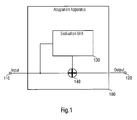
- Fig. 1 shows an embodiment of an adaptation apparatus 100 with a connector 110 for an input signal and a connector 120 for an output signal.
- the adaptation apparatus 100 further comprises an evaluation unit 130 and a summation entity 140.
- the adaptation apparatus 100 is for adapting an input signal, the input signal being digital in the frequency domain and having a peak-to-average-power-ratio in time domain.
- the input signal could for example be a signal from a WLAN system, a DVB-T system, or a 4G system.
- the input signal can be any multi-carrier signal in the frequency domain.
- the adaptation apparatus 100 further comprises the evaluation unit 130 for evaluating the input signal and for providing an evaluation signal based on an optimization criterion.
- the optimization criterion can comprise several constraints regarding the evaluation signal as for example a power constraint or also a constraint on a bit error rate.
- the adaptation apparatus 100 further comprises a summing unit 140 for adding the evaluation signal to the input signal in the frequency domain and for providing the output signal in the frequency domain having a lower peak-to-average-power-ratio in the time domain than the input signal in the time domain.
- the proposed technique adds signal-processing units, i.e. the evaluation unit 130 and the summing unit 140 only at the transmitter, whereas a potential receiver remains unchanged.
- the evaluation signal as a peak-to-average-power ratio-reduction signal is added to a transmission signal and it therewith causes some degradation in the system performance, as the transmission symbols do not coincide with the original symbol constellation any more.
- the peak-to-average-power-ratio reduction signal degradation can be easily controlled and limited.
- the proposed method exhibits a number of advantages. Assuming the same bit-error-ratio versus signal-to-noise-ratio working point, the proposed method exhibits a lower peak-to-average-power ratio. This is due to the fact that all sub-carriers are exploited for peak-to-average-power-ratio suppression and thus more degrees of freedom are available to find a solution that minimizes the peak-to-average-power-ratio than in the case of the tone reservation method for example.
- the proposed method further provides the advantage that no reservations of special sub-carriers for purposes of peak-to-average-power-ratio reduction are required and it does thus not reduce the spectral efficiency as for example the tone reservation method.
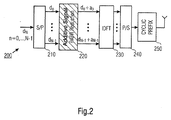
- Fig. 2 illustrates an orthogonal frequency division multiplexing transmitter 200.
- the transmitter comprises a serial-to-parallel converter 210, an additive signal entity 220, which is an embodiment of the inventive adaptation apparatus, an inverse discrete Fourier transformation entity 230, a parallel-to-serial converter 240, and a cyclic prefix addition entity 250.
- An orthogonal frequency division multiplexing system with a total of N sub-carriers is considered.
- the array d is fed into the peak-to-average-power-ratio reduction unit 220, which is an embodiment of the inventive adaptation apparatus.
- the peak-to-average-power-ratio reduction unit 220 adds to each symbol d n a complex valued signal a n .
- the vector c is modulated on N sub-carriers using the inverse discrete Fourier transform entity 230. After that, a parallel-to-serial conversion is performed using the parallel-to-serial converter 240, and a guard interval of length T ⁇ that exceeds the delay spread of the multi-path channel is added as cyclic prefix.
- the additive array a a 0 ⁇ a 1 ... a N - 1 T , a ⁇ C N , is designed according to an optimisation criterion by which the peak-to-average-power-ratio is improved, respectively, in one embodiment of the present invention even minimized.
- PAPR peak-to-average-power-ratio
- F is the N x N matrix with entries F m
- p 0 , 1 , ... , N - 1 .
- the factor 1 N in (3) is a scale factor inserted so that the minimum peak-to-average-power-ratio equals 0 dB.
- the vector a has two constraints.
- the first constraint ensures that the sequence c does not invest more power into the transmission than the original sequence d, i.e. ⁇ d + a ⁇ ⁇ 2 ⁇ ⁇ d ⁇ 2 .
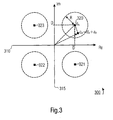
- Fig. 3 shows a constellation diagram 300 for quadrature phase shift keying (QPSK) modulation.
- Fig. 3 depicts the complex plane with a real axis 310 and an imaginary axis 315.
- Fig. 3 shows four modulation symbols 320-323, which all have the same magnitude and are ordered symmetrically to the origin. Taking into account the constraints given in equation (8), one can determine circular regions centered in the modulation symbols 320-323 themselves with the radius of R, wherein the manipulated symbols c n may happen to occur. As it can be seen from Fig.
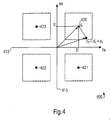
- Fig. 4 shows another constellation diagram 400 with a real axis 410, an imaginary axis 415, and four modulation symbols 420-423.
- Fig. 4 shows the four rectangular areas in which the points c n are allowed to lie as mentioned above.
- This convex optimization problem has N unknowns and N+1 constraints.
- the interior point methods can find a solution for such problems in a number of iterations that is almost always in a range between 10 and 100. For each iteration, the complexity is equal to O(N 2 (N+1)).
- the barrier method is applied. This is an iterative method that transforms the optimization problem with constraints in an unconstrained optimization problem. The resulting unconstrained optimization problem can be solved, for example applying the gradient method.
- the function to be minimized is defined as objective function.
- the objective function is the peak-to-average-power-ratio as given in equation (6).
- the first step is to transform the original inequality constraint problem in an equivalent unconstrained problem.
- the new objective function as given in equation (12) can be minimized using for example a gradient method.
- a possible drawback of the embodiment of the present invention, which is described above and which is based on the addition of the signal is a degradation in the bit-error-ratio versus the signal-to-noise-ratio performance as, due to the addition of the complex values a n , the resulting points c n do not coincide with the original points d n .
- the bit-error-ratio degradation is analyzed by Monte-Carlo simulations, which are described in the following.
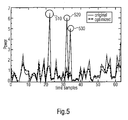
- Fig. 5 shows a plot of two OFDM transmission symbols, one in its original version depicted as a straight line and one which was optimized according to the algorithm described above, depicted by a dotted line.
- Quadrature phase shift keying with Gray mapping modulation is applied and channel coding is not considered.
- the radius R is set to 0.5 in Fig. 5.
- Fig. 5 shows a plot of the power of a typical time domain signal before and after the optimization. The benefits of the inventive methods are clearly visible. Looking at the areas 510, 520, and 530, which are marked in Fig. 5, it can clearly be seen how the peak values are reduced, and therewith the peak-to-average-power ratio.
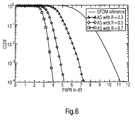
- Fig. 6 presents the results in terms of a complementary cumulative distribution function (CCDF).
- CCDF complementary cumulative distribution function
- the radius R is kept variable.
- the peak-to-average-power-ratio reduction is averaged over a 100,000 randomly chosen data sequences.
- the simulation results are given for different radii R.
- the diagram shown in Fig. 6 shows the complementary cumulative distribution function versus the peak-to-average-power-ratio in dB.
- a remarkable average reduction of more than 6 dB is achieved, when considering a ratio of 10 -3 for the CCDF.
- a further increase of the radius R enables even better suppression.
- the reason for this lies in the fact that as the radius R grows the constraint from equation (8) becomes looser, therefore allowing more degrees of freedom to find a solution of equation (9).
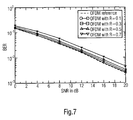
- the inventive method of the additive signal results in a bit-error-ratio loss, since the resulting points c n do not coincide with the original points d n .
- R the bit-error-ratio performance
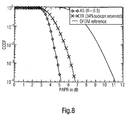
- Fig. 8 shows a comparison of the inventive method of the additive signal with the tone reservation method.
- the inventive method of the additive signal exhibits much lower peak-to-average-power ratio.
- the inventive approach has higher spectral efficiency as it does not require reservation of the spectral sub-carriers as the tone reservation method does.
- the present invention provides the advantage that the peak-to-average-power-ratio especially in OFDM systems and multi-carrier systems can be efficiently reduced, as it was shown utilizing numerical results which have been presented in the Figs. 5 to 8. Furthermore, the present invention provides the advantage that it can be applied in many systems as for example WLAN, DVB-T, and 4G systems. Comparing the inventive methods to the state of the art approaches, the present invention further provides the advantage that the spectral efficiency of a transmission system can be kept higher while achieving a lower peak-to-average-power-ratio at the same time.
- the inventive method can be implemented in hardware or in software.
- the implementation can be performed using a digital storage medium, in particular a disk, a DVD, or a CD having an electronically readable control signal stored thereon, which cooperate with a programmable computer system such that the inventive methods are performed.
- the present invention is therefore, a computer program product with a program code for a machine-readable carrier, the program code being operative for performing the inventive methods when the computer program runs on a computer.
- the inventive methods are therefore, a computer program having a program code for performing at least one of the inventive methods when the computer program runs on a computer.
Landscapes
- Engineering & Computer Science (AREA)
- Computer Networks & Wireless Communication (AREA)
- Signal Processing (AREA)
- Transmitters (AREA)
- Digital Transmission Methods That Use Modulated Carrier Waves (AREA)
Priority Applications (4)
| Application Number | Priority Date | Filing Date | Title |
|---|---|---|---|
| EP06019360A EP1901510A1 (fr) | 2006-09-15 | 2006-09-15 | Réduction du rapport entre puissance de crête et puissance moyenne d'un système multiporteuse |
| CNA2007101536923A CN101146081A (zh) | 2006-09-15 | 2007-09-14 | 通信系统中的峰均功率比降低 |
| JP2007239850A JP2008092563A (ja) | 2006-09-15 | 2007-09-14 | 通信システムにおける最大対平均出力比の低減 |
| US11/901,392 US7974354B2 (en) | 2006-09-15 | 2007-09-17 | Peak-to-average-power-ratio reduction in communication systems |
Applications Claiming Priority (1)
| Application Number | Priority Date | Filing Date | Title |
|---|---|---|---|
| EP06019360A EP1901510A1 (fr) | 2006-09-15 | 2006-09-15 | Réduction du rapport entre puissance de crête et puissance moyenne d'un système multiporteuse |
Publications (1)
| Publication Number | Publication Date |
|---|---|
| EP1901510A1 true EP1901510A1 (fr) | 2008-03-19 |
Family
ID=37708354
Family Applications (1)
| Application Number | Title | Priority Date | Filing Date |
|---|---|---|---|
| EP06019360A Withdrawn EP1901510A1 (fr) | 2006-09-15 | 2006-09-15 | Réduction du rapport entre puissance de crête et puissance moyenne d'un système multiporteuse |
Country Status (4)
| Country | Link |
|---|---|
| US (1) | US7974354B2 (fr) |
| EP (1) | EP1901510A1 (fr) |
| JP (1) | JP2008092563A (fr) |
| CN (1) | CN101146081A (fr) |
Families Citing this family (6)
| Publication number | Priority date | Publication date | Assignee | Title |
|---|---|---|---|---|
| CA2657091A1 (fr) * | 2006-07-11 | 2008-01-17 | Telefonaktiebolaget L M Ericsson (Publ) | Appareil d'ecretage des pics de puissance dans un emetteur de systemes de telecommunications |
| WO2008129645A1 (fr) * | 2007-04-13 | 2008-10-30 | Fujitsu Limited | Procédé d'écrêtage |
| US8774315B2 (en) * | 2009-08-25 | 2014-07-08 | The Aerospace Corporation | Phase-optimized constant envelope transmission (POCET) method, apparatus and system |
| US9198133B2 (en) * | 2010-03-12 | 2015-11-24 | Sunrise Micro Devices, Inc. | Power efficient communications |
| CN111030960A (zh) * | 2019-12-03 | 2020-04-17 | 中国电子科技集团公司第三十六研究所 | 一种数字调制信号显示评估方法 |
| CN114884793A (zh) * | 2022-07-08 | 2022-08-09 | 清华四川能源互联网研究院 | 基于凸优化的ofdm信号峰均比抑制算法、系统、设备及介质 |
Family Cites Families (7)
| Publication number | Priority date | Publication date | Assignee | Title |
|---|---|---|---|---|
| US7139322B1 (en) * | 2002-07-15 | 2006-11-21 | National Semiconductor Corporation | Method for reducing peak-to-average power ratios in a multi-carrier transmission system |
| JPWO2005055479A1 (ja) * | 2003-12-02 | 2007-07-05 | 松下電器産業株式会社 | マルチキャリア伝送における無線送信装置およびピーク電力抑圧方法 |
| KR100688118B1 (ko) * | 2004-04-23 | 2007-02-28 | 삼성전자주식회사 | 직교 주파수 분할 다중 통신 시스템에서 피크 전력 대평균 전력비를 감소시키기 위한 장치 및 방법 |
| KR100754617B1 (ko) * | 2004-10-11 | 2007-09-05 | 삼성전자주식회사 | 직교 주파수 분할 다중화 통신 시스템에서 피크대 평균전력비를 최소화시키기 위한 장치 및 방법 |
| JP2006165781A (ja) * | 2004-12-03 | 2006-06-22 | Univ Nihon | 直交周波数分割多重通信方法及び装置 |
| US7792200B2 (en) * | 2005-11-14 | 2010-09-07 | Telefonaltiebolaget Lm Ericsson (Publ) | Peak-to-average power reduction |
| US7675982B2 (en) * | 2005-11-28 | 2010-03-09 | Mitsubishi Electric Research Laboratories, Inc. | Method and system for reducing peak-to-average power for OFDM signals |
-
2006
- 2006-09-15 EP EP06019360A patent/EP1901510A1/fr not_active Withdrawn
-
2007
- 2007-09-14 CN CNA2007101536923A patent/CN101146081A/zh active Pending
- 2007-09-14 JP JP2007239850A patent/JP2008092563A/ja active Pending
- 2007-09-17 US US11/901,392 patent/US7974354B2/en not_active Expired - Fee Related
Non-Patent Citations (2)
| Title |
|---|
| AGGARWAL A ET AL: "Minimizing the peak-to-average power ratio of OFDM signals via convex optimization", GLOBECOM'03. 2003 - IEEE GLOBAL TELECOMMUNICATIONS CONFERENCE. CONFERENCE PROCEEDINGS. SAN FRANCISCO, DEC. 1 - 5, 2003, IEEE GLOBAL TELECOMMUNICATIONS CONFERENCE, NEW YORK, NY : IEEE, US, vol. VOL. 7 OF 7, 1 December 2003 (2003-12-01), pages 2385 - 2389, XP010677782, ISBN: 0-7803-7974-8 * |
| JONES D L ET AL: "An Active-Set Approach for OFDM PAR Reduction via Tone Reservation", IEEE TRANSACTIONS ON SIGNAL PROCESSING, IEEE SERVICE CENTER, NEW YORK, NY, US, vol. 52, no. 2, February 2004 (2004-02-01), pages 495 - 509, XP011105734, ISSN: 1053-587X * |
Also Published As
| Publication number | Publication date |
|---|---|
| CN101146081A (zh) | 2008-03-19 |
| US7974354B2 (en) | 2011-07-05 |
| US20080069254A1 (en) | 2008-03-20 |
| JP2008092563A (ja) | 2008-04-17 |
Similar Documents
| Publication | Publication Date | Title |
|---|---|---|
| CN102687476B (zh) | 用于控制组合无线信号的系统和方法 | |
| US7649950B2 (en) | OFDM transmitter that performs a peak reduction process on a transmission signal sequence | |
| US20050238110A1 (en) | Apparatus and method for reducing peak-to-average power ratio in orthogonal frequency division multiplexing communication system | |
| Guel et al. | Analysis and comparison of clipping techniques for OFDM peak-to-average power ratio reduction | |
| US7974354B2 (en) | Peak-to-average-power-ratio reduction in communication systems | |
| Jiang et al. | Companding technique for PAPR reduction in OFDM systems based on an exponential function | |
| Vaiyamalai et al. | PAPR reduction in SLM–OFDM system using Lehmer sequence without explicit side information | |
| Singh et al. | An efficient PAPR reduction scheme for OFDM system using peak windowing and clipping | |
| Jayati et al. | Partial transmit sequence and selected mapping schemes for PAPR reduction in GFDM systems | |
| Mondal et al. | Approach to reduce PAPR in orthogonal frequency division multiplexing technique | |
| KR20030059523A (ko) | 직교 주파수 분할 다중 무선통신시스템에서 피크전력 대평균전력 감소장치 및 방법 | |
| Abdelali et al. | New technique combining the tone reservation method with clipping technique to reduce the peak-to-average power ratio | |
| Tasadduq et al. | PAPR reduction of OFDM signals using multiamplitude CPM | |
| Gupta et al. | Improved selected mapping technique for reduction of papr in ofdm systems | |
| Al-Azzo et al. | Time domain statistical control for PAPR reduction in OFDM system | |
| Ghassemi et al. | Fractional Selective Mapping Using Decimation in Time IFFT/FFT. | |
| Wahab et al. | Improved partial transmit sequence (PTS) for PAPR reduction in OFDM system | |
| Manhas et al. | PAPR reduction of OFDM using recurring SLM with cyclic block codes schemes | |
| Mestoui et al. | A Novel PM-OFDM-CDMA System for 5G Wireless Communication with High Capacity and Low Energy Consumption | |
| Shirazi et al. | Analysis and comparison of PAPR reduction techniques in OFDM systems | |
| Murthy et al. | Reducing the Peak to Average Power Ratio of OFDM Signals by Using Harr Wavelet | |
| Kashyap et al. | Peak Insertion and Active Constellation Extension with Subcarrier Grouping PAPR reduction techniques for OFDM system | |
| Thakur | PEAK-TO-AVERAGE POWER RATIO IN WEIGHTED OFDM | |
| Choudhary et al. | Performance Enhancement Of Ofdm Signals Using Selected Mapping Technique And Overview Of Different Papr Reduction Schemes | |
| Irfan et al. | CPM based PAPR reduction for multicarrier systems |
Legal Events
| Date | Code | Title | Description |
|---|---|---|---|
| PUAI | Public reference made under article 153(3) epc to a published international application that has entered the european phase |
Free format text: ORIGINAL CODE: 0009012 |
|
| 17P | Request for examination filed |
Effective date: 20070821 |
|
| AK | Designated contracting states |
Kind code of ref document: A1 Designated state(s): AT BE BG CH CY CZ DE DK EE ES FI FR GB GR HU IE IS IT LI LT LU LV MC NL PL PT RO SE SI SK TR |
|
| AX | Request for extension of the european patent |
Extension state: AL BA HR MK YU |
|
| AKX | Designation fees paid |
Designated state(s): DE FR GB |
|
| STAA | Information on the status of an ep patent application or granted ep patent |
Free format text: STATUS: THE APPLICATION HAS BEEN WITHDRAWN |
|
| 18W | Application withdrawn |
Effective date: 20110722 |