EP1902879A2 - Rolloanordnung - Google Patents
Rolloanordnung Download PDFInfo
- Publication number
- EP1902879A2 EP1902879A2 EP07018053A EP07018053A EP1902879A2 EP 1902879 A2 EP1902879 A2 EP 1902879A2 EP 07018053 A EP07018053 A EP 07018053A EP 07018053 A EP07018053 A EP 07018053A EP 1902879 A2 EP1902879 A2 EP 1902879A2
- Authority
- EP
- European Patent Office
- Prior art keywords
- coil spring
- damping profile
- damping
- profile
- roller blind
- Prior art date
- Legal status (The legal status is an assumption and is not a legal conclusion. Google has not performed a legal analysis and makes no representation as to the accuracy of the status listed.)
- Withdrawn
Links
Images


Classifications
-
- B—PERFORMING OPERATIONS; TRANSPORTING
- B60—VEHICLES IN GENERAL
- B60J—WINDOWS, WINDSCREENS, NON-FIXED ROOFS, DOORS, OR SIMILAR DEVICES FOR VEHICLES; REMOVABLE EXTERNAL PROTECTIVE COVERINGS SPECIALLY ADAPTED FOR VEHICLES
- B60J1/00—Windows; Windscreens; Accessories therefor
- B60J1/20—Accessories, e.g. wind deflectors, blinds
- B60J1/2011—Blinds; curtains or screens reducing heat or light intensity
- B60J1/2013—Roller blinds
- B60J1/2033—Roller blinds characterised by the spring motor
-
- B—PERFORMING OPERATIONS; TRANSPORTING
- B60—VEHICLES IN GENERAL
- B60J—WINDOWS, WINDSCREENS, NON-FIXED ROOFS, DOORS, OR SIMILAR DEVICES FOR VEHICLES; REMOVABLE EXTERNAL PROTECTIVE COVERINGS SPECIALLY ADAPTED FOR VEHICLES
- B60J1/00—Windows; Windscreens; Accessories therefor
- B60J1/20—Accessories, e.g. wind deflectors, blinds
- B60J1/2011—Blinds; curtains or screens reducing heat or light intensity
- B60J1/2013—Roller blinds
- B60J1/2036—Roller blinds characterised by structural elements
- B60J1/205—Winding tubes, e.g. telescopic tubes or conically shaped tubes
-
- E—FIXED CONSTRUCTIONS
- E06—DOORS, WINDOWS, SHUTTERS, OR ROLLER BLINDS IN GENERAL; LADDERS
- E06B—FIXED OR MOVABLE CLOSURES FOR OPENINGS IN BUILDINGS, VEHICLES, FENCES OR LIKE ENCLOSURES IN GENERAL, e.g. DOORS, WINDOWS, BLINDS, GATES
- E06B9/00—Screening or protective devices for wall or similar openings, with or without operating or securing mechanisms; Closures of similar construction
- E06B9/24—Screens or other constructions affording protection against light, especially against sunshine; Similar screens for privacy or appearance; Slat blinds
- E06B9/40—Roller blinds
- E06B9/42—Parts or details of roller blinds, e.g. suspension devices, blind boxes
- E06B9/44—Rollers therefor; Fastening roller blinds to rollers
-
- E—FIXED CONSTRUCTIONS
- E06—DOORS, WINDOWS, SHUTTERS, OR ROLLER BLINDS IN GENERAL; LADDERS
- E06B—FIXED OR MOVABLE CLOSURES FOR OPENINGS IN BUILDINGS, VEHICLES, FENCES OR LIKE ENCLOSURES IN GENERAL, e.g. DOORS, WINDOWS, BLINDS, GATES
- E06B9/00—Screening or protective devices for wall or similar openings, with or without operating or securing mechanisms; Closures of similar construction
- E06B9/56—Operating, guiding or securing devices or arrangements for roll-type closures; Spring drums; Tape drums; Counterweighting arrangements therefor
- E06B9/60—Spring drums operated only by closure members
Definitions
- the invention relates to a roller blind arrangement, which is intended in particular for use in a vehicle, having a hollow tubular winding shaft extending in a main extension direction for receiving a removable flexible sheet, a winding spring inserted into the winding shaft and designed as a helical spring, which extends in the main direction of extent. and a damping profile extending in the main extension direction, which is arranged in an annular space between the winding shaft and the winding spring.
- the invention also relates to such roller blind arrangements in which a spring rod extending in the main extension direction is inserted into the winding spring.
- Such blind arrangements are from the DE 29 41 711 C2 known.
- roller blind arrangements are between a torsion spring provided on the one hand and an outer roller or an inner shaft tubes, which abut respectively on the inside and the outside of a torsion spring.
- the purpose of these tubes is to dampen disturbing noises that occur when twisting the torsion spring.
- roller blind arrangements are considered that although they dampen the sound, but do not prevent a deflection of the torsion spring against the Rollowandung or against the shaft.
- the object of the invention is to provide a roller blind arrangement in which the noise which arises during operation within the rolling arrangement and which penetrates to the outside is reduced.
- a generic roller blind arrangement in which the damping profile is designed such that it rests with outer contact sections on an inner side of the winding shaft and with inner contact sections on an outer side of the coil spring.
- a generic roller blind arrangement in which the damping profile is designed such that it rests with outer contact portions on an inner side of the coil spring and with inner contact portions on an outer side of the spring rod.
- Generic roller blind assemblies are particularly useful for supporting a flexible sheet during non-use and retraction of the flexible sheet to transfer it from a use condition to a non-use condition.
- the sheet In the retracted state, the sheet is preferably multi-layered on the winding shaft rolled up.
- the clock spring is twisted so that it exerts a return force on the extended part of the sheet.
- Changes in the torsional state of the coil spring, in particular the manual removal of the fabric and the automatic retraction of the fabric, as well as vibration of the roller blind can cause a radially acting on the coil spring force occurs, which deflects the coil spring from its initial position.
- a deflection of the coil spring can also be caused by vibrations introduced from outside.
- the deflections of the coil spring lead to disturbing noises that arise in particular when the outside of the coil spring on the inside of the winding shaft and when striking the inside of the coil spring on the outside of the spring rod.
- inventively provided play or largely free of play inside and outside fitting damping profile which is provided depending on the application in the annular space between the coil spring and the winding shaft or in the annular space between the coil spring and the spring rod, a hard impact of the coil spring on the inside of the winding shaft or prevented on the outside of the spring rod.
- the damping profile prevents on the one hand the direct contact between the coil spring on the one hand and the winding shaft or the spring rod on the other.
- the damping profile also prevents a free and unbraked deflection of the coil spring and the associated hard impact on the inside of the winding shaft or on the outside of the spring rod.
- the damping profile is preferably made of elastic materials such as plastic or rubber, which allow a small deflection of the coil spring from its initial position, since such a deflection can occur when twisting the coil spring.
- elastic materials such as plastic or rubber
- the cross section of the damping profile is preferably designed so that a limited deflection of the coil spring remains possible.
- the damping profile extends parallel to the winding shaft and the coil spring in the main direction of extension. Preferred embodiments are those in which the damping profile extends over the entire length of the coil spring. However, embodiments may also be expedient in which the damping profile is provided only on portions of the coil spring, these sections are preferably spaced only so far that a beating of the coil spring on the winding shaft or on the spring rod is prevented even in the intermediate sections.
- a cross section of the damping profile is formed such that the damping profile rests in at least one contact area on the outside of the coil spring and in at least one lot range from the outside of Clock spring is spaced.
- the cross section according to this development is designed such that the damping profile rests in at least one contact area on the inside of the coil spring and is spaced in at least one loose area from the inside of the coil spring.
- Such a damping profile is therefore only in the contact portions, but not in full, on the coil spring.
- the clock spring can be deflected by a small amount in the lot area in the course of torsion or in the course of shocks.
- This is particularly advantageous in terms of torsion, since a deflection is limited in the normalization of the torsion spring. Becomes This twisting completely prevented, this leads to an increase of the manually applied pull-out force.
- the contact portions lie in contact areas on the coil spring, which are suitable with respect to their dimensions and / or arrangement on the circumference to securely fix the coil spring in the relaxed state in an undeflected rest position.
- the damping profile is designed such that it rests in three contact areas on the coil spring, wherein between the contact areas in each case a dead zone.
- the contact areas are preferably distributed uniformly over the circumference of the coil spring. Due to the design with three contact areas, a good positional fixation of the coil spring in a non-radially deflected state can be achieved.
- the damping profile is designed as a hollow damping profile.
- Such a damping hollow profile is circumferentially closed, so that a direct contact between the coil spring on the one hand and the spring rod or the winding shaft on the other hand reliably prevented.
- the training as a hollow damping profile also has advantages in terms of mounting advantages, as in a simple manner, the coil spring inserted into the damping profile and then the damping profile can be inserted with inserted coil spring in the winding shaft. Accordingly easy is the installation of a damping profile, which is arranged between the coil spring and spring rod.
- the damping profile has a plurality of profile segments extending in the main extension direction, which are connected to each other in a circumferential direction at least not to the full length of the damping profile.
- Such a damping profile with separate profile segments preferably has profile segments which are distributed at regular intervals in the circumferential direction around the coil spring or about the spring rod.
- the inner and outer contact portions are preferably arranged such that each profile segment has both at least one inner and at least one outer contact portion.
- embodiments are also conceivable and depending on the boundary conditions appropriate in which profile segments are provided with inner contact portions and other profile segments with outer contact portions. Particularly advantageous are profile segments with a round cross section.
- the profile segments are connected to each other in the region of a connecting portion, wherein these connecting portions are preferably provided on the end faces of the damping profile.
- these connecting portions are preferably provided on the end faces of the damping profile.
- the cross section of the damping profile is designed such that a radial displacement of an inner or outer contact section has an effect in the same direction radial displacement of an opposite outer or inner contact portion result.
- a displacement in the same direction is also understood as meaning a radially outward movement or a radially inward displacement as well.
- a design of the damping profile causes the voltage applied to the winding shaft or the spring rod contact portions are pressed in response to deflection of the coil spring to the winding shaft or to the spring rod, which is preferably a deformation of the damping profile in the area the outer contact sections leads.
- Particular preference is given to those designs in which a deflection of the coil spring at different winding shaft-side or spring-rod-side contacting contact sections over the circumference leads to an increased contact pressure.
- the cross section of the damping profile is designed in such a way that a radial displacement of an inner or outer contact section results in a displacement of at least one other inner or outer contact section.
- the deflection of the coil spring and the associated deflection of a voltage applied to the coil spring contact portion to the fact that the other contact portions which rest against the coil spring, are moved.
- the displacement takes place in the circumferential direction and / or in the radial direction.
- the coil spring thereby remains in the deflected state in contact with several adjacent contact portions of the damping profile, so that a return of the coil spring into its initial position does not lead to a Gegenrespond to the damping profile and the coil spring. A reduced noise is the result.
- damping profile is designed as a damping tube with a polygonal cross section, wherein the Cross-section has concave indentations, which include the inner contact portion, and convex bulges comprising the outer contact portions.
- a damping hose with a polygonal cross-section is to be understood as a damping hose having a wall with an approximately uniform wall thickness whose cross-section is not circular but whose cross-section has a shape, the sub-areas in which the wall is in contact with the winding spring, and other sub-areas in which the wall is in contact with the winding shaft or the spring rod has.
- These contact portions are concave or convex.
- Embodiments with in each case three or more convex outer contact sections and concave inner contact sections are particularly preferred. In such a damping profile, a radial displacement of a contact portion can lead to a displacement of adjacent contact portions, so that the contact between all contact portions and the coil spring is maintained.
- the damping profile is designed as a damping hose having a preferably circular cross-section and extending from the damping hose radially inwardly and / or radially outwardly facing contact webs, wherein at distal ends of the contact webs respectively the inner and the outer contact portions are provided
- contact portions which are elastically deformable. This is both in terms of the deflection of the coil spring advantage as well as with regard to the use of one and the same type of damping profile for various bobbins, coil springs and / or spring rods.
- the damping profile in the non-installed state has a smaller inner diameter and / or a larger outer diameter than the annular space in which it is arranged in the installed state.
- Such a damping profile is elastically deformed in the installed state, so that in a deflection of the coil spring in the radial direction, the deflection of the opposite contact portions are tracked in the direction of their relaxed state and remain in contact with the coil spring.
- the illustrated embodiments of blind arrangements according to the invention each show only the winding shaft together with the clock spring, the damping element and partly together with the spring rod.
- the other components of the blind arrangements such as the flexible fabric or a surrounding housing are not shown for reasons of clarity.
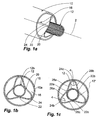
- FIG. 1a shows the example of a first embodiment of the winding shaft of a roller blind according to the invention the basic structure: Within the winding shaft 10, a coil spring 12 is arranged, wherein the winding shaft 10 and the coil spring 12 have a common main extension direction 2. In an annular cavity 16 between the winding shaft 10 and the inner coil spring 12, a damping profile 20 is inserted, which rests with inner contact portions 22 on the coil spring and outer contact portions 24 on the winding shaft 12 each without play.
- FIG 1b shows the winding shaft 10 shown in Figure 1a together with the inserted coil spring 12 and the damping profile 20 in a sectional side view.
- the damping profile 20 is with its outer contact portions 24 - as described above - on an inner wall 10a of the winding shaft 10 at. With its inner contact portions 22, the outer damping profile 20 bears against the outer side 12b of the coil spring 12.
- the three inner contact portions 22 and the three outer contact portions 24 are arranged alternately on the circumference of the damping profile 20.
- the cross-section of the damping profile 20 has a polygonal, approximately dreizackige shape, wherein the outer contact portions 24 are arranged in the region of the rounded teeth and the inner contact portions 22 between the prongs. In the area of the outer contact sections 24, the outer damping profile 20 is convex and concave in the region of the inner contact sections 22.
- the illustrated design ensures a particularly quiet operation.
- the attenuation profile is very easy due to its thin-walled and simple design and can be produced at favorable prices.
- the coil spring 12 is held by the damping profile 20 in its position shown in Figs. 1a and 1b, but can still due to the fact that the damping profile 20 is made of an elastic material, and the shape of the damping profile 20 in the intended torsion required level be deflected.
- a direct contact of the coil spring 12 with the winding shaft 10 is excluded by the damping profile 20 as well as a high radial acceleration of the coil spring, for example as a result of shocks.
- Fig. 1c shows the behavior of the damping profile 20 in the case of a radial deflection of the coil spring 12.
- the coil spring is designed in the illustrated state by a small distance to the left, the initial position 12 'is shown in dashed lines.
- the deflection causes a fitting inner contact portion 22a is also deflected radially outward.
- connecting portions 26a of the damper profile 20 connecting the inner contact portion 22a to the adjacent outer contact portions 24b, 24c are pivoted about the adjacent outer contact portions 24b, 24c.
- the outer contact portions 24b, 24c are easily rotated in the direction of the arrows 4.
- a dimensioning of the damping profile 20 is particularly advantageous in which the defined by the outer contact portions 24a, 24b, 24c outer diameter of the damping profile 20 in the non-installed state is greater than the inner diameter of the winding shaft 10. The thereby in the installed state Achievable elastically tensioned state additionally supports the tracking described above.
- the cross section of the damping profile in the manner of a circumferential rectangular function formed in the alternating circumferential portions bear against the inside of the coil spring and abut the outside of the winding shaft, wherein the peripheral portions are connected by radial connecting portions.
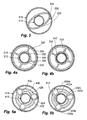
- FIGS. 2a to 2c show a winding shaft of a second embodiment of a roller blind arrangement according to the invention.
- a coil spring 112 is arranged within the winding shaft 110. This trained as a coil spring coil spring 112 is limited by means of an inserted into the coil spring 112 spring rod 114 with respect to their radial mobility.
- a damping profile 140 is arranged in an annular space 118 between the coil spring 112 and the spring rod 114.
- the winding shaft 110, the winding spring 112, the spring bar 114 and the damping profile 140 extend parallel to one another in a main direction of extent 102.
- the damping profile 140 is formed as a damping hose with an approximately circular cross-section, distributed over the circumference a total of three thickenings 146 are provided.
- the thickenings 146 extend radially inwardly and outwardly from the damping tube, forming both inner contact portions 142 and outer contact portions 144. With the inner contact portions 142, the damping profile 140 is applied to the spring rod 114 and with the outer contact portions of the damping profile 140 is applied to the coil spring 112.
- Fig. 2c shows how the damping profile 140 behaves at a deflection of the coil spring 112 from its initial position 112 '.
- the damping profile 140 prevents direct contact between the spring rod 114 and the coil spring 112.
- a thickening 146a is elastically compressed by the deflection.
- the damping profile 140 allows a deflection of the coil spring, it presses the coil spring back into its starting position.
- the coil spring 112 and the spring rod 114 are always in at least one of the thickenings 146 in indirect contact with each other.
- FIGS. 3 to 7 show cross sections of further damping profiles which are arranged between winding shafts 210, 310, 410, 510, 610 and coil springs 212, 312, 412, 512, 612.
- damping profiles can also be used between spring rods and coil springs use. Unless otherwise indicated, the damping profiles over their entire length to the respective illustrated cross-section.
- FIG. 3 shows a particularly simple design of a damping profile 220 of a roller blind arrangement according to the invention.
- This damping profile 220 has an approximately oval cross-section and has two outer contact portions 224 resting against the winding shaft 210 and two inner contact portions 222 resting against the winding spring 212.
- Such a damping profile 220 is particularly advantageous due to the low weight, the simple construction and the associated low cost.
- Figures 4a and 4b show a damping profile 320, which consists of an outer tube 330 and an inner tube 332, which are connected via connecting webs 334 with each other.
- the outer surface of the outer tube 330 forms the outer contact portion 324 of the damping profile and the inner side of the inner tube 332
- FIG. 4b a radial deflection of the coil spring 312 from its initial position 312 'while at the same time elastic Elongation or elastic compression of the connecting webs 334 possible.
- the damping profile 420 shown in FIGS. 5a and 5b is similar to the damping profile 40 of the embodiment of FIGS. 2a to 2c. It also has a circular tube section 430 which has thickened portions 432 at three points spaced from each other by 120 °. These thickenings 432 extend inwardly and outwardly from the circular cross section of the tube 430. The inwardly facing portions of the thickenings 432 form the inner contact portions 422. The outwardly facing portions of the thickenings 432 form the outer contact portions 424. Deviating from the embodiment of Figures 2a to 2c hollow tubes are provided in the thickenings 432, which in terms of elastic deformation is beneficial.
- a deflection of the coil spring 412 from the initial position leads - as shown in Fig. 5b - in this embodiment, that two of the thickenings 432 a, 432 b are compressed in the radial direction, which on the wall 430 of the hose 430 compression of the third thickenings 432 c in the circumferential direction and thus an extension of these thickenings 432c in the radial direction has to result.
- Figures 6a and 6b show an embodiment with a damping profile 520, which consists of a on the inner wall of the winding shaft 510 adjacent hose section 530 and four of the hose section 530 inwardly extending contact webs 532 consists.
- the tube section 530 forms an outer contact section 524.
- the contact webs 532 each have angled inner and outer legs 532a, 532b.
- the inner legs 532b each open in an inner contact portion 522, which is designed to rest on the coil spring 512 as a concave contact cups 532c.
- the contact webs 532 are preferably dimensioned such that they are resiliently biased when the coil spring 512 is inserted.
- FIG. 7 shows a damping profile 620 which has four profile segments 630 distributed over the circumference which are not connected to one another in the circumferential direction in the sectional plane of FIG.
- the profile segments 630 each have a circular cross-section, wherein the mutually facing sides of the profile segments 630 form inner contact portions 622 which abut against a coil spring 612, and wherein the facing away sides of the profile sections 630 form outer contact portions 624 which on a winding shaft 610 issue.
- the profile segments 630 are interconnected outside of the illustrated sectional plane with each other via connecting webs 632, wherein such connecting webs 632 are provided at least on the end faces of the damping profile. In addition, it is expedient to distribute further connecting sections 632 over the length of the damping profile.
- the behavior at a deflection of the. Is in such a damping profile Clock spring 612 particularly advantageous.
- the profile segments 630 are movable in the circumferential direction to a limited extent, so that they can be elastically deflected from their initial position shown in FIG. 7 while being compressed simultaneously. Thus, a convenient limited mobility of the coil spring 612 is given.
Landscapes
- Engineering & Computer Science (AREA)
- Structural Engineering (AREA)
- Architecture (AREA)
- Civil Engineering (AREA)
- Mechanical Engineering (AREA)
- Operating, Guiding And Securing Of Roll- Type Closing Members (AREA)
- Springs (AREA)
Abstract
Description
- Die Erfindung betrifft eine Rolloanordnung, die insbesondere zur Verwendung in einem Fahrzeug vorgesehen ist, mit einer sich in einer Haupterstreckungsrichtung erstreckenden hohlrohrförmigen Wickelwelle zur Aufnahme eines abziehbaren flexiblen Flächengebildes, einer in die Wickelwelle eingelegten und als Schraubenfeder ausgebildeten Wickelfeder, die sich in der Haupterstreckungsrichtung erstreckt, und einem sich in Haupterstreckungsrichtung erstreckendem Dämpfungsprofil, welches in einem Ringraum zwischen der Wickelwelle und der Wickelfeder angeordnet ist. Die Erfindung betrifft dabei insbesondere auch solche Rolloanordnungen, bei denen eine sich in Haupterstreckungsrichtung erstreckende Federstange in die Wickelfeder eingelegt ist.
- Derartige Rolloanordnungen sind aus der
DE 29 41 711 C2 bekannt. Bei diesen bekannten Rolloanordnungen sind zwischen einer Torsionsfeder einerseits und einer außenliegenden Rolle bzw. einer innenliegenden Welle Rohre vorgesehen, die jeweils an der Innenseite bzw. der Außenseite einer Torsionsfeder anliegen. Zweck dieser Rohre ist es, störende Geräusche zu dämpfen, die bei der Tordierung der Torsionsfeder entstehen. - Als nachteilig an den Rolloanordnungen wird angesehen, dass sie den Schall zwar dämpfen, ein Ausschlagen der Torsionsfeder gegen die Rollowandung oder gegen die Welle jedoch nicht verhindern.
- Aufgabe der Erfindung ist es, eine Rolloanordnung zur Verfügung zu stellen, bei der der im Betrieb innerhalb der Rollanordnung entstehende und nach außen dringende Schall reduziert wird.
- Erfindungsgemäß wird eine gattungsgemäße Rolloanordnung vorgeschlagen, bei der das Dämpfungsprofil derart ausgebildet, ist, dass es mit äußeren Kontaktabschnitten an einer Innenseite der Wickelwelle und mit inneren Kontaktabschnitten an einer Außenseite der Wickelfeder anliegt. Im Hinblick auf die Geräuschentstehung durch Zusammenwirken der Wickelfeder und der Federstange wird eine gattungsgemäße Rolloanordnung vorgeschlagen, bei der das Dämpfungsprofil derart ausgebildet ist, dass es mit äußeren Kontaktabschnitten an einer Innenseite der Wickelfeder und mit inneren Kontaktabschnitten an einer Außenseite der Federstange anliegt.
- Gattungsgemäße Rolloanordnungen dienen insbesondere der Lagerung eines flexiblen Flächengebildes während der Nichtverwendung und dem Einziehen des flexiblen Flächengebildes, um es aus einem Benutzungszustand in einen Nichtbenutzungszustand zu überführen. Im eingezogenen Zustand ist das Flächengebilde vorzugsweise mehrlagig auf der Wickelwelle aufgerollt. Beim manuellen Ausziehen des Flächengebildes wird die Wickelfeder tordiert, so dass sie auf den ausgezogenen Teil des Flächengebildes eine Rückholkraft ausübt. Änderungen im Torsionszustand der Wickelfeder, insbesondere also das manuelle Abziehen des Flächengebildes sowie das automatische Zurückziehen des Flächengebildes, sowie Erschütterung der Rolloanordnung können dazu führen, dass eine radial auf die Wickelfeder wirkende Kraft auftritt, die die Wickelfeder aus ihrer Ausgangslage auslenkt. Zu einer Auslenkung der Wickelfeder kann es darüber hinaus auch durch von außen eingeleitete Erschütterungen kommen. Die Auslenkungen der Wickelfeder führen zu störenden Geräuschen, die insbesondere beim Aufschlagen der Außenseite der Wickelfeder auf der Innenseite der Wickelwelle und beim Aufschlagen der Innenseite der Wickelfeder auf der Außenseite der Federstange entstehen. Durch das erfindungsgemäß vorgesehene spielfrei oder weitgehend spielfrei innen und außen anliegende Dämpfungsprofil, welches je nach Anwendungszweck im Ringraum zwischen der Wickelfeder und der Wickelwelle oder aber im Ringraum zwischen der Wickelfeder und der Federstange vorgesehen ist, wird ein hartes Aufschlagen der Wickelfeder auf der Innenseite der Wickelwelle bzw. auf der Außenseite der Federstange verhindert. Das Dämpfungsprofil verhindert zum einen den unmittelbaren Kontakt zwischen der Wickelfeder einerseits und der Wickelwelle bzw. der Federstange andererseits. Zum anderen verhindert das Dämpfungsprofil auch eine freie und ungebremste Auslenkung der Wickelfeder und das damit einhergehender harte Aufschlagen auf der Innseite der Wickelwelle bzw. auf der Außenseite der Federstange.
- Das Dämpfungsprofil ist vorzugsweise aus elastischen Materialien wie Kunststoff oder Gummi gefertigt, die eine geringe Auslenkung der Wickelfeder aus ihrer Ausgangslage erlauben, da eine solche Auslenkung beim Tordieren der Wickelfeder auftreten kann. Neben der Materialwahl ist auch die Gestaltung des Querschnitts des Dämpfungsprofils vorzugsweise so ausgebildet, dass eine begrenzte Auslenkung der Wickelfeder möglich bleibt.
- Das Dämpfungsprofil erstreckt sich parallel zur Wickelwelle und zur Wickelfeder in Haupterstreckungsrichtung. Bevorzugt sind Ausführungsformen, bei denen sich das Dämpfungsprofil über die Gesamtlänge der Wickelfeder erstreckt. Zweckmäßig können jedoch auch Ausführungsformen sein, bei denen das Dämpfungsprofil nur an Teilabschnitten der Wickelfeder vorgesehen ist, wobei diese Teilabschnitte vorzugsweise nur soweit voneinander beabstandet sind, dass ein Anschlagen der Wickelfeder an der Wickelwelle bzw. an der Federstange auch in den dazwischenliegenden Abschnitten verhindert wird.
- In einer Weiterbildung der Erfindung ist im Falle eines Dämpfungsprofils, welches zwischen der Wickelfeder und der Wickelwelle angeordnet ist, ein Querschnitt des Dämpfungsprofils derart ausgebildet, dass das Dämpfungsprofils in mindestens einem Kontaktbereich an der Außenseite der Wickelfeder anliegt und in mindestens einem Losbereich von der Außenseite der Wickelfeder beabstandet ist. Im Falle eines Dämpfungsprofils, welches zwischen der Wickelfeder und der Federstange angeordnet ist, ist der Querschnitt gemäß dieser Weiterbildung derart ausgebildet, dass das Dämpfungsprofil in mindestens einem Kontaktbereich an der Innenseite der Wickelfeder anliegt und in mindestens einem Losbereich von der Innenseite der Wickelfeder beabstandet ist.
- Ein solches Dämpfungsprofil liegt demnach nur in den Kontaktabschnitten, nicht aber vollumfänglich, an der Wickelfeder an. Dadurch kann die Wickelfeder im Zuge der Torsion oder im Zuge von Erschütterungen um ein geringes Maß in den Losbereich ausgelenkt werden. Dies ist insbesondere in Hinblick auf die Torsion von Vorteil, da eine Auslenkung in begrenztem Maße bei der Tordierung der Wickelfeder normal ist. Wird diese Tordierung vollständig verhindert, so führt dies zu einer Erhöhung der manuell aufzubringenden Auszugskraft. Insbesondere von Vorteil sind solche Dämpfungsprofile, deren Kontaktabschnitte in Kontaktbereichen an der Wickelfeder anliegen, die bezüglich ihrer Dimensionierung und/oder Anordnung auf dem Umfang geeignet sind, die Wickelfeder im entspannten Zustand in einer unausgelenkten Ruheposition sicher zu fixieren.
- In einer Weiterbildung der Erfindung ist das Dämpfungsprofil derart ausgebildet, dass es in drei Kontaktbereichen an der Wickelfeder anliegt, wobei zwischen den Kontaktbereichen jeweils ein Losbereich liegt.
- Die Kontaktbereiche sind dabei vorzugsweise gleichmäßig über den Umfang der Wickelfeder verteilt. Durch die Ausführung mit drei Kontaktbereichen ist eine gute Lagefixierung der Wickelfeder in einem nicht radial ausgelenkten Zustand erreichbar.
- In einer Weiterbildung der Erfindung ist das Dämpfungsprofil als Dämpfungshohlprofil ausgebildet.
- Ein solches Dämpfungshohlprofil ist umlaufend geschlossen, so dass ein unmittelbarer Kontakt zwischen der Wickelfeder einerseits und der Federstange bzw. der Wickelwelle andererseits zuverlässig verhindert wird. Die Ausbildung als Dämpfungshohlprofil hat darüber hinaus auch bezüglich der Montage Vorteile, da in einfacher Art und Weise die Wickelfeder in das Dämpfungsprofil eingeschoben und anschließend das Dämpfungsprofil mit eingeschobener Wickelfeder in die Wickelwelle eingeschoben werden kann. Entsprechend einfach ist auch die Montage eines Dämpfungsprofils, welches zwischen Wickelfeder und Federstange angeordnet ist.
- In einer Weiterbildung der Erfindung weist das Dämpfungsprofil mehrere sich in der Haupterstreckungsrichtung erstreckende Profilsegmente auf, die in einer Umfangsrichtung zumindest nicht auf vollständiger Länge des Dämpfungsprofils miteinander verbunden sind.
- Ein solches Dämpfungsprofil mit getrennten Profilsegmenten weist vorzugsweise Profilsegmente auf, die in regelmäßigen Abständen in Umfangsrichtung um die Wickelfeder bzw. um die Federstange verteilt sind. Dabei sind die inneren und äußeren Kontaktabschnitte vorzugsweise derart angeordnet, dass jedes Profilsegment sowohl mindestens einen inneren als auch mindestens einen äußeren Kontaktabschnitt aufweist. Alternativ dazu sind auch Ausführungsformen denkbar und je nach Randbedingungen zweckmäßig, bei denen Profilsegmente mit inneren Kontaktabschnitten und andere Profilsegmente mit äußeren Kontaktabschnitten vorgesehen sind. Besonders vorteilhaft sind Profilsegmente mit rundem Querschnitt.
- Die Profilsegmente sind im Bereich eines Verbindungsabschnitts miteinander verbunden, wobei diese Verbindungsabschnitte vorzugsweise an den Stirnseiten des Dämpfungsprofils vorgesehen sind. Zur Erhöhung der Lagestabilität der Profilsegmente kann es auch zweckmäßig sein, mehrere Verbindungsabschnitte vorzusehen, die vorzugsweise in Haupterstreckungsrichtung regelmäßig voneinander beabstandet sind. Der Vorteil der Verwendung eines Dämpfungsprofils mit in Umfangsrichtung nicht auf voller Länge verbunden Profilsegmenten liegt insbesondere in der Materialeinsparung und der Gewichtsreduzierung.
- In einer Weiterbildung der Erfindung ist der Querschnitt des Dämpfungsprofils derart ausgebildet, dass eine Radialverschiebung eines inneren oder äußeren Kontaktabschnitts eine in gleiche Richtung wirkende Radialverschiebung eines gegenüberliegenden äußeren bzw. inneren Kontaktabschnitts zur Folge hat.
- Unter einer Verschiebung in gleicher Richtung ist in diesem Zusammenhang eine ebenfalls radial nach außen bzw. eine ebenfalls radial nach innen wirkende Verschiebung zu verstehen. Im eingebauten Zustand des Dämpfungsprofils führt eine solche Gestaltung des Dämpfungsprofils dazu, dass die an der Wickelwelle oder der Federstange anliegenden Kontaktabschnitte in Reaktion auf eine Auslenkung des Wickelfeder an die Wickelwelle bzw. an die Federstange angepresst werden, was vorzugsweise zu einer Deformation des Dämpfungsprofils im Bereich der äußeren Kontaktabschnitte führt. Insbesondere bevorzugt sind solche Gestaltungen, bei denen eine Auslenkung der Wickelfeder an verschiedenen über den Umfang wickelwellenseitigen oder federstangenseitigen anliegenden Kontaktabschnitten zu einem erhöhten Anpressdruck führt.
- In einer Weiterbildung der Erfindung ist der Querschnitt des Dämpfungsprofils derart ausgebildet, dass eine Radialverschiebung eines inneren oder äußeren Kontaktabschnitts eine Verschiebung mindestens eines anderen inneren bzw. äußeren Kontaktabschnitts zur Folge hat.
- Bei einer solchen Ausgestaltung führt die Auslenkung der Wickelfeder und die damit einhergehende Auslenkung eines an der Wickelfeder anliegenden Kontaktabschnitts dazu, dass auch die anderen Kontaktabschnitte, die an der Wickelfeder anliegen, verschoben werden. Die Verschiebung erfolgt dabei in Umfangsrichtung und/oder in radialer Richtung. Die Wickelfeder bleibt dadurch auch im ausgelenkten Zustand im Kontakt mit mehreren anliegenden Kontaktabschnitten des Dämpfungsprofils, so dass eine Rückkehr der Wickelfeder in ihre Ausgangslage nicht zu einem Gegeneinanderschlagen des Dämpfungsprofils und der Wickelfeder führt. Eine verringerte Geräuschentwicklung ist die Folge.
- Bei einer Weiterbildung der Erfindung ist Dämpfungsprofil als Dämpfungsschlauch mit polygonalem Querschnitt ausgebildet, wobei der Querschnitt konkave Einbuchtungen aufweist, die die inneren Kontaktabschnitt umfassen, und konvexe Ausbuchtungen aufweist, die die äußeren Kontaktabschnitte umfassen.
- Als Dämpfungsschlauch mit polygonalem Querschnitt ist dabei ein Dämpfungsschlauch mit einer Wandung mit in etwa gleichmäßiger Wandungsstärke zu verstehen, dessen Querschnitt nicht kreisförmig ist, sondern dessen Querschnitt eine Formgebung aufweist, die Teilbereiche, in denen die Wandung in Kontakt mit der Wickelfeder ist, und andere Teilbereiche, in denen die Wandung in Kontakt mit der Wickelwelle bzw. der Federstange ist, aufweist. Diese Kontaktabschnitte sind konkav bzw. konvex ausgebildet. Besonders bevorzugt sind dabei Ausführungsformen mit jeweils drei oder mehr konvexen äußeren Kontaktabschnitten und konkaven inneren Kontaktabschnitten. Bei einem solchen Dämpfungsprofil kann eine Radialverschiebung eines Kontaktabschnitts zu einer Verschiebung benachbarter Kontaktabschnitte führen, so dass der Kontakt zwischen allen Kontaktabschnitten und der Wickelfeder erhalten bleibt.
- In einer Weiterbildung der Erfindung ist das Dämpfungsprofil als Dämpfungsschlauch mit vorzugsweise kreisrundem Querschnitt und mit vom Dämpfungsschlauch ausgehenden radial nach innen und/oder radial nach außen weisenden Kontaktstegen ausgebildet ist, wobei an distalen Enden der Kontaktstege jeweils die inneren bzw. die äußeren Kontaktabschnitte vorgesehen sind
- Besonders bevorzugt ist dabei die Verwendung von Kontaktabschnitten, die elastisch verformbar sind. Dies ist sowohl in Hinblick auf die Auslenkung der Wickelfeder von Vorteil als auch in Hinblick auf die Verwendung ein und desselben Dämpfungsprofiltyps für verschiedene Wickelrollen, Wickelfedern und/oder Federstangen.
- In einer Weiterbildung der Erfindung weist das Dämpfungsprofil im nicht eingebauten Zustand einen geringeren Innendurchmesser und/oder einen größeren Außendurchmesser auf als der Ringraum, in dem es im eingebauten Zustand angeordnet ist.
- Ein solches Dämpfungsprofil ist im eingebauten Zustand elastisch verformt, so dass bei einer Auslenkung der Wickelfeder in radialer Richtung die der Auslenkung abgewandten Kontaktabschnitte in Richtung ihres entspannten Zustandes nachgeführt werden und so in Kontakt mit der Wickelfeder bleiben.
- Weitere Merkmale der Erfindung ergeben sich aus den in den Figuren dargestellten und nachfolgend beschrieben Ausführungsformen der Erfindung. Dabei zeigen:
- Fig. 1a bis 1c
- eine erste Ausführungsform einer erfindungsgemäßen Rolloanordnung mit einem Dämpfungsprofil in einer perspektivischen, geschnittenen Darstellung sowie in verschiedenen geschnittenen Seitenansichten mit ausgelenkter und nicht ausgelenkter Wickelfeder,
- Fig. 2a bis 2c
- eine zweite Ausführungsform einer erfindungsgemäßen Rolloanordnung mit einem Dämpfungsprofil in einer perspektivischen, geschnittenen Darstellung sowie in verschiedenen geschnittenen Seitenansichten mit ausgelenkter und nicht ausgelenkter Wickelfeder,
- Fig. 3
- eine dritte Ausführungsform einer erfindungsgemäßen Rolloanordnung in einer geschnittenen Seitendarstellung,
- Fig. 4a und 4b
- eine vierte Ausführungsform einer erfindungsgemäßen Rolloanordnung in zwei geschnittenen Seitendarstellungen mit ausgelenkter und nicht ausgelenkter Wickelfeder,
- Fig. 5a und 5b
- eine fünfte Ausführungsform einer erfindungsgemäßen Rolloanordnung in zwei geschnittenen Seitendarstellungen mit ausgelenkter und nicht ausgelenkter Wickelfeder,
- Fig. 6a und 6b
- eine sechste Ausführungsform einer erfindungsgemäßen Rolloanordnung in zwei geschnittenen Seitendarstellungen mit ausgelenkter und nicht ausgelenkter Wickelfeder und
- Fig. 7
- eine siebte Ausführungsform einer erfindungsgemäßen Rolloanordnung in einer geschnittenen Seitendarstellung.
- Die dargestellten Ausführungsformen von erfindungsgemäßen Rolloanordnungen zeigen jeweils nur die Wickelwelle mitsamt der Wickelfeder, dem Dämpfungselement und zum Teil mitsamt der Federstange. Die übrigen Komponenten der Rolloanordnungen wie beispielsweise das flexibles Flächengebilde oder ein umgebendes Gehäuse sind aus Gründen der Übersichtlichkeit nicht dargestellt.
- Die Fig. 1a zeigt am Bespiel einer ersten Ausführungsform der Wickelwelle einer erfindungsgemäßer Rolloanordnung den grundsätzlichen Aufbau: Innerhalb der Wickelwelle 10 ist eine Wickelfeder 12 angeordnet, wobei die Wickelwelle 10 und die Wickelfeder 12 eine gemeinsame Haupterstreckungsrichtung 2 aufweisen. In einem ringförmigen Hohlraum 16 zwischen der Wickelwelle 10 und der innenliegenden Wickelfeder 12 ist ein Dämpfungsprofil 20 eingelegt, welches mit inneren Kontaktabschnitten 22 an der Wickelfeder und mit äußeren Kontaktabschnitten 24 an der Wickelwelle 12 jeweils spielfrei anliegt.
- Figur 1b zeigt die in Figur 1a dargestellte Wickelwelle 10 mitsamt der eingelegten Wickelfeder 12 und dem Dämpfungsprofil 20 in einer geschnittenen Seitenansicht. Das Dämpfungsprofil 20 liegt mit seinen äußeren Kontaktabschnitten 24 - wie oben beschrieben - an einer Innenwandung 10a der Wickelwelle 10 an. Mit seinen inneren Kontaktabschnitten 22 liegt das äußere Dämpfungsprofil 20 an der Außenseite 12b der Wickelfeder 12 an. Die drei inneren Kontaktabschnitte 22 und die drei äußeren Kontaktabschnitte 24 sind dabei alternierend auf den Umfang des Dämpfungsprofils 20 angeordnet. Der Querschnitt des Dämpfungsprofils 20 weist eine polygonale, in etwa dreizackige Form auf, wobei die äußeren Kontaktabschnitte 24 im Bereich der abgerundeten Zacken und die inneren Kontaktabschnitte 22 zwischen den Zacken angeordnet sind. Im Bereich der äußeren Kontaktabschnitte 24 ist das äußere Dämpfungsprofil 20 konvex und im Bereich der inneren Kontaktabschnitte 22 konkav ausgebildet.
- Die dargestellte Gestaltung gewährleistet einen besonders ruhigen Betrieb. Das Dämpfungsprofil ist durch seine dünnwandige und einfache Gestaltung sehr leicht und kann günnstig hergestellt werden. Die Wickelfeder 12 wird durch das Dämpfungsprofil 20 in seiner in den Fig. 1a und 1b dargestellten Lage gehalten, kann aber dennoch aufgrund der Tatsache, dass das Dämpfungsprofil 20 aus einem elastischen Material besteht, und der Formgestaltung des Dämpfungsprofils 20 in dem für die bestimmungsgemäße Torsion erforderlichen Maß ausgelenkt werden. Ein unmittelbarer Kontakt der Wickelfeder 12 mit der Wickelwelle 10 ist durch das Dämpfungsprofil 20 ebenso ausgeschlossen wie eine hohe Radialbeschleunigung der Wickelfeder, beispielsweise in Folge von Erschütterungen.
- Fig. 1c zeigt das Verhalten des Dämpfungsprofils 20 für den Fall einer radialen Auslenkung der Wickelfeder 12. Die Wickelfeder ist im dargestellten Zustand um eine geringe Distanz nach links ausgelegt, wobei die Ausgangslage 12' gestrichelt dargestellt ist. Die Auslenkung führt dazu, dass ein anliegender innerer Kontaktabschnitt 22a ebenfalls radial nach außen ausgelenkt ist. In Reaktion darauf werden Verbindungsabschnitte 26a des Dämpfungsprofils 20, die den inneren Kontaktabschnitt 22a mit den benachbarten äußeren Kontaktabschnitten 24b, 24c verbinden, um die benachbarten äußeren Kontaktabschnitte 24b, 24c geschwenkt. Dies hat zur Folge, dass die äußeren Kontaktabschnitte 24b, 24c leicht in Richtung der Pfeile 4 verdreht werden. Dies wiederum führt zu einer entsprechenden Verdrehung der den Verbindungsabschnitten 26a gegenüberliegenden Verbindungsabschnitte 26b, 26c, die dadurch eine radial nach innen gewandte Nachführung der inneren Kontaktabschnitte 22b, 22c bewirken. Dadurch wird erreicht, dass auch in diesem ausgelenkten Zustand der Wickelfeder 12 alle drei Kontaktabschnitte 22a, 22b, 22c an der Außenseite 12b der Wickelfeder 12 anliegen. Diese kontinuierliche Nachführung, die zumindest bei nur geringen Erschütterungen einen stetigen Kontakt der Innenabschnitte 22a, 22b, 22c des Dämpfungsprofils 20 mit der Wickelfeder 12 gewährleistet, verhindert unerwünschte Geräusche wie Klappern oder Rasseln.
- Bei der Ausführungsform der Fig. 1a bis 1c ist eine Dimensionierung des Dämpfungsprofils 20 besonders vorteilhaft, bei der der durch die äußeren Kontaktabschnitte 24a, 24b, 24c definierte Außendurchmesser des Dämpfungsprofils 20 im nicht eingebauten Zustand größer ist als der Innendurchmesser der Wickelwelle 10. Der dadurch im eingebauten Zustand erreichbare elastisch gespannte Zustand unterstützt die oben beschriebene Nachführung zusätzlich.
- Bei nicht dargestellten Variationen dieser ersten Ausführungsform ist der Querschnitt des Dämpfungsprofils in der Art einer umlaufenden Rechteckfunktion ausgebildet, bei der wechselnd Umfangsabschnitte innen an der Wickelfeder anliegen und außen an der Wickelwelle anliegen, wobei die Umfangsabschnitte durch radiale Verbindungsabschnitte miteinander verbunden sind.
- Die Figuren 2a bis 2c zeigen eine Wickelwelle einer zweiten Ausführungsform einer erfindungsgemäßen Rolloanordnung. Innerhalb der Wickelwelle 110 ist eine Wickelfeder 112 angeordnet. Diese als Schraubenfeder ausgebildete Wickelfeder 112 ist mittels einer in die Wickelfeder 112 eingelegten Federstange 114 bezüglich ihrer radialen Beweglichkeit eingeschränkt. In einem Ringraum 118 zwischen der Wickelfeder 112 und der Federstange 114 ist ein Dämpfungsprofil 140 angeordnet. Die Wickelwelle 110, die Wickelfeder 112, die Federstange 114 und das Dämpfungsprofil 140 erstrecken sich parallel zueinander in einer Haupterstreckungsrichtung 102.
- Das Dämpfungsprofil 140 ist als Dämpfungsschlauch mit etwa kreisförmigem Querschnitt ausgebildet, wobei über den Umfang verteilt insgesamt drei Verdickungen 146 vorgesehen sind. Die Verdickungen 146 erstrecken sich vom Dämpfungsschlauch radial nach innen und außen, wobei sie sowohl innere Kontaktabschnitte 142 als auch äußere Kontaktabschnitte 144 bilden. Mit den inneren Kontaktabschnitten 142 liegt das Dämpfungsprofil 140 an der Federstange 114 an und mit den äußeren Kontaktabschnitten liegt das Dämpfungsprofil 140 an der Wickelfeder 112 an.
- Fig. 2c zeigt, wie sich das Dämpfungsprofil 140 bei einer Auslenkung der Wickelfeder 112 aus ihrer Ausgangsstellung 112' verhält. Das Dämpfungsprofil 140 verhindert dabei einen direkten Kontakt zwischen der Federstange 114 und der Wickelfeder 112. Dabei wird eine Verdickung 146a wird durch die Auslenkung elastisch komprimiert. Dadurch erlaubt das Dämpfungsprofil 140 zwar eine Auslenkung der Wickelfeder, drückt dabei jedoch die Wickelfeder wieder in ihre Ausgangsstellung zurück. Die Wickelfeder 112 und die Federstange 114 sind stets über mindestens eine der Verdickungen 146 in mittelbarem Kontakt miteinander.
- Die Figuren 3 bis 7 zeigen Querschnitte weiterer Dämpfungsprofile, die zwischen Wickelwellen 210, 310, 410, 510, 610 und Wickelfedern 212, 312, 412, 512, 612 angeordnet sind. In gleicher oder entsprechend angepasster Form können diese Dämpfungsprofile jedoch auch zwischen Federstangen und Wickelfedern Verwendung finden. Soweit nicht anders gekennzeichnet, weisen die Dämpfungsprofile über ihre gesamte Länge den jeweils dargestellten Querschnitt auf.
- Die Figur 3 zeigt eine besonders einfache Gestaltung eines Dämpfungsprofils 220 einer erfindungsgemäßen Rolloanordnung. Dieses Dämpfungsprofil 220 hat einen in etwa ovalen Querschnitt und weist jeweils zwei an der Wickelwelle 210 anliegende äußere Kontaktabschnitte 224 und zwei an der Wickelfeder 212 anliegende innere Kontaktabschnitte 222 auf. Ein solches Dämpfungsprofil 220 ist insbesondere aufgrund des geringen Gewichtes, des einfachen Aufbaus sowie der damit verbundenen geringen Kosten von Vorteil.
- Die Figuren 4a und 4b zeigen ein Dämpfungsprofil 320, welches aus einem Außenschlauch 330 und einem Innenschlauch 332 besteht, die über Verbindungsstege 334 miteinander verbunden sind. Die Außenfläche des Außenschlauchs 330 bildet dabei den äußeren Kontaktabschnitt 324 des Dämpfungsprofils und die Innenseite des Innenschlauchs 332 bildet dabei den inneren Kontaktabschnitt 322. Dadurch, dass der Innenschlauch 332 und der Außenschlauch 330 lediglich über schmale Stege 334 miteinander verbunden sind, ist - wie in Fig. 4b dargestellt ist - eine radiale Auslenkung der Wickelfeder 312 aus ihrer Ausgangslage 312' bei gleichzeitiger elastischer Dehnung bzw. elastischer Kompression der Verbindungsstege 334 möglich.
- Das in den Figuren 5a und 5b dargestellte Dämpfungsprofil 420 ähnelt dem Dämpfungsprofil 40 der Ausführungsform der Figuren 2a bis 2c. Es weist ebenfalls einen kreisförmigen Schlauchabschnitt 430 auf, der an drei jeweils um 120° voneinander beabstandeten Stellen Verdickungen 432 aufweist. Diese Verdickungen 432 erstrecken sich vom kreisförmigen Querschnitt des Schlauchs 430 nach innen und nach außen. Die nach innen weisenden Abschnitte der Verdickungen 432 bilden die inneren Kontaktabschnitte 422. Die nach außen weisenden Abschnitte der Verdickungen 432 bilden die äußeren Kontaktabschnitte 424. Abweichend von der Ausführungsform der Figuren 2a bis 2c sind in den Verdickungen 432 Hohlröhren vorgesehen, was in Hinblick auf eine elastische Verformung von Vorteil ist. Eine Auslenkung der Wickelfeder 412 aus der Ausgangslage führt - wie in Fig. 5b dargestellt ist - bei dieser Ausführungsform dazu, dass zwei der Verdickungen 432a, 432b in radialer Richtung komprimiert werden, was über die Wandung 430 des Schlauchs 430 eine Komprimierung der dritten Verdickungen 432c in Umfangsrichtung und damit eine Ausdehnung dieser Verdickungen 432c in Radialrichtung zu Folge hat. Somit ist auch bei der Ausführungsform der Figuren 5a und 5b gewährleistet, dass zumindest kleinere Auslenkungen der Wickelfeder 412 ohne einen Kontaktverlust der inneren Kontaktabschnitte 422 von der Außenseite der Wickelfeder 412 möglich sind.
- Die Figuren 6a und 6b zeigen eine Ausführungsform mit einem Dämpfungsprofil 520, welches aus einem an der Innenwandung der Wickelwelle 510 anliegenden Schlauchabschnitt 530 sowie vier sich von dem Schlauchabschnitt 530 nach innen erstreckenden Kontaktstegen 532 besteht. Der Schlauchabschnitt 530 bildet dabei einen äußeren Kontaktabschnitt 524. Die Kontaktstege 532 weisen jeweils zueinander angewinkelte innere und äußere Schenkel 532a, 532b auf. Die inneren Schenkel 532b mündet jeweils in einem inneren Kontaktabschnitt 522, der zur Anlage an der Wickelfeder 512 als konkav gestaltete Kontaktpfannen 532c ausgebildet ist. Die Kontaktstege 532 sind vorzugsweise so dimensioniert, dass sie bei eingeführter Wickelfeder 512 elastisch vorgespannt sind. Sobald es zu einer Auslenkung der Wickelfeder 512 aus ihrer Ausgangslage 512' kommt, führt dies zu einer Erhöhung der elastischen Spannung desjenigen Kontaktstegs 532a, der in der Richtung angeordnet ist, in die die Auslenkung erfolgt, während der gegenüberliegende Kontaktsteg 532b eine elastische Entspannung erfährt, dabei jedoch im Kontakt bleibt mit der Wickelfeder 512.
- Die Figur 7 zeigt ein Dämpfungsprofil 620, welches über vier über den Umfang verteilte Profilsegmente 630 verfügt, die in der Schnittebene der Figur 7 in Umfangsrichtung nicht miteinander verbunden sind. Die Profilsegmente 630 weisen einen jeweils kreisförmigen Querschnitt auf, wobei die aufeinander zugewandten Seiten der Profilsegmente 630 innere Kontaktabschnitte 622 bilden, die an einer Wickelfeder 612 anliegen, und wobei die voneinander weg gewandten Seiten der Profilabschnitte 630 äußere Kontaktabschnitte 624 bilden, die an einer Wickelwelle 610 anliegen. Die Profilsegmente 630 sind außerhalb der dargestellten Schnittebene untereinander über Verbindungsstege 632 miteinander verbunden, wobei solche Verbindungsstege 632 zumindest an den Stirnseiten des Dämpfungsprofils vorgesehen sind. Darüber hinaus ist es zweckmäßig, weitere Verbindungsabschnitte 632 über die Länge des Dämpfungsprofils zu verteilen. Neben der Materialersparnis, die mit einer derartigen Gestaltung eines Dämpfungsprofils einhergeht, ist bei einem solchen Dämpfungsprofil das Verhalten bei einer Auslenkung der Wickelfeder 612 besonders vorteilhaft. Die Profilsegmente 630 sind im begrenzten Maße in Umfangsrichtung beweglich, so dass sie bei gleichzeitiger Kompression elastisch aus ihrer in Figur 7 dargestellten Ausgangslage ausgelenkt werden können. Somit ist eine zweckmäßige begrenzte Beweglichkeit der Wickelfeder 612 gegeben.
Claims (13)
- Rolloanordnung, insbesondere zur Verwendung in einem Fahrzeug, mit- einer sich in einer Haupterstreckungsrichtung (2; 102) erstreckenden hohlrohrförmigen Wickelwelle (10; 110; 210; 310; 410; 510; 610) zur Aufnahme eines abziehbaren flexiblen Flächengebildes,- einer in die Wickelwelle eingelegten und als Schraubenfeder ausgebildeten Wickelfeder (12; 112; 212; 312; 412; 512; 612), die sich in der Haupterstreckungsrichtung erstreckt, und- einem sich in Haupterstreckungsrichtung erstreckendem Dämpfungsprofil (20; 220; 320; 420; 520; 620), welches in einem Ringraum (16) zwischen der Wickelwelle und der Wickelfeder angeordnet ist,dadurch gekennzeichnet, dass- das Dämpfungsprofil derart ausgebildet ist, dass es mit äußeren Kontaktabschnitten (24; 224; 324; 424; 524; 624) an einer Innenseite der Wickelwelle und mit inneren Kontaktabschnitten (22; 222; 322; 422; 522; 622) an einer Außenseite der Wickelfeder anliegt.
- Rolloanordnung nach Anspruch 1,
dadurch gekennzeichnet, dass
ein Querschnitt des Dämpfungsprofils (20; 220; 420; 520; 620) derart ausgebildet ist, dass das Dämpfungsprofils- in mindestens einem Kontaktbereich an der Außenseite der Wickelfeder (12; 212; 412; 512; 612) anliegt und- in mindestens einem Losbereich von der Außenseite der Wickelfeder beabstandet ist. - Rolloanordnung, insbesondere zur Verwendung in einem Fahrzeug, mit- einer sich in einer Haupterstreckungsrichtung (102) erstreckenden hohlrohrförmigen Wickelwelle (110) zur Aufnahme eines abziehbaren flexiblen Flächengebildes,- einer in die Wickelwelle eingelegten und als Schraubenfeder ausgebildeten Wickelfeder, (112), die sich in der Haupterstreckungsrichtung erstreckt,- einer in die Wickelfeder (112) eingelegten und sich in Haupterstreckungsrichtung erstreckenden Federstange (114) und- einem sich in Haupterstreckungsrichtung erstreckendem Dämpfungsprofil (140), welches in einem Ringraum (118) zwischen der Wickelwelle und der Wickelfeder angeordnet ist,dadurch gekennzeichnet, dass- das Dämpfungsprofil (140) derart ausgebildet ist, dass es mit äußeren Kontaktabschnitten (144) an einer Innenseite der Wickelfeder und mit inneren Kontaktabschnitten (142) an einer Außenseite der Federstange (114) anliegt.
- Rolloanordnung nach Anspruch 3,
dadurch gekennzeichnet, dass
ein Querschnitt des Dämpfungsprofils (140) derart ausgebildet ist, dass das Dämpfungsprofils- in mindestens einem Kontaktbereich an der Innenseite der Wickelfeder (112) anliegt und- in mindestens einem Losbereich von der Innenseite der Wickelfeder (112) beabstandet ist. - Rolloanordnung nach einem der Ansprüche 2 und 4,
dadurch gekennzeichnet, dass
das Dämpfungsprofil (20; 140; 420) derart ausgebildet ist, dass es in drei Kontaktbereichen an der Wickelfeder anliegt, wobei zwischen den Kontaktbereichen jeweils ein Losbereich liegt. - Rolloanordnung nach einem der vorstehenden Ansprüche,
dadurch gekennzeichnet, dass das Dämpfungsprofil (20; 140; 220; 320; 420; 520) als Dämpfungshohlprofil ausgebildet ist. - Rolloanordnung nach einem der Ansprüche 1 bis 5,
dadurch gekennzeichnet, dass das Dämpfungsprofil (620) mehrere sich in der Haupterstreckungsrichtung erstreckende Profilsegmente (630) aufweist, die zumindest nicht auf vollständiger Länge des Dämpfungsprofils in einer Umfangsrichtung miteinander verbunden sind. - Rolloanordnung nach Anspruch 7,
dadurch gekennzeichnet, dass die Profilsegmente (630) zumindest an einer Stirnseite durch einen umlaufenden Verbindungssteg (632) miteinander verbunden sind. - Rolloanordnung nach einem der vorstehenden Ansprüche,
dadurch gekennzeichnet, dass
der Querschnitt des Dämpfungsprofils (20) derart ausgebildet ist, dass eine Radialverschiebung eines inneren oder äußeren Kontaktabschnitts (22, 24) eine in gleiche Richtung wirkende Radialverschiebung eines gegenüberliegenden äußeren bzw. inneren Kontaktabschnitts (24, 22) zur Folge hat. - Rolloanordnung nach einem der vorstehenden Ansprüche,
dadurch gekennzeichnet, dass
der Querschnitt des Dämpfungsprofils (20; 420) derart ausgebildet ist, dass eine Radialverschiebung eines inneren oder äußeren Kontaktabschnitts (22a; 422a, 422c) eine Verschiebung mindestens eines anderen inneren bzw. äußeren Kontaktabschnitts (22b, 22c; 422b) zur Folge hat. - Rolloanordnung nach einem der vorstehenden Ansprüche,
dadurch gekennzeichnet, dass
das Dämpfungsprofil (20) als Dämpfungsschlauch mit polygonalem Querschnitt ausgebildet ist, wobei der Querschnitt- konkave Einbuchtungen aufweist, die die inneren Kontaktabschnitt (22) umfassen, und- konvexe Ausbuchtungen aufweist, die die äußeren Kontaktabschnitte (24) umfassen. - Rolloanordnung nach einem der Ansprüche 1 bis 10,
dadurch gekennzeichnet, dass
das Dämpfungsprofil (520) als Dämpfungsschlauch (530) mit vorzugsweise kreisrundem Querschnitt und mit vom Dämpfungsschlauch (530) radial nach innen und/oder radial nach außen weisenden Kontaktstegen (532) ausgebildet ist, wobei an distalen Enden (532c) der Kontaktstege (532) jeweils die inneren bzw. die äußeren Kontaktabschnitte (522) vorgesehen sind. - Rolloanordnung nach einem der vorstehenden Ansprüche,
dadurch gekennzeichnet, dass
das Dämpfungsprofil (20; 520) im nicht eingebauten Zustand einen geringeren Innendurchmesser und/oder einen größeren Außendurchmesser aufweist als der Ringraum (16), in dem es im eingebauten Zustand angeordnet ist.
Applications Claiming Priority (2)
| Application Number | Priority Date | Filing Date | Title |
|---|---|---|---|
| US84697306P | 2006-09-25 | 2006-09-25 | |
| DE102006046440A DE102006046440B3 (de) | 2006-09-25 | 2006-09-25 | Rolloanordnung |
Publications (2)
| Publication Number | Publication Date |
|---|---|
| EP1902879A2 true EP1902879A2 (de) | 2008-03-26 |
| EP1902879A3 EP1902879A3 (de) | 2009-03-25 |
Family
ID=39198639
Family Applications (1)
| Application Number | Title | Priority Date | Filing Date |
|---|---|---|---|
| EP07018053A Withdrawn EP1902879A3 (de) | 2006-09-25 | 2007-09-14 | Rolloanordnung |
Country Status (4)
| Country | Link |
|---|---|
| US (1) | US20080073039A1 (de) |
| EP (1) | EP1902879A3 (de) |
| CN (1) | CN101152933A (de) |
| DE (2) | DE202006019824U1 (de) |
Cited By (4)
| Publication number | Priority date | Publication date | Assignee | Title |
|---|---|---|---|---|
| CN103317997A (zh) * | 2012-03-20 | 2013-09-25 | 宝适汽车部件(太仓)有限公司 | 用于车辆内室的保护装置 |
| WO2015032655A1 (de) * | 2013-09-05 | 2015-03-12 | Webasto SE | Wickelvorrichtung für eine rolloanordnung, rolloanordnung sowie dachanordnung |
| EP2526825B1 (de) | 2011-05-24 | 2016-04-13 | Karl Simon GmbH & Co. Kg | Einzugvorrichtung |
| WO2019105493A1 (de) * | 2017-12-01 | 2019-06-06 | Skoda Auto A.S. | System zum abwickeln der abdeckplane im kofferraum eines fahrzeuges |
Families Citing this family (15)
| Publication number | Priority date | Publication date | Assignee | Title |
|---|---|---|---|---|
| US7967051B2 (en) * | 2007-02-16 | 2011-06-28 | Overhead Door Corporation | Counterbalance system for upward acting door |
| US20100307701A1 (en) * | 2009-06-09 | 2010-12-09 | Thomas Peterson | Integrated quiet Motorized Roller Shade System |
| SE535383C2 (sv) * | 2010-11-10 | 2012-07-17 | Markisol Holding Ab | Anordning för förspänning av en upprullningsmekanism |
| WO2013084803A1 (ja) | 2011-12-09 | 2013-06-13 | 林テレンプ株式会社 | シート巻取装置 |
| DE202011052505U1 (de) * | 2011-12-28 | 2013-04-09 | Inalfa Roof Systems Group B.V. | Wickelmechanismus einer Sonnenblende, Sonnenblendenanordnung und Dachanordnung |
| GB201203153D0 (en) | 2012-02-23 | 2012-04-11 | Louver Lite Ltd | Roller tube |
| JP2014083891A (ja) * | 2012-10-19 | 2014-05-12 | Aisin Seiki Co Ltd | 車両用シート巻取り装置 |
| CN103225477A (zh) * | 2013-02-18 | 2013-07-31 | 上海云峰小伙伴汽车服务有限公司 | 止回遮阳帘 |
| EP3332998B1 (de) | 2016-12-08 | 2020-04-29 | Inalfa Roof Systems Group B.V. | Wicklungsmechanismus für einen sonnenschutz |
| DE102018209262B4 (de) | 2017-07-21 | 2020-11-12 | Bos Gmbh & Co. Kg | Wickelwellenanordnung für eine Schutzvorrichtung eines Kraftfahrzeugs |
| CZ309748B6 (cs) * | 2017-12-01 | 2023-09-13 | ŠKODA AUTO a.s. | Systém pro odvíjení plachty v zavazadlovém prostoru automobilu |
| US10926491B2 (en) * | 2018-01-24 | 2021-02-23 | Spirit Aerosystems, Inc. | Roller device with tailorable compliance for automated fiber placement |
| FR3083817B1 (fr) * | 2018-07-11 | 2020-10-09 | Somfy Activites Sa | Systeme d'entrainement d'un ecran et installation comprenant un tel systeme |
| CN112682449B (zh) * | 2019-10-18 | 2022-12-20 | 长城汽车股份有限公司 | 弹性元件安装塞及安装塞组件 |
| US12037844B2 (en) * | 2021-05-04 | 2024-07-16 | Crestron Electronics, Inc. | Roller tube tension insert |
Family Cites Families (6)
| Publication number | Priority date | Publication date | Assignee | Title |
|---|---|---|---|---|
| US4222601A (en) * | 1978-10-16 | 1980-09-16 | Irvin Industries Inc. | Automobile compartment cover |
| DE19902016C1 (de) * | 1999-01-20 | 2000-06-21 | B & T Exact Gmbh | Springrollo |
| DE19903811C1 (de) * | 1999-02-02 | 2000-05-04 | Butz Peter Verwaltung | Wickelvorrichtung für eine Werkstoffbahn einer Rückhaltevorrichtung od. dgl. eines Fahrzeugs, wie z. B. eines Kombinationskraftwagens |
| DE20011452U1 (de) * | 2000-06-29 | 2001-10-31 | Hüppe Form Sonnenschutzsysteme GmbH, 26133 Oldenburg | Wickelwelle für ein Rollo |
| DE102004036948B3 (de) * | 2004-07-29 | 2006-03-23 | Bos Gmbh & Co. Kg | Gekrümmtes Fensterrollo mit innen liegendem Federwiderlager |
| DE102005034620B4 (de) * | 2005-07-15 | 2007-04-05 | Bos Gmbh & Co. Kg | Wickelwelle für ein flexibles Flächengebilde |
-
2006
- 2006-09-25 DE DE202006019824U patent/DE202006019824U1/de not_active Expired - Lifetime
- 2006-09-25 DE DE102006046440A patent/DE102006046440B3/de not_active Expired - Fee Related
-
2007
- 2007-09-14 EP EP07018053A patent/EP1902879A3/de not_active Withdrawn
- 2007-09-24 US US11/903,739 patent/US20080073039A1/en not_active Abandoned
- 2007-09-25 CN CNA2007101612151A patent/CN101152933A/zh active Pending
Cited By (5)
| Publication number | Priority date | Publication date | Assignee | Title |
|---|---|---|---|---|
| EP2526825B1 (de) | 2011-05-24 | 2016-04-13 | Karl Simon GmbH & Co. Kg | Einzugvorrichtung |
| CN103317997A (zh) * | 2012-03-20 | 2013-09-25 | 宝适汽车部件(太仓)有限公司 | 用于车辆内室的保护装置 |
| WO2015032655A1 (de) * | 2013-09-05 | 2015-03-12 | Webasto SE | Wickelvorrichtung für eine rolloanordnung, rolloanordnung sowie dachanordnung |
| US9776484B2 (en) | 2013-09-05 | 2017-10-03 | Webasto SE | Winding device for a roller blind arrangement, roller blind arrangement and roof arrangement |
| WO2019105493A1 (de) * | 2017-12-01 | 2019-06-06 | Skoda Auto A.S. | System zum abwickeln der abdeckplane im kofferraum eines fahrzeuges |
Also Published As
| Publication number | Publication date |
|---|---|
| US20080073039A1 (en) | 2008-03-27 |
| DE102006046440B3 (de) | 2008-04-24 |
| CN101152933A (zh) | 2008-04-02 |
| DE202006019824U1 (de) | 2007-05-10 |
| EP1902879A3 (de) | 2009-03-25 |
Similar Documents
| Publication | Publication Date | Title |
|---|---|---|
| EP1902879A2 (de) | Rolloanordnung | |
| DE102007016591A1 (de) | Mehrreihiges Schub-Kugellager mit unsymmetrischer Lastenverteilung | |
| DE102007035090A1 (de) | Zylindrische Vibrationsdämfungsvorrichtung und Verfahren zum Herstellen derselben und Vibrationsdämpfungsstruktur einschließlich der zylindrischen Vibrationsdämpfungsstruktur | |
| EP1194326B1 (de) | Teleskopmechanismus | |
| DE102016112240B4 (de) | Schwingungstilger mit einer rohrförmigen Tilgermasse, einer ringförmigen Elastomerfeder und einer rohrförmigen Basis | |
| DE102014013077A1 (de) | Elastomerlager als Buchsenlager | |
| EP2038558B1 (de) | Drehmomentübertragungseinrichtung | |
| DE102006010270B4 (de) | Zahnradanordnung | |
| DE102009025985B4 (de) | Biegedorn mit Ausrichtemitteln | |
| DE102004033531B4 (de) | Reibungsdämpfer, insbesondere für Trommelwaschmaschinen | |
| DE102009036880A1 (de) | Umschaltbare Freilaufanordnung für ein Getriebe, insbesondere für ein Kurbel-CVT eines Kraftfahrzeuges | |
| DE102006046560A1 (de) | Luftfeder, insbesondere für das Fahrwerk eines Fahrzeugs | |
| EP1905943A2 (de) | Rolloanordnung | |
| WO2011032800A1 (de) | Kugelrollenlager | |
| DE10014808A1 (de) | Gummilager mit abgestuftem Dämpfungsverhalten | |
| DE102015205322B4 (de) | Einheit aus Anschlussvorrichtung und spiral- oder schraubenförmig ausgebildeter Zugfeder | |
| DE102009038266A1 (de) | Feder-Dämpfer-System | |
| DE102007007151A1 (de) | Längsverschiebeeinheit für Gelenkwellen | |
| DE102011005060B4 (de) | Zahnradgetriebe mit Schrägverzahnung | |
| DE102010037726A1 (de) | Schwingungstilger mit mehreren, an einer gemeinsamen Basis elastisch abgestützten ringförmigen Tilgermassen | |
| DE102021203356A1 (de) | Lagertopf für eine Lenksäule und Lenksäule mit einem solchen Lagertopf | |
| DE102016216009B4 (de) | Pufferanordnung aus Elastomermaterial zur Anordnung zwischen einem Schwingungsdämpfer und einem Dämpferlager einer Radaufhängung eines Kraftfahrzeugs | |
| DE102011001894A1 (de) | Verfahren zur Herstellung einer Spreizhülse, Spreizhülse und Baureihe von Spreizhülsen | |
| DE102008020853A1 (de) | Wälzlager zur Lagerung einer Lenkwelle eines Kraftfahrzeugs und Toleranzring | |
| DE20014397U1 (de) | Teleskopmechanismus |
Legal Events
| Date | Code | Title | Description |
|---|---|---|---|
| PUAI | Public reference made under article 153(3) epc to a published international application that has entered the european phase |
Free format text: ORIGINAL CODE: 0009012 |
|
| AK | Designated contracting states |
Kind code of ref document: A2 Designated state(s): AT BE BG CH CY CZ DE DK EE ES FI FR GB GR HU IE IS IT LI LT LU LV MC MT NL PL PT RO SE SI SK TR |
|
| AX | Request for extension of the european patent |
Extension state: AL BA HR MK YU |
|
| PUAL | Search report despatched |
Free format text: ORIGINAL CODE: 0009013 |
|
| AK | Designated contracting states |
Kind code of ref document: A3 Designated state(s): AT BE BG CH CY CZ DE DK EE ES FI FR GB GR HU IE IS IT LI LT LU LV MC MT NL PL PT RO SE SI SK TR |
|
| AX | Request for extension of the european patent |
Extension state: AL BA HR MK RS |
|
| AKX | Designation fees paid | ||
| STAA | Information on the status of an ep patent application or granted ep patent |
Free format text: STATUS: THE APPLICATION IS DEEMED TO BE WITHDRAWN |
|
| 18D | Application deemed to be withdrawn |
Effective date: 20090926 |
|
| REG | Reference to a national code |
Ref country code: DE Ref legal event code: 8566 |