EP1903018A2 - Engobe ou glaçure photocatalytique active pour tuiles - Google Patents
Engobe ou glaçure photocatalytique active pour tuiles Download PDFInfo
- Publication number
- EP1903018A2 EP1903018A2 EP07017842A EP07017842A EP1903018A2 EP 1903018 A2 EP1903018 A2 EP 1903018A2 EP 07017842 A EP07017842 A EP 07017842A EP 07017842 A EP07017842 A EP 07017842A EP 1903018 A2 EP1903018 A2 EP 1903018A2
- Authority
- EP
- European Patent Office
- Prior art keywords
- layer
- engobe
- glaze
- interference pigments
- fired
- Prior art date
- Legal status (The legal status is an assumption and is not a legal conclusion. Google has not performed a legal analysis and makes no representation as to the accuracy of the status listed.)
- Withdrawn
Links
Images

Classifications
-
- C—CHEMISTRY; METALLURGY
- C04—CEMENTS; CONCRETE; ARTIFICIAL STONE; CERAMICS; REFRACTORIES
- C04B—LIME, MAGNESIA; SLAG; CEMENTS; COMPOSITIONS THEREOF, e.g. MORTARS, CONCRETE OR LIKE BUILDING MATERIALS; ARTIFICIAL STONE; CERAMICS; REFRACTORIES; TREATMENT OF NATURAL STONE
- C04B41/00—After-treatment of mortars, concrete, artificial stone or ceramics; Treatment of natural stone
- C04B41/45—Coating or impregnating, e.g. injection in masonry, partial coating of green or fired ceramics, organic coating compositions for adhering together two concrete elements
- C04B41/50—Coating or impregnating, e.g. injection in masonry, partial coating of green or fired ceramics, organic coating compositions for adhering together two concrete elements with inorganic materials
- C04B41/5025—Coating or impregnating, e.g. injection in masonry, partial coating of green or fired ceramics, organic coating compositions for adhering together two concrete elements with inorganic materials with ceramic materials
- C04B41/5037—Clay, Kaolin
- C04B41/504—Engobes
-
- C—CHEMISTRY; METALLURGY
- C04—CEMENTS; CONCRETE; ARTIFICIAL STONE; CERAMICS; REFRACTORIES
- C04B—LIME, MAGNESIA; SLAG; CEMENTS; COMPOSITIONS THEREOF, e.g. MORTARS, CONCRETE OR LIKE BUILDING MATERIALS; ARTIFICIAL STONE; CERAMICS; REFRACTORIES; TREATMENT OF NATURAL STONE
- C04B41/00—After-treatment of mortars, concrete, artificial stone or ceramics; Treatment of natural stone
- C04B41/009—After-treatment of mortars, concrete, artificial stone or ceramics; Treatment of natural stone characterised by the material treated
-
- C—CHEMISTRY; METALLURGY
- C04—CEMENTS; CONCRETE; ARTIFICIAL STONE; CERAMICS; REFRACTORIES
- C04B—LIME, MAGNESIA; SLAG; CEMENTS; COMPOSITIONS THEREOF, e.g. MORTARS, CONCRETE OR LIKE BUILDING MATERIALS; ARTIFICIAL STONE; CERAMICS; REFRACTORIES; TREATMENT OF NATURAL STONE
- C04B41/00—After-treatment of mortars, concrete, artificial stone or ceramics; Treatment of natural stone
- C04B41/45—Coating or impregnating, e.g. injection in masonry, partial coating of green or fired ceramics, organic coating compositions for adhering together two concrete elements
- C04B41/50—Coating or impregnating, e.g. injection in masonry, partial coating of green or fired ceramics, organic coating compositions for adhering together two concrete elements with inorganic materials
- C04B41/5022—Coating or impregnating, e.g. injection in masonry, partial coating of green or fired ceramics, organic coating compositions for adhering together two concrete elements with inorganic materials with vitreous materials
-
- C—CHEMISTRY; METALLURGY
- C04—CEMENTS; CONCRETE; ARTIFICIAL STONE; CERAMICS; REFRACTORIES
- C04B—LIME, MAGNESIA; SLAG; CEMENTS; COMPOSITIONS THEREOF, e.g. MORTARS, CONCRETE OR LIKE BUILDING MATERIALS; ARTIFICIAL STONE; CERAMICS; REFRACTORIES; TREATMENT OF NATURAL STONE
- C04B41/00—After-treatment of mortars, concrete, artificial stone or ceramics; Treatment of natural stone
- C04B41/80—After-treatment of mortars, concrete, artificial stone or ceramics; Treatment of natural stone of only ceramics
- C04B41/81—Coating or impregnation
- C04B41/85—Coating or impregnation with inorganic materials
- C04B41/86—Glazes; Cold glazes
-
- C—CHEMISTRY; METALLURGY
- C04—CEMENTS; CONCRETE; ARTIFICIAL STONE; CERAMICS; REFRACTORIES
- C04B—LIME, MAGNESIA; SLAG; CEMENTS; COMPOSITIONS THEREOF, e.g. MORTARS, CONCRETE OR LIKE BUILDING MATERIALS; ARTIFICIAL STONE; CERAMICS; REFRACTORIES; TREATMENT OF NATURAL STONE
- C04B41/00—After-treatment of mortars, concrete, artificial stone or ceramics; Treatment of natural stone
- C04B41/80—After-treatment of mortars, concrete, artificial stone or ceramics; Treatment of natural stone of only ceramics
- C04B41/81—Coating or impregnation
- C04B41/85—Coating or impregnation with inorganic materials
- C04B41/87—Ceramics
-
- C—CHEMISTRY; METALLURGY
- C09—DYES; PAINTS; POLISHES; NATURAL RESINS; ADHESIVES; COMPOSITIONS NOT OTHERWISE PROVIDED FOR; APPLICATIONS OF MATERIALS NOT OTHERWISE PROVIDED FOR
- C09C—TREATMENT OF INORGANIC MATERIALS, OTHER THAN FIBROUS FILLERS, TO ENHANCE THEIR PIGMENTING OR FILLING PROPERTIES ; PREPARATION OF CARBON BLACK ; PREPARATION OF INORGANIC MATERIALS WHICH ARE NO SINGLE CHEMICAL COMPOUNDS AND WHICH ARE MAINLY USED AS PIGMENTS OR FILLERS
- C09C1/00—Treatment of specific inorganic materials other than fibrous fillers; Preparation of carbon black
- C09C1/0009—Pigments for ceramics
-
- C—CHEMISTRY; METALLURGY
- C09—DYES; PAINTS; POLISHES; NATURAL RESINS; ADHESIVES; COMPOSITIONS NOT OTHERWISE PROVIDED FOR; APPLICATIONS OF MATERIALS NOT OTHERWISE PROVIDED FOR
- C09C—TREATMENT OF INORGANIC MATERIALS, OTHER THAN FIBROUS FILLERS, TO ENHANCE THEIR PIGMENTING OR FILLING PROPERTIES ; PREPARATION OF CARBON BLACK ; PREPARATION OF INORGANIC MATERIALS WHICH ARE NO SINGLE CHEMICAL COMPOUNDS AND WHICH ARE MAINLY USED AS PIGMENTS OR FILLERS
- C09C1/00—Treatment of specific inorganic materials other than fibrous fillers; Preparation of carbon black
- C09C1/0015—Pigments exhibiting interference colours, e.g. transparent platelets of appropriate thinness or flaky substrates, e.g. mica, bearing appropriate thin transparent coatings
-
- C—CHEMISTRY; METALLURGY
- C09—DYES; PAINTS; POLISHES; NATURAL RESINS; ADHESIVES; COMPOSITIONS NOT OTHERWISE PROVIDED FOR; APPLICATIONS OF MATERIALS NOT OTHERWISE PROVIDED FOR
- C09C—TREATMENT OF INORGANIC MATERIALS, OTHER THAN FIBROUS FILLERS, TO ENHANCE THEIR PIGMENTING OR FILLING PROPERTIES ; PREPARATION OF CARBON BLACK ; PREPARATION OF INORGANIC MATERIALS WHICH ARE NO SINGLE CHEMICAL COMPOUNDS AND WHICH ARE MAINLY USED AS PIGMENTS OR FILLERS
- C09C1/00—Treatment of specific inorganic materials other than fibrous fillers; Preparation of carbon black
- C09C1/0015—Pigments exhibiting interference colours, e.g. transparent platelets of appropriate thinness or flaky substrates, e.g. mica, bearing appropriate thin transparent coatings
- C09C1/0021—Pigments exhibiting interference colours, e.g. transparent platelets of appropriate thinness or flaky substrates, e.g. mica, bearing appropriate thin transparent coatings comprising a core coated with only one layer having a high or low refractive index
-
- B—PERFORMING OPERATIONS; TRANSPORTING
- B01—PHYSICAL OR CHEMICAL PROCESSES OR APPARATUS IN GENERAL
- B01J—CHEMICAL OR PHYSICAL PROCESSES, e.g. CATALYSIS OR COLLOID CHEMISTRY; THEIR RELEVANT APPARATUS
- B01J21/00—Catalysts comprising the elements, oxides, or hydroxides of magnesium, boron, aluminium, carbon, silicon, titanium, zirconium, or hafnium
- B01J21/06—Silicon, titanium, zirconium or hafnium; Oxides or hydroxides thereof
-
- B—PERFORMING OPERATIONS; TRANSPORTING
- B01—PHYSICAL OR CHEMICAL PROCESSES OR APPARATUS IN GENERAL
- B01J—CHEMICAL OR PHYSICAL PROCESSES, e.g. CATALYSIS OR COLLOID CHEMISTRY; THEIR RELEVANT APPARATUS
- B01J21/00—Catalysts comprising the elements, oxides, or hydroxides of magnesium, boron, aluminium, carbon, silicon, titanium, zirconium, or hafnium
- B01J21/06—Silicon, titanium, zirconium or hafnium; Oxides or hydroxides thereof
- B01J21/063—Titanium; Oxides or hydroxides thereof
-
- B—PERFORMING OPERATIONS; TRANSPORTING
- B01—PHYSICAL OR CHEMICAL PROCESSES OR APPARATUS IN GENERAL
- B01J—CHEMICAL OR PHYSICAL PROCESSES, e.g. CATALYSIS OR COLLOID CHEMISTRY; THEIR RELEVANT APPARATUS
- B01J35/00—Catalysts, in general, characterised by their form or physical properties
- B01J35/30—Catalysts, in general, characterised by their form or physical properties characterised by their physical properties
- B01J35/39—Photocatalytic properties
-
- C—CHEMISTRY; METALLURGY
- C04—CEMENTS; CONCRETE; ARTIFICIAL STONE; CERAMICS; REFRACTORIES
- C04B—LIME, MAGNESIA; SLAG; CEMENTS; COMPOSITIONS THEREOF, e.g. MORTARS, CONCRETE OR LIKE BUILDING MATERIALS; ARTIFICIAL STONE; CERAMICS; REFRACTORIES; TREATMENT OF NATURAL STONE
- C04B2111/00—Mortars, concrete or artificial stone or mixtures to prepare them, characterised by specific function, property or use
- C04B2111/00474—Uses not provided for elsewhere in C04B2111/00
- C04B2111/00586—Roofing materials
-
- C—CHEMISTRY; METALLURGY
- C04—CEMENTS; CONCRETE; ARTIFICIAL STONE; CERAMICS; REFRACTORIES
- C04B—LIME, MAGNESIA; SLAG; CEMENTS; COMPOSITIONS THEREOF, e.g. MORTARS, CONCRETE OR LIKE BUILDING MATERIALS; ARTIFICIAL STONE; CERAMICS; REFRACTORIES; TREATMENT OF NATURAL STONE
- C04B2111/00—Mortars, concrete or artificial stone or mixtures to prepare them, characterised by specific function, property or use
- C04B2111/20—Resistance against chemical, physical or biological attack
- C04B2111/2038—Resistance against physical degradation
- C04B2111/2061—Materials containing photocatalysts, e.g. TiO2, for avoiding staining by air pollutants or the like
-
- C—CHEMISTRY; METALLURGY
- C09—DYES; PAINTS; POLISHES; NATURAL RESINS; ADHESIVES; COMPOSITIONS NOT OTHERWISE PROVIDED FOR; APPLICATIONS OF MATERIALS NOT OTHERWISE PROVIDED FOR
- C09C—TREATMENT OF INORGANIC MATERIALS, OTHER THAN FIBROUS FILLERS, TO ENHANCE THEIR PIGMENTING OR FILLING PROPERTIES ; PREPARATION OF CARBON BLACK ; PREPARATION OF INORGANIC MATERIALS WHICH ARE NO SINGLE CHEMICAL COMPOUNDS AND WHICH ARE MAINLY USED AS PIGMENTS OR FILLERS
- C09C2200/00—Compositional and structural details of pigments exhibiting interference colours
- C09C2200/10—Interference pigments characterized by the core material
- C09C2200/1004—Interference pigments characterized by the core material the core comprising at least one inorganic oxide, e.g. Al2O3, TiO2 or SiO2
-
- C—CHEMISTRY; METALLURGY
- C09—DYES; PAINTS; POLISHES; NATURAL RESINS; ADHESIVES; COMPOSITIONS NOT OTHERWISE PROVIDED FOR; APPLICATIONS OF MATERIALS NOT OTHERWISE PROVIDED FOR
- C09C—TREATMENT OF INORGANIC MATERIALS, OTHER THAN FIBROUS FILLERS, TO ENHANCE THEIR PIGMENTING OR FILLING PROPERTIES ; PREPARATION OF CARBON BLACK ; PREPARATION OF INORGANIC MATERIALS WHICH ARE NO SINGLE CHEMICAL COMPOUNDS AND WHICH ARE MAINLY USED AS PIGMENTS OR FILLERS
- C09C2200/00—Compositional and structural details of pigments exhibiting interference colours
- C09C2200/10—Interference pigments characterized by the core material
- C09C2200/102—Interference pigments characterized by the core material the core consisting of glass or silicate material like mica or clays, e.g. kaolin
Definitions
- the present invention relates to the production of photocatalytically active engobes and glazes of roof tiles, and in particular the use of commercially available interference pigments as a photocatalytically active material for such engobes or glazes.
- a special field of application of the Lotus Effects ® are, for example, roof tiles and roofs covered with them, which are called self-cleaning. These roof tiles have a porous, micro- to nano-structured surface that minimizes the adhesion of dirt particles so that they can be washed off with rainwater.
- titanium dioxide has a photocatalytic activity which leads to the decomposition of adhering organic material when exposed to sunlight.
- This photocatalytic activity of titanium dioxide is particularly disadvantageous in paints and coatings with organic ingredients, in which particulate titanium dioxide is often used as a white pigment, but is also exploited as a desired property in other applications.
- WO 2004/005577 and WO 2005/105304 Describes substrates with a photocatalytic layer containing photocatalytically active TiO 2 particles, wherein the TiO 2 distribution forms a gradient and the particles are enriched on the surface of the photocatalytic layer.
- the TiO 2 used is obtained via a sol-gel process and is preferably nanoscale, ie with an average particle size in the nanometer range. Preference is given to using doped, surface-modified titanium dioxide particles.
- the photocatalytic layers are applied to the desired substrates and dried with moderate heat.
- the substrates can consist of oxide ceramics.
- WO 01/79141 describes a process for producing a self-cleaning property of a surface, in particular a roof tile, in which the surface is coated with a layer of titanium dioxide of the anatase crystal form, this layer being produced by a sol-gel process. Before, during or after this coating, the coated surface can obtain a structuring which is described as a prerequisite for the self-cleaning effect.
- WO 03/101912 and WO 03/101913 discloses ceramic moldings having a self-cleaning surface in the form of a coating, which has a specific surface area of 25 to 200 m 2 / g. This high specific surface area can be generated by various methods and materials.
- the shaped body or the coating may contain photocatalytically active materials which consist, for example, of particulate TiO 2 in the anatase modification.
- TiO 2 nanoparticles are used as a photocatalytically active material, the associated potential dangers for manufacturers and users should not be underestimated. It is now known that nanoparticulate titanium dioxide can be absorbed by the human via the lungs as well as through the skin or the digestive tract, where it can lead to accumulation. In particular, on the top of roof tiles, the use of considerable amounts of nanoparticles in the groundwater can not be ruled out. Even if there is no detailed analysis of the actual hazard potential, avoidance of the Use of TiO 2 nanoparticles a reduction of a possible health risk for manufacturers and users. It would therefore be desirable photocatalytic active engobes and glazes to provide for roof tiles that are not made on the basis of nanoparticulate material, but good on a Effectiveness.
- Out DE 198 59 420 is a Engobe pearlescent effect known for brick, clay and ceramic goods, which has a high decoration value and firmly adheres to the substrate material.
- mica pigments are used which are coated with iron oxide, which leads to strongly colored products, such as roof tiles.
- Another object of the invention was to provide photocatalytically active glazes and engobes for roof tiles, which sustainably prevent overgrowth, Veralgen or Bemoosen of roof tiles and are permanently connected to the roof tile.
- the object of the invention was to demonstrate a simple method which allows the production of photocatalytically active engobes and glazes for roof tiles and substantially consistent with the conventional methods for producing non-photocatalytically active glazes and engobes of roof tiles and without additional steps or post-treatment can be carried out the fire.
- an object of the invention was to provide photocatalytically active roof tiles available.
- interference pigments which have a layer of titanium dioxide, preferably commercially available interference pigments, are outstandingly suitable as photocatalytically active material in engobes and glazes for roof tiles and can be added in the usual production process of roof tiles substantially without a significant change in the process stages.
- the present invention is therefore the use of interference pigments based on coated with a layer of titanium dioxide temperature-stable platelet-shaped substrates as photocatalytically active material in engobes and glazes of roof tiles.
- Another object of the present invention is a photocatalytically effective engobe or glaze for roof tiles, which contains as a photocatalytically active material interference pigments on the basis of coated with a layer of titanium dioxide temperature-stable platelet-shaped substrates.
- a method for producing a photocatalytically active engobe or glaze for roof tiles is the subject matter of the present invention in which a base material for an engobe or glaze with interference pigments based on titanium dioxide-coated temperature-stable platelet-shaped substrates is homogeneously mixed as a photocatalytically active substance and applied to at least one surface of a fired or unfired tile in the form of a single or multi-layer coating such that at least the outer layer of the coating contains the interference pigments, and then fired together with the tile at a temperature of at least 400 ° C.
- a photocatalytically active tile containing the above-mentioned interference pigments as a photocatalytically active material in an engobe or glaze on at least one of its surfaces is the subject of the present invention.
- Interference pigments which are used according to the invention as a photocatalytic material in engobes and glazes of roof tiles are those interference pigments which have temperature-stable platelet-shaped substrates which are coated with a layer of titanium dioxide.
- pigment substrates are considered when they calcination and firing temperatures of up to at least 800 ° C, preferably up to at least in the usual both in the production process of the pigments and in the production process of tiles 1000 ° C and more preferably not to 1200 ° C, do not melt, retain their platelet shape, and do not substantially alter their chemical composition.
- Platelet-shaped, temperature-stable substrates in the context of the invention are, for example, platelet-shaped natural or synthetic mica, kaolin, talc, other sheet silicates, SiO 2 , glass, borosilicates, Al 2 O 3 , metal oxides, metals, or with one or more layers of metal oxides, metal oxide hydrates, Metal suboxides, metal fluorides, metal nitrides, metal oxynitrides or mixtures of these coated platelet natural or synthetic mica, kaolin, talc, other layered silicates, SiO 2 , glass, borosilicates, Al 2 O 3 , metal oxides or metals, as long as they satisfy the above requirements.
- the size of these substrates is not critical per se.
- the substrates generally have a thickness between 0.01 and 5 .mu.m, in particular between 0.05 and 4.5 .mu.m.
- the extension in the length or width is usually between 1 and 250 ⁇ m, preferably between 2 and 200 ⁇ m and in particular between 2 and 100 ⁇ m. They usually have an aspect ratio (ratio of diameter to particle thickness) of 2: 1 to 25000: 1, and in particular from 3: 1 to 2000: 1.
- Platelet-shaped natural mica for example muscovite mica, synthetic mica, platelet-shaped SiO 2 and glass platelets, have proven particularly suitable.
- platelet-shaped supports of the abovementioned materials as substrates coated with one or more layers of metal oxides, metal oxide hydrates, metal suboxides, metal fluorides, metal nitrides, metal oxynitrides or mixtures of these materials is particularly advantageous if, in addition to the photocatalytic property of said interference pigments, also their color properties . that is, their interference colors are to be exploited to impart additional color effects to the engobes or glazes offset therewith.
- the metal oxide, metal oxide hydrate, metal suboxide, metal fluoride, metal nitride, metal oxynitride layers or the mixtures of these materials may be low (refractive index ⁇ 1.8) or high refractive index (refractive index ⁇ 1.8).
- Suitable metal oxides and metal oxide hydrates are all conventional layer-applied such compounds, e.g. Alumina, alumina hydrate, silica, silica oxide, iron oxide, iron oxide hydrate, tin oxide, ceria, zinc oxide, zirconia, chromia, titania, especially titania, titania hydrate, and mixed phases thereof, e.g. Ilmenite or pseudobrookite.
- the titanium suboxides can be used.
- a metal fluoride for example, magnesium fluoride is suitable.
- metal nitrides or metal oxynitrides for example, the nitrides or oxynitrides of the metals titanium, zirconium and / or tantalum can be used. Preference is given to applying metal oxide, metal fluoride and / or metal oxide hydrate layers and very particularly preferably metal oxide and metal oxide hydrate layers to the platelet-shaped carrier materials.
- a single layer of titanium dioxide which is applied to a platelet-shaped support, can lead to different interference colors of the interference pigments produced in this way, if in each case different layer thicknesses of the titanium dioxide layer are selected.
- color flop effects if desired, can often be achieved better by means of a multilayer structure of the interference pigments, in which layers of high and low refractive index alternate with one another on a platelet-shaped support, as a rule layers with a high refractive index are the outermost layer of the pigment.
- a preferred high refractive index material is, for example, TiO 2 , while SiO 2 is preferably used as the low refractive index material.
- interference pigments For the effectiveness of the interference pigments according to the present invention, however, their interference effects only play a role if, in addition to the photocatalytic activity of the interference pigments, interference color effects are desired. For this reason, the known interference effects of interference pigments should not be discussed in more detail here. In addition, it is also possible to almost completely eliminate the interference properties of the pigments, if this should be desirable, through the targeted selection of the layer thicknesses of single-layer or multilayer coatings on the support material.
- the interference pigments have a layer of titanium dioxide deposited on a thermally stable substrate selected from the substrates described above.
- both the substrates themselves can be mixed and subsequently coated with TiO 2 , or different substrates are each coated with TiO 2 and then mixed.
- the titanium dioxide layer is applied on both sides of the substrate and in particular it completely or largely envelops the temperature-stable substrate.
- the thickness of the titanium dioxide layer is generally 1 to 400 nm, preferably 5 to 250 nm and in particular 10 to 200 nm.
- the thickness of these layers is generally 2 to 350 nm and is selected according to the desired color effect.
- the layer of titanium dioxide constitutes the outermost layer of the interference pigments.
- the interference pigments used in accordance with the invention preferably do not undergo any of the customary "postcoats” or “post-treatments” which often improve the dispersibility of interference pigments Application media, their mechanical and / or coloristic stability and the like can be performed.
- Titanium dioxide in the context of the present invention is understood as meaning both pure titanium dioxide in crystalline form and titanium dioxide hydrate with different proportions of water. This is due to the fact that in u. a. customary wet-chemical preparation process of the interference pigments titanium oxide hydrate is precipitated by hydrolysis of particular inorganic metal salts on a platelet-shaped substrate and is then converted by means of a calcining essentially into titanium dioxide. The case of not completely complete conversion into crystalline titanium dioxide should be included here.
- the titanium dioxide in the interference pigment in the rutile modification or at least predominantly, ie with a proportion of more than 50 wt.%, Preferably more than 60 wt.% And in particular more than 70 wt.%, Based on the total amount of TiO 2 , in the rutile modification.
- titanium dioxide can also be present in the anatase modification or at least predominantly in the anatase modification.
- an interference pigment which consists of a substrate of natural mica or synthetic mica and a layer of titanium dioxide in the anatase or rutile modification or a mixture of anatase and rutile modification located thereon.
- the substrate is preferably covered on both sides with the titanium dioxide layer, but in particular completely or at least almost completely surrounded by the titanium dioxide layer.
- Such pigments are commercially available as products of Merck KGaA, for example under the name Iriodin® 100 and Iriodin® 103.
- interference pigments are used which consist of natural mica with a layer of titanium dioxide in the rutile modification located thereon.
- interference pigments Since usually annealed interference pigments are used, a high proportion of rutile modification inevitably results in the preparation of the pigments, since the formation of the rutile modification usually starts at temperatures of about 700 to 750 ° C and the interference pigments by default at more than 800 ° C, in particular more than 900 ° C and preferably more than 950 ° C are annealed.
- the application of the titanium dioxide layer on the platelet-shaped substrate can be carried out wet-chemically from organic or inorganic metal salts, by means of sol-gel methods, CVD and / or PVD methods.
- a coating is wet-chemically, and in particular wet-chemically with inorganic starting materials.
- the said methods can also be used for applying single or multiple layers on the carrier material, which are located below the titanium dioxide layer and together with the carrier material form the platelet-shaped substrate.
- Their composition has already been described above. Such methods are known per se and have been described in detail in the prior art.
- the coating methods developed for coating pearlescent pigments are preferably used, which are described, for example, in US Pat DE 14 67 468 . DE 19 59 998 . DE 20 09 566 . DE 22 14 545 . DE 22 15 191 . DE 22 44 298 . DE 23 13 331 . DE 15 22 572 . DE 31 37 808 . DE 31 37 809 . DE 31 51 343 . DE 31 51 354 . DE 31 51 355 . DE 32 11 602 . DE 32 35 017 or in other patent documents known to those skilled in the art and other publications.
- the substrate particles are suspended in water and admixed with one or more hydrolyzable, especially inorganic, metal salts (eg inorganic titanium salts such as titanium tetrachloride which are suitable for the application of the titanium dioxide layer) at a pH which is suitable for the hydrolysis and which is selected is that the metal oxides or metal oxide are precipitated directly on the platelets, without causing precipitation.
- the pH is usually kept constant by simultaneous addition of a base and / or acid.
- the pigments are separated, washed and dried at 50-150 ° C for 6-18 h and annealed for 0.5-3 h, the annealing temperature can be optimized with respect to the particular coating present.
- the annealing temperatures are between 500 and 1200 ° C, preferably between 600 and 1000 ° C, and in particular between 750 and 950 ° C.
- the pigments may be separated, dried and, if necessary, calcined, and then re-suspended to precipitate further layers.
- SiO 2 layers are applied to the substrate, their precipitation generally takes place by adding a potassium or sodium water-glass solution at a suitable pH.
- other application methods are also suitable, such as, for example, the application of organic silicon compounds or the application via a sol-gel method.
- a coating can also be carried out in a fluidized bed reactor by gas phase coating, wherein the in EP 0 045 851 and EP 0 106 235 for the preparation of pearlescent pigments proposed methods can be applied accordingly.
- the substrate is coated with the various materials described above such that the layer of titanium dioxide is preferably the outermost coating of the final pigment.
- the otherwise customary various post-coating and post-treatment methods are preferably dispensed with.
- the photocatalytically active engobe or glaze for roof tiles according to the invention is applied to at least one side of a roof tile and is present there in one or more layers.
- the engobe or glaze is present in one or two layers on the roof tile.
- the pigments used according to the invention as the photocatalytically active material are mixed homogeneously with a base material of the engobe or glaze.
- the basic materials used are the customarily used ceramic compositions, which are generally used for the production of common engobes or glazes for roof tiles.
- these basic compositions for engobes also contain conventional minerals or metal oxides in order to change the surface color of the roof tiles.
- the clays used usually contain minerals such as illite and / or montmorillonite, kaolinite, quartz, feldspar, hematite and goethite in varying percentage composition. To plasticize the clays, it is also possible to use various organic compounds, phosphates or soda.
- the engobes used for the surface treatment often use red-burning and white-burning clays that are mixed with fluxing agents and coloring oxides.
- the basic compounds for glazes are usually mixtures of starting materials (eg Al 2 O 3 , quartz powders, chalks, MgCO 3 ), fluxes, clay and coloring oxides or frits.
- the corresponding base materials are used in an amount of 0.1 to 30% by weight, preferably 1 to 15% by weight, and in particular 1 to 5% by weight of interference pigments, in each case based on the solids content of Engobe or glaze, mixed.
- the engobe or glaze is to be formed in a multi-layered manner, at least the base material for the outermost layer must be admixed with the photocatalytically active interference pigments.
- both the matrix for the outermost layer and the matrix (s) for one or more underlying layers of the engobe or glaze contain (contain) the photocatalytically active interference pigments.
- the photocatalytically active interference pigments of the matrix for the outermost layer are in an amount of preferably 0.01 to 10% by weight, in particular 1 to 3% by weight, based in each case on the solids content of the engobe or glaze, blended, regardless of the presence or concentration of the interference pigments in the underlying layers.
- roof tiles As roof tiles, the usual clay roof tiles are used. These are produced from the common raw clays which, in principle, have the mineralogical composition already described above. As already stated with the engobes, the raw clay mass is still added various additives, such as organic compounds, phosphates or soda.
- the clay is pressed into clay strands, removed as chunks and pressed into bricks.
- the blank thus obtained is dried for several hours until it has a residual moisture content of about 1%.
- the subsequent coating is then carried out with an engobe or glaze, which is finally fired together with the roof tile at temperatures of about 1000 ° C over a period of several hours.
- basic materials for engobes or glazes are used according to the invention which contain the above-stated amounts of photocatalytically active interference pigments.
- the engobe used according to the invention has a particularly smooth surface, an additional treatment of the engobeton can take place.
- the engobeton is the main component of a usual engobe. This often has a grain structure containing significant amounts of oversize (coarse grain size of the particles). To remove the oversize, a wet sieving of the engobe clay dissolved in water is usually carried out.
- the engobeton dissolved in water is subjected to a sedimentation treatment.
- the dissolved engobe clay is in the simplest case for a certain period, for example of for about an hour, after which the part of the engobe is derived, which has not settled on the bottom surface of the container.
- a particularly fine-grained engobe (average particle size less than 60 microns) is obtained, in which the interference pigments used according to the invention can be particularly homogeneously distributed and arranged parallel to the surface, so that the finally resulting fired engobe has a particularly smooth surface in the the interference pigments arrange like a roof tile.
- the basic materials can be applied both to an already fired roof tile (which was fired without engobe or glaze), as well as on a still unfired roof tiles.
- the base material for the engobe or glaze according to the invention is applied to the roof tile in one or more layers, then it must be ensured that at least the outermost layer contains said interference pigments in homogeneous distribution, and that this outermost layer is at a temperature of at least 400 ° C is fired together with the roof tile.
- this layer is fired with the roof tile at a temperature of at least 800 ° C.
- the minimum firing temperature for the first layer directly on the roof tile is 800 ° C, while the second layer must be fired at a minimum temperature of 400 ° C to obtain satisfactory surfaces.
- the firing temperatures for both the first and the second layer are each significantly higher, namely at temperatures of 850 to 1000 ° C for the first layer and 500 to 1000 ° C for the second layer.
- the present invention also provides photocatalytically active engobes or glazes for roof tiles, which contain as the photocatalytically active substance interference pigments based on temperature-stable platelet-shaped substrates coated with a layer of titanium dioxide.
- these engobes or glazes are applied as a single-layer or multi-layer coating on at least one surface of a fired or unfired roof tile, the interference pigments being homogeneously distributed in the single-layer coating and, in the case of a multilayer coating, at least in the outermost layer of the coating distributed homogeneously.
- the firing temperature for the outermost coating is at least 400 ° C, wherein the outermost layer is fired together with the roof tiles, regardless of whether this was already burned in advance.
- the base for the engobe or glaze is applied in a single layer to a fired or unfired roof tile, this layer is fired together with the roof tile at a temperature of at least 800 ° C.
- the coating consists of an engobe or glaze according to the invention of two layers on a fired or unfired roof tile, then at least the outermost of these layers contains interference pigments in a homogeneous distribution.
- the first layer which may optionally also contain interference pigments in homogeneous distribution, at a temperature of at least 800 ° C and the second layer at a temperature of at least 400 ° C is fired together with the roof tile.
- the optimum firing temperatures for the outermost and possibly underlying layers of the engobe or glaze are higher, namely within the limits described above.
- the engobes or glazes according to the invention for coloration additionally contain minerals or metal oxides. These then correspond to the commonly used minerals and metal oxides, which are often used in reddish, red-brown and black shades, but also more often in bluish or greenish shades, depending on the regional taste sensation or traditional orientation.
- the interference pigments used according to the invention as photocatalytically active material have the advantage that, if required, they can also be prepared in such a way that, in addition to the photocatalytic activity, they also have interference colors. Depending on the coating material used and the thickness of the layers, they can be varied as desired within a wide range. Thus, in addition to silvery or golden shimmering pigments and clear colors such as red, blue or green in different shades possible, so that a large color spectrum can be achieved. Varying with the proportion of interference pigments in the base materials for engobes or glazes, the various color effects of the engobes or glazes produced therewith can be achieved either only by the interference pigments used or by mixtures of these with the otherwise customarily used coloring minerals and metal oxides. These go beyond the pure color and can also lead to iridescent pearlescent effects or so-called color flop effects.
- interference pigments Iriodin® 100 and Iriodin® 103 from Merck KGaA have a silvery white pearlescent color when used in coatings.
- Engobes or glazes which are applied without the pearlescent pigments used according to the invention should usually smooth, protect, refine and give color to the surfaces of the porous roof tiles coated therewith. Nevertheless, the fired roof tiles still have porous surfaces with the engobes or glazes. Dirt particles or organic matter can accumulate on these areas, leading to vegetation, gravel or dirt that can not be removed by rainwater (Fig. 1, SEM image of the surface of a conventional engobe).
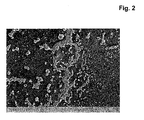
- the self-cleaning roof tiles with lotus effect ® known from the prior art, on the other hand, show agglomerates of fine TiO 2 particles which are not distributed uniformly over the entire surface but give the desired effect of a surface structuring which is to be decisive for the self-cleaning function ( Fig.2, SEM image of the surface of a commercial roof tile with lotus effect ®).
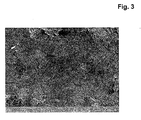
- the engobes or glazes according to the invention which contain as photocatalytically active material interference pigments with a coating of TiO 2 on a platelet-shaped substrate, preferably have a particularly smooth and dense surface structure after firing and subsequent cooling.
- FIG. 3 SEM image of the surface of an engobe produced with the addition of 25% by weight of an interference pigment in the sedimentation process).
- the engobes or glazes according to the invention are suitable for sustainably reducing or preventing the overgrowth, algae or mossing of a roof tile provided therewith.
- the present invention also provides a process for producing a photocatalytically active engobe or glaze for roof tiles, in which a base material for an engobe or glaze with interference pigments based on coated with a layer of titanium dioxide temperature-stable platelet-shaped substrates homogeneously mixed as a photocatalytically active substance and is applied to at least one surface of a fired or unfired tile in the form of a single or multi-layer coating, so that at least the outermost layer of the coating contains the interference pigments, and then fired together with the tile at a temperature of at least 400 ° C.
- the first layer is fired at at least 800 ° C and the second layer at at least 400 ° C together with the roof tile.
- the integration of the process stages of applying and firing the engobe or glaze onto the roof tile blank advantageously takes place in such a way that the usual process sequence described above does not need to be modified or changed significantly.
- the interference pigments of the matrix in an amount of 0.1 to 30 wt.%, Preferably from 1 to 15 wt.%, And especially from 1 to 5 wt .%, Based on the solids content of engobe or glaze, mixed.
- the base material for the engobe or glaze according to the invention in the outer layer is the interference pigments in an amount of from 0.01 to 10% by weight, and preferably from 1 to 3% by weight. , based on the solids content of the layer, added, regardless of their presence or the concentration in the underlying layers.
- the further one or more layers which are located on the roof tile blank below the outermost layer may likewise contain the interference pigments used according to the invention, preferably in the amounts given above for the single-layer coating.
- the invention also provides a photocatalytically active roof tile, which is provided on at least one of its surfaces, preferably on the surface facing the various weather conditions, with an engobe or glaze containing as photocatalytically active ingredient the interference pigments described above.
- photocatalytically active engobes and glazes for roof tiles and thus also photocatalytically active roof tiles are provided that sustainably prevent the overgrowing, algae and Bemoosen of roof tiles with sufficient activity, can be easily produced via existing in existing production processes to be integrated process without further post-treatments having to be carried out after the firing process, with starting materials which are readily and cost-effectively available on the market, and in which the health risks possibly to be feared with nanomaterials do not occur, since the corresponding pigments are in some cases even suitable for consumption and permitted are.
- the modified engobe base thus obtained is applied to an unfired roof tile and this fired at 980 ° C for 54h.
- the roof tile has a visually appealing, smooth red surface.
- Example 1 is repeated, with the exception that instead of 2.5% by weight of Iriodin® 100, a total of 5% by weight (in this case 20 g) are incorporated into the engobe base.
- the firing temperature is 985 ° C, the burning time 24h.
- the tile surface is smooth and has a red, pleasant color.
- Example 1 is repeated with the exception that 2.5% by weight of Iriodin® 103 (20 g) [TiO 2 (rutile) on mica, product of Merck KGaA] are incorporated into the engobe base.
- the firing temperature is 985 ° C, the burning time 24h.
- a roof tile with a smooth red surface is obtained, which has no optical impairments.
- Example 1 is repeated, with the exception that 5.0% by weight of Iriodin® 103 (here 20 g) are incorporated into the engobe base.
- the firing temperature and duration correspond to those in Example 1.
- the resulting roof tile has a visually appealing, red surface.
- the experimental facility is structured as follows:
- the plate inclination can be varied, but in the present experiment, 35 °.
- the inclined plane is irradiated with a lamp field consisting of 4 fluorescent tubes from Philipps, type Cleo, 15W, which gives a homogeneous intensity of 65 W / m 2 in the relevant UV-A range.
- a wetting test with distilled water shows that for all samples (both dark and irradiated) there is no increase in TOC when rinsing with distilled water, but the straps can be well wetted.
- the straps are wetted from above with 1.0 l of a DCA solution (initial concentration 5 mmol / l, corresponds to 120 mg / l TOC, initial pH value: 3.1).
- the effluent from the straps solution is collected and again passed over the straps, the circulation volume flow is 360 l / h * m.
- the test duration is 120 minutes.
- volume losses due to water evaporation are determined for each sample by which the total volume is corrected.
- a roof tile which after firing is provided with a TiO 2 layer consisting of nanoscale TiO 2 (use of 5 g / l AEROXIDE® TiO 2 P25 from Degussa, anatase / rutile ratio 80:20), After drying of the layer, a belt with an area of approximately 0.02 m 2 is cut out. This is subjected to the experimental procedure described above. A DCA degradation rate of 170 mg TOC / m 2 * h is determined.
- the interference pigments practically do not influence the optical (color) appearance of the engobes displaced therewith.
Landscapes
- Chemical & Material Sciences (AREA)
- Engineering & Computer Science (AREA)
- Ceramic Engineering (AREA)
- Organic Chemistry (AREA)
- Materials Engineering (AREA)
- Structural Engineering (AREA)
- Inorganic Chemistry (AREA)
- Catalysts (AREA)
Applications Claiming Priority (1)
| Application Number | Priority Date | Filing Date | Title |
|---|---|---|---|
| DE102006044075 | 2006-09-20 |
Publications (2)
| Publication Number | Publication Date |
|---|---|
| EP1903018A2 true EP1903018A2 (fr) | 2008-03-26 |
| EP1903018A3 EP1903018A3 (fr) | 2012-07-25 |
Family
ID=38739467
Family Applications (1)
| Application Number | Title | Priority Date | Filing Date |
|---|---|---|---|
| EP07017842A Withdrawn EP1903018A3 (fr) | 2006-09-20 | 2007-09-12 | Engobe ou glaçure photocatalytique active pour tuiles |
Country Status (2)
| Country | Link |
|---|---|
| EP (1) | EP1903018A3 (fr) |
| DE (1) | DE102007043375A1 (fr) |
Cited By (3)
| Publication number | Priority date | Publication date | Assignee | Title |
|---|---|---|---|---|
| EP2324917A3 (fr) * | 2009-11-20 | 2011-06-22 | Ceracasa S.A. | Composition de glaçure photocatalytique céramique |
| WO2016207854A1 (fr) * | 2015-06-24 | 2016-12-29 | Revigrés - Indústria De Revestimentos De Grés, Lda. | Plaque céramique de revêtement pour application à l'extérieur |
| CN112441744A (zh) * | 2019-09-05 | 2021-03-05 | 伊泰尔瑟股份公司 | 光催化陶瓷 |
Families Citing this family (2)
| Publication number | Priority date | Publication date | Assignee | Title |
|---|---|---|---|---|
| DE102014008533B4 (de) * | 2014-06-16 | 2024-09-26 | Universität Augsburg | Photoelektrochemisches Kolloid und Verfahren zur Herstellung von Kolloidteilchen |
| DE102019007756A1 (de) | 2019-11-08 | 2021-05-12 | N-Tec Gmbh | Verwendung von Titanverbindungen |
Family Cites Families (3)
| Publication number | Priority date | Publication date | Assignee | Title |
|---|---|---|---|---|
| JPS61286283A (ja) * | 1985-06-13 | 1986-12-16 | メルク・パテント・ゲゼルシヤフト・ミツト・ベシユレンクテル・ハフツング | 真珠顔料被覆粘土素地製品 |
| JP2000290528A (ja) * | 1999-04-09 | 2000-10-17 | Matsushita Electric Works Ltd | 光輝材料、コーティング組成物及び塗装品 |
| DE10018458A1 (de) * | 2000-04-15 | 2001-10-18 | Erlus Baustoffwerke | Verfahren zur Erzeugung einer Selbstreinigungseigenschaft einer Oberfläche und Gegenstand mit dieser Oberfläche |
-
2007
- 2007-09-12 DE DE102007043375A patent/DE102007043375A1/de not_active Withdrawn
- 2007-09-12 EP EP07017842A patent/EP1903018A3/fr not_active Withdrawn
Cited By (4)
| Publication number | Priority date | Publication date | Assignee | Title |
|---|---|---|---|---|
| EP2324917A3 (fr) * | 2009-11-20 | 2011-06-22 | Ceracasa S.A. | Composition de glaçure photocatalytique céramique |
| WO2016207854A1 (fr) * | 2015-06-24 | 2016-12-29 | Revigrés - Indústria De Revestimentos De Grés, Lda. | Plaque céramique de revêtement pour application à l'extérieur |
| CN112441744A (zh) * | 2019-09-05 | 2021-03-05 | 伊泰尔瑟股份公司 | 光催化陶瓷 |
| CN114423523A (zh) * | 2019-09-05 | 2022-04-29 | 伊泰尔瑟股份公司 | 光催化陶瓷 |
Also Published As
| Publication number | Publication date |
|---|---|
| DE102007043375A1 (de) | 2008-04-03 |
| EP1903018A3 (fr) | 2012-07-25 |
Similar Documents
| Publication | Publication Date | Title |
|---|---|---|
| EP0307747B1 (fr) | Pigments à lustre doré | |
| EP3159380B1 (fr) | Mélange pigment/frittes | |
| EP1213330B1 (fr) | Pigment nacré de couleurs d'argent | |
| EP2064292A2 (fr) | Revêtement à action photocatalytique | |
| EP0632110B1 (fr) | Pigments brillants contenant du vanadate de bismuth | |
| DE10320455A1 (de) | Interferenzpigment mit hohem Deckvermögen | |
| EP0082985A1 (fr) | Pigments nacrés résistant à la lumière, préparation et utilisation | |
| DE1959998B2 (de) | Perlglanzpigmente und verfahren zu ihrer herstellung | |
| EP1270682A2 (fr) | Pigment perlescent à couches multiples | |
| EP1572812A1 (fr) | Pigments d'interference blanc argente a forte brillance a base de substrats sous forme de paillettes transparentes | |
| EP0948572A1 (fr) | Pigments de polarisation multicouches | |
| EP2892960B1 (fr) | Pigment d'or | |
| EP2370371A1 (fr) | Particules de verre colorées, leur procédé de fabrication et leur utilisation | |
| EP1786868A1 (fr) | Pigments nacres | |
| DE19810317A1 (de) | Seltene Erdmetallsulfidpigmente und Yttriumsulfidpigmente | |
| DD292471A5 (de) | Grau-schwarze einschlusspigmente und verfahren zu ihrer herstellung | |
| DE112015004189B4 (de) | Verfahren zum Herstellen eines Perlglanzpigments mittels Koextraktion aus in Salzsäure gelöstem Ilmenit | |
| EP1903018A2 (fr) | Engobe ou glaçure photocatalytique active pour tuiles | |
| EP1910478B1 (fr) | Système de pigments d'interférence | |
| EP3963009A1 (fr) | Pigments à effet | |
| EP2727966A1 (fr) | Pigment à activité photocatalytique, son procédé de fabrication et moyen de revêtement | |
| DE10331903A1 (de) | Deckendes Silberpigment | |
| DE68917894T2 (de) | Verfahren zur Herstellung eines durchscheinenden Metalloxidpigmentes. | |
| DE2344196C2 (de) | Lasierendes gelbes Eisenoxid-Pigment | |
| DE102004024455A1 (de) | Polychrome Pigmente |
Legal Events
| Date | Code | Title | Description |
|---|---|---|---|
| PUAI | Public reference made under article 153(3) epc to a published international application that has entered the european phase |
Free format text: ORIGINAL CODE: 0009012 |
|
| 17P | Request for examination filed |
Effective date: 20070912 |
|
| AK | Designated contracting states |
Kind code of ref document: A2 Designated state(s): AT BE BG CH CY CZ DE DK EE ES FI FR GB GR HU IE IS IT LI LT LU LV MC MT NL PL PT RO SE SI SK TR |
|
| AX | Request for extension of the european patent |
Extension state: AL BA HR MK YU |
|
| PUAL | Search report despatched |
Free format text: ORIGINAL CODE: 0009013 |
|
| AK | Designated contracting states |
Kind code of ref document: A3 Designated state(s): AT BE BG CH CY CZ DE DK EE ES FI FR GB GR HU IE IS IT LI LT LU LV MC MT NL PL PT RO SE SI SK TR |
|
| AX | Request for extension of the european patent |
Extension state: AL BA HR MK RS |
|
| RIC1 | Information provided on ipc code assigned before grant |
Ipc: C09C 1/00 20060101ALI20120621BHEP Ipc: C04B 41/85 20060101AFI20120621BHEP Ipc: B01J 35/00 20060101ALI20120621BHEP |
|
| AKX | Designation fees paid |
Designated state(s): AT BE BG CH CY CZ DE DK EE ES FI FR GB GR HU IE IS IT LI LT LU LV MC MT NL PL PT RO SE SI SK TR |
|
| 17Q | First examination report despatched |
Effective date: 20130408 |
|
| STAA | Information on the status of an ep patent application or granted ep patent |
Free format text: STATUS: THE APPLICATION IS DEEMED TO BE WITHDRAWN |
|
| 18D | Application deemed to be withdrawn |
Effective date: 20130820 |