EP1903482A2 - Traitement de données selon les éléments de liaison de données - Google Patents
Traitement de données selon les éléments de liaison de données Download PDFInfo
- Publication number
- EP1903482A2 EP1903482A2 EP07018027A EP07018027A EP1903482A2 EP 1903482 A2 EP1903482 A2 EP 1903482A2 EP 07018027 A EP07018027 A EP 07018027A EP 07018027 A EP07018027 A EP 07018027A EP 1903482 A2 EP1903482 A2 EP 1903482A2
- Authority
- EP
- European Patent Office
- Prior art keywords
- data
- sequences
- ensemble
- linking
- ranking
- Prior art date
- Legal status (The legal status is an assumption and is not a legal conclusion. Google has not performed a legal analysis and makes no representation as to the accuracy of the status listed.)
- Withdrawn
Links
Images








Classifications
-
- G—PHYSICS
- G06—COMPUTING OR CALCULATING; COUNTING
- G06N—COMPUTING ARRANGEMENTS BASED ON SPECIFIC COMPUTATIONAL MODELS
- G06N5/00—Computing arrangements using knowledge-based models
- G06N5/02—Knowledge representation; Symbolic representation
- G06N5/022—Knowledge engineering; Knowledge acquisition
-
- G—PHYSICS
- G06—COMPUTING OR CALCULATING; COUNTING
- G06F—ELECTRIC DIGITAL DATA PROCESSING
- G06F16/00—Information retrieval; Database structures therefor; File system structures therefor
- G06F16/20—Information retrieval; Database structures therefor; File system structures therefor of structured data, e.g. relational data
- G06F16/24—Querying
-
- G—PHYSICS
- G06—COMPUTING OR CALCULATING; COUNTING
- G06N—COMPUTING ARRANGEMENTS BASED ON SPECIFIC COMPUTATIONAL MODELS
- G06N5/00—Computing arrangements using knowledge-based models
- G06N5/02—Knowledge representation; Symbolic representation
-
- Y—GENERAL TAGGING OF NEW TECHNOLOGICAL DEVELOPMENTS; GENERAL TAGGING OF CROSS-SECTIONAL TECHNOLOGIES SPANNING OVER SEVERAL SECTIONS OF THE IPC; TECHNICAL SUBJECTS COVERED BY FORMER USPC CROSS-REFERENCE ART COLLECTIONS [XRACs] AND DIGESTS
- Y10—TECHNICAL SUBJECTS COVERED BY FORMER USPC
- Y10S—TECHNICAL SUBJECTS COVERED BY FORMER USPC CROSS-REFERENCE ART COLLECTIONS [XRACs] AND DIGESTS
- Y10S707/00—Data processing: database and file management or data structures
- Y10S707/912—Applications of a database
- Y10S707/913—Multimedia
Definitions
- the present invention relates generally to the field of data analysis, data integration, knowledge management business intelligence, and artificial intelligence (i.e. knowledge-based systems, reasoning systems, etcetera) and, more specifically, to a system, method and computer program to organize, formalize, represent, record, use, retrieve, distribute, manage and integrate data and knowledge in order to support the knowledge life cycle within organizations.
- artificial intelligence i.e. knowledge-based systems, reasoning systems, etcetera
- IT information technology
- DBMS database management systems
- DW/DM data warehouses
- intranet/extranet intranet/extranet and groupware.
- This object is obtained by the present invention, in a computer controlled method for automatically segmenting an ensemble of digital data comprising a step of acquiring the ensemble of data, and wherein this ensemble of data is segmented by:
- the invention is based on the insight that any ensemble of data can be structured by linked Information Carrying Data Elements (ICDEs).
- ICDEs Information Carrying Data Elements
- LDEs Linking Data Elements
- the approach of segementing the ensembles of data using a repository of predefined DLEs in accordance with the present invention has the advantage that the ICDEs are discovered within the context of the ensemble. Once the ICDEs have been identified, the structure of the information in an ensemble of data becomes explorable.
- DLEs are essentially context and domain independent, they appear in almost all imaginable ensembles of data in the same way. This provides the advantage that a relatively small set of DLEs allows to analyse, structure and interpret a complete set of all imaginable ensembles of data as to the information contained therein. That is, in the light of the present invention, the set of DLEs can be considered as the equivalent of a closed set in mathematics, whereas the ICDEs can be considered as the equivalent of an infinite set in mathematics.
- DLEs may comprise of a particular type such as geometrical, logical, spatial, temporal and psychological.
- LDEs may be but don't need to be explicitly categorized as of a particular type.
- the ICDEs may comprise of sequences of data elements or of patterns formed by different data elements.
- an ensemble of digital data is any gathering of computer readable data arranged in one or more files, in data blocks, or any other format.
- subsequences of a sequence are identified as a being part of a sequence occurring in at least two different sequences. Like the sequences, subsequences may contribute to the analysis of the structure of the information provided in a data ensemble, and may comprise further meaningful information.
- the sequences and subsequences may be ranked based on their presence in an ensemble of data, providing a general ranking and the general ranking may be represented in a structured format for further use by humans, machines or devices.
- the general ranking may be specifically based on a ranking of position of sequences and subsequences in an ensemble of data, a ranking based on frequency of occurrence of sequences and subsequences in an ensemble of data, and a ranking based on length of sequences and subsequences.
- sequences may be ranked based on co-occurring subsequences, providing a subsequence based ranking and the subsequence based ranking may be represented in a structured format for further use by humans, machines or devices.
- sequences and subsequences may be ranked based on being linked with any other sequences and subsequences by an LDE providing a linkage ranking.
- the linkage ranking may be represented in a structured format for further use by humans, machines or devices.
- any of the sequences and subsequences and LDEs may have an order of occurrence and any of the sequences and subsequences may be ranked in accordance with the invention based on the order of occurrence with a particular LDE, providing an order based ranking and representing the order based ranking in a structured format.
- the rankings disclosed above in accordance with the present invention are based on parts of the data ensemble carrying information rather than on a minimal data entity approach known in the prior art as for example rankings based on individual words or letters in text data or 16-bit samples in a pcm sound file, or pixels in a video file. Any of these rankings may be advantageously used, in accordance with the invention, for determining clusterability of a sequence or a subsequence.
- the clusterability datasets of the ensemble of data may be selected, representing information carrying parts and linked parts associated with a particular sequence, or subsequence. This to enhance the analysis of the structure of the information contained in a data ensemble, thereby enhancing the speed and efficiency in browsing or stepping through the data, the efficiency of disclosing the information in the data, the efficiency of searching for particular information parts or informative subsets of the data and the efficiency of representing the data to human users or machines. Further, the data ensemble may be structured on the basis of the sequences and subsequences.
- density and sparsity of an ensemble of data may be determined based on the clusterability and linkage data ranking.
- the invention further provides that two or more LDEs may combined based on an order of occurrence of the LDEs in the ensemble of data.
- the LDEs may be associated with a predefined qualification in a qualification system and a sequence or subsequence may be qualified according to its order of occurrence with a particular LDE and in accordance with the qualification of the linking data.
- This qualification may be presented in a structured format for further use.
- Qualifications may be any of a group of sentiment or mood based indications, judgements on a positive/negative scale, numerical denotations etc...
- a sequence may be further qualified based on the qualification of subsequences of that sequence.
- any of the sequences, subsequences and LDEs have a predefined qualification in a qualification system
- the qualification of any of a sequence, subsequence and LDE may be adapted according to its order of occurrence with any of a particular LDE, a particular sequence, and a particular subsequence and in accordance with the qualification of the LDE.
- the adapted qualification may be represented in a structured format for further use.
- the invention further provides that the predefined qualifications of an LDE is comprised in the repository. Qualifications can however also be retrieved from remote sources of information such as for example sentiment and mood based dictionaries.
- any of the sequences, subsequences and LDEs may have a predefined semantic denotation, and wherein any of a sequence, subsequence and LDE is semantically denoted according to its order of occurrence with any of a particular LDE, a particular sequence, and a particular subsequence and in accordance with the semantic denotation of any of the LDE, the sequences and subsequences.
- This denotation is represented in a structured format.
- any of a sequence and subsequence may be identified as a semantic denotation for any of an other sequence and subsequence based on being linked with any other sequence and subsequence by a specific LDE.
- Semantic denotations of any of a sequence, a subsequence and an LDE may be stored in the repository.
- the data ensemble may be structured based on the semantic denotation of any of the sequences and subsequences.
- entities such as people, places, companies, chemical substances, diseases and many more are extracted from an ensemble of data by qualifying a sequence of Information Carrying Data Elements as being of a particular kind based on its occurrence in the ensemble of data in association with a specific subset of sequences of Linking Data Elements.
- sequences of Linking Data Elements have to be considered in some contexts as sequences of Information Carrying Data Elements.
- the first subset of sequences of Linking Data Elements is assessed in order to determine whether sequences of this first subset have to be interpreted as pertaining to the second subset of Information Carrying Data Elements. This assessment may be performed on the basis of sequences being linked with a particular set of other sequences.
- the information structure of the ensemble of data can be further uncovered, in accordance with the invention, by the fact that a specific semantic link or functional link between sequences of Information Carrying Data Elements is determined by the fact of being linked by at least one sequence of a specific set of sequences of Linking Data Elements.
- semantic equivalent sequences of Information Carrying Data Elements and equivalent sequences of Linking Data Elements have to be determined.
- a plurality of sequences of Information Carrying Data Elements can be determined as semantically equivalent when this plurality of sequences is co-occurring in an ensemble of data and is linked by a specific set of sequences of Linking Data Elements with different sequences of Information Carrying Data Elements.
- a plurality of sequences of Linking Data Elements can be determined as semantically equivalent, in accordance with the present invention, when this plurality of sequences is co-occurring in an ensemble of data and is linking more than once different identical pairs of sequences of Information Carrying Data Elements.
- actions may be initiated based on any of a qualification and a semantic denotation of any of a sequence and subsequence.
- This allows an event triggered information representation. For example having established from the data ensemble the occurrence of a heart fibrillation may trigger a representation of datasets of an electronic patient record system meaningful to this heart fibrillation.
- an ensemble of data can be searched by segmenting the data and presenting in a structured format any of a sequence, a subsequence and an LDE according to any of the general ranking, the linkage ranking, the order based ranking, and the clusterability and further selecting any of a sequence, a subsequence and an LDE, and retrieving datasets of the ensemble of data in accordance with this selection.
- the invention further provides a computer controlled system for automatically analyzing an ensemble of data comprising means for acquiring the ensemble of data and means for segmentation of the data arranged for identifying a first subset of LDEs based on a repository of LDEs and for identifying a second subset of sequences of ICDEs wherein the sequences are linked by the LDEs, and means for providing the subsets in a structured format.
- the invention also provides a computer program product comprising a computer program arranged for performing the method disclosed above, if loaded into a memory of an electronic processing device.
- a computer program product may comprise any of a group of data carrying devices including floppy discs, CD-roms, DVDs, tapes, memory stick devices, zip drives, flash memory cards, remote access devices, hard disks, semi-conductor memory devices, programmable semi-conductor memory devices, optical disks, magneto-optical data storage devices, and ferro electric data storage devices.
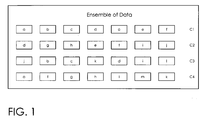
- Figure 1 schematically shows an ensemble of data comprising data elements referred to as a-m.
- FIGS 2-3 schematically show the segmentation process in accordance with the invention.
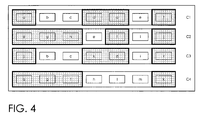
- FIG. 4 schematically shows the segmented ensemble of data in accordance with the invention
- Figure 5 represents a part of a repository of Linking Data Elements which are in a textual domain referred to as relations.
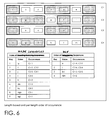
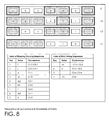
- FIG. 6-8 schematically show several rankings of sequences in accordance with the present invention
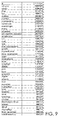
- Figure 9 represents a ranking based on frequency of occurrence of Information Carrying Data Elements which are in a textual domain referred to concepts.
- Figure 10 schematically shows a ranking of sequences and subsequences based on the presence of common subsequences
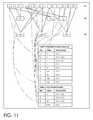
- Figure 11-13 schematically show how sequences and subquences can be used to build lossless indices representing the original ensemble of data searchable in constant time and with minimal redundancy.
- Figure 14 represents the qualification negative of the sequence "division" as defined by the sentiment and mood based dictionaries.
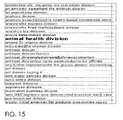
- Figure 15 represents the sequences of Information Carrying Data Elements containing the subsequence "division".
- sequence "animal health division” results to be a qualified as neutral although the single subsequence division in a repository could be qualified as negative.
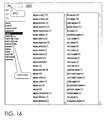
- Figure 16 represents the search within a ensemble of data from the subsequence "enz", where this subsequence is represented in the first and second position of a bi-gram data sequence.
- Figure 17 shows an example of a subset of sequences of Information Carrying Data Elements that are associated with a specific semantic link (etiology) based on the fact of being linked by at least one sequence of a specific set of sequences of Linking Data Elements.
- Figure 1 shows an ensemble of digital data comprising data elements a-m, which can take the form of e.g. samples, bytes, strings according to the nature of the digital data ensemble.
- data elements a-m are representing words grouped as sentences C1-CR4.
- Figure 2 shows the data segmenting process wherein the data elements are segmented into sequences of Linking Data Elements (LDEs) available in a repository.
- LDEs Linking Data Elements
- LDEs may be retrieved from an external or remote repository, through suitable data communication means
- sequences of data elements not identified as LDEs are considered as sequences of Information Carrying Data Elements (ICDEs) which sequences of ICDEs are shown in the bold and dashed boxes.
- ICDEs Information Carrying Data Elements
- Figure 6 schematically shows a ranking of sequences of ICDs and DLEs based on their length.
- Figure 7 schematically shows a ranking of sequences of ICDs and DLEs based on their on their order of occurrence in the ensemble of digital data.
- Figure 8 schematically shows a ranking of sequences of ICDs and DLEs based on their frequency of occurrence in the ensemble of digital data.
- Figure 9 schematically represents a ranking on order of frequency of Information Carrying Data Elements which are in a textual domain referred to concepts.
- Figure 10 schematically represents a ranking based on co-occurrence of subsequences.
- Figure 11-13 schematically show how sequences and subquences can be used to build lossless indices representing the original ensemble of data searchable in constant time and with minimal redundancy. Moreover the principle of clusterability is illustrated by the fact that in figure 12 an additional index of combinations of sequences of ICDEs and DLEs is built based on their neighbourship in the ensemble of digital data. In figure 13 the additional index contains patterns of sequences of two ICDEs linked by a sequence of DLEs
- Figure 14 represents the qualification negative of the sequence "division" as defined by the sentiment and mood based dictionaries.
- Figure 15 represents the sequences of Information Carrying Data Elements containing the subsequence "division".
- sequence "animal health division” results to be a qualified as neutral although the single subsequence division in a repository could be qualified as negative.
- Figure 16 represents the search within a ensemble of data from the subsequence "enz", where this subsequence is represented in the first and second position of a bi-gram data sequence.
- Figure 17 shows an example of a subset of sequences of Information Carrying Data Elements that are associated with a specific semantic link (etiology) based on the fact of being linked by at least one sequence of a specific set of sequences of Linking Data Elements.
Landscapes
- Engineering & Computer Science (AREA)
- Theoretical Computer Science (AREA)
- General Engineering & Computer Science (AREA)
- General Physics & Mathematics (AREA)
- Data Mining & Analysis (AREA)
- Physics & Mathematics (AREA)
- Computational Linguistics (AREA)
- Evolutionary Computation (AREA)
- Computing Systems (AREA)
- Mathematical Physics (AREA)
- Software Systems (AREA)
- Artificial Intelligence (AREA)
- Databases & Information Systems (AREA)
- Information Retrieval, Db Structures And Fs Structures Therefor (AREA)
- Machine Translation (AREA)
- Automatic Analysis And Handling Materials Therefor (AREA)
Applications Claiming Priority (1)
| Application Number | Priority Date | Filing Date | Title |
|---|---|---|---|
| US84445006P | 2006-09-13 | 2006-09-13 |
Publications (2)
| Publication Number | Publication Date |
|---|---|
| EP1903482A2 true EP1903482A2 (fr) | 2008-03-26 |
| EP1903482A3 EP1903482A3 (fr) | 2017-08-09 |
Family
ID=38863078
Family Applications (1)
| Application Number | Title | Priority Date | Filing Date |
|---|---|---|---|
| EP07018027.8A Withdrawn EP1903482A3 (fr) | 2006-09-13 | 2007-09-13 | Traitement de données selon les éléments de liaison de données |
Country Status (2)
| Country | Link |
|---|---|
| US (3) | US7912841B2 (fr) |
| EP (1) | EP1903482A3 (fr) |
Families Citing this family (3)
| Publication number | Priority date | Publication date | Assignee | Title |
|---|---|---|---|---|
| US8983954B2 (en) * | 2012-04-10 | 2015-03-17 | Microsoft Technology Licensing, Llc | Finding data in connected corpuses using examples |
| JP2016507828A (ja) * | 2013-01-11 | 2016-03-10 | カタール・ファンデーション | 機械翻訳システム及び方法 |
| CN111488430B (zh) * | 2020-04-07 | 2023-08-04 | 百度在线网络技术(北京)有限公司 | 事件的数据处理的方法、装置、设备以及存储介质 |
Citations (1)
| Publication number | Priority date | Publication date | Assignee | Title |
|---|---|---|---|---|
| EP0962873A1 (fr) * | 1998-06-02 | 1999-12-08 | International Business Machines Corporation | Traitement des informations textuels et comprehension automatisée d'information |
Family Cites Families (12)
| Publication number | Priority date | Publication date | Assignee | Title |
|---|---|---|---|---|
| US6076088A (en) * | 1996-02-09 | 2000-06-13 | Paik; Woojin | Information extraction system and method using concept relation concept (CRC) triples |
| US6038561A (en) * | 1996-10-15 | 2000-03-14 | Manning & Napier Information Services | Management and analysis of document information text |
| US7185049B1 (en) * | 1999-02-01 | 2007-02-27 | At&T Corp. | Multimedia integration description scheme, method and system for MPEG-7 |
| US6629097B1 (en) * | 1999-04-28 | 2003-09-30 | Douglas K. Keith | Displaying implicit associations among items in loosely-structured data sets |
| KR100370247B1 (ko) * | 1999-08-26 | 2003-01-29 | 엘지전자 주식회사 | 등장인물 관계 기반 동영상 검색 방법 |
| US6493706B1 (en) * | 1999-10-26 | 2002-12-10 | Cisco Technology, Inc. | Arrangement for enhancing weighted element searches in dynamically balanced trees |
| US6751621B1 (en) * | 2000-01-27 | 2004-06-15 | Manning & Napier Information Services, Llc. | Construction of trainable semantic vectors and clustering, classification, and searching using trainable semantic vectors |
| US6564213B1 (en) * | 2000-04-18 | 2003-05-13 | Amazon.Com, Inc. | Search query autocompletion |
| US7146308B2 (en) * | 2001-04-05 | 2006-12-05 | Dekang Lin | Discovery of inference rules from text |
| AU2003210393A1 (en) * | 2002-02-27 | 2003-09-09 | Michael Rik Frans Brands | A data integration and knowledge management solution |
| US7502765B2 (en) * | 2005-12-21 | 2009-03-10 | International Business Machines Corporation | Method for organizing semi-structured data into a taxonomy, based on tag-separated clustering |
| US8108204B2 (en) * | 2006-06-16 | 2012-01-31 | Evgeniy Gabrilovich | Text categorization using external knowledge |
-
2007
- 2007-09-13 US US11/855,103 patent/US7912841B2/en not_active Expired - Fee Related
- 2007-09-13 EP EP07018027.8A patent/EP1903482A3/fr not_active Withdrawn
-
2011
- 2011-03-11 US US13/046,110 patent/US8417711B2/en not_active Expired - Fee Related
-
2013
- 2013-03-06 US US13/786,533 patent/US9053145B2/en not_active Expired - Fee Related
Patent Citations (1)
| Publication number | Priority date | Publication date | Assignee | Title |
|---|---|---|---|---|
| EP0962873A1 (fr) * | 1998-06-02 | 1999-12-08 | International Business Machines Corporation | Traitement des informations textuels et comprehension automatisée d'information |
Also Published As
| Publication number | Publication date |
|---|---|
| US20080189280A1 (en) | 2008-08-07 |
| US9053145B2 (en) | 2015-06-09 |
| US7912841B2 (en) | 2011-03-22 |
| US20130311499A1 (en) | 2013-11-21 |
| US20110161385A1 (en) | 2011-06-30 |
| US8417711B2 (en) | 2013-04-09 |
| EP1903482A3 (fr) | 2017-08-09 |
Similar Documents
| Publication | Publication Date | Title |
|---|---|---|
| Nemes et al. | Social media sentiment analysis based on COVID-19 | |
| KR101242369B1 (ko) | 사용자 액티비티, 주의, 관심 측정을 활용하는 데이터감지, 저장, 인덱싱, 및 탐색 | |
| US5819259A (en) | Searching media and text information and categorizing the same employing expert system apparatus and methods | |
| Marshall et al. | Semi-Automated evidence synthesis in health psychology: current methods and future prospects | |
| KR20190062391A (ko) | 전자 기록의 문맥 리트리벌을 위한 시스템 및 방법 | |
| US11847415B2 (en) | Automated detection of safety signals for pharmacovigilance | |
| EP3270303A1 (fr) | Système et procédé de surveillance et archivage automatique de données | |
| Hossari et al. | TEST: A terminology extraction system for technology related terms | |
| US9053145B2 (en) | Data analysis based on data linking elements | |
| Iancu et al. | Multi-label classification for automatic tag prediction in the context of programming challenges | |
| CN121188178A (zh) | 查询语句的检索处理方法、装置、设备、介质及程序产品 | |
| CN114896357A (zh) | 一种自动采集并处理生成音乐情感数据库的方法 | |
| Foote et al. | A computational analysis of social media scholarship | |
| CN119848309A (zh) | 一种基于大语言模型的舆情报告生成方法及系统 | |
| Segev et al. | Context recognition using internet as a knowledge base | |
| Evangeline et al. | Frequency based feature extraction technique for text documents in Tamil Language | |
| Wolfe | ChronoNLP: Exploration and Analysis of Chronological Textual Corpora | |
| Hu | Mining novel connections from large online digital library using biomedical ontologies | |
| Afzal et al. | Towards semantic annotation of bioinformatics services: building a controlled vocabulary | |
| Mohapatra et al. | Driving Sustainable Practices in Industry 6.0: A Study on Article Detection with Fuzzy-Wuzzy and Supervised Machine Learning Algorithms | |
| Theeramunkong et al. | A framework for constructing a thai medical knowledge base | |
| Joseph et al. | Emotion Detection Based on Text and Emojis | |
| Preeti | Review on Text Mining: Techniques, Applications and Issues | |
| Xiao et al. | CKM: a shared visual analytical tool for large-scale analysis of audio-video interviews | |
| Aangenendt | Applied NLP for humanities research |
Legal Events
| Date | Code | Title | Description |
|---|---|---|---|
| PUAI | Public reference made under article 153(3) epc to a published international application that has entered the european phase |
Free format text: ORIGINAL CODE: 0009012 |
|
| AK | Designated contracting states |
Kind code of ref document: A2 Designated state(s): AT BE BG CH CY CZ DE DK EE ES FI FR GB GR HU IE IS IT LI LT LU LV MC MT NL PL PT RO SE SI SK TR |
|
| AX | Request for extension of the european patent |
Extension state: AL BA HR MK YU |
|
| RIN1 | Information on inventor provided before grant (corrected) |
Inventor name: BRANDS, MICHAEL RIK FRANS Inventor name: VAN HYFTE, DIRK MEDARD HELENA |
|
| RAP1 | Party data changed (applicant data changed or rights of an application transferred) |
Owner name: I.KNOW NV |
|
| RAP1 | Party data changed (applicant data changed or rights of an application transferred) |
Owner name: INTERSYSTEMS CORPORATION |
|
| PUAL | Search report despatched |
Free format text: ORIGINAL CODE: 0009013 |
|
| AK | Designated contracting states |
Kind code of ref document: A3 Designated state(s): AT BE BG CH CY CZ DE DK EE ES FI FR GB GR HU IE IS IT LI LT LU LV MC MT NL PL PT RO SE SI SK TR |
|
| AX | Request for extension of the european patent |
Extension state: AL BA HR MK RS |
|
| RIC1 | Information provided on ipc code assigned before grant |
Ipc: G06N 5/02 20060101AFI20170706BHEP Ipc: G06F 17/30 20060101ALI20170706BHEP |
|
| 17P | Request for examination filed |
Effective date: 20180209 |
|
| RBV | Designated contracting states (corrected) |
Designated state(s): AT BE BG CH CY CZ DE DK EE ES FI FR GB GR HU IE IS IT LI LT LU LV MC MT NL PL PT RO SE SI SK TR |
|
| AKX | Designation fees paid |
Designated state(s): AT BE BG CH CY CZ DE DK EE ES FI FR GB GR HU IE IS IT LI LT LU LV MC MT NL PL PT RO SE SI SK TR |
|
| AXX | Extension fees paid |
Extension state: BA Extension state: MK Extension state: HR Extension state: RS Extension state: AL |
|
| 17Q | First examination report despatched |
Effective date: 20180605 |
|
| STAA | Information on the status of an ep patent application or granted ep patent |
Free format text: STATUS: THE APPLICATION IS DEEMED TO BE WITHDRAWN |
|
| 18D | Application deemed to be withdrawn |
Effective date: 20200603 |