EP1903652A2 - Procédé et commutation destinés à la détermination du courant maximal d'un électromoteur - Google Patents
Procédé et commutation destinés à la détermination du courant maximal d'un électromoteur Download PDFInfo
- Publication number
- EP1903652A2 EP1903652A2 EP07016542A EP07016542A EP1903652A2 EP 1903652 A2 EP1903652 A2 EP 1903652A2 EP 07016542 A EP07016542 A EP 07016542A EP 07016542 A EP07016542 A EP 07016542A EP 1903652 A2 EP1903652 A2 EP 1903652A2
- Authority
- EP
- European Patent Office
- Prior art keywords
- voltage
- circuit
- motor
- electric motor
- current
- Prior art date
- Legal status (The legal status is an assumption and is not a legal conclusion. Google has not performed a legal analysis and makes no representation as to the accuracy of the status listed.)
- Withdrawn
Links
Images

Classifications
-
- H—ELECTRICITY
- H02—GENERATION; CONVERSION OR DISTRIBUTION OF ELECTRIC POWER
- H02H—EMERGENCY PROTECTIVE CIRCUIT ARRANGEMENTS
- H02H7/00—Emergency protective circuit arrangements specially adapted for specific types of electric machines or apparatus or for sectionalised protection of cable or line systems, and effecting automatic switching in the event of an undesired change from normal working conditions
- H02H7/08—Emergency protective circuit arrangements specially adapted for specific types of electric machines or apparatus or for sectionalised protection of cable or line systems, and effecting automatic switching in the event of an undesired change from normal working conditions for dynamo-electric motors
- H02H7/085—Emergency protective circuit arrangements specially adapted for specific types of electric machines or apparatus or for sectionalised protection of cable or line systems, and effecting automatic switching in the event of an undesired change from normal working conditions for dynamo-electric motors against excessive load
- H02H7/0851—Emergency protective circuit arrangements specially adapted for specific types of electric machines or apparatus or for sectionalised protection of cable or line systems, and effecting automatic switching in the event of an undesired change from normal working conditions for dynamo-electric motors against excessive load for motors actuating a movable member between two end positions, e.g. detecting an end position or obstruction by overload signal
-
- F—MECHANICAL ENGINEERING; LIGHTING; HEATING; WEAPONS; BLASTING
- F16—ENGINEERING ELEMENTS AND UNITS; GENERAL MEASURES FOR PRODUCING AND MAINTAINING EFFECTIVE FUNCTIONING OF MACHINES OR INSTALLATIONS; THERMAL INSULATION IN GENERAL
- F16D—COUPLINGS FOR TRANSMITTING ROTATION; CLUTCHES; BRAKES
- F16D2500/00—External control of clutches by electric or electronic means
- F16D2500/10—System to be controlled
- F16D2500/102—Actuator
- F16D2500/1021—Electrical type
- F16D2500/1023—Electric motor
-
- F—MECHANICAL ENGINEERING; LIGHTING; HEATING; WEAPONS; BLASTING
- F16—ENGINEERING ELEMENTS AND UNITS; GENERAL MEASURES FOR PRODUCING AND MAINTAINING EFFECTIVE FUNCTIONING OF MACHINES OR INSTALLATIONS; THERMAL INSULATION IN GENERAL
- F16D—COUPLINGS FOR TRANSMITTING ROTATION; CLUTCHES; BRAKES
- F16D2500/00—External control of clutches by electric or electronic means
- F16D2500/30—Signal inputs
- F16D2500/302—Signal inputs from the actuator
- F16D2500/3022—Current
-
- G—PHYSICS
- G01—MEASURING; TESTING
- G01R—MEASURING ELECTRIC VARIABLES; MEASURING MAGNETIC VARIABLES
- G01R19/00—Arrangements for measuring currents or voltages or for indicating presence or sign thereof
- G01R19/0092—Measuring current only
-
- H—ELECTRICITY
- H02—GENERATION; CONVERSION OR DISTRIBUTION OF ELECTRIC POWER
- H02H—EMERGENCY PROTECTIVE CIRCUIT ARRANGEMENTS
- H02H3/00—Emergency protective circuit arrangements for automatic disconnection directly responsive to an undesired change from normal electric working condition with or without subsequent reconnection ; integrated protection
- H02H3/006—Calibration or setting of parameters
-
- H—ELECTRICITY
- H03—ELECTRONIC CIRCUITRY
- H03K—PULSE TECHNIQUE
- H03K5/00—Manipulating of pulses not covered by one of the other main groups of this subclass
- H03K5/153—Arrangements in which a pulse is delivered at the instant when a predetermined characteristic of an input signal is present or at a fixed time interval after this instant
- H03K5/1532—Peak detectors
Definitions
- the invention relates to a method and a circuit for determining the maximum current consumed by an electric motor, in particular an EC motor (electronically controlled motor or electronically commutated DC motor).
- an electric motor in particular an EC motor (electronically controlled motor or electronically commutated DC motor).
- Electric motors are used in modern motor vehicles in a variety of ways as actuators, for example as selector or switch actuators in automated transmissions, as clutch actuators in automatic clutches, for example, provided in a parallel shift two clutch actuators, as power window motors, etc. Measuring the recorded by such an electric motor Electricity is important for many reasons.
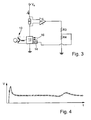
- FIG. 3 shows a block diagram of an EC motor with associated current measurement:
- the generally designated 10 EC motor is controlled in a conventional manner by an electronic control unit 12.
- the current I flowing through the electronic control unit is measured by means of a shunt or measuring resistor R, by its voltage drop via an operational amplifier A1 and optionally a filter, not shown, and a voltage divider with the resistors R3 and R4 preferably integrated into the controller 12 AD converter 14 is supplied to the other inputs 16 for the operation of the EC motor relevant signals.
- Structure and function of an EC motor and the associated control unit are known per se and are therefore not explained.
- the input signal of the AD converter 14 analogously supplied current signal is digitized in the AD converter 14 and read into the processor of the control unit 12.
- the current signal in the processor is processed every 2.5 ms.
- the current values in the controller 12 are present in each controller interrupt.
- the current absorbed by the control unit 12 may change relatively strongly within the aforementioned controller sampling time, so that the actual current present in the processor current signal is subject to a high degree of inaccuracy.
- Fig. 4 the course of the analog, the input of the AD converter 14 supplied voltage V over time t is exemplified.
- the constant sampling rate has the following disadvantages:
- a blockage detection of DC motors is known in which a blocking is detected by the fact that a peak current value occurring when the drive motor is switched on exceeds a predetermined value.
- the peak current value is measured by means of a sample-and-hold circuit and stored as a reference for the respective movement of the drive motor.
- the current peak is measured by means of an analog-to-digital converter and stored in a microprocessor for controlling the drive motor.
- the determination of the peak current is subject to the same uncertainties because of the sample-and-hold method used, as explained with reference to FIGS. 3 and 4.
- the invention has for its object to provide a way to determine the maximum, recorded by an electric motor, in particular an EC motor power without a microprocessor heavily burdened by large amounts of data must be processed.
- the stored voltage is digitized during readout.
- the read and preferably digital available voltage may be used to limit the current consumed by the electric motor.
- the voltage storage circuit advantageously comprises a capacitor which is connected to a current limiting resistor, with which the charging time of the capacitor can be adjusted, via a series circuit with a diode and an operational amplifier.
- the reset circuit includes, for example, a series circuit of a switch and a resistor in parallel with the capacitor.
- the invention with which a maximum of a current recorded by an electric motor, especially when it is turned on, can be determined for substantially all electric motors; in particular, it is suitable for EC motors. Because the maximum current absorbed by the electric motor when it is switched on can be precisely predetermined, the current supplied to the electric motor can be limited to a predetermined value (the starting is then possibly slowed down), as a result of which the electronic components contained in the control circuit of the electric motor do not need to be unnecessarily large dimensions.
- the shunt or current measuring resistor R via the operational amplifier A1 is not directly connected to the voltage divider circuit (resistors R3 and R4), but the output of the operational amplifier A1 is followed by a filter resistor R1, connected in series with a diode D1, which is connected via a capacitor C1, in parallel thereto via a series circuit of a switch S and a resistor R2 and again in parallel thereto via the voltage divider circuit R3 and R4 to ground.
- the function of the circuit according to FIG. 1 is the following:
- At the output of the operational amplifier A1 is a voltage which is proportional to the voltage drop across the measuring resistor R and thus absorbed by the electric motor 10 current.
- the capacitor C1 is charged by this voltage.
- the voltage is read out via the voltage divider R3, R4.
- the voltage divider R3, R4 is so high-impedance that the capacitor C1 does not discharge appreciably, for example, within 10 ms.
- the reset functionality is implemented via switch S and resistor R2. As soon as the switch S is closed, the capacitor discharges. R2 is chosen so that the capacitor C1 can discharge completely within 10 ⁇ s.
- the voltage built up in the capacitor C1 is blocked by the diode D1, so that the capacitor can not discharge via the path with A1.
- Fig. 2 illustrates the situation:
- the voltage curve at the output of the operational amplifier A1 is shown in solid lines. Due to the blocking effect of the diode D1, the capacitor C1 can not discharge, so that its voltage represented by the broken line remains at the peak peak value Vs as long as the switch S is opened. The possible even with open switch S discharge via the voltage divider circuit R 3, R4, as stated, in 100ms range, ie does not affect the voltage during the illustrated time interval significantly.
- the capacitor C1 has a peak-hold function with respect to the voltage, in which the largest value (Vs) is maintained and via the A / D converter 14, which with an opposite of the duration of the peak current, for example less than 1 ms, it can operate at a significantly slower clock frequency.
- a reset takes place, ie the switch S is closed, so that the capacitor C1 discharges rapidly via the resistor R2 and the capacitor voltage to the instantaneous value of Output voltage of the operational amplifier drops.
- the capacitor voltage remains at this value and in turn increases as the output voltage of the operational amplifier increases according to the peak-hold function.
- the circuit according to the invention can be modified in many ways, as long as peak hold function is realized with reset possibility.
- the switch S is advantageously an electronic switch.
- the invention can be used for all types of electric motors, in particular EC motors, such as transmission actuators, for example in clutch actuators, gear actuators, etc.
- the digitized voltage read out via the AD converter 14, which corresponds to the peak value of the current absorbed by the EC motor 10 during startup, can be used in a wide variety of ways.
- a permissible maximum value of the peak current can be stored in the control unit 12 and the starting of the electric motor can be controlled such that this maximum value is not exceeded.
- the switch S, via which the reset takes place, is integrated, for example, in the control unit 12 and is controlled at a predetermined clock frequency or separately.
Landscapes
- Control Of Electric Motors In General (AREA)
- Control Of Direct Current Motors (AREA)
Applications Claiming Priority (1)
| Application Number | Priority Date | Filing Date | Title |
|---|---|---|---|
| DE102006044542 | 2006-09-21 |
Publications (2)
| Publication Number | Publication Date |
|---|---|
| EP1903652A2 true EP1903652A2 (fr) | 2008-03-26 |
| EP1903652A3 EP1903652A3 (fr) | 2012-10-31 |
Family
ID=38829263
Family Applications (1)
| Application Number | Title | Priority Date | Filing Date |
|---|---|---|---|
| EP07016542A Withdrawn EP1903652A3 (fr) | 2006-09-21 | 2007-08-23 | Procédé et commutation destinés à la détermination du courant maximal d'un électromoteur |
Country Status (2)
| Country | Link |
|---|---|
| EP (1) | EP1903652A3 (fr) |
| DE (1) | DE102007039855A1 (fr) |
Cited By (1)
| Publication number | Priority date | Publication date | Assignee | Title |
|---|---|---|---|---|
| WO2017023982A1 (fr) | 2015-08-03 | 2017-02-09 | Mevay Alex C H | Capteur de courant à faible perte et convertisseur d'énergie utilisant celui-ci |
Families Citing this family (5)
| Publication number | Priority date | Publication date | Assignee | Title |
|---|---|---|---|---|
| DE102017102434A1 (de) | 2017-02-08 | 2018-08-09 | Schaeffler Technologies AG & Co. KG | Verfahren zur Erzielung eines Kurzschlusses eines Elektromotors und Ansteuerschaltung |
| DE102017106008B4 (de) | 2017-03-21 | 2019-07-04 | Schaeffler Technologies AG & Co. KG | Verfahren zur Erkennung eines Kurzschlusses einer Endstufe eines Elektromotors, vorzugsweise eines elektrisch kommutierten Elektromotors |
| DE102018105381A1 (de) | 2018-03-08 | 2019-09-12 | Schaeffler Technologies AG & Co. KG | Verfahren zur Erkennung eines Kurzschlusses eines mechatronischen Kupplungsaktors in einem Fahrzeug |
| DE102018114115A1 (de) | 2018-06-13 | 2019-12-19 | Schaeffler Technologies AG & Co. KG | Vorrichtung zur Erkennung eines Fehlerstromes in einem eine Steuereinheit aufweisenden Aktor eines Fahrzeuges |
| DE102018115311A1 (de) | 2018-06-26 | 2020-01-02 | Schaeffler Technologies AG & Co. KG | Verfahren zur Erkennung eines Kurzschlusses eines mechatronischen Kupplungsaktors in einem Fahrzeug |
Family Cites Families (3)
| Publication number | Priority date | Publication date | Assignee | Title |
|---|---|---|---|---|
| US4373141A (en) * | 1981-01-22 | 1983-02-08 | E-Systems, Inc. | Fast updating peak detector circuit |
| JPH0224572A (ja) * | 1988-07-13 | 1990-01-26 | Matsushita Electric Ind Co Ltd | ピークホールド回路 |
| DE4203659A1 (de) * | 1992-02-10 | 1993-08-12 | Bayerische Motoren Werke Ag | Blockiererkennung von gleichstrommotoren |
-
2007
- 2007-08-23 DE DE102007039855A patent/DE102007039855A1/de not_active Withdrawn
- 2007-08-23 EP EP07016542A patent/EP1903652A3/fr not_active Withdrawn
Cited By (2)
| Publication number | Priority date | Publication date | Assignee | Title |
|---|---|---|---|---|
| WO2017023982A1 (fr) | 2015-08-03 | 2017-02-09 | Mevay Alex C H | Capteur de courant à faible perte et convertisseur d'énergie utilisant celui-ci |
| EP3332260B1 (fr) * | 2015-08-03 | 2024-11-13 | Sunforge LLC | Capteur de courant à faible perte et convertisseur d'énergie utilisant celui-ci |
Also Published As
| Publication number | Publication date |
|---|---|
| DE102007039855A1 (de) | 2008-04-03 |
| EP1903652A3 (fr) | 2012-10-31 |
Similar Documents
| Publication | Publication Date | Title |
|---|---|---|
| EP3701274B1 (fr) | Procédé pour faire fonctionner un capteur de batterie et capteur de batterie | |
| EP1903652A2 (fr) | Procédé et commutation destinés à la détermination du courant maximal d'un électromoteur | |
| DE112016002719T5 (de) | Treiber-steuerungsschaltung für leistungshalbleiter-element | |
| DE102012005936A1 (de) | Magnetventil mit einer Zustandsüberwachungseinheit sowie Verfahren zur Zustandsüberwachung eines Magnetventils | |
| EP0392058A1 (fr) | Circuit de commande d'au moins un relais électromagnétique | |
| DE19611885B4 (de) | Verfahren und Vorrichtung zur Steuerung eines elektromagnetischen Schaltorgans | |
| WO2012041580A1 (fr) | Procédé de contrôle de l'état de bon fonctionnement d'un détecteur photoélectrique de fumées | |
| EP2550740B1 (fr) | Élément électronique pour un dispositif de capteur, dispositif de capteur et procédé de configuration d'un dispositif de capteur | |
| EP0836085B1 (fr) | Circuit de mesure de résistance et méthode de mesure de résistance | |
| EP0066682B1 (fr) | Dispositif de positionnement | |
| DE2920894C2 (de) | Elektronische Uhr mit einem Schrittmotor und einer Nachweiseinrichtung für ein äußeres magnetisches Wechselfeld | |
| EP2731246A1 (fr) | Convertisseur continu | |
| EP0890217B1 (fr) | Detection de venue en butee et de blocage d'un moteur pas a pas | |
| DE2545325B2 (de) | Schaltungsanordnung zur Messung des Isolationswiderstandes erdfreier Starkstromschaltungen | |
| EP3637116B1 (fr) | Détecteur et procédé de vérification d'un détecteur | |
| EP1005051B1 (fr) | Procédé de commande d'un consommateur électromagnétique | |
| DE10118299A1 (de) | Verfahren zur Funktionsprüfung eines Kondensators, zur Bestimmung dessen ohmschen Anteils des Innenwiderstands sowie geeignete Schaltungsanordnung | |
| WO2010102965A1 (fr) | Procédé de contrôle des propriétés électriques d'un circuit de charge commandé en mode commuté, et configuration de circuit pour la mise en oeuvre de ce procédé | |
| EP0438469B1 (fr) | Circuit permettant l'enregistrement numerique d'une information analogique formee par l'intervalle entre deux etats successifs d'un signal | |
| DE102019126136A1 (de) | Verfahren und Einrichtung zum Ermitteln einer eine Temperatur eines Widerstandstemperaturfühlers beschreibenden Temperaturinformation, Wechselrichter, Fahrzeug und Computerprogramm | |
| DE102009022135A1 (de) | Schaltungsanordnung zur Messung von elektrischem Strom | |
| WO2007045645A2 (fr) | Procede pour mesurer le courant d'un moteur | |
| DE102007033152A1 (de) | Verfahren und Vorrichtung zur Diagnose einer Ausgangsgröße eines Gleichstrommotors | |
| DE29609570U1 (de) | Schaltung zum Erfassen des Aussertrittfallens eines Schritt- oder Synchronmotors | |
| DE102022201923B3 (de) | Verfahren und Schaltungsanordnung zur Ermittlung einer Induktivität einer Messspule und Verwendung dafür |
Legal Events
| Date | Code | Title | Description |
|---|---|---|---|
| PUAI | Public reference made under article 153(3) epc to a published international application that has entered the european phase |
Free format text: ORIGINAL CODE: 0009012 |
|
| AK | Designated contracting states |
Kind code of ref document: A2 Designated state(s): AT BE BG CH CY CZ DE DK EE ES FI FR GB GR HU IE IS IT LI LT LU LV MC MT NL PL PT RO SE SI SK TR |
|
| AX | Request for extension of the european patent |
Extension state: AL BA HR MK YU |
|
| RAP1 | Party data changed (applicant data changed or rights of an application transferred) |
Owner name: SCHAEFFLER TECHNOLOGIES AG & CO. KG |
|
| PUAL | Search report despatched |
Free format text: ORIGINAL CODE: 0009013 |
|
| AK | Designated contracting states |
Kind code of ref document: A3 Designated state(s): AT BE BG CH CY CZ DE DK EE ES FI FR GB GR HU IE IS IT LI LT LU LV MC MT NL PL PT RO SE SI SK TR |
|
| AX | Request for extension of the european patent |
Extension state: AL BA HR MK RS |
|
| RIC1 | Information provided on ipc code assigned before grant |
Ipc: H02H 7/085 20060101AFI20120924BHEP Ipc: H03K 5/1532 20060101ALI20120924BHEP Ipc: G01R 19/04 20060101ALI20120924BHEP |
|
| AKY | No designation fees paid | ||
| REG | Reference to a national code |
Ref country code: DE Ref legal event code: R108 |
|
| REG | Reference to a national code |
Ref country code: DE Ref legal event code: R108 Effective date: 20130703 |
|
| STAA | Information on the status of an ep patent application or granted ep patent |
Free format text: STATUS: THE APPLICATION IS DEEMED TO BE WITHDRAWN |
|
| 18D | Application deemed to be withdrawn |
Effective date: 20130503 |
|
| P01 | Opt-out of the competence of the unified patent court (upc) registered |
Effective date: 20230523 |