EP1903759A1 - Verfahren zur Steuerung der Anzeige einer Analoguhr und mobiles Kommunikationsendgerät dazu - Google Patents
Verfahren zur Steuerung der Anzeige einer Analoguhr und mobiles Kommunikationsendgerät dazu Download PDFInfo
- Publication number
- EP1903759A1 EP1903759A1 EP07116716A EP07116716A EP1903759A1 EP 1903759 A1 EP1903759 A1 EP 1903759A1 EP 07116716 A EP07116716 A EP 07116716A EP 07116716 A EP07116716 A EP 07116716A EP 1903759 A1 EP1903759 A1 EP 1903759A1
- Authority
- EP
- European Patent Office
- Prior art keywords
- analog clock
- mobile communication
- communication terminal
- clock
- minute
- Prior art date
- Legal status (The legal status is an assumption and is not a legal conclusion. Google has not performed a legal analysis and makes no representation as to the accuracy of the status listed.)
- Withdrawn
Links
Images


Classifications
-
- G—PHYSICS
- G04—HOROLOGY
- G04G—ELECTRONIC TIME-PIECES
- G04G9/00—Visual time or date indication means
- G04G9/0082—Visual time or date indication means by building-up characters using a combination of indicating elements and by selecting desired characters out of a number of characters or by selecting indicating elements the positions of which represents the time, i.e. combinations of G04G9/02 and G04G9/08
-
- H—ELECTRICITY
- H04—ELECTRIC COMMUNICATION TECHNIQUE
- H04B—TRANSMISSION
- H04B1/00—Details of transmission systems, not covered by a single one of groups H04B3/00 - H04B13/00; Details of transmission systems not characterised by the medium used for transmission
- H04B1/38—Transceivers, i.e. devices in which transmitter and receiver form a structural unit and in which at least one part is used for functions of transmitting and receiving
- H04B1/40—Circuits
-
- G—PHYSICS
- G04—HOROLOGY
- G04G—ELECTRONIC TIME-PIECES
- G04G9/00—Visual time or date indication means
- G04G9/02—Visual time or date indication means by selecting desired characters out of a number of characters or by selecting indicating elements the position of which represent the time, e.g. by using multiplexing techniques
-
- H—ELECTRICITY
- H04—ELECTRIC COMMUNICATION TECHNIQUE
- H04M—TELEPHONIC COMMUNICATION
- H04M1/00—Substation equipment, e.g. for use by subscribers
- H04M1/72—Mobile telephones; Cordless telephones, i.e. devices for establishing wireless links to base stations without route selection
- H04M1/724—User interfaces specially adapted for cordless or mobile telephones
- H04M1/72403—User interfaces specially adapted for cordless or mobile telephones with means for local support of applications that increase the functionality
- H04M1/72427—User interfaces specially adapted for cordless or mobile telephones with means for local support of applications that increase the functionality for supporting games or graphical animations
-
- H—ELECTRICITY
- H04—ELECTRIC COMMUNICATION TECHNIQUE
- H04M—TELEPHONIC COMMUNICATION
- H04M1/00—Substation equipment, e.g. for use by subscribers
- H04M1/72—Mobile telephones; Cordless telephones, i.e. devices for establishing wireless links to base stations without route selection
- H04M1/724—User interfaces specially adapted for cordless or mobile telephones
- H04M1/72448—User interfaces specially adapted for cordless or mobile telephones with means for adapting the functionality of the device according to specific conditions
Definitions
- the present invention relates generally to a mobile communication terminal having a variable screen, and in particular, to a method of controlling the contents displayed on a screen according state information of a mobile communication terminal, and a mobile communication terminal using the same.
- Such a mobile communication terminal employs various additional functions in order to increase convenience or efficiency in use.
- a screen of the mobile communication terminal may display a state of the mobile communication terminal, various kinds of information, interesting images to a user in normal times, or a game execution state.
- a screen s of such a mobile communication terminal needs to be more efficient and versatile.
- the screen in order to increase an effective value of a screen in a mobile communication terminal and satisfy various demands of users, the screen needs to be connected to various additional functions of the mobile communication terminal.
- a screen of a mobile communication terminal can display a moving picture in order to increase an effective value.
- a digital or analog clock designed in an icon form is displayed, and even when the digital or analog clock is displayed, the display is performed in a simple and repetitive method, such as a change of digits or a motion of the hour and the minute hands according to a time change.
- this clock design merely borrows the function and structure of a general watch.
- existing mobile communication terminals display time information by varying only digits or the hour and the minute hands in a clock design. That is, time display methods of the existing mobile communication terminals, which are designed in a digital or analog form, simply represent only time information.
- standard clock designs since standard clock designs are used, they tend to be boring, and the effectiveness of utilization of a variety of colors and an enlarged screen of each mobile communication terminal decreases.
- a method of reflecting various personalities of the users and simultaneously increasing visibility in information delivery is required.
- a clock displayed on a screen can be vividly represented in response to state information of a mobile communication terminal, it will be helpful to satisfy the various demands of users.
- the present invention has been designed to substantially solve at least the above problems and/or disadvantages and to provide at least the advantages below. Accordingly, the object of the present invention is to provide a method of controlling display of an analog clock, whereby a user can intuitively view a state of a mobile communication terminal, and a mobile communication terminal using the same.
- Another aspect of the present invention is to provide a method of controlling display of an analog clock, whereby information besides clock information can be displayed by means of an analog clock design, and a mobile communication terminal using the same.
- a mobile communication terminal for controlling display of an analog clock
- the mobile communication terminal including a memory for storing animation data of the analog clock moving with a predetermined per-minute perspective angle; a controller for reading analog clock animation data from the memory every time a predetermined minute-based time elapses and controlling the analog clock moving with a perspective angle corresponding to a current minute to be displayed using the read analog clock animation data; and a display unit for displaying the analog clock.
- a method of controlling display of an analog clock in a mobile communication terminal including storing animation data of the analog clock moving with a predetermined per-minute perspective angle; reading analog clock animation data from the memory every time a predetermined minute-based time elapses; and displaying the analog clock moving with a perspective angle corresponding to a current minute using the read analog clock animation data.
- the present invention implements a function of displaying a clock visually varying according to state information that can be provided by a mobile communication terminal.
- an analog clock designed to move three-dimensionally, which is formed by adding a graphical factor to state information, such as remaining power of battery and reception sensitivity, of a mobile communication terminal, is displayed.
- state information such as remaining power of battery and reception sensitivity
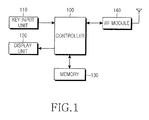
- FIG. 1 is a block diagram of a mobile communication terminal according to an exemplary embodiment of the present invention.
- the mobile communication terminal includes a controller 100, a key input unit 110, a display unit 120, a memory 130, and a Radio Frequency (RF) module 140.
- RF Radio Frequency
- the controller 100 controls a general operation of the mobile communication terminal, and in particular, controls an operation for showing an effect in which an analog clock moves three-dimensionally by varying a perspective angle of the analog clock according to a position viewing of the minute hand.
- the controller 100 reads analog clock animation data from the memory 130 for storing animation data of the analog clock moving with a predetermined per-minute perspective angle, every time a predetermined minute-based time elapses, and controls the analog clock moving with a perspective angle corresponding to a current minute to be displayed using the read analog clock animation data.
- the controller 100 controls an analog clock of which a perspective angle varies 30° per minute based on a current minute to be displayed.
- RSSI Received Signal Strength Indication
- the controller 100 periodically measures RSSI indicating a level of signal power received from a network and displays the analog clock by varying a shape of the analog clock in correspondence to the measured RSSI.
- the controller 100 also displays the analog clock by varying a color of the analog clock in correspondence to remaining power of battery.
- the RSSI can be represented by dividing the circular face of the analog clock into a plurality of circular arcs having the same length and varying the length of each circular arc according to the RSSI as illustrated in Table 1.
- the controller 100 determines the length of each circular arc corresponding to the RSSI in order to display the circular frame of the analog clock having an arc length corresponding to a percentage of the RSSI.
- the analog clock is represented as a single circle, and if the RSSI is weaker, the analog clock having the plurality of circular arcs evenly disposed on the clock face, each arc having shorter length, is displayed.
- each gap between circular arcs is gradually widened when the RSSI gradually decreases.
- a user can intuitively perceive that the RSSI is weak if the analog clock has the circular face with wide gaps between circular arcs.
- Table 1 Percentage of RSSI (%) Length of each circular arc 100 ⁇ /6 ⁇ radius 80 ( ⁇ /6 ⁇ radius) ⁇ 0.8 60 ( ⁇ /6 ⁇ radius) ⁇ 0.6 40 ( ⁇ /6 ⁇ radius) ⁇ 0.4 20 ( ⁇ /6 ⁇ radius) ⁇ 0.2 0 0
- the colors of the analog clock can represent remaining power of battery as illustrated in Table 2.
- Table 2 illustrates a correlation between a percentage of remaining power of battery and a color of the circular arcs forming the circular face of the analog clock.
- the controller 100 determines a color of the analog clock with reference to Table 2 in order to display the analog clock having a color corresponding to a percentage of the remaining power of battery.
- the remaining power of battery may be represented by varying only a color of a circular arc currently facing the minute hand or a color of all circular arcs of the analog clock.
- Table 2 Percentage of remaining power of battery (%) Color of circular arc 100 Red 70 Orange 30 Yellow 0 Blue
- the state information, such as the RSSI and the remaining power of battery, of the mobile communication terminal can be represented in various methods, such as a method of varying a circular shape of the analog clock to an oval.
- the key input unit 110 includes various keys, such as various function keys, number keys, and special keys (*, #), and provides key input data input by the user to the controller 100. That is, the key input unit 110 outputs key input data dependent to each key selected by the user, and the controller 100 receives the key input data output from the key input unit 110, detects what key was selected, and performs a relevant operation according to the detection result.
- various keys such as various function keys, number keys, and special keys (*, #)
- the display unit 120 receives display data corresponding to the key input data input from the key input unit 110 and displays the display data, or displays an operational state and a plurality of pieces of information of the mobile communication terminal using icons and characters, under the control of the controller 100.
- the controller 100 controls the display unit 120 to allow the user to visually perceive a state of the setting or operation.
- the display unit 120 displays an analog clock of which a perspective angle, a color, and a shape vary according to state information which can be provided by the mobile communication terminal.
- the memory 130 includes Read Only Memory (ROM) and Random Access Memory (RAM) for storing a plurality of programs and data.
- the memory 130 stores animation data of an analog clock moving with a predetermined perspective angle according to a time change. That is, the memory 130 stores animation data of an analog clock moving with a predetermined per-minute perspective angle.
- the memory 130 also stores data of analog clock display items corresponding to state information, such as RSSI and remaining power of battery, of the mobile communication terminal.
- the RF module 140 is connected to the controller 100, converts voice data and control data to an RF signal and transmits the converted RF signal, and receives an RF signal and converts the received RF signal to voice data and control data.
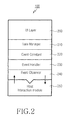
- FIG. 2 is a configuration of the controller 100 illustrated in FIG. 1, according to an exemplary embodiment of the present invention.
- a host interaction module 250 collects and manages various kinds of information, combines an event and the various kinds of information, and transmits the combined result to a User Interface (UI) layer 200.
- the UI layer 200 includes a data manager 210, an event constant 220, an event handler 230, and an event observer 240.
- the UI layer 200 displays an analog clock in which perspective angle information of the analog clock and state information of the mobile communication terminal are mixed, the analog clock being designed in advance to increase user readability.
- the host interaction module 250 detects state information, such as RSSI and remaining power of battery, of the mobile communication terminal and transmits the detected state information to the data manager 210 via the layers existing below the UI layer 200.
- the event observer 240 detects a current time and transmits a timer event for displaying a motion of the hour and minute hands of the analog clock to the event handler 230 in order to display the detected current time.
- the event handler 230 transmits information on how components on a screen for forming the analog clock are changed according to the timer event to the event constant 220.
- the event constant 220 transmits information on the components forming the analog clock according to the timer event to the data manager 210.
- the data manager 210 forms the analog clock based on the component information according to the timer event in order to control the analog clock to move according to a time change so that the analog clock is displayed by the UI layer 200.
- the data manager 210 also reflects the state information of the mobile communication terminal on the components forming the analog clock.
- the UI layer displays the analog clock of which a perspective angle varies according to a time change and simultaneously the length and color of each circular arc forming the analog clock vary according to the state information.
- the perspective angle of the analog clock varies so that a circular arc currently facing the minute hand or a second hand can be well visible to the user.
- a method of implementing an analog clock animation of which a perspective angle of an analog clock varies according to a time change by applying the principle of the present invention described above to the mobile communication terminal will now be described. That is, a method of displaying an analog clock moving with a perspective angle according to a time change will now be described with reference to FIG. 3.
- FIG. 3 illustrates a process of displaying an analog clock in order to display a current time by varying a perspective angle so that a user can well view the analog clock in a position of the minute hand.
- Minutes are grouped in a predetermined unit in step 300. It is determined based on the grouping whether the analog clock is displayed by varying a perspective angle every minute or every group.
- Analog clock animation data corresponding to each group is stored in step 310, wherein the analog clock animation data is data to display the analog clock moving with a perspective angle of 30° per minute.
- the grouping may be set in advance by a manufacturer when the mobile communication terminal is manufactured and can be changed by the user.
- the mobile communication terminal In order to display a current time in a state where the analog clock animation data corresponding to each group has been stored, the mobile communication terminal reads relevant analog clock animation data from among the analog clock animation data pre-stored according to a time change in step 320.
- the mobile communication terminal displays a flow of time using the read analog clock animation data in step 330.
- the analog clock moves three-dimensionally with a perspective angle corresponding to 30° per minute according to the timer event.
- the minute hand directs a number corresponding to a current minute according to the timer event.
- analog clock animation data of which a perspective angle is adjusted to emphasize the five-minute position is read. That is, in order to emphasize and view a current minute position every five minutes, a perspective angle of the analog clock is changed and displayed.
- the analog clock is viewed as if the analog clock moves three-dimensionally.
- the motion of the hour and minute hands of the analog clock indicating a current time follows a conventional method of displaying an analog clock, the detailed description is omitted.
- FIG. 4 is a flowchart illustrating a method of displaying an analog clock by varying components forming the analog clock according to state information.
- the mobile communication terminal detects state information, such as RSSI and remaining power of battery, in step 400. Since the process of detecting state information is the same as a conventional process of detecting state information, the detailed description is omitted.
- the mobile communication terminal determines the length of each circular arc corresponding to the state information in step 410.
- the mobile communication terminal can determine the length of each circular arc corresponding to current state information by referring to Table 1.
- the mobile communication terminal can determine a color of a circular arc corresponding to current remaining power of battery by referring to Table 2.
- the mobile communication terminal reflects the determined length and color on analog clock animation data in step 430.
- the mobile communication terminal represents its state information and a time change by varying a shape, a perspective angle, and a color of the analog clock using the analog clock animation data in step 440.
- FIGs. 5A-5C illustrate shapes of an analog clock varying according to RSSI.
- FIG. 5A illustrates a shape of the analog clock when the RSSI is very strong, showing a case where a circular face of the analog clock is drawn with a single solid line.
- FIGs. 5B and 5C show cases where the length of each circular arc obtained by dividing the circular frame of the analog clock into a plurality of circular arcs having the same length is gradually shorter according to a decrease of the RSSI. As illustrated in FIGs. 5A-5C, a user can intuitively perceive a level of the RSSI by viewing the length of each circular arc.
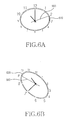
- FIG. 6A and 6B illustrate colors of an analog clock varying according to remaining power of battery.
- FIG. 6A illustrates an analog clock of which a color varies according to remaining power of battery, showing a case where a color of a circular arc 610 corresponding to a current second position 600 is displayed as a color corresponding to the remaining power of battery. For example, if a color of a circular arc facing the second hand 600 is displayed as blue, it indicates that the remaining power of battery is almost nothing, and if a color of a circular arc 620 facing the second hand 600 is displayed as red, it indicates that the remaining power of battery is almost full.
- a circular arc currently facing the second hand can be represented with a color corresponding to remaining power of battery, and alternatively, a color of the entire analog clock may be changed to represent remaining power of battery.
- FIGs. 5A-5C and 6A-6B are only exemplary embodiments and are not limited thereto. That is, various analog clock animation effects can be provided according to selections of a user, a service provider, or a terminal manufacturer.
- the analog clock animation effects according to the exemplary embodiments of the present invention can be created by the user, or received as a kind of content from a content provider and modified by the user.
- a user by applying a very dynamic and high-class animation scheme to an analog clock, a user can intuitively perceive a state of a mobile communication terminal, and mobile communication terminals can meet various personalities and tastes of users.
Landscapes
- Engineering & Computer Science (AREA)
- Physics & Mathematics (AREA)
- General Physics & Mathematics (AREA)
- Computer Networks & Wireless Communication (AREA)
- Signal Processing (AREA)
- Human Computer Interaction (AREA)
- Electric Clocks (AREA)
- Telephone Function (AREA)
Applications Claiming Priority (1)
| Application Number | Priority Date | Filing Date | Title |
|---|---|---|---|
| KR1020060090626A KR20080025884A (ko) | 2006-09-19 | 2006-09-19 | 아날로그 시계의 디스플레이를 제어하기 위한 방법 및 이를위한 이동 통신 단말기 |
Publications (1)
| Publication Number | Publication Date |
|---|---|
| EP1903759A1 true EP1903759A1 (de) | 2008-03-26 |
Family
ID=38984178
Family Applications (1)
| Application Number | Title | Priority Date | Filing Date |
|---|---|---|---|
| EP07116716A Withdrawn EP1903759A1 (de) | 2006-09-19 | 2007-09-19 | Verfahren zur Steuerung der Anzeige einer Analoguhr und mobiles Kommunikationsendgerät dazu |
Country Status (4)
| Country | Link |
|---|---|
| US (1) | US20080070533A1 (de) |
| EP (1) | EP1903759A1 (de) |
| KR (1) | KR20080025884A (de) |
| CN (1) | CN101150814A (de) |
Cited By (5)
| Publication number | Priority date | Publication date | Assignee | Title |
|---|---|---|---|---|
| GB2471175A (en) * | 2009-06-16 | 2010-12-22 | Intel Corp | Power conservation for a mobile device display |
| US8254957B2 (en) | 2009-06-16 | 2012-08-28 | Intel Corporation | Context-based limitation of mobile device operation |
| US8776177B2 (en) | 2009-06-16 | 2014-07-08 | Intel Corporation | Dynamic content preference and behavior sharing between computing devices |
| US8904164B2 (en) | 2009-06-16 | 2014-12-02 | Intel Corporation | Multi-mode handheld wireless device to provide data utilizing combined context awareness and situational awareness |
| US9092069B2 (en) | 2009-06-16 | 2015-07-28 | Intel Corporation | Customizable and predictive dictionary |
Families Citing this family (9)
| Publication number | Priority date | Publication date | Assignee | Title |
|---|---|---|---|---|
| CN102073265B (zh) * | 2009-11-25 | 2013-11-06 | 新奥特(北京)视频技术有限公司 | 一种生成模拟时钟的方法和装置 |
| US8634766B2 (en) | 2010-02-16 | 2014-01-21 | Andrew Llc | Gain measurement and monitoring for wireless communication systems |
| CN104216687A (zh) * | 2013-05-29 | 2014-12-17 | 腾讯科技(深圳)有限公司 | 一种计时显示的方法和系统 |
| CN104915161A (zh) * | 2014-03-10 | 2015-09-16 | 联想(北京)有限公司 | 一种信息处理方法及电子设备 |
| CN104166543A (zh) * | 2014-06-16 | 2014-11-26 | 周连惠 | 一种世界时钟软件 |
| CN104410756B (zh) * | 2014-12-26 | 2017-01-04 | 贵州万臻时代通讯技术有限公司 | 一种手机当前时间秒值快速和直观显示的方法 |
| CN104820360B (zh) * | 2015-04-29 | 2018-11-09 | 惠州市德赛西威汽车电子股份有限公司 | 模拟时钟显示方法 |
| KR20170033062A (ko) * | 2015-09-16 | 2017-03-24 | 엘지전자 주식회사 | 이동 단말기 및 그 제어 방법 |
| US9639064B2 (en) * | 2015-09-18 | 2017-05-02 | Timex Group Usa, Inc. | Wearable electronic device with hand synchronization |
Citations (3)
| Publication number | Priority date | Publication date | Assignee | Title |
|---|---|---|---|---|
| EP0855823A2 (de) * | 1997-01-23 | 1998-07-29 | Sony Corporation | Anzeigeverfahren, Anzeigegerät und Kommunikationsverfahren |
| US20040075700A1 (en) * | 2002-10-16 | 2004-04-22 | Catherine Liu | Functional idle mode display |
| US20040225966A1 (en) * | 2003-05-09 | 2004-11-11 | Motorola, Inc. | Method and device for automatically displaying appointments |
-
2006
- 2006-09-19 KR KR1020060090626A patent/KR20080025884A/ko not_active Withdrawn
-
2007
- 2007-09-19 EP EP07116716A patent/EP1903759A1/de not_active Withdrawn
- 2007-09-19 CN CNA2007101547754A patent/CN101150814A/zh active Pending
- 2007-09-19 US US11/858,017 patent/US20080070533A1/en not_active Abandoned
Patent Citations (3)
| Publication number | Priority date | Publication date | Assignee | Title |
|---|---|---|---|---|
| EP0855823A2 (de) * | 1997-01-23 | 1998-07-29 | Sony Corporation | Anzeigeverfahren, Anzeigegerät und Kommunikationsverfahren |
| US20040075700A1 (en) * | 2002-10-16 | 2004-04-22 | Catherine Liu | Functional idle mode display |
| US20040225966A1 (en) * | 2003-05-09 | 2004-11-11 | Motorola, Inc. | Method and device for automatically displaying appointments |
Cited By (9)
| Publication number | Priority date | Publication date | Assignee | Title |
|---|---|---|---|---|
| GB2471175A (en) * | 2009-06-16 | 2010-12-22 | Intel Corp | Power conservation for a mobile device display |
| GB2471175B (en) * | 2009-06-16 | 2012-06-13 | Intel Corp | Power conservation for mobile device displays |
| US8254957B2 (en) | 2009-06-16 | 2012-08-28 | Intel Corporation | Context-based limitation of mobile device operation |
| US8446398B2 (en) | 2009-06-16 | 2013-05-21 | Intel Corporation | Power conservation for mobile device displays |
| US8776177B2 (en) | 2009-06-16 | 2014-07-08 | Intel Corporation | Dynamic content preference and behavior sharing between computing devices |
| US8803868B2 (en) | 2009-06-16 | 2014-08-12 | Intel Corporation | Power conservation for mobile device displays |
| US8904164B2 (en) | 2009-06-16 | 2014-12-02 | Intel Corporation | Multi-mode handheld wireless device to provide data utilizing combined context awareness and situational awareness |
| US8909915B2 (en) | 2009-06-16 | 2014-12-09 | Intel Corporation | Multi-mode handheld wireless device with shared mode to support cross-mode communications |
| US9092069B2 (en) | 2009-06-16 | 2015-07-28 | Intel Corporation | Customizable and predictive dictionary |
Also Published As
| Publication number | Publication date |
|---|---|
| US20080070533A1 (en) | 2008-03-20 |
| CN101150814A (zh) | 2008-03-26 |
| KR20080025884A (ko) | 2008-03-24 |
Similar Documents
| Publication | Publication Date | Title |
|---|---|---|
| EP1903759A1 (de) | Verfahren zur Steuerung der Anzeige einer Analoguhr und mobiles Kommunikationsendgerät dazu | |
| EP1860856B1 (de) | Verfahren zum Bereitstellen einer Bildschirmoberfläche mit visuellen Effekten für den Ruhezustand und Verfahren zum Bereitstellen eines Bildschirmschoners damit | |
| EP1418735B1 (de) | Steuerungsverfahren zur Anzeige von Ikonen in einem schnurlosen Mobilendgerät | |
| EP1876803A2 (de) | Mobiles Kommunikationsendgerät mit Drehtaste und Betriebssteuerungsverfahren dafür | |
| US20020160817A1 (en) | Method and apparatus for displaying prioritized icons in a mobile terminal | |
| US8350834B2 (en) | Ambient light dependent themes | |
| US20110059774A1 (en) | Wireless Communication Device for Providing a Visual Representation of a Widget | |
| US20090327958A1 (en) | Electronic device having multiple operation modes and a method of providing the multiple operation modes | |
| CN103118192B (zh) | 终端设备的显示方法及终端设备 | |
| KR100771943B1 (ko) | 휴대용 전화기의 화면 설정 방법 및 이를 이용하는 휴대용전화기 | |
| KR101380084B1 (ko) | 이동통신단말기의 메뉴표시방법 및 그 이동통신단말기 | |
| US7865215B2 (en) | Magnification of currently selected menu item | |
| US20110320939A1 (en) | Electronic Device for Providing a Visual Representation of a Resizable Widget Associated with a Contacts Database | |
| EP1241787A3 (de) | Photoelektrischer Schalter | |
| US20110061019A1 (en) | Portable Electronic Device for Providing a Visual Representation of a Widget | |
| EP1860854B1 (de) | Verfahren für eine Wählanzeige und Schichtstruktur für ein mobiles Endgerät | |
| US20110320980A1 (en) | Electronic Device for Providing a Visual Representation of a Widget Associated with a Contacts Database | |
| JP4001706B2 (ja) | 携帯通信端末の機能設定装置 | |
| KR100909556B1 (ko) | 화면을 구성하기 위한 계층 구조 제공 방법 및 그에 따른화면 제공 방법 및 이를 위한 이동 통신 단말기 | |
| EP1154619B1 (de) | Tragbares Kommunikationsgerät mit angezeigter, doppelgenutzter Zustandszeile | |
| KR20020080175A (ko) | 이동통신 단말기의 메뉴 구성방법 | |
| KR100905622B1 (ko) | 대기 화면 계층 제공 방법과 대기 화면 제공 방법 및 이를위한 이동통신 단말기 | |
| KR100956187B1 (ko) | 이동 통신 단말기에서 대기화면의 팝업창 동작 방법 | |
| CA2532123C (en) | Magnification of currently selected menu item | |
| KR20050077606A (ko) | 휴대단말기의 메뉴 마지막 항목 표시방법 |
Legal Events
| Date | Code | Title | Description |
|---|---|---|---|
| PUAI | Public reference made under article 153(3) epc to a published international application that has entered the european phase |
Free format text: ORIGINAL CODE: 0009012 |
|
| 17P | Request for examination filed |
Effective date: 20070919 |
|
| AK | Designated contracting states |
Kind code of ref document: A1 Designated state(s): AT BE BG CH CY CZ DE DK EE ES FI FR GB GR HU IE IS IT LI LT LU LV MC MT NL PL PT RO SE SI SK TR |
|
| AX | Request for extension of the european patent |
Extension state: AL BA HR MK YU |
|
| 17Q | First examination report despatched |
Effective date: 20080514 |
|
| AKX | Designation fees paid |
Designated state(s): DE FR GB |
|
| STAA | Information on the status of an ep patent application or granted ep patent |
Free format text: STATUS: THE APPLICATION IS DEEMED TO BE WITHDRAWN |
|
| 18D | Application deemed to be withdrawn |
Effective date: 20080925 |