EP1903794A2 - Verfahren und Vorrichtung zur Anzeige von bewegten Bildern mithilfe von Kontrasttönen in mobilem Kommunikationsendgerät - Google Patents
Verfahren und Vorrichtung zur Anzeige von bewegten Bildern mithilfe von Kontrasttönen in mobilem Kommunikationsendgerät Download PDFInfo
- Publication number
- EP1903794A2 EP1903794A2 EP07009317A EP07009317A EP1903794A2 EP 1903794 A2 EP1903794 A2 EP 1903794A2 EP 07009317 A EP07009317 A EP 07009317A EP 07009317 A EP07009317 A EP 07009317A EP 1903794 A2 EP1903794 A2 EP 1903794A2
- Authority
- EP
- European Patent Office
- Prior art keywords
- moving image
- contrast
- image data
- color
- tone
- Prior art date
- Legal status (The legal status is an assumption and is not a legal conclusion. Google has not performed a legal analysis and makes no representation as to the accuracy of the status listed.)
- Withdrawn
Links
Images




Classifications
-
- H—ELECTRICITY
- H04—ELECTRIC COMMUNICATION TECHNIQUE
- H04B—TRANSMISSION
- H04B1/00—Details of transmission systems, not covered by a single one of groups H04B3/00 - H04B13/00; Details of transmission systems not characterised by the medium used for transmission
- H04B1/38—Transceivers, i.e. devices in which transmitter and receiver form a structural unit and in which at least one part is used for functions of transmitting and receiving
- H04B1/40—Circuits
-
- H—ELECTRICITY
- H04—ELECTRIC COMMUNICATION TECHNIQUE
- H04N—PICTORIAL COMMUNICATION, e.g. TELEVISION
- H04N5/00—Details of television systems
- H04N5/44—Receiver circuitry for the reception of television signals according to analogue transmission standards
- H04N5/57—Control of contrast or brightness
- H04N5/58—Control of contrast or brightness in dependence upon ambient light
-
- G—PHYSICS
- G09—EDUCATION; CRYPTOGRAPHY; DISPLAY; ADVERTISING; SEALS
- G09G—ARRANGEMENTS OR CIRCUITS FOR CONTROL OF INDICATING DEVICES USING STATIC MEANS TO PRESENT VARIABLE INFORMATION
- G09G3/00—Control arrangements or circuits, of interest only in connection with visual indicators other than cathode-ray tubes
- G09G3/20—Control arrangements or circuits, of interest only in connection with visual indicators other than cathode-ray tubes for presentation of an assembly of a number of characters, e.g. a page, by composing the assembly by combination of individual elements arranged in a matrix no fixed position being assigned to or needed to be assigned to the individual characters or partial characters
- G09G3/34—Control arrangements or circuits, of interest only in connection with visual indicators other than cathode-ray tubes for presentation of an assembly of a number of characters, e.g. a page, by composing the assembly by combination of individual elements arranged in a matrix no fixed position being assigned to or needed to be assigned to the individual characters or partial characters by control of light from an independent source
- G09G3/36—Control arrangements or circuits, of interest only in connection with visual indicators other than cathode-ray tubes for presentation of an assembly of a number of characters, e.g. a page, by composing the assembly by combination of individual elements arranged in a matrix no fixed position being assigned to or needed to be assigned to the individual characters or partial characters by control of light from an independent source using liquid crystals
- G09G3/3611—Control of matrices with row and column drivers
-
- G—PHYSICS
- G09—EDUCATION; CRYPTOGRAPHY; DISPLAY; ADVERTISING; SEALS
- G09G—ARRANGEMENTS OR CIRCUITS FOR CONTROL OF INDICATING DEVICES USING STATIC MEANS TO PRESENT VARIABLE INFORMATION
- G09G5/00—Control arrangements or circuits for visual indicators common to cathode-ray tube indicators and other visual indicators
- G09G5/02—Control arrangements or circuits for visual indicators common to cathode-ray tube indicators and other visual indicators characterised by the way in which colour is displayed
- G09G5/028—Circuits for converting colour display signals into monochrome display signals
-
- H—ELECTRICITY
- H04—ELECTRIC COMMUNICATION TECHNIQUE
- H04N—PICTORIAL COMMUNICATION, e.g. TELEVISION
- H04N21/00—Selective content distribution, e.g. interactive television or video on demand [VOD]
- H04N21/40—Client devices specifically adapted for the reception of or interaction with content, e.g. set-top-box [STB]; Operations thereof
- H04N21/41—Structure of client; Structure of client peripherals
- H04N21/414—Specialised client platforms, e.g. receiver in car or embedded in a mobile appliance
- H04N21/41407—Specialised client platforms, e.g. receiver in car or embedded in a mobile appliance embedded in a portable device, e.g. video client on a mobile phone, PDA, laptop
-
- H—ELECTRICITY
- H04—ELECTRIC COMMUNICATION TECHNIQUE
- H04N—PICTORIAL COMMUNICATION, e.g. TELEVISION
- H04N21/00—Selective content distribution, e.g. interactive television or video on demand [VOD]
- H04N21/40—Client devices specifically adapted for the reception of or interaction with content, e.g. set-top-box [STB]; Operations thereof
- H04N21/41—Structure of client; Structure of client peripherals
- H04N21/422—Input-only peripherals, i.e. input devices connected to specially adapted client devices, e.g. global positioning system [GPS]
- H04N21/42202—Input-only peripherals, i.e. input devices connected to specially adapted client devices, e.g. global positioning system [GPS] environmental sensors, e.g. for detecting temperature, luminosity, pressure, earthquakes
-
- H—ELECTRICITY
- H04—ELECTRIC COMMUNICATION TECHNIQUE
- H04N—PICTORIAL COMMUNICATION, e.g. TELEVISION
- H04N21/00—Selective content distribution, e.g. interactive television or video on demand [VOD]
- H04N21/40—Client devices specifically adapted for the reception of or interaction with content, e.g. set-top-box [STB]; Operations thereof
- H04N21/41—Structure of client; Structure of client peripherals
- H04N21/422—Input-only peripherals, i.e. input devices connected to specially adapted client devices, e.g. global positioning system [GPS]
- H04N21/4223—Cameras
-
- H—ELECTRICITY
- H04—ELECTRIC COMMUNICATION TECHNIQUE
- H04N—PICTORIAL COMMUNICATION, e.g. TELEVISION
- H04N21/00—Selective content distribution, e.g. interactive television or video on demand [VOD]
- H04N21/40—Client devices specifically adapted for the reception of or interaction with content, e.g. set-top-box [STB]; Operations thereof
- H04N21/43—Processing of content or additional data, e.g. demultiplexing additional data from a digital video stream; Elementary client operations, e.g. monitoring of home network or synchronising decoder's clock; Client middleware
- H04N21/431—Generation of visual interfaces for content selection or interaction; Content or additional data rendering
- H04N21/4318—Generation of visual interfaces for content selection or interaction; Content or additional data rendering by altering the content in the rendering process, e.g. blanking, blurring or masking an image region
-
- G—PHYSICS
- G09—EDUCATION; CRYPTOGRAPHY; DISPLAY; ADVERTISING; SEALS
- G09G—ARRANGEMENTS OR CIRCUITS FOR CONTROL OF INDICATING DEVICES USING STATIC MEANS TO PRESENT VARIABLE INFORMATION
- G09G2310/00—Command of the display device
- G09G2310/04—Partial updating of the display screen
-
- G—PHYSICS
- G09—EDUCATION; CRYPTOGRAPHY; DISPLAY; ADVERTISING; SEALS
- G09G—ARRANGEMENTS OR CIRCUITS FOR CONTROL OF INDICATING DEVICES USING STATIC MEANS TO PRESENT VARIABLE INFORMATION
- G09G2320/00—Control of display operating conditions
- G09G2320/02—Improving the quality of display appearance
- G09G2320/0242—Compensation of deficiencies in the appearance of colours
-
- G—PHYSICS
- G09—EDUCATION; CRYPTOGRAPHY; DISPLAY; ADVERTISING; SEALS
- G09G—ARRANGEMENTS OR CIRCUITS FOR CONTROL OF INDICATING DEVICES USING STATIC MEANS TO PRESENT VARIABLE INFORMATION
- G09G2320/00—Control of display operating conditions
- G09G2320/02—Improving the quality of display appearance
- G09G2320/0271—Adjustment of the gradation levels within the range of the gradation scale, e.g. by redistribution or clipping
-
- G—PHYSICS
- G09—EDUCATION; CRYPTOGRAPHY; DISPLAY; ADVERTISING; SEALS
- G09G—ARRANGEMENTS OR CIRCUITS FOR CONTROL OF INDICATING DEVICES USING STATIC MEANS TO PRESENT VARIABLE INFORMATION
- G09G2360/00—Aspects of the architecture of display systems
- G09G2360/14—Detecting light within display terminals, e.g. using a single or a plurality of photosensors
- G09G2360/144—Detecting light within display terminals, e.g. using a single or a plurality of photosensors the light being ambient light
-
- G—PHYSICS
- G09—EDUCATION; CRYPTOGRAPHY; DISPLAY; ADVERTISING; SEALS
- G09G—ARRANGEMENTS OR CIRCUITS FOR CONTROL OF INDICATING DEVICES USING STATIC MEANS TO PRESENT VARIABLE INFORMATION
- G09G2360/00—Aspects of the architecture of display systems
- G09G2360/16—Calculation or use of calculated indices related to luminance levels in display data
Definitions
- the present invention relates to a mobile communication terminal. More particularly, the present invention relates to a method and apparatus for displaying moving images using a plurality of contrast tones in a mobile communication terminal, thereby effectively displaying color moving image data.
- a mobile communication terminal refers to a terminal that is carried by an individual user and supports various functions using application programs and is operable with wireless communication services.
- Examples of a mobile communication terminal include a personal mobile communication services terminal, a personal digital assistant (PDA), a smart phone, an international mobile telecommunication 2000 (IMT-2000), and a wireless local area network (LAN) terminal.
- PDA personal digital assistant
- IMT-2000 international mobile telecommunication 2000
- LAN wireless local area network
- a mobile communication terminal is equipped with a display for displaying various information based on an operating status of the terminal.
- the display is typically a liquid crystal display (LCD).
- Black and white LCDs display moving images using contrast tone levels including gray tones, not just black and white colors.
- a representative example of black and white LCDs is a 4 gray level LCD.
- a 4 gray level LCD is a 2-bit enhanced version of 1-bit black and white LCD and enables the display of all moving images using four contrast tones, i.e., white, light gray, dark gray, and black.
- a mobile communication terminal with a 4 gray level LCD enables a color moving image or camera preview screen to be displayed after converting input data into contrast tone data represented by four contrast tones to match a color range of the 4 gray level LCD.
- a conventional method for displaying color moving image data using contrast tones involves the conversion of color moving image data into contrast tones corresponding to gray levels for each pixel.
- Each gray level corresponds one-to-one to a particular contrast tone. For example, a gray level corresponding to a white contrast tone is always converted into a white moving image.
- contrast tones corresponding to gray levels of the color moving image data remain unchanged irrespective of ambient light conditions.
- ambient light conditions are too bright or too dark, only two or three contrast tones are used to display a moving image. This makes it difficult for a user to precisely recognize a moving image displayed using contrast tones.
- an aspect of an exemplary embodiment of the present invention is to provide a method and apparatus for displaying moving images using a plurality of contrast tones in a mobile communication terminal, thereby effectively displaying color moving image data.
- a method for displaying an moving image in a mobile communication terminal includes generating contrast tone moving image data represented by a plurality of contrast tones from color moving image data, wherein the contrast tones vary depending on an ambient brightness; and displaying a moving image using the generated contrast tone moving image data.
- a mobile communication terminal for displaying an moving image using a plurality of contrast tones.
- the mobile communication terminal includes a camera module for taking a photograph of color moving image data; a data generator for generating contrast tone moving image data represented by a plurality of contrast tones from the color moving image data, wherein the contrast tones vary depending on an ambient brightness; and a display unit for displaying an moving image using the generated contrast tone moving image data.
- the data generator includes a moving image frame extractor, a monochrome frame generator, an illumination recognizer, and an moving image converter.
- the moving image frame extractor, the monochrome frame generator, the illumination recognizer, and the moving image converter are preferably incorporated into a control unit.
- the components can be separately installed and connected to the control unit.
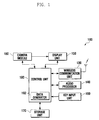
- FIG. 1 is a schematic block diagram illustrating a configuration of a mobile communication terminal 100 according to an exemplary embodiment of the present invention.
- the mobile communication terminal 100 includes a wireless communication unit 130, an audio processor 140, a display unit 150, a key input unit 160, a camera module 180, a storage unit 170, and a control unit 190.
- the wireless communication unit 130 transmits and receives data for wireless communication.
- the wireless communication unit 130 includes an RF transmitter that up-converts the frequency of a signal being transmitted and amplifies the signal.
- the wireless communication unit 130 further includes an RF receiver that low-noise amplifies a signal being received and down-converts its frequency.
- the wireless communication unit 130 receives data through a wireless channel to output the data to the control unit 190 and receives data from the control unit 190 to transmit the data through the wireless channel.
- the audio processor 140 includes a coder/decoder (codec).
- codec consists of a data codec for processing data such as packet data and an audio codec for processing audio signals such as voice.
- the audio processor 140 converts digital audio data fed into the control unit 190 to an analog audio signal through the audio codec and plays back the analog audio signal through a speaker.
- the audio processor 140 also converts an analog audio signal received through a microphone to digital audio data through the audio codec and outputs the digital audio data to the control unit 190.
- the key input unit 160 receives a user's manipulation signal for controlling the mobile communication terminal 100 and outputs the signal to the control unit 190. To achieve this function, the key input unit 160 includes multiple alphanumeric keys for inputting numeric and character information and control keys for controlling the operation of the mobile communication terminal 100.
- the camera module 180 takes a moving image formed by a lens of a camera sensor and converts the resulting optical signal to an electrical signal.
- the camera sensor may be a charge coupled device (CCD) or complementary metal oxide semiconductor (CMOS) sensor.
- CMOS complementary metal oxide semiconductor
- the camera sensor of the camera module 180 includes a plurality of photodiodes.
- the photodiode senses ambient illumination, i.e. ambient brightness when a moving image is taken, converts the sensed ambient illumination into illumination data, and transmits the illumination data to an illumination recognizer of a data generator 192.
- the camera module 180 further includes a signal processor that converts an analog moving image signal output from the camera sensor to digital moving image data.
- the signal processor may be a digital signal processor (DSP) or other signal processor.
- the display unit 150 displays data received from the control unit 190 on a screen.
- the display unit 150 is a 4 gray level liquid crystal display (LCD) designed to display a screen using contrast tones consisting of four gray levels such as black, dark gray, light gray, and white.
- the display unit 150 may be any other display device that can display a screen consisting of a plurality of contrast tones using a monochrome color.
- the display unit 150 includes an LCD control unit, a memory for storing moving image data, and an LCD display element. When the LCD is implemented using touch screen technology, the screen of the display unit 150 may function as an input unit.
- the storage unit 170 includes a program memory for storing programs for controlling the operation of the mobile communication terminal 100 and a data memory for storing data generated while executing the programs, moving image data obtained by converting an moving image signal input through the camera module 180, and various moving image data stored directly by a user.
- the storage unit 170 also stores upper and lower thresholds for defining a range of brightness values as well as high gray level, low gray level, and default gray level segmentation tables used to generate contrast tone moving image data.
- the upper and lower thresholds and the high gray level, low gray level, and default gray level segmentation tables will be described in more detail later, together with a method for displaying moving images using contrast tones according to an exemplary embodiment of the present invention.
- the control unit 190 performs the overall control operation of the mobile communication terminal 100.
- the control unit 190 also generates contrast tone moving image data, and outputs the contrast tone moving image data to the display unit 150 so that the display unit 150 can display a color moving image.
- the control unit 190 includes a data generator 192 that selects a suitable segmentation table that is appropriate for the ambient brightness and generates contrast tone moving image data using color moving image data.
- FIG. 2 is a block diagram schematically illustrating a configuration of the data generator 192 shown in FIG. 1.
- the data generator 192 includes a moving image frame extractor 195, a monochrome frame generator 196, an illumination recognizer 197, and a moving image converter 199.
- the moving image frame extractor 195 sequentially extracts color moving image frames from color moving image data and transmits the color moving image frames to the monochrome frame generator 196.
- the monochrome frame generator 196 extracts only a specific color from a color moving image frame obtained by the moving image frame extractor 195 and generates a monochrome moving image frame having the specific color.
- the specific color is green because it can emphasize contrast in the monochrome moving image frame well.
- other colors may be used as the specific color.
- the illumination recognizer 197 uses signals being fed from the plurality of photodiodes in the camera sensor to obtain an average illumination (hereinafter "brightness information") when a current color moving image is input.
- the moving image converter 199 receives brightness information from the illumination recognizer 197 and generates different contrast tone moving image data according to a range to which the brightness information belongs. That is, the moving image converter 199 converts a monochrome moving image frame to contrast tone moving image data using one of a high gray level segmentation table, a low gray level segmentation table, and a default gray level segmentation table, according to the range to which the brightness information belongs.
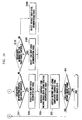
- FIGs. 3A and 3B are a flowchart illustrating a method for displaying a moving image using contrast tones according to an exemplary embodiment of the present invention.
- the control unit 190 determines whether there is a request to display a moving image (S12). A user inputs the request to display a moving image by converting the mode of the mobile communication terminal 100 to an moving image-taking mode. The control unit 190 then controls the camera module 180 to convert an moving image signal output from the camera sensor into color moving image data that is expressed by a digital signal and to output the color moving image data to the control unit 190 (S 13).
- the moving image frame extractor 195 sequentially extracts a color moving image frame from the received color moving image data (S 14).
- the color moving image frame is the frame received first of a plurality of color moving image frames in the color moving image data.
- a moving image frame with a monochrome color, such as green, is generated using the color moving image frame (S 15).
- the monochrome frame generator 196 extracts only green (G) information among red:green:blue (RGB) information for each pixel in the color moving image frame and generates a monochrome moving image frame based on the G information.
- brightness information is obtained (S16).
- the illumination recognizer 197 receives signals from the plurality of photodiodes in the camera sensor to calculate brightness for a current moving image being input to the camera sensor.
- the calculated brightness is used as the brightness information.
- the brightness information may be obtained by calculating an average illumination of a moving image frame. Further, the brightness information may be obtained before generating a monochrome moving image frame. That is, signals may be received from the plurality of photodiodes to obtain brightness information simultaneously with color moving image data being input to the control unit 190.
- the moving image converter 199 determines a range in which the brightness information lies. The moving image converter 199 determines whether the brightness information lies in a range of values greater than an upper threshold ("upper range") (S17). If the brightness information lies in the upper range, the moving image converter 199 selects a high-level segmentation table for conversion of a monochrome moving image frame (S18).
- upper range an upper threshold
- the moving image converter 199 determines whether the brightness information lies in a range of values less than a lower threshold ("lower range") (S 172). If the brightness value lies in the lower range, the moving image converter 199 selects a low gray level segmentation table for conversion of a monochrome moving image frame (S 182).
- the upper and lower thresholds are illumination values obtained when a screen moving image is too bright or too dark, respectively, for the user to clearly recognize the moving image.
- the upper and lower thresholds are predefined or modified by the user or engineer.
- the upper and lower thresholds are 700 Lux and 30 Lux, respectively.
- the upper and lower thresholds may be any other value that is appropriate.
- the moving image converter 199 selects a default gray level segmentation table (S 184) for conversion of a monochrome moving image frame.
- the moving image converter 199 uses the selected segmentation table to convert a monochrome moving image frame to contrast tone moving image data (S19).
- S19 A method for converting a monochrome moving image frame into contrast tone moving image data is described here with reference to FIGS. 4A-6B.
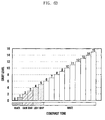
- FIG. 4A illustrates a default gray level segmentation table according to an exemplary embodiment of the present invention
- FIG. 4B is a graphic representation of FIG. 4A.
- the default gray level segmentation table contains 16 gray levels. That is, the entire gray scale is divided such that there are gray levels 0 to 15. As a gray level approaches 0, it represents a darker tone. As a gray level approaches 15, it represents a lighter tone.
- a contrast tone becomes brighter. While in the above description, a gray scale is divided into 16 gray levels, it may be divided into 32, 64, or more levels.
- the 16 gray levels in the default gray level segmentation table are grouped into 4 sets that are mapped into 4 contrast tones.
- one contrast tone corresponds to four gray levels. That is, black is matched to four gray levels 0 through 3. Dark gray is matched to gray levels 4 through 7. Similarly, light gray is matched to gray levels 8 through 11 while white is matched to gray levels 12 through 15.
- the moving image converter 199 first extracts one pixel in the monochrome moving image frame to determine gray level information about the pixel.
- the gray level information represents a gray level indicating the brightness of the pixel.
- each pixel has one of 16 gray levels as gray level information.
- the moving image converter 199 selects a contrast tone corresponding to the gray level information about the pixel using the default segmentation table. Because each pixel has one gray level, each pixel is mapped to one contrast tone using the default gray level segmentation table. The same applies when high gray and low gray level segmentation tables are used.
- the gray level of the extracted pixel is 10
- light gray is selected as a contrast tone of the extracted pixel
- dark gray is selected as the contrast tone of the pixel.
- FIG. 5A illustrates a high gray level segmentation table according to an exemplary embodiment of the present invention and FIG. 5B is a graphic representation of FIG. 5A.
- FIG. 6A illustrates a low gray level segmentation table according to an exemplary embodiment of the present invention and FIG. 6B is a graphic representation of FIG. 6A.
- the high gray and low gray level tables have structures similar to the default gray level segmentation table shown in FIG. 4A but have different mapping relationships between a gray level and a contrast tone.
- the high gray and low gray level segmentation tables each contain gray levels 0 to 15. As a gray level approaches 0, it represents a darker tone. As a gray level approaches 15, it represents a lighter tone.
- the difference is that high gray levels are mapped to more finely segmented contrast tones in the high gray level segmentation table than in the default gray level segmentation table shown in FIG. 4A.
- low gray levels are mapped to more finely segmented contrast tones in the low gray level segmentation table than in the default gray level segmentation table.
- the high gray level segmentation table is designed such that gray levels 0 through 9 are all mapped to black while the remaining gray levels 10 through 16 are grouped into three sets and each set is sequentially mapped to a corresponding contrast tone that goes from dark to light. That is, gray levels 10 and 11 are mapped to dark gray, gray levels 12 and 13 are mapped to light gray, and gray levels 14 and 15 are mapped to white.
- the low gray level segmentation table is designed such that gray levels 6 through 15 are all mapped to white while the remaining gray levels 0 through 5 are grouped into three sets and each set is sequentially mapped to a corresponding contrast tone that goes from dark to light. That is, gray levels 0 and 1 are mapped to black, gray levels 2 and 3 are mapped to dark gray, and gray levels 4 and 5 are mapped to light gray.
- pixels having the same gray level information may have different contrast tones depending on ambient brightness.
- the number of gray levels corresponding to one contrast tone may vary depending on the range in which brightness information lies. For example, in the present embodiment, the number of gray levels corresponding to black is 2, 4, and 10 in the low gray level, default gray level and high gray level segmentation table respectively.
- a process of selecting a contrast tone corresponding to each pixel in a monochrome moving image frame using a high gray level or low gray level segmentation table is performed in the same manner as the process of selecting a contrast tone corresponding to each pixel using the default gray level segmentation table.
- the gray level of an extracted pixel is 10
- dark gray is selected as the contrast tone of the pixel.
- black is selected as the contrast tone of the pixel.
- the gray level of an extracted pixel is 10
- white is selected as the contrast tone of the pixel.
- the gray level of the pixel is 5
- light gray is selected as the contrast tone of the pixel.
- the moving image converter 199 selects contrast tones corresponding to all pixels in a monochrome moving image frame to generate contrast tone moving image data.
- control unit 190 controls the display unit 150 to display an moving image on the screen using the contrast tone moving image data (S20).
- the control unit 190 continues to determine whether a subsequent color moving image frame exists in the color moving image data (S21). If a subsequent color moving image frame exists in the color moving image data, the process returns to step S 14.
- the control unit 190 extracts the subsequent color moving image frame from the color moving image data and repeats the steps S15 through S20. In this manner, the control unit 190 continuously generates contrast tone moving image data from color moving image data and controls the display unit 150 to display a moving image.
- contrast tone moving image data is generated using a high gray level segmentation table.
- contrast tone moving image data is generated using a low gray level segmentation table.
- exemplary embodiments of the present invention describe an example of converting color moving image data input through a camera module into contrast tone moving image data
- exemplary embodiments of the present invention can be applied to any other color moving image data such as color moving image data prestored in a storage unit.
- the entire brightness of an extracted color moving image frame is preferably calculated instead of its illumination value because the illumination value is not available.
- exemplary embodiments of the present invention can be applied to a mobile communication terminal with an apparatus for displaying contrast tones (for example, 4 gray level LCD) and other electronic devices with a 4 gray level LCD.
- contrast tones for example, 4 gray level LCD
- a method for displaying moving image using contrast tones in a mobile communication terminal enables the creation of contrast tone moving image data represented by contrast tones that can vary depending on ambient brightness.
- exemplary embodiments of the present invention enable a moving image to be naturally rendered by making full use of contrast tones even when an input moving image screen is too bright or too dark.
Landscapes
- Engineering & Computer Science (AREA)
- Signal Processing (AREA)
- Multimedia (AREA)
- General Physics & Mathematics (AREA)
- Theoretical Computer Science (AREA)
- Physics & Mathematics (AREA)
- Computer Hardware Design (AREA)
- Ecology (AREA)
- Remote Sensing (AREA)
- Business, Economics & Management (AREA)
- Life Sciences & Earth Sciences (AREA)
- Biodiversity & Conservation Biology (AREA)
- Chemical & Material Sciences (AREA)
- Emergency Management (AREA)
- Environmental & Geological Engineering (AREA)
- Environmental Sciences (AREA)
- Crystallography & Structural Chemistry (AREA)
- General Engineering & Computer Science (AREA)
- Computer Networks & Wireless Communication (AREA)
- Image Processing (AREA)
- Telephone Function (AREA)
- Facsimile Image Signal Circuits (AREA)
- Controls And Circuits For Display Device (AREA)
- Control Of Indicators Other Than Cathode Ray Tubes (AREA)
- Two-Way Televisions, Distribution Of Moving Picture Or The Like (AREA)
- Transforming Electric Information Into Light Information (AREA)
Applications Claiming Priority (1)
| Application Number | Priority Date | Filing Date | Title |
|---|---|---|---|
| KR1020060090496A KR100782505B1 (ko) | 2006-09-19 | 2006-09-19 | 이동통신 단말기의 명암색을 이용한 영상 표시 방법 및장치 |
Publications (2)
| Publication Number | Publication Date |
|---|---|
| EP1903794A2 true EP1903794A2 (de) | 2008-03-26 |
| EP1903794A3 EP1903794A3 (de) | 2010-03-24 |
Family
ID=38904841
Family Applications (1)
| Application Number | Title | Priority Date | Filing Date |
|---|---|---|---|
| EP07009317A Withdrawn EP1903794A3 (de) | 2006-09-19 | 2007-05-09 | Verfahren und Vorrichtung zur Anzeige von bewegten Bildern mithilfe von Kontrasttönen in mobilem Kommunikationsendgerät |
Country Status (4)
| Country | Link |
|---|---|
| US (1) | US20080068450A1 (de) |
| EP (1) | EP1903794A3 (de) |
| KR (1) | KR100782505B1 (de) |
| CN (1) | CN101149912A (de) |
Families Citing this family (4)
| Publication number | Priority date | Publication date | Assignee | Title |
|---|---|---|---|---|
| US20080204605A1 (en) * | 2007-02-28 | 2008-08-28 | Leonard Tsai | Systems and methods for using a remote control unit to sense television characteristics |
| EP2129090B1 (de) * | 2008-05-29 | 2016-06-15 | LG Electronics Inc. | Mobiles Endgerät und Anzeigesteuerungsverfahren dafür |
| JP5252247B2 (ja) * | 2010-08-19 | 2013-07-31 | アイシン精機株式会社 | ターゲット位置決定装置 |
| US9299007B2 (en) * | 2014-01-28 | 2016-03-29 | Ncr Corporation | Methods and apparatus for item identification using brightness compensation |
Family Cites Families (9)
| Publication number | Priority date | Publication date | Assignee | Title |
|---|---|---|---|---|
| US5546105A (en) * | 1991-07-19 | 1996-08-13 | Apple Computer, Inc. | Graphic system for displaying images in gray-scale |
| US6188385B1 (en) * | 1998-10-07 | 2001-02-13 | Microsoft Corporation | Method and apparatus for displaying images such as text |
| US6278434B1 (en) * | 1998-10-07 | 2001-08-21 | Microsoft Corporation | Non-square scaling of image data to be mapped to pixel sub-components |
| US6393145B2 (en) * | 1999-01-12 | 2002-05-21 | Microsoft Corporation | Methods apparatus and data structures for enhancing the resolution of images to be rendered on patterned display devices |
| GB2391995A (en) * | 2002-08-15 | 2004-02-18 | Seiko Epson Corp | Mobile telephone comprising sensors which optimise the contrast or colour of the screen. |
| KR100528537B1 (ko) * | 2003-04-04 | 2005-11-15 | 엘지전자 주식회사 | Lcd 화면 밝기 자동 조절 장치 및 그 방법 |
| WO2005027042A1 (ja) * | 2003-09-11 | 2005-03-24 | Matsushita Electric Industrial Co., Ltd. | 視覚処理装置、視覚処理方法、視覚処理プログラムおよび半導体装置 |
| US20050212824A1 (en) * | 2004-03-25 | 2005-09-29 | Marcinkiewicz Walter M | Dynamic display control of a portable electronic device display |
| JP2005341416A (ja) * | 2004-05-28 | 2005-12-08 | Toshiba Corp | 撮像機能付き電子機器およびその画像表示方法 |
-
2006
- 2006-09-19 KR KR1020060090496A patent/KR100782505B1/ko not_active Expired - Fee Related
-
2007
- 2007-02-12 US US11/705,158 patent/US20080068450A1/en not_active Abandoned
- 2007-03-09 CN CNA2007100860879A patent/CN101149912A/zh active Pending
- 2007-05-09 EP EP07009317A patent/EP1903794A3/de not_active Withdrawn
Also Published As
| Publication number | Publication date |
|---|---|
| KR100782505B1 (ko) | 2007-12-05 |
| EP1903794A3 (de) | 2010-03-24 |
| US20080068450A1 (en) | 2008-03-20 |
| CN101149912A (zh) | 2008-03-26 |
Similar Documents
| Publication | Publication Date | Title |
|---|---|---|
| CN102265707B (zh) | 终端设备中的发光器件控制方法、装置及终端设备 | |
| US11759143B2 (en) | Skin detection method and electronic device | |
| US8228438B2 (en) | Image processing method capable of improving the display quality of image frames | |
| KR100678101B1 (ko) | 영상의 색정보를 이용하여 메뉴 화면의 디스플레이 색상을구성하는 휴대용 단말기 및 그 방법 | |
| CN111510698A (zh) | 图像处理方法、装置、存储介质及移动终端 | |
| RU2704724C1 (ru) | Способ и устройство для отображения изображения интерфейса | |
| KR20130056442A (ko) | 화이트 밸런스 조절장치 및 방법 | |
| CN109670445B (zh) | 低视力助视智能眼镜系统 | |
| US12574635B2 (en) | Image processing method and related device thereof that processes an image with an algorithm based on a quantity of wait time determination | |
| CN114463191A (zh) | 一种图像处理方法及电子设备 | |
| EP1903794A2 (de) | Verfahren und Vorrichtung zur Anzeige von bewegten Bildern mithilfe von Kontrasttönen in mobilem Kommunikationsendgerät | |
| US20070075969A1 (en) | Method for controlling display of image according to movement of mobile terminal | |
| JP4282610B2 (ja) | カメラ、当該カメラを備えた携帯通信機器、撮影方法及びプログラム | |
| KR100663455B1 (ko) | 주변 조도에 따른 영상 표시장치 및 방법. | |
| CN103024470A (zh) | 图像显示方法、服务器及图像显示系统 | |
| KR100325250B1 (ko) | 카메라폰에서 반투과형 엘씨디 백라이트 제어장치 및 그방법 | |
| CN112508820B (zh) | 图像处理方法、装置及电子设备 | |
| KR100923643B1 (ko) | 영상 통화용 촬영 영상의 휘도 보정 방법 | |
| US20060072031A1 (en) | Mobile communication terminal equipped with digital image capturing module and method of capturing digital image | |
| CN118175246A (zh) | 处理视频的方法、显示设备及存储介质 | |
| KR20090010803A (ko) | 카메라에서 획득된 영상데이터를 표시하는 방법 및휴대단말기 | |
| JP5846856B2 (ja) | カメラ付インターホン装置 | |
| KR101015753B1 (ko) | 문서 이미지 전송 기능을 갖춘 이동 단말과 이를 위한문서 이미지 변환 방법 | |
| CN120343218A (zh) | 视频处理方法、装置、电子设备及存储介质 | |
| KR100678033B1 (ko) | 휴대 단말기의 카메라 기능 수행 방법 |
Legal Events
| Date | Code | Title | Description |
|---|---|---|---|
| PUAI | Public reference made under article 153(3) epc to a published international application that has entered the european phase |
Free format text: ORIGINAL CODE: 0009012 |
|
| 17P | Request for examination filed |
Effective date: 20070509 |
|
| AK | Designated contracting states |
Kind code of ref document: A2 Designated state(s): AT BE BG CH CY CZ DE DK EE ES FI FR GB GR HU IE IS IT LI LT LU LV MC MT NL PL PT RO SE SI SK TR |
|
| AX | Request for extension of the european patent |
Extension state: AL BA HR MK YU |
|
| PUAL | Search report despatched |
Free format text: ORIGINAL CODE: 0009013 |
|
| AK | Designated contracting states |
Kind code of ref document: A3 Designated state(s): AT BE BG CH CY CZ DE DK EE ES FI FR GB GR HU IE IS IT LI LT LU LV MC MT NL PL PT RO SE SI SK TR |
|
| AX | Request for extension of the european patent |
Extension state: AL BA HR MK RS |
|
| AKY | No designation fees paid | ||
| STAA | Information on the status of an ep patent application or granted ep patent |
Free format text: STATUS: THE APPLICATION IS DEEMED TO BE WITHDRAWN |
|
| 18D | Application deemed to be withdrawn |
Effective date: 20100928 |
|
| REG | Reference to a national code |
Ref country code: DE Ref legal event code: R108 Effective date: 20110301 Ref country code: DE Ref legal event code: 8566 |