EP1903863B1 - Kulturpflanzenverträgliche herbizide mittel enthaltend herbizide und acylsulfamoylbenzoesäureamide safener - Google Patents
Kulturpflanzenverträgliche herbizide mittel enthaltend herbizide und acylsulfamoylbenzoesäureamide safener Download PDFInfo
- Publication number
- EP1903863B1 EP1903863B1 EP06762208.4A EP06762208A EP1903863B1 EP 1903863 B1 EP1903863 B1 EP 1903863B1 EP 06762208 A EP06762208 A EP 06762208A EP 1903863 B1 EP1903863 B1 EP 1903863B1
- Authority
- EP
- European Patent Office
- Prior art keywords
- plants
- component
- effective amount
- herbicidal
- herbicidal composition
- Prior art date
- Legal status (The legal status is an assumption and is not a legal conclusion. Google has not performed a legal analysis and makes no representation as to the accuracy of the status listed.)
- Active
Links
Classifications
-
- A—HUMAN NECESSITIES
- A01—AGRICULTURE; FORESTRY; ANIMAL HUSBANDRY; HUNTING; TRAPPING; FISHING
- A01N—PRESERVATION OF BODIES OF HUMANS OR ANIMALS OR PLANTS OR PARTS THEREOF; BIOCIDES, e.g. AS DISINFECTANTS, AS PESTICIDES OR AS HERBICIDES; PEST REPELLANTS OR ATTRACTANTS; PLANT GROWTH REGULATORS
- A01N25/00—Biocides, pest repellants or attractants, or plant growth regulators, characterised by their forms, or by their non-active ingredients or by their methods of application, e.g. seed treatment or sequential application; Substances for reducing the noxious effect of the active ingredients to organisms other than pests
- A01N25/32—Ingredients for reducing the noxious effect of the active substances to organisms other than pests, e.g. toxicity reducing compositions, self-destructing compositions
-
- A—HUMAN NECESSITIES
- A01—AGRICULTURE; FORESTRY; ANIMAL HUSBANDRY; HUNTING; TRAPPING; FISHING
- A01N—PRESERVATION OF BODIES OF HUMANS OR ANIMALS OR PLANTS OR PARTS THEREOF; BIOCIDES, e.g. AS DISINFECTANTS, AS PESTICIDES OR AS HERBICIDES; PEST REPELLANTS OR ATTRACTANTS; PLANT GROWTH REGULATORS
- A01N37/00—Biocides, pest repellants or attractants, or plant growth regulators containing organic compounds containing a carbon atom having three bonds to hetero atoms with at the most two bonds to halogen, e.g. carboxylic acids
- A01N37/18—Biocides, pest repellants or attractants, or plant growth regulators containing organic compounds containing a carbon atom having three bonds to hetero atoms with at the most two bonds to halogen, e.g. carboxylic acids containing the group —CO—N<, e.g. carboxylic acid amides or imides; Thio analogues thereof
- A01N37/22—Biocides, pest repellants or attractants, or plant growth regulators containing organic compounds containing a carbon atom having three bonds to hetero atoms with at the most two bonds to halogen, e.g. carboxylic acids containing the group —CO—N<, e.g. carboxylic acid amides or imides; Thio analogues thereof the nitrogen atom being directly attached to an aromatic ring system, e.g. anilides
-
- A—HUMAN NECESSITIES
- A01—AGRICULTURE; FORESTRY; ANIMAL HUSBANDRY; HUNTING; TRAPPING; FISHING
- A01N—PRESERVATION OF BODIES OF HUMANS OR ANIMALS OR PLANTS OR PARTS THEREOF; BIOCIDES, e.g. AS DISINFECTANTS, AS PESTICIDES OR AS HERBICIDES; PEST REPELLANTS OR ATTRACTANTS; PLANT GROWTH REGULATORS
- A01N37/00—Biocides, pest repellants or attractants, or plant growth regulators containing organic compounds containing a carbon atom having three bonds to hetero atoms with at the most two bonds to halogen, e.g. carboxylic acids
- A01N37/36—Biocides, pest repellants or attractants, or plant growth regulators containing organic compounds containing a carbon atom having three bonds to hetero atoms with at the most two bonds to halogen, e.g. carboxylic acids containing at least one carboxylic group or a thio analogue, or a derivative thereof, and a singly bound oxygen or sulfur atom attached to the same carbon skeleton, this oxygen or sulfur atom not being a member of a carboxylic group or of a thio analogue, or of a derivative thereof, e.g. hydroxy-carboxylic acids
- A01N37/38—Biocides, pest repellants or attractants, or plant growth regulators containing organic compounds containing a carbon atom having three bonds to hetero atoms with at the most two bonds to halogen, e.g. carboxylic acids containing at least one carboxylic group or a thio analogue, or a derivative thereof, and a singly bound oxygen or sulfur atom attached to the same carbon skeleton, this oxygen or sulfur atom not being a member of a carboxylic group or of a thio analogue, or of a derivative thereof, e.g. hydroxy-carboxylic acids having at least one oxygen or sulfur atom attached to an aromatic ring system
- A01N37/40—Biocides, pest repellants or attractants, or plant growth regulators containing organic compounds containing a carbon atom having three bonds to hetero atoms with at the most two bonds to halogen, e.g. carboxylic acids containing at least one carboxylic group or a thio analogue, or a derivative thereof, and a singly bound oxygen or sulfur atom attached to the same carbon skeleton, this oxygen or sulfur atom not being a member of a carboxylic group or of a thio analogue, or of a derivative thereof, e.g. hydroxy-carboxylic acids having at least one oxygen or sulfur atom attached to an aromatic ring system having at least one carboxylic group or a thio analogue, or a derivative thereof, and one oxygen or sulfur atom attached to the same aromatic ring system
-
- A—HUMAN NECESSITIES
- A01—AGRICULTURE; FORESTRY; ANIMAL HUSBANDRY; HUNTING; TRAPPING; FISHING
- A01N—PRESERVATION OF BODIES OF HUMANS OR ANIMALS OR PLANTS OR PARTS THEREOF; BIOCIDES, e.g. AS DISINFECTANTS, AS PESTICIDES OR AS HERBICIDES; PEST REPELLANTS OR ATTRACTANTS; PLANT GROWTH REGULATORS
- A01N41/00—Biocides, pest repellants or attractants, or plant growth regulators containing organic compounds containing a sulfur atom bound to a hetero atom
- A01N41/02—Biocides, pest repellants or attractants, or plant growth regulators containing organic compounds containing a sulfur atom bound to a hetero atom containing a sulfur-to-oxygen double bond
- A01N41/04—Sulfonic acids; Derivatives thereof
- A01N41/06—Sulfonic acid amides
Definitions
- the invention relates to the technical field of crop protection agents which can be used against undesired plant growth and contain as active ingredients a combination of at least one herbicide and at least one safener.
- herbicides are not always sufficiently compatible with (i.e., not selective enough in) some important crops, such as corn, rice or corn, that their use is limited. Therefore, they can not be used in some cultures or only in such low application rates that the desired broad herbicidal activity against harmful plants is not guaranteed. In particular, many herbicides can not be used fully selectively against harmful plants in corn, rice, corn, sugar cane and some other crops.
- herbicides in combination with a so-called safener or antidote.
- a safener is to be understood as meaning a compound which abolishes or reduces the phytotoxic properties of a herbicide against crop plants, without the herbicidal activity against harmful plants being substantially reduced.
- Herbicides and safeners are already known from some documents as herbicides. For example, in WO 96/14304 herbicidal agents of sulfonylureas and in WO 03/022050 herbicidal agents of Benzoylisoxazolen each described with a variety of structurally different safeners.
- WO2003 / 022050 discloses the combination of certain acylsulfamoylbenzoic acid amides and herbicidally active benzoylisoxazoles.
- US2004 / 224849 is the combination of Benzoylcyclohexanedionen and Acylsulfamoylbenzoeklareamiden called and in US20004 / 087445 the combination of benzoylpyrazoles and acylsulfamoylbenzoic acid amides is disclosed.
- the safeners A can also be used in the form of their salts. These include in particular the salts of alkali and alkaline earth metals, such as sodium, potassium, magnesium and calcium.
- the salts can be prepared by reactions known to those skilled in the art, for example by reacting the safeners A with the corresponding bases, such as sodium hydroxide or potassium hydroxide.
- the herbicidal compositions according to the invention have high compatibility with cultivated plants.
- the high compatibility with cultivated plants can be observed, for example, in the case of joint application of components A and B; it can often also be detected in the case of application at a later time (splitting).
- Possible is also the application of the individual herbicides and safeners or herbicide-safener combinations in several portions (sequence application), z.
- herbicidal compositions which, in addition to the components A and B, also contain one or more further agrochemical active substances of a different structure, such as herbicides, insecticides, fungicides or safeners.
- further agrochemical active substances of a different structure such as herbicides, insecticides, fungicides or safeners.
- herbicidal compositions which, in addition to components A and B, also contain fertilizers, such as ammonium sulfate, ammonium nitrate, urea, potassium nitrate and mixtures thereof.
- fertilizers such as ammonium sulfate, ammonium nitrate, urea, potassium nitrate and mixtures thereof.
- herbicidal compositions which, in addition to the components A and B, also contain adjuvants, such as emulsifiers, dispersants, mineral and vegetable oils and mixtures thereof.
- adjuvants such as emulsifiers, dispersants, mineral and vegetable oils and mixtures thereof.
- herbicidal compositions comprising, as component A, the safener A3
- Preferred herbicidal agents are those containing one or more of the combinations of components A and B mentioned in Table 1.
- herbicidal compositions are those containing one or more of the combinations of components A and B mentioned in Table 3.
- the herbicidal compositions according to the invention are characterized by a content of one component A and two different components B of the groups B1, B4, B5, B7 and B10 mentioned.
- the herbicidal compositions according to the invention comprise, as component A, the safener A3 and a component B in each case one of the groups B1, B4, B5, B7 and B10.
- the herbicidal compositions according to the invention contain as component A the safener A3 and two different components B. Such particularly preferred embodiments are mentioned in Table 4.
- compositions according to the invention are generally required application rates in the range of 1 to 1000 g, preferably 1 to 500 g, more preferably 5 to 250 g of component A and 1 to 2000 g, preferably 1 to 1000 g, particularly preferably 5 bis 500 g, the component B.
- the application rate of the component B, the expert can refer to the known recommendations of the manufacturers on the packaging units.
- the weight ratios of the components A to B can be varied within wide ranges and depend inter alia on the herbicide used, the harmful plants to be controlled and the crop culture in which the agent according to the invention is to be used.
- the quantitative ratio of components A to B is preferably in the range from 1: 100 to 100: 1, more preferably in the range from 1:50 to 50: 1, in particular in the range from 1:20 to 20: 1.
- Optimal weight ratios may depend on the particular application area, weed spectrum and the active ingredient combination used and be determined in preliminary experiments.
- the safeners used according to the invention are also outstandingly suitable for the pretreatment of the seed of crop plants (dressing of the seeds).
- the safeners may also be introduced into the seed furrow before sowing or applied together with the herbicide before or after emergence of the plants.
- Pre-emergence treatment includes both the treatment of the cultivated area prior to sowing and the treatment of the sown, but not overgrown cultivated areas.
- preference is given to joint use with the herbicide. For this tank mixes or finished formulations can be used.
- Another particularly preferred embodiment is those herbicidal compositions in which the combinations of A3 mentioned in Table 4 with two herbicides B are each combined with a fungicide or insecticide C.
- compositions according to the invention can be used for the selective control of annual and perennial monocotyledonous and dicotyledonous harmful plants in crops (for example barley, oats, rye, wheat), maize and rice crops and in transgenic crops or conventionally selected crops which are active against the active substances B resistant.
- crops for example barley, oats, rye, wheat
- they can be used for controlling unwanted harmful plants in plantation crops such as oil palm, sugar cane, coconut palm, rubber tree, citrus, pineapple, cotton, coffee, cocoa u.a. as well as in the fruit and viticulture. Due to their good compatibility, they are particularly suitable for use in cereals and maize, especially in maize.
- compositions according to the invention capture a broad spectrum of weeds. They are suitable for controlling annual and perennial harmful plants such as the species Abuthylon, Alopecurus, Avena, Chenopodium, Cynoden, Cyperus, Digitaria, Echinochloa, Elymus, Galium, Ipomoea, Kochia, Lamium, Matricaria, Polygonum, Scirpus, Setaria, Sorghum , Veronica, Viola and Xanthium.
- a further advantage of the agents according to the invention is also their excellent action against many harmful plants now resistant to sulphonylureas, such as, for example, Kochia.
- the invention also provides a method for controlling unwanted plant growth, characterized in that applying the herbicide B with one or more safeners A on the harmful plants, plant parts thereof or the acreage.
- herbicidal compositions according to the invention can be present both as mixed formulations of safener A and herbicides B, optionally with other customary formulation auxiliaries, which are then diluted with water in the usual way, or as so-called tank mixtures by joint dilution of the separately formulated or partially separately formulated Components are made with water.
- the herbicidal compositions according to the invention can be formulated in various ways, depending on which biological and / or chemical-physical parameters are predetermined.
- general formulation possibilities come e.g. in question: wettable powders (WP), emulsifiable concentrates (EC), aqueous solutions (SL), emulsions (EW) such as oil-in-water and water-in-oil emulsions, sprayable solutions or emulsions, oil suspension concentrate (SC), Oil or water-based dispersions, suspoemulsions, dusts (DP), mordants, granules for soil or litter application or water-dispersible granules (WG), water-dispersible granules (WDG), water-emulsifiable granules (WEG), ULV formulations, microcapsules or waxes.
- WP wettable powders
- EC emulsifiable concentrates
- SL aqueous solutions
- EW e
- Injection powders are preparations which are uniformly dispersible in water and which, in addition to the active ingredient, except for a diluent or inert substance, are also ionic or nonionic surfactants (wetting agents, dispersants), e.g. polyoxethylated alkylphenols, polyethoxylated fatty alcohols or fatty amines, alkanesulfonates or alkylbenzenesulfonates, sodium lignosulfonate, sodium 2,2'-dinaphthylmethane-6,6'-disulfonate, sodium dibutylnaphthalene-sulfonate, or sodium oleoylmethyltaurine.
- ionic or nonionic surfactants e.g. polyoxethylated alkylphenols, polyethoxylated fatty alcohols or fatty amines, alkanesulfonates or alkylbenzenesulfonates,
- Emulsifiable concentrates are prepared by dissolving the active ingredient in an organic solvent, for example butanol, cyclohexanone, dimethylformamide, xylene or higher-boiling aromatics or hydrocarbons with the addition of one or more ionic or nonionic surfactants (emulsifiers).
- organic solvent for example butanol, cyclohexanone, dimethylformamide, xylene or higher-boiling aromatics or hydrocarbons with the addition of one or more ionic or nonionic surfactants (emulsifiers).
- emulsifiers which can be used are: alkylarylsulfonic acid calcium salts such as calcium dodecylbenzenesulfonate or nonionic emulsifiers such as fatty acid polyglycol esters, alkylaryl polyglycol ethers, fatty alcohol polyglycol ethers, propylene oxide / ethylene oxide condensation products, Alkyl polyethers, sorbitan fatty acid esters, polyoxyethylene sorbitan fatty acid esters or polyoxethylene sorbitol esters.
- Dusts are obtained by milling the active ingredient with finely divided solids, e.g. Talc, natural clays such as kaolin, bentonite and pyrophyllite, or diatomaceous earth.
- finely divided solids e.g. Talc, natural clays such as kaolin, bentonite and pyrophyllite, or diatomaceous earth.
- Granules can either be prepared by atomizing the active ingredient on adsorptive, granulated inert material or by applying active substance concentrates by means of adhesives, e.g. Polyvinyl alcohol, polyacrylic acid sodium or mineral oils, on the surface of carriers such as sand, kaolinites or granulated inert material. It is also possible to granulate suitable active ingredients in the manner customary for the production of fertilizer granules, if desired in admixture with fertilizers. Water dispersible granules are typically prepared by methods such as spray drying, fluidized bed granulation, plate granulation, high speed mixing and extrusion without solid inert material.
- the agrochemical preparations generally contain from 0.1 to 99% by weight, in particular from 0.2 to 95% by weight, of components A and B, the following concentrations being customary depending on the type of formulation:
- the active ingredient concentration is, for example, about 10 to 95% by weight .-%, the remainder to 100 wt .-% consists of conventional formulation ingredients.
- the active ingredient concentration may be, for example, from 5 to 80% by weight.
- Dusty formulations usually contain 5 to 20 wt .-% of active ingredient, sprayable solutions about 0.2 to 25 wt .-% of active ingredient.
- the active ingredient content depends, in part, on whether the active compound is liquid or solid and which granulating aids and fillers are used. As a rule, the content of the water-dispersible granules is between 10 and 90% by weight.
- the active ingredient formulations mentioned optionally contain the customary adhesion, wetting, dispersing, emulsifying, preserving, antifreeze and solvent, filling, color and Carriers, defoamers, evaporation inhibitors and agents that influence the pH or the viscosity.
- the formulations present in commercial form are optionally diluted in a customary manner, e.g. for wettable powders, emulsifiable concentrates, dispersions and water-dispersible granules by means of water. Dust-like preparations, soil or scattering granules, as well as sprayable solutions are usually no longer diluted with other inert substances before use.
- the active substances can be applied to the plants, plant parts, plant seeds or the acreage (field soil), preferably to the green plants and plant parts and optionally additionally to the field soil.
- One possibility of the application is the joint application of the active ingredients in the form of tank mixes, wherein the optimally formulated concentrated formulations of the individual active ingredients are mixed together in the tank with water and the resulting spray mixture is discharged.
- a common herbicidal formulation of the herbicidal compositions according to the invention has the advantage of easier applicability, because the amounts of the components are already set in the correct ratio to each other.
- the adjuvants in the formulation can be optimally matched to each other, while a tank mix of different formulations can give undesirable combinations of adjuvants.
- Seeds of monocotyledonous and dicotyledonous weeds or crop plants are laid out in sandy soil in cardboard pots and covered with soil.
- the herbicidal compositions according to the invention formulated in the form of wettable powders or emulsion concentrates are then applied to the surface of the cover soil as an aqueous suspension or emulsion having a water application rate of 600 to 800 l / ha in different dosages.
- the pots are placed in the greenhouse and kept under good growth conditions for the weeds.
- the visual assessment of plant damage or run-on damage occurs after emergence of the test plants after a test period of 3 to 4 weeks in comparison to untreated controls. The results are summarized in Table A.
- Seeds of monocotyledonous or dicotyledonous weed or crop plants are laid out in sandy loam soil in wood fiber pots or in plastic pots, covered with soil and grown in the greenhouse, during the growing season outside in the greenhouse, under good growth conditions. 2-3 weeks after sowing, the test plants are treated in the one to three leaf stage.
- the herbicidal compositions according to the invention formulated as wettable powders (WP) or liquid (EC) are sprayed onto the plants and the soil surface in different dosages with a water application rate of 300 l / ha with the addition of wetting agent (0.2 to 0.3%).
- WP wettable powders
- EC liquid
- Seeds of maize are treated with different amounts of a safener (pickled) and then laid in sandy loam soil and covered with soil.
- the herbicides formulated as emulsifiable concentrates or dusts are applied to the surface of the cover soil at a dosage of 300 to 800 l / ha in different dosages.
- the visual evaluation of damage to crops takes place 3 to 5 weeks after the treatment. The results are summarized in Tables C and D.
- Tables 3 and 4 show the dosage of the herbicide (component B) in grams per hectare and that of the safener (component A) in grams per kilogram of seed.
- Table C Effect in the case of seed treatment, pre-emergence component dosage Damage to corn Reduction of injury B1.10 63 50% B1.10 + A3 63 + 0.5 20% 60% B1.25 40 40% B1.25 + A3 40 + 0.5 20% 50% component dosage Damage to corn Reduction of injury B1.1 31 100% B1.1 + A3 31 + 0.5 20% 80% B1.5 13 50% B1.5 + A3 13 + 0.5 10% 80% B1.12 31 70% B1.12 + A3 31 + 0.5 20% 71% B1.23 38 95% B1.23 + A3 38 + 0.5 30% 68% B1.25 125 65% B1.25 + A3 125 + 0.5 20% 69% B1.31 38 40% B1.31 + A3 38 + 0.5 10% 75%
Landscapes
- Life Sciences & Earth Sciences (AREA)
- Health & Medical Sciences (AREA)
- General Health & Medical Sciences (AREA)
- Dentistry (AREA)
- Plant Pathology (AREA)
- Engineering & Computer Science (AREA)
- Pest Control & Pesticides (AREA)
- Agronomy & Crop Science (AREA)
- Wood Science & Technology (AREA)
- Zoology (AREA)
- Environmental Sciences (AREA)
- Toxicology (AREA)
- Agricultural Chemicals And Associated Chemicals (AREA)
Description
- Die Erfindung betrifft das technische Gebiet der Pflanzenschutzmittel, die gegen unerwünschten Pflanzenwuchs eingesetzt werden können und als Wirkstoffe eine Kombination von mindestens einem Herbizid und mindestens einem Safener enthalten.
- In der Regel sind Herbizide nicht immer ausreichend verträglich mit (d.h. nicht selektiv genug bei) einigen wichtigen Kulturpflanzen, wie Mais, Reis oder Getreide, so daß ihrem Einsatz enge Grenzen gesetzt sind. Sie können deshalb in manchen Kulturen nicht oder nur in so geringen Aufwandmengen eingesetzt werden, daß die erwünschte breite herbizide Wirksamkeit gegenüber Schadpflanzen nicht gewährleistet ist. Speziell können viele Herbizide nicht vollständig selektiv gegen Schadpflanzen in Mais, Reis, Getreide, Zuckerrohr und einigen anderen Kulturen eingesetzt werden.
- Zur Überwindung dieser Nachteile ist es bekannt, Herbizide in Kombination mit einem sogenannten Safener oder Antidot einzusetzen. Unter einem Safener ist eine Verbindung zu verstehen, die die phytotoxischen Eigenschaften eines Herbizides gegenüber Nutzpflanzen aufhebt oder verringert, ohne daß die herbizide Wirkung gegenüber Schadpflanzen wesentlich vermindert wird. Aus einigen Dokumenten sind bereits herbizide Mittel enthaltend Herbizide und Safener bekannt. So werden beispielsweise in
WO 96/14304 WO 03/022050 US 6,251,827 sind Safener vom Typ der Acylsulfamoylbenzoesäureamide bekannt.
WO99/16744 -
WO2003/022050 offenbart die Kombination bestimmter Acylsulfamoylbenzoesäureamide und herbizid wirksamer Benzoylisoxazole. InUS2004/224849 ist die Kombination von Benzoylcyclohexanedionen und Acylsulfamoylbenzoesäureamiden genannt und inUS20004/087445 ist die Kombination von Benzoylpyrazolen und Acylsulfamoylbenzoesäureamiden offenbart. - Die Anwendung der aus diesen Schriften bekannten herbiziden Mitteln ist jedoch in der Praxis häufig mit Nachteilen verbunden. So ist die herbizide Wirksamkeit der bekannten Verbindungen nicht immer ausreichend, oder bei ausreichender herbizider Wirksamkeit werden unerwünschte Schädigungen der Nutzpflanzen beobachtet.
- Aufgabe der vorliegenden Erfindung ist die Bereitstellung von herbiziden Mitteln mit gegenüber dem Stand der Technik verbesserten Eigenschaften.
- Es wurde nun gefunden, daß ausgewählte Kombinationen von bestimmten Herbiziden mit einigen Safenern eine hervorragende Verträglichkeit in Kulturen von Nutzpflanzen bei gleichzeitig hoher Wirksamkeit gegen unerwünschte Schadpflanzen aufweisen.
- Ein Gegenstand der Erfindung sind ausgewählte herbizide Mittel, gekennzeichnet durch einen wirksamen Gehalt an
- A) einer antidotisch wirksamen Menge an einem oder mehreren Safenern aus der Gruppe der Acylsulfamoylbenzoesäureamide der Formel (I), gegebenenfalls auch in Salzform, (Komponente A)

- R1 bedeutet Methoxy;
- R2 bedeutet Wasserstoff;
- R3 bedeutet Wasserstoff;
- R4 bedeutet Cyclopropyl
- B) einer herbizid wirksamen Menge eines oder mehrerer Herbizide (Komponente B) ausgewählt aus den Gruppen B1, B4, B5, B7 und B10:
- B1 Inhibitoren der Aminosäurebiosynthese
Flucarbazone (B1.1), Metsulfuron (B1.5), Prosulfuron (B1.8), Tribenuron (B1.10), Chlorimuron (B1.12), Ethoxysulfuron (B1.13), , Halosulfuron (B1.17), Propoxycarbazone (B1.23), Amidosulfuron (B1.25), Chlorsulfuron (B1.26), Triasulfuron (B1.28), Flupyrsulfuron (B1.31), - B4 Inhibitoren der Fettsäurebiosynthese
EPTC (B4.1), - B5 Inhibitoren der Zellteilung
S-Metolachlor (B5.2), - B7 Synthetische Auxine
Dicamba (B7.1), - B10 Pendimethalin (B10.1),
- B1 Inhibitoren der Aminosäurebiosynthese
- Die chemischen Strukturen der oben und auch noch nachfolgend mit ihren "common names" genannten Wirkstoffe sind beispielsweise aus "The Pesticide Manual" 13. Auflage, 2003, British Crop Protection Council, und von der Webseite http://www.hclrss.demon.co.uk bekannt.
- Wenn im Rahmen dieser Beschreibung die Kurzform des "common name" eines Wirkstoffs verwendet wird, so sind damit jeweils alle gängigen Derivate, wie die Ester und Salze, und Isomere, insbesondere optische Isomere umfasst, insbesondere die handelsübliche Form bzw. Formen. Wird mit dem "common name" ein Ester oder Salz bezeichnet, so sind damit auch jeweils alle anderen gängigen Derivate wie andere Ester und Salze, die freien Säuren und Neutralverbindungen, und Isomere, insbesondere optische Isomere umfasst, insbesondere die handelsübliche Form bzw. Formen. Die angegebenen chemischen Verbindungsnamen bezeichnen zumindest eine der von dem "common name" umfaßten Verbindungen, häufig eine bevorzugte Verbindung.
- Im Folgenden sind die Begriffe "Komponente A" und "Safener A" als gleichbedeutend zu verstehen. Analoges gilt für die Begriffe "Komponente B" und "Herbizid B".
- Die Safener A können auch in Form ihrer Salze eingesetzt werden. Dazu zählen insbesondere die Salze der Alkali- und Erdalkalimetalle, wie Natrium, Kalium, Magnesium und Calcium. Die Salze können durch dem Fachmann bekannte Reaktionen, beispielsweise durch Umsetzung der Safener A mit den entsprechenden Basen, wie Natriumhydroxid oder Kaliumhydroxid, hergestellt werden.
- Die erfindungsgemäßen herbiziden Mittel weisen hohe Verträglichkeit gegenüber Kulturplanzen auf. Die hohe Verträglichkeit gegenüber Kulturplanzen kann z.B. bei gemeinsamer Ausbringung der Komponenten A und B beobachtet werden, sie kann häufig auch bei zeitlich versetzter Anwendung (Splitting) festgestellt werden. Möglich ist auch die Anwendung der einzelnen Herbizide und Safener oder der Herbizid-Safener-Kombinationen in mehreren Portionen (Sequenzanwendung), z. B. Anwendungen im Vorauflauf, gefolgt von Nachauflauf-Applikationen oder frühe Nachauflaufanwendungen, gefolgt von Applikationen im mittleren oder späten Nachauflauf. Bevorzugt ist dabei die gemeinsame oder die zeitnahe Anwendung der Wirkstoffe Safener und Herbizd.
- Erfindungsgemäß umfasst sind auch solche herbiziden Mittel, die neben den Komponenten A und B noch ein oder mehrere weitere agrochemische Wirkstoffe anderer Struktur enthalten, wie Herbizide, Insektizide, Fungizide oder Safener. Für solche herbiziden Mittel gelten die vor- und nachstehend erläuterten bevorzugten Bedingungen ebenfalls.
- Ebenso erfindungsgemäß umfasst sind auch solche herbiziden Mittel, die neben den Komponenten A und B noch Düngenmittel, wie Ammoniumsulfat, Ammoniumnitrat, Harnstoff, Kaliumnitrat und Mischungen davon, enthalten. Für solche herbiziden Mittel gelten die vor- und nachstehend erläuterten bevorzugten Bedingungen ebenfalls.
- Weiterhin erfindungsgemäß umfasst sind auch solche herbiziden Mittel, die neben den Komponenten A und B noch Adjuvantien, wie Emulgatoren, Dispergatoren, mineralische und pflanzliche Öle und Mischungen davon, enthalten. Für solche herbiziden Mittel gelten die vor- und nachstehend erläuterten bevorzugten Bedingungen ebenfalls.
- Von besonderem Interesse sind herbizide Mittel enthaltend
- A) als Komponente A Acylsulfamoylbenzoesäureamide der Formel (I) wie vorstehend definiert und
- B) als Komponente B ein oder mehrere Herbizide ausgewählt aus den Gruppen B1, B4, B5, B7 und B10:
- B1 Inhibitoren der Aminosäurebiosynthese
Flucarbazone (B1.1), Metsulfuron (B1.5), Prosulfuron (B1.8), Tribenuron (B1.10), Chlorimuron (B1.12), Ethoxysulfuron (B1.13), Halosulfuron (B1.17), Propoxycarbazone (B1.23), Amidosulfuron (B1.25), Chlorsulfuron (B1.26), Triasulfuron (B1.28), Flupyrsulfuron (B1.31), - B4 Inhibitoren der Fettsäurebiosynthese
EPTC (B4.1), - B5 Inhibitoren der Zellteilung
S-Metolachlor (B5.2), - B7 Synthetische Auxine
Dicamba (B7.1), - B10 Pendimethalin (B10.1).
- B1 Inhibitoren der Aminosäurebiosynthese
- Von ganz besonderem Interesse sind herbizide Mittel enthaltend als Komponente A den Safener A3

- Ebenfalls von ganz besonderem Interesse sind herbizide Mittel enthaltend als Komponente B ein oder mehrere Herbizide ausgewählt aus Flucarbazone, Metsulfuron, Prosulfuron, Tribenuron, Chlorimuron, Ethoxysulfuron, Propoxycarbazone,S-Metolachlor, Dicamba, .
- Bevorzugte herbizide Mittel sind solche mit einem Gehalt an einer oder mehreren der in Tabelle 1 genannten Kombinationen der Komponenten A und B.
- (A3+B1.1 (A3+B1.5), (A3+B1.8), (A3+B1.10), (A3+B1.12), (A3+B1.13), (A3+B1.17), (A3+B1.23), (A3+B5.2), (A3+B10.1)
- Besonders bevorzugte herbizide Mittel sind solche mit einem Gehalt an einer oder mehreren der in Tabelle 3 genannten Kombinationen der Komponenten A und B.
- (A3+B1.1), (A3+B1.5), (A3+B1.8), (A3+B1.10), (A3+B5.2), (A3+B7.1), (A3+B10.1)
- In einer weiteren bevorzugten Ausführungsform sind die erfindungsgemäßen herbiziden Mittel gekennzeichnet durch einen Gehalt an einer Komponente A und zwei verschiedenen Komponenten B der genannten Gruppen B1, B4, B5, B7 und B10. In einer besonders bevorzugten Ausführungsform enthalten die erfindungsgemäßen herbiziden Mittel als Komponente A den Safener A3 und eine Komponente B jeweils einer der Gruppen B1, B4, B5, B7 und B10. In weiteren besonders bevorzugten Ausführungsform enthalten die erfindungsgemäßen herbiziden Mittel als Komponente A den Safener A3 und zwei verschiedene Komponenten B. Solche besonders bevorzugten Ausführungsformen sind in Tabelle 4 genannt.
- (A3+B1.1+B1.5), (A3+B1.1+B1.8), (A3+B1.1+B1.10), (A3+B1.1+B1.12), (A3+B1.1+B1.13), (A3+B1.1+B1.17), (A3+B1.1+B1.23), (A3+B1.1+B1.25), (A3+B1.1+B1.26), (A3+B1.1+B1.28), (A3+B1.1+B1.31), (A3+B1.1+B4.1), (A3+B1.1+B5.2), (A3+B1.1+B7.1), (A3+B1.1+B10.1),
(A3+B1.5+B1.8), (A3+B1.5+B1.10), (A3+B1.5+B1.12), (A3+B1.5+B1.13), (A3+B1.5+B1.17), (A3+B1.5+B1.23 (A3+B1.5+B1.25), (A3+B1.5+B1.26), (A3+B1.5+B4.1), (A3+B1.5+B5.2), (A3+B1.5+B7.1), (A3+B1.5+B10.1),
(A3+B1.8+B1.10), (A3+B1.8+B1.12), (A3+B1.8+B1.13), (A3+B1.8+B1.17), (A3+B1.8+B1.23), (A3+B1.8+B1.25), (A3+B1.8+B1.26), (A3+B1.8+B1.28), (A3+B1.8+B1.31), (A3+B1.8+B4.1), (A3+B1.8+B5.2), (A3+B1.8+B7.1), (A3+B1.8+B10.1),
(A3+B1.10+B1.12), (A3+B1.10+B1.13), (A3+B1.10+B1.17), (A3+B1.10+B1.23), (A3+B1.10+B1.25), (A3+B1.10+B1.26), (A3+B1.10+B1.28), (A3+B1.10+B1.31), (A3+B1.10+B4.1), (A3+B1.10+B5.2), (A3+B1.10+B7.1), (A3+B1.10+B10.1),
(A3+B1.12+B1.13), (A3+B1.12+B1.17), (A3+B1.12+B1.23), (A3+B1.12+B1.25), (A3+B1.12+B1.26), (A3+B1.12+B1.28), (A3+B1.12+B1.31), (A3+B1.12+B4.1), (A3+B1.12+B5.2), (A3+B1.12+B7.1), (A3+B1.12+B10.1),
(A3+B1.13+B1.17), (A3+B1.13+B1.23 (A3+B1.13+B1.25), (A3+B1.13+B1.26), (A3+B1.13+B1.28), (A3+B1.13+B1.31), (A3+B1.13+B4.1), (A3+B1.13+B5.2), (A3+B1.13+B7.1), (A3+B1.13+B10.1),
(A3+B1.17+B1.23), (A3+B1.17+B1.25), (A3+B1.17+B1.26), (A3+B1.17+B1.28), (A3+B1.17+B1.31), (A3+B1.17+B4.1), (A3+B1.17+B5.1), (A3+B1.17+B7.1), (A3+B1.17+B10.1),
(A3+B1.23+B1.25), (A3+B1.23+B1.26), (A3+B1.23+B1.28), (A3+B1.23+B1.31), (A3+B1.23+B4.1), (A3+B1.23+B5.2), (A3+B1.23+B7.1), (A3+B1.23+B10.1),
(A3+B1.25+B1.26), (A3+B1.25+B1.28), (A3+B1.25+B1.31), (A3+B1.25+B4.1), (A3+B1.25+B5.2), (A3+B1.25+B7.1), (A3+B1.25+B10.1),
(A3+B1.26+B1.28), (A3+B1.26+B1.31), (A3+B1.26+B4.1), (A3+B1.26+B5.2), (A3+B1.26+B7.1), (A3+B1.26+B10.1),
(A3+B1.28+B1.31), (A3+B1.28+B4.1), (A3+B1.28+B7.1), (A3+B1.28+B10.1),
(A3+B1.31+B4.1 (A3+B1.31+B5.2), (A3+B1.31+B7.1), (A3+B1.31+B10.1),
(A3+B4.1+B5.2),(A3+B4.1+B7.1), (A3+B4.1+B10.1),
(A3+B5.2+B7.1), (A3+B5.2+B10.1),
(A3+B7.1+B10.1), - In den erfindungsgemäßen herbiziden Mitteln benötigt man in der Regel Aufwandmengen im Bereich von 1 bis 1000 g, vorzugsweise 1 bis 500 g, besonders bevorzugt 5 bis 250 g der Komponente A und 1 bis 2000 g, vorzugsweise 1 bis 1000 g, besonders bevorzugt 5 bis 500 g, der Komponente B. Die Aufwandmenge der Komponente B kann der Fachmann den bekannten Empfehlungen der Hersteller auf den Verpackungseinheiten entnehmen.
- Die Gewichtsverhältnisse der Komponenten A zu B können in weiten Bereichen variiert werden und hängen unter anderem ab vom verwendeten Herbizid, den zu bekämpfenden Schadpflanzen und der Nutzpflanzenkultur, in der das erfindungsgemäße Mittel eingesetzt werden soll. Vorzugsweise ist das Mengenverhältnis der Komponenten A zu B im Bereich von 1:100 bis 100:1, besonders bevorzugt im Bereich von 1:50 bis 50:1, insbesondere im Bereich von 1:20 bis 20:1. Optimale Gewichtsverhältnisse können vom jeweiligen Applikationsgebiet, Unkrautspektrum und der eingesetzten Wirkstoffkombination abhängen und in Vorversuchen bestimmt werden.
- Die erfindungsgemäß eingesetzten Safener eignen sich auch hervorragend zur Vorbehandlung des Saatgutes von Kulturpflanzen (Beizung der Samen). Ebenso können die Safener auch vor der Saat in die Saatfurchen eingebracht oder zusammen mit dem Herbizid vor oder nach dem Auflaufen der Pflanzen angewendet werden. Vorauflaufbehandlung schließt sowohl die Behandlung der Anbaufläche vor der Aussaat als auch die Behandlung der angesäten, aber noch nicht bewachsenen Anbauflächen ein. Bevorzugt ist neben der Saatgutbehandlung die gemeinsame Anwendung mit dem Herbizid. Hierzu können Tankmischungen oder Fertigformulierungen eingesetzt werden.
- Bei einer weiteren besonders bevorzugten Ausführungsform handelt es sich um solche herbizide Mittel, bei denen die in Tabelle 4 genannten Kombinationen von A3 mit zwei Herbiziden B jeweils mit einem Fungizid oder Insektizid C kombiniert werden.
- Die erfindungsgemäßen Mittel lassen sich zur selektiven Bekämpfung von annuellen und perennierenden monokotylen und dikotylen Schadpflanzen in Getreide-(beispielsweise Gerste, Hafer, Roggen, Weizen), Mais- und Reiskulturen sowie in transgenen Nutzpflanzenkulturen oder auf klassischem Wege selektierten Nutzpflanzenkulturen, die gegen die Wirkstoffe B resistent sind, einsetzen. Ebenso sind sie zur Bekämpfung unerwünschter Schadpflanzen einsetzbar in Plantagenkulturen wie Ölpalme, Zuckerrohr, Kokospalme, Gummibaum, Zitrus, Ananas, Baumwolle, Kaffee, Kakao u.a. sowie im Obst- und Weinbau. Besonders geeignet sind sie auf Grund ihrer guten Verträglichkeit für die Anwendung in Getreide und Mais, ganz besonders in Mais.
- Die erfindungsgemäßen Mittel erfassen ein breites Unkrautspektrum. Sie eignen sich zur Bekämpfung von annuellen und perennierenden Schadpflanzen wie z.B. aus den Spezies Abuthylon, Alopecurus, Avena, Chenopodium, Cynoden, Cyperus, Digitaria, Echinochloa, Elymus, Galium, Ipomoea, Kochia, Lamium, Matricaria, Polygonum, Scirpus, Setaria, Sorghum, Veronica, Viola und Xanthium.
- Ein weiterer Vorteil der erfindungsgemäßen Mittel besteht auch in ihrer ausgezeichneten Wirkung gegen viele mittlerweile gegen Sulfonylharnstoffe resistent gewordene Schadpflanzen, wie beispielsweise Kochia.
- Gegenstand der Erfindung ist auch ein Verfahren zur Bekämpfung von unerwünschtem Pflanzenwuchs, dadurch gekennzeichnet, daß man das Herbizid B mit einem oder mehreren Safener A auf die Schadpflanzen, Pflanzenteile davon oder die Anbaufläche appliziert.
- Die erfindungsgemäßen herbiziden Mittel können sowohl als Mischformulierungen der Safener A und der Herbizide B, gegebenenfalls mit weiteren üblichen Formulierungshilfsmitteln vorliegen, die dann in üblicher Weise mit Wasser verdünnt zur Anwendung gebracht werden, oder als sogenannte Tankmischungen durch gemeinsame Verdünnung der getrennt formulierten oder partiell getrennt formulierten Komponenten mit Wasser hergestellt werden.
- Die erfindungsgemäßen herbiziden Mittel können auf verschiedene Arten formuliert werden, je nachdem welche biologischen und/oder chemisch-physikalischen Parameter vorgegeben sind. Als allgemeine Formulierungsmöglichkeiten kommen z.B. in Frage: Spritzpulver (WP), emulgierbare Konzentrate (EC), wäßrige Lösungen (SL), Emulsionen (EW) wie Öl-in-Wasser- und Wasser-in-ÖI-Emulsionen, versprühbare Lösungen oder Emulsionen, Ölsuspensionskonzentrat (SC), Dispersionen auf Öl-oder Wasserbasis, Suspoemulsionen, Stäubemittel (DP), Beizmittel, Granulate zur Boden- oder Streuapplikation oder wasserdispergierbare Granulate (WG), wasserdispergierbares Granulat (WDG), wasseremulgierbares Granulat (WEG), ULV-Formulierungen, Mikrokapseln oder Wachse.
- Die einzelnen Formulierungstypen sind im Prinzip bekannt und werden z.B. beschrieben in: Winnacker-Küchler, "Chemische Technologie", Band 7, C. Hauser Verlag München, 4. Aufl. 1986; van Valkenburg, "Pesticides Formulations", Marcel Dekker N.Y., 1973; K. Martens, "Spray Drying Handbook", 3rd Ed. 1979, G. Goodwin Ltd. London. Die notwendigen Formulierungshilfsmittel wie Inertmaterialien, Tenside, Lösungsmittel und weitere Zusatzstoffe sind ebenfalls bekannt und werden beispielsweise beschrieben in: Watkins, "Handbook of Insecticide Dust Diluents and Carriers", 2nd Ed., Darland Books, Caldwell N.J.; H.v. Olphen, "Introduction to Clay Colloid Chemistry"; 2nd Ed., J. Wiley & Sons, N.Y. Marsden, "Solvents Guide", 2nd Ed., Interscience, N.Y. 1950; McCutcheon's, "Detergents and Emulsifiers Annual", MC Publ. Corp., Ridegewood N.J.; Sisley and Wood, "Encyclopedia of Surface Active Agents", Chem. Publ. Co. Inc., N.Y. 1964; Schönfeldt, "Grenzflächenaktive Äthylenoxidaddukte", Wiss. Verlagsgesellschaft, Stuttgart 1976, Winnacker-Küchler, "Chemische Technologie", Band 7, C. Hauser Verlag München, 4. Aufl. 1986.
- Auf der Basis dieser Formulierungen lassen sich auch Kombinationen mit anderen pestizid wirksamen Stoffen, wie anderen Herbiziden, Fungiziden oder Insektiziden, sowie Safenern, Düngemitteln und/oder Wachstumsregulatoren herstellen, z.B. in Form einer Fertigformulierung oder als Tankmix.
- Spritzpulver (benetzbare Pulver) sind in Wasser gleichmäßig dispergierbare Präparate, die neben dem Wirkstoff außer einem Verdünnungs- oder Inertstoff noch Tenside ionischer oder nichtionischer Art (Netzmittel, Dispergiermittel), z.B. polyoxethylierte Alkylphenole, polyethoxylierte Fettalkohole oder -Fettamine, Alkansulfonate oder Alkylbenzolsulfonate, ligninsulfonsaures Natrium, 2,2'-dinaphthylmethan-6,6'-disulfonsaures Natrium, dibutylnaphthalin-sulfonsaures Natrium oder auch oleoylmethyltaurinsaures Natrium enthalten.
- Emulgierbare Konzentrate werden durch Auflösen des Wirkstoffs in einem organischen Lösungsmittel, z.B. Butanol, Cyclohexanon, Dimethylformamid, Xylol oder auch höhersiedenden Aromaten oder Kohlenwasserstoffe unter Zusatz von einem oder mehreren ionischen oder nichtionischen Tensiden (Emulgatoren) hergestellt. Als Emulgatoren können beispielsweise verwendet werden: Alkylarylsulfonsaure Calcium-Salze wie Ca-Dodecylbenzolsulfonat oder nichtionische Emulgatoren wie Fettsäurepolyglykolester, Alkylarylpolyglykolether, Fettalkoholpolyglykolether, Propylenoxid-Ethylenoxid-Kondensationsprodukte, Alkylpolyether, Sorbitanfettsäureester, Polyoxyethylensorbitanfettsäureester oder Polyoxethylensorbitester.
- Stäubemittel erhält man durch Vermahlen des Wirkstoffs mit fein verteilten festen Stoffen, z.B. Talkum, natürlichen Tonen, wie Kaolin, Bentonit und Pyrophyllit, oder Diatomeenerde.
- Granulate können entweder durch Verdüsen des Wirkstoffes auf adsorptionsfähiges, granuliertes Inertmaterial hergestellt werden oder durch Aufbringen von Wirkstoffkonzentraten mittels Klebemitteln, z.B. Polyvinylalkohol, polyacrylsaurem Natrium oder auch Mineralölen, auf die Oberfläche von Trägerstoffen wie Sand, Kaolinite oder von granuliertem Inertmaterial. Auch können geeignete Wirkstoffe in der für die Herstellung von Düngemittelgranulaten üblichen Weise - gewünschtenfalls in Mischung mit Düngemitteln - granuliert werden. Wasserdispergierbare Granulate werden in der Regel nach Verfahren wie Sprühtrocknung, Wirbelbett-Granulierung, Teller-Granulierung, Mischung mit Hochgeschwindigkeitsmischern und Extrusion ohne festes Inertmaterial hergestellt.
- Die agrochemischen Zubereitungen enthalten in der Regel 0,1 bis 99 Gewichtsprozent, insbesondere 0,2 bis 95 Gew.-%, Komponenten A und B, wobei je nach Formulierungsart folgende Konzentrationen üblich sind: In Spritzpulvern beträgt die Wirkstoffkonzentration z.B. etwa 10 bis 95 Gew.-%, der Rest zu 100 Gew.-% besteht aus üblichen Formulierungsbestandteilen. Bei emulgierbaren Konzentraten kann die Wirkstoffkonzentration z.B. 5 bis 80 Gew.-%, betragen. Staubförmige Formulierungen enthalten meistens 5 bis 20 Gew.-% an Wirkstoff, versprühbare Lösungen etwa 0,2 bis 25 Gew.-% Wirkstoff. Bei Granulaten wie dispergierbaren Granulaten hängt der Wirkstoffgehalt zum Teil davon ab, ob die wirksame Verbindung flüssig oder fest vorliegt und welche Granulierhilfsmittel und Füllstoffe verwendet werden. In der Regel liegt der Gehalt bei den in Wasser dispergierbaren Granulaten zwischen 10 und 90 Gew.-%. Daneben enthalten die genannten Wirkstofformulierungen gegebenenfalls die jeweils üblichen Haft-, Netz-, Dispergier-, Emulgier-, Konservierungs-, Frostschutz- und Lösungsmittel, Füll-, Farb- und Trägerstoffe, Entschäumer, Verdunstungshemmer und Mittel, die den pH-Wert oder die Viskosität beeinflussen.
- Zur Anwendung werden die in handelsüblicher Form vorliegenden Formulierungen gegebenenfalls in üblicher Weise verdünnt, z.B. bei Spritzpulvern, emulgierbaren Konzentraten, Dispersionen und wasserdispergierbaren Granulaten mittels Wasser. Staubförmige Zubereitungen, Boden- bzw. Streugranulate, sowie versprühbare Lösungen werden vor der Anwendung üblicherweise nicht mehr mit weiteren inerten Stoffen verdünnt.
- Die Wirkstoffe können auf die Pflanzen, Pflanzenteile, Pflanzensamen oder die Anbaufläche (Ackerboden) ausgebracht werden, vorzugsweise auf die grünen Pflanzen und Pflanzenteile und gegebenenfalls zusätzlich auf den Ackerboden.
- Eine Möglichkeit der Anwendung ist die gemeinsame Ausbringung der Wirkstoffe in Form von Tankmischungen, wobei die optimal formulierten konzentrierten Formulierungen der Einzelwirkstoffe gemeinsam im Tank mit Wasser gemischt und die erhaltene Spritzbrühe ausgebracht wird.
- Eine gemeinsame herbizide Formulierung der erfindungsgemäßen herbiziden Mittel hat den Vorteil der leichteren Anwendbarkeit, weil die Mengen der Komponenten bereits im richtigen Verhältnis zueinander eingestellt sind. Außerdem können die Hilfsmittel in der Formulierung aufeinander optimal abgestimmt werden, während ein Tank-mix von unterschiedlichen Formulierungen unerwünschte Kombinationen von Hilfstoffen ergeben kann.
-
- a) Ein Stäubemittel (WP) wird erhalten, indem man 10 Gew.-Teile eines Wirkstoffs/Wirksstoffgemischs und 90 Gew.-Teile Talkum als Inertstoff mischt und in einer Schlagmühle zerkleinert.
- b) Ein in Wasser leicht dispergierbares, benetzbares Pulver (WG) wird erhalten, indem man 25 Gew.-Teile eines Wirkstoffs/Wirksstoffgemischs, 64 Gew.-Teile kaolinhaltigen Quarz als Inertstoff, 10 Gew.-Teile ligninsulfonsaures Kalium und 1 Gew.-Teil oleoylmethyltaurinsaures Natrium als Netz- und Dispergiermittel mischt und in einer Stiftmühle mahlt.
- c) Ein in Wasser leicht dispergierbares Dispersionskonzentrat wird erhalten, indem man 20 Gew.-Teile eines Wirkstoffs/Wirksstoffgemischs mit 6 Gew.-Teilen Alkylphenolpolyglykolether (Triton X 207), 3 Gew.-Teilen Isotridecanolpolyglykolether (8 EO) und 71 Gew.-Teilen paraffinischem Mineralöl (Siedebereich z.B. ca. 255 bis 277° (C) mischt und in einer Reibkugelmühle auf eine Feinheit von unter 5 Mikron vermahlt.
- d) Ein emulgierbares Konzentrat (EC) wird erhalten aus 15 Gew.-Teilen eines Wirkstoffs/Wirksstoffgemischs, 75 Gew.-Teilen Cyclohexanon als Lösemittel und 10 Gew.-Teilen oxethyliertem Nonylphenol als Emulgator.
- e) Ein in Wasser dispergierbares Granulat wird erhalten indem man
- 75 Gew.-Teile eines Wirkstoffs/Wirksstoffgemischs,
- 10 Gew.-Teile ligninsulfonsaures Calcium,
- 5 Gew.-Teile Natriumlaurylsulfat, 3 Gew.-Teile Polyvinylalkohol und
- 7 Gew.-Teile Kaolin
- f) Ein in Wasser dispergierbares Granulat wird auch erhalten, indem man
- 25 Gew.-Teile eines Wirkstoffs/Wirksstoffgemischs,
- 5 Gew.-Teile 2,2'-dinaphthylmethan-6,6'-disulfonsaures Natrium,
- 2 Gew.-Teile oleoylmethyltaurinsaures Natrium,
- 1 Gew.-Teil Polyvinylalkohol,
- 17 Gew.-Teile Calciumcarbonat und
- 50 Gew.-Teile Wasser
- Samen von mono- und dikotylen Unkraut- bzw. Kulturpflanzen werden in Papptöpfen in sandiger Lehmerde ausgelegt und mit Erde abgedeckt. Die in Form von benetzbaren Pulvern oder Emulsionskonzentraten formulierten erfindungsgemäßen herbizden Mittel werden dann als wäßrige Suspension bzw. Emulsion mit einer Wasseraufwandmenge von umgerechnet 600 bis 800 l/ha in unterschiedlichen Dosierungen auf die Oberfläche der Abdeckerde appliziert. Nach der Behandlung werden die Töpfe im Gewächshaus aufgestellt und unter guten Wachstumsbedingungen für die Unkräuter gehalten. Die optische Bonitur der Pflanzen- bzw. Auflaufschäden erfolgt nach dem Auflaufen der Versuchspflanzen nach einer Versuchszeit von 3 bis 4 Wochen im Vergleich zu unbehandelten Kontrollen. Die Ergebnisse sind in Tabelle A zusammengefasst.
- Samen von mono- bzw. dikotylen Unkraut- bzw. Kulturpflanzen werden in Holzfasertöpfen oder in Plastiktöpfen in sandigem Lehmboden ausgelegt, mit Erde abgedeckt und im Gewächshaus, während der Vegetationsperiode auch im Freien außerhalb des Gewächshauses, unter guten Wachstumsbedingungen angezogen. 2-3 Wochen nach der Aussaat werden die Versuchspflanzen im Ein- bis Drei-Blattstadium behandelt. Die als Spritzpulver (WP) oder Flüssigkeit (EC) formulierten erfindungsgemäßen herbiziden Mittel werden in unterschiedlichen Dosierungen mit einer Wasseraufwandmenge von umgerechnet 300 l/ha unter Zusatz von Netzmittel (0,2 bis 0,3 %) auf die Pflanzen und die Bodenoberfläche gespritzt. 3 bis 4 Wochen nach Behandlung der Versuchspflanzen wird die Wirkung der Präparate visuell im Vergleich zu unbehandelten Kontrollen bonitiert. Die Ergebnisse sind in Tabelle B zusammengefasst.
- Saatgut von Mais werden mit unterschiedlichen Mengen eines Safeners behandelt (gebeizt) und anschließend in sandiger Lehmerde ausgelegt und mit Erde bedeckt. Die als emulgierbare Konzentrate oder Stäubemittel formulierten Herbizide werden mit einer Wasseraufwandmenge von umgerechnet 300 bis 800l/ha in unterschiedlichen Dosierungen auf die Oberfläche der Abdeckerde appliziert. Die optische Bewertung der Schäden an Nutzpflanzen erfolgt 3 bis 5 Wochen nach der Behandlung. Die Ergebnisse sind in Tabellen C und D zusammengefasst.
- Die herbizide Wirkung beziehungsweise Schädigung ist jeweils in Prozent angegeben: 100 % Wirkung = Pflanzen sind abgestorben, 0 % Wirkung = wie unbehandelte Kontrollpflanzen. Die Abkürzung "a.i." bedeutet Wirkstoff (active ingredient).
Tabelle A Wirkung im Vorauflauf Komponente Dosierung [g a.i./ha Schädigung von Mais Verringerung der Schädigung B1.1 31 90% B1.1 + A3 31 + 100 20% 78% B1.8 125 60% B1.8 + A3 125 + 100 20% 67% B1.10 20 20% B1.10 + A3 20 + 100 10% 50% B1.13 63 40% B1.13 + A3 63 + 100 20% 50% B1.28 150 70% B1.28 + A3 150 + 100 20% 71% 1500 23% B5.2 B5.2 + A3 1500 + 300 5% 78% B10.1 3300 65% B10.1 + A3 3300 + 300 30% 54% Tabelle B Wirkung im Nachauflauf Komponente Dosierung [g a.i./ha] Schädigung von Mais Verringerung der Schädigung B1.1 31 100% B1.1 + A3 31 + 100 30% 70% B1.5 13 50% B1.5 + A3 13 + 100 10% 80% B1.12 31 70% B1.12 + A3 31 + 100 10% 86% B1.13 63 40% B1.13 + A3 63 + 100 20% 50% B1.17 31 10% B1.17 + A3 31 + 100 0% 100% B1.25 125 50% B1.25 + A3 125 + 100 10% 80% B1.26 25 70% B1.26 + A3 25 + 100 10% 86% B1.31 38 40% B1.31 + A3 38 + 100 10% 75% B4.1 3500 13% B4.1 + A3 3500+ 100 5% 62% B7.1 400 30% B7.1 + A3 400+50 0% 100% - In Tabellen 3 und 4 ist die Dosierung des Herbizids (Komponente B) in Gramm pro Hektar und die des Safeners (Komponente A) in Gramm pro Kilogramm Saatgut angegeben.
Tabelle C Wirkung im Falle von Saatgutbehandlung, Vorauflauf Komponente Dosierung Schädigung von Mais Verringerung der Schädigung B1.10 63 50% B1.10 + A3 63 + 0,5 20% 60% B1.25 40 40% B1.25 + A3 40 + 0,5 20% 50% Tabelle D Wirkung im Falle von Saatgutbehandlung Nachauflauf Komponente Dosierung Schädigung von Mais Verringerung der Schädigung B1.1 31 100% B1.1 + A3 31 + 0,5 20% 80% B1.5 13 50% B1.5 + A3 13 + 0,5 10% 80% B1.12 31 70% B1.12 + A3 31 + 0,5 20% 71% B1.23 38 95% B1.23 + A3 38 + 0,5 30% 68% B1.25 125 65% B1.25 + A3 125 + 0,5 20% 69% B1.31 38 40% B1.31 + A3 38 + 0,5 10% 75% - Die Ergebnisse der Tabellen A bis D zeigen, daß die erfindungsgemäßen herbiziden Mittel zu einer deutlichen Verringerung der Schädigung von Kulturpflanzen führen.
Claims (10)
- Herbizides Mittel, gekennzeichnet durch einen wirksamen Gehalt anA) einer antidotisch wirksamen Menge des Safeners der Formel(I), gegebenenfalls auch in Salzform, (Komponente A)
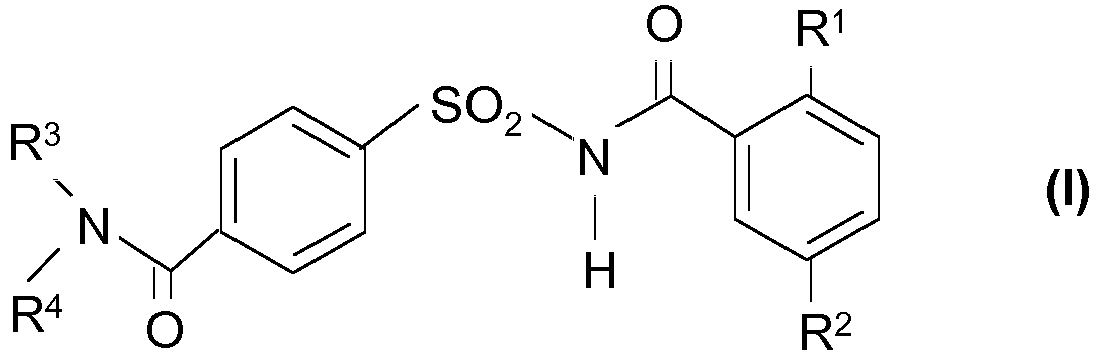 R1 Methoxy bedeutet,R2 Wasserstoff bedeutet,R3 Wasserstoff bedeutet undR4 Cyclopropyl bedeutetundB) einer herbizid wirksamen Menge eines oder mehrer Herbizide (Komponente(n) B) ausgewählt aus der Gruppe umfassend Flucarbazone, Metsulfuron, Prosulfuron, Tribenuron, Chlorimuron, Ethoxysulfuron, Halosulfuron, Propoxycarbazone, Amidosulfuron, Chlorsulfuron, Triasulfuron, Flupyrsulfuron, EPTC, S-Metolachlor, Dicamba und Pendimethalin
und
wobei diese Mittel die Komponenten (A) und (B) in einem Gewichtsverhältnis von 1:200 bis 200:1 enthalten. - Herbizides Mittel nach Anspruch 1, gekennzeichnet durch einen wirsamen Gehalt an Metsulfuron, Prosulfuron, Tribenuron, Chlorimuron, Ethoxysulfuron, Halosulfuron, Amidosulfuron, Chlorsulfuron, Triasulfuron oder Flupyrsulfuron als Komponente (B).
- Herbizide Mittel nach Anspruch 1, gekennzeichnet durch einen wirksamen Gehalt an Flucarbazone als Komponente (B).
- Herbizide Mittel nach Anspruch 1, gekennzeichnet durch einen wirksamen Gehalt an Propoxycarbazone als Komponente (B).
- Herbizide Mittel nach Anspruch 1, gekennzeichnet durch einen wirksamen Gehalt an EPTC, S-Metolachlor, Dicamba und Pendimethalin als Komponente (B).
- Verfahren zur Bekämpfung von Schafpflanzen in Nutzpflanzenkulturen, dadurch gekennzeichnet, dass eine herbizid wirksame Menge eines herbizid wirksamen Mittels gemäß einem oder mehreren der Ansprüche 1-5 auf die Schadpflanzen, Kulturpflanzen, Pflanzensamen oder die Fläche, auf der die Pflanzen wachsen, aufgebracht wird.
- Verfahren gemäß Anspruch 6, dadurch gekennzeichnet, dass Saatgut einer Kulturpflanze mit einem Safener der Komponente (A) des herbiziden Mittels gebeizt wurde, und die Anwendung des Herbizids der Komponente (B) vor oder nach dem Auflaufen der Pflanzen erfolgt.
- Verfahren nach einem der Ansprüche 6 oder 7 zur Bekämpfung von Schadpflanzen in monokotylen Pflanzenkulturen.
- Verfahren gemäß einem der Ansprüche 6 oder 7, dadurch gekennzeichnet, dass die Pflanzen aus der Gruppe Mais, Weizen, Roggen, Gerste, Hafer, Reis, Sorghum, Baumwolle oder Soja stammen.
- Verfahren gemäß den Ansprüchen 6 bis 9, dadurch gekennzeichnet, dass die Pflanzenkulturen gentechnisch verändert oder durch Mutationsselektion erhalten wurden.
Priority Applications (2)
| Application Number | Priority Date | Filing Date | Title |
|---|---|---|---|
| PL06762208T PL1903863T3 (pl) | 2005-07-07 | 2006-06-27 | Tolerowane przez rośliny uprawne środki chwastobójcze zawierające herbicydy i jako sejfnery amidy kwasu acylosulfamoilobenzoesowego |
| SI200632284T SI1903863T1 (sl) | 2005-07-07 | 2006-06-27 | Herbicidna sredstva prenosljiva na kulturne rastline, ki vsebujejo herbicide in acilsulfamoilbenzamidna varovala |
Applications Claiming Priority (2)
| Application Number | Priority Date | Filing Date | Title |
|---|---|---|---|
| DE102005031787A DE102005031787A1 (de) | 2005-07-07 | 2005-07-07 | Kulturpflanzenverträgliche herbizide Mittel enthaltend Herbizide Safener |
| PCT/EP2006/006181 WO2007006416A2 (de) | 2005-07-07 | 2006-06-27 | Kulturpflanzenverträgliche herbizide mittel enthaltend herbizide und acylsulfamoylbenzoesäureamide safener |
Publications (2)
| Publication Number | Publication Date |
|---|---|
| EP1903863A2 EP1903863A2 (de) | 2008-04-02 |
| EP1903863B1 true EP1903863B1 (de) | 2018-07-18 |
Family
ID=37497899
Family Applications (1)
| Application Number | Title | Priority Date | Filing Date |
|---|---|---|---|
| EP06762208.4A Active EP1903863B1 (de) | 2005-07-07 | 2006-06-27 | Kulturpflanzenverträgliche herbizide mittel enthaltend herbizide und acylsulfamoylbenzoesäureamide safener |
Country Status (24)
| Country | Link |
|---|---|
| US (1) | US20070010399A1 (de) |
| EP (1) | EP1903863B1 (de) |
| JP (1) | JP2008544998A (de) |
| CN (1) | CN101217869B (de) |
| AR (1) | AR053950A1 (de) |
| BR (5) | BR122017004709A8 (de) |
| CA (3) | CA2614221C (de) |
| CR (1) | CR9608A (de) |
| CY (1) | CY1120774T1 (de) |
| DE (1) | DE102005031787A1 (de) |
| DK (1) | DK1903863T3 (de) |
| EA (1) | EA015337B1 (de) |
| ES (1) | ES2691622T3 (de) |
| HU (1) | HUE040288T2 (de) |
| IL (1) | IL188434A0 (de) |
| LT (1) | LT1903863T (de) |
| MX (1) | MX2008000069A (de) |
| NZ (1) | NZ564896A (de) |
| PL (1) | PL1903863T3 (de) |
| PT (1) | PT1903863T (de) |
| SI (1) | SI1903863T1 (de) |
| UA (1) | UA95246C2 (de) |
| WO (1) | WO2007006416A2 (de) |
| ZA (1) | ZA200710845B (de) |
Families Citing this family (57)
| Publication number | Priority date | Publication date | Assignee | Title |
|---|---|---|---|---|
| DE4426753A1 (de) * | 1994-07-28 | 1996-02-01 | Bayer Ag | Mittel zur Bekämpfung von Pflanzenschädlingen |
| HU230539B1 (hu) | 1998-06-10 | 2016-11-28 | Bayer Intellectual Property Gmbh | Növényvédőszer-készítmény |
| DE10347090A1 (de) * | 2003-10-10 | 2005-05-04 | Bayer Cropscience Ag | Synergistische fungizide Wirkstoffkombinationen |
| DE102006031978A1 (de) * | 2006-07-11 | 2008-01-17 | Bayer Cropscience Ag | Wirkstoffkombinationen mit insektiziden und akariziden Eigenschaften |
| DE102006031976A1 (de) * | 2006-07-11 | 2008-01-17 | Bayer Cropscience Ag | Wirkstoffkombinationen mit insektiziden und akariziden Eigenschaften |
| US20090281157A1 (en) * | 2006-07-11 | 2009-11-12 | Bayer Cropscience Ag | Active Ingredient Combinations With Insecticidal and Acaricidal Properties |
| PT2124557E (pt) * | 2007-02-02 | 2015-02-27 | Plant Health Care Inc | Composições fungicidas sinérgicas compreendendo formononetina |
| EP1985180A1 (de) * | 2007-04-25 | 2008-10-29 | Bayer CropScience AG | Defoliant |
| EP2052616A1 (de) * | 2007-10-24 | 2009-04-29 | Bayer CropScience AG | Herbizid-Safener-Kombination |
| EP2052611A1 (de) * | 2007-10-24 | 2009-04-29 | Bayer CropScience AG | Herbizid-Kombination |
| EP2064953A1 (de) * | 2007-11-29 | 2009-06-03 | Bayer CropScience AG | Herbizid-Azol-Kombination |
| WO2009089165A2 (en) * | 2008-01-07 | 2009-07-16 | Auburn University | Combinations of herbicides and safeners |
| AU2009212525B2 (en) * | 2008-02-05 | 2012-06-21 | Arysta Lifescience North America, Llc | Solid formulation of low melting active compound |
| CN102026545A (zh) * | 2008-02-12 | 2011-04-20 | 北美爱利思达生命科学有限责任公司 | 控制多余植物的方法 |
| CA2738413C (en) * | 2008-10-06 | 2016-10-25 | Syngenta Participations Ag | Herbicidal compositions comprising hppd-inhibitors and methods of controlling weeds in turfgrasses |
| US8683346B2 (en) * | 2008-11-17 | 2014-03-25 | Sap Portals Israel Ltd. | Client integration of information from a supplemental server into a portal |
| EP2191720A1 (de) * | 2008-11-29 | 2010-06-02 | Bayer CropScience AG | Herbizid-Safener-Kombination |
| CN101530104B (zh) * | 2009-04-21 | 2013-07-31 | 上虞颖泰精细化工有限公司 | 一种含有磺酰脲类、吡啶类、氰氟草酯的除草剂组合物及其应用 |
| US9288984B2 (en) * | 2009-06-25 | 2016-03-22 | Dow Agrosciences Llc | Herbicidal concentrate compositions containing glyphosate and dicamba salts |
| CN101642122B (zh) * | 2009-07-17 | 2013-05-08 | 陕西上格之路生物科学有限公司 | 一种除草剂组合物 |
| EP3424324A1 (de) * | 2009-10-28 | 2019-01-09 | Dow AgroSciences LLC | Synergistische herbizidzusammensetzung mit fluroxypyr und ein als inhibitor herbizid aus der klasse der imidazole |
| CA3075333C (en) | 2010-03-12 | 2021-10-19 | Monsanto Technology Llc | Plant health compositions comprising a water-soluble pesticide and a water-insoluble agrochemical |
| CN102265883B (zh) * | 2010-06-03 | 2013-08-07 | 南京华洲药业有限公司 | 一种含灭草松、玉嘧磺隆和硝磺草酮的混合除草剂及其应用 |
| CN101940213A (zh) * | 2010-09-13 | 2011-01-12 | 尹小根 | 含有双氟磺草胺与精噁唑禾草灵的除草组合物 |
| CN101971822B (zh) * | 2010-10-28 | 2013-05-29 | 江苏龙灯化学有限公司 | 一种增效的除草组合物及其应用方法 |
| EP2635125A2 (de) * | 2010-11-02 | 2013-09-11 | Syngenta Participations AG | Pestizidkombinationen mit einem neonikotinoiden insektizid und herbizid-safener |
| CN103929956B (zh) * | 2011-09-16 | 2017-02-22 | 拜耳知识产权有限责任公司 | 酰基磺酰胺用于改善植物产量的用途 |
| JP2013184912A (ja) | 2012-03-07 | 2013-09-19 | Sumitomo Chemical Co Ltd | 除草用組成物 |
| BR112014022728B1 (pt) * | 2012-03-13 | 2019-12-17 | Syngenta Participations Ag | método para reduzir a fitotoxicidade de herbicidas em plantas de cana-de-açúcar |
| JP2014001179A (ja) * | 2012-06-20 | 2014-01-09 | Sumitomo Chemical Co Ltd | 有害生物の防除方法 |
| CN104106589B (zh) * | 2012-06-28 | 2016-08-24 | 永农生物科学有限公司 | 含有氟唑磺隆和氨氯吡啶酸或其盐的复配农药组合物、制剂及应用 |
| CN104994734B (zh) | 2012-12-14 | 2018-06-29 | 美国陶氏益农公司 | 由施用氯氨基吡啶酸和二氯吡啶酸进行协同杂草防治 |
| US10412964B2 (en) | 2012-12-14 | 2019-09-17 | Dow Agrosciences Llc | Synergistic weed control from applications of aminopyralid and clopyralid |
| CN105859623B (zh) * | 2013-09-18 | 2018-01-16 | 河北兰升生物科技有限公司 | 吡唑酰基氨磺酰苯甲酰胺制备方法及其中间体 |
| CN103598195B (zh) * | 2013-11-19 | 2015-05-13 | 江苏钟山化工有限公司 | 一种含炔草酯与丙苯磺隆的混合除草剂 |
| CN103749476B (zh) * | 2013-12-26 | 2016-05-18 | 广东中迅农科股份有限公司 | 一种含有双草醚和精噁唑禾草灵的除草组合物 |
| CN103828816B (zh) * | 2014-02-26 | 2015-02-11 | 江苏富鼎化学有限公司 | 含精噁唑禾草灵、炔草酯和氯氟吡氧乙酸的混合除草剂 |
| CN103918663A (zh) * | 2014-03-27 | 2014-07-16 | 广东中迅农科股份有限公司 | 一种含有嗪草酮和烯草酮的除草组合物 |
| CN105494355B (zh) * | 2014-09-24 | 2017-11-10 | 南京华洲药业有限公司 | 一种含甲磺草胺与高效氟吡甲禾灵的混合除草剂 |
| CN105494357A (zh) * | 2014-09-24 | 2016-04-20 | 南京华洲药业有限公司 | 一种含甲磺草胺与精喹禾灵的混合除草剂 |
| CN104381262B (zh) * | 2014-11-25 | 2017-08-29 | 广东中迅农科股份有限公司 | 一种含有甲咪唑烟酸和烯草酮的除草组合物 |
| CN105076200A (zh) * | 2015-09-04 | 2015-11-25 | 广东中迅农科股份有限公司 | 一种含有草甘膦和双氟磺草胺的除草组合物 |
| GB2545726B (en) * | 2015-12-23 | 2020-06-17 | Rotam Agrochem Int Co Ltd | Herbicidal composition and method for controlling plant growth |
| PT109118B (pt) * | 2016-01-26 | 2018-02-27 | Sapec Agro S A | Mistura herbicida compreendendo iodossulfurão-metilo ou os seus sais e flazassulfurão |
| EP3426041B1 (de) * | 2016-03-07 | 2020-09-23 | Bayer CropScience Aktiengesellschaft | Herbizide zusammensetzung enthaltend einen hppd-inhibitor, isoxadifen-ethyl und metribuzin |
| CN105685094B (zh) * | 2016-03-11 | 2019-01-29 | 浙江天丰生物科学有限公司 | 一种复配除草组合物 |
| CN105746518B (zh) * | 2016-03-25 | 2018-11-06 | 湖南省农业生物技术研究中心 | 一种应用杀菌剂提高除草剂对杂草防效的方法 |
| CN106070286A (zh) * | 2016-06-24 | 2016-11-09 | 河北冠润药业股份有限公司 | 一种小麦田用除草剂 |
| CN107646847A (zh) * | 2016-07-25 | 2018-02-02 | 四川利尔作物科学有限公司 | 除草组合物及其应用 |
| CN106719707A (zh) * | 2017-02-22 | 2017-05-31 | 佛山市普尔玛农化有限公司 | 一种包含苯唑草酮与炔草酯的除草组合物 |
| CN107136079B (zh) * | 2017-05-12 | 2020-01-07 | 扬州大学 | 一种氰氟草酯水乳剂及其制备方法 |
| CN108576045A (zh) * | 2018-06-09 | 2018-09-28 | 合肥喜田生物科技有限公司 | 一种含草甘膦、双氟磺草胺与高效氟吡甲禾灵的混合除草剂及其应用 |
| CN108576044A (zh) * | 2018-06-09 | 2018-09-28 | 合肥喜田生物科技有限公司 | 一种含草甘膦、双氟磺草胺与精喹禾灵的混合除草剂及其应用 |
| CN109380249A (zh) * | 2018-12-03 | 2019-02-26 | 浙江中山化工集团股份有限公司 | 一种小麦田除草剂组合物 |
| PL238671B1 (pl) | 2019-02-01 | 2021-09-20 | Przed Uslugowo Handlowe Chemirol Spolka Z Ograniczona Odpowiedzialnoscia | Kompozycja chwastobójcza i sposób zwalczania chwastów |
| CN114075149A (zh) * | 2020-08-20 | 2022-02-22 | 宁夏苏融达化工有限公司 | 含二氟苯基的杂环化合物及其应用 |
| CN112741092B (zh) * | 2021-02-05 | 2022-03-01 | 安徽沙隆达生物科技有限公司 | 一种包含硝磺草酮和敌稗的除草组合物 |
Citations (2)
| Publication number | Priority date | Publication date | Assignee | Title |
|---|---|---|---|---|
| US20040087445A1 (en) * | 2002-08-16 | 2004-05-06 | Frank Ziemer | Herbicidal compositions comprising benzoylpyrazoles and safeners |
| US20040224849A1 (en) * | 2001-04-21 | 2004-11-11 | Frank Ziemer | Herbicides comprising benzoylcyclohexanediones and safeners |
Family Cites Families (7)
| Publication number | Priority date | Publication date | Assignee | Title |
|---|---|---|---|---|
| DE19742951A1 (de) * | 1997-09-29 | 1999-04-15 | Hoechst Schering Agrevo Gmbh | Acylsulfamoylbenzoesäureamide, diese enthaltende nutzpflanzenschützende Mittel und Verfahren zu ihrer Herstellung |
| DE19827855A1 (de) * | 1998-06-23 | 1999-12-30 | Hoechst Schering Agrevo Gmbh | Kombinationen aus Herbiziden und Safenern |
| US6503904B2 (en) * | 1998-11-16 | 2003-01-07 | Syngenta Crop Protection, Inc. | Pesticidal composition for seed treatment |
| DE10145019A1 (de) * | 2001-09-13 | 2003-04-03 | Bayer Cropscience Gmbh | Kombinationen aus Herbiziden und Safenern |
| PL207276B1 (pl) * | 2001-09-27 | 2010-11-30 | Syngenta Participations Ag | Kompozycja chwastobójcza oraz sposób selektywnego zwalczania chwastów i traw w uprawach roślin użytkowych |
| EP1491527A1 (de) * | 2003-06-25 | 2004-12-29 | Bayer CropScience GmbH | Verfahren zur Herstellung von Acylsulfamoylbenzamiden |
| ATE389327T1 (de) * | 2003-11-03 | 2008-04-15 | Bayer Cropscience Ag | Herbizid wirksames mittel |
-
2005
- 2005-07-07 DE DE102005031787A patent/DE102005031787A1/de not_active Withdrawn
-
2006
- 2006-06-27 BR BR122017004709A patent/BR122017004709A8/pt not_active Application Discontinuation
- 2006-06-27 BR BRPI0612776-2A patent/BRPI0612776B1/pt active IP Right Grant
- 2006-06-27 EP EP06762208.4A patent/EP1903863B1/de active Active
- 2006-06-27 CA CA2614221A patent/CA2614221C/en active Active
- 2006-06-27 BR BR122017004707A patent/BR122017004707A8/pt not_active Application Discontinuation
- 2006-06-27 BR BR122017004695-0A patent/BR122017004695B1/pt active IP Right Grant
- 2006-06-27 CA CA2836534A patent/CA2836534A1/en not_active Withdrawn
- 2006-06-27 MX MX2008000069A patent/MX2008000069A/es active IP Right Grant
- 2006-06-27 BR BR122017026652-7A patent/BR122017026652B1/pt active IP Right Grant
- 2006-06-27 HU HUE06762208A patent/HUE040288T2/hu unknown
- 2006-06-27 JP JP2008519825A patent/JP2008544998A/ja not_active Abandoned
- 2006-06-27 SI SI200632284T patent/SI1903863T1/sl unknown
- 2006-06-27 PT PT06762208T patent/PT1903863T/pt unknown
- 2006-06-27 LT LTEP06762208.4T patent/LT1903863T/lt unknown
- 2006-06-27 CN CN2006800245642A patent/CN101217869B/zh active Active
- 2006-06-27 WO PCT/EP2006/006181 patent/WO2007006416A2/de not_active Ceased
- 2006-06-27 UA UAA200801602A patent/UA95246C2/ru unknown
- 2006-06-27 CA CA2854520A patent/CA2854520C/en active Active
- 2006-06-27 NZ NZ564896A patent/NZ564896A/en not_active IP Right Cessation
- 2006-06-27 ES ES06762208.4T patent/ES2691622T3/es active Active
- 2006-06-27 EA EA200800216A patent/EA015337B1/ru not_active IP Right Cessation
- 2006-06-27 DK DK06762208.4T patent/DK1903863T3/en active
- 2006-06-27 PL PL06762208T patent/PL1903863T3/pl unknown
- 2006-07-05 AR ARP060102892A patent/AR053950A1/es active IP Right Grant
- 2006-07-06 US US11/482,087 patent/US20070010399A1/en not_active Abandoned
-
2007
- 2007-12-13 ZA ZA200710845A patent/ZA200710845B/xx unknown
- 2007-12-19 CR CR9608A patent/CR9608A/es not_active Application Discontinuation
- 2007-12-26 IL IL188434A patent/IL188434A0/en unknown
-
2018
- 2018-10-18 CY CY181101076T patent/CY1120774T1/el unknown
Patent Citations (2)
| Publication number | Priority date | Publication date | Assignee | Title |
|---|---|---|---|---|
| US20040224849A1 (en) * | 2001-04-21 | 2004-11-11 | Frank Ziemer | Herbicides comprising benzoylcyclohexanediones and safeners |
| US20040087445A1 (en) * | 2002-08-16 | 2004-05-06 | Frank Ziemer | Herbicidal compositions comprising benzoylpyrazoles and safeners |
Also Published As
Similar Documents
| Publication | Publication Date | Title |
|---|---|---|
| EP2140763B1 (de) | Synergische herbizide Mittel | |
| EP2232991B1 (de) | Synergistische kulturpflanzenverträgliche Kombinationen enthaltend Herbizide aus der Gruppe der Benzoylcyclohexandione in Kombination mit mindestens zwei weiteren herbiziden Wirkstoffen für den Einsatz in Reis-Kulturen | |
| EP2096913B1 (de) | Synergetisch wirkende und kulturpflanzenverträgliche herbizide mittel enthaltend herbizide aus der gruppe der benzoylpyrazole | |
| DE102005031787A1 (de) | Kulturpflanzenverträgliche herbizide Mittel enthaltend Herbizide Safener | |
| EP1903865B1 (de) | Synergistische kulturpflanzenverträgliche herbizide mittel enthaltend herbizide aus der gruppe der benzoylcyclohexadione | |
| EP1233673A2 (de) | Hydroxyphenylpyruvat-dioxygenaseinhibitor-herbizide in synergistischen mischungen | |
| EP1453379B1 (de) | Synergistische herbizide mittel enthaltend herbizide aus der gruppe der benzoylpyrazole | |
| DE4236475A1 (de) | Herbizide Mittel zur Unkrautbekämpfung in Reiskulturen | |
| DE102005014944A1 (de) | Synergistische kulturpflanzenverträgliche herbizide Mittel enthaltend Herbizide aus der Gruppe der Benzoylpyrazole | |
| EP1383383A1 (de) | Benzoylcyclohexandione enthaltende synergistische herbizide für den einsatz in mais-kulturen | |
| DE4336953A1 (de) | Herbizide Mittel zur Unkrautbekämpfung in Reiskulturen |
Legal Events
| Date | Code | Title | Description |
|---|---|---|---|
| PUAI | Public reference made under article 153(3) epc to a published international application that has entered the european phase |
Free format text: ORIGINAL CODE: 0009012 |
|
| 17P | Request for examination filed |
Effective date: 20080207 |
|
| AK | Designated contracting states |
Kind code of ref document: A2 Designated state(s): AT BE BG CH CY CZ DE DK EE ES FI FR GB GR HU IE IS IT LI LT LU LV MC NL PL PT RO SE SI SK TR |
|
| AX | Request for extension of the european patent |
Extension state: HR YU |
|
| RAX | Requested extension states of the european patent have changed |
Extension state: RS Payment date: 20080207 Extension state: HR Payment date: 20080207 |
|
| 17Q | First examination report despatched |
Effective date: 20100618 |
|
| RAX | Requested extension states of the european patent have changed |
Extension state: HR Payment date: 20080207 Extension state: RS Payment date: 20080207 |
|
| RAP1 | Party data changed (applicant data changed or rights of an application transferred) |
Owner name: BAYER INTELLECTUAL PROPERTY GMBH |
|
| STAA | Information on the status of an ep patent application or granted ep patent |
Free format text: STATUS: EXAMINATION IS IN PROGRESS |
|
| GRAP | Despatch of communication of intention to grant a patent |
Free format text: ORIGINAL CODE: EPIDOSNIGR1 |
|
| STAA | Information on the status of an ep patent application or granted ep patent |
Free format text: STATUS: GRANT OF PATENT IS INTENDED |
|
| RIC1 | Information provided on ipc code assigned before grant |
Ipc: A01P 13/00 20060101ALI20180313BHEP Ipc: A01N 25/32 20060101AFI20180313BHEP Ipc: A01N 37/22 20060101ALI20180313BHEP Ipc: A01N 43/707 20060101ALI20180313BHEP Ipc: A01N 33/18 20060101ALI20180313BHEP Ipc: A01N 47/36 20060101ALI20180313BHEP Ipc: A01N 25/04 20060101ALI20180313BHEP Ipc: A01N 41/10 20060101ALI20180313BHEP Ipc: A01N 37/40 20060101ALI20180313BHEP |
|
| INTG | Intention to grant announced |
Effective date: 20180403 |
|
| GRAS | Grant fee paid |
Free format text: ORIGINAL CODE: EPIDOSNIGR3 |
|
| GRAA | (expected) grant |
Free format text: ORIGINAL CODE: 0009210 |
|
| STAA | Information on the status of an ep patent application or granted ep patent |
Free format text: STATUS: THE PATENT HAS BEEN GRANTED |
|
| AK | Designated contracting states |
Kind code of ref document: B1 Designated state(s): AT BE BG CH CY CZ DE DK EE ES FI FR GB GR HU IE IS IT LI LT LU LV MC NL PL PT RO SE SI SK TR |
|
| AX | Request for extension of the european patent |
Extension state: HR RS |
|
| RAP1 | Party data changed (applicant data changed or rights of an application transferred) |
Owner name: BAYER CROPSCIENCE AG |
|
| REG | Reference to a national code |
Ref country code: GB Ref legal event code: FG4D Free format text: NOT ENGLISH |
|
| REG | Reference to a national code |
Ref country code: CH Ref legal event code: EP |
|
| REG | Reference to a national code |
Ref country code: IE Ref legal event code: FG4D Free format text: LANGUAGE OF EP DOCUMENT: GERMAN |
|
| REG | Reference to a national code |
Ref country code: AT Ref legal event code: REF Ref document number: 1018374 Country of ref document: AT Kind code of ref document: T Effective date: 20180815 |
|
| REG | Reference to a national code |
Ref country code: DE Ref legal event code: R096 Ref document number: 502006015963 Country of ref document: DE |
|
| REG | Reference to a national code |
Ref country code: RO Ref legal event code: EPE |
|
| REG | Reference to a national code |
Ref country code: NL Ref legal event code: FP |
|
| REG | Reference to a national code |
Ref country code: SE Ref legal event code: TRGR |
|
| REG | Reference to a national code |
Ref country code: PT Ref legal event code: SC4A Ref document number: 1903863 Country of ref document: PT Date of ref document: 20181109 Kind code of ref document: T Free format text: AVAILABILITY OF NATIONAL TRANSLATION Effective date: 20181017 |
|
| REG | Reference to a national code |
Ref country code: DK Ref legal event code: T3 Effective date: 20181106 |
|
| REG | Reference to a national code |
Ref country code: EE Ref legal event code: FG4A Ref document number: E015992 Country of ref document: EE Effective date: 20181001 |
|
| REG | Reference to a national code |
Ref country code: ES Ref legal event code: FG2A Ref document number: 2691622 Country of ref document: ES Kind code of ref document: T3 Effective date: 20181128 |
|
| REG | Reference to a national code |
Ref country code: SK Ref legal event code: T3 Ref document number: E 28533 Country of ref document: SK |
|
| PG25 | Lapsed in a contracting state [announced via postgrant information from national office to epo] |
Ref country code: IS Free format text: LAPSE BECAUSE OF FAILURE TO SUBMIT A TRANSLATION OF THE DESCRIPTION OR TO PAY THE FEE WITHIN THE PRESCRIBED TIME-LIMIT Effective date: 20181118 |
|
| REG | Reference to a national code |
Ref country code: HU Ref legal event code: AG4A Ref document number: E040288 Country of ref document: HU |
|
| REG | Reference to a national code |
Ref country code: GR Ref legal event code: EP Ref document number: 20180402966 Country of ref document: GR Effective date: 20190225 |
|
| REG | Reference to a national code |
Ref country code: DE Ref legal event code: R097 Ref document number: 502006015963 Country of ref document: DE |
|
| PLBE | No opposition filed within time limit |
Free format text: ORIGINAL CODE: 0009261 |
|
| STAA | Information on the status of an ep patent application or granted ep patent |
Free format text: STATUS: NO OPPOSITION FILED WITHIN TIME LIMIT |
|
| 26N | No opposition filed |
Effective date: 20190423 |
|
| PG25 | Lapsed in a contracting state [announced via postgrant information from national office to epo] |
Ref country code: MC Free format text: LAPSE BECAUSE OF FAILURE TO SUBMIT A TRANSLATION OF THE DESCRIPTION OR TO PAY THE FEE WITHIN THE PRESCRIBED TIME-LIMIT Effective date: 20180718 |
|
| P01 | Opt-out of the competence of the unified patent court (upc) registered |
Effective date: 20230507 |
|
| PGFP | Annual fee paid to national office [announced via postgrant information from national office to epo] |
Ref country code: NL Payment date: 20250526 Year of fee payment: 20 |
|
| PGFP | Annual fee paid to national office [announced via postgrant information from national office to epo] |
Ref country code: FI Payment date: 20250620 Year of fee payment: 20 |
|
| PGFP | Annual fee paid to national office [announced via postgrant information from national office to epo] |
Ref country code: PL Payment date: 20250529 Year of fee payment: 20 Ref country code: DE Payment date: 20250521 Year of fee payment: 20 |
|
| PGFP | Annual fee paid to national office [announced via postgrant information from national office to epo] |
Ref country code: GB Payment date: 20250522 Year of fee payment: 20 Ref country code: DK Payment date: 20250618 Year of fee payment: 20 |
|
| PGFP | Annual fee paid to national office [announced via postgrant information from national office to epo] |
Ref country code: LT Payment date: 20250522 Year of fee payment: 20 |
|
| PGFP | Annual fee paid to national office [announced via postgrant information from national office to epo] |
Ref country code: LU Payment date: 20250611 Year of fee payment: 20 Ref country code: BE Payment date: 20250526 Year of fee payment: 20 Ref country code: IT Payment date: 20250528 Year of fee payment: 20 |
|
| PGFP | Annual fee paid to national office [announced via postgrant information from national office to epo] |
Ref country code: LV Payment date: 20250520 Year of fee payment: 20 Ref country code: PT Payment date: 20250612 Year of fee payment: 20 |
|
| PGFP | Annual fee paid to national office [announced via postgrant information from national office to epo] |
Ref country code: EE Payment date: 20250528 Year of fee payment: 20 Ref country code: FR Payment date: 20250523 Year of fee payment: 20 |
|
| PGFP | Annual fee paid to national office [announced via postgrant information from national office to epo] |
Ref country code: BG Payment date: 20250529 Year of fee payment: 20 Ref country code: GR Payment date: 20250530 Year of fee payment: 20 |
|
| PGFP | Annual fee paid to national office [announced via postgrant information from national office to epo] |
Ref country code: RO Payment date: 20250530 Year of fee payment: 20 Ref country code: AT Payment date: 20250528 Year of fee payment: 20 |
|
| PGFP | Annual fee paid to national office [announced via postgrant information from national office to epo] |
Ref country code: TR Payment date: 20250620 Year of fee payment: 20 Ref country code: SK Payment date: 20250523 Year of fee payment: 20 |
|
| PGFP | Annual fee paid to national office [announced via postgrant information from national office to epo] |
Ref country code: CZ Payment date: 20250618 Year of fee payment: 20 |
|
| PGFP | Annual fee paid to national office [announced via postgrant information from national office to epo] |
Ref country code: IE Payment date: 20250523 Year of fee payment: 20 |
|
| PGFP | Annual fee paid to national office [announced via postgrant information from national office to epo] |
Ref country code: SE Payment date: 20250528 Year of fee payment: 20 Ref country code: SI Payment date: 20250526 Year of fee payment: 20 |
|
| PGFP | Annual fee paid to national office [announced via postgrant information from national office to epo] |
Ref country code: HU Payment date: 20250610 Year of fee payment: 20 |
|
| PGFP | Annual fee paid to national office [announced via postgrant information from national office to epo] |
Ref country code: ES Payment date: 20250703 Year of fee payment: 20 |
|
| PGFP | Annual fee paid to national office [announced via postgrant information from national office to epo] |
Ref country code: CH Payment date: 20250701 Year of fee payment: 20 |
|
| PGFP | Annual fee paid to national office [announced via postgrant information from national office to epo] |
Ref country code: CY Payment date: 20250624 Year of fee payment: 20 |