EP1904831B1 - Vorrichtung und verfahren zur bestimmung der konzentration von sauerstoff einer substanz - Google Patents
Vorrichtung und verfahren zur bestimmung der konzentration von sauerstoff einer substanz Download PDFInfo
- Publication number
- EP1904831B1 EP1904831B1 EP06757824A EP06757824A EP1904831B1 EP 1904831 B1 EP1904831 B1 EP 1904831B1 EP 06757824 A EP06757824 A EP 06757824A EP 06757824 A EP06757824 A EP 06757824A EP 1904831 B1 EP1904831 B1 EP 1904831B1
- Authority
- EP
- European Patent Office
- Prior art keywords
- oxygen
- lifetime
- concentration
- triplet
- tissue
- Prior art date
- Legal status (The legal status is an assumption and is not a legal conclusion. Google has not performed a legal analysis and makes no representation as to the accuracy of the status listed.)
- Active
Links
Images








Classifications
-
- A—HUMAN NECESSITIES
- A61—MEDICAL OR VETERINARY SCIENCE; HYGIENE
- A61K—PREPARATIONS FOR MEDICAL, DENTAL OR TOILETRY PURPOSES
- A61K49/00—Preparations for testing in vivo
- A61K49/001—Preparation for luminescence or biological staining
- A61K49/0013—Luminescence
- A61K49/0017—Fluorescence in vivo
- A61K49/0019—Fluorescence in vivo characterised by the fluorescent group, e.g. oligomeric, polymeric or dendritic molecules
- A61K49/0021—Fluorescence in vivo characterised by the fluorescent group, e.g. oligomeric, polymeric or dendritic molecules the fluorescent group being a small organic molecule
- A61K49/0036—Porphyrins
-
- A—HUMAN NECESSITIES
- A61—MEDICAL OR VETERINARY SCIENCE; HYGIENE
- A61K—PREPARATIONS FOR MEDICAL, DENTAL OR TOILETRY PURPOSES
- A61K49/00—Preparations for testing in vivo
- A61K49/001—Preparation for luminescence or biological staining
- A61K49/0013—Luminescence
- A61K49/0017—Fluorescence in vivo
- A61K49/0019—Fluorescence in vivo characterised by the fluorescent group, e.g. oligomeric, polymeric or dendritic molecules
- A61K49/0021—Fluorescence in vivo characterised by the fluorescent group, e.g. oligomeric, polymeric or dendritic molecules the fluorescent group being a small organic molecule
-
- A—HUMAN NECESSITIES
- A61—MEDICAL OR VETERINARY SCIENCE; HYGIENE
- A61K—PREPARATIONS FOR MEDICAL, DENTAL OR TOILETRY PURPOSES
- A61K49/00—Preparations for testing in vivo
- A61K49/001—Preparation for luminescence or biological staining
- A61K49/0013—Luminescence
- A61K49/0017—Fluorescence in vivo
- A61K49/005—Fluorescence in vivo characterised by the carrier molecule carrying the fluorescent agent
- A61K49/0056—Peptides, proteins, polyamino acids
-
- G—PHYSICS
- G01—MEASURING; TESTING
- G01N—INVESTIGATING OR ANALYSING MATERIALS BY DETERMINING THEIR CHEMICAL OR PHYSICAL PROPERTIES
- G01N21/00—Investigating or analysing materials by the use of optical means, i.e. using sub-millimetre waves, infrared, visible or ultraviolet light
- G01N21/62—Systems in which the material investigated is excited whereby it emits light or causes a change in wavelength of the incident light
- G01N21/63—Systems in which the material investigated is excited whereby it emits light or causes a change in wavelength of the incident light optically excited
- G01N21/64—Fluorescence; Phosphorescence
- G01N21/6408—Fluorescence; Phosphorescence with measurement of decay time, time resolved fluorescence
-
- Y—GENERAL TAGGING OF NEW TECHNOLOGICAL DEVELOPMENTS; GENERAL TAGGING OF CROSS-SECTIONAL TECHNOLOGIES SPANNING OVER SEVERAL SECTIONS OF THE IPC; TECHNICAL SUBJECTS COVERED BY FORMER USPC CROSS-REFERENCE ART COLLECTIONS [XRACs] AND DIGESTS
- Y10—TECHNICAL SUBJECTS COVERED BY FORMER USPC
- Y10T—TECHNICAL SUBJECTS COVERED BY FORMER US CLASSIFICATION
- Y10T436/00—Chemistry: analytical and immunological testing
- Y10T436/20—Oxygen containing
- Y10T436/207497—Molecular oxygen
Definitions
- the invention relates to the field of medicine. More specifically, the invention relates to monitoring the concentration of a substance.
- Health control diagnosis of disease and/or monitoring of treatment of disease often involves measurement of various parameters.
- One parameter is the concentration of a certain substance, such as oxygen, within at least part of an organism.
- Local tissue oxygenation is an important parameter in the diagnosis and treatment of a wide range of diseases. Measurements of the amount of oxygen present in a specific part of a subject are for instance carried out during peri-operative monitoring in the operating room and intensive care and for diagnosis of a wide range of clinical disorders in which tissue oxygenation lies central to the development and cure of disease. Examples include diagnosis of cardiovascular disease, monitoring healing of decubitus and diabetic wounds, monitoring hyperbaric correction of radiation wounds and assessment of success of bypass surgery.
- tissue oxygen pressure pO 2
- Assessment of tumor oxygenation is an example wherein measuring of local tissue oxygenation is helpful for the choice of treatment, as oxygen is an important determinant for success of radiotherapy.
- the concentration of oxygen in a tumor is preferably determined in order to determine whether radiotherapy is recommended.
- Local oxygen measurements are also applicable for the assessment of organ viability for transplantation.
- Dioxygen is a molecule of utmost biological importance because of its role as the primary biological oxidant. Therefore, oxygen plays a key role in the oxidation/reduction reactions that are coupled to cellular respiration and energy supply. Adequate measurement of oxygen concentrations in biological samples like cells, tissues and whole organs is important to gain insight in the determinants of oxygen supply and utilisation under normal and pathological conditions. It is interesting to note that the clinical interest in methods providing information about blood-flow and oxygen delivery at the (sub-)organ level (e.g. microcirculatory) is growing. This is amongst other things because of increasing insight into the role of the microcirculation in pathogenesis, and the importance of adequate tissue perfusion as end-point of treatment (Siegemund et al., 1999).
- the reference sample used for correction of non-ideal apparatus behavior, can be anything with well-known absorption properties, but a white sample (no absorption) is mostly used.
- EMPHO Erans Micro- lightguide spectrophotometer
- Frank, 1989 EMPHO II, Bodenseewerk Acttechnik, vonlingen, Germany
- O2C Lea Medizintechnik, Giesen, Germany
- Wilson and Vanderkooi introduced the oxygen-dependent quenching of phosphorescence of metallo-porphyrin compounds for biological oxygen concentration measurements.
- the technique is based upon the principle that a metallo-porphyrin molecule that has been excited by light can either release this absorbed energy as light (phosphorescence) or transfer the absorbed energy to oxygen (without light emission). This results in an oxygen dependent phosphorescence intensity and lifetime.
- the relationship between the lifetime and the oxygen concentration is given by the Stern-Volmer relationship (Vanderkooi, 1989). Calibration constants associated with the Stern-Volmer relationship allow oxygen concentrations to be calculated from the measured lifetimes. The measurement of lifetimes allows quantitative measurements without the influence of tissue optical properties.
- Pd-porphyrin is bound to albumin to form a large molecular complex that after injection into the circulation remains confined, at least for a certain time, inside the blood vessels.
- a phosphorimeter is a device that measures the phosphorescence decay after a pulse of light (time-domain device) or determines the phase-shift between a modulated excitation source and the emitted phosphorescence (frequency-domain device).
- Fiber phosphorimeters allow measurement of pO 2 in single blood vessels in the microcirculation.
- Use of fiber phosphorimeters allows measurement of microvascular pO 2 ( ⁇ pO 2 ) without having to resort to microscope techniques.
- a fiber phosphorimeter has been developed for measurement of ⁇ pO2 in large animal models of shock and sepsis (Sinaasappel, 1999; Van Iterson, 1998), as well as in mice (Van Bommel, 1998) and the analysis of the decay kinetics has been improved to provide more reliable calculation of pO 2 values from the decay kinetics (Mik, 2002).
- a multichannel implementation of this phosphorimeter allows simultaneous detection of ⁇ pO 2 at different sites and different organs.
- Figure 1 shows schematically an example of a frequency-domain phosphorimeter of which the light source is a very cost-effective light emitting diode (LED).
- LED light emitting diode
- NADH-fluorimetry The measurement of tissue bioenergetics is commonly used for measurement of the adequacy of tissue oxygenation. Oxidative phosphorylation occurring in the mitochondria of cells is the main site for the production of ATP.
- reduced pyridine nucleotides NADH
- NAD + reduced pyridine nucleotides
- NADH emits blue fluorescence (around 450 nm) when illuminated with ultraviolet light (around 360 nm). This allows spectroscopic determination of relative tissue NADH levels.
- the fluorescence intensity of NADH is therefore an optical indicator of cellular metabolism.
- Measurement of the fluorescence intensity of endogenous mitochondrial NADH in situ can thus be used as a direct measure of tissue bioenergetics. Since for the conversion of mitochondrial NADH to NAD+ the availability of molecular oxygen is mandatory, lack of oxygen results in accumulation of NADH and subsequent increase in fluorescence intensity.
- the fluorescence intensity is for instance imaged using sensitive photographic or video techniques and can be used to study the regional heterogeneity of tissue dysoxia on organ surfaces in vitro and in vivo. Unwanted influence of the absorbance of hemoglobin can be corrected by use of a two-wavelength method (Coremans, 1997).
- a method is provided wherein at least one of the above mentioned disadvantages is overcome.
- the invention provides a method for determining a concentration of a substance in a compartment according to claim 1.
- An endogenous compound is defined as a compound which is naturally present in said compartment, without artificial interference by man, or which is essentially the same kind of compound as a compound which is naturally present in said compartment.
- said compound is identical to a compound which is naturally present in said compartment.
- said endogenous compound comprises an administered compound which is essentially the same kind of compound as a compound which is naturally present in said compartment.
- said compound is present as a result of a conversion of a precursor into at least one compound which is naturally present in said compartment, or which is essentially the same kind of compound as a compound which is naturally present in said compartment.
- an endogenous compound is derived from a precursor.
- a method of the invention is not limited to exciting compounds which are already naturally present in a compartment. Exciting an administered compound which is essentially the same kind of compound as an endogenous compound, , is also within the scope of the present invention.
- one embodiment of the invention comprises exciting an endogenous compound, , which has been administered to a compartment.
- a method of the invention comprises exciting an endogenous compound which is already naturally present within said compartment.
- Yet another embodiment of the invention comprises administering a precursor of an endogenous compound, which is capable of being converted into at least one endogenous compound, and exciting a compound derived from said precursor.
- a compartment is defined as an area with properties that make it distinguishable from other areas.
- Said compartment for instance comprises an organism as a whole, or a part of an organism such as for instance an organ, a tissue, a cell, an organelle, a tumor and/or the microcirculation of an organism, or a part of said organ, tissue, cell, organelle, tumor and/or microcirculation.
- said compartment comprises a mitochondrion.
- said compartment comprises a part of an organ, tissue or cell.
- said compartment comprises an in vitro compartment, such as for instance a culture medium, a cell suspension, a bioreactor or a tissue or organ cultured in vitro .
- said compartment comprises an enclosed area, such as an organism, cell, organelle (preferably a mitochondrion) or bioreactor.
- said compartment is not enclosed. Examples of such compartments are parts of a tissue, organ and/or tumor. Although no exact borders of such compartment are present, usually tissue present within 20 cm, preferably within 15 cm of a given site of interest is considered.
- said compartment comprises a tumor, because information about the concentration of a substance such as oxygen in a tumor is desired in order to determine whether a certain treatment such as irradiation and/or photodynamic therapy is suitable.
- a concentration gradient through at least part of an organ, wound and/or tumor is determined.
- a method of the invention wherein said endogenous compound comprises a compound capable of being excited to a triplet state since molecular oxygen is a molecule of which the ground state is a triplet state. Oxygen is therefore capable of quenching an excited triplet state.
- a compound capable of being excited to a triplet state is particularly suitable for determining an oxygen concentration with a method of the present invention.
- quenching an excited triplet state means causing relaxation of an excited triplet state to occur at a rate that is higher than the rate of spontaneous relaxation.
- Spontaneous relaxation means relaxation without the presence of a substance capable of accelerating relaxation. For instance, in the presence of oxygen the lifetime of an excited triplet state is shortened as compared to the lifetime of an excited triplet state in the absence of oxygen.
- Luminescence for instance comprises phosphorescence and/or fluorescence. Fluorescence and phosphorescence lifetime measurements are based on the fact that after pulsed excitation the emitted signal does not vanish instantaneously, but decays with a certain lifetime. Energy transfer between the excited molecules and quencher molecules in its environment causes shortening of the luminescence lifetime.
- said luminescence comprises delayed fluorescence. Delayed fluorescence is a phenomenon which occurs in the case of a bi-directional intersystem-crossing. For instance, repopulation of a S1 state from a T1 state results in delayed fluorescence.
- Delayed fluorescence presents itself as another component of fluorescence besides prompt fluorescence, having a decay time equal to the lifetime of a triplet state if the time needed for intersystem-crossing is much shorter than the lifetime of the T1 state. Compared to prompt fluorescence, delayed fluorescence is measured much longer after a molecule has been photo-excited, thus avoiding interference of the emitted light pulse and the measured fluorescence.
- Transient absorption is defined as a temporary absorption change after photoexcitation. Such temporary absorption change is measured using any method known in the art.
- said transient absorption comprises triplet-triplet absorption.
- a preferred method of the invention therefore comprises measuring a triplet-triplet absorption. This is for instance performed with a MicroScan.
- Triplet-triplet absorption from the first excited Triplet state (T1) to the second excited triplet state (T2) is a process that can only occur after previous population of the first excited Triplet state and during the existence of this T1 state. If for example the T1 to T2 transition occurs with the absorption of light of a certain wavelength ⁇ , than a transient absorption of light of wavelength ⁇ is observed after photo excitation of the compound.
- This transient absorption has a lifetime equal to the T1 lifetime and is therefore also a means to measure the T1 lifetime.
- Triplet-triplet absorption measurements require a second light source (with another wavelength as the main excitation source).
- Said endogenous compound is protoporphyrin IX.
- a porphyrin chelated to an iron atom constitutes the haem molecule.
- Haem is one of the central molecules involved in oxygen transport (haemoglobin and myoglobin) and oxygen utilisation (cytochromes in the mitochondrial respiratory chain).
- Porphyrins are derivatives of porphine.
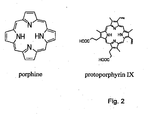
- Porphine possesses a ringsystem ( figure 2 ) with four pyrolrings and is a chemically very stable molecule that can be found as "chemical fossil" in oil.
- Porphine and its derivatives are of biological importance because of their central role in most vital processes were oxygen turnover takes place.
- derivatives of porphine are key substances in the photosynthesis process. This is the process were oxygen is produced out of carbon dioxide and light.
- porphine derivatives like heme and cytochrome C play central roles in oxygen transport and oxygen consumption.
- Protoporphyrin IX (PpIX, structure formula in figure 2 ) is synthesized inside the mitochondria were it becomes heme after inclusion of an iron atom by the enzyme ferrochelatase. Since the ferrochelatase activity is rather slow (speed limiting step), adding the precursor 5-aminolevulinic acid (ALA) results in a temporary rise in intramitochondrial PpIX levels. Hence, if desired, the level of PpIX in a compartment such as for instance a cell and/or tissue is easily enhanced by administration of 5-aminolevulinic acid (ALA), a precursor of the haem biosynthetic pathway.
- ALA 5-aminolevulinic acid
- the level of PpIX in a compartment is enhanced by administration of PpIX.
- a study of Chantrell et al. reports that PpIX dimethyl ester does not show measurable phosphorescence in the visible range (Chantrell et al., 1977). Therefore, this molecule was not expected to be useful for monitoring a concentration of a substance like oxygen.
- protoporphyrin IX emits delayed fluorescence after excitation.
- Protoporphyrin IX possesses an excited triplet state that is quenched by a substance like for instance oxygen, making its lifetime dependent on said substance. After excitation of PpIX, delayed fluorescence is observed. Moreover, triplet-triplet absorption is measurable.
- a use of a protoporphyrin IX for determining a concentration of oxygen in a compartment is therefore also herewith provided.
- Said porphyrin is protoporphyrin IX.
- said porphyrin comprises a clinically used photodynamic agent , which is currently used for photodynamic therapy against, amongst other things, tumor cells. This provides the advantage that oxygen concentration measurements is possible during therapy with a method of the invention using the therapeutic agent itself.
- T 1 -lifetimes are determined in several ways.
- three different modes of T 1 -lifetime measurements are shown: phosphorescence, triplet-triplet absorption and delayed fluorescence.
- phosphorescence lifetimes are measured by measuring the decay of the emitted light after pulsed excitation.
- PpIX does not show measurable phosphorescence (Chantrell et al., 1977).
- Triplet-triplet absorption relies on the measurement of the transient increase in absorption after photo excitation and population of the triplet state. Triplet-triplet absorption is also suitable for measuring a triplet lifetime of PpIX.
- One embodiment therefore provides a method of the invention wherein measuring said transient absorption lifetime comprises measuring triplet-triplet absorption.
- PpIX does not show measurable phosphorescence
- PpIX was not considered in the art to be suitable for monitoring a concentration of a substance like for instance oxygen.
- PpIX is nevertheless suitable since it shows delayed fluorescence and triplet-triplet absorption with an oxygen dependent lifetime.
- delayed fluorescence is not red-shifted compared to the prompt fluorescence. Delayed fluorescence of PpIX has not been described in the art.
- PpIX shows a type of delayed fluorescence with a decay time comparable to the decay of the T 1 state.
- the decay of the T 1 state was determined by measurement of the light transmission through the sample, the transmission being the reverse of the Triplet-Triplet absorption ( figures 3A and 3B ).
- the sample consisted of a solution of PpIX bound to albumin.
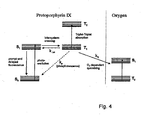
- Figure 4 shows a working model for state transitions, quenching and measurement modes.
- PpIX is the final precursor in the synthesis of haem used for haemoglobin, myoglobin and cytochromes, all key substances in the transport and/or utilization of oxygen. This makes the use of PpIX as oxygen sensor even more attractive because it provides a unique method for measurement of an oxygen concentration at the place where the availability of oxygen is the most important (i.e. intracellular and inside the mitochondria). Moreover, delayed fluorescence measurements are easier to implement in vivo and in clinical use than absorption measurements.
- a method of the invention wherein protoporphyrin IX is photo-excited.
- This is a usual way of exciting a compound and a lot of equipment for photo-exciting is available in the art.
- An example of a photo-exciting device is described in Shonat et al, 1997 .
- the endogenous compound thereof is excited by other means, like for instance electromagnetic radiation.
- a method of the invention is therefore provided wherein said compartment comprises a cell.
- said compartment comprises an organelle.
- said compartment comprises a mitochondrion, since protoporphyrin IX is naturally present in mitochondria.
- a method of the invention is particularly suitable for determining oxygen concentration in mitochondria. This is a preferred application of the invention since the availability of oxygen in mitochondria is a measure of tissue bioenergetics. Since mitochondria normally consume oxygen, a low concentration of oxygen within mitochondria is indicative for tissue bioenergetics. Tissue bioenergetics is therefore preferably assessed by determining a mitochondrial oxygen concentration with a method of the present invention.
- One preferred embodiment of the present invention involves determining mitochondrial oxygen concentration after a period of tissue dysoxia in order to determine whether tissue cells are still viable or whether these cells are prone to apoptosis. If a mitochondrial oxygen concentration appears to be low, it indicates that bioenergetics still take place and that cells are still viable. If however mitochondrial oxygen concentrations appear to be high, bioenergetics hardly - if at all - take place indicating that cells are prone to apoptosis.
- 5-aminolevulinic acid is administered to cells, resulting in accumulation of protoporphyrin IX inside the mitochondria.
- luminescence and/or transient absorption lifetime of said accumulated PpIX is measured in order to determine mitochondrial oxygen concentration.
- oxygen concentration in mitochondria of a cell is determined within four hours, more preferably within two hours, even more preferably within one hour after administration of 5-aminolevulinic acid to said cell, because during this period PpIX primarily accumulates inside mitochondria. In one embodiment oxygen concentration is determined in other parts of said cell after four hours.
- a method of the invention is suitable for determining the concentration of oxygen in a tissue or organ, or in a certain part of a tissue or organ.
- Important applications are for instance measurements of oxygen concentration in the heart, the brain and/or the retina of the eye, preferably during surgery.
- Oxygen concentration in the brain and/or heart is for instance measured in order to determine whether a stroke and/or myocardial infarction has occurred.
- oxygen concentrations in several different parts of a certain tissue or organ are determined in order to obtain an overall impression, and/or to measure a pO 2 gradient.
- a method of the invention is therefore provided wherein said compartment comprises at least part of a tissue.
- oxygen concentration at a tumor site is determined.
- Information about oxygen concentration at a tumor site is for instance required for determining whether a certain kind of treatment, such as irradiation and/or photodynamic therapy, is suitable. For instance, little oxygen is present at a solid tumor site. Irradiation is therefore not likely to be effective at such site. Therefore, once it is determined with a method of the invention that an individual is suffering from a solid tumor with little oxygen, irradiation therapy is preferably not applied. Instead, alternative treatment is preferred. Hence, therapy is adapted to information about oxygen concentration, which information is obtained by a method of the invention.
- oxygen concentration at a tumor site and/or around a tumor site is monitored with a method of the invention in order to monitor progress of disease and/or therapy.
- a concentration of oxygen at a location of interest is measured by providing an organism with an endogenous compound, and/or with a precursor thereof, which is coupled to a moiety capable of specifically binding said location of interest.
- Said moiety for instance comprises an antibody or a functional part, derivative and/or analogue thereof.
- an endogenous compound or a precursor thereof is preferably coupled to an antibody capable of specifically binding a tumor-specific antigen.
- a tumor-specific antigen is an antigen that is present on a tumor cell while it is less (preferably not) present on normal cells. Said endogenous compound or precursor coupled to a tumor-specific antibody will accumulate in and/or around said tumor.
- the concentration of oxygen is specifically measured at any location of interest, using protoporphyrin IX and/or precursor thereof that is coupled to a moiety capable of specifically binding said location of interest.
- the endogenous compound protoporphyrin IX is administered to the circulation of an individual.
- a precursor is administered which is converted in vivo into at least one metabolite that is essentially the same kind as - preferably identical to - the endogenous compound and which, if excited, exhibits a luminescence and/or transient absorption of which the life time is dependent on the concentration of a given substance.
- 5-aminolevulinic acid is administered, which is metabolized into protoporphyrin IX in vivo.
- said molecule is in one embodiment bound, for instance to albumin, to form a large molecular complex that remains confined, at least for a certain time, inside the circulation.
- Said administered compound which is essentially the same kind as the endogenous compound, and/or whose metabolite is essentially the same kind as the endogenous compound, is not or to a lesser extent toxic as compared to exogenous compounds such as for instance palladium-porphyrin. Administration of said compound is therefore not, or to a lesser extent, involved with (harmful) side reactions.
- a method of the invention is therefore provided wherein said compartment comprises the (micro)circulation.
- Another application of a method of the invention is the use of the endogenous compound , for determining the concentration of oxygen in a culture medium.
- a certain kind of tissue, cell and/or organism is cultured in a culture medium.
- an endogenous compound of said tissue, cell and/or organism is excited. Subsequently, the lifetime of luminescence and/or transient absorption is measured.
- said culture medium comprises a cell suspension.
- a suitable compound which, when excited, displays a luminescence and/or transient absorption, the lifetime of which is dependent on the concentration of oxygen, or a compound which is converted in vivo into at least one metabolite that is essentially the same kind as - preferably identical to - an endogenous compound.
- Said administered compound for instance comprises a compound which is essentially the same kind as - preferably identical to - an endogenous compound.
- said compound need not be naturally present in said cultured tissue, cell and/or organism.
- protoporphyrin IX or a precursor thereof such as for instance 5-aminolevulinic acid is administered to a culture medium, such as a bioreactor, in order to monitor oxygen concentration with a method of the invention, comprising exciting said porphyrin and measuring the lifetime of delayed fluorescence.
- a method of the invention comprising exciting said porphyrin and measuring the lifetime of delayed fluorescence.
- said oxygen concentration is measured at several time points, such that the availability of oxygen is monitored over time.
- the lifetime of luminescence and/or transient absorption is compared with a reference.
- a reference curve also called a calibration curve
- kq and ⁇ 0 are derived.
- a luminescence lifetime is correlated with the concentration of oxygen, preferably by the Stern-Volmer relationship.
- a reference curve is preferably generated in order to correlate the lifetime of transient absorption to the concentration of oxygen.
- a compartment is successively provided with various concentrations of the substance in order to generate a reference curve. Additionally, or alternatively, several similar compartments are provided with various concentrations of the substance. According to this embodiment, luminescence and/or transient absorption lifetime is determined at various concentrations of said substance.
- Many alternative methods of generating a reference curve are known in the art, which are suitable for a method of the present invention.
- a luminescence and/or transient absorption lifetime is preferably determined at at least two concentrations of said substance.
- luminescence and/or transient absorption lifetime is determined at at least three concentrations of said substance, more preferably at at least four concentrations of said substance.
- a reference curve is for instance generated by plotting luminescence lifetime and/or transient absorption lifetime versus concentration of oxygen. Of course, said reference curve need not to be physically plotted. It is for instance also possible to store measured reference values, for instance in a (computer) database.
- a formula representing a reference curve is for instance calculated. In one embodiment a measured luminescence lifetime and/or transient absorption lifetime is entered into said database, after which an algorithm calculates and discloses the correlated substance concentration.
- a calibration curve is generated using the same kind of compartment(s) as the compartment(s) wherein the concentration of oxygen is to be measured.
- a calibration curve is generated, it is preferably used to correlate a measured luminescence and/or transient absorption lifetime with a concentration of oxygen.
- a calibration curve is generated before the concentration of oxygen a compartment is determined.
- it is not necessary to generate another calibration curve each time before a concentration of oxygen is determined. For instance, once kq and ⁇ 0 have been determined it is preferably repeatedly used for correlating said lifetime to the concentration of oxygen.
- a luminescence lifetime is measured in the time-domain, meaning that said lifetime is measured after a pulse of light.
- said lifetime is measured in the frequency-domain, meaning that continuous excitation takes place.
- the phase-shift between a modulated excitation source and the emitted luminescence is measured.
- phosphorescence and/or delayed fluorescence is capable of being measured in the frequency domain. Measurement of said lifetime in the frequency domain is usually cheaper. On the other hand, measurement of said lifetime in the time domain is possible with a higher intensity of light.
- a method of the invention is suitable for being performed with single-photon excitation.
- a preferred embodiment provides a method of the invention wherein multi-photon excitation is applied, such as for instance two-photon, three-photon or four-photon excitation.
- Multi-photon excitation involves excitation with multiple photons instead of one.
- the multiple photons for instance have one half of the energy of a single photon (in case of two-photon excitation).
- the multiple photons have one third of the energy of a single photon (in case of three-photon excitation), or one fourth of the energy of a single photon (in case of four-photon excitation), and so on.
- Multi-photon excitation is preferred because it allows for deeper tissue penetration and a more precise and confined selection of an excitation volume as compared to single-photon excitation, due to the non-linear multi-photon effect.
- inner parts of a compartment such as for instance inner parts of a tissue or organ, are more easily examined.
- Multi-photon excitation facilitates determination of a concentration gradient, for instance from an outer surface of a tissue until an inner part of such tissue or vice versa.
- multi-photon excitation allows for a more precise and confined selection of an excitation volume, damage to surrounding tissue is more easily avoided.
- a method of the invention is used for an "optical biopsy".
- a certain part of interest such as a small part of a certain tissue, is investigated but not excised.
- the oxygen concentration of said part of interest is determined using a method of the invention specifically directed to said part of interest, while said part of interest remains at its original site.
- at least part of a tissue of an organism is investigated while said part remains in said organism. This is preferably performed using multi-photon excitation because multi-photon excitation allows for a precise selection of an excitation volume.
- two-photon excitation is applied.
- the principles and advantages of two-photon excitation are outlined in (Mik, 2004), which is incorporated herein by reference.
- two-photon excitation is a non-linear optical process in which a compound is excited by two photons instead of a single photon with a double energy (or half the wavelength).
- R TPE ⁇ 2 ⁇ l A ⁇ C ⁇ P 2
- ⁇ is the two-photon cross-section
- 1 the path-length
- A the cross-sectional area of the beam (multiplying 1 by A defines the interaction volume)
- C the molar concentration of the excitable compounds
- P the power of the excitation beam.
- equation (3) can be rewritten in terms of signal intensity versus excitation power: I 0 ⁇ C ⁇ P 2
- I 0 is the measured phosphorescence intensity at time zero, i.e. directly after the excitation pulse.
- I 0 is the measured phosphorescence intensity at time zero, i.e. directly after the excitation pulse.
- constants influencing the absolute value of I 0 like the molecular constants, excitation geometry and detection efficiency are omitted. These constants are intensity independent so that the proportionality sign describes the relation between I 0 and P 2 .
- the non-linear behavior of TPE provides a means of selective excitation within a 3-dimensional space, and the quadratic dependence of emission intensity versus excitation power is regarded as proof of the two-photon nature of the studied phenomena.
- the invention furthermore provides a device for determining a concentration of oxygen in a compartment according to claim 20
- equipment for optical spectroscopy comprises an illumination light source, an optical system (for instance comprising filters, mirrors and lenses) and a detection unit.
- the detector for instance comprises a sensitive CCD camera, photomultiplier tube and/or spectrophotometer.
- a combination of a prism and a bandpassfilter is used, at least partly preventing a high amount of excitation light to reach the filters in order to avoid possible disturbance of a delayed fluorescence signal as a result of fluorescence and/or phosphorescence of the filters themselves.
- a device of the invention comprises a fast shutter in front of a PMT, preferably a pockel cell, in order to prevent distortion of the fist 20 to 30 ⁇ s of a signal which would otherwise occur if a PMT is gated by switching the voltages of the second and third dynodes during the laser pulse.
- a semi-conductor device preferably an avalanche-photodiode is used, which is cheaper.
- a device according to the invention comprising an imaging device capable of oxygen mapping, preferably a CCD camera and/or a diode array, is used in order to allow imaging of a specific location.
- an imaging device capable of oxygen mapping preferably a CCD camera and/or a diode array
- Reference measurements are preferably performed for quantitative measurements, in order to take account of possible influences of tissue optical properties on the signal.
- the spectra of prompt and delayed luminescence were recorded using a LS50B luminescence spectrometer (Perkin-Elmer, Wellesley, MA, USA). Prompt fluorescence was measured using the fluorescence mode with excitation source correction. Delayed luminescence was recorded in the phosphorescence mode, using varying delay times with respect to the excitation flash and a gate width of 100 ⁇ s. The measurements were made at room temperature. Excitation and emission wavelengths and slit widths will be specified in the results section. Spectra were recorded with either air-saturated samples or samples containing zero oxygen.
- the detector was coupled to a monochromator (Oriel 77320) in order to select the emission wavelength of interest.
- the output of the PMT was fed into an oscilloscope (Tektronix 2440, TEKTRONIX INC., Beaverton Oregon, USA) and transferred to a computer by the serial bus.
- the wavelength-dependent transient absorption was measured using a white light source and scanning of the monochromator. These experiments were carried out at room temperature (20°C).
- the detector was the same R928 PMT with C1392-09 socked, switched off during 5 ⁇ s gate width.
- the detector was coupled to the reaction vessel by a VIS-type liquid light guide with a 5 mm optical core (Oriel, Stratford, USA). Instead of the monochromator three 630 nm long pass glass filters were used for filtering of the emission light.
- the laser pulse was fired 1 ⁇ s after off gating of the PMT, the repetition rate was 10 Hz.
- Per measurement 64 traces were averaged on a digital oscilloscope (Tektronix TDS-350, Tektronix Inc., Beaverton Oregon, USA). Data were transferred to a computer by serial bus and lifetime analysis was performed using LabView 5.1 graphical programming software (National Instruments, Austin, Texas, USA). Mono-exponential fitting was performed using a Marquard-Levenberg non-linear fit.
- the oxygen concentration in the PpIX solution was varied using the ascorbate oxidase/ascorbic acid enzymatic reaction.
- Calibration experiments needing precisely controlled oxygen concentrations, were performed using a specially made reaction vessel.
- the vessel had to be airtight, allow continuous mixing of the PpIX solution, temperature control, continuous temperature monitoring and physical access to the content. The latter was necessary to allow injection of aliquots of ascorbic acid solution but should not go at the expense of an interfering oxygen back-diffusion into the sample. It consisted of two glass parts, a bottom part and a top part. Both parts were interconnected by screw lock.
- the bottom of the reaction vessel was flat, to allow continuous stirring of the content by a magnetic stirrer.
- the top part contained three capillary entries: one allowing insertion of a small thermocouple, one for the insertion of the light guide from the excitation source and the latter for injection of ascorbic acid.
- the capillaries had a length of 2 cm and a lumen of 1 mm diameter.
- the diffusion barrier was large enough to prevent measurable oxygen back diffusion within an hour, an adequate time span for calibration experiments. This was checked by oxygen dependent quenching of phosphorescence of Pd-meso-tetra(4)-carboxyphenyl porphine starting at varying oxygen concentrations below 40 ⁇ M.
- the reaction vessel was mounted in a temperature-controlled water jacked on top of a magnetic stirring device.
- Injection of 10 ⁇ l of a 200 mM solution of ascorbic acid resulted therefore in 32.5 ⁇ M oxygen steps (PO 2 steps of approximately 20 mmHg).
- Pd-meso-tetra(4)-carboxyphenyl porphine was purchased from Porphyrin Products (Porphyrin Products Inc., Logan, UT, USA).
- Protoporphyrin IX disodium salt (PpIX) was purchased from Sigma (Sigma Chemical CO., ,St. Louis, MO, USA).
- Two regimens of creating PpIX solutions were used. In the first regimen, 8 mg/ml PpIX was dissolved in distilled water brought at a pH of 8.0 by titration with 1M TRIS base. From this solution 0.5 ml was added to 50 ml of a human albumin solution (40 gr/l) in phosphate buffered saline (PBS).
- PBS phosphate buffered saline
- PpIX was dissolved in methanol (6.07 mg PpIX in 10 ml methanol) and 2 ml of this PpIX solution was immediately added to the albumin solution, resulting in a final concentration of approximately 10 ⁇ M PpIX.
- PpIX solutions according to the second regimen were used for the recording of the shown spectra and calibration experiments, unless stated otherwise.
- Metallo-porphyrins used for oxygen concentration measurements in vivo can usually be effectively excited at several different wavelengths.
- Pd-porphyrin the most widely used phosphorescent dye for in vivo measurements, can be effectively excited around 400 nm (the Soret maximum) and 530 nm (the Q-band).
- Figure 5 shows the fluorescence emission versus the excitation wavelength of PpIX bound to albumin. Two peak emissions, one around 400 nm and one around 510 nm are prominently present.
- the excitation wavelengths of the used lasers are indicated in the figure for convenience. As will become apparent, both wavelengths are effective for delayed fluorescence measurements.
- FIG. 6 shows the transient transmission spectrum of a 20 ⁇ M PpIX solution as function of the transmission wavelength.
- the maximum at 400 nm is caused by depletion of the ground state by the laser pulse, the minimum at 450 nm is due to population of the T 1 level and absorption to the T 2 level.
- FIG 7 shows the prompt fluorescence spectrum, with its characteristic peak at 636 nm. Delayed luminescence spectra, recorded using varying delays after the excitation flash, are shown in figure 8.
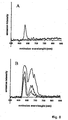
- Figure 8A shows the delayed luminescence in an air-saturated sample. Delayed luminescence is hardly detectable 30 ⁇ s after the excitation and is totally vanished after a delay of 100 ⁇ s. In contrast, figure 8B shows that under zero oxygen conditions delayed luminescence can be detected even after a 1 ms delay.
- the delayed fluorescence lifetime should be an appropriate representative of the T 1 lifetime.
- the delayed fluorescence lifetime was compared to the lifetime of transient Triplet-Triplet absorption in a deoxygenated sample.
- Figure 9 shows the decay of the triplet state measured with both delayed fluorescence and Triplet-Triplet absorption.
- Panel A displays the decay curve measured by delayed fluorescence at 636 nm after pulsed excitation at 505 nm. The fast decaying first part of the curve is an artefact introduced by the excitation source.
- Panel B contains the corresponding decay trace as measured by Triplet-Triplet absorption at 470 nm.
- a method of the invention is for instance performed in the time-domain using pulsed excitation from an experimental high power tuneable laser.
- the laser of this Example consists of a doubled flash-lamp pumped Nd-YAG laser pumping an optical parametric oscillator (OPO). This results in a tuneable laser providing 10 mJ pulses of 6 ns duration.
- OPO optical parametric oscillator
- the laser is coupled to a quart cuvette containing the studied samples using a glass fiber.
- Perpendicular to the laser beam is a detector consisting of coupling lens, monochromator and photomultiplier tube (PMT).
- the photomultiplier (Hamamatsu R928) is working in photon-counting mode and is gated during laser excitation by reversing the polarities of the second and third dynode.
- the current from the PMT is voltage converted using a fast-switching integrator (integration time 3,5 ⁇ s and reset time 0,5 ⁇ s).
- the voltage is digitised at a sample rate of 250 kHz using a data-acquisition board in a PC.
- the signal of 64 pulses is averaged before applying a mono-exponential fit procedure to the measured decay curves.
- the lifetime typically varies from 20 ms at high oxygen levels to 700 ms at zero-oxygen conditions.
- FIG. 11 shows the distribution of the PpIX fluorescence at three different time points (2, 4 and 8 hours for panel A, B and C respectively). At least until four hours, the PpIX fluorescence shows a spotty appearance corresponding to a mitochondrial pattern. At 8 hours a more diffuse fluorescence is observed located in the cytosol.
- ALA 5-aminolevulinic acid
- excitation is achieved using a Q-switched laser operating at 1064 nm (Laser 1-2-3, Schartz Electro-Optics Inc., Orlando, FL, USA).
- the laser provides pulses of approximately 10 ns duration and an energy ranging from 10 mJ per pulse for in vitro experiments to 100 mJ per pulse in in vivo experiments.
- the bundle diameter of the laser beam is slightly expanded to a final diameter of 5 mm by a beam expander, before being directed to the focusing lens by an optical mirror with an enhanced silver reflection surface (Opto Sigma, Santa Anna, CA, USA).
- the focusing lens is a single plan-convex lens with a focal length of 2.0 cm.
- the bundle diameter of 5 mm combined with a lens with a focal length of 2.0 cm results in a focal spot size of 8 ⁇ m and a focus length of 94 ⁇ m (in air).
- the measurement volume is approximately a cylinder with diameter of 10 ⁇ m and a length of 130 ⁇ m.
- the focusing lens is connected to a micrometer-screw for manual adjustment of the focal plane, thereby allowing longitudinal measurements to be made.
- the reading of the micrometer screw is multiplied by the refractive index of tissue, assumed to be 1.4. Emission light is collected by the same lens and directed towards the photo detector by two mirrors.
- phosphorescence light is achieved by two 700 ⁇ 20 nm band pass filters (Oriel, Stratford, CT, USA), positioned in series before the cathode of the photomultiplier tube (PMT, type R928, Hamamatsu, Hamamatsu City, Japan).
- the output of the PMT is voltage-converted by a current-to-voltage converter with subsequent wide-band amplifier (30 MHz) and fed into a digital oscilloscope (Tektronix 2440, Tektronix Inc., Beaverton, OR, USA).
- Tektronix 2440 Tektronix Inc., Beaverton, OR, USA
- luminescent traces are averaged on the oscilloscope. For instance, an average of 32 traces is used.
- the resulting averaged traces are transferred to a computer by serial bus for data-collection and analysis using software, for instance written in LabView (National Instruments, Austin, TX, USA).
- Luminescence lifetimes can be measured both in the time-domain as well as in the frequency-domain.
- the real decay curve is measured after photo excitation with a short pulse of light.
- the (continuous) excitation light is modulated with a known frequency and the lifetime can be determined from the phase-shift between excitation and emission light.
- Both methods have their specific advantages and disadvantages: Time-domain Frequency-domain Pros: Pros: No disturbance by prompt fluorescence Lock-in amplification (high S/N-ratio) No influence on oxygen tension Relatively cheap Cons: Cons: Background light needs to be taken care of Possible disturbance by prompt fluorescence Expensive Oxygen consumption
- a monochromator is preferably used instead of filters in order to avoid possible disturbance of the delayed fluorescence signal as a result of fluorescence and/or phosphorescence of the filters themselves.
- monochromators have low transmission efficiency and a gain in performance is achieved by using a different optical system.
- a cost-effective solution is a use of band-pass filters combined with an optical system that at least partly prevents a high amount of excitation light to reach the filters. An example of this embodiment is shown in Figure 14 .
- PMT's are a good choice. Due to the high energetic laser pulse and the resulting high amount of prompt fluorescence the detector and electronics are preferably protected against damage. In one embodiment gating of the PMT is performed by switching the voltages of the second and third dynodes during the laser pulse. This causes distortion of the fist 20 to 30 ⁇ s of the signal, diminishing adequate measurement of short lifetimes. A dedicated microchannelplate PMT is therefore a preferred option. An alternative is using a fast shutter in front of a standard PMT, e.g. a pockel cell. An even cheaper alternative is the use of semi-conductor devices like avalanche-photodiodes.
- FIG. 1 Schematic example of frequency-domain phosphorimeter.
- a sinusoidal voltage (V excitation ) with a frequency of 2000 Hz is generated by a data aquisition board (PCI-MIO-16E1, National Instruments).
- the light output of the green LED is modulated by V excitation through a voltage-to-current converter.
- the excitation light is filtered by a 530 broadband bandpass filter (F1) and focussed into a liquid light guide (LLG, Oriel) by a lens (L1).
- the emission light returning from the sample is directed to the detector by a dichroic mirror (M).
- L2 is a coupling lens and F2 is a 700 nm bandpass filter.
- the detector is a red-sensitive photomultiplier tube (PMT, Hamamatsu R928).
- the current from the PMT passes a current-to-voltage converter and is amplified to generate a signal (V signal ) that can be sampled by the DAQ-board.
- V signal a signal that can be sampled by the DAQ-board.
- the phase-shift between V excitation and V signal is determined by software, for instance written in LabView (such as version 5.1, National Instruments).
- the phosphorescence lifetime ( ⁇ ) is calculated from ⁇ , allowing the calculation of the oxygen tension (pO 2 ) by the Stern-Volmer relationship, with ⁇ 0 the lifetime under zero-oxygen conditions and k q the quenching constant.
- Figure 2 Structure formulas of porphine and protoporphyrin IX.
- Figure 3 Panel A: The delayed fluorescence at zero oxygen conditions measured in a solution of PpIX bound to albumin.
- Panel B The Triplet-Triplet absorption at 470 nm also at zero oxygen, same sample as A.
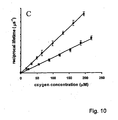
- Panel C Reciprocal lifetime of delayed fluorescence as a function of oxygen concentration at two different temperatures.
- FIG. 4 Jablonski diagram showing, schematically, the energy states and state-transitions of PpIX and its interaction with dioxygen.
- S 0 - S 2 denote singlet states.
- T 0 - T 2 denote triplet states.
- K q and k p are the rate-constants of the occurrence of quenching and phosphorescence respectively.
- parentheses and the broken arrow depict the absence of detectable phosphorescence.
- K- isc is the rate constant of the T 1 ⁇ S 1 intersystem crossing.
- Figure 5 Emission intensity of PpIX fluorescence as a function of the excitation wavelength.
- Figure 6 The transient transmission of 20 ⁇ M PpIX in 4% albumin as function of the transmission wavelength after pulsed excitation at 505 nm.
- the maximum at 400 nm is caused by depletion of the ground state by the laser pulse, the minimum at 450 nm is due to population of the T 1 level and absorption to the T 2 level.
- Figure 7 Prompt fluorescence emission spectrum of PpIX bound to albumin. Excitation wavelength was 405 ⁇ 2.5 nm. The emission was detected with a 4 nm slit width of the monochromator.
- FIG 8 Delayed luminescence spectra of PpIX bound to albumin. The emission spectra recorded at varying delays after the excitation flashes are shown. The used gate-width was 100 ⁇ s. All spectra are the result of summation of 10 consecutive runs. The spectra shown in 8A were recorded in an air-equilibrated sample. The spectra in 8B show the increase in delayed luminescence after deoxygenation of the sample (see text for details).
- Figure 9 Panel A: The delayed fluorescence at zero oxygen conditions measured in a solution of PpIX bound to albumin.
- Panel B The Triplet-Triplet absorption at 470 nm also at zero oxygen, same sample as A.
- Figure 10 Reciprocal lifetime of delayed fluorescence as a function of oxygen concentration at two different temperatures.
- Figure 11 Microscopy in ALA incubated neuroblastoma cells. From up to down the image shows phase-contrast wide field, PpIX fluorescence and a combination image. Panel A: 2 hours ALA incubation. Panel B: 4 hours ALA incubation. Panel C: 8 hours ALA incubation.
- FIG. 12 Intramitochondrial oxygen measurement in a cell suspension of neuroblastoma cells. Rotenone is a blocker of the mitochondrial oxygen consumption. After administration of rotenone, the intramitochondrial PO 2 is assumed to be the same as the extracellular PO 2 .
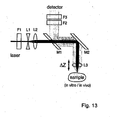
- FIG. 13 Schematic diagram of the experimental set-up.
- the laser provided pulses of 10 ns with a wavelength of 1064 nm at a repetition rate of 10 Hz.
- F1 is a 1064 nm laser line bandpass filter.
- L1 and L2 form a beam-expander resulting in a beam width of approximately 5 mm.
- Mirror M1 is a standard optical mirror with a central bore-hole for passing of the laser-beam.
- Mirror M2. has an enhanced silver surface.
- L3 is a lens with a focal length of 2 cm. This distance of this lens to the sample can be varied in the z-plane ( ⁇ Z) for adjustment of the measurement depth.
- Filters F2 and F3 are 700 nm bandpass filters.
- the detector is a red-sensitive photomultiplier tube, the output is fed into a digital oscilloscope.
- Figure 14 A combination of a prism and a bandpass filter is a cost-effective alternative to a monochromator and provides even better transmission efficiency.
Landscapes
- Health & Medical Sciences (AREA)
- Life Sciences & Earth Sciences (AREA)
- General Health & Medical Sciences (AREA)
- Engineering & Computer Science (AREA)
- Biomedical Technology (AREA)
- Epidemiology (AREA)
- Animal Behavior & Ethology (AREA)
- Public Health (AREA)
- Veterinary Medicine (AREA)
- Chemical & Material Sciences (AREA)
- Medicinal Chemistry (AREA)
- Proteomics, Peptides & Aminoacids (AREA)
- Nuclear Medicine, Radiotherapy & Molecular Imaging (AREA)
- Physics & Mathematics (AREA)
- Analytical Chemistry (AREA)
- Biochemistry (AREA)
- General Physics & Mathematics (AREA)
- Immunology (AREA)
- Pathology (AREA)
- Investigating, Analyzing Materials By Fluorescence Or Luminescence (AREA)
- Investigating Or Analysing Materials By The Use Of Chemical Reactions (AREA)
- Investigating Or Analysing Biological Materials (AREA)
Claims (24)
- Ein Verfahren zur Bestimmung der Konzentration von Sauerstoff in einem Kompartiment, Schritte umfassend, bei denen man:- Protoporhyrin IX anregt,- die Lebensdauer der Lumineszenz und/oder transienten Absorption, welche dieses Porphyrin zeigt, misst, wobei in der Anwesenheit von Sauerstoff die Lebensdauer eines angeregten Triplet-Zustands verkürzt ist gegenüber der Lebensdauer eines angeregten Triplet-Zustands in der Abwesenheit von Sauerstoff, und wobei die Lumineszenz und/oder transiente Absorption verzögerte Fluoreszenz und/oder Triplet-Triplet Absorption ist, und- die Lebensdauer mit der Konzentration korreliert.
- Ein Verfahren gemäß Anspruch 1, wobei das Porphyrin mittels Photonen angeregt wird.
- Ein Verfahren gemäß einem der Ansprüche 1 oder 2, wobei das Kompartiment eine Zelle umfasst.
- Ein Verfahren gemäß einem der Ansprüche 1-3, wobei das Kompartiment eine Organelle umfasst.
- Ein Verfahren gemäß Anspruch 4, wobei die Organelle ein Mitochondrium umfasst.
- Ein Verfahren gemäß einem der Ansprüche 1-5, wobei das Kompartiment zumindest einen Teil eines Gewebes umfasst.
- Ein Verfahren gemäß einem der Ansprüche 1-6, wobei das Kompartiment ein Organ umfasst.
- Ein Verfahren gemäß einem der Ansprüche 1-7, wobei das Kompartiment einen Tumor umfasst.
- Ein Verfahren gemäß einem der Ansprüche 1-8, wobei das Kompartiment die Mikrozirkulation umfasst.
- Ein Verfahren gemäß einem der Ansprüche 3-9, wobei das Gewebe, die Zelle oder die Organelle in einem Kulturmedium vorliegt.
- Ein Verfahren gemäß einem der Ansprüche 1-10, wobei das Kompartiment eine Zellsuspension umfasst.
- Ein Verfahren gemäß einem der Ansprüche 1-11, wobei die Lebensdauer mit einer Referenz verglichen wird.
- Ein Verfahren gemäß einem der Ansprüche 1-12, wobei die Lebensdauer im Zeitbereich gemessen wird.
- Ein Verfahren gemäß einem der Ansprüche 1-13, wobei genannte Lebensdauer im Frequenzbereich gemessen wird.
- Ein Verfahren gemäß einem der Ansprüche 1-14, wobei Mehrphotonenanregung verwendet wird.
- Ein Verfahren gemäß einem der Ansprüche 1-15, wobei Zweiphotonenanregung verwendet wird.
- Ein Verfahren gemäß einem der Ansprüche 1-16, wobei dem Kompartiment ein Vorläufer von Protoporphyrin IX verabreicht wird, welcher dazu in der Lage ist, in mindestens ein endogenes Porphyrin umgewandelt zu werden, wobei das von dem Vorläuferstoff abgeleitete Porphyrin angeregt wird.
- Ein Verfahren gemäß Anspruch 17, wobei der Vorläufer 5-Aminolävulinsäure ist.
- Ein Verfahren gemäß Anspruch 18, wobei eine Sauerstoffkonzentration in Mitochondrien in einer Zelle bestimmt wird, und wobei die Lebensdauer innerhalb von vier Stunden nach der Verabreichung der 5-Aminolävulinsäure an die Zelle gemessen wird.
- Verwendung einer Vorrichtung, umfassend:- Mittel zur Anregung eines endogenen Protoporphyrin IX, wobei das Porphyrin, wenn angeregt, eine Lumineszenz und/oder eine transiente Absorption zeigt, deren Lebensdauer von der Substanz abhängt, wobei die Lumineszenz und/oder transiente Absorption verzögerte Fluoreszenz und/oder Triplet-Triplet Absorption ist, und- Mittel zum Messen der Lebensdauer,zur Bestimmung der Konzentration von Sauerstoff in einem Kompartiment nach der Methode gemäß einem der Ansprüche 1-19.
- Verwendung gemäß Anspruch 20, umfassend eine Kombination von einem Prisma und einem Bandbreitenfilter.
- Verwendung gemäß einem der Anspruch 20 oder 21, umfassend einen schnellen Verschluss vor einer PMT.
- Verwendung gemäß einem der Ansprüche 20-22, umfassend eine Halbleitervorrichtung.
- Verwendung gemäß einem der Ansprüche 20-23, umfassend eine bildgebende Vorrichtung, die Sauerstoff kartieren kann.
Priority Applications (2)
| Application Number | Priority Date | Filing Date | Title |
|---|---|---|---|
| EP10012634A EP2273255A1 (de) | 2005-07-06 | 2006-07-06 | Vorrichtung und Verfahren zur Bestimmung der Konzentration einer Substanz |
| EP06757824A EP1904831B1 (de) | 2005-07-06 | 2006-07-06 | Vorrichtung und verfahren zur bestimmung der konzentration von sauerstoff einer substanz |
Applications Claiming Priority (3)
| Application Number | Priority Date | Filing Date | Title |
|---|---|---|---|
| EP05076565A EP1742038A1 (de) | 2005-07-06 | 2005-07-06 | Vorrichtung und Verfahren zur Bestimmung der Konzentration einer Substanz |
| PCT/NL2006/000341 WO2007004873A1 (en) | 2005-07-06 | 2006-07-06 | Device and method for determining the concentration of a substance |
| EP06757824A EP1904831B1 (de) | 2005-07-06 | 2006-07-06 | Vorrichtung und verfahren zur bestimmung der konzentration von sauerstoff einer substanz |
Related Child Applications (1)
| Application Number | Title | Priority Date | Filing Date |
|---|---|---|---|
| EP10012634.1 Division-Into | 2010-09-30 |
Publications (2)
| Publication Number | Publication Date |
|---|---|
| EP1904831A1 EP1904831A1 (de) | 2008-04-02 |
| EP1904831B1 true EP1904831B1 (de) | 2011-09-14 |
Family
ID=35414517
Family Applications (3)
| Application Number | Title | Priority Date | Filing Date |
|---|---|---|---|
| EP05076565A Withdrawn EP1742038A1 (de) | 2005-07-06 | 2005-07-06 | Vorrichtung und Verfahren zur Bestimmung der Konzentration einer Substanz |
| EP10012634A Withdrawn EP2273255A1 (de) | 2005-07-06 | 2006-07-06 | Vorrichtung und Verfahren zur Bestimmung der Konzentration einer Substanz |
| EP06757824A Active EP1904831B1 (de) | 2005-07-06 | 2006-07-06 | Vorrichtung und verfahren zur bestimmung der konzentration von sauerstoff einer substanz |
Family Applications Before (2)
| Application Number | Title | Priority Date | Filing Date |
|---|---|---|---|
| EP05076565A Withdrawn EP1742038A1 (de) | 2005-07-06 | 2005-07-06 | Vorrichtung und Verfahren zur Bestimmung der Konzentration einer Substanz |
| EP10012634A Withdrawn EP2273255A1 (de) | 2005-07-06 | 2006-07-06 | Vorrichtung und Verfahren zur Bestimmung der Konzentration einer Substanz |
Country Status (4)
| Country | Link |
|---|---|
| US (2) | US20090130700A1 (de) |
| EP (3) | EP1742038A1 (de) |
| AT (1) | ATE524725T1 (de) |
| WO (1) | WO2007004873A1 (de) |
Families Citing this family (20)
| Publication number | Priority date | Publication date | Assignee | Title |
|---|---|---|---|---|
| EP1742038A1 (de) * | 2005-07-06 | 2007-01-10 | Academisch Medisch Centrum bij de Universiteit van Amsterdam | Vorrichtung und Verfahren zur Bestimmung der Konzentration einer Substanz |
| JP5098051B2 (ja) * | 2007-04-05 | 2012-12-12 | Sbiファーマ株式会社 | ミトコンドリア障害脳疾患治療剤及び診断剤 |
| US8738160B2 (en) * | 2008-07-25 | 2014-05-27 | Jeffery Bucove | Apparatus and method for plant metabolism manipulation using spectral output |
| WO2010019041A1 (en) * | 2008-08-15 | 2010-02-18 | Erasmus University Medical Center Rotterdam | Methods and devices for assessment of mitochondrial function |
| US8939966B2 (en) * | 2008-08-21 | 2015-01-27 | University Of Florida Research Foundation, Inc. | Differential laser-induced perturbation (DLIP) for bioimaging and chemical sensing |
| US9874520B1 (en) | 2008-11-07 | 2018-01-23 | Mocon, Inc. | Epi-fluoresence confocal optical analyte sensor |
| EP2350614A4 (de) * | 2008-11-07 | 2017-01-11 | Mocon, Inc. | Kalibrierungskarte für optische sauerstoffsensoren |
| US8323978B2 (en) * | 2008-11-07 | 2012-12-04 | Mocon, Inc. | Calibration system and technique for photoluminescent oxygen sensors with zero point maintained with a metal-air battery |
| US20110136247A1 (en) * | 2009-12-07 | 2011-06-09 | Dmitri Boris Papkovsky | Photoluminescent oxygen probe with reduced cross-sensitivity to humidity |
| US20130005047A1 (en) * | 2010-03-25 | 2013-01-03 | Mocon, Inc. | Luminescence lifetime based analyte sensing instruments and calibration technique |
| US9274060B1 (en) | 2011-01-13 | 2016-03-01 | Mocon, Inc. | Methods for transmembrane measurement of oxygen concentration and monitoring changes in oxygen concentration within a space enclosed by a membrane employing a photoluminescent transmembrane oxygen probe |
| US9121827B2 (en) | 2011-06-30 | 2015-09-01 | Mocon, Inc. | Method of contemporaneously monitoring changes in analyte concentration in a plurality of samples on individual schedules |
| US9057687B2 (en) | 2012-04-20 | 2015-06-16 | Mocon, Inc. | Calibration vial and technique for calibrating a fiber optic oxygen sensing needle |
| EP2687288A1 (de) * | 2012-07-19 | 2014-01-22 | Sociedad española de carburos metalicos, S.A. | Verfahren zur Vorhersage der Effizienz eines TIO2-Katalysators |
| US8658429B1 (en) | 2012-08-06 | 2014-02-25 | Mocon, Inc. | Photoluminescent oxygen probe tack |
| CN107072505B (zh) * | 2014-04-05 | 2021-03-12 | 手术感应设备公司 | 用于组织氧合的绘制的装置、系统和方法 |
| PT109877A (pt) * | 2017-01-26 | 2018-07-26 | Inst Superior Tecnico | Método ótico para a medição da concentração de oxigénio em sistemas de combustível. |
| US11604146B2 (en) | 2017-09-19 | 2023-03-14 | Beckman Coulter, Inc. | Analog light measuring and photon counting with a luminometer system for assay reactions in chemiluminescence measurements |
| EP3913357A1 (de) | 2020-05-22 | 2021-11-24 | Erasmus University Medical Center Rotterdam | Verfahren und vorrichtung zur optischen quantifizierung von sauerstoffpartialdruck in biologischen geweben |
| US11408825B2 (en) * | 2020-08-28 | 2022-08-09 | Hong Kong Applied Science and Technology Research Institute Company Limited | Forensic detector and the system thereof |
Family Cites Families (7)
| Publication number | Priority date | Publication date | Assignee | Title |
|---|---|---|---|---|
| US20020058008A1 (en) * | 1989-07-28 | 2002-05-16 | Kennedy James C. | Photochemotherapeutic method using 5-aminolevulinic acid and other precursors of endogenous porphyrins |
| SE9103837L (sv) * | 1991-12-21 | 1993-06-22 | Jonas Johansson | Fluorescensdiagnostik av cancer utnyttjande delta- aminolevulinsyra |
| AU766128B2 (en) * | 1999-10-14 | 2003-10-09 | Oxygen Enterprises, Ltd | Apparatus for measuring an oxygen concentration gradient and method of use thereof |
| JP3835600B2 (ja) * | 2001-11-14 | 2006-10-18 | 富士電機ホールディングス株式会社 | 酸素濃度計測素子とその製造方法 |
| JP2007500227A (ja) * | 2003-05-29 | 2007-01-11 | ミトス・ファーマシューティカルズ・インコーポレーテッド | 光増感剤及び音増感剤と関連してのニトロキシドの使用方法 |
| JP2005108746A (ja) * | 2003-10-01 | 2005-04-21 | Internatl Business Mach Corp <Ibm> | 有機エレクトロ・ルミネッセンス素子および有機エレクトロ・ルミネッセンス素子の製造方法 |
| EP1742038A1 (de) | 2005-07-06 | 2007-01-10 | Academisch Medisch Centrum bij de Universiteit van Amsterdam | Vorrichtung und Verfahren zur Bestimmung der Konzentration einer Substanz |
-
2005
- 2005-07-06 EP EP05076565A patent/EP1742038A1/de not_active Withdrawn
-
2006
- 2006-07-06 AT AT06757824T patent/ATE524725T1/de not_active IP Right Cessation
- 2006-07-06 WO PCT/NL2006/000341 patent/WO2007004873A1/en not_active Ceased
- 2006-07-06 EP EP10012634A patent/EP2273255A1/de not_active Withdrawn
- 2006-07-06 EP EP06757824A patent/EP1904831B1/de active Active
- 2006-07-06 US US11/988,535 patent/US20090130700A1/en not_active Abandoned
-
2009
- 2009-09-10 US US12/584,691 patent/US8008038B2/en active Active
Also Published As
| Publication number | Publication date |
|---|---|
| US20100255523A1 (en) | 2010-10-07 |
| EP2273255A1 (de) | 2011-01-12 |
| US20090130700A1 (en) | 2009-05-21 |
| US8008038B2 (en) | 2011-08-30 |
| WO2007004873A1 (en) | 2007-01-11 |
| ATE524725T1 (de) | 2011-09-15 |
| EP1904831A1 (de) | 2008-04-02 |
| EP1742038A1 (de) | 2007-01-10 |
Similar Documents
| Publication | Publication Date | Title |
|---|---|---|
| US8008038B2 (en) | Methods for determining oxygen concentration with protoporphyrin IX | |
| Schneckenburger et al. | Fluorescence decay kinetics and imaging of NAD (P) H and flavins as metabolic indicators | |
| Mik | Measuring mitochondrial oxygen tension: from basic principles to application in humans | |
| Roberts et al. | Non-invasive imaging of skin physiology and percutaneous penetration using fluorescence spectral and lifetime imaging with multiphoton and confocal microscopy | |
| Koenig et al. | Laser-induced autofluorescence for medical diagnosis | |
| Marti et al. | Comparison of aminolevulinic acid and hexylester aminolevulinate induced protoporphyrin IX distribution in human bladder cancer | |
| US20120170037A1 (en) | Apparatus for imaging a tissue region | |
| US20140120564A1 (en) | Non-invasive measurement of analytes | |
| US20040106163A1 (en) | Non-invasive measurement of analytes | |
| WO1998016656A1 (en) | Two-photon and multi-photon measurement of analytes in animal and human tissues and fluids | |
| Letuta et al. | Delayed luminescence of erythrosine in biological tissue and photodynamic therapy dosimetry | |
| Babilas et al. | In Vivo Phosphorescence Imaging of p O 2 Using Planar Oxygen Sensors | |
| Duffy et al. | Towards optimized naphthalocyanines as sonochromes for photoacoustic imaging in vivo | |
| JP4930943B2 (ja) | 酸素濃度測定試薬および酸素濃度測定方法 | |
| Huntosova et al. | In vivo measurement of tissue oxygenation by time-resolved luminescence spectroscopy: advantageous properties of dichlorotris (1, 10-phenanthroline)-ruthenium (II) hydrate | |
| Scholz et al. | pO2-weighted imaging in vivo by delayed fluorescence of intracellular Protoporphyrin IX | |
| Efendiev et al. | Near-infrared phototheranostics of tumors with protoporphyrin IX and chlorin e6 photosensitizers | |
| Scholz et al. | The singlet-oxygen-sensitized delayed fluorescence in mammalian cells: a time-resolved microscopy approach | |
| Gu et al. | High-resolution three-dimensional scanning optical image system for intrinsic and extrinsic contrast agents in tissue | |
| Bellnier et al. | The validation of a new vascular damage assay for photodynamic therapy agents | |
| Stratonnikov et al. | Photobleaching of photosensitizers applied for photodynamic therapy | |
| EP2318823B1 (de) | Verfahren und vorrichtungen zur beurteilung der mitochondrienfunktion | |
| Piffaretti et al. | Optical fiber-based setup for in vivo measurement of the delayed fluorescence lifetime of oxygen sensors | |
| Spizzirri et al. | Photophysics and intracellular distribution of a boronated porphyrin phototherapeutic agent | |
| Diamond et al. | Quantification of fluorophore concentration in vivo using two simple fluorescence-based measurement techniques |
Legal Events
| Date | Code | Title | Description |
|---|---|---|---|
| PUAI | Public reference made under article 153(3) epc to a published international application that has entered the european phase |
Free format text: ORIGINAL CODE: 0009012 |
|
| 17P | Request for examination filed |
Effective date: 20080206 |
|
| AK | Designated contracting states |
Kind code of ref document: A1 Designated state(s): AT BE BG CH CY CZ DE DK EE ES FI FR GB GR HU IE IS IT LI LT LU LV MC NL PL PT RO SE SI SK TR |
|
| DAX | Request for extension of the european patent (deleted) | ||
| 17Q | First examination report despatched |
Effective date: 20081013 |
|
| RIN1 | Information on inventor provided before grant (corrected) |
Inventor name: SINAASAPPEL, MICHIEL Inventor name: MIK, EGBERT, GEZINUS |
|
| GRAP | Despatch of communication of intention to grant a patent |
Free format text: ORIGINAL CODE: EPIDOSNIGR1 |
|
| RIC1 | Information provided on ipc code assigned before grant |
Ipc: G01N 21/64 20060101AFI20101209BHEP Ipc: G01N 33/49 20060101ALI20101209BHEP Ipc: A61K 49/00 20060101ALI20101209BHEP |
|
| RTI1 | Title (correction) |
Free format text: DEVICE AND METHOD FOR DETERMINING THE OXIGEN CONCENTRATION OF A SUBSTANCE |
|
| RTI1 | Title (correction) |
Free format text: DEVICE AND METHOD FOR DETERMINING THE OXYGEN CONCENTRATION OF A SUBSTANCE |
|
| GRAS | Grant fee paid |
Free format text: ORIGINAL CODE: EPIDOSNIGR3 |
|
| GRAJ | Information related to disapproval of communication of intention to grant by the applicant or resumption of examination proceedings by the epo deleted |
Free format text: ORIGINAL CODE: EPIDOSDIGR1 |
|
| GRAP | Despatch of communication of intention to grant a patent |
Free format text: ORIGINAL CODE: EPIDOSNIGR1 |
|
| GRAS | Grant fee paid |
Free format text: ORIGINAL CODE: EPIDOSNIGR3 |
|
| GRAC | Information related to communication of intention to grant a patent modified |
Free format text: ORIGINAL CODE: EPIDOSCIGR1 |
|
| RIN1 | Information on inventor provided before grant (corrected) |
Inventor name: SINAASAPPEL, MICHIEL Inventor name: MIK, EGBERT, GEZINUS |
|
| DAX | Request for extension of the european patent (deleted) | ||
| GRAA | (expected) grant |
Free format text: ORIGINAL CODE: 0009210 |
|
| AK | Designated contracting states |
Kind code of ref document: B1 Designated state(s): AT BE BG CH CY CZ DE DK EE ES FI FR GB GR HU IE IS IT LI LT LU LV MC NL PL PT RO SE SI SK TR |
|
| REG | Reference to a national code |
Ref country code: CH Ref legal event code: EP |
|
| REG | Reference to a national code |
Ref country code: IE Ref legal event code: FG4D |
|
| REG | Reference to a national code |
Ref country code: DE Ref legal event code: R096 Ref document number: 602006024406 Country of ref document: DE Effective date: 20111110 |
|
| REG | Reference to a national code |
Ref country code: NL Ref legal event code: VDEP Effective date: 20110914 |
|
| PG25 | Lapsed in a contracting state [announced via postgrant information from national office to epo] |
Ref country code: FI Free format text: LAPSE BECAUSE OF FAILURE TO SUBMIT A TRANSLATION OF THE DESCRIPTION OR TO PAY THE FEE WITHIN THE PRESCRIBED TIME-LIMIT Effective date: 20110914 Ref country code: SE Free format text: LAPSE BECAUSE OF FAILURE TO SUBMIT A TRANSLATION OF THE DESCRIPTION OR TO PAY THE FEE WITHIN THE PRESCRIBED TIME-LIMIT Effective date: 20110914 Ref country code: LT Free format text: LAPSE BECAUSE OF FAILURE TO SUBMIT A TRANSLATION OF THE DESCRIPTION OR TO PAY THE FEE WITHIN THE PRESCRIBED TIME-LIMIT Effective date: 20110914 |
|
| LTIE | Lt: invalidation of european patent or patent extension |
Effective date: 20110914 |
|
| PG25 | Lapsed in a contracting state [announced via postgrant information from national office to epo] |
Ref country code: AT Free format text: LAPSE BECAUSE OF FAILURE TO SUBMIT A TRANSLATION OF THE DESCRIPTION OR TO PAY THE FEE WITHIN THE PRESCRIBED TIME-LIMIT Effective date: 20110914 Ref country code: LV Free format text: LAPSE BECAUSE OF FAILURE TO SUBMIT A TRANSLATION OF THE DESCRIPTION OR TO PAY THE FEE WITHIN THE PRESCRIBED TIME-LIMIT Effective date: 20110914 Ref country code: SI Free format text: LAPSE BECAUSE OF FAILURE TO SUBMIT A TRANSLATION OF THE DESCRIPTION OR TO PAY THE FEE WITHIN THE PRESCRIBED TIME-LIMIT Effective date: 20110914 Ref country code: GR Free format text: LAPSE BECAUSE OF FAILURE TO SUBMIT A TRANSLATION OF THE DESCRIPTION OR TO PAY THE FEE WITHIN THE PRESCRIBED TIME-LIMIT Effective date: 20111215 Ref country code: CY Free format text: LAPSE BECAUSE OF FAILURE TO SUBMIT A TRANSLATION OF THE DESCRIPTION OR TO PAY THE FEE WITHIN THE PRESCRIBED TIME-LIMIT Effective date: 20110914 |
|
| REG | Reference to a national code |
Ref country code: AT Ref legal event code: MK05 Ref document number: 524725 Country of ref document: AT Kind code of ref document: T Effective date: 20110914 |
|
| PG25 | Lapsed in a contracting state [announced via postgrant information from national office to epo] |
Ref country code: BE Free format text: LAPSE BECAUSE OF FAILURE TO SUBMIT A TRANSLATION OF THE DESCRIPTION OR TO PAY THE FEE WITHIN THE PRESCRIBED TIME-LIMIT Effective date: 20110914 |
|
| PG25 | Lapsed in a contracting state [announced via postgrant information from national office to epo] |
Ref country code: IS Free format text: LAPSE BECAUSE OF FAILURE TO SUBMIT A TRANSLATION OF THE DESCRIPTION OR TO PAY THE FEE WITHIN THE PRESCRIBED TIME-LIMIT Effective date: 20120114 Ref country code: CZ Free format text: LAPSE BECAUSE OF FAILURE TO SUBMIT A TRANSLATION OF THE DESCRIPTION OR TO PAY THE FEE WITHIN THE PRESCRIBED TIME-LIMIT Effective date: 20110914 Ref country code: SK Free format text: LAPSE BECAUSE OF FAILURE TO SUBMIT A TRANSLATION OF THE DESCRIPTION OR TO PAY THE FEE WITHIN THE PRESCRIBED TIME-LIMIT Effective date: 20110914 |
|
| PG25 | Lapsed in a contracting state [announced via postgrant information from national office to epo] |
Ref country code: RO Free format text: LAPSE BECAUSE OF FAILURE TO SUBMIT A TRANSLATION OF THE DESCRIPTION OR TO PAY THE FEE WITHIN THE PRESCRIBED TIME-LIMIT Effective date: 20110914 Ref country code: EE Free format text: LAPSE BECAUSE OF FAILURE TO SUBMIT A TRANSLATION OF THE DESCRIPTION OR TO PAY THE FEE WITHIN THE PRESCRIBED TIME-LIMIT Effective date: 20110914 Ref country code: IT Free format text: LAPSE BECAUSE OF FAILURE TO SUBMIT A TRANSLATION OF THE DESCRIPTION OR TO PAY THE FEE WITHIN THE PRESCRIBED TIME-LIMIT Effective date: 20110914 Ref country code: NL Free format text: LAPSE BECAUSE OF FAILURE TO SUBMIT A TRANSLATION OF THE DESCRIPTION OR TO PAY THE FEE WITHIN THE PRESCRIBED TIME-LIMIT Effective date: 20110914 Ref country code: PL Free format text: LAPSE BECAUSE OF FAILURE TO SUBMIT A TRANSLATION OF THE DESCRIPTION OR TO PAY THE FEE WITHIN THE PRESCRIBED TIME-LIMIT Effective date: 20110914 Ref country code: PT Free format text: LAPSE BECAUSE OF FAILURE TO SUBMIT A TRANSLATION OF THE DESCRIPTION OR TO PAY THE FEE WITHIN THE PRESCRIBED TIME-LIMIT Effective date: 20120116 |
|
| PLBE | No opposition filed within time limit |
Free format text: ORIGINAL CODE: 0009261 |
|
| STAA | Information on the status of an ep patent application or granted ep patent |
Free format text: STATUS: NO OPPOSITION FILED WITHIN TIME LIMIT |
|
| PG25 | Lapsed in a contracting state [announced via postgrant information from national office to epo] |
Ref country code: DK Free format text: LAPSE BECAUSE OF FAILURE TO SUBMIT A TRANSLATION OF THE DESCRIPTION OR TO PAY THE FEE WITHIN THE PRESCRIBED TIME-LIMIT Effective date: 20110914 |
|
| 26N | No opposition filed |
Effective date: 20120615 |
|
| REG | Reference to a national code |
Ref country code: DE Ref legal event code: R097 Ref document number: 602006024406 Country of ref document: DE Effective date: 20120615 |
|
| PG25 | Lapsed in a contracting state [announced via postgrant information from national office to epo] |
Ref country code: MC Free format text: LAPSE BECAUSE OF NON-PAYMENT OF DUE FEES Effective date: 20120731 |
|
| REG | Reference to a national code |
Ref country code: CH Ref legal event code: PL |
|
| PG25 | Lapsed in a contracting state [announced via postgrant information from national office to epo] |
Ref country code: ES Free format text: LAPSE BECAUSE OF FAILURE TO SUBMIT A TRANSLATION OF THE DESCRIPTION OR TO PAY THE FEE WITHIN THE PRESCRIBED TIME-LIMIT Effective date: 20111225 Ref country code: LI Free format text: LAPSE BECAUSE OF NON-PAYMENT OF DUE FEES Effective date: 20120731 Ref country code: CH Free format text: LAPSE BECAUSE OF NON-PAYMENT OF DUE FEES Effective date: 20120731 |
|
| REG | Reference to a national code |
Ref country code: IE Ref legal event code: MM4A |
|
| PG25 | Lapsed in a contracting state [announced via postgrant information from national office to epo] |
Ref country code: BG Free format text: LAPSE BECAUSE OF FAILURE TO SUBMIT A TRANSLATION OF THE DESCRIPTION OR TO PAY THE FEE WITHIN THE PRESCRIBED TIME-LIMIT Effective date: 20111214 |
|
| PG25 | Lapsed in a contracting state [announced via postgrant information from national office to epo] |
Ref country code: IE Free format text: LAPSE BECAUSE OF NON-PAYMENT OF DUE FEES Effective date: 20120706 |
|
| PG25 | Lapsed in a contracting state [announced via postgrant information from national office to epo] |
Ref country code: TR Free format text: LAPSE BECAUSE OF FAILURE TO SUBMIT A TRANSLATION OF THE DESCRIPTION OR TO PAY THE FEE WITHIN THE PRESCRIBED TIME-LIMIT Effective date: 20110914 |
|
| PG25 | Lapsed in a contracting state [announced via postgrant information from national office to epo] |
Ref country code: LU Free format text: LAPSE BECAUSE OF NON-PAYMENT OF DUE FEES Effective date: 20120706 |
|
| PG25 | Lapsed in a contracting state [announced via postgrant information from national office to epo] |
Ref country code: HU Free format text: LAPSE BECAUSE OF FAILURE TO SUBMIT A TRANSLATION OF THE DESCRIPTION OR TO PAY THE FEE WITHIN THE PRESCRIBED TIME-LIMIT Effective date: 20060706 |
|
| REG | Reference to a national code |
Ref country code: FR Ref legal event code: PLFP Year of fee payment: 11 |
|
| REG | Reference to a national code |
Ref country code: FR Ref legal event code: PLFP Year of fee payment: 12 |
|
| REG | Reference to a national code |
Ref country code: FR Ref legal event code: PLFP Year of fee payment: 13 |
|
| REG | Reference to a national code |
Ref country code: GB Ref legal event code: 732E Free format text: REGISTERED BETWEEN 20240314 AND 20240320 |
|
| REG | Reference to a national code |
Ref country code: DE Ref legal event code: R081 Ref document number: 602006024406 Country of ref document: DE Owner name: STICHTING AMSTERDAM UMC, NL Free format text: FORMER OWNER: ACADEMISCH MEDISCH CENTRUM BIJ DE UNIVERSITEIT VAN AMSTERDAM, AMSTERDAM, NL |
|
| PGFP | Annual fee paid to national office [announced via postgrant information from national office to epo] |
Ref country code: DE Payment date: 20250722 Year of fee payment: 20 |
|
| PGFP | Annual fee paid to national office [announced via postgrant information from national office to epo] |
Ref country code: GB Payment date: 20250724 Year of fee payment: 20 |
|
| PGFP | Annual fee paid to national office [announced via postgrant information from national office to epo] |
Ref country code: FR Payment date: 20250723 Year of fee payment: 20 |