EP1904887B1 - Transparente optische komponente mit durch wände getrennten zellen - Google Patents
Transparente optische komponente mit durch wände getrennten zellen Download PDFInfo
- Publication number
- EP1904887B1 EP1904887B1 EP06820919A EP06820919A EP1904887B1 EP 1904887 B1 EP1904887 B1 EP 1904887B1 EP 06820919 A EP06820919 A EP 06820919A EP 06820919 A EP06820919 A EP 06820919A EP 1904887 B1 EP1904887 B1 EP 1904887B1
- Authority
- EP
- European Patent Office
- Prior art keywords
- optical component
- walls
- component
- wall
- cells
- Prior art date
- Legal status (The legal status is an assumption and is not a legal conclusion. Google has not performed a legal analysis and makes no representation as to the accuracy of the status listed.)
- Not-in-force
Links
Images

Classifications
-
- G—PHYSICS
- G02—OPTICS
- G02F—OPTICAL DEVICES OR ARRANGEMENTS FOR THE CONTROL OF LIGHT BY MODIFICATION OF THE OPTICAL PROPERTIES OF THE MEDIA OF THE ELEMENTS INVOLVED THEREIN; NON-LINEAR OPTICS; FREQUENCY-CHANGING OF LIGHT; OPTICAL LOGIC ELEMENTS; OPTICAL ANALOGUE/DIGITAL CONVERTERS
- G02F1/00—Devices or arrangements for the control of the intensity, colour, phase, polarisation or direction of light arriving from an independent light source, e.g. switching, gating or modulating; Non-linear optics
- G02F1/01—Devices or arrangements for the control of the intensity, colour, phase, polarisation or direction of light arriving from an independent light source, e.g. switching, gating or modulating; Non-linear optics for the control of the intensity, phase, polarisation or colour
- G02F1/13—Devices or arrangements for the control of the intensity, colour, phase, polarisation or direction of light arriving from an independent light source, e.g. switching, gating or modulating; Non-linear optics for the control of the intensity, phase, polarisation or colour based on liquid crystals, e.g. single liquid crystal display cells
- G02F1/133—Constructional arrangements; Operation of liquid crystal cells; Circuit arrangements
- G02F1/1333—Constructional arrangements; Manufacturing methods
- G02F1/1339—Gaskets; Spacers; Sealing of cells
-
- G—PHYSICS
- G02—OPTICS
- G02C—SPECTACLES; SUNGLASSES OR GOGGLES INSOFAR AS THEY HAVE THE SAME FEATURES AS SPECTACLES; CONTACT LENSES
- G02C7/00—Optical parts
- G02C7/10—Filters, e.g. for facilitating adaptation of the eyes to the dark; Sunglasses
- G02C7/101—Filters, e.g. for facilitating adaptation of the eyes to the dark; Sunglasses having an electro-optical light valve
-
- G—PHYSICS
- G02—OPTICS
- G02C—SPECTACLES; SUNGLASSES OR GOGGLES INSOFAR AS THEY HAVE THE SAME FEATURES AS SPECTACLES; CONTACT LENSES
- G02C7/00—Optical parts
- G02C7/02—Lenses; Lens systems ; Methods of designing lenses
-
- G—PHYSICS
- G02—OPTICS
- G02C—SPECTACLES; SUNGLASSES OR GOGGLES INSOFAR AS THEY HAVE THE SAME FEATURES AS SPECTACLES; CONTACT LENSES
- G02C7/00—Optical parts
- G02C7/10—Filters, e.g. for facilitating adaptation of the eyes to the dark; Sunglasses
-
- G—PHYSICS
- G02—OPTICS
- G02F—OPTICAL DEVICES OR ARRANGEMENTS FOR THE CONTROL OF LIGHT BY MODIFICATION OF THE OPTICAL PROPERTIES OF THE MEDIA OF THE ELEMENTS INVOLVED THEREIN; NON-LINEAR OPTICS; FREQUENCY-CHANGING OF LIGHT; OPTICAL LOGIC ELEMENTS; OPTICAL ANALOGUE/DIGITAL CONVERTERS
- G02F1/00—Devices or arrangements for the control of the intensity, colour, phase, polarisation or direction of light arriving from an independent light source, e.g. switching, gating or modulating; Non-linear optics
- G02F1/01—Devices or arrangements for the control of the intensity, colour, phase, polarisation or direction of light arriving from an independent light source, e.g. switching, gating or modulating; Non-linear optics for the control of the intensity, phase, polarisation or colour
- G02F1/13—Devices or arrangements for the control of the intensity, colour, phase, polarisation or direction of light arriving from an independent light source, e.g. switching, gating or modulating; Non-linear optics for the control of the intensity, phase, polarisation or colour based on liquid crystals, e.g. single liquid crystal display cells
- G02F1/133—Constructional arrangements; Operation of liquid crystal cells; Circuit arrangements
- G02F1/1333—Constructional arrangements; Manufacturing methods
-
- G—PHYSICS
- G02—OPTICS
- G02C—SPECTACLES; SUNGLASSES OR GOGGLES INSOFAR AS THEY HAVE THE SAME FEATURES AS SPECTACLES; CONTACT LENSES
- G02C2202/00—Generic optical aspects applicable to one or more of the subgroups of G02C7/00
- G02C2202/16—Laminated or compound lenses
-
- G—PHYSICS
- G02—OPTICS
- G02C—SPECTACLES; SUNGLASSES OR GOGGLES INSOFAR AS THEY HAVE THE SAME FEATURES AS SPECTACLES; CONTACT LENSES
- G02C2202/00—Generic optical aspects applicable to one or more of the subgroups of G02C7/00
- G02C2202/18—Cellular lens surfaces
Definitions
- the present invention relates to a transparent optical component which comprises cells separated by walls.
- an optical component in the form of a transparent substrate which carries, on at least one of its faces, a set of juxtaposed cells which at least in part covers this face.
- Substances which have determined optical properties are contained in the cells, and cooperate so as to endow the optical component with the optical characteristics sought for a particular application.
- transparent substances which have different refractive indices can be distributed in the cells, so that the component obtained constitutes an ametropia correcting lens blank.
- the lens is then obtained by cutting out the optical component according to a contour which corresponds to a spectacles frame of a wearer of the lens.
- an absorbing substance in the cells of the optical component, so as to obtain an antisolar function or a contrast strengthening function.
- the substance has luminous absorption.
- this can be a photochromic substance, whose absorption level varies as a function of received light intensity.
- the substance can have selective transmission which varies as a function of a wavelength of visible light, or as a function of a direction of light polarization.
- Such transparent optical components with cells are particularly beneficial, since a large number of different templates can be obtained on the basis of one and the same substrate covered with cells, by varying the substance(s) with optical property(properties) which is (are) placed in the cells.
- the manufacture of the optical components is then particularly economical, since the substrates covered with cells can be mass-manufactured in a factory.
- the substrates thereafter receive inside the cells one or more substance(s) with optical property(properties), which are chosen as a function of the optical characteristics sought to meet a customer request. Tailoring of the optical component to each customer is thus carried out, which can be performed downstream in the components distribution chain.
- the manufacture and distribution logistics are thus simplified and flexible, thereby contributing to an additional reduction in the unit price of each completed optical component delivered.
- Cells neighbouring the surface of the optical component are separated by walls. These separating walls prevent the substances contained in the cells from mixing progressively in the course of the use of the optical component. They thus ensure an almost unlimited lifetime of the optical component, or of an optical element obtained on the basis of the latter.
- each wall has a limited thickness, parallel to the surface of the optical component, it gives rise to microscopic diffraction of the light which reaches the component at the location of this wall.
- the walls form a periodic network on the surface of the optical component, the fractions of an incident luminous flux which are diffracted respectively by all the walls are concentrated in certain isolated directions. Macroscopic diffraction results therefrom, which consists in a concentration of the light transmitted or reflected by the component in certain isolated directions.
- the optical component then appears dark then suddenly luminous, when its orientation with respect to an observer varies, and when the direction of observation coincides with a direction of diffraction. Stated otherwise, a luminous glint is formed in certain directions, from the surface of the optical component.
- Such an aspect is not aesthetic and, in particular, is not acceptable in ophthalmics.
- optical component is not regarded as being transparent.
- An optical component is considered to be transparent when the observation of an image through this component is perceived without significant loss of contrast. Stated otherwise, the interposition of a transparent optical component between an image and an observer of the latter does not significantly reduce the quality of the image.
- This definition of the term transparent is applicable, within the meaning of the invention, to all the objects regarded as such in the description.
- the walls which separate the cells of the optical component interact with the light by diffracting it.
- Diffraction is defined as the phenomenon of the scattering of light that is observed when a light wave is materially limited ( J-P. PEREZ - Optique, Fondements et applications [Optics, Basics and applications] - 7th edition - DUNOD - October 2004, p. 262 ).
- an optical component comprising such walls transmits a degraded image because of this light scattering induced by said walls.
- the microscopic diffraction appears macroscopically through diffusion.
- Such a macroscopic diffusion is not acceptable, in particular for an ophthalmic lens which must be transparent and not comprise any luminous effect or defect capable of inconveniencing the vision of a wearer of this lens.
- Random mesh is understood to mean a mesh which is not periodic and which does not exhibit any symmetry.
- the walls separating the cells are then oriented individually in an arbitrary manner, parallel to the surface of the component, and the light which is transmitted or reflected by the optical component is distributed macroscopically in all directions. Nevertheless, each wall then individually diffracts a perceptible amount of light, so that luminous dots appear at variable locations of the surface of the optical component when it is observed while being progressively rotated. Stated otherwise, a flashing appears on the optical component, which is not acceptable for numerous applications, and in particular for ophthalmic applications.
- An aim of the present invention consists in reducing the perception of the luminous glints and the flashing of an optical component with cells separated by walls.
- the invention proposes a transparent optical component according to claim 1.
- At least some of the walls are not straight at the surface of the optical component, in other words sections parallel to the component surface of at least some of the walls are not straight, or not rectilinear, at the surface of the component.
- a segment of wall length diffracts the light in a plane perpendicular to the longitudinal direction of this segment.
- the direction of the wall varies between the two ends of the latter, light is diffracted in distinct planes which are offset angularly, so that the luminous intensity diffracted by the wall in a given plane, and in a given direction, is decreased.
- a partial decrease of the luminous glints is obtained by using non-straight walls, even if the network formed by the walls is periodic.
- the luminous intensity of the luminous glints in a given direction is directly proportional to the length of the wall diffracting in this direction.
- the intensity which is diffracted by the wall in a given direction is reduced by decreasing the wall length in a given direction, and a luminous glint which would be possibly produced in this direction is then less intense.
- the subject-matter of the invention encounters a particular interest for ophthalmic applications.
- an optical component according to the invention exhibits all the manufacturing and cost price advantages of transparent optical components with cellular structure.
- the cells can be juxtaposed according to a mesh on the surface of the component, and each wall separating two neighbouring cells extends between two ends of this wall which correspond to nodes of the mesh. At least some of the walls then have variable respective directions along these walls between the corresponding ends, parallel to the surface of the component.
- the direction of certain walls varies, parallel to the surface of the optical component, by at least 5 degrees along this wall.
- the optical component is then yet more transparent, and is devoid of luminous glint and/or of flashing even when lighting and observation conditions are particularly unfavourable, for example in the presence of directional lighting.
- the invention also relates to an optical element obtained by cutting out a transparent optical component such as described previously.
- the optical component, or the optical element obtained on the basis of the latter can be, in a non-limiting manner, a lens for optics instrument, a filter, an optical sight lens, an ocular visor, a lighting device optic, etc.
- the invention is advantageously applied to ophthalmic optics.
- the optical component or element can then be an ophthalmic lens, but also a contact lens or an ocular implant.
- the optical component 10 represented in Figure 1 is a blank for spectacles lens;
- a spectacles lens comprises an ophthalmic lens.
- Ophthalmic lens is understood to mean a lens which fits a spectacles frame so as to protect the eye and/or correct the sight, this lens being chosen from among afocal, unifocal, bifocal, trifocal and progressive lenses.
- Figure 2 shows a spectacles lens 11, or ophthalmic lens, obtained by cutting the blank 10 along a contour C, represented by dashed lines in Figure 1 .
- the contour C is a priori arbitrary, provided it is inscribed within the confines of the blank 10. Blanks manufactured in batches are thus usable to obtain lenses that can fit a large variety of spectacles frames.
- the rim of the cut lens can be trimmed in the usual manner with no problem, so as to endow it with a shape suitable for the frame and for the mode of fastening of the lens to this frame, and/or for aesthetic reasons. It is also possible to drill holes 14 therein, for example to receive screws serving for the fastening of the lens to the frame.
- the general shape of the blank 10 can be in accordance with industry standards, with for example a circular peripheral rim B of diameter 60 mm, a convex front face 12 and a concave back face 13 ( Figure 3 ).
- the traditional cutting, trimming and drilling tools can thus be used to obtain the lens 11 from the blank 10.
- a partial cutaway of the surface layers reveals the pixellated structure of the blank 10 and of the lens 11.
- This structure consists of a set of cells 15, also called microtanks, which are formed in a layer 17 of the blank 10 ( Figure 3 ).
- the whole set of cells 15 can be disposed on the convex face 12 of the substrate 16, or on its concave face 13.
- the cells 15 have dimensions D less than 500 ⁇ m (micrometres), or even less than 100 ⁇ m, parallel to the surface of the substrate 16. D corresponds to the average distance between two opposite sides of each cell 15.
- the cells 15 are separated by walls 18.
- the walls 18 have a thickness d advantageously comprised between 0.10 ⁇ m and 5 ⁇ m, measured parallel to the surface of the optical component, and a height comprised between 1 ⁇ m and 50 ⁇ m, measured perpendicularly to the surface of the component.
- They can be made up of opaque or transparent materials.
- the material of the walls 18 can be selected, in particular, as a function of the optical characteristics of the lens 11.
- Usable opaque materials comprise metals or metal oxides, such as certain chromium or cobalt oxides, for example, and usable transparent materials are alumina and silica, in particular. Organic materials may also be used for forming the walls 18.
- the cells 15, separated by the walls 18, form a mesh on the face 12 or 13 of the substrate 16.
- a mesh is defined by a set of nodes N distributed over the surface of the substrate 16 ( Figures 4 to 7 ).
- Each node N corresponds to the convergence of at least three walls 18, and defines the common position of respective ends of these walls on the substrate 16.
- a given node N corresponds to an end line of the walls which converge at this node, this end line being perpendicular to the surface of the substrate 16.
- the mesh on the surface of the substrate 16 can be a periodic, or regular, network of nodes disposed on this surface.
- a periodic network can be hexagonal, also termed honeycombed, triangular, for example standing on a base of equilateral triangles, square or rectangular.
- each node N corresponds to the convergence of three walls 18.
- each node N corresponds to the convergence of four walls 18, and for a triangular network, each node N corresponds to the convergence of six walls 18.
- the mesh on the surface of the substrate 16 can be of the random mesh type.
- Such random mesh does not exhibit periodicity or symmetry.
- distinct nodes of the mesh can correspond to variable numbers of walls which converge.
- Such random meshes can be generated in numerous ways, in particular by computer. Among them may be cited the abinitio methods, in which the mesh is generated by using processes of random picking of points of the surface of the substrate 16 that are intended to constitute nodes N, and in which walls 18 are created between pairs of these points, likewise picked at random.
- a random mesh can also be generated by deformation, or destructuration, of a regular mesh. For this purpose, nodes of a regular network are shifted from their initial position in a random or pseudo-random manner, and walls of the thus deformed network may possibly be removed, and/or additional walls may be added.
- the cells 15 are hermetically sealed, so as to be able to contain a substance with optical property in liquid or gel form.
- liquid or gelled substances are particularly advantageous since they can be placed in the cells using methods that are simple and fast to implement, such as filling by means of an ink jet head of the kind employed in printers.
- liquid or gelled substances which have distinct optical properties can easily be mixed to obtain a resulting substance which has an optical property intermediate between those of the initial substances.
- Such a mixing of substances can be carried out before the filling of the cells, or in situ on the optical component by successively depositing several substances in one and the same cell.
- each wall 18 is curved, over the surface of the component 10.
- the direction of each wall 18 parallel to the surface of the component 10 varies progressively between the two ends of this wall.
- Figures 4 and 5 illustrate this first variant of the invention, respectively for a square mesh and a random mesh.
- the curvature of each wall 18 may be arbitrary: it may be constant between the two ends of the wall, or variable. It may also not change sense along the wall, or conversely reverse at at least one location on the length of the wall.
- the variation in curvature of each wall along the latter may itself be random or regular, for example when the wall has the shape of a wave.
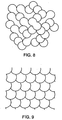
- An illustration of random curvature variation of each wall is especially given by Figure 8 .
- each wall 18 forming a cell 15 represents an arc of circle over 60°, over the surface of the optical component
- FIG. 9 illustrates a portion of an optical component, in which the mesh of the surface of the optical component 10 comprises, over said surface, a periodic network of so-called “imbrication” comprising nodes located on a regular hexagon, each node being connected by an arc of circle over 60°.
- a variant of the so-called “imbrication” periodic network can also be obtained based on nodes located on a regular square, each node being connected by an arc of circle over 90°.
- This network type may be present over all or part of the surface of the optical component.
- the periodic network of so-called “imbrication” is only present over a part of the surface of the optical component, the remaining part of the surface of said optical component can be composed of a mesh of random or pseudo-random type.
- the walls 18 comprise a series of straight wall segments, referenced for example 18a, 18b, 18c ( Figures 6 and 7 ).
- the straight wall segments are disposed end-to-end and connect the respective ends of the walls.
- the direction of each wall 18 parallel to the surface of the optical component is then constant along each segment, and varies between successive segments.
- Figures 6 and 7 illustrate this second variant, respectively for a square mesh and for a random mesh.
- the successive straight segments of one and the same wall 18 can form any changes of direction whatsoever. Stated otherwise, the angle between two successive segments can have an arbitrary absolute value and an arbitrary sense.
- a wall can be in the shape of a zig-zag, whose profile can constitute a pattern repeated for several walls.
- each wall 18 can comprise points located over its length and between which the direction of the wall varies by at least 5 degrees, and preferably by at least 10 degrees.
Landscapes
- Physics & Mathematics (AREA)
- Health & Medical Sciences (AREA)
- Ophthalmology & Optometry (AREA)
- General Physics & Mathematics (AREA)
- Optics & Photonics (AREA)
- General Health & Medical Sciences (AREA)
- Nonlinear Science (AREA)
- Crystallography & Structural Chemistry (AREA)
- Chemical & Material Sciences (AREA)
- Mathematical Physics (AREA)
- Eyeglasses (AREA)
- Prostheses (AREA)
- Apparatus Associated With Microorganisms And Enzymes (AREA)
- Optical Elements Other Than Lenses (AREA)
- Micro-Organisms Or Cultivation Processes Thereof (AREA)
- Re-Forming, After-Treatment, Cutting And Transporting Of Glass Products (AREA)
Claims (13)
- Transparente optische Komponente (10), die wenigstens einen Satz auf einer Oberfläche der Komponente nebeneinander angeordneter Zellen (15) umfasst, wobei jede Zelle eine Substanz mit einer optischen Eigenschaft umfasst und zwei benachbarte Zellen durch eine sich orthogonal zur Oberfläche der Komponente erstreckende Wand (18) voneinander getrennt sind, wobei zu der Komponentenoberfläche parallele Abschnitte wenigstens einiger Wände an der Oberfläche der Komponente nicht gerade sind, wobei wenigstens einige Wände (18) eine Dicke zwischen 0,10 µm und 5 µm parallel zu der Oberfläche der optischen Komponente gemessen aufweisen, wobei die Komponente dadurch gekennzeichnet ist, dass die Zellen (15) gemäß einem Netz auf der Oberfläche der Komponente nebeneinander angeordnet sind, wobei sich jede zwei benachbarte Zellen trennende Wand (18) zwischen zwei Enden der Wand erstreckt, die Knoten des Netzes entsprechen, wobei wenigstens einige der Wände (18) veränderliche jeweilige Ausrichtungen entlang der Wände zwischen den entsprechenden Enden, parallel zur Oberfläche der Komponente aufweisen.
- Optische Komponente nach Anspruch 1, bei welcher die Ausrichtung bestimmter Wände (18) parallel zur Oberfläche der optischen Komponente um wenigstens 5 Grad entlang der Wand variiert.
- Optische Komponente nach Anspruch 1 oder 2, bei welcher wenigstens einige der Wände (18) über die Oberfläche der optischen Komponente gekrümmt sind.
- Optische Komponente nach einem der vorangehenden Ansprüche, bei welcher alle Wände (18) über die Fläche der optischen Komponente gekrümmt sind.
- Optische Komponente nach Anspruch 4, bei welcher jede eine Zelle (15) formende Wand (18) einen Kreisbogen über 60° über die gesamte Oberfläche der optischen Komponente darstellt.
- Optische Komponente nach Anspruch 1 oder 2, bei welcher wenigstens einige der Wände (18) eine Serie gerader Wandsegmente umfassen, die jeweilige Enden der Wände verbinden.
- Optische Komponente nach einem der Ansprüche 1 bis 6, bei welcher das Netz auf der Oberfläche der optischen Komponente (10) ein auf der Oberfläche angeordnetes regelmäßiges Knotennetz umfasst.
- Optische Komponente nach Anspruch 7, bei welcher das Netz auf der Oberfläche der optischen Komponente (10) über dieser Oberfläche ein regelmäßiges Netz so genannter "Verflechtungen" mit auf einem regelmäßigen Sechseck angeordneten Knoten aufweist, wobei jeder Knoten durch einen Kreisbogen über 60° verbunden ist.
- Optische Komponente nach Anspruch 7, bei welcher das Netz auf der Oberfläche der optischen Komponente (10) über dieser Oberfläche ein regelmäßiges Netz so genannter "Verflechtungen" mit auf einem regelmäßigen Sechseck angeordneten Knoten aufweist, wobei jeder Knoten durch einen Kreisbogen über 90° verbunden ist.
- Optische Komponente nach einem der Ansprüche 1 bis 6, bei welcher das Netz auf der Oberfläche der optischen Komponente vom Zufallsnetz- oder Pseudozufallsnetz-Typ ist.
- Optische Komponente nach einem der vorangehenden Ansprüche, bei welcher die Zellen (15) hermetisch abgedichtet sind.
- Optisches Element (11), welches durch Ausschneiden einer transparenten optischen Komponente (10) gemäß einem der vorangehenden Ansprüche erhalten wird.
- Optisches Element nach Anspruch 12, welches eine ophtalmische Linse umfasst.
Priority Applications (1)
| Application Number | Priority Date | Filing Date | Title |
|---|---|---|---|
| PL06820919T PL1904887T3 (pl) | 2005-07-20 | 2006-07-13 | Przezroczysty składnik optyczny z komórkami rozdzielonymi przegrodami |
Applications Claiming Priority (2)
| Application Number | Priority Date | Filing Date | Title |
|---|---|---|---|
| FR0507719A FR2888954B1 (fr) | 2005-07-20 | 2005-07-20 | Composant optique transporent a cellules separees par des parois |
| PCT/IB2006/003267 WO2007029117A2 (en) | 2005-07-20 | 2006-07-13 | Transparent optical component with cells separated by walls |
Publications (2)
| Publication Number | Publication Date |
|---|---|
| EP1904887A2 EP1904887A2 (de) | 2008-04-02 |
| EP1904887B1 true EP1904887B1 (de) | 2011-11-30 |
Family
ID=36128626
Family Applications (1)
| Application Number | Title | Priority Date | Filing Date |
|---|---|---|---|
| EP06820919A Not-in-force EP1904887B1 (de) | 2005-07-20 | 2006-07-13 | Transparente optische komponente mit durch wände getrennten zellen |
Country Status (14)
| Country | Link |
|---|---|
| US (1) | US7828430B2 (de) |
| EP (1) | EP1904887B1 (de) |
| JP (1) | JP5058162B2 (de) |
| KR (1) | KR101343995B1 (de) |
| CN (1) | CN101268407B (de) |
| AT (1) | ATE535838T1 (de) |
| AU (1) | AU2006288775B2 (de) |
| BR (1) | BRPI0613959B1 (de) |
| CA (1) | CA2615303C (de) |
| ES (1) | ES2378511T3 (de) |
| FR (1) | FR2888954B1 (de) |
| PL (1) | PL1904887T3 (de) |
| PT (1) | PT1904887E (de) |
| WO (1) | WO2007029117A2 (de) |
Families Citing this family (12)
| Publication number | Priority date | Publication date | Assignee | Title |
|---|---|---|---|---|
| FR2939910B1 (fr) | 2008-12-15 | 2011-04-01 | Essilor Int | Element optique transparent comprenant un ensemble de cellules |
| FR2948465B1 (fr) * | 2009-07-24 | 2011-11-25 | Thales Sa | Composant optique transparent a microcuves |
| FR2960305B1 (fr) * | 2010-05-21 | 2013-03-01 | Essilor Int | Realisation d'un composant optique transparent a structure cellulaire |
| FR2969313B1 (fr) | 2010-12-16 | 2012-12-21 | Essilor Int | Element optique comprenant un aerogel sans fissure |
| FR2972814B1 (fr) | 2011-03-16 | 2014-04-18 | Essilor Int | Element optique transparent a plusieurs couches constituees de pavages cellulaires |
| EP2693260A1 (de) * | 2012-08-03 | 2014-02-05 | ESSILOR INTERNATIONAL (Compagnie Générale d'Optique) | Verfahren zur Bereitstellung einer individuell anpassbaren ophthalmischen Linse an ein Auge eines Trägers und zugehöriges aktives Sichtsystem |
| WO2016151347A1 (en) | 2015-03-25 | 2016-09-29 | Essilor International (Compagnie Generale D'optique) | Thin-film alignment layer provided with integrally-formed spacing structures and forming an intermediate layer for an optical article comprising liquid crystals |
| TWI895204B (zh) * | 2018-04-26 | 2025-08-21 | 法商依視路國際公司 | 眼鏡鏡片元件 |
| KR20220024469A (ko) | 2019-06-13 | 2022-03-03 | 제트 옵틱스, 인크. | 고선명 및 연장된 피사계 심도 안내 렌즈 |
| EP4076281B1 (de) * | 2019-12-20 | 2026-04-29 | Z Optics, Inc. | Hohe auflösung und erweiterte schärfentiefe für intraokulare linse |
| US11963868B2 (en) | 2020-06-01 | 2024-04-23 | Ast Products, Inc. | Double-sided aspheric diffractive multifocal lens, manufacture, and uses thereof |
| KR102956689B1 (ko) | 2021-12-09 | 2026-04-23 | 주식회사 엘지화학 | 기판 |
Family Cites Families (16)
| Publication number | Priority date | Publication date | Assignee | Title |
|---|---|---|---|---|
| US2196066A (en) * | 1938-03-02 | 1940-04-02 | Feinbloom William | Contact lens |
| US3978580A (en) * | 1973-06-28 | 1976-09-07 | Hughes Aircraft Company | Method of fabricating a liquid crystal display |
| US4268132A (en) * | 1979-09-24 | 1981-05-19 | Neefe Charles W | Oxygen generating contact lens |
| US4621912A (en) * | 1985-02-14 | 1986-11-11 | Meyer Donald R | Foraminated optical contact lens |
| IT1190508B (it) * | 1986-03-24 | 1988-02-16 | Daniele Senatore | Occhiali a trasparenza regolabile |
| IL85860A (en) * | 1988-03-24 | 1992-06-21 | Amir Cohen | Contact lens |
| GB2347005B (en) * | 1996-07-26 | 2000-10-04 | Sharp Kk | Methods of filling liquid crystal device |
| US5763054A (en) * | 1996-09-13 | 1998-06-09 | Trw Inc. | Anti-reflection treatment for optical elements |
| DE19714434A1 (de) * | 1997-04-08 | 1998-10-15 | Armin Schaeuble | Selektive elektronische Lichtschutzbrille |
| US6360352B2 (en) * | 1998-07-17 | 2002-03-19 | David E. Wallace | Digital circuit layout techniques |
| US6871951B2 (en) * | 2000-06-23 | 2005-03-29 | E-Vision, Llc | Electro-optic lens with integrated components |
| TW556044B (en) * | 2001-02-15 | 2003-10-01 | Sipix Imaging Inc | Process for roll-to-roll manufacture of a display by synchronized photolithographic exposure on a substrate web |
| TW527529B (en) * | 2001-07-27 | 2003-04-11 | Sipix Imaging Inc | An improved electrophoretic display with color filters |
| US6860601B2 (en) * | 2002-02-06 | 2005-03-01 | John H. Shadduck | Adaptive optic lens system and method of use |
| WO2005003842A1 (en) * | 2003-07-08 | 2005-01-13 | Koninklijke Philips Electronics N.V. | Variable focus spectacles |
| KR20060034700A (ko) * | 2003-07-14 | 2006-04-24 | 코닌클리케 필립스 일렉트로닉스 엔.브이. | 가변렌즈 |
-
2005
- 2005-07-20 FR FR0507719A patent/FR2888954B1/fr not_active Expired - Fee Related
-
2006
- 2006-07-13 PT PT06820919T patent/PT1904887E/pt unknown
- 2006-07-13 WO PCT/IB2006/003267 patent/WO2007029117A2/en not_active Ceased
- 2006-07-13 JP JP2008522100A patent/JP5058162B2/ja not_active Expired - Fee Related
- 2006-07-13 CA CA2615303A patent/CA2615303C/en not_active Expired - Fee Related
- 2006-07-13 AT AT06820919T patent/ATE535838T1/de active
- 2006-07-13 ES ES06820919T patent/ES2378511T3/es active Active
- 2006-07-13 CN CN2006800346662A patent/CN101268407B/zh active Active
- 2006-07-13 EP EP06820919A patent/EP1904887B1/de not_active Not-in-force
- 2006-07-13 PL PL06820919T patent/PL1904887T3/pl unknown
- 2006-07-13 BR BRPI0613959-0A patent/BRPI0613959B1/pt not_active IP Right Cessation
- 2006-07-13 US US11/996,098 patent/US7828430B2/en active Active
- 2006-07-13 AU AU2006288775A patent/AU2006288775B2/en not_active Ceased
-
2008
- 2008-02-19 KR KR1020087003920A patent/KR101343995B1/ko not_active Expired - Fee Related
Also Published As
| Publication number | Publication date |
|---|---|
| ES2378511T3 (es) | 2012-04-13 |
| WO2007029117A2 (en) | 2007-03-15 |
| JP5058162B2 (ja) | 2012-10-24 |
| KR101343995B1 (ko) | 2013-12-24 |
| US20080297720A1 (en) | 2008-12-04 |
| US7828430B2 (en) | 2010-11-09 |
| JP2009501954A (ja) | 2009-01-22 |
| AU2006288775B2 (en) | 2011-11-24 |
| ATE535838T1 (de) | 2011-12-15 |
| CA2615303A1 (en) | 2007-03-15 |
| AU2006288775A1 (en) | 2007-03-15 |
| PT1904887E (pt) | 2012-03-06 |
| WO2007029117A3 (en) | 2007-05-03 |
| BRPI0613959A2 (pt) | 2011-02-22 |
| CA2615303C (en) | 2015-06-02 |
| CN101268407B (zh) | 2013-01-30 |
| EP1904887A2 (de) | 2008-04-02 |
| PL1904887T3 (pl) | 2012-05-31 |
| KR20080058328A (ko) | 2008-06-25 |
| AU2006288775A8 (en) | 2008-03-06 |
| CN101268407A (zh) | 2008-09-17 |
| FR2888954A1 (fr) | 2007-01-26 |
| BRPI0613959B1 (pt) | 2018-02-14 |
| FR2888954B1 (fr) | 2008-02-08 |
Similar Documents
| Publication | Publication Date | Title |
|---|---|---|
| KR101343995B1 (ko) | 벽에 의해 분리된 셀을 가진 투명 광학 부품 | |
| AU2006271328B2 (en) | Randomly pixellated optical component, its fabrication method and its use in the fabrication of a transparent optical element | |
| JP4975026B2 (ja) | セルを有する光学部品 | |
| US9421719B2 (en) | Production of a transparent optical component having a cellular structure | |
| US20070132943A1 (en) | Multipart Sunglasses | |
| JP5137830B2 (ja) | アポダイズされた壁を有するピクセル化された光学部品、該光学部品を製造する方法、および透明な光学素子の製造における該光学部品の使用 | |
| AU2023256009A1 (en) | Lens element, optical lens group, mold, and glasses | |
| US4750812A (en) | Objective observation optical material | |
| EP1946181B1 (de) | Gepixelte optische komponente mit nanowänden | |
| TWI382215B (zh) | 光學元件及其製造方法、該光學元件之使用方法與切割該光學元件所製造之鏡片 | |
| TWI410697B (zh) | 光學元件及切割該光學元件所製造之鏡片 | |
| GB2494936A (en) | Lens engraved with image logo or text |
Legal Events
| Date | Code | Title | Description |
|---|---|---|---|
| PUAI | Public reference made under article 153(3) epc to a published international application that has entered the european phase |
Free format text: ORIGINAL CODE: 0009012 |
|
| 17P | Request for examination filed |
Effective date: 20080108 |
|
| AK | Designated contracting states |
Kind code of ref document: A2 Designated state(s): AT BE BG CH CY CZ DE DK EE ES FI FR GB GR HU IE IS IT LI LT LU LV MC NL PL PT RO SE SI SK TR |
|
| DAX | Request for extension of the european patent (deleted) | ||
| 17Q | First examination report despatched |
Effective date: 20101201 |
|
| GRAP | Despatch of communication of intention to grant a patent |
Free format text: ORIGINAL CODE: EPIDOSNIGR1 |
|
| DAX | Request for extension of the european patent (deleted) | ||
| GRAS | Grant fee paid |
Free format text: ORIGINAL CODE: EPIDOSNIGR3 |
|
| GRAA | (expected) grant |
Free format text: ORIGINAL CODE: 0009210 |
|
| AK | Designated contracting states |
Kind code of ref document: B1 Designated state(s): AT BE BG CH CY CZ DE DK EE ES FI FR GB GR HU IE IS IT LI LT LU LV MC NL PL PT RO SE SI SK TR |
|
| REG | Reference to a national code |
Ref country code: CH Ref legal event code: EP Ref country code: GB Ref legal event code: FG4D |
|
| REG | Reference to a national code |
Ref country code: IE Ref legal event code: FG4D |
|
| REG | Reference to a national code |
Ref country code: DE Ref legal event code: R096 Ref document number: 602006026208 Country of ref document: DE Effective date: 20120126 |
|
| REG | Reference to a national code |
Ref country code: RO Ref legal event code: EPE |
|
| REG | Reference to a national code |
Ref country code: NL Ref legal event code: T3 |
|
| REG | Reference to a national code |
Ref country code: PT Ref legal event code: SC4A Free format text: AVAILABILITY OF NATIONAL TRANSLATION Effective date: 20120222 |
|
| REG | Reference to a national code |
Ref country code: ES Ref legal event code: FG2A Ref document number: 2378511 Country of ref document: ES Kind code of ref document: T3 Effective date: 20120413 |
|
| LTIE | Lt: invalidation of european patent or patent extension |
Effective date: 20111130 |
|
| REG | Reference to a national code |
Ref country code: GR Ref legal event code: EP Ref document number: 20120400454 Country of ref document: GR Effective date: 20120322 |
|
| PG25 | Lapsed in a contracting state [announced via postgrant information from national office to epo] |
Ref country code: IS Free format text: LAPSE BECAUSE OF FAILURE TO SUBMIT A TRANSLATION OF THE DESCRIPTION OR TO PAY THE FEE WITHIN THE PRESCRIBED TIME-LIMIT Effective date: 20120330 Ref country code: LT Free format text: LAPSE BECAUSE OF FAILURE TO SUBMIT A TRANSLATION OF THE DESCRIPTION OR TO PAY THE FEE WITHIN THE PRESCRIBED TIME-LIMIT Effective date: 20111130 |
|
| PG25 | Lapsed in a contracting state [announced via postgrant information from national office to epo] |
Ref country code: SE Free format text: LAPSE BECAUSE OF FAILURE TO SUBMIT A TRANSLATION OF THE DESCRIPTION OR TO PAY THE FEE WITHIN THE PRESCRIBED TIME-LIMIT Effective date: 20111130 Ref country code: SI Free format text: LAPSE BECAUSE OF FAILURE TO SUBMIT A TRANSLATION OF THE DESCRIPTION OR TO PAY THE FEE WITHIN THE PRESCRIBED TIME-LIMIT Effective date: 20111130 Ref country code: LV Free format text: LAPSE BECAUSE OF FAILURE TO SUBMIT A TRANSLATION OF THE DESCRIPTION OR TO PAY THE FEE WITHIN THE PRESCRIBED TIME-LIMIT Effective date: 20111130 |
|
| REG | Reference to a national code |
Ref country code: PL Ref legal event code: T3 |
|
| REG | Reference to a national code |
Ref country code: HU Ref legal event code: AG4A Ref document number: E013173 Country of ref document: HU |
|
| PG25 | Lapsed in a contracting state [announced via postgrant information from national office to epo] |
Ref country code: CY Free format text: LAPSE BECAUSE OF FAILURE TO SUBMIT A TRANSLATION OF THE DESCRIPTION OR TO PAY THE FEE WITHIN THE PRESCRIBED TIME-LIMIT Effective date: 20111130 |
|
| PG25 | Lapsed in a contracting state [announced via postgrant information from national office to epo] |
Ref country code: EE Free format text: LAPSE BECAUSE OF FAILURE TO SUBMIT A TRANSLATION OF THE DESCRIPTION OR TO PAY THE FEE WITHIN THE PRESCRIBED TIME-LIMIT Effective date: 20111130 Ref country code: SK Free format text: LAPSE BECAUSE OF FAILURE TO SUBMIT A TRANSLATION OF THE DESCRIPTION OR TO PAY THE FEE WITHIN THE PRESCRIBED TIME-LIMIT Effective date: 20111130 Ref country code: CZ Free format text: LAPSE BECAUSE OF FAILURE TO SUBMIT A TRANSLATION OF THE DESCRIPTION OR TO PAY THE FEE WITHIN THE PRESCRIBED TIME-LIMIT Effective date: 20111130 Ref country code: BG Free format text: LAPSE BECAUSE OF FAILURE TO SUBMIT A TRANSLATION OF THE DESCRIPTION OR TO PAY THE FEE WITHIN THE PRESCRIBED TIME-LIMIT Effective date: 20120229 Ref country code: DK Free format text: LAPSE BECAUSE OF FAILURE TO SUBMIT A TRANSLATION OF THE DESCRIPTION OR TO PAY THE FEE WITHIN THE PRESCRIBED TIME-LIMIT Effective date: 20111130 |
|
| REG | Reference to a national code |
Ref country code: AT Ref legal event code: MK05 Ref document number: 535838 Country of ref document: AT Kind code of ref document: T Effective date: 20111130 |
|
| PLBE | No opposition filed within time limit |
Free format text: ORIGINAL CODE: 0009261 |
|
| STAA | Information on the status of an ep patent application or granted ep patent |
Free format text: STATUS: NO OPPOSITION FILED WITHIN TIME LIMIT |
|
| 26N | No opposition filed |
Effective date: 20120831 |
|
| REG | Reference to a national code |
Ref country code: DE Ref legal event code: R097 Ref document number: 602006026208 Country of ref document: DE Effective date: 20120831 |
|
| PG25 | Lapsed in a contracting state [announced via postgrant information from national office to epo] |
Ref country code: AT Free format text: LAPSE BECAUSE OF FAILURE TO SUBMIT A TRANSLATION OF THE DESCRIPTION OR TO PAY THE FEE WITHIN THE PRESCRIBED TIME-LIMIT Effective date: 20111130 |
|
| PG25 | Lapsed in a contracting state [announced via postgrant information from national office to epo] |
Ref country code: MC Free format text: LAPSE BECAUSE OF NON-PAYMENT OF DUE FEES Effective date: 20120731 |
|
| PG25 | Lapsed in a contracting state [announced via postgrant information from national office to epo] |
Ref country code: FI Free format text: LAPSE BECAUSE OF FAILURE TO SUBMIT A TRANSLATION OF THE DESCRIPTION OR TO PAY THE FEE WITHIN THE PRESCRIBED TIME-LIMIT Effective date: 20111130 |
|
| PG25 | Lapsed in a contracting state [announced via postgrant information from national office to epo] |
Ref country code: LU Free format text: LAPSE BECAUSE OF NON-PAYMENT OF DUE FEES Effective date: 20120713 |
|
| REG | Reference to a national code |
Ref country code: FR Ref legal event code: PLFP Year of fee payment: 10 |
|
| REG | Reference to a national code |
Ref country code: FR Ref legal event code: PLFP Year of fee payment: 11 |
|
| REG | Reference to a national code |
Ref country code: FR Ref legal event code: PLFP Year of fee payment: 12 |
|
| REG | Reference to a national code |
Ref country code: BE Ref legal event code: PD Owner name: ESSILOR INTERNATIONAL; FR Free format text: DETAILS ASSIGNMENT: CHANGE OF OWNER(S), CESSION, APPORT; FORMER OWNER NAME: ESSILOR INTERNATIONAL (COMPAGNIE GENERALE D'OPTIQUE) Effective date: 20180112 |
|
| REG | Reference to a national code |
Ref country code: HU Ref legal event code: FH1C Free format text: FORMER REPRESENTATIVE(S): SZABO ZSOLT, DANUBIA SZABADALMI ES JOGI IRODA KFT., HU Representative=s name: SBGK SZABADALMI UEGYVIVOEI IRODA, HU Ref country code: HU Ref legal event code: GB9C Owner name: ESSILOR INTERNATIONAL, FR Free format text: FORMER OWNER(S): ESSILOR INTERNATIONAL (COMPAGNIE GENERALE D'OPTIQUE), FR |
|
| REG | Reference to a national code |
Ref country code: NL Ref legal event code: PD Owner name: ESSILOR INTERNATIONAL; FR Free format text: DETAILS ASSIGNMENT: CHANGE OF OWNER(S), ASSIGNMENT; FORMER OWNER NAME: ESSILOR INTERNATIONAL (COMPAGNIE GENERALE D'OPTIQUE) Effective date: 20180219 |
|
| REG | Reference to a national code |
Ref country code: DE Ref legal event code: R081 Ref document number: 602006026208 Country of ref document: DE Owner name: ESSILOR INTERNATIONAL, FR Free format text: FORMER OWNER: ESSILOR INTERNATIONAL (COMPAGNIE GENERALE D'OPTIQUE), CHARENTON-LE-PONT, FR |
|
| REG | Reference to a national code |
Ref country code: ES Ref legal event code: PC2A Effective date: 20180521 Ref country code: ES Ref legal event code: PC2A Owner name: ESSILOR INTERNATIONAL Effective date: 20180521 |
|
| REG | Reference to a national code |
Ref country code: CH Ref legal event code: PUE Owner name: ESSILOR INTERNATIONAL, FR Free format text: FORMER OWNER: ESSILOR INTERNATIONAL (COMPAGNIE GENERALE D'OPTIQUE), FR |
|
| REG | Reference to a national code |
Ref country code: GB Ref legal event code: 732E Free format text: REGISTERED BETWEEN 20180517 AND 20180523 |
|
| REG | Reference to a national code |
Ref country code: FR Ref legal event code: TP Owner name: ESSILOR INTERNATIONAL, FR Effective date: 20180601 |
|
| REG | Reference to a national code |
Ref country code: FR Ref legal event code: PLFP Year of fee payment: 13 |
|
| PGFP | Annual fee paid to national office [announced via postgrant information from national office to epo] |
Ref country code: IE Payment date: 20180726 Year of fee payment: 13 Ref country code: IT Payment date: 20180719 Year of fee payment: 13 Ref country code: NL Payment date: 20180726 Year of fee payment: 13 |
|
| PGFP | Annual fee paid to national office [announced via postgrant information from national office to epo] |
Ref country code: BE Payment date: 20180727 Year of fee payment: 13 Ref country code: GR Payment date: 20180730 Year of fee payment: 13 |
|
| PGFP | Annual fee paid to national office [announced via postgrant information from national office to epo] |
Ref country code: PT Payment date: 20190618 Year of fee payment: 14 Ref country code: PL Payment date: 20190619 Year of fee payment: 14 |
|
| PGFP | Annual fee paid to national office [announced via postgrant information from national office to epo] |
Ref country code: RO Payment date: 20190620 Year of fee payment: 14 |
|
| PGFP | Annual fee paid to national office [announced via postgrant information from national office to epo] |
Ref country code: HU Payment date: 20190624 Year of fee payment: 14 |
|
| REG | Reference to a national code |
Ref country code: CH Ref legal event code: PL |
|
| REG | Reference to a national code |
Ref country code: BE Ref legal event code: MM Effective date: 20190731 |
|
| PG25 | Lapsed in a contracting state [announced via postgrant information from national office to epo] |
Ref country code: NL Free format text: LAPSE BECAUSE OF NON-PAYMENT OF DUE FEES Effective date: 20190801 Ref country code: GR Free format text: LAPSE BECAUSE OF NON-PAYMENT OF DUE FEES Effective date: 20200206 |
|
| REG | Reference to a national code |
Ref country code: NL Ref legal event code: MM Effective date: 20190801 |
|
| PG25 | Lapsed in a contracting state [announced via postgrant information from national office to epo] |
Ref country code: BE Free format text: LAPSE BECAUSE OF NON-PAYMENT OF DUE FEES Effective date: 20190731 Ref country code: LI Free format text: LAPSE BECAUSE OF NON-PAYMENT OF DUE FEES Effective date: 20190731 Ref country code: CH Free format text: LAPSE BECAUSE OF NON-PAYMENT OF DUE FEES Effective date: 20190731 |
|
| PG25 | Lapsed in a contracting state [announced via postgrant information from national office to epo] |
Ref country code: IE Free format text: LAPSE BECAUSE OF NON-PAYMENT OF DUE FEES Effective date: 20190713 |
|
| PG25 | Lapsed in a contracting state [announced via postgrant information from national office to epo] |
Ref country code: IT Free format text: LAPSE BECAUSE OF NON-PAYMENT OF DUE FEES Effective date: 20190713 |
|
| REG | Reference to a national code |
Ref country code: ES Ref legal event code: FD2A Effective date: 20201130 |
|
| PG25 | Lapsed in a contracting state [announced via postgrant information from national office to epo] |
Ref country code: ES Free format text: LAPSE BECAUSE OF NON-PAYMENT OF DUE FEES Effective date: 20190714 |
|
| PG25 | Lapsed in a contracting state [announced via postgrant information from national office to epo] |
Ref country code: HU Free format text: LAPSE BECAUSE OF NON-PAYMENT OF DUE FEES Effective date: 20200714 Ref country code: RO Free format text: LAPSE BECAUSE OF NON-PAYMENT OF DUE FEES Effective date: 20200713 Ref country code: PT Free format text: LAPSE BECAUSE OF NON-PAYMENT OF DUE FEES Effective date: 20210215 |
|
| PG25 | Lapsed in a contracting state [announced via postgrant information from national office to epo] |
Ref country code: TR Free format text: LAPSE BECAUSE OF NON-PAYMENT OF DUE FEES Effective date: 20200713 |
|
| PG25 | Lapsed in a contracting state [announced via postgrant information from national office to epo] |
Ref country code: PL Free format text: LAPSE BECAUSE OF NON-PAYMENT OF DUE FEES Effective date: 20200713 |
|
| P01 | Opt-out of the competence of the unified patent court (upc) registered |
Effective date: 20230525 |
|
| PGFP | Annual fee paid to national office [announced via postgrant information from national office to epo] |
Ref country code: DE Payment date: 20240729 Year of fee payment: 19 |
|
| PGFP | Annual fee paid to national office [announced via postgrant information from national office to epo] |
Ref country code: GB Payment date: 20240729 Year of fee payment: 19 |
|
| PGFP | Annual fee paid to national office [announced via postgrant information from national office to epo] |
Ref country code: FR Payment date: 20240725 Year of fee payment: 19 |
|
| REG | Reference to a national code |
Ref country code: DE Ref legal event code: R119 Ref document number: 602006026208 Country of ref document: DE |
|
| GBPC | Gb: european patent ceased through non-payment of renewal fee |
Effective date: 20250713 |
|
| PG25 | Lapsed in a contracting state [announced via postgrant information from national office to epo] |
Ref country code: GB Free format text: LAPSE BECAUSE OF NON-PAYMENT OF DUE FEES Effective date: 20250713 |
|
| PG25 | Lapsed in a contracting state [announced via postgrant information from national office to epo] |
Ref country code: DE Free format text: LAPSE BECAUSE OF NON-PAYMENT OF DUE FEES Effective date: 20260203 |
|
| PG25 | Lapsed in a contracting state [announced via postgrant information from national office to epo] |
Ref country code: FR Free format text: LAPSE BECAUSE OF NON-PAYMENT OF DUE FEES Effective date: 20250731 |