EP1905740A1 - Condensateur électrique double couche - Google Patents
Condensateur électrique double couche Download PDFInfo
- Publication number
- EP1905740A1 EP1905740A1 EP06756780A EP06756780A EP1905740A1 EP 1905740 A1 EP1905740 A1 EP 1905740A1 EP 06756780 A EP06756780 A EP 06756780A EP 06756780 A EP06756780 A EP 06756780A EP 1905740 A1 EP1905740 A1 EP 1905740A1
- Authority
- EP
- European Patent Office
- Prior art keywords
- group
- acid
- activated carbon
- electric double
- dimethyl
- Prior art date
- Legal status (The legal status is an assumption and is not a legal conclusion. Google has not performed a legal analysis and makes no representation as to the accuracy of the status listed.)
- Withdrawn
Links
Images
Classifications
-
- H—ELECTRICITY
- H01—ELECTRIC ELEMENTS
- H01G—CAPACITORS; CAPACITORS, RECTIFIERS, DETECTORS, SWITCHING DEVICES, LIGHT-SENSITIVE OR TEMPERATURE-SENSITIVE DEVICES OF THE ELECTROLYTIC TYPE
- H01G11/00—Hybrid capacitors, i.e. capacitors having different positive and negative electrodes; Electric double-layer [EDL] capacitors; Processes for the manufacture thereof or of parts thereof
- H01G11/22—Electrodes
- H01G11/30—Electrodes characterised by their material
- H01G11/32—Carbon-based
-
- C—CHEMISTRY; METALLURGY
- C01—INORGANIC CHEMISTRY
- C01B—NON-METALLIC ELEMENTS; COMPOUNDS THEREOF; METALLOIDS OR COMPOUNDS THEREOF NOT COVERED BY SUBCLASS C01C
- C01B32/00—Carbon; Compounds thereof
- C01B32/30—Active carbon
-
- C—CHEMISTRY; METALLURGY
- C01—INORGANIC CHEMISTRY
- C01B—NON-METALLIC ELEMENTS; COMPOUNDS THEREOF; METALLOIDS OR COMPOUNDS THEREOF NOT COVERED BY SUBCLASS C01C
- C01B32/00—Carbon; Compounds thereof
- C01B32/30—Active carbon
- C01B32/312—Preparation
- C01B32/318—Preparation characterised by the starting materials
-
- C—CHEMISTRY; METALLURGY
- C08—ORGANIC MACROMOLECULAR COMPOUNDS; THEIR PREPARATION OR CHEMICAL WORKING-UP; COMPOSITIONS BASED THEREON
- C08G—MACROMOLECULAR COMPOUNDS OBTAINED OTHERWISE THAN BY REACTIONS ONLY INVOLVING UNSATURATED CARBON-TO-CARBON BONDS
- C08G8/00—Condensation polymers of aldehydes or ketones with phenols only
- C08G8/04—Condensation polymers of aldehydes or ketones with phenols only of aldehydes
- C08G8/08—Condensation polymers of aldehydes or ketones with phenols only of aldehydes of formaldehyde, e.g. of formaldehyde formed in situ
- C08G8/20—Condensation polymers of aldehydes or ketones with phenols only of aldehydes of formaldehyde, e.g. of formaldehyde formed in situ with polyhydric phenols
-
- C—CHEMISTRY; METALLURGY
- C08—ORGANIC MACROMOLECULAR COMPOUNDS; THEIR PREPARATION OR CHEMICAL WORKING-UP; COMPOSITIONS BASED THEREON
- C08G—MACROMOLECULAR COMPOUNDS OBTAINED OTHERWISE THAN BY REACTIONS ONLY INVOLVING UNSATURATED CARBON-TO-CARBON BONDS
- C08G8/00—Condensation polymers of aldehydes or ketones with phenols only
- C08G8/04—Condensation polymers of aldehydes or ketones with phenols only of aldehydes
- C08G8/08—Condensation polymers of aldehydes or ketones with phenols only of aldehydes of formaldehyde, e.g. of formaldehyde formed in situ
- C08G8/20—Condensation polymers of aldehydes or ketones with phenols only of aldehydes of formaldehyde, e.g. of formaldehyde formed in situ with polyhydric phenols
- C08G8/22—Resorcinol
-
- H—ELECTRICITY
- H01—ELECTRIC ELEMENTS
- H01G—CAPACITORS; CAPACITORS, RECTIFIERS, DETECTORS, SWITCHING DEVICES, LIGHT-SENSITIVE OR TEMPERATURE-SENSITIVE DEVICES OF THE ELECTROLYTIC TYPE
- H01G11/00—Hybrid capacitors, i.e. capacitors having different positive and negative electrodes; Electric double-layer [EDL] capacitors; Processes for the manufacture thereof or of parts thereof
- H01G11/04—Hybrid capacitors
- H01G11/06—Hybrid capacitors with one of the electrodes allowing ions to be reversibly doped thereinto, e.g. lithium ion capacitors [LIC]
-
- H—ELECTRICITY
- H01—ELECTRIC ELEMENTS
- H01G—CAPACITORS; CAPACITORS, RECTIFIERS, DETECTORS, SWITCHING DEVICES, LIGHT-SENSITIVE OR TEMPERATURE-SENSITIVE DEVICES OF THE ELECTROLYTIC TYPE
- H01G11/00—Hybrid capacitors, i.e. capacitors having different positive and negative electrodes; Electric double-layer [EDL] capacitors; Processes for the manufacture thereof or of parts thereof
- H01G11/22—Electrodes
- H01G11/30—Electrodes characterised by their material
- H01G11/32—Carbon-based
- H01G11/34—Carbon-based characterised by carbonisation or activation of carbon
-
- H—ELECTRICITY
- H01—ELECTRIC ELEMENTS
- H01G—CAPACITORS; CAPACITORS, RECTIFIERS, DETECTORS, SWITCHING DEVICES, LIGHT-SENSITIVE OR TEMPERATURE-SENSITIVE DEVICES OF THE ELECTROLYTIC TYPE
- H01G11/00—Hybrid capacitors, i.e. capacitors having different positive and negative electrodes; Electric double-layer [EDL] capacitors; Processes for the manufacture thereof or of parts thereof
- H01G11/54—Electrolytes
- H01G11/58—Liquid electrolytes
-
- H—ELECTRICITY
- H01—ELECTRIC ELEMENTS
- H01G—CAPACITORS; CAPACITORS, RECTIFIERS, DETECTORS, SWITCHING DEVICES, LIGHT-SENSITIVE OR TEMPERATURE-SENSITIVE DEVICES OF THE ELECTROLYTIC TYPE
- H01G9/00—Electrolytic capacitors, rectifiers, detectors, switching devices, light-sensitive or temperature-sensitive devices; Processes of their manufacture
- H01G9/004—Details
- H01G9/02—Diaphragms; Separators
-
- Y—GENERAL TAGGING OF NEW TECHNOLOGICAL DEVELOPMENTS; GENERAL TAGGING OF CROSS-SECTIONAL TECHNOLOGIES SPANNING OVER SEVERAL SECTIONS OF THE IPC; TECHNICAL SUBJECTS COVERED BY FORMER USPC CROSS-REFERENCE ART COLLECTIONS [XRACs] AND DIGESTS
- Y02—TECHNOLOGIES OR APPLICATIONS FOR MITIGATION OR ADAPTATION AGAINST CLIMATE CHANGE
- Y02E—REDUCTION OF GREENHOUSE GAS [GHG] EMISSIONS, RELATED TO ENERGY GENERATION, TRANSMISSION OR DISTRIBUTION
- Y02E60/00—Enabling technologies; Technologies with a potential or indirect contribution to GHG emissions mitigation
- Y02E60/13—Energy storage using capacitors
-
- Y—GENERAL TAGGING OF NEW TECHNOLOGICAL DEVELOPMENTS; GENERAL TAGGING OF CROSS-SECTIONAL TECHNOLOGIES SPANNING OVER SEVERAL SECTIONS OF THE IPC; TECHNICAL SUBJECTS COVERED BY FORMER USPC CROSS-REFERENCE ART COLLECTIONS [XRACs] AND DIGESTS
- Y02—TECHNOLOGIES OR APPLICATIONS FOR MITIGATION OR ADAPTATION AGAINST CLIMATE CHANGE
- Y02T—CLIMATE CHANGE MITIGATION TECHNOLOGIES RELATED TO TRANSPORTATION
- Y02T10/00—Road transport of goods or passengers
- Y02T10/60—Other road transportation technologies with climate change mitigation effect
- Y02T10/70—Energy storage systems for electromobility, e.g. batteries
-
- Y—GENERAL TAGGING OF NEW TECHNOLOGICAL DEVELOPMENTS; GENERAL TAGGING OF CROSS-SECTIONAL TECHNOLOGIES SPANNING OVER SEVERAL SECTIONS OF THE IPC; TECHNICAL SUBJECTS COVERED BY FORMER USPC CROSS-REFERENCE ART COLLECTIONS [XRACs] AND DIGESTS
- Y10—TECHNICAL SUBJECTS COVERED BY FORMER USPC
- Y10T—TECHNICAL SUBJECTS COVERED BY FORMER US CLASSIFICATION
- Y10T29/00—Metal working
- Y10T29/49—Method of mechanical manufacture
- Y10T29/49002—Electrical device making
- Y10T29/49108—Electric battery cell making
- Y10T29/49115—Electric battery cell making including coating or impregnating
Definitions
- the present invention relates to electric double-layer capacitors.
- Electric energy-storage devices having large capacity are required in the fields such as midnight-power storage and auxiliary power supplies for power failure.
- Electric energy-storage devices having large capacity per unit volume that is, having abilities of supplying power for long duration in spite of the small size thereof, are also required in the field of transportation vehicles characterized by battery-powered driving force such as battery-powered electric vehicles and hybrid electric vehicles and in the field of portable electric terminals such as mobile personal computers, cellular phones and portable audio devices.
- Electric double-layer capacitors are expected as an electric energy-storage device, which are composed of an electrode, a separator and an electrolytic solution and store electric power in a boundary surface (electric double-layer) formed between an electrolyte and an electrode due to absorption of the electrolyte dissolved in an the electrolytic solution to the electrode.
- the capacity of stored energy is defined by the formula 1/2 ⁇ C ⁇ V 2 (wherein C is electrostatic capacity (F) and V is voltage), therefore in order to store more energy, the electrostatic capacity of electric energy-storage devices must be enhanced, especially in order to store more energy in compact volume, enhancement of electrostatic capacity per unit volume is required.
- Activated carbons are commonly used for the electrode of electric double-layer capacitors, specifically included is an activated carbon having micropores (20 ⁇ or less of pore diameter) as major pores thereof which is obtained by carbonizing and activating palm shell and the like.
- an activated carbon having meso-pores as major pores thereof is disclosed which is produced by polymerizing resorcinol with formaldehyde in the presence of a basic catalyst and an aqueous solvent to obtain an organic aerogel uniformly having meso-pores (20 ⁇ or more of pore diameter), washing the organic aerogel with an organic solvent, replacing the aqueous solvent to the organic solvent, drying and then carbonizing, and can be used for the electrode of electric double-layer capacitor ( U.S. Patent 4873218 ), however, the electric double-layer capacitor does not have sufficient electrostatic capacity per unit weight.
- the object of the present invention is to provide an activated carbon giving an electrode suitable to an electric double-layer capacitor having enhanced electrostatic capacity.
- the invention provides the following [1] to [20] aspects.
- the activated carbon used in the present invention is an activated carbon in which a compound represented by the formula (1) is carbonized, or carbonized and activated.
- R represents a hydrocarbon group having 1 to 12 carbon atoms, and the hydrocarbon group may be optionally substituted with hydroxyl group, alkyl group, alkoxy group, aryl group, aryloxy group, sulfonyl group, halogen atoms, nitro group, thioalkyl group, cyano group, carboxyl group, amino group or amide group.
- the hydrocarbon group having 1 to 12 carbon atoms includes, for example, alkyl groups such as methyl group, ethyl group, and butyl group; cycloalkyl groups such as cyclohexyl group; and aromatic groups such as phenyl group and naphthyl group.
- the hydrocarbon group coupled with the substitution groups mentioned above includes, for example, aromatic groups substituted with alkyl group such as 2-tolyl group, 3-tolyl group, and 4-tolyl group; and aromatic groups substituted with hydroxyl group such as 2-hydroxybenzyl group, 3-hydroxybenzyl group, and 4-hydroxybenzyl group.
- aromatic groups optionally substituted with the groups mentioned above in view of yields in carbonization processing, preferable are aromatic groups optionally substituted with the groups mentioned above, and more preferable being aromatic groups optionally substituted with hydroxyl group and alkyl group.
- R' represents hydrogen atom or methyl group, and preferably being hydrogen atom in view of easiness of production.
- n represents a numeral of 4, 6, or 8, and preferably being 4 in view of easiness of production.
- the hydroxyl groups coupled together with R' to the benzene ring of the formula (1) are usually bound to the ortho- and para-positions relative to the position bound by a group of -CH(R)-.
- the compound (1) has stereoisomers, and may be constituted with any one of the stereoisomers or a mixture thereof. When the compound (1) is produced by using an acid catalyst as mentioned hereinafter, it will be usually a mixture of the stereoisomers.
- R includes groups exemplified in the right box.
- Methods for producing the compound (1) include, as being exemplified in the description of P. Timmerman et.al. in Tetrahedron, 52, (1996) p2663-2704 , a method of subjecting a resorcinol optionally substituted with methyl group (hereinafter, occasionally referred to as resorcinols) and an aldehyde to dehydration condensation in the presence of an aqueous solvent with an acid catalyst, and the like.
- the resorcinols used for producing the compound (1) include, for example, resorcinol, 2-methylresorcinol, and 5-methylresorcinol. Preferably used is resorcinol due to commercial availability thereof.
- the aldehydes used for producing the compound (1) include, for example, aliphatic aldehydes such as acetaldehyde, n-butylaldehyde, isobutylaldehyde, n-hexylaldehyde, n-dodecylaldehyde, 3-phenylpropionealdehyde and 5-hydroxypentanal; and aromatic aldehyde such as benzaldehyde, 1-naphthaldehyde, 2-methylbenzaldehyde, 3-methylbenzaldehyde, 4-methylbenzaldehyde, 2-hydroxybenzaldehyde, 3-hydroxybenzaldehyde, 4-hydroxybenzaldehyde, 4-t-butylbenzaldehyde, 4-phenylbenzaldehyde, 2-methoxybenzaldehyde, 3-methoxybenzaldehyde, 4-methoxybenzaldehyde, 2-chlorobenzaldehyde
- the acid catalyst used for producing the compound (1) includes, for example, hydrochloric acid, sulfuric acid, phosphoric acid, nitric acid and acetic acid. Among of them, hydrochloric acid and sulfuric acid are preferably used.
- the use amount of acid catalyst is usually about 0.001 to 3 moles per mole of resorcinols.
- the aqueous solvent used for producing the compound (1) is a mixture of water and an organic solvent mixable with water in optional ratios.
- the organic solvent includes, for example, alcohols such as methanol, ethanol and i-propylalcohol; and ethers such as tetrahydrofuran. When these solvents are used, they may be used alone or a mixture of two or more kinds thereof.
- the aqueous solvent preferably used are alcohols having 3 or less carbon atoms or a mixture of water and alcohols having 3 or less carbon atoms, and preferably alcoholic solvents having 3 or less carbon atoms.
- the ratio of use amount of resorcinols to aqueous solvent is usually 0.5 to 5 parts by weight, preferably 1 to 2 parts by weight, per 1 part by weight of the aqueous solvent.
- Methods for producing the compound (1) include, for example, a method of mixing together resorcinols, an aldehyde, an acid catalyst, and an aqueous solvent, followed by stirring usually at 0 to 100°C, and preferably 30 to 90°C to precipitate a compound (1) and then to collect the precipitated by filtration; a method of mixing an aldehyde with a mixture of resorcinols, an acid catalyst, and an aqueous solvent usually at 0 to 100°C, and preferably 30 to 90°C to precipitate a compound (1) and then to collect the precipitated by filtration; a method of mixing resorcinols with a mixture of an aldehyde, an acid catalyst, and an aqueous solvent usually at 0 to 100°C , and preferably 30 to 90°C to precipitate a compound (1) and then to collect the precipitated by filtration; and a method of mixing an acid catalyst with a mixture of resorcinols, an aldehyde, and
- the compound (1) collected is dried usually at a room temperature to about 100°C by ventilation, under reduced pressure, or the like. As alternative, drying may be conducted after the collected compound (1) is washed with a hydrophilic organic solvent to replace the aqueous solvent contained therein.
- the hydrophilic organic solvent includes, for example, alcohols such as methyl alcohol, ethyl alcohol, n-propyl alcohol and t-butyl alcohol; aliphatic nitriles such as acetonitrile; aliphatic ketones such as acetone; aliphatic sulfoxides such as dimethylsulfoxide; and aliphatic carboxylic acids such as acetic acid.
- the activated carbon used in the present invention can be obtained by carbonizing, or carbonizing and activating a dried compound (1).
- the specific methods for producing the activated carbon used in the present invention include, for example, (I) a method of calcining (carbonizing) the compound (1) under an atmosphere of an inactive gas to carbon such as nitrogen, argon, helium, and hydrogen at a temperature usually in the range of 200 to 1500°C, preferably 600 to 1100°C for usually about 1 minute to 24 hours, followed by calcining (activating) the obtained one under an oxidative gas such as H 2 O, CO 2 , and O 2 at a temperature usually in the range of 200 to 1500°C , preferably 600 to 1100°C for usually about 1 minute to 10 hours; (II) a method of calcining (carbonizing and activating) under an oxidative gas at a temperature usually in the range of 200 to 1500°C, preferably 600 to 1100°C for usually about 1 minute to 24 hours; (III) a method of calcining (carbonizing) the compound (1) under an oxidative gas such as air usually at a temperature of 400°C or less,
- the preferably used oxidative gases are H 2 O or CO 2 . It is preferable that, when calcining at a temperature of 200°C or more, the pore volume is enhanced, and, when calcining at 1500°C or less, the activated carbon yields are enhanced. It is also preferable that, when calcining for 1 minute or more, the pore volume is enhanced, and, when calcining for 24 hours or less, the activated carbon yields are enhanced.
- the activated carbon thus obtained has a total pore volume of usually less than 0.95 ml/g, and preferably 0. 5 ml/g or more and 0.93 ml/g or less. It is preferable that, when having the total pore volume of less than 0.95 ml/g, electrostatic capacity per unit volume is enhanced. To provide the total pore volume in such ranges, it may appropriately adjust the times and temperatures for calcining.
- the total pore volume is calculated from an amount of nitrogen absorbed at around 0.95 relative pressure in an absorption isotherm determined at a temperature of liquid nitrogen by AUTOSORB (manufactured by Yuasa Ionics Inc.).
- the activated carbon When applying thus obtained activated carbon to an electrode, the activated carbon is crushed into particles having an average particle diameter of usually 50 ⁇ m or less, preferably 30 ⁇ m or less, more preferably 10 ⁇ m or less.
- the average particle diameter means volume average particle diameter of the activated carbon dispersed with a solution containing a neutral detergent measured by Laser Diffraction Type Particle Size Distribution Analyzer model SALD-2000J (Trade name, manufactured by Shimadzu Co.).
- Crushing is preferably carried out by using a crusher for fine grinding such as impact-friction crushers, centrifugal crushers, ball mills (tube mills, compound mills, conical ball mills, rod mills), vibrating mills, colloid mills, friction disk mills, and jet mills.
- a crusher for fine grinding such as impact-friction crushers, centrifugal crushers, ball mills (tube mills, compound mills, conical ball mills, rod mills), vibrating mills, colloid mills, friction disk mills, and jet mills.
- a ball mill which is general for crushing
- the ball and crushing vessel thereof is preferably made of non-metal materials such as alumina, zirconia and agate to avoid contamination of metal powder.
- activated carbon having a total pore volume of less than 0.95 ml/g and a content of alkali metal component and alkaline earth metal component of 100 ppm or less can be preferably used for electrodes due to no polarization to be caused by metals and providing abundant electric double layer.
- the electrode of the present invention is characterized by including the above mentioned activated carbon therein, and usually further includes a binder, conducting agent and the like therein to improve moldability thereof.
- the electrode is generally produced by methods for molding a mixture of an activated carbon, a binder, a conducting agent and the like on a current collector.
- These methods include, for example, a method of coating a slurry mixture of an binder, a conducting agent, a solvent and the like on a current collector by doctor blade method or dipping the collector in the slurry mixture, followed by drying; a method of preparing a sheet by mixing, molding and then drying a mixture of an activated carbon, a binder, a conducting agent, a solvent and the like, disposing the sheet on a current collector with interposing a conductive adhesive and then subjecting to pressing and heating treatments and drying; and a method of molding a mixture of an activated carbon, a binder, a conducting agent, a liquid lubricant and the like on a current collector, removing the liquid lubricant to obtain a sheet and then streching the sheet in mono- or multi-axial directions.
- the thickness thereof is usually about 50 to about 1000 ⁇ m.
- Ingredient materials for the current collector include, for example, metals such as nickel, aluminium, titanium, copper, gold, silver, platinum, aluminium alloy and stainless steel; carbon material or activated carbon fibers coated by plasma or ark spraying with nickel, aluminium, zinc, copper, tin or lead or an alloy thereof; and conductive films composed of resins containing a conducting agent dispersed therein such as rubbers and styrene-ethylene-butylene-styrene copolymer (SEBS). Aluminium is particularly preferable due to its lightness, excellent in conductivity and electrochemical stability.
- Configurations of the current collector include, for example, foil, plate, mesh, net, lath, punching and emboss and a combination thereof (for example, meshed plate). Corrugated surface may be formed on a surface of the current collector by etching.
- the conducting agent includes, for example, electro-conductive carbons such as graphite, carbon black, acetylene black, Ketjenblack and activated carbons other than that of the invention; graphitic conductants such as natural graphites, thermally expandable graphites, flake graphites and expandable graphites; carbon fibers such as vapor-grown carbon fibers; fine powders or fibers of metals such as aluminium, nickel, copper, silver, gold and platinum; elecrto-conductive metal oxides such as ruthenium oxide or titanium oxide; and electro-conductive polymers such as polyaniline, polypyrrole, polythiophene, polyacetylene and polyacene.
- electro-conductive carbons such as graphite, carbon black, acetylene black, Ketjenblack and activated carbons other than that of the invention
- graphitic conductants such as natural graphites, thermally expandable graphites, flake graphites and expandable graphites
- carbon fibers such as vapor-grown carbon fibers
- Content of the conducting agent blended in the electrode is usually about 5 to about 50 parts by weight, preferably about 10 to about 30 parts by weight, based on 100 parts by weight of the activated carbon of the present invention.
- the binder includes, for example, polymers of fluorine compounds; the fluorine compounds include, for example, fluorinated alkyl(1 to 18 carbon atoms)(meth)acrylate, perfluoroalkyl(meth)acrylates [such as perfluorododecyl(meth)acrylate , perfluoro-n-octyl(meth)acrylate and perfluoro-n-butyl(meth)acrylate], perfluoroalkyl-substituted alkyl(meth)acrylates [such as perfluorohexylethyl(meth)acrylate and perfluorooctylethyl(meth)acrylate], perfluorooxyalkyl(meth)acrylates [such as perfluorododecyloxyethyl(meth)acrylate and perfluorodecyloxyethyl(meth)acrylate], fluorinated alkyl(1 to 18 carbon atoms)
- the binder further includes, for example, polymers produced by addition polymerization of monomers having ethylenic double bond but not having fluorine atom; such monomers include, for example, (cyclo)alkyl(1 to 22 carbon atoms)(meth)acrylates [such as methyl(meth)acrylate, ethyl(meth)acrylate, n-butyl(meth)acrylate, iso-butyl(meth)acrylate, cyclohexyl(meth)acrylate, 2-ethylhexyl(meth)acrylate, isodecyl(meth)acrylate, lauryl(meth)acrylate, octadecyl(meth)acrylate]; aromatic ring containing (meth)acrylates [such as benzyl(meth)acrylate and phenylethyl(meth)acrylate]; mono(meth)acrylates of alkyleneglycol or dialkyleneglycol(having 2 to
- the polymers produced by addition polymerization may be copolymers composed of a plurality of monomers such as ethylene-vinyl acetate copolymer, styrene-butadiene copolymer and ethylene-propylene copolymer.
- polymers of vinyl carboxylate may be partially or completely saponificated such as polyvinyl alcohol.
- the binder may be copolymers composed of fluorine compounds and monomers having ethylenic double bond but not having fluorine atom.
- the binder further include, for example, polysaccharides and derivatives thereof such as starch, methylcellulose, carboxymethylcellulose, hydroxymethylcellulose, hydroxyethylcellulose, hydroxypropylcellulose, carboxymethylhydroxyethylcellulose and nitrocellulose; phenol resins; melamine resins; polyurethane resins; urea resins; polyimide resins; polyamide-imide resins; petroleum pitches and coal-tar pitches.
- the binder is preferably polymers of fluorine compound, particularly preferably polytetrafluoroethylene of tetrafluoroethylene polymer.
- a binder As the binder, a plurality of binders can be used. Amount of the binder blended in the electrode is usually about 0.5 to about 30 parts by weight, preferably about 2 to about 30 parts by weight, based on 100 parts by weight of activated carbon.
- a solvent used for the binder includes, for example, alcohols such as IPA (isopropyl alcohol), ethanol and methanol as well as ethers and ketones. When the binder is highly viscous, plasticizers may be applied to allow coatability on a current collector.
- the conducting adhesives are usually a mixture of above described conducting agents and binders. Among them, a mixture of carbon black and polyvinyl alcohol is preferable because of solvent free, easy preparation and enhanced preservability thereof.
- the electrode of the present invention is applied for an electrode of dry batteries, redox capacitors, hybrid capacitors and electric double-layer capacitors.
- the redox capacitor is a device having an electrode containing active material to store electric power by oxidation-reduction reaction as described, for example, in the third chapter (from the 141 page) of "DAI-YOURYOU DENKI NIJYUSO CAPACITOR NO SAIZENSEN (The leading edge of large capacity electric double-layer capacitors, compiled under the editorship of TAMURA HIDEO, published by NTS Inc .)
- This capacitor is constituted with two electrodes interposing therebetween a similar separator used in the electric double-layer capacitor mentioned below and an electrolytic solution being filled therein.
- an electrolytic solution defines a mixture of an electrolyte and a solvent.
- the active material used for the redox capacitor includes oxides of transition metals such as ruthenium, transition metal hydroxides and conductive polymers.
- the electrode includes the activated carbon of present the invention alone or 1 to 60 % by weight of a mixture of the activated carbon of the present invention and the conducting agent exemplified above and 2 to 30 % by weight of the binder exemplified above.
- the electrolytic solution for the redox capacitor when an oxide of transition metals such as ruthenium or transition metal hydroxide is used as the active material, includes aqueous sulfuric acid solution, for example, under conditions disclosed in Kokai No. 2002-359155 .
- an organic acid as the electrolyte and an electrolytic solution dissolved in an organic solvent
- an electrolyte capable of being dissolved in an organic solvent and dissociated may be applied, for example, including lithium salts such as LiBF 4 , LiPF 6 and LiClO 4 .
- LiPF 6 is particularly preferably applied due to large ionization degree and favorable solubility thereof.
- These electrolytes may be used alone, or a mixture of at least two kinds thereof, respectively.
- Concentration of the electrolyte in the electrolytic solution is preferably 0.5 to 1.5 mole/L in order to have favorable ionic conductivity.
- the concentration of electrolyte is 0.5 mole/L or more, it is preferable to enhance the electrostatic capacity, and when 1.5 mole/L or less, it is preferable to enhance ionic conductivity due to reduction of viscosity of the electrolytic solution.
- an organic polar solvent exemplified for the electric double-layer capacitor mentioned hereinafter is preferably used as the solvent contained in the electrolytic solution for the redox capacitor.
- an aprotic organic solvent is preferably used, for example, a solvent of cyclic carbonates, chain carbonates or cyclic esters or a mixture of at least two kinds thereof are illustrated.
- the cyclic carbonates include, for example, ethylene carbonate, propylene carbonate and the like; the chain carbonates include, for example, dimethyl carbonate, diethyl carbonate, methylethyl carbonate and the like; and the cyclic carbonateestersinclude,for example, ⁇ -butyrolactone, ⁇ -valerolactone and the like. These may be used alone or a mixture of at least 2 kinds thereof, respectively.
- Required properties for the electrolytic solution are high dielectric constant to assist dissociation of electrolyte as well as low viscosity not to disturb mobility of ions and further high resistance against electrochemical oxidation and reduction. Therefore, the carbonates are particularly preferable for the solvent, for example, it is preferable to use a mixture of ethylene carbonate as a solvent having high dielectric constant and diethyl carbonate as a solvent having low viscosity.
- the hybrid capacitor is a device in which, during charging, lithium ions are induced into layers of carbon such as graphite at the negative pole and anions of electrolyte are drawn on the electrode surface at the positive pole, resulting of formation of electric double layer to store electric power.
- This capacitor is constituted by using a similar electrode at the negative pole as applied for a negative pole of lithium-ion secondary battery, using the above mentioned electrode of the present invention at the positive pole, interposing a similar separator as used in the electric double-layer capacitor mentioned below between the positive and negative electrodes and filling an electrolytic solution therein.
- the electrolyte for hybrid capacitor usually employs combinations of inorganic anions and lithium cation, and preferably a combination of lithium cation and at least one inorganic anion selected from the group consisting of BF 4 - , PF 6 - and ClO 4 - .
- the organic polar solvent contained in the electrolytic solution for the hybrid capacitor usually employs a solvent mainly composed of at least one kind of the group consisting of carbonates and lactones.
- the solvent includes, for example, cyclic carbonates such as propylene carbonate, ethylene carbonate and butylene carbonate, chain carbonates such as dimethyl carbonate, ethylmethyl carbonate and diethyl carbonate, and ⁇ -butyrolactone; and preferably a mixture of ethylene carbonate and at least one kind of chain carbonates, ⁇ -butyrolactone alone or a mixture of ⁇ -butyrolactone and at least one kind of chain carbonates.
- Additives such as those exemplified in the section about electric double-layer capacitor can be used.
- the electrode of the present invention is preferably used for an electrode of the electric double-layer capacitor because of the enhanced electrostatic capacity thereof.
- the electric double-layer capacitor is explained in more detail below.
- the electric double-layer capacitor of the present invention is a capacitor characterized by including the electrode above mentioned; specifically, being a capacitor constituted by disposing independently a separator between the two electrodes as positive and negative electrodes mentioned above and filling an electrolytic solution between the separator and the electrodes, or being a capacitor constituted by filling a solid electrolyte (a gel electrolyte) between the two electrodes as positive and negative electrodes mentioned above.
- the positive electrode is positively charged resulting formation of an electric double layer at the boundary of the positive electrode by negative electrolyte as well as the negative electrode is negatively charged resulting formation of an electric double layer at the boundary of the negative electrode by positive electrolyte, consequently electric energy is stored.
- the electric double layers are maintained after stopping charging, but dissipate along with releasing electric energy by discharging.
- the electric double-layer capacitor may be constituted with a single cell including positive and negative poles, or a combination of plurality cells.
- the solid electrolyte is a resin dispersed with an electrolyte mentioned hereinafter, and may be further dispersed with an organic polar solvent also mentioned hereinafter; specifically including a gel electrolyte described at the 79 page of "DAI-YOURYOU DENKI NIJYUSO CAPACITOR NO SAIZENSEN (The leading edge of large capacity electric double-layer capacitors, compiled under the editorship of TAMURA HIDEO, published by NTS Inc .) or solid electrolytes disclosed in Kokai No. 2004-172346 and cited documents thereof, Kokai No. 2004-303567 and cited documents thereof, Kokai No. 2003-68580 and cited documents thereof and Kokai No. 2003-257240 .
- the electric double-layer capacitor of the present invention is preferably an electric double-layer capacitor which has an independent separator between two electrodes as positive and negative electrodes mentioned above and fills an electrolytic solution between the separator and electrodes; this electric double-layer capacitor is explained in more detail hereinafter.
- Configurations of the electric double-layer capacitor include coin-shaped, wound, laminated or accordion formations, and the like.
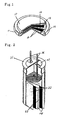
- a method for producing a coin-shaped capacitor includes, as shown in Fig. 1 , layering (or laminating) a current collector (12), an electrode (13), a separator (14), an electrode (13) and a current collector (12) in this order within a metallic case (11) made of stainless steel and the like, filling the case with an electrolytic solution and then sealing with a metallic lid (15) and gasket (16).
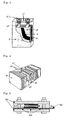
- a method for producing a wound capacitor includes, as shown in Fig.
- a method for producing a layered capacitor includes, as shown in Fig.
- Examples of the present invention are carried out with an electric double-layer capacitor which is constituted, as shown in Fig. 5 , by layering a sheet-shaped electrode (53), a separator (54), an electrode (53), an current collector (52) and insulating material (55) in this order between pressure plates (51), filling an electrolytic solution between the separator (54) and the electrode (53), sealing the outermost layer with fluorine resin and then fastening by bolts.
- the bolts are insulated from the current collector (52).
- a method for producing an accordion capacitor includes layering in accordion-folding manner an electrode and two current collector sheets with interposing a separator therebetween, and then preparing by the same way as applied to the layered capacitor.
- the separator used for the electric double-layer capacitor functions to separate positive and negative electrodes and to retain an electrolytic solution; for this reason, it applies a membrane having large ionic permeability, predetermined mechanical strength and electric insulating ability.
- the separator includes, for example, papers made of a viscose rayon, natural cellulose and the like, electrolytic papers, kraft papers , manila papers, mixed papers made of fibers such as cellulose and polyester, polyethylene non-woven fabrics, polypropylene non-woven fabrics, polyester non-woven fabrics, glass fibers, porous polyethylenes, porous polypropylenes, porous polyesters, aramid fibers, polybutyleneterephthalate non-woven fabrics, wholly aromatic p-polyamides, vinylidene fluoride, tetrafluoroethylene, copolymers of vinylidene fluoride and hexafluoro propylene, and fabrics and porous membranes of resins containing fluorine atom such as fluororubber.
- the separator may be a molded article composed of particles of ceramics such as silica and binders mentioned above.
- the molded article is usually integrally molded with both of positive and negative electrodes.
- a separator employing polyethylene or polypropylene may contain surfactants or silica particles to enhance hydrophilicity thereof.
- the separator may further contain organic solvents such as acetone, plasticizer such as dibutylphthalate (DBP), and others.
- a proton conductive polymer can be used as the separator.
- preferable separators include electrolytic papers, papers made of a viscose rayon or natural cellulose, kraft papers, manila papers, mixed papers made of cellulose or polyester fibers, polyethylene non-woven fabrics, polypropylene non-woven fabrics, polyester non-woven fabrics, sheets of Manila hemp and sheets of glass fibers.
- the separator usually has pores of about 0.01 to about 10 ⁇ m.
- the separator usually has thickness of about 1 to about 300 ⁇ m, preferably about 5 to about 30 ⁇ m.
- the separator may be a layered separator laminating separators having different pore ratios.
- Electrolytes used for the electric double-layer capacitor include inorganic electrolytes and organic electrolytes.
- the inorganic electrolytes include, for example, acids such as sulfuric acid, hydrochloric acid, and perchloric acid; bases such as sodium hydroxide, potassium hydroxide, lithium hydroxide, and tetraalkylammonium hydroxide; and salts such as sodium chloride and sodium sulfate.
- acids such as sulfuric acid, hydrochloric acid, and perchloric acid
- bases such as sodium hydroxide, potassium hydroxide, lithium hydroxide, and tetraalkylammonium hydroxide
- salts such as sodium chloride and sodium sulfate.
- aqueous sulfuric acid is suitable due to its excellent stability and low ability corroding materials composing the electric double-layer capacitor.
- Concentration of the inorganic electrolytes is usually about 0.2 to 5 moles (electrolyte)/L (electrolytic solution), preferably about 1 to 2 moles (electrolyte)/L (electrolytic solution). When the concentration is 0.2 to 5 moles/L, favorable ionic conductivity can be obtained in an electrolytic solution.
- the inorganic electrolytes are usually mixed with water to be used as an electrolytic solution.
- the organic electrolyte includes, for example, a combination of the following inorganic anions and organic cations described below.
- the anions include BO 3 3- , F - , PF 6 - , BF 4 - , AsF 6 - , SbF 6 - , ClO 4 - , AlF 4 - , AlCl 4 - , TaF 6 - , NbF 6 - , SiF 6 2- , CN - and F(HF) n- (wherein n represents an integer of 1 or more and 4 or less); a combination of organic anions described below and the organic cations, and a combination of the organic anions and inorganic cations such as lithium ion, sodium ion, potassium ion, hydrogen ion, and the like.
- the organic cation is a cationic organic compound such as organic quaternary ammonium cation and organic quaternary phosphonium cation.
- the organic quaternary ammonium cation is meant by a quaternary ammonium cation of which a hydrocarbon group selected from the group consisiting of alkyl group (having 1 to 20 carbon atoms), cycloalkyl group (having 6 to 20 carbon atoms), aryl group (having 6 to 20 carbon atoms) and aralkyl group (having 7 to 20 carbon atoms) is substituted with nitrogen atom
- the organic quaternary phosphonium cation is meant by a quaternary phosphonium cation of which the same hydrocarbon groups described above is substituted with phosphorus atom.
- the substituted hydrocarbon group may be further coupled with hydroxyl group, amino group, nitro group, cyano group, carboxyl group; ether group, aldehyde group and the like.
- the typical organic quaternary ammonium cations and organic quaternary phosphonium cations are exemplified as follows:
- the imidazolium cation is 1-ethyl-3-methylimidazolium (EMI + ) represented by the formula (2).
- the organic anion is an anion containing hydrocarbon group optionally having substituent, for example, includes an anion selected from the group consisting of N(SO 2 R f ) 2- , C(SO 2 R f ) 3- , R f COO- and R f SO 3- (wherein R f represents perfluoroalkyl group having 1 to 12 carbon atoms) and anions in which an active hydrogen is eliminated from the following organic acids (carboxylic acids, organic sulfonic acids and organic phosphoric acids) or phenols.
- organic acids carboxylic acids, organic sulfonic acids and organic phosphoric acids
- two to four valent polycarboxylic acids having 2 to 15 carbon atoms such as aliphatic polycarboxylic acids [saturated polycarboxylic acids (oxalic acid, malonic acid, succinic acid, glutaric acid, adipic acid, pimelic acid, suberic acid, azelaic acid, sebacic acid, undecanedioic acid, dodecanedioic acid, tridecanedioic acid, tetradecanedioic acid, pentadecanedioic acid, hexadecanedioic acid, methylmalonic acid, ethylmalonic acid, propylmalonic acid, butylmalonic acid, pentylmalonic acid, hexylmalonic acid, dimethylmalonic acid, diethylmalonic acid, methylpropylmalonic acid, methylbutylmalonic acid, ethylpropylmalonic acid, dipropylmalonic acids
- monophenols including phenols and naphthols: phenol, alkyl(1 to 15 carbon atoms) phenols (cresol, xylenol, ethylphenol, n- or iso-propylphenol, isododecylphenol and the like), methoxyphenols (eugenol, guaiacol and the like), a-naphthol, ⁇ -naphthol, cyclohexylphenol and the like); and polyphenols: catechol, resorcin, pyrogallol, phloroglucine, bisphenol A, bisphenol F, bisphenol S and the like.
- mono- and di-methylphosphate mono- and di-isopropylphosphate,mono-and di-butylphosphate, mono- and di-(2-ethylhexyl)phosphate, mono- and di-isodecylphosphate and the like.
- alkyl(1 to 15 carbon atoms)benzenesulfonic acids p-toluenesulfonic acid, nonylbenzenesulfonic acid, dodecylbenzenesulfonic acid and the like
- sulfosalicylic acid methanesulfonic acid, trifloromethanesulfonic acid and the like.
- borodioxalate borodiglycolate, borodi(2-hydroxyisobutyrate), alkane borates, aryl borates, methane borate, ethane borate, phenyl borates and the like.
- R' represents hydrocarbon group having 1 to 10 carbon atoms which optionally has hydroxyl group, amino group, nitro group, cyano group, chloro group, fluoro group, formyl group or a group having ether bonding, or hydrogen atom or fluorine atom; each of R's may be same or different and R's may form a ring by binding with alkylene group each other.
- R 1 and R 2 represent monovalent organic group having 1 to 4 carbon atoms containing fluorine atom; R 1 and R 2 may be same or different and R 3 represents divalent organic group having 2 to 8 carbon atoms containing fluorine atom.
- As anions preferable are inorganic anions, more preferable are BF 4 - , AsF 6 - , and SbF 6 - , further more preferable is BF 4 - due to its tendency to enhance electrostatic capacity.
- Solvents used for the electrolytic solution containing an electrolyte include water and/or organic polar solvents.
- the electrolytic solution containing an inorganic-base electrolyte only water is usually used as a solvent; otherwise, a solvent mainly containing water or a mixture of water and the above-mentioned hydrophilic organic solvent may be used.
- a solvent mainly containing an organic polar solvent is used as the electrolytic solution containing an organic electrolyte; and water content of the electrolytic solution containing organic-base electrolytes is usually 200 ppm or less, preferably 50 ppm or less, and more preferably 20 ppm or less.
- organic polar solvents are exemplified as follows:
- the polar organic solvents dissolving the electrolytes may be a mixture of two different kinds or more thereof.
- the polar organic solvent contained in the electrolytic solution is preferably a solvent mainly containing at least one compound selected from the group consisting of carbonates, lactones, and sulfoxides; more preferably mainly containing at least one compound selected from the group consisting of propylene carbonate, ethylene carbonate, butylene carbonate, sulfolane, 3-methylsulfolane, acetonitrile, dimethyl carbonate, ethylmethyl carbonate, ⁇ -butyrolactone, ethylene glycol, and diethyl carbonate; and further preferably mainly containing at least one compound selected from the group consisting of ethylene carbonate, propylene carbonate, ⁇ -butyrolactone, and sulfolane.
- the term "mainly containing” defines that the compound(s) occupies usually 50 % by weight or more of the weight of the solvent, and preferably 70 % by weight or more. The more the polar organic solvent is contained, the more long-term durability and operating voltage of the capacitor are enhanced.
- the additives specifically include, in order to suppress gas generation and enhance voltage endurance, phosphates (such as trimethyl phosphate, triethyl phosphate, and triallyl phosphate); and, in order to achieve high capacity and output, fluorine-contained organic silicon compounds represented by the following fomula: CF 3 CH 2 CH 2 Si(CH 3 ) 3 , (CH 3 ) 3 Si-O-Si(CH 3 )(CF 3 CH 2 CH 2 )-Si(CH 3 )
- the phosphate is added usually in an amount of about 10 % by weight or less of the electrolyte, and the fluorine-contained organic silicon compound is added in an amount of about 0.1 to 5 % by weight of the electrolytic solution.
- Benzoic acids [alkyl benzoates such as methyl benzoate, ethyl benzoate, and propyl benzoate, benzoic acid, and the like], being one kind of polar organic solvents, can be used as an additive for preventing metal elution from current collector.
- benzoic acid is used as an additive, it is used usually about 0.001 to 10.0 % by weight of the electrolyte, preferably 0.005 to 5 % by weight, more preferably 0.1 to 1 % by weight.
- Concentration of the organic electrolyte in the electrolytic solution containing an organic polar solvent is usually about 0.5 to 5.0 moles (electrolyte)/L (electrolytic solution), and preferably 0.7 to 3.0 moles (electrolyte)/L (electrolytic solution). It is preferable that, when dissolving the electrolyte of 0.5 mole/L or more, electrostatic capacity tends to increase; and, when dissolving 5.0 moles/L or less, viscosity tends to decrease.
- the electric double-layer capacitor is charged by applying current of usually about 5 mA/g to 10 A/g, preferably 10 mA/g to 5 A/g. It is preferable that, when applying the current of 5 mA/g or more, charging rate tends to be enhanced; and, when applying the current of 10 A/g or less, reduction of electrostatic capacity tends to be suppressed. Besides, the electric double-layer capacitor of the present invention causes little reduction of electrostatic capacity even if being repeatedly subjected to quick charging/discharging at a current of 1 A/g or more.
- the electric double-layer capacitor of the present invention is an electric double-layer capacitor having an excellent electrostatic capacity such that the electrostatic capacity per unit volume of the activated carbon is usually 15 F/ml or more, and preferably 18 F/ml or more; besides, having excellent electric characteristics such that the electrostatic capacity per unit weight of the activated carbon is usually 19 F/g or more, and preferably 24 F/g or more.
- An electric double-layer capacitor of the present invention comprises an electrode and an electrolytic solution, wherein said electrolytic solution is 1 mole/L of the propylene carbonate solution of tetraethylammonium BF 4 salt and said electrode is obtained by kneading a mixture of 80 parts by weight of an active carbon having a total pore volume of less than 0.95 ml/g, 10 parts by weight of acetylene black and 10 parts by weight of polytetrafluoroethylene, molding the kneaded mixture in the form of a sheet having a thickness of 0.28 mm, and drying the molded one to obtain positive and negative electrodes, in this case the electrostatic capacity per unit volume of the activated carbon is usually 15 F/ml or more.
- the electric double-layer capacitor of the present invention has other excellent electric characteristics: when charging/discharging it at a constant current (300 mA, 0 to 2.3 V) and letting the value of its electrostatic capacity obtained be 100, the capacitor little reduces its electrostatic capacity even if being subjected to quick charging/discharging; and, when 3 moles/L of propylene carbonate solution of 1-ethyl-3-methylimidazolium BF 4 salt being used as an electrolytic solution, the reduction of its electrostatic capacity is contained usually less than 5 %, and preferably 3 % or less even if being subjected to quick charging/discharging at a current of 4000 mA/g.
- the electric double-layer capacitor including the electrode having the activated carbon of the present invention remarkably enhances both of electrostatic capacity per unit volume and electrostatic capacity per unit weight.
- the capacitor also has low resistance value at discharging, suppresses heat generation, and hardly reduces the electrostatic capacity thereof under repeating quick charging/discharging;andfurthermore, seldom reduces the electrostatic capacity thereof under preservation at a high temperature such as about 70°C after being enough charged.
- MCRA was calcined (carbonized) at 1000°C for 4 hours under argon atmosphere, and then calcined (activated) at 1000°C for 2 hours in the presence of carbon dioxide; followed by crushing by a ball mill (agate ball, 28 rpm, 5 minutes). Since this activated carbon did not contact to metals, no metal including metal ions was substantially contaminated therein.
- the calculated total pore volume of the activated carbon obtained was 0.68 ml/g, the calculated micropore volume was 0.43 ml/g and the calculated mesopore volume was 0.25 ml/g.
- the total pore volume was calculated from an amount of nitrogen absorbed at around 0.95 relative pressure and the micropore was calculated at around 0. 30 relative pressure in a absorption isotherm determined at a temperature of liquid nitrogen by AUTOSORB (manufactured by Yuasa Ionics Inc.).
- Electrostatic capacity per unit volume of the activated carbon is calculated by multiplying a density (g/cc) by electrostatic capacity per unit weight (F/g), wherein the density (g/cc) of a molded article having a diameter of 13 ⁇ obtained by kneading a mixture of 80 parts by weight of the activated carbon and 10 parts by weight of polytetrafluoroethylene (about 60% by weight aqueous dispersion) and molding the mixture under the condition at a pressure of 162 kgf/cm 2 , and the electrostatic capacity per unit weight (F/g) of the molded article is calculated using a discharging curve obtained by charging a constant current at 300 mA/g up to 2.8 V and discharging with TOSCAT-3100 charge and discharge evaluation device manufactured by Toyo System K.K.
- Example Compound (1) Activation Time (h) Total Pore Volumn (ml/g) Micropore Volumn (ml/g) Current value (mA/g) Electrostatic Capacity n R m/z 1 H NMR ( ⁇ ) (F/cc) (F/g) 1 4 -CH 3 544 1.29 (s, 12H), 4.45 (q, 4H), 6.14 (s, 4H), 6.77 (s, 4H), 8.53 (s, 8H) 2 0.68 0.49 300 16.3 24.7 2 *1 4 -CH 3 544 0.73 ⁇ 1.40 (m, 12H), 4.31 ⁇ 4.79 (m, 4H), 6.10 ⁇ 6.80 (m, 4H), 6.77 ⁇ 6.80 (m, 4H), 8.40 ⁇ 8.91 (m,
- the activated carbon was obtained by carbonizing the compound (1) at 300°C for 1 hour in air, calcining (carbonizing) at 1000 °C for 4 hours under argon atmosphere, and then calcining (activating) at 1000°C for 2 hours in the presence of carbon dioxide.
- *4 In the production of the activated carbon, calcining for 4 hours in the presence of carbon dioxide (carbonizing and activating) was performed.
- Example 3 Examples were conducted according to the same manner of Example 1 except for applying the compounds (1) listed in Table 2, and 1 mole/L of aqueous sulfuric acid in place of 1 mole/L of the propylene carbonate solution of tetraethylammonium BF 4 salt. The results are shown in Table 3.
- the electrostatic capacities per unit volume of the electric double-layer capacitor (B) mentioned above were determined by a constant current charging/discharging measurement (1000 to 8000 mA/g), and the measured values were respectively expressed in percentage when the electrostatic capacity determined by a constant current charging/discharging measurement at 300 mA/g was as 100%.
- the results are shown in Table 4.
- the electric double-layer capacitor (A) was almost same as electric double-layer capacitor (B) except for being filled with 1 mole/L of the propylene carbonate solution of tetraethylammonium BF 4 salt (organic electrolyte) was subjected to the same measurement as in the capacitor (B), and the measured values were also respectively expressed in percentage by the same manner as in the capacitor (B).
- Table 4 It is understood that, even at the quick charging/discharging, the values of electrostatic capacity are almost same as that of the constant current charging/discharging.
- a current application characteristics was evaluated for the electric double-layer capacitor (B) according to the same manner that the capacitor (B) was kept at a temperature of 70°C for 300 hours and then subjected to a constant current charging/discharging measurement (300 mA/g, 0 to 2.3 V). The electrostatic capacities per unit volume and weight were retained in 86 % respectively based on the value of the initial constant current charging/discharging measurement at 300 mA/g.
- the electrode used was an electrode prepared with the same activated carbon obtained in Example 3.
- the electrolytic solution of the (A) 1 mole/L of the propylene carbonate solution of tetraethylammonium BF 4 salt (organic-base electrolyte)
- the electrolytic solution of the (B) 3 mole/L of propylene carbonate solution of 1-ethyl-3-methylimidazolium BF 4 salt (organic electrolyte)
- Comparative Examples 1 to 3 were conducted by using the compounds (1) listed in Table 5 according to the same manner as in Example 1 except for not conducting activation processing. The results are shown in Table 5.
- Comparative Example 4 was conducted by preparing a resorcin-formaldehyde resin according to Patent Literature 1, carbonizing and activating said resin to obtain an activated carbon, and then using said activated carbon. The results of this example are also shown in Table 5.
- the activated carbon of the present invention can be used, for example, to an electrode for dry batteries, redox capacitors, hybrid capacitors, electric double-layer capacitors, and the like; among of them, suitably used to an electrode of electric double-layer capacitors due to enhanced electrostatic capacity thereof.
- the electric double-layer capacitor of the present invention can be utilized for storage of energy source. Due to the enhanced properties thereof, it can be particularly used for storing energy source in the fields such as portable electric terminals and transportation vehicles characterized by battery-powered driving force.
Landscapes
- Chemical & Material Sciences (AREA)
- Engineering & Computer Science (AREA)
- Power Engineering (AREA)
- Organic Chemistry (AREA)
- Microelectronics & Electronic Packaging (AREA)
- Chemical Kinetics & Catalysis (AREA)
- Materials Engineering (AREA)
- Electrochemistry (AREA)
- Health & Medical Sciences (AREA)
- Medicinal Chemistry (AREA)
- Polymers & Plastics (AREA)
- Inorganic Chemistry (AREA)
- Electric Double-Layer Capacitors Or The Like (AREA)
- Carbon And Carbon Compounds (AREA)
Applications Claiming Priority (4)
| Application Number | Priority Date | Filing Date | Title |
|---|---|---|---|
| JP2005155167 | 2005-05-27 | ||
| JP2005194143 | 2005-07-01 | ||
| JP2005194144 | 2005-07-01 | ||
| PCT/JP2006/310832 WO2006126721A1 (fr) | 2005-05-27 | 2006-05-24 | Condensateur électrique double couche |
Publications (2)
| Publication Number | Publication Date |
|---|---|
| EP1905740A1 true EP1905740A1 (fr) | 2008-04-02 |
| EP1905740A4 EP1905740A4 (fr) | 2010-03-17 |
Family
ID=37452134
Family Applications (1)
| Application Number | Title | Priority Date | Filing Date |
|---|---|---|---|
| EP06756780A Withdrawn EP1905740A4 (fr) | 2005-05-27 | 2006-05-24 | Condensateur électrique double couche |
Country Status (6)
| Country | Link |
|---|---|
| US (1) | US7785495B2 (fr) |
| EP (1) | EP1905740A4 (fr) |
| KR (1) | KR101257966B1 (fr) |
| CN (1) | CN101184691A (fr) |
| TW (1) | TWI399239B (fr) |
| WO (1) | WO2006126721A1 (fr) |
Cited By (3)
| Publication number | Priority date | Publication date | Assignee | Title |
|---|---|---|---|---|
| EP2141184A1 (fr) * | 2006-10-20 | 2010-01-06 | Air Water Inc. | Poudre de résine de phénol non thermofusible, son procédé de production, composition de résine thermodurcissable, matériau de scellage pour semi-conducteur, et adhésif pour semi-conducteur |
| EP2093191A4 (fr) * | 2006-11-09 | 2011-03-30 | Sumitomo Chemical Co | Charbon actif et son procédé de fabrication |
| EP2214235A4 (fr) * | 2007-10-30 | 2012-03-28 | Sumitomo Chemical Co | Batterie secondaire à électrolyte non aqueux, électrode et matériau carboné |
Families Citing this family (51)
| Publication number | Priority date | Publication date | Assignee | Title |
|---|---|---|---|---|
| BRPI0718811B1 (pt) | 2006-11-15 | 2020-05-19 | Basf Se | dispositivo elétrico de capacitância de camada dupla |
| WO2008130042A2 (fr) * | 2007-04-12 | 2008-10-30 | Linxross, Inc. | Supercondensateurs bipolaires et procédés de fabrication de ces derniers |
| JP5339453B2 (ja) | 2007-05-11 | 2013-11-13 | Jx日鉱日石エネルギー株式会社 | スルホン酸基含有炭素質材料の製造方法、固体酸触媒、アルキル化反応生成物の製造方法、およびオレフィン重合体の製造方法 |
| WO2009031427A1 (fr) * | 2007-09-07 | 2009-03-12 | Meidensha Corporation | Condensateur électrique à double couche |
| WO2009078371A2 (fr) * | 2007-12-19 | 2009-06-25 | Sumitomo Chemical Company, Limited | Procédé de production de matière carbonée |
| EP2242131A1 (fr) * | 2008-02-04 | 2010-10-20 | Sumitomo Chemical Company, Limited | Oxyde métallique composite et batterie rechargeable au sodium |
| US20110003191A1 (en) * | 2008-02-04 | 2011-01-06 | Sumitomo Chemical Company, Limited | Sodium secondary battery |
| US10122014B2 (en) * | 2008-02-04 | 2018-11-06 | Sumitomo Chemical Company, Limited | Mixed metal oxide and sodium secondary battery |
| JP5309581B2 (ja) * | 2008-02-04 | 2013-10-09 | 住友化学株式会社 | 正極活物質用粉末、正極活物質およびナトリウム二次電池 |
| US8804309B2 (en) * | 2008-06-05 | 2014-08-12 | California Institute Of Technology | Low temperature double-layer capacitors using asymmetric and spiro-type quaternary ammonium salts |
| JP2010226100A (ja) * | 2009-02-25 | 2010-10-07 | Daikin Ind Ltd | 電気二重層キャパシタ |
| PL2448748T3 (pl) | 2009-07-01 | 2024-11-25 | Basf Mobile Emissions Catalysts Llc | Ultraczyste syntetyczne materiały węglowe |
| US20110267740A1 (en) * | 2010-04-29 | 2011-11-03 | Shrisudersan Jayaraman | Packaging for electrochemically active materials, devices made therefrom, and methods of making the same |
| US20110303881A1 (en) * | 2010-06-11 | 2011-12-15 | Samsung Electro-Mechanics Co., Ltd. | Carboxy methyl cellulose and slurry composition with the same |
| KR101138572B1 (ko) * | 2010-08-27 | 2012-05-10 | 삼성전기주식회사 | 리튬 이온 커패시터 |
| WO2012045002A1 (fr) | 2010-09-30 | 2012-04-05 | Energ2 Technologies, Inc. | Agrégation améliorée de particules d'accumulation d'énergie |
| JP6019400B2 (ja) * | 2010-10-15 | 2016-11-02 | パナソニックIpマネジメント株式会社 | 電気化学キャパシタ用電極とそれを用いた電気化学キャパシタ |
| EP2643840A4 (fr) * | 2010-11-26 | 2014-05-28 | Basf Se | Procédé pour la fabrication d'une matière carbonée poreuse contenant de l'azote |
| US9171675B2 (en) * | 2010-12-20 | 2015-10-27 | Jsr Corporation | Electrical storage device, lithium ion capacitor and negative electrode for lithium ion capacitor |
| US10326168B2 (en) | 2011-01-03 | 2019-06-18 | Nanotek Instruments, Inc. | Partially and fully surface-enabled alkali metal ion-exchanging energy storage devices |
| US20120262127A1 (en) | 2011-04-15 | 2012-10-18 | Energ2 Technologies, Inc. | Flow ultracapacitor |
| US10522836B2 (en) | 2011-06-03 | 2019-12-31 | Basf Se | Carbon-lead blends for use in hybrid energy storage devices |
| CN104221110B (zh) | 2011-07-08 | 2019-04-05 | 快帽系统公司 | 高温能量储存装置 |
| US9558894B2 (en) | 2011-07-08 | 2017-01-31 | Fastcap Systems Corporation | Advanced electrolyte systems and their use in energy storage devices |
| US9349542B2 (en) * | 2011-12-21 | 2016-05-24 | Nanotek Instruments, Inc. | Stacks of internally connected surface-mediated cells and methods of operating same |
| US9409777B2 (en) | 2012-02-09 | 2016-08-09 | Basf Se | Preparation of polymeric resins and carbon materials |
| US20120177923A1 (en) * | 2012-03-20 | 2012-07-12 | Haycarb PLC | Low ash activated carbon and methods of making same |
| CN102874807A (zh) * | 2012-09-19 | 2013-01-16 | 浙江工业大学 | 活性炭材料及其作为双电层电容器电极材料的应用 |
| US10043615B2 (en) | 2012-10-08 | 2018-08-07 | Maxwell Technologies, Inc. | Electrode porosity for three-volt ultracapacitor |
| US20140272592A1 (en) | 2013-03-14 | 2014-09-18 | Energ2 Technologies, Inc. | Composite carbon materials comprising lithium alloying electrochemical modifiers |
| US10195583B2 (en) | 2013-11-05 | 2019-02-05 | Group 14 Technologies, Inc. | Carbon-based compositions with highly efficient volumetric gas sorption |
| US9520243B2 (en) * | 2014-02-17 | 2016-12-13 | Korea Institute Of Energy Research | Method of manufacturing flexible thin-film typer super-capacitor device using a hot-melt adhesive film, and super-capacitor device manufactured by the method |
| JP6665121B2 (ja) | 2014-03-14 | 2020-03-13 | グループ14・テクノロジーズ・インコーポレイテッドGroup14 Technologies, Inc. | 無溶媒中におけるゾル−ゲル重合のための新規方法、及びゾル−ゲル重合由来の可変炭素構造の作製 |
| JP6528087B2 (ja) * | 2014-06-23 | 2019-06-12 | パナソニックIpマネジメント株式会社 | 電解コンデンサの製造方法 |
| WO2017031006A1 (fr) | 2015-08-14 | 2017-02-23 | Energ2 Technologies, Inc. | Composites constitués de matériaux au silicium poreux et de matières carbonées |
| US10147950B2 (en) | 2015-08-28 | 2018-12-04 | Group 14 Technologies, Inc. | Materials with extremely durable intercalation of lithium and manufacturing methods thereof |
| DE102015218433A1 (de) * | 2015-09-25 | 2017-03-30 | Robert Bosch Gmbh | Hybridsuperkondensator |
| EP3459097A4 (fr) | 2016-05-20 | 2020-05-06 | AVX Corporation | Électrolyte non aqueux pour supercondensateur |
| CN109155204B (zh) | 2016-05-20 | 2020-12-22 | 阿维科斯公司 | 用于超级电容器的电极构造体 |
| MY194849A (en) | 2016-05-20 | 2022-12-19 | Kyocera Avx Components Corp | Ultracapacitor for use at high temperatures |
| CN116978701A (zh) | 2017-03-09 | 2023-10-31 | 14集团技术公司 | 含硅前体在多孔支架材料上的分解 |
| US11936002B2 (en) * | 2017-12-13 | 2024-03-19 | Basf Se | Electrolyte composition comprising oligomeric silyl ester phosphonates |
| CN110734061B (zh) * | 2018-07-19 | 2021-12-31 | 深圳市环球绿地新材料有限公司 | 一种超容炭、其制备方法和用途 |
| CN111261426B (zh) * | 2018-12-03 | 2022-08-09 | 深圳新宙邦科技股份有限公司 | 一种超级电容器电解液及超级电容器 |
| JP2023537954A (ja) | 2020-08-10 | 2023-09-06 | グループ14・テクノロジーズ・インコーポレイテッド | 振動熱補助化学気相浸透 |
| US11335903B2 (en) | 2020-08-18 | 2022-05-17 | Group14 Technologies, Inc. | Highly efficient manufacturing of silicon-carbon composites materials comprising ultra low z |
| US11174167B1 (en) | 2020-08-18 | 2021-11-16 | Group14 Technologies, Inc. | Silicon carbon composites comprising ultra low Z |
| EP4707235A1 (fr) | 2020-08-18 | 2026-03-11 | Group14 Technologies, Inc. | Fabrication de matériaux composites silicium-carbone |
| US11639292B2 (en) | 2020-08-18 | 2023-05-02 | Group14 Technologies, Inc. | Particulate composite materials |
| JP7834731B2 (ja) | 2020-09-30 | 2026-03-24 | グループ14・テクノロジーズ・インコーポレイテッド | シリコン-カーボン複合材料の酸素含有量及び反応性制御のための不動態化の方法 |
| JP7722395B2 (ja) * | 2023-01-11 | 2025-08-13 | Dic株式会社 | フェノール性水酸基含有樹脂、感光性樹脂組成物、硬化性組成物及びレジスト膜 |
Family Cites Families (15)
| Publication number | Priority date | Publication date | Assignee | Title |
|---|---|---|---|---|
| US4048715A (en) * | 1976-01-27 | 1977-09-20 | The United States Of America As Represented By The United States Energy Research And Development Administration | Method of preparing porous, active material for use in electrodes of secondary electrochemical cells |
| US4873218A (en) | 1988-05-26 | 1989-10-10 | The United States Department Of Energy | Low density, resorcinol-formaldehyde aerogels |
| JP2679010B2 (ja) * | 1989-08-23 | 1997-11-19 | 工業技術院長 | 有機強磁性体及びその製造方法 |
| GB8924143D0 (en) * | 1989-10-26 | 1989-12-13 | Ciba Geigy | Novel oligomers |
| US5439989A (en) * | 1990-10-03 | 1995-08-08 | Commonwealth Scientific & Industrial Research Organisation | Epoxy resins based on macrocyclic compounds |
| US5260855A (en) | 1992-01-17 | 1993-11-09 | Kaschmitter James L | Supercapacitors based on carbon foams |
| US5945084A (en) | 1997-07-05 | 1999-08-31 | Ocellus, Inc. | Low density open cell organic foams, low density open cell carbon foams, and methods for preparing same |
| JPH11130414A (ja) * | 1997-10-22 | 1999-05-18 | Sumitomo Durez Kk | 炭素材 |
| JP2001284188A (ja) | 2000-04-03 | 2001-10-12 | Asahi Glass Co Ltd | 電気二重層キャパシタ電極用炭素材料の製造方法及びこの炭素材料を用いた電気二重層キャパシタの製造方法 |
| JP3930739B2 (ja) * | 2002-01-10 | 2007-06-13 | フタムラ化学株式会社 | 電気二重層キャパシタ用活性炭及びその製造方法 |
| JP2005050669A (ja) * | 2003-07-28 | 2005-02-24 | Tdk Corp | 電極、及び、それを用いた電気化学素子 |
| EP1659598A4 (fr) * | 2003-08-29 | 2010-02-17 | Japan Carlit Co Ltd | Solution electrolytique pour un condensateur electrique a double couche et condensateur electrique a double couche |
| US20060093915A1 (en) * | 2004-11-04 | 2006-05-04 | Lundquist Eric G | Carbons useful in energy storage devices |
| JP4912587B2 (ja) * | 2004-12-08 | 2012-04-11 | リグナイト株式会社 | 複合炭化材料の製造方法 |
| WO2006109815A1 (fr) | 2005-04-12 | 2006-10-19 | Sumitomo Chemical Company, Limited | Condensateur électrique double couche |
-
2006
- 2006-05-24 WO PCT/JP2006/310832 patent/WO2006126721A1/fr not_active Ceased
- 2006-05-24 CN CNA2006800181759A patent/CN101184691A/zh active Pending
- 2006-05-24 EP EP06756780A patent/EP1905740A4/fr not_active Withdrawn
- 2006-05-24 KR KR1020077028665A patent/KR101257966B1/ko not_active Expired - Fee Related
- 2006-05-24 US US11/920,344 patent/US7785495B2/en active Active
- 2006-05-25 TW TW095118532A patent/TWI399239B/zh not_active IP Right Cessation
Cited By (9)
| Publication number | Priority date | Publication date | Assignee | Title |
|---|---|---|---|---|
| EP2141184A1 (fr) * | 2006-10-20 | 2010-01-06 | Air Water Inc. | Poudre de résine de phénol non thermofusible, son procédé de production, composition de résine thermodurcissable, matériau de scellage pour semi-conducteur, et adhésif pour semi-conducteur |
| EP2145906A1 (fr) * | 2006-10-20 | 2010-01-20 | Air Water Inc. | Poudre de résine de phénol non thermofusible, son procédé de production, composition de résine thermodurcissable, matériau de scellage pour semi-conducteur, et adhésif pour semi-conducteur |
| US8158095B2 (en) | 2006-10-20 | 2012-04-17 | Air Water Inc. | Non-thermofusible phenol resin powder, method for producing the same, thermosetting resin composition, sealing material for semiconductor, and adhesive for semiconductor |
| US8293860B2 (en) | 2006-10-20 | 2012-10-23 | Air Water Inc. | Non-thermofusible phenol resin powder, method for producing the same, thermosetting resin composition, sealing material for semiconductor, and adhesive for semiconductor |
| US8409756B2 (en) | 2006-10-20 | 2013-04-02 | Air Water Inc. | Non-thermofusible phenol resin powder, method for producing the same, thermosetting resin composition, sealing material for semiconductor, and adhesive for semiconductor |
| US8411415B2 (en) | 2006-10-20 | 2013-04-02 | Air Water Inc. | Non-thermofusible phenol resin powder, method for producing the same, thermosetting resin composition, sealing material for semiconductor, and adhesive for semiconductor |
| US8658120B2 (en) | 2006-10-20 | 2014-02-25 | Air Water Inc. | Non-thermofusible phenol resin powder, method for producing the same, thermosetting resin composition, sealing material for semiconductor, and adhesive for semiconductor |
| EP2093191A4 (fr) * | 2006-11-09 | 2011-03-30 | Sumitomo Chemical Co | Charbon actif et son procédé de fabrication |
| EP2214235A4 (fr) * | 2007-10-30 | 2012-03-28 | Sumitomo Chemical Co | Batterie secondaire à électrolyte non aqueux, électrode et matériau carboné |
Also Published As
| Publication number | Publication date |
|---|---|
| KR20080009743A (ko) | 2008-01-29 |
| TWI399239B (zh) | 2013-06-21 |
| US7785495B2 (en) | 2010-08-31 |
| CN101184691A (zh) | 2008-05-21 |
| EP1905740A4 (fr) | 2010-03-17 |
| KR101257966B1 (ko) | 2013-04-24 |
| WO2006126721A1 (fr) | 2006-11-30 |
| TW200706239A (en) | 2007-02-16 |
| US20090103241A1 (en) | 2009-04-23 |
Similar Documents
| Publication | Publication Date | Title |
|---|---|---|
| US7785495B2 (en) | Electric double-layer capacitor | |
| US7800886B2 (en) | Electric double layer capacitor | |
| US20100321863A1 (en) | Activated carbon and process for producing the same | |
| JP4802243B2 (ja) | 電解液用添加剤及び電解液 | |
| JP5082300B2 (ja) | 活性炭及びその製造方法 | |
| KR100836550B1 (ko) | 전기화학 캐패시터용 전해액 및 이를 사용한 전기화학캐패시터 | |
| KR20190003793A (ko) | 울트라커패시터용 전극 구조 | |
| JP4857911B2 (ja) | 電極及び電気二重層キャパシタ | |
| JP5167644B2 (ja) | 活性炭 | |
| JP5125054B2 (ja) | 粉末無定形炭素及びその製造方法 | |
| CN101180691A (zh) | 双电层电容器 | |
| EP1876611A1 (fr) | Condensateur électrique double couche | |
| CN101036206A (zh) | 用于双层电容器的电解质溶液和具有该电解质溶液的双层电容器 | |
| JP2003173936A (ja) | 電気化学キャパシタ用電解液およびそれを用いた電気化学キャパシタ | |
| JP2012109539A (ja) | 電気二重層キャパシタ用電解液およびこれを用いた電気二重層キャパシタ | |
| JP2011192963A (ja) | 電気二重層キャパシタ用電解液およびこれを用いた電気二重層キャパシタ | |
| JP2006319322A (ja) | 電気二重層キャパシタ | |
| JP2004047969A (ja) | 電気化学キャパシタ用電解液およびそれを用いた電気化学キャパシタ | |
| JP2006319321A (ja) | 活性炭及びその製造方法 | |
| JP7007830B2 (ja) | 電解液用溶媒 | |
| JP2003324038A (ja) | 電気化学キャパシタ用電解液及びそれを用いた電気化学キャパシタ | |
| JP2004047957A (ja) | 電気化学キャパシタ用電解液およびそれを用いた電気化学キャパシタ | |
| JP2004006842A (ja) | 電気化学キャパシタ用電解液およびそれを用いた電気化学キャパシタ | |
| JP2013222866A (ja) | 電気二重層キャパシタ用電解液およびこれを用いた電気二重層キャパシタ | |
| JP2002343679A (ja) | 電気化学キャパシタ用電解液及びそれを用いた電気化学キャパシタ |
Legal Events
| Date | Code | Title | Description |
|---|---|---|---|
| PUAI | Public reference made under article 153(3) epc to a published international application that has entered the european phase |
Free format text: ORIGINAL CODE: 0009012 |
|
| 17P | Request for examination filed |
Effective date: 20071221 |
|
| AK | Designated contracting states |
Kind code of ref document: A1 Designated state(s): AT BE BG CH CY CZ DE DK EE ES FI FR GB GR HU IE IS IT LI LT LU LV MC NL PL PT RO SE SI SK TR |
|
| DAX | Request for extension of the european patent (deleted) | ||
| A4 | Supplementary search report drawn up and despatched |
Effective date: 20100211 |
|
| 17Q | First examination report despatched |
Effective date: 20100602 |
|
| STAA | Information on the status of an ep patent application or granted ep patent |
Free format text: STATUS: THE APPLICATION IS DEEMED TO BE WITHDRAWN |
|
| 18D | Application deemed to be withdrawn |
Effective date: 20141202 |