EP1906352A1 - Dispositif et procédé destinés à la coordination d'un parc de machines - Google Patents
Dispositif et procédé destinés à la coordination d'un parc de machines Download PDFInfo
- Publication number
- EP1906352A1 EP1906352A1 EP07111434A EP07111434A EP1906352A1 EP 1906352 A1 EP1906352 A1 EP 1906352A1 EP 07111434 A EP07111434 A EP 07111434A EP 07111434 A EP07111434 A EP 07111434A EP 1906352 A1 EP1906352 A1 EP 1906352A1
- Authority
- EP
- European Patent Office
- Prior art keywords
- record
- user
- data
- threshold
- machine
- Prior art date
- Legal status (The legal status is an assumption and is not a legal conclusion. Google has not performed a legal analysis and makes no representation as to the accuracy of the status listed.)
- Withdrawn
Links
Images

Classifications
-
- A—HUMAN NECESSITIES
- A01—AGRICULTURE; FORESTRY; ANIMAL HUSBANDRY; HUNTING; TRAPPING; FISHING
- A01B—SOIL WORKING IN AGRICULTURE OR FORESTRY; PARTS, DETAILS, OR ACCESSORIES OF AGRICULTURAL MACHINES OR IMPLEMENTS, IN GENERAL
- A01B79/00—Methods for working soil
- A01B79/005—Precision agriculture
-
- G—PHYSICS
- G06—COMPUTING OR CALCULATING; COUNTING
- G06Q—INFORMATION AND COMMUNICATION TECHNOLOGY [ICT] SPECIALLY ADAPTED FOR ADMINISTRATIVE, COMMERCIAL, FINANCIAL, MANAGERIAL OR SUPERVISORY PURPOSES; SYSTEMS OR METHODS SPECIALLY ADAPTED FOR ADMINISTRATIVE, COMMERCIAL, FINANCIAL, MANAGERIAL OR SUPERVISORY PURPOSES, NOT OTHERWISE PROVIDED FOR
- G06Q10/00—Administration; Management
- G06Q10/06—Resources, workflows, human or project management; Enterprise or organisation planning; Enterprise or organisation modelling
-
- Y—GENERAL TAGGING OF NEW TECHNOLOGICAL DEVELOPMENTS; GENERAL TAGGING OF CROSS-SECTIONAL TECHNOLOGIES SPANNING OVER SEVERAL SECTIONS OF THE IPC; TECHNICAL SUBJECTS COVERED BY FORMER USPC CROSS-REFERENCE ART COLLECTIONS [XRACs] AND DIGESTS
- Y10—TECHNICAL SUBJECTS COVERED BY FORMER USPC
- Y10S—TECHNICAL SUBJECTS COVERED BY FORMER USPC CROSS-REFERENCE ART COLLECTIONS [XRACs] AND DIGESTS
- Y10S707/00—Data processing: database and file management or data structures
- Y10S707/912—Applications of a database
- Y10S707/944—Business related
-
- Y—GENERAL TAGGING OF NEW TECHNOLOGICAL DEVELOPMENTS; GENERAL TAGGING OF CROSS-SECTIONAL TECHNOLOGIES SPANNING OVER SEVERAL SECTIONS OF THE IPC; TECHNICAL SUBJECTS COVERED BY FORMER USPC CROSS-REFERENCE ART COLLECTIONS [XRACs] AND DIGESTS
- Y10—TECHNICAL SUBJECTS COVERED BY FORMER USPC
- Y10S—TECHNICAL SUBJECTS COVERED BY FORMER USPC CROSS-REFERENCE ART COLLECTIONS [XRACs] AND DIGESTS
- Y10S707/00—Data processing: database and file management or data structures
- Y10S707/912—Applications of a database
- Y10S707/951—Calendar or scheduling
Definitions
- the present invention relates to an apparatus and a method for the coordination of a machine park, in particular of mobile agricultural machines, which allow to operate the machines with a high degree of productivity.
- a system that supports the exchange of information between users and mobile agricultural machines, allowing users to make changes to information stored in the system, is out DE 102 45 169 A1 known.
- the object of the invention is to develop such a system so that it supports the use of mobile machines with high productivity.
- the object is achieved by providing, in a device for coordinating a park of mobile agricultural machines, a memory for storing a plurality of data records, an interface for communicating with a plurality of users and a management unit capable of Responding to user requests to make changes to the records, each record representing a given proportion of the work capacity of a machine of the machine park, the changes relating to the allocation of the work capacity represented by the record to the change user and the management unit being set up to allow a user to change a record when requested by the user if the record is not assigned to another user and an urgency of the change signaled by the requesting user is erroneous for the item in question calibrates.
- users who are not committed to a particular record may refer to records that are not used by less flexible users able to satisfy the widest possible number of inquiring users or ensure a good utilization of the machines to be coordinated.
- the management unit can specify a distance between two records that allows the management unit to determine whether or not a given record is in the vicinity of another record, and the management unit is set up the threshold based on the frequency of allocated records under in the vicinity of the record to be changed to set records. Based on the proportion of already allocated records near the requested record, the device can dynamically estimate how needed the requested record is from the requesting or other external units.
- each record corresponds to an operating period of a machine of the machine park.
- the distance between two data sets is expediently defined to increase with increasing time interval between the data sets.
- the administration unit is set up to determine the proportion of already allocated data records among the data records lying in the vicinity of a given data record at respectively predetermined time intervals from the time corresponding to the given data record. That is, between two occupancy level determinations, the urgency that a user must specify to get a requested record does not change. This improves the predictability of the query result for the user.
- the management unit is set up to determine the proportion of already allocated data records among the data records lying near a given data set for each request for the given data record.
- the result of a request for the user is less predictable, on the other hand, however, an improved utilization of the machines can be achieved.
- the threshold is expediently a decreasing function of the time interval between the present and the time corresponding to the data record, that is, given the frequency of allocated data records in the environment of a given data set, the closer in the future the closer to the given data set Time lapse. This ensures that undelivered records are preferred in the short term and time periods in which the machines remain idle are minimized.
- the distance between two data sets associated with two machines suitable for the same task is independent of the machine's identity. That is, if the data sets respectively correspond to operating periods of the machines, then the distance set by the regulation of two data records allocated to a same operating time period on two different machines to a third data record is always the same.
- the administration unit is expediently set up to cancel an assignment of a data record to the external unit at the request of a user and to assign a new data record to it , Such reassignment can be done without further requirements if the threshold for the new record is lower than that for the originally assigned record. Otherwise, the reassignment expediently takes place only if the urgency specified for this purpose by the external unit is at least as great as the difference between the threshold for the new data record and that for the originally assigned data record.
- control device and the machine park on the one hand and the users on the other hand belong to different economic units
- the user has the opportunity to plan his operating costs at an early stage, and he can optimize them at any time, because he can weigh whether any additional costs that occur when booking harvesters at an ideal date or a rebooking compared to another, suboptimal date are justified by benefits such as the expected higher yield or better quality of the crop.
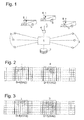
- Fig. 1 shows a block diagram of the coordination device according to the invention and its environment of use.
- a management unit 1 which may be implemented as a suitably programmed computer, is connected to a data memory 2 and to a plurality of user terminals 3.
- As infrastructure for the connections to the terminals 3 can serve in a conventional manner, a public or private telecommunications network, a computer network or the like.
- the management unit 1 is further connected to a radio interface 4, which communicates with a plurality of machines 5 of a machine park allows.
- the machines 5 may be directly remotely controllable by instructions transmitted by the management unit 1 via the radio interface 4; in the case of machines such as the combines shown here as an example, which do not make sense fully automated tasks, the control can be limited by the administrative unit 1 to transmit work instructions to a carried in the machine 5 data display unit 6, so that an operator of the Machine 5 take note of the instructions and can perform with the help of the machine 5.
- the coordination device As an application example of the coordination device according to the invention, the planning of a harvest campaign will be considered below, it being understood that the coordination device can also be used in other areas where it is necessary to distribute limited available resources to a plurality of users within a given period of time that on the one hand a high degree of utilization of resources is achieved and on the other hand the requirements of the users are optimally fulfilled.
- One problem with planning a harvest campaign is that a probable harvest time and harvest amount, and thus the time and extent of the demand for harvesters, can only be roughly estimated in advance, as the exact optimum harvest time and the amount then to be harvested are of a number of uncertainties which only become known in the course of fruit growth or even just a few days before the actual harvest date. For example, due to temperature and precipitation fluctuations during the growth period, the actual maturity date may shift back or forth from a long-term average by several days, and also the amount to be harvested may deviate up or down from an expected value.
- the coordination device takes this problem into account by requesting an indication of the urgency of such a reservation from a user 3 who intends to reserve a quota of capacity of the machines 5 for a certain period of time and makes the reservation only if the urgency specified reached a specified by the administrative unit 1 threshold.
- a criterion for quantifying the urgency for example, the difference between the expected crop yields at the time requested at the reservation and, for example, one week earlier or later may be assumed. Also dependent on the harvest time Quality of the crop can be considered. The sooner the time of reservation is, the smaller is the already predictable difference at that time, and accordingly the urgency of the reservation is lower. The later the reservation is made, the more accurately the user can predict an expected difference and, accordingly, the higher the urgency he specifies.
- the urgency can also be easily by a Quantify the amount of money a user is willing to pay for using the machines at the desired time.
- a simple possibility is to give the administrative unit 1 a prescription, setting the threshold of urgency only depending on the date for which capacity is to be reserved, and the time interval between the date to be reserved and the time of the reservation.
- Such a rule generally becomes a high threshold for a reservation within a harvest harvest period to be expected and for a reservation period set a low threshold outside the expected harvest period, which increases in a given manner for a given reservation period as this reservation period approaches. If a capacity quota has remained unreserved until shortly before its appointment, the threshold can be reduced again for this, in order to increase the probability that it will be reserved in the short term and the corresponding machine will be used more continuously.
- FIG. 2 shows a schematic representation of the contents of the data memory 2 at a time in which the expected harvest time of a crop to be introduced with the machines 5 is still far in the future.
- the illustration shows a plurality of boxes, each corresponding to a record of the memory 2, arranged in a matrix having a plurality of rows and columns. Each column corresponds to a certain period of time, for example one day, and each row is assigned to one of the machines 5. If the machine park machines 5 of different In other words, a higher-performance machine may also have multiple rows of the chart associated with it, such that each row corresponds approximately to a specific workload of a machine, such as a certain number of tons of crop.
- the management unit 1 determines the utilization rate of the machines of a given week, that is, determines the ratio of reserved boxes to the total number of boxes for that week and sets the obtained ratio as an argument in a function f, which is an increasing function of this ratio.
- Fig. 3 shows the occupancy of the data memory 2 at a later time, wherein since the date shown in Fig. 2 time added reservations are characterized by a weaker hatching of the corresponding box.
- the degree of utilization in the week I has now reached the same value 10/42 as the week II in Fig. 2, so now for a reservation in the week I the same urgency must be specified as at the time of Fig. 2 for a reservation in the week II.
- the utilization of the latter has reached a value 23/42 here, so that here too the urgency to be given for a reservation is higher than in the case of FIG. 2.
- a calculation of the degree of utilization relating to a fixed period of time, such as one week, as shown in FIGS. 2, 3, can lead to unsatisfactory results if the time span in which the demand of the users 3 for the machines 5 reaches their maximum becomes clear shorter than this fixed period of time. Such a situation may arise in particular when rainfall in a region is foreseeable during the harvesting period and users 3 in the region are very interested in harvesting their land before rainfall.
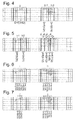
- a method for determining the degree of utilization, taking into account this problem is shown in Figs. 4 and 5. These in turn show the contents of the data memory 2 at the same times as in Figs. 2 and 3, respectively.
- Administrative unit 1 divides the corresponding time period into two part-time periods, here the part-time periods II-1, II-2 in the case of week II, setting the boundary between the part-time periods such that the number of allocated boxes in the two part-time periods is as little as possible.
- part-time II-1 comprising the first four days of week II and having a degree of utilization of 4/24
- part-time 11-2 occupying the remaining three days of the week, having a capacity of 6/18 are obtained. Consequently, in order to reserve a further box in the part-time period II-2, a user 3 must indicate a higher urgency than for a reservation in the part-time period II-1.
- Fig. 5 the progressive reservations according to the above-described method for subdividing week I into part time periods I-1, I-2 and part time periods II-1, II-2 into subintervals II-11, II-12, II-21 , II-22, the degree of utilization of which is determined separately.
- FIG. 1 A method for establishing the threshold D, which is independent of a subdivision of the calendar in weeks, is illustrated in FIG.
- the reservations shown are again the same as in Fig. 2.
- the utilization rate is calculated individually for each calendar day by adding together the reserved boxes of the relevant calendar day and the two preceding and the two subsequent ones and dividing them by the total number of boxes corresponding to these five days become. In each case, the registered in the figure for the individual days occupancy rates are obtained.
- the smallest symmetric interval will be used formed the relevant day containing a predetermined number of reserved boxes, for example three pieces.
- the time interval containing the minimum number of three reservations is five days, so that for these days a utilization of 3/30 results; in the case of the day Ie it is seven days, corresponding to a utilization of 3/42.
- the time interval for day IIb is five days and contains four reservations, corresponding to a load of 4/30; for the days IIc, IId there is a three-day interval with loadings of 4/18 and 6/18 respectively, and for the days IIe and IIf the interval is one day long, with a load of 3/6.
- step S1 the management unit 1 receives from a user N or his terminal 3 a request to reserve to this user N a share T of the working capacity of the machines 5, the share being at least one time unit, such as a calendar day, at which the working capacity is needed is, as well as possibly defined by an indication of the desired machine 5.
- the proportion thus corresponds to one or more of the boxes or data sets shown in FIGS. 2 to 7. For the sake of clarity, it is assumed below that the proportion T is exactly one record where the generalization to multiple data sets is not difficult.
- the management unit 2 first checks in step S2 whether the relevant share T is already allocated to another user. If so, the request for N must be rejected in step S3.
- the management unit determines in step S4 a threshold S (T) for the urgency that the request of the N must have, so that the share T can be reserved for him.
- This determination can be made by the management unit 2 respectively determining the utilization rate corresponding to the demanded share T at the time of step S4 by means of one of the methods described above with reference to FIGS. 2 to 7 and setting the threshold S (T) as a monotonically increasing function f the degree of utilization at the time of this proportion T calculated.
- An alternative possibility is to determine the degree of utilization for the time of the proportion T at specific times or at predetermined time intervals from the time corresponding to the proportion T and to store the threshold S (T) corresponding to this utilization level in a table. In such a case, the threshold S (T) remains unchanged between two update times, so that a user can better estimate in advance the urgency D required for a successful reservation.
- the management unit 2 compares the urgency D reported by the user N with the threshold S (T) set in step 4 in step S5. If the urgency D indicated by the user N is at least as large as the threshold S (T), the work time share T is allocated to the user in step S6, and in time for the time corresponding to the proportion T, the management unit sends an instruction in step S7 one of the machines 5 to perform the desired work for the user N.
- a user who already reserves work capacity shares at an early stage and thus gives scheduling security to the operator of the machines 3 is rewarded by requiring only relatively little urgency for a successful reservation.
- a user 3, who waits a long time before reserving, has to accept the risk that his requirement will not be fulfilled because there is no more available working capacity or that it will only be fulfilled with high urgency.
- the management unit 1 can be designed to carry out the method described below with reference to FIG. 9 in addition to the method of FIG. 8.
- the administration unit 2 receives in a first step S11 a request from the user N for whom a working time component T1 has already been reserved, instead of making a reservation for another working time component T2.
- the management unit first checks in step S12 whether the specified in the request portion T1 is actually allocated to the user N.
- step S13 the request must be rejected in step S13, because only the user who can actually reserve the share T1 for which it is actually reserved.
- step S14 it is next checked in step S14 whether the proportion T2 is allocated to any one user. If so, the request can also be rejected only in step S13. If not, the determination of the threshold S (T1) or S (T2) for the proportion T1 or T2 takes place in steps S15, S16. As described above with reference to step S4, the determination may be made on the basis of a utilization level determined at the time of these steps S15, S16 or on the basis of a utilization rate determined independently of the request at an earlier point in time.
- Step S17 compares the urgency D indicated in the inquiry of step S11 with the difference between the thresholds S (T2) and S (T1), If the threshold for T2 is lower than for T1, ie if the demand for the working time proportion T2 is smaller than for T1, a change of the reservation is generally also for the operator Machine 3 is useful, so that in step S18 the proportion T2 is reserved for the user N and the reservation for the share T1 is canceled.
- the threshold S for the proportion T2 is higher than for T1, the specified urgency D but at least as large as the difference of the thresholds S (T2) -S (T1).
- An instruction to perform work for the user N is sent to one of the machines 3 in time before the time corresponding to the proportion T2 in step S19.
Landscapes
- Engineering & Computer Science (AREA)
- Business, Economics & Management (AREA)
- Economics (AREA)
- Strategic Management (AREA)
- Human Resources & Organizations (AREA)
- Life Sciences & Earth Sciences (AREA)
- Entrepreneurship & Innovation (AREA)
- Game Theory and Decision Science (AREA)
- Operations Research (AREA)
- Development Economics (AREA)
- Environmental Sciences (AREA)
- Soil Sciences (AREA)
- Mechanical Engineering (AREA)
- Marketing (AREA)
- Educational Administration (AREA)
- Quality & Reliability (AREA)
- Tourism & Hospitality (AREA)
- Physics & Mathematics (AREA)
- General Business, Economics & Management (AREA)
- General Physics & Mathematics (AREA)
- Theoretical Computer Science (AREA)
- Management, Administration, Business Operations System, And Electronic Commerce (AREA)
Applications Claiming Priority (1)
| Application Number | Priority Date | Filing Date | Title |
|---|---|---|---|
| DE102006045280A DE102006045280A1 (de) | 2006-09-22 | 2006-09-22 | Vorrichtung und Verfahren zur Koordination eines Maschinenparks |
Publications (1)
| Publication Number | Publication Date |
|---|---|
| EP1906352A1 true EP1906352A1 (fr) | 2008-04-02 |
Family
ID=39047780
Family Applications (1)
| Application Number | Title | Priority Date | Filing Date |
|---|---|---|---|
| EP07111434A Withdrawn EP1906352A1 (fr) | 2006-09-22 | 2007-06-29 | Dispositif et procédé destinés à la coordination d'un parc de machines |
Country Status (4)
| Country | Link |
|---|---|
| US (1) | US7873617B2 (fr) |
| EP (1) | EP1906352A1 (fr) |
| DE (1) | DE102006045280A1 (fr) |
| RU (1) | RU2453920C2 (fr) |
Families Citing this family (66)
| Publication number | Priority date | Publication date | Assignee | Title |
|---|---|---|---|---|
| US20110270783A1 (en) * | 2010-04-30 | 2011-11-03 | Agco Corporation | Trigger-based application control |
| US20110270723A1 (en) * | 2010-04-30 | 2011-11-03 | Agco Corporation | Dynamically triggered application configuration |
| US9772625B2 (en) | 2014-05-12 | 2017-09-26 | Deere & Company | Model referenced management and control of a worksite |
| US10114348B2 (en) | 2014-05-12 | 2018-10-30 | Deere & Company | Communication system for closed loop control of a worksite |
| US10152891B2 (en) * | 2016-05-02 | 2018-12-11 | Cnh Industrial America Llc | System for avoiding collisions between autonomous vehicles conducting agricultural operations |
| US9949423B2 (en) * | 2016-06-10 | 2018-04-24 | Cnh Industrial America Llc | Customizable equipment library for command and control software |
| US11957072B2 (en) | 2020-02-06 | 2024-04-16 | Deere & Company | Pre-emergence weed detection and mitigation system |
| US11672203B2 (en) | 2018-10-26 | 2023-06-13 | Deere & Company | Predictive map generation and control |
| US11653588B2 (en) | 2018-10-26 | 2023-05-23 | Deere & Company | Yield map generation and control system |
| US12069978B2 (en) | 2018-10-26 | 2024-08-27 | Deere & Company | Predictive environmental characteristic map generation and control system |
| US11589509B2 (en) | 2018-10-26 | 2023-02-28 | Deere & Company | Predictive machine characteristic map generation and control system |
| US11079725B2 (en) | 2019-04-10 | 2021-08-03 | Deere & Company | Machine control using real-time model |
| US11467605B2 (en) | 2019-04-10 | 2022-10-11 | Deere & Company | Zonal machine control |
| US11641800B2 (en) | 2020-02-06 | 2023-05-09 | Deere & Company | Agricultural harvesting machine with pre-emergence weed detection and mitigation system |
| US11240961B2 (en) | 2018-10-26 | 2022-02-08 | Deere & Company | Controlling a harvesting machine based on a geo-spatial representation indicating where the harvesting machine is likely to reach capacity |
| US11178818B2 (en) | 2018-10-26 | 2021-11-23 | Deere & Company | Harvesting machine control system with fill level processing based on yield data |
| US11234366B2 (en) | 2019-04-10 | 2022-02-01 | Deere & Company | Image selection for machine control |
| US11778945B2 (en) | 2019-04-10 | 2023-10-10 | Deere & Company | Machine control using real-time model |
| US12035648B2 (en) | 2020-02-06 | 2024-07-16 | Deere & Company | Predictive weed map generation and control system |
| US12225846B2 (en) | 2020-02-06 | 2025-02-18 | Deere & Company | Machine control using a predictive map |
| US12329148B2 (en) | 2020-02-06 | 2025-06-17 | Deere & Company | Predictive weed map and material application machine control |
| US11477940B2 (en) | 2020-03-26 | 2022-10-25 | Deere & Company | Mobile work machine control based on zone parameter modification |
| US12386354B2 (en) | 2020-10-09 | 2025-08-12 | Deere & Company | Predictive power map generation and control system |
| US12069986B2 (en) | 2020-10-09 | 2024-08-27 | Deere & Company | Map generation and control system |
| US11635765B2 (en) | 2020-10-09 | 2023-04-25 | Deere & Company | Crop state map generation and control system |
| US11871697B2 (en) | 2020-10-09 | 2024-01-16 | Deere & Company | Crop moisture map generation and control system |
| US11727680B2 (en) | 2020-10-09 | 2023-08-15 | Deere & Company | Predictive map generation based on seeding characteristics and control |
| US11889788B2 (en) | 2020-10-09 | 2024-02-06 | Deere & Company | Predictive biomass map generation and control |
| US11474523B2 (en) | 2020-10-09 | 2022-10-18 | Deere & Company | Machine control using a predictive speed map |
| US11845449B2 (en) | 2020-10-09 | 2023-12-19 | Deere & Company | Map generation and control system |
| US11650587B2 (en) | 2020-10-09 | 2023-05-16 | Deere & Company | Predictive power map generation and control system |
| US11675354B2 (en) | 2020-10-09 | 2023-06-13 | Deere & Company | Machine control using a predictive map |
| US12013245B2 (en) | 2020-10-09 | 2024-06-18 | Deere & Company | Predictive map generation and control system |
| US11711995B2 (en) | 2020-10-09 | 2023-08-01 | Deere & Company | Machine control using a predictive map |
| US11825768B2 (en) | 2020-10-09 | 2023-11-28 | Deere & Company | Machine control using a predictive map |
| US11844311B2 (en) | 2020-10-09 | 2023-12-19 | Deere & Company | Machine control using a predictive map |
| US11864483B2 (en) | 2020-10-09 | 2024-01-09 | Deere & Company | Predictive map generation and control system |
| US11895948B2 (en) | 2020-10-09 | 2024-02-13 | Deere & Company | Predictive map generation and control based on soil properties |
| US12178158B2 (en) | 2020-10-09 | 2024-12-31 | Deere & Company | Predictive map generation and control system for an agricultural work machine |
| US11927459B2 (en) | 2020-10-09 | 2024-03-12 | Deere & Company | Machine control using a predictive map |
| US11946747B2 (en) | 2020-10-09 | 2024-04-02 | Deere & Company | Crop constituent map generation and control system |
| US11849671B2 (en) | 2020-10-09 | 2023-12-26 | Deere & Company | Crop state map generation and control system |
| US12422847B2 (en) | 2020-10-09 | 2025-09-23 | Deere & Company | Predictive agricultural model and map generation |
| US12550802B2 (en) | 2020-10-08 | 2026-02-17 | Deere & Company | Predictive machine characteristic map generation and control system |
| US11874669B2 (en) | 2020-10-09 | 2024-01-16 | Deere & Company | Map generation and control system |
| US11983009B2 (en) | 2020-10-09 | 2024-05-14 | Deere & Company | Map generation and control system |
| US11592822B2 (en) | 2020-10-09 | 2023-02-28 | Deere & Company | Machine control using a predictive map |
| US11849672B2 (en) | 2020-10-09 | 2023-12-26 | Deere & Company | Machine control using a predictive map |
| US12419220B2 (en) | 2020-10-09 | 2025-09-23 | Deere & Company | Predictive map generation and control system |
| US12250905B2 (en) | 2020-10-09 | 2025-03-18 | Deere & Company | Machine control using a predictive map |
| US11889787B2 (en) | 2020-10-09 | 2024-02-06 | Deere & Company | Predictive speed map generation and control system |
| US12229886B2 (en) | 2021-10-01 | 2025-02-18 | Deere & Company | Historical crop state model, predictive crop state map generation and control system |
| US12310286B2 (en) | 2021-12-14 | 2025-05-27 | Deere & Company | Crop constituent sensing |
| US12302791B2 (en) | 2021-12-20 | 2025-05-20 | Deere & Company | Crop constituents, predictive mapping, and agricultural harvester control |
| US12245549B2 (en) | 2022-01-11 | 2025-03-11 | Deere & Company | Predictive response map generation and control system |
| US12520759B2 (en) | 2022-01-26 | 2026-01-13 | Deere & Company | Systems and methods for predicting material dynamics |
| US12082531B2 (en) | 2022-01-26 | 2024-09-10 | Deere & Company | Systems and methods for predicting material dynamics |
| US12295288B2 (en) | 2022-04-05 | 2025-05-13 | Deere &Company | Predictive machine setting map generation and control system |
| US12298767B2 (en) | 2022-04-08 | 2025-05-13 | Deere & Company | Predictive material consumption map and control |
| US12058951B2 (en) | 2022-04-08 | 2024-08-13 | Deere & Company | Predictive nutrient map and control |
| US12358493B2 (en) | 2022-04-08 | 2025-07-15 | Deere & Company | Systems and methods for predictive power requirements and control |
| US12582035B2 (en) | 2022-04-08 | 2026-03-24 | Deere & Company | Systems and methods for predictive power requirements and control |
| US12284934B2 (en) | 2022-04-08 | 2025-04-29 | Deere & Company | Systems and methods for predictive tractive characteristics and control |
| DE102022110132A1 (de) * | 2022-04-27 | 2023-11-02 | Claas E-Systems Gmbh | Autonome landwirtschaftliche Arbeitsmaschine |
| DE102022110211A1 (de) | 2022-04-27 | 2023-11-02 | Claas E-Systems Gmbh | Schwarmassistenzsystem für autonome landwirtschaftliche Universal-Arbeitsmaschinen |
| DE102022110279A1 (de) | 2022-04-27 | 2023-11-02 | Claas E-Systems Gmbh | Schwarmassistenzsystem zum Planen und Steuern des Einsatzes mindestens einer autonomen landwirtschaftlichen Universal-Arbeitsmaschine |
Citations (8)
| Publication number | Priority date | Publication date | Assignee | Title |
|---|---|---|---|---|
| EP0740896A2 (fr) * | 1995-04-15 | 1996-11-06 | CLAAS KGaA | Méthode d'optimisation pour l'opération de machines agricoles |
| EP0814397A2 (fr) * | 1996-06-17 | 1997-12-29 | CLAAS KGaA | Ordinateur portable de bord avec unités de commande pour machines de travail |
| EP1225527A2 (fr) * | 2001-01-17 | 2002-07-24 | CLAAS Selbstfahrende Erntemaschinen GmbH | Procédé pour planifier la réparation de véhicules/machines de travail mobiles |
| US20020103688A1 (en) * | 2000-08-22 | 2002-08-01 | Schneider Gary M. | System and method for developing a farm management plan for production agriculture |
| EP1403799A1 (fr) * | 2002-09-26 | 2004-03-31 | CLAAS Selbstfahrende Erntemaschinen GmbH | Système d'échange de données électroniques |
| EP1495663A1 (fr) * | 2003-07-02 | 2005-01-12 | CLAAS Selbstfahrende Erntemaschinen GmbH | Procédé et dispositif pour opérer une machine de travail |
| EP1619517A1 (fr) * | 2004-07-19 | 2006-01-25 | CLAAS Selbstfahrende Erntemaschinen GmbH | Système de communication pour des dispositifs mobiles et stationaires |
| WO2006030052A1 (fr) * | 2004-08-17 | 2006-03-23 | Agrotech Biotecnología Aplicada, S.A. | Procede et systeme de valorisation agraire des dejections de betail |
Family Cites Families (18)
| Publication number | Priority date | Publication date | Assignee | Title |
|---|---|---|---|---|
| US4073537A (en) * | 1976-09-23 | 1978-02-14 | Hammersburg Don D | Universal support pads for wheelchair |
| US4989890A (en) * | 1986-09-30 | 1991-02-05 | Invacare Corporation | Length and width adjustable wheelchair |
| JPH08500201A (ja) * | 1993-05-20 | 1996-01-09 | ムーア.ビジネス.フォームス.インコーポレイテッド | 顧客の注文を集中型コンピュータを通して様々なサプライヤーへ導く統合計算機網 |
| AU714679B2 (en) * | 1995-12-29 | 2000-01-06 | Tixi.Com Gmbh Telecommunication Systems | Process and microcomputer system for automatic, secure and direct data transfer |
| US7152035B1 (en) * | 1999-11-16 | 2006-12-19 | Dana Corporation | Apparatus and method for tracking and managing physical assets |
| JP2002063513A (ja) * | 2000-08-23 | 2002-02-28 | Nec Corp | レンタカー予約方法、レンタカー予約システムおよびレンタカー予約プログラムを記録した記録媒体 |
| US6769013B2 (en) * | 2002-02-02 | 2004-07-27 | E-Wings, Inc. | Distributed system for interactive collaboration |
| US20040021563A1 (en) * | 2002-07-31 | 2004-02-05 | Deere & Company | Method for remote monitoring equipment for an agricultural machine |
| US20040073468A1 (en) * | 2002-10-10 | 2004-04-15 | Caterpillar Inc. | System and method of managing a fleet of machines |
| US20050125247A1 (en) * | 2003-05-13 | 2005-06-09 | Ding Steven A. | Industrial vehicle fleet management system |
| US7028961B1 (en) * | 2003-05-30 | 2006-04-18 | Csav, Inc. | Self-balancing adjustable flat panel mounting system |
| US7487019B2 (en) * | 2003-12-12 | 2009-02-03 | United States Postal Service | Intelligent vehicle fleet systems and methods |
| DE102004027242A1 (de) * | 2004-06-03 | 2005-12-22 | Claas Selbstfahrende Erntemaschinen Gmbh | Routenplanungssystem für landwirtschaftliche Arbeitsmaschinen |
| US20060143060A1 (en) * | 2004-12-28 | 2006-06-29 | General Electric Company | Integrated scheduling system for health care providers |
| US7734493B1 (en) * | 2005-04-28 | 2010-06-08 | Southwest Airline Co. | Tuning a schedule of transportation resources using mathematical programming |
| US20070173991A1 (en) * | 2006-01-23 | 2007-07-26 | Stephen Tenzer | System and method for identifying undesired vehicle events |
| US20070271002A1 (en) * | 2006-05-22 | 2007-11-22 | Hoskinson Reed L | Systems and methods for the autonomous control, automated guidance, and global coordination of moving process machinery |
| US8019617B2 (en) * | 2007-11-06 | 2011-09-13 | Exxonmobil Research & Engineering Company | System for optimizing transportation scheduling |
-
2006
- 2006-09-22 DE DE102006045280A patent/DE102006045280A1/de not_active Withdrawn
-
2007
- 2007-06-29 EP EP07111434A patent/EP1906352A1/fr not_active Withdrawn
- 2007-09-17 RU RU2007134314/08A patent/RU2453920C2/ru active
- 2007-09-21 US US11/859,228 patent/US7873617B2/en not_active Expired - Fee Related
Patent Citations (8)
| Publication number | Priority date | Publication date | Assignee | Title |
|---|---|---|---|---|
| EP0740896A2 (fr) * | 1995-04-15 | 1996-11-06 | CLAAS KGaA | Méthode d'optimisation pour l'opération de machines agricoles |
| EP0814397A2 (fr) * | 1996-06-17 | 1997-12-29 | CLAAS KGaA | Ordinateur portable de bord avec unités de commande pour machines de travail |
| US20020103688A1 (en) * | 2000-08-22 | 2002-08-01 | Schneider Gary M. | System and method for developing a farm management plan for production agriculture |
| EP1225527A2 (fr) * | 2001-01-17 | 2002-07-24 | CLAAS Selbstfahrende Erntemaschinen GmbH | Procédé pour planifier la réparation de véhicules/machines de travail mobiles |
| EP1403799A1 (fr) * | 2002-09-26 | 2004-03-31 | CLAAS Selbstfahrende Erntemaschinen GmbH | Système d'échange de données électroniques |
| EP1495663A1 (fr) * | 2003-07-02 | 2005-01-12 | CLAAS Selbstfahrende Erntemaschinen GmbH | Procédé et dispositif pour opérer une machine de travail |
| EP1619517A1 (fr) * | 2004-07-19 | 2006-01-25 | CLAAS Selbstfahrende Erntemaschinen GmbH | Système de communication pour des dispositifs mobiles et stationaires |
| WO2006030052A1 (fr) * | 2004-08-17 | 2006-03-23 | Agrotech Biotecnología Aplicada, S.A. | Procede et systeme de valorisation agraire des dejections de betail |
Also Published As
| Publication number | Publication date |
|---|---|
| US20080098035A1 (en) | 2008-04-24 |
| DE102006045280A1 (de) | 2008-04-03 |
| RU2007134314A (ru) | 2009-03-27 |
| US7873617B2 (en) | 2011-01-18 |
| RU2453920C2 (ru) | 2012-06-20 |
Similar Documents
| Publication | Publication Date | Title |
|---|---|---|
| EP1906352A1 (fr) | Dispositif et procédé destinés à la coordination d'un parc de machines | |
| DE102020203718B4 (de) | Computerimplementiertes Verfahren für eine Produktionsplanung und/oder -steuerung eines Produktionssystems und Produktionsplanung und/oder-steuerungssystem zur Produktionsoptimierung | |
| DE10112681B4 (de) | Computersystem mit Verfahren zum Planen von Vorgängen in einem Stahlwerk und Programmspeichereinrichtung zum Durchführen des Verfahrens | |
| DE102019101524A1 (de) | Vorrichtung und Verfahren zur Verwaltung von gemeinsam genutzten Fahrzeugen | |
| DE69508931T2 (de) | Fabriknetzwerk mit mehreren fabriken und koordinationsverfahren | |
| DE60114846T2 (de) | Produktionsplanungsverfahren und vorrichtung zur vorbereitung eines produktionsplans | |
| DE69703938T3 (de) | Ressourcenzuordnung | |
| DE102020203716B4 (de) | Computerimplementiertes Verfahren für eine Produktionsplanung und/oder -steuerung eines Produktionssystems und Produktionsplanung und/oder-steuerungssystem | |
| DE112016004631T5 (de) | Dynamische Kapazitätsbereiche für eine Mitarbeiter-Routenplanung | |
| DE102018113327A1 (de) | Verfahren zur Steuerung einer landwirtschaftlichen Erntekampagne | |
| DE102008050460A1 (de) | Verfahren zur Einsatzsteuerung von landwirtschaftlichen Maschinen | |
| DE102012206301A1 (de) | Anzeigen einer Vielzahl von Kalendereinträgen | |
| DE60122346T2 (de) | Produktionsplanungsmethode und system zur produktionsplanung | |
| EP3410363A1 (fr) | Détermination d'un plan de production | |
| DE69604942T2 (de) | System und Verfahren zum Erstellen von Produktionsstartplänen | |
| EP3864945B1 (fr) | Machine de travail agricole | |
| EP3581006B1 (fr) | Procédé et dispositif de commande pour la production à rendement optimisé de cartes de circuits imprimés sur plusieurs ligne de montage | |
| EP4228385B1 (fr) | Procédé mis en oeuvre par ordinateur de détermination d'une affectation optimale des types de module à une ligne de montage sélectionnée en fonction de son performance de montage | |
| DE19911699A1 (de) | Verfahren zur Überwachung, Steuerung und/oder Optimierung von Prozeß- und/oder Arbeitsprojektplänen | |
| DE10250313A1 (de) | Verfahren zur Bestimmung einer Vorlaufzeit | |
| EP2901384A1 (fr) | Procédé de gestion de stock et/ou d'estimation du risque d'obsolescence | |
| EP0867793B1 (fr) | Procédé pour contrôler des tâches dans un système de fabrication intégré | |
| DE102006020176A1 (de) | Verfahren zur Bereitstellung einer Patternprognose | |
| WO2001065323A2 (fr) | Procede et dispositif d'aide a la maintenance d'un groupe d'installations techniques | |
| EP3914977B1 (fr) | Procédé et dispositif d'optimisation assistée par ordinateur d'une occupation d'emplacements de magasinage par des outils |
Legal Events
| Date | Code | Title | Description |
|---|---|---|---|
| PUAI | Public reference made under article 153(3) epc to a published international application that has entered the european phase |
Free format text: ORIGINAL CODE: 0009012 |
|
| AK | Designated contracting states |
Kind code of ref document: A1 Designated state(s): AT BE BG CH CY CZ DE DK EE ES FI FR GB GR HU IE IS IT LI LT LU LV MC MT NL PL PT RO SE SI SK TR |
|
| AX | Request for extension of the european patent |
Extension state: AL BA HR MK YU |
|
| 17P | Request for examination filed |
Effective date: 20081002 |
|
| 17Q | First examination report despatched |
Effective date: 20081030 |
|
| AKX | Designation fees paid |
Designated state(s): AT BE BG CH CY CZ DE DK EE ES FI FR GB GR HU IE IS IT LI LT LU LV MC MT NL PL PT RO SE SI SK TR |
|
| RAP1 | Party data changed (applicant data changed or rights of an application transferred) |
Owner name: CLAAS SELBSTFAHRENDE ERNTEMASCHINEN GMBH |
|
| STAA | Information on the status of an ep patent application or granted ep patent |
Free format text: STATUS: THE APPLICATION HAS BEEN WITHDRAWN |
|
| 18W | Application withdrawn |
Effective date: 20180320 |