EP1908513A1 - Method for preparing and using chemical collections - Google Patents
Method for preparing and using chemical collections Download PDFInfo
- Publication number
- EP1908513A1 EP1908513A1 EP06020794A EP06020794A EP1908513A1 EP 1908513 A1 EP1908513 A1 EP 1908513A1 EP 06020794 A EP06020794 A EP 06020794A EP 06020794 A EP06020794 A EP 06020794A EP 1908513 A1 EP1908513 A1 EP 1908513A1
- Authority
- EP
- European Patent Office
- Prior art keywords
- peg
- compounds
- water
- solution
- library
- Prior art date
- Legal status (The legal status is an assumption and is not a legal conclusion. Google has not performed a legal analysis and makes no representation as to the accuracy of the status listed.)
- Withdrawn
Links
- 238000000034 method Methods 0.000 title claims abstract description 48
- 239000000126 substance Substances 0.000 title claims abstract description 17
- XLYOFNOQVPJJNP-UHFFFAOYSA-N water Substances O XLYOFNOQVPJJNP-UHFFFAOYSA-N 0.000 claims abstract description 55
- 239000000243 solution Substances 0.000 claims abstract description 52
- 150000001875 compounds Chemical class 0.000 claims abstract description 51
- 229920001223 polyethylene glycol Polymers 0.000 claims abstract description 45
- 239000002202 Polyethylene glycol Substances 0.000 claims abstract description 24
- 239000000203 mixture Substances 0.000 claims abstract description 23
- 238000003556 assay Methods 0.000 claims abstract description 17
- 239000007787 solid Substances 0.000 claims abstract description 14
- 238000012216 screening Methods 0.000 claims abstract description 13
- 238000003860 storage Methods 0.000 claims abstract description 9
- 238000009826 distribution Methods 0.000 claims abstract description 7
- 239000008366 buffered solution Substances 0.000 claims abstract description 5
- 238000001035 drying Methods 0.000 claims abstract description 4
- IAZDPXIOMUYVGZ-UHFFFAOYSA-N dimethyl sulfoxide Natural products CS(C)=O IAZDPXIOMUYVGZ-UHFFFAOYSA-N 0.000 claims description 54
- 239000011550 stock solution Substances 0.000 claims description 17
- IJGRMHOSHXDMSA-UHFFFAOYSA-N Atomic nitrogen Chemical compound N#N IJGRMHOSHXDMSA-UHFFFAOYSA-N 0.000 claims description 12
- 238000004108 freeze drying Methods 0.000 claims description 12
- 239000007788 liquid Substances 0.000 claims description 10
- 229910052757 nitrogen Inorganic materials 0.000 claims description 8
- ZMXDDKWLCZADIW-UHFFFAOYSA-N N,N-Dimethylformamide Chemical compound CN(C)C=O ZMXDDKWLCZADIW-UHFFFAOYSA-N 0.000 claims description 6
- 239000003960 organic solvent Substances 0.000 claims description 6
- 238000002360 preparation method Methods 0.000 claims description 6
- 238000001704 evaporation Methods 0.000 claims description 5
- 239000000843 powder Substances 0.000 claims description 5
- 230000008020 evaporation Effects 0.000 claims description 4
- CURLTUGMZLYLDI-UHFFFAOYSA-N Carbon dioxide Chemical compound O=C=O CURLTUGMZLYLDI-UHFFFAOYSA-N 0.000 claims description 3
- 235000011089 carbon dioxide Nutrition 0.000 claims description 3
- 238000007710 freezing Methods 0.000 claims description 3
- 230000008014 freezing Effects 0.000 claims description 3
- 239000002826 coolant Substances 0.000 claims description 2
- 238000004090 dissolution Methods 0.000 claims description 2
- 239000007789 gas Substances 0.000 claims description 2
- 239000011521 glass Substances 0.000 claims description 2
- 239000012456 homogeneous solution Substances 0.000 claims description 2
- 229920003023 plastic Polymers 0.000 claims description 2
- 239000004033 plastic Substances 0.000 claims description 2
- 239000012265 solid product Substances 0.000 claims 4
- IAZDPXIOMUYVGZ-WFGJKAKNSA-N Dimethyl sulfoxide Chemical group [2H]C([2H])([2H])S(=O)C([2H])([2H])[2H] IAZDPXIOMUYVGZ-WFGJKAKNSA-N 0.000 claims 1
- 238000001816 cooling Methods 0.000 claims 1
- 238000000527 sonication Methods 0.000 claims 1
- 230000003381 solubilizing effect Effects 0.000 abstract description 3
- 239000003905 agrochemical Substances 0.000 abstract description 2
- WEVYAHXRMPXWCK-UHFFFAOYSA-N Acetonitrile Chemical compound CC#N WEVYAHXRMPXWCK-UHFFFAOYSA-N 0.000 description 18
- 229920002594 Polyethylene Glycol 8000 Polymers 0.000 description 18
- VOXZDWNPVJITMN-ZBRFXRBCSA-N 17β-estradiol Chemical compound OC1=CC=C2[C@H]3CC[C@](C)([C@H](CC4)O)[C@@H]4[C@@H]3CCC2=C1 VOXZDWNPVJITMN-ZBRFXRBCSA-N 0.000 description 13
- 229960005309 estradiol Drugs 0.000 description 13
- 229930182833 estradiol Natural products 0.000 description 13
- 238000012360 testing method Methods 0.000 description 12
- 238000010790 dilution Methods 0.000 description 11
- 239000012895 dilution Substances 0.000 description 11
- 238000004128 high performance liquid chromatography Methods 0.000 description 10
- GZSUIHUAFPHZSU-UHFFFAOYSA-N 9-ethyl-2,3-dihydro-1h-carbazol-4-one Chemical compound C12=CC=CC=C2N(CC)C2=C1C(=O)CCC2 GZSUIHUAFPHZSU-UHFFFAOYSA-N 0.000 description 9
- 238000011084 recovery Methods 0.000 description 6
- 229920002565 Polyethylene Glycol 400 Polymers 0.000 description 5
- 239000007864 aqueous solution Substances 0.000 description 5
- 238000002474 experimental method Methods 0.000 description 5
- 150000002634 lipophilic molecules Chemical class 0.000 description 5
- 102000004169 proteins and genes Human genes 0.000 description 5
- 108090000623 proteins and genes Proteins 0.000 description 5
- 238000005303 weighing Methods 0.000 description 5
- 229920002538 Polyethylene Glycol 20000 Polymers 0.000 description 4
- DTQVDTLACAAQTR-UHFFFAOYSA-N Trifluoroacetic acid Chemical compound OC(=O)C(F)(F)F DTQVDTLACAAQTR-UHFFFAOYSA-N 0.000 description 4
- 230000000694 effects Effects 0.000 description 4
- 238000011067 equilibration Methods 0.000 description 4
- 230000007928 solubilization Effects 0.000 description 4
- 238000005063 solubilization Methods 0.000 description 4
- 238000004458 analytical method Methods 0.000 description 3
- 239000000872 buffer Substances 0.000 description 3
- 239000001913 cellulose Substances 0.000 description 3
- 229920002678 cellulose Polymers 0.000 description 3
- 239000000463 material Substances 0.000 description 3
- 239000012071 phase Substances 0.000 description 3
- 239000002904 solvent Substances 0.000 description 3
- HEFNNWSXXWATRW-UHFFFAOYSA-N Ibuprofen Chemical compound CC(C)CC1=CC=C(C(C)C(O)=O)C=C1 HEFNNWSXXWATRW-UHFFFAOYSA-N 0.000 description 2
- CMWTZPSULFXXJA-UHFFFAOYSA-N Naproxen Natural products C1=C(C(C)C(O)=O)C=CC2=CC(OC)=CC=C21 CMWTZPSULFXXJA-UHFFFAOYSA-N 0.000 description 2
- 239000004353 Polyethylene glycol 8000 Substances 0.000 description 2
- ZGDZDAPCWHIIKB-LVYWIKMTSA-N Stanolone benzoate Chemical compound O([C@H]1CC[C@H]2[C@H]3[C@@H]([C@]4(CCC(=O)C[C@@H]4CC3)C)CC[C@@]21C)C(=O)C1=CC=CC=C1 ZGDZDAPCWHIIKB-LVYWIKMTSA-N 0.000 description 2
- 230000007423 decrease Effects 0.000 description 2
- 235000010228 ethyl p-hydroxybenzoate Nutrition 0.000 description 2
- 239000004403 ethyl p-hydroxybenzoate Substances 0.000 description 2
- 229940043351 ethyl-p-hydroxybenzoate Drugs 0.000 description 2
- NUVBSKCKDOMJSU-UHFFFAOYSA-N ethylparaben Chemical compound CCOC(=O)C1=CC=C(O)C=C1 NUVBSKCKDOMJSU-UHFFFAOYSA-N 0.000 description 2
- 150000002433 hydrophilic molecules Chemical class 0.000 description 2
- 229960001680 ibuprofen Drugs 0.000 description 2
- 229960002009 naproxen Drugs 0.000 description 2
- CMWTZPSULFXXJA-VIFPVBQESA-N naproxen Chemical compound C1=C([C@H](C)C(O)=O)C=CC2=CC(OC)=CC=C21 CMWTZPSULFXXJA-VIFPVBQESA-N 0.000 description 2
- WLJVXDMOQOGPHL-UHFFFAOYSA-N phenylacetic acid Chemical compound OC(=O)CC1=CC=CC=C1 WLJVXDMOQOGPHL-UHFFFAOYSA-N 0.000 description 2
- 229940085678 polyethylene glycol 8000 Drugs 0.000 description 2
- 235000019446 polyethylene glycol 8000 Nutrition 0.000 description 2
- 239000002244 precipitate Substances 0.000 description 2
- 238000007423 screening assay Methods 0.000 description 2
- LMYRWZFENFIFIT-UHFFFAOYSA-N toluene-4-sulfonamide Chemical compound CC1=CC=C(S(N)(=O)=O)C=C1 LMYRWZFENFIFIT-UHFFFAOYSA-N 0.000 description 2
- PJVWKTKQMONHTI-UHFFFAOYSA-N warfarin Chemical compound OC=1C2=CC=CC=C2OC(=O)C=1C(CC(=O)C)C1=CC=CC=C1 PJVWKTKQMONHTI-UHFFFAOYSA-N 0.000 description 2
- 229960005080 warfarin Drugs 0.000 description 2
- WLJVXDMOQOGPHL-PPJXEINESA-N 2-phenylacetic acid Chemical compound O[14C](=O)CC1=CC=CC=C1 WLJVXDMOQOGPHL-PPJXEINESA-N 0.000 description 1
- 102000004190 Enzymes Human genes 0.000 description 1
- 108090000790 Enzymes Proteins 0.000 description 1
- 238000013459 approach Methods 0.000 description 1
- 239000012062 aqueous buffer Substances 0.000 description 1
- 239000006184 cosolvent Substances 0.000 description 1
- 238000001514 detection method Methods 0.000 description 1
- 238000001914 filtration Methods 0.000 description 1
- 238000013537 high throughput screening Methods 0.000 description 1
- 229920001477 hydrophilic polymer Polymers 0.000 description 1
- 238000002347 injection Methods 0.000 description 1
- 239000007924 injection Substances 0.000 description 1
- 238000011835 investigation Methods 0.000 description 1
- 238000010829 isocratic elution Methods 0.000 description 1
- 238000012417 linear regression Methods 0.000 description 1
- 239000007791 liquid phase Substances 0.000 description 1
- 238000012792 lyophilization process Methods 0.000 description 1
- 229920002521 macromolecule Polymers 0.000 description 1
- 230000014759 maintenance of location Effects 0.000 description 1
- 238000002156 mixing Methods 0.000 description 1
- 231100000252 nontoxic Toxicity 0.000 description 1
- 230000003000 nontoxic effect Effects 0.000 description 1
- 229960003424 phenylacetic acid Drugs 0.000 description 1
- 239000003279 phenylacetic acid Substances 0.000 description 1
- 229940068918 polyethylene glycol 400 Drugs 0.000 description 1
- 229920000642 polymer Polymers 0.000 description 1
- 239000000047 product Substances 0.000 description 1
- 239000012460 protein solution Substances 0.000 description 1
- 239000012047 saturated solution Substances 0.000 description 1
- 238000007614 solvation Methods 0.000 description 1
- 238000005556 structure-activity relationship Methods 0.000 description 1
- 230000007704 transition Effects 0.000 description 1
- 239000003643 water by type Substances 0.000 description 1
Images
Classifications
-
- C—CHEMISTRY; METALLURGY
- C40—COMBINATORIAL TECHNOLOGY
- C40B—COMBINATORIAL CHEMISTRY; LIBRARIES, e.g. CHEMICAL LIBRARIES
- C40B50/00—Methods of creating libraries, e.g. combinatorial synthesis
- C40B50/14—Solid phase synthesis, i.e. wherein one or more library building blocks are bound to a solid support during library creation; Particular methods of cleavage from the solid support
- C40B50/18—Solid phase synthesis, i.e. wherein one or more library building blocks are bound to a solid support during library creation; Particular methods of cleavage from the solid support using a particular method of attachment to the solid support
-
- B—PERFORMING OPERATIONS; TRANSPORTING
- B01—PHYSICAL OR CHEMICAL PROCESSES OR APPARATUS IN GENERAL
- B01J—CHEMICAL OR PHYSICAL PROCESSES, e.g. CATALYSIS OR COLLOID CHEMISTRY; THEIR RELEVANT APPARATUS
- B01J19/00—Chemical, physical or physico-chemical processes in general; Their relevant apparatus
- B01J19/0046—Sequential or parallel reactions, e.g. for the synthesis of polypeptides or polynucleotides; Apparatus and devices for combinatorial chemistry or for making molecular arrays
-
- C—CHEMISTRY; METALLURGY
- C40—COMBINATORIAL TECHNOLOGY
- C40B—COMBINATORIAL CHEMISTRY; LIBRARIES, e.g. CHEMICAL LIBRARIES
- C40B40/00—Libraries per se, e.g. arrays, mixtures
- C40B40/04—Libraries containing only organic compounds
-
- B—PERFORMING OPERATIONS; TRANSPORTING
- B01—PHYSICAL OR CHEMICAL PROCESSES OR APPARATUS IN GENERAL
- B01J—CHEMICAL OR PHYSICAL PROCESSES, e.g. CATALYSIS OR COLLOID CHEMISTRY; THEIR RELEVANT APPARATUS
- B01J2219/00—Chemical, physical or physico-chemical processes in general; Their relevant apparatus
- B01J2219/00274—Sequential or parallel reactions; Apparatus and devices for combinatorial chemistry or for making arrays; Chemical library technology
- B01J2219/00277—Apparatus
- B01J2219/00279—Features relating to reactor vessels
- B01J2219/00306—Reactor vessels in a multiple arrangement
- B01J2219/00313—Reactor vessels in a multiple arrangement the reactor vessels being formed by arrays of wells in blocks
- B01J2219/00315—Microtiter plates
-
- B—PERFORMING OPERATIONS; TRANSPORTING
- B01—PHYSICAL OR CHEMICAL PROCESSES OR APPARATUS IN GENERAL
- B01J—CHEMICAL OR PHYSICAL PROCESSES, e.g. CATALYSIS OR COLLOID CHEMISTRY; THEIR RELEVANT APPARATUS
- B01J2219/00—Chemical, physical or physico-chemical processes in general; Their relevant apparatus
- B01J2219/00274—Sequential or parallel reactions; Apparatus and devices for combinatorial chemistry or for making arrays; Chemical library technology
- B01J2219/00277—Apparatus
- B01J2219/00452—Means for the recovery of reactants or products
-
- B—PERFORMING OPERATIONS; TRANSPORTING
- B01—PHYSICAL OR CHEMICAL PROCESSES OR APPARATUS IN GENERAL
- B01J—CHEMICAL OR PHYSICAL PROCESSES, e.g. CATALYSIS OR COLLOID CHEMISTRY; THEIR RELEVANT APPARATUS
- B01J2219/00—Chemical, physical or physico-chemical processes in general; Their relevant apparatus
- B01J2219/00274—Sequential or parallel reactions; Apparatus and devices for combinatorial chemistry or for making arrays; Chemical library technology
- B01J2219/00277—Apparatus
- B01J2219/00497—Features relating to the solid phase supports
-
- B—PERFORMING OPERATIONS; TRANSPORTING
- B01—PHYSICAL OR CHEMICAL PROCESSES OR APPARATUS IN GENERAL
- B01J—CHEMICAL OR PHYSICAL PROCESSES, e.g. CATALYSIS OR COLLOID CHEMISTRY; THEIR RELEVANT APPARATUS
- B01J2219/00—Chemical, physical or physico-chemical processes in general; Their relevant apparatus
- B01J2219/00274—Sequential or parallel reactions; Apparatus and devices for combinatorial chemistry or for making arrays; Chemical library technology
- B01J2219/00718—Type of compounds synthesised
- B01J2219/0072—Organic compounds
-
- B—PERFORMING OPERATIONS; TRANSPORTING
- B01—PHYSICAL OR CHEMICAL PROCESSES OR APPARATUS IN GENERAL
- B01J—CHEMICAL OR PHYSICAL PROCESSES, e.g. CATALYSIS OR COLLOID CHEMISTRY; THEIR RELEVANT APPARATUS
- B01J2219/00—Chemical, physical or physico-chemical processes in general; Their relevant apparatus
- B01J2219/00274—Sequential or parallel reactions; Apparatus and devices for combinatorial chemistry or for making arrays; Chemical library technology
- B01J2219/00718—Type of compounds synthesised
- B01J2219/00756—Compositions, e.g. coatings, crystals, formulations
-
- G—PHYSICS
- G01—MEASURING; TESTING
- G01N—INVESTIGATING OR ANALYSING MATERIALS BY DETERMINING THEIR CHEMICAL OR PHYSICAL PROPERTIES
- G01N1/00—Sampling; Preparing specimens for investigation
- G01N1/28—Preparing specimens for investigation including physical details of (bio-)chemical methods covered elsewhere, e.g. G01N33/50, C12Q
- G01N1/38—Diluting, dispersing or mixing samples
Definitions
- the invention relates to compound management in the exploitation of chemical collections or libraries. More specifically, the invention provides a method for the storage, distribution and setup of chemical collections or libraries of compounds to be used in biochemical screening techniques or assays especially in the pharmaceutical and agrochemical industries.
- the method comprises the steps of solubilizing the compounds in polyethylene glycol - water mixtures and the drying of the solutions to obtain solid cakes that can be stored, distributed or dissolved by addition of water or water buffered solutions.
- DMSO stock solutions facilitates distribution through liquid handling, but poses problems of stability and is generally coupled with storage at low temperature, where DMSO freezes, and inert atmosphere conditions.
- DMSO hygroscopicity solutions tend to take up water in the cycles of freeze-and-thaw as required for compound distribution. This water further decreases compound stability as well as solubility of the less hydrophilic compounds, which often precipitate.
- DMSO is not compatible with the activity or stability of many enzymes/proteins, and stock solutions have to be diluted in buffer (generally 50-100 fold) for an effective use in screening tests.
- stock solutions must be prepared at a concentration (1-10 mM) which is typically 100-fold higher than that used in screening tests (10-50 ⁇ M). Therefore, the amount of compound which is lost in dead volumes during distribution of the stock solutions is correspondingly high. Moreover, upon dilution of DMSO stock solutions, lipophilic compounds sometimes precipitate in aqueous solution and this effect generates considerable nuisance and artefacts in the interpretation of high throughput screening results.
- Polyethylene glycol a non-toxic hydrophilic polymer
- This polymer is soluble in water, where it acts as a cosolvent and helps at solubilizing lipophilic compounds. Above an average molecular weight of 600, polyethylene glycol is solid at ordinary room temperature and its aqueous solutions may be freeze-dried to produce solid cakes, which are then easily redissolved in water.
- the present invention provides a method for the preparation, in a form suitable for storage, distribution or dissolution, of a chemical collection or library of compounds to be used in screening assays, which essentially comprises the steps of:
- the invention provides a chemical collection or library of compounds obtainable by the above method and the use thereof for the setup of a biochemical screening technique or assay.
- solubilization of hydrophilic and particularly lipophilic compounds is obtained with a water - polyethylene glycol mixture.
- a water - polyethylene glycol mixture For the solubilization, either weighed powders or concentrated stock solutions in an organic solvent such as dimethylsulfoxide or dimethylformamide can be used; preferably the content of this solvent in the aqueous PEG solution does not exceed 5%. A large fraction of this organic solvent is removed during the lyophilization process, and thus the reconstituted solutions will contain much less organic solvent than this upper limit. Moreover, the organic solvent content in the assay conditions is further reduced by dilution to the assay concentration.
- an organic solvent such as dimethylsulfoxide or dimethylformamide
- the polyethylene glycol content of the water - polyethylene glycol mixture may vary from 5% (w/w) for chemical collections containing only hydrophilic molecules, up to 60% (w/w) for collections of strongly lipophilic molecules.
- the molar concentration of each compound (between 100 ⁇ M and 1 mM) should be kept at least 10-fold higher than that used in the assay conditions. Therefore the final PEG concentration in the assay condition is generally between 0.5% and 6%, which is compatible with the activity of most proteins.
- Polyethylene glycol of well defined average molecular weight or mixtures of different average molecular weights may be used, as long as at least one component is solid at room temperature and the mixture leads to a solid cake upon evaporation or lyophilization.
- the solutions in PEG-water may be distributed into several containers, so that each single aliquot contains the amount necessary for one or a few single assays.
- an automated liquid handler can be used with one or more channels, or a manually operated micropipette.
- Evaporation can be obtained with an evaporative centrifuge or under a gentle flow of a gas such as dry air or nitrogen.
- Freeze-drying can be carried out according to well known laboratory procedures, which include a freezing phase by means of a cooling agent (e.g. dry ice, liquid nitrogen) or with the help of a refrigerating device, followed by removal of water under reduced pressure.
- a cooling agent e.g. dry ice, liquid nitrogen
- the containers can be glass tubes, plastic tubes, vials, multi-well microtiter plates. After evaporation or lyophilization, the containers are closed, under inert atmosphere if required, and these evaporated or lyophilized samples may be stored at room temperature or in refrigerated conditions. To reconstitute the solutions, a predefined volume of water or buffer is added to each container or microtiter plate well either manually or with the help of an automated liquid handler, and mild shaking may be applied to speed up the process and to obtain a homogeneous solution. If required, reconstituted solutions are then diluted by pipetting an appropriate volume directly into the assay vessel or at an intermediate concentration in an appropriate container.
- the experimental value of the concentration in water agrees with the target value for compounds 1-3, and gradually decreases for the other five compounds, following the ranking found in literature.
- the target concentration value is maintained within 5% for all investigated compounds, including the least water soluble ones, and within 10% also for the corresponding reconstituted solutions.
- ten-fold dilution of the reconstituted PEG lyophilized samples produces solutions with a measured concentration of 19.0 - 19.4 ⁇ M in presence of only 3% PEG-8000, although for the same compounds dilution of a DMSO stock solution in water produces a saturated solution with measured concentration of 8.4 and 8.6 ⁇ M respectively.
- Table 1 1.
- Estradiol was a Sigma-Aldrich product. The following compounds were obtained from Fluka - Riedel deHa ⁇ n: carbazol (Vetranal analytical standard), Polyethylene glycol 8000, Polyethylene glycol 20000, Polyethylene glycol 400. Stock solutions of carbazol or estradiol were prepared in dimethylsulfoxide (Sigma-Aldrich, ACS spectrophotometric grade) at 10 mM concentration by weighing an appropriate amount of each compound and adding the computed DMSO volume with a calibrated variable volume pipet (Eppendorf).
- Solutions of PEG-8000 and PEG-20000 in water (30%, w/w) were prepared in 50 mL centrifuge tubes by weighing 15.0 g of the corresponding PEG and adding water up to 50.0 g.
- a solution containing PEG-8000 (10%, w/w) and PEG-400 (20%, w/w) was similarly prepared by mixing 5 g PEG-8000 with 10 g of PEG-8000, and adding water up to 50 g.
- the two most lipophilic (the least water soluble) compounds of example 1 were selected to test the influence of PEG molecular weight on the recovery of the reconstitution process.
- dilute solutions with a nominal concentration of 200 ⁇ M were prepared by 50-fold dilution with one of three different aqueous PEG medium. After equilibration for 1 day at room temperature, these solutions were filtered through 0.45 ⁇ m cellulose filters (ProFill, 25 mm syringe filters, Alltech). Aliquots were placed in HPLC vials and submitted to analysis. Results (average of three different experiments) are collected in Table 3. In good agreement with results of experiment 1, the concentration of both compounds agrees well with the target value (better than 5%) in the 30% PEG-8000 / water mixture; for the other mixtures the deviation is appreciable but still within a 10% range.
Landscapes
- Chemical & Material Sciences (AREA)
- Organic Chemistry (AREA)
- Chemical Kinetics & Catalysis (AREA)
- Health & Medical Sciences (AREA)
- Life Sciences & Earth Sciences (AREA)
- Biochemistry (AREA)
- General Chemical & Material Sciences (AREA)
- Medicinal Chemistry (AREA)
- Molecular Biology (AREA)
- Engineering & Computer Science (AREA)
- Structural Engineering (AREA)
- Medicinal Preparation (AREA)
Abstract
The invention provides a method for the storage, distribution and set up of chemical collections or libraries of compounds to be used in biochemical screening techniques or assays especially in the pharmaceutical and agrochemical industries. The method comprises the steps of solubilizing the compounds in polyethylene glycol - water mixtures and the drying of the solutions to obtain solid cakes that can be stored, distributed or dissolved by addition of water or water buffered solutions.
Description
- The invention relates to compound management in the exploitation of chemical collections or libraries. More specifically, the invention provides a method for the storage, distribution and setup of chemical collections or libraries of compounds to be used in biochemical screening techniques or assays especially in the pharmaceutical and agrochemical industries. The method comprises the steps of solubilizing the compounds in polyethylene glycol - water mixtures and the drying of the solutions to obtain solid cakes that can be stored, distributed or dissolved by addition of water or water buffered solutions.
- Large collections of various chemical compounds (also named chemical libraries) form the basis of modem biochemical screenings for the identification of active structural moieties with respect to a given target (a protein, or another biological macromolecule). Such screenings are also used for the definition of structure-activity relationship, where chemical libraries specifically designed for the target (also known as focused libraries) may be used. Chemical collections are usually stored either in the dry powder format or as stock solutions in a suitable solvent (most often dimethylsulfoxide, DMSO). Storage in dry powder format enhances the stability of chemical compounds, but requires weighing for the preparation of solutions with known concentration. This step is slow, difficult to automate for the preparation of small quantities of solutions, and constitutes a bottleneck in the process. Storage as DMSO stock solutions facilitates distribution through liquid handling, but poses problems of stability and is generally coupled with storage at low temperature, where DMSO freezes, and inert atmosphere conditions. However, as a consequence of DMSO hygroscopicity, solutions tend to take up water in the cycles of freeze-and-thaw as required for compound distribution. This water further decreases compound stability as well as solubility of the less hydrophilic compounds, which often precipitate. Finally, DMSO is not compatible with the activity or stability of many enzymes/proteins, and stock solutions have to be diluted in buffer (generally 50-100 fold) for an effective use in screening tests. Thus, stock solutions must be prepared at a concentration (1-10 mM) which is typically 100-fold higher than that used in screening tests (10-50 µM). Therefore, the amount of compound which is lost in dead volumes during distribution of the stock solutions is correspondingly high. Moreover, upon dilution of DMSO stock solutions, lipophilic compounds sometimes precipitate in aqueous solution and this effect generates considerable nuisance and artefacts in the interpretation of high throughput screening results.
- Polyethylene glycol, a non-toxic hydrophilic polymer, has many applications in biochemistry because of its compatibility with native protein structures [see, for instance: O. Annunziata et al. "Effect of polyethylene glycol on the liquid-liquid phase transition in aqueous protein solutions" Proc.Natl.Acad.Sci. USA (2002) 99, pp. 14165-14170]. This polymer is soluble in water, where it acts as a cosolvent and helps at solubilizing lipophilic compounds. Above an average molecular weight of 600, polyethylene glycol is solid at ordinary room temperature and its aqueous solutions may be freeze-dried to produce solid cakes, which are then easily redissolved in water. Mixtures of liquid PEG and solid PEG may also be used to the same purpose: K. Amin et al. have reported that mixtures composed of 20% PEG-400, which is a liquid at ordinary room temperature, and 5% PEG-8000 produce solid cakes upon freeze-drying [K. Amin et al. "Lyophilization of polyethylene glycol mixtures" J.Pharm.Sci. (2004) 93, 2244-2249].
- With an appropriate investigation, we found that compounds which are barely water soluble at the ordinary screening concentrations (10-30 µM) are soluble at about 10-fold higher concentration (100-300 µM) in PEG-water mixtures. These solutions can be distributed with a liquid handler, evaporated or freeze-dried to a solid, which can be stored safely and then reconstituted with water or aqueous buffer just before its use. Final dilution to the desired concentration leads to minimal loss of compound and the solution can be used in usual screening assays, because the residual PEG concentration is fully compatible with proteins in the native and active state. Since the storage concentration is lower than that used for DMSO stock solutions, the material loss due to dead volumes is comparably reduced.
- The present invention provides a method for the preparation, in a form suitable for storage, distribution or dissolution, of a chemical collection or library of compounds to be used in screening assays, which essentially comprises the steps of:
- (a) providing the compounds in form of powder or concentrated stock solution;
- (b) dissolving a pre-determined amount of each compound in a water-polyethylene glycol (PEG) mixture, to obtain a solution;
- (c) drying the solution of step (b), to obtain a solid cake;
and, optionally, - (d) adding water or an aqueous buffered solution to the solid cake.
- By using a polyethylene glycol - water mixture as solvent, compounds which are barely water soluble at the common assay concentration can be dissolved at a concentration which is at least tenfold higher. These solutions are distributed into appropriate containers such as tubes, vials, multi-well microtiter plates, so that the amount in each container is sufficient for one or a few assays. Most of the water is then evaporated or removed with freeze-drying and the samples can be stored in such a dry state, with improved stability properties with respect to the common practice of using frozen DMSO solutions. Just before testing, solutions are reconstituted with the addition of a predetermined volume of water or buffer, and finally brought to the desired assay concentration through dilution.
- In further embodiments the invention provides a chemical collection or library of compounds obtainable by the above method and the use thereof for the setup of a biochemical screening technique or assay.
- In the method of the present invention, solubilization of hydrophilic and particularly lipophilic compounds is obtained with a water - polyethylene glycol mixture. For the solubilization, either weighed powders or concentrated stock solutions in an organic solvent such as dimethylsulfoxide or dimethylformamide can be used; preferably the content of this solvent in the aqueous PEG solution does not exceed 5%. A large fraction of this organic solvent is removed during the lyophilization process, and thus the reconstituted solutions will contain much less organic solvent than this upper limit. Moreover, the organic solvent content in the assay conditions is further reduced by dilution to the assay concentration.
- The polyethylene glycol content of the water - polyethylene glycol mixture may vary from 5% (w/w) for chemical collections containing only hydrophilic molecules, up to 60% (w/w) for collections of strongly lipophilic molecules. The molar concentration of each compound (between 100 µM and 1 mM) should be kept at least 10-fold higher than that used in the assay conditions. Therefore the final PEG concentration in the assay condition is generally between 0.5% and 6%, which is compatible with the activity of most proteins. Polyethylene glycol of well defined average molecular weight or mixtures of different average molecular weights (between 200 and 40,000) may be used, as long as at least one component is solid at room temperature and the mixture leads to a solid cake upon evaporation or lyophilization. The solutions in PEG-water may be distributed into several containers, so that each single aliquot contains the amount necessary for one or a few single assays. To this purpose an automated liquid handler can be used with one or more channels, or a manually operated micropipette.
- Evaporation can be obtained with an evaporative centrifuge or under a gentle flow of a gas such as dry air or nitrogen. Freeze-drying (lyophilization) can be carried out according to well known laboratory procedures, which include a freezing phase by means of a cooling agent (e.g. dry ice, liquid nitrogen) or with the help of a refrigerating device, followed by removal of water under reduced pressure.
- The containers can be glass tubes, plastic tubes, vials, multi-well microtiter plates. After evaporation or lyophilization, the containers are closed, under inert atmosphere if required, and these evaporated or lyophilized samples may be stored at room temperature or in refrigerated conditions. To reconstitute the solutions, a predefined volume of water or buffer is added to each container or microtiter plate well either manually or with the help of an automated liquid handler, and mild shaking may be applied to speed up the process and to obtain a homogeneous solution. If required, reconstituted solutions are then diluted by pipetting an appropriate volume directly into the assay vessel or at an intermediate concentration in an appropriate container.
- The following examples illustrate the invention in more detail.
- Materials and methods. The following compounds were obtained from Sigma-Aldrich: ethyl-p-hydroxybenzoate, naproxen, ibuprofen, warfarin, estradiol. The following compounds were obtained from Fluka - Riedel deHaën: phenylacetic acid, p-toluenesulphonamide, carbazol (Vetranal analytical standard), Polyethylene glycol 8000. Stock solutions were prepared in dimethylsulfoxide (Sigma-Aldrich, ACS spectrophotometric grade) at 10 mM concentration by weighing an appropriate amount of each compound and adding the computed DMSO volume with a calibrated variable volume pipet (Eppendorf). A solution of PEG-8000 (30%, w/w) in water in a 50 mL centrifuge tube was prepared by weighing 15.0 g of PEG-8000 and adding water up to 50.0 g.
- Solutions were analysed using an Agilent 1100 chromatograph with the following HPLC method:
- Column: Waters X-terra 4.6x50 mm, 3.5 µm
- Mobile phase A: water/acetonitrile (97/3 by volume) containing 0.1% trifluoroacetic acid
- Mobile phase B: acetonitrile containing 0.1% trifluoroacetic acid
- Flow = 1 mL/min, injection = 10 µL, detection wavelength 220 nm (8 nm bandwidth) with reference at 400 nm (40 nm bandwidth).
- Gradient 1: from 100% A to 60% A in 6 min, down to 40% A in 1 min, followed by 3 min re-equilibration at 100% A.
- Gradient 2: from 70% A to 30% A in 6 min, 1 min isocratic elution at 30% A, followed by 3 min re-equilibration at 70% A.
- Results. A series of 8 compounds with different water solubility was selected to test the process of the present invention. The compounds are listed in Table 1, together with values of logSw (the decimal logarithm of the molar solubility in water, as obtained from literature, see Table 1). For each compound, linearity of the HPLC method was demonstrated in the range from 10 to 300 µM with the analysis of solutions prepared by dilution of the stock solutions into water/acetonitrile (4/1, v/v) for compounds 1-3 and into water/acetonitrile (1/1, v/v) for compounds 4-8.
- The following solutions were prepared by 50-fold dilution of the DMSO stock solutions:
- Target concentration: 200 µM in water
- Target concentration: 200 µM in 30% PEG-8000 / water
- After equilibration (1 day at room temperature), all solutions were filtered through 0.45 µm cellulose filters (ProFill, 25 mm syringe filters, Alltech). Aliquots were placed in HPLC vials and submitted to analysis. Two 1 mL aliquots of each 30% PEG solution were placed into 14x100 mm pre-weighed test tubes. These tubes were weighed, and placed in liquid nitrogen to freeze the solution, and finally submitted to freeze-drying in a Lio-5P apparatus (5Pascal, Trezzano sul Naviglio, Italy). After one day, the tubes were weighed and water was added with a micropipette in order to match the original solution weight. A fraction of these solutions was diluted 1:10 with water (target concentration: 20 µM). All of these solutions were then analysed with HPLC and the results are reported in Table 2.
- The experimental value of the concentration in water agrees with the target value for compounds 1-3, and gradually decreases for the other five compounds, following the ranking found in literature. In the PEG / water mixture, the target concentration value is maintained within 5% for all investigated compounds, including the least water soluble ones, and within 10% also for the corresponding reconstituted solutions. Notably, for compounds 7 and 8, ten-fold dilution of the reconstituted PEG lyophilized samples produces solutions with a measured concentration of 19.0 - 19.4 µM in presence of only 3% PEG-8000, although for the same compounds dilution of a DMSO stock solution in water produces a saturated solution with measured concentration of 8.4 and 8.6 µM respectively.
Table 1. Properties of the test compounds Compound LogSw+ HPLC gradient Retention time (min) r2‡ Nr Name 1 Phenylacetic acid -0.89 1 4.5 0.9999 2 p-Toluenesulphonamide -1.74 1 3.8 0.9991 3 Ethyl-p-hydroxybenzoate -2.35 1 6.4 0.9999 4 Ibuprofen -3.76 2 4.5 0.9996 5 Naproxen -4.2 2 3.3 0.9997 6 Warfarin -4.26 2 3.9 0.9999 7 Estradiol -5.03 2 3.7 0.9999 8 Carbazol -5.27 2 4.7 0.9997 +) Decimal logarithm of the molar aqueous solubility as reported by: G.Yang, Y.Ran, S.H.Yalkowsky "Prediction of the aqueous solubility: Comparison of the general solubility equation and the method using an amended solvation energy relationship" J.Pharm.Sci. 2001, 91, 517-533.
‡ ) Regression coefficient for a weighted linear regression through the data (y=a + bx, weights = 1/(y)2)Table 2. Experimental concentration [µM] of solutions prepared to simulate the process of the present invention Compound Nr. Cw ‡ CPEG PEG solutions, freeze dried and reconstituted PEG solutions, reconstituted and diluted 1:10 Test 1Test 2Test 1Test 21 200 198 181 187 17.7 17.8 2 196 195 197 198 19.6 19.8 3 193 190 190 193 18.6 19.3 4 187 200 189 184 18.5 18.6 5 131 200 201 201 20.2 22.9 6 155 198 199 199 20.2 20.4 7 8.4 194 194 195 19.3 19.4 8 8.6 196 195 195 19.0 19.2 ‡) Concentration of an aqueous solution obtained upon 50-fold dilution of a 10 mM solution in DMSO, followed by filtration through a 0.45 µm cellulose filter. - Materials and methods. Estradiol was a Sigma-Aldrich product. The following compounds were obtained from Fluka - Riedel deHaën: carbazol (Vetranal analytical standard), Polyethylene glycol 8000, Polyethylene glycol 20000, Polyethylene glycol 400. Stock solutions of carbazol or estradiol were prepared in dimethylsulfoxide (Sigma-Aldrich, ACS spectrophotometric grade) at 10 mM concentration by weighing an appropriate amount of each compound and adding the computed DMSO volume with a calibrated variable volume pipet (Eppendorf). Solutions of PEG-8000 and PEG-20000 in water (30%, w/w) were prepared in 50 mL centrifuge tubes by weighing 15.0 g of the corresponding PEG and adding water up to 50.0 g. A solution containing PEG-8000 (10%, w/w) and PEG-400 (20%, w/w) was similarly prepared by mixing 5 g PEG-8000 with 10 g of PEG-8000, and adding water up to 50 g.
- Solutions were analysed by HPLC with the
method using gradient 2, as described in example 1, with a standard prepared in water/acetonitrile (1/1 v/v) at a concentration of 200 µM. - Results. The two most lipophilic (the least water soluble) compounds of example 1, were selected to test the influence of PEG molecular weight on the recovery of the reconstitution process. Starting from DMSO stock solutions, dilute solutions with a nominal concentration of 200 µM were prepared by 50-fold dilution with one of three different aqueous PEG medium. After equilibration for 1 day at room temperature, these solutions were filtered through 0.45 µm cellulose filters (ProFill, 25 mm syringe filters, Alltech). Aliquots were placed in HPLC vials and submitted to analysis. Results (average of three different experiments) are collected in Table 3. In good agreement with results of
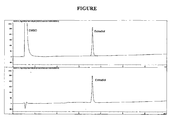
experiment 1, the concentration of both compounds agrees well with the target value (better than 5%) in the 30% PEG-8000 / water mixture; for the other mixtures the deviation is appreciable but still within a 10% range. - Two 0.5 mL aliquots of each water/PEG solution were placed into 14x100 mm pre-weighed test tubes. These tubes were weighed, and placed either in liquid nitrogen or in dry ice to freeze the solution, and finally submitted to freeze-drying in a Lio-5P apparatus (5Pascal, Trezzano sul Naviglio, Italy). After one day, the tubes were weighed and water was added with a micropipette in order to match the original solution weight. The clear solutions were placed into HPLC vials and analysed with the above method. A typical chromatogram is reported in Figure. The experiment was repeated several times and the averaged results are reported in Table 4. Values of recovery, defined as the ratio between the experimental (HPLC) concentration and the expected one (200 µM), are well above 90% and approach 100% in the case of PEG-8000 solutions.
Table 3. Solubility of estradiol and carbazol in various aqueous PEG media 20% PEG-400 + 10% PEG-8000 30% PEG-8000 30% PEG-20000 Estradiol Average solubility [µM] 197.1 199.4 188.0 SD 0.8 3.2 8.1 N 3 3 3 Carbazol Average solubility [µM] 187.1 193.5 187.6 SD 6.7 2.8 4.4 N 3 3 3 SD = standard deviation [µM]
N = number of experimentsTable 4. Recovery of estradiol and carbazol after freeze-drying and reconstitution with water from various aqueous PEG media 20% PEG-400 + 10% PEG-8000 30% PEG-8000 30% PEG-20000 Estradiol Average Recovery % 96.0% 101.0% 96.8% RSD 3.5% 2.0% 2.9% N 4 4 4 Carbazol Average Recovery % 94.8% 97.6% 92.1% RSD 1.3% 1.9% 1.1% N 4 4 3 Recovery % = 100 · experimental concentration / expected concentration
RSD = relative standard deviation
N = number of experiments - Figure. HPLC chromatograms of the following estradiol solutions: 1) a
reference 200 µM solution in water/acetonitrile (1/1 by volume) as prepared by 50-fold dilution of a 10 mM solution of estradiol in DMSO; 2) a reconstituted solution of estradiol in 30% PEG-8000 / water. This latter solution was prepared as described in example 2, at a target estradiol concentration of 200 µM.
Claims (26)
- A method for the preparation, in a form suitable for storage, distribution or dissolution, of a chemical collection or library of compounds to be used in a biochemical screening technique or assay, which essentially comprises the steps of:(a) providing the compounds in form of powder or concentrated stock solution;(b) dissolving a pre-determined amount of each compound in a water-polyethylene glycol (PEG) mixture, to obtain a solution;(c) drying the solution of step (b) to obtain a solid product.
- A method according to claim 1, further comprising the step (d) of adding water or an aqueous buffered solution to the solid product of step (c).
- A method according to claim 1 or 2, wherein the concentrated stock solution of step (a) contains an organic solvent.
- A method according to claim 3, wherein the organic solvent is dimethylsulfoxide or dimethylformamide.
- A method according to claim 1 or 2, wherein the solution prepared according to step (b) contains from 100 µM to 1 mM of said compound.
- A method according to claim 1 or 2, wherein the water-PEG mixture used in step (b) contains from 5% wt to 60% wt PEG.
- A method according to claim 6, wherein said PEG is a mixture of PEGs with different average molecular weight, provided that at least one PEG is solid at room temperature (20-25°C).
- A method according to claim 7, wherein said average molecular weight ranges from 200 to 40,000.
- A method according to claim 1 or 2, wherein step (b) is carried out in a container which is a glass tube, a plastic tube, a vial or a multi-well microtiter plate.
- A method according to claim 1 or 2, wherein step (c) is carried out by evaporating or freeze-drying the solution of step (b).
- A method according to claim 10, wherein evaporation is obtained with an evaporative centrifuge or under flow of a gas which is preferably air or nitrogen.
- A method according to claim 10, wherein freeze-drying includes a freezing phase in a cooling apparatus or by means of a cooling agent, which is preferably dry ice or liquid nitrogen.
- A method according to claim 12, wherein said freezing phase is followed by removal of water under reduced pressure.
- A method according to claim 1 or 2, wherein the solid product obtained in step (c) is stored at room temperature or in refrigerated conditions.
- A method according to claim 2, wherein the addition of water or of an aqueous buffered solution to the solid product is carried out with simultaneous shaking or sonication to obtain a homogeneous solution.
- A method according to claim 1 or 2, wherein the compounds are lipophilic.
- A method according to claim 1 or 2, wherein the biochemical screening techniques or assays are in a low, medium or high-throughput format.
- A method according to claim 17, wherein said screening techniques or assays are run in an automatic apparatus.
- The use of polyethylene glycol (PEG) for the storage of compounds in a chemical collection or library.
- The use according to claim 19, wherein said PEG is a mixture of PEGs with different average molecular weight, provided that at least one PEG is solid at room temperature (20-25°C).
- The use according to claim 20, wherein said average molecular weight ranges from 200 to 40,000.
- A chemical collection or library of compounds for use in biochemical screening techniques or assays, wherein each compound is included in a solid PEG mixture.
- A chemical collection or library of compounds according to claim 22, wherein said PEG mixture comprises different average molecular weight PEGs.
- A chemical collection or library of compounds according to claim 23, wherein said average molecular weight ranges from 200 to 40,000.
- A chemical collection or library of compounds according to claims 22-24, which is obtainable by the method of any one of claims 1-18.
- The use of a chemical collection or library of compounds according to claims 22-25, for the setup of a biochemical screening technique or assay.
Priority Applications (1)
| Application Number | Priority Date | Filing Date | Title |
|---|---|---|---|
| EP06020794A EP1908513A1 (en) | 2006-10-04 | 2006-10-04 | Method for preparing and using chemical collections |
Applications Claiming Priority (1)
| Application Number | Priority Date | Filing Date | Title |
|---|---|---|---|
| EP06020794A EP1908513A1 (en) | 2006-10-04 | 2006-10-04 | Method for preparing and using chemical collections |
Publications (1)
| Publication Number | Publication Date |
|---|---|
| EP1908513A1 true EP1908513A1 (en) | 2008-04-09 |
Family
ID=37806183
Family Applications (1)
| Application Number | Title | Priority Date | Filing Date |
|---|---|---|---|
| EP06020794A Withdrawn EP1908513A1 (en) | 2006-10-04 | 2006-10-04 | Method for preparing and using chemical collections |
Country Status (1)
| Country | Link |
|---|---|
| EP (1) | EP1908513A1 (en) |
Citations (4)
| Publication number | Priority date | Publication date | Assignee | Title |
|---|---|---|---|---|
| EP0947820A2 (en) * | 1998-03-31 | 1999-10-06 | Evotec BioSystems GmbH | Method for sample preparation |
| WO2000059627A1 (en) * | 1999-04-05 | 2000-10-12 | Millennium Pharmaceuticals, Inc. | Formulation arrays and use thereof |
| WO2001014291A1 (en) * | 1999-08-24 | 2001-03-01 | Astrazeneca Ab | Use of cyclodextrin for protective storage of chemical compound libraries |
| US20050276728A1 (en) * | 2004-04-08 | 2005-12-15 | Biomatrica, Inc. | Integration of sample storage and sample management for life science |
-
2006
- 2006-10-04 EP EP06020794A patent/EP1908513A1/en not_active Withdrawn
Patent Citations (4)
| Publication number | Priority date | Publication date | Assignee | Title |
|---|---|---|---|---|
| EP0947820A2 (en) * | 1998-03-31 | 1999-10-06 | Evotec BioSystems GmbH | Method for sample preparation |
| WO2000059627A1 (en) * | 1999-04-05 | 2000-10-12 | Millennium Pharmaceuticals, Inc. | Formulation arrays and use thereof |
| WO2001014291A1 (en) * | 1999-08-24 | 2001-03-01 | Astrazeneca Ab | Use of cyclodextrin for protective storage of chemical compound libraries |
| US20050276728A1 (en) * | 2004-04-08 | 2005-12-15 | Biomatrica, Inc. | Integration of sample storage and sample management for life science |
Similar Documents
| Publication | Publication Date | Title |
|---|---|---|
| Barker | Matrix solid-phase dispersion | |
| Yi et al. | Molecularly imprinted solid-phase extraction in the analysis of agrochemicals | |
| Li et al. | Extraction and mechanism investigation of trace roxithromycin in real water samples by use of ionic liquid–salt aqueous two-phase system | |
| Jacobsen et al. | Multi-component analysis of tetracyclines, sulfonamides and tylosin in swine manure by liquid chromatography–tandem mass spectrometry | |
| Manna et al. | Impregnation of PVP microparticles with ketoprofen in the presence of supercritical CO2 | |
| US5413732A (en) | Reagent compositions for analytical testing | |
| US6541273B1 (en) | Multiple sorbent cartridges for solid phase extraction | |
| Kolberg et al. | Development and independent laboratory validation of a simple method for the determination of paraquat and diquat in potato, cereals and pulses | |
| Liang et al. | Molecularly imprinted monolithic column based on functionalized β-cyclodextrin and multi-walled carbon nanotubes for selective recognition of benzimidazole residues in citrus samples | |
| Zeng et al. | Dispersive liquid–liquid microextraction based on the solidification of deep eutectic solvent for the determination of benzoylureas in environmental water samples | |
| JP5449202B2 (en) | Methods and kits for determining the presence and amount of vitamin D analogs in a sample | |
| CN107709251A (en) | For analyzing the composition and method of sample preparation | |
| US5272094A (en) | Isolation of components from biological specimens via matrix solid phase dispersion | |
| CN114994218A (en) | Detection kit for detecting 4 fat-soluble vitamins in dried blood spots by liquid chromatography-tandem mass spectrometry and detection method thereof | |
| EP2035836B1 (en) | Device for processing whole blood for analyte determination | |
| CN103380376B (en) | Solid support and from the method wherein reclaiming biomaterial | |
| CN100358604C (en) | Solid phase dispersion microwave extraction method of sample residues matrix and extraction stuffing and solvent | |
| Bagheri et al. | High-throughput micro-solid phase extraction on 96-well plate using dodecyl methacrylate-ethylen glycol dimethacrylate monolithic copolymer | |
| Bal et al. | Catalytically Active Coacervates Sustained Out‐of‐Equilibrium | |
| JP4997487B2 (en) | Apparatus for liquid-liquid extraction or solid-liquid extraction and extraction method using the same | |
| Malick et al. | Loss of nitroglycerin from solutions to intravenous plastic containers: a theoretical treatment | |
| EP1908513A1 (en) | Method for preparing and using chemical collections | |
| Zendegi‐Shiraz et al. | Polyethylene glycol grafted flower‐like cupric nano oxide for the hollow‐fiber solid‐phase microextraction of hexaconazole, penconazole, and diniconazole in vegetable samples | |
| Shigeno et al. | Fibril Film Formation of Pseudoenantiomeric Oxymethylenehelicene Oligomers at the Liquid–Solid Interface: Structural Changes, Aggregation, and Discontinuous Heterogeneous Nucleation | |
| Bäcklund et al. | Tuning the aqueous self-assembly process of insulin by a hydrophobic additive |
Legal Events
| Date | Code | Title | Description |
|---|---|---|---|
| PUAI | Public reference made under article 153(3) epc to a published international application that has entered the european phase |
Free format text: ORIGINAL CODE: 0009012 |
|
| AK | Designated contracting states |
Kind code of ref document: A1 Designated state(s): AT BE BG CH CY CZ DE DK EE ES FI FR GB GR HU IE IS IT LI LT LU LV MC NL PL PT RO SE SI SK TR |
|
| AX | Request for extension of the european patent |
Extension state: AL BA HR MK RS |
|
| AKX | Designation fees paid | ||
| REG | Reference to a national code |
Ref country code: DE Ref legal event code: 8566 |
|
| STAA | Information on the status of an ep patent application or granted ep patent |
Free format text: STATUS: THE APPLICATION IS DEEMED TO BE WITHDRAWN |
|
| 18D | Application deemed to be withdrawn |
Effective date: 20081010 |