EP1908604A2 - Ring binder mechanism - Google Patents
Ring binder mechanism Download PDFInfo
- Publication number
- EP1908604A2 EP1908604A2 EP07112561A EP07112561A EP1908604A2 EP 1908604 A2 EP1908604 A2 EP 1908604A2 EP 07112561 A EP07112561 A EP 07112561A EP 07112561 A EP07112561 A EP 07112561A EP 1908604 A2 EP1908604 A2 EP 1908604A2
- Authority
- EP
- European Patent Office
- Prior art keywords
- ring
- binder mechanism
- intermediate connector
- travel bar
- lever
- Prior art date
- Legal status (The legal status is an assumption and is not a legal conclusion. Google has not performed a legal analysis and makes no representation as to the accuracy of the status listed.)
- Withdrawn
Links
Images












Classifications
-
- B—PERFORMING OPERATIONS; TRANSPORTING
- B42—BOOKBINDING; ALBUMS; FILES; SPECIAL PRINTED MATTER
- B42F—SHEETS TEMPORARILY ATTACHED TOGETHER; FILING APPLIANCES; FILE CARDS; INDEXING
- B42F13/00—Filing appliances with means for engaging perforations or slots
- B42F13/16—Filing appliances with means for engaging perforations or slots with claws or rings
- B42F13/20—Filing appliances with means for engaging perforations or slots with claws or rings pivotable about an axis or axes parallel to binding edges
- B42F13/22—Filing appliances with means for engaging perforations or slots with claws or rings pivotable about an axis or axes parallel to binding edges in two sections engaging each other when closed
- B42F13/26—Filing appliances with means for engaging perforations or slots with claws or rings pivotable about an axis or axes parallel to binding edges in two sections engaging each other when closed and locked when so engaged, e.g. snap-action
-
- B—PERFORMING OPERATIONS; TRANSPORTING
- B42—BOOKBINDING; ALBUMS; FILES; SPECIAL PRINTED MATTER
- B42F—SHEETS TEMPORARILY ATTACHED TOGETHER; FILING APPLIANCES; FILE CARDS; INDEXING
- B42F13/00—Filing appliances with means for engaging perforations or slots
- B42F13/16—Filing appliances with means for engaging perforations or slots with claws or rings
-
- B—PERFORMING OPERATIONS; TRANSPORTING
- B42—BOOKBINDING; ALBUMS; FILES; SPECIAL PRINTED MATTER
- B42F—SHEETS TEMPORARILY ATTACHED TOGETHER; FILING APPLIANCES; FILE CARDS; INDEXING
- B42F13/00—Filing appliances with means for engaging perforations or slots
-
- B—PERFORMING OPERATIONS; TRANSPORTING
- B42—BOOKBINDING; ALBUMS; FILES; SPECIAL PRINTED MATTER
- B42F—SHEETS TEMPORARILY ATTACHED TOGETHER; FILING APPLIANCES; FILE CARDS; INDEXING
- B42F13/00—Filing appliances with means for engaging perforations or slots
- B42F13/16—Filing appliances with means for engaging perforations or slots with claws or rings
- B42F13/20—Filing appliances with means for engaging perforations or slots with claws or rings pivotable about an axis or axes parallel to binding edges
- B42F13/22—Filing appliances with means for engaging perforations or slots with claws or rings pivotable about an axis or axes parallel to binding edges in two sections engaging each other when closed
Definitions
- This invention relates to a ring binder mechanism for retaining loose-leaf pages, and in particular to an improved ring binder mechanism for opening and closing ring members and for locking closed ring members together.
- a ring binder mechanism retains loose-leaf pages, such as hole-punched pages, in a file or notebook. It has ring members for retaining the pages. The ring members may be selectively opened to add or remove pages or closed to retain pages while allowing the pages to be moved along the ring members.
- the ring members mount on two adjacent hinge plates that join together about a pivot axis.
- An elongate housing loosely supports the hinge plates within the housing and holds the hinge plates together so they may pivot relative to the housing.
- the undeformed housing is slightly narrower than the joined hinge plates when the hinge plates are in a coplanar position (180°). So as the hinge plates pivot through this position, they deform the resilient housing and cause a spring force in the housing that urges the hinge plates to pivot away from the coplanar position, either opening or closing the ring members. Thus, when the ring members are closed the spring force resists hinge plate movement and clamps the ring members together. Similarly, when the ring members are opened, the spring force holds them apart. An operator may typically overcome this force by manually pulling the ring members apart or pushing them together. Levers or other actuators may also be provided on one or both ends of the housing for moving the ring members between the opened and closed positions. But a drawback to these known ring binder mechanisms is that when the ring members are closed, they do not positively lock together. So if the mechanism is accidentally dropped, the ring members may unintentionally open.
- Some ring binder mechanisms have been modified to include locking structure to block the hinge plates from pivoting when the ring members are closed.
- the blocking structure positively locks the closed ring members together, preventing them from unintentionally opening if the ring binder mechanism is accidentally dropped.
- the blocking structure also allows the housing spring force to be reduced because the strong spring force is not required to clamp the closed ring members together. Thus, less operator force is required to open and close the ring members of these mechanisms than in traditional ring binder mechanisms.
- Some of these ring binder mechanisms incorporate the locking structure onto a control slide connected to the lever.
- the lever moves the control slide (and its locking structure) to either block the pivoting movement of the hinge plates or allow it.
- One drawback to these mechanisms is that an operator must positively move the lever after closing the ring members to position the locking structure so as to block the hinge plates and lock the ring members closed. Failure to do this could allow the hinge plates to inadvertently pivot and open the ring members, especially if the mechanisms are accidentally dropped.
- Some locking ring binder mechanisms use springs to move the locking structure into a position blocking the hinge plates when the ring members close. Examples are shown in coassigned U.S. Patent Application Nos. 10/870,801 (Cheng et al. ), 10/905,606 (Cheng ), and 11/027,550 (Cheng ). These mechanisms employ separate springs to help lock the mechanisms.
- Movement of the locking structure is generally linear or translational, but the movement is effected by pivoting of a lever or other movement by a suitable actuator. Accordingly, there is a need to transfer only the translational component of the lever's motion to the locking structure.
- solutions that have been proposed For example, refer to co-owned U.S. Patent Application No. 10/870,801 .
- a ring binder mechanism for retaining loose leaf pages comprises a housing, a ring support supported by the housing for movement relative to the housing, and rings for holding the loose-leaf pages.
- Each ring includes a first ring member and a second ring member.
- the first ring member is mounted on the ring support for movement relative to the second ring member between a closed position and an opened position.
- the closed position the two ring members form a substantially continuous, closed loop for allowing loose-leaf pages retained by the rings to be moved along the rings from one ring member to the other.
- the two ring members In the opened position, the two ring members form a discontinuous, open loop for adding or removing loose-leaf pages from the rings.
- An actuator is mounted on the housing for movement relative to the housing whereby the actuator movement pivots the ring support to move the ring members from the closed position to the opened position.
- a travel bar comprises at least one locking element and is moveable between a locked position wherein the ring members are locked in the closed position and an unlocked position wherein the ring members are capable of being moved to the opened position.
- An intermediate connector operably connects the travel bar to the actuator.
- a biasing member is engageable with the intermediate connector and at least one of the travel bar and actuator for biasing the travel bar toward the locked position.
- a ring binder mechanism for retaining loose leaf pages comprises a housing, a ring support supported by the housing for movement relative to the housing, and rings for holding the loose-leaf pages.
- Each ring includes a first ring member and a second ring member.
- the first ring member is mounted on the ring support for movement relative to the second ring member between a closed position and an opened position.
- the closed position the two ring members form a substantially continuous, closed loop for allowing loose-leaf pages retained by the rings to be moved along the rings from one ring member to the other.
- the two ring members In the opened position, the two ring members form a discontinuous, open loop for adding or removing loose-leaf pages from the rings.
- An actuator is mounted on the housing for movement relative to the housing for causing the pivoting motion of the ring support to move the ring members from the closed position to the opened position.
- a locking element locks the ring members in the closed position.
- An intermediate connector operably connects the locking element to the actuator. The actuator is configured for pivoting movement relative to the intermediate connector without movement of the intermediate connector.
- a ring binder mechanism for retaining loose leaf pages comprises a housing, a ring support supported by the housing for movement relative to the housing, and rings for holding the loose-leaf pages.
- Each ring includes a first ring member and a second ring member.
- the first ring member is mounted on the ring support for movement relative to the second ring member between a closed position and an opened position.
- the closed position the two ring members form a substantially continuous, closed loop for allowing loose-leaf pages retained by the rings to be moved along the rings from one ring member to the other.
- the two ring members In the opened position, the two ring members form a discontinuous, open loop for adding or removing loose-leaf pages from the rings.
- An actuator is mounted on the housing for movement relative to the housing for causing the pivoting motion of the ring support to move the ring members from the closed position to the opened position.
- a travel bar comprises at least one locking element and is moveable between a locked position wherein the ring members are locked in the closed position and an unlocked position wherein the ring members are capable of being moved to the opened position.
- the travel bar includes a mounting groove having at least one narrow section and a wide section spacing inward on the travel bar from the narrow section.
- An intermediate connector operably connects the travel bar to the actuator.
- the intermediate connector has a portion thereof captured by the wide section of the mounting groove in the travel bar. The portion of the intermediate connector is moveable within the wide section of the mounting groove so that the intermediate connector can move relative to the travel bar.
- FIG. 1 is a perspective of a notebook incorporating a first embodiment of a ring binder mechanism
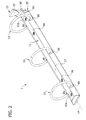
- FIG. 2 is a top side perspective of the ring binder mechanism at a closed and locked position and with the lever in a first relaxed position;
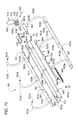
- FIG. 3 is an exploded perspective of the ring binder mechanism of FIG. 1;
- FIG. 4 is a bottom side perspective thereof
- FIG. 5 is a fragmentary perspective of the ring binder mechanism of FIG. 2 with a portion of a housing broken away to reveal internal construction;
- FIG. 6 is an enlarged fragmentary side elevation thereof with the housing and a hinge plate removed;
- FIG. 7 is a bottom side perspective similar to FIG. 4 but with the ring binder mechanism at a closed and unlocked position and with the lever in a first deformed position;
- FIG. 8 is an enlarged fragmentary side elevation similar to FIG. 6 but with the ring binder mechanism at the closed and unlocked position and the lever at the first deformed position;
- FIG. 9 is a top side perspective of the ring binder mechanism at an opened position and with the lever in a second deformed position;
- FIG. 10 is a bottom side perspective thereof
- FIG. 11 is an enlarged fragmentary side elevation similar to FIG. 6 but with the ring binder mechanism at the opened position;
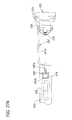
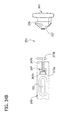
- FIGS. 12A and 12B are side views similar to FIG. 11 illustrating pivoting movement of the lever toward the closed and locked position and the concurrent movement of the intermediate connector and hinge plate;
- FIGS. 13A and 13B are top plan views of FIGS. 12A and 12B, respectively;
- FIG. 14 is a top side perspective of a second embodiment of a ring binder mechanism at a closed and locked position and with the lever in a first relaxed position;
- FIG. 15 is an exploded perspective of the ring binder mechanism
- FIG. 16 is an enlarged fragmentary perspective of the ring binder mechanism of FIG. 14 with a portion of a housing broken away to reveal internal construction;
- FIG. 17 is an enlarged fragmentary side elevation of the ring binder mechanism with the housing and a hinge plate removed;
- FIG. 18 is an enlarged fragmentary side elevation similar to FIG. 17 but with the lever at a first deformed position;
- FIG. 19 is an enlarged fragmentary side elevation similar to FIG. 18 but with the ring binder mechanism at the opened position and with the lever in a second deformed position;
- FIGS. 20A and 20B are top plan views illustrating pivoting movement of the lever toward the closed and locked position and the concurrent movement of the intermediate connector
- FIG. 21 is a top side perspective of a third embodiment of a ring binder mechanism at a closed and locked position and with the lever in a first relaxed position;
- FIG. 22 is an exploded perspective of the ring binder mechanism
- FIG. 23 is an enlarged fragmentary perspective of the ring binder mechanism of FIG. 21 with a portion of a housing broken away to reveal internal construction;
- FIG. 24 is an enlarged fragmentary side elevation of the ring binder mechanism with the housing and a hinge plate removed;
- FIG. 25 is an enlarged fragmentary side elevation similar to FIG. 24 but with the lever at the first deformed position;
- FIG. 26 is an enlarged fragmentary side elevation similar to FIG. 25 but with the ring binder mechanism at the opened position and with the lever in a second deformed position;
- FIGS. 27A and 27B are top plan views illustrating pivoting movement of the lever toward the closed and locked position and the concurrent movement of the intermediate connector
- FIG. 28 is a top side perspective of a fourth embodiment of a ring binder mechanism at a closed and locked position and with the lever in a first relaxed position;
- FIG. 29 is an exploded perspective of the ring binder mechanism
- FIG. 30 is an enlarged fragmentary perspective of the ring binder mechanism of FIG. 28 with a portion of a housing broken away to reveal internal construction;
- FIG. 31 is an enlarged fragmentary side elevation of the ring binder mechanism with the housing and a hinge plate removed;
- FIG. 32 is an enlarged fragmentary side elevation similar to FIG. 31 but with the lever at the first deformed position;
- FIG. 33 is an enlarged fragmentary side elevation similar to FIG. 32 but with the ring binder mechanism at the opened position and with the lever in a second deformed position;
- FIGS. 34A and 34B are top plan views illustrating pivoting movement of the lever toward the closed and locked position and the concurrent movement of the intermediate connector
- FIG. 35 is a top side perspective of a fifth embodiment of a ring binder mechanism at a closed and locked position and with the lever in a first relaxed position;
- FIG. 36 is an exploded perspective of the ring binder mechanism
- FIG. 37 is an enlarged fragmentary perspective of the ring binder mechanism of FIG. 35 with a portion of a housing broken away to reveal internal construction;
- FIG. 38 is an enlarged fragmentary side elevation of the ring binder mechanism with the housing and a hinge plate removed;
- FIG. 39 is an enlarged fragmentary side elevation similar to FIG. 38 but with the lever at the first deformed position;
- FIG. 40 is an enlarged fragmentary side elevation similar to FIG. 39 but with the ring binder mechanism at the opened position and with the lever in a second deformed position;
- FIGS. 41A and 41B are top plan views illustrating pivoting movement of the lever toward the closed and locked position and the concurrent movement of the intermediate connector;
- FIG. 42 is a top side perspective of a sixth embodiment of a ring binder mechanism at a closed and locked position and with the lever in a first relaxed position;
- FIG. 43 is an exploded perspective of the ring binder mechanism
- FIG. 44 is an enlarged fragmentary perspective of the ring binder mechanism of FIG. 43 with a portion of a housing broken away to reveal internal construction;
- FIG. 45 is an enlarged fragmentary side elevation of the ring binder mechanism with the housing and a hinge plate removed;
- FIG. 46 is an enlarged fragmentary side elevation similar to FIG. 45 but with the lever at the first deformed position;
- FIG. 47 is an enlarged fragmentary side elevation similar to FIG. 46 but with the ring binder mechanism at the opened position and with the lever in a second deformed position;
- FIGS. 48A and 48B are top plan views illustrating pivoting movement of the lever toward the closed and locked position and the concurrent movement of the intermediate connector
- FIG. 49 is a top side perspective of a seventh embodiment of a ring binder mechanism at a closed and locked position and with the lever in a first relaxed position;
- FIG. 50 is an exploded perspective of the ring binder mechanism
- FIG. 51 is an enlarged fragmentary perspective of the ring binder mechanism of FIG. 49 with a portion of a housing broken away to reveal internal construction;
- FIG. 52 is an enlarged fragmentary side elevation of the ring binder mechanism with the housing and a hinge plate removed;
- FIG. 53 is an enlarged fragmentary side elevation similar to FIG. 52 but with the lever at the first deformed position;
- FIG. 54 is an enlarged fragmentary side elevation similar to FIG. 53 but with the ring binder mechanism at the opened position and with the lever in a second deformed position;
- FIGS. 55A and 55B are top plan views illustrating pivoting movement of the lever toward the closed and locked position and the concurrent movement of the intermediate connector
- FIG. 56 is a top side perspective of an eighth embodiment of a ring binder mechanism at a closed and locked position and with the lever in a first relaxed position;
- FIG. 57 is an exploded perspective of the ring binder mechanism
- FIG. 58 is an enlarged fragmentary perspective of the ring binder mechanism of FIG. 56 with a portion of a housing broken away to reveal internal construction;
- FIG. 59 is an enlarged fragmentary side elevation of the ring binder mechanism with the housing and a hinge plate removed;
- FIG. 60 is an enlarged fragmentary side elevation similar to FIG. 59 but with the lever at the first deformed position;
- FIG. 61 is an enlarged fragmentary side elevation similar to FIG. 60 but with the ring binder mechanism at the opened position and with the lever in a second deformed position;
- FIGS. 62A and 62B are top plan views illustrating pivoting movement of the lever toward the closed and locked position and the concurrent movement of the intermediate connector;
- FIG. 63 is a top side perspective of a ninth embodiment of a ring binder mechanism at a closed and locked position and with the lever in a first relaxed position;
- FIG. 64 is an exploded perspective of the ring binder mechanism
- FIG. 65 is an enlarged fragmentary perspective of the ring binder mechanism of FIG. 63 with a portion of a housing broken away to reveal internal construction;
- FIG. 66 is an enlarged fragmentary side elevation of the ring binder mechanism with the housing and a hinge plate removed;
- FIG. 67 is an enlarged fragmentary side elevation similar to FIG. 66 but with the lever at the first deformed position;
- FIG. 68 is an enlarged fragmentary side elevation similar to FIG. 67 but with the ring binder mechanism at the opened position and with the lever in a second deformed position;
- FIGS. 69A and 69B are top plan views illustrating pivoting movement of the lever toward the closed and locked position and the concurrent movement of the intermediate connector;
- FIG. 70 is a top side perspective of a tenth embodiment of a ring binder mechanism at a closed and locked position and with the lever in a first relaxed position;
- FIG. 71 is an exploded perspective of the ring binder mechanism
- FIG. 72 is an enlarged fragmentary perspective of the ring binder mechanism of FIG. 70 with a portion of a housing broken away to reveal internal construction;
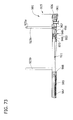
- FIG. 73 is an enlarged fragmentary side elevation of the ring binder mechanism with the housing and a hinge plate removed;
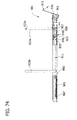
- FIG. 74 is an enlarged fragmentary side elevation similar to FIG. 73 but with the lever at the first deformed position;
- FIG. 75 is an enlarged fragmentary side elevation similar to FIG. 74 but with the ring binder mechanism at the opened position and with the lever in a second deformed position;
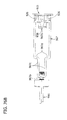
- FIGS. 76A and 76B are top plan views illustrating pivoting movement of the lever toward the closed and locked position and the concurrent movement of the intermediate connector;
- FIG. 77 is a top side perspective of a eleventh embodiment of a ring binder mechanism at a closed and locked position and with the lever in a first relaxed position;
- FIG. 78 is an exploded perspective of the ring binder mechanism
- FIG. 79 is an enlarged fragmentary perspective of the ring binder mechanism of FIG. 77 with a portion of a housing broken away to reveal internal construction;
- FIG. 80 is an enlarged fragmentary side elevation of the ring binder mechanism with the housing and a hinge plate removed;
- FIG. 81 is an enlarged fragmentary side elevation similar to FIG. 80 but with the lever at the first deformed position;
- FIG. 82 is an enlarged fragmentary side elevation similar to FIG. 81 but with the ring binder mechanism at the opened position and with the lever in a second deformed position;
- FIGS. 83A and 83B are enlarged perspective views illustrating pivoting movement of the lever toward the closed and locked position and the concurrent movement of the intermediate connector;
- FIG. 84 is a top side perspective of a twelfth embodiment of a ring binder mechanism at a closed and locked position and with the lever in a first relaxed position;
- FIG. 85 is an exploded perspective of the ring binder mechanism
- FIG. 86 is an enlarged fragmentary perspective of the ring binder mechanism of FIG. 84 with a portion of a housing broken away to reveal internal construction;
- FIG. 87 is an enlarged fragmentary side elevation of the ring binder mechanism with the housing and a hinge plate removed;
- FIG. 88 is an enlarged fragmentary side elevation similar to FIG. 87 but with the lever at the first deformed position;
- FIG. 89 is an enlarged fragmentary side elevation similar to FIG. 88 but with the ring binder mechanism at the opened position and with the lever in a second deformed position;
- FIGS. 90A and 90B are enlarged perspective views illustrating pivoting movement of the lever toward the closed and locked position and the concurrent movement of the intermediate connector.
- FIG. 91 is an exploded perspective of the ring binder mechanism having a thirteenth embodiment.
- Figs. 1-13B show a first embodiment of a ring binder mechanism generally at 1.
- the mechanism 1 is shown mounted on a notebook designated generally at 3.
- the mechanism 1 is shown mounted on a spine 5 of the notebook 3 between a front cover 7 and a back cover 9 hingedly attached to the spine 3.
- the front and back covers 7, 9 move to selectively cover or expose loose-leaf pages (not shown) retained by the mechanism 1 in the notebook 3.
- Ring binder mechanisms mounted on notebooks in other ways or on surfaces other than a notebook, for example, a file do not depart from the scope of this invention.
- a housing supports three rings (each designated generally at 13) and a lever (broadly, an "actuator,” and designated generally at 15).
- the rings 13 retain loose-leaf pages on the ring binder mechanism 1 in the notebook 3 while the lever 15 operates to open and close the rings so that pages may be added or removed.
- the housing 11 is shaped as an elongated rectangle with a uniform, roughly arch-shaped cross section, having at its center a generally flat plateau 17.
- a first longitudinal end 10 of the housing 11 (to the right in Fig. 3) is generally open while a second, opposite longitudinal end 12 is generally closed (to the left in Fig. 3).
- Bent under rims 21 (Fig. 4) extend lengthwise along longitudinal edges of the housing 11 from the first longitudinal end 10 of the housing to the second longitudinal end 12.
- the three rings 13 of the ring binder mechanism 1 are substantially similar and are each generally circular in shape (e.g., Fig. 2).
- the rings 13 each include two generally semi-circular ring members 23a, 23b formed from a conventional, cylindrical rod of a suitable material (e.g., steel).
- the ring members 23a, 23b include free ends 25a, 25b, respectively, formed to secure the ring members against transverse misalignment (relative to longitudinal axes of the ring members) when they are closed together (see Fig. 2).
- Ring binder mechanisms with ring members formed of different material or having different cross-sectional shapes, for example, oval shapes, do not depart from the scope of this invention.
- the ring binder mechanism 1 includes two substantially identical hinge plates (broadly, "ring supports"), designated generally at 27a, 27b, supporting the ring members 23a, 23b, respectively.
- the hinge plates 27a, 27b are each generally elongate, flat, and rectangular in shape and are each somewhat shorter in length than the housing 11.
- Four corresponding cutouts 29a-d are formed in each of the hinge plates 27a, 27b along an inner edge margin of the plate.
- a finger 31 extends longitudinally away from a first end of each of the hinge plates 27a, 27b (to the right in Fig. 3).
- the fingers 31 are each narrower in width than the respective hinge plates 27a, 27b and are positioned with their inner longitudinal edges generally aligned with the inner longitudinal edges of the plates. The purpose of the cutouts 29a-d and fingers 31 will be described hereinafter.
- the lever 15 and hinge plates 27a, 27b can broadly be referred to as an "actuation system.”
- the lever 15 includes a grip 33, a body 35 attached to the grip, and an upper lip 36 and lower lip 37 attached to the body.
- the grip 33 is sized and shaped to facilitate grasping the lever 15 and applying force to move the lever.
- the body 35 is formed as one piece with the grip 33 for substantially conjoint movement with the grip.
- the entire lever 15 is formed as a single piece.
- the various components of the lever 15 may be formed separately and attached thereto without departing from the scope of the invention.
- the ring binder mechanism 1 includes an elongated travel bar designated generally at 45.
- the travel bar includes a mounting groove 47 at a first end (to the right in Fig. 3) and three locking elements (each designated generally at 49) along a bottom surface.
- the mounting groove, indicated generally at 47, in the travel bar 45 has a narrower section 47a near the end of the travel bar and a wider section 47b inward of the end.
- the locking elements 49 are spaced apart longitudinally along the travel bar 45 with one locking element adjacent each longitudinal end of the travel bar, and one located toward a center of the travel bar.
- the travel bar 45 may have other shapes or greater or fewer than three locking elements 49 within the scope of this invention.
- the travel bar and locking elements may be broadly referred to as a "locking system.”
- each locking element 49 of the illustrated travel bar 45 are each substantially similar in shape. As shown in Fig. 6, each locking element 49 includes a narrow, flat bottom 53, an angled forward edge 55, and a rearward edge 56. In the illustrated embodiment, the locking elements 49 each have a generally wedge shape. The angled edges 55 of the locking elements 49 may engage the hinge plates 27a, 27b and assist in pivoting the hinge plates down. In the illustrated embodiment, the locking elements 49 are formed as one piece of material with the travel bar 45 by, for example, a mold process. But the locking elements 49 may be formed separate from the travel bar 45 and attached thereto without departing from the scope of the invention. Additionally, locking elements with different shapes, for example, block shapes (e.g., no angled edges), are within the scope of this invention.
- ring binder mechanism 1 in assembled form will now be described with reference to Figs. 4-6 in which the mechanism is illustrated with the ring members 23a, 23b in the closed position and the lever 15 in an upright position.
- the lever 15 pivotally mounts on the first, open end of the housing 11 by a lever mount, indicated generally at 57, having mounting arms 59.
- a mounting opening (not shown) in each mounting arm 59 aligns with a channel 41 in the lever 15.
- At least one hinge pin 61 passes through the aligned openings 60 and channel 41 to pivotally mount the lever 15 on the housing 11.
- the illustrated configuration uses two hinge pins 61 to mount the lever 15.
- the lever mount 57 is shown as being one piece with the housing 11, but it may be formed separate from the housing and attached thereto without departing from the scope of the invention.
- the travel bar 45 is disposed within the housing 11 beneath the housing's plateau 17.
- the travel bar 45 extends lengthwise of the housing 11, in generally parallel orientation with a longitudinal axis LA (see Fig. 2) of the housing, with the locking elements 49 extending toward the hinge plates 27a, 27b.
- the travel bar 45 is operably connected to the lever 15 by an intermediate connector, designated generally at 67.
- the intermediate connector 67 is illustrated as a flat elongate plate having a U-shaped cutout 69 at a first end and an elongate tab, designated generally at 71, at a second end.
- the first end of the intermediate connector includes two parallel-spaced free ends 73 shaped to fit on opposite sides of the upper lip 36 of the lever 15 and be secured to the upper lip by a hinge pin 75 to form a pivoting connection.
- the tab 71 has a larger, narrow neck 77 and a wider head 79 at the free end of the neck.
- the tab 71 fits in the mounting groove 47 of the travel bar 45 so that the neck 77 extends through the narrower section 47a and the head 79 is received in the wider section 47b.
- the wider section 47b of the mounting groove 47 is longer than the head 79 of the tab 71 of the intermediate connector 67 so that the tab has room to move linearly, in a longitudinal direction, relative to the travel bar 45.
- the tab 71 operably secures the intermediate connector 67 to the travel bar 45 so that the tab can pull on the travel bar.
- the tab 71 also allows the intermediate connector 67 to pivot relative to the travel bar 45 to accommodate small vertical movements of the intermediate connector that occur when the lever 15 pivots.
- the hinge plates 27a, 27b are interconnected in parallel arrangement along their inner longitudinal edge margins, forming a central hinge 81 having a pivot axis. This is done in a conventional manner known in the art. As will be described, the hinge plates 27a, 27b can pivot about the hinge 81 upward and downward.
- the four cutouts 29a-d in each of the two individual hinge plates 27a, 27b (Fig. 3) align to form four openings also designated 29a-d in the interconnected plates (Fig. 4).
- the housing 11 supports the interconnected hinge plates 27a, 27b within the housing below the travel bar 45.
- the outer longitudinal edge margins of the hinge plates 27a, 27b loosely fit behind the bent under rims 21 of the housing 11 for allowing them to move within the rims when the hinge plates pivot.
- the fingers 31 of the hinge plates 27a, 27b extend between the lower lip 37 and the upper lip 36 of the lever 15 so that lower surfaces of the hinge plates are engageable by the lower lip and upper surfaces of the hinge plates 27a, 27b are engageable by the upper lip.
- a spring 85 (broadly referred to as a "biasing member”) connects to the hinge plates 27a, 27b at a hook 87 disposed along the inner edge margins of the hinge plates (Fig. 4) and to the travel bar 45 at a detent (not shown) in the bar.
- the bias provided by the spring 85 urges the travel bar 45 to move away from the lever 15 (i.e., toward a locked position). This seats the head 79 of the tab 71 of the intermediate connector 67 against an outward end of the wider section 47b of the mounting groove 47 of the travel bar 45 and holds the lever 15 in an upright position.
- the ring members 23a, 23b are each mounted on upper surfaces of respective ones of the hinge plates 27a, 27b in generally opposed fashion, with the free ends 25a, 25b facing. As shown in Figs. 4 and 5, the ring members 23a, 23b extend through respective openings 89 along sides of the housing 11 so that the free ends 25a, 25b of the ring members can engage above the housing.
- the ring members 23a, 23b are rigidly connected to the hinge plates 27a, 27b as is known in the art and move with the hinge plates when they pivot.
- each ring binder mechanism 1 both ring members 23a, 23b of each ring 13 are each mounted on one of the two hinge plates 27a, 27b and move with the pivoting movement of the hinge plates, a mechanism in which each ring has one movable ring member and one fixed ring member does not depart from the scope of this invention (e.g., a mechanism in which only one of the ring members of each ring is mounted on a hinge plate with the other ring member mounted, for example, on a housing).
- two mounting posts 91a, 91b are secured to the illustrated ring binder mechanism 1 to mount the mechanism on, for example, the notebook 3 (e.g., Fig. 1) in any suitable manner.
- the posts 91a, 91b attach to the housing 11 at mounting post openings 93a, 93b (Fig. 3) of the plateau 17 located toward the longitudinal ends 10, 12 of the housing.
- One of the two mounting posts 91b extends through the U-shaped cutout 69 in the intermediate connector 67, through one of the openings 29d in the interconnected hinge plates 27a, 27b, and through one of the mounting post openings 93b.
- the other mounting post 91a extends through one of the openings 29a in the interconnected hinge plates 27a, 27b and through the other mounting post opening 93a in the housing 11.
- the travel bar 45 terminates before it reaches the mounting post 91a adjacent the second longitudinal end 12 of the housing 11.
- two elongate openings 95 extend through the travel bar 45 and align with two rivet openings 97 of the housing plateau 17.
- Grooved rivets 99 secure to the housing plateau 17 at the rivet openings 97 and extend through the respective elongate openings 95 of the travel bar 45 to vertically support the travel bar within the housing 11 for movement relative to the housing.
- the travel bar 45 fits within the grooves of the rivets 99, allowing the travel bar to slide in translation lengthwise of the housing 11.
- FIGs 4-6 illustrate the mechanism 1 in a closed and locked position with the lever 15 in the upright position.
- an operator pivots the lever 15 outward and downward (clockwise as indicated by the arrow in Fig. 8).
- the lower lip 37 of the lever 15 is initially spaced apart from the lower surfaces of the hinge plates 27a, 27b (Fig. 6). This provides time for the upper lip 36 of the lever 15 to pull the intermediate connector 67, which simultaneously pulls the travel bar 45 and moves the locking elements 49 toward the lever 15 and into registration with the openings 29a, 29b, 29c in the hinge plates 27a, 27b before the upper lip engages the hinge plates.
- the spring 85 extends and tends to urge the travel bar 45 and locking elements 49 back toward the locked position with the locking elements behind the hinge plates 27a, 27b. As shown in Figs. 7 and 8, the lower lip 37 of the lever 15 then moves into engagement with lower surfaces of the hinge plates 27a, 27b (only one hinge plate is shown in Fig. 8) and begins pushing them upward toward the housing plateau 17. Once the hinge plates 27a, 27b pass through the co-planar position, the spring force of the housing 11 pivots the hinge plates fully upward over the locking elements 49 and the ring members 23a, 23b open as shown in Figs. 9-11. The extended spring 85 recoils slightly and seats the locking elements 49 against forward edges of the openings 29a, 29b, 29c in the hinge plates 27a, 27b. The spring 85 is still under tension, but the locking elements 49 remain seated in the openings 29a, 29b, 29c as the spring force of the housing 11 resists movement of the hinge plates 27a, 27b downward.
- the extension spring 85 pulls on the travel bar 45 and moves it and the locking elements back to the locked position with the locking elements behind the hinge plates.
- the travel bar 45 moves a short distance relative to the intermediate connector 67 until the head 79 of the tab 71 again contacts the outward end of the wider section 47b of the mounting groove 47 of the travel bar 45 (Fig. 13B).
- the travel bar 45 then pulls on the intermediate connector 67 and the lever 15 and returns the lever to its upright position (Fig. 12B).
- the lower lip 37 of the lever 15 is spaced apart from the lower surfaces of the hinge plates 27a, 27b when the ring members 23a, 23b are closed. This provides room for the lower lip 37 to pivot to pull the locking elements 49 from the locked position behind the hinge plates 27a, 27b to the unlocked position in registration with openings 29a, 29b, 29c in the hinge plates before beginning to pivot the hinge plates upward.
- the intermediate connector 67 and travel bar 45 are formed so that the travel bar slidably receives the tab 71 of the intermediate connector, allowing the connector to move relative to the travel bar in a linear direction along a longitudinal axis of the travel bar.
- the intermediate connector 67 is initially positioned relative to the travel bar 45 so that opening movement of the lever 15 pulls on the intermediate connector and simultaneously moves the travel bar and locking elements 49 toward the lever and out of the locked position.
- the intermediate connector 67 can then move relative to the travel bar 45 so that closing movement of the lever 15 pushes on the intermediate connector but does not initially move the travel bar 45.
- the intermediate connector 67 moves relative to the travel bar 45 so that the lever 15 can first pivot the hinge plates 27a, 27b downward to close the ring members 23a, 23b. Then the spring 85 pulls the travel bar 45 and locking elements 49 to the locked position, which in turn pulls the lever 15 to the upright position.
- Figures 14-20B illustrate a second embodiment of a ring binder mechanism 101 in which an intermediate connector 167 comprises a pair of wires 167a, 167b bent into elongate, roughly half-rectangular forms.
- Each wire 167a, 167b connects to a lever 115 at an opening 116 in an upper lip 136 of the lever and to a travel bar 145 at elongate openings 147a, 147b in a mounting groove 147 of the bar.
- the elongate openings 147a, 147b secure the wires 167a, 167b to the travel bar 145 while still allowing the wires to move relative to the travel bar in a linear direction along the longitudinal axis of the travel bar.
- a tension spring 185 urges the travel bar 145 and locking elements 149 back to the locked position with the locking elements behind the hinge plates.
- FIGs 21-27B illustrate a third embodiment of a ring binder mechanism 201 in which an intermediate connector 167 comprises a cup 279 and a wire 267a having an enlarged head 267b.
- the wire 267a connects to a lever 215 at an opening 216 in one side of an upper lip 236 of the lever.
- the cup 279 is located in a wider section 247b of a mounting groove 247 of a travel bar 245.
- a narrower section 247a of the mounting groove 247 receives the wire 267a therethrough and into the wider section 247b so the enlarged head 267b is seated in the cup 279 when ring members 223a, 223b are closed (Figs. 24 and 27B).
- the wire 267a is crimped behind the cup 279 to secure the cup on the wire. As a result, the cup 279 moves conjointly with the wire 267a.
- Figures 28-34B illustrate a fourth embodiment of a ring binder mechanism 301 in which an intermediate connector 367 comprises a wire 371 bent to form a pair of spaced apart loops 371a, 371b (broadly, "stops").
- the wire 371 connects to a lever 315 at an opening 316 in one side of an upper lip 336 of the lever.
- a first of the loops 371a is positioned in a wider section 347b of a mounting groove 347 of a travel bar 345, and a second of the loops 371b is outside the mounting groove. More specifically, the second loop 371b is located adjacent an end of the travel bar 345.
- an extension spring 385 urges the travel bar 345 and locking elements 349 to the locked position (Figs. 30 and 31).
- Figures 35-41B illustrate a ring binder mechanism 401 according to a fifth embodiment.
- the mechanism 401 of this embodiment is similar to the previously described mechanism, with the following exceptions.
- ring members 423a, 423b of this embodiment cooperatively form rings 413 having a slanted D-shape when closed.
- an intermediate connector 467 of this embodiment is a wire bent into an elongate, roughly rectangular form. A first end of the intermediate connector 467 is open and includes two free ends 467a that fit within openings 416 in an upper lip 436 of a lever 415 to form a pivoting connection.
- a second, closed end of the intermediate connector 467 is narrowed and includes a downwardly bent end 467b that fits within a mounting groove 447 of a travel bar 445.
- the bent end 467b secures the intermediate connector 467 to the travel bar 445 within the mounting groove 447 to pull on the travel bar while still allowing the intermediate connector to move relative to the travel bar in a linear direction along a longitudinal axis of the travel bar.
- the bent end 467b is positioned adjacent an inward end of the mounting groove 447 when the ring members are closed (Figs. 37 and 38).
- the mounting groove 447 is generally U-shaped with the arms of the "U" receiving respective sections of the bent end 467b of the intermediate connector 467.
- the bent end 467b also allows the intermediate connector 467 to pivot relative to the travel bar 445 to accommodate small vertical movements of the intermediate connector that occur when the lever 415 pivots.
- two compression springs 485 are located over sections of a narrowed portion 467c of the intermediate connector 467.
- the springs 485 are positioned between an end of the travel bar and shoulders 467c of the intermediate connector.
- the bias of the springs 485 urges the travel bar 445 away from the lever 415 and intermediate connector 467. This seats the bent end 467b of the intermediate connector 467 against the outward end of the mounting groove 447 of the travel bar 445 when the ring members 423a, 423b are closed (Figs. 37 and 38).
- FIG. 37 and 38 illustrate the mechanism 401 in a closed and locked position with the lever 415 in an upright position.
- an operator pivots the lever 415 outward and downward (clockwise as indicated by the arrow in Fig. 39).
- a lower lip 437 of the lever 415 is in contact with lower surfaces of hinge plates 427a, 427b and immediately pushes upward on the hinge plates, flexing them upward at their ends adjacent the lever.
- the hinge plates 427a, 427b flex because the locking elements 449 are still behind the hinge plates, resisting the upward movement of the plates.
- the upward flex of the hinge plates 427a, 427b allows an upper lip 436 to pull the intermediate connector 467 and travel bar 445 and move the locking elements 449 from behind the hinge plates into registration with openings 429a, 429b, 429c in the hinge plates.
- the lower lip 437 of the lever 415 pushes the hinge plates 427a, 427b to the co-planar position, at which point the spring force of the housing pivots them fully upward over the locking elements 449, and the ring members 423a, 423b open as shown in Fig. 40.
- an operator pivots the lever 415 upward and inward as indicated by the arrow in Fig. 40.
- the upper lip 436 of the lever 415 pushes the intermediate connector 467 forward.
- the bent end 467b of the intermediate connector 467 moves within the mounting groove 447 of the travel bar 445 from the outward end of the mounting groove toward a forward end of the groove (Fig. 41A).
- the compression springs 485 compress between the shoulders 467d of the intermediate connector 467 and the outward end of the travel bar 445, and urge the travel bar forward.
- the travel bar 445 resists this movement because the locking elements 449 are seated in the openings 429a, 429b, 429c in the hinge plates 427a, 427b against edges of the hinge plates.
- the upper lip 436 moves into engagement with upper surfaces of the hinge plates 427a, 427b and pivots them downward, through the co-planar position, opening the ring members 423a, 423b.
- the hinge plates 427a, 427b clear bottom surfaces of the locking elements 449, they move into engagement with the lower lip 437 of the lever 415 and move it to its upright position.
- the compression springs 485 then urge the travel bar 445 and the locking elements 449 back to the locked position with the locking elements behind the hinge plates 427a, 427b.
- the travel bar 445 moves until the bent end 467b of the intermediate connector 467 moves back into contact with the outward end of the mounting groove 447 of the travel bar (Fig. 41B).
- the reaction surfaces against which the compression springs 485 push are the shoulders 467d of the intermediate connector 467 which are held in place by the lever 415 in its upright position.
- the lever 415 is held in its upright position by the hinge plates 427a, 427b in contact with the lower lip 437 of the lever.
- Figures 42-48B illustrate a sixth embodiment of a ring binder mechanism 501 that is substantially similar to the fifth embodiment (Figs. 35-41B) except that a single compression spring 585 (broadly, a "biasing member") is positioned over a narrowed second end of an intermediate connector 567.
- a single compression spring 585 (broadly, a "biasing member"
- Figures 49-55B illustrate a seventh embodiment of a ring binder mechanism 601 in which a single compression spring 685 (broadly, a "biasing member”) is positioned inward of a bent end 667b of a narrowed second end of an intermediate connector 667.
- the spring 685 is located within a mounting groove 647 of a travel bar 645 between the bent end 667b of the intermediate connector 667 and the forward end of the mounting groove (Figs. 51 and 52).
- a lever 615 pivots to open ring members 623a, 623b, the intermediate connector 667 simultaneously pulls on the travel bar 645 and moves locking elements 649 to the unlocked position (Fig. 53).
- Figures 56-62B illustrate still an eighth embodiment of a ring binder mechanism 701 that is substantially similar to the fifth, sixth, and seventh embodiments.
- multiple springs 785a, 785b (broadly, “biasing members”) are used to urge a travel bar 745 to the locked position when ring members 723a, 723b are closed.
- Two compression springs 785b are located over sections of the narrowed end of an intermediate connector 767 between shoulders 767d of the intermediate connector and a rearward end of the travel bar 745 and a single compression spring 785a is positioned forward of a bent end 767b of the intermediate connector within a mounting groove 747 of the travel bar.
- Figures 63-69B illustrate a ninth embodiment of the ring binder mechanism 801 in which two compression springs 885 (broadly, “biasing members”) are positioned adjacent free ends 867a of the intermediate connector 867 for urging a travel bar 845 to a locked position when ring members 823a, 823b close. More specifically, the compression springs 885 are each received in an opening in a lever 845 and secured therein by threaded plugs 886. Also in this embodiment, a bent end 867b of the intermediate connector 867 is received in a mounting groove 847 of the travel bar 845 and held against movement relative to the travel bar. The free ends 867a of the intermediate connector 867 are received in elongate openings 816 in an upper lip 836 of the lever 815 so that the lever can move relative to the intermediate connector.
- the locking elements 849 are positioned in the openings 829a, 829b, 829c in the hinge plates 837a, 827b and are seated against forward edges of hinge plate openings and thereby resist forward movement of the intermediate connector 867.
- the lever 815 continues to pivot, it moves relative to the intermediate connector 867 and compresses the compression springs 885 against the plugs 886.
- the upper lip 836 of the lever 815 engages the hinge plates 827a, 827b and pivots them toward the co-planar position. Once the hinge plates 827a, 827b pivot over the locking elements 849, the lever 815 moves to the upright position and moves the intermediate connector 867, travel bar 845 and locking elements 849 to the locked position.
- the compression springs 885 extend and urge the intermediate connector 867 to the forward end of the elongate openings 816 in the upper lip 836 of the lever 815. This pushes the travel bar 845 and locking elements 849 to the locked position (Fig. 69A).
- FIGs 70-76B illustrate a tenth embodiment of a ring binder mechanism 901.
- this mechanism 901 includes a lever 915 that is formed with a lower lip 937 having an I-shaped structure 938.
- this I-shaped structure 938 extends through a pair of hinge plates 927a, 927b so that the hinge plates are trapped by the structure between an upper tab 938a and the lower lip 937.
- the lever 915 of this embodiment also includes a pair of opposite upper arms 926.
- the arms 926 receive an intermediate connector 967 as will be described; the arms do not operate to engage the hinge plates 927a, 927b or produce pivoting movement of the hinge plates.
- This lever 915 does not have an upper lip as has been described in prior embodiments.
- a travel bar 945 of this embodiment is operably connected to the lever 915 by the intermediate connector 967.
- the intermediate connector 967 is illustrated as a wire bent into an elongate, roughly rectangular form.
- a first end of the intermediate connector 967 is open and includes two free ends 967a that fit within respective openings 916 in the upper arms 926 of the lever 915 to form a pivoting connection.
- a second, closed end 967 of the intermediate connector 967 is narrowed and fits within an elongate opening 946 in a first locking element 949 of the travel bar 945 (Fig. 73).
- one of the free ends 967a of the intermediate connector is threaded through the elongate opening 946 and the intermediate connector is manipulated until the closed end 967b is positioned in the elongate opening.
- the intermediate connector 967 is retained on the locking element 949 for allowing the intermediate connector to pull on the locking element, and thus the travel bar 945, toward the lever 915 while still allowing the intermediate connector to move relative to the locking element, and thus the travel bar, in a forward linear direction away from the lever.
- the intermediate connector 967 can also pivot relative to the locking element 949, and thus the travel bar 945, to accommodate small vertical movements of the intermediate connector that occur when the lever 915 pivots.
- this mechanism 901 also includes a tension spring 985 (broadly, a "biasing member”) connected to the hinge plates 927a, 927b at a hook 987 along the inner edge margin of one of the plates and to the travel bar 945 at a downward projecting hook 988 on the travel bar.
- the bias of the spring 985 urges the travel bar 945 to move away from the lever 915 toward the locked position. This also seats the narrow end 967b of the intermediate connector 967 against an outward end of the elongate opening 946 in the first locking element 949 of the travel bar 945 and helps holds the lever 915 in an upright position (Fig. 73).
- Figures 70, 72, and 73 illustrate the mechanism 901 in a closed and locked position with the lever 915 in the upright position.
- an operator pivots the lever 915 outward and downward (clockwise as indicated by the arrow in Fig. 74).
- the lower lip 937 of the lever 915 is initially spaced apart from the lower surfaces of the hinge plates 927a, 927b (Fig. 73).
- the spring force of the housing 911 pivots the hinge plates fully upward over the locking elements 949 and the ring members 923a, 923b open as shown in Fig. 75.
- the spring 985 recoils slightly and seats the locking elements 949 against inward edges of the openings 929a, 929b, 929c in the hinge plates 927a, 927b.
- the spring 985 is still under tension, but the locking elements 949 remain seated in the openings 929a, 929b, 929c and resist the spring's tension.
- the spring force of the housing 911 prevents the locking elements 949 from camming the hinge plates 927a, 927b downward under the urge of the extension spring 985.
- an operator pivots the lever 915 upward and inward.
- the upper arms 926 of the lever 915 push the intermediate connector 967 forward.
- the narrow end 967b of the intermediate connector moves within the elongate opening 946 in the first locking element 949 of the travel bar 945 from the rearward end of the elongate opening toward a forward end of the elongate opening (Fig. 76B).
- the travel bar 945 is initially stationary.
- the upper tab 938a of the I-shaped structure 938 moves into engagement with upper surfaces of the hinge plates 927a, 927b and pivots the hinge plates downward, through the co-planar position, and opens the ring members 923a, 923b. Sloped inward edges 955 of the locking elements 949 allow the travel bar 945 to move slightly as the hinge plates 927a, 927b pivot down. As soon as the hinge plates 927a, 927b clear bottom surfaces of the locking elements 949, the extension spring 985 pulls on the travel bar 945 and moves it and the locking elements back to the locked position with the locking elements behind the hinge plates.
- the travel bar 945 moves a short distance relative to the intermediate connector 967 until the narrow end 967ba of the intermediate connector again contacts the outward end of the elongate opening 946 in the travel bar 945.
- the travel bar 945 then pulls on the intermediate connector 967 and the lever 915, and returns the lever to its upright position (Fig. 73).
- the lower lip 937 of the lever 915 is spaced apart from the lower surfaces of the hinge plates 927a, 927b when the ring members 923a, 923b are closed. This provides room for the lower lip 937 to pivot to pull the locking elements 949 from the locked position behind the hinge plates 927a, 927b to the unlocked position in registration with openings 929a, 929b, 929c in the hinge plates before beginning to pivot the hinge plates upward.
- the intermediate connector 967 and the first locking element 949 of the travel bar 945 are formed so that the locking element slidably receives the intermediate connector, allowing the intermediate connector to move relative to the locking element and travel bar in a linear direction along a longitudinal axis of the travel bar.
- the intermediate connector 967 is initially positioned relative to the locking element 949 so that opening movement of the lever 915 pulls on the connector and simultaneously moves the travel bar 945 and locking elements toward the lever and out of the locked position.
- the intermediate connector 967 can then move relative to the locking elements 949 and travel bar 945 so that closing movement of the lever 915 pushes on the intermediate connector but does not initially move the travel bar.
- the intermediate connector 967 moves relative to the travel bar 945 so that the lever 915 can first pivot the hinge plates 927a, 927b downward to close the ring members 923a, 923b. Then the spring 985 pulls the travel bar 945 and locking elements 949 to the locked position, which in turn pull the lever 915 to the upright position.
- lever 915 of this embodiment is formed from a rigid material such as sheet metal. Other materials may be used within the scope of the invention.
- Figures 77-83B illustrate an eleventh embodiment of a ring binder mechanism 1001 in which a spring plate 1085 and torsion spring 1086 (broadly, “biasing members”) are used to bias a travel bar 1045 and locking elements 1049 toward the locked position and a lever 1015 to the upright position.
- the tension spring of the previous embodiment is omitted in this embodiment.
- an intermediate connector 1067 is connected to the travel bar 1045 so that the intermediate connector does not slide relative to the travel bar.
- upper arms 1026 of the lever 1015 are formed with elongate openings 1016 so that the intermediate connector 1067 can slide in a linear direction within the openings relative to the lever (Fig. 83B).
- the spring plate 1085 is U-shaped with a first arm 1085a and a second arm 1085b.
- the second arm 1085b includes an opening 1085c for receiving a rivet 1092 to connect the spring plate to an inward side of the lever 1015.
- the spring plate 1085 connects to the lever 1015 between the upper arms 1026 of the lever and above a lower lip 1037.
- the torsion spring 1086 engages an outward side of the lever 1015.
- a body of the spring 1086 extends around the outward side of the lever 1015.
- Coils 1086a in the spring 1086 align with mounting openings 1041 in the lever 1015 so that a mounting pin 1061 which connects the lever to the housing 1011 also connects the torsion spring to the lever.
- Free ends 1086b of the torsion spring 1086 are disposed to engage the underside of the housing 1011 to limit their movement in a clockwise direction (as shown in Fig. 80) about the axis of the mounting pin 1061.
- the lever simultaneously pulls the intermediate connector 1067 and travel bar 1045 toward the lever and moves the locking elements 1049 to the unlocked position in registration with openings 1029a, 1029b, 1029c in the hinge plates 1027a. 1027b.
- the torsion spring 1086 extending around the outward side of the lever 1015 tensions and bends with the movement of the lever, tending to urge the lever back toward the upright position. If the lever 1015 is released before the ring members 1023a, 1023b open and the hinge plates 1027a, 1027b pass through the co-planar position, the torsion spring 1086 will push the lever back to the upright position, conjointly moving the travel bar 1045 and locking elements 1049 back to the locked position.
- the first arm 1085a of the spring plate 1085 is pushed by the intermediate connector 1067 toward the second arm 1085b of the spring plate, which is held relatively stationary against the free ends 1067a of the intermediate connector 1067. This flexes and tensions the spring plate 1067.
- An upper tab 1038a of the I-shaped formation 1038 of the lever 1015 engages the hinge plates 1027a, 1027b and pivots them toward the co-planar position. Sloped inward edges 1055 of the locking elements 1049 allow the travel bar 1045 to move slightly as the hinge plates 1027a, 1027b pivot down.
- the lever 1015 moves to the upright position and moves the intermediate connector 1067, travel bar 1025 and locking elements 1049 to the locked position.
- the tensioned spring plate 1085 pushes the intermediate connector 1067 to the forward end of the elongate openings 1016 in the upper arms 1026, ensuring the travel bar 1045 and locking elements 1049 move fully to the locked position.
- the tension spring 1086 pushes upward on the lever 1015, ensuring it moves fully back to the upright position.
- FIGs 85-90B illustrate a ring binder mechanism 1101 having a twelfth embodiment.
- a torsion spring 1186 (broadly, a “biasing member”) is positioned with a closed end of the spring under a pair of hinge plates 1027a, 1027b. Free ends 1186b of the spring 1186 are bent inward and fit through elongate openings 1116 in upper arms 1126 of a lever 1115 and rest against free ends 1167a of the intermediate connector 1167 (outward of the connector ends).
- the lever 1115 pivots to open paired ring members 1123a, 1123b, the lever pulls the intermediate connector 1167 toward it (Fig. 88).
- the lever 1115 also pulls the free ends 1186b of the spring 1186 away from the closed end of the spring, creating a tension in the spring that tends to urge the lever 1115 back toward the upright position.
- the intermediate connector 1167 is initially held substantially stationary by locking elements 1149 seated in the openings 1129a, 1129b, 1129c in the hinge plates 1127a, 1127b. As the lever 1115 continues to pivot, the lever moves relative to the intermediate connector 1167.
- the free ends 1167a of the intermediate connector 1167 slide toward the rearward end of the elongate openings 1116 in the upper arms 1126 of the lever 1115 (Fig. 90B).
- the intermediate connector 1167 pushes the free ends 1186b of the spring 1186 to the outward end of the elongate openings 1116 thereby tensioning the spring.
- the spring 1186 immediately pushes the intermediate connector 1167 inward and moves the travel bar 1145 and locking elements 1149 to the locked position.
- Figure 91 illustrates a thirteenth embodiment of the ring binder mechanism 1201, which is substantially the same as the twelfth embodiment of Figs. 85-90B.
- a lever 1215 is shaped differently and is formed from a plastic material. The lever 1215 operates the mechanism 1201 to open and close ring members 1223a, 1223b in substantially the same manner as described above with respect to the lever 1115 of the previous ring binder mechanism 1101.
- ring binder mechanisms of the embodiments described and illustrated herein are made of a suitable rigid material, such as a metal (e.g. steel). But mechanisms having components made of a nonmetallic material, specifically including a plastic, do not depart from the scope of this invention.
Landscapes
- Sheet Holders (AREA)
- Clamps And Clips (AREA)
Abstract
Description
- This application claims the benefit of
U.S. Provisional Application No. 60/827,205, filed September 27, 2006 - This invention relates to a ring binder mechanism for retaining loose-leaf pages, and in particular to an improved ring binder mechanism for opening and closing ring members and for locking closed ring members together.
- A ring binder mechanism retains loose-leaf pages, such as hole-punched pages, in a file or notebook. It has ring members for retaining the pages. The ring members may be selectively opened to add or remove pages or closed to retain pages while allowing the pages to be moved along the ring members. The ring members mount on two adjacent hinge plates that join together about a pivot axis. An elongate housing loosely supports the hinge plates within the housing and holds the hinge plates together so they may pivot relative to the housing.
- The undeformed housing is slightly narrower than the joined hinge plates when the hinge plates are in a coplanar position (180°). So as the hinge plates pivot through this position, they deform the resilient housing and cause a spring force in the housing that urges the hinge plates to pivot away from the coplanar position, either opening or closing the ring members. Thus, when the ring members are closed the spring force resists hinge plate movement and clamps the ring members together. Similarly, when the ring members are opened, the spring force holds them apart. An operator may typically overcome this force by manually pulling the ring members apart or pushing them together. Levers or other actuators may also be provided on one or both ends of the housing for moving the ring members between the opened and closed positions. But a drawback to these known ring binder mechanisms is that when the ring members are closed, they do not positively lock together. So if the mechanism is accidentally dropped, the ring members may unintentionally open.
- Some ring binder mechanisms have been modified to include locking structure to block the hinge plates from pivoting when the ring members are closed. The blocking structure positively locks the closed ring members together, preventing them from unintentionally opening if the ring binder mechanism is accidentally dropped. The blocking structure also allows the housing spring force to be reduced because the strong spring force is not required to clamp the closed ring members together. Thus, less operator force is required to open and close the ring members of these mechanisms than in traditional ring binder mechanisms.
- Some of these ring binder mechanisms incorporate the locking structure onto a control slide connected to the lever. The lever moves the control slide (and its locking structure) to either block the pivoting movement of the hinge plates or allow it. One drawback to these mechanisms, however, is that an operator must positively move the lever after closing the ring members to position the locking structure so as to block the hinge plates and lock the ring members closed. Failure to do this could allow the hinge plates to inadvertently pivot and open the ring members, especially if the mechanisms are accidentally dropped.
- Some locking ring binder mechanisms use springs to move the locking structure into a position blocking the hinge plates when the ring members close. Examples are shown in coassigned
U.S. Patent Application Nos. 10/870,801 (Cheng et al. ),10/905,606 (Cheng 11/027,550 (Cheng - Movement of the locking structure is generally linear or translational, but the movement is effected by pivoting of a lever or other movement by a suitable actuator. Accordingly, there is a need to transfer only the translational component of the lever's motion to the locking structure. There are solutions that have been proposed. For example, refer to co-owned
U.S. Patent Application No. 10/870,801 . However, there is a need to accomplish the transmission of motion with structure which is inexpensive to manufacture, simple in overall construction, and reliable in repeated operation. - A ring binder mechanism for retaining loose leaf pages comprises a housing, a ring support supported by the housing for movement relative to the housing, and rings for holding the loose-leaf pages. Each ring includes a first ring member and a second ring member. The first ring member is mounted on the ring support for movement relative to the second ring member between a closed position and an opened position. In the closed position, the two ring members form a substantially continuous, closed loop for allowing loose-leaf pages retained by the rings to be moved along the rings from one ring member to the other. In the opened position, the two ring members form a discontinuous, open loop for adding or removing loose-leaf pages from the rings. An actuator is mounted on the housing for movement relative to the housing whereby the actuator movement pivots the ring support to move the ring members from the closed position to the opened position. A travel bar comprises at least one locking element and is moveable between a locked position wherein the ring members are locked in the closed position and an unlocked position wherein the ring members are capable of being moved to the opened position. An intermediate connector operably connects the travel bar to the actuator. A biasing member is engageable with the intermediate connector and at least one of the travel bar and actuator for biasing the travel bar toward the locked position.
- In another aspect, a ring binder mechanism for retaining loose leaf pages comprises a housing, a ring support supported by the housing for movement relative to the housing, and rings for holding the loose-leaf pages. Each ring includes a first ring member and a second ring member. The first ring member is mounted on the ring support for movement relative to the second ring member between a closed position and an opened position. In the closed position, the two ring members form a substantially continuous, closed loop for allowing loose-leaf pages retained by the rings to be moved along the rings from one ring member to the other. In the opened position, the two ring members form a discontinuous, open loop for adding or removing loose-leaf pages from the rings. An actuator is mounted on the housing for movement relative to the housing for causing the pivoting motion of the ring support to move the ring members from the closed position to the opened position. A locking element locks the ring members in the closed position. An intermediate connector operably connects the locking element to the actuator. The actuator is configured for pivoting movement relative to the intermediate connector without movement of the intermediate connector.
- In yet another aspect, a ring binder mechanism for retaining loose leaf pages comprises a housing, a ring support supported by the housing for movement relative to the housing, and rings for holding the loose-leaf pages. Each ring includes a first ring member and a second ring member. The first ring member is mounted on the ring support for movement relative to the second ring member between a closed position and an opened position. In the closed position, the two ring members form a substantially continuous, closed loop for allowing loose-leaf pages retained by the rings to be moved along the rings from one ring member to the other. In the opened position, the two ring members form a discontinuous, open loop for adding or removing loose-leaf pages from the rings. An actuator is mounted on the housing for movement relative to the housing for causing the pivoting motion of the ring support to move the ring members from the closed position to the opened position. A travel bar comprises at least one locking element and is moveable between a locked position wherein the ring members are locked in the closed position and an unlocked position wherein the ring members are capable of being moved to the opened position. The travel bar includes a mounting groove having at least one narrow section and a wide section spacing inward on the travel bar from the narrow section. An intermediate connector operably connects the travel bar to the actuator. The intermediate connector has a portion thereof captured by the wide section of the mounting groove in the travel bar. The portion of the intermediate connector is moveable within the wide section of the mounting groove so that the intermediate connector can move relative to the travel bar.
- Other features of the invention will be in part apparent and in part pointed out hereinafter.
- FIG. 1 is a perspective of a notebook incorporating a first embodiment of a ring binder mechanism;
- FIG. 2 is a top side perspective of the ring binder mechanism at a closed and locked position and with the lever in a first relaxed position;
- FIG. 3 is an exploded perspective of the ring binder mechanism of FIG. 1;
- FIG. 4 is a bottom side perspective thereof;
- FIG. 5 is a fragmentary perspective of the ring binder mechanism of FIG. 2 with a portion of a housing broken away to reveal internal construction;
- FIG. 6 is an enlarged fragmentary side elevation thereof with the housing and a hinge plate removed;
- FIG. 7 is a bottom side perspective similar to FIG. 4 but with the ring binder mechanism at a closed and unlocked position and with the lever in a first deformed position;
- FIG. 8 is an enlarged fragmentary side elevation similar to FIG. 6 but with the ring binder mechanism at the closed and unlocked position and the lever at the first deformed position;
- FIG. 9 is a top side perspective of the ring binder mechanism at an opened position and with the lever in a second deformed position;
- FIG. 10 is a bottom side perspective thereof;
- FIG. 11 is an enlarged fragmentary side elevation similar to FIG. 6 but with the ring binder mechanism at the opened position;
- FIGS. 12A and 12B are side views similar to FIG. 11 illustrating pivoting movement of the lever toward the closed and locked position and the concurrent movement of the intermediate connector and hinge plate;
- FIGS. 13A and 13B are top plan views of FIGS. 12A and 12B, respectively;
- FIG. 14 is a top side perspective of a second embodiment of a ring binder mechanism at a closed and locked position and with the lever in a first relaxed position;
- FIG. 15 is an exploded perspective of the ring binder mechanism;
- FIG. 16 is an enlarged fragmentary perspective of the ring binder mechanism of FIG. 14 with a portion of a housing broken away to reveal internal construction;
- FIG. 17 is an enlarged fragmentary side elevation of the ring binder mechanism with the housing and a hinge plate removed;
- FIG. 18 is an enlarged fragmentary side elevation similar to FIG. 17 but with the lever at a first deformed position;
- FIG. 19 is an enlarged fragmentary side elevation similar to FIG. 18 but with the ring binder mechanism at the opened position and with the lever in a second deformed position;
- FIGS. 20A and 20B are top plan views illustrating pivoting movement of the lever toward the closed and locked position and the concurrent movement of the intermediate connector;
- FIG. 21 is a top side perspective of a third embodiment of a ring binder mechanism at a closed and locked position and with the lever in a first relaxed position;
- FIG. 22 is an exploded perspective of the ring binder mechanism;
- FIG. 23 is an enlarged fragmentary perspective of the ring binder mechanism of FIG. 21 with a portion of a housing broken away to reveal internal construction;
- FIG. 24 is an enlarged fragmentary side elevation of the ring binder mechanism with the housing and a hinge plate removed;
- FIG. 25 is an enlarged fragmentary side elevation similar to FIG. 24 but with the lever at the first deformed position;
- FIG. 26 is an enlarged fragmentary side elevation similar to FIG. 25 but with the ring binder mechanism at the opened position and with the lever in a second deformed position;
- FIGS. 27A and 27B are top plan views illustrating pivoting movement of the lever toward the closed and locked position and the concurrent movement of the intermediate connector;
- FIG. 28 is a top side perspective of a fourth embodiment of a ring binder mechanism at a closed and locked position and with the lever in a first relaxed position;
- FIG. 29 is an exploded perspective of the ring binder mechanism;
- FIG. 30 is an enlarged fragmentary perspective of the ring binder mechanism of FIG. 28 with a portion of a housing broken away to reveal internal construction;
- FIG. 31 is an enlarged fragmentary side elevation of the ring binder mechanism with the housing and a hinge plate removed;
- FIG. 32 is an enlarged fragmentary side elevation similar to FIG. 31 but with the lever at the first deformed position;
- FIG. 33 is an enlarged fragmentary side elevation similar to FIG. 32 but with the ring binder mechanism at the opened position and with the lever in a second deformed position;
- FIGS. 34A and 34B are top plan views illustrating pivoting movement of the lever toward the closed and locked position and the concurrent movement of the intermediate connector;
- FIG. 35 is a top side perspective of a fifth embodiment of a ring binder mechanism at a closed and locked position and with the lever in a first relaxed position;
- FIG. 36 is an exploded perspective of the ring binder mechanism;
- FIG. 37 is an enlarged fragmentary perspective of the ring binder mechanism of FIG. 35 with a portion of a housing broken away to reveal internal construction;
- FIG. 38 is an enlarged fragmentary side elevation of the ring binder mechanism with the housing and a hinge plate removed;
- FIG. 39 is an enlarged fragmentary side elevation similar to FIG. 38 but with the lever at the first deformed position;
- FIG. 40 is an enlarged fragmentary side elevation similar to FIG. 39 but with the ring binder mechanism at the opened position and with the lever in a second deformed position;
- FIGS. 41A and 41B are top plan views illustrating pivoting movement of the lever toward the closed and locked position and the concurrent movement of the intermediate connector;
- FIG. 42 is a top side perspective of a sixth embodiment of a ring binder mechanism at a closed and locked position and with the lever in a first relaxed position;
- FIG. 43 is an exploded perspective of the ring binder mechanism;
- FIG. 44 is an enlarged fragmentary perspective of the ring binder mechanism of FIG. 43 with a portion of a housing broken away to reveal internal construction;
- FIG. 45 is an enlarged fragmentary side elevation of the ring binder mechanism with the housing and a hinge plate removed;
- FIG. 46 is an enlarged fragmentary side elevation similar to FIG. 45 but with the lever at the first deformed position;
- FIG. 47 is an enlarged fragmentary side elevation similar to FIG. 46 but with the ring binder mechanism at the opened position and with the lever in a second deformed position;
- FIGS. 48A and 48B are top plan views illustrating pivoting movement of the lever toward the closed and locked position and the concurrent movement of the intermediate connector;
- FIG. 49 is a top side perspective of a seventh embodiment of a ring binder mechanism at a closed and locked position and with the lever in a first relaxed position;
- FIG. 50 is an exploded perspective of the ring binder mechanism;
- FIG. 51 is an enlarged fragmentary perspective of the ring binder mechanism of FIG. 49 with a portion of a housing broken away to reveal internal construction;
- FIG. 52 is an enlarged fragmentary side elevation of the ring binder mechanism with the housing and a hinge plate removed;
- FIG. 53 is an enlarged fragmentary side elevation similar to FIG. 52 but with the lever at the first deformed position;
- FIG. 54 is an enlarged fragmentary side elevation similar to FIG. 53 but with the ring binder mechanism at the opened position and with the lever in a second deformed position;
- FIGS. 55A and 55B are top plan views illustrating pivoting movement of the lever toward the closed and locked position and the concurrent movement of the intermediate connector;
- FIG. 56 is a top side perspective of an eighth embodiment of a ring binder mechanism at a closed and locked position and with the lever in a first relaxed position;
- FIG. 57 is an exploded perspective of the ring binder mechanism;
- FIG. 58 is an enlarged fragmentary perspective of the ring binder mechanism of FIG. 56 with a portion of a housing broken away to reveal internal construction;
- FIG. 59 is an enlarged fragmentary side elevation of the ring binder mechanism with the housing and a hinge plate removed;
- FIG. 60 is an enlarged fragmentary side elevation similar to FIG. 59 but with the lever at the first deformed position;
- FIG. 61 is an enlarged fragmentary side elevation similar to FIG. 60 but with the ring binder mechanism at the opened position and with the lever in a second deformed position;
- FIGS. 62A and 62B are top plan views illustrating pivoting movement of the lever toward the closed and locked position and the concurrent movement of the intermediate connector;
- FIG. 63 is a top side perspective of a ninth embodiment of a ring binder mechanism at a closed and locked position and with the lever in a first relaxed position;
- FIG. 64 is an exploded perspective of the ring binder mechanism;
- FIG. 65 is an enlarged fragmentary perspective of the ring binder mechanism of FIG. 63 with a portion of a housing broken away to reveal internal construction;
- FIG. 66 is an enlarged fragmentary side elevation of the ring binder mechanism with the housing and a hinge plate removed;
- FIG. 67 is an enlarged fragmentary side elevation similar to FIG. 66 but with the lever at the first deformed position;
- FIG. 68 is an enlarged fragmentary side elevation similar to FIG. 67 but with the ring binder mechanism at the opened position and with the lever in a second deformed position;
- FIGS. 69A and 69B are top plan views illustrating pivoting movement of the lever toward the closed and locked position and the concurrent movement of the intermediate connector;
- FIG. 70 is a top side perspective of a tenth embodiment of a ring binder mechanism at a closed and locked position and with the lever in a first relaxed position;
- FIG. 71 is an exploded perspective of the ring binder mechanism;
- FIG. 72 is an enlarged fragmentary perspective of the ring binder mechanism of FIG. 70 with a portion of a housing broken away to reveal internal construction;
- FIG. 73 is an enlarged fragmentary side elevation of the ring binder mechanism with the housing and a hinge plate removed;
- FIG. 74 is an enlarged fragmentary side elevation similar to FIG. 73 but with the lever at the first deformed position;
- FIG. 75 is an enlarged fragmentary side elevation similar to FIG. 74 but with the ring binder mechanism at the opened position and with the lever in a second deformed position;
- FIGS. 76A and 76B are top plan views illustrating pivoting movement of the lever toward the closed and locked position and the concurrent movement of the intermediate connector;
- FIG. 77 is a top side perspective of a eleventh embodiment of a ring binder mechanism at a closed and locked position and with the lever in a first relaxed position;
- FIG. 78 is an exploded perspective of the ring binder mechanism;
- FIG. 79 is an enlarged fragmentary perspective of the ring binder mechanism of FIG. 77 with a portion of a housing broken away to reveal internal construction;
- FIG. 80 is an enlarged fragmentary side elevation of the ring binder mechanism with the housing and a hinge plate removed;
- FIG. 81 is an enlarged fragmentary side elevation similar to FIG. 80 but with the lever at the first deformed position;
- FIG. 82 is an enlarged fragmentary side elevation similar to FIG. 81 but with the ring binder mechanism at the opened position and with the lever in a second deformed position;
- FIGS. 83A and 83B are enlarged perspective views illustrating pivoting movement of the lever toward the closed and locked position and the concurrent movement of the intermediate connector;
- FIG. 84 is a top side perspective of a twelfth embodiment of a ring binder mechanism at a closed and locked position and with the lever in a first relaxed position;
- FIG. 85 is an exploded perspective of the ring binder mechanism;
- FIG. 86 is an enlarged fragmentary perspective of the ring binder mechanism of FIG. 84 with a portion of a housing broken away to reveal internal construction;
- FIG. 87 is an enlarged fragmentary side elevation of the ring binder mechanism with the housing and a hinge plate removed;
- FIG. 88 is an enlarged fragmentary side elevation similar to FIG. 87 but with the lever at the first deformed position;
- FIG. 89 is an enlarged fragmentary side elevation similar to FIG. 88 but with the ring binder mechanism at the opened position and with the lever in a second deformed position;
- FIGS. 90A and 90B are enlarged perspective views illustrating pivoting movement of the lever toward the closed and locked position and the concurrent movement of the intermediate connector; and
- FIG. 91 is an exploded perspective of the ring binder mechanism having a thirteenth embodiment.
- Corresponding reference numbers indicate corresponding parts throughout the views of the drawings.
- Referring to the drawings, Figs. 1-13B show a first embodiment of a ring binder mechanism generally at 1. In Fig. 1, the
mechanism 1 is shown mounted on a notebook designated generally at 3. Specifically, themechanism 1 is shown mounted on aspine 5 of thenotebook 3 between afront cover 7 and aback cover 9 hingedly attached to thespine 3. The front and back covers 7, 9 move to selectively cover or expose loose-leaf pages (not shown) retained by themechanism 1 in thenotebook 3. Ring binder mechanisms mounted on notebooks in other ways or on surfaces other than a notebook, for example, a file, do not depart from the scope of this invention. - As shown in Fig. 1, a housing, designated generally at 11, supports three rings (each designated generally at 13) and a lever (broadly, an "actuator," and designated generally at 15). The
rings 13 retain loose-leaf pages on thering binder mechanism 1 in thenotebook 3 while thelever 15 operates to open and close the rings so that pages may be added or removed. Referring now also to Figs. 2 and 3, thehousing 11 is shaped as an elongated rectangle with a uniform, roughly arch-shaped cross section, having at its center a generallyflat plateau 17. A firstlongitudinal end 10 of the housing 11 (to the right in Fig. 3) is generally open while a second, oppositelongitudinal end 12 is generally closed (to the left in Fig. 3). Bent under rims 21 (Fig. 4) extend lengthwise along longitudinal edges of thehousing 11 from the firstlongitudinal end 10 of the housing to the secondlongitudinal end 12. Mechanisms having housings of other shapes, including irregular shapes, or housings that are integral with a file or notebook do not depart from the scope of this invention. - The three rings 13 of the
ring binder mechanism 1 are substantially similar and are each generally circular in shape (e.g., Fig. 2). As shown in Fig. 3, therings 13 each include two generallysemi-circular ring members ring members free ends - As also shown in Fig. 3, the
ring binder mechanism 1 includes two substantially identical hinge plates (broadly, "ring supports"), designated generally at 27a, 27b, supporting thering members hinge plates housing 11. Four correspondingcutouts 29a-d are formed in each of thehinge plates finger 31 extends longitudinally away from a first end of each of thehinge plates fingers 31 are each narrower in width than therespective hinge plates cutouts 29a-d andfingers 31 will be described hereinafter. Thelever 15 andhinge plates - Referring to Figs. 2 and 3, the
lever 15 includes agrip 33, abody 35 attached to the grip, and anupper lip 36 andlower lip 37 attached to the body. Thegrip 33 is sized and shaped to facilitate grasping thelever 15 and applying force to move the lever. In the illustratedring binder mechanism 1, thebody 35 is formed as one piece with thegrip 33 for substantially conjoint movement with the grip. In fact, theentire lever 15 is formed as a single piece. The various components of thelever 15 may be formed separately and attached thereto without departing from the scope of the invention. - Referring again to Fig. 3, the
ring binder mechanism 1 includes an elongated travel bar designated generally at 45. The travel bar includes a mountinggroove 47 at a first end (to the right in Fig. 3) and three locking elements (each designated generally at 49) along a bottom surface. The mounting groove, indicated generally at 47, in thetravel bar 45 has anarrower section 47a near the end of the travel bar and awider section 47b inward of the end. The lockingelements 49 are spaced apart longitudinally along thetravel bar 45 with one locking element adjacent each longitudinal end of the travel bar, and one located toward a center of the travel bar. Thetravel bar 45 may have other shapes or greater or fewer than three lockingelements 49 within the scope of this invention. The travel bar and locking elements may be broadly referred to as a "locking system." - The locking
elements 49 of the illustratedtravel bar 45 are each substantially similar in shape. As shown in Fig. 6, each lockingelement 49 includes a narrow, flat bottom 53, anangled forward edge 55, and arearward edge 56. In the illustrated embodiment, the lockingelements 49 each have a generally wedge shape. The angled edges 55 of the lockingelements 49 may engage thehinge plates elements 49 are formed as one piece of material with thetravel bar 45 by, for example, a mold process. But thelocking elements 49 may be formed separate from thetravel bar 45 and attached thereto without departing from the scope of the invention. Additionally, locking elements with different shapes, for example, block shapes (e.g., no angled edges), are within the scope of this invention. - The
ring binder mechanism 1 in assembled form will now be described with reference to Figs. 4-6 in which the mechanism is illustrated with thering members lever 15 in an upright position. As shown in Fig. 4, thelever 15 pivotally mounts on the first, open end of thehousing 11 by a lever mount, indicated generally at 57, having mountingarms 59. A mounting opening (not shown) in each mountingarm 59 aligns with achannel 41 in thelever 15. At least onehinge pin 61 passes through the aligned openings 60 andchannel 41 to pivotally mount thelever 15 on thehousing 11. The illustrated configuration uses twohinge pins 61 to mount thelever 15. Thelever mount 57 is shown as being one piece with thehousing 11, but it may be formed separate from the housing and attached thereto without departing from the scope of the invention. - As shown in Fig. 5, the
travel bar 45 is disposed within thehousing 11 beneath the housing'splateau 17. Thetravel bar 45 extends lengthwise of thehousing 11, in generally parallel orientation with a longitudinal axis LA (see Fig. 2) of the housing, with the lockingelements 49 extending toward thehinge plates travel bar 45 is operably connected to thelever 15 by an intermediate connector, designated generally at 67. In this embodiment, theintermediate connector 67 is illustrated as a flat elongate plate having aU-shaped cutout 69 at a first end and an elongate tab, designated generally at 71, at a second end. The first end of the intermediate connector includes two parallel-spaced free ends 73 shaped to fit on opposite sides of theupper lip 36 of thelever 15 and be secured to the upper lip by ahinge pin 75 to form a pivoting connection. Thetab 71 has a larger,narrow neck 77 and awider head 79 at the free end of the neck. Thetab 71 fits in the mountinggroove 47 of thetravel bar 45 so that theneck 77 extends through thenarrower section 47a and thehead 79 is received in thewider section 47b. Thewider section 47b of the mountinggroove 47 is longer than thehead 79 of thetab 71 of theintermediate connector 67 so that the tab has room to move linearly, in a longitudinal direction, relative to thetravel bar 45. Thetab 71 operably secures theintermediate connector 67 to thetravel bar 45 so that the tab can pull on the travel bar. Thetab 71 also allows theintermediate connector 67 to pivot relative to thetravel bar 45 to accommodate small vertical movements of the intermediate connector that occur when thelever 15 pivots. - As shown in Figs. 4, 7, and 10, the
hinge plates central hinge 81 having a pivot axis. This is done in a conventional manner known in the art. As will be described, thehinge plates hinge 81 upward and downward. The fourcutouts 29a-d in each of the twoindividual hinge plates housing 11 supports theinterconnected hinge plates travel bar 45. The outer longitudinal edge margins of thehinge plates rims 21 of thehousing 11 for allowing them to move within the rims when the hinge plates pivot. As shown in Figs. 5 and 6, thefingers 31 of thehinge plates lower lip 37 and theupper lip 36 of thelever 15 so that lower surfaces of the hinge plates are engageable by the lower lip and upper surfaces of thehinge plates hinge plates hook 87 disposed along the inner edge margins of the hinge plates (Fig. 4) and to thetravel bar 45 at a detent (not shown) in the bar. The bias provided by thespring 85 urges thetravel bar 45 to move away from the lever 15 (i.e., toward a locked position). This seats thehead 79 of thetab 71 of theintermediate connector 67 against an outward end of thewider section 47b of the mountinggroove 47 of thetravel bar 45 and holds thelever 15 in an upright position. - As shown in Fig. 3, the
ring members hinge plates free ends ring members respective openings 89 along sides of thehousing 11 so that thefree ends ring members hinge plates ring binder mechanism 1 bothring members ring 13 are each mounted on one of the twohinge plates - As shown in Fig. 4, two mounting
posts ring binder mechanism 1 to mount the mechanism on, for example, the notebook 3 (e.g., Fig. 1) in any suitable manner. Theposts housing 11 at mountingpost openings plateau 17 located toward the longitudinal ends 10, 12 of the housing. One of the two mountingposts 91b (toward the right in Fig. 4) extends through theU-shaped cutout 69 in theintermediate connector 67, through one of theopenings 29d in theinterconnected hinge plates post openings 93b. The other mountingpost 91a extends through one of theopenings 29a in theinterconnected hinge plates post opening 93a in thehousing 11. Thetravel bar 45 terminates before it reaches the mountingpost 91a adjacent the secondlongitudinal end 12 of thehousing 11. - As illustrated in Fig. 3, two
elongate openings 95 extend through thetravel bar 45 and align with tworivet openings 97 of thehousing plateau 17.Grooved rivets 99 secure to thehousing plateau 17 at therivet openings 97 and extend through the respectiveelongate openings 95 of thetravel bar 45 to vertically support the travel bar within thehousing 11 for movement relative to the housing. Thetravel bar 45 fits within the grooves of therivets 99, allowing the travel bar to slide in translation lengthwise of thehousing 11. - Operation of the
ring binder mechanism 1 of this embodiment will now be described. Figures 4-6 illustrate themechanism 1 in a closed and locked position with thelever 15 in the upright position. To unlock thering binder mechanism 1 and open thering members lever 15 outward and downward (clockwise as indicated by the arrow in Fig. 8). Thelower lip 37 of thelever 15 is initially spaced apart from the lower surfaces of thehinge plates upper lip 36 of thelever 15 to pull theintermediate connector 67, which simultaneously pulls thetravel bar 45 and moves the lockingelements 49 toward thelever 15 and into registration with theopenings hinge plates spring 85 extends and tends to urge thetravel bar 45 and lockingelements 49 back toward the locked position with the locking elements behind thehinge plates lower lip 37 of thelever 15 then moves into engagement with lower surfaces of thehinge plates housing plateau 17. Once thehinge plates housing 11 pivots the hinge plates fully upward over the lockingelements 49 and thering members extended spring 85 recoils slightly and seats the lockingelements 49 against forward edges of theopenings hinge plates spring 85 is still under tension, but thelocking elements 49 remain seated in theopenings housing 11 resists movement of thehinge plates - To close the
ring members mechanism 11 to the locked position, an operator pivots the lever upward and inward as indicated by the arrow in Fig. 12A. Theupper lip 36 of thelever 15 pushes theintermediate connector 67 forward. Thehead 79 on thetab 71 of theintermediate connector 67 moves within thewider section 47b of the mountinggroove 47 of thetravel bar 45 from the outward end of the groove toward an inward end of the groove. Thetravel bar 45 does not move with thelever 15 while thehead 79 of thetab 71 moves within the mounting groove 47 (Fig. 13A). As thelever 15 continues to pivot, theupper lip 36 of thelever 15 moves into engagement with upper surfaces of thehinge plates ring members - As soon as the
hinge plates elements 49, theextension spring 85 pulls on thetravel bar 45 and moves it and the locking elements back to the locked position with the locking elements behind the hinge plates. Thetravel bar 45 moves a short distance relative to theintermediate connector 67 until thehead 79 of thetab 71 again contacts the outward end of thewider section 47b of the mountinggroove 47 of the travel bar 45 (Fig. 13B). Thetravel bar 45 then pulls on theintermediate connector 67 and thelever 15 and returns the lever to its upright position (Fig. 12B). - In this embodiment the
lower lip 37 of thelever 15 is spaced apart from the lower surfaces of thehinge plates ring members lower lip 37 to pivot to pull thelocking elements 49 from the locked position behind thehinge plates openings - Also in this embodiment, the
intermediate connector 67 andtravel bar 45 are formed so that the travel bar slidably receives thetab 71 of the intermediate connector, allowing the connector to move relative to the travel bar in a linear direction along a longitudinal axis of the travel bar. Theintermediate connector 67 is initially positioned relative to thetravel bar 45 so that opening movement of thelever 15 pulls on the intermediate connector and simultaneously moves the travel bar and lockingelements 49 toward the lever and out of the locked position. Theintermediate connector 67 can then move relative to thetravel bar 45 so that closing movement of thelever 15 pushes on the intermediate connector but does not initially move thetravel bar 45. Instead, theintermediate connector 67 moves relative to thetravel bar 45 so that thelever 15 can first pivot thehinge plates ring members spring 85 pulls thetravel bar 45 and lockingelements 49 to the locked position, which in turn pulls thelever 15 to the upright position. - Figures 14-20B illustrate a second embodiment of a
ring binder mechanism 101 in which anintermediate connector 167 comprises a pair ofwires wire lever 115 at anopening 116 in anupper lip 136 of the lever and to atravel bar 145 atelongate openings groove 147 of the bar. Theelongate openings wires travel bar 145 while still allowing the wires to move relative to the travel bar in a linear direction along the longitudinal axis of the travel bar. - Operation for this embodiment is substantially the same as previously described embodiment illustrated in Figs. 1-13B. When
ring members wires elongate openings groove 147 of the travel bar 145 (Figs. 16, 17, and 20B). When thelever 115 pivots to open thering members wires travel bar 145 and lockingelements 149 from a locked position behindhinge plates openings lever 115 pivots to close thering members wires elongate openings travel bar 145. When thehinge plates elements 149, a tension spring 185 (broadly, a "biasing member") urges thetravel bar 145 and lockingelements 149 back to the locked position with the locking elements behind the hinge plates. - Figures 21-27B illustrate a third embodiment of a
ring binder mechanism 201 in which anintermediate connector 167 comprises acup 279 and awire 267a having anenlarged head 267b. Thewire 267a connects to alever 215 at anopening 216 in one side of anupper lip 236 of the lever. Thecup 279 is located in awider section 247b of a mountinggroove 247 of atravel bar 245. Anarrower section 247a of the mountinggroove 247 receives thewire 267a therethrough and into thewider section 247b so theenlarged head 267b is seated in thecup 279 whenring members wire 267a is crimped behind thecup 279 to secure the cup on the wire. As a result, thecup 279 moves conjointly with thewire 267a. - Operation is again substantially the same as previously described embodiments. When the
lever 215 pivots to open thering members wire 267a immediately pulls on thecup 279 andtravel bar 245 andmoves locking elements 249 of the travel bar to an unlocked position. When thelever 215 pivots to close thering members wire 267a andcup 279 move inward relative to the travel bar 245 (Fig. 27A). Oncehinge plates ring members elements 249, a tension spring 285 (broadly, a "biasing member") urges thetravel bar 245 and locking elements to the locked position. - Figures 28-34B illustrate a fourth embodiment of a
ring binder mechanism 301 in which an intermediate connector 367 comprises awire 371 bent to form a pair of spaced apartloops wire 371 connects to alever 315 at anopening 316 in one side of anupper lip 336 of the lever. A first of theloops 371a is positioned in awider section 347b of a mountinggroove 347 of atravel bar 345, and a second of theloops 371b is outside the mounting groove. More specifically, thesecond loop 371b is located adjacent an end of thetravel bar 345. As a result, a portion of thetravel bar 345 between its end and the mountinggroove 347 is captured by theloops first loop 347a within the mountinggroove 347 is positioned adjacent the outward end of the mounting groove whenring members lever 315 pivots to open thering members end loop 371a of thewire 371 simultaneously pulls on thetravel bar 345 andmoves locking elements 349 to the unlocked position (Figs. 32 and 33). When thelever 315 pivots to close thering members loop 371a of thewire 371 moves forward within the mountinggroove 347 relative to the travel bar 345 (Fig. 34A). Oncehinge plates elements 349, an extension spring 385 (broadly, a "biasing member") urges thetravel bar 345 and lockingelements 349 to the locked position (Figs. 30 and 31). - Figures 35-41B illustrate a
ring binder mechanism 401 according to a fifth embodiment. Themechanism 401 of this embodiment is similar to the previously described mechanism, with the following exceptions. As shown in Fig. 35,ring members intermediate connector 467 of this embodiment is a wire bent into an elongate, roughly rectangular form. A first end of theintermediate connector 467 is open and includes twofree ends 467a that fit withinopenings 416 in anupper lip 436 of alever 415 to form a pivoting connection. A second, closed end of theintermediate connector 467 is narrowed and includes a downwardlybent end 467b that fits within a mountinggroove 447 of atravel bar 445. Thebent end 467b secures theintermediate connector 467 to thetravel bar 445 within the mountinggroove 447 to pull on the travel bar while still allowing the intermediate connector to move relative to the travel bar in a linear direction along a longitudinal axis of the travel bar. Thebent end 467b is positioned adjacent an inward end of the mountinggroove 447 when the ring members are closed (Figs. 37 and 38). The mountinggroove 447 is generally U-shaped with the arms of the "U" receiving respective sections of thebent end 467b of theintermediate connector 467. Thebent end 467b also allows theintermediate connector 467 to pivot relative to thetravel bar 445 to accommodate small vertical movements of the intermediate connector that occur when thelever 415 pivots. - As can be seen with reference to Figs. 36 and 37, two compression springs 485 (broadly, "biasing members") are located over sections of a narrowed portion 467c of the
intermediate connector 467. When theintermediate connector 467 is connected to thetravel bar 445, thesprings 485 are positioned between an end of the travel bar and shoulders 467c of the intermediate connector. The bias of thesprings 485 urges thetravel bar 445 away from thelever 415 andintermediate connector 467. This seats thebent end 467b of theintermediate connector 467 against the outward end of the mountinggroove 447 of thetravel bar 445 when thering members - Operation of the
mechanism 401 of this embodiment is also substantially similar to the operation described for the above provided embodiments. Figures 37 and 38 illustrate themechanism 401 in a closed and locked position with thelever 415 in an upright position. To unlock thering binder mechanism 401 and open thering members lever 415 outward and downward (clockwise as indicated by the arrow in Fig. 39). As shown in Fig. 39, alower lip 437 of thelever 415 is in contact with lower surfaces ofhinge plates hinge plates elements 449 are still behind the hinge plates, resisting the upward movement of the plates. The upward flex of thehinge plates upper lip 436 to pull theintermediate connector 467 andtravel bar 445 and move the lockingelements 449 from behind the hinge plates into registration withopenings lower lip 437 of thelever 415 pushes thehinge plates elements 449, and thering members - To close the
ring members mechanism 401 to the locked position, an operator pivots thelever 415 upward and inward as indicated by the arrow in Fig. 40. Theupper lip 436 of thelever 415 pushes theintermediate connector 467 forward. Thebent end 467b of theintermediate connector 467 moves within the mountinggroove 447 of thetravel bar 445 from the outward end of the mounting groove toward a forward end of the groove (Fig. 41A). The compression springs 485 compress between theshoulders 467d of theintermediate connector 467 and the outward end of thetravel bar 445, and urge the travel bar forward. However, thetravel bar 445 resists this movement because the lockingelements 449 are seated in theopenings hinge plates lever 415 continues to pivot, theupper lip 436 moves into engagement with upper surfaces of thehinge plates ring members hinge plates elements 449, they move into engagement with thelower lip 437 of thelever 415 and move it to its upright position. The compression springs 485 then urge thetravel bar 445 and the lockingelements 449 back to the locked position with the locking elements behind thehinge plates travel bar 445 moves until thebent end 467b of theintermediate connector 467 moves back into contact with the outward end of the mountinggroove 447 of the travel bar (Fig. 41B). The reaction surfaces against which the compression springs 485 push are theshoulders 467d of theintermediate connector 467 which are held in place by thelever 415 in its upright position. Thelever 415 is held in its upright position by thehinge plates lower lip 437 of the lever. - Figures 42-48B illustrate a sixth embodiment of a
ring binder mechanism 501 that is substantially similar to the fifth embodiment (Figs. 35-41B) except that a single compression spring 585 (broadly, a "biasing member") is positioned over a narrowed second end of anintermediate connector 567. - Figures 49-55B illustrate a seventh embodiment of a
ring binder mechanism 601 in which a single compression spring 685 (broadly, a "biasing member") is positioned inward of abent end 667b of a narrowed second end of anintermediate connector 667. Thespring 685 is located within a mountinggroove 647 of atravel bar 645 between thebent end 667b of theintermediate connector 667 and the forward end of the mounting groove (Figs. 51 and 52). When alever 615 pivots to openring members intermediate connector 667 simultaneously pulls on thetravel bar 645 andmoves locking elements 649 to the unlocked position (Fig. 53). When thelever 615 pivots to close thering members intermediate connector 667 moves forward relative to thetravel bar 645 and compresses thecompression spring 685 in the mounting groove 647 (Figs. 54 and 55A). Oncehinge plates elements 649, thelever 615 moves to the upright position and thecompression spring 685 pushes thetravel bar 645 and lockingelements 649 to the locked position (Figs. 52 and 55B). - Figures 56-62B illustrate still an eighth embodiment of a
ring binder mechanism 701 that is substantially similar to the fifth, sixth, and seventh embodiments. In this embodiment, however,multiple springs travel bar 745 to the locked position whenring members intermediate connector 767 betweenshoulders 767d of the intermediate connector and a rearward end of thetravel bar 745 and asingle compression spring 785a is positioned forward of abent end 767b of the intermediate connector within a mountinggroove 747 of the travel bar. - Figures 63-69B illustrate a ninth embodiment of the
ring binder mechanism 801 in which two compression springs 885 (broadly, "biasing members") are positioned adjacent free ends 867a of theintermediate connector 867 for urging atravel bar 845 to a locked position whenring members lever 845 and secured therein by threadedplugs 886. Also in this embodiment, abent end 867b of theintermediate connector 867 is received in a mountinggroove 847 of thetravel bar 845 and held against movement relative to the travel bar. The free ends 867a of theintermediate connector 867 are received in elongate openings 816 in anupper lip 836 of thelever 815 so that the lever can move relative to the intermediate connector. - In this variation, when the
ring members intermediate connector 867 are positioned at a forward end of the elongate openings 816 in thelever 815. When thelever 815 pivots to open thering members intermediate connector 867 andtravel bar 845 andmoves locking elements 849 to an unlocked position (Figs. 67 and 69B). When thelever 815 pivots to close thering members intermediate connector 867 is held stationary (Fig. 68). The lockingelements 849 are positioned in theopenings hinge plates 837a, 827b and are seated against forward edges of hinge plate openings and thereby resist forward movement of theintermediate connector 867. As thelever 815 continues to pivot, it moves relative to theintermediate connector 867 and compresses the compression springs 885 against theplugs 886. Theupper lip 836 of thelever 815 engages thehinge plates hinge plates elements 849, thelever 815 moves to the upright position and moves theintermediate connector 867,travel bar 845 and lockingelements 849 to the locked position. The compression springs 885 extend and urge theintermediate connector 867 to the forward end of the elongate openings 816 in theupper lip 836 of thelever 815. This pushes thetravel bar 845 and lockingelements 849 to the locked position (Fig. 69A). - Figures 70-76B illustrate a tenth embodiment of a
ring binder mechanism 901. As shown in Fig. 71, thismechanism 901 includes alever 915 that is formed with alower lip 937 having an I-shapedstructure 938. As can be seen in Fig. 72, when thelever 915 is mounted on ahousing 911 this I-shapedstructure 938 extends through a pair ofhinge plates upper tab 938a and thelower lip 937. As shown in Fig. 71, thelever 915 of this embodiment also includes a pair of oppositeupper arms 926. Thearms 926 receive anintermediate connector 967 as will be described; the arms do not operate to engage thehinge plates lever 915 does not have an upper lip as has been described in prior embodiments. - A
travel bar 945 of this embodiment is operably connected to thelever 915 by theintermediate connector 967. Theintermediate connector 967 is illustrated as a wire bent into an elongate, roughly rectangular form. A first end of theintermediate connector 967 is open and includes twofree ends 967a that fit withinrespective openings 916 in theupper arms 926 of thelever 915 to form a pivoting connection. A second,closed end 967 of theintermediate connector 967 is narrowed and fits within anelongate opening 946 in afirst locking element 949 of the travel bar 945 (Fig. 73). To connect theintermediate connector 967 to thelocking element 949, one of the free ends 967a of the intermediate connector is threaded through theelongate opening 946 and the intermediate connector is manipulated until theclosed end 967b is positioned in the elongate opening. Theintermediate connector 967 is retained on thelocking element 949 for allowing the intermediate connector to pull on the locking element, and thus thetravel bar 945, toward thelever 915 while still allowing the intermediate connector to move relative to the locking element, and thus the travel bar, in a forward linear direction away from the lever. Theintermediate connector 967 can also pivot relative to thelocking element 949, and thus thetravel bar 945, to accommodate small vertical movements of the intermediate connector that occur when thelever 915 pivots. - As shown in Fig. 72, this
mechanism 901 also includes a tension spring 985 (broadly, a "biasing member") connected to thehinge plates hook 987 along the inner edge margin of one of the plates and to thetravel bar 945 at a downward projectinghook 988 on the travel bar. The bias of thespring 985 urges thetravel bar 945 to move away from thelever 915 toward the locked position. This also seats thenarrow end 967b of theintermediate connector 967 against an outward end of theelongate opening 946 in thefirst locking element 949 of thetravel bar 945 and helps holds thelever 915 in an upright position (Fig. 73). - Operation of the ring binder mechanism of this embodiment will now be described. Figures 70, 72, and 73 illustrate the
mechanism 901 in a closed and locked position with thelever 915 in the upright position. To unlock thering binder mechanism lever 915 outward and downward (clockwise as indicated by the arrow in Fig. 74). Thelower lip 937 of thelever 915 is initially spaced apart from the lower surfaces of thehinge plates upper arms 926 to pull theintermediate connector 967, which simultaneously pulls thetravel bar 945 and moves the lockingelements 949 toward thelever 915 and into registration withopenings hinge plates lower lip 937 engages the hinge plates. Thespring 985 extends and tends to pull thetravel bar 945 and lockingelements 949 back to the locked position with the locking elements behind thehinge plates lower lip 937 of thelever 915 then moves into engagement with lower surfaces of thehinge plates hinge plate 927a is shown) and begins pushing them upward. Once thehinge plates housing 911 pivots the hinge plates fully upward over the lockingelements 949 and thering members spring 985 recoils slightly and seats the lockingelements 949 against inward edges of theopenings hinge plates spring 985 is still under tension, but the lockingelements 949 remain seated in theopenings housing 911 prevents the lockingelements 949 from camming thehinge plates extension spring 985. - To close the
ring members mechanism 901 to the locked position, an operator pivots thelever 915 upward and inward. Theupper arms 926 of thelever 915 push theintermediate connector 967 forward. Thenarrow end 967b of the intermediate connector moves within theelongate opening 946 in thefirst locking element 949 of thetravel bar 945 from the rearward end of the elongate opening toward a forward end of the elongate opening (Fig. 76B).
Thus, thetravel bar 945 is initially stationary. As thelever 915 continues to pivot, theupper tab 938a of the I-shapedstructure 938 moves into engagement with upper surfaces of thehinge plates ring members elements 949 allow thetravel bar 945 to move slightly as thehinge plates hinge plates elements 949, theextension spring 985 pulls on thetravel bar 945 and moves it and the locking elements back to the locked position with the locking elements behind the hinge plates. Thetravel bar 945 moves a short distance relative to theintermediate connector 967 until the narrow end 967ba of the intermediate connector again contacts the outward end of theelongate opening 946 in thetravel bar 945. Thetravel bar 945 then pulls on theintermediate connector 967 and thelever 915, and returns the lever to its upright position (Fig. 73). - In this embodiment the
lower lip 937 of thelever 915 is spaced apart from the lower surfaces of thehinge plates ring members lower lip 937 to pivot to pull the lockingelements 949 from the locked position behind thehinge plates openings - Also in this embodiment, the
intermediate connector 967 and thefirst locking element 949 of thetravel bar 945 are formed so that the locking element slidably receives the intermediate connector, allowing the intermediate connector to move relative to the locking element and travel bar in a linear direction along a longitudinal axis of the travel bar. Theintermediate connector 967 is initially positioned relative to thelocking element 949 so that opening movement of thelever 915 pulls on the connector and simultaneously moves thetravel bar 945 and locking elements toward the lever and out of the locked position. Theintermediate connector 967 can then move relative to the lockingelements 949 andtravel bar 945 so that closing movement of thelever 915 pushes on the intermediate connector but does not initially move the travel bar. Instead, theintermediate connector 967 moves relative to thetravel bar 945 so that thelever 915 can first pivot thehinge plates ring members
Then thespring 985 pulls thetravel bar 945 and lockingelements 949 to the locked position, which in turn pull thelever 915 to the upright position. - It is envisioned that the
lever 915 of this embodiment is formed from a rigid material such as sheet metal. Other materials may be used within the scope of the invention. - Figures 77-83B illustrate an eleventh embodiment of a
ring binder mechanism 1001 in which aspring plate 1085 and torsion spring 1086 (broadly, "biasing members") are used to bias atravel bar 1045 and lockingelements 1049 toward the locked position and alever 1015 to the upright position. The tension spring of the previous embodiment is omitted in this embodiment. Also in this embodiment, anintermediate connector 1067 is connected to thetravel bar 1045 so that the intermediate connector does not slide relative to the travel bar. Instead,upper arms 1026 of thelever 1015 are formed withelongate openings 1016 so that theintermediate connector 1067 can slide in a linear direction within the openings relative to the lever (Fig. 83B). - As shown in Fig. 78, the
spring plate 1085 is U-shaped with afirst arm 1085a and asecond arm 1085b. Thesecond arm 1085b includes anopening 1085c for receiving arivet 1092 to connect the spring plate to an inward side of thelever 1015. Specifically, thespring plate 1085 connects to thelever 1015 between theupper arms 1026 of the lever and above a lower lip 1037. Thetorsion spring 1086 engages an outward side of thelever 1015. Particularly, a body of thespring 1086 extends around the outward side of thelever 1015.Coils 1086a in thespring 1086 align with mountingopenings 1041 in thelever 1015 so that a mountingpin 1061 which connects the lever to thehousing 1011 also connects the torsion spring to the lever. Free ends 1086b of thetorsion spring 1086 are disposed to engage the underside of thehousing 1011 to limit their movement in a clockwise direction (as shown in Fig. 80) about the axis of the mountingpin 1061. - In this variation, when the
ring members intermediate connector 1067 are positioned at an inward end of theelongate openings 1016 in theupper arms 1026 of thelever 1015. Thefirst arm 1085a of thespring plate 1085 engages the free ends 1067a of theintermediate connector 1067 and urges them to this position. When thelever 1015 pivots to open thering members intermediate connector 1067 andtravel bar 1045 toward the lever and moves thelocking elements 1049 to the unlocked position in registration withopenings hinge plates 1027a. 1027b. Thetorsion spring 1086 extending around the outward side of thelever 1015 tensions and bends with the movement of the lever, tending to urge the lever back toward the upright position. If thelever 1015 is released before thering members hinge plates torsion spring 1086 will push the lever back to the upright position, conjointly moving thetravel bar 1045 and lockingelements 1049 back to the locked position. Once thering members locking elements 1049 are seated in theopenings hinge plates travel bar 1045 andintermediate connector 1067 via the spring force of the housing 1011 (the spring force of the housing resists camming forces of the locking elements that may tend to pivot the hinge plates downward). This also resists the bias of thetorsion spring 1086 tending to pivot thelever 1015 upward and inward. - When the
lever 1015 is pivoted to close thering members intermediate connector 1067 is held stationary (Fig. 838). Thelocking elements 1049 are positioned in theopenings hinge plates travel bar 1045 andintermediate connector 1067. As thelever 1015 continues to pivot, it moves relative to theintermediate connector 1067, which slides within theelongate openings 1016 in theupper arms 1026 of the lever. This can be seen in Fig. 83B. Thefirst arm 1085a of thespring plate 1085 is pushed by theintermediate connector 1067 toward thesecond arm 1085b of the spring plate, which is held relatively stationary against the free ends 1067a of theintermediate connector 1067. This flexes and tensions thespring plate 1067. Anupper tab 1038a of the I-shapedformation 1038 of thelever 1015 engages thehinge plates inward edges 1055 of thelocking elements 1049 allow thetravel bar 1045 to move slightly as thehinge plates hinge plates elements 1049, thelever 1015 moves to the upright position and moves theintermediate connector 1067, travel bar 1025 and lockingelements 1049 to the locked position. The tensionedspring plate 1085 pushes theintermediate connector 1067 to the forward end of theelongate openings 1016 in theupper arms 1026, ensuring thetravel bar 1045 and lockingelements 1049 move fully to the locked position. At about the same time, thetension spring 1086 pushes upward on thelever 1015, ensuring it moves fully back to the upright position. - Figures 85-90B illustrate a
ring binder mechanism 1101 having a twelfth embodiment. In this mechanism, a torsion spring 1186 (broadly, a "biasing member") is positioned with a closed end of the spring under a pair ofhinge plates spring 1186 are bent inward and fit throughelongate openings 1116 inupper arms 1126 of alever 1115 and rest against free ends 1167a of the intermediate connector 1167 (outward of the connector ends). - When the
lever 1115 pivots to open pairedring members intermediate connector 1167 toward it (Fig. 88). Thelever 1115 also pulls the free ends 1186b of thespring 1186 away from the closed end of the spring, creating a tension in the spring that tends to urge thelever 1115 back toward the upright position. When thelever 1115 pivots to close thering members intermediate connector 1167 is initially held substantially stationary by lockingelements 1149 seated in theopenings hinge plates lever 1115 continues to pivot, the lever moves relative to theintermediate connector 1167. The free ends 1167a of theintermediate connector 1167 slide toward the rearward end of theelongate openings 1116 in theupper arms 1126 of the lever 1115 (Fig. 90B). Theintermediate connector 1167 pushes the free ends 1186b of thespring 1186 to the outward end of theelongate openings 1116 thereby tensioning the spring. Once thehinge plates elements 1149, thespring 1186 immediately pushes theintermediate connector 1167 inward and moves thetravel bar 1145 and lockingelements 1149 to the locked position. - Figure 91 illustrates a thirteenth embodiment of the
ring binder mechanism 1201, which is substantially the same as the twelfth embodiment of Figs. 85-90B. In this embodiment, however, alever 1215 is shaped differently and is formed from a plastic material. Thelever 1215 operates themechanism 1201 to open andclose ring members lever 1115 of the previousring binder mechanism 1101. - Components of ring binder mechanisms of the embodiments described and illustrated herein are made of a suitable rigid material, such as a metal (e.g. steel). But mechanisms having components made of a nonmetallic material, specifically including a plastic, do not depart from the scope of this invention.
- When introducing elements of the ring binder mechanisms herein, the articles "a", "an", "the" and "said" are intended to mean that there are one or more of the elements. The terms "comprising", "including" and "having" and variations thereof are intended to be inclusive and mean that there may be additional elements other than the listed elements. Moreover, the use of "forward" and "rearward" and variations of these terms, or the use of other directional and orientation terms, is made for convenience, but does not require any particular orientation of the components.
- As various changes could be made in the above without departing from the scope of the invention, it is intended that all matter contained in the above description and shown in the accompanying drawings shall be interpreted as illustrative and not in a limiting sense.
Claims (29)
- A ring binder mechanism for retaining loose leaf pages, the mechanism comprising:a housing;a ring support supported by the housing for movement relative to the housing;rings for holding the loose-leaf pages, each ring including a first ring member and a second ring member, the first ring member being mounted on the ring support for movement relative to the second ring member between a closed position and an opened position, in the closed position the two ring members form a substantially continuous, closed loop for allowing loose-leaf pages retained by the rings to be moved along the rings from one ring member to the other, and in the opened position the two ring members form a discontinuous, open loop for adding or removing loose-leaf pages from the rings;an actuator mounted on the housing for movement relative to the housing whereby said actuator movement pivots the ring support to move the ring members from the closed position to the opened position;a travel bar comprising at least one locking element and being moveable between a locked position wherein the ring members are locked in the closed position and an unlocked position wherein the ring members are capable of being moved to the opened position;an intermediate connector operably connecting the travel bar to the actuator; anda biasing member engageable with the intermediate connector and at least one of the travel bar and actuator for biasing the travel bar toward the locked position.
- The ring binder mechanism as set forth in claim 1 wherein the biasing member comprises a spring.
- The ring binder mechanism as set forth in claim 2 wherein the spring is a coiled spring.
- The ring binder mechanism as set forth in claim 3 wherein the coiled spring receives a portion of the intermediate connector.
- The ring binder mechanism as set forth in claim 1 wherein the biasing member comprises a plurality of springs.
- The ring binder mechanism as set forth in claim 1 wherein the travel bar includes a mounting groove for receiving a portion of the intermediate connector.
- The ring binder mechanism as set forth in claim 6 wherein the biasing member is received in the mounting groove.
- The ring binder mechanism as set forth in claim 1 wherein the travel bar includes a free end, the biasing member being in direct contact with the free end of the travel bar.
- The ring binder mechanism as set forth in claim 1 wherein the actuator includes at least one opening therein for receiving the biasing member.
- The ring binder mechanism as set forth in claim 9 wherein the actuator has a plug for retaining the biasing member in the opening.
- The ring binder mechanism as set forth in claim 10 wherein the biasing member comprises a torsion spring.
- The ring binder mechanism as set forth in claim 1 wherein the ring support comprises a pair of hinge plates.
- A ring binder mechanism for retaining loose leaf pages, the mechanism comprising:a housing;a ring support supported by the housing for movement relative to the housing;rings for holding the loose-leaf pages, each ring including a first ring member and a second ring member, the first ring member being mounted on the ring support for movement relative to the second ring member between a closed position and an opened position, in the closed position the two ring members form a substantially continuous, closed loop for allowing loose-leaf pages retained by the rings to be moved along the rings from one ring member to the other, and in the opened position the two ring members form a discontinuous, open loop for adding or removing loose-leaf pages from the rings;an actuator mounted on the housing for movement relative to the housing for causing the pivoting motion of the ring support to move the ring members from the closed position to the opened position;a locking element for locking the ring members in the closed position; andan intermediate connector operably connecting the locking element to the actuator;the actuator being configured for pivoting movement relative to the intermediate connector without movement of the intermediate connector.
- The ring binder mechanism as set forth in claim 13 wherein the actuator is adapted for movement relative to the housing for causing the pivoting motion of the ring support to move the ring members from the opened position to the closed position.
- The ring binder mechanism as set forth in claim 14 wherein the actuator is adapted to move the ring support before the locking element.
- The ring binder mechanism as set forth in claim 15 wherein the actuator is moveable to move the ring support while the intermediate connector is held stationary.
- The ring binder mechanism as set forth in claim 16 wherein the actuator comprises at least one elongate opening for receiving a portion the intermediate connector so that actuator can move relative to the intermediate connector.
- The ring binder mechanism as set forth in claim 17 wherein the actuator comprises a body and a pair of arms extending outward from the body, the elongate openings being formed in the arms.
- The ring binder mechanism as set forth in claim 13 further comprising a biasing member for biasing the locking element to the locked position.
- The ring binder mechanism as set forth in claim 19 wherein the biasing member comprises a wire form spring.
- The ring binder mechanism as set forth in claim 19 wherein the biasing member comprises a generally U-shaped spring plate.
- The ring binder mechanism as set forth in claim 13 wherein the ring support comprises a pair of hinge plates.
- A ring binder mechanism for retaining loose leaf pages, the mechanism comprising:a housing;a ring support supported by the housing for movement relative to the housing;rings for holding the loose-leaf pages, each ring including a first ring member and a second ring member, the first ring member being mounted on the ring support for movement relative to the second ring member between a closed position and an opened position, in the closed position the two ring members form a substantially continuous, closed loop for allowing loose-leaf pages retained by the rings to be moved along the rings from one ring member to the other, and in the opened position the two ring members form a discontinuous, open loop for adding or removing loose-leaf pages from the rings;an actuator mounted on the housing for movement relative to the housing for causing the pivoting motion of the ring support to move the ring members from the closed position to the opened position;a travel bar comprising at least one locking element and being moveable between a locked position wherein the ring members are locked in the closed position and an unlocked position wherein the ring members are capable of being moved to the opened position, the travel bar including a mounting groove having at least one narrow section and a wide section spacing inward on the travel bar from the narrow section; andan intermediate connector operably connecting the travel bar to the actuator, the intermediate connector having a portion thereof captured by the wide section of the mounting groove in the travel bar, the portion of the intermediate connector being moveable within the wide section of the mounting groove so that the intermediate connector can move relative to the travel bar.
- A ring binder mechanism as set forth in claim 23 wherein the intermediate connector includes first and second ends, the second end including a neck and a head at the free end of the neck, the head being captured by the wide section of the mounting groove in the travel bar and the neck being received by the narrow section.
- A ring binder mechanism as set forth in claim 23 wherein the intermediate connector comprises a pair of bent wires having free ends, and the wide section of the mounting groove includes a pair elongate openings for receiving the free ends of the bent wires.
- A ring binder mechanism as set forth in claim 23 wherein the intermediate connector comprises a wire having an enlarged head.
- A ring binder mechanism as set forth in claim 26 wherein the intermediate connector further comprises a cup receiving the enlarged head of the wire.
- A ring binder mechanism as set forth in claim 27 wherein the intermediate connector comprises a wire having a pair of spaced apart loops.
- A ring binder mechanism as set forth in claim 23 wherein the ring support comprises a pair of hinge plates.
Applications Claiming Priority (2)
| Application Number | Priority Date | Filing Date | Title |
|---|---|---|---|
| US82720506P | 2006-09-27 | 2006-09-27 | |
| US11/697,556 US8047737B2 (en) | 2006-09-27 | 2007-04-06 | Ring binder mechanism |
Publications (2)
| Publication Number | Publication Date |
|---|---|
| EP1908604A2 true EP1908604A2 (en) | 2008-04-09 |
| EP1908604A3 EP1908604A3 (en) | 2009-08-26 |
Family
ID=39092773
Family Applications (1)
| Application Number | Title | Priority Date | Filing Date |
|---|---|---|---|
| EP07112561A Withdrawn EP1908604A3 (en) | 2006-09-27 | 2007-07-16 | Ring binder mechanism |
Country Status (11)
| Country | Link |
|---|---|
| US (3) | US8047737B2 (en) |
| EP (1) | EP1908604A3 (en) |
| JP (1) | JP2008080795A (en) |
| KR (1) | KR20080028756A (en) |
| CN (2) | CN101885280B (en) |
| AR (1) | AR062552A1 (en) |
| CA (1) | CA2594035A1 (en) |
| MX (1) | MX2007008534A (en) |
| RU (1) | RU2007133362A (en) |
| SG (1) | SG141303A1 (en) |
| TW (1) | TW200823073A (en) |
Cited By (1)
| Publication number | Priority date | Publication date | Assignee | Title |
|---|---|---|---|---|
| WO2011104305A1 (en) | 2010-02-26 | 2011-09-01 | Biella-Neher Holding Ag | File mechanism |
Families Citing this family (25)
| Publication number | Priority date | Publication date | Assignee | Title |
|---|---|---|---|---|
| US7296946B2 (en) | 2001-11-30 | 2007-11-20 | Microsoft Corporation | Ring binder mechanism |
| US7549817B2 (en) | 2002-12-18 | 2009-06-23 | World Wide Stationery Mfg. Co., Ltd. | Ready lock ring binder mechanism |
| US8573876B2 (en) | 2004-03-15 | 2013-11-05 | World Wide Stationery Manufacturing Company, Limited | Soft close ring binder mechanism with mating ring tips |
| US7275886B2 (en) * | 2004-03-15 | 2007-10-02 | World Wide Stationary Mfg. Co., Ltd. | Positive lock ring binder mechanism |
| US7404685B2 (en) | 2004-12-30 | 2008-07-29 | World Wide Stationery Manufacturing Company, Limited | Ring binder mechanism spring biased to a locked position when ring members close |
| US7648302B2 (en) | 2006-09-27 | 2010-01-19 | World Wide Stationery Mfg. Co., Ltd. | Ring binder mechanism |
| US8047737B2 (en) | 2006-09-27 | 2011-11-01 | World Wide Stationery Mfg. Co., Ltd. | Ring binder mechanism |
| US7731441B2 (en) | 2006-09-27 | 2010-06-08 | World Wide Stationery Mfg. Co., Ltd. | Ring binder mechanism |
| US7819602B2 (en) * | 2007-10-31 | 2010-10-26 | World Wide Stationery Mfg. Co., Ltd. | Ring binder mechanism |
| US20090304435A1 (en) * | 2008-06-05 | 2009-12-10 | Ferris Darren S | Removable rivets and related methods |
| CN102126374B (en) | 2010-01-14 | 2013-10-30 | 国际文具制造厂有限公司 | Ring Binder Mechanism with Dual Time Buffered Actuator |
| US8393819B2 (en) | 2010-11-12 | 2013-03-12 | Moore Wallace North America, Inc. | Binder apparatus |
| US8517624B2 (en) | 2010-11-12 | 2013-08-27 | R.R. Donnelly & Sons | Binder apparatus |
| US8899866B2 (en) | 2012-04-28 | 2014-12-02 | World Wide Stationary Mfg. Co. Ltd. | Ring binder mechanism with self-locking actuator |
| CN103568634B (en) * | 2012-07-26 | 2015-07-29 | 萧仲贤 | Loose-leaf binder |
| US9815315B2 (en) | 2012-11-19 | 2017-11-14 | U.S. Ring Binder, L.P. | Locking ring metal |
| US9821594B2 (en) | 2012-11-19 | 2017-11-21 | U.S. Ring Binder, L.P. | Locking ring metal |
| US8480326B1 (en) | 2013-01-11 | 2013-07-09 | Wing Sun WONG | Ring binder mechanism |
| US10086639B2 (en) | 2013-03-15 | 2018-10-02 | Hans Johann Horn | Binder apparatus |
| US9522561B2 (en) | 2013-08-27 | 2016-12-20 | World Wide Stationery Mfg. Co., Ltd. | Ring binder mechanism |
| CA2932238C (en) * | 2013-10-04 | 2017-09-19 | Ccl Label, Inc. | Single booster binder mechanism |
| US9511617B2 (en) | 2013-10-31 | 2016-12-06 | World Wide Stationary Mfg. Co., Ltd. | Ring binder mechanism |
| US9102187B1 (en) | 2014-02-19 | 2015-08-11 | Chung Tin International, Inc. | Ring binder mechanism |
| US10160253B2 (en) * | 2015-11-25 | 2018-12-25 | Sau Fung YIP | Single-detent binder |
| KR102564344B1 (en) | 2023-03-24 | 2023-08-11 | 라프인더스트리 주식회사 | Ring binder instruments for stationery |
Family Cites Families (204)
| Publication number | Priority date | Publication date | Assignee | Title |
|---|---|---|---|---|
| US419160A (en) | 1890-01-07 | Letter file and perforator | ||
| US621256A (en) | 1899-03-14 | Armin krah | ||
| US566717A (en) | 1896-08-25 | Lettel pile | ||
| US651254A (en) | 1899-02-14 | 1900-06-05 | Armin Krah | Letter-file. |
| US683019A (en) | 1901-01-08 | 1901-09-24 | Robert J Buchanan | Temporary binder. |
| US790382A (en) | 1903-07-22 | 1905-05-23 | Glenn Mcbride | Loose-leaf binder. |
| US779879A (en) | 1904-02-16 | 1905-01-10 | George W Sheridan | Loose-leaf binder. |
| US854074A (en) | 1906-04-14 | 1907-05-21 | Clyde J Bryant | Temporary binder. |
| US857377A (en) | 1907-03-30 | 1907-06-18 | John Walker | Temporary binder. |
| US974831A (en) | 1909-07-08 | 1910-11-08 | Tengwall Company | Loose-leaf binder. |
| US1011391A (en) | 1911-03-17 | 1911-12-12 | F E Wear | Loose-leaf device. |
| US1163179A (en) | 1915-06-12 | 1915-12-07 | Nat Blank Book Co | Loose-leaf binder. |
| US1168260A (en) | 1915-07-07 | 1916-01-11 | Western Tablet Company | Loose-leaf binder. |
| US1398388A (en) | 1920-02-05 | 1921-11-29 | Murphy William Harold | Loose-leaf binder |
| US1398034A (en) | 1921-03-19 | 1921-11-22 | Frank K Mero | Loose-leaf binder |
| US1598206A (en) | 1921-12-29 | 1926-08-31 | Galco Ab | Temporary binder |
| US1733894A (en) | 1928-11-03 | 1929-10-29 | Alfred M Martin | Latch maeans for binders |
| US1824791A (en) | 1928-12-31 | 1931-09-29 | Grunewalds Registrator Co Akt | Paper file |
| US1733548A (en) | 1929-02-08 | 1929-10-29 | Alfred M Martin | Latching means for binders |
| US1822669A (en) | 1929-07-27 | 1931-09-08 | Nat Blank Book Co | Visible index book |
| US1991362A (en) | 1929-11-29 | 1935-02-19 | E J Andrews | Loose leaf binder |
| US1787957A (en) | 1929-11-29 | 1931-01-06 | Nat Blank Book Co | Loose-leaf ring book |
| US1953981A (en) | 1930-11-26 | 1934-04-10 | Trussell Mfg Co | Loose leaf binder |
| US1857291A (en) | 1930-12-16 | 1932-05-10 | Trussell Mfg Co | Loose-leaf binder |
| US2075766A (en) | 1931-08-14 | 1937-03-30 | Remington Rand Inc | Loose leaf binder |
| US2075767A (en) | 1931-08-14 | 1937-03-30 | Remington Rand Inc | Shiftable binder |
| US2089211A (en) | 1933-05-29 | 1937-08-10 | E J Andrews | Loose leaf binder |
| US2103307A (en) | 1933-06-26 | 1937-12-28 | Wilson Jones Co | Loose-leaf binder |
| US1996463A (en) | 1933-10-09 | 1935-04-02 | Wilson Jones Co | Loose leaf binder |
| US2004570A (en) | 1933-10-09 | 1935-06-11 | Wilson Jones Co | Loose leaf binder |
| US2067846A (en) | 1934-01-02 | 1937-01-12 | Hall And Mcchesney | Loose leaf binder |
| US2013416A (en) | 1934-05-12 | 1935-09-03 | Mcmillan Book Co | Snap ring loose leaf binder |
| BE413302A (en) | 1935-01-18 | |||
| US2096944A (en) | 1935-01-21 | 1937-10-26 | Wilson Jones Co | Loose leaf binder |
| US2024461A (en) | 1935-04-22 | 1935-12-17 | Stationers Loose Leaf Company | Loose leaf binder |
| US2081372A (en) | 1935-08-23 | 1937-05-25 | James M Thomas | Loose leaf notebook binder |
| US2105235A (en) | 1936-03-03 | 1938-01-11 | Nat Blank Book Co | Ring binder mechanism |
| US2158056A (en) | 1936-07-18 | 1939-05-16 | Trussell Mfg Co | Ring binder |
| US2252422A (en) | 1937-06-07 | 1941-08-12 | Wilson Jones Co | Loose-leaf binder |
| US2304716A (en) | 1938-10-14 | 1942-12-08 | Boorum & Pease Company | Loose-leaf binder |
| US2204918A (en) | 1938-11-10 | 1940-06-18 | Trussell Mfg Co | Loose leaf binder |
| US2311492A (en) | 1938-11-21 | 1943-02-16 | Wilson Jones Co | Loose-leaf binder |
| US2218105A (en) | 1938-11-28 | 1940-10-15 | Tenacity Mfg Company | Loose-leaf binder |
| US2251878A (en) | 1939-01-25 | 1941-08-05 | Hanna | Loose-leaf binder |
| US2239121A (en) | 1939-02-08 | 1941-04-22 | Wilson Jones Co | Loose-leaf binder |
| US2236321A (en) | 1939-04-29 | 1941-03-25 | Joel W Ostrander | Loose-leaf binder |
| US2260929A (en) | 1939-06-28 | 1941-10-28 | Copeland Chatterson Ltd | Loose-leaf binder |
| US2239062A (en) | 1940-06-03 | 1941-04-22 | Edward W Schlappritzi | Spring structure |
| US2288189A (en) | 1941-02-21 | 1942-06-30 | James P Guinane | Loose-leaf binder |
| US2322595A (en) | 1941-11-24 | 1943-06-22 | Nat Blank Book Co | Loose-leaf book construction |
| US2338011A (en) | 1942-11-11 | 1943-12-28 | Nat Blank Book Co | Ring binder |
| US2421799A (en) | 1943-01-29 | 1947-06-10 | Alfred M Martin | Loose-leaf binder |
| US2528866A (en) | 1946-08-05 | 1950-11-07 | Loose Leaf Metals Co | Loose-leaf binder device |
| US2543866A (en) | 1947-07-03 | 1951-03-06 | Heinn Company | Removable loose-leaf binder |
| US2612169A (en) | 1948-06-14 | 1952-09-30 | Wilson Jones Co | Slidably actuated loose-leaf binder |
| US2570323A (en) | 1948-08-27 | 1951-10-09 | Sears Roebuck & Co | Loose-leaf binder construction |
| US2552076A (en) | 1948-12-29 | 1951-05-08 | Wilson Jones Co | Loose-leaf binder |
| NL184284B (en) | 1952-07-05 | Matsushita Electric Industrial Co Ltd | METHOD FOR MANUFACTURING ANISOTROPIC PERMANENT MAGNETS FROM MN-AL-C ALLOYS. | |
| NL87245C (en) | 1953-05-20 | |||
| NL101809C (en) | 1955-02-08 | |||
| US2865377A (en) | 1956-04-30 | 1958-12-23 | Loose Leaf Metals Company | Utility prong metal |
| US2891553A (en) | 1956-08-24 | 1959-06-23 | Acton Edmond William | Loose leaf holders |
| US2907332A (en) | 1957-05-08 | 1959-10-06 | Brock And Rankin Inc | Loose-leaf binder with floating rings |
| US2950719A (en) | 1958-06-23 | 1960-08-30 | Gen Binding Corp | Metal loose leaf binding with lock |
| US3077888A (en) | 1958-07-21 | 1963-02-19 | Gen Binding Corp | Slide lock for a binding element |
| GB868724A (en) | 1958-09-10 | 1961-05-25 | C H Hare & Son Ltd | Improvements connected with ring type loose leaf binders |
| US3149636A (en) | 1959-05-06 | 1964-09-22 | Brock And Rankin | Latch means for loose-leaf binder |
| GB906279A (en) | 1960-01-21 | 1962-09-19 | Magnussons Mek Verkst Ab | Improvements in trigger devices for opening the ringmechanism of loose-leaf binders |
| US3101719A (en) | 1960-06-21 | 1963-08-27 | S E & M Vernon Inc | Loose leaf binder |
| US3098489A (en) | 1961-03-23 | 1963-07-23 | S E & M Vernon Inc | Loose leaf binder construction |
| US3098490A (en) | 1961-06-09 | 1963-07-23 | S E & M Vernon Inc | Loose leaf ring binder |
| US3104667A (en) | 1961-12-07 | 1963-09-24 | Mintz Julius | Ring binder |
| BE628243A (en) | 1962-02-13 | |||
| FR1346864A (en) | 1962-02-13 | 1963-12-20 | Bensons Tool Works Ltd | Improvements to loose-leaf binders |
| US3205895A (en) | 1962-06-04 | 1965-09-14 | Anderson Tool & Mfg Co | Loose-leaf binding mechanism |
| FR1336765A (en) | 1962-07-23 | 1963-09-06 | Roger Redonet Ets | Loose-leaf binder |
| US3190293A (en) | 1962-12-13 | 1965-06-22 | Hollister Inc | Binder |
| US3255759A (en) | 1963-09-23 | 1966-06-14 | Ralph E Dennis | Loose-leaf binder |
| US3348550A (en) | 1966-01-06 | 1967-10-24 | Feldco Major Inc | Ring binder |
| US3748051A (en) | 1968-08-27 | 1973-07-24 | Litton Business Systems Inc | Loose-leaf binder mechanism |
| US3718402A (en) | 1971-05-21 | 1973-02-27 | Nat Blank Book Co | Arched ring-wire post binder |
| US3884586A (en) | 1973-02-01 | 1975-05-20 | Swingline Inc | Safety lock loose-leaf ring binder mechanism |
| FR2221924A5 (en) | 1973-03-14 | 1974-10-11 | Delka Sa | Ring assembly for loose leaf sheets - has half rings mounted on centre hinged plate with overcentre action |
| FR2238332A5 (en) | 1973-07-17 | 1975-02-14 | Assant Henri | Loose leaf file locking mechanism - toggle arm lifts spring blades carrying stirrups to release sheets |
| SE7500870L (en) | 1974-09-24 | 1976-03-25 | Krause Kg Robert | COLLECTION DEVICE FOR DOCUMENT |
| US3954343A (en) | 1974-12-24 | 1976-05-04 | John Thomsen | Plastic looseleaf binder ring assembly |
| US4127340A (en) | 1975-11-06 | 1978-11-28 | American Loose Leaf Corp. | Movable hinge binder |
| US4130368A (en) | 1977-10-28 | 1978-12-19 | Filtronics Ltd. | Plastic looseleaf binder ring assembly |
| US4222679A (en) | 1978-11-08 | 1980-09-16 | American Loose Leaf Corporation | Loose-leaf binder |
| US4352582A (en) | 1980-01-08 | 1982-10-05 | Erik Eliasson | Loose leaf binder |
| US4486112A (en) | 1982-03-04 | 1984-12-04 | R. D. Cummins, Incorporated | Loose leaf binder |
| US4522526A (en) | 1982-06-28 | 1985-06-11 | Dennison National Company | Ring mechanism for loose leaf binders and method of manufacture therefor |
| JPS5979379U (en) | 1982-11-20 | 1984-05-29 | 合資会社遠間製作所 | ring binder |
| US4571108A (en) | 1982-11-26 | 1986-02-18 | Kurt Vogl | Locking ring binder mechanism with control slide |
| US4566817A (en) | 1984-01-16 | 1986-01-28 | Barrett Jr Arthur M | Ring binder |
| JPS6118880U (en) | 1984-07-09 | 1986-02-03 | 株式会社ライオン事務器 | Locking mechanism of binder metal fittings |
| DE3433124A1 (en) | 1984-09-08 | 1986-03-20 | Robert Krause GmbH & Co KG, 4992 Espelkamp | RINGBOOK MECHANICS |
| JPS62114779U (en) | 1986-01-08 | 1987-07-21 | ||
| DE3621576A1 (en) | 1986-06-27 | 1988-01-07 | Krause Robert Gmbh Co Kg | RINGBOOK MECHANICS |
| US4696595A (en) | 1986-12-04 | 1987-09-29 | South Park Sales & Mfg., Inc. | Loose leaf binder lift lock |
| US4813803A (en) | 1987-10-05 | 1989-03-21 | Wilson Jones Company | Trigger mechanism for ring binder |
| JPH089274B2 (en) | 1988-05-28 | 1996-01-31 | コクヨ株式会社 | Ring fittings |
| JPH0234289U (en) | 1988-08-28 | 1990-03-05 | ||
| US4919557A (en) | 1988-10-14 | 1990-04-24 | Dennison Manufacturing Company | Looseleaf binder with sliding lock mechanism |
| US4886390A (en) | 1988-10-17 | 1989-12-12 | Silence Joseph A | Loose leaf binder |
| US5067840A (en) | 1989-05-08 | 1991-11-26 | Acco World Corporation | Binder locking ring mechanism with configured trigger |
| MY104163A (en) | 1989-05-08 | 1994-02-28 | Acco World Corp | Binder locking ring mechanism with configured trigger. |
| US5116157A (en) | 1990-12-28 | 1992-05-26 | U.S. Ring Binder Corporation | Locking ring binder |
| JP2505934Y2 (en) | 1991-04-09 | 1996-08-07 | 井沢工業株式会社 | Binder structure |
| GB2254828B (en) | 1991-04-15 | 1994-06-22 | Bensons Int Systems | A lockable ring binder mechanism |
| US5180247A (en) | 1991-05-06 | 1993-01-19 | World-Wide Stationery Manufacturing Co. Ltd. | Ring binder |
| US5354142A (en) | 1991-05-03 | 1994-10-11 | World Wide Stationery Manufacturing Company Limited | Ring binder |
| GB2275023B (en) | 1991-05-03 | 1995-08-09 | World Wide Stationery Mfg Co | Ring binder |
| US5135323A (en) | 1991-07-23 | 1992-08-04 | U.S. Ring Binder | Ring binder |
| US5332327A (en) | 1991-09-23 | 1994-07-26 | U.S. Ring Binder | D ring binder |
| US5346325A (en) | 1992-07-24 | 1994-09-13 | Seiichi Yamanoi | Paper holder having a locking device |
| US5286128A (en) | 1992-09-24 | 1994-02-15 | U.S. Ring Binder | Ring binder |
| DE69318964T2 (en) | 1993-03-31 | 1998-11-26 | World-Wide Stationery Mfg. Co. Ltd., Kwai Chung, New Territories, Hong Kong | Improvements in or regarding the ring rail part of a ring binder mechanism |
| DK0618086T3 (en) | 1993-03-31 | 1998-01-19 | World Wide Stationery Mfg Co | Improvements at and in connection with carrier rails for ring binder |
| CA2094021A1 (en) | 1993-03-31 | 1994-10-15 | Weng Io Ng | Ring binder housing |
| EP0711225B1 (en) | 1993-07-30 | 1997-07-16 | Samsill Corporation | Improved loose-leaf binder and method and apparatus for manufacturing improved loose-leaf binders |
| US5393156A (en) | 1994-02-08 | 1995-02-28 | Duo-Tang, Inc. | Molded binder assembly |
| KR960701750A (en) | 1994-03-23 | 1996-03-28 | 구로다 아키히로 | LOOSE-LEAF RING BINDER WITH IMPROVED LOCK MECHANISM |
| DE4434769A1 (en) | 1994-09-29 | 1996-04-04 | Friedrich Von Rohrscheidt | Ring comb binder mfd. by injection moulding, to hold stacked sheets of paper |
| ATE183967T1 (en) | 1994-10-21 | 1999-09-15 | World Wide Stationery Mfg Co | RING FOLDER MECHANISM |
| US5634666A (en) | 1995-03-09 | 1997-06-03 | Lee; Dong H. | Binder with cover spacer |
| US5660490A (en) | 1995-03-31 | 1997-08-26 | U.S. Ring Binder Corporation | Ring binder |
| US5476335A (en) | 1995-03-31 | 1995-12-19 | U.S. Ring Binder Corp. | Locking mechanism for a ring binder |
| GB9509380D0 (en) | 1995-05-09 | 1995-06-28 | World Wide Stationery Mfg Co | A ring binder |
| US5620206A (en) | 1995-05-19 | 1997-04-15 | Flores; Adalberto | Apparatus for binding materials |
| JP2814957B2 (en) | 1995-08-09 | 1998-10-27 | コクヨ株式会社 | Ring binding |
| GB2309434A (en) | 1996-01-24 | 1997-07-30 | Leco Stationery Mfg | A lockable ring binder |
| US5836709A (en) | 1996-01-24 | 1998-11-17 | Leco Stationery Manufacturing Company Limited | Ring binder |
| GB2309424A (en) | 1996-01-24 | 1997-07-30 | Leco Stationery Mfg | A lockable ring binder |
| GB2309427A (en) | 1996-01-24 | 1997-07-30 | Leco Stationery Mfg | A lockable ring binder |
| GB2309425A (en) | 1996-01-24 | 1997-07-30 | Leco Stationery Mfg | A lockable ring binder |
| US5692847A (en) | 1996-03-19 | 1997-12-02 | Zane; Barry | Loose leaf binder assembly and spine therefor |
| EP0808727B1 (en) | 1996-05-21 | 2000-10-11 | Leco Stationery Manufacturing Co. Ltd. | A ring binder |
| EP0933232A3 (en) | 1996-05-21 | 1999-10-27 | Leco Stationery Manufacturing Co. Ltd. | A ring binder |
| JP3039418B2 (en) | 1997-02-10 | 2000-05-08 | コクヨ株式会社 | Ring binding |
| US5816729A (en) | 1997-02-25 | 1998-10-06 | Us Ring Binder Corp. | Ring binder with low profile ring metal |
| US5895164A (en) | 1997-04-30 | 1999-04-20 | Wu; Ming-Chuan | Paper binding device |
| US5924811A (en) | 1997-07-30 | 1999-07-20 | World Wide Stationery Mfg. Co., Ltd. | Assembling and disassembling device for ring binders |
| US5957611A (en) | 1997-08-12 | 1999-09-28 | U.S. Ring Binder Corporation | Ring binder with dual angle ring metal |
| US5882135A (en) | 1997-08-25 | 1999-03-16 | Hong Kong Stationery Mfg. Co., Ltd. | Ring binder assembly |
| US6146042A (en) | 1998-06-17 | 2000-11-14 | World Wide Stationery Mfg. Co., Ltd. | Sheet retaining device and method of packaging sheet retaining devices |
| US6036394A (en) | 1998-11-30 | 2000-03-14 | World Wide Stationary Manufacturing Co., Ltd. | Ring metals with linkage locking device |
| JP4120085B2 (en) | 1999-02-26 | 2008-07-16 | ソニー株式会社 | Tape drive device |
| US6206601B1 (en) | 1999-03-04 | 2001-03-27 | Hong Kong Stationery Manufacturing Co., Ltd. | Locking booster ring binder mechanism |
| US6196749B1 (en) | 1999-04-22 | 2001-03-06 | James S. Chizmar | Loose-leaf binder |
| US6155737A (en) | 1999-04-30 | 2000-12-05 | U. S. Ring Binder Corporation | Bolt action ring binder |
| US6142697A (en) | 1999-09-02 | 2000-11-07 | Intercraft Company | Ring lock for album or binder |
| US6276862B1 (en) | 1999-09-15 | 2001-08-21 | Acco Brands, Inc. | Binder mechanism |
| US6293722B1 (en) | 1999-09-15 | 2001-09-25 | Acco Brands, Inc. | Binder Mechanism |
| US6203229B1 (en) | 1999-12-27 | 2001-03-20 | Charles B. Coerver | Bolt action ring binder assembly |
| US6217247B1 (en) | 1999-12-27 | 2001-04-17 | World Wide Stationery Manufacturing Company Limited | Ring binder mechanism |
| US6474897B1 (en) | 2000-03-31 | 2002-11-05 | World Wide Stationery Mfg. Co., Ltd. | Ring binder having actuating lever with cushion member |
| US6533486B1 (en) | 2000-03-31 | 2003-03-18 | World Wide Stationary Mfg. Co., Ltd. | Ring binder having actuating lever with cushion member |
| US6467984B1 (en) | 2000-03-31 | 2002-10-22 | World Wide Stationery Mfg. Co., Ltd. | Ring binder having actuating lever with cushion member |
| US6364558B1 (en) | 2000-03-31 | 2002-04-02 | World Wide Stationery Mfg. Co., Ltd. | Ring binder having actuating lever with cushion member |
| CA2376170C (en) | 2000-04-25 | 2009-03-17 | Hans Johann Horn | Ring binder mechanism |
| US6270279B1 (en) | 2000-08-18 | 2001-08-07 | U.S. Ring Binder L.P. | Ring binder mechanism |
| US6758621B2 (en) | 2001-08-03 | 2004-07-06 | World Wide Stationery Manufacturing Company, Ltd. | Ring binder mechanism |
| US20030044221A1 (en) | 2001-08-30 | 2003-03-06 | To Chun Yuen | Binder device with linked arches |
| US7296946B2 (en) | 2001-11-30 | 2007-11-20 | Microsoft Corporation | Ring binder mechanism |
| US6749357B2 (en) | 2001-11-30 | 2004-06-15 | World Wide Stationery Manufacturing Company, Limited | Ring binder mechanism |
| JP3821763B2 (en) | 2001-12-27 | 2006-09-13 | コクヨ株式会社 | Binding tool |
| GB2387815B (en) | 2002-04-24 | 2005-05-11 | World Wide Stationery Mfg Co | A ring binder mechanism and a ring binder incorporating same |
| JP3853278B2 (en) | 2002-09-09 | 2006-12-06 | 井沢工業株式会社 | File binding tool |
| DE10393258B4 (en) | 2002-09-27 | 2012-03-01 | Lihit Lab., Inc. | stapler |
| US6821045B2 (en) | 2002-11-07 | 2004-11-23 | U.S. Ring Binder, Lp | Ring metal shield for use with concealed fastener |
| US7549817B2 (en) | 2002-12-18 | 2009-06-23 | World Wide Stationery Mfg. Co., Ltd. | Ready lock ring binder mechanism |
| ATE332813T1 (en) | 2003-01-24 | 2006-08-15 | Esselte Leitz Gmbh & Co Kg | MULTIPLE LOCKING ELEMENTS IN A RING FOLDER MECHANICAL |
| US6916134B2 (en) | 2003-05-22 | 2005-07-12 | Hong Kong Stationery Manufacturing Co., Ltd. | Safety ring binder having sliding actuators |
| CA2500817A1 (en) | 2004-03-15 | 2005-09-15 | World Wide Stationery Manufacturing Company, Ltd. | Soft close ring binder mechanism with reinforced travel bar |
| US7275886B2 (en) | 2004-03-15 | 2007-10-02 | World Wide Stationary Mfg. Co., Ltd. | Positive lock ring binder mechanism |
| US7748922B2 (en) * | 2004-03-15 | 2010-07-06 | World Wide Stationery Manufacturing Company, Limited | Ring binder mechanism with dual pivot locking elements |
| US8573876B2 (en) | 2004-03-15 | 2013-11-05 | World Wide Stationery Manufacturing Company, Limited | Soft close ring binder mechanism with mating ring tips |
| US8002488B2 (en) | 2004-03-15 | 2011-08-23 | World Wide Stationery Mfg. Co., Ltd. | Soft close ring binder mechanism |
| US7661898B2 (en) | 2004-03-15 | 2010-02-16 | World Wide Stationery Manufacturing Company, Limited | Soft close ring binder mechanism with reinforced travel bar |
| US20060008318A1 (en) | 2004-07-07 | 2006-01-12 | World Wide Stationery Manufacturing Company Limited | Ring binder mechanism with reinforced hinge plates |
| US7530755B2 (en) * | 2004-10-21 | 2009-05-12 | U.S. Ring Binder, L.P. | Easy open ring binder |
| US7491006B2 (en) | 2004-10-21 | 2009-02-17 | U.S. Ring Binder, L.P. | Easy open ring binder |
| CN100488783C (en) * | 2004-10-21 | 2009-05-20 | P·A·惠利 | Easy-to-open ring type loose-leaf binder |
| US20060147254A1 (en) | 2004-12-30 | 2006-07-06 | World Wide Stationery Mfg. Co., Ltd. | Lever for a ring mechanism |
| US7404685B2 (en) | 2004-12-30 | 2008-07-29 | World Wide Stationery Manufacturing Company, Limited | Ring binder mechanism spring biased to a locked position when ring members close |
| US7524128B2 (en) | 2004-12-30 | 2009-04-28 | World Wide Stationery Manufacturing Company Limited | Ring binder mechanism spring biased to a locked position |
| US7534064B2 (en) | 2005-01-12 | 2009-05-19 | World Wide Stationery Mfg. Co., Ltd. | Ring mechanism biased to closed and locked position |
| US7661899B2 (en) | 2005-03-22 | 2010-02-16 | World Wide Stationery Mfg. Co., Ltd. | Lever for a ring binder mechanism |
| DE102006004113A1 (en) * | 2005-04-12 | 2006-10-19 | Hans Johann Horn | Ring binder mechanism |
| US7665926B2 (en) | 2005-05-06 | 2010-02-23 | World Wide Stationery Mfg. Co., Ltd. | Ring mechanism with spring biased travel bar |
| US20070086836A1 (en) | 2005-09-19 | 2007-04-19 | World Wide Stationery Mfg. Co., Ltd. | Ring binder mechanism with operating lever and travel bar |
| US7524127B2 (en) * | 2005-12-12 | 2009-04-28 | Staples The Office Superstore, Llc | Ring binder mechanism |
| US7731441B2 (en) | 2006-09-27 | 2010-06-08 | World Wide Stationery Mfg. Co., Ltd. | Ring binder mechanism |
| US8047737B2 (en) | 2006-09-27 | 2011-11-01 | World Wide Stationery Mfg. Co., Ltd. | Ring binder mechanism |
| US7648302B2 (en) | 2006-09-27 | 2010-01-19 | World Wide Stationery Mfg. Co., Ltd. | Ring binder mechanism |
| US20090035053A1 (en) | 2007-07-30 | 2009-02-05 | World Wide Stationery Mfg. Co., Ltd. | Ring Binder Mechanism with Plastic Housing and Locking Structure |
| US20090060631A1 (en) | 2007-08-31 | 2009-03-05 | World Wide Stationery Mfg. Co., Ltd. | Ring binder mechanism with polymeric housing and travel bar |
| US7819602B2 (en) | 2007-10-31 | 2010-10-26 | World Wide Stationery Mfg. Co., Ltd. | Ring binder mechanism |
| CN102126374B (en) | 2010-01-14 | 2013-10-30 | 国际文具制造厂有限公司 | Ring Binder Mechanism with Dual Time Buffered Actuator |
| CN102343738B (en) | 2011-08-24 | 2013-09-04 | 孔燕萍 | Annular-handle binder mechanism |
| US8899866B2 (en) | 2012-04-28 | 2014-12-02 | World Wide Stationary Mfg. Co. Ltd. | Ring binder mechanism with self-locking actuator |
| US9815315B2 (en) | 2012-11-19 | 2017-11-14 | U.S. Ring Binder, L.P. | Locking ring metal |
| US9821594B2 (en) | 2012-11-19 | 2017-11-21 | U.S. Ring Binder, L.P. | Locking ring metal |
-
2007
- 2007-04-06 US US11/697,556 patent/US8047737B2/en not_active Expired - Fee Related
- 2007-07-05 SG SG200705025-5A patent/SG141303A1/en unknown
- 2007-07-11 TW TW096125300A patent/TW200823073A/en unknown
- 2007-07-13 CN CN2010102394739A patent/CN101885280B/en not_active Expired - Fee Related
- 2007-07-13 MX MX2007008534A patent/MX2007008534A/en unknown
- 2007-07-13 CN CN2011102946743A patent/CN102371809A/en active Pending
- 2007-07-16 EP EP07112561A patent/EP1908604A3/en not_active Withdrawn
- 2007-07-18 CA CA002594035A patent/CA2594035A1/en not_active Abandoned
- 2007-07-25 KR KR1020070074540A patent/KR20080028756A/en not_active Withdrawn
- 2007-08-02 JP JP2007201462A patent/JP2008080795A/en active Pending
- 2007-08-27 AR ARP070103798A patent/AR062552A1/en not_active Application Discontinuation
- 2007-09-05 RU RU2007133362/12A patent/RU2007133362A/en not_active Application Discontinuation
-
2011
- 2011-10-31 US US13/285,546 patent/US8801317B2/en active Active
-
2014
- 2014-08-01 US US14/449,900 patent/US9751356B2/en not_active Expired - Fee Related
Cited By (1)
| Publication number | Priority date | Publication date | Assignee | Title |
|---|---|---|---|---|
| WO2011104305A1 (en) | 2010-02-26 | 2011-09-01 | Biella-Neher Holding Ag | File mechanism |
Also Published As
| Publication number | Publication date |
|---|---|
| RU2007133362A (en) | 2009-03-10 |
| US8047737B2 (en) | 2011-11-01 |
| US20080075527A1 (en) | 2008-03-27 |
| US20120051830A1 (en) | 2012-03-01 |
| AR062552A1 (en) | 2008-11-19 |
| TW200823073A (en) | 2008-06-01 |
| US9751356B2 (en) | 2017-09-05 |
| JP2008080795A (en) | 2008-04-10 |
| KR20080028756A (en) | 2008-04-01 |
| MX2007008534A (en) | 2009-01-07 |
| EP1908604A3 (en) | 2009-08-26 |
| SG141303A1 (en) | 2008-04-28 |
| CA2594035A1 (en) | 2008-03-27 |
| US8801317B2 (en) | 2014-08-12 |
| CN102371809A (en) | 2012-03-14 |
| US20140363216A1 (en) | 2014-12-11 |
| CN101885280A (en) | 2010-11-17 |
| CN101885280B (en) | 2012-06-13 |
Similar Documents
| Publication | Publication Date | Title |
|---|---|---|
| EP1908604A2 (en) | Ring binder mechanism | |
| US8052343B2 (en) | Ring binder mechanism | |
| US7661899B2 (en) | Lever for a ring binder mechanism | |
| US10532599B2 (en) | Ring binder mechanism | |
| US20110020053A1 (en) | Ring mechanism having guide for travel bar | |
| CA2531731A1 (en) | A lever for a ring mechanism | |
| CN101152812B (en) | Ring binder mechanism | |
| HK1114584A (en) | Ring binder mechanism | |
| EP1832441B1 (en) | A lever for a ring binder mechanism |
Legal Events
| Date | Code | Title | Description |
|---|---|---|---|
| PUAI | Public reference made under article 153(3) epc to a published international application that has entered the european phase |
Free format text: ORIGINAL CODE: 0009012 |
|
| AK | Designated contracting states |
Kind code of ref document: A2 Designated state(s): AT BE BG CH CY CZ DE DK EE ES FI FR GB GR HU IE IS IT LI LT LU LV MC MT NL PL PT RO SE SI SK TR |
|
| AX | Request for extension of the european patent |
Extension state: AL BA HR MK RS |
|
| PUAL | Search report despatched |
Free format text: ORIGINAL CODE: 0009013 |
|
| AK | Designated contracting states |
Kind code of ref document: A3 Designated state(s): AT BE BG CH CY CZ DE DK EE ES FI FR GB GR HU IE IS IT LI LT LU LV MC MT NL PL PT RO SE SI SK TR |
|
| AX | Request for extension of the european patent |
Extension state: AL BA HR MK RS |
|
| AKX | Designation fees paid | ||
| REG | Reference to a national code |
Ref country code: DE Ref legal event code: 8566 |
|
| STAA | Information on the status of an ep patent application or granted ep patent |
Free format text: STATUS: THE APPLICATION IS DEEMED TO BE WITHDRAWN |
|
| 18D | Application deemed to be withdrawn |
Effective date: 20100301 |