EP1908959A2 - Dispositif de couplage de turbine de pompe à mouvement libre limité - Google Patents
Dispositif de couplage de turbine de pompe à mouvement libre limité Download PDFInfo
- Publication number
- EP1908959A2 EP1908959A2 EP07253734A EP07253734A EP1908959A2 EP 1908959 A2 EP1908959 A2 EP 1908959A2 EP 07253734 A EP07253734 A EP 07253734A EP 07253734 A EP07253734 A EP 07253734A EP 1908959 A2 EP1908959 A2 EP 1908959A2
- Authority
- EP
- European Patent Office
- Prior art keywords
- coupling
- coupling device
- impeller
- parts
- coupling member
- Prior art date
- Legal status (The legal status is an assumption and is not a legal conclusion. Google has not performed a legal analysis and makes no representation as to the accuracy of the status listed.)
- Granted
Links
Images



Classifications
-
- F—MECHANICAL ENGINEERING; LIGHTING; HEATING; WEAPONS; BLASTING
- F04—POSITIVE - DISPLACEMENT MACHINES FOR LIQUIDS; PUMPS FOR LIQUIDS OR ELASTIC FLUIDS
- F04D—NON-POSITIVE-DISPLACEMENT PUMPS
- F04D13/00—Pumping installations or systems
- F04D13/02—Units comprising pumps and their driving means
- F04D13/021—Units comprising pumps and their driving means containing a coupling
- F04D13/022—Units comprising pumps and their driving means containing a coupling a coupling allowing slip, e.g. torque converter
-
- F—MECHANICAL ENGINEERING; LIGHTING; HEATING; WEAPONS; BLASTING
- F04—POSITIVE - DISPLACEMENT MACHINES FOR LIQUIDS; PUMPS FOR LIQUIDS OR ELASTIC FLUIDS
- F04D—NON-POSITIVE-DISPLACEMENT PUMPS
- F04D13/00—Pumping installations or systems
- F04D13/02—Units comprising pumps and their driving means
- F04D13/06—Units comprising pumps and their driving means the pump being electrically driven
-
- F—MECHANICAL ENGINEERING; LIGHTING; HEATING; WEAPONS; BLASTING
- F16—ENGINEERING ELEMENTS AND UNITS; GENERAL MEASURES FOR PRODUCING AND MAINTAINING EFFECTIVE FUNCTIONING OF MACHINES OR INSTALLATIONS; THERMAL INSULATION IN GENERAL
- F16D—COUPLINGS FOR TRANSMITTING ROTATION; CLUTCHES; BRAKES
- F16D15/00—Clutches with wedging balls or rollers or with other wedgeable separate clutching members
-
- F—MECHANICAL ENGINEERING; LIGHTING; HEATING; WEAPONS; BLASTING
- F16—ENGINEERING ELEMENTS AND UNITS; GENERAL MEASURES FOR PRODUCING AND MAINTAINING EFFECTIVE FUNCTIONING OF MACHINES OR INSTALLATIONS; THERMAL INSULATION IN GENERAL
- F16D—COUPLINGS FOR TRANSMITTING ROTATION; CLUTCHES; BRAKES
- F16D3/00—Yielding couplings, i.e. with means permitting movement between the connected parts during the drive
- F16D3/02—Yielding couplings, i.e. with means permitting movement between the connected parts during the drive adapted to specific functions
-
- F—MECHANICAL ENGINEERING; LIGHTING; HEATING; WEAPONS; BLASTING
- F16—ENGINEERING ELEMENTS AND UNITS; GENERAL MEASURES FOR PRODUCING AND MAINTAINING EFFECTIVE FUNCTIONING OF MACHINES OR INSTALLATIONS; THERMAL INSULATION IN GENERAL
- F16D—COUPLINGS FOR TRANSMITTING ROTATION; CLUTCHES; BRAKES
- F16D3/00—Yielding couplings, i.e. with means permitting movement between the connected parts during the drive
- F16D3/02—Yielding couplings, i.e. with means permitting movement between the connected parts during the drive adapted to specific functions
- F16D3/10—Couplings with means for varying the angular relationship of two coaxial shafts during motion
-
- H—ELECTRICITY
- H02—GENERATION; CONVERSION OR DISTRIBUTION OF ELECTRIC POWER
- H02K—DYNAMO-ELECTRIC MACHINES
- H02K7/00—Arrangements for handling mechanical energy structurally associated with dynamo-electric machines, e.g. structural association with mechanical driving motors or auxiliary dynamo-electric machines
- H02K7/10—Structural association with clutches, brakes, gears, pulleys or mechanical starters
- H02K7/118—Structural association with clutches, brakes, gears, pulleys or mechanical starters with starting devices
Definitions
- This invention relates to a limited free-motion coupling device coupling an impeller to a shaft of a rotor of a pump motor and to a pump motor incorporating the coupling device.
- this initial unloaded free-movement allows the angular velocity of the rotor shaft to increase prior to the motor being put under load from the impeller.
- a significant problem that has been identified with the known arrangement is that the provision of arcuate channels in the lateral surfaces results in the impartation of moments through the ball bearings and perpendicularly to the rotational axis, tending to cause the ball bearings to ride up and even out of the arcuate channels. This results in axial separation of the surfaces. Axial separation of the surfaces leads to potential contamination within the coupling device by the ingress of external liquid and/or particulate matter, and once the ball bearings ride fully out of the channels, torque can no longer be transmitted to the impeller and the pump must be replaced.
- the present invention seeks to provide a solution to this problem.
- a limited free-motion coupling device coupling an impeller to a shaft of a rotor
- the coupling device comprising first and second parts which are axially engaged for relative angular displacement about a rotational axis, and two spherical coupling members for engaging the first and second parts to prevent the said relative angular displacement, one of the first and second parts being provided on the shaft of the rotor, and the other of the first and second parts being provided on the impeller, the first part comprising two spaced coupling member arms which extend in the axial direction of the coupling device and which project radially, the second part comprising a cylindrical wall extending coaxially with the rotational axis of the coupling device, and two spaced arcuate channels which are formed in the cylindrical wall, each said coupling member being received in and projecting radially from a respective said arcuate channel and being freely movable between ends of the arcuate channel, so that, as one of the first and second parts rotates relative to the other
- the coupling member arms project radially outwardly so that a radially outermost edge of each arm extends in parallel with the rotational axis of the coupling device.
- the first part includes a base element which supports the coupling members, and a boss which extends from the base element and coaxially with the rotational axis of the coupling device and which prevents or limits radially inwards movement of the coupling members, the coupling member arms extending from the base element, and along and radially outwards from the boss.
- the coupling member arms extend partway towards the peripheral edge of the base element.
- the second part includes a cavity in which the first part and the coupling members are received, the cavity including a first surface extending laterally to the rotational axis of the coupling device, and the cylindrical wall extending from the first surface.
- the coupling members project radially inwardly from the arcuate channels.
- the longitudinal extents of the arcuate channels are in the same plane.
- the coupling member arms project radially inwardly so that a radially innermost edge of each arm extends in parallel with the rotational axis of the coupling device.
- the first part includes a cavity in which the second part and the coupling members are received, the coupling member arms extending radially inwardly into the cavity.
- the second part includes a base element which includes a coupling member bearing surface, and a boss which extends from the base element and coaxially with the rotational axis of the coupling device and which prevents or limits radially inwards movement of the coupling members, the boss including the cylindrical wall and the two spaced arcuate channels.
- the first part is provided on the rotor shaft, and the second part is provided on the impeller.
- the first part is provided on the impeller, and the second part is provided on the rotor shaft.
- the present invention provides a pump assembly, comprising a synchronous motor having a wound stator and a permanent magnet rotor including a shaft, and an impeller connected to the shaft and driven thereby via a coupling device allowing limited free-motion, wherein the coupling device comprising first and second parts which are axially engaged for relative angular displacement about a rotational axis, and two spherical coupling members for engaging the first and second parts to prevent the said relative angular displacement, one of the first and second parts being provided on the shaft of the rotor, and the other of the first and second parts being provided on the impeller, characterised by: the first part comprising two spaced coupling member arms which extend in the axial direction of the coupling device and which project radially, the second part comprising a cylindrical wall extending coaxially with the rotational axis of the coupling device, and two spaced arcuate channels which are formed in the cylindrical wall, each said coupling member being received in and projecting radially from
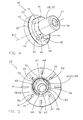
- a limited free-motion coupling device 10 which can also be referred to as a lost-motion coupling device.
- the coupling device 10 shown forms part of a pump assembly for a washing machine.
- the pump assembly comprises a two-pole permanent magnet rotor 12 and an impeller 14.
- the coupling device 10 couples a shaft 16 of the rotor 12 and the impeller 14.
- An elastomeric seal 18, typically rubber ring, gasket, or boot, and a bracket 19 for supporting a bearing 21 of the rotor 12 and the seal 18, are also included.
- the rotor shaft 16 projects through the seal 18 and bracket 19.
- the seal 18 acts as a seal for a chamber of the rotor 12 and protects bearing grease provided therein. As this pump assembly is for use in a washing machine, and the water in which the pump assembly is immersed is therefore not clean.
- the preferred seal is in the form of a boot which seals directly between the shaft and the rotor chamber.
- the preferred boot as shown in Figure 3, also provides an elastic mount for the bearing 21 by passing between the bearing and the bracket thereby giving the bearing some freedom to align with the shaft under the resilient urgings of the material of the boot to accommodate slight misalignment of the shaft and/or bearing.
- Bearing 21 is preferably a bushing, as shown.
- the coupling device 10 comprises a, typically plastics moulded, first part 20, a, typically plastics moulded, second part 22 in which the first part 20 is received for limited relative angular displacement about a rotational axis A of the rotor 12, and two identical, typically stainless steel, spherical coupling members 24, preferably in the form of ball bearings.
- the first part 20 comprises a cylindrical base element 26 having a first diameter, a cylindrical boss 28 which is integrally formed to project from one surface of the base element 26, and two coupling member arms 30.
- the cylindrical boss 28 has a second diameter which is smaller than the first diameter of the base element 26, thus providing a first coupling member bearing surface 32 on the base element 26, around and adjacent to the boss 28.
- Cylindrical axes B, S of the base element 26 and the boss 28 are coaxial, and a rotor shaft opening 34 is formed as a hole through the first part 20, and along the cylindrical axis S of the boss 28.
- the rotor shaft opening 34 is dimensioned to accept the rotor shaft 16 of the rotor 12 assembly.
- an end portion 36 of the rotor shaft 16 engages a metal, typically copper, tube or sleeve 37 moulded into the rotor shaft opening 34 in the first part 20.
- Sleeve 37 is an interference press-fit on the end-portion 36 of the shaft 16.
- the rotor shaft can be keyed to or splined in the rotor shaft opening, with or without the interposed sleeve, any other suitable means for engaging the first part 20 to the rotor shaft 16 can be utilised, providing the first part 20 is held stationary relative to the rotor shaft 16.
- the end portion of the rotor shaft and the rotor shaft opening can be complementarily non-circularly shaped.
- first part 20 can be integrally formed as part of the rotor shaft 16, for example, by moulding or casting.
- the coupling member arms 30 are provided diametrically opposite each other.
- the arms 30 are integrally formed to extend partway along the cylindrical outer wall 35 of the boss 28 from the base element 26, and radially outwardly from the boss 28 and partway across the first coupling member bearing surface 32.
- a radially outermost edge 40 of each arm 30 extends in parallel with the rotational axis A of the coupling device 10.
- Each coupling member arm 30 extends a distance along the boss 28 and away from the base element 26 which is approximately equal to the diameter of each coupling member 24. It may be slightly greater or slightly less.
- Each coupling member arm 30 also extends radially outwardly across the first coupling member bearing surface 32 a distance which may be equal to but preferably marginally less than the radius of each coupling member 24.
- a radially outermost circumferential surface 44 of each coupling member arm 30 is arcuate in a plane which is lateral to the cylindrical axis S of the boss 28, and rectilinear in a plane which is parallel to the cylindrical axis S of the boss 28.
- the second part 22 of the coupling device 10 forms part of the impeller 14, and comprises a housing 46 defining a stepped cavity 48, and two spaced elongate arcuate channels 50 for receiving the two spherical coupling members 24, respectively.
- Blades 52 of the impeller 14 are formed on an exterior surface of the housing 46, and project radially outwardly along an integrally formed plate-like radial skirt 38, and beyond the bracket 19.
- Radial skirt 38 has four through holes 39 equally spaced circumferentially between respective impeller blades 52.
- the lower face of the radial skirt 38, opposite the impeller blades 52 has eight radial ridges 41 forming scavenger blades which create a lower pressure area in the vicinity of the bearing 21.
- the stepped cavity 48 includes a first cylindrical chamber 53 for receiving the boss 28 of the first part 20 as a close rotatable fit, a second cylindrical chamber 54 for receiving the coupling member arms 30 of the first part 20 as a close rotatable fit, and a third cylindrical chamber 56 for receiving the base element 26 of the first part 20, also as a close rotatable fit.
- Cylindrical axes FC, SC and TC of the first, second and third chambers 53, 54 and 56 are coaxial.
- the first chamber 53 has a diameter which is less than the diameter of the second chamber 54, thereby forming a radially outwardly extending first shoulder 58 between the first and second chambers 53, 54.
- the second chamber 54 has a diameter which is less than the diameter of the third chamber 56, thereby forming a radially outwardly extending second shoulder or shoulders 60 between the second and third chambers 54, 56.
- the first shoulder 58 defines a second coupling member bearing surface 62 which extends laterally to the cylindrical axes FC, SC of the first and second chamber 53, 54.
- the second shoulder or shoulders 60 define a base element bearing surface 64 which extends laterally to the cylindrical axis TC of the third chamber 56.
- the second chamber 54 has a cylindrical wall 66 which extends coaxially with the rotational axis A of the coupling device 10, and the two arcuate channels 50 are formed diametrically opposite each other in the cylindrical wall 66 to extend the second coupling member bearing surface 62 further radially outwardly.
- the cylindrical wall 66 is thus recessed radially outwardly at two angularly spaced positions so that each arcuate channel 50 comprises two radially or substantially radially extending end walls 68, and a circumferential wall 70 which extends between the two end walls 68.
- the arcuate channels 50 are formed in a plane which extends laterally to the cylindrical axes FC, SC, TC of the first, second and third chamber 53, 54, 56, and have a sufficient longitudinal extent to allow the respective spherical coupling members 24 to freely and independently move therealong.
- a radial extent R of each arcuate channel 50 being the depth perpendicular to the cylindrical axis SC of the second chamber 54, is such that each coupling member 24 projects radially inwardly from its respective channel 50.
- the radial extent R of each arcuate channel 50 which may be equal to but preferably marginally less than the radius of each coupling member 24.
- each arcuate channel 50 being the depth parallel to the cylindrical axis SC and perpendicular to the radial extent R, is equal to or slightly greater than the diameter of each coupling member 24.
- the first part 20 is initially fitted to the end portion 36 of the rotor shaft 16, as described above.
- the two spherical coupling members 24 are seated on the first coupling member bearing surface 32, provided on the base element 26 and between the coupling member arms 30.
- a ridge 33 formed on the outer edge of the first coupling member bearing surface 32, provides a lip to hold the coupling members 24 in place during assembly. Ridge 33 is shown as being formed in two sections but may be a continuous ridge.
- the first part 20 and the coupling members 24 are then inserted into the cavity 48 of the second part 22, with the boss 28 of the first part 20 being located in the first chamber 53, the coupling member arms 30 and the coupling members 24 being located in the second chamber 54 and arcuate channels 50, respectively, and the base element 26 being located in the third chamber 56.
- a groove 72 is provided in the cylindrical wall 74 of the third chamber 56, adjacent to the base element 26 of the first part 20.
- a cover plate 76 is provided on the rotor shaft 16 adjacent to the base element 26. The cover plate 76 is engaged with the groove 72 of the third chamber 56 as a snap- or push- fit.
- a spring 78 such as a spring clip or spring washer is interposed between the base element 26 and the cover plate 76 to bias the first part 20 of the coupling device 10 into the cavity 48 of the second part 22.
- a flat washer 79 is optionally provided as a sliding contact between the spring 78 and the cover plate 76.
- the coupling members 24 are thus interposed between the first and second coupling member bearing surfaces 32, 62, which prevents or limits axial movement of the coupling members 24.
- the coupling members 24 are also interposed between the cylindrical outer wall 35 of the boss 28 and recessed-portions 67 of the cylindrical wall 66 of the second chamber 54, thus preventing or limiting radial movement of the coupling members 24.
- the recessed portions 67 correspond to the channels 50.
- the elongate arcuate channels 50 do allow circumferential movement of the coupling members 24 along the arcuate channels 50, from one end to the other.
- a radial extent M of the coupling member arms 30 is fractionally less than the diameter of unrecessed-portions 69 of the second chamber 54 of the housing cavity 48 of the second part 22, so that, if the coupling members 24 were removed, the first and second parts 20, 22 of the coupling device 10 would be freely rotatable by more than 360° relative to each other. In other words, the coupling member arms 30 cannot directly engage the ends of the channels 50 or the cylindrical wall 66 of the second chamber 54 of the housing cavity 48.
- each coupling member arm 30 has a radial extent M equal or substantially equal to the radius of its respective coupling member 24, a force applied by the arm 30 to the coupling member 24 when making contact is imparted through or substantially through the centre of the coupling member 24, in a tangential or substantially tangential direction of the arms 24.
- the arms 30 push the coupling members 24 along the respective arcuate channels 50, until the coupling members 24 abut the end walls 68 of the channels 50, respectively.
- the force imparted by the arms 30 to the coupling members 24 is transmitted to the second part 22, thus causing the second part 22 to rotate with the first part 20.
- the impeller 14 is caused to rotate with rotation of the rotor shaft 16.
- each coupling member 24 can be moved from one end of its arcuate channel 50 to the other before the first and second parts 20, 22 of the coupling device 10 become locked or engaged.
- the amount of free- or lost- motion available to the rotor 12 can be in excess of 180°, thus allowing the rotor more than 180° of start-up rotation before the load of the impeller 14 is applied.
- the range of free-motion is typically chosen depending on the application and material strength.
- a higher load may preferably require a larger range of free movement, but this tends to put more stress on the arms and the ends of the channels.
- larger coupling member arms and shorter channels give greater strength, but the free movement is less and thus requires greater torque to move a given load.
- a typical range of free movement allowed by the coupling device 10 is 90 degrees to 270 degrees.
- An angular spacing between radial surfaces 42 of each coupling member arm 30 is less than 180°, and is typically in the range of 5 degrees to 95 degrees.
- each arcuate channel 50 between its respective end walls 68, is less than 180°, and is typically in the range of 5 degrees to 110 degrees.
- angles described by the coupling member arms and the arcuate channels can be the same or different, depending upon necessity.
- FIG. 7 illustrates a pump assembly incorporating a coupling device according to the present invention.
- the motor 80 has a rotor driving an impeller 14 through the coupling device as hereinbefore described. In this illustration, the impeller does not have a radial skirt.
- the pump motor has a flange 82 to which a pump volute is fitted to form or complete the pump chamber in which the impeller resides.
- a stator 84 formed by a stack of steel laminations and a stator core (not visible) provides the driving force for the rotor.
- a motor housing 86 completes the motor shell of the pump motor.
- the first part as described can be provided on the impeller side of the pump, either forming part of the impeller or attached to the impeller, and the second part can be provided on the rotor shaft.
- the arcuate channels can be provided in the cylindrical wall of the boss, and the coupling member arms can be provided in the cavity, projecting radially inwards from the cylindrical wall of the second chamber.
- the first part of the coupling device comprises the housing having the cavity with the coupling member arms, and the second part comprises the base element, boss, and arcuate channels.
- a distal end of the rotor shaft can be formed with an internally extending axial screw-thread, and a screw-threaded cap element can be threadingly engaged therewith, whereby the cap element overlaps the end of the boss remote from the base element.
- the first part can be integrally formed as part of the rotor shaft, for example, by moulding or casting.
- the provision of the arcuate channels in an axially parallel wall enables the coupling members to project radially, instead of axially, from the channels.
- the coupling member arms are also conveniently spaced radially from the arcuate channels, either radially inwardly or radially outwardly.
- the coupling members themselves act to cushion the impact of engagement with the ends of the channels, thus reducing wear and noise when compared to direct engagement between the coupling member arms and the ends of the channels.
- the boss is any suitable projection, and can be, for example, a spigot.
Landscapes
- Engineering & Computer Science (AREA)
- General Engineering & Computer Science (AREA)
- Mechanical Engineering (AREA)
- Power Engineering (AREA)
- Structures Of Non-Positive Displacement Pumps (AREA)
- Connection Of Motors, Electrical Generators, Mechanical Devices, And The Like (AREA)
Applications Claiming Priority (1)
| Application Number | Priority Date | Filing Date | Title |
|---|---|---|---|
| CN2006101689498A CN101153604B (zh) | 2006-09-29 | 2006-09-29 | 具有有限自由运动的泵叶轮连接装置 |
Publications (3)
| Publication Number | Publication Date |
|---|---|
| EP1908959A2 true EP1908959A2 (fr) | 2008-04-09 |
| EP1908959A3 EP1908959A3 (fr) | 2010-11-03 |
| EP1908959B1 EP1908959B1 (fr) | 2012-10-24 |
Family
ID=38983596
Family Applications (1)
| Application Number | Title | Priority Date | Filing Date |
|---|---|---|---|
| EP07253734A Ceased EP1908959B1 (fr) | 2006-09-29 | 2007-09-21 | Dispositif de couplage de turbine de pompe à mouvement libre limité |
Country Status (4)
| Country | Link |
|---|---|
| US (1) | US7972121B2 (fr) |
| EP (1) | EP1908959B1 (fr) |
| JP (1) | JP2008111440A (fr) |
| CN (1) | CN101153604B (fr) |
Cited By (1)
| Publication number | Priority date | Publication date | Assignee | Title |
|---|---|---|---|---|
| WO2011150819A1 (fr) * | 2010-06-04 | 2011-12-08 | 深圳市博孚机电有限公司 | Embrayage de petites dimensions, moteur électrique doté d'un embrayage de petites dimensions et rideau à mouvement électrique doté d'un embrayage de petites dimensions |
Families Citing this family (17)
| Publication number | Priority date | Publication date | Assignee | Title |
|---|---|---|---|---|
| CN101871459B (zh) * | 2009-04-24 | 2013-10-30 | 德昌电机(深圳)有限公司 | 排水泵 |
| CN101929465B (zh) * | 2009-06-19 | 2013-12-11 | 德昌电机(深圳)有限公司 | 排水泵 |
| CN102545466B (zh) * | 2010-11-10 | 2015-11-25 | 德昌电机(深圳)有限公司 | 电机装置 |
| CN102287397B (zh) * | 2011-06-02 | 2013-07-17 | 关松生 | 转桨叶轮泵 |
| US9399996B2 (en) * | 2011-07-20 | 2016-07-26 | General Electric Company | Cam plate and an appliance including the cam plate |
| CN102777517A (zh) * | 2012-08-06 | 2012-11-14 | 关松生 | 转桨叶轮泵式制动器 |
| CN102865138A (zh) * | 2012-10-18 | 2013-01-09 | 关松生 | 转桨叶轮泵燃气轮机 |
| CN102865226A (zh) * | 2012-10-18 | 2013-01-09 | 关松生 | 可调变量转桨叶轮泵 |
| EP2759710A1 (fr) * | 2013-01-23 | 2014-07-30 | Sulzer Pumpen AG | Pompe centrifuge et manchon de couplage de l'arbre d'une pompe centrifuge sur l'arbre d'un moteur de commande |
| CN104179853B (zh) * | 2014-07-29 | 2017-03-15 | 岑溪市东正动力科技开发有限公司 | 封闭阻塞式制动器 |
| CN107404160A (zh) * | 2016-05-18 | 2017-11-28 | 德昌电机(深圳)有限公司 | 电机 |
| CN108119392B (zh) * | 2016-11-29 | 2019-11-01 | 长城汽车股份有限公司 | 水泵以及车辆 |
| CN108238270A (zh) * | 2016-12-27 | 2018-07-03 | 襄阳爱默思智能检测装备有限公司 | 一种特殊光电吊舱旋转角度的机械调整办法 |
| CN109383832A (zh) * | 2017-08-09 | 2019-02-26 | 昊翔电能运动科技(昆山)有限公司 | 旋转限位装置 |
| TWI674736B (zh) * | 2018-05-09 | 2019-10-11 | 建準電機工業股份有限公司 | 馬達轉子 |
| KR102360572B1 (ko) * | 2019-10-16 | 2022-02-10 | 오토딘시스 주식회사 | 신규한 구조의 회전축 어셈블리 |
| CN113460578A (zh) * | 2021-07-02 | 2021-10-01 | 台嘉蚌埠玻璃纤维有限公司 | 一种斗提机及磨料系统 |
Family Cites Families (11)
| Publication number | Priority date | Publication date | Assignee | Title |
|---|---|---|---|---|
| FR1134678A (fr) * | 1954-11-08 | 1957-04-16 | Walterscheid Gmbh Jean | Accouplement de surcharge, en particulier pour les machines agricoles |
| DE1453728A1 (de) * | 1964-04-06 | 1969-05-08 | Bueche Dr Ernst | Kreiselpumpe fuer Heizungen |
| FR2029933A5 (fr) | 1969-01-31 | 1970-10-23 | Proclem | |
| ITPD20010256A1 (it) * | 2001-10-30 | 2003-04-30 | Askoll Holding Srl | Dispositivo perfezionato di trascinamento fra il rotore di un motore sincrono a magneti permanenti e l'organo operatore. |
| ITPD980058A1 (it) * | 1998-03-19 | 1999-09-19 | Askoll Holding Srl | Dispositivo di trascinamento, con angolo di libera rotazione ampliato fra il motore sincrono a magneti permanenti e l'organo operatore |
| US4661085A (en) * | 1985-09-09 | 1987-04-28 | Philips Home Products, Inc. | Lost motion clutch assembly |
| US4997346A (en) * | 1990-04-12 | 1991-03-05 | Atlantic Richfield Company | Well pumping systems |
| FR2676510B1 (fr) * | 1991-05-14 | 1995-01-06 | Electro Mec Nivernais | Motopompe centrifuge silencieuse. |
| DE9302945U1 (de) * | 1993-03-01 | 1993-11-11 | Hanning Elektro-Werke GmbH & Co, 33813 Oerlinghausen | Mit einer Anlaufhilfe ausgestatteter Synchronmotor |
| GB9713892D0 (en) * | 1997-07-02 | 1997-09-03 | Johnson Electric Sa | Coupling device for a pump impeller |
| EP1553681B1 (fr) * | 2003-12-31 | 2017-03-15 | Askoll Holding S.r.l. | Dispositif de couplage entre un rotor de moteur synchrone à aimants permanents et un organe de travail |
-
2006
- 2006-09-29 CN CN2006101689498A patent/CN101153604B/zh not_active Expired - Fee Related
-
2007
- 2007-09-21 EP EP07253734A patent/EP1908959B1/fr not_active Ceased
- 2007-09-27 US US11/905,127 patent/US7972121B2/en not_active Expired - Fee Related
- 2007-09-28 JP JP2007279597A patent/JP2008111440A/ja not_active Withdrawn
Cited By (1)
| Publication number | Priority date | Publication date | Assignee | Title |
|---|---|---|---|---|
| WO2011150819A1 (fr) * | 2010-06-04 | 2011-12-08 | 深圳市博孚机电有限公司 | Embrayage de petites dimensions, moteur électrique doté d'un embrayage de petites dimensions et rideau à mouvement électrique doté d'un embrayage de petites dimensions |
Also Published As
| Publication number | Publication date |
|---|---|
| CN101153604B (zh) | 2011-04-13 |
| EP1908959A3 (fr) | 2010-11-03 |
| EP1908959B1 (fr) | 2012-10-24 |
| US7972121B2 (en) | 2011-07-05 |
| JP2008111440A (ja) | 2008-05-15 |
| US20080080987A1 (en) | 2008-04-03 |
| CN101153604A (zh) | 2008-04-02 |
Similar Documents
| Publication | Publication Date | Title |
|---|---|---|
| EP1908959B1 (fr) | Dispositif de couplage de turbine de pompe à mouvement libre limité | |
| EP1801954B1 (fr) | Pompe centrifuge entraînée par un moteur électrique synchrone | |
| RU2518736C2 (ru) | Осевое торцевое уплотнение | |
| EP2878827B1 (fr) | Soufflante à gaz | |
| JP2002013643A (ja) | シールスリーブ | |
| CN101334033A (zh) | 磁力支承和耦接装置 | |
| KR102125108B1 (ko) | 밀봉형 구름 베어링 | |
| US4869654A (en) | Magnetic pump drive | |
| KR20090023093A (ko) | 다중-리브형 키리스 커플링 | |
| US10781828B2 (en) | Centrifugal pump with noise dampening rubber isolation impeller bushing | |
| CN107407386B (zh) | 用于流体动力止推轴承的轴向保持和防转动结构 | |
| CN105114460B (zh) | 一种轴承及具有该轴承的深井泵传动轴系 | |
| CN106516065B (zh) | 一种用于水下的磁耦合转舵装置 | |
| EP0966612B1 (fr) | Raccord d'entrainement, tributaire du sens de la marche, entre le rotor d'un moteur synchrone a aimant permanent et la piece active | |
| US6890159B2 (en) | Air blower with fan unable to contact motor housing | |
| US6007308A (en) | Coupling device for a pump impeller | |
| US20050260088A1 (en) | Electrically driven pump and domestic appliance having the pump | |
| US20060016657A1 (en) | Clutch having a variable viscosity fluid | |
| US20160115961A1 (en) | Pump Arrangement | |
| US10677059B2 (en) | Rotary pump with deformable pump ring | |
| CN209294272U (zh) | 一种全密封锥形配合套筒联轴器 | |
| CN217029331U (zh) | 一种无油自润滑克负泵 | |
| CN220415777U (zh) | 一种防呆安装式风机组件 | |
| CN218882584U (zh) | 一种泵的机械密封结构及立式多级泵 | |
| JPS6342206Y2 (fr) |
Legal Events
| Date | Code | Title | Description |
|---|---|---|---|
| PUAI | Public reference made under article 153(3) epc to a published international application that has entered the european phase |
Free format text: ORIGINAL CODE: 0009012 |
|
| AK | Designated contracting states |
Kind code of ref document: A2 Designated state(s): AT BE BG CH CY CZ DE DK EE ES FI FR GB GR HU IE IS IT LI LT LU LV MC MT NL PL PT RO SE SI SK TR |
|
| AX | Request for extension of the european patent |
Extension state: AL BA HR MK RS |
|
| PUAL | Search report despatched |
Free format text: ORIGINAL CODE: 0009013 |
|
| AK | Designated contracting states |
Kind code of ref document: A3 Designated state(s): AT BE BG CH CY CZ DE DK EE ES FI FR GB GR HU IE IS IT LI LT LU LV MC MT NL PL PT RO SE SI SK TR |
|
| AX | Request for extension of the european patent |
Extension state: AL BA HR MK RS |
|
| RIC1 | Information provided on ipc code assigned before grant |
Ipc: F04D 13/06 20060101ALI20100927BHEP Ipc: H02K 7/118 20060101ALI20100927BHEP Ipc: F16D 15/00 20060101ALI20100927BHEP Ipc: F16D 3/10 20060101ALI20100927BHEP Ipc: F16D 3/02 20060101ALI20100927BHEP Ipc: F04D 13/02 20060101AFI20080207BHEP |
|
| 17P | Request for examination filed |
Effective date: 20110428 |
|
| AKX | Designation fees paid |
Designated state(s): DE |
|
| RIC1 | Information provided on ipc code assigned before grant |
Ipc: F16D 3/02 20060101ALI20120410BHEP Ipc: F04D 13/02 20060101AFI20120410BHEP Ipc: H02K 7/118 20060101ALI20120410BHEP Ipc: F16D 15/00 20060101ALI20120410BHEP Ipc: F16D 3/10 20060101ALI20120410BHEP Ipc: F04D 13/06 20060101ALI20120410BHEP |
|
| GRAP | Despatch of communication of intention to grant a patent |
Free format text: ORIGINAL CODE: EPIDOSNIGR1 |
|
| GRAS | Grant fee paid |
Free format text: ORIGINAL CODE: EPIDOSNIGR3 |
|
| GRAA | (expected) grant |
Free format text: ORIGINAL CODE: 0009210 |
|
| AK | Designated contracting states |
Kind code of ref document: B1 Designated state(s): DE |
|
| REG | Reference to a national code |
Ref country code: DE Ref legal event code: R096 Ref document number: 602007026231 Country of ref document: DE Effective date: 20121213 |
|
| PLBE | No opposition filed within time limit |
Free format text: ORIGINAL CODE: 0009261 |
|
| STAA | Information on the status of an ep patent application or granted ep patent |
Free format text: STATUS: NO OPPOSITION FILED WITHIN TIME LIMIT |
|
| 26N | No opposition filed |
Effective date: 20130725 |
|
| REG | Reference to a national code |
Ref country code: DE Ref legal event code: R097 Ref document number: 602007026231 Country of ref document: DE Effective date: 20130725 |
|
| PGFP | Annual fee paid to national office [announced via postgrant information from national office to epo] |
Ref country code: DE Payment date: 20150916 Year of fee payment: 9 |
|
| REG | Reference to a national code |
Ref country code: DE Ref legal event code: R119 Ref document number: 602007026231 Country of ref document: DE |
|
| PG25 | Lapsed in a contracting state [announced via postgrant information from national office to epo] |
Ref country code: DE Free format text: LAPSE BECAUSE OF NON-PAYMENT OF DUE FEES Effective date: 20170401 |