EP1909087A2 - Système antivol pour thermomètre - Google Patents
Système antivol pour thermomètre Download PDFInfo
- Publication number
- EP1909087A2 EP1909087A2 EP07117982A EP07117982A EP1909087A2 EP 1909087 A2 EP1909087 A2 EP 1909087A2 EP 07117982 A EP07117982 A EP 07117982A EP 07117982 A EP07117982 A EP 07117982A EP 1909087 A2 EP1909087 A2 EP 1909087A2
- Authority
- EP
- European Patent Office
- Prior art keywords
- thermometer
- sensor
- set forth
- microcontroller
- mount
- Prior art date
- Legal status (The legal status is an assumption and is not a legal conclusion. Google has not performed a legal analysis and makes no representation as to the accuracy of the status listed.)
- Withdrawn
Links
Images







Classifications
-
- G—PHYSICS
- G01—MEASURING; TESTING
- G01K—MEASURING TEMPERATURE; MEASURING QUANTITY OF HEAT; THERMALLY-SENSITIVE ELEMENTS NOT OTHERWISE PROVIDED FOR
- G01K13/00—Thermometers specially adapted for specific purposes
- G01K13/20—Clinical contact thermometers for use with humans or animals
-
- Y—GENERAL TAGGING OF NEW TECHNOLOGICAL DEVELOPMENTS; GENERAL TAGGING OF CROSS-SECTIONAL TECHNOLOGIES SPANNING OVER SEVERAL SECTIONS OF THE IPC; TECHNICAL SUBJECTS COVERED BY FORMER USPC CROSS-REFERENCE ART COLLECTIONS [XRACs] AND DIGESTS
- Y10—TECHNICAL SUBJECTS COVERED BY FORMER USPC
- Y10T—TECHNICAL SUBJECTS COVERED BY FORMER US CLASSIFICATION
- Y10T29/00—Metal working
- Y10T29/49—Method of mechanical manufacture
- Y10T29/49002—Electrical device making
- Y10T29/4902—Electromagnet, transformer or inductor
Definitions
- the present invention generally relates to electronic thermometers and more particularly to an anti-theft system for an electronic thermometer
- Electronic thermometers are widely used in the healthcare field for measuring a patient's body temperature.
- Typical electronic thermometers have a base unit that is held in the palm of a hand and a probe with an elongated shaft connected to the base.
- the base unit includes a probe well for holding the probe when the thermometer is not in use.
- Electronic temperature sensors such as thermistors or other temperature sensitive elements are contained within a tip of the probe. When the tip is placed, for example, in a patient's mouth, the tip is heated up by the patient's body and the thermistor measures the temperature of the tip Electronic components in the base unit receive input from the sensor components to compute the patient's temperature. The temperature is then typically displayed on a visual output device such as a seven segment numerical display device.
- electronic thermometers are powered by batteries to make the thermometers portable Since the thermometers are portable, wall mounts or other holders may be included with the thermometers to provide places to securely store the thermometers.
- thermometers have an anti-theft mechanism for deterring theft
- One type of anti-theft mechanism employs a microcontroller with a counter that records the number of uses of the thermometer. When the counter reaches a predetermined number, then the thermometer is disabled. The counter can be reset by placing the thermometer on the wall mount, for example. When the thermometer is placed back on the wall mount, an anti-theft switch in the thermometer is activated, resetting the counter.
- a conventional anti-theft switch may include a reed switch in communication with the microcontroller.
- the mount includes a magnet having sufficient strength to bring the contact reeds together within the tube of the switch (activating the switch), thereby resetting the counter.
- the reed switch is prone to mechanical wear and failure. Moreover, the reed switch is fragile, as the contact reeds are maintained in a glass vacuum tube. Still further, the magnet used to open the switch typically must have a flux density of at least about 1200 Gauss, which means the magnet is probably bulky and expensive.
- a hand-held thermometer generally comprises a housing sized and shaped to be held in a hand and an input for taking in temperature data
- a microcontroller located in the housing includes a resetable anti-theft counter for recording a use-parameter of the thermometer, wherein the thermometer is disabled in an anti-theft mode when the counter reaches a pre-selected number
- a solid-state sensor in communication with the microcontroller and having no moving parts is capable of detecting a magnetic field with a predetermined flux density to signal to the microcontroller to reset the anti-theft counter.
- a method of making an electronic thermometry assembly including a thermometer and a mount for receiving the thermometer comprises assembling a magnetic source capable of generating a magnetic field into a housing of the mount
- a microcontroller including a resetable anti-theft counter for recording a use-parameter of the thermometer is mounted on a circuit board, wherein the thermometer is disabled in an anti-theft mode when the counter reaches a pre-selected number.
- a solid-state sensor in communication with the microcontroller is mounted on the circuit board The sensor is capable of being activated by the magnetic field of the magnetic source to signal to the microcontroller to reset the anti-theft counter.
- the circuit board is assembled with the microcontroller and solid-state sensor thereon into a housing of the thermometer.
- Fig. 1 is a perspective of one embodiment of a thermometry assembly including a thermometer received in a mount;
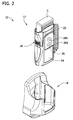
- Fig. 2 is the thermometry assembly of Fig. 1 with the thermometer exploded from the mount;
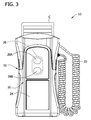
- thermometer 3 is a front elevation of the thermometer
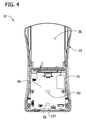
- Fig 4 is a section of the thermometer taken along its height
- Fig. 5 is a rear perspective of the thermometer with a probe exploded from a probe well
- Fig. 6 is a front perspective of the thermometer with a carton of probe covers exploded from the thermometer;
- Fig 7 is a perspective of the probe of the thermometer
- Fig. 8 3 is a fragmentary perspective of the probe with parts broken away to show internal construction
- Fig. 9 is an enlarged, fragmentary section of the probe
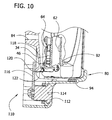
- Fig. 10 is an enlarged, fragmentary side elevation of the thermometer received in the mount with the mount in section and parts broken away from the thermometer to show internal construction;
- Fig. 11 is a schematic including circuitry of an activating system and an anti-theft system of the thermometer;
- Fig. 11A is an enlarged, fragmentary side elevation of another embodiment of a thermometer with parts broken away to show internal construction
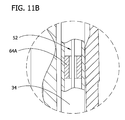
- Fig 11B is an enlarged fragmentary view of the internal construction of a probe as defined by Fig. 11A;
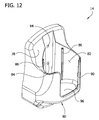
- Fig. 12 is a perspective of the mount
- Fig 13 is a front elevation of the mount
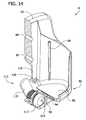
- Fig. 14 is a vertical section of the mount
- Fig. 15 is a section of the wall mount taken in a plane containing the line 15-15 of Fig. 13, with a thermometer received in the mount and not sectioned
- thermometry apparatus includes a hand-held, electronic thermometer 12 and a mount 14 for mounting the thermometer on a wall or other structure (the reference numerals indicating their subjects generally).
- the electronic thermometer 12 comprises a housing, indicated generally at 16, that is sized and shaped to be held comfortably in the hand
- the housing is connected to a probe, generally indicated at 18 (Fig 5), by a helical cord 20
- the probe 18 is constructed for contacting the object (e.g., a patient) and sending signals representative of the temperature to a microcontroller 22 (Fig. 4) which is stored in the housing 16.
- the microcontroller 22 receives the signals from the probe 18 and uses them to calculate the temperature
- the thermometer 12 may include other device and/or circuitry for performing these calculations, and these devices and/or circuitry along with the microcontroller 22 broadly constitute a calculating device of the thermometer.
- Logic in the microcontroller 22 may include a predictive algorithm for rapidly ascertaining the final temperature of the patient
- the microcontroller 22 makes the calculated temperature appear on an LCD screen 24 (Figs 1-3) on a front side ofthe housing 16. Other information desirably can appear on the screen 24, as will be appreciated by those of ordinary skill in the art.
- a control panel 26 defined by a pair of buttons 28A, 28B for operating the thermometer 12 is located directly above the screen 24
- the housing 16 includes a probe well 30 generally at a back side of the housing 16 that can receive a shaft 34 (Figs 5 and 7) of the probe 18 into the housing for holding the probe and isolating the shaft from the environment when not in use
- the housing 16 also has a receptacle 36 (Fig.
- the shaft 34 of the probe 18 can be inserted into the open end of one of the probe covers and the probe cover can be captured (e.g, snapped into) an annular recess 38 (Figs 5 and 7) of the probe
- the probe cover protects the probe shaft 34 from contamination when the shaft is inserted, for example, into a patient's mouth
- Pushers 40 located at the junction of a handle 42 of the probe 18 with a probe shaft 34 release the probe cover from the probe shaft when a button 44 on the probe handle 42 is depressed
- Other ways of capturing and releasing probe covers may be used without departing from the scope of the present invention.
- an aluminum tip 46 at a distal end of the probe shaft 34 is heated by the patient and the temperature of the tip is detected, as will be described more fully hereinafter
- the probe cover is preferably made of highly thermally conductive material, at least at the portion covering the tip 46, so that the tip can be rapidly heated by the patient.
- the tip 46 and distal end of the probe shaft 34 are partially broken away to reveal components used to measure the temperature of the tip.
- a generally tubular separator, generally indicated at 48, is mounted on the distal end ofthe probe shaft 34 and extends generally into an open bottom of the tip 46, but does not engage the tip.
- An isolator is mounted on the end of the separator 48 and engages the tip 46 for use in mounting the tip on the probe shaft 34
- the probe shaft, the tip 46, the separator 48 and the isolator 50 may be connected together in a suitable fashion
- a flex circuit, generally indicated at 52 includes a deformable substrate 54 mounting a tip thermistor 56 (broadly, a temperature sensing component; Fig 9), a separator thermistor 58 (Fig 9) and a heating resistor (not shown).
- the tip thermistor 56 is in thermal contact with the tip 46, and the separator thermistor 58 and heating resistor are in thermal contact with the separator 48 It will be appreciated that other electrical components (not shown) and other arrangements and numbers of components may be used without departing from the scope of the present invention
- the tip thermistor 56 generates a signal that is representative of the temperature of the tip 46
- the signal is transmitted by one or more electrical conductors in the flex circuit substrate 54 to the circuitry in the housing 16.
- the separator thermistor 58 generates a signal that is representative of the temperature of the separator 48
- the resistor heats the separator 48 so that the aluminum tip 46 can reach the temperature of the patient more rapidly.
- Monitoring the temperature of the separator 48 with the separator thermistor 58 allows the heating of the resistor to be controlled to best effect For instance, the separator 48 can be initially rapidly heated, but then heated intermittently as the separator nears or reaches a pre-selected temperature
- the function and operation of these components are known to those of ordinary skill in the art
- the thermometer 12 includes an automatic activating system for automatically configuring the thermometer between an active state (broadly, the thermometer is turned on) and a non-active state (broadly, the thermometer is turned off).
- active state means that the thermometer 12 is operating so that it can take a temperature of a subject Activation of the active state may include automatic powering up of the thermometer 12, including heating of the tip 46 of the probe 18 using the resistor, as is known in the art.
- non-active state means that the thermometer 12 cannot take a temperature of a subject, although other functions, such as data retrieval, may be performed.
- the automatic activating system will automatically configure the thermometer 12 in a non-active state when the probe shaft 34 is received in the probe well 30 and will automatically configure the thermometer in an active state when the probe shaft is removed from the probe well.
- a power supply e g., batteries
- the activating system includes a solid-state activating sensor 62 (Figs 4, 10 and 11) in the housing 16 of the thermometer 12 and a magnet 64 (broadly, a magnetic source; Figs 8 and 9) in the probe 18 for activating the sensor when the probe is received in the probe well 30.
- a solid-state activating sensor 62 (Figs 4, 10 and 11) in the housing 16 of the thermometer 12 and a magnet 64 (broadly, a magnetic source; Figs 8 and 9) in the probe 18 for activating the sensor when the probe is received in the probe well 30.
- the term "solid-state” means that the sensor 62 does not have any moving parts.
- the activating magnet 64 may be, for example, either a permanent magnet, or a temporary magnet that can be temporarily magnetized, or an electromagnet.
- the activating sensor 62 is electrically connected to (broadly, "in communication with") the microcontroller 22 In the illustrated embodiment, the microcontroller 22 and the sensor 62 are mounted on the same printed circuit
- the sensor 62 When the sensor 62 detects the magnetic field ofthe magnet (i.e., when the probe 18 is received in the probe well 30), the sensor sends a non-active output signal to the microcontroller 22. The microcontroller, in response, places the thermometer 12 in the non-active state. When the sensor 62 is no longer detecting the magnetic field of the activating magnet 64 (i.e., when the probe 18 is removed from the probe well 30), the sensor either discontinues the non-active output signal or sends a different, active signal to the microcontroller 22, and the microcontroller places the thermometer in the active state Other arrangements of signaling are within the scope of the invention.
- the activating magnet 64 is mounted directly on the flex circuit 52 in the shaft ofthe probe 18 (Figs 9 and 10), and the sensor 62 is mounted on a back side of the circuit board 66 (Figs. 4, and 10)
- the locations of the activating sensor 62 and the magnet 64 are such that when the probe 18 is substantially completely received in the probe well 30 (Fig 10), the magnetic field from the magnet 64 is generally perpendicular to the sensor 62 so that the magnetic field activates the sensor
- the locations of the activating magnet 64 and the activating sensor 62 may be other than described, although it is preferred that the locations allow for the sensor to be activated only when the probe is substantially completely received in the probe well
- the magnetic source may be other than the activating magnet 64
- the probe shaft or another component(s) of the probe e.g., the tip or the separator
- the probe shaft or another component(s) of the probe e.g., the tip or the separator
- the activating system may include a mechanical switch for automatically configuring the thermometer between the active state and the non-active state as the thermometer probe is removed from and inserted into the probe well
- Other types of switches or sensors are within the scope of the invention.
- the activating sensor 62 comprises a Hall-effect sensor
- a Hall-effect sensor generally senses or detects a magnetic field having a (first) magnetic flux density or magnitude that is greater than or equal to a pre-selected operate point (i.e., the flux density necessary to activate the sensor).
- the activating sensor 62 has a pie-selected operate point at or below the flux density of the magnetic field of the magnet 64 at the sensor when the probe 18 is received in the probe well 30
- the sensor 62 Once the sensor 62 has been activated, it will stay active until it detects a magnetic field have a (second) flux density that is at or below a pre-selected release point of the sensor (i.e., the flux density necessary to deactivate the sensor) It will be appreciated that the second magnetic flux density could be zero or non-zero.
- the Hall-effect sensor 62 may be a unipolar sensor, in that it senses only one of a north pole or a south pole of a magnet, or it may be an omnipolar sensor, in that it senses both a north pole and a south pole of a magnet
- the sensor 62 may have a digital output or an analog output.
- the Hall-effect sensor is a low-power, omnipolar Hall-effect sensor having a digital output. Suitable Hall-effect sensors of this type include sensors sold by Allegro® Microsystems, Inc as model numbers A3210, A3211, A3212, A3213 and A3214.
- Solid-state sensor 62 may be a magnetoresitive sensor, the structure and function of which is known to those of ordinary skill in the art. Other types of solid-state sensors are within the scope of the invention
- a schematic of a suitable, non-limiting example of the circuitry of the automatic activating system is generally indicated at 68.
- the circuitry includes a Hall-effect sensor 62 (the activating sensor), sold by Allegno® Microsystems, Inc. under model number A3214ELHLT-T, interfaced with the microcontroller 22.
- the sensor 62 has an input voltage of 3 volts and uses less than about 5 ⁇ A of current
- the circuitry also includes a pull-up resistor 70 having a resistance of 1,0 M ⁇ and a capacitor 72 between supply S and ground G having a capacitance of 0 1 ⁇ F for reducing noise
- An inverter 74 (broadly, a logic gate) and a diode 76 (broadly, a leakage preventing device), the functions of which are explained below, are also a part of the circuit 68.
- the sensor 62 has an operate point of about 42 Gauss and a release point of about 32 Gauss
- the magnet 64 mounted on the flex circuit 52 has a magnetic field having a magnetic flux density of between about 3800 Gauss and about 4200 Gauss, preferably about 3895 Gauss, sufficient to activate the sensor 62 when the probe 18 is received in the probe well 30.
- the specific values set forth herein may be other than stated without departing from the scope of the present invention.
- the inverter 74 receives the output signal from the sensor 62 and inverts the signal to 5 V (binary 1 state), which is sent to the microcontroller 22, signaling to the microcontroller to switch the thermometer 12 to the non-active state
- the magnetic flux density falls below the release point (i,e., to a second magnetic flux density)
- the sensor 62 switches off and the output switches high to 3 V.
- the inverter 74 receives the signal and inverts it to a low voltage of between about 100 mV and 300 mV, typically 200 mV (binary state 0) signaling to the microcontroller 22 to switch the thermometer 12 to the active state.
- the diode 76 prevents current from flowing from the inverter 74 to the microcontroller 22 when the thermometer 12 is in the non-active state. Accordingly, the diode 76 reduces overall power consumption of the circuit 68. In the illustrated embodiment, the current leakage that is blocked by the diode 76 is about 25 ⁇ A. It is believed that the diode 76 may save approximately 18 mAh of battery capacity per month It is understood that the circuitry of the activating system may be other than described without departing from the scope of the invention
- the activating system is similar to the activating system described above, and therefore corresponding components are indicated by corresponding reference numerals
- the present embodiment is different from the above-described embodiment in that the present activating system includes an activating sensor 62A comprising a Hall-effect sensor of the type that has a magnet (not shown) or other magnetic source associated with it The magnet has a magnetic field with a flux density at the sensor greater than or equal to an operate point of the sensor so that the sensor is biased in an active state.
- a ferromagnetic or highly magnetically permeable ring 64A (broadly, a magnetically permeable structure) is disposed inside the probe shaft 34.
- the ring 64A is concentric with the probe shaft 34 and the flex circuit 52 extends through the central opening of the ring.
- the presence of the ferromagnetic ring 64A decreases the flux density of the magnetic source at the sensor 62A to less than or equal to the release point of the sensor, whereby the sensor is switched to its inactive state
- the magnetically permeable structure may be other than a ring and may be associated with the probe in other ways For example, it is contemplated that the structure may be disposed on the outer surface of the probe 18.
- the shaft 34 itself may be at least partially constructed of a ferromagnetic material
- An activating circuit including the Hall-effect sensor 62A and the microcontroller 22 are configured so that when the Hall-effect sensor is active (i.e., the probe is not seated in the probe well), the thermometer 12 is in its active state and when the Hall-effect sensor is inactive (i.e., the probe is seated in the probe well), the thermometer is in its non-active state
- the mount 14 of'the thermometry assembly 12 includes a rear wall 78 and a holder, generally indicated at 80, projecting forward from the rear wall and defining a cavity 80 for slidably receiving the housing 16 of the thermometer 12 to hold the thermometer in the mount
- the mount 14 may be secured to a wall or other structure by inserting fasteners, e.g., screws, (not shown) through spaced apart openings 84 in the rear wall 78 of the mount 14 and into the wall or other support structure.
- the holder 80 includes elongate vertical tongues 86 projecting into the cavity 82.
- thermometer 12 slides between the tongues 86 when it is being received in the holder 80 so that the thermometer fits snugly therein
- a front of the holder has a large opening 90 formed therein having a size and shape corresponding generally to the size and shape of the LCD screen 24 of the thermometer 12.
- the opening 90 allows the user to have access to the LCD screen 24 when the thermometer 12 is received in the mount 14
- the thermometry assembly 20 includes an anti-theft system for deterring theft of the thermometer 12.
- the microcontroller 22 includes an anti-theft counter that counts the number of uses ofthe thermometer 12 (broadly, a use-parameter) during a period beginning from the time the thermometer was last on the mount 14. That is, the counter records the number of uses from the time the thermometer 12 is removed from the mount 14 until the thermometer is returned to the mount. It is contemplated that the counter may record other use-parameters, including, but not limited to, real time elapsed
- the microcontroller 22 is programmed to disable further operation of'the thermometer 12 when a threshold number has been reached or exceeded by the counter.
- the counter is reset when the thermometer 12 is returned to the mount 14
- the threshold number is thirty
- the user is allowed to use (i e , take a temperature) thirty times without having to return the thermometer 12 to the mount 15 before the microcontroller 22 will disable the operation of the thermometer. After being disabled the user must return the thermometer 12 to the mount 14 to use it again. If the user returns the thermometer 12 to the mount 14 before the counter reaches 15, then the counter is reset and the thermometer is not disabled.
- the thermometer includes a solid-state anti-theft sensor 92 (Figs. 4 and 10), and the mount includes a permanent magnet 94 (broadly an anti-theft magnetic source; Figs. 14 and 15) emitting a magnetic field with a flux density sufficient to activate the sensor when the thermometer is received in the mount.
- the anti-theft sensor 92 may be of any of the types of sensors described above with respect to the activating sensor 62, or may be another type of solid-state sensor.
- the ant-theft sensor 92 is preferably a low-power, omnipolar Hall-effect sensor, such as those sensors sold by Allegro® Microsystems, Inc. under the model numbers A3210, A3211, A3212, A3213 and A3214.
- the anti-theft sensor 92 may have a digital output when it is activated by the anti-theft magnet 94 and no output when it is not activated. The digital output is sent to the microcontroller 22, and the microcontroller resets the counter.
- Other configurations of the sensor 92 and the microcontroller 22, including other or additional circuitry are within the scope of the invention
- the anti-theft sensor 92 is mounted on the circuit board (Figs. 4 and 10) so that it is in communication with the microcontroller 22.
- the magnet 94 is secured within a floor 96 (broadly, a structure) of the mount 14, such as by securing the magnet within a cavity 98 defined by the floor or injection molding the mount around the magnet.
- An operate point of the anti-theft sensor 92 i.e., the magnetic flux density necessary to activate the sensor
- the magnetic flux density of the anti-theft magnet 94 are chosen so that when the thermometer 12 is substantially fully received in the mount 14, the magnet activates the sensor It is understood that the locations of'the anti-theft magnet 94 and the anti-theft sensor 92 may be other than described, although it is preferred that the locations allow for the sensor to be activated only when the thermometer 12 is substantially completely received in the mount 14
- the circuitry 100 of the anti-theft system is substantially similar to the circuitry 68 of the activating system.
- the circuitry includes a Hall-effect sensor 92 (the anti-theft sensor), sold by Allegro® Microsystems, Inc under the name A3214ELHLI-I.
- the sensor 92 is interfaced with the microcontroller 22
- the sensor 92 has an input voltage of 3 volts and uses less than about 5 ⁇ A of current.
- the circuitry 100 also includes a pull-up resistor 102 having a resistance of 1.0 M ⁇ and a capacitor 104 between supply S and ground G having a capacitance of 0.1 ⁇ F for reducing noise.
- An inverter 106 (broadly, a logic gate) and a diode 108 (broadly, a leakage preventing device), the functions of which are explained below, are also a part of the circuit 100.
- the sensor 92 has an operate point of about 42 Gauss and a release point of about 32 Gauss.
- the anti-theft magnet 94 mounted in the floor 96 of the mount 14 emits a magnetic field having a magnetic flux density of about 2200 Gauss, sufficient to activate the sensor 92 when the thermometer 12 is received in the mount.
- thermometer 12 When the thermometer 12 is received in the mount 14, the sensor 92 switches on and the output of the sensor switches low to about 100 mV.
- the inverter 106 receives the output signal from the sensor 92 and inverts the signal to 5 V (binary 1 state), which is sent to the microcontroller 22, signaling to the microcontroller to reset the counter.
- 5 V binary 1 state
- the inverter 106 receives the output signal and inverts it to a low voltage of between about 100 mV and 300 mV, typically 200 mV (binary state 0) signaling to the microcontroller 22 to reset the counter
- the diode 108 like the diode 76 of the activating circuitry 68, prevents current from flowing from the inverter 106 to the microcontroller 22 when the thermometer 12 is removed from the mount 14. Accordingly, the diode 108 reduces overall power consumption of the circuit 100.
- the current leakage that is blocked by the diode 108 is about 25 ⁇ A
- the two diodes 108, 76 save approximately 432 mAh of battery capacity per year
- the respective locations of the activating sensor 62, the anti-theft sensor 92, the activating magnet 64 and the anti-theft magnet 94 are such that the activating magnet does not activate the anti-theft sensor when the probe is seated in the probe well 30 and the anti-theft magnet does not activate the activating sensor when the thermometer 12 is received in the mount 14
- the respective locations may be a function of the flux densities of the magnets 64, 94 and the locations of the sensors relative to the corresponding magnet
- a ratio of the distance between the activating magnet 64 and the anti-theft sensor 92 and the distance between the activating magnet and the activating sensor 62 must be greater than about 1 77
- the distance between the activating magnet 64 and the anti-theft sensor 92 must be at least 1.77 times greater than the distance between the activating magnet and the activating sensor 62 so that the activating magnet, having a flux density of 3895 Gauss, will
- the Hall-effect sensor of the anti-theft system may be of the type that has a magnet or other magnetic source associated with it.
- the magnet has a magnetic field with a flux density at the sensor greater than or equal to an operate point of the sensor so that the sensor is biased in an active state.
- a ferromagnetic or highly magnetically permeable structure may be associated with the mount whereby when the thermometer is received in the mount, the presence of the ferromagnetic structure decreases the flux density ofthe magnetic source at the sensor to less than or equal to the release point of the sensor, whereby the sensor is switched to its inactive state
- the bottom of the holder of the mount may be constructed of a ferromagnetic material
- An anti-theft circuit, including the Hall-effect sensor, and the microcontroller are configured so that when the Hall-effect sensor is active (i.e., the thermometer is not received in the mount) the anti-theft counter is not reset and when the Hall-effect sensor is inactive (i.e., the thermometer is received in the mount), the anti-theft counter is reset.
- the mount 14 includes a keyed latch mechanism, generally indicated at 110 (Figs. 14 and 15), for locking the thermometer 12 in the mount to deter theft
- the keyed latch mechanism 110 includes a keyed bolt 112
- the bolt is located below the holder 80 in the rear wall 78 of the mount 14 so that an opening of a keyslot 114 of the bolt is forward of or substantially flush with a front face of the rear wall
- the bolt 112 extends through the rear wall 78 and includes a rotatable cam 116 that is located on a rear side ofthe rear wall.
- the cam 116 is rotatable between a substantially vertical position (locking position), as shown in Fig 15, and a substantially horizontal position (unlocking position), generally as shown in Fig. 14
- a cantilever latch 118 engageable by the cam 116 when the cam is in its vertical position is hingedly attached (i.e., by a living hinge) to the rear wall 78
- the latch 118 is movable between an initial, unlocked position, in which the cam 116 is not contacting the latch (Fig 14), and a forward, locked position, in which the cam contacts the latch and moves the latch forward (Fig. 15).
- a keyed tumbler e.g, a 5 pin radial tumbler
- suitable lock may be used in place of the bolt 112
- thermometer 12 In use, when the thermometer 12 is received in the mount 14, the user inserts a key (not shown) into the bolt 112, and turns the key to the right, thereby rotating the cam 116 into its vertical position As the cam 116 rotates, it engages the latch 118 and deflects the latch from it initial position forward to its locked position. When the latch 118 is in its locked position, an engagement member 120 of the latch is received in a recess 122 formed in the back side of the housing 16 (F ig 15) The cam 116 retains the engagement member 120 of the latch 118 in the recess 122 until the keyed bolt 112 is turned to the left and the cam disengages the latch.
- Other ways of locking the thermometer 12 in the mount 14 is within the scope of the invention
Landscapes
- Physics & Mathematics (AREA)
- General Physics & Mathematics (AREA)
- Measuring And Recording Apparatus For Diagnosis (AREA)
- Burglar Alarm Systems (AREA)
Applications Claiming Priority (1)
| Application Number | Priority Date | Filing Date | Title |
|---|---|---|---|
| US11/539,548 US7722247B2 (en) | 2006-10-06 | 2006-10-06 | Anti-theft system for thermometer |
Publications (2)
| Publication Number | Publication Date |
|---|---|
| EP1909087A2 true EP1909087A2 (fr) | 2008-04-09 |
| EP1909087A3 EP1909087A3 (fr) | 2008-05-28 |
Family
ID=38973132
Family Applications (1)
| Application Number | Title | Priority Date | Filing Date |
|---|---|---|---|
| EP07117982A Withdrawn EP1909087A3 (fr) | 2006-10-06 | 2007-10-05 | Système antivol pour thermomètre |
Country Status (2)
| Country | Link |
|---|---|
| US (2) | US7722247B2 (fr) |
| EP (1) | EP1909087A3 (fr) |
Families Citing this family (18)
| Publication number | Priority date | Publication date | Assignee | Title |
|---|---|---|---|---|
| NL1021054C1 (nl) * | 2002-07-12 | 2004-01-13 | Best Medical Internat Beheer B | Universele meetinrichting voor medische toepassing. |
| CN1863481A (zh) * | 2003-09-12 | 2006-11-15 | 福尔尼克斯医疗系统控股有限公司 | 用于医学测量的设备和方法 |
| US7316507B2 (en) * | 2005-11-03 | 2008-01-08 | Covidien Ag | Electronic thermometer with flex circuit location |
| US7749170B2 (en) | 2007-05-22 | 2010-07-06 | Tyco Healthcare Group Lp | Multiple configurable electronic thermometer |
| US9089707B2 (en) | 2008-07-02 | 2015-07-28 | The Board Of Regents, The University Of Texas System | Systems, methods and devices for paired plasticity |
| US8457757B2 (en) | 2007-11-26 | 2013-06-04 | Micro Transponder, Inc. | Implantable transponder systems and methods |
| US8496377B2 (en) | 2007-12-31 | 2013-07-30 | Covidien Lp | Thermometer having molded probe component |
| US7997793B2 (en) * | 2008-05-19 | 2011-08-16 | Welch Allyn, Inc. | Thermometer heater and thermistor |
| EP2407764A4 (fr) * | 2009-03-11 | 2013-08-28 | Actherm Inc | Support de thermomètre auriculaire et combinaison de ce support et d'un thermomètre |
| KR20140046754A (ko) * | 2012-10-11 | 2014-04-21 | 삼성메디슨 주식회사 | 초음파 프로브의 움직임에 기초하여 초음파 프로브를 자동으로 활성화하는 초음파 시스템 및 방법 |
| WO2015061471A1 (fr) * | 2013-10-22 | 2015-04-30 | Kindara, Inc. | Système de suivi de fertilité sans fil intégré |
| USD749001S1 (en) * | 2014-01-23 | 2016-02-09 | Henry C. Chu | Temperature test unit |
| USD841493S1 (en) * | 2018-01-15 | 2019-02-26 | Shenzhen Hypersynes Co., Ltd | Bluetooth food thermometer (PRO3) |
| USD841494S1 (en) * | 2018-01-15 | 2019-02-26 | Shenzhen Hypersynes Co., Ltd | Bluetooth food thermometer (PRO4) |
| USD841492S1 (en) * | 2018-01-15 | 2019-02-26 | Shenzhen Hypersynes Co., Ltd | Bluetooth food thermometer (PRO2) |
| USD899277S1 (en) * | 2020-06-10 | 2020-10-20 | Finemold Technologies Co., Limited | Food thermometer |
| USD1014299S1 (en) * | 2023-08-28 | 2024-02-13 | Jianli Deng | Food thermometer |
| CN222528789U (zh) * | 2024-05-31 | 2025-02-25 | 深圳市虎一科技有限公司 | 温度探针组件及温度探针收纳底座 |
Family Cites Families (87)
| Publication number | Priority date | Publication date | Assignee | Title |
|---|---|---|---|---|
| US2201039A (en) | 1938-11-07 | 1940-05-14 | Manning Maxwell & Moore Inc | Temperature responsive instrument |
| US3550448A (en) * | 1968-11-27 | 1970-12-29 | Measurement Science Corp | Electronic thermometer unit |
| US3729998A (en) * | 1970-08-10 | 1973-05-01 | Royal Medical Corp | Electronic, digital thermometer |
| US3729988A (en) * | 1970-10-29 | 1973-05-01 | Dake Corp | Apparatus for mounting tension indicators |
| US3785207A (en) * | 1971-06-28 | 1974-01-15 | Wagner John E | Digital readout instrument employing enablement circuits for system when under reading conditions |
| US3893058A (en) * | 1973-03-06 | 1975-07-01 | J & J Manufacturing Corp | Electronic thermometer probe |
| US3905232A (en) * | 1973-10-05 | 1975-09-16 | Ivac Corp | Electronic thermometer |
| US3965743A (en) * | 1974-05-28 | 1976-06-29 | American Medical Electronics Corporation | Automatic on-off electronic switch |
| US4497585A (en) * | 1975-04-10 | 1985-02-05 | Roi Corporation | Electronic thermometer |
| US4112764A (en) * | 1977-01-12 | 1978-09-12 | Johnson & Johnson | Automatic on/off digitally timed electronic switch |
| US4121574A (en) * | 1977-04-11 | 1978-10-24 | Medicgraph Systems, Inc. | Method and apparatus for measuring and recording vital signs of a patient |
| US4260058A (en) * | 1979-10-12 | 1981-04-07 | Seymour Paull | Electronic thermometer |
| JPS58106427A (ja) * | 1981-12-18 | 1983-06-24 | Terumo Corp | 電子体温計 |
| JPS58143226A (ja) * | 1982-02-19 | 1983-08-25 | Terumo Corp | 電子体温計 |
| AT376795B (de) * | 1982-06-08 | 1984-12-27 | Elkon Elektron Geraeten | Elektronisches kleingeraet, insbesondere elektronisches fieberthermometer |
| US4537516A (en) * | 1982-09-27 | 1985-08-27 | Saul Epstein | Electronic thermometer |
| US4536851A (en) * | 1982-10-22 | 1985-08-20 | Damon Germanton | Electronic thermometer and associated apparatus |
| FR2537272B1 (fr) * | 1982-12-03 | 1986-04-04 | Solomat Sa | Appareil de mesure multi-sondes |
| US4546266A (en) * | 1983-07-28 | 1985-10-08 | Zenick Walter N | Magnetically actuated interlock |
| JPS6080730A (ja) | 1983-10-12 | 1985-05-08 | Terumo Corp | 電子体温計 |
| US4790324A (en) * | 1984-10-23 | 1988-12-13 | Intelligent Medical Systems, Inc. | Method and apparatus for measuring internal body temperature utilizing infrared emissions |
| US4602642A (en) * | 1984-10-23 | 1986-07-29 | Intelligent Medical Systems, Inc. | Method and apparatus for measuring internal body temperature utilizing infrared emissions |
| US4619271A (en) * | 1984-12-13 | 1986-10-28 | Chesebrough-Pond's, Inc. | Electronic thermometer with probe isolation chamber |
| WO1987001229A1 (fr) * | 1985-08-14 | 1987-02-26 | Dunn, Jeffrey | Dispositif de securite |
| US4728199A (en) * | 1985-12-31 | 1988-03-01 | Kyushu Hitachi Maxell, Ltd. | Temperature measurement device |
| JPH0812113B2 (ja) * | 1986-04-22 | 1996-02-07 | シチズン時計株式会社 | 電池寿命表示付電子体温計 |
| US4800361A (en) * | 1987-07-13 | 1989-01-24 | Greif Jonathan D | Anti-theft alarm system for motor vehicles |
| US4862310A (en) * | 1988-04-29 | 1989-08-29 | Dallas Semiconductor Corporation | Low leakage battery protection diode structure |
| US4959860A (en) * | 1989-02-07 | 1990-09-25 | Compaq Computer Corporation | Power-on password functions for computer system |
| JPH02232535A (ja) | 1989-03-06 | 1990-09-14 | Sekisui Chem Co Ltd | 暗証番号付体温計 |
| US5133606A (en) * | 1989-07-28 | 1992-07-28 | Becton, Dickinson And Company | Electronic clinical thermometer |
| US5057824A (en) * | 1990-07-30 | 1991-10-15 | Wanderguard, Inc. | Electronic apparatus with on-switch to conserve battery before closing switch |
| US5487607A (en) * | 1992-04-08 | 1996-01-30 | Omron Corporation | Radiation clinical thermometer |
| US5314243A (en) * | 1992-12-04 | 1994-05-24 | Automated Healthcare, Inc. | Portable nursing center |
| US5411032A (en) * | 1993-06-18 | 1995-05-02 | Infra-Temp Inc. | Electronic thermometer probe cover |
| US5606604A (en) * | 1993-12-13 | 1997-02-25 | Lucent Technologies Inc. | System and method for preventing fraud upon PBX through a remote maintenance or administration port |
| US5646858A (en) * | 1994-03-10 | 1997-07-08 | Analytical Systems Engineering Corp. | Heat apportionment system |
| DE4429206C2 (de) * | 1994-08-18 | 1998-04-09 | Atlas Copco Tools Ab | Einrichtung zur Betriebssperre bzw. Betriebsfreigabe einer elektrischen Handwerkzeugmaschine |
| US5612682A (en) * | 1995-05-30 | 1997-03-18 | Motorola, Inc. | Method and apparatus for controlling utilization of a process added to a portable communication device |
| US5781005A (en) * | 1995-06-07 | 1998-07-14 | Allegro Microsystems, Inc. | Hall-effect ferromagnetic-article-proximity sensor |
| FR2759671B1 (fr) * | 1997-02-14 | 1999-05-21 | Api | Dispositif pour la formation de lots de produits et la separation desdits lots entre eux et reciproquement en vue de leur conditionnement |
| US6393431B1 (en) * | 1997-04-04 | 2002-05-21 | Welch Allyn, Inc. | Compact imaging instrument system |
| US6001066A (en) * | 1997-06-03 | 1999-12-14 | Trutek, Inc. | Tympanic thermometer with modular sensing probe |
| KR100497345B1 (ko) * | 1998-04-28 | 2005-09-09 | 삼성전자주식회사 | 비밀번호에 의해 전원이 제어되는 컴퓨터 시스템 및 그 전원제어방법 |
| JP2002512829A (ja) * | 1998-04-30 | 2002-05-08 | ゲラテルム メディカル アクチェンゲゼルシャフト | 医療遠隔測定システム |
| US6442880B1 (en) * | 1998-07-31 | 2002-09-03 | Robert M. Allan | Firearm with locking and unlocking apparatus |
| US7138902B2 (en) | 1998-10-23 | 2006-11-21 | Royal Thoughts, Llc | Personal medical device communication system and method |
| US6097272A (en) * | 1998-11-17 | 2000-08-01 | Korry Electronics Co. | Contactless switch |
| US6292692B1 (en) * | 1999-04-30 | 2001-09-18 | Medical Research Laboratories, Inc. | Medical treatment device with functions, operated under passcode control |
| DE60128418T2 (de) * | 2000-03-16 | 2008-01-17 | Makita Corp., Anjo | Angetriebenes Schlagwerkzeug mit Mitteln zum Ermitteln des Schlaggeräusches |
| US20020066034A1 (en) * | 2000-10-24 | 2002-05-30 | Schlossberg Barry J. | Distributed network security deception system |
| US6988203B2 (en) * | 2001-04-06 | 2006-01-17 | Honeywell International Inc. | System and method of extending communications with the wiegand protocol |
| US6634789B2 (en) * | 2001-05-29 | 2003-10-21 | Sherwood Services Ag | Electronic thermometer |
| US20030002562A1 (en) * | 2001-06-27 | 2003-01-02 | Yerlikaya Y. Denis | Temperature probe adapter |
| US20030130567A1 (en) * | 2002-01-09 | 2003-07-10 | Mault James R. | Health-related devices and methods |
| US6727814B2 (en) * | 2001-09-24 | 2004-04-27 | Medtronic Physio-Control Manufacturing Corp. | System, method and apparatus for sensing and communicating status information from a portable medical device |
| DK1504426T3 (da) * | 2002-05-12 | 2007-03-26 | Risco Ltd | Indbrudsalarm med dobbelt sensor |
| US20030225596A1 (en) * | 2002-05-31 | 2003-12-04 | Richardson Bill R. | Biometric security for access to a storage device for a healthcare facility |
| US20040019258A1 (en) * | 2002-07-09 | 2004-01-29 | Kavounas Gregory T. | Detecting removal of a medical device from a station |
| US20040186357A1 (en) * | 2002-08-20 | 2004-09-23 | Welch Allyn, Inc. | Diagnostic instrument workstation |
| US6750747B2 (en) * | 2002-08-29 | 2004-06-15 | Ljm Associates, Inc. | Proximity safety switch suitable for use in a hair dryer for disabling operation |
| US20040049233A1 (en) * | 2002-09-11 | 2004-03-11 | Edwards D. Craig | Medical device status information system |
| US6827488B2 (en) * | 2002-10-10 | 2004-12-07 | Welch Allyn, Inc. | Sealed probe chamber for thermometry apparatus |
| GB0223956D0 (en) | 2002-10-15 | 2002-11-20 | Koninkl Philips Electronics Nv | Security status indication for consumer equipment |
| TW567054B (en) | 2002-11-28 | 2003-12-21 | Actherm Inc | Method for assembling electric clinical thermometer and structure thereof |
| EP1604380B1 (fr) * | 2003-03-14 | 2008-05-14 | Mahlon William Edmonson Jr. | Ensemble magnetique pour dispositifs de commande a actionnement magnetique |
| US20050108057A1 (en) | 2003-09-24 | 2005-05-19 | Michal Cohen | Medical device management system including a clinical system interface |
| US7355506B2 (en) * | 2003-10-01 | 2008-04-08 | Microsoft Corporation | Systems and methods for deterring theft of electronic devices |
| US7021824B2 (en) * | 2003-10-20 | 2006-04-04 | Welch Allyn, Inc. | Switch assembly for thermometry apparatus |
| TWM244878U (en) * | 2003-10-21 | 2004-10-01 | Innovatech Inc | Electric ear thermometer capable of storing a number of people's data |
| EP1528381A1 (fr) * | 2003-10-31 | 2005-05-04 | Microlife Intellectual Property GmbH | Thermomètre à deux modes de fonctionnement, dispositif de réinitialisation d'un thermomètre, système comprenant un thermomètre et un dispositif de réinitialisation et une méthode de réinitialisation d'un thermomètre |
| US20040171935A1 (en) * | 2004-03-12 | 2004-09-02 | Siemens Medical Solutions Usa, Inc. | Ultrasound transducer probe identification for security and other purposes |
| US20060022822A1 (en) * | 2004-07-30 | 2006-02-02 | Wong Daniel H | Holster for a portable electronic device |
| US7571265B2 (en) * | 2004-08-16 | 2009-08-04 | Microsoft Corporation | Deterring theft and unauthorized use of electronic devices through the use of counters and private code |
| US7103698B2 (en) * | 2004-09-29 | 2006-09-05 | Hewlett-Packard Development Company, L.P. | Docking alignment sensor |
| CN1932712B (zh) * | 2005-09-12 | 2010-04-28 | 鸿富锦精密工业(深圳)有限公司 | 笔记本电脑防盗报警电路 |
| JP2007076614A (ja) * | 2005-09-16 | 2007-03-29 | Denso Corp | 車両用盗難防止装置 |
| US20070100253A1 (en) * | 2005-11-03 | 2007-05-03 | Sherwood Services Ag | Electronic thermometer with sensor location |
| US7443176B2 (en) * | 2005-11-22 | 2008-10-28 | Stmicroelectronics, Inc. | Test mode and test method for a temperature tamper detection circuit |
| US7362248B2 (en) * | 2005-11-22 | 2008-04-22 | Stmicroelectronics, Inc. | Temperature tamper detection circuit and method |
| CN1996200B (zh) * | 2006-01-05 | 2010-12-08 | 鸿富锦精密工业(深圳)有限公司 | 笔记本电脑防盗报警系统 |
| CN101098156B (zh) * | 2006-06-28 | 2012-05-23 | 鸿富锦精密工业(深圳)有限公司 | 具有特殊使用模式的通讯装置 |
| CN101102376B (zh) * | 2006-07-05 | 2012-07-04 | 鸿富锦精密工业(深圳)有限公司 | 具有报警功能的通讯装置 |
| US7651267B2 (en) * | 2006-08-08 | 2010-01-26 | Ford Global Technologies, Llc | Sensor arrangement and method for using same |
| US9729696B2 (en) * | 2006-09-20 | 2017-08-08 | Samsung Electronics Co., Ltd | Method and system for tracking mobile communication device using MMS |
| US20080157958A1 (en) * | 2006-12-28 | 2008-07-03 | Inventec Corporation | Anti-theft device with trigger |
| US7630864B2 (en) * | 2007-01-16 | 2009-12-08 | S&S X-Ray Products, Inc. | Temperature and humidity monitoring for pharmacy shipping crate |
-
2006
- 2006-10-06 US US11/539,548 patent/US7722247B2/en active Active
-
2007
- 2007-10-05 EP EP07117982A patent/EP1909087A3/fr not_active Withdrawn
-
2009
- 2009-04-30 US US12/433,278 patent/US7648268B2/en active Active
Also Published As
| Publication number | Publication date |
|---|---|
| US7648268B2 (en) | 2010-01-19 |
| US20080084911A1 (en) | 2008-04-10 |
| EP1909087A3 (fr) | 2008-05-28 |
| US20090205195A1 (en) | 2009-08-20 |
| US7722247B2 (en) | 2010-05-25 |
Similar Documents
| Publication | Publication Date | Title |
|---|---|---|
| US7648268B2 (en) | Method of making electronic thermometer with anti-theft feature | |
| EP0332355B1 (fr) | Biberon | |
| EP1909086B1 (fr) | Système d'activation automatique pour thermomètre | |
| US6753778B2 (en) | Orientation/time sensing alarm device for golf club | |
| US4444517A (en) | Electronic clinical thermometer | |
| KR20070084068A (ko) | 골프 백용 골프 클럽 리마인더 시스템 | |
| US20020181545A1 (en) | Electronic thermometer | |
| WO1999043283A1 (fr) | Dispositif et procede pour indiquer un evenement d'administration | |
| CA2668672A1 (fr) | Procedes et appareils pour detecter une acceleration, une temperature et des conditions d'humidite d'un dispositif medical | |
| US20150254550A1 (en) | Method for recording the number of sterilizations of a piece for a medical device | |
| BR112012032422B1 (pt) | carrinho e método de proteger suprimentos médicos no mesmo | |
| US3550448A (en) | Electronic thermometer unit | |
| EP3732340B1 (fr) | Dispositif de détection et d'indication de l'état d'une serrure de porte | |
| EP1997372A2 (fr) | Détecteur de touche pour la pêche | |
| US20070076778A1 (en) | Thermometer with two operating modes, device for resetting a thermometer, system comprising a thermometer, and a method for resetting a thermometer | |
| GB2334801A (en) | Alarm device for use with a golf bag | |
| JPH11108769A (ja) | 体温計 | |
| JPH0525618Y2 (fr) | ||
| JPH0674940U (ja) | 電子体温計 | |
| JP3759784B2 (ja) | 生体情報収集装置 | |
| JPH0744986Y2 (ja) | 電子体温計用ケース | |
| JPH08305968A (ja) | 盗難防止装置 | |
| JPH02177840A (ja) | 釣竿 | |
| JPS6222527U (fr) |
Legal Events
| Date | Code | Title | Description |
|---|---|---|---|
| PUAI | Public reference made under article 153(3) epc to a published international application that has entered the european phase |
Free format text: ORIGINAL CODE: 0009012 |
|
| 17P | Request for examination filed |
Effective date: 20071009 |
|
| AK | Designated contracting states |
Kind code of ref document: A2 Designated state(s): AT BE BG CH CY CZ DE DK EE ES FI FR GB GR HU IE IS IT LI LT LU LV MC MT NL PL PT RO SE SI SK TR |
|
| AX | Request for extension of the european patent |
Extension state: AL BA HR MK RS |
|
| PUAL | Search report despatched |
Free format text: ORIGINAL CODE: 0009013 |
|
| AK | Designated contracting states |
Kind code of ref document: A3 Designated state(s): AT BE BG CH CY CZ DE DK EE ES FI FR GB GR HU IE IS IT LI LT LU LV MC MT NL PL PT RO SE SI SK TR |
|
| AX | Request for extension of the european patent |
Extension state: AL BA HR MK RS |
|
| 17Q | First examination report despatched |
Effective date: 20090107 |
|
| AKX | Designation fees paid |
Designated state(s): AT BE BG CH CY CZ DE DK EE ES FI FR GB GR HU IE IS IT LI LT LU LV MC MT NL PL PT RO SE SI SK TR |
|
| STAA | Information on the status of an ep patent application or granted ep patent |
Free format text: STATUS: THE APPLICATION IS DEEMED TO BE WITHDRAWN |
|
| 18D | Application deemed to be withdrawn |
Effective date: 20090718 |