EP1909406B1 - Procédé de communication radio, transmetteur et récepteur avec la sélection d'un sous-groupe d'antennes de transmission et réception - Google Patents
Procédé de communication radio, transmetteur et récepteur avec la sélection d'un sous-groupe d'antennes de transmission et réception Download PDFInfo
- Publication number
- EP1909406B1 EP1909406B1 EP07114250.9A EP07114250A EP1909406B1 EP 1909406 B1 EP1909406 B1 EP 1909406B1 EP 07114250 A EP07114250 A EP 07114250A EP 1909406 B1 EP1909406 B1 EP 1909406B1
- Authority
- EP
- European Patent Office
- Prior art keywords
- transmission
- antenna
- antennas
- transmitter
- receiver
- Prior art date
- Legal status (The legal status is an assumption and is not a legal conclusion. Google has not performed a legal analysis and makes no representation as to the accuracy of the status listed.)
- Ceased
Links
Images




Classifications
-
- H—ELECTRICITY
- H04—ELECTRIC COMMUNICATION TECHNIQUE
- H04B—TRANSMISSION
- H04B7/00—Radio transmission systems, i.e. using radiation field
- H04B7/02—Diversity systems; Multi-antenna system, i.e. transmission or reception using multiple antennas
- H04B7/04—Diversity systems; Multi-antenna system, i.e. transmission or reception using multiple antennas using two or more spaced independent antennas
- H04B7/06—Diversity systems; Multi-antenna system, i.e. transmission or reception using multiple antennas using two or more spaced independent antennas at the transmitting station
- H04B7/0686—Hybrid systems, i.e. switching and simultaneous transmission
- H04B7/0691—Hybrid systems, i.e. switching and simultaneous transmission using subgroups of transmit antennas
-
- H—ELECTRICITY
- H04—ELECTRIC COMMUNICATION TECHNIQUE
- H04B—TRANSMISSION
- H04B7/00—Radio transmission systems, i.e. using radiation field
- H04B7/02—Diversity systems; Multi-antenna system, i.e. transmission or reception using multiple antennas
- H04B7/04—Diversity systems; Multi-antenna system, i.e. transmission or reception using multiple antennas using two or more spaced independent antennas
- H04B7/0413—MIMO systems
- H04B7/0417—Feedback systems
-
- H—ELECTRICITY
- H04—ELECTRIC COMMUNICATION TECHNIQUE
- H04B—TRANSMISSION
- H04B7/00—Radio transmission systems, i.e. using radiation field
- H04B7/02—Diversity systems; Multi-antenna system, i.e. transmission or reception using multiple antennas
- H04B7/04—Diversity systems; Multi-antenna system, i.e. transmission or reception using multiple antennas using two or more spaced independent antennas
- H04B7/06—Diversity systems; Multi-antenna system, i.e. transmission or reception using multiple antennas using two or more spaced independent antennas at the transmitting station
- H04B7/0613—Diversity systems; Multi-antenna system, i.e. transmission or reception using multiple antennas using two or more spaced independent antennas at the transmitting station using simultaneous transmission
- H04B7/0615—Diversity systems; Multi-antenna system, i.e. transmission or reception using multiple antennas using two or more spaced independent antennas at the transmitting station using simultaneous transmission of weighted versions of same signal
- H04B7/0619—Diversity systems; Multi-antenna system, i.e. transmission or reception using multiple antennas using two or more spaced independent antennas at the transmitting station using simultaneous transmission of weighted versions of same signal using feedback from receiving side
- H04B7/0621—Feedback content
- H04B7/0634—Antenna weights or vector/matrix coefficients
-
- H—ELECTRICITY
- H04—ELECTRIC COMMUNICATION TECHNIQUE
- H04B—TRANSMISSION
- H04B7/00—Radio transmission systems, i.e. using radiation field
- H04B7/02—Diversity systems; Multi-antenna system, i.e. transmission or reception using multiple antennas
- H04B7/04—Diversity systems; Multi-antenna system, i.e. transmission or reception using multiple antennas using two or more spaced independent antennas
- H04B7/06—Diversity systems; Multi-antenna system, i.e. transmission or reception using multiple antennas using two or more spaced independent antennas at the transmitting station
- H04B7/0613—Diversity systems; Multi-antenna system, i.e. transmission or reception using multiple antennas using two or more spaced independent antennas at the transmitting station using simultaneous transmission
- H04B7/0615—Diversity systems; Multi-antenna system, i.e. transmission or reception using multiple antennas using two or more spaced independent antennas at the transmitting station using simultaneous transmission of weighted versions of same signal
- H04B7/0619—Diversity systems; Multi-antenna system, i.e. transmission or reception using multiple antennas using two or more spaced independent antennas at the transmitting station using simultaneous transmission of weighted versions of same signal using feedback from receiving side
- H04B7/0636—Feedback format
- H04B7/0639—Using selective indices, e.g. of a codebook, e.g. pre-distortion matrix index [PMI] or for beam selection
-
- H—ELECTRICITY
- H04—ELECTRIC COMMUNICATION TECHNIQUE
- H04B—TRANSMISSION
- H04B7/00—Radio transmission systems, i.e. using radiation field
- H04B7/02—Diversity systems; Multi-antenna system, i.e. transmission or reception using multiple antennas
- H04B7/04—Diversity systems; Multi-antenna system, i.e. transmission or reception using multiple antennas using two or more spaced independent antennas
- H04B7/08—Diversity systems; Multi-antenna system, i.e. transmission or reception using multiple antennas using two or more spaced independent antennas at the receiving station
- H04B7/0868—Hybrid systems, i.e. switching and combining
- H04B7/0874—Hybrid systems, i.e. switching and combining using subgroups of receive antennas
-
- H—ELECTRICITY
- H04—ELECTRIC COMMUNICATION TECHNIQUE
- H04B—TRANSMISSION
- H04B7/00—Radio transmission systems, i.e. using radiation field
- H04B7/02—Diversity systems; Multi-antenna system, i.e. transmission or reception using multiple antennas
- H04B7/04—Diversity systems; Multi-antenna system, i.e. transmission or reception using multiple antennas using two or more spaced independent antennas
- H04B7/0413—MIMO systems
- H04B7/0426—Power distribution
- H04B7/043—Power distribution using best eigenmode, e.g. beam forming or beam steering
-
- H—ELECTRICITY
- H04—ELECTRIC COMMUNICATION TECHNIQUE
- H04B—TRANSMISSION
- H04B7/00—Radio transmission systems, i.e. using radiation field
- H04B7/02—Diversity systems; Multi-antenna system, i.e. transmission or reception using multiple antennas
- H04B7/04—Diversity systems; Multi-antenna system, i.e. transmission or reception using multiple antennas using two or more spaced independent antennas
- H04B7/06—Diversity systems; Multi-antenna system, i.e. transmission or reception using multiple antennas using two or more spaced independent antennas at the transmitting station
- H04B7/0602—Diversity systems; Multi-antenna system, i.e. transmission or reception using multiple antennas using two or more spaced independent antennas at the transmitting station using antenna switching
- H04B7/0608—Antenna selection according to transmission parameters
- H04B7/061—Antenna selection according to transmission parameters using feedback from receiving side
-
- H—ELECTRICITY
- H04—ELECTRIC COMMUNICATION TECHNIQUE
- H04B—TRANSMISSION
- H04B7/00—Radio transmission systems, i.e. using radiation field
- H04B7/02—Diversity systems; Multi-antenna system, i.e. transmission or reception using multiple antennas
- H04B7/04—Diversity systems; Multi-antenna system, i.e. transmission or reception using multiple antennas using two or more spaced independent antennas
- H04B7/06—Diversity systems; Multi-antenna system, i.e. transmission or reception using multiple antennas using two or more spaced independent antennas at the transmitting station
- H04B7/0686—Hybrid systems, i.e. switching and simultaneous transmission
- H04B7/0689—Hybrid systems, i.e. switching and simultaneous transmission using different transmission schemes, at least one of them being a diversity transmission scheme
-
- H—ELECTRICITY
- H04—ELECTRIC COMMUNICATION TECHNIQUE
- H04B—TRANSMISSION
- H04B7/00—Radio transmission systems, i.e. using radiation field
- H04B7/02—Diversity systems; Multi-antenna system, i.e. transmission or reception using multiple antennas
- H04B7/04—Diversity systems; Multi-antenna system, i.e. transmission or reception using multiple antennas using two or more spaced independent antennas
- H04B7/06—Diversity systems; Multi-antenna system, i.e. transmission or reception using multiple antennas using two or more spaced independent antennas at the transmitting station
- H04B7/0697—Diversity systems; Multi-antenna system, i.e. transmission or reception using multiple antennas using two or more spaced independent antennas at the transmitting station using spatial multiplexing
Definitions
- the present invention relates to a radio communication method, a transmitter, and a receiver.
- the present invention relates to an art suitable for use in selecting transmission antennas and reception antennas in a radio communication system using MIMO (Multiple Input Multiple Output).
- MIMO Multiple Input Multiple Output
- MIMO Multiple-Input Multiple-Output
- CSI channel state information
- the Base Station In MIMO communication system, normally, the Base Station (BS) employs antennas greater in number than that of the mobile station (MS). In addition, depending upon a state, for securing transfer quality, etc., the BS and the MS communicates each other via a relay station (RS).
- BS Base Station
- MS mobile station
- RS relay station
- the reception antennas of the BS is grouped, and the BS uses an antenna group selected on the basis of a certain criterion for reception.
- the number of transmission antennas used (selected) in the BS (transmitter) end is normally equal to the number of reception antennas used in the MS (receiver) end (for example, 2 transmission antennas in the BS end and 2 reception antennas in the MS end; 2 ⁇ 2 MIMO).
- the condition of antennas is sometimes not good depending upon communication environment, and it is difficult to ensure robust transfer capacity.
- WO 2005/034387 discloses a radio communication method and a receiver and a transmitter for use in a communication system as detailed in the preamble to the independent claims herein.
- SANAYEI SET AL "Capacity maximizing algorithms for joint transmit-receive antenna selection" SIGNALS, SYSTEMS AND COMPUTERS, 2004. CONFERENCE RECORD OF THE THIRTY- EIGHTH ASILOMAR CONFERENCE ON PACIFIC GROVE, CA, USA NOV. 7-10, 2004, PISCATAWAY, NJ, USA,IEEE, vol. 2, 7 November 2004 (2004-11-07), pages 1773-1776,XP010781192 ISBN: 978-0-7803-8622-8 also discloses a communication method and associated hardware which is adapted to maximize communications capacity. The algorithm manages the selection of a combination of receiver and transmitter antennas also as detailed in the preamble to the independent claims herein.
- MIMO communication and precoding transmission can be selectively performed, thereby making possible ensuring transfer capacity maintaining reliability of communication and communication quality such as a wave reachable range.
- the following radio communication method, a transmitter, and a receiver are provided.
- a radio communication method for use in a receiver of a radio communication system in which radio communication is performed between a transmitter having N t -number (N t is an integer greater than 1) of transmission antennas and a receiver having N r -number (N r is and integer greater than 1) of reception antennas, said method comprising: grouping (N r xN t )-number of channel estimation values, which are obtained between the transmission antennas and the reception antennas, into a plurality of blocks including (L r xL t )-number (L t ⁇ N t , L r ) of element estimation values; selecting a block which satisfies a first selection criterion relating to communication quality, out of the plurality of blocks; selecting one or more combinations which satisfy a second criterion relating to communication quality, out of combinations of element estimation values which are included in the selected block; wherein the step of selecting said one or more combinations is characterised by evaluating whether
- a receiver for use in a radio communication system in which radio communication is performed between a transmitter having N t -number (N t is an integer greater than 1) of transmission antennas and a receiver having N r -number (N r is an integer greater than 1) of reception antennas, said receiver comprising: a grouping means which groups (N r xN t )-number of channel estimation values, which are obtained between the transmission antennas and the reception antennas, into a plurality of blocks including (L r xL t ) -number (L t ⁇ N t , L r ⁇ N r ) of element estimation values; a block selecting means which selects a block that satisfies a first selection criterion relating to communication quality, out of the plurality of blocks obtained by said grouping means ; an element estimation value selecting means which selects one ore more combinations which satisfy a second criterion relating to communication quality, out of combinations of element
- a transmitter for use in a radio communication system in which radio communication is performed between a transmitter having N t -number (N t is an integer greater than 1) of transmission antennas and a receiver as set forth above, said transmitter comprising: a receiving means which receives the antenna selection information from said notifying means; and an antenna selecting means which selects transmission antenna to be used according to the antenna selection information received by said receiving means, characterised by further comprising a precoding means which performs, when precoding information is received by said receiving means as the antenna selection information, precoding transmission using transmission antennas corresponding to the combination of element estimation values, on the basis of the received precoding information.
- FIG. 1 is a diagram showing a construction of a multi antenna radio communication system according to a first embodiment of the present invention.
- the radio communication system of FIG. 1 includes at least one base station apparatus (BS)10 as a transmitter, and at least one mobile station apparatus (MS) 20 as a receiver.
- BS base station apparatus
- MS mobile station apparatus
- An important part of the BS 10 includes a spatial multiplexing modulator 11, a precoding processor 12, L t -number (L t is a integer greater than 1) of RF transmitter 13-1 through 13-L t (hereinafter will be described as an RF transmitter 13 when individuals are not distinguished), an antenna switch 14, N t -number (N t is an integer greater than 1, and N t ⁇ L t ) of transmission antennas 15-1 through 15-N t (hereinafter will be described as transmission antenna 15 when individuals are not distinguished), a code book memory 16, a precoding matrix/code word selector 17, and a transmission antenna selection controller 18.
- N r -number (N r is an integer greater than 1) of reception antenna 21-1 through 21-N r (hereinafter will be described as a reception antenna 21 when individuals are not distinguished), N r -number of RF receiver 23-1 through 23-N r (hereinafter will be described as an RF receiver 23 when individuals are not distinguished), a MIMO reception signal processor 24, a channel estimator 25, an antenna selector (a determiner of antenna to be used) 26, a code book memory 28, a precoding matrix calculator/code word retriever 29.
- N r -number of RF receiver 23 means that the maximum number of reception data stream which can be processed by the MS 20 (reception RF unit 23) at the same time is N r , and thus, the maximum value is N r as described above.
- the spatial multiplexing modulator 11 of the BS 10 performs mapping and modulation of the coding sequence obtained by means of necessary error coding, for example, turbo coding, into symbols (a signal of a data channel) having signal points of such as a predetermined modulation scheme, for example, QPSK (Quadrature Phase Shift Keying) and 16 QAM (Quadrature Amplitude Modulation).
- a predetermined modulation scheme for example, QPSK (Quadrature Phase Shift Keying) and 16 QAM (Quadrature Amplitude Modulation).
- QPSK Quadrature Phase Shift Keying
- 16 QAM Quadrature Amplitude Modulation
- this spatial multiplexing modulator 11 can perform multiplexing processing of known signals (a pilot signal or a preamble signal), in addition to a signal of a data channel, between the BS 10 and the MS 20 and a control channel signal (control symbols) which transfers control information, used for channel estimation.
- known signals a pilot signal or a preamble signal
- control symbols control information
- the precoding processor (precoding means) 12 performs precoding of N s -number (1 ⁇ N s ⁇ N r ) of tranmission data streams using the precoding matrix (matrix) or the code word given by the precoding matrix/code word selector 17.
- the precoding processor 12 maps the transmission data streams to L t -number of transmission antennas 15 selected by the transmission antenna selection controller 18, thereby performing beam forming by L t -number of transmission antennas 15.
- Each of the RF transmitter 13 performs necessary radio transmission processing including DA (Digital to Analog) conversion and frequency conversion (up-conversion) to a radio frequency (RF) of L t -number of transmission data streams.
- Each of the transmission antennas 15 radiates, into space to the MS 20, a transmission RF signal from the RF transmitter 13 which is connected through the antenna switch 14.
- the code book memory 16 memorizes beforehand a code book (code word) for use in determining a precoding matrix (or vector, hereinafter the same) to be used at the time of the above-mentioned precoding.
- the code book is defined, for example, as a set of a predetermined Unitary Matrix (its elements are defined as code words), and is determined beforehand on the basis of the number N s of data streams and the number L t of transmission antennas and the number (L) of feedback bits.
- elements in the code book are defined as code words. Since it is necessary to use the same code book with the MS 20, the same code book is stored on the MS 20 end (code book memory 28), too.
- the transfer of the limited information such as the above-mentioned index, etc. is performed using a feedback channel which is indicated by reference character 40 in FIG. 1 .
- the feedback channel 40 is one of the uplink channels from the transmission system of the MS 20 to the reception system of the BS 10. In FIG. 1 , these transmission system of the MS 20 and the reception system of the BS 10 are not illustrated.
- the precoding matrix/code word selector 17 receives antenna indexes (antenna selection information) which are notified from the MS 20 through the feedback channel 40, and notifies the transmission antenna selection controller 18 of the received antenna indexes.
- the precoding matrix/code word selector 17 gives the precoding processor 12 a precoding matrix which is necessary in the above-mentioned precoding processing.
- the precoding matrix notified from the MS 20 through the feedback channel 40 can be given as it is, or code words identified from the indexes notified by the above-mentioned, limited feed back transfer can be selected from the above-mentioned code book, and the corresponding precoding matrix can be selected and given.
- the transmission antenna selection controller 18 controls the antenna switch 14 according to the above-mentioned antenna selection information, and controls connection between the RF transmitter 13 and the transmission antenna 15.
- each of the reception antenna 21 receives RF signals sent from the transmission antenna 15 of the BS 10.
- Each of the RF receivers 23 performs necessary radio reception processing including frequency conversion (down-conversion) of the reception RF signal received by the reception antenna 21 into a base band frequency, and AD (Analog to Digital) conversion.
- the MIMO reception signal processor 24 separates the reception signal (digital base band signal) processed by the RF receiver 23, that is, the reception signal spatially multiplexed, into transmission data streams, and demodulates and decodes the reception signal.
- This separation process can be performed by the method in which the inverse matrix of the channel correlation matrix is used on the basis of CSI obtained by the correlation operation between the above-mentioned pilot signal (or the preamble signal, hereinafter one same) and the pilot replica or by the method in which the MLD (maximum Likelihood Detection) algorithm is used.
- the channel estimator 25 obtains the above-mentioned CSI by using correlation operation between the pilot signal processed on the RF receiver 23 and the pilot replica the MS 20 holds beforehand (that is, the channel estimator 25 estimates a channel response).
- the to-be-used antenna selection unit 26 selects (determines) combinations of the transmission antennas 15 and the reception antennas 21 to be used in communication with the BS 10 on the basis of the predetermined antenna selection standard.
- a hierarchical selection is performed. That is, the transmission antennas 15 and the reception antennas 21 are grouped into multiple antenna groups composed of multiple transmission antennas 15 and reception antennas 21, and an antenna group, out of the multiple antenna groups, which satisfies a first antenna selection criterion is selected. Of the selected antenna group, a combination of the transmission antennas 15 and the reception antennas 21 which satisfies a second antenna selection criterion is selected.
- the number N t of transmission antennas is samller than a certain reference number, all the combinations of antennas can be selected.
- a part of or all of the reception antennas 21 can be treated as elements common to all of the antenna groups. If all of the reception antennas 21 are treated as elements common to all of the antenna groups, it means that only the transmission antennas 15 are grouped into multiple groups.
- This type of grouping means, that element estimation values of the CSI (channel matrix) obtained by the channel estimator are grouped. Selecting a combination of the transmission antennas 15 and the reception antennas 21 means that a combination of element estimation values of the channel matrix is selected. A specific example of such grouping and the details of antenna selection standard will be described later.
- the antenna selector 26 has a function as a grouping means which groups (N r xN t )-number of channel estimation values, which are obtained between the transmission antennas 15 and the reception antennas 21, into multiple blocks each including (L r xL t )-number of element estimation values.
- the precoding matrix calculator/code word retriever 29 generates information (feedback information) necessary for the above-mentioned precoding performed on the BS 10 on the basis of CSI obtained by the channel estimator 25, and notifies the BS 10 of the generated information through the feedback channel 40.
- the precoding matrix calculator/code word retriever 29 In the case of precoding matrix calculated based on the above-mentioned CSI, or in the case of the above-mentioned limited feedback transfer, the precoding matrix calculator/code word retriever 29 generates indexes of code words retrieved from the code book in the code book memory 28 as the above-mentioned feedback information.
- the BS 10 and the MS 20 transceives each other information about the number of their transmission/reception antennas and about processing capacity of data streams, thereby acknowledging the number of antennas and the processing capacity of the opponent in communication (steps S11 and S21).
- the BS 10 transmits a pilot signal to the MS 20 (step S12).
- the channel estimator 25 of the MS 20 estimates (obtains CSI) (step S22) a channel response by a correlation operation between the reception pilot signal and the pilot replica.
- the MS 20 selects one antenna group which satisfies a predetermined antenna selection criterion. That is, the transmission antennas 15 of the BS 10 is grouped into multiple antenna groups in such a manner that the number (L t ) of transmission antennas for each group is greater than the number (L r ) of reception antennas usable on the MS 20. Of the antenna groups, one antenna group which satisfies the above-mentioned antenna selection criterion is selected.
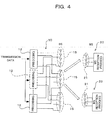
- the above-mentioned grouping can be performed in such a manner that adjacent L t -number of transmission antennas are grouped into one group, or in such a manner that, as schematically described in FIG. 4 , L t -number of transmission antennas which are disposed at an equal interval (distance) from a certain reference transmission antenna 15 are grouped into one group.
- L r xN t 2x9 matrix.
- one antenna group is capable of communicating with multiple MS 20 (multi user MIMO transmission).
- the MS 20 selects an antenna group (a block of element estimation values) using any one of the following antenna selection criteria as shown in the following items (a) through (c), that is, a first antenna selection criterion relating to communication quality with the BS 10. That is, of the multiple blocks of the above-mentioned element estimation values, the to-be-used antenna selector 26 has a function as a block selecting means which selects a block that satisfies any one of the following antenna selection criteria (a) through (c).
- the MS 20 selects an antenna group which maximizes the minimum singular value ⁇ min ⁇ H s ⁇ of the channel matix H s under the following formula (2) (this means that the minimum SNR is maximized).
- ⁇ arg max H s ⁇ H ⁇ min H s
- the MS 20 selects an antenna group which minimizes a channel condition number, that is, the value obtained by diving the maximum singular value ⁇ max ⁇ H s ⁇ by the minimum singular value ⁇ min ⁇ H s ⁇ (this means that an error rate is optimized) under the following formula (3).
- ⁇ arg max H s ⁇ H ⁇ max H s ⁇ min H s
- the MS 20 compares the number of transmission antennas and the number of reception antennas included in the selected antenna group to evaluate whether or not the number L t of transmission antennas is smaller or equal to the number L r of reception antennas (step S24).
- the precoding matrix calculator/code word retriever 29 of the MS 20 transmits (notifies) the indexes of the selected transmission antennas 15 to the BS 10 through the feedback channel 40 (from Y route of step S24 to step S25).
- the to-be-used antenna selector 26 makes the number L t of transmission antennas and the number L r of reception antennas included in the selected antenna group equal, and searches all the combinations of the transmission and the reception antennas included in the selected antenna group, and reevaluates whether or not the combinations satisfy a predetermined antenna selection criterion (a second criterion for antenna selection based on communication quality) (for example, than the condition number of the above-mentioned channel is not smaller than a certain threshold value) (steps S26 and S27).
- a predetermined antenna selection criterion a second criterion for antenna selection based on communication quality
- adjustment (selection) of transmission/reception antennas to be reevaluated can be performed by means of calculating SINR (Signal-to-Interference and Noise power Ratio) of each of the antennas 15 and 21 to exclude the antennas 15 and 21 having the minimum SINR, or by means of selecting antennas 15 and 21 with a large SINR or a large mean electric power.
- SINR Signal-to-Interference and Noise power Ratio
- the precoding matrix calculator/code word retriever 29 of the MS 20 transmits (notifies) the indexes of the selected transmission antennas 15, like in step S25, to the BS 10 through the feedback channel 40 (Y route of step S27 to step S28).
- the to-be-used antenna selector 26 has a function as an element estimation value selecting means which selects combinations satisfying the second selection criterion relating to communication quality, out of the combinations of element estimation values of the block selected by the above-mentioned block selecting means.
- the selecting means has a function as an evaluating means which evaluates whether or not any combination exists which satisfies a criterion relating to MIMO communication between the same number of reception antennas and transmission antennas 15, out or the above-mentioned combinations of the element estimation values.
- the precoding matrix calculator/code word retriever 29 has a function as a notifying means which generates antenna selection information for the BS 10 on the basis of the selection result by the to-be-used antenna selector (block selecting means or element estimation value selecting means) 26 and notifies the BS 10 of the generated information.
- the to-be-used antenna selector 26 further evaluates whether or not eigen mode transmission is to be performed (N route of step S27 to step S29). As a result, if the to-be-used antenna selector 26 decides that the to-be-used antenna selector 26 is to perform eigen mode transmission, the precoding matrix calculator/code word retriever 29 (the Singular Value Decomposition: SVD) of the MS 20 calculates the SVD (Singular Value Decomposition) of the CSI (channel matrix) to obtain the precoding matrix (described below) and transmits the obtained SCI to the BS 10 through the feedback channel 40 (from Y route of step S29 to step S30).
- the precoding matrix calculator/code word retriever 29 the Singular Value Decomposition: SVD
- the precoding matrix calculator/code word retriever 29 calculates the SVD (Singular Value Decomposition) of the CSI (channel matrix) to obtain the precoding matrix (described below) and transmits the obtained SCI to the BS 10
- the precoding matrix calculator/code word retriever 29 of the MS 20 searches for the indexes of code words of the code book in the code book memory 28, and transmits the indexed of the code word to the BS 10 through the feedback channel 40 (from N route of step S29 to step S31).
- the precoding matrix calculator/code word retriever 29 has a function as a antenna selection information generating means which generates, if it is evaluated that a combination of the element estimation values exists by the evaluating unit, the antenna selection information (antenna index) corresponding to the combination of the element estimation values, and generates, if it is evaluated that such a combination does not exist by the evaluating unit, precoding information (indexes of precoding matrix or cord words) necessary for precoding transmission of the BS 10 on the basis of the combination of element estimation values, as the antenna selection information, and notifies the BS 10 of the generated information.
- the transmission antenna selection controller 18 of the BS 10 controls the antenna switch 14 to connect the transmission antennas 15 which are identified by antenna indexes notified as described above to the RF transmitter 13 in which transmission data streams are identified to exist, and performs MIMO multiplexing transmission (from Y route of step S13 to step S14).
- the BS 10 precoding matrix/code word selector 17 evaluates whether or not eigen mode transmission is to be performed (N route of step S13 to step S15). As a result, if the precoding matrix is notified from the MS 20 through the feedback channel 40, and if it is evaluated that eigen mode transmission is to be performed in step S15, the precoding matrix/code word selector 17 gives the precoding processor 12 the precoding matrix.
- the transmission antenna selection controller 18 controls the antenna switch 14 to connect the RF transmitter 13 in which a transmission data streams exists to the selected transmission antennas 15 (in this case, the number of antennas is greater than the number of reception antennas selected on the MS 20).
- the BS 10 uses the transmission antennas 15 which is larger in number than the reception antennas (transmission data streams) on the MS 20 to perform beam forming due to the above-mentioned precoding and performs transmission to the MS 20 (Y route of step S15 to step S16).
- the precoding matrix/code word selector 17 retries the code book memory 16 for the code book corresponding to the indexes of the code words, and determines the precoding matrix on the basis of the corresponding code book to give the precoding matrix to the precoding processor 12 on the basis of the corresponding code book.
- the transmission antenna selection controller 18 controls the antenna switch 14, thereby connecting the RF transmitter 13 in which transmission data streams exist, to the selected transmission antennas 15 (in this case, also, the number of transmission antennas is greater than the number of selected reception antennas).
- the BS 10 uses the transmission antennas 15 which is greater in number than the reception antennas on the MS 20 (the number of transmission data streams) to perform beam forming by the a for ementioned precoding, and transmits the resultant beam forming to the MS 20 (N route of step S15 to step S17).
- the precoding processor 12 performs precoding transmission by means of transmission antennas 15 corresponding to the combination of element estimation values on the basis of the precoding information.
- the transmission antennas 15 in one antenna group of the BS 10 is not included in the multiple MSs 20 (for example, in FIG. 2 as described above), it is possible to transmit to the MSs 20 at the same time. If a part of or all of the transmission antennas 15 in one antenna group of the BS 10 multiplex are included with respect to multiple MS 20, time divisional transmission is to be performed with respect to the multiplexed transmission antennas 15.
- reciprocity of channels makes it possible to estimate channel information based on the sounding of the BS 10 and the MS 20.
- FDD Frequency Division Duplex
- the BS 10 acknowledges down-link channel information due to the feedback from the MS 20 to the BS 10.
- the precoding matrix calculator/code word retriever 29 of the MS 20 performs singular value decomposition (SVD) of the CSI, and obtains the decomposition of the matrix as precoding matrix.
- SVD singular value decomposition
- the CSI channel matrix H
- U is a left singular matrix
- V is a right singular matrix
- D is a diagonal matrix
- its element ⁇ 1 , ... ⁇ m are proportional to the obtain of the eigen mode.
- the obtain of the eigen mode is obtained, and the first eigen mode ⁇ 2 is the maximum, the m th eigen mode ⁇ m is the minimum.
- m presents the rank of the channel matrix H.
- x Fs
- s represents N s ⁇ 1 transmission vector
- x represents transmission antenna data vector L t ⁇ 1.
- n noise vector of L r ⁇ 1.
- y represents the reception signal of L r ⁇ 1 and the signal of each reception antenna 21 is multiplexed with transmission signals.
- H F given as known values on the MS 20
- ML maximum likelihood
- Q[ ] represents a demapper
- G represents the matrix of N s ⁇ L r .
- G HF + where () + expresses a pseudo-inverse matrix.
- the same code book is determined between the transmitter end (BS 10) and the receiver end (MS 20). Then, as described above, it is assumed that the BS 10 and the MS 20 stores the same code book in the code book memory 16 and the code book memory 28.
- the channel estimator 25 performs channel estimation, and obtains CSI, and on the basis of the obtained CSI, the optimum code word is selected according to any one of the following criteria (1) through (3).
- MSE Mel Square Error
- the precoding matrix calculator/code word retriever 29 selects a code word which minimizes the Trace (tr) or the Determinant (det) of MSE of this formula (11), out of the code book. That is, the following formula (12) is selected by the following formula (13).
- F arg min F j ⁇ F tr MSE
- F j arg min F j ⁇ F det MSE
- the MS 20 selects a code word, out of a code book, in such a manner that the capacity is maximized under the following formula (14).
- F arg max F j ⁇ F log 2 det I N s + ⁇ N s F ′ H ′ HF
- the MS 20 (precoding matrix calculator/code word retriever 29) can select a code word, out of the code book, in such manner that the minimum singular value is maximized.
- F arg max F j ⁇ F ⁇ min H F j
- the MS 2C precoding matrix calculator/code word retriever 29
- the index (L bit) of the code word selected under the above-described criterion transfers the index (L bit) of the code word selected under the above-described criterion to the BS 10 through the feedback channel 40.
- the matrix (or vector) is used as a precoding matrix by use of the corresponding code book.
- linear decoder ZF liner decoder or MMSE linear decoder
- the transmission antennas 15 of the BS 10 and the reception antennas 21 of the MS 20 are grouped into multiple antenna groups composed of multiple transmission antennas 15 and multiple reception antennas. Out of the antenna groups, antenna groups satisfying the first antenna selection criterion are selected, and out of the selected antenna groups, the combinations of the transmission antennas 15 and the reception antennas 21 satisfying the second antenna criterion are selected.
- MIMO communication is performed using such a communication transmission and reception antennas, and since if the combination satisfying the predetermined (the above mentioned first or second) antenna selection criterion exists, MIMO communication is performed using such a communication transmission and reception antennas, and if the combination appropriate for MIMO communication does not exits, precoding (beam-forming) is performed using a greater number of antennas 15 than the reception antennas, communication quality such as transmission capacity and electric wave reachable range in which communication reliability is maintained is secured in what kind of radio communication environment.
- the BS 10 receives a signal from the MS 20, if not all of the reception antennas are used but an antenna group is selected, performance of MRC (Maximum Ratio Combining) can be improved.
- MRC Maximum Ratio Combining
- FIG. 6 is a block diagram showing a construction of multi antenna radio communication system According to second embodiment of the present invention.
- the radio communication, system of FIG. 6 includes at least one base station (BS) 10 and at least on relay station (RS) apparatus 30.
- the BS 10 is constructed as in that of the first embodiment; the important part of the RS 30 includes N r -number (N r is an integer greater than 1) of reception antennas 31-1 through 31-N r (hereinafter described as reception antenna 31 when distinction is not made), an antenna switch 32, L r -number (L r is an integer greater than 1 and L r ⁇ N r ) of RF receiver 33-1 through 33-L r (hereinafter described as an RF receiver 33 when distinction is not made), a MIMO reception signal processor 34, a channel estimator 35, an antenna selector (to-be-used antenna selector) 36, an antenna section controller 37, a code book memory 38, and a precoding matrix calculator/code word retriever 39.
- the RS 30 of the present example has approximate the same construction of the MS 20 as described in FIG. 1 , but since it has an antenna switch 32 and antenna section controller 37, it is possible for the RS 30 to select the reception antenna 31 to be used.
- the antenna switch 32 connects arbitrary reception antennas 31 and arbitrary RF receivers 33 according to control from the antenna section controller 37; the reception antenna selection controller 27 performs connection control between the reception antennas 31 determined (selected) by the to-be-used antenna selector 36 and the RF receiver 33 according to the procedure similar the first embodiment.
- the reception antenna 31, the RF receiver 33, the MIMO reception signal processor 34, the channel estimator 35, the to-be-used antenna determiner 36, the antenna section controller 37, the code book 38, the preceding matrix calculator/code word retriever 39 are the same as or similar to the already described reception antenna 21, the RF receiver 23, the MIMO reception signal processor 24, the channel estimator 25, the to-be-used antenna selector 26, the reception antenna selection controller 27, the code book memory 28, the precoding matrix calculator/code word retriever 29.
- all the reception antennas 31 on the RS 30 are not treated as construction elements of one antenna group, and as schematically described in FIG. 7 , for example, they are grouped with respect to the reception antennas 31.
- adjacent antennas or antennas with equal intervals can be grouped as elements of one antenna group.
- a part of transmission antennas 15 or reception antennas 31 which are included in one antenna group can be included in another antenna group.
- the number of transmission antennas of the BS 10 included in one antenna group is greater than the number of reception antennas of the RS 30.
- hierarchical antenna selection makes possible selection of optimal combination according to radio environment, thereby performing beam forming according MIMO communication or precoding.
- the to-be-used antenna determiner 36 selects, out of the antenna groups, antenna groups that satisfy the above-mentioned first antenna selection criterion on the basis of the CSI obtained by the channel estimator 35. Out of the selected antenna groups, the RS 30 selects combinations of transmission antennas 15 and reception antennas 31 which satisfy the above-mentioned second antenna selection criterion. Then, if there is a combination in which the transmission antennas 15 and the reception antennas 31 are equal in number, MIMO communication is performed. In other cases, precoding (beam forming) is performed using all the transmission antennas 15 of the selected antenna groups.
- the invention also provides a computer program or a computer program product for carrying out any of the methods described herein, and a computer readable medium having stored thereon a program for carrying out any of the methods described herein.
- a computer program embodying the invention may be stored on a computer-readable medium, or it could, for example, be in the form of a signal such as a downloadable data signal provided from an Internet website, or it could be in any other form.
Landscapes
- Engineering & Computer Science (AREA)
- Computer Networks & Wireless Communication (AREA)
- Signal Processing (AREA)
- Physics & Mathematics (AREA)
- Mathematical Physics (AREA)
- Power Engineering (AREA)
- Radio Transmission System (AREA)
- Mobile Radio Communication Systems (AREA)
Claims (9)
- Procédé de radiocommunication utilisé dans un récepteur d'un système de radiocommunication dans lequel une radiocommunication est effectuée entre un émetteur-récepteur (10) possédant un nombre Nt (Nt est un entier supérieur à 1) d'antennes de transmission (15) et un récepteur possédant un nombre Nr (Nr est un entier supérieur à 1) d'antennes de réception, ledit procédé comportant :le regroupement d'un nombre (Nr x Nt) de valeurs d'estimation de canal, qui sont obtenues entre les antennes de transmission (15) et les antennes de réception (21), en une pluralité de blocs comprenant un nombre (Lr x Lt) (Lt < Nt, Lr) de valeurs d'estimation d'élément ;la sélection d'un bloc qui satisfait un premier critère de sélection ayant trait à une qualité de communication, parmi la pluralité de blocs ;la sélection d'une ou de plusieurs combinaisons qui satisfont un second critère ayant trait à une qualité de communication, parmi les combinaisons de valeurs d'estimation d'élément qui sont comprises dans le bloc sélectionné ;dans lequel l'étape de sélection de ladite une ou plusieurs combinaisons est caractérisée parl'évaluation si oui ou non au moins une des combinaisons existe, ladite au moins une des combinaisons satisfaisant ledit second critère ayant trait à une qualité d'une communication MIMO lorsque le nombre d'antennes de réception sélectionnées est égal au nombre d'antennes de transmission sélectionnées (15) ;l'exécution, s'il est évalué qu'une telle combinaison existe, d'une communication MIMO utilisant la combinaison d'antennes de transmission (15) ; etl'exécution, s'il est évalué qu'une telle combinaison n'existe pas, d'une transmission de précodage en utilisant toutes les antennes de transmission sélectionnées (15) dont le nombre est supérieur à celui des antennes de réception sélectionnées (21).
- Procédé de radiocommunication selon la revendication 1,
dans lequel l'émetteur-récepteur (10) est un appareil de station de base, et
dans lequel le récepteur (20) est un appareil de station mobile. - Procédé de radiocommunication selon la revendication 1 ou 2,
dans lequel l'émetteur-récepteur (10) est un appareil de station de base, et
dans lequel le récepteur (20) est un appareil de station relais. - Procédé de radiocommunication selon l'une quelconque des revendications 1 à 3,
dans lequel l'émetteur-récepteur (10) est un appareil de station relais, et
dans lequel le récepteur (20) est un appareil de station mobile. - Récepteur utilisé dans un système de radiocommunication dans lequel une radiocommunication est effectuée entre un émetteur-récepteur (10) possédant un nombre Nt (Nt est un entier supérieur à 1) d'antennes de transmission (15) et un récepteur (20) possédant un nombre Nr (Nr est un entier supérieur à 1) d'antennes de réception (21), ledit récepteur comportant :un moyen de regroupement (26) qui regroupe un nombre (Nr x Nt) de valeurs d'estimation de canal, qui sont obtenues entre des antennes de transmission (15) et les antennes de réception (21), en une pluralité de blocs comprenant un nombre (Lr x Lt) (Lt < Nt, Lr ≤ Nr) de valeurs d'estimation d'élément ;un moyen de sélection de bloc qui sélectionne un bloc qui satisfait un premier critère de sélection ayant trait à une qualité de communication, parmi la pluralité de blocs obtenus par ledit moyen de regroupement (26) ;un moyen de sélection de valeur d'estimation d'élément qui sélectionne une ou plusieurs combinaisons qui satisfont un second critère ayant trait à une qualité de communication, parmi les combinaisons de valeurs d'estimation d'élément qui sont comprises dans le bloc sélectionné par ledit moyen de sélection de bloc ;un moyen de notification (29) qui génère une information de sélection d'antenne pour l'émetteur-récepteur en fonction du résultat de sélection obtenue par ledit moyen de sélection de bloc ou ledit élément de sélection de valeur d'estimation d'élément et notifie à l'émetteur-récepteur l'information de sélection d'antenne générée ;
caractérisé en ce queledit moyen de sélection de valeur d'estimation d'élément comprend une unité d'évaluation qui évalue si oui ou non au moins une des combinaisons existe, ladite au moins une des combinaisons satisfaisant ledit second critère ayant trait à une qualité d'une communication MIMO lorsque le nombre d'antennes de réception sélectionnées est égal au nombre d'antennes de transmission sectionnées (15), etdans lequel ledit moyen de notification comprend une unité de génération d'information de sélection d'antenne qui génère, s'il est évalué par ladite unité d'évaluation qu'une telle combinaison existe, l'information de sélection d'antenne correspondant à la combinaison, et qui génère, s'il est évalué par ladite unité d'évaluation qu'une telle combinaison n'existe pas, une information de précodage en utilisant toutes les antennes de transmission sélectionnées (15) dont le nombre est supérieur à celui des antennes de réception sélectionnées (21) nécessaires pour une transmission de précodage par ledit émetteur-récepteur (10), en tant qu'information de sélection d'antenne en fonction de la combinaison de valeurs d'estimation d'élément et notifie à l'émetteur-récepteur l'information de sélection d'antenne. - Récepteur selon la revendication 5, dans lequel le bloc comprend de multiples valeurs d'estimation d'élément adjacentes ou de multiples valeurs d'estimation d'élément disposées à égale distance d'une valeur d'estimation d'élément de référence dans une matrice de canal Nr x Nt.
- Récepteur selon la revendication 5 ou la revendication 6, dans lequel une partie des valeurs d'estimation d'élément comprises dans un bloc sont comprises dans un autre bloc.
- Récepteur selon l'une quelconque des revendications 5 à 7, dans lequel Lt > Lr.
- Émetteur-récepteur utilisé dans un système de radiocommunication dans lequel une radiocommunication est effectuée entre un émetteur-récepteur (10) possédant un nombre Nt (Nt est un entier supérieur à 1) d'antennes de transmission (15) et un récepteur (20) selon l'une quelconque des revendications 5 à 8, ledit émetteur-récepteur comportant :un moyen de réception (17) qui reçoit l'information de sélection d'antenne depuis ledit moyen de notification (29) ; etun moyen de sélection d'antenne (18) qui sélectionne une antenne de transmission à utiliser selon l'information de sélection d'antenne reçue par ledit moyen de réception (17),caractérisé en outre en ce qu'il comporte un moyen de précodage (12) qui effectue, lorsque l'information de précodage est reçue par ledit moyen de réception (17) en tant qu'information de sélection d'antenne, une transmission de précodage en utilisant les antennes de transmission (15) correspondant à la combinaison de valeurs d'estimation d'élément, en fonction de l'information de précodage reçue.
Priority Applications (1)
| Application Number | Priority Date | Filing Date | Title |
|---|---|---|---|
| EP14166282.5A EP2763328A3 (fr) | 2006-10-04 | 2007-08-13 | Procédé de communication radio avec la sélection d'un sous-groupe d'antennes de transmission et réception |
Applications Claiming Priority (1)
| Application Number | Priority Date | Filing Date | Title |
|---|---|---|---|
| JP2006273018A JP4734210B2 (ja) | 2006-10-04 | 2006-10-04 | 無線通信方法 |
Related Child Applications (2)
| Application Number | Title | Priority Date | Filing Date |
|---|---|---|---|
| EP14166282.5A Division EP2763328A3 (fr) | 2006-10-04 | 2007-08-13 | Procédé de communication radio avec la sélection d'un sous-groupe d'antennes de transmission et réception |
| EP14166282.5A Division-Into EP2763328A3 (fr) | 2006-10-04 | 2007-08-13 | Procédé de communication radio avec la sélection d'un sous-groupe d'antennes de transmission et réception |
Publications (3)
| Publication Number | Publication Date |
|---|---|
| EP1909406A2 EP1909406A2 (fr) | 2008-04-09 |
| EP1909406A3 EP1909406A3 (fr) | 2008-06-11 |
| EP1909406B1 true EP1909406B1 (fr) | 2016-05-25 |
Family
ID=38790935
Family Applications (2)
| Application Number | Title | Priority Date | Filing Date |
|---|---|---|---|
| EP14166282.5A Withdrawn EP2763328A3 (fr) | 2006-10-04 | 2007-08-13 | Procédé de communication radio avec la sélection d'un sous-groupe d'antennes de transmission et réception |
| EP07114250.9A Ceased EP1909406B1 (fr) | 2006-10-04 | 2007-08-13 | Procédé de communication radio, transmetteur et récepteur avec la sélection d'un sous-groupe d'antennes de transmission et réception |
Family Applications Before (1)
| Application Number | Title | Priority Date | Filing Date |
|---|---|---|---|
| EP14166282.5A Withdrawn EP2763328A3 (fr) | 2006-10-04 | 2007-08-13 | Procédé de communication radio avec la sélection d'un sous-groupe d'antennes de transmission et réception |
Country Status (5)
| Country | Link |
|---|---|
| US (1) | US7873113B2 (fr) |
| EP (2) | EP2763328A3 (fr) |
| JP (1) | JP4734210B2 (fr) |
| KR (1) | KR100967754B1 (fr) |
| CN (1) | CN101159464B (fr) |
Families Citing this family (96)
| Publication number | Priority date | Publication date | Assignee | Title |
|---|---|---|---|---|
| US7689177B2 (en) * | 2006-05-24 | 2010-03-30 | Samsung Electronics Co., Ltd. | Method and apparatus for transmitting/receiving feedback information and system supporting the same in a multi-user multi-antenna system |
| JP2008211462A (ja) | 2007-02-26 | 2008-09-11 | Fujitsu Ltd | ビームウェイト検出制御方法及び受信機 |
| CN101378277B (zh) * | 2007-08-29 | 2016-04-06 | 上海贝尔股份有限公司 | 多用户预编码及调度方法和实现该方法的基站 |
| KR101372736B1 (ko) * | 2007-09-28 | 2014-03-26 | 삼성전자주식회사 | 통신 시스템에서 피드백 정보 송신 장치 및 방법 |
| JP5146464B2 (ja) | 2007-12-05 | 2013-02-20 | 富士通株式会社 | 送信装置、送信制御方法および通信装置 |
| KR100966054B1 (ko) | 2007-12-14 | 2010-06-28 | 한국전자통신연구원 | 다중입력 다중출력 시스템에서 부반송파별 가변 전송 방법 |
| EP2073471A1 (fr) * | 2007-12-20 | 2009-06-24 | Sony Corporation | Critères de sélection améliorés pour un multiplexage mimo spatial, précodé et quantifié |
| US8929325B2 (en) * | 2008-02-01 | 2015-01-06 | Apple Inc. | System and method for spatial multiplexing-based multiple antenna broadcast/multicast transmission |
| CN101981826A (zh) * | 2008-03-28 | 2011-02-23 | 爱立信电话股份有限公司 | 用于mimo系统中的天线选择的方法和设备 |
| CN101552633A (zh) * | 2008-04-02 | 2009-10-07 | 株式会社Ntt都科摩 | 一种多输入多输出预编码方法及装置 |
| US8306095B2 (en) * | 2008-04-29 | 2012-11-06 | Samsung Electronics Co., Ltd. | Methods and apparatus for network coding in a communication system |
| US8149946B2 (en) * | 2008-05-06 | 2012-04-03 | Industrial Technology Research Institute | Joint transceiver design for MIMO communications |
| US20090325479A1 (en) * | 2008-06-25 | 2009-12-31 | Qualcomm Incorporated | Relay antenna indexing for shared antenna communication |
| EP2141824B1 (fr) | 2008-06-30 | 2012-03-07 | Alcatel Lucent | Procédé pour l'attribution de vecteurs de précodage dans un réseau cellulaire mobile |
| JP5174169B2 (ja) | 2008-07-30 | 2013-04-03 | 株式会社日立製作所 | 無線通信システムおよび無線通信方法 |
| US8204151B2 (en) * | 2008-08-06 | 2012-06-19 | Samsung Electronics Co., Ltd. | Methods and apparatus to generate multiple antennas transmit precoding codebook |
| US9755705B2 (en) * | 2008-08-07 | 2017-09-05 | Qualcomm Incorporated | Method and apparatus for supporting multi-user and single-user MIMO in a wireless communication system |
| US9294160B2 (en) * | 2008-08-11 | 2016-03-22 | Qualcomm Incorporated | Method and apparatus for supporting distributed MIMO in a wireless communication system |
| KR101495824B1 (ko) * | 2008-08-22 | 2015-02-25 | 삼성전자주식회사 | 다중 안테나 무선통신 시스템에서 프리코딩 행렬 선택 방법및 장치 |
| AU2008361474A1 (en) | 2008-09-05 | 2010-03-11 | Telefonaktiebolaget L M Ericsson (Publ) | Methods and arrangements in a radio access network |
| JP5256955B2 (ja) * | 2008-09-12 | 2013-08-07 | 富士通株式会社 | 制御方法、通信特性制御方法、基地局装置、及び移動局装置 |
| WO2010039069A1 (fr) * | 2008-10-01 | 2010-04-08 | Telefonaktiebolaget L M Ericsson (Publ) | Systèmes et procédés pour générer un livre de code de précodage |
| EP3651390B1 (fr) * | 2008-11-14 | 2024-07-24 | Sun Patent Trust | Appareil de terminal de communication sans fil et procédé de réglage de constellation de groupe |
| US8488536B2 (en) * | 2008-12-11 | 2013-07-16 | Alvarion Ltd. | Mode selection for MIMO in wireless communication |
| JP4587004B2 (ja) * | 2009-01-07 | 2010-11-24 | 岩崎通信機株式会社 | マルチアンテナを用いた無線通信方法、無線通信システムおよび無線通信装置 |
| US8503572B2 (en) * | 2009-02-02 | 2013-08-06 | Qualcomm Incorporated | Antenna virtualization in a wireless communication environment |
| KR101644433B1 (ko) * | 2009-02-13 | 2016-08-01 | 엘지전자 주식회사 | 4 안테나 시스템에서 상향링크 프리코딩 수행 방법 |
| KR101502148B1 (ko) * | 2009-03-04 | 2015-03-12 | 삼성전자주식회사 | 저 복잡도로 간섭 정렬 기법을 적용하는 통신 네트워크 |
| CN102342056A (zh) * | 2009-03-05 | 2012-02-01 | 三菱电机株式会社 | 无线通信系统、发送装置以及接收装置 |
| FR2943207B1 (fr) * | 2009-03-16 | 2012-01-13 | Canon Kk | Procede de configuration d'antennes de dispositifs emetteur et recepteur dans un reseau de communication sans-fil, produit programme d'ordinateur, moyen de stockage et dispositifs correspondants |
| FR2943206B1 (fr) * | 2009-03-16 | 2012-01-13 | Canon Kk | Procede de configuration d'une antenne agile d'un dispositif recepteur dans un reseau de communication sans-fil, produit programme d'ordinateur, moyen de stockage et dispositif correspondant |
| JP5488016B2 (ja) * | 2009-03-30 | 2014-05-14 | 富士通株式会社 | 無線通信方法、無線通信システム及び無線通信装置 |
| KR101800294B1 (ko) * | 2009-04-02 | 2017-12-20 | 삼성전자주식회사 | 다중 셀 통신 시스템에서 셀 가장자리 사용자의 에러를 최소화하기 위한 장치 및 방법 |
| US8036098B2 (en) * | 2009-04-20 | 2011-10-11 | Intel Corporation | Wireless network and method for adaptive opportunistic clustering for interference alignment in wireless networks |
| US8289910B2 (en) | 2009-04-24 | 2012-10-16 | Kathrein-Werke Kg | Device for receiving and transmitting mobile telephony signals with multiple transmit-receive branches |
| RU2552643C2 (ru) | 2009-04-30 | 2015-06-10 | Конинклейке Филипс Электроникс Н.В. | Способ осуществления связи в сети |
| JP5369896B2 (ja) * | 2009-05-25 | 2013-12-18 | 富士通株式会社 | 通信装置、通信方法、通信システム及び基地局装置ならびに移動局装置 |
| CN101582712B (zh) * | 2009-06-19 | 2014-11-05 | 中兴通讯股份有限公司 | 一种实现预编码的方法及预编码矩阵集的生成方法 |
| JP5347755B2 (ja) * | 2009-06-24 | 2013-11-20 | 富士通株式会社 | 中継装置、通信システムおよび通信方法 |
| US9054763B2 (en) | 2009-07-24 | 2015-06-09 | Panasonic Intellectual Property Corporation Of America | Wireless communication device and wireless communication method |
| CN101626262B (zh) * | 2009-08-11 | 2012-12-19 | 中兴通讯股份有限公司 | 预编码矩阵选择方法及装置 |
| WO2011027635A1 (fr) | 2009-09-02 | 2011-03-10 | 日本電気株式会社 | Appareil de communication sans fil, procédé et programme de communication sans fil |
| US8259857B2 (en) * | 2009-12-10 | 2012-09-04 | The Aerospace Corporation | Methods and systems for increased communication throughput |
| US9173191B2 (en) | 2009-12-20 | 2015-10-27 | Intel Corporation | Device, system and method of simultaneously communicating with a group of wireless communication devices |
| US8374154B2 (en) * | 2009-12-23 | 2013-02-12 | Intel Corporation | Device, system and method of simultaneously communicating with a group of wireless communication devices |
| JP2011139268A (ja) * | 2009-12-28 | 2011-07-14 | Fujitsu Ltd | 無線中継装置、無線中継方法 |
| EP2541823B1 (fr) | 2010-02-25 | 2014-12-10 | Nippon Telegraph And Telephone Corporation | Système de transmission sans fil à multiplexage spatial, procédé de transmission sans fil à multiplexage spatial et programme d'ordinateur |
| US20120113909A1 (en) * | 2010-05-06 | 2012-05-10 | Yu-Chih Jen | Method of Handling an Uplink Control Channel and Related Communication Device |
| JP5627080B2 (ja) * | 2010-05-31 | 2014-11-19 | シャープ株式会社 | 通信システム、送信装置、送信制御方法、送信制御プログラム、及びプロセッサ |
| JP5625573B2 (ja) * | 2010-07-15 | 2014-11-19 | 富士通株式会社 | 無線通信システム及び無線通信装置、並びに無線通信方法 |
| CN102468925B (zh) * | 2010-11-09 | 2014-05-28 | 大唐移动通信设备有限公司 | 预编码矩阵索引上报及预编码处理方法、系统和装置 |
| KR20120083619A (ko) * | 2011-01-18 | 2012-07-26 | 삼성전자주식회사 | 분산 안테나 시스템에서 레인징을 수행하기 위한 장치 및 방법 |
| JP5724496B2 (ja) * | 2011-03-17 | 2015-05-27 | 富士通株式会社 | 無線通信システム及び無線通信方法 |
| JP5562281B2 (ja) * | 2011-03-24 | 2014-07-30 | 株式会社日立製作所 | 無線通信システム、基地局装置及び無線通信方法 |
| CN103098381A (zh) * | 2011-06-28 | 2013-05-08 | 华为技术有限公司 | 分布式天线系统的天线组分配的方法和装置 |
| CN103138821B (zh) * | 2011-11-30 | 2017-02-08 | 华为技术有限公司 | 一种数据传输方法、装置及系统 |
| CN103188768A (zh) * | 2011-12-30 | 2013-07-03 | 华为终端有限公司 | 一种通信模式选择方法及装置 |
| EP2639970A1 (fr) * | 2012-03-15 | 2013-09-18 | Thomson Licensing | Procédé et appareil permettant de commander une connexion sans fil dans un système MIMO utilisant des antennes directionnelles multisecteurs |
| JP5985853B2 (ja) * | 2012-03-28 | 2016-09-06 | 京セラ株式会社 | 通信システム、基地局、移動局及び通信制御方法 |
| EP2850796B8 (fr) * | 2012-05-18 | 2020-12-16 | Rearden, LLC | Systèmes et procédés pour améliorer une diversité spatiale dans des systèmes sans fil à entrées distribuées sorties distribuées |
| KR101932197B1 (ko) | 2012-07-03 | 2018-12-24 | 삼성전자주식회사 | 다중 안테나 통신 시스템에서의 안테나 개수 결정 방법 및 장치 |
| US9673878B1 (en) * | 2012-08-28 | 2017-06-06 | Marvell International Ltd. | Systems and methods for performing precoding in multi-user systems |
| JP6190889B2 (ja) * | 2012-11-09 | 2017-08-30 | インターデイジタル パテント ホールディングス インコーポレイテッド | ビーム形成方法およびビームを使用するための方法 |
| KR101439731B1 (ko) * | 2013-01-18 | 2014-09-12 | 경상대학교산학협력단 | 복수 개의 안테나를 이용하여 단말과 통신하는 장치 및 방법 |
| CN108923888B (zh) * | 2013-06-19 | 2021-10-22 | Lg 电子株式会社 | 传输和接收广播信号的装置、传输和接收广播信号的方法 |
| EP3028388B1 (fr) * | 2013-07-30 | 2019-08-07 | LG Electronics Inc. | Procédé pour rapporter des informations d'état de canal pour un réseau d'antennes partiel basé sur la formation de faisceau dans un système de communication sans fil |
| CN105432026B (zh) * | 2013-07-30 | 2018-10-30 | Lg电子株式会社 | 在无线通信系统中利用基于部分天线阵列的波束成形执行天线重排的方法及其设备 |
| US9143206B2 (en) | 2014-02-04 | 2015-09-22 | Qualcomm Incorporated | Antenna selection with eMBMS |
| JP5830568B2 (ja) * | 2014-04-25 | 2015-12-09 | シャープ株式会社 | 端末装置、基地局装置、通信方法および集積回路 |
| JP6278131B2 (ja) * | 2014-06-16 | 2018-02-14 | 日本電気株式会社 | Pmiを計算する方法及び無線通信システム |
| WO2015194229A1 (fr) * | 2014-06-16 | 2015-12-23 | Nec Corporation | Calcul de pmi, en particulier dans des systèmes de communication sans fil dotés de canaux de communication en trois dimensions, utilisant une antenne de référence ou un sous-ensemble d'antennes de référence |
| KR101555018B1 (ko) * | 2014-10-10 | 2015-09-23 | 한국철도기술연구원 | 대규모 미모 시스템 및 대규모 미모 시스템의 송수신 방법 |
| US9872296B2 (en) * | 2015-01-06 | 2018-01-16 | Qualcomm Incorporated | Techniques for beam shaping at a millimeter wave base station and a wireless device and fast antenna subarray selection at a wireless device |
| CN105991169B (zh) * | 2015-02-02 | 2019-06-25 | 启碁科技股份有限公司 | 无线通信装置与天线搜索方法 |
| KR102356781B1 (ko) * | 2015-09-14 | 2022-01-28 | 엘지전자 주식회사 | 다중 안테나 기반 무선 통신 시스템에서 데이터를 송신하는 방법 |
| US10931343B2 (en) * | 2015-10-30 | 2021-02-23 | Panasonic Intellectual Property Corporation Of America | Transmitting method, transmitting device, receiving method and receiving device |
| CN105429686B (zh) * | 2015-11-05 | 2018-10-12 | 江苏中兴微通信息科技有限公司 | 分离型非对称混合波束成型的传输装置及方法 |
| EP3185616B1 (fr) * | 2015-12-22 | 2020-06-10 | Intel IP Corporation | Terminal de communication et procédé pour effectuer une recherche de cellule |
| CN106982089B (zh) * | 2016-01-19 | 2021-02-09 | 中兴通讯股份有限公司 | 一种数据传输方法和装置 |
| JP6400614B2 (ja) * | 2016-02-12 | 2018-10-03 | 日本電信電話株式会社 | 分散アンテナを用いた無線基地局およびアンテナ切替方法 |
| KR101879030B1 (ko) * | 2016-02-24 | 2018-07-17 | 한국과학기술원 | 안테나 그룹핑을 이용한 채널 정보 피드백 및 자원 할당 방법 및 이를 수행하는 장치들 |
| JP6929530B2 (ja) * | 2017-01-10 | 2021-09-01 | 国立研究開発法人情報通信研究機構 | 無線通信システム |
| CN108631847B (zh) * | 2017-03-24 | 2021-06-01 | 华为技术有限公司 | 传输信道状态信息的方法、终端设备和网络设备 |
| US10715233B2 (en) * | 2017-08-31 | 2020-07-14 | Qualcomm Incorporated | Sounding reference signal (SRS) transmit antenna selection |
| CN108173582B (zh) * | 2017-11-30 | 2020-08-25 | 东南大学 | 一种基于收发联合样式的空间调制方法和系统 |
| CN110324884B (zh) | 2018-03-30 | 2021-04-06 | 维沃移动通信有限公司 | 传输模式确定方法及设备 |
| EP3660981B8 (fr) * | 2018-11-29 | 2021-06-02 | Rohde & Schwarz GmbH & Co. KG | Dispositif et procédé de multiplexage spatial et de bande passante |
| US11641269B2 (en) | 2020-06-30 | 2023-05-02 | Rampart Communications, Inc. | Modulation-agnostic transformations using unitary braid divisional multiplexing (UBDM) |
| US10951442B2 (en) * | 2019-07-31 | 2021-03-16 | Rampart Communications, Inc. | Communication system and method using unitary braid divisional multiplexing (UBDM) with physical layer security |
| US10735062B1 (en) | 2019-09-04 | 2020-08-04 | Rampart Communications, Inc. | Communication system and method for achieving high data rates using modified nearly-equiangular tight frame (NETF) matrices |
| EP3793095B1 (fr) * | 2019-09-16 | 2025-08-27 | Telefonica, S.A. | Procédé et système de multiplexage spatial optimal dans des systèmes de communication sans fil multi-antennes utilisant des techniques mu-mimo |
| US10965352B1 (en) | 2019-09-24 | 2021-03-30 | Rampart Communications, Inc. | Communication system and methods using very large multiple-in multiple-out (MIMO) antenna systems with extremely large class of fast unitary transformations |
| US11159220B2 (en) | 2020-02-11 | 2021-10-26 | Rampart Communications, Inc. | Single input single output (SISO) physical layer key exchange |
| WO2022048800A1 (fr) * | 2020-09-03 | 2022-03-10 | HELLA GmbH & Co. KGaA | Procédé de déclenchement d'un premier dispositif en tant qu'étape d'accès à un dispositif accessible |
| CN114828107B (zh) * | 2021-01-21 | 2025-05-27 | 联发科技股份有限公司 | 用于测量和用户设备天线选择的方法 |
| CN115085776B (zh) * | 2021-03-16 | 2024-08-20 | 华为技术有限公司 | 天线的选择方法及相关产品 |
Family Cites Families (14)
| Publication number | Priority date | Publication date | Assignee | Title |
|---|---|---|---|---|
| JP4181259B2 (ja) * | 1998-12-14 | 2008-11-12 | 松下電器産業株式会社 | 受信装置及び受信方法 |
| GB0125178D0 (en) | 2001-10-19 | 2001-12-12 | Koninkl Philips Electronics Nv | Method of operating a wireless communication system |
| US8045935B2 (en) * | 2001-12-06 | 2011-10-25 | Pulse-Link, Inc. | High data rate transmitter and receiver |
| JP4178501B2 (ja) * | 2002-05-21 | 2008-11-12 | 日本電気株式会社 | アンテナ送受信システム |
| US7483718B2 (en) * | 2003-10-01 | 2009-01-27 | Broadcom Corporation | System and method for antenna selection |
| JP4184854B2 (ja) | 2003-04-07 | 2008-11-19 | 株式会社エヌ・ティ・ティ・ドコモ | 電波送受信装置及び電波送受信方法 |
| KR100981554B1 (ko) * | 2003-11-13 | 2010-09-10 | 한국과학기술원 | 다중 송수신 안테나들을 구비하는 이동통신시스템에서,송신 안테나들을 그룹핑하여 신호를 전송하는 방법 |
| JP2005245941A (ja) * | 2004-03-08 | 2005-09-15 | Olympus Corp | 受信装置 |
| JP2006067237A (ja) | 2004-08-26 | 2006-03-09 | Sharp Corp | 無線送信機および無線受信機 |
| DE602005007135D1 (de) * | 2004-09-07 | 2008-07-10 | Samsung Electronics Co Ltd | MIMO System mit adaptiver Umschaltung des Übertragungsschemas |
| CN1797987B (zh) * | 2004-12-30 | 2011-02-16 | 都科摩(北京)通信技术研究中心有限公司 | 自适应调度的mimo通信系统及其自适应用户调度方法 |
| CN1815941A (zh) * | 2005-02-04 | 2006-08-09 | 松下电器产业株式会社 | 多天线传输系统中的天线选择和比特分配方法及装置 |
| US7542439B2 (en) * | 2005-09-09 | 2009-06-02 | Intel Corporation | Methods and apparatus for providing a cooperative relay system associated with a broadband wireless access network |
| US7917101B2 (en) * | 2005-09-21 | 2011-03-29 | Broadcom Corporation | Method and system for a greedy user group selection with range reduction in TDD multiuser MIMO downlink transmission |
-
2006
- 2006-10-04 JP JP2006273018A patent/JP4734210B2/ja not_active Expired - Fee Related
-
2007
- 2007-08-13 EP EP14166282.5A patent/EP2763328A3/fr not_active Withdrawn
- 2007-08-13 EP EP07114250.9A patent/EP1909406B1/fr not_active Ceased
- 2007-08-14 US US11/889,544 patent/US7873113B2/en not_active Expired - Fee Related
- 2007-09-10 KR KR1020070091495A patent/KR100967754B1/ko not_active Expired - Fee Related
- 2007-09-10 CN CN2007101492662A patent/CN101159464B/zh not_active Expired - Fee Related
Also Published As
| Publication number | Publication date |
|---|---|
| EP1909406A2 (fr) | 2008-04-09 |
| KR100967754B1 (ko) | 2010-07-05 |
| EP2763328A3 (fr) | 2015-12-30 |
| US20070281746A1 (en) | 2007-12-06 |
| JP4734210B2 (ja) | 2011-07-27 |
| CN101159464A (zh) | 2008-04-09 |
| EP1909406A3 (fr) | 2008-06-11 |
| JP2008092433A (ja) | 2008-04-17 |
| US7873113B2 (en) | 2011-01-18 |
| CN101159464B (zh) | 2011-09-21 |
| KR20080031615A (ko) | 2008-04-10 |
| EP2763328A2 (fr) | 2014-08-06 |
Similar Documents
| Publication | Publication Date | Title |
|---|---|---|
| EP1909406B1 (fr) | Procédé de communication radio, transmetteur et récepteur avec la sélection d'un sous-groupe d'antennes de transmission et réception | |
| US7907912B2 (en) | Apparatus and method for eliminating multi-user interference | |
| US9473223B2 (en) | Methods for optimal collaborative MIMO-SDMA | |
| CN1813375B (zh) | 多天线传输方法和装置 | |
| US6987819B2 (en) | Method and device for multiple input/multiple output transmit and receive weights for equal-rate data streams | |
| US8290539B2 (en) | Beam selection in open loop MU-MIMO | |
| US7139328B2 (en) | Method and apparatus for closed loop data transmission | |
| US8594161B2 (en) | Method and system for beamforming in a multiple user multiple input multiple output (MIMO) communication system using a codebook | |
| EP2315365B1 (fr) | Méthode et système de communication et équipements associés de transmission de données | |
| US8009754B2 (en) | Wireless communication method, radio receiving apparatus, radio transmitting apparatus, and wireless communication system | |
| US20160105226A1 (en) | Methods for Opportunistic Multi-User Beamforming in Collaborative MIMO-SDMA | |
| US20130188677A1 (en) | Reduced complexity beam-steered mimo ofdm system | |
| US7558330B2 (en) | Multiple stream co-phasing for multiple-input-multiple-output (MIMO) systems | |
| US7839810B2 (en) | Transmitter, communication system and communication method | |
| US8503565B2 (en) | Multi-antenna communication method and system thereof | |
| KR20030078663A (ko) | 폐루프 다중 안테나 시스템 | |
| US20080089432A1 (en) | Apparatus and method for beamforming in a multiple-input multiple-output system | |
| EP2485423B1 (fr) | Procédé de précodage dans un système de relais coopératif, dispositif de communication et dispositif relais | |
| EP2234287B1 (fr) | Procédé, dispositif et système de formation de faisceaux par duplexage à répartition dans le temps à entrées multiples et sorties multiples | |
| KR20090053599A (ko) | 다중 입출력 안테나를 포함하는 시분할다중화무선통신시스템에서 상향 링크 데이터 전송을 위한 송신안테나 선택과 다중 입출력 채널 추정을 위한 데이터송/수신 장치 및 방법 | |
| EP2197125A2 (fr) | Système de communication utilisant un schéma de communication (MU-MIMO) multiutilisateur à entrées multiples sorties multiples | |
| EP1521383B1 (fr) | Procédé pour optimiser la covariance d'émission dans des liaisons sans fil avec antennes multiples | |
| US8340596B2 (en) | Signal transmission apparatus and method using eigen antenna technique in wireless communication system | |
| US20070297576A1 (en) | Method and device for controlling channel state information transferred by a first telecommunication device to a second telecommunication device |
Legal Events
| Date | Code | Title | Description |
|---|---|---|---|
| PUAI | Public reference made under article 153(3) epc to a published international application that has entered the european phase |
Free format text: ORIGINAL CODE: 0009012 |
|
| AK | Designated contracting states |
Kind code of ref document: A2 Designated state(s): AT BE BG CH CY CZ DE DK EE ES FI FR GB GR HU IE IS IT LI LT LU LV MC MT NL PL PT RO SE SI SK TR |
|
| AX | Request for extension of the european patent |
Extension state: AL BA HR MK RS |
|
| PUAL | Search report despatched |
Free format text: ORIGINAL CODE: 0009013 |
|
| AK | Designated contracting states |
Kind code of ref document: A3 Designated state(s): AT BE BG CH CY CZ DE DK EE ES FI FR GB GR HU IE IS IT LI LT LU LV MC MT NL PL PT RO SE SI SK TR |
|
| AX | Request for extension of the european patent |
Extension state: AL BA HR MK RS |
|
| RIC1 | Information provided on ipc code assigned before grant |
Ipc: H04B 7/06 20060101ALI20080502BHEP Ipc: H04B 7/04 20060101AFI20080124BHEP Ipc: H04B 7/08 20060101ALI20080502BHEP |
|
| 17P | Request for examination filed |
Effective date: 20081203 |
|
| AKX | Designation fees paid |
Designated state(s): DE FR GB |
|
| 17Q | First examination report despatched |
Effective date: 20140214 |
|
| GRAP | Despatch of communication of intention to grant a patent |
Free format text: ORIGINAL CODE: EPIDOSNIGR1 |
|
| INTG | Intention to grant announced |
Effective date: 20151216 |
|
| GRAS | Grant fee paid |
Free format text: ORIGINAL CODE: EPIDOSNIGR3 |
|
| GRAA | (expected) grant |
Free format text: ORIGINAL CODE: 0009210 |
|
| AK | Designated contracting states |
Kind code of ref document: B1 Designated state(s): DE FR GB |
|
| REG | Reference to a national code |
Ref country code: GB Ref legal event code: FG4D |
|
| REG | Reference to a national code |
Ref country code: FR Ref legal event code: PLFP Year of fee payment: 10 |
|
| REG | Reference to a national code |
Ref country code: DE Ref legal event code: R096 Ref document number: 602007046414 Country of ref document: DE |
|
| REG | Reference to a national code |
Ref country code: DE Ref legal event code: R097 Ref document number: 602007046414 Country of ref document: DE |
|
| PLBE | No opposition filed within time limit |
Free format text: ORIGINAL CODE: 0009261 |
|
| STAA | Information on the status of an ep patent application or granted ep patent |
Free format text: STATUS: NO OPPOSITION FILED WITHIN TIME LIMIT |
|
| 26N | No opposition filed |
Effective date: 20170228 |
|
| REG | Reference to a national code |
Ref country code: FR Ref legal event code: PLFP Year of fee payment: 11 |
|
| PGFP | Annual fee paid to national office [announced via postgrant information from national office to epo] |
Ref country code: GB Payment date: 20170809 Year of fee payment: 11 Ref country code: DE Payment date: 20170808 Year of fee payment: 11 Ref country code: FR Payment date: 20170714 Year of fee payment: 11 |
|
| REG | Reference to a national code |
Ref country code: DE Ref legal event code: R119 Ref document number: 602007046414 Country of ref document: DE |
|
| GBPC | Gb: european patent ceased through non-payment of renewal fee |
Effective date: 20180813 |
|
| PG25 | Lapsed in a contracting state [announced via postgrant information from national office to epo] |
Ref country code: DE Free format text: LAPSE BECAUSE OF NON-PAYMENT OF DUE FEES Effective date: 20190301 |
|
| PG25 | Lapsed in a contracting state [announced via postgrant information from national office to epo] |
Ref country code: FR Free format text: LAPSE BECAUSE OF NON-PAYMENT OF DUE FEES Effective date: 20180831 |
|
| PG25 | Lapsed in a contracting state [announced via postgrant information from national office to epo] |
Ref country code: GB Free format text: LAPSE BECAUSE OF NON-PAYMENT OF DUE FEES Effective date: 20180813 |