EP1911169B1 - Support de multiplexage et de retroaction pour systemes de communication sans fil - Google Patents
Support de multiplexage et de retroaction pour systemes de communication sans fil Download PDFInfo
- Publication number
- EP1911169B1 EP1911169B1 EP06788091A EP06788091A EP1911169B1 EP 1911169 B1 EP1911169 B1 EP 1911169B1 EP 06788091 A EP06788091 A EP 06788091A EP 06788091 A EP06788091 A EP 06788091A EP 1911169 B1 EP1911169 B1 EP 1911169B1
- Authority
- EP
- European Patent Office
- Prior art keywords
- mobile station
- uplink
- downlink
- power
- base transceiver
- Prior art date
- Legal status (The legal status is an assumption and is not a legal conclusion. Google has not performed a legal analysis and makes no representation as to the accuracy of the status listed.)
- Not-in-force
Links
Images


Classifications
-
- H—ELECTRICITY
- H04—ELECTRIC COMMUNICATION TECHNIQUE
- H04W—WIRELESS COMMUNICATION NETWORKS
- H04W52/00—Power management, e.g. Transmission Power Control [TPC] or power classes
- H04W52/02—Power saving arrangements
-
- H—ELECTRICITY
- H04—ELECTRIC COMMUNICATION TECHNIQUE
- H04B—TRANSMISSION
- H04B7/00—Radio transmission systems, i.e. using radiation field
- H04B7/005—Control of transmission; Equalising
-
- H—ELECTRICITY
- H04—ELECTRIC COMMUNICATION TECHNIQUE
- H04W—WIRELESS COMMUNICATION NETWORKS
- H04W52/00—Power management, e.g. Transmission Power Control [TPC] or power classes
- H04W52/04—Transmission power control [TPC]
- H04W52/18—TPC being performed according to specific parameters
- H04W52/24—TPC being performed according to specific parameters using SIR [Signal to Interference Ratio] or other wireless path parameters
-
- H—ELECTRICITY
- H04—ELECTRIC COMMUNICATION TECHNIQUE
- H04L—TRANSMISSION OF DIGITAL INFORMATION, e.g. TELEGRAPHIC COMMUNICATION
- H04L1/00—Arrangements for detecting or preventing errors in the information received
-
- H—ELECTRICITY
- H04—ELECTRIC COMMUNICATION TECHNIQUE
- H04L—TRANSMISSION OF DIGITAL INFORMATION, e.g. TELEGRAPHIC COMMUNICATION
- H04L1/00—Arrangements for detecting or preventing errors in the information received
- H04L1/12—Arrangements for detecting or preventing errors in the information received by using return channel
- H04L1/16—Arrangements for detecting or preventing errors in the information received by using return channel in which the return channel carries supervisory signals, e.g. repetition request signals
- H04L1/18—Automatic repetition systems, e.g. Van Duuren systems
-
- H—ELECTRICITY
- H04—ELECTRIC COMMUNICATION TECHNIQUE
- H04W—WIRELESS COMMUNICATION NETWORKS
- H04W52/00—Power management, e.g. Transmission Power Control [TPC] or power classes
- H04W52/04—Transmission power control [TPC]
- H04W52/18—TPC being performed according to specific parameters
- H04W52/28—TPC being performed according to specific parameters using user profile, e.g. mobile speed, priority or network state, e.g. standby, idle or non-transmission
- H04W52/286—TPC being performed according to specific parameters using user profile, e.g. mobile speed, priority or network state, e.g. standby, idle or non-transmission during data packet transmission, e.g. high speed packet access [HSPA]
-
- H—ELECTRICITY
- H04—ELECTRIC COMMUNICATION TECHNIQUE
- H04W—WIRELESS COMMUNICATION NETWORKS
- H04W72/00—Local resource management
Definitions
- Provisional Application Serial Number 60/701,967 entitled Method and Apparatus for Multiplexing in Wireless Communications, filed on July 21, 2005; and (2) Provisional Application Serial Number 60/758,075 , entitled Some Elements for the Support of VoIP in GERAN, filed on January 10, 2006. These provisional applications are assigned to the assignee of the present Application.
- Embodiments of the present invention relates generally to telecommunications, and, more specifically, to methods, apparatus, and articles of manufacture for multiplexing multiple users and supporting feedback in cellular radio networks.
- a modem communication system is expected to provide reliable data transmission for a variety of applications, including voice and data applications.
- Multi-user communications may include a transmitter sending data to multiple receivers, and several transmitters sending data to a receiver.
- Cellular communication systems employ multi-user communications, for example, between a base transceiver station (BTS) and multiple mobile stations (MSs) within the sector served by the BTS.
- BTS base transceiver station
- MSs mobile stations
- FDMA frequency division multiple access
- TDMA time division multiple access
- CDMA code division multiple access
- a CDMA system may be designed to support one or more CDMA standards, such as (1) the "TIA/EIA-95 Mobile Station-Base Station Compatibility Standard for Dual-Mode Wideband Spread Spectrum Cellular System," (2) the “TIA/EIA-98-C Recommended Minimum Standard for Dual-Mode Wideband Spread Spectrum Cellular Mobile Station,” (3) the standard sponsored by a consortium named “3rd Generation Partnership Project” (3GPP) and embodied in a set of documents including documents known as 3G TS 25.211, 3G TS 25.212, 3G TS 25.213, and 3G TS 25.214 (the "W-CDMA standard"), (4) the standard sponsored by a consortium named "3rd Generation Partnership Project 2" (3GPP2) and embodied in a set of documents including "C.S0002-A Physical Layer Standard for cdma2000 Spread Spectrum Systems," the “C.S0005-A Upper Layer (Layer 3) Signaling Standard for cdma2000 Spread Spectrum Systems,” (5) the 1xEV-DO standard "
- a TDMA system may implement the standards known as Global System for Mobile Communications (GSM). GSM-based networks are widely deployed throughout the world. General Packet Radio Service (GPRS) and its enhanced version known as Enhanced Data rates for GSM Evolution (EDGE) are data services available at some GSM-compatible mobile stations (e.g., cellular telephones). GSM, GPRS, and EDGE may also be collectively referred to as GSM EDGE Radio Access Network or GERAN.
- GSM Global System for Mobile Communications
- GPRS General Packet Radio Service
- EDGE Enhanced Data rates for GSM Evolution
- GSM, GPRS, and EDGE may also be collectively referred to as GSM EDGE Radio Access Network or GERAN.
- Frequency hopping is a technique that provides frequency diversity over time.
- a frequency hopping system transmits on a different carrier frequency during every transmission time unit or slot, which typically has a duration of twenty milliseconds. Consecutive hops from one carrier frequency to another are generally made between non-contiguous carrier frequencies to reduce frequency-selective fading of consecutive frames, i.e., to reduce the probability that blocks in consecutive frames will not be correctly decoded at a receiver.
- IP Internet protocol
- VoIP voice over IP
- VoIP also known as Internet telephony or IP telephony
- VoIP is a fast-growing application of IP-based networks.
- a call connecting a mobile station to another telephone terminal may be routed using VoIP along at least some portion of the route between the mobile station and the other terminal.
- Such a call may be converted between VoIP and another protocol at the air interface of the cellular network serving the mobile station. It may be preferable, however, to have end-to-end IP-based connectivity, assuming this is feasible under existing system constraints.
- a GERAN system will transmit twelve blocks of twenty millisecond duration each, and then send a polling request to the receiver (e.g., to a mobile station or a BTS), asking the receiver to inform the transmitter about the status of the sent blocks.
- a polling request e.g., to a mobile station or a BTS
- an acknowledgement of the first block in a twelve-block series of blocks will be received about 240 milliseconds later, or with even greater latency.
- End-to-end acknowledgements of a VoIP call might take sill longer because of additional en route delays. This is typically too much latency for live telephone conversations.
- link quality in a mobile environment may deteriorate rapidly, and a delay of 240 milliseconds may be too long for providing timely link quality indications.
- additional aspects of cellular system operation may benefit from decreased latency of feedback mechanisms.
- Embodiments disclosed herein address the above stated needs by multiplexing multiple downlink packets/blocks intended for multiple mobile stations into the same time slot and the same carrier frequency, and by providing a fast feedback mechanism for GERAN air interfaces.
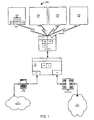
- Figure 1 is a high-level block diagram showing selected components of a cellular radio network configured in accordance with aspects of an embodiment of the present invention
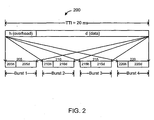
- Figure 2 illustrates a transmission time interval used in the network of Figure 1 ;
- Figure 3 illustrates selected fields of a downlink header with control information.
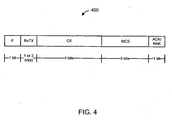
- Figure 4 illustrates selected fields of an uplink header with control information
- Figure 5 illustrates a fast feedback scheme for an air interface.
- the words “embodiment,” “variant,” and similar expressions are used to refer to particular apparatus, process, or article of manufacture, and not necessarily to the same apparatus, process, or article of manufacture.
- “one embodiment” (or a similar expression) used in one place or context can refer to a particular apparatus, process, or article of manufacture; the same or a similar expression in a different place can refer to a different apparatus, process, or article of manufacture.
- the expression “alternative embodiment,” “alternative variant,” and similar phrases are used to indicate one of a number of different possible embodiments or variants. The number of possible embodiments or variants is not necessarily limited to two or any other quantity.
- Base transceiver stations (BTSs) and base station controllers (BSCs) are parts of a network called "radio network,” “RN,” “access network,” or “AN.”
- a base station controller may also be referred to as a radio network controller or "RNC.”
- a radio network may be a GERAN-based network
- the radio network may transport data packets between multiple mobile stations (MSs), also known as user equipment devices.
- the radio network may be further connected to additional networks outside the radio network, such as a corporate intranet, the Internet, another radio network, or a conventional public switched telephone network (PSTN), and may transport data and voice between each mobile station and such outside networks.
- PSTN public switched telephone network
- Described examples may use superposition coding, multi-user packet transmission, and joint detection and decoding communication techniques. The following paragraphs explain these techniques.
- Superposition coding refers to the use of the same transmission resource to communicate with multiple receivers.
- the use of the same transmission resource refers to simultaneous transmission of data from a transmitter to the multiple receivers using the same frequency and time slot.
- the transmitter Tx with knowledge of the relative radio conditions for the two receivers can apportion its power budget for a particular slot and a particular carrier frequency between the two receivers so that a first block of data intended for the first receiver R x1 (the one in the weaker radio conditions) is transmitted with higher power than a second block of data intended for the second receiver R x2 (the one in the stronger radio conditions).
- the transmitter Tx may dedicate sufficient power to the block intended for the first receiver R x1 to allow the first receiver R x1 to decode this block given the current radio conditions and the additional interference due to transmission of the second block to the second receiver R x2 .
- the transmitter Tx may then dedicate less power to the block intended for the second receiver R x2 , but still sufficient for the second receiver R x2 to decode the second block using, for example, interference cancellation to eliminate or reduce the interference caused by the transmission of the first block.
- the transmitter then transmits the two blocks on the same carrier frequency and at the same time. Thus, it can be said that the two blocks "collide.”
- the second block simply appears to the first receiver R x1 as an increase in noise or interference. If the power offset between the transmissions of the two blocks is high enough, the degradation of the SINR at the first receiver R x1 may be small and even inconsequential. (This need not always be the case.) Thus, the first receiver R x1 should be able to decode the first block if it is transmitted with sufficient power relative to the transmission rate of the first block, the current radio conditions, and the additional interference caused by the transmission of the second block.
- the second receiver R x2 should also be able to decode the first block, because it receives it with a better SINR than the first receiver R x1 due to the stronger radio conditions of the second receiver R x2 .
- the second receiver R x2 decodes the first block, it can treat is as interference and cancel it from the total signal received during the period of time when the two blocks were received, using known interference cancellation techniques.
- the remaining signal represents the second block in combination with noise and interference originating from other sources.
- the second receiver R x2 should be able to decode the second block if the second block is transmitted with sufficient power relative to the transmission rate of the second block and the radio conditions of the second receiver R x2 , albeit with lower power than the first block.
- this method may be extended to three or more receivers. For example, most power could be allocated for transmissions to the receiver in the weakest radio conditions, least power could be allocated to transmissions to the receiver in the strongest radio conditions, and intermediate power could be allocated to the receiver in intermediate radio conditions.
- the receiver in the strongest radio conditions could then decode the block intended for the receiver in the weakest radio conditions, cancel the decoded block from the received signal, decode the block intended for the receiver in intermediate radio conditions, cancel the second decoded block, and finally decode the block intended for itself.
- the receiver in intermediate radio conditions could also decode the block intended for the receiver in the weakest radio conditions, cancel it from the received signal, and then decode the block intended for itself.
- the receiver in the weakest radio conditions may be able to directly decode the block intended for it, because that block is transmitted at the highest power level.
- Analogous processes may be performed at a single receiver when multiple transmitters simultaneously transmit to the single receiver on the same frequency.
- multi-user joint detection using techniques such as successive interference cancellation may be employed to decode multiple packets originating from multiple transmitters and that collide ( i.e ., are received simultaneously) at the receiver.
- the receiver may be a base transceiver station, and the multiple transmitters may be mobile stations.
- Multi-user packet transmission may also be used to multiplex two or more users into a single slot ( i.e ., into the same frequency-time allocation).
- a transmitter may form a packet with different payload data intended for two or more different receivers.
- Each of the two or more receivers may decode the entire packet, and determine which part of the packet is intended for it from the packet's header or from another form of signaling.
- Multi-user packet communications enhance spectrum utilization through statistical multiplexing, particularly for live voice communications that typically include considerable percentage of silence periods.
- base station may utilize multi-user packet transmission or superposition coding techniques. Hard capacity of GERAN may thus be doubled for groups of two mobile stations sharing a slot. If three mobile stations share a slot, hard limit on capacity may be tripled.
- the gains realizable from statistical multiplexing typically exceed any losses from the additional overhead that may be required to send the same packet to multiple receivers.
- FIG. 1 illustrates selected components of a GERAN-based (e.g., GSM-compliant) communication network 100, which includes a radio network controller 110 coupled to a wireless base transceiver station 120.
- the base transceiver station 120 communicates with mobile stations 130A, 130B, 130C, and 130D through corresponding wireless communication links 140A through 140D, as shown.
- the radio network controller 110 is coupled to a public switched telephone network 150 through a telephone switch 160, and to a packet switched network 170 through a packet data server node (PDSN) 180.
- PDSN packet data server node
- Data interchange between various network elements, such as the radio network controller 110 and the packet data server node 180 can be implemented using any number of protocols, for example, the Internet Protocol, an asynchronous transfer mode (ATM) protocol, T1, E1, frame relay, and other protocols.
- ATM asynchronous transfer mode
- the communication network 100 provides to the mobile stations 130 data communication services, Cellular telephone services, and telephone services through VoIP.
- the communication network 100 may provide to the mobile stations 130 only data services (such as VoIP) or only cellular telephone services.
- the mobile stations 130 may include wireless telephones, wireless modems, personal digital assistants, wireless local loop apparatus, PC cards, external or internal modems, and other communication devices.
- a typical mobile station, for example, the user equipment device 130A may include receiver circuitry 131, transmitter circuitry 132, an encoder 133, a decoder 134, a processor 136, and a memory device 137.
- the receiver circuitry 131, transmitter circuitry 132, encoder 133, and decoder 134 are configured by the processor 136 executing code stored in the memory device 137.
- Each mobile station 130 is configured to communicate data and voice with the BTS 120 using a GERAN (GSM) protocol.
- GSM GERAN
- Each communication channel 140 may include both a forward link and a reverse link between the BTS 120 and a corresponding user equipment device 130.
- the base transceiver station 120 includes one or more wireless receivers (e.g ., a receiver 121), one or more wireless transmitters (e.g ., a transmitter 122), one or more radio network controller interfaces (e.g ., an interface 123), one or more memory devices ( e.g., a memory device 124), one or more processors ( e.g ., a processor 125), and encoder/decoder circuitry (e.g ., encoder/decoder circuitry 126).
- wireless receivers e.g ., a receiver 121
- wireless transmitters e.g ., a transmitter 122
- radio network controller interfaces e.g ., an interface 123
- memory devices e.g., a memory device 124
- processors e.g ., a processor 125
- encoder/decoder circuitry e.g ., encoder/decoder circuitry 126.
- the receiver 121 and transmitter 122 of the base transceiver station 120 are configured by the processor 125 operating under control of the program code stored in the memory device 124 to establish forward and reverse links with the user equipment devices 130 in order to send data and voice packets to and receive data and voice packets from the user equipment devices 130.
- the base transceiver station 120 may receive forward link data packets from the packet switched network 170 through the packet data server node 180 and through the radio network controller 110, and transmit these packets to the user equipment devices 130.
- the base transceiver station 120 may receive reverse link data packets that originate at the user equipment devices 130, and forward these packets to the packet switched network 170 through the radio network controller 110 and the packet data server node 180.
- the base transceiver station 120 may receive forward link data packets from the telephone network 150 through the telephone switch 160 and through the radio network controller 110, and transmit these packets to the user equipment devices 130.
- Voice carrying packets originating at the user equipment devices 130 may be received at the base transceiver station 120 and forwarded to the telephone network 150 via the radio network controller 110 and the telephone switch 160.
- the mobile stations 130 and the BTS 120 are configured to communicate with each other using superposition coding, multi-user packets, joint decoding, and/or joint detection.
- the mobile stations 130A and 130B are configured to communicate with the BTS 120 selectively using superposition coding, multi-user packets, and joint decoding and detection;
- the mobile stations 130C and 130D are legacy devices that communicate with the BTS 120 using conventional GSM protocols.
- the BTS 120 under control of its processor 125 executing the program code stored in the memory device 124, configures itself and the mobile stations 130A and 130B for downlink communications using the same transmission resource and superposition coding.
- Downlink communications are communications from the radio network to the mobile stations.
- the BTS 120 sends data packets to the mobile stations 130A and 130B on the same carrier frequency and during the same time period (slot) at least some of the time.
- the BTS 120 under control of its processor 125 executing the program code stored in the memory device 124, configures itself and the mobile stations 130A and 130B for downlink communications using multi-user packets and statistical multiplexing.
- the BTS 120 sends the same packet to the mobile stations 130A and 130B, with different portions of the packet containing payload data intended for the different mobile stations.
- Each of the mobile stations 130A or 130B decodes the entire packet, but uses only the payload data intended for it, ignoring the payload data intended for the other mobile station 130.
- the BTS 120 under control of its processor 125 executing the program code stored in the memory device 124, selectively configures itself and the mobile stations 130A and 130B for downlink communications using multi-user packets or superposition coding.
- the BTS 120 may configure itself and the mobile stations 130A/B for downlink communications using superposition coding when the two mobile stations have sufficiently disparate radio conditions. Spectral efficiency gains are best realized through superposition coding when the radio conditions are disparate at the multiple receivers.
- the BTS may configure itself and the mobile stations 130A/B for superposition coding on the downlink when the C/I ratios for the two (or more) mobile stations differ by at least a predetermined extent.
- the BTS 130 may match ( i.e ., group) two or more mobile stations when their respective C/I ratios differ by at least 10 dB, by at least 6 dB, or by at least 3 dB. Otherwise, i.e., if the C/I ratios for the two or more grouped mobile stations differ by less than a predetermined extent such as 10 dB, 6 dB, or 3 dB, the BTS 120 may configure itself and the mobile stations for downlink communications with multi-user packets, realizing statistical multiplexing gains.
- the BTS 120 may employ multi-user packet downlink communications when there is no payload data for at least one of the mobile stations multiplexed in a given slot, and employ superposition coding when payload data need be simultaneously transmitted to all the mobile stations multiplexed in the given slot.
- the radio network may terminate a transmission early for all mobile stations grouped together if acknowledgements from all these mobile stations are received for a given packet before the maximum number of repetitions of the packet have been transmitted. Termination of transmission upon receipt of acknowledgement from fewer than all mobile stations addressed in the same slot may therefore be prevented.
- the BTS 120 may configure one or more MS pairs (or higher-order sets) for downlink communications using superposition coding, one or more MS pairs (or higher-order sets) for downlink communications using multi-user packets, and/or one or more MSs for downlink communications using conventional GSM-based (non-multiplexed) methods.
- a mobile station that is capable of downlink communications using superposition coding and/or multi-user packets need not use these techniques at all times.
- such a mobile station may be configured for downlink communications using conventional GSM-based methods when it cannot be matched with another such mobile station, or when there is no need for the additional gains that can flow from multiplexing a plurality of mobile stations into a single slot.
- the BTS 120 may simultaneously receive colliding data packets on the uplink from the mobile stations 130A and 130B on the same carrier frequency.
- the uplink carrier frequency for the mobile stations 130A and 130B may be the same, but differ from the downlink carrier frequency for these mobile stations.
- the same two or more mobile stations that are paired for downlink communications using superposition coding and/or multi-user packets may also share the-same uplink slot.
- the BTS 120 may conduct uplink communications with legacy mobile stations (e.g ., the mobile stations 130C and 130D) using conventional non-multiplexed GSM-based methods.
- the spectral efficiency of the system 100 is increased by means of multiplexing the mobile stations 130A and 130B into a single slot, and the interference between these two units sharing the same slot is addressed through advanced encoding and decoding techniques, such as superposition coding, multi-user packets, and joint detection and decoding, as described above.
- advanced encoding and decoding techniques such as superposition coding, multi-user packets, and joint detection and decoding, as described above.
- robustness and link efficiency are improved through use of hybrid Automatic Repeat-reQuest (H-ARQ) techniques, for example, type II H-ARQ.
- H-ARQ hybrid Automatic Repeat-reQuest
- TTT transmission time interval
- three TTI transmissions are used (two retransmissions).
- the use of H-ARQ techniques may thus increase delays, for example, the maximum effective TTI may be increased from 20 milliseconds to 40 or 60 milliseconds.
- the system 100 reduces the changes to the physical layer structure of GSM-based communications. Certain changes are implemented in order to accommodate control channels that facilitate H-ARQ type II operation, multi-user packets, superposition coding, and joint detection and decoding, but the system 100 is deployed in backward compatible manner.
- the BTS 120 supports legacy mobile stations 130C and 130D using the same carrier frequency sets as the mobile stations 130A and 130B, which are capable of multiplexed operation described above.
- a header may be included in each packet transmission in order to accommodate link adaptation algorithm.
- the information in the header may be repeated every TTI.
- Figure 2 illustrates an exemplary TTI 200 with four bursts of packets 205, 210, 215, and 220.
- Each packet (205, 210, 215, and 220) includes an overhead portion (headers 205h, 210h, 215h, and 220h) and a data portion (data 205d, 210d, 215d, and 220d).
- Headers 205h, 210h, 215h, and 220h overhead portion
- data portion data 205d, 210d, 215d, and 220d
- Uplink and downlink control information is used to configure the BTS 120 and the mobile stations 130 for exchanging data packets as described above.
- a packet header may contain both uplink and downlink control information.
- the uplink control information transmitted in the header of a downlink packet may include three bits uplink H-ARQ ACK/NAK (one ACK/NAK bit for each of three mobile stations that can be multiplexed in the same slot), and three bits for up/down uplink power control (one bit for each mobile station). Power control provided by this structure allows 50 bits-per-second up/down power adjustments for twenty-millisecond TTIs. Step sizes may be set between one and two dB, for example.
- Uplink power control is desirable because multiple users can share a common uplink slot, and various multi-user receivers favor different power ratios among users.
- Power control mechanism allows the network to adjust transmitted uplink power according to the deployed multi-user algorithm, current radio conditions, and other parameters and requirements.
- the downlink control information in the downlink packet header may include three bits indicating traffic channel Power Offset relative to pilot power (faction of power used to transmit to the mobile station in weak radio conditions), three modulation and coding (MCS) bits indicating selected modulation and coding scheme, one or two ReTX bits indicating retransmission number, and a one-bit flag F indicating transmission of a new data block.
- MCS modulation and coding
- the new data block flag F and the ReTX field allow the mobile station to infer part of control information. For example, modulation and coding do not change from one transmission to the other in some variants. If the mobile station decodes the control information that accompanies the second transmission, for example, it may be able to determine the MCS for the first transmission.
- FIG. 3 shows selected fields of an exemplary downlink header 300 with fourteen or fifteen bits of downlink control information, depending on the length of the ReTX field.
- the header may further contain cyclic redundancy check (CRC) bits and reserved bits, for example, eight CRC bits and two reserved bits, bringing the total number of bits to 24 or 25.
- CRC cyclic redundancy check
- the encoding options for the downlink header may be as follows:
- Constraint length 9, 1/2 convolution code, resulting in 32*2/(116*4) 0.14 or 14 percent overhead.
- the C/I per coded bit may be 0 dB or above.
- spectral efficiency needs to be improved by 16 percent ([ 1 / (1-0.14) ] ⁇ 1.16).
- the data payload portion of the downlink frame/packet may contain MAC IDs and length fields indicating the useful payload for each mobile station.
- data portion of the mobile station in weak radio conditions may contain all necessary header information for all other mobile stations as well. This additional overhead is typically one byte or less per mobile station, because MAC ID can be two bits, and the length field typically need not exceed six bits.
- Uplink overhead may be multiplexed in a similar fashion to that of the downlink overhead.
- Figure 4 illustrates selected fields of an exemplary uplink header 400 that includes a four-bit C1 field with carrier-to-interference ratio information that may be used for downlink rate selection, a three-bit MCS field used to convey the selected modulation and coding scheme for the uplink, one-bit ACK/NAK field carrying positive or negative acknowledgement for downlink transmission, an ReTX field of one or two bits for conveying retransmission number, and a one-bit F flag indicating transmission of a new data block.
- the uplink header may additionally contain eight bits of CRC, and three reserved bits, bringing the total number of bits to twenty-one or twenty two, depending on the length of the ReTX field.
- the encoding options for the uplink header may be as follows:
- control channel information can be decoded when required Eb/Nt (the ratio of energy-per-bit to the effective noise spectral density) for the selected code is below 4 dB, which is well within the capabilities of many convolutional codes.
- the decoding of overhead information may require joint decoding, interference cancellation, or both of these techniques.
- Overhead information received from all users may be approximately synchronized, so that joint decoding and interference cancellation can be limited to the header portion. Any overlap with the data portion may be treated as interference.
- Separate decoder may jointly decode the data portion.
- the training sequences for uplink channel estimation and tracking are selected to minimize cross correlation between sequences, in order to avoid joint time tracking algorithms for all users that share a common slot.
- Joint detection may be performed to facilitate multiple mobile station uplink transmissions in one slot.
- a successive interference cancellation (SIC) receiver may be suitable for this function.
- a joint multi-user receiver may also be used. Such a receiver would make the system throughput less susceptible to changes in rate and power distribution among mobile stations.
- the complexity of the multi-user receiver should remain manageable for joint decoding of 2, 3, or 4 users. A higher number of users is also not excluded.
- Uplink rate control may be performed with Layer 3 signaling.
- the BTS 120 may configure itself and the mobile stations to switch assigned slots. This may be desirable to regroup the mobile stations as radio conditions change.
- a mobile station may be able to perform a "soft" switch to a different slot; that is, be able to transmit and receive in two different slots, on either or both uplink and downlink. This feature is analogous to the capability of a mobile station to transmit and receive on two downlink and two uplink slots in conventional GSM-based systems. Note that due to H-ARQ operation, there maybe be up to four pending transmission in progress at any point in time (assuming that there are only two H-ARQ instances).
- the uplink channel In order to keep the number of H-ARQ instances to a minimum of two, it may be desirable to select the uplink channel so that a mobile station has enough time to decode the received downlink packet and form an uplink header that contains ACK/NAK information. It may also be desirable to allow enough time for the BTS to decode an uplink packet and form a downlink header that contains ACK/NAK information for the uplink transmission. In some variants, for example variants with a total of eight slots in a burst, offsets of three and four slots work well for these purposes. Offsets of two slots and five or more slots may also be used in some circumstances.
- VoIP packet transmission over GSM air interfaces The first question is whether a VoIP frame will fit in one RLC/MAC (Radio Link Control/Medium Access Control) block. It has been argued that with the use of appropriate header compression, one RLC/MAC block coded with MCS 7, 8, or 9 can contain one VoIP frame. Moreover, while the size of a VoIP frame depends on the particular codec employed, twenty bytes are typically an acceptable payload (from the mean opinion score point of view), representing ten milliseconds of a voice stream in VoIP networks. This means that even with no RTP compression, a typical VoIP datagram may fall in the 64 to 66 byte range. With RTP compression, a typical compressed VoIP datagram may fall in the 22 to 24 byte range. (This does not include GERAN-specific headers, such as SNDCP/LLC/RLC.) Thus, a typical VoIP frame should fit in one RLC.MAC block of a GSM air interface.
- RLC/MAC Radio Link Control/Medium Access Control
- a VoIP call is by its nature bidirectional, while of course being a data call.
- a mechanism is introduced into a GERAN system (such as the system 100 of Figure 1 ) to provide fast uplink feedback for downlink blocks that have or have not been received, and to provide fast downlink feedback for the uplink blocks that have or have not been received. This can be done with a modification of the RLC/MAC header of the uplink and downlink frames.
- acknowledgement for an uplink block 522 of an uplink frame "n” is transmitted in a downlink block 512 of a frame "n+1.”
- acknowledgement for a downlink block 514 of a downlink frame “n” is transmitted in an uplink block 524 of an uplink frame “n+1.”
- uplink and downlink frames with the same sequence number, "n,” for example, are the frames with the largest overlap in time.
- frame offset need is not necessarily be one frame as shown in Figure 5 ; frame offset may be two, three, four, or even a higher number of frames.
- acknowledgement for an uplink block in an uplink frame "n” may be transmitted in a downlink block of a frame "n+m”
- acknowledgement for a downlink block of a downlink frame “n” may be transmitted in an uplink block of an uplink frame "n+p.”
- Both “m” and “p” may be integers equal to or greater than one, they may be equal to each other or not equal to each other, and they may be predetermined or variable. For example, "m” may be equal to two, and “p” may be equal to three.
- an acknowledgement for multiple (two or more) downlink blocks may be transmitted in each or selected uplink frames; similarly, an acknowledgement for multiple uplink blocks may be transmitted in each downlink frame or in selected downlink frames.
- an uplink frame “n+2” may carry an acknowledgement for downlink frames “n” and "n+1”; and a downlink frame “n+2” may carry an acknowledgement for uplink frames "n” and "n+1.”
- the acknowledgement scheme is not necessarily identical for uplink and downlink air interface frames.
- an uplink frame “n+2" may carry an acknowledgement for downlink frames “n” and “n+1,” while a downlink frame “n+2” may carry an acknowledgement for uplink frames “n-1" and "n.”
- an uplink frame may carry acknowledgement for a different number (either more or less) of blocks than a downlink frames. Note that the acknowledgement for multiple frames may be repeated. For example, each uplink frame may carry acknowledgement for blocks in two preceding downlink frames, and each downlink frame may carry acknowledgement for blocks in two preceding uplink frames.
- acknowledgments and other feedback are provided automatically, i.e ., in response to receipt of the blocks, rather than in response to polling.
- the acknowledgement and other feedback may be included in an RLC/MAC header of a block sent from the receiver of the block(s) being acknowledged to the source of the block(s) being acknowledged.
- One aspect of the introduction of fast automatic feedback techniques described above is that they could be used to provide a faster Incremental Redundancy H-ARQ, especially if the fast feedback techniques are used in conjunction with the shorter TTI, and with RLC/MAC non-persistent mode.
- Incremental Redundancy H-ARQ refers to adaptation of error correcting coding redundancy to fluctuating radio conditions.
- a VoIP call over a GERAN air interface could then enjoy Incremental Redundancy gain without incurring an excessive delay budget hit.
- the quality of the air interface link (e.g ., C/I ratio of the downlink) may also be updated at more frequent intervals.
- a mobile station transmits to the BTS estimates of the quality of the downlink connection with every frame.
- a mobile station transmits to the BTS estimates of the quality of the downlink connection whenever the mobile station transmits an acknowledgement of a downlink block.
- a mobile station transmits to the BTS estimates of the quality of the downlink connection once in every two frames, three frame, four frames, or five frames.
- a difficulty may arise in applying the fast feedback techniques described above to systems with discontinuous transmission, since continuous communications on both uplink and downlink are presumed.
- DTX discontinuous transmission or "DTX” refers to not transmitting from a wireless communication device when there is no voice input to transmit.
- DTX discontinuous transmission
- this difficulty is circumvented through the use of so-called "dummy packets,” that is, feedback-only packets to be sent when user voice traffic is not present.
- Dummy packets may be sent using very low rate and low transmitted energy, in order to minimize the interference created by such packets and the energy consumed by such packets.
- Dummy packets may carry H-ARQ acknowledgements, link quality information, Incremental Redundancy H-ARQ information, or other feedback information.
- steps of the various methods may have been described serially in this disclosure, some of these steps may be performer by separate elements in conjunction or in parallel, asynchronously or synchronously, in a pipelined manner, or otherwise. There is no particular requirement that the steps be performed in the same order in which this description lists them, except where explicitly so indicated, otherwise made clear from the context, or inherently required. Furthermore, not every step is necessarily required in every embodiment in accordance with the invention, while some steps that have not been specifically illustrated may be desirable in some embodiments in accordance with the invention.
- DSP digital signal processor
- ASIC application specific integrated circuit
- FPGA field programmable gate array
- a general purpose processor may be a microprocessor, but in the alternative, the processor may be any conventional processor, controller, microcontoller, or state machine.
- a processor may also be implemented as a combination of computing devices, e.g., a combination of a DSP and a microprocessor, a plurality of microprocessors, one or more microprocessors in conjunction with a DSP core, or any other such configuration.
- a software module may reside in random access memory (RAM), flash memory, read only memory (ROM), erasable programmable read only memory (EPROM), electrically erasable programmable read only memory (EEPROM), registers, hard disk, removable disk, CD-ROM, or any other form of storage medium known in the art.
- An exemplary storage medium is coupled to the processor such that the processor can read information from, and write information to, the storage medium.
- the storage medium may be integral to the processor.
- the processor and the storage medium may reside in an ASIC.
- the ASIC may reside in a user equipment device (mobile station).
- the processor and the storage medium may reside as discrete components in a user equipment device.
- the processor and the storage medium may also reside in a BTS or a radio network controller.
Landscapes
- Engineering & Computer Science (AREA)
- Computer Networks & Wireless Communication (AREA)
- Signal Processing (AREA)
- Mobile Radio Communication Systems (AREA)
- Detection And Prevention Of Errors In Transmission (AREA)
- Telephonic Communication Services (AREA)
Claims (16)
- Procédé d'envoi d'informations sur une interface radio à accès multiple par répartition temporelle d'un système de communication cellulaire (100), le procédé comprenant :le regroupement d'une première pluralité de stations mobiles (130A, 130B) dans un secteur desservi par une station d'émission-réception de base (120) du système de communication cellulaire (100), la première pluralité de stations mobiles (130A, 130B) comprenant une première station mobile (130A) et une deuxième station mobile (130B) ;l'obtention d'un rapport porteuse sur brouillage (C/I) de liaison descendante de la première station mobile (130A) et d'un rapport porteuse sur brouillage (C/I) de liaison descendante de la deuxième station mobile (130B) ;si les rapports porteuse sur brouillage (C/I) de liaison descendante diffèrent d'au moins une quantité prédéterminée :l'envoi par la station d'émission-réception de base (120), sur une première fréquence porteuse durant un premier créneau temporel, d'un premier bloc de données de liaison descendante à la première station mobile (130A) en utilisant une première puissance d'émission ; etl'envoi par la station d'émission-réception de base (120), sur la première fréquente porteuse durant le premier créneau temporel, d'un deuxième bloc de données de liaison descendante à la deuxième station mobile (130B) en utilisant une deuxième puissance d'émission ;la première puissance d'émission et la deuxième puissance d'émission étant telles que la première station mobile (130A) peut recevoir et décoder le premier bloc de données et la deuxième station mobile (130B) peut recevoir et décoder le deuxième bloc de données ; etsi les rapports porteuse sur brouillage (C/I) de liaison descendante diffèrent de moins de la quantité prédéterminée :l'envoi par la station d'émission-réception de base, sur la première fréquence porteuse durant le premier créneau temporel, d'un paquet de données multiutilisateur de liaison descendante aux première et deuxième stations mobiles, le paquet de données de liaison descendante multiutilisateur comprenant des premières données utiles destinées à la première station mobile, des deuxièmes données utiles destinées à la deuxième station mobile et un en-tête, l'en-tête indiquant aux première et deuxième stations mobiles les premières données utiles et les deuxièmes données utiles de manière à ce que la première station mobile puisse utiliser les premières données utiles et la deuxième station mobile puisse utiliser les deuxièmes données utiles.
- Procédé selon la revendication 1, comprenant en outre :l'envoi par la station d'émission-réception de base (120), sur une deuxième fréquence porteuse durant le premier créneau temporel, d'un troisième bloc de données de liaison descendante à une troisième station mobile (130C) dans le secteur desservi par la station d'émission-réception de base (120) ;dans lequel le troisième bloc de données de liaison descendante n'est pas multiplexé, et l'étape d'envoi sur la deuxième fréquence porteuse est effectuée conformément à la norme de réseau d'accès radio (GERAN) à débits de données améliorés pour évolution GSM (EDGE) du système mondial de communication avec les mobiles (GSM).
- Procédé selon la revendication 1 ou la revendication 2, dans lequel la quantité prédéterminée est de 10 décibels.
- Procédé selon la revendication 1 ou la revendication 2, dans lequel la quantité prédéterminée est de 6 décibels.
- Procédé selon la revendication 1 ou la revendication 2, dans lequel la quantité prédéterminée est de 3 décibels.
- Procédé selon la revendication 1, dans lequel :la première pluralité de stations mobiles (130A, 130B) comprend en outre une troisième station mobile ;le procédé comprenant en outre :la détermination d'un rapport porteuse sur brouillage (C/I) de liaison descendante de la troisième station mobile ; etsi tous les rapports porteuse sur brouillage (C/I) de liaison descendante diffèrent d'au moins une quantité prédéterminée :l'envoi par la station d'émission-réception de base, sur la première fréquence porteuse durant le premier créneau temporel, d'un troisième bloc de données de liaison descendante à la troisième station mobile en utilisant une troisième puissance d'émission telle que la troisième station mobile peut recevoir et décoder le troisième bloc de données de liaison descendante.
- Procédé selon la revendication 6, dans lequel la première puissance d'émission est supérieure à la deuxième puissance d'émission, la première puissance d'émission est supérieure à la troisième puissance d'émission, le premier bloc de données de liaison descendante comprend un en-tète, et l'en-tête comprend :un champ d'accusé de réception/accusé de réception négatif (ACK/NAK) indiquant la réception ou non réception par la station d'émission-réception de base d'un premier bloc de liaison montante en provenance de la première station mobile, d'un deuxième bloc de liaison montante en provenance de la deuxième station mobile et d'un troisième bloc de liaison montante en provenance de la troisième station mobile, les premier, deuxième et troisième blocs de liaison montante ayant été envoyés durant un créneau temporel précédant le premier créneau temporel ;un champ de commande de puissance comprenant un premier sous-champ de commande de puissance indiquant un ajustement de puissance pour la puissance d'émission en liaison montante de la première station mobile, un deuxième sous-champ de commande de puissance indiquant un ajustement de puissance pour la puissance d'émission en liaison montante de la deuxième station mobile et un troisième sous-champ de commande de puissance indiquant un ajustement de puissance pour la puissance d'émission en liaison montante de la troisième station mobile ; etun champ de technique de modulation et de codage (MCS) indiquant une modulation et un codage de transmission en liaison descendante.
- Procédé selon la revendication 7, dans lequel l'en-tête comprend en outre :un champ de décalage de puissance indiquant un décalage de puissance de canal de trafic de liaison descendante par rapport à une puissance pilote ;un drapeau F indiquant la transmission d'un nouveau bloc de données ; etun champ ReTX indiquant un numéro de retransmission.
- Procédé selon la revendication 8, dans lequel le champ ACK/NAK est constitué de 3 bits, le champ de commande de puissance est constitué de 3 bits, le champ de décalage de puissance est constitué de 3 bits, le champ MCS est constitué de 3 bits, le champ F est constitué de 1 bit et le champ ReTX est constitué de 1 ou 2 bits.
- Procédé selon la revendication 8, dans lequel le champ ACK/NAK comprend 3 bits, le champ de commande de puissance comprend 3 bits, le champ de décalage de puissance comprend 3 bits, le champ MCS comprend 3 bits, le champ F comprend 1 bit et le champ ReTX comprend 1 bit.
- Procédé selon la revendication 1, dans lequel la première puissance d'émission est supérieure à la deuxième puissance d'émission, le premier bloc de données de liaison descendante comprend un en-tête, et l'en-tête comprend :un champ d'accusé de réception/accusé de réception négatif (ACK/NAK) indiquant la réception ou non réception par la station d'émission-réception de base d'un premier bloc de liaison montante en provenance de la première station mobile et la réception ou non réception d'un deuxième bloc de liaison montante en provenance de la deuxième station mobile, les premier et deuxième blocus de liaison montante ayant été envoyés durant un créneau temporel précédant le premier créneau temporel ;un champ de commande de puissance comprenant un premier sous-champ de commande de puissance indiquant un ajustement de puissance pour la puissance d'émission en liaison montante de la première station mobile et un deuxième sous-champ de commande de puissance indiquant un ajustement de puissance pour la puissance d'émission en liaison montante de la deuxième station mobile ; etun champ de technique de modulation et de codage (MCS) indiquant une modulation et un codage utilisés dans les étapes d'envoi.
- Procédé selon la revendication 1, comprenant en outre :la réception au niveau de la station d'émission-réception de base (120), sur une troisième fréquence porteuse durant un deuxième créneau temporel, d'un premier bloc de liaison montante en provenance de la première station mobile (130A) et la réception, sur la troisième fréquence porteuse durant le deuxième créneau temporel, d'un deuxième bloc de liaison montante en provenance de la deuxième station mobile (130B), les premier et deuxième blocs de liaison montante entrant en collision au niveau de la station d'émission-réception de base (120) ; etle décodage conjoint des premier et deuxième blocs de liaison montante au niveau de la station d'émission-réception de base (120).
- Procédé selon la revendication 1, dans lequel l'interface radio est mise en oeuvre en utilisant un saut de fréquence.
- Station d'émission-réception de base (120) d'un système de communication cellulaire à accès multiple par répartition temporelle (100), la station d'émission-réception de base (120) comprenant :un récepteur (121) ;un émetteur (122) ;une mémoire (124) stockant un code de programme ; etun processeur (125) couplé au récepteur (121), à l'émetteur (122) et à la mémoire (124), dans laquelle le processeur (125), sous la commande du code de programme, est configuré pour amener la station d'émission-réception de base (120) à mettre en oeuvre le procédé selon l'une quelconque des revendications 1 à 13.
- Support lisible par machine comprenant des instructions, dans lequel les instructions, lorsqu'elles sont exécutées par au moins un professeur (125) d'une station d'émission-réception de base (120) d'un système de communication cellulaire à accès multiple par répartition temporelle (100), amènent l'au moins un processeur (125) à mettre en oeuvre le procédé selon l'une quelconque des revendications I à 13.
- Première station mobile destinée à recevoir des informations envoyées conformément au procédé selon la revendication 1, la première station mobile comprenant :un moyen pour recevoir et décoder le premier bloc de données ; etun moyen pour déterminer, à partir de l'en-tête, que les premières données utiles sont destinées à la première station mobile.
Priority Applications (2)
| Application Number | Priority Date | Filing Date | Title |
|---|---|---|---|
| EP08006600.4A EP1936828B1 (fr) | 2005-07-21 | 2006-07-20 | Support de multiplexage et de réponse pour systèmes de communication sans fil |
| EP08006598A EP1936827B1 (fr) | 2005-07-21 | 2006-07-20 | Support de multiplexage et de rétroaction pour systèmes de communication sans fil |
Applications Claiming Priority (4)
| Application Number | Priority Date | Filing Date | Title |
|---|---|---|---|
| US70196705P | 2005-07-21 | 2005-07-21 | |
| US75807506P | 2006-01-10 | 2006-01-10 | |
| US11/489,918 US7869417B2 (en) | 2005-07-21 | 2006-07-19 | Multiplexing and feedback support for wireless communication systems |
| PCT/US2006/028341 WO2007014021A2 (fr) | 2005-07-21 | 2006-07-20 | Support de multiplexage et de retroaction pour systemes de communication sans fil |
Related Child Applications (4)
| Application Number | Title | Priority Date | Filing Date |
|---|---|---|---|
| EP08006600.4A Division EP1936828B1 (fr) | 2005-07-21 | 2006-07-20 | Support de multiplexage et de réponse pour systèmes de communication sans fil |
| EP08006598A Division EP1936827B1 (fr) | 2005-07-21 | 2006-07-20 | Support de multiplexage et de rétroaction pour systèmes de communication sans fil |
| EP08006600.4 Division-Into | 2008-03-31 | ||
| EP08006598.0 Division-Into | 2008-03-31 |
Publications (2)
| Publication Number | Publication Date |
|---|---|
| EP1911169A2 EP1911169A2 (fr) | 2008-04-16 |
| EP1911169B1 true EP1911169B1 (fr) | 2012-11-14 |
Family
ID=37855872
Family Applications (1)
| Application Number | Title | Priority Date | Filing Date |
|---|---|---|---|
| EP06788091A Not-in-force EP1911169B1 (fr) | 2005-07-21 | 2006-07-20 | Support de multiplexage et de retroaction pour systemes de communication sans fil |
Country Status (6)
| Country | Link |
|---|---|
| US (3) | US7869417B2 (fr) |
| EP (1) | EP1911169B1 (fr) |
| JP (2) | JP5006320B2 (fr) |
| KR (1) | KR101003289B1 (fr) |
| CN (2) | CN102142943B (fr) |
| WO (1) | WO2007014021A2 (fr) |
Families Citing this family (67)
| Publication number | Priority date | Publication date | Assignee | Title |
|---|---|---|---|---|
| US5754961A (en) * | 1994-06-20 | 1998-05-19 | Kabushiki Kaisha Toshiba | Radio communication system including SDL having transmission rate of relatively high speed |
| FR2884375B1 (fr) * | 2005-04-08 | 2007-11-23 | Nec Technologies Uk Ltd | Procede d'optimisation des echanges d'information d'accuse de reception dans une communication asynchrone entre un terminal et un reseau |
| US7869417B2 (en) | 2005-07-21 | 2011-01-11 | Qualcomm Incorporated | Multiplexing and feedback support for wireless communication systems |
| US8085819B2 (en) * | 2006-04-24 | 2011-12-27 | Qualcomm Incorporated | Superposition coding in a wireless communication system |
| WO2007133051A2 (fr) * | 2006-05-17 | 2007-11-22 | Lg Electronics Inc. | Procédé de mise en oeuvre de codage par superposition pour un lien aval dans un système de communication sans fil |
| KR101298265B1 (ko) * | 2006-07-07 | 2013-08-22 | 삼성전자주식회사 | 패킷 수신 방법 및 패킷 전송 방법 |
| US7885289B2 (en) * | 2006-12-19 | 2011-02-08 | Lockheed Martin Corporation | System and method for relaying turbo-coded piggyback messages |
| US8483240B2 (en) * | 2006-12-19 | 2013-07-09 | Lockheed Martin Corporation | Piggyback networks |
| KR100955817B1 (ko) * | 2006-12-29 | 2010-05-06 | 삼성전자주식회사 | 이동통신 시스템에서 하이브리드 자동 재전송 요구 기법을적용한 효율적인 하향링크 전송률 제어 장치 및 방법 |
| US7751382B2 (en) * | 2007-01-09 | 2010-07-06 | Nokia Corporation | Power for uplink acknowledgment transmission |
| KR101002881B1 (ko) | 2007-03-16 | 2010-12-21 | 삼성전자주식회사 | 무선 중계 시스템에서 다중 사용자 중첩 코딩을 이용한데이터 송수신 방법 및 장치 |
| KR101358349B1 (ko) * | 2007-04-23 | 2014-02-06 | 엘비트 시스템즈 랜드 앤드 씨4아이 - 타디란 리미티드 | 위성링크에서 날씨에 기인한 감쇠를 보상하기 위한 방법 및 장치 |
| US20080267168A1 (en) * | 2007-04-27 | 2008-10-30 | Zhijun Cai | Slow Adaptation of Modulation and Coding for Packet Transmission |
| US8064390B2 (en) | 2007-04-27 | 2011-11-22 | Research In Motion Limited | Uplink scheduling and resource allocation with fast indication |
| CN101299706B (zh) * | 2007-04-30 | 2011-01-19 | 上海贝尔阿尔卡特股份有限公司 | 实现数据包的查询处理的方法、通信系统和发送端设备 |
| CA2690430A1 (fr) * | 2007-06-15 | 2008-12-18 | Research In Motion Limited | Systeme et procede pour une reduction de surdebit d'adaptation de liaison |
| WO2008151411A1 (fr) * | 2007-06-15 | 2008-12-18 | Research In Motion Limited | Système et procédé pour une distribution de gros paquets pendant une session attribuée de façon semi-persistante |
| AU2007354841B2 (en) | 2007-06-15 | 2011-11-24 | Blackberry Limited | System and method for semi-persistent and dynamic scheduling and discontinuous reception control |
| KR100962115B1 (ko) | 2007-07-06 | 2010-06-10 | 삼성전자주식회사 | 무선인지 통신시스템에서 공동 전력제어를 위한 방법 및장치 |
| US8855567B2 (en) | 2007-07-10 | 2014-10-07 | Qualcomm Incorporated | Methods and apparatus for successive interference cancellation based on two rate feedback in peer-to-peer networks |
| US8849197B2 (en) | 2007-07-10 | 2014-09-30 | Qualcomm Incorporated | Methods and apparatus for active successive interference cancellation in peer-to-peer networks |
| US9668225B2 (en) | 2007-07-10 | 2017-05-30 | Qualcomm Incorporated | Methods and apparatus for active successive interference cancellation based on one rate feedback and probability adaptation in peer-to-peer networks |
| US8433349B2 (en) | 2007-07-10 | 2013-04-30 | Qualcomm Incorporated | Methods and apparatus for successive interference cancellation based on transmit power control by interfering device with success probability adaptation in peer-to-peer wireless networks |
| US8874040B2 (en) | 2007-07-10 | 2014-10-28 | Qualcomm Incorporated | Methods and apparatus for successive interference cancellation based on rate capping in peer-to-peer networks |
| US9521680B2 (en) | 2007-07-10 | 2016-12-13 | Qualcomm Incorporated | Methods and apparatus for successive interference cancellation based on three rate reports from interfering device in peer-to-peer networks |
| US20090046639A1 (en) * | 2007-08-14 | 2009-02-19 | Zhijun Cai | System and Method for Handling Large IP Packets During VoIP Session |
| HUE049863T2 (hu) | 2007-08-20 | 2020-10-28 | Blackberry Ltd | Rendszer és eljárás DRX vezérlés és NACK/ACK kezelésére |
| KR101129823B1 (ko) * | 2007-08-24 | 2012-03-27 | 인터디지탈 패튼 홀딩스, 인크 | 피기백된 ack/nack 필드로 무선 블록을 신뢰성있게 전송하는 방법 및 장치 |
| ES2558744T3 (es) | 2007-09-14 | 2016-02-08 | Blackberry Limited | Sistema y método para el tiempo de inicio de control de recepción discontinua |
| CN101816206B (zh) * | 2007-10-04 | 2014-10-08 | Lm爱立信电话有限公司 | 针对服务gprs支持节点使用电路交换承载的系统间切换 |
| US8861423B2 (en) * | 2008-01-18 | 2014-10-14 | Intel Corporation | Interference mitigation by overhearing |
| US8548002B2 (en) * | 2008-02-08 | 2013-10-01 | Koolspan, Inc. | Systems and methods for adaptive multi-rate protocol enhancement |
| EP2283688B1 (fr) * | 2008-05-21 | 2018-10-03 | Telefonaktiebolaget LM Ericsson (publ) | Annulation de perturbations intercellules coordonnées de liaison montante |
| TWI395976B (zh) * | 2008-06-13 | 2013-05-11 | Teco Image Sys Co Ltd | 掃描模組之光源投射裝置及其光源排列方法 |
| EP2314021B1 (fr) | 2008-06-18 | 2018-09-19 | Emerson Process Management LLLP | Système et procédé pour une communication de procédé sans fil |
| US8737383B2 (en) * | 2008-07-07 | 2014-05-27 | Intel Corporation | Techniques for enhanced persistent scheduling with efficient link adaptation capability |
| US8259572B2 (en) * | 2008-12-02 | 2012-09-04 | Kyocera Corporation | Communication method and transmitting apparatus utilizing the same |
| KR101470503B1 (ko) * | 2008-12-30 | 2014-12-08 | 삼성전자주식회사 | 다중 입출력 통신 시스템을 위한 채널 정보 피드백 방법 및장치 |
| US8249005B2 (en) * | 2009-02-11 | 2012-08-21 | Qualcomm Incorporated | Systems and methods for reducing power consumption using a variable constraint length convolutional encoder |
| MX2011007713A (es) * | 2009-02-18 | 2011-10-11 | Ericsson Telefon Ab L M | Esquema de retransmision de datos. |
| US9112689B2 (en) * | 2009-03-11 | 2015-08-18 | Samsung Electronics Co., Ltd. | Transmission of acknowledgement signals in a communication system |
| JP5365560B2 (ja) * | 2010-03-17 | 2013-12-11 | 富士通株式会社 | 通信システム、通信局、通信端末及び通信方法 |
| KR101752492B1 (ko) * | 2010-04-30 | 2017-06-29 | 삼성전자주식회사 | 무선통신 시스템에서 제어 정보의 송수신 방법 및 장치 |
| FR2963195B1 (fr) | 2010-07-26 | 2013-07-05 | Commissariat Energie Atomique | Methode centralisee d'allocation de puissance sous contrainte de qualite de service |
| EP2638652A2 (fr) | 2010-11-10 | 2013-09-18 | Interdigital Patent Holdings, Inc. | Procédé et appareil de limitation de brouillage par annulation successive dans des réseaux hétérogènes |
| JP5864199B2 (ja) * | 2011-05-20 | 2016-02-17 | 株式会社Nttドコモ | 受信装置、送信装置及び無線通信方法 |
| US8625452B2 (en) | 2011-09-15 | 2014-01-07 | International Business Machines Corporation | Maintenance of high-speed channels by inserting channel maintenance data in a mobile data network to avoid channel type switching |
| US9014023B2 (en) | 2011-09-15 | 2015-04-21 | International Business Machines Corporation | Mobile network services in a mobile data network |
| US8971192B2 (en) | 2011-11-16 | 2015-03-03 | International Business Machines Corporation | Data breakout at the edge of a mobile data network |
| US10021696B2 (en) | 2011-11-16 | 2018-07-10 | International Business Machines Corporation | Data caching at the edge of a mobile data network |
| US8521153B1 (en) | 2012-06-18 | 2013-08-27 | International Business Machines Corporation | Using the maintenance channel in a mobile data network to provide subscriber data when a cache miss occurs |
| KR102136609B1 (ko) * | 2012-09-21 | 2020-08-13 | 삼성전자주식회사 | 무선 통신 시스템에서 전력 정보의 시그널링 방법 및 장치 |
| JP5875540B2 (ja) * | 2013-02-12 | 2016-03-02 | 株式会社Nttドコモ | 無線基地局、ユーザ端末、無線通信システム、及び無線通信方法 |
| US10097315B2 (en) * | 2013-04-19 | 2018-10-09 | Qualcomm Incorporated | Group scheduling and acknowledgement for wireless transmission |
| WO2014196968A1 (fr) * | 2013-06-05 | 2014-12-11 | Intel Corporation | Techniques pour la transmission et la réception simultanée de paquets dans un réseau local sans fil |
| US10862634B2 (en) | 2014-03-07 | 2020-12-08 | Huawei Technologies Co., Ltd. | Systems and methods for OFDM with flexible sub-carrier spacing and symbol duration |
| US9532183B2 (en) * | 2014-04-09 | 2016-12-27 | Denise Roth | Data locator technology |
| US10299261B2 (en) | 2014-08-12 | 2019-05-21 | Lg Electronics Inc. | Method and device for downlink multi-user transmission in wireless communication system |
| US10110363B2 (en) * | 2015-01-29 | 2018-10-23 | Qualcomm Incorporated | Low latency in time division duplexing |
| US10687285B2 (en) | 2015-04-30 | 2020-06-16 | Industrial Technology Research Institute | Control channel and data channel power allocation among multiple user equipment |
| WO2016195754A1 (fr) | 2015-06-01 | 2016-12-08 | Intel IP Corporation | Techniques de réduction de latence pour réseaux d'accès radio |
| US10863512B2 (en) | 2015-09-30 | 2020-12-08 | Hfi Innovation Inc. | Power control signaling for multiuser superpostion transmission |
| US10291785B2 (en) * | 2015-10-08 | 2019-05-14 | Avago Technologies International Sales Pte. Limtied | Data unit retransmission |
| US10432386B2 (en) | 2015-10-19 | 2019-10-01 | Qualcomm Incorporated | Flexible time division duplexing (TDD) subframe structure with latency reduction |
| BR112019008501A2 (pt) * | 2016-10-28 | 2019-07-09 | Telefonaktiebolaget Lm Ericsson (Publ) | método para comunicação sem fio, equipamento de usuário, programa de computador, e, nó de rede. |
| CN111108782B (zh) | 2017-09-28 | 2023-08-22 | 联想(新加坡)私人有限公司 | 用于传输功率调整的发送功率控制命令 |
| CN114980201B (zh) * | 2019-05-09 | 2025-09-02 | 北京小米移动软件有限公司 | 下行控制信息发送方法、装置及可读存储介质 |
Family Cites Families (15)
| Publication number | Priority date | Publication date | Assignee | Title |
|---|---|---|---|---|
| US5896375A (en) | 1996-07-23 | 1999-04-20 | Ericsson Inc. | Short-range radio communications system and method of use |
| FI105368B (fi) * | 1997-05-16 | 2000-07-31 | Nokia Networks Oy | Tehonsäätö matkaviestinjärjestelmässä |
| CN1123995C (zh) * | 1997-08-14 | 2003-10-08 | 西门子公司 | 应用跳频的无线电传送数据的方法及装置 |
| US6539010B1 (en) * | 1999-10-28 | 2003-03-25 | Telefonaktiebolaget Lm Ericsson (Publ) | Downlink power control and adaptive beamforming for half-rate radiocommunication systems |
| FI109437B (fi) | 2000-04-03 | 2002-07-31 | Nokia Corp | Resurssien varaus pakettimuotoisessa tiedonsiirrossa |
| US7181223B1 (en) | 2000-06-21 | 2007-02-20 | Motorola, Inc. | Method for rapid uplink access by GSM GPRS/EDGE mobile stations engaged in voice over internet protocol packet transfer mode |
| EP1255368A1 (fr) * | 2001-04-30 | 2002-11-06 | Siemens Information and Communication Networks S.p.A. | Procède pour l'adaptation de liaison en systèmes de communication cellulaire amélioré utilisant plusieurs schémas de modulation et codage |
| US6837992B2 (en) * | 2001-07-10 | 2005-01-04 | Systec Inc. | Integrated apparatus for degassing and blending multiple mobile phase streams |
| DE60104113T2 (de) | 2001-08-22 | 2004-10-28 | Matsushita Electric Industrial Co., Ltd., Kadoma | Übertragungsverfahren und Übertragungsgerät mit Mehrkanal-ARQ |
| US6665280B2 (en) | 2002-03-22 | 2003-12-16 | Nokia Corporation | Method and apparatus providing multiple temporary block flow (TBF) mapping to upper layer when operating in GSM/EDGE radio access network (GERAN) A/Gb mode |
| US7159163B2 (en) | 2002-07-08 | 2007-01-02 | Qualcomm Incorporated | Feedback for data transmissions |
| MXPA05000828A (es) * | 2002-07-19 | 2005-04-19 | Interdigital Tech Corp | Cancelacion de interferencia sucesiva por grupos para bloquear transmision con diversidad de recepcion. |
| US7280562B2 (en) * | 2003-02-18 | 2007-10-09 | Qualcomm Incorporated | Variable packet lengths for high packet data rate communications |
| US7411895B2 (en) * | 2003-02-19 | 2008-08-12 | Qualcomm Incorporated | Controlled superposition coding in multi-user communication systems |
| US7869417B2 (en) | 2005-07-21 | 2011-01-11 | Qualcomm Incorporated | Multiplexing and feedback support for wireless communication systems |
-
2006
- 2006-07-19 US US11/489,918 patent/US7869417B2/en active Active
- 2006-07-20 CN CN201110120258.1A patent/CN102142943B/zh active Active
- 2006-07-20 JP JP2008522985A patent/JP5006320B2/ja active Active
- 2006-07-20 CN CN201110120272.1A patent/CN102142944B/zh active Active
- 2006-07-20 WO PCT/US2006/028341 patent/WO2007014021A2/fr not_active Ceased
- 2006-07-20 KR KR1020087004197A patent/KR101003289B1/ko active Active
- 2006-07-20 EP EP06788091A patent/EP1911169B1/fr not_active Not-in-force
-
2011
- 2011-01-10 US US12/987,576 patent/US8743861B2/en active Active
- 2011-03-07 JP JP2011049121A patent/JP5384544B2/ja active Active
-
2014
- 2014-05-22 US US14/284,855 patent/US8913537B2/en active Active
Also Published As
| Publication number | Publication date |
|---|---|
| WO2007014021A3 (fr) | 2007-05-18 |
| CN102142944A (zh) | 2011-08-03 |
| CN102142943B (zh) | 2014-08-06 |
| JP5384544B2 (ja) | 2014-01-08 |
| JP2011176834A (ja) | 2011-09-08 |
| JP2009515372A (ja) | 2009-04-09 |
| US7869417B2 (en) | 2011-01-11 |
| US20070060167A1 (en) | 2007-03-15 |
| US8913537B2 (en) | 2014-12-16 |
| KR20080050572A (ko) | 2008-06-09 |
| US20140269479A1 (en) | 2014-09-18 |
| EP1911169A2 (fr) | 2008-04-16 |
| JP5006320B2 (ja) | 2012-08-22 |
| KR101003289B1 (ko) | 2010-12-21 |
| US8743861B2 (en) | 2014-06-03 |
| US20120014268A1 (en) | 2012-01-19 |
| WO2007014021A2 (fr) | 2007-02-01 |
| CN102142943A (zh) | 2011-08-03 |
| CN102142944B (zh) | 2014-05-07 |
Similar Documents
| Publication | Publication Date | Title |
|---|---|---|
| EP1911169B1 (fr) | Support de multiplexage et de retroaction pour systemes de communication sans fil | |
| US9386575B2 (en) | Efficient transmission on a shared data channel for wireless communication | |
| US8625601B2 (en) | Method and apparatus for low-overhead packet data transmission and control of reception mode | |
| CN101507168B (zh) | 低开销分组数据传输和接收模式控制的方法和装置 | |
| CN101268629B (zh) | 用于无线通信系统的多路复用和反馈支持 | |
| US7945258B2 (en) | Wireless device operable to manipulate high-speed shared control channel (HSSCCH) quality control through channel quality indication report manipulation | |
| EP1936827B1 (fr) | Support de multiplexage et de rétroaction pour systèmes de communication sans fil | |
| EP2263409B1 (fr) | Procédés et appareil de communications par paquets utilisant des intervalles de transmission en liaison montante et en liaison descendante à l'alternat qui supportent une retransmission et une extension de paquet | |
| CN100559747C (zh) | 基于信道条件和消息长度的传输机制选择的方法和设备 | |
| HK1082611A (en) | Improved feedback for data transmissions | |
| HK1108248A (en) | Enhanced block acknowledgement |
Legal Events
| Date | Code | Title | Description |
|---|---|---|---|
| PUAI | Public reference made under article 153(3) epc to a published international application that has entered the european phase |
Free format text: ORIGINAL CODE: 0009012 |
|
| 17P | Request for examination filed |
Effective date: 20080220 |
|
| AK | Designated contracting states |
Kind code of ref document: A2 Designated state(s): AT BE BG CH CY CZ DE DK EE ES FI FR GB GR HU IE IS IT LI LT LU LV MC NL PL PT RO SE SI SK TR |
|
| 17Q | First examination report despatched |
Effective date: 20091029 |
|
| REG | Reference to a national code |
Ref country code: DE Ref legal event code: R079 Ref document number: 602006033093 Country of ref document: DE Free format text: PREVIOUS MAIN CLASS: H04B0007005000 Ipc: H04W0052240000 |
|
| RIC1 | Information provided on ipc code assigned before grant |
Ipc: H04W 52/24 20090101AFI20120403BHEP Ipc: H04W 52/28 20090101ALI20120403BHEP |
|
| GRAP | Despatch of communication of intention to grant a patent |
Free format text: ORIGINAL CODE: EPIDOSNIGR1 |
|
| DAX | Request for extension of the european patent (deleted) | ||
| GRAS | Grant fee paid |
Free format text: ORIGINAL CODE: EPIDOSNIGR3 |
|
| GRAA | (expected) grant |
Free format text: ORIGINAL CODE: 0009210 |
|
| AK | Designated contracting states |
Kind code of ref document: B1 Designated state(s): AT BE BG CH CY CZ DE DK EE ES FI FR GB GR HU IE IS IT LI LT LU LV MC NL PL PT RO SE SI SK TR |
|
| REG | Reference to a national code |
Ref country code: GB Ref legal event code: FG4D |
|
| REG | Reference to a national code |
Ref country code: AT Ref legal event code: REF Ref document number: 584522 Country of ref document: AT Kind code of ref document: T Effective date: 20121115 Ref country code: CH Ref legal event code: EP |
|
| REG | Reference to a national code |
Ref country code: IE Ref legal event code: FG4D |
|
| REG | Reference to a national code |
Ref country code: DE Ref legal event code: R096 Ref document number: 602006033093 Country of ref document: DE Effective date: 20130110 |
|
| REG | Reference to a national code |
Ref country code: NL Ref legal event code: VDEP Effective date: 20121114 |
|
| REG | Reference to a national code |
Ref country code: AT Ref legal event code: MK05 Ref document number: 584522 Country of ref document: AT Kind code of ref document: T Effective date: 20121114 |
|
| REG | Reference to a national code |
Ref country code: LT Ref legal event code: MG4D |
|
| PG25 | Lapsed in a contracting state [announced via postgrant information from national office to epo] |
Ref country code: LT Free format text: LAPSE BECAUSE OF FAILURE TO SUBMIT A TRANSLATION OF THE DESCRIPTION OR TO PAY THE FEE WITHIN THE PRESCRIBED TIME-LIMIT Effective date: 20121114 Ref country code: ES Free format text: LAPSE BECAUSE OF FAILURE TO SUBMIT A TRANSLATION OF THE DESCRIPTION OR TO PAY THE FEE WITHIN THE PRESCRIBED TIME-LIMIT Effective date: 20130225 Ref country code: SE Free format text: LAPSE BECAUSE OF FAILURE TO SUBMIT A TRANSLATION OF THE DESCRIPTION OR TO PAY THE FEE WITHIN THE PRESCRIBED TIME-LIMIT Effective date: 20121114 Ref country code: FI Free format text: LAPSE BECAUSE OF FAILURE TO SUBMIT A TRANSLATION OF THE DESCRIPTION OR TO PAY THE FEE WITHIN THE PRESCRIBED TIME-LIMIT Effective date: 20121114 |
|
| PG25 | Lapsed in a contracting state [announced via postgrant information from national office to epo] |
Ref country code: PL Free format text: LAPSE BECAUSE OF FAILURE TO SUBMIT A TRANSLATION OF THE DESCRIPTION OR TO PAY THE FEE WITHIN THE PRESCRIBED TIME-LIMIT Effective date: 20121114 Ref country code: LV Free format text: LAPSE BECAUSE OF FAILURE TO SUBMIT A TRANSLATION OF THE DESCRIPTION OR TO PAY THE FEE WITHIN THE PRESCRIBED TIME-LIMIT Effective date: 20121114 Ref country code: GR Free format text: LAPSE BECAUSE OF FAILURE TO SUBMIT A TRANSLATION OF THE DESCRIPTION OR TO PAY THE FEE WITHIN THE PRESCRIBED TIME-LIMIT Effective date: 20130215 Ref country code: SI Free format text: LAPSE BECAUSE OF FAILURE TO SUBMIT A TRANSLATION OF THE DESCRIPTION OR TO PAY THE FEE WITHIN THE PRESCRIBED TIME-LIMIT Effective date: 20121114 Ref country code: BE Free format text: LAPSE BECAUSE OF FAILURE TO SUBMIT A TRANSLATION OF THE DESCRIPTION OR TO PAY THE FEE WITHIN THE PRESCRIBED TIME-LIMIT Effective date: 20121114 Ref country code: PT Free format text: LAPSE BECAUSE OF FAILURE TO SUBMIT A TRANSLATION OF THE DESCRIPTION OR TO PAY THE FEE WITHIN THE PRESCRIBED TIME-LIMIT Effective date: 20130314 |
|
| PG25 | Lapsed in a contracting state [announced via postgrant information from national office to epo] |
Ref country code: AT Free format text: LAPSE BECAUSE OF FAILURE TO SUBMIT A TRANSLATION OF THE DESCRIPTION OR TO PAY THE FEE WITHIN THE PRESCRIBED TIME-LIMIT Effective date: 20121114 |
|
| PG25 | Lapsed in a contracting state [announced via postgrant information from national office to epo] |
Ref country code: CZ Free format text: LAPSE BECAUSE OF FAILURE TO SUBMIT A TRANSLATION OF THE DESCRIPTION OR TO PAY THE FEE WITHIN THE PRESCRIBED TIME-LIMIT Effective date: 20121114 Ref country code: BG Free format text: LAPSE BECAUSE OF FAILURE TO SUBMIT A TRANSLATION OF THE DESCRIPTION OR TO PAY THE FEE WITHIN THE PRESCRIBED TIME-LIMIT Effective date: 20130214 Ref country code: SK Free format text: LAPSE BECAUSE OF FAILURE TO SUBMIT A TRANSLATION OF THE DESCRIPTION OR TO PAY THE FEE WITHIN THE PRESCRIBED TIME-LIMIT Effective date: 20121114 Ref country code: EE Free format text: LAPSE BECAUSE OF FAILURE TO SUBMIT A TRANSLATION OF THE DESCRIPTION OR TO PAY THE FEE WITHIN THE PRESCRIBED TIME-LIMIT Effective date: 20121114 Ref country code: DK Free format text: LAPSE BECAUSE OF FAILURE TO SUBMIT A TRANSLATION OF THE DESCRIPTION OR TO PAY THE FEE WITHIN THE PRESCRIBED TIME-LIMIT Effective date: 20121114 |
|
| PG25 | Lapsed in a contracting state [announced via postgrant information from national office to epo] |
Ref country code: NL Free format text: LAPSE BECAUSE OF FAILURE TO SUBMIT A TRANSLATION OF THE DESCRIPTION OR TO PAY THE FEE WITHIN THE PRESCRIBED TIME-LIMIT Effective date: 20121114 Ref country code: IT Free format text: LAPSE BECAUSE OF FAILURE TO SUBMIT A TRANSLATION OF THE DESCRIPTION OR TO PAY THE FEE WITHIN THE PRESCRIBED TIME-LIMIT Effective date: 20121114 Ref country code: RO Free format text: LAPSE BECAUSE OF FAILURE TO SUBMIT A TRANSLATION OF THE DESCRIPTION OR TO PAY THE FEE WITHIN THE PRESCRIBED TIME-LIMIT Effective date: 20121114 |
|
| PLBE | No opposition filed within time limit |
Free format text: ORIGINAL CODE: 0009261 |
|
| STAA | Information on the status of an ep patent application or granted ep patent |
Free format text: STATUS: NO OPPOSITION FILED WITHIN TIME LIMIT |
|
| 26N | No opposition filed |
Effective date: 20130815 |
|
| PG25 | Lapsed in a contracting state [announced via postgrant information from national office to epo] |
Ref country code: CY Free format text: LAPSE BECAUSE OF FAILURE TO SUBMIT A TRANSLATION OF THE DESCRIPTION OR TO PAY THE FEE WITHIN THE PRESCRIBED TIME-LIMIT Effective date: 20121114 |
|
| REG | Reference to a national code |
Ref country code: DE Ref legal event code: R097 Ref document number: 602006033093 Country of ref document: DE Effective date: 20130815 |
|
| PG25 | Lapsed in a contracting state [announced via postgrant information from national office to epo] |
Ref country code: MC Free format text: LAPSE BECAUSE OF FAILURE TO SUBMIT A TRANSLATION OF THE DESCRIPTION OR TO PAY THE FEE WITHIN THE PRESCRIBED TIME-LIMIT Effective date: 20121114 |
|
| REG | Reference to a national code |
Ref country code: CH Ref legal event code: PL |
|
| REG | Reference to a national code |
Ref country code: IE Ref legal event code: MM4A |
|
| REG | Reference to a national code |
Ref country code: FR Ref legal event code: ST Effective date: 20140331 |
|
| PG25 | Lapsed in a contracting state [announced via postgrant information from national office to epo] |
Ref country code: CH Free format text: LAPSE BECAUSE OF NON-PAYMENT OF DUE FEES Effective date: 20130731 Ref country code: LI Free format text: LAPSE BECAUSE OF NON-PAYMENT OF DUE FEES Effective date: 20130731 |
|
| PG25 | Lapsed in a contracting state [announced via postgrant information from national office to epo] |
Ref country code: FR Free format text: LAPSE BECAUSE OF NON-PAYMENT OF DUE FEES Effective date: 20130731 |
|
| PG25 | Lapsed in a contracting state [announced via postgrant information from national office to epo] |
Ref country code: IE Free format text: LAPSE BECAUSE OF NON-PAYMENT OF DUE FEES Effective date: 20130720 |
|
| PG25 | Lapsed in a contracting state [announced via postgrant information from national office to epo] |
Ref country code: TR Free format text: LAPSE BECAUSE OF FAILURE TO SUBMIT A TRANSLATION OF THE DESCRIPTION OR TO PAY THE FEE WITHIN THE PRESCRIBED TIME-LIMIT Effective date: 20121114 |
|
| PG25 | Lapsed in a contracting state [announced via postgrant information from national office to epo] |
Ref country code: HU Free format text: LAPSE BECAUSE OF FAILURE TO SUBMIT A TRANSLATION OF THE DESCRIPTION OR TO PAY THE FEE WITHIN THE PRESCRIBED TIME-LIMIT; INVALID AB INITIO Effective date: 20060720 Ref country code: LU Free format text: LAPSE BECAUSE OF NON-PAYMENT OF DUE FEES Effective date: 20130720 |
|
| PG25 | Lapsed in a contracting state [announced via postgrant information from national office to epo] |
Ref country code: IS Free format text: LAPSE BECAUSE OF FAILURE TO SUBMIT A TRANSLATION OF THE DESCRIPTION OR TO PAY THE FEE WITHIN THE PRESCRIBED TIME-LIMIT Effective date: 20121114 |
|
| PGFP | Annual fee paid to national office [announced via postgrant information from national office to epo] |
Ref country code: GB Payment date: 20240613 Year of fee payment: 19 |
|
| PGFP | Annual fee paid to national office [announced via postgrant information from national office to epo] |
Ref country code: DE Payment date: 20240613 Year of fee payment: 19 |
|
| REG | Reference to a national code |
Ref country code: DE Ref legal event code: R119 Ref document number: 602006033093 Country of ref document: DE |
|
| GBPC | Gb: european patent ceased through non-payment of renewal fee |
Effective date: 20250720 |
|
| PG25 | Lapsed in a contracting state [announced via postgrant information from national office to epo] |
Ref country code: GB Free format text: LAPSE BECAUSE OF NON-PAYMENT OF DUE FEES Effective date: 20250720 |
|
| PG25 | Lapsed in a contracting state [announced via postgrant information from national office to epo] |
Ref country code: DE Free format text: LAPSE BECAUSE OF NON-PAYMENT OF DUE FEES Effective date: 20260203 |