EP1912182A1 - Berechtigung zur Durchführung einer Transaktion zwischen einem elektronischen Schaltkreis und einem Endgerät - Google Patents
Berechtigung zur Durchführung einer Transaktion zwischen einem elektronischen Schaltkreis und einem Endgerät Download PDFInfo
- Publication number
- EP1912182A1 EP1912182A1 EP07118062A EP07118062A EP1912182A1 EP 1912182 A1 EP1912182 A1 EP 1912182A1 EP 07118062 A EP07118062 A EP 07118062A EP 07118062 A EP07118062 A EP 07118062A EP 1912182 A1 EP1912182 A1 EP 1912182A1
- Authority
- EP
- European Patent Office
- Prior art keywords
- word
- transaction
- terminal
- circuit
- entity
- Prior art date
- Legal status (The legal status is an assumption and is not a legal conclusion. Google has not performed a legal analysis and makes no representation as to the accuracy of the status listed.)
- Withdrawn
Links
Images


Classifications
-
- G—PHYSICS
- G07—CHECKING-DEVICES
- G07F—COIN-FREED OR LIKE APPARATUS
- G07F7/00—Mechanisms actuated by objects other than coins to free or to actuate vending, hiring, coin or paper currency dispensing or refunding apparatus
- G07F7/08—Mechanisms actuated by objects other than coins to free or to actuate vending, hiring, coin or paper currency dispensing or refunding apparatus by coded identity card or credit card or other personal identification means
- G07F7/10—Mechanisms actuated by objects other than coins to free or to actuate vending, hiring, coin or paper currency dispensing or refunding apparatus by coded identity card or credit card or other personal identification means together with a coded signal, e.g. in the form of personal identification information, like personal identification number [PIN] or biometric data
-
- G—PHYSICS
- G06—COMPUTING OR CALCULATING; COUNTING
- G06Q—INFORMATION AND COMMUNICATION TECHNOLOGY [ICT] SPECIALLY ADAPTED FOR ADMINISTRATIVE, COMMERCIAL, FINANCIAL, MANAGERIAL OR SUPERVISORY PURPOSES; SYSTEMS OR METHODS SPECIALLY ADAPTED FOR ADMINISTRATIVE, COMMERCIAL, FINANCIAL, MANAGERIAL OR SUPERVISORY PURPOSES, NOT OTHERWISE PROVIDED FOR
- G06Q20/00—Payment architectures, schemes or protocols
- G06Q20/30—Payment architectures, schemes or protocols characterised by the use of specific devices or networks
- G06Q20/34—Payment architectures, schemes or protocols characterised by the use of specific devices or networks using cards, e.g. integrated circuit [IC] cards or magnetic cards
- G06Q20/347—Passive cards
-
- G—PHYSICS
- G06—COMPUTING OR CALCULATING; COUNTING
- G06Q—INFORMATION AND COMMUNICATION TECHNOLOGY [ICT] SPECIALLY ADAPTED FOR ADMINISTRATIVE, COMMERCIAL, FINANCIAL, MANAGERIAL OR SUPERVISORY PURPOSES; SYSTEMS OR METHODS SPECIALLY ADAPTED FOR ADMINISTRATIVE, COMMERCIAL, FINANCIAL, MANAGERIAL OR SUPERVISORY PURPOSES, NOT OTHERWISE PROVIDED FOR
- G06Q20/00—Payment architectures, schemes or protocols
- G06Q20/38—Payment protocols; Details thereof
- G06Q20/389—Keeping log of transactions for guaranteeing non-repudiation of a transaction
-
- G—PHYSICS
- G06—COMPUTING OR CALCULATING; COUNTING
- G06Q—INFORMATION AND COMMUNICATION TECHNOLOGY [ICT] SPECIALLY ADAPTED FOR ADMINISTRATIVE, COMMERCIAL, FINANCIAL, MANAGERIAL OR SUPERVISORY PURPOSES; SYSTEMS OR METHODS SPECIALLY ADAPTED FOR ADMINISTRATIVE, COMMERCIAL, FINANCIAL, MANAGERIAL OR SUPERVISORY PURPOSES, NOT OTHERWISE PROVIDED FOR
- G06Q20/00—Payment architectures, schemes or protocols
- G06Q20/38—Payment protocols; Details thereof
- G06Q20/40—Authorisation, e.g. identification of payer or payee, verification of customer or shop credentials; Review and approval of payers, e.g. check credit lines or negative lists
- G06Q20/403—Solvency checks
- G06Q20/4033—Local solvency checks
-
- G—PHYSICS
- G06—COMPUTING OR CALCULATING; COUNTING
- G06Q—INFORMATION AND COMMUNICATION TECHNOLOGY [ICT] SPECIALLY ADAPTED FOR ADMINISTRATIVE, COMMERCIAL, FINANCIAL, MANAGERIAL OR SUPERVISORY PURPOSES; SYSTEMS OR METHODS SPECIALLY ADAPTED FOR ADMINISTRATIVE, COMMERCIAL, FINANCIAL, MANAGERIAL OR SUPERVISORY PURPOSES, NOT OTHERWISE PROVIDED FOR
- G06Q20/00—Payment architectures, schemes or protocols
- G06Q20/38—Payment protocols; Details thereof
- G06Q20/40—Authorisation, e.g. identification of payer or payee, verification of customer or shop credentials; Review and approval of payers, e.g. check credit lines or negative lists
- G06Q20/403—Solvency checks
- G06Q20/4037—Remote solvency checks
-
- G—PHYSICS
- G07—CHECKING-DEVICES
- G07F—COIN-FREED OR LIKE APPARATUS
- G07F7/00—Mechanisms actuated by objects other than coins to free or to actuate vending, hiring, coin or paper currency dispensing or refunding apparatus
- G07F7/08—Mechanisms actuated by objects other than coins to free or to actuate vending, hiring, coin or paper currency dispensing or refunding apparatus by coded identity card or credit card or other personal identification means
-
- G—PHYSICS
- G07—CHECKING-DEVICES
- G07F—COIN-FREED OR LIKE APPARATUS
- G07F7/00—Mechanisms actuated by objects other than coins to free or to actuate vending, hiring, coin or paper currency dispensing or refunding apparatus
- G07F7/08—Mechanisms actuated by objects other than coins to free or to actuate vending, hiring, coin or paper currency dispensing or refunding apparatus by coded identity card or credit card or other personal identification means
- G07F7/10—Mechanisms actuated by objects other than coins to free or to actuate vending, hiring, coin or paper currency dispensing or refunding apparatus by coded identity card or credit card or other personal identification means together with a coded signal, e.g. in the form of personal identification information, like personal identification number [PIN] or biometric data
- G07F7/1025—Identification of user by a PIN code
- G07F7/1058—PIN is checked locally
- G07F7/1066—PIN data being compared to data on card
-
- G—PHYSICS
- G07—CHECKING-DEVICES
- G07F—COIN-FREED OR LIKE APPARATUS
- G07F7/00—Mechanisms actuated by objects other than coins to free or to actuate vending, hiring, coin or paper currency dispensing or refunding apparatus
- G07F7/08—Mechanisms actuated by objects other than coins to free or to actuate vending, hiring, coin or paper currency dispensing or refunding apparatus by coded identity card or credit card or other personal identification means
- G07F7/12—Card verification
- G07F7/127—Card verification in which both online and offline card verification can take place
Definitions
- the present invention generally relates to electronic circuits and, more particularly, to such circuits involved in authorizing a transaction with a read-write terminal of the circuit.
- the invention applies more particularly to circuits capable of carrying out transactions with and without establishment of a communication with an entity distinct from the terminal.
- the invention applies, for example, to smart cards and transactions representing a payment, capable of operating in accordance with a standard called EMV (Europay, Mastercard, Visa).
- the user In case of refusal of transaction, the user often seeks to know the reason for this refusal.
- the establishment for example, bank
- the establishment that has validated the transaction may communicate messages or message codes reconstituted by the terminal to inform the user, insofar as the decision is made by the user.
- bank which knows the reason for the refusal.
- the device in a non-online transaction, the device is not able to determine the reasons for a transaction failure. Even the bank is usually unable to provide a response on the origin of the refusal if it is then contacted by the cardholder.
- the present invention aims at overcoming all or part of the disadvantages of transaction authorization systems by means of smart cards or the like.
- the invention more particularly relates to a mechanism for interpreting a non-online transaction refusal. More generally, the invention aims at such an authentication or authorization mechanism combining online and non-online transaction authorizations.
- said third word is stored in the circuit only if the transaction is refused without connection with said entity.
- At least one third word, previously recorded in the circuit is transmitted to said entity during a transaction validation by this entity.
- said third word includes a field indicating its transmission to said entity.
- said third word comprises a field indicating the rank of the connectionless transaction since a transaction with connection to said entity.
- said first word is contained in a nonvolatile memory element of the circuit.
- said first word is contained in the terminal.
- said third word comprises at least one indicator field of the position of a bit of the first word contained in the circuit and at least one indicator field of the position of a bit of another first word contained in the terminal.
- said third word includes a field indicating the position of the most significant bit of the transaction amount.
- said third word includes a field indicating the date of the denied transaction.
- the invention also provides a transaction system involving at least one electronic circuit, a terminal and an entity separate from the terminal and the circuit.
- the invention also provides an electronic circuit.
- the invention also provides a chip card comprising at least one electronic circuit.
- FIG. 1 very schematically shows a smart card 1 of the type to which, by way of example, the present invention applies.
- a card 1 consists of a support material (generally made of plastic) carrying or enclosing one or more electronic circuits 10.
- the circuit 10 communicates with the outside by means of contacts 2, connectable to a read / write terminal.
- Circuit 10 may also be associated with contactless transmission-reception means and then communicate wirelessly with the terminal (for example, by radiofrequency or electromagnetic radiation).
- the card 1 has a size depending on the terminal with which it cooperates. For example, its size may be limited to that required to support the electronic circuit and its contacts (case of a card of a mobile phone where the terminal is then the phone).
- FIG. 2 very schematically shows in the form of blocks an example of an electronic circuit 10 of the type to which the present invention applies.
- a circuit is, for example, that of a smart card as shown in FIG.
- the circuit 10 includes a processing unit 11, for example a central processing unit (CPU), communicating inside the circuit 10 and via one or more buses 16 (or direct links or both). ) data, addresses and commands, at least with one or more volatile memories 12 (MEM) and nonvolatile memories 13 (NVM) and with an input / output circuit (I / O).
- the circuit 14 serves as an interface for communication, with or without contact, with the outside of the circuit 10. Most often, the circuit 10 comprises other software functions, hardware or both, symbolized in FIG. 2 by a block 15 (CTF).
- a transaction represents an exchange of data either between the electronic circuit and the terminal (for example, a virtual access ticket to a service transferred from the terminal to the card - for example, a transport ticket, a show ticket, etc.), or between two entities respectively associated with the circuit and the terminal (for example, a transfer agreement real or fictitious of an amount between bank accounts respectively associated with the terminal and the bank card, or a transfer of data between two respectively associated equipment terminal and electronic circuit).
- the electronic circuit can be carried by a support other than a plastic card. For example, it may be worn by any product or be mounted on an electronic card of a device (usually mobile) likely to communicate with a terminal to perform transactions.
- FIG. 3 very schematically represents, in the form of blocks, elements of a payment system involved in a so-called non-online transaction, that is, without a connection to an entity separate from the terminal during the transaction to validate it (for example, the bank that provided the card).
- the authentication of the card and the decision to authorize or refuse the transaction is therefore taken by the card, the terminal or both, but without recourse to the bank that provided the card. the map.
- the card 1 (CARD) communicates with or without contact (arrows 30) with a terminal 20 (TERM).
- This terminal is, for example, the card reader of a merchant.
- Authorization mechanisms consist not only in authenticating the card and its holder (in particular by entering the PIN code), but also in verifying a certain number of data (for example, the amounts and numbers of transactions). These checks are based on the application of the card and are, in this example, detailed in different standards known under the names EMV, VIS, CPA and MCHIP4.
- FIG. 4 very schematically illustrates, in the form of blocks, elements of an EMV system participating in a so-called on-line transaction, that is to say in which a connection (communication) is established with an entity separate from the terminal (usually remote).
- the card 1 communicates with or without contact (arrows 30) with a terminal 20.
- the terminal 20 communicates (arrows 31) also with the banking establishment 21 (ACQ, "acquirer") of the merchant possessing the terminal.
- This first banking institution 21 communicates (arrows 32) with an entity 22 managing the network of bank cards (SCH, "scheme”) which itself communicates (arrows 33) with the banking establishment 23 (ISS, "issuer”) having provided the card 1, that is to say possessing the bank account of its holder.
- this entity 23 will be indifferently designated as the card provider, the validation entity or the banking institution.
- the validation of the transaction is directly carried out by the establishment 21 (confused with the establishment 23).
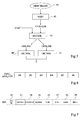
- Figure 5 is a simplified block diagram of authorization mechanisms for a transaction using a bank card.
- a set of tests and checks (block 42, TEST) are carried out, including, among others, the cardholder authentication by entering the PIN code, verifying a threshold for the maximum amount of non-online transaction, etc.
- CVR Card Verification Results
- ADR Application Decision Results
- This word CVR or ADR is compared with a second Card Issuer Action Code (CIAC) reference word contained in the card (in non-volatile memory 13) and whose states are fixed by the provider of it, for example during personalization or an online transaction.
- CVR Card Verification Results
- ADR Application Decision Results
- This word CIAC represents, among other things, the conditions in which a transaction must be authorized (especially online or not), sets thresholds and states for transactions, etc.
- the word CIAC (more precisely, at least its byte containing the authorization conditions of a non-online transaction) is compared (block 43, DECID) with the word CVR or ADR to allow the terminal to accept a transaction or not. direct (without going online).
- the comparison is generally made on the electronic circuit side of the card in which the words CIAC and CVR or ADR are stored.
- the use of an online transaction is for example imposed when a transaction amount greater than a threshold is requested by the terminal or when a number of transactions not online is exceeded.
- the authorization mechanism continues with a validation phase (block 44 or 44 'OK / NOK) whose decision determines the continuation of the transaction.
- a validation phase block 44 or 44 'OK / NOK
- Figure 6 illustrates, very schematically and in block form, the form of a word CIAC, ADR or CVR used in the transaction authorization mechanisms.
- this word includes six bytes B1, B2, B3, B4, B5 and B6 whose respective states identify verification elements of the current transaction or of a previous transaction allowing the system to make the adapted decision, based on the decision-making scheme set by the CIAC word of the banking institution.
- ADR, CVR and CIAC contain bits in the same order in terms of their meaning, so as to allow a bit-by-bit comparison, the word CIAC constituting somehow a reading mask of the word ADR or CVR.
- At least one third information word is stored in the circuit electronic (eg smart card), in case of refusal of a transaction not online.
- This word is intended to be transmitted to the bank (or card provider) in a future online transaction.
- the bank will be able to indicate to the bearer, the reason for the refusal of the transaction even though it took place without connection.
- the present invention takes advantage of the structure of the verification words (eg, ADR or CVR) and reference words (eg, CIAC) used in the authentication and transaction authorization mechanisms to reduce the volume. information to store in case of refusal of a transaction not online, then to transmit during a next transaction online.
- verification words eg, ADR or CVR
- reference words eg, CIAC
- the invention provides for storing the bit position of the verification word (or reference word) that led to the refusal, without storing the verification word.
- the position of a bit in one of the ADR or CVR verification words is predefined.
- the CIAC reference word is provided by the card provider (the bank) and is therefore known to the card provider.
- the bank's knowledge of the bit that triggered the refusal is sufficient for it to reconstruct, based on the word CIAC that it knows, the nature of the refusal of the transaction.
- One advantage is that it limits the amount of information to be stored and transmitted.
- EMV eight bits are enough to code a position of 1 to 48 (6 * 8) to compare with the forty-eight bits of the word ADR or CVR.
- a second position field stores a second refusal source. This always takes up less space than the full verification word.
- FIG. 7 very schematically shows in the form of blocks an exemplary INF information word that can be stored and transmitted according to an embodiment of the present invention.
- the optional elements have been shown in dotted lines.
- a first field 51 of the word INF contains, as indicated above, the position or offset (OFFSET) of the bit of a verification word (for example, ADR or CVR) which triggered the refusal of the non-online transaction.
- the information word also contains a send flag 56 (SENT).
- This sending indicator allows, during each online connection, to determine if the word has already been transmitted, in order to avoid redundant transmissions.
- only the information word of the last denied transaction is stored.
- a single nonvolatile storage area is sufficient in the circuit of the card and its contents are then overwritten with each new non-online transaction refused.
- several information words are stored in a cyclic file whose size is chosen as a function of the memory available in the circuit of the card (in practice, without, of course, exceeding the maximum threshold of transactions not in line allowed).
- the transmission mechanism with the banking establishment conditions the number of information words to be transmitted to each online transaction to inform a user file (considered unlimited size) side banking.
- the sending indicator field 56 makes it possible, in this embodiment, to distinguish the transmitted words from those to be transmitted.
- a field 57 stores information equivalent to that of the field 51 in the event of refusal by the terminal.
- a verification word TVR (Terminal Verification Results) similar to the verification word of the card is often used in the transaction authorization mechanisms, the terminal then generally using not only the IAC reference word it reads. in the map, but also a TAC (Terminal Action Code) reference word defined, for example, by the ACQ entity.
- This word contains, for example, the information of a refusal because of blacklisted card (following opposition, for example). If the TAC reference word contained in the terminal is known to the banking institution 23, only the position of the bit is stored in the field 57. If the reference word TAC is managed by another stakeholder of the system (for example, the manager - scheme), the information it contains is codified from a code that can be used by all banks.
- a field 58 stores an identification of the counter that has triggered the refusal, among the non-online transaction counter, the accumulated amount counter, the PIN code entry attempt counter, and so on.
- Fig. 8 is a simplified block diagram illustrating an embodiment of the transaction authorization method according to the present invention.
- the check (block 44, OK?) Leads, in case of refusal (output N of block 44), to the recording of the information word INF (block 65 , STORE INF) in nonvolatile memory (13, FIG. 2) of the circuit (10) of the card.
- the one or more information words INF contained in the card are, if exists (meaning a previous transaction not online refused), read and then transmitted to the bank (block 66, SENT INF).
- the card provider therefore has sufficient information to communicate to the cardholder the reasons for the refusal of payment. past (at least last) transactions, even if they were made in a non-online mechanism.
- the terminal concerned when the cardholder introduces the card into a terminal of his bank network, the terminal concerned is capable of directly supplying information readable by the bearer by interpreting the states of the words INF.
- This type of information can take the form of short messages displayed on the terminal screen, whether through an interactive menu or not.
- the card provider can obtain information on past refused transactions, in particular when these have been decided directly between the card and the terminal.
- the mechanisms described are compatible with the transmission mechanisms of the EMV standard.
- the invention applies regardless of the transmission mechanism used by the circuit, whether it is a transmission with or without contact, and regardless of the intermediaries of the transaction authorization system.
- the invention is applicable in the case of payments made through a mobile phone using its SIM card as an authentication card.
- the storage of the information word in the electronic circuit can be provided for each denied transaction (online or offline) at the cost of a larger memory space, for example to keep in the circuit, a history rejected transactions.
- This history is, for example, transmitted to a remote entity, periodically or after a number of online transactions.
- this transmission can be performed when the card is introduced into a terminal of the bank (23) of the wearer, then enjoying a communication channel with the computer system of this institution without going through the manager (22).
Landscapes
- Business, Economics & Management (AREA)
- General Physics & Mathematics (AREA)
- Engineering & Computer Science (AREA)
- Physics & Mathematics (AREA)
- Accounting & Taxation (AREA)
- General Business, Economics & Management (AREA)
- Theoretical Computer Science (AREA)
- Strategic Management (AREA)
- Finance (AREA)
- Computer Security & Cryptography (AREA)
- Microelectronics & Electronic Packaging (AREA)
- Computer Networks & Wireless Communication (AREA)
- Financial Or Insurance-Related Operations Such As Payment And Settlement (AREA)
Applications Claiming Priority (1)
| Application Number | Priority Date | Filing Date | Title |
|---|---|---|---|
| FR0654218 | 2006-10-12 |
Publications (1)
| Publication Number | Publication Date |
|---|---|
| EP1912182A1 true EP1912182A1 (de) | 2008-04-16 |
Family
ID=38055648
Family Applications (1)
| Application Number | Title | Priority Date | Filing Date |
|---|---|---|---|
| EP07118062A Withdrawn EP1912182A1 (de) | 2006-10-12 | 2007-10-08 | Berechtigung zur Durchführung einer Transaktion zwischen einem elektronischen Schaltkreis und einem Endgerät |
Country Status (1)
| Country | Link |
|---|---|
| EP (1) | EP1912182A1 (de) |
Cited By (4)
| Publication number | Priority date | Publication date | Assignee | Title |
|---|---|---|---|---|
| EP3172724A1 (de) * | 2014-07-22 | 2017-05-31 | MT Bilgi Teknolojileri Ve Dis Ticaret A.S. | Biometrisches sicheres verkaufs- und zahlungsendgerät mit verwendung von gesichtserkennung- und fingerabdruckdefinitionsverfahren |
| EP3079115A4 (de) * | 2013-12-04 | 2017-10-11 | Tendyron Corporation | Verfahren und chipkarte zur verarbeitung von transaktionsdaten |
| EP3314803A1 (de) * | 2015-06-29 | 2018-05-02 | IDEMIA France | Durch eine mikroschaltung implementiertes aufzeichnungsverfahren und zugehörige vorrichtung |
| FR3076027A1 (fr) * | 2017-12-21 | 2019-06-28 | Oberthur Technologies | Securisation du traitement d'une transaction |
Citations (2)
| Publication number | Priority date | Publication date | Assignee | Title |
|---|---|---|---|---|
| WO1996036947A1 (en) * | 1995-05-15 | 1996-11-21 | Mondex International Limited | Transaction recovery in a value transfer system |
| US6913193B1 (en) * | 1998-01-30 | 2005-07-05 | Citicorp Development Center, Inc. | Method and system of tracking and providing an audit trail of smart card transactions |
-
2007
- 2007-10-08 EP EP07118062A patent/EP1912182A1/de not_active Withdrawn
Patent Citations (2)
| Publication number | Priority date | Publication date | Assignee | Title |
|---|---|---|---|---|
| WO1996036947A1 (en) * | 1995-05-15 | 1996-11-21 | Mondex International Limited | Transaction recovery in a value transfer system |
| US6913193B1 (en) * | 1998-01-30 | 2005-07-05 | Citicorp Development Center, Inc. | Method and system of tracking and providing an audit trail of smart card transactions |
Non-Patent Citations (2)
| Title |
|---|
| EMV: "EMV Integrated Circuit Card Specifications for Payment Systems: Common Payment Application Specification", INTERNET ARTICLE, December 2005 (2005-12-01), XP002435791, Retrieved from the Internet <URL:http://www.emvco.com/specifications.asp?show=1> [retrieved on 20070530] * |
| OESTREICHER M: "Transactions in Java Card", COMPUTER SECURITY APPLICATIONS CONFERENCE, 1999. (ACSAC '99). PROCEEDINGS. 15TH ANNUAL PHOENIX, AZ, USA 6-10 DEC. 1999, LOS ALAMITOS, CA, USA,IEEE COMPUT. SOC, US, 6 December 1999 (1999-12-06), pages 291 - 298, XP010368606, ISBN: 0-7695-0346-2 * |
Cited By (4)
| Publication number | Priority date | Publication date | Assignee | Title |
|---|---|---|---|---|
| EP3079115A4 (de) * | 2013-12-04 | 2017-10-11 | Tendyron Corporation | Verfahren und chipkarte zur verarbeitung von transaktionsdaten |
| EP3172724A1 (de) * | 2014-07-22 | 2017-05-31 | MT Bilgi Teknolojileri Ve Dis Ticaret A.S. | Biometrisches sicheres verkaufs- und zahlungsendgerät mit verwendung von gesichtserkennung- und fingerabdruckdefinitionsverfahren |
| EP3314803A1 (de) * | 2015-06-29 | 2018-05-02 | IDEMIA France | Durch eine mikroschaltung implementiertes aufzeichnungsverfahren und zugehörige vorrichtung |
| FR3076027A1 (fr) * | 2017-12-21 | 2019-06-28 | Oberthur Technologies | Securisation du traitement d'une transaction |
Similar Documents
| Publication | Publication Date | Title |
|---|---|---|
| EP0426541B1 (de) | Verfahren zum Schutz gegen betrügerischen Gebrauch einer Mikroprozessor-Karte und Vorrichtung zur Durchführung | |
| CA2027344C (fr) | Systeme de paiement ou de transfert d'information par carte a memoire electronique porte monnaie | |
| EP1014317B1 (de) | Gesichertes Bezahlungsverfahren | |
| EP0049650A1 (de) | Gerät zum Ausgeben von Gegenständen und Leisten von Diensten | |
| FR3021799A1 (fr) | Methode d'identification, dispositif et programme correspondant | |
| CA2946143C (fr) | Procede de traitement de donnees transactionnelles, dispositif et programme correspondant | |
| EP1912182A1 (de) | Berechtigung zur Durchführung einer Transaktion zwischen einem elektronischen Schaltkreis und einem Endgerät | |
| EP1791291A1 (de) | Personalisierung einer Bankkarte für andere Verwendungen | |
| EP1791292B1 (de) | Personalisierung einer elektronischen Schaltung | |
| FR2697929A1 (fr) | Protocole sécurisé d'échange de données entre un dispositif de transfert et un objet portatif. | |
| EP1483645A2 (de) | Vorrichtung und verfahren zur sicherung empfindlicher daten zwischen zwei teilen durch dritte partei | |
| EP3261014B1 (de) | Sendeverfahren einer sicherheitsinformation | |
| FR2710769A1 (fr) | Système de traitement des données d'une carte à microcircuit, carte et lecteur pour ce système et procédé de mise en Óoeuvre. | |
| WO1997031343A1 (fr) | Carte de gestion de comptes multiples et procede de mise en ×uvre | |
| FR3054701A1 (fr) | Procede de mise en oeuvre d'une transaction depuis un moyen de transaction electronique | |
| EP3514749B1 (de) | Verfahren zur kontrolle von abhangigkeitsregelen für geänderte objekte in einem mikroschaltkreis und entsprechendes gerät | |
| FR2885246A1 (fr) | Terminal nomade de transactions electroniques securise et systeme de transactions electroniques securise | |
| CA2275940A1 (fr) | Procede d'interpretation dynamique de donnees pour une carte a puce | |
| EP3358493A1 (de) | Verfahren zur sicherung einer elektronischen operation | |
| EP2812864B1 (de) | Zahlungssystem, zahlungsendgerat dieses system und entsprechendes zahlungsverfahren | |
| FR3061332A1 (fr) | Procede pour la securite d'une operation electronique avec une carte a puce | |
| CA2325895C (fr) | Procede de paiement securise | |
| FR2897705A1 (fr) | Mise a jour d'une carte a puce | |
| FR3099272A1 (fr) | Procédé de sécurisation, et dispositif électronique associé | |
| EP3208731A1 (de) | Konfigurationsprozess und konfigurationsgerät für ein gerät, das banktransaktionen durchführt |
Legal Events
| Date | Code | Title | Description |
|---|---|---|---|
| PUAI | Public reference made under article 153(3) epc to a published international application that has entered the european phase |
Free format text: ORIGINAL CODE: 0009012 |
|
| AK | Designated contracting states |
Kind code of ref document: A1 Designated state(s): AT BE BG CH CY CZ DE DK EE ES FI FR GB GR HU IE IS IT LI LT LU LV MC MT NL PL PT RO SE SI SK TR |
|
| AX | Request for extension of the european patent |
Extension state: AL BA HR MK RS |
|
| 17P | Request for examination filed |
Effective date: 20081014 |
|
| AKX | Designation fees paid |
Designated state(s): BE DE FR GB |
|
| 17Q | First examination report despatched |
Effective date: 20081218 |
|
| STAA | Information on the status of an ep patent application or granted ep patent |
Free format text: STATUS: THE APPLICATION IS DEEMED TO BE WITHDRAWN |
|
| 18D | Application deemed to be withdrawn |
Effective date: 20130503 |