EP1912202A2 - Beschleunigte Darstellung von Graphiken über zwei Prozessoren - Google Patents
Beschleunigte Darstellung von Graphiken über zwei Prozessoren Download PDFInfo
- Publication number
- EP1912202A2 EP1912202A2 EP07117797A EP07117797A EP1912202A2 EP 1912202 A2 EP1912202 A2 EP 1912202A2 EP 07117797 A EP07117797 A EP 07117797A EP 07117797 A EP07117797 A EP 07117797A EP 1912202 A2 EP1912202 A2 EP 1912202A2
- Authority
- EP
- European Patent Office
- Prior art keywords
- processor
- graphics
- processors
- application
- rendering
- Prior art date
- Legal status (The legal status is an assumption and is not a legal conclusion. Google has not performed a legal analysis and makes no representation as to the accuracy of the status listed.)
- Granted
Links
Images


Classifications
-
- G—PHYSICS
- G06—COMPUTING OR CALCULATING; COUNTING
- G06F—ELECTRIC DIGITAL DATA PROCESSING
- G06F3/00—Input arrangements for transferring data to be processed into a form capable of being handled by the computer; Output arrangements for transferring data from processing unit to output unit, e.g. interface arrangements
- G06F3/14—Digital output to display device ; Cooperation and interconnection of the display device with other functional units
-
- G—PHYSICS
- G06—COMPUTING OR CALCULATING; COUNTING
- G06T—IMAGE DATA PROCESSING OR GENERATION, IN GENERAL
- G06T15/00—Three-dimensional [3D] image rendering
- G06T15/005—General purpose rendering architectures
-
- G—PHYSICS
- G09—EDUCATION; CRYPTOGRAPHY; DISPLAY; ADVERTISING; SEALS
- G09G—ARRANGEMENTS OR CIRCUITS FOR CONTROL OF INDICATING DEVICES USING STATIC MEANS TO PRESENT VARIABLE INFORMATION
- G09G5/00—Control arrangements or circuits for visual indicators common to cathode-ray tube indicators and other visual indicators
- G09G5/36—Control arrangements or circuits for visual indicators common to cathode-ray tube indicators and other visual indicators characterised by the display of a graphic pattern, e.g. using an all-points-addressable [APA] memory
- G09G5/363—Graphics controllers
-
- G—PHYSICS
- G06—COMPUTING OR CALCULATING; COUNTING
- G06F—ELECTRIC DIGITAL DATA PROCESSING
- G06F3/00—Input arrangements for transferring data to be processed into a form capable of being handled by the computer; Output arrangements for transferring data from processing unit to output unit, e.g. interface arrangements
- G06F3/14—Digital output to display device ; Cooperation and interconnection of the display device with other functional units
- G06F3/1423—Digital output to display device ; Cooperation and interconnection of the display device with other functional units controlling a plurality of local displays, e.g. CRT and flat panel display
- G06F3/1438—Digital output to display device ; Cooperation and interconnection of the display device with other functional units controlling a plurality of local displays, e.g. CRT and flat panel display using more than one graphics controller
Definitions
- the present invention relates to processing of graphics and more particularly to a method and apparatus for processing high order graphics languages, such as OpenGL®, for embedded systems, for multiple application tasks, and for partitions.
- high order graphics languages such as OpenGL®
- embedded systems for multiple application tasks, and for partitions.
- X Windows GUI for Unix supports a client-server over a network method of OpenGL® operation.
- X Windows allows one computer to act as an OpenGL® client while another computer acts as an OpenGL® server over a network.
- This invention is designed to optimize performance for graphics processors using multiple processors.
- Windows SMP does not allow a single thread such as OpenGL® application linked with a device driver to operate on more than one processor.
- the X Windows system uses a network style interface that requires decoding and encoding of X Windows system calls into OpenGL® calls.
- the X Windows system does not have the ability to statically configure the client server between separate processors on a single computer.
- the present invention meets this need and provides for multiple application tasks rendered to a hardware graphics processor by using two processors when rendering to single screen. This improves graphics throughput and allows complex tasking/partitioning for application software and allows any task of any partition to render to any graphics window.
- the present invention is a method and apparatus using dual processor accelerated graphics rendering which allows for optimizing graphics performance using two processors and three dimensional (3D) hardware accelerators on at least one screen.
- Each processor has an independent operating system executing.
- One processor is dedicated to running applications, and the other processor is dedicated to driving the graphics hardware.
- graphics rendering throughput is slowed by operations done on the processor prior to transferring data across the bus, limitations of the bus, overhead of coordination between central processing unit (CPU) and graphics hardware, as well as the time needed for the graphics rendering. Separating these activities from the application results in more time for applications and allows for graphics rendering without blocking functions.
- graphics execution can be done in parallel with processor execution; however, there are certain functions that force the processor to wait for the graphics hardware; these are called blocking functions.
- the first processor no longer interacts with the graphics hardware; it only needs to communicate with the second processor.
- the second processor does the communication to the graphics hardware in a more methodical fashion than the application processor would be capable of. This is especially true if the application processor is being interrupt driven or has excessive time partitioning.
- a primary object of the present invention is to optimize performance for graphics processors using multiple processors.
- a primary advantage of the present invention is the flexibility in time and space partitioning, that the application tasks are allowed.
- Another advantage is that a windowing system is feasible for all windows to be rendered using hardware acceleration in a real time system.
- a further advantage is the gain in graphics performance by separating the interaction between the application processor and graphics hardware, so that the application processor is never held waiting for the graphics processor.
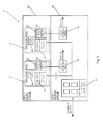
- Fig. 1 is an overview of the relationship between the two processors.
- Fig. 2 is an overview of the tasking on processor 0.
- Fig. 3 is an overview of the tasking on processor 1.
- the present invention is a method of utilizing two or more processors to increase graphics performance to a single screen.
- the preferred embodiment of the invention is shown in Figs. 1-3.
- One processor 10 executes the application while the second processor 14 drives the GPU to render graphics.
- a subset of OpenGL® with window/context functionalities is supported.
- OpenGL® is a common API, window/context functions are not consistent across all implementations.
- an OpenGL® function call will not render graphics, but rather encode the instruction with parameters to common memory 12 shared with the graphics processor 14, which is much faster.
- the second processor 14 then executes a single application of executing all stored instructions. The lists are buffered, and a call to swap the buffers for that window causes the rendering processor 14 to begin executing that list of instructions.
- the application processor 10 encodes all OpenGL® calls to common memory 12 shared between the processors. The instructions will be grouped by which window they are drawing to. This processor 10 also performs memory management for the buffered lists 72. Memory 12 is managed in blocks 40 rather than allocated, although either mechanism works. If more than one memory block is needed then there is an instruction pointer to another memory block. There are a fixed number of memory blocks 40 at startup. Memory blocks 40 are also used when transferring data to the GPU such as texture. In addition to encoding the OpenGL® calls, the application processor 10 also performs error checking on the parameters passed as well as validating the order the calls are made. Applications execute significantly faster than if they also are rendering the image.
- the rendering processor 14 handles all calls in a single application, or two applications if two GPUs 16 and 18 are used. Two GPUs could be beneficial if applications are known to take excessive amounts of rendering time, or if one GPU is used for video processing and the other for primitive rendering.
- the invention can be scaled to as many GPUs as desired. Executing all calls to a GPU in a single application, allows for the GPU to function in a mode more efficient for generating displays. Displays are preferred to be generated at a fixed rate, which is the rate the display list application is operating at. Not having the rendering processor 14 time partitioned like the application processor 10 allows for the processor to take advantage of all processing time. Only the windows that are being changed need to be updated and this is handled by buffering the draw and scan frame buffers.
- Another advantage of separating the graphics calls between processors is that extra processing can be done on the generated lists.
- the increased throughput allows time for additional processing to improve image quality.
- Additional line drawing algorithms can be added to improve the anti-aliasing.
- Haloing can also be added with no performance impact to the application.
- Improved display list processing can be implemented to enhance the OpenGL® functions. Lists can be stored and modified in shared memory 12 with almost no impact to the application, potentially generating tremendous amounts of updated rendering.
- Features can be added to sort the order of lists for priority. This method will create an abstraction layer for OpenGL® as well as graphics and context switching, which make it adaptable and more portable.
- the major advantage is the modular design of the application and the graphics which will reduce the effort to achieve FAA and DO178B certification and allow for upgrades to one or the other potentially without having to re-qualify both pieces.
- Fig. 1 is an overview of the relationship between the two processors.
- Each processor or central processing unit (CPU) has a real time operating system with time and space partitioning.
- CPU 0 10 can have as many address spaces and time partitions as needed.
- the application processor CPU 0 10 encodes all OpenGL® calls to common memory 12 shared between the processors. In addition to encoding the OpenGL® calls, application processor CPU 0 10 also performs error checking on the parameters passed as well as validating the order of the parameters. Applications execute significantly faster than if they also were rendering the image.
- the instructions will be grouped by which window they are drawing to.
- CPU 1 14 has a partition for each hardware accelerator to be used. The instructions will be grouped by which window they are drawing to.
- Processor 0 10 has graphics applications with drivers that generate lists of OpenGL® and graphics service calls.
- the queues of graphics commands are all buffered so that CPU 1 14 can render out of a buffer in parallel to CPU 0 10 filling a queue. If multiple application tasks will be writing into the same window then a windows manager task will be needed on CPU 0 10 to coordinate the swapping of buffers. If only a single application on CPU 0 10 is allowed to fill a queue then the swapping of buffers can be coordinated by their respective application.
- the rendering processor CPU 1 14 then polls the status of the queues for each window. Whenever a queue has been swapped, CPU 1 14 begins operating out of that queue. In this way, only windows of the screen that are changed need to be updated.
- Memory 12 is managed in blocks rather than allocated. If more than a memory block is needed then there can be an instruction pointer to another memory block. Preferably there are a fixed number of blocks at startup. The memory blocks will also be used when transferring data to the GPU such as texture data. Buffer lists are shown with a plurality of windows 72. Each window and or context has a list that also preferably contains header information, control instructions, status, and render statistics such as time.
- Processor 1 14 drives the graphics processors or graphics processing units (GPU). This example has two graphics processors GPU A 16 and GPU B 18. Each GPU has hardware that provides accelerated raster rendering.
- Timeline A 20 is the timeline for tasks on processor 0 10.
- Timeline B 22 is the timeline for tasks on processor 1 14. Timelines A 20 and B 22 demonstrate how processor 0 10 can be time partitioned as needed by application processing while the graphics processing can remain at a fixed update rate which is optimal for displays processing.
- Fig. 2 is an overview of the tasking on processor 0 10.
- CPU 0 kernel space 26 is a protected partition where the OS kernel executes. Kernel space is the partitioned memory dedicated for operation of the operating system.
- CPU 0 user space 24 is where applications execute.
- Address spaces 28, 30, and 32 are where the application tasks reside. Address spaces are partitioned memories dedicated for application tasks. Each address partition can have multiple tasks.
- Graphic library 34 exists in kernel space 26 so that multiple instances are not needed in every application space. Alternately, the graphics library can be directly linked to each application in user space. Some other functions can be performed on the graphics calls, such as a memory manager 36 that allocates fixed memory blocks as needed and shared memory blocks 38 for display lists and texture.
- FIG. 3 is an overview of the tasking on processor 1 14.
- CPU 1 kernel space 44 is a protected partition where the OS kernel executes.
- CPU 1 user space 42 is the user space where the actual display rendering takes place.
- Application or address space A 46 and address space 56 are needed for each graphics processor that is being used.
- Each address space 46 and 56 have shared memory blocks 50 and 60 for the graphics calls for the windows that each GPU is rendering.
- the memory regions are mapped 70 in kernel space 44, but separated for their respective windows.
- Task A 48 and task B 58 write to their respective graphics libraries, graphic library A 52 and graphic library B 62.
- Graphics libraries 52 and 62 interface to kernel space 44 through PCI mapped memory regions, GPU A PCI 54 and GPU B PCI 64 and map directly to GPU A PCI memory region 66 and GPU B PCI memory region 68 in kernel space 44 respectively.
- a window managing task could be implemented on the application processor to better manage only updating graphics when needed, or rendering by priority. Frequent called functions such as a font set could be hosted on the second processor so that the higher order graphics calls could be made from the application processor allowing for greater efficiency. Similarly, compiled display lists can be maintained on the second processor to reduce the throughput required for static symbology.
- each window driver has to be allocated a worse case time for the client and the worse case time for its server.
- OS time partitioned operating system
- the sum of the two worse case times is significantly larger than the worse case time of the combined client/server, because high times on the client or server do not necessarily translate to high times on the other side.
Landscapes
- Engineering & Computer Science (AREA)
- Theoretical Computer Science (AREA)
- Physics & Mathematics (AREA)
- General Physics & Mathematics (AREA)
- Computer Graphics (AREA)
- Computer Hardware Design (AREA)
- Human Computer Interaction (AREA)
- General Engineering & Computer Science (AREA)
- Controls And Circuits For Display Device (AREA)
- Image Generation (AREA)
Applications Claiming Priority (1)
| Application Number | Priority Date | Filing Date | Title |
|---|---|---|---|
| US11/542,575 US7830389B2 (en) | 2006-10-03 | 2006-10-03 | Dual processor accelerated graphics rendering |
Publications (3)
| Publication Number | Publication Date |
|---|---|
| EP1912202A2 true EP1912202A2 (de) | 2008-04-16 |
| EP1912202A3 EP1912202A3 (de) | 2009-05-27 |
| EP1912202B1 EP1912202B1 (de) | 2020-02-26 |
Family
ID=39111823
Family Applications (1)
| Application Number | Title | Priority Date | Filing Date |
|---|---|---|---|
| EP07117797.6A Active EP1912202B1 (de) | 2006-10-03 | 2007-10-02 | Beschleunigte Darstellung von Graphiken über zwei Prozessoren |
Country Status (2)
| Country | Link |
|---|---|
| US (1) | US7830389B2 (de) |
| EP (1) | EP1912202B1 (de) |
Cited By (4)
| Publication number | Priority date | Publication date | Assignee | Title |
|---|---|---|---|---|
| FR2953285A1 (fr) * | 2009-12-01 | 2011-06-03 | Sagem Defense Securite | Dispositif d'affichage d'informations critiques et non critiques, et aeronef incorporant un tel dispositif |
| US9342196B2 (en) | 2012-07-19 | 2016-05-17 | Parade Technologies, Ltd. | Hardware accelerator for touchscreen data processing |
| US9377909B2 (en) | 2012-07-19 | 2016-06-28 | Parade Technologies, Ltd. | Touchscreen data processing |
| WO2024144523A1 (en) * | 2022-12-28 | 2024-07-04 | Havelsan Hava Elektronik San. Ve Tic. A.S. | Providing 3d imaging on a platform with a real-time operating system |
Families Citing this family (10)
| Publication number | Priority date | Publication date | Assignee | Title |
|---|---|---|---|---|
| US7996787B2 (en) * | 2007-02-06 | 2011-08-09 | Cptn Holdings Llc | Plug-in architecture for window management and desktop compositing effects |
| US8300056B2 (en) | 2008-10-13 | 2012-10-30 | Apple Inc. | Seamless display migration |
| US8368702B2 (en) | 2010-01-06 | 2013-02-05 | Apple Inc. | Policy-based switching between graphics-processing units |
| US8648868B2 (en) | 2010-01-06 | 2014-02-11 | Apple Inc. | Color correction to facilitate switching between graphics-processing units |
| US8797334B2 (en) | 2010-01-06 | 2014-08-05 | Apple Inc. | Facilitating efficient switching between graphics-processing units |
| GB201015590D0 (en) | 2010-09-17 | 2010-10-27 | Matcon Ltd | Material handling apparatus |
| US8786619B2 (en) | 2011-02-25 | 2014-07-22 | Adobe Systems Incorporated | Parallelized definition and display of content in a scripting environment |
| US20130155077A1 (en) * | 2011-12-14 | 2013-06-20 | Advanced Micro Devices, Inc. | Policies for Shader Resource Allocation in a Shader Core |
| US10218645B2 (en) * | 2014-04-08 | 2019-02-26 | Mellanox Technologies, Ltd. | Low-latency processing in a network node |
| CN109800190B (zh) * | 2019-01-22 | 2021-04-06 | 星辰天合(北京)数据科技有限公司 | 内存的加速处理方法及装置、存储介质、处理器 |
Family Cites Families (11)
| Publication number | Priority date | Publication date | Assignee | Title |
|---|---|---|---|---|
| US5408650A (en) * | 1993-06-29 | 1995-04-18 | Digital Equipment Corporation | Memory analysis system for dynamically displaying memory allocation and de-allocation events associated with an application program |
| US6331856B1 (en) * | 1995-11-22 | 2001-12-18 | Nintendo Co., Ltd. | Video game system with coprocessor providing high speed efficient 3D graphics and digital audio signal processing |
| US6359624B1 (en) | 1996-02-02 | 2002-03-19 | Kabushiki Kaisha Toshiba | Apparatus having graphic processor for high speed performance |
| US6249294B1 (en) | 1998-07-20 | 2001-06-19 | Hewlett-Packard Company | 3D graphics in a single logical sreen display using multiple computer systems |
| US6525738B1 (en) | 1999-07-16 | 2003-02-25 | International Business Machines Corporation | Display list processor for decoupling graphics subsystem operations from a host processor |
| US6675289B1 (en) * | 2000-06-30 | 2004-01-06 | Broadcom Corporation | System and method for executing hybridized code on a dynamically configurable hardware environment |
| US7234144B2 (en) * | 2002-01-04 | 2007-06-19 | Microsoft Corporation | Methods and system for managing computational resources of a coprocessor in a computing system |
| JP4683384B2 (ja) * | 2004-09-22 | 2011-05-18 | 株式会社ソニー・コンピュータエンタテインメント | メモリ制御方法、グラフィックプロセッサおよび情報処理装置 |
| US7852342B2 (en) * | 2004-10-14 | 2010-12-14 | Microsoft Corporation | Remote client graphics rendering |
| US7586493B1 (en) * | 2006-05-24 | 2009-09-08 | Nvidia Corporation | System and method for offloading application tasks in a multi-processor environment utilizing a driver |
| US8751067B2 (en) | 2007-02-27 | 2014-06-10 | The Boeing Company | Electronic flight bag system and method |
-
2006
- 2006-10-03 US US11/542,575 patent/US7830389B2/en active Active
-
2007
- 2007-10-02 EP EP07117797.6A patent/EP1912202B1/de active Active
Non-Patent Citations (1)
| Title |
|---|
| DAVID ALLEN: "Electronic flight bag (EFB)", INTERNET CITATION,[ONLINE, 29 August 2006 (2006-08-29), pages 1 - 17 |
Cited By (6)
| Publication number | Priority date | Publication date | Assignee | Title |
|---|---|---|---|---|
| FR2953285A1 (fr) * | 2009-12-01 | 2011-06-03 | Sagem Defense Securite | Dispositif d'affichage d'informations critiques et non critiques, et aeronef incorporant un tel dispositif |
| WO2011066920A1 (fr) * | 2009-12-01 | 2011-06-09 | Sagem Defense Securite | Dispositif d'affichage d'informations critiques et non critiques, et aeronef incorporant un tel dispositif |
| US8694179B2 (en) | 2009-12-01 | 2014-04-08 | Sagem Defense Securite | Device for displaying critical and non-critical information, and aircraft including such a device |
| US9342196B2 (en) | 2012-07-19 | 2016-05-17 | Parade Technologies, Ltd. | Hardware accelerator for touchscreen data processing |
| US9377909B2 (en) | 2012-07-19 | 2016-06-28 | Parade Technologies, Ltd. | Touchscreen data processing |
| WO2024144523A1 (en) * | 2022-12-28 | 2024-07-04 | Havelsan Hava Elektronik San. Ve Tic. A.S. | Providing 3d imaging on a platform with a real-time operating system |
Also Published As
| Publication number | Publication date |
|---|---|
| US20080079736A1 (en) | 2008-04-03 |
| US7830389B2 (en) | 2010-11-09 |
| EP1912202B1 (de) | 2020-02-26 |
| EP1912202A3 (de) | 2009-05-27 |
Similar Documents
| Publication | Publication Date | Title |
|---|---|---|
| EP1912202A2 (de) | Beschleunigte Darstellung von Graphiken über zwei Prozessoren | |
| US20250191111A1 (en) | Reconfigurable virtual graphics and compute processor pipeline | |
| US8350864B2 (en) | Serializing command streams for graphics processors | |
| US8988442B2 (en) | Asynchronous notifications for concurrent graphics operations | |
| EP2622461B1 (de) | Gemeinsam genutzter speicher zwischen untergeordneten und übergeordneten partitionen | |
| EP2315122B1 (de) | Verfahren und systeme zur fernübertragung dreidimensionaler graphiken | |
| US8269780B2 (en) | Batching graphics operations with time stamp tracking | |
| US20090002263A1 (en) | Providing a Composite Display | |
| US20190206023A1 (en) | Multi-gpu frame rendering | |
| US7898554B2 (en) | Asymmetric two-pass graphics scaling | |
| EP3413198A1 (de) | Parallele datenverarbeitung auf mehreren prozessoren | |
| US20070088792A1 (en) | Hardware processing of commands within virtual client computing environment | |
| US10002403B2 (en) | Command remoting | |
| JP5202319B2 (ja) | スケーラブルなマルチスレッド型メディア処理アーキテクチャ | |
| US8531470B2 (en) | Deferred deletion and cleanup for graphics resources | |
| US7940276B2 (en) | Virtualization of graphics resources | |
| CN119668791A (zh) | 任务处理方法、系统、电子设备及存储介质 | |
| AU2014204556B2 (en) | Parallel runtime execution on multiple processors | |
| Tanveer | Development of generic scheduling concepts for OpenGL ES 2.0 | |
| Rothermel et al. | DEVELOPMENT OF GENERIC SCHEDULING CONCEPTS | |
| Tanveer | DEVELOPMENT OF GENERIC SCHEDULING CONCEPTS | |
| AU2016213890A1 (en) | Data parallel computing on multiple processors |
Legal Events
| Date | Code | Title | Description |
|---|---|---|---|
| PUAI | Public reference made under article 153(3) epc to a published international application that has entered the european phase |
Free format text: ORIGINAL CODE: 0009012 |
|
| 17P | Request for examination filed |
Effective date: 20080115 |
|
| AK | Designated contracting states |
Kind code of ref document: A2 Designated state(s): AT BE BG CH CY CZ DE DK EE ES FI FR GB GR HU IE IS IT LI LT LU LV MC MT NL PL PT RO SE SI SK TR |
|
| AX | Request for extension of the european patent |
Extension state: AL BA HR MK RS |
|
| RIN1 | Information on inventor provided before grant (corrected) |
Inventor name: HANCOCK, WILLIAM R. Inventor name: MEEHAN, NATHAN J. Inventor name: MAASS, SCOTT R. |
|
| PUAL | Search report despatched |
Free format text: ORIGINAL CODE: 0009013 |
|
| AK | Designated contracting states |
Kind code of ref document: A3 Designated state(s): AT BE BG CH CY CZ DE DK EE ES FI FR GB GR HU IE IS IT LI LT LU LV MC MT NL PL PT RO SE SI SK TR |
|
| AX | Request for extension of the european patent |
Extension state: AL BA HR MK RS |
|
| 17Q | First examination report despatched |
Effective date: 20090805 |
|
| AKX | Designation fees paid |
Designated state(s): DE FR GB |
|
| RAP1 | Party data changed (applicant data changed or rights of an application transferred) |
Owner name: HONEYWELL INTERNATIONAL INC. |
|
| REG | Reference to a national code |
Ref country code: DE Ref legal event code: R079 Ref document number: 602007059893 Country of ref document: DE Free format text: PREVIOUS MAIN CLASS: G09G0005360000 Ipc: G06F0003140000 |
|
| GRAP | Despatch of communication of intention to grant a patent |
Free format text: ORIGINAL CODE: EPIDOSNIGR1 |
|
| RIC1 | Information provided on ipc code assigned before grant |
Ipc: G09G 5/36 20060101ALI20190920BHEP Ipc: G06T 15/00 20110101ALI20190920BHEP Ipc: G06F 3/14 20060101AFI20190920BHEP |
|
| INTG | Intention to grant announced |
Effective date: 20191018 |
|
| GRAS | Grant fee paid |
Free format text: ORIGINAL CODE: EPIDOSNIGR3 |
|
| GRAA | (expected) grant |
Free format text: ORIGINAL CODE: 0009210 |
|
| AK | Designated contracting states |
Kind code of ref document: B1 Designated state(s): DE FR GB |
|
| REG | Reference to a national code |
Ref country code: GB Ref legal event code: FG4D |
|
| REG | Reference to a national code |
Ref country code: DE Ref legal event code: R096 Ref document number: 602007059893 Country of ref document: DE |
|
| REG | Reference to a national code |
Ref country code: DE Ref legal event code: R097 Ref document number: 602007059893 Country of ref document: DE |
|
| PLBE | No opposition filed within time limit |
Free format text: ORIGINAL CODE: 0009261 |
|
| STAA | Information on the status of an ep patent application or granted ep patent |
Free format text: STATUS: NO OPPOSITION FILED WITHIN TIME LIMIT |
|
| 26N | No opposition filed |
Effective date: 20201127 |
|
| P01 | Opt-out of the competence of the unified patent court (upc) registered |
Effective date: 20230525 |
|
| PGFP | Annual fee paid to national office [announced via postgrant information from national office to epo] |
Ref country code: DE Payment date: 20251028 Year of fee payment: 19 |
|
| PGFP | Annual fee paid to national office [announced via postgrant information from national office to epo] |
Ref country code: GB Payment date: 20251023 Year of fee payment: 19 |
|
| PGFP | Annual fee paid to national office [announced via postgrant information from national office to epo] |
Ref country code: FR Payment date: 20251027 Year of fee payment: 19 |