EP1914268B1 - Ensemble pneu-jante - Google Patents
Ensemble pneu-jante Download PDFInfo
- Publication number
- EP1914268B1 EP1914268B1 EP07024580A EP07024580A EP1914268B1 EP 1914268 B1 EP1914268 B1 EP 1914268B1 EP 07024580 A EP07024580 A EP 07024580A EP 07024580 A EP07024580 A EP 07024580A EP 1914268 B1 EP1914268 B1 EP 1914268B1
- Authority
- EP
- European Patent Office
- Prior art keywords
- tire
- particles
- internal pressure
- acrylonitrile
- pressure
- Prior art date
- Legal status (The legal status is an assumption and is not a legal conclusion. Google has not performed a legal analysis and makes no representation as to the accuracy of the status listed.)
- Expired - Lifetime
Links
- 239000002245 particle Substances 0.000 claims description 420
- 229920001577 copolymer Polymers 0.000 claims description 64
- NLHHRLWOUZZQLW-UHFFFAOYSA-N Acrylonitrile Chemical compound C=CC#N NLHHRLWOUZZQLW-UHFFFAOYSA-N 0.000 claims description 49
- OEPOKWHJYJXUGD-UHFFFAOYSA-N 2-(3-phenylmethoxyphenyl)-1,3-thiazole-4-carbaldehyde Chemical compound O=CC1=CSC(C=2C=C(OCC=3C=CC=CC=3)C=CC=2)=N1 OEPOKWHJYJXUGD-UHFFFAOYSA-N 0.000 claims description 41
- 229920005989 resin Polymers 0.000 claims description 36
- 239000011347 resin Substances 0.000 claims description 36
- VVQNEPGJFQJSBK-UHFFFAOYSA-N Methyl methacrylate Chemical compound COC(=O)C(C)=C VVQNEPGJFQJSBK-UHFFFAOYSA-N 0.000 claims description 31
- 239000004088 foaming agent Substances 0.000 claims description 29
- 229920000642 polymer Polymers 0.000 claims description 27
- 239000000203 mixture Substances 0.000 claims description 26
- -1 alicyclic hydrocarbon Chemical class 0.000 claims description 24
- GYCMBHHDWRMZGG-UHFFFAOYSA-N Methylacrylonitrile Chemical compound CC(=C)C#N GYCMBHHDWRMZGG-UHFFFAOYSA-N 0.000 claims description 19
- OKTJSMMVPCPJKN-UHFFFAOYSA-N Carbon Chemical compound [C] OKTJSMMVPCPJKN-UHFFFAOYSA-N 0.000 claims description 13
- 229910052799 carbon Inorganic materials 0.000 claims description 13
- 229920003229 poly(methyl methacrylate) Polymers 0.000 claims description 12
- 229920001897 terpolymer Polymers 0.000 claims description 12
- 229920000058 polyacrylate Polymers 0.000 claims description 10
- 230000015572 biosynthetic process Effects 0.000 claims description 8
- 239000004372 Polyvinyl alcohol Substances 0.000 claims description 7
- 229920002451 polyvinyl alcohol Polymers 0.000 claims description 7
- 239000004156 Azodicarbonamide Substances 0.000 claims description 6
- XOZUGNYVDXMRKW-AATRIKPKSA-N azodicarbonamide Chemical compound NC(=O)\N=N\C(N)=O XOZUGNYVDXMRKW-AATRIKPKSA-N 0.000 claims description 6
- 235000019399 azodicarbonamide Nutrition 0.000 claims description 6
- 229920002239 polyacrylonitrile Polymers 0.000 claims description 6
- KRHYYFGTRYWZRS-UHFFFAOYSA-M Fluoride anion Chemical compound [F-] KRHYYFGTRYWZRS-UHFFFAOYSA-M 0.000 claims description 5
- 239000004215 Carbon black (E152) Substances 0.000 claims description 4
- MWRWFPQBGSZWNV-UHFFFAOYSA-N Dinitrosopentamethylenetetramine Chemical compound C1N2CN(N=O)CN1CN(N=O)C2 MWRWFPQBGSZWNV-UHFFFAOYSA-N 0.000 claims description 4
- 150000001338 aliphatic hydrocarbons Chemical class 0.000 claims description 4
- RTZKZFJDLAIYFH-UHFFFAOYSA-N ether Substances CCOCC RTZKZFJDLAIYFH-UHFFFAOYSA-N 0.000 claims description 4
- 150000002222 fluorine compounds Chemical class 0.000 claims description 4
- 229930195733 hydrocarbon Natural products 0.000 claims description 4
- 150000002430 hydrocarbons Chemical group 0.000 claims description 4
- 229930195734 saturated hydrocarbon Natural products 0.000 claims description 4
- 229930195735 unsaturated hydrocarbon Natural products 0.000 claims description 4
- ISNKSXRJJVWFIL-UHFFFAOYSA-N (sulfonylamino)amine Chemical compound NN=S(=O)=O ISNKSXRJJVWFIL-UHFFFAOYSA-N 0.000 claims description 3
- YXFVVABEGXRONW-UHFFFAOYSA-N Toluene Chemical compound CC1=CC=CC=C1 YXFVVABEGXRONW-UHFFFAOYSA-N 0.000 claims description 3
- UFFYTMBVSQBVKV-UHFFFAOYSA-N ctk5j6542 Chemical compound NN=S(=O)=O.C=1C=CC=CC=1OC1=CC=CC=C1 UFFYTMBVSQBVKV-UHFFFAOYSA-N 0.000 claims description 3
- 239000007789 gas Substances 0.000 description 106
- 238000011049 filling Methods 0.000 description 72
- 238000000034 method Methods 0.000 description 71
- 238000007789 sealing Methods 0.000 description 44
- 230000005484 gravity Effects 0.000 description 41
- 230000006378 damage Effects 0.000 description 37
- IJGRMHOSHXDMSA-UHFFFAOYSA-N Atomic nitrogen Chemical compound N#N IJGRMHOSHXDMSA-UHFFFAOYSA-N 0.000 description 30
- 238000012360 testing method Methods 0.000 description 28
- 230000006835 compression Effects 0.000 description 25
- 238000007906 compression Methods 0.000 description 25
- 229920001971 elastomer Polymers 0.000 description 22
- 239000002131 composite material Substances 0.000 description 20
- VLKZOEOYAKHREP-UHFFFAOYSA-N n-Hexane Chemical compound CCCCCC VLKZOEOYAKHREP-UHFFFAOYSA-N 0.000 description 20
- 238000003860 storage Methods 0.000 description 20
- 230000001413 cellular effect Effects 0.000 description 19
- 230000000052 comparative effect Effects 0.000 description 18
- 239000007788 liquid Substances 0.000 description 17
- 239000005060 rubber Substances 0.000 description 16
- 238000000429 assembly Methods 0.000 description 15
- 230000000712 assembly Effects 0.000 description 15
- 238000011156 evaluation Methods 0.000 description 15
- OFBQJSOFQDEBGM-UHFFFAOYSA-N n-pentane Natural products CCCCC OFBQJSOFQDEBGM-UHFFFAOYSA-N 0.000 description 15
- NNPPMTNAJDCUHE-UHFFFAOYSA-N isobutane Chemical compound CC(C)C NNPPMTNAJDCUHE-UHFFFAOYSA-N 0.000 description 14
- QWTDNUCVQCZILF-UHFFFAOYSA-N isopentane Chemical compound CCC(C)C QWTDNUCVQCZILF-UHFFFAOYSA-N 0.000 description 14
- 238000000576 coating method Methods 0.000 description 13
- 239000004698 Polyethylene Substances 0.000 description 12
- ATUOYWHBWRKTHZ-UHFFFAOYSA-N Propane Chemical compound CCC ATUOYWHBWRKTHZ-UHFFFAOYSA-N 0.000 description 12
- 238000010438 heat treatment Methods 0.000 description 12
- 239000000463 material Substances 0.000 description 12
- 229910052757 nitrogen Inorganic materials 0.000 description 12
- 238000005096 rolling process Methods 0.000 description 12
- 230000000694 effects Effects 0.000 description 11
- 239000011248 coating agent Substances 0.000 description 10
- DMEGYFMYUHOHGS-UHFFFAOYSA-N heptamethylene Natural products C1CCCCCC1 DMEGYFMYUHOHGS-UHFFFAOYSA-N 0.000 description 10
- 239000011159 matrix material Substances 0.000 description 10
- 229920000573 polyethylene Polymers 0.000 description 10
- XEEYBQQBJWHFJM-UHFFFAOYSA-N Iron Chemical compound [Fe] XEEYBQQBJWHFJM-UHFFFAOYSA-N 0.000 description 9
- IMNFDUFMRHMDMM-UHFFFAOYSA-N N-Heptane Chemical compound CCCCCCC IMNFDUFMRHMDMM-UHFFFAOYSA-N 0.000 description 9
- 229920005549 butyl rubber Polymers 0.000 description 9
- AFABGHUZZDYHJO-UHFFFAOYSA-N dimethyl butane Natural products CCCC(C)C AFABGHUZZDYHJO-UHFFFAOYSA-N 0.000 description 9
- 238000005259 measurement Methods 0.000 description 9
- 239000000565 sealant Substances 0.000 description 9
- XLYOFNOQVPJJNP-UHFFFAOYSA-N water Substances O XLYOFNOQVPJJNP-UHFFFAOYSA-N 0.000 description 9
- RGSFGYAAUTVSQA-UHFFFAOYSA-N Cyclopentane Chemical compound C1CCCC1 RGSFGYAAUTVSQA-UHFFFAOYSA-N 0.000 description 8
- 206010052428 Wound Diseases 0.000 description 8
- 208000027418 Wounds and injury Diseases 0.000 description 8
- 208000014674 injury Diseases 0.000 description 8
- 230000035699 permeability Effects 0.000 description 8
- 238000006243 chemical reaction Methods 0.000 description 7
- 239000001282 iso-butane Substances 0.000 description 7
- 238000011068 loading method Methods 0.000 description 7
- 239000012812 sealant material Substances 0.000 description 7
- CSCPPACGZOOCGX-UHFFFAOYSA-N Acetone Chemical compound CC(C)=O CSCPPACGZOOCGX-UHFFFAOYSA-N 0.000 description 6
- 230000007423 decrease Effects 0.000 description 6
- 230000006866 deterioration Effects 0.000 description 6
- 229910001873 dinitrogen Inorganic materials 0.000 description 6
- 238000009826 distribution Methods 0.000 description 6
- 239000000806 elastomer Substances 0.000 description 6
- 230000008569 process Effects 0.000 description 6
- 239000001294 propane Substances 0.000 description 6
- 238000005303 weighing Methods 0.000 description 6
- LVZWSLJZHVFIQJ-UHFFFAOYSA-N Cyclopropane Chemical compound C1CC1 LVZWSLJZHVFIQJ-UHFFFAOYSA-N 0.000 description 5
- 239000004743 Polypropylene Substances 0.000 description 5
- 239000011324 bead Substances 0.000 description 5
- 239000001273 butane Substances 0.000 description 5
- 150000001875 compounds Chemical class 0.000 description 5
- 238000006073 displacement reaction Methods 0.000 description 5
- 238000001879 gelation Methods 0.000 description 5
- 238000004519 manufacturing process Methods 0.000 description 5
- IJDNQMDRQITEOD-UHFFFAOYSA-N n-butane Chemical compound CCCC IJDNQMDRQITEOD-UHFFFAOYSA-N 0.000 description 5
- TVMXDCGIABBOFY-UHFFFAOYSA-N octane Chemical compound CCCCCCCC TVMXDCGIABBOFY-UHFFFAOYSA-N 0.000 description 5
- 239000011342 resin composition Substances 0.000 description 5
- 238000004073 vulcanization Methods 0.000 description 5
- CURLTUGMZLYLDI-UHFFFAOYSA-N Carbon dioxide Chemical compound O=C=O CURLTUGMZLYLDI-UHFFFAOYSA-N 0.000 description 4
- PMPVIKIVABFJJI-UHFFFAOYSA-N Cyclobutane Chemical compound C1CCC1 PMPVIKIVABFJJI-UHFFFAOYSA-N 0.000 description 4
- JOYRKODLDBILNP-UHFFFAOYSA-N Ethyl urethane Chemical compound CCOC(N)=O JOYRKODLDBILNP-UHFFFAOYSA-N 0.000 description 4
- 239000004793 Polystyrene Substances 0.000 description 4
- PPBRXRYQALVLMV-UHFFFAOYSA-N Styrene Chemical compound C=CC1=CC=CC=C1 PPBRXRYQALVLMV-UHFFFAOYSA-N 0.000 description 4
- 230000008859 change Effects 0.000 description 4
- 238000004891 communication Methods 0.000 description 4
- 230000001419 dependent effect Effects 0.000 description 4
- 239000000446 fuel Substances 0.000 description 4
- 150000004820 halides Chemical class 0.000 description 4
- 229910052742 iron Inorganic materials 0.000 description 4
- 229920000098 polyolefin Polymers 0.000 description 4
- 229920001155 polypropylene Polymers 0.000 description 4
- XDTMQSROBMDMFD-UHFFFAOYSA-N Cyclohexane Chemical compound C1CCCCC1 XDTMQSROBMDMFD-UHFFFAOYSA-N 0.000 description 3
- LYCAIKOWRPUZTN-UHFFFAOYSA-N Ethylene glycol Chemical compound OCCO LYCAIKOWRPUZTN-UHFFFAOYSA-N 0.000 description 3
- 239000004677 Nylon Substances 0.000 description 3
- 239000005062 Polybutadiene Substances 0.000 description 3
- DNIAPMSPPWPWGF-UHFFFAOYSA-N Propylene glycol Chemical compound CC(O)CO DNIAPMSPPWPWGF-UHFFFAOYSA-N 0.000 description 3
- 239000004433 Thermoplastic polyurethane Substances 0.000 description 3
- QVGXLLKOCUKJST-UHFFFAOYSA-N atomic oxygen Chemical compound [O] QVGXLLKOCUKJST-UHFFFAOYSA-N 0.000 description 3
- 238000007664 blowing Methods 0.000 description 3
- WJTCGQSWYFHTAC-UHFFFAOYSA-N cyclooctane Chemical compound C1CCCCCCC1 WJTCGQSWYFHTAC-UHFFFAOYSA-N 0.000 description 3
- 239000004914 cyclooctane Substances 0.000 description 3
- 238000011161 development Methods 0.000 description 3
- 230000018109 developmental process Effects 0.000 description 3
- 239000012530 fluid Substances 0.000 description 3
- 125000000524 functional group Chemical group 0.000 description 3
- 239000011521 glass Substances 0.000 description 3
- 229920005555 halobutyl Polymers 0.000 description 3
- 238000003801 milling Methods 0.000 description 3
- 238000002156 mixing Methods 0.000 description 3
- 238000012544 monitoring process Methods 0.000 description 3
- 229920001778 nylon Polymers 0.000 description 3
- 239000001301 oxygen Substances 0.000 description 3
- 229910052760 oxygen Inorganic materials 0.000 description 3
- 230000037361 pathway Effects 0.000 description 3
- 230000002093 peripheral effect Effects 0.000 description 3
- 229920001225 polyester resin Polymers 0.000 description 3
- 239000004645 polyester resin Substances 0.000 description 3
- 229920013716 polyethylene resin Polymers 0.000 description 3
- 229920002223 polystyrene Polymers 0.000 description 3
- 238000001556 precipitation Methods 0.000 description 3
- 238000000197 pyrolysis Methods 0.000 description 3
- 230000003252 repetitive effect Effects 0.000 description 3
- 239000002904 solvent Substances 0.000 description 3
- 230000003068 static effect Effects 0.000 description 3
- 230000000638 stimulation Effects 0.000 description 3
- 229920002725 thermoplastic elastomer Polymers 0.000 description 3
- 229920002803 thermoplastic polyurethane Polymers 0.000 description 3
- YBYIRNPNPLQARY-UHFFFAOYSA-N 1H-indene Chemical compound C1=CC=C2CC=CC2=C1 YBYIRNPNPLQARY-UHFFFAOYSA-N 0.000 description 2
- HNRMPXKDFBEGFZ-UHFFFAOYSA-N 2,2-dimethylbutane Chemical compound CCC(C)(C)C HNRMPXKDFBEGFZ-UHFFFAOYSA-N 0.000 description 2
- JVSWJIKNEAIKJW-UHFFFAOYSA-N 2-Methylheptane Chemical class CCCCCC(C)C JVSWJIKNEAIKJW-UHFFFAOYSA-N 0.000 description 2
- RSWGJHLUYNHPMX-UHFFFAOYSA-N Abietic-Saeure Natural products C12CCC(C(C)C)=CC2=CCC2C1(C)CCCC2(C)C(O)=O RSWGJHLUYNHPMX-UHFFFAOYSA-N 0.000 description 2
- LFQSCWFLJHTTHZ-UHFFFAOYSA-N Ethanol Chemical compound CCO LFQSCWFLJHTTHZ-UHFFFAOYSA-N 0.000 description 2
- 244000043261 Hevea brasiliensis Species 0.000 description 2
- VQTUBCCKSQIDNK-UHFFFAOYSA-N Isobutene Chemical group CC(C)=C VQTUBCCKSQIDNK-UHFFFAOYSA-N 0.000 description 2
- 229920000577 Nylon 6/66 Polymers 0.000 description 2
- 229920001328 Polyvinylidene chloride Polymers 0.000 description 2
- KHPCPRHQVVSZAH-HUOMCSJISA-N Rosin Natural products O(C/C=C/c1ccccc1)[C@H]1[C@H](O)[C@@H](O)[C@@H](O)[C@@H](CO)O1 KHPCPRHQVVSZAH-HUOMCSJISA-N 0.000 description 2
- 238000000944 Soxhlet extraction Methods 0.000 description 2
- 235000021355 Stearic acid Nutrition 0.000 description 2
- 230000009471 action Effects 0.000 description 2
- 230000032683 aging Effects 0.000 description 2
- TZYHIGCKINZLPD-UHFFFAOYSA-N azepan-2-one;hexane-1,6-diamine;hexanedioic acid Chemical compound NCCCCCCN.O=C1CCCCCN1.OC(=O)CCCCC(O)=O TZYHIGCKINZLPD-UHFFFAOYSA-N 0.000 description 2
- 125000000484 butyl group Chemical group [H]C([*])([H])C([H])([H])C([H])([H])C([H])([H])[H] 0.000 description 2
- 239000001569 carbon dioxide Substances 0.000 description 2
- 229910002092 carbon dioxide Inorganic materials 0.000 description 2
- 238000007796 conventional method Methods 0.000 description 2
- 230000003247 decreasing effect Effects 0.000 description 2
- 230000007547 defect Effects 0.000 description 2
- 230000007613 environmental effect Effects 0.000 description 2
- 238000000605 extraction Methods 0.000 description 2
- 239000000945 filler Substances 0.000 description 2
- 238000012423 maintenance Methods 0.000 description 2
- 230000007246 mechanism Effects 0.000 description 2
- 229920003052 natural elastomer Polymers 0.000 description 2
- 229920001194 natural rubber Polymers 0.000 description 2
- CRSOQBOWXPBRES-UHFFFAOYSA-N neopentane Chemical compound CC(C)(C)C CRSOQBOWXPBRES-UHFFFAOYSA-N 0.000 description 2
- OQCDKBAXFALNLD-UHFFFAOYSA-N octadecanoic acid Natural products CCCCCCCC(C)CCCCCCCCC(O)=O OQCDKBAXFALNLD-UHFFFAOYSA-N 0.000 description 2
- 230000000149 penetrating effect Effects 0.000 description 2
- 239000002985 plastic film Substances 0.000 description 2
- 229920002857 polybutadiene Polymers 0.000 description 2
- 229920002635 polyurethane Polymers 0.000 description 2
- 239000004814 polyurethane Substances 0.000 description 2
- 239000005033 polyvinylidene chloride Substances 0.000 description 2
- 238000011084 recovery Methods 0.000 description 2
- 230000003014 reinforcing effect Effects 0.000 description 2
- 238000009877 rendering Methods 0.000 description 2
- 230000000630 rising effect Effects 0.000 description 2
- 239000005368 silicate glass Substances 0.000 description 2
- 239000007858 starting material Substances 0.000 description 2
- 239000008117 stearic acid Substances 0.000 description 2
- 230000008961 swelling Effects 0.000 description 2
- KHPCPRHQVVSZAH-UHFFFAOYSA-N trans-cinnamyl beta-D-glucopyranoside Natural products OC1C(O)C(O)C(CO)OC1OCC=CC1=CC=CC=C1 KHPCPRHQVVSZAH-UHFFFAOYSA-N 0.000 description 2
- YXIWHUQXZSMYRE-UHFFFAOYSA-N 1,3-benzothiazole-2-thiol Chemical compound C1=CC=C2SC(S)=NC2=C1 YXIWHUQXZSMYRE-UHFFFAOYSA-N 0.000 description 1
- IANQTJSKSUMEQM-UHFFFAOYSA-N 1-benzofuran Chemical compound C1=CC=C2OC=CC2=C1 IANQTJSKSUMEQM-UHFFFAOYSA-N 0.000 description 1
- FLTJDUOFAQWHDF-UHFFFAOYSA-N 2,2-dimethylhexane Chemical class CCCCC(C)(C)C FLTJDUOFAQWHDF-UHFFFAOYSA-N 0.000 description 1
- AEXMKKGTQYQZCS-UHFFFAOYSA-N 3,3-dimethylpentane Chemical class CCC(C)(C)CC AEXMKKGTQYQZCS-UHFFFAOYSA-N 0.000 description 1
- LFIVUPGZYYBPKC-UHFFFAOYSA-N 3,4-dihydro-2h-chromene;1h-indene Chemical compound C1=CC=C2CC=CC2=C1.C1=CC=C2CCCOC2=C1 LFIVUPGZYYBPKC-UHFFFAOYSA-N 0.000 description 1
- 241000016649 Copaifera officinalis Species 0.000 description 1
- 239000004859 Copal Substances 0.000 description 1
- 229920002943 EPDM rubber Polymers 0.000 description 1
- 229920001875 Ebonite Polymers 0.000 description 1
- NHTMVDHEPJAVLT-UHFFFAOYSA-N Isooctane Chemical compound CC(C)CC(C)(C)C NHTMVDHEPJAVLT-UHFFFAOYSA-N 0.000 description 1
- 208000034693 Laceration Diseases 0.000 description 1
- 239000004640 Melamine resin Substances 0.000 description 1
- 229920000877 Melamine resin Polymers 0.000 description 1
- 229920000571 Nylon 11 Polymers 0.000 description 1
- 229920003904 Rilsan® BMNO Polymers 0.000 description 1
- 229910000831 Steel Inorganic materials 0.000 description 1
- NINIDFKCEFEMDL-UHFFFAOYSA-N Sulfur Chemical compound [S] NINIDFKCEFEMDL-UHFFFAOYSA-N 0.000 description 1
- YMJZJRBRVXYECZ-UHFFFAOYSA-N [N].CC(C)C Chemical compound [N].CC(C)C YMJZJRBRVXYECZ-UHFFFAOYSA-N 0.000 description 1
- 230000002159 abnormal effect Effects 0.000 description 1
- 229920006243 acrylic copolymer Polymers 0.000 description 1
- 239000003570 air Substances 0.000 description 1
- 150000001298 alcohols Chemical class 0.000 description 1
- 125000001931 aliphatic group Chemical group 0.000 description 1
- 125000000217 alkyl group Chemical group 0.000 description 1
- 229910000323 aluminium silicate Inorganic materials 0.000 description 1
- 239000010426 asphalt Substances 0.000 description 1
- 238000009835 boiling Methods 0.000 description 1
- 239000006229 carbon black Substances 0.000 description 1
- 239000007810 chemical reaction solvent Substances 0.000 description 1
- 238000013329 compounding Methods 0.000 description 1
- 238000007596 consolidation process Methods 0.000 description 1
- 238000010276 construction Methods 0.000 description 1
- 238000004132 cross linking Methods 0.000 description 1
- 239000003431 cross linking reagent Substances 0.000 description 1
- 238000013461 design Methods 0.000 description 1
- 230000002542 deteriorative effect Effects 0.000 description 1
- HNPSIPDUKPIQMN-UHFFFAOYSA-N dioxosilane;oxo(oxoalumanyloxy)alumane Chemical compound O=[Si]=O.O=[Al]O[Al]=O HNPSIPDUKPIQMN-UHFFFAOYSA-N 0.000 description 1
- 238000007720 emulsion polymerization reaction Methods 0.000 description 1
- 238000002474 experimental method Methods 0.000 description 1
- 239000000284 extract Substances 0.000 description 1
- 238000007667 floating Methods 0.000 description 1
- 239000006260 foam Substances 0.000 description 1
- 238000005187 foaming Methods 0.000 description 1
- 239000001257 hydrogen Substances 0.000 description 1
- 229910052739 hydrogen Inorganic materials 0.000 description 1
- 238000012001 immunoprecipitation mass spectrometry Methods 0.000 description 1
- 239000011261 inert gas Substances 0.000 description 1
- 239000004615 ingredient Substances 0.000 description 1
- 238000003780 insertion Methods 0.000 description 1
- 230000037431 insertion Effects 0.000 description 1
- 238000007689 inspection Methods 0.000 description 1
- 239000012948 isocyanate Substances 0.000 description 1
- 150000002513 isocyanates Chemical class 0.000 description 1
- 229920001684 low density polyethylene Polymers 0.000 description 1
- 239000004702 low-density polyethylene Substances 0.000 description 1
- 238000002844 melting Methods 0.000 description 1
- 230000008018 melting Effects 0.000 description 1
- 125000002496 methyl group Chemical group [H]C([H])([H])* 0.000 description 1
- 239000000178 monomer Substances 0.000 description 1
- QIQXTHQIDYTFRH-UHFFFAOYSA-N octadecanoic acid Chemical compound CCCCCCCCCCCCCCCCCC(O)=O QIQXTHQIDYTFRH-UHFFFAOYSA-N 0.000 description 1
- 239000008041 oiling agent Substances 0.000 description 1
- 238000000053 physical method Methods 0.000 description 1
- 229920006255 plastic film Polymers 0.000 description 1
- 229920001083 polybutene Polymers 0.000 description 1
- 229920001195 polyisoprene Polymers 0.000 description 1
- 229920005672 polyolefin resin Polymers 0.000 description 1
- 150000003097 polyterpenes Chemical class 0.000 description 1
- 239000000843 powder Substances 0.000 description 1
- 230000001376 precipitating effect Effects 0.000 description 1
- 238000002360 preparation method Methods 0.000 description 1
- 230000002035 prolonged effect Effects 0.000 description 1
- 239000002994 raw material Substances 0.000 description 1
- 230000035945 sensitivity Effects 0.000 description 1
- 238000000926 separation method Methods 0.000 description 1
- 230000035939 shock Effects 0.000 description 1
- 229920002545 silicone oil Polymers 0.000 description 1
- 239000010959 steel Substances 0.000 description 1
- 230000035882 stress Effects 0.000 description 1
- 229920003048 styrene butadiene rubber Polymers 0.000 description 1
- 229920000468 styrene butadiene styrene block copolymer Polymers 0.000 description 1
- 239000000126 substance Substances 0.000 description 1
- 229910052717 sulfur Inorganic materials 0.000 description 1
- 239000011593 sulfur Substances 0.000 description 1
- 239000004094 surface-active agent Substances 0.000 description 1
- 229920003002 synthetic resin Polymers 0.000 description 1
- 239000000057 synthetic resin Substances 0.000 description 1
- 238000010998 test method Methods 0.000 description 1
- 238000002076 thermal analysis method Methods 0.000 description 1
- 229920002397 thermoplastic olefin Polymers 0.000 description 1
- ZISSAWUMDACLOM-UHFFFAOYSA-N triptane Chemical compound CC(C)C(C)(C)C ZISSAWUMDACLOM-UHFFFAOYSA-N 0.000 description 1
- 235000014692 zinc oxide Nutrition 0.000 description 1
- 239000011787 zinc oxide Substances 0.000 description 1
- XOOUIPVCVHRTMJ-UHFFFAOYSA-L zinc stearate Chemical compound [Zn+2].CCCCCCCCCCCCCCCCCC([O-])=O.CCCCCCCCCCCCCCCCCC([O-])=O XOOUIPVCVHRTMJ-UHFFFAOYSA-L 0.000 description 1
- 229910000859 α-Fe Inorganic materials 0.000 description 1
Images



Classifications
-
- B—PERFORMING OPERATIONS; TRANSPORTING
- B60—VEHICLES IN GENERAL
- B60C—VEHICLE TYRES; TYRE INFLATION; TYRE CHANGING; CONNECTING VALVES TO INFLATABLE ELASTIC BODIES IN GENERAL; DEVICES OR ARRANGEMENTS RELATED TO TYRES
- B60C29/00—Arrangements of tyre-inflating valves to tyres or rims; Accessories for tyre-inflating valves, not otherwise provided for
- B60C29/06—Accessories for tyre-inflating valves, e.g. housings, guards, covers for valve caps, locks, not otherwise provided for
- B60C29/062—Accessories for tyre-inflating valves, e.g. housings, guards, covers for valve caps, locks, not otherwise provided for for filling a tyre with particular materials, e.g. liquids
-
- B—PERFORMING OPERATIONS; TRANSPORTING
- B60—VEHICLES IN GENERAL
- B60C—VEHICLE TYRES; TYRE INFLATION; TYRE CHANGING; CONNECTING VALVES TO INFLATABLE ELASTIC BODIES IN GENERAL; DEVICES OR ARRANGEMENTS RELATED TO TYRES
- B60C17/00—Tyres characterised by means enabling restricted operation in damaged or deflated condition; Accessories therefor
- B60C17/04—Tyres characterised by means enabling restricted operation in damaged or deflated condition; Accessories therefor utilising additional non-inflatable supports which become load-supporting in emergency
- B60C17/06—Tyres characterised by means enabling restricted operation in damaged or deflated condition; Accessories therefor utilising additional non-inflatable supports which become load-supporting in emergency resilient
- B60C17/066—Tyres characterised by means enabling restricted operation in damaged or deflated condition; Accessories therefor utilising additional non-inflatable supports which become load-supporting in emergency resilient made-up of plural spherical elements provided in the tyre chamber
-
- B—PERFORMING OPERATIONS; TRANSPORTING
- B60—VEHICLES IN GENERAL
- B60C—VEHICLE TYRES; TYRE INFLATION; TYRE CHANGING; CONNECTING VALVES TO INFLATABLE ELASTIC BODIES IN GENERAL; DEVICES OR ARRANGEMENTS RELATED TO TYRES
- B60C5/00—Inflatable pneumatic tyres or inner tubes
- B60C5/002—Inflatable pneumatic tyres or inner tubes filled at least partially with foam material
-
- Y—GENERAL TAGGING OF NEW TECHNOLOGICAL DEVELOPMENTS; GENERAL TAGGING OF CROSS-SECTIONAL TECHNOLOGIES SPANNING OVER SEVERAL SECTIONS OF THE IPC; TECHNICAL SUBJECTS COVERED BY FORMER USPC CROSS-REFERENCE ART COLLECTIONS [XRACs] AND DIGESTS
- Y10—TECHNICAL SUBJECTS COVERED BY FORMER USPC
- Y10T—TECHNICAL SUBJECTS COVERED BY FORMER US CLASSIFICATION
- Y10T152/00—Resilient tires and wheels
- Y10T152/10—Tires, resilient
- Y10T152/10036—Cushion and pneumatic combined
- Y10T152/10054—Enclosed cushion
-
- Y—GENERAL TAGGING OF NEW TECHNOLOGICAL DEVELOPMENTS; GENERAL TAGGING OF CROSS-SECTIONAL TECHNOLOGIES SPANNING OVER SEVERAL SECTIONS OF THE IPC; TECHNICAL SUBJECTS COVERED BY FORMER USPC CROSS-REFERENCE ART COLLECTIONS [XRACs] AND DIGESTS
- Y10—TECHNICAL SUBJECTS COVERED BY FORMER USPC
- Y10T—TECHNICAL SUBJECTS COVERED BY FORMER US CLASSIFICATION
- Y10T152/00—Resilient tires and wheels
- Y10T152/10—Tires, resilient
- Y10T152/10279—Cushion
- Y10T152/10378—Casing enclosed core
- Y10T152/10387—Separate core
- Y10T152/10396—Removable
- Y10T152/10432—Sectional transversely
- Y10T152/10441—Balls
Definitions
- This invention relates to a tire-rim assembly capable of controlling a rapid drop of a tire internal pressure after being subjected to external damage and prolonging an available running distance after the damage without sacrificing durability and ride comfort during the usual running of the tire not subjected to the external damage.
- tension is generated in a skeleton portion of the tire such as a carcass, a belt and the like by sealing air in the interior of the tire under an internal pressure (absolute pressure) of about 250-350 kPa, and it is possible to conduct tire deforming and restoring against an input to the tire by such a tension. That is, a constant tension is generated in the tire skeleton by holding the tire internal pressure within a given range, whereby a load supporting function is imparted to the tire and also a rigidity is enhanced to provide basic performances required in the running of a vehicle such as driving, braking and turning performances.
- a safety tire capable of running even at the puncture state.
- various types such as a tire having a double-wall structure, a tire comprising a load supporting device therein, a tire having a reinforced sidewall portion and so on.
- This type of tire is used as a so-called run-flat tire among tires having mainly an aspect ratio of not more than 60%.
- a pneumatic tire having a high tire section height or an aspect ratio of not less than 60% is mainly applied a run-flat tire having a structure that an inner support body such as an inner ring or the like is fixed to a rim to support a load under puncture for avoiding heat build-up in a sidewall portion based on running at a relatively high speed over a long distance.
- the running ability after a puncture can be developed to a certain extent on road surfaces having a high friction coefficient to some degree such as usual asphalt road surfaces rough road surfaces and so on.
- road surfaces having a high friction coefficient such as usual asphalt road surfaces rough road surfaces and so on.
- the punctured tire is not a driving wheel but is an idle wheel, a significant defect is exposed on a road surface having a low friction coefficient represented by ice road or snow road in winter season. That is, the tire is naturally small in the deflection at a state before the puncture and holds a shape near to a circle, so that when the vehicle is moved by a driving force produced from the driving wheel at a start time, the idle wheel begins to rotate accompanied with the movement of the vehicle.
- the tire has large deflection and takes a shape deviated from the circle at a state after the puncture. Since the idle wheel is a wheel not self-rotating or not developing the driving force, the rotation of the idle wheel is dependent upon the friction coefficient between the movement of the vehicle and the road surface. When the vehicle begins to start on a road surface having a low friction coefficient, therefore, the tire largely deflected and deviated from the circle through the puncture generates a large slippage in a ground contacting face owing to the low friction coefficient of the road surface and moves together with the vehicle while being dragged without rotation.
- the conventional techniques mention the running ability after a drop of internal pressure through damage of the tire, but can not compensate for a rapid fall in internal pressure due to not penetrating internal pressure due to foreign matter penetrating the tire during the running.
- the sealing ability of the damaged hole with the sealant material is dependent upon the thickness of the sealant material layer formed on the inner face of the tire.
- the sealant material layer is required to have a thickness of about 3-5 mm for sealing a damaged hole formed by a nail having a diameter of about 3 mm.
- the weight is increased by 1500-2500 g by arranging the sealant material, which not only deteriorates the low rolling resistance and ride comfort in the usual running before a puncture but also considerably deteriorates the durability of the bushes or the like as an underbody part of the vehicle. Also, the tire provided with the sealant material has poor weight uniformity, which is a main factor of deteriorating the low rolling resistance and ride comfort in the usual running.
- tires in which a foamed body having many closed cells is filled in an inner space of a tire and rim assembly are disclosed, for example, in JP-A-6-127207 , JP-A-6-183226 , JP-A-7-186610 , JP-A-8-332805 and the like.
- These proposed tires are mainly restricted to special or small-size tires such as an agricultural tire, a rally tire, a motorcycle tire, a bicycle tire and so on. Therefore, it is unknown to apply them to tires having low rolling resistance and ride comfort such as passenger car tires, truck and bus tires and so on.
- all of the foamed bodies have low expansion ratio, so that the weight is big for the foamed body having closed cells and hence deterioration of the ride comfort against vibrations and of the fuel consumption is not avoided. Furthermore, since the interior of the closed cell is an atmospheric pressure, the foamed body is functionally insufficient as an alternative for high-pressure air in the conventional tire.
- Japanese Patent No. 2987076 discloses a punctureless tire in which a filler made of a foamed body is inserted into an inner peripheral portion of the tire.
- a filler made of a foamed body is inserted into an inner peripheral portion of the tire.
- energy loss resulted from an intermolecular hydrogen bond of an urethane group is large and self-heat build-up is high. Therefore, when a urethane foamed body is filled in the tire, the foamed body is heat-developed by repetitive deformation during the rotation of the tire to largely deteriorate the durability.
- JP-A-48-47002 proposes another punctureless tire in which a plurality of expansion pressure cellular bodies formed by integrally covering and sealing outer circumferences of many cellular bodies consisting essentially of closed cells with an outer coating made of rubber or synthetic resin having a thickness of 0.5-3 mm are filled in the tire to maintain the tire at a specified internal pressure.
- an amount of a foaming agent compounded in the starting material for the formation of the closed cells rendering into the expansion pressure cellular body is set to an amount of a foaming agent generating an amount of gas at least equal to or more than an inner volume of the tire, whereby it is aimed to provide performances at least similar to those of the usual pneumatic tire.
- the cellular bodies are integrally covered and sealed with an outer coating.
- an outer coating are exemplified only a tube for an automobile and compounding ingredients for the formation of such a tube. That is, the cellular bodies are covered and sealed with a soft elastic outer coating mainly composed of butyl rubber used in a tire tube or the like and having a low permeability to nitrogen gas and filled in the tire.
- an uncured tire tube is used as the soft elastic outer coating and uncured starting materials for the formation of closed cellular body are used as the expansion pressure cellular body, and they are placed in the interior of the tire-rim assembly and foamed by heating to obtain a tire filled with the foamed body. Air of atmospheric pressure in the interior of the tire is spontaneously discharged through a small exhaust hole formed in the rim by the expansion of the cellular bodies.
- the internal pressure of a passenger car tire is set to about 250-350 kPa as an absolute pressure at room temperature, so that it is presumed from an equation of gas state that the pressure inside the resulting cellular body filled tire is about 1.5 times the above internal pressure at a heating state (about 140°C) for the vulcanization building of the tire.
- the uncured tire tube itself as the soft elastic outer coating causes blowing due to the lack of vulcanization pressure (since the vulcanization pressure is a pressure in the expansion of the cellular body as a source, the lack of the pressure in the cellular body induces the blowing of the soft elastic outer coating).
- the small exhaust hole formed in the rim is effective to spontaneously discharge air of the atmospheric pressure from the interior of the tire by the expansion of the expansion pressure cellular bodies, but also serves as a dissipating path for the gas inside the cells in the expansion pressure cellular bodies, so that such a tire is not durable in use over a long time.
- the soft elastic outer coating Although a composition mainly composed of butyl rubber having a low permeability to nitrogen gas such as tire tube or the like is used as the soft elastic outer coating, since the vulcanization reaction rate of the butyl rubber is very slow, it is required to take a considerably prolonged heating time in order to complete the reaction at a temperature of about 140°C. This means that the crosslinking density of the soft elastic outer coating is lacking, which can be said to be a cause of peeling of the soft elastic outer coatings. Also, the prolongation of the heating time further increases the damage of the tire through the aforementioned heat aging, so that deterioration of the durability can not be avoided and hence the above technique can not be said to be practical.
- the inventors have made various studies in order to solve the above problems and found that in order to enable stable running even upon a drop of the tire internal pressure after damage, it is effective to provide a minimum tire internal pressure required in later running by an adequate means when the gas inside the tire is leaked out by damage.
- the present invention in one aspect provides an expandable composition for the formation of substantially sphere-shaped particles each containing a closed cell(s) comprising at least one resin selected from a polyvinyl alcohol resin, an acrylonitrile based polymer, an acrylic polymer and a vinylidene chloride based polymer, and at least one foaming agent selected from straight and branched aliphatic hydrocarbons having a carbon number of 2 to 8 and fluorides thereof, an alicyclic hydrocarbon having a carbon number of 2 to 8 and a fluoride thereof, and an ether compound represented by the following general formula (I): R 1 -O-R 2 (I) (wherein each of R 1 and R 2 is a monovalent hydrocarbon residue having a carbon number of 1 to 5 and may be a saturated hydrocarbon or an unsaturated hydrocarbon and may have a straight or branched structure and contain a ring).
- a closed cell(s) comprising at least one resin selected from a polyvinyl alcohol resin, an acrylonit
- the invention in another aspect provides an expandable composition for the formation of substantially sphere-shaped particles each containing a closed cell(s) comprising at least one resin selected from a polyvinyl alcohol resin, an acrylonitrile based polymer, an acrylic polymer and a vinylidene chloride based polymer, and at least one pyrolitic foaming agent selected from dinitrosopentamethylene tetramine, azodicarbon amide, paratoluene sulfonyl hydrazine and derivatives thereof, and oxybisbenzene sulfonyl hydrazine.
- a closed cell(s) comprising at least one resin selected from a polyvinyl alcohol resin, an acrylonitrile based polymer, an acrylic polymer and a vinylidene chloride based polymer, and at least one pyrolitic foaming agent selected from dinitrosopentamethylene tetramine, azodicarbon amide, paratoluene sulfony
- the acrylonitrile based polymer is preferably at least one selected from acrylonitrile polymer, acrylonitrile/methacrylonitrile copolymer, acrylonitrile/methyl methacrylate copolymer and acrylonitrile/methacrylonitrile/methyl methacrylate terpolymer.
- the acrylic polymer is at preferably least one selected from methyl methacrylate resin, methyl methacrylate/acrylonitrile copolymer, methyl methacrylate/methacrylonitrile copolymer and methyl methacrylate/acrylonitrile/methacrylonitrile terpolymer.
- the vinylidene chloride based polymer is preferably at least one selected from vinylidene chloride/acrylonitrile copolymer, vinylidene chloride/methyl methacrylate copolymer, vinylidene chloride/methacrylonitrile copolymer, vinylidene chloride/acrylonitrile/metacrylonitrile copolymer, vinylidene chloride/acrylonitrile/methyl methacrylate copolymer, vinylidene chloride/methacrylonitrile/methyl methacrylate copolymer and vinylidene chloride/acrylonitrile/methacrylonitrile/methyl methacrylate copolymer.
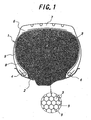
- the tire-rim assembly is described with reference to FIG. 1 showing a section in its widthwise direction below.
- the illustrated tire-rim assembly is constructed by assembling a tire 1 onto an approved rim 2 and disposing a great number of substantially sphere-shaped particles 3 each comprised of a continuous phase of a resin and a closed cell(s) in an interior of the tire defined by the tire 1 and the approved rim 2.
- the tire 1 it is not particularly required to limit the structure unless various tires, e.g. tires for passenger cars and the like are according to usual manner.
- the illustrated tire is a general tire for passenger cars, in which a belt 6 and a tread 7 are successively arranged on a crown portion of a carcass 5 toroidally extending between a pair of bead cores 4 outward in a radial direction thereof.
- numeral 8 is an innerliner layer.
- the particle 3 is a hollow body having a substantially sphere-shaped closed cell(s) surrounded by a continuous phase of a resin and a diameter of, for example, about 10-500 ⁇ m, or a sponge structural body containing a great number of small chambers made of closed cells. That is, the particle 3 is a particle involving a closed cell(s) not communicated with the exterior in which the number of the closed cells may be one or more.
- the feature that the particle involves the closed cell(s) means that the particle has a shell of a resin involving the closed cell at a closed state. Therefore, the continuous phase of the resin means a continuous phase of a composition constituting the shell of the resin. Moreover, the composition of the shell made of the resin is as mentioned later.
- the particles seal the damaged portion to control the rapid drop of the internal pressure.
- a deflection amount of the tire is increased accompanied with the dropping of the tire internal pressure to decrease an inner volume of the tire, and as a result the particles themselves directly bear the load to thereby hold a minimum internal pressure of the tire required in later running.
- This state is a state that the particles directly bear the load to provide a minimum internal pressure of the tire required in the running.
- the deflection of the tire at such a state is relatively small and a circular shape can be held as compared with the aforementioned conventional safety tire and hence the distribution of ground contact pressure in the ground contacting area of the tire can be maintained at a relatively uniform state. Therefore, when the particles are filled in, for example, a tire mainly running on a road surface in a winter season such as a studless tire or the like basic performances inherent to the studless tire do not deteriorate even after damaging the tire. That is, the deterioration of steering performances such as traction, braking, turning and so on is less even on a road surface having a low friction coefficient such as snow road, ice road or the like and the running is never made impossible.
- the particles having a mean bulk specific gravity under an atmospheric pressure of not more than 0.1 are filled in the interior of the tire.
- the total weight of the particles becomes heavy to damage the ride comfort in the running under a normal internal pressure and the durability of the underbody parts of the vehicle, and also the self-heat generation in the running at the drop of the tire internal pressure accompanied with damaging the tire becomes large to fuse the particles before a target running distance is attained and hence it is difficult to hold the minimum internal pressure of the tire required in the running.
- the mean bulk specific gravity under an atmospheric pressure can be calculated, for example, by measuring a weight of particles having a known volume under an atmospheric pressure.
- the total volume of particles means a sum of total volume of shells of the particles, total volume of closed cells in the particles and total volume of spaces between the particles.
- a pressure at 25°C in the interior of the tire is set to not less than 150 kPa, preferably not less than 150 kPa but not more than 900 kPa as an absolute pressure. That is, when the pressure is less than 150 kPa, compression level of the particles is small and also a space pressure around the particles is small, so that a load bearing ratio of the particles becomes high in the usual running before damaging of the tire and there is a fear of damaging the durability of the particles. When said pressure exceeds 900 kPa, a part of the particles is at a completely crushed state by compression and is broken at this time. As a result, there is a possibility that when the tire internal pressure is dropped by damaging the tire, it can not be guaranteed to maintain the minimum internal pressure of the tire required for running over a constant distance.
- the pressure at 25°C in the interior of the tire is limited for the above reasons, such a pressure is preferably not less than 180 kPa, particularly not less than 200 kPa, more particularly not less than 250 kPa.
- the feature that the pressure is not less than 180 kPa, not less than 200 kPa, further not less than 250 kPa means that the compression level of the particles is made high and the pressure of the space around the particles is raised, and it is possible to mitigate the load bearing ratio of the particles to preserve the durability of the particles.
- Vt inner volume of the tire (liter)).
- the total volume under an atmospheric pressure of all particles disposed in the interior of the tire is calculated by the following method.
- the mean bulk specific gravity of the particles under an atmospheric pressure is determined by the aforementioned method.
- volume of the particles 3 is a volume including volumes of spaces between the particles under an atmospheric pressure and can be represented as follows.
- Volume of particles used volumes of shells in particles + volumes of gaps inside particles + volumes of spaces between particles
- volume of gas inside particle volume of closed cell(s).
- particles are weighed in a measuring cylinder under an atmospheric pressure and rendered into a stably packed state by applying vibrations to the cylinder in a supersonic water bath to measure the volume of the particles.
- the inner volume of the tire is defined as a volume defined by the tire and the rim.
- a non-compressive fluid having a known specific gravity such as water is filled in the interior of the assembly, whereby the inner volume of the tire is determined from an increment of the weight.
- the volume filling ratio is preferably limited to not less than 75% but not more than 150%.
- the volume filling ratio is less than 75%, the sealing of the damaged portion with the particles is broken and a pressure in the spaces around the particles is made equal to an atmospheric pressure, so that the tire is largely deflected and run while dragging a sidewall portion thereof, whereby the sidewall portion is locally worn to cause a fear of breaking the tire before the arrival to the target running distance.
- volume filling ratio exceeds 150%, a part of the particles is at a completely crushed state through compression and is broken at this time and hence there is a possibility that when the tire internal pressure is dropped by damaging the tire, it can not be guaranteed to maintain a minimum internal pressure of the tire required in the running over a constant distance.
- the volume filling ratio of the particles inside the tire is limited from the above reasons, the volume filling ratio is further preferably not less than 75% but not more than 130%, not less than 75% but not more than 110%, and not less than 80% but not more than 100%.
- spring constant in a radial direction of the tire can be variously changed by variously changing the volume filling ratio of the particles filled inside the tire within the above range. That is, as the volume filling ratio is increased, if the pressure in the spaces around the particles is dropped to an extent approximately equal to the atmospheric pressure after damaging the tire, each of the compressed particles creates recovery counterforce, so that a higher spring constant can be ensured.
- the particles After the particles are supplied to the interior of the tire, the particles can be compressed, for example by filling air of about 200-300 kPa into the interior of the tire. Therefore, the compression level of the particles can be set to a desired range by properly adjusting the amount of the particles supplied to the interior of the tire and air pressure filled in the interior of the tire.
- a volume filling amount of the particles is preferably within a range from the following lower limit to the following upper limit as a total volume including a space volume around the particle under an atmospheric pressure.
- Upper limit of volume filling amount an inner volume of the tire-rim assembly under a load applied to each shaft of the vehicle when the assembly inflated under a pressure adjusted to an internal pressure designated by such a vehicle is mounted onto the vehicle;
- Lower limit of volume filling amount an inner volume of the tire-rim assembly under a load corresponding to 2.0 times the load applied to each shaft of the vehicle when the assembly having an internal pressure set to an atmospheric pressure is mounted onto the vehicle.
- the volume filling amount of the particles indicates a total volume of all particles filled in the interior of the tire-rim assembly under an atmospheric pressure, which includes space volumes around the particles.
- the volume filling amount of the particles indicates a total volume of all particles filled in the interior of the tire as measured by the above method under an atmospheric pressure, which includes space volumes around the particles.
- the upper limit of the volume filling amount is an inner volume of the tire-rim assembly under a load applied to each shaft of the vehicle when the assembly inflated under a pressure adjusted to an internal pressure designated by such a vehicle is mounted onto the vehicle.
- the tire internal pressure is recovered by the aforementioned pressure developing mechanism of the particles. Therefore, when the particles are filled at a volume exceeding the upper limit, there are a possibility that friction between the particles is caused in the running under a designated internal pressure before the damaging of the tire and a possibility that the rolling resistance is increased by such a friction. This is unfavourable in view of fuel saving.
- the reason of defining "the lower limit of the volume filling amount is an inner volume of the tire-rim assembly under a load corresponding to 2.0 times the load applied to each shaft of the vehicle when the assembly having an internal pressure set to an atmospheric pressure is mounted onto the vehicle" is described below.
- the tire internal pressure is recovered by the aforementioned pressure developing mechanism of the particles. Therefore, when the particles are filled at a volume not meeting the lower limit, even if the tire internal pressure drops to the atmospheric pressure, the particles themselves can not directly bear the load and friction between the particles is hardly caused and as a result the recovery of the tire internal pressure can not be guaranteed.
- the internal pressure recovering function can be developed by filling the particles at a volume within a range between the above upper limit and lower limit, whereby it is attained to safely run over a constant distance after damaging the tire.
- the upper limit may be properly corresponded to a load applied to each shaft of the vehicle in accordance with the running condition of the vehicle and the use method and conditions of the vehicle such as number of crew members, freight authorized mass and so on. Under a use situation that the number of crew members or the freight authorized mass changes day by day, it is preferable to lower the upper limit in the volume of the particle considering the above concern. That is, it is preferable to be an inner volume of the tire-rim assembly under a load corresponding to 1.2 times, preferably 1.5 times, more preferably 2.0 times the load applied to each shaft of the vehicle.
- the lower limit can be explained as a preferable range for the following reasons. That is, when the internal pressure starts to drop by the damaging of the tire, friction between the particles is rapidly caused at a volume filling amount near to the upper limit to recover the internal pressure. Under such a situation, a difference of wheel speed between left and right wheels is not large and an amount of dropping of the pressure as directly measured by a tire internal pressure sensor is not large, so that a sensitivity for detecting the drop of the internal pressure through the damaging of the tire lowers and there is concern that risk information may not be opportunely reported to a driver.
- the lower limit becomes high in order to avoid such a fear.
- the lower limit is an inner volume under a load corresponding to 2.0 times the load applied to each shaft of the vehicle when the tire internal pressure is set to an atmospheric pressure, preferably an inner volume when the tire internal pressure is set to 10% of an internal pressure designated by the vehicle, further preferably 30% thereof, more preferably 40% thereof, and most preferably 50% thereof.
- a gas of, for example, about 150-250 kPa is filled in the interior of the tire after the particles are disposed in the interior of the tire to hold the internal pressure in the space around the particles for a constant time, whereby a pressure inside the closed cell in the particles can be enhanced to about 150-250 kPa. Therefore, the pressure inside the closed cell in the particle can be set to a desired range by properly adjusting the pressure of the gas filled in the interior of the tire.
- the pressure inside the closed cell in the particles is set to a pressure higher than the atmospheric pressure, the aforementioned internal pressure recovering function after damaging the tire can be developed.
- the sealing function of the injured portion with the particles is a necessary function supporting the internal pressure recovering function.
- the particles have extremely low specific gravity, they have a distribution of the specific gravity because all of the particles are not uniform.
- a measure for roughly separating the above particles into two components in view of the specific gravity there is attempted the separation into a component (particles having a specific gravity of not less than 0.79) precipitating in ethanol (specific gravity: 0.79) and a floating component (particles having less than 0.79) and each of the particles is positioned under a definition as a precipitation component content to a total weight of a sample.
- a component particles having a specific gravity of not less than 0.79 precipitating in ethanol
- a floating component particles having less than 0.79
- the content of particles having a specific gravity of not less than 0.79 is not more than 40 mass%.
- the definition on the content of particles having a specific gravity of not less than 0.79 is based on a discovery that the particles having a specific gravity of not less than 0.79 control the durability of the particles.
- a preferable content of the particles having a specific gravity of not less than 0.79 is limited for the above reason, such a content is preferably not more than 30 mass%, more preferably not more than 20 mass%, and further not more than 5 mass%.
- the continuous phase of the particle as a matrix for the closed cell is made of a material having a low gas permeability.
- any one of polyvinyl alcohol resin, acrylonitrile based polymer, acrylic polymer and vinylidene chloride based polymer to the continuous phase of the particle.
- the acrylonitrile based polymer is advantageously used at least one selected from acrylonitrile polymer, acrylonitrile/methacrylonitrile copolymer, acrylonitrile/methyl methacrylate copolymer and acrylonitrile/methacrylonitrile/methyl methacrylate terpolymer
- the acrylic polymer is advantageously used at least one selected from methyl methacrylate resin (MMA), methyl methacrylate/acrylonitrile copolymer (MMA/AN), methyl methacrylate/methacrylonitrile copolymer (MMA/MAN) and methyl methacrylate/acrylonitrile/methacrylonitrile terpolymer (MMA/AN/MAN)
- the vinylidene chloride based polymer is advantageously used at least one selected from methyl methacrylate resin
- the continuous phase of the particle preferably has gas permeation constant at 30°C of not more than 300 ⁇ 10 -12 (cc ⁇ cm/cm 2 ⁇ s ⁇ cmHg), preferably a gas permeation constant at 30°C of not more than 20 ⁇ 10 -12 (cc ⁇ cm/cm 2 ⁇ s ⁇ cmHg), further preferably a gas permeation constant at 30°C of not more than 2 ⁇ 10 -12 (cc ⁇ cm/cm 2 ⁇ cmHg).
- an innerliner layer in a common pneumatic tire has a sufficient internal pressure holding function at a level that a gas permeation constant is not more than 300 ⁇ 10 -12 (cc ⁇ cm/cm 2 ⁇ s ⁇ cmHg)
- the gas permeation constant at 30°C of the continuous phase of the particle is rendered into 300 ⁇ 10 -12 (cc ⁇ cm/cm 2 ⁇ s ⁇ cmHg).
- the gas permeation constant is recommended to be not more than 20 ⁇ 10 -12 (cc ⁇ cm/cm 2 ⁇ s ⁇ cmHg), further preferably not more than 2 ⁇ 10 -12 (cc ⁇ cm/cm 2 ⁇ s ⁇ cmHg) from a viewpoint of maintenance.
- the gas constituting the closed cell of the particle is mentioned at least one gas selected from nitrogen, air, straight and branched aliphatic hydrocarbons having a carbon number of 2 to 8 and fluorides thereof, an alicyclic hydrocarbon having a carbon number of 2 to 8 and a fluoride thereof, and an ether compound represented by the following general formula (I): R 1 -O-R 2 (I) (wherein each of R 1 and R 2 is a monovalent hydrocarbon residue having a carbon number of 1 to 5 and may be a saturated hydrocarbon or an unsaturated hydrocarbon and may have a straight or branched structure and contain a ring).
- the gas filled in the tire is usually air or an air changing an oxygen partial pressure, but if the gas in the particle is not a fluoride, a gas containing no oxygen such as nitrogen, inert gas or the like is preferable in view of safeness.
- a method of forming the particles having a closed cell(s) is not particularly limited, but it is preferable to use a foaming agent.
- a foaming agent mention may be made of a pyrolitic foaming agent producing a gas by pyrolysis, a high-pressure compression gas, a liquefied gas and the like.
- a large number of the pyrolitic foaming agents have a characteristic of producing nitrogen, so that the particle obtained by properly controlling the reaction of such a pyrolitic foaming agent contains nitrogen in its cell.
- an emulsion polymerization is carried out while liquefying propane, butane, pentane, hexane, heptane, octane, cyclopropane, cyclobutane, cyclopentane, cyclohexane, cycloheptane, cyclooctane or the like under a high pressure and dispersing into a reaction solvent, whereby there can be obtained expandable resin particles in which a gas component such as propane, butane, pentane, hexane, heptane, octane, cyclopropane, cyclobutane, cyclopentane, cyclohexane, cycloheptane, cyclooctane or the like is sealed in the resin continuous phase at a liquid state.
- a gas component such as propane, butane, pentane, hexane, heptane, octan
- propane, butane, pentane, hexane, heptane, octane, cyclopropane, cyclobutane, cyclopentane, cyclohexane, cycloheptane or cyclooctane is sealed in the cell.
- isobutane isopentane, neopentane, 2-methyl pentane, 2,2-dimethyl butane, methylhexanes, dimethylpentanes, trimethyl butane, methylheptanes, dimethylhexanes, trimethylpentanes and so on.
- an objective tire can be obtained by subjecting the above expandable resin particles to a surface coating such as a surfactant, an oiling agent or the like and expanding under heating in the tire. Furthermore, an objective tire can be obtained by previously expanding under heating the resin particles sealed with the liquefied gas to form particles of substantially a sphere form and compression-filling them into the tire.
- the tire usually has an innerliner layer in its inner peripheral face.
- an innerliner layer is preferably made of a thermoplastic elastomer composition comprising a nylon resin having a melting point of 170-230°C and a halide of isobutylene paramethylstyrene copolymer in which an elastomer component is dynamically cured at a gelation ratio of 50-95%.
- the nylon resin constitutes a continuous phase different from the conventional innerliner layer mainly composed of butyl rubber and the gas permeation is very low and hence the function of the innerliner layer can be strengthened.
- an innerliner layer having a rich flexibility and excellent heat resistance and durability is obtained by using a thermoplastic elastomer composition in which the elastomer component including the halide of isobutylene paramethylstyrene copolymer is dynamically cured at the gelation ratio of 50-95%. Since the innerliner layer has the above characteristics, there can be created an environment facilitating to retain the gas in the closed cell(s) of the particle.
- the gelation ratio is a value calculated by the following equation after pelletized compounds after biaxial milling are subjected to Soxhlet extraction with acetone in a water bath for 8 hours and further a residue is subjected to Soxhlet extraction with n-hexane for 8 hours to extract uncured elastomer components in a solvent and then weights of extracts with acetone and n-hexane after the removal of the solvent are measured.
- Gelation ratio % weight of all compounds - extraction with acetone + extraction with n - hexane - amount of stearic acid / weight of all compounds ⁇ 100
- the innerliner layer preferably has a gas permeation constant at 30°C of not more than 20 ⁇ 10 -12 (cc ⁇ cm/cm 2 ⁇ s ⁇ cmHg). This is because even if the gas inside the cell is leaked out from the particle for some reason, when the gas permeability of the innerliner layer is sufficiently low, the leaking of the gas from the cell(s) of the particle toward outside of the tire becomes less and it is advantageous to maintain the internal pressure of the tire. That is, the gas permeability of the innerliner layer is a factor directly deciding the pressure maintenance of the tire as a pressure vessel. Of course, the gas permeability of the continuous phase constituting the particle is low, and further it is ideal to use an innerliner layer having a low gas permeability.
- a sealant matrix material can be further filled in the interior of the tire-rim assembly filling the great number of the particles 3 therein.
- damage such as laceration or the like
- the particles and the sealant matrix material vigorously flow into the damaged portion.
- a large space of the damaged portion is first clogged with the particles moved into the damaged portion, and further micro-spaces between the damaged portion and the particles are filled with the sealant matrix material and the flowing-movement of the particles in the damaged portion is controlled by the tackiness of the sealant matrix material to seal the damaged portion with the particles and the sealant matrix material. Therefore, the gas in the tire is not leaked out to the exterior.
- the particles and the sealant matrix material bear part of the function sealing the damaged portion and the time up to the completion of the sealing is considerably shortened, so that the breakage of the tire and the rapid dropping of the internal pressure can be effectively controlled to maintain the safeness of the tire over a constant time after damage.
- the sealant matrix material is not particularly limited unless it has a fluidity, a tackiness and the like and may be properly selected in accordance with the use purpose.
- it may preferably include ethylene-propylene copolymer, ethylene-propylene-diene terpolymer, polybutadiene, a halogenated polybutadiene, polyisoprene, polyisoprene-butadiene copolymer, butyl rubber, a halogenated butyl rubber, polyethylene, polypropylene, acrylonitrile-butadiene copolymer, styrene-butadiene copolymer, a synthesized polyterpene, a thermoplastic olefin, pentaerythritol ester of hydrogenated rosin, triethylene glycol ester of hydrogenated rosin, vinyltoluene copolymer, alkyl aromatics, chroman-indene, depolymerized natural rubber, poly
- the filling amount of the particles is not particularly limited and may be properly selected in accordance with the use purpose, but it is preferably not less than 0.1 volume%.
- a liquid not substantially swelling the continuous layer of the particles may be further added to the interior of the tire.
- the particle has high fluidity owing to substantially the sphere form and can be easily filled in the interior of the tire-rim assembly through an inlet port having a small inner diameter such as a valve for the tire.
- the particles gather in an inner face of the injured portion so as to blow out from the injured portion toward the outside of the tire.
- an injuring path from the inner face of the injured portion to an outer peripheral face of the tire is not straight but indicates a complicated shape, so that the particles entered from the injured opening at the inner face of the tire are checked in the course of the above path, and hence a great number of the particles gather in the inner face of the injured portion at a compressed state to seal the injured portion with these particles.
- the liquid to be added clearly has a large specific gravity as compared with the particles, so that it largely distributes onto an inner face of a tire tread portion through centrifugal force accompanied with the rotation of the tire during the usual running.
- the particles into the tire at a high fluidity state or at a dry state before the mixing with the liquid.
- the particles are mixed with the liquid to form a gather body as previously mentioned.
- the particles mixed with the liquid have very low fluidity and are difficult to fill into the tire. Therefore, the mixing of the liquid is efficient and sure through a method of applying the liquid onto the inner face of the tire or an inner face of the rim before the filling, or through a method of pouring the liquid into the interior of the tire-rim assembly after the filling of the particles.
- the liquid to be used is required to have performances that it does not particularly swell the continuous phase of the particle as previously mentioned or does not cause chemical reaction therewith, and preferably does not cause the swelling or chemical reaction to the innerliner layer, and further it is stable to heat build-up in the running, and so on.
- silicone oil aliphatic polyvalent alcohols represented by ethylene glycol and propylene glycol, and so on.
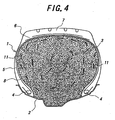
- the tire-rim assembly can further contain expansion particles 10 capable of expanding volume by stimulation in its interior.
- the expansion particles 10 are not particularly limited unless the volume can be expanded by stimulation, but preferably comprise a foaming agent and a shell encapsulating a gas produced by expansion of the foaming agent at a closed state.
- the stimulation is not particularly limited, but includes heat (exothermic, endothermic), pressure, vibration and so on. As the running of the tire is continued at a state of causing damage by a foreign matter such as a nail, a greater amount of heat is caused by friction, so that heat (particularly exothermic) is preferable.
- the foaming agent is the same as used in the gas inside the closed cell of the particle and includes at least one selected from nitrogen, air, straight and branched aliphatic hydrocarbons having a carbon number of 2 to 8 and fluorides thereof, an alicyclic hydrocarbon having a carbon number of 2 to 8 and a fluoride thereof, and an ether compound represented by the following general formula (I): R 1 -O-R 2 (I) (wherein each of R 1 and R 2 is a monovalent hydrocarbon residue having a carbon number of 1 to 5 and may be a saturated hydrocarbon or an unsaturated hydrocarbon and may have a straight or branched structure and contain a ring).
- a pyrolitic foaming agent As the foaming agent, use may be made of a pyrolitic foaming agent, a high-pressure compression gas, a liquefied gas and so on. Particularly, a pyrolitic foaming agent producing a gas by pyrolysis is preferable.
- a pyrolitic foaming agent As the pyrolitic foaming agent are mentioned dinitrosopentamethylene tetramine (DPT), azodicarbon amide (ADCA), paratoluene sulfonyl hydrazine (TSH) and derivatives thereof, oxybisbenzene sulfonyl hydrazine (OBSH) and so on. They may be used alone or in a combination of two or more.
- DPT dinitrosopentamethylene tetramine
- ADCA azodicarbon amide
- TSH paratoluene sulfonyl hydrazine
- OBSH oxybisbenzene sul
- the foaming agent preferably starts the expansion at a temperature of not lower than 100°C, preferably at a temperature of not lower than 120°C. That is, in the tire inflated under the internal pressure, a case that the interior temperature exceeds 100°C is rare though it is dependent upon environmental conditions. On the other hand, when the tire is run at a state of being punctured, a foreign matter such as a nail even under an exterior environment of -20°C, there may be a case that the temperature around the remaining foreign matter locally rises to not lower than 100°C. In order to conduct the expansion even under any environmental conditions, therefore, the expansion starting temperature is preferably not lower than 100°C.
- the particle size of the expansion particle is not particularly limited, but an average particle size before the expansion through foaming is 1-200 ⁇ m, preferably about 1-40 ⁇ m.
- an average particle size before the expansion through foaming is 1-200 ⁇ m, preferably about 1-40 ⁇ m.
- the expansion particles have an average particle size of the above range, the volume expansion ratio is high, and they easily enter into a contact face between the foreign matter and the injured portion, and the effect of sealing the space in the injured portion and the effect of preventing the dropping of the internal pressure are excellent.
- the average particle size is less than 1 ⁇ m, even if the expansion is attained, the effect is less from a viewpoint of the volume expansion effect, while when it exceeds 200 ⁇ m, the particles hardly enter into the contact face between the foreign matter and the tire.
- the expansion particles preferably have a volume expansion ability of not less than 5 times at the above expansion starting temperature.
- the expansion ability is less than 5 times, if the particles are expanded in the contact face between the foreign matter and the tire, a force sealing a space in the contact face (force directly pushing the surface of the foreign matter or the contact face of the tire) is lacking and it is difficult to obtain a sufficient sealing effect.
- particles having a mean bulk specific gravity of not more than 0.3 may be co-used if it is intended to guarantee the minimum running required by merely sealing the injured portion instead of compensating a pressure based on the dropping of the internal pressure in the injuring of the tire.
- the latter particles may be disposed in the interior of the assembly so that a volume under an atmospheric pressure is not less than 0.2 volume%, preferably not less than 0.5 volume%, more preferably not less than 1.0 volume%, particularly not less than 5.0 volume%.
- the rapid dropping of the internal pressure after the injuring of the tire can be controlled if the amount of the particles satisfies the above lower limit, but it is sufficient to dispose the particles in an amount of 20 volume% considering the deterioration of ride comfort and steering property accompanied with the increase of weight in the tire-rim assembly, and the cost.
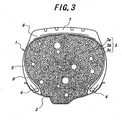
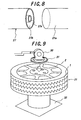
- a great number of the particles 3 having a mean bulk specific gravity under an atmospheric pressure of not more than 0.1 which are disposed in the interior of the tire-rim assembly according to the invention, can comprise particles 3a having a diameter under the atmospheric pressure of not less than 10 ⁇ m but less than 1 mm, particles 3b having a diameter of not less than 1 mm but less than 5 mm and particles 3c having a diameter of not less than 5 mm but less than 5 cm as schematically shown in FIG. 3 .
- FIG. 3 exaggeratingly shows the diameters of three kinds of the particles, and a diameter ratio among the particles is not necessarily the illustrated one.
- the open wound formed by the foreign matter largely grows, so that there is a case that the open wound can not be sufficiently sealed with only the particles 3a having a diameter of less than 1 mm. Therefore, it is preferable to mix the particles 3b having a diameter of not less than 1 mm but less than 5 mm.
- a size of an open wound extends to, for example, 5 cm as a maximum diameter.
- it is effective to mix the particles 3c having a diameter of not less than 5 mm but less than 5 cm.
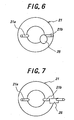
- the compression elastic body means a body changing volume and developing stress in the compression and having a restoring ability in the releasing of the compression. That is, it is preferable that the compression elastic body comprises a.hollow body and a gas or a composite included in an interior of the hollow body. Also, all of plural compression elastic bodies may include a gas in the hollow body or include a composite in the hollow body. Further, a part of plural compression elastic bodies may include a gas in the hollow body, and the remainder may include a composite in the hollow body. Moreover, each of the hollow body, the gas and the composite included in the plural compression elastic bodies may be one or more.
- the hollow body in the compression elastic body may have a self-recovering ability of spontaneously turning the hollow body itself into a certain given shape. Especially, when the gas is included in the interior, as mentioned detailedly below, the hollow body is effective to have the self-recovering ability.
- the hollow body preferably has gas permeation constant at 30°C of 10 -10 -10 -9 (cc ⁇ cm/cm 2 ⁇ s ⁇ cmHg).
- the hollow body is preferably made of at least one selected from the group consisting of polyolefin, a thermoplastic polyurethane and a rubber composition having a butyl based rubber.
- a thermoplastic polyurethane having a stretchability is preferable.
- the polyolefin mention may be made of polyethylene, polypropylene, polystyrene/polyethylene copolymer and so on, and among them polyethylene is preferable.
- the butyl based rubber mention may be made of a halide of isobutylene/paramethyl styrene copolymer, butyl rubber, a halogenated butyl rubber and so on.
- the hollow body has a thickness of 10-200 ⁇ m, preferably 20-100 ⁇ m and contains the gas or the composite therein.
- various gases can be used.
- a gas having a high stability which includes ordinary air or air having an adjusted oxygen partial pressure and/or nitrogen.
- any mixing ratio can be adopted.
- a composite when included in the interior of the hollow body, it is preferable to comprise a polymer and a continuous cell.
- polymers having a polar functional group in their molecules mention may be made of polymers having a polar functional group in their molecules, polyolefins and elastomers, but it is not limited thereto.
- polymer having a polar functional group in its molecule mention may be made of polyurethane, melamine resin, polyvinyl alcohol resin, an acrylonitrile based polymer, an acrylic polymer, a vinylidene chloride based polymer, acrylonitrile/styrene resin and polyester resin.
- acrylonitrile based polymer mention may be made of acrylonitrile polymer, acrylonitrile/methacrylkonitrile copolymer, acrylonitrile/ methyl methacrylate copolymer and acrylonitrile/methacrylonitrile/methyl methacrylate terpolymer.
- acrylic polymer mention may be made of methyl methacrylate resin, methyl methacrylate/acrylonitrile copolymer, methyl methacrylate/methacrylonitrile copolymer and methyl methacrylate/acrylonitrile/ methacrylonitrile terpolymer.
- vinylidene chloride based polymer mention may be made of vinylidene chloride/acrylonitrile copolymer, vinylidene chloride/ methyl methacrylate copolymer, vinylidene chloride/ methacrylonitrile copolymer, vinylidene chloride/acrylonitrile/methyl methacrylate copolymer, vinylidene chloride/methacrylonitrile/methyl methacrylate copolymer and vinylidene chloride/ acrylonitrile/methacrylonitrile/methyl methacrylate copolymer.
- polyethylene polypropylene, polystyrene/ polyethylene copolymer and so on, and among them polyethylene is preferable.
- elastomer mention may be made of sulfur-curable elastomers such as a halide of isobutylene/paramethyl styrene copolymer, butyl rubber, a halogenated butyl rubber and the like, and thermoplastic elastomers such as styrene-butadiene-styrene block copolymer and the like.
- the polymer constituting the composite is preferably a polymer having a polar functional group in its molecule, preferably polyurethane.
- a size of the continuous cell in the composite can be properly selected in accordance with application or object using the tire and is not particularly limited. However, when the size of the continuous cell is too large, it tends to deteriorate the durability of the composite itself.
- the composite preferably has a density under an atmospheric pressure of 0.012-0.12 g/cm 3 , note preferably 0.015-0.06 g/cm 3 .
- the density is too high, it tends to increase the tire weight, while when the density is too low, it tends to deteriorate the durability of the composite.
- an expansion ratio under an atmospheric pressure is preferably 10-100 times, more preferably 20-80 times.
- the expansion ratio is too low, it tends to increase the tire weight, while when the expansion ratio is too high, it tends to deteriorate the durability of the composite.
- each compression elastic body used herein can be properly selected in accordance with the purpose and application and is not particularly limited, but the diameter thereof is preferably within a range of the aforementioned particle diameter. Moreover, plural compression elastic bodies are used herein, but they may be the same or different in volume.
- the preparation of the compression elastic body is not particularly limited and may include, for example, the following first to fourth methods.
- the first to third methods relate to a method of producing the compression elastic body including the composite in its hollow body
- the fourth method relates to a method of producing the compression elastic body including the gas in its hollow body.
- the first method is a method wherein a bag-shaped hollow body is provided and a composite is placed therein and thereafter an opening portion of the bag-shaped hollow body is closed.
- a closing method of the opening portion is dependent upon the material of the hollow body used and the like, but may include, for example, an inner heating system such as a high frequency sealing process, a ultrasonic sealing process and the like, and an outer heating system such as heat sealing process, impulse sealing process and the like.
- a bag-shaped hollow body is provided and a foamable composition is placed therein.
- the foamable composition is a composition forming the composite later. Thereafter, the hollow body including the foamable composition is disposed in a mold or the like and shaped.
- the third method is a method wherein a foamable composition is placed in a mold or the like and then shaped and expanded.
- a non-expanded layer produced as an outermost layer by expansion corresponds to the hollow body.
- the fourth method is a method wherein a bag-shaped hollow body is provided and a gas is filled therein and thereafter an opening portion of the bag-shaped hollow body is closed.
- the method of closing the opening portion the aforementioned ones can be used.
- a method using a foaming agent is preferable.
- the foaming agent mention may be made of a pyrolitic foaming agent producing a gas by pyrolysis, a high-pressure compression gas, a liquefied gas and so on.
- a large number of the pyrolitic foaming agents have a characteristic of producing nitrogen, so that the composite obtained by properly controlling the reaction of such a pyrolitic foaming agent contains nitrogen in its cell.
- the foamable material particularly urethane foam
- a method wherein water is used as a foaming agent and carbon dioxide gas is produced by reacting water with isocyanate as a kind of monomer.
- a physical method in which an inert, low boiling point solvent is vaporized by utilizing a reaction heat in the formation of the polymer, and so on.
- sealing sheets 11 having a maximum diameter of not less than 2 cm are disposed in the interior of the tire together with a great number of the particles 3 as shown in FIG. 4 . That is, a thermoplastic polyurethane, a polyolefin based resin, a nylon based resin and the like are applicable to the sealing sheet 11, but it is not particularly limited thereto.
- the sealing of the open wound can be conducted by disposing many sealing sheets 11 in the tire because the sealing sheet 11 acts likewise the aforementioned particles 3a to 3c.
- relatively small-size particles having a diameter of less than 1 mm are shown as the particles 3, but the sealing sheets 11 may be disposed in a mixture of particles having various sizes shown in FIG. 3 . That is, either or both of particles having a diameter of not less than 1 mm but less than 5 mm, particles having a diameter of not less than 5 mm but less than 5 cm and sealing sheets 11 can be disposed in the tire in addition to the relatively small-size particles having a diameter of less than 1 mm.
- a method of charging into the tire on the way of the rim assembling and before the fitting onto the bead is simple, but it is not limited thereto.
- the sealing sheets previously mixed with the above particle group. May be filled into the tire-rim assembly after the fitting onto the band.
- the tire-rim assembly having the aforementioned structure can be obtained by filling cell-containing particles, in which an internal pressure of the closed cell is controlled to a given range under a pressure environment higher than an atmospheric pressure, in the interior of the tire-rim assembly under a high pressure environment.
- the cell-containing particles of substantially sphere shape are produced by heating and expanding resin particles each encapsulated with a foaming agent such as a liquefied gas or the like.
- a foaming agent such as a liquefied gas or the like.
- FIG. 5 a great number of the thus obtained cell-containing particles are stored in a pressure-resistant storage tank 20 filled with a gas such as nitrogen or the like at a higher pressure of not less than 150 kPa, and a tire-rim assembly 21 is connected to the storage tank 20 through a transferring means, and the cell-containing particles inside the storage tank 20 are transferred to the interior of the tire-rim assembly 21 together with the gas in the tank to conduct the filling of the cell-containing particles.
- the transferring means for the cell-containing particles there can be mentioned a method wherein the storage tank 20 is connected to an inlet port 21a arranged on the tire-rim assembly 21 through a pipe way 22,and a pipe way 23 extending from an outlet port 21b arranged at a position separated by 180° from the inlet port 21a of the tire-rim assembly 21 is connected to a diaphragm pump 24 as shown in FIG. 5 .
- a diaphragm pump 24 is actuated to form suction stream shown by arrows in the pipe ways 22 and 23
- the cell-containing particles inside the storage tank 20 can be led to the interior of the tire-rim assembly 21.
- a filter 25 passing the gas but not passing the cell-containing particles is attached to the outlet port 21b of the tire-rim assembly 21 as shown in FIG. 6 , or a filter 26 similar to the above is arranged in a connecting portion of the pipe way 23 as shown in FIG. 7 , whereby only the gas is led to the outside of the tire-rim assembly 21 and the cell-containing particles can be left in the interior of the tire-rim assembly 21.
- a pipe way 27 of a double-pipe structure as shown in FIG. 8 is connected to the inlet port 21a without arranging the outlet port 21b in the tire-rim assembly 21, whereby the gas and the cell-containing particles can be supplied through an inner pipe 27a and a gas inside the tire can be sucked through an outer pipe 27b.
- the filling of the cell-containing particles is carried out while sucking the gas, inside the tire to the outside, but it is possible to conduct the filling of the cell-containing particles without sucking the gas inside the tire.
- the filling small-size cell-containing particles having an average particle size of not more than 1 mm it is desirable to suck air inside the tire for avoiding clogging of the neighbourhood of the inlet port with such particles.
- the transferring rate of the cell-containing particles can be changed in accordance with a suction amount.
- a gas discharged from the diaphragm pump 24 is led to the storage tank 20 to form an annularly closed system of "storage tank ⁇ tire-rim assembly ⁇ storage tank ⁇ ⁇ ".
- the inventors have aimed at the recovering force of the compressed cell-containing particles and made various studies with respect to a method of filling the cell-containing particles capable of providing performances as a safety tire into the interior of the tire-rim assembly while utilizing the above action to maintain performances required as the tire, and as a result the above method has been established.
- the tire filled with the cell-containing particles without compression does not create a case tension, and has the following drawbacks.
- the deflection to the load becomes large, and the deformation amount of the cell-containing particle in the tire increases. This promotes heat build-up based on hysteresis loss of the cell-containing particles but also accelerates the breakage or creep of the cell-containing particles.
- the inlet port 21a for the cell-containing particles and the outlet port 21b for extra air inside the tire shown in FIG. 5 are preferably arranged in plural number.
- the inlet port and the outlet port are existent at symmetrical positions on the circumference with respect to a rotating axis of the tire. This is because the cell-containing particles tend to be filled (consolidated) in the vicinity of the inlet port and the outlet port in a high density, so that the weight distribution of the cell-containing particles is made non-uniform to cause the deterioration of tire uniformity. This induces the occurrence of vibration during the rotation of the tire, which causes the deterioration of ride comfort, steering stability and fuel consumption. As a countermeasure for solving this inconvenience, it is effective to arrange the inlet port and the outlet port in symmetrical positions with respect to the rotating axis of the tire.
- a method of filling the cell-containing particles while applying vibrations to the tire is also effective. This promotes the movement of the cell-containing particles by the application of vibrations and is made possible to avoid the consolidation into a particular position and expected to have an effect of avoiding the clogging in the interior of the pipe with the powder by the application of vibrations.
- the application of vibrations brings about the increase of the filling density of the cell-containing particles (decrease of apparent volume) and there is a possibility that a space having no cell-containing particles is formed in the interior of the tire. Therefore, it is advantageous to conduct the application of vibrations in the filling.
- a jig capable of simply attaching or detaching a wheel cap 31 fixed with a ball vibrator 30 made by Exxen Corporation rotating a steel ball through a compressed air to the assembly 21 of the tire 1 and the rim 2 as shown in FIG. 9 . Also, it is possible to use a hitting type vibration applying machine.
- Such a vibration applying means may be directly arranged on the tire-rim assembly as a detachable one, or may be arranged at a side of the filling apparatus such as a stand 32 (see FIG. 9 ) holding the tire -rim assembly or the like.
- the storage tank 20 for the cell-containing particles comprises a first tank 20a and a second tank 20b in which a given amount of the cell-containing particles measured from the first tank 20a is transferred to the second tank 20b and an amount of the cell-containing particles accurately weighed from the second tank 20b is filled in the tire-rim assembly 21.
- the first tank 20a is not suitable in the precise weighing because it is large-size for stocking a great amount of the material, so that the weighing function is preferably provided to the second tank 20b.
- a precise filling amount can be derived by previously weighing a given amount of the cell-containing particles, and transferring them into the second tank 20b, and measuring a weight reduced through the filling into the tire.
- both the filling and weighing are realized by placing the second tank 20b on, for example, a balance 23 and conducting the filling at such a state.
- the storage tank preferably has a pressure changing function for adjusting a pressure and a pressure sensor. That is, it is possible to fill the cell-containing particles adjusted to a given pressure by adjusting a pressure inside the storage tank through the pressure changing function. For instance, as shown in FTG. 11, compressed air obtained by using an air compressor 34 is introduced into the storage tank 35 through a regulator 35, and a pressure can be changed by arranging a valve for leaking (leak valve) 36 on the storage tank 20.
- the gas adjusted to a desired pressure through the regulator 35 is always supplied, even if the pressure is dropped by leaking at the side of the tank 20, the pressure is automatically increased to the desired value. Furthermore, it is preferable to arrange a filter on the leak valve 36 so as not to move the cell-containing particles out from the inside of the tank.
- a necessary casing tension can be given to the tire. That is, a tension corresponding to the tire internal pressure is given by disposing the cell-containing particles in the interior of the tire instead of filling air in the interior of the tire, so that there is established a new method of applying the internal pressure different from the conventional method.
- a new tire-rim assembly can be provided only by subjecting any tires and any rims to a minimum working without requiring the changing and controlling of the tire structure. Even if the tire in such an assembly is subjected to an external injury by riding over, for example, a nail or the like, the drop of the casing tension as in the ordinary pneumatic tire is not easily caused. This is because, when external damage is caused in the tire to dissipate the compressed gas from the interior of the tire toward the outside, a pressure surrounding the cell-containing particles drops, but the volumes are increased by the recovering force of the compressed cell-containing particles to newly create a casing tension. Thus, there is no occurrence of puncture state as in the conventional pneumatic tire.
- the tires are products mounted onto vehicles through various markets from their makers. There are mainly a case that the tire is supplied from a tire maker to a car manufacturing maker and mounted onto a new car by the manufacturing maker, and a case that an owner for the vehicle takes a tire from a tire selling shop, so that there are many parties for supplying the tires.
- the tire-rim assembly in which the internal pressure is applied by filling the cell-containing particles is premised on the filling of the cell-containing particles, so that it is required to establish a supply system peculiar to the tire filled with the cell-containing particles.
- the inventors have investigated a supplying means suitable for the tire filled with the cell-containing particles and found the following supply method and a service method accompanied therewith.
- the following methods (A)-(C) are advantageously adaptable as the supply method for the tire filled with the cell-containing particles.
- an internal pressure sensor is first arranged on the tire-rim assembly, while a vehicle is required to be provided with an end equipment for transmitting particular information including position information and information relating to tire trouble, such as a radio apparatus, PHS, a mobile telephone provided with a function of GPS (global positioning system), a navigation system or the like.
- a radio apparatus such as a radio apparatus, PHS, a mobile telephone provided with a function of GPS (global positioning system), a navigation system or the like.
- the particular information is transmitted from the end equipment. It is preferable to automatically transmit this information.
- the transmitted particular information is transmitted through a communication control section such as telephone lines, satellite communications or the like to an information control server having data base section previously stored with a position information of service shops for selling and repairing of tires such as a tire service network.
- a communication control section such as telephone lines, satellite communications or the like
- an information control server having data base section previously stored with a position information of service shops for selling and repairing of tires such as a tire service network.
- the information control server receiving the information picks up an information of service shops in an area positioning the vehicle from the data base section and transmits the picked service shop information through the communication control section.
- the transmitted service shop information is received by the end equipment, and the received service shop information is transmitted to a driver by means of an information transmitting means provided on the vehicle together with an alarm on the dropping of the tire internal pressure.
- the driver can easily know a nearest service shop such as a tire selling shop or a tire repairing factory from the transmitted information and can rapidly go straight to the nearest service shop.
- the information transmitting means there are mentioned a display means such as monitor or the like, an acoustic means such as voice or the like, and so on. Particularly, in the case of a vehicle provided with the navigation system, the position of the nearest service shop can be displayed on a map.
- the information control server can transmit the particular information of the vehicle to the picked nearest service shop through the communication control section.
- the communication control section there is a merit that an operator in such a service shop can await the arrival of the vehicle at a state that the cell-containing particles compensate for the dropping of the internal pressure are compressed under a given pressure.
- the resin particles encapsulating a gas component therein as shown in Table 3 are heated and expanded to form particles, and the thus obtained particles are charged into an interior of the tire at various mean bulk specific gravities as shown in Tables 1 and 2.
- a kind of rubber for an innerliner layer is shown in Table 4.
- an inner volume of the tire in Tables 1 and 2 is defined by a volume closed by the tire and the rim. Therefore, the inner volume of the tire can be determined from an increment of a weight by assembling the tire onto the rim and filling a non-compression fluid having a known specific gravity such as water into an interior thereof, so that water is used at this time.
- volume amount of the particles used under an atmospheric pressure is measured according to the following equation.
- Volume amount of particles used under an atmospheric pressure total weight of particles filled in tire/mean bulk specific gravity of particles under an atmospheric pressure
- a deflection amount of the tire is measured before and after a drum test over a distance of 5000 km under conditions that the safety tire for passenger car is run at a speed of 90 km/h under a load of 3.53 kN and the safety tire for truck and bus is run at a speed of 60 km/h under a load of 26.46 kN, and a deflection displacement before and after the drum test (tire height before the running under loading - tire height after the running under loading) is represented by an index on the basis that the tire height before the running under loading is 100. The smaller the index value, the better the result.
- the bearing of the load means that force durable to external force is existent in the interior of the tire.
- This force is developed by air existing inside the tire in the conventional tire, while it is developed by the particles filled in the interior of the tire and gas existing in spaces around the particles in the tire according to the invention.
- the tire holds an original shape and does not cause problems in the running, but as the force from the interior of the tire is decreased by leaking air from the interior the tire is gradually deformed by an exterior force to cause a deflection phenomenon.
- the leakage of air from the interior means that air filled inside the tire leaks out toward the outside of the tire in case of the conventional pneumatic tire, and means that in the case of the tire according to the invention, a gas leaked from the inside of the cell in the particles toward the exterior of the particle or the space around the particle and the gas originally existing in the spaces around the particles leak out toward the outside of the tire.
- an increasing ratio of the deflection amount in the tire is measured as an indication of a change of load supporting ability of the tire.
- the passenger car tire after the above drum test is mounted onto a passenger car of 1500 cc class and a nail having a diameter of 3 mm and a length of 3 cm is passed through the tread from an outside of a tire tread to form an external damage, and then the car is run on a test circuit course at a speed of 90 km/h under a load capacity corresponding to four crewmen weight over a maximum distance of 300 km, during which an available running distance of not less than 200 km is made.
- the tire for truck and bus after the above drum test is subjected to external damage by passing a nail having a diameter of 5 mm and a length of 8 cm from an outside of the tire tread through the tread, and then mounted onto a truck, which is run on a test circuit course at a speed of 60 km/h under a 100% load over a maximum distance of 100 km, during which an available running distance of not less than 40 km is made.
- Compound name of continuous phase Manufacturer Trade mark Gas component include in cell Mean bulk specific gravity (g/cc) 1 acrylonitrile polymer - trial product propane 0.05 2 acrylonitrile/methacrylonitrile copolymer - trial product cyclopropane 0.06 3 vinylidene chloride/acrylonitrile/ mehacrylonitrile terpolymer trial product hexane 0.095 4 acrylonitrile/methacrylonitrile copolymer - trial product azodicarbonamide 0.11 5 methyl methacrylate/acrylonitrile copolymer - trial product azodicarbonamide 0.06 6 methyl methacrylatelacrylonitrile copolymer Aquzo-Novel Corp.
- EXPANCEL 053 isobutane 0.022 7 methyl methacrylate/acrylonitrile/ methacrylonitrile terpolymer Aquzo-Novel Corp.
- EXPANCEL 091 isopentane 0.019 8 vinylidene chloride/acrylonitrile copolymer Aquzo-Novel Corp.
- EXPANCEL 461 isobutane 0.023 Table 4 Kind of innerliner rubber A B nylon 11 (made by Atochem. Co., Ltd. : Rilsan BMNO) - 8 nylon 6/66 copolymer (made by Toray Industries Inc. : Amilan CM6001) - 32 nylon 6/66 copolymer (made by Toray Industries Inc.
- NOCCELER TT - - Accelerator DPG (Ouchi-Shinko Chemical Co., Ltd. NOCCELER D,D-T) 0.1 - Vulcanization accelerator (Ouchi-Shinko Chemical Co., Ltd. NOCCELER NS-F) - - powdery sulfur 1.0 - Method of charging crosslinking agent Rubber milling Rubber milling Gelation ratio (%) - 83 Gas permeation constant (10 -12 cc ⁇ cm/cm 2 ⁇ sec. ⁇ cmHg) 200 11 Measurement of gas permeation constant: Model MT-C3 made by Toyo Seiki Seisakusho JIS K7126 (1987) (Test method (A-method) of gas permeation in plastic film and sheet)
- the resin particles encapsulating a gas component therein as shown in Table 3 are heated and expanded to form particles, and the thus obtained particles are charged into an interior of the tire at volume filling ratios shown in Tables 5 and 6.
- a kind of rubber for an innerliner layer is shown in the above Table 4.
- the deflection amount of the tire is measured in the same manner as in Example 1, from which a deflection displacement before and after the drum test (tire height before the running under loading - tire height after the running under loading) is represented by an index on the basis that the tire height before the running under loading is 100.
- an available running distance is measured after each of the tires after the drum test is subjected to an external injury by passing a given nail from the outside of the tire tread through the tread in the same manner as in Example 1. The measured results are also shown in Tables 5 and 6.
- Example 13 Example 14
- Example 15 Example 16
- Example 18 Example 19 kind of composition constituting hollow particles - No. 1 No. 1 No.
- a thermal expansion starting temperature in Table 8 is a temperature in the rising of displacement when expansion displacement is measured under the following conditions.
- Measuring conditions temperature rising rate of 10°C/min, temperature at start of measurement of 25°C, temperature at termination of measurement of 200°C
- Procedure 1-1 A non-compressive fluid having a known specific gravity such as water is filled in the tire-rim assembly under an atmospheric pressure while maintaining a state of not applying a load thereto, and a weight after the filling is measured to obtain an initial inner volume V 0 (liter) of the tire-rim assembly.
- V 0 liter
- Procedure 2-1 Air of room temperature is filled while maintaining the state of not applying the load to the tire-rim assembly to obtain a given internal pressure P 2 . At this time, the tire is expanded by the internal pressure, and hence an inner volume V 2 at the given internal pressure increases as compared with the initial inner volume Vo.
- Procedure 2-2 A volume V1 of air discharged by opening a tire valve under an atmospheric pressure is measured by an integrating flowmeter. At this time, the tire expanded to V 2 by the internal pressure turns back to the initial inner volume V 0 . Moreover, DCDRY gas meter DC-2C and intelligent counter SSF, made by Shinagawa Seiki Co., Ltd. are used as the integrating flowmeter.
- Procedure 3-1 Air of room temperature is filled while maintaining the state of not applying the load to the tire-rim assembly to obtain a given internal pressure P 2 .
- Procedure 3-2 The tire-rim assembly is pushed onto a road surface or the like under a given load to measure an internal pressure P 3 by a pressure sensor. Since the tire is deflected by applying the above load, an inner volume V 3 of the tire-rim assembly at the loaded state decreases as compared with the inner volume V 2 of the tire-rim assembly at a state of not applying the load. By such a decreasing action of the inner volume a tire internal pressure P 3 at the loaded state is increased as compared with the tire internal pressure P 2 at a state of not applying the load. Moreover, a pressure transducer with an amplifier PA-400-353G, made by Copal Denshi Co., Ltd., is used as the pressure sensor.
- the passenger car of 1500 cc class is set to a load capacity corresponding to four crewmen weight and the test tire is mounted onto a left front wheel thereof to measure an axel weight at the left front wheel of this vehicle.
- the axel weight of the left front wheel is 3.92 kN.
- an internal pressure sensor monitoring the internal pressure is incorporated into an inner face of the rim, and signals on measured data of the internal pressure are transmitted by using a usually used telemeter and received by a receiver arranged in the interior of the vehicle to measure a change of the internal pressure.
- the measured results are also shown in Table 7.
- the rolling resistance is measured by an inertia method, in which a test is carried out under conditions that a tire internal pressure is 170 kPa, a load is a JIS 100% load and an inertia start temperature is 100 km and a work done corresponding to the rolling resistance of the tire is determined from a curve of lowering a speed of an inertial drum.
- the measured results are represented by an index on the basis that the tire of Comparative Example 10 is 100. The smaller the index value, the lower the rolling resistance.
- F-77 108 5 isobutane/ isooctane 3 acrylonitrile/methacrylonitrile copolymer Matsumoto Yushi Seiyaku Co., Ltd.
- F-79 117 6 isobutane/ isopentane/ isopentane 4 methyl methacrylate/ acrylonitrile copolymer Aquzo-Novel Corp.
- EXPANCEL 053 101 16 isobutane 5 methyl methacrylate/ acrylonitrile/methacrylonitrile terpolymer Aquzo-Novel Corp.
- EXPANCEL 091 128 15 isopentane Table 9 Internal pressure designated in vehicle : 200 kPa Axel load of vehicle: 3.92 Kn Tire size : 175/70R13, Rim size : 5J-13 Internal pressure in measurement of inner volume (kPa) Load measured (kN) Inner volume of tire-rim assembly (liter) Initial inner volume V 0 0 0 21.3 V 2 200 0 22.7 V 3 (upper limit value -1) 200 3.92 22.4 V 3 (upper limit value -2) 200 4.70 22.3 V 3 (upper limit value -3) 200 5.88 22.1 V 3 (upper limit value -4) 200 7.84 21.8 V 3 (lower limit value -1) 0 7.84 15,9 (corresponding to 90% of 17.7 liters) V 3 (lower limit value -2) 0 7.84 17.7 V 3 (lower limit value -3) 20 7.84 18.0 V 3 (lower limit value -4) 60 7.84 18.7 V 3 (lower limit value -5) 80 7.84 19.3 V
- the thus obtained passenger car tire-rim assembly is mounted onto a passenger car of 1500 cc class.
- the ride comfort against vibrations under usual internal pressure is evaluated by a professional driver as a 10-point rating. In the evaluation result, the higher the score, the better the result.
- an iron plate welded at equal intervals with 10 nails each having a diameter of 3.0 mm and a length of 50 mm is fixed onto a road surface of a test circuit course, and once the car is passed on the iron plate at a speed of 90 km/h under a load capacity corresponding to four crewmen weight to ride front and rear wheels at a right side of the car on the nails to thereby create injuries in the tire, the steering property is evaluated by three-stage rating under a situation of dropping the internal pressure while measuring a lapse of time from the passing through the above iron plate and an internal pressure inside the tire. That is, the measurement is carried out by running at a speed of 90 km/h until the internal pressure drops to not less than 50 kPa before damage and a time required for dropping 50 kPa is an evaluation measure.
- a cut of 30 mm in length is artificially formed in a bead filler portion of the above passenger car tire, and such a cut is temporarily sealed and an internal pressure is filled in the tire. Then, the sealing is removed to evaluate whether or not the blow-off of the particles is stopped while measuring a time of dropping the internal pressure up to an atmospheric pressure.
- EXPANCEL 053 isobutane 0.022 methyl methacrylate/ acrylonitrile copolymer not less than 1 mm but less than 5 mm trial product isopentane 0.046 polystylene/ polyethylene copolymer not less than 5 mm but less than 5 cm trial product isopentane 0.042 polystylene/ polyethylene copolymer
- a kind of the cell-containing particles A is shown in Table 14, and a kind of the particles B is shown in Table 15. That is, the resin particles encapsulating a gas component therein as shown in Table 3 are heated and expanded to form cell-containing particles A, and the thus obtained cell-containing particles A are charged into an interior of the tire at various true specific gravities as shown in Table 14. Also, the particles B shown in Table 15 are disposed inside the tire as they are.
- a sensor monitoring the internal pressure is incorporated into an inner face of the rim in the tire-rim assembly for the above evaluation, and signals on measured data of the internal pressure are transmitted by using a usually used telemeter and received by a receiver arranged outside a drum testing apparatus to measure a change of the internal pressure.
- an internal pressure is adjusted to 300 kPa as an absolute pressure by filling a nitrogen gas into the passenger car tire-rim assembly, 10 nails each having a diameter of 5.0 mm and a length of 50 mm are knocked from a tread surface so as to pass through the tire toward the interior thereof.
- the tire is run on the drum at a speed of 90 km/h while applying a load of 3.54 kN, and a lapse of time from the start of the drum test and an internal pressure inside the tire are measured.
- the internal pressure is measured while continuously running at 90 km/h until the internal pressure drops by not less than 50 kPa from a test starting level of 300 kPa, and the test is stopped at a time of 250 kPa to conduct the comparison of running distances. Further, the number of remaining nails is counted after stopping the drum at a time of 250 kPa, and traces after the falling-out of the nails are observed to evaluate the sealing degree and analyze a cause of dropping the internal pressure.
- the evaluation is carried out in the same manner as mentioned above except that the internal pressure is 800 kPa as an absolute pressure, and the nail has a diameter of 5 mm and a length of 8 cm, and the load is 26.46 kN, and the speed is 60 km/h and the internal pressure on stopping the test is 500 kPa.
- the tire is left to stand statically until the internal pressure completely escapes up to an atmospheric pressure.
- the tire is run on the drum at a speed of 90 km/h over a distance of 300 km while applying a load of 3.54 kN in case of the tire for passenger car, during which a running distance of not less than 200 km is made, while in the case of the tire for trucks and buses the running on the drum is continued under conditions that the load is 26.46 kN, and the speed is 60 km/h and the maximum distance is 100 km, during which a running distance of not less than 40 km is made.
- Example 41 Example 42 kind of cell-containing particles A 1A 1A 1A 1A 2A 2A Volume amount of cell-containing particles A used under an atmospheric pressure (liter) 15.75 14.7 19.95 18.9 24.0 14.4 Volume ratio of cell-containing particles A to inner volume of tire (%) (*1) 75.0 70.0 95.0 90.0 100.0 60.0 kind of particles B - 2B - 4B - 2B Volume amount of particles B used under an atmospheric pressure (liter) - 1.05 - 1.05 - 6.0 Volume ratio of particles B to inner volume of tire (%) (*1) - 5.0 - 5.0 - 25.0 Evaluation results of performances after the injuring of tire (drum test) (*2) Running distance up to dropping of internal pressure to 250 kPa (km) (*3) 682 895 640 987 665 986 Number of remaining nails at a time of dropping internal pressure to 250 kPa (nails) 5 5 5 4 4 4 Sealing property of trace after the falling-
- Example 43 Example 44
- Example 45 Example 46
- Example 48 Kind of cell-containing particles A 3A 3A 3A 3A 2A 3A Volume amount of cell-containing particles A used under an atmospheric pressure (liter) 90.00 84.00 108.00 102.00 96.0 96.0 Volume ratio of cell-containing particles A to inner volume of tire (%) (*1) 75.0 70.0 90.0 85.0 80.0 80.0 kind of particles B - 1B - 3B - 3B Volume amount of particles B used under an atmospheric pressure (liter) - 6.0 - 6.0 - 6.0 Volume ratio of particles B to inner volume of tire (%) (*1) - 5.0 - 5.0 - 5.0 Evaluation results of performances after the injuring of tire (drum test) (*2) Running distance up to dropping of internal pressure to 250 kPa (km) (*3) 265 316 271 346 278 384 Number of remaining nails at a time of dropping internal pressure to 250 kPa (nails) 4 3 3 3 3 3 3 Sealing property of trace after
- a storage tank storing cell-containing particles having an average particle size of 120 ⁇ m under an atmospheric pressure, a tire-rim assembly and a diaphragm pump are connected through pressure hoses, and the cell-containing particles are filled in the interior of the tire-rim assembly at various filling amounts by a discharge pressure of the pump.
- the tire-rim assembly is an assembly of a passenger car tire having a tire size of 185/70R14 with a rim having a size of 5.5J-14, and four inlet ports for the cell-containing particles and four outlet ports for extra air inside the tire are arranged on a bottom of the rim.
- a glass filter is arranged in the outlet port for the extra air so as not to flow out the cell-containing particles from the tire.
- a storage tank storing cell-containing particles having an average particle size of 120 ⁇ m under a high pressure, a tire-rim assembly, a diaphragm pump and the storage tank are connected through pressure hoses to form an annular closed system.
- a storage tank storing cell-containing particles having an average particle size of 120 ⁇ m under a high pressure
- a tire-rim assembly, a diaphragm pump and the storage tank are connected through pressure hoses to form an annular closed system.
- a filling amount of not less than 100% can be attained in the high pressure filling because the cell-containing particles are compressed to decrease the volume.
- a static spring characteristic of the tire-rim assembly filled with the cell-containing particles is evaluated by using a longitudinal spring rigidity testing machine.
- a pneumatic tire having the same tire size as mentioned above is used as a control.
- the evaluation of the static spring of the tire is carried out by gradually evacuating only air from the interior of the tire after air of 300 kPa as a usual internal pressure is filled in the tire and measuring a spring characteristic at each internal pressure.
Landscapes
- Engineering & Computer Science (AREA)
- Mechanical Engineering (AREA)
- Tires In General (AREA)
Claims (5)
- Composition expansible pour la formation de particules de forme substantiellement sphérique, chacune contenant une (des) cellule(s) fermée(s), comprenant au moins une résine sélectionnée parmi une résine d'alcool de polyvinyle, un polymère à base d'acrylonitrile, un polymère acrylique et un polymère à base de chlorure de vinylidène, et au moins un agent moussant sélectionné parmi des hydrocarbures alphatiques linéaires ou ramifiés ayant de 2 à 8 atomes de carbone et des fluorures de ceux-ci, un hydrocarbure alicyclique ayant de 2 à 8 atomes de carbone et un fluorure de ceux-ci, et un composé d'éther représenté par la formule générale suivante (I):
R1-O-R2 (I)
(dans laquelle chacun de R1 et R2 est un résidu d'hydrocarbure monovalent ayant de 1 à 5 atomes de carbone et peut être un hydrocarbure saturé ou un hydrocarbure insaturé et peut avoir une structure linéaire ou ramifiée et contenir un cycle). - Composition expansible pour la formation de particules de forme substantiellement sphérique chacune contenant une (des) cellule(s) fermée(s) comprenant au moins une résine sélectionnée parmi une résine d'alcool de polyvinyle, un polymère à base d'acrylonitrile, un polymère acrylique et un polymère à base de chlorure de vinylidène, et au moins un agent moussant pyrolitique sélectionné parmi la dinitrosopentaméthylène tétramine, amide azodicarbonique, l'hydrazine de paratoluène sulfonyle, et des dérivés de ceux-ci, et de l'hydrazine d'oxybisbenzène sulfonyle.
- Composition expansible selon la revendication 1 ou 2, dans laquelle le polymère à base d'acrylonitrile est au moins un sélectionné parmi le polymère d'acrylonitrile, le copolymère d' acrylonitrile/méthacrylonitrile, le copolymère d'acrylonitrile/méthylméthacrylate et le terpolymère d'acrylonitrile/méthacrylonitrile/méthylméthacrylate.
- Composition expansible selon la revendication 1 ou 2, dans laquelle le polymère acrylique est au moins un sélectionné parmi la résine de méthylméthacrylate, le copolymère de méthylméthacrylate/acrylonitrile, le copolymère de méthylméthacrylate/méthacrylonitrile et le terpolymère de méthylméthacrylate/acrylonitrile/méthacrylonitrile.
- Composition expansible selon la revendication 1 ou 2, dans laquelle le polymère à base de chlorure de vinylidène est au moins un sélectionné parmi un copolymère de chlorure de vinylidène/acrylonitrile, copolymère de chlorure de vinylidène/méthylméthacrylate, copolymère de chlorure de vinylidène/méthacrylonitrile, copolymère de chlorure de vinylidène/acrylonitrile/métacrylonitrile, copolymère de chlorure de vinylidène/acrylonitrile/méthylméthacrylate, copolymère de chlorure de vinylidène/méthacrylonitrile/méthylméthacrylate, et copolymère de chlorure de vinylidène/acrylonitrile/méthacrylonitrile/méthylméthacrylate.
Applications Claiming Priority (19)
| Application Number | Priority Date | Filing Date | Title |
|---|---|---|---|
| JP2001080855 | 2001-03-21 | ||
| JP2001080856 | 2001-03-21 | ||
| JP2001080905 | 2001-03-21 | ||
| JP2001138764A JP2002332474A (ja) | 2001-05-09 | 2001-05-09 | シーラント組成物並びにそれを用いた圧力容器及びタイヤ |
| JP2001138765A JP2002332475A (ja) | 2001-05-09 | 2001-05-09 | シーラント組成物並びにそれを用いた圧力容器及びタイヤ |
| JP2001138776 | 2001-05-09 | ||
| JP2001138882 | 2001-05-09 | ||
| JP2001237621 | 2001-08-06 | ||
| JP2001238115 | 2001-08-06 | ||
| JP2001237622 | 2001-08-06 | ||
| JP2001237623 | 2001-08-06 | ||
| JP2001237649 | 2001-08-06 | ||
| JP2001237627A JP2003025806A (ja) | 2001-05-09 | 2001-08-06 | 安全タイヤ及びリム組立体と発泡性組成物 |
| JP2001237628A JP2003025807A (ja) | 2001-05-09 | 2001-08-06 | 安全タイヤ及びリム組立体と発泡性組成物 |
| JP2001237938 | 2001-08-06 | ||
| JP2001238327 | 2001-08-06 | ||
| JP2001238730 | 2001-08-07 | ||
| JP2001238731 | 2001-08-07 | ||
| EP02705417A EP1375197B1 (fr) | 2001-03-21 | 2002-03-20 | Ensemble pneumatique et jante |
Related Parent Applications (2)
| Application Number | Title | Priority Date | Filing Date |
|---|---|---|---|
| EP02705417.0 Division | 2002-03-20 | ||
| EP02705417A Division EP1375197B1 (fr) | 2001-03-21 | 2002-03-20 | Ensemble pneumatique et jante |
Publications (2)
| Publication Number | Publication Date |
|---|---|
| EP1914268A1 EP1914268A1 (fr) | 2008-04-23 |
| EP1914268B1 true EP1914268B1 (fr) | 2010-04-28 |
Family
ID=27586154
Family Applications (3)
| Application Number | Title | Priority Date | Filing Date |
|---|---|---|---|
| EP07024580A Expired - Lifetime EP1914268B1 (fr) | 2001-03-21 | 2002-03-20 | Ensemble pneu-jante |
| EP07024579A Expired - Lifetime EP1914091B1 (fr) | 2001-03-21 | 2002-03-20 | Méthode pour ajuster la pression des particules comprenant des cellules fermées |
| EP02705417A Expired - Lifetime EP1375197B1 (fr) | 2001-03-21 | 2002-03-20 | Ensemble pneumatique et jante |
Family Applications After (2)
| Application Number | Title | Priority Date | Filing Date |
|---|---|---|---|
| EP07024579A Expired - Lifetime EP1914091B1 (fr) | 2001-03-21 | 2002-03-20 | Méthode pour ajuster la pression des particules comprenant des cellules fermées |
| EP02705417A Expired - Lifetime EP1375197B1 (fr) | 2001-03-21 | 2002-03-20 | Ensemble pneumatique et jante |
Country Status (4)
| Country | Link |
|---|---|
| US (1) | US20040140042A1 (fr) |
| EP (3) | EP1914268B1 (fr) |
| ES (1) | ES2304426T3 (fr) |
| WO (1) | WO2002074558A1 (fr) |
Families Citing this family (36)
| Publication number | Priority date | Publication date | Assignee | Title |
|---|---|---|---|---|
| US6837104B2 (en) * | 2002-10-08 | 2005-01-04 | Itzhak Sapir | Tire safety system |
| US20110236699A1 (en) * | 2003-11-14 | 2011-09-29 | Tundra Composites, LLC | Work piece comprising metal polymer composite with metal insert |
| US9105382B2 (en) | 2003-11-14 | 2015-08-11 | Tundra Composites, LLC | Magnetic composite |
| US8841358B2 (en) | 2009-04-29 | 2014-09-23 | Tundra Composites, LLC | Ceramic composite |
| WO2005102740A1 (fr) * | 2004-04-22 | 2005-11-03 | Bridgestone Corporation | Ensemble de pneu et de jante, et particules creuses placees dans l’ensemble |
| JP4990485B2 (ja) * | 2004-08-19 | 2012-08-01 | 株式会社ブリヂストン | タイヤとリムとの組立体およびこの組立体の内側に配置する中空粒子群 |
| CA2517822C (fr) * | 2004-09-06 | 2009-10-27 | Honda Motor Co., Ltd. | Structure de support de siege pour vehicule a selle |
| JP4558518B2 (ja) * | 2005-01-18 | 2010-10-06 | 株式会社ブリヂストン | 安全タイヤ |
| EP1870256B1 (fr) * | 2005-04-14 | 2013-10-30 | Bridgestone Corporation | Ensemble de pneu et de jante, et particule creuse |
| ITMC20050078A1 (it) * | 2005-08-03 | 2005-11-02 | Tecnofilm Spa Unipersonale | Materiale elastomerico adatto alla produzione di barre sostitutive delle camere d'aria per cicli, motocicli e veicoli leggeri |
| US20070074564A1 (en) * | 2005-10-05 | 2007-04-05 | Rennich George J | Method and device for the automatic maintenance of minimum required air pressure within a tire |
| JP5145048B2 (ja) * | 2005-10-27 | 2013-02-13 | 株式会社ブリヂストン | タイヤ用熱膨張性微小球およびタイヤ用中空微粒子とそれらの製造方法並びにタイヤとリムとの組立体 |
| JP4540691B2 (ja) * | 2007-06-08 | 2010-09-08 | 住友ゴム工業株式会社 | タイヤ用ゴム組成物およびタイヤ |
| MX2010007764A (es) | 2008-01-18 | 2010-11-10 | Wild River Consulting Group Llc | Mezcla de polimero de moldeo por fusion y metodos para hacerlo y su uso. |
| US7814781B2 (en) * | 2008-03-17 | 2010-10-19 | Infineon Technologies, Ag | Active and adaptive tire systems |
| US8776851B2 (en) | 2008-08-29 | 2014-07-15 | The Goodyear Tire & Rubber Company | Film to keep tire surface clean and simultaneously prime for better adhesion of balance pad |
| KR100896655B1 (ko) * | 2008-09-22 | 2009-05-11 | 이희곤 | 온수의 이동 경로가 한 쌍으로 이루어진 조립식 보온 패널 |
| US20100175798A1 (en) * | 2008-10-29 | 2010-07-15 | International Marketing, Inc. | Composition for correcting tire-wheel imbalances, force variations, and vibrations |
| MX2011004429A (es) * | 2008-10-29 | 2011-09-27 | Int Marketing Inc | Composicion que corrige variaciones de fuerza y vibraciones de montaje de neumatico-rueda. |
| BR112012015135B1 (pt) * | 2009-12-21 | 2020-02-18 | Pirelli Tyre S.P.A. | Método para prolongar a duração de trabalho de um pneu para uma motocicleta fora de estrada, roda para uma motocicleta fora de estrada, e, montagem de pneu para rodas de motocicleta fora de estrada |
| CN102906214B (zh) | 2010-05-27 | 2014-04-30 | 横滨橡胶株式会社 | 液态凝固剂及补胎材料套件 |
| US10604203B2 (en) * | 2010-10-12 | 2020-03-31 | Weng-Dah Ken | Green bike |
| US8454778B2 (en) | 2010-11-15 | 2013-06-04 | Ramendra Nath Majumdar | Pneumatic tire with barrier layer and method of making the same |
| US9016117B2 (en) * | 2012-05-23 | 2015-04-28 | Yuval Solomon | Tire monitoring apparatus, system and method of using the same |
| JP5729436B2 (ja) | 2013-09-09 | 2015-06-03 | 横浜ゴム株式会社 | タイヤパンクシール剤 |
| ITBS20130129A1 (it) * | 2013-09-19 | 2015-03-20 | Ten Program Di Interno Gianfranco | Sistema antiforatura per bicicletta |
| US9016116B1 (en) | 2013-10-07 | 2015-04-28 | Infineon Technologies Ag | Extraction of tire characteristics combining direct TPMS and tire resonance analysis |
| CN105899377B (zh) | 2014-01-30 | 2021-08-06 | 住友橡胶工业株式会社 | 自修复轮胎 |
| US11034188B2 (en) | 2016-11-17 | 2021-06-15 | Bridgestone Americas Tire Operations, Llc | Pneumatic tire having reinforcing members and air barrier layer |
| US12168374B2 (en) | 2016-11-17 | 2024-12-17 | Bridgestone Americas Tire Operations, Llc | Pneumatic tire having dampening element adhered to air barrier layer |
| CN110139745A (zh) | 2016-11-17 | 2019-08-16 | 普利司通美国轮胎运营有限责任公司 | 具有施加的空气屏障层的充气轮胎 |
| GB2556070A (en) * | 2016-11-17 | 2018-05-23 | Brilly James | A tyre assembly |
| FR3075231B1 (fr) * | 2017-12-18 | 2019-11-15 | Compagnie Generale Des Etablissements Michelin | Sol et dispositif et procedes associes |
| US11407381B2 (en) * | 2019-08-07 | 2022-08-09 | Keep Technologies, Inc. | Multi-device vehicle intrusion detection |
| CN112373249B (zh) * | 2020-11-26 | 2022-09-02 | 江苏珀然股份有限公司 | 一种具有缓冲结构的防爆轮毂 |
| JP7773063B2 (ja) * | 2021-04-07 | 2025-11-19 | 横浜ゴム株式会社 | タイヤ |
Family Cites Families (35)
| Publication number | Priority date | Publication date | Assignee | Title |
|---|---|---|---|---|
| US1826926A (en) * | 1928-10-23 | 1931-10-13 | Hoepner Automatic Machinery Co | Machine for filling containers |
| US2353492A (en) * | 1942-01-16 | 1944-07-11 | John C O'connor | Vibration producing mechanism |
| US2432389A (en) * | 1945-11-20 | 1947-12-09 | Us Rubber Co | Cellular products |
| US3022810A (en) * | 1960-08-03 | 1962-02-27 | Donald M Lambe | Deflation-proof tires |
| US3200858A (en) * | 1961-12-18 | 1965-08-17 | Hough Co Frank | Device for filling and removal of dry ballast |
| US3256123A (en) * | 1962-05-28 | 1966-06-14 | Frank A Hart | Automobile tire |
| US3544491A (en) * | 1967-01-13 | 1970-12-01 | Rohm & Haas | Foamed copolymer of an ethylenically unsaturated monomer and an alkenyl guanamine and process of making same |
| JPS5141721B2 (fr) | 1971-10-16 | 1976-11-11 | ||
| JPS49129301U (fr) * | 1973-02-28 | 1974-11-07 | ||
| DE2335481A1 (de) * | 1973-07-12 | 1975-02-06 | Basf Ag | Kraftfahrzeugsicherheitsreifen |
| US4027712A (en) * | 1973-12-21 | 1977-06-07 | Compagnie Generale Des Etablissements Michelin, Raison Sociale Michelin & Cie | Tire filled with lubricant coated cellular particles |
| FR2278512A1 (fr) * | 1973-12-21 | 1976-02-13 | Michelin & Cie | Perfectionnements aux enveloppes de pneumatiques |
| US3866652A (en) * | 1974-05-03 | 1975-02-18 | Goodrich Co B F | Tire and wheel combination |
| AR206661A1 (es) * | 1975-01-14 | 1976-08-06 | Michelin Rech Tech | Material para obturar perforaciones o roturas de un neumatico de rueda de vehiculo en rodaje |
| US4037626A (en) * | 1975-09-15 | 1977-07-26 | Standard Oil Company (Indiana) | High strength composite pipe structure having leakproof joints |
| JPS6021770B2 (ja) * | 1980-02-14 | 1985-05-29 | 松本油脂製薬株式会社 | 熱膨張性マイクロカプセルの製造法 |
| JPS58223896A (ja) * | 1982-06-22 | 1983-12-26 | 日産自動車株式会社 | タイヤ内圧状態検出装置 |
| SE452471B (sv) * | 1982-11-26 | 1987-11-30 | Casco Nobel Ab | Forfarande for expandering av termoplastiska mikrosferer |
| JPS607202U (ja) * | 1983-09-21 | 1985-01-18 | 西出 博行 | タイヤ車輪 |
| JPS6087703U (ja) * | 1983-11-19 | 1985-06-17 | 西出 博行 | タイヤ車輪 |
| US5031679A (en) * | 1985-03-08 | 1991-07-16 | Shoner Douglas J | Syntactic foam tire inserts for flat-proof tire and vehicle tire including same |
| US4610923A (en) * | 1985-10-16 | 1986-09-09 | Uniroyal Plastics Company, Inc. | Laminated fabric structure containing microspheres and process for making same |
| US5075346A (en) * | 1990-12-03 | 1991-12-24 | Arco Chemical Technology, Inc. | Tertiary ethers as blowing agents for foam polymer systems |
| JPH0538907A (ja) * | 1991-08-02 | 1993-02-19 | Honda Motor Co Ltd | 車両用タイヤ |
| JPH06127207A (ja) | 1992-10-13 | 1994-05-10 | Bridgestone Corp | タイヤ・リム組立体 |
| JPH06183226A (ja) | 1992-12-22 | 1994-07-05 | Yokohama Rubber Co Ltd:The | ランフラット空気入りタイヤ |
| DE4325470A1 (de) * | 1993-07-29 | 1995-02-02 | Egon Turba | Geräuscharmes Fahrzeugrad |
| JP2804226B2 (ja) | 1993-12-24 | 1998-09-24 | 住友ゴム工業株式会社 | 二輪車用のタイヤとリムの組立体 |
| JP2987076B2 (ja) | 1995-03-28 | 1999-12-06 | 三ツ星ベルト株式会社 | パンクレスタイヤ、これに使用する発泡体充填材、および発泡体充填材の製造方法 |
| JP2841352B2 (ja) | 1995-04-03 | 1998-12-24 | 株式会社イノアックコーポレーション | タイヤ車輪 |
| KR100703576B1 (ko) * | 1998-01-13 | 2007-04-05 | 요코하마 고무 가부시키가이샤 | 열가소성 탄성중합체 조성물, 이의 제조방법 및 이를 사용한 공기 타이어 |
| CA2651878A1 (fr) * | 1998-11-05 | 2000-05-11 | International Truck And Engine Corporation | Systeme de communication pour vehicule terrestre et procede pour fournir des informations et coordonner les activites de plusieurs vehicules |
| US6225361B1 (en) * | 1999-07-28 | 2001-05-01 | Akzo Nobel N.V. | Expanded hollow micro sphere composite beads and method for their production |
| US6736176B2 (en) * | 2000-01-29 | 2004-05-18 | Bridgestone Corporation | Tires |
| JP2002055715A (ja) * | 2000-08-10 | 2002-02-20 | Yazaki Corp | 乗員への車両状態通知システム |
-
2002
- 2002-03-20 EP EP07024580A patent/EP1914268B1/fr not_active Expired - Lifetime
- 2002-03-20 ES ES02705417T patent/ES2304426T3/es not_active Expired - Lifetime
- 2002-03-20 EP EP07024579A patent/EP1914091B1/fr not_active Expired - Lifetime
- 2002-03-20 WO PCT/JP2002/002721 patent/WO2002074558A1/fr not_active Ceased
- 2002-03-20 EP EP02705417A patent/EP1375197B1/fr not_active Expired - Lifetime
- 2002-03-20 US US10/276,802 patent/US20040140042A1/en not_active Abandoned
Also Published As
| Publication number | Publication date |
|---|---|
| ES2304426T3 (es) | 2008-10-16 |
| EP1914091B1 (fr) | 2010-06-16 |
| EP1375197A1 (fr) | 2004-01-02 |
| EP1914091A1 (fr) | 2008-04-23 |
| WO2002074558A1 (fr) | 2002-09-26 |
| EP1375197A4 (fr) | 2004-12-08 |
| US20040140042A1 (en) | 2004-07-22 |
| EP1914268A1 (fr) | 2008-04-23 |
| EP1375197B1 (fr) | 2008-05-07 |
Similar Documents
| Publication | Publication Date | Title |
|---|---|---|
| EP1375197B1 (fr) | Ensemble pneumatique et jante | |
| WO2008142679A2 (fr) | Système de gonflage de pneumatiques | |
| JP4382331B2 (ja) | セルフシール性及びセルフバランシング性に富んだタイヤ−リム組立体 | |
| JP2002332475A (ja) | シーラント組成物並びにそれを用いた圧力容器及びタイヤ | |
| JP2004075039A (ja) | 安全タイヤおよび安全タイヤ用中子 | |
| GB2024225A (en) | Pneumatic tyre having self-selaing feature | |
| JP2003118312A (ja) | 圧力容器と圧力容器の内圧付与方法及びその装置と圧力容器の供給方法及びその後のサービス提供方法 | |
| JP2004243985A (ja) | タイヤとリムとの組立体およびこの組立体に充填する粒子群 | |
| CN1458881A (zh) | 轮胎-轮辋组合体 | |
| JP4063561B2 (ja) | 安全タイヤ及びリム組立体 | |
| JP4603850B2 (ja) | 安全タイヤ及びリム組立体と発泡性組成物 | |
| JP2004255981A (ja) | タイヤとリムとの組立体およびこの組立体に充填する粒子群 | |
| JP2003025806A (ja) | 安全タイヤ及びリム組立体と発泡性組成物 | |
| JP3621689B2 (ja) | タイヤとリムとの組立体および発泡性組成物 | |
| JP4990485B2 (ja) | タイヤとリムとの組立体およびこの組立体の内側に配置する中空粒子群 | |
| JP2003118325A (ja) | タイヤとリムの組立体とその体積の調整方法 | |
| JP2003306006A (ja) | タイヤとリムとの組立体および発泡性組成物 | |
| JP2006248445A (ja) | タイヤと中空粒子との集合体 | |
| JP2003025807A (ja) | 安全タイヤ及びリム組立体と発泡性組成物 | |
| JP4002125B2 (ja) | 安全タイヤとリムの組立体 | |
| JP4994231B2 (ja) | タイヤとリムとの組立体および中空粒子 | |
| JP2003118331A (ja) | セルフシール性に富んだタイヤ−リム組立体 | |
| JP2003118326A (ja) | タイヤとリムの組立体 | |
| JP2003306005A (ja) | タイヤとリムとの組立体および発泡性組成物 | |
| JP2003011626A (ja) | タイヤおよびその製造方法 |
Legal Events
| Date | Code | Title | Description |
|---|---|---|---|
| PUAI | Public reference made under article 153(3) epc to a published international application that has entered the european phase |
Free format text: ORIGINAL CODE: 0009012 |
|
| 17P | Request for examination filed |
Effective date: 20080102 |
|
| AC | Divisional application: reference to earlier application |
Ref document number: 1375197 Country of ref document: EP Kind code of ref document: P |
|
| AK | Designated contracting states |
Kind code of ref document: A1 Designated state(s): DE ES FR GB IT |
|
| 17Q | First examination report despatched |
Effective date: 20081010 |
|
| AKX | Designation fees paid |
Designated state(s): DE ES FR GB IT |
|
| GRAP | Despatch of communication of intention to grant a patent |
Free format text: ORIGINAL CODE: EPIDOSNIGR1 |
|
| GRAS | Grant fee paid |
Free format text: ORIGINAL CODE: EPIDOSNIGR3 |
|
| GRAA | (expected) grant |
Free format text: ORIGINAL CODE: 0009210 |
|
| AC | Divisional application: reference to earlier application |
Ref document number: 1375197 Country of ref document: EP Kind code of ref document: P |
|
| AK | Designated contracting states |
Kind code of ref document: B1 Designated state(s): DE ES FR GB IT |
|
| REG | Reference to a national code |
Ref country code: GB Ref legal event code: FG4D |
|
| REF | Corresponds to: |
Ref document number: 60236228 Country of ref document: DE Date of ref document: 20100610 Kind code of ref document: P |
|
| PG25 | Lapsed in a contracting state [announced via postgrant information from national office to epo] |
Ref country code: ES Free format text: LAPSE BECAUSE OF FAILURE TO SUBMIT A TRANSLATION OF THE DESCRIPTION OR TO PAY THE FEE WITHIN THE PRESCRIBED TIME-LIMIT Effective date: 20100808 |
|
| PLBE | No opposition filed within time limit |
Free format text: ORIGINAL CODE: 0009261 |
|
| STAA | Information on the status of an ep patent application or granted ep patent |
Free format text: STATUS: NO OPPOSITION FILED WITHIN TIME LIMIT |
|
| PG25 | Lapsed in a contracting state [announced via postgrant information from national office to epo] |
Ref country code: IT Free format text: LAPSE BECAUSE OF FAILURE TO SUBMIT A TRANSLATION OF THE DESCRIPTION OR TO PAY THE FEE WITHIN THE PRESCRIBED TIME-LIMIT Effective date: 20100428 |
|
| 26N | No opposition filed |
Effective date: 20110131 |
|
| GBPC | Gb: european patent ceased through non-payment of renewal fee |
Effective date: 20110320 |
|
| REG | Reference to a national code |
Ref country code: FR Ref legal event code: ST Effective date: 20111130 |
|
| PG25 | Lapsed in a contracting state [announced via postgrant information from national office to epo] |
Ref country code: FR Free format text: LAPSE BECAUSE OF NON-PAYMENT OF DUE FEES Effective date: 20110331 |
|
| PG25 | Lapsed in a contracting state [announced via postgrant information from national office to epo] |
Ref country code: GB Free format text: LAPSE BECAUSE OF NON-PAYMENT OF DUE FEES Effective date: 20110320 |
|
| REG | Reference to a national code |
Ref country code: DE Ref legal event code: R082 Ref document number: 60236228 Country of ref document: DE Representative=s name: MARKS & CLERK (LUXEMBOURG) LLP, LU |
|
| REG | Reference to a national code |
Ref country code: DE Ref legal event code: R081 Ref document number: 60236228 Country of ref document: DE Owner name: BRIDGESTONE CORPORATION, JP Free format text: FORMER OWNER: BRIDGESTONE CORP., TOKIO/TOKYO, JP Effective date: 20140828 Ref country code: DE Ref legal event code: R082 Ref document number: 60236228 Country of ref document: DE Representative=s name: MARKS & CLERK (LUXEMBOURG) LLP, LU Effective date: 20140828 |
|
| PGFP | Annual fee paid to national office [announced via postgrant information from national office to epo] |
Ref country code: DE Payment date: 20210319 Year of fee payment: 20 |
|
| REG | Reference to a national code |
Ref country code: DE Ref legal event code: R071 Ref document number: 60236228 Country of ref document: DE |