EP1914343A2 - Revêtement pour traiter des substrats pour impression à jet d'encre comprenant une solution d'inhibition pour la visualisation et la rétention d'image améliorée, procédé de traitement de ces substrats et articles produits - Google Patents
Revêtement pour traiter des substrats pour impression à jet d'encre comprenant une solution d'inhibition pour la visualisation et la rétention d'image améliorée, procédé de traitement de ces substrats et articles produits Download PDFInfo
- Publication number
- EP1914343A2 EP1914343A2 EP08001346A EP08001346A EP1914343A2 EP 1914343 A2 EP1914343 A2 EP 1914343A2 EP 08001346 A EP08001346 A EP 08001346A EP 08001346 A EP08001346 A EP 08001346A EP 1914343 A2 EP1914343 A2 EP 1914343A2
- Authority
- EP
- European Patent Office
- Prior art keywords
- substrate
- coating formulation
- treating
- aqueous coating
- fabric
- Prior art date
- Legal status (The legal status is an assumption and is not a legal conclusion. Google has not performed a legal analysis and makes no representation as to the accuracy of the status listed.)
- Granted
Links
- 239000000758 substrate Substances 0.000 title claims abstract description 157
- 238000000034 method Methods 0.000 title claims abstract description 97
- 230000014759 maintenance of location Effects 0.000 title claims description 44
- 238000012800 visualization Methods 0.000 title claims description 4
- 238000000576 coating method Methods 0.000 title abstract description 80
- 239000011248 coating agent Substances 0.000 title abstract description 61
- 238000007641 inkjet printing Methods 0.000 title description 18
- 239000000976 ink Substances 0.000 claims abstract description 156
- 239000002979 fabric softener Substances 0.000 claims abstract description 46
- 239000008199 coating composition Substances 0.000 claims abstract description 44
- 238000007639 printing Methods 0.000 claims abstract description 37
- 229920006317 cationic polymer Polymers 0.000 claims abstract description 34
- CDBYLPFSWZWCQE-UHFFFAOYSA-L sodium carbonate Substances [Na+].[Na+].[O-]C([O-])=O CDBYLPFSWZWCQE-UHFFFAOYSA-L 0.000 claims abstract description 32
- 229920003118 cationic copolymer Polymers 0.000 claims abstract description 30
- XSQUKJJJFZCRTK-UHFFFAOYSA-N Urea Chemical compound NC(N)=O XSQUKJJJFZCRTK-UHFFFAOYSA-N 0.000 claims abstract description 29
- 239000004202 carbamide Substances 0.000 claims abstract description 29
- 239000000985 reactive dye Substances 0.000 claims abstract description 28
- 239000004615 ingredient Substances 0.000 claims abstract description 17
- 229910000029 sodium carbonate Inorganic materials 0.000 claims abstract description 16
- 238000001035 drying Methods 0.000 claims abstract description 15
- UIIMBOGNXHQVGW-DEQYMQKBSA-M Sodium bicarbonate-14C Chemical compound [Na+].O[14C]([O-])=O UIIMBOGNXHQVGW-DEQYMQKBSA-M 0.000 claims abstract description 13
- 239000007864 aqueous solution Substances 0.000 claims abstract 2
- 239000000243 solution Substances 0.000 claims description 94
- 239000007787 solid Substances 0.000 claims description 55
- 238000011282 treatment Methods 0.000 claims description 46
- 239000004816 latex Substances 0.000 claims description 24
- 229920000126 latex Polymers 0.000 claims description 24
- 239000011230 binding agent Substances 0.000 claims description 14
- 239000000654 additive Substances 0.000 claims description 13
- 239000000080 wetting agent Substances 0.000 claims description 9
- -1 defoamers Substances 0.000 claims description 6
- 239000004094 surface-active agent Substances 0.000 claims description 5
- 229920001577 copolymer Polymers 0.000 claims description 4
- 230000002708 enhancing effect Effects 0.000 claims description 3
- 239000000980 acid dye Substances 0.000 abstract description 23
- BFNBIHQBYMNNAN-UHFFFAOYSA-N ammonium sulfate Chemical compound N.N.OS(O)(=O)=O BFNBIHQBYMNNAN-UHFFFAOYSA-N 0.000 abstract description 8
- 229910052921 ammonium sulfate Inorganic materials 0.000 abstract description 8
- 235000011130 ammonium sulphate Nutrition 0.000 abstract description 8
- 239000004744 fabric Substances 0.000 description 118
- 239000000203 mixture Substances 0.000 description 96
- XLYOFNOQVPJJNP-UHFFFAOYSA-N water Substances O XLYOFNOQVPJJNP-UHFFFAOYSA-N 0.000 description 95
- 238000009472 formulation Methods 0.000 description 79
- 239000004753 textile Substances 0.000 description 73
- 229920000742 Cotton Polymers 0.000 description 41
- 230000008569 process Effects 0.000 description 31
- 238000005406 washing Methods 0.000 description 28
- 239000000975 dye Substances 0.000 description 25
- 238000010025 steaming Methods 0.000 description 23
- 239000004677 Nylon Substances 0.000 description 20
- 229920001778 nylon Polymers 0.000 description 20
- UIIMBOGNXHQVGW-UHFFFAOYSA-M Sodium bicarbonate Chemical compound [Na+].OC([O-])=O UIIMBOGNXHQVGW-UHFFFAOYSA-M 0.000 description 18
- 239000013256 coordination polymer Substances 0.000 description 17
- 229920000728 polyester Polymers 0.000 description 17
- 229920002334 Spandex Polymers 0.000 description 15
- 238000001723 curing Methods 0.000 description 15
- 239000004759 spandex Substances 0.000 description 15
- 238000002156 mixing Methods 0.000 description 14
- 238000012360 testing method Methods 0.000 description 13
- 238000007792 addition Methods 0.000 description 12
- 239000000839 emulsion Substances 0.000 description 11
- 239000000835 fiber Substances 0.000 description 11
- 239000000463 material Substances 0.000 description 11
- 229920000642 polymer Polymers 0.000 description 10
- 239000000126 substance Substances 0.000 description 10
- 239000003086 colorant Substances 0.000 description 9
- 239000000049 pigment Substances 0.000 description 9
- 235000017557 sodium bicarbonate Nutrition 0.000 description 9
- 239000002253 acid Substances 0.000 description 8
- 238000010438 heat treatment Methods 0.000 description 8
- SJEYSFABYSGQBG-UHFFFAOYSA-M Patent blue Chemical compound [Na+].C1=CC(N(CC)CC)=CC=C1C(C=1C(=CC(=CC=1)S([O-])(=O)=O)S([O-])(=O)=O)=C1C=CC(=[N+](CC)CC)C=C1 SJEYSFABYSGQBG-UHFFFAOYSA-M 0.000 description 7
- 238000005516 engineering process Methods 0.000 description 7
- 125000002091 cationic group Chemical group 0.000 description 6
- 239000005038 ethylene vinyl acetate Substances 0.000 description 6
- 229920001200 poly(ethylene-vinyl acetate) Polymers 0.000 description 6
- NIXOWILDQLNWCW-UHFFFAOYSA-N acrylic acid group Chemical group C(C=C)(=O)O NIXOWILDQLNWCW-UHFFFAOYSA-N 0.000 description 5
- 230000000740 bleeding effect Effects 0.000 description 5
- 229910000030 sodium bicarbonate Inorganic materials 0.000 description 5
- 229920004934 Dacron® Polymers 0.000 description 4
- DGAQECJNVWCQMB-PUAWFVPOSA-M Ilexoside XXIX Chemical compound C[C@@H]1CC[C@@]2(CC[C@@]3(C(=CC[C@H]4[C@]3(CC[C@@H]5[C@@]4(CC[C@@H](C5(C)C)OS(=O)(=O)[O-])C)C)[C@@H]2[C@]1(C)O)C)C(=O)O[C@H]6[C@@H]([C@H]([C@@H]([C@H](O6)CO)O)O)O.[Na+] DGAQECJNVWCQMB-PUAWFVPOSA-M 0.000 description 4
- 229920000297 Rayon Polymers 0.000 description 4
- 238000013461 design Methods 0.000 description 4
- 238000005259 measurement Methods 0.000 description 4
- 239000000178 monomer Substances 0.000 description 4
- 230000003287 optical effect Effects 0.000 description 4
- 239000005020 polyethylene terephthalate Substances 0.000 description 4
- 239000002964 rayon Substances 0.000 description 4
- 238000007650 screen-printing Methods 0.000 description 4
- 239000011734 sodium Substances 0.000 description 4
- 229910052708 sodium Inorganic materials 0.000 description 4
- 239000007921 spray Substances 0.000 description 4
- 238000010998 test method Methods 0.000 description 4
- 229920003171 Poly (ethylene oxide) Polymers 0.000 description 3
- 239000000853 adhesive Substances 0.000 description 3
- 230000001070 adhesive effect Effects 0.000 description 3
- 239000003599 detergent Substances 0.000 description 3
- 239000000982 direct dye Substances 0.000 description 3
- 239000006185 dispersion Substances 0.000 description 3
- 239000000834 fixative Substances 0.000 description 3
- 238000003384 imaging method Methods 0.000 description 3
- 238000004519 manufacturing process Methods 0.000 description 3
- XOFYZVNMUHMLCC-ZPOLXVRWSA-N prednisone Chemical compound O=C1C=C[C@]2(C)[C@H]3C(=O)C[C@](C)([C@@](CC4)(O)C(=O)CO)[C@@H]4[C@@H]3CCC2=C1 XOFYZVNMUHMLCC-ZPOLXVRWSA-N 0.000 description 3
- 229920005989 resin Polymers 0.000 description 3
- 239000011347 resin Substances 0.000 description 3
- 239000011550 stock solution Substances 0.000 description 3
- 239000010981 turquoise Substances 0.000 description 3
- ORLGPUVJERIKLW-UHFFFAOYSA-N 5-chlorotriazine Chemical class ClC1=CN=NN=C1 ORLGPUVJERIKLW-UHFFFAOYSA-N 0.000 description 2
- NIXOWILDQLNWCW-UHFFFAOYSA-M Acrylate Chemical compound [O-]C(=O)C=C NIXOWILDQLNWCW-UHFFFAOYSA-M 0.000 description 2
- PPBRXRYQALVLMV-UHFFFAOYSA-N Styrene Chemical compound C=CC1=CC=CC=C1 PPBRXRYQALVLMV-UHFFFAOYSA-N 0.000 description 2
- 238000010521 absorption reaction Methods 0.000 description 2
- 230000008901 benefit Effects 0.000 description 2
- 230000008859 change Effects 0.000 description 2
- 238000010276 construction Methods 0.000 description 2
- 238000004132 cross linking Methods 0.000 description 2
- AFOSIXZFDONLBT-UHFFFAOYSA-N divinyl sulfone Chemical class C=CS(=O)(=O)C=C AFOSIXZFDONLBT-UHFFFAOYSA-N 0.000 description 2
- 239000010919 dye waste Substances 0.000 description 2
- 229920001971 elastomer Polymers 0.000 description 2
- 238000005562 fading Methods 0.000 description 2
- 239000002609 medium Substances 0.000 description 2
- 230000005855 radiation Effects 0.000 description 2
- 230000009467 reduction Effects 0.000 description 2
- 238000002310 reflectometry Methods 0.000 description 2
- 150000003839 salts Chemical class 0.000 description 2
- 238000005070 sampling Methods 0.000 description 2
- 229920002994 synthetic fiber Polymers 0.000 description 2
- 230000000007 visual effect Effects 0.000 description 2
- NJVOHKFLBKQLIZ-UHFFFAOYSA-N (2-ethenylphenyl) prop-2-enoate Chemical compound C=CC(=O)OC1=CC=CC=C1C=C NJVOHKFLBKQLIZ-UHFFFAOYSA-N 0.000 description 1
- SSZXAJUPVKMUJH-UHFFFAOYSA-N 2-(dimethylamino)ethyl prop-2-enoate;hydrochloride Chemical compound Cl.CN(C)CCOC(=O)C=C SSZXAJUPVKMUJH-UHFFFAOYSA-N 0.000 description 1
- UQRDRWROFYCKEV-UHFFFAOYSA-N 2-ethenyl-3-methylpyridine;hydrochloride Chemical compound Cl.CC1=CC=CN=C1C=C UQRDRWROFYCKEV-UHFFFAOYSA-N 0.000 description 1
- KGIGUEBEKRSTEW-UHFFFAOYSA-N 2-vinylpyridine Chemical compound C=CC1=CC=CC=N1 KGIGUEBEKRSTEW-UHFFFAOYSA-N 0.000 description 1
- NECRQCBKTGZNMH-UHFFFAOYSA-N 3,5-dimethylhex-1-yn-3-ol Chemical compound CC(C)CC(C)(O)C#C NECRQCBKTGZNMH-UHFFFAOYSA-N 0.000 description 1
- 208000032484 Accidental exposure to product Diseases 0.000 description 1
- HRPVXLWXLXDGHG-UHFFFAOYSA-N Acrylamide Chemical compound NC(=O)C=C HRPVXLWXLXDGHG-UHFFFAOYSA-N 0.000 description 1
- 101100493710 Caenorhabditis elegans bath-40 gene Proteins 0.000 description 1
- VEXZGXHMUGYJMC-UHFFFAOYSA-M Chloride anion Chemical compound [Cl-] VEXZGXHMUGYJMC-UHFFFAOYSA-M 0.000 description 1
- 241001427367 Gardena Species 0.000 description 1
- 235000003332 Ilex aquifolium Nutrition 0.000 description 1
- 235000002296 Ilex sandwicensis Nutrition 0.000 description 1
- 235000002294 Ilex volkensiana Nutrition 0.000 description 1
- 244000178870 Lavandula angustifolia Species 0.000 description 1
- 235000010663 Lavandula angustifolia Nutrition 0.000 description 1
- 101100412856 Mus musculus Rhod gene Proteins 0.000 description 1
- 240000007817 Olea europaea Species 0.000 description 1
- 239000004952 Polyamide Substances 0.000 description 1
- 229920002873 Polyethylenimine Polymers 0.000 description 1
- 229910000831 Steel Inorganic materials 0.000 description 1
- XTXRWKRVRITETP-UHFFFAOYSA-N Vinyl acetate Chemical compound CC(=O)OC=C XTXRWKRVRITETP-UHFFFAOYSA-N 0.000 description 1
- NJSSICCENMLTKO-HRCBOCMUSA-N [(1r,2s,4r,5r)-3-hydroxy-4-(4-methylphenyl)sulfonyloxy-6,8-dioxabicyclo[3.2.1]octan-2-yl] 4-methylbenzenesulfonate Chemical compound C1=CC(C)=CC=C1S(=O)(=O)O[C@H]1C(O)[C@@H](OS(=O)(=O)C=2C=CC(C)=CC=2)[C@@H]2OC[C@H]1O2 NJSSICCENMLTKO-HRCBOCMUSA-N 0.000 description 1
- 230000002745 absorbent Effects 0.000 description 1
- 239000002250 absorbent Substances 0.000 description 1
- 231100000818 accidental exposure Toxicity 0.000 description 1
- 229920006322 acrylamide copolymer Polymers 0.000 description 1
- 230000000996 additive effect Effects 0.000 description 1
- 125000000129 anionic group Chemical group 0.000 description 1
- 239000013011 aqueous formulation Substances 0.000 description 1
- 239000012736 aqueous medium Substances 0.000 description 1
- DQXBYHZEEUGOBF-UHFFFAOYSA-N but-3-enoic acid;ethene Chemical compound C=C.OC(=O)CC=C DQXBYHZEEUGOBF-UHFFFAOYSA-N 0.000 description 1
- 239000003795 chemical substances by application Substances 0.000 description 1
- 238000004040 coloring Methods 0.000 description 1
- 238000002508 contact lithography Methods 0.000 description 1
- 238000007405 data analysis Methods 0.000 description 1
- 238000013506 data mapping Methods 0.000 description 1
- 239000008367 deionised water Substances 0.000 description 1
- 229910021641 deionized water Inorganic materials 0.000 description 1
- 238000012217 deletion Methods 0.000 description 1
- 230000037430 deletion Effects 0.000 description 1
- 230000001419 dependent effect Effects 0.000 description 1
- 238000002059 diagnostic imaging Methods 0.000 description 1
- YIOJGTBNHQAVBO-UHFFFAOYSA-N dimethyl-bis(prop-2-enyl)azanium Chemical compound C=CC[N+](C)(C)CC=C YIOJGTBNHQAVBO-UHFFFAOYSA-N 0.000 description 1
- GQOKIYDTHHZSCJ-UHFFFAOYSA-M dimethyl-bis(prop-2-enyl)azanium;chloride Chemical compound [Cl-].C=CC[N+](C)(C)CC=C GQOKIYDTHHZSCJ-UHFFFAOYSA-M 0.000 description 1
- 230000003292 diminished effect Effects 0.000 description 1
- FPVGTPBMTFTMRT-UHFFFAOYSA-L disodium;2-amino-5-[(4-sulfonatophenyl)diazenyl]benzenesulfonate Chemical compound [Na+].[Na+].C1=C(S([O-])(=O)=O)C(N)=CC=C1N=NC1=CC=C(S([O-])(=O)=O)C=C1 FPVGTPBMTFTMRT-UHFFFAOYSA-L 0.000 description 1
- 238000005108 dry cleaning Methods 0.000 description 1
- 230000000694 effects Effects 0.000 description 1
- 235000019233 fast yellow AB Nutrition 0.000 description 1
- 239000011521 glass Substances 0.000 description 1
- 230000001771 impaired effect Effects 0.000 description 1
- 238000010409 ironing Methods 0.000 description 1
- 238000002372 labelling Methods 0.000 description 1
- 238000003475 lamination Methods 0.000 description 1
- 238000007648 laser printing Methods 0.000 description 1
- 238000004900 laundering Methods 0.000 description 1
- 239000001102 lavandula vera Substances 0.000 description 1
- 235000018219 lavender Nutrition 0.000 description 1
- 239000007788 liquid Substances 0.000 description 1
- 238000012986 modification Methods 0.000 description 1
- 230000004048 modification Effects 0.000 description 1
- OMNKZBIFPJNNIO-UHFFFAOYSA-N n-(2-methyl-4-oxopentan-2-yl)prop-2-enamide Chemical compound CC(=O)CC(C)(C)NC(=O)C=C OMNKZBIFPJNNIO-UHFFFAOYSA-N 0.000 description 1
- WSSBCLYTBCEJFV-UHFFFAOYSA-N n-[2-(dimethylamino)ethyl]prop-2-enamide;hydrochloride Chemical compound Cl.CN(C)CCNC(=O)C=C WSSBCLYTBCEJFV-UHFFFAOYSA-N 0.000 description 1
- 230000007935 neutral effect Effects 0.000 description 1
- 230000037361 pathway Effects 0.000 description 1
- 239000001042 pigment based ink Substances 0.000 description 1
- 229920002647 polyamide Polymers 0.000 description 1
- 229920000768 polyamine Polymers 0.000 description 1
- 229920005596 polymer binder Polymers 0.000 description 1
- 239000002491 polymer binding agent Substances 0.000 description 1
- 239000002952 polymeric resin Substances 0.000 description 1
- 238000012805 post-processing Methods 0.000 description 1
- 238000002360 preparation method Methods 0.000 description 1
- 230000002035 prolonged effect Effects 0.000 description 1
- 238000003847 radiation curing Methods 0.000 description 1
- 230000003014 reinforcing effect Effects 0.000 description 1
- HFIYIRIMGZMCPC-YOLJWEMLSA-J remazole black-GR Chemical compound [Na+].[Na+].[Na+].[Na+].[O-]S(=O)(=O)C1=CC2=CC(S([O-])(=O)=O)=C(\N=N\C=3C=CC(=CC=3)S(=O)(=O)CCOS([O-])(=O)=O)C(O)=C2C(N)=C1\N=N\C1=CC=C(S(=O)(=O)CCOS([O-])(=O)=O)C=C1 HFIYIRIMGZMCPC-YOLJWEMLSA-J 0.000 description 1
- 230000003252 repetitive effect Effects 0.000 description 1
- 230000000717 retained effect Effects 0.000 description 1
- NXLOLUFNDSBYTP-UHFFFAOYSA-N retene Chemical compound C1=CC=C2C3=CC=C(C(C)C)C=C3C=CC2=C1C NXLOLUFNDSBYTP-UHFFFAOYSA-N 0.000 description 1
- 238000012552 review Methods 0.000 description 1
- 238000010022 rotary screen printing Methods 0.000 description 1
- 229920006395 saturated elastomer Polymers 0.000 description 1
- MKWYFZFMAMBPQK-UHFFFAOYSA-J sodium feredetate Chemical compound [Na+].[Fe+3].[O-]C(=O)CN(CC([O-])=O)CCN(CC([O-])=O)CC([O-])=O MKWYFZFMAMBPQK-UHFFFAOYSA-J 0.000 description 1
- 239000010959 steel Substances 0.000 description 1
- 238000003860 storage Methods 0.000 description 1
- 239000000988 sulfur dye Substances 0.000 description 1
- 239000012209 synthetic fiber Substances 0.000 description 1
- 239000004758 synthetic textile Substances 0.000 description 1
- 230000003655 tactile properties Effects 0.000 description 1
- 239000002562 thickening agent Substances 0.000 description 1
- ZUCXUTRTSQLRCV-UHFFFAOYSA-K trisodium;1-amino-4-[3-[[4-chloro-6-(3-sulfonatoanilino)-1,3,5-triazin-2-yl]amino]-2,4,6-trimethyl-5-sulfonatoanilino]-9,10-dioxoanthracene-2-sulfonate Chemical compound [Na+].[Na+].[Na+].CC1=C(S([O-])(=O)=O)C(C)=C(NC=2C=3C(=O)C4=CC=CC=C4C(=O)C=3C(N)=C(C=2)S([O-])(=O)=O)C(C)=C1NC(N=1)=NC(Cl)=NC=1NC1=CC=CC(S([O-])(=O)=O)=C1 ZUCXUTRTSQLRCV-UHFFFAOYSA-K 0.000 description 1
- 229940117958 vinyl acetate Drugs 0.000 description 1
- 229920003176 water-insoluble polymer Polymers 0.000 description 1
- 210000002268 wool Anatomy 0.000 description 1
- 238000004383 yellowing Methods 0.000 description 1
Images


Classifications
-
- D—TEXTILES; PAPER
- D06—TREATMENT OF TEXTILES OR THE LIKE; LAUNDERING; FLEXIBLE MATERIALS NOT OTHERWISE PROVIDED FOR
- D06P—DYEING OR PRINTING TEXTILES; DYEING LEATHER, FURS OR SOLID MACROMOLECULAR SUBSTANCES IN ANY FORM
- D06P5/00—Other features in dyeing or printing textiles, or dyeing leather, furs, or solid macromolecular substances in any form
- D06P5/30—Ink jet printing
-
- D—TEXTILES; PAPER
- D06—TREATMENT OF TEXTILES OR THE LIKE; LAUNDERING; FLEXIBLE MATERIALS NOT OTHERWISE PROVIDED FOR
- D06P—DYEING OR PRINTING TEXTILES; DYEING LEATHER, FURS OR SOLID MACROMOLECULAR SUBSTANCES IN ANY FORM
- D06P1/00—General processes of dyeing or printing textiles, or general processes of dyeing leather, furs, or solid macromolecular substances in any form, classified according to the dyes, pigments, or auxiliary substances employed
- D06P1/38—General processes of dyeing or printing textiles, or general processes of dyeing leather, furs, or solid macromolecular substances in any form, classified according to the dyes, pigments, or auxiliary substances employed using reactive dyes
-
- D—TEXTILES; PAPER
- D06—TREATMENT OF TEXTILES OR THE LIKE; LAUNDERING; FLEXIBLE MATERIALS NOT OTHERWISE PROVIDED FOR
- D06P—DYEING OR PRINTING TEXTILES; DYEING LEATHER, FURS OR SOLID MACROMOLECULAR SUBSTANCES IN ANY FORM
- D06P1/00—General processes of dyeing or printing textiles, or general processes of dyeing leather, furs, or solid macromolecular substances in any form, classified according to the dyes, pigments, or auxiliary substances employed
- D06P1/44—General processes of dyeing or printing textiles, or general processes of dyeing leather, furs, or solid macromolecular substances in any form, classified according to the dyes, pigments, or auxiliary substances employed using insoluble pigments or auxiliary substances, e.g. binders
- D06P1/52—General processes of dyeing or printing textiles, or general processes of dyeing leather, furs, or solid macromolecular substances in any form, classified according to the dyes, pigments, or auxiliary substances employed using insoluble pigments or auxiliary substances, e.g. binders using compositions containing synthetic macromolecular substances
- D06P1/5207—Macromolecular compounds obtained by reactions involving only carbon-to-carbon unsaturated bonds
- D06P1/5214—Polymers of unsaturated compounds containing no COOH groups or functional derivatives thereof
- D06P1/5242—Polymers of unsaturated N-containing compounds
-
- D—TEXTILES; PAPER
- D06—TREATMENT OF TEXTILES OR THE LIKE; LAUNDERING; FLEXIBLE MATERIALS NOT OTHERWISE PROVIDED FOR
- D06P—DYEING OR PRINTING TEXTILES; DYEING LEATHER, FURS OR SOLID MACROMOLECULAR SUBSTANCES IN ANY FORM
- D06P1/00—General processes of dyeing or printing textiles, or general processes of dyeing leather, furs, or solid macromolecular substances in any form, classified according to the dyes, pigments, or auxiliary substances employed
- D06P1/44—General processes of dyeing or printing textiles, or general processes of dyeing leather, furs, or solid macromolecular substances in any form, classified according to the dyes, pigments, or auxiliary substances employed using insoluble pigments or auxiliary substances, e.g. binders
- D06P1/52—General processes of dyeing or printing textiles, or general processes of dyeing leather, furs, or solid macromolecular substances in any form, classified according to the dyes, pigments, or auxiliary substances employed using insoluble pigments or auxiliary substances, e.g. binders using compositions containing synthetic macromolecular substances
- D06P1/5264—Macromolecular compounds obtained otherwise than by reactions involving only unsaturated carbon-to-carbon bonds
- D06P1/5278—Polyamides; Polyimides; Polylactames; Polyalkyleneimines
-
- D—TEXTILES; PAPER
- D06—TREATMENT OF TEXTILES OR THE LIKE; LAUNDERING; FLEXIBLE MATERIALS NOT OTHERWISE PROVIDED FOR
- D06P—DYEING OR PRINTING TEXTILES; DYEING LEATHER, FURS OR SOLID MACROMOLECULAR SUBSTANCES IN ANY FORM
- D06P1/00—General processes of dyeing or printing textiles, or general processes of dyeing leather, furs, or solid macromolecular substances in any form, classified according to the dyes, pigments, or auxiliary substances employed
- D06P1/44—General processes of dyeing or printing textiles, or general processes of dyeing leather, furs, or solid macromolecular substances in any form, classified according to the dyes, pigments, or auxiliary substances employed using insoluble pigments or auxiliary substances, e.g. binders
- D06P1/64—General processes of dyeing or printing textiles, or general processes of dyeing leather, furs, or solid macromolecular substances in any form, classified according to the dyes, pigments, or auxiliary substances employed using insoluble pigments or auxiliary substances, e.g. binders using compositions containing low-molecular-weight organic compounds without sulfate or sulfonate groups
- D06P1/642—Compounds containing nitrogen
- D06P1/649—Compounds containing carbonamide, thiocarbonamide or guanyl groups
- D06P1/6491—(Thio)urea or (cyclic) derivatives
-
- D—TEXTILES; PAPER
- D06—TREATMENT OF TEXTILES OR THE LIKE; LAUNDERING; FLEXIBLE MATERIALS NOT OTHERWISE PROVIDED FOR
- D06P—DYEING OR PRINTING TEXTILES; DYEING LEATHER, FURS OR SOLID MACROMOLECULAR SUBSTANCES IN ANY FORM
- D06P1/00—General processes of dyeing or printing textiles, or general processes of dyeing leather, furs, or solid macromolecular substances in any form, classified according to the dyes, pigments, or auxiliary substances employed
- D06P1/44—General processes of dyeing or printing textiles, or general processes of dyeing leather, furs, or solid macromolecular substances in any form, classified according to the dyes, pigments, or auxiliary substances employed using insoluble pigments or auxiliary substances, e.g. binders
- D06P1/673—Inorganic compounds
- D06P1/67333—Salts or hydroxides
- D06P1/6735—Salts or hydroxides of alkaline or alkaline-earth metals with anions different from those provided for in D06P1/67341
Definitions
- the present invention relates to coatings for treating ink jet printable substrates, which are intended to receive images when printed by ink jet printing devices.
- the present invention relates to coatings for treating textile substrates for ink jet printing, methods for treating said substrates, and articles produced therefrom. Such methods facilitate the use of such substrates in commonly available ink jet or laser printing devices, such as wide or narrow format ink jet and laser printers.
- Ink jet printing is a non-impact and non-contact printing method in which an electronic signal controls and directs droplets or a stream of ink that can be deposited on a wide variety of substrates.
- Ink jet printing is extremely versatile in terms of the variety of substrates that can be treated, as well as the print quality and the speed of operation that can be achieved.
- ink jet printing is digitally controllable. For these reasons, ink jet methodology has been widely adopted for industrial marking and labeling.
- ink jet methodology has also found widespread use in architectural and engineering design applications, medical imaging, office printing (of both text and graphics), geographical imaging systems (e.g., for seismic data analysis and mapping), signage, in display graphics (e.g., photographic reproduction, business and courtroom graphics, graphic arts), and the like.
- ink jet printing has now also been used to create an image on a variety of textile substrates.
- the use of ink-jet printing to create an image on textile fabrics has allowed for the rapid visualization of an aesthetic design on fabric without the use of expensive and often wasteful screen printing techniques.
- Such ink-jet printing methodology allows a designer or production facility to visualize a finished design in significantly less time than is usually necessary to bum a screen image of the design by typical screen printing methodology.
- textile substrates also poses specific problems when printing or imaging via ink jet print methods, which are not found with common ink jet substrates (e.g. paper or coated paper).
- the textile fibers can vary widely in composition, with each composition presenting a unique set of conditions for acceptable printing of the substrate.
- cotton substrates may be very absorbent, such as in the case of aqueous-based inks.
- ink is ejected from the ink channel of an ink jet printing device, it is rapidly absorbed into the fibers of the cotton substrate. Since these fibers are much larger than the fibers typically found in paper substrates, the color density or appearance of color brightness is significantly diminished due to the lack of retention of the colorant at the surface of the fibers.
- bleeding, mottle of the print pattern, and loss of image sharpness or clarity can often result from printing on the textile fabric itself.
- synthetic fibers such as polyester may be poorly wet by the aqueous inks and such inks may be only retained in the interstitial spaces between the fibers. This limited ink retention also causes the print-quality related problems outlined above.
- the permanence of the printed image on textile fabrics is often achieved commercially by some post-printing curing process such as heating, steaming, or chemical fixation. These processes tend to be inefficient, requiring further washing and drying steps to remove unfixed colorant from the fabric. It is therefore desirable to enhance the permanence of the printed image on ink jet printable substrates, either in the presence or absence of a post-printing curing process step.
- Polymeric materials are typically used commercially to modify the properties of both natural and synthetic textile fibers and substrates. These polymeric treatments may alter textile appearance or hand, reduce shrinking, reduce flammability, or alter other properties of the fiber or substrate. Treatments may even be employed to enhance the ease of printing and/or print performance when commercial printing processes, such as rotary screen printing, are employed.
- polyethylene oxide has been used to pretreat a starting cloth material so as to create an adequate textile substrate for ink-jet printing.
- U.S. Patent number 5,781,216 to Haruta et al. the use of polyethylene oxide treated textile substrates are described as being highly capable of providing images of great color depth with sufficient brightness and sharpness, but free of objectionable color bleed. While Haruta discloses such a polyethylene oxide pretreatment with a cationizing agent, to thereby enhance the coloring ability of images, Haruta requires such treatment to thereafter be cured by additional heating, washing and drying steps.
- imbibing solutions with sodium bicarbonate, sodium carbonate and urea are also known.
- Such imbibing solutions are typically used by textile mills in ink pastes along with other additives such as thickeners, and not in conjunction with coating treatments on the textile substrates themselves prior to being printed.
- the ink pastes are then rotary screen printed down onto the fabric substrates.
- an ink jet paste delivery system can not be used for ink jet printing because of the physical constraints of the ink jet printer technology.
- the salts in the pastes will corrode the ink jet printer heads.
- Use of ink pastes are also a wasteful process. Furthermore, even with the use of such pastes in a convention screen printing process, the process experiences a large amount of dye wash off following printing.
- ink jet printable substrate coatings and treatment methods which provide for high optical density with a minimum amount of bleeding on the substrate during and after imaging from ink jet printers.
- ink jet printable substrate treatment methods which can be applied to textile fabric substrates.
- methods for treating fabrics for receiving ink-jet ink formulations which methods allow for improved colorfastness and color intensity in a wide variety of textile substrates.
- substrates which are not dependent upon an ink curing step for construction.
- the color density and quality of the printed image, and the adhesion properties and/or colorfastness of acid and reactive dye-based ink jet ink formulations when applied to a variety of ink jet printable substrates can be improved by treating the substrates with coating formulations used in conjunction with imbibing solutions.
- a wide array of textile fabric substrates can be treated to improve the colorfastness and washfastness of ink jet ink formulations.
- the treatment formulations include an aqueous coating formulation containing solids and comprising a cationic polymer or copolymer, a fabric softener, urea and either sodium bicarbonate, sodium carbonate, or a combination thereof for reactive dye based inks, or in the alternative, the same cationic polymers, and fabric softeners, but additionally urea and ammonium sulfate for acid dye based inks.
- the treatment formulations include about 5-95 % cationic polymers or copolymers, and about 5-20 % fabric softeners.
- the formulations may also include about 0-80% of a polymeric latex binder so as to increase washfastness. These percentages are based on solids.
- Total solids content for the formulations typically range from about 10-50 %.
- use of cationic polymer coatings in conjunction with a separate imbibing solution of either sodium bicarbonate or sodium carbonate and urea for reactive dye classes may be used.
- use of cationic polymer coating formulations in conjunction with a separate imbibing solution of ammonium sulfate and urea for acid dye classes may be used.
- the present methods provide pathways to the fixation of dyes, irrespective of chemical class or textile fabric substrate, and do so without the need of any further ink curing process beyond drying under ambient conditions.
- efficacy of post printing processes such as steaming or curing may be enhanced by such formulations, reducing dye waste and further enhancing color vibrancy.
- fixation of pigment or colorant may be enhanced by these formulations.
- aqueous coatings and methods to improve the adhesion properties and/or colorfastness/color density and washfastness of ink jet printable substrates in the absence of a heating or post treatment curing step said methods including treating a textile substrate with an aqueous coating formulation including cationic polymers or copolymers and fabric softeners.
- the method comprises treating a textile substrate with an aqueous coating formulation including about 5-95 % cationic polymers or copolymers, and about 5-20 % fabric softeners. As has been stated earlier, these percentages are percent of total solids, unless otherwise stated.
- the percent of the total solids is calculated by dividing the dry parts value for a particular component by the total dry parts of all of the components of the formulation.
- the present invention is further directed to a treated ink jet printable substrate wherein the treatment comprises an aqueous coating formulation of cationic polymers or copolymers and fabric softeners.
- a desirable embodiment of the present invention is a treated ink jet printable substrate wherein the aqueous coating treatment comprises about 5-95 % cationic polymers or copolymers, and about 5-20 % fabric softeners.
- the cationic copolymers function in the formulation to attract and fix oppositely charged anionic dye molecules to the substrates, and in particular, textile fabric substrates.
- the polymers or copolymers may contain reactive residues or groups capable of crosslinking to the textile fibers, with themselves, or with other components present in the formulation.
- Such cationic resins may incorporate charge groups in the main polymer chains or polymer backbones, or as side groups in the polymer chains.
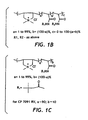
- An exemplary list of the structural formulas of such cationic polymers are illustrated in Figs. 1A-1C .
- the cationic polymers for use in the coatings may include but are not limited to, polymers and copolymers of diallyldialkyammonium monomers such as diallyldimethylammonium chloride, cationic acrylate and acrylamide such as acryloxyethyldimethylammonium chloride or acrylamidoethyldimethylammonium chloride monomers, quartemized vinylpyridine such as methyl vinylpyridine chloride, and polyalkylamine polymers and copolymers.
- Co-monomers in such systems may consist of ones which modify the flexibility, hydrophobicity, or mechanical properties of the polymer molecule.
- reactive and/or self-condensing monomers may be included to enhance adhesion to the textile fiber or other components in the formulation.
- cationic polymers with charged groups in the main chain include epihalohydrin-amine polymers such as RetenTM 204 LS and KymeneTM 557 LX polymers of Hercules Incorporated, of Wilmington. Delaware.
- a specific example of a preferred cationic polymer resin is CP 7091 RV available from ECC international of Roswell, Georgia, with CP 7091 RV being a poly(diallyldimethlammonium chloride-co-diacetone acrylamide).
- Suitable fabric softeners which may be used in accordance with the present inventive coatings/methods include, but are not limited to, Varisoft 222 of the Witco Corporation of Greenwich, Connecticut, Adogen 432 also of the Witco Corporation, Accosoft 550-75 of the Stepan Company of Northfield, Illinois, Alubrasoft Super 100 and Alubrasoft 116 of the BASF Corporation, Specialty Chemicals Division of Mt. Olive, New Jersey, and Ahcovel Base N-62 of ICI Surfactants or Hodgson Texiles Chemical of Mt. Holly, North Carolina.
- Suitable fabric softeners include those that are cationic or nonionic and provide the attributes of print quality and image brightness to the printed textile substrate. The fabric softener most suitable to a particular textile fabric substrate varies by fabric substrate. For instance, it has been found that the fabric softener Varisoft 222 performs better with cotton/banner fabric samples while Adogen 432 performs better with nylon/lycra samples.
- the previously described coating treatments or formulations for ink jet printable substrates also include a latex binder in order to further enhance the adhesion and/or waterfastness of colorants on the textile fabric substrates. It has been found that coated ink jet receptive substrates including a latex binder provide high color density and saturation, superior print quality, reduction of wicking or bleeding, and enhanced ink absorption. Furthermore, the coating or treatment formulations provide a waterfast printed image when printing via an ink jet printing process, without the necessity of post-printing curing steps such as heating, steaming, chemical fixation, or radiation.
- the present invention is also directed to a treated ink jet printable substrate wherein the treatment comprises an aqueous coating formulation of cationic polymers or copolymers, fabric softeners, and a latex binder.
- the treatment comprises an aqueous coating formulation of cationic polymers or copolymers, fabric softeners, and a latex binder.
- a desirable embodiment of the present invention is a treated ink jet printable substrate wherein the aqueous treatment formulation comprises about 5-95 % cationic polymers or copolymers, about 5-20 % fabric softeners and about 0-80% latex binder.
- the treatment or coating formulations in this alternate embodiment consist primarily of cationic polymers and copolymers, fabric softeners and a water-insoluble polymer in the form of a latex dispersion or emulsion.
- the treating formulation may include about 0-80 % polymeric latex binder depending on the textile fabric substrate.
- the latex reinforcing polymers may be either nonionic or cationic.
- the latex materials may include vinylacetate, ethylene-vinylacetate, acrylate, styrene, and styrene-acrylate resins and other cationic or nonionic latexes. These resins may include reactive or self cross-linking groups in addition to inherent cationic functionality.
- the aqueous coating formulations may also include other additives which effect the appearance or tactile properties of the finished substrate, such as optical brighteners. It should be recognized that all of the stated percentages are based on solids unless otherwise noted. Total solids content for the formulations typically range from about 5-50 %, but desirably range from about 5-32 %. More desirably the total solids content for the formulations range from about 25-28 %.
- Treatment formulations (compositions) for the textile substrates are made by adding the above components from stock solutions or dispersions, or as solids where appropriate, and mixing to homogeneity.
- Application of the treatment formulation to the textile substrates may be carried out by any known means to those having ordinary skill in the art.
- fabric substrates may be treated by a standard padding (dip and squeeze) method and dried in a forced air oven, although any suitable drying means of textiles known to those skilled in the art may be employed.
- a textile substrate 20 is unwound from the incoming roll 30 and is then dipped in a saturator tank/bath 40 for sufficient time for it to become saturated with the treating formulation.
- the textile substrate is then run through a pressurized nip roll set 44 and 48.
- the pressure on the rolls should be in the range of about 10-120 psig but desirably in the range of about 10-65 psig, depending on the type of textile fabric substrate utilized, and the total solids content of the treatment formulations used.
- the pressurized nip rolls squeeze the coating evenly onto the substrate so as to penetrate the surface of the substrate.
- the rolls may be either rubber or steel, however a set of rolls in which at least one roll being rubber is desirable.
- the drying means may include a tenter frame for holding the textile substrate, and may itself encompass multiple consecutive drying means depending on the nature of the substrate to be dried.
- the drying temperature is desirably in the range from about 200° F to 325° F, desirably between about 220 to 250° F.
- the typical time for drying is between about 30 seconds and 3 minutes.
- the finished treated textile substrate is taken up on a wind up roll 52.
- the textile substrate may be rolled up for storage or moved to a second lamination process in preparation for ink jet printing.
- the textile substrate may be laminated to a carrier backing for ease of printing.
- dry pick-up ratios of the textile substrate may vary from about 0.5% to about 50%. Desirably, the dry pick-up ratios may vary from about 3 to about 20%. More desirably, the dry pick-up ratios may vary from about 6 to about 15%.
- Wet pick-up ratios for the textile substrates are typically between about 30-150%. Desirably such wet pick-up ratios are between about 80-120%. Desirably for Dacron banners, the wet pick up ratios are between about 40-120 %.
- Substrates which may be treated in accordance with the present inventive methods are varied and include paper, fabric, films, and the like, although textile fabric substrates are preferred. Such fabrics may include cotton, silk, wool, polyester, rayon, nylon, and blends thereof.
- the disclosed ink jet substrates may provide the benefits disclosed herein with or without further post-printing curing steps involving the use of heat, radiation or pressure. Ideally such treated substrates provide adhesion and/or colorfastness of the colorant with only ambient or room temperature curing or drying of the printed image. It should be noted however, that while not being necessary for the process, a post printing curing step may further enhance the colorfastness and washfastness of the printed image on the substrate.
- the basis weight of the various fabrics which may be treated by these formulations may range from about 2 ounces per square yard (osy) to about 9 osy.
- Dye classes which may be used in ink jet printers to be printed on such substrates include acid dyes, reactive dyes, direct dyes, azoic dyes, sulfur dyes, modified dyes, polymeric dyes, copolymerized dyes or other classes of colorants known to those skilled in the art. Furthermore, pigment colorants may be used in the ink jet printers to be printed on such substrates. Additionally, it has been found that when such substrate is printed with ink jet inks containing additives, such as those described in U.S. Application bearing Serial Number 09/109,681 filed July 2, 1998 and U.S. Patent No. 5,897,694 incorporated herein by reference in its entirety, such substrate treatments may be enhanced so as to provide enhanced colorfastness and washfastness.
- such previously described treatment formulations may be used in a method to treat banner textile fabric substrates.
- substrate materials include 100% cotton, 100 % polyester, 100% silk, nylon, rayon and blended materials, such as blends of cotton and polyester, as well as nonwoven materials.
- an aqueous coating formulation including cationic polymers, fabric softeners, and latex polymer binders in accordance with the previously described methods enable the banner substrates to be ink jet printable, with improved colorfastness/ color density and washfastness, and with reduced color bleed.
- the present invention is also directed to a treated ink jet printable banner substrate wherein the treatment comprises a formulation of cationic polymers or copolymers, fabric softeners, and an optional latex binder.
- the treatment comprises a formulation of cationic polymers or copolymers, fabric softeners, and an optional latex binder.
- a desirable embodiment of the present invention is a treated ink jet printable banner substrate wherein the aqueous treatment formulation includes between about 5-95 % cationic polymers or copolymers, between about 5-20 % fabric softeners and between about 0-80% latex binder.
- articles produced by the above described methods employing treated textile substrates as described herein.
- Such articles may include for example banners, wall coverings and other home furnishing products.
- ink jet printed images applied to a treated substrate as described herein resists removal of said image from said substrate, even upon repeated contact of the printed substrate with water. Such repetitive contact can be the result of normal handling of an article, accidental exposure to liquid, and routine laundering of the article.
- articles according to the present invention comprise a treated substrate containing an ink jet image printed thereon, the resulting image adheres sufficiently to said substrate to resist removal therefrom upon washing of said article.
- Textile substrate samples were first printed with a test pattern using a commercial ink jet printer utilizing commercial ink jet inks containing acid, reactive, and/or direct dyes. Color density, color bleed, and print quality were evaluated on the samples as printed. These textiles included cotton poplin textile substrates. Duplicates of both sets of samples were washed using a washing method as described. Color density, color bleed, print quality or appearance, and color permanence were evaluated using the washed samples. Data from the preliminary examples is expressed in Table 1 which follows. TABLE 1 INK INK ADDITIVE FABRIC TREATMENT HEAT TREATMENT COLORFAST EVAL WATER DELTA E DETERG.
- CP 7091 RV is a diallyldimethyammonium chloride/diacetone acrylamide copolymer, ECC International.
- Encad GA inks employ standard monomeric dyes. Samples were hand washed. The sampling tested magenta inks. Delta E was calculated in the samples utilizing the spectrodensitometer and equation described below. The sampling was produced using a dip and squeeze method; as previously described. As can be seen, the coating in the Preliminary Examples only included cationic polymer in the aqueous formulation. Percent represents percent solution.
- treated textile samples were printed using an Encad Pro E (@ 300dpi) ink jet printer obtained from Encad Inc. of San Diego, California.
- Encad GA, GS, or GO inks were employed using 4-Pass Enhanced Print Mode, that is with the printer passing over the textile substrate four times.
- the printing head was preheated and option identified as number "7" was selected on the printer. This option enabled more ink to be expelled from the printer onto the substrates.
- Dyes in the inks consisted of reactive, acid, and/or direct dyes and are described in Table 3.
- Sample sizes were typically 11 by 15 inches. Additionally, a floral three color print, using lavender, green and magenta was used for testing, of approximately 14 by 25 inches in size. Where it was difficult to distinguish between shades of green, a neutral portion (that is free of ink) of the sample was also evaluated.
- L* a* b* color values measurements (CIE 1976 Commission Internationale de l'Eclairage) and optical density were made of the printed textile substrates using an X-Rite 938 Spectrodensitometer (D65/10°) using CMY filters, in accordance with the operator's manual.
- the X-Rite spectrodensitometer was obtained from the X-Rite Corporation of Grandville, Michigan. Average optical densities were taken as the sum of the average of three measurements using each filter.
- ⁇ E SQRT ⁇ L * standard - L * sample 2 + a * standard - a * sample 2 + b * standard - b * sample 2
- ASTM DM 224-93 ASTM E308-90. Where values for delta E are less than 3.0, it is generally accepted that such color change cannot be observed with the human eye.
- a detailed description of spectrodensitometer testing is available in Color Technology in the Textile Industry, 2nd Edition, Published 1997 by AATCC (American Association of Textile Chemists & Colorists) .
- textile samples were washed using the following method. Samples were placed in an appropriate size beaker or container such as a one liter beaker. Samples were then placed under cold running water (between approximately 10-20° C) for approximately two minutes. The cold water was then drained from the textile samples. The beakers were then refilled with hot water (between approximately 40-50° C), and one ounce of detergent (Synthrapol ® per gallon of water was added to the beakers).
- the textile samples were then washed out for approximately five minutes and then rinsed and drained of remaining water. Finally, the textile samples were rinsed with warm water (of between approximately 25-30° C) for two minutes followed by a rinse with cold water (of between approximately 10-20° C) for approximately one more minute.
- a second set of samples were printed and subsequently steamed using a laboratory steamer for comparison.
- a colorfastness level is characterized as poor, bleeding or wicking has occurred.
- a washfastness level has been characterized as poor, the image has washed out.
- a colorfastness and washfastness level has been characterized as good, the color vibrancy and image retention is noticeably better than the poor level.
- the colorfastness and washfastness levels are characterized as excellent, the color properties and vibrancy are the highest levels with the highest color density.
- the textile substrate had been laminated to an adhesive coated paper backing which was obtained from American Builtrite, Inc. under the designation ProtecRite® 6798 prior to printing to enable the substrate to be easily coursed through the printer. The substrates were then removed from the backing prior to washing.
- Adhesive coated backing papers identified by the designation 6798 include a paper having a nominal thickness of 5.4 ml, an initial adhesion value of 27 oz/in, a tensile strength of 16 Ibs/in, and an elongation capability of 10 %.
- the batch formulations utilized are described in the following example summaries.
- Example 1 Cationic copolymer CP 7091 RV (ECC International), poly(diallyldimethylammonium chloride-co-diacetone acrylamide), was obtained in a 49.3% stock solution in water. 20.3 wet parts of this solution (10 dry parts, or approximately 90-91 % of the total dry parts) were added to 70.3 parts water with mixing. 1.1 wet part ( 1 dry part, or approximately 9 % of the total dry parts) Varisoft® 222 fabric softener (90% in water) was added and the entire solution was mixed until homogeneous. This formulation was used to treat 100% cotton poplin via a padding application and dried as previously described. A portion of this sample was laminated to an adhesive paper carrier, printed with an ink jet printer and dried under ambient conditions.
- the properties of the sample were evaluated for quality of the printed image, ink retention, and color density or saturation under the following conditions: 1) immediately after printing, 2) after printing and washing, 3) after printing and steaming, 4) after printing, steaming and washing.
- the printed samples exhibited superior image quality with little or no bleed, excellent ink retention, and excellent color density.
- Samples that were steamed exhibited excellent enhancement of color and appearance. Washfastness of steamed samples and samples not post-treated with steam exhibited moderate retention of color when washed. This Example utilized the GS ink set.
- Example 2 The formulation employed in Example 1 was used to treat a 100% polyester georgette fabric. Results for this fabric were similar to those obtained in Example 1. This Example utilized the GS ink set and GO ink set.
- Example 3 20.3 wet parts (cationic copolymer CP 7091 RV (ECC International) (49.3% in water)(10 dry parts or approximately 90-91 % of the total dry parts) was added to 48.9 parts water with mixing. 22.5 wet parts Adogen® 432 fabric softener (4.4% in water)(1 dry part, or approximately 9 % of the total dry parts) was added and the entire solution was mixed until homogeneous. This formulation was used to treat 100% cotton poplin via a conventional padding application and dried. The sample was printed and evaluated using the process described in Example 1. The printed sample exhibited superior image quality with little or no bleed, excellent ink retention, and excellent color density. Samples that were steamed exhibited excellent enhancement for color and appearance. Washfastness of steamed samples and samples not post-treated with steam exhibited moderate retention of color when washed. This Example utilized the GS ink set.
- Example 4 The formulation employed in Example 3 was used to treat a 100% silk charmeuse fabric. Results for this fabric were similar to those obtained in Example 3. This Example utilized the GS ink set.
- Example 5 The formulation employed in Example 3 was used to treat a 100% silk crepe de chine fabric. Results for this fabric were similar to those obtained in Example 3. This Example utilized the GS ink set.
- Example 6 20.3 wet parts cationic copolymer CP 7091 RV (ECC International) (49.3% in water) was added to 48.9 parts water with mixing. 11.3 wet parts Adogen® 432 fabric softener (4.4% in water) and 11.3 wet part Varisoft® 222 (4.7% in water) was added and the entire solution was mixed until homogeneous. This formulation was used to treat 100% cotton poplin via a conventional padding application and dried. The sample was printed and evaluated using the process described in Example 1. The printed sample exhibited superior image quality with little or no bleed, excellent ink retention, and excellent color density. Samples that were steamed exhibited excellent enhancement for color and appearance. Washfastness of steamed samples and samples not post-treated with steam exhibited moderate retention of color when washed. This Example utilized the GS ink set.
- ECC International ECC International
- Example 7 A treatment composition was formulated as in Example 6, substituting 23.1 wet parts Accosoft® 550 fabric softener (4.3% in water) (1 dry part, or approximately 9 % of the total dry parts) for parts Adogen® 432 fabric softener.
- the cationic polymer made up 10 dry parts or approximately 90-91 % of the total dry parts.
- the wet parts of water constituted approximately 48.2 parts.
- This formulation was used to treat 100% cotton poplin via a padding application and dried.
- the sample was printed and evaluated using the process described in Example 1. The printed sample exhibited superior image quality with little or no bleed, excellent ink retention, and excellent color density. Samples that were steamed exhibited excellent enhancement for color and appearance. Permanence of color to washing of steamed was dramatically increased compared to untreated samples. Some enhancement of colorfastness was achieved without steaming.
- This Example utilized the GS ink set.
- Example 8 The formulation employed in Example 7 was used to treat 85/15 nylon/lycra blend fabric. Results for this fabric were similar to those obtained in Example 7. This Example utilized the GS ink set.
- Example 9 The formulation employed in Example 7 was used to treat a 100% silk charmeuse fabric. Results for this fabric were similar to those obtained in Example 7. This Example utilized the GS ink set.
- Example 10 A treatment composition was formulated as in Example 3, substituting 22.7 wet parts Alubrasoft® Super 100 fabric softener (4.4% in water)(1 dry part or approximately 9 % of the total dry parts) for parts Adogen® 432 fabric softener.
- the formulation included 20.3 wet parts of 7091 RV (10 dry parts, or approximately 90-91 % of the total dry parts), and 48.7 parts water. This formulation was used to treat cotton poplin via a conventional padding application and dried.
- the sample was printed and evaluated using the process described in Example 1. The printed sample exhibited superior image quality with little or no bleed, excellent ink retention, and excellent color density. Samples that were steamed exhibited excellent enhancement for color and appearance. Permanence of color to washing of steamed samples was dramatically increased compared to untreated samples. Some enhancement of colorfastness was achieved without steaming.
- the Example utilized the GS ink set.
- Example 11 The formulation employed in Example 10 was used to treat 85/15 nylon/lycra blend fabric. Results for this fabric were similar to those obtained in Example 10. The Example utilized the GS ink set.
- Example 12 The formulation employed in Example 10 was used to treat a 100% silk charmeuse fabric. Results for this fabric were similar to those obtained in Example 10. The Example utilized the GS ink set.
- Example 13 A treatment composition was formulated as in Example 3, substituting 8.8 wet parts Ahcovel® fabric softener (11.3% in water)(1 dry part, or approximately 9 % of the total dry parts) for parts Adogen® 432 fabric softener.
- the formulation included 20.3 wet parts of 7091 RV (10 dry parts, or approximately 90-91 % of the total dry parts), and 62.5 parts water. This formulation was used to treat 100% cotton poplin via a padding application and dried.
- the sample was printed and evaluated using the process described in Example 1. The printed sample exhibited superior image quality with little or no bleed, excellent ink retention, and excellent color density. Samples that were steamed exhibited excellent enhancement for color and appearance. Permanence of color to washing of steamed samples was dramatically increased compared to untreated samples. Good enhancement of colorfastness was achieved without steaming.
- the Example utilized the GS ink set.
- Example 14 Cationic polymer CP 261LV (ECC international). Poly(diallyldimethylammonium), was obtained in a 43.0% stock solution in water. 23.3 wet parts of this solution (10 dry parts, or approximately 90-91 % of the total dry parts) was added to 47.1 parts water with mixing. 21.3 wet parts Varisoft® 222 fabric softener (4.7% in water)(1 dry part, or approximately 9 % of the total dry parts) was added and the entire solution was mixed until homogeneous. This formulation was used to treat 100% cotton poplin via a padding application and dried. The sample was printed and evaluated using the process described in Example 1. The printed sample exhibited superior image quality with little or no bleed, excellent ink retention, and excellent color density.
- Samples that were not steamed exhibited moderate retention of color when washed. Some enhancement of colorfastness was achieved. Samples that were steamed exhibited excellent enhancement for color and appearance. Washfastness of steamed samples and samples not post-treated with steam exhibited moderate retention of color when washed.
- the Example utilized the GS ink set.
- Example 15 28.8 wet parts of a solution containing 80% ethoxylated polyethylenimine (34.7% in water)(10 dry parts, or approximately 90-91 % of the total dry parts) was combined with 41.6 parts water with mixing. 21.3 wet parts Varisoft® 222 fabric softener (4.7% in water) (1 dry part, or approximately 9 % of the total dry parts) were added and the entire solution was mixed until homogeneous. This formulation was used to treat 100% cotton poplin via a padding application and dried. The sample was printed and evaluated using the process described in Example 1. The printed sample exhibited superior image quality with little or no bleed, excellent ink retention, and excellent color density. Samples that were not steamed exhibited moderate retention of color when washed. Some enhancement of colorfastness was achieved. Samples that were steamed exhibited excellent enhancement for color and appearance. Washfastness of steamed samples and samples not post-treated with steam exhibited moderate retention of color when washed. The Example utilized the GS ink set.
- Example 16 50.7 wet parts cationic copolymer CP 7091 RV (ECC international) (49.3% in water)(25 dry parts, or approximately 18-19 % of the total dry parts) was added to 656 parts water with mixing. 90.6 wet parts Airflex® 540 latex emulsion (ethylene-vinyl acetate copolymer, 55.2% in water)(50 dry parts, or approximately 37 % of the total dry parts) of AirProducts and Chemicals Inc.
- ECC ECC international
- Airflex® 540 latex emulsion ethylene-vinyl acetate copolymer, 55.2% in water
- Example 17 The formulation employed in Example 16 was used to treat a 100% cotton Jersey knit fabric. Results for this fabric were similar to those obtained in Example 16. The trial utilized the GS ink set.
- Example 18 The formulation employed in Example 16 was used to treat an 85/15 nylon/lycra blend fabric. Results for this fabric were similar to those obtained in Example 16. The Example utilized the GS ink set.
- Example 19 The formulation employed in Example 16 was used to treat a 100% silk charmeuse fabric. Results for this fabric were similar to those obtained in Example 16. The Example utilized the GS ink set.
- Example 20 The formulation employed in Example 16 was used to treat a 100% silk crepe de chine fabric. Results for this fabric were similar to those obtained in Example 16. The Example utilized the GS ink set.
- Example 21 50.7 wet parts cationic copolymer CP 7091 RV (ECC International) (49.3% in water)(25 dry parts, or approximately 18-19 % of the total dry parts) was added to 656.0 parts water with mixing. 90.6 wet parts Airflex® 540 latex emulsion (ethylene-vinyl acetate copolymer, 55.2% in water)(50 dry parts, or approximately 37 % of the total dry parts), 114.9 wet parts PrintRite® 591 acrylic emulsion (BF Goodrich, 43.5% in water)(50 dry parts, or approximately 37 % of the total dry parts), and 212.8 wet parts Varisoft® 222 fabric softener (4.7% in water) (10 dry parts, or approximately 7 % of the total dry parts) were added and the entire solution was mixed until homogeneous.
- Airflex® 540 latex emulsion ethylene-vinyl acetate copolymer, 55.2% in water
- This formulation was used to treat 100% cotton poplin via a padding application and dried.
- the sample was printed and evaluated using the process described in Example 1.
- the printed sample exhibited superior image quality with little or no bleed, excellent ink retention, and excellent color density. Samples that were not steamed exhibited good retention of color when washed. Samples that were steamed exhibited excellent enhancement for color and appearance. Permanence of color to washing was dramatically increased compared to untreated samples. Little measurable washout was detected.
- the Example utilized the GS ink set.
- Example 22 The formulation employed in Example 21 was used to treat a 100% cotton Jersey Knit fabric. Results for this fabric were similar to those obtained in Example 21.
- the Example utilized the GS ink set.
- Delta E values are reflected in the following Table 4. It should be recognized that values for delta E can range from 0 to 100 with the lower values being preferred for demonstrating minimum loss of color vibrancy/fading. Delta E values are a comparison of "treated and washed” or “treated and dry cleaned” samples versus “treated” samples. In some instances, Delta E values are a comparison of "treated, steamed, and washed” samples, versus “treated” samples. Textile fabrics which were capable of being printed without a coating experienced poor printing attributes and experienced total washout (with a Delta E theoretically at approximately 100). The following data applies to a Cranston Cotton sample, which was treated with a coating formulation as described in Example 21. Table 4 TREATED L* A* B* DELTA E Magenta 58.0 30.8 -17.6 standard T reated & Washed Magenta 59.0 37.2 -22.9 8.3
- Example 23 The formulation employed in Example 21 was used to treat a 100% silk charmeuse fabric. Results for this fabric were similar to those obtained in Example 21. This substrate was cleaned using commercial dry cleaning facilities and sample results are reflected in the following Table 5.
- the Example utilized the GS ink set. Table 5 TREATED L* A* B* DELTA E Magenta 46.9 54.8 -5.2 standard Black 1 29.5 1.8 0.5 standard Yellow 83.6 5.0 91.8 standard Cyan 61.8 -27.9 -31.2 standard Dry Cleaned Magenta 44.7 54.6 -5.0 2.3 Black 1 27.7 1.4 -.03 2.0 Yellow 82.4 4.7 90.3 1.9 Cyan 60.8 -28.5 29.8 1.8
- Example 24 10.1 wet parts cationic copolymer CP 7091 RV (ECC International) (49.3% in water)(5 dry parts, or approximately 45 % of the total dry parts) was added to 48.8 parts water with mixing. 11.5 wet parts PrintRite® 591 acrylic emulsion (BF Goodrich, 43.5% in water)(5 dry parts, or approximately 45 % of the total dry parts), and 21.3 wet parts Varisoft® 222 fabric softener (4.7% in water) (1 dry part, or approximately 9 % of the total dry parts) were added and the entire solution was mixed until homogeneous. This formulation was used to treat 100% cotton poplin via a padding application and dried. The sample was printed and evaluated using the process described in Example 1.
- ECC International ECC International
- the printed sample exhibited superior image quality with little or no bleed, excellent ink retention, and excellent color density. Samples that were not steamed exhibited good retention of color when washed. Samples that were steamed exhibited excellent enhancement for color and appearance. Washfastness of steamed samples and samples not post-treated with steam exhibited moderate retention of color when washed.
- the Example utilized the GS ink set.
- Example 25 The formulation employed in Example 24 was used to treat an 85/15 nylon/lycra blend fabric. Results for this fabric were similar to those obtained in Example 24.
- the Example utilized the GS ink set.
- Example 26 10.1 wet parts cationic copolymer CP 7091 RV (ECC International) (49.3% in water)(5 dry parts, or approximately 45 % of the total dry parts) was added to 48.8 parts water with mixing.
- Example 27 The formulation employed in Example 26 was used to treat an 85/15 nylon/lycra blend fabric.
- the printed sample exhibited superior image quality with little or no bleed, excellent ink retention, and excellent color density. Permanence of color to washing was not improved in these samples.
- the Example utilized the GS ink set.
- Example 28 10.1 wet parts cationic copolymer CP 7091 RV (ECC International) (49.3% in water)(5 dry parts, or approximately 45 % of the total dry parts) was added to 51.2 parts water with mixing. 9.1 wet parts Airflex® 540 latex emulsion (ethylene-vinyl acetate copolymer, 55.2% in water)(5 dry parts, or approximately 45 % of the total dry parts), and 21.3 wet parts Varisoft® 222 fabric softener (4.7% in water)(1 dry part, or approximately 9 % of the total dry parts) were added and the entire solution was mixed until homogeneous. This formulation was used to treat 100% cotton poplin via a padding application and dried. The sample was printed and evaluated using the process described in Example 1.
- ECC International ECC International
- the printed sample exhibited superior image quality with little or no bleed, excellent ink retention, and excellent color density. Samples that were not steamed exhibited good retention of color when washed. Samples that were steamed exhibited excellent enhancement for color and appearance. Permanence of color to washing was dramatically increased compared to untreated samples.
- the Example utilized the GS ink set. Example 29. The formulation employed in Example 28 was used to treat an 85/15 nyton/tycra blend fabric. The printed sample exhibited superior image quality with little or no bleed, excellent ink retention, and excellent color density. Permanence of color to washing was not improved in these samples. The Example utilized the GS ink set.
- Example 30 50.7 wet parts cationic copolymer CP 7091 RV (ECC international) (49.3% in water)(25 dry parts, or approximately 18-19 % of the total dry parts) was added to 881.9 parts water with mixing. 181.3 wet parts Airflex® 540 latex emulsion (ethylene-vinyl acetate copolymer, 55.2% in water)(100 dry parts, or approximately 74 % of the total dry parts), and 11.1 wet parts Varisoft® 222 fabric softener (90% in water)(10 dry parts, or approximately 7 % of the total dry parts) were added and the entire solution was mixed until homogeneous. This formulation was used to treat a 250 denier polyester/cotton banner fabric via a padding application and dried. The sample was printed as described in Example 1. The printed samples exhibited superior image quality with little or no bleed, excellent ink retention, and excellent color density. Permanence of color to washing was dramatically increased without steaming or other steps.
- Example 31 50.7 wet parts cationic copolymer CP 7091 RV (ECC international) (49.3% in water) (25 dry parts, or approximately 18-19 % of the total dry parts) was added to 878.0 parts water with mixing. 181.3 wet parts Airflex® 540 latex emulsion (ethylene-vinyl acetate copolymer, 55.2% in water)(100 dry parts, or approximately 74 % of the total dry parts), and 15.0 wet parts Adogen® 432 fabric softener (66.7% in water)(10 dry parts, or approximately 7 % of the total dry parts) were added and the entire solution was mixed until homogeneous. This formulation was used to treat a 250 denier polyester/cotton banner fabric via a padding application and dried. The sample was printed as described in Example 1. The printed samples exhibited superior image quality with little or no bleed, excellent ink retention, and excellent color density. Permanence of color to washing was dramatically increased without steaming or other steps.
- Example 32 The formulation employed in Example 31 was used to treat a polyester poplin fabric.
- the printed sample exhibited superior image quality with little or no bleed, excellent ink retention, and excellent color density. Permanence of color to washing was dramatically increased without steaming or other curing steps.
- Example 33 The formulation employed in Example 31 was used to treat a polyester satin fabric.
- the printed sample exhibited superior image quality with little or no bleed, excellent ink retention, and excellent color density. Permanence of color to washing was dramatically increased without steaming or other curing steps. In addition, the sample possessed excellent visual color reflectivity. Such quality may be observed visually or measured through diffuse reflectance methods.
- Example 34 The formulation employed in Example 31 was used to treat a polyester poplin fabric.
- the printed sample exhibited superior image quality with little or no bleed, excellent ink retention, and excellent color density. Permanence of color to washing was dramatically increased without steaming or other steps.
- Example 35 The formulation employed in Example 31 was used to treat a polyester satin fabric.
- the printed sample exhibited superior image quality with little or no bleed, excellent ink retention, and excellent color density. Permanence of color to washing was dramatically increased without steaming or other steps. In addition, sample possessed excellent color reflectivity.
- Example 36 50.7 wet parts cationic copolymer CP 7091 RV (ECC International) (49.3% in water)(25 dry parts, or approximately 17 % of the total dry parts) was added to 993.5 parts water with mixing. 230.9 wet parts PrintRite® 591 acrylic emulsion (BF Goodrich, 43.3% in water)(100 dry parts, or approximately 68-69 % of the total dry parts), and 296.3 wet parts Varisoft® 475 fabric softener (6.8% in water) (20 dry parts, or approximately 13-14 % of the total dry parts) were added and the entire solution was mixed until homogeneous. This formulation was used to treat 100% silk charmeuse via a padding application and dried. Wet pick-up was 140%.
- the sample was printed and evaluated using the process described in Example 1.
- the printed sample exhibited superior image quality with little or no bleed, excellent ink retention, and excellent color density. Samples that were not steamed exhibited good retention of color when washed. Samples that were steamed exhibited excellent enhancement for color and appearance. Permanence of color to washing was dramatically increased compared to untreated samples.
- the Example utilized the GS ink set.
- Test method 1 was employed for continuous exposure to light and intermittent exposure to water spray.
- the type of apparatus used consisted of an Atlas Ci 5000 apparatus.
- the instrument was programmed for continuous light and intermittent water spray in accordance with the manufacturer's instructions.
- the conventional cycle of 102 minutes of light exposure followed by a cycle of 18 minutes of light and water spray was employed.
- Such sample data measurements are reflected in the following Table 6.
- the method of print mode is double strike, at 102 light, 18 min. spray after 6 hours.
- Table 6 FR POLY.
- a still further alternate embodiment of the present invention relates to treatments/coating formulations and related methods for treating textile substrates which enhance the color brilliance, adhesion, and/or waterfastness/detergentfastness of inkjet reactive dye, acid dye, and pigment based inks on textile fabric substrates, which utilizes an imbibing solution in conjunction with a substrate coating.
- an imbibing solution shall mean a solution used to saturate a fabric such that it penetrates the interstitial spaces of the fabric.
- the coating solution ( or treatment, as has earlier been described) itself may include the imbibing solution, or in the alternative, the coating solution and imbibing solution may be applied in separate application steps.
- the treatment or coating formulations in the present invention consist primarily of cationic polymers, binders, fabric softeners, and other additives similar to those previously described.
- an imbibing solution is used to further treat the fabric substrate.
- an imbibing solution consisting of either sodium bicarbonate or sodium carbonate and urea, (for added color brilliance with post-treatment) is used with a aqueous coated fabric treatment.
- the imbibing solution is desirably applied at a level of between about 5-20 % by weight, more desirably 5-10 % by weight, depending on fabric type, and by using a standard saturation/padding method.
- the sodium bicarbonate, sodium carbonate, or combination is present in the imbibing/coating solution in an amount between about 3 and 10 percent of the total solids.
- the urea is present in the combined imbibing/coating solution in an amount between about 5 and 12 percent of the total solids.
- Other additives may be included in the combined coating/imbibing solution such as wetting agents, and defoamers. If additives are present in the formulation, they are desirably present in an amount between about 0.1 and 1 percent of the total solids.
- the wetting agent Q2-511 may be included in the combined coating/imbibing solution.
- dye fixatives may also be included in the coating formulation at less than about 5 % of the total solids.
- the sodium bicarbonate/sodium carbonate is also desirably present in an amount between about 30 and 40 percent of the total solids.
- the urea is present in the separate imbibing solution in an amount between about 50 and 70 percent solids.
- the imbibing solution may also include a wetting agent in solution as well as other additives in the same amounts as the prior embodiment.
- Water is present in solution in an amount between about 10 and 90 percent of the solution.
- this imbibing solution embodiment is desirably used with the reactive colorant classes, including those which may be applied via ink jet printing processes such as the monochlorotriazines and/or vinyl sulfones.
- the aqueous imbibing solution includes ammonium sulfate and urea for added color brilliance with post-treatment.
- the imbibing solution may be a part of the initial coating, or a separate solution.
- the ammonium sulfate is desirably present in an amount between about 5 and 10 percent of the total solids, when used as part of the coating formulation.
- the urea is desirably present in the combined coating/imbibing solution in an amount of between about 2 and 5 percent of the total solids.
- the imbibing solution is a separate solution from the coating solution
- the ammonium sulfate is present in an amount of between about 30 and 40 percent of the total solids.
- the urea is present in this separate imbibing solution in an amount between about 50 and 70 percent of the total solids.
- Other additives may be included in the combined coating/imbibing solution such as wetting agents, surfactants and defoamers.
- the wetting agent Q2-5211 may be included in the combined coating/imbibing solution.
- dye fixatives may also be included in the coating formulation at less than about 5 percent of the total solids.
- the solution also includes water and optionally wetting agents.
- the second embodiment is to be used with the acid dye class including those which may be applied via ink jet printing processes.
- the imbibing solution is desirably applied at a level of 5-20 % by weight, depending on fabric type, and by using a standard saturation/padding method. More desirably, the imbibing solution is applied at a level of 10-15 % by weight. It should be noted that when the imbibing solution for the above described embodiments are to be made separately from the coating formulation, they can either be mixed in a 50/50 ratio with the coating formulation to be applied simultaneously or in the alternative, the coating formulation can first be applied to the fabric, the fabric dried, and then the imbibing solution can be applied to the fabric and then dried.
- Textile substrates for use with the treatment methods may include cotton, silk, linen, polyester, rayon, nylon, and blends thereof.
- reactive dyes are used for cotton substrates
- acid dyes are used for silk and nylon substrates.
- the coating treatment and fixation treatment imbibing solution
- the invention allows for the fixation of classes of dyes on substrates that they are not normally associated with, or which would not be done commercially because the fixation is not normally facile or efficient.
- the disclosed ink jet receptive substrates that have been further treated with an imbibing solution provide high color density and saturation, superior print quality, reduction of wicking or bleeding, and enhanced ink absorption.
- the coating or treatment formulations provide a color enhanced waterfast/detergentfast printed image when printed with an ink jet printing process with post-printing treatment steps, such as heating, steaming, chemical fixation, or radiation curing.
- post-printing treatment steps such as heating, steaming, chemical fixation, or radiation curing.
- a series of coatings were created including cationic polymers, fabric softeners, latex binders, other additives and water.
- the coatings are identified below with the respective content percentages. It should be noted that certain coatings included an imbibing solution within their formulation while others did not, and an imbibing solution was therefore utilized in a separate application step. Batch sizes are expressed in grams.
- Dyeset concentrations Polyamines
- Dyeset Conc concentrations obtained from Sybron Chemicals of Wellford, South Carolina, along with Dyeset NOZ and Dyeset NFS.
- Such materials are dye fixatives for reactive dyes.
- the Q2-5211 which is a wetting agent, was obtained from Dow Coming.
- the sodium bicarbonate can be obtained from VWR of Norcross, Georgia and Baker Chemical, and the Urea can be obtained from Baker Chemical.
- the "Combo" which is a combination of a coating and imbibing solution, referred to in the examples which follow as Type E, for use with cotton fabrics.
- the above coatings can be used on a variety of textiles including silk and nylon. Additionally, the following coating can be used for Nylon/Lycra and silk substrates when using acid dyes. Coating, used for Nylon/Lycra and silk fabrics with acid dyes sets ORDER OF ADDITION OF INGREDIENTS % TOTAL SOLIDS DRY PARTS WET PARTS BATCH SIZE 5 Reten 204LS 17.95 25.00 139.28 452.62 2 AirFlex 540 55.27 100.00 181.26 589.06 3 VS475 10.00 20.00 200.00 649.97 4 Q2-5211 100.00 2.70 2.70 8.77 1.00 0.00 0.00 0.00 1.00 0.00 0.00 0.00 1 water 707.60 2299.58 12 147.7 1230.83 4000
- the coating and imbibing solution may be poured together as described below.
- the separate acid dye fixation formula includes deionized water in the range of about 30-90 %, but more desirably at about 83 weight percentage, ammonium sulfate in the range of about 30 to 40 total solids percent, urea in the range of about 50 to 70 solids percent, and an optional surfactant in the range of about 0.1-1.0, such as, Surfynol 465 at about 0.2 weight percent.
- the acid dye fixation formula described above is used with a particular coating, such as coatings described to be similar to preliminary Example 21 (described in the reactive dye section) or the coating listed immediately above, by being poured into the coating in a 50/50 ratio and then applied to the substrate as previously described, as opposed to being applied in a separate application step.
- a particular coating such as coatings described to be similar to preliminary Example 21 (described in the reactive dye section) or the coating listed immediately above, by being poured into the coating in a 50/50 ratio and then applied to the substrate as previously described, as opposed to being applied in a separate application step.
- the coating used was combined in a 50/50 ratio with the acid imbibing solution.
- the coating and imbibing solution can be combined, such as in the formulation described below.
- 11 by 15 inch fabric samples were evaluated.
- the samples were first coated and then imbibed.
- the fabric was first coated through a dip and nip procedure/padding as has been previously described, using coating A and then dried in a forced air oven at 100°C for 30 seconds.
- the fabric sample was imbibed in a dip and nip/padding method using imbibing solution C and dried again in the oven at 100°C for 30 seconds.
- the goal for percent dry pickup was between 7 and 9. The percent dry pickup was calculated in accordance with the following series of equations.
- % Dry Pickup Wet / Basis Weight ⁇ 100 - 100 ⁇ % Solids TS Results of Example 1 OBJECTIVE: TO IMBIBE COTTON POPLIN FABRIC USING TYPE A COATING AND SEPARATE IMBIBING SOLUTION. T.S.* OF 11.6 IN PERCENT # BW Dry in grms/m 2 Wet weight in grams % Pickup Dry 1 14.1 24.29 8.4 2 14.1 24.21 8.4 3 14.3 24.74 8.5 4 14.3 25.28 9.0 *T.S. represents total solids (percent), BW represents basis weight.
- each of the samples were exposed on half of their area to D65/ 10° illuminant (standard day light) to determine whether any yellowing occurs.
- a sample of each was also printed using the TX-1500 printer of Encad and a reactive ink set available from Kimberly-Clark Printing Technology, Inc. of Escondido, California under the designations 17960-17970.
- the fabric sample Prior to printing, the fabric sample was first laminated to a backing as has been previously described in the first example set.
- Examples of reactive dyes used included reactive blue 49 and black 5 available from companies such as DyStar and BASF corporation.
- the reactive dye sets utilize vinyl sulfones and monochlorotriazines.
- Type A was demonstrated to work well only after it had been steamed. Exposing Type A to a water wash was acceptable before steaming but detergent wash demonstrated considerable washout. Type B was demonstrated to work well without steaming but had some redepositing problems onto the fabric. Type C was demonstrated as having the most washout of all samples tested without steaming and having a visually impaired appearance. After steaming the results for Type C were very much improved.
- Type D demonstrated positive results across all samples but failed the water spot test and printed samples. Only after washing and/or after steam and washing did Type D sample pass water spot testing. Type E demonstrated very acceptable results with water spotting occurring on printed sample only. Type E demonstrated poor results in detergent washing with no post processing steps. Type F demonstrated positive visual appearances as did Type H samples. Type G samples failed most testing. Types I, J and K each demonstrated relatively the same positive results, although type K was shown to be a better performer in terms of appearance and washability.
- the water spot test comprised AATTC Test Method 104-1994. Essentially in this test, a drop of water is placed on a substrate and then rubbed down using a glass rod. The substrate is then observed to see if a water spot remains after the water dries. If a white circle appears then a water spot is considered to have been left.
- reactive dye ink sets may be used with these coatings including those available from Kimberly-Clark Printing Technology, Inc. under the designations, TXCR-500 Black, TXCR-520 Red, TXCR-523 Medium Red, TXCR-526 Scarlet, TXCR-530 Orange, TXCR-540 Yellow, TXCR-545 Golden Yellow, TXCR-550 Green, TXCR-560 Turquoise, TXCR-565 Medium Turquoise, TXCR-570 Blue, and TXCR-580 Gray. These reactive dye ink sets were tested with the above coatings by printing them through a Colorspan DM XII 12-color printer/ 600 dpi.
- acid dye ink sets may be used with acid dye fixation solutions (Imbibing solutions).
- Textile substrates which can use the acid dye sets include ones such as those with fibers that are dyeable with acid dyes, blended yarns, as long as the ratio is at least 15% between nylon and other material such as Lycra, and polyamides.
- Such acid dye sets are available from Kimberly-Clark Printing Technology, Inc. under the designation 17972-17975. Additional acid dye sets are available from Kimberly-Clark Printing Technology, Inc. under the designations 7287-20-2 Black, 7287-27-2 Gray, 6869-184-5 Violet, 7287-21-1 Blue, 7287-24-2 Lt.
- an inkjet solution to a conventional screen printing process using acid dyes and a treated substrate is provided.
- Providing a digital alternative to this market will greatly reduce the cost for the manufacturing of textiles and will allow for more custom-made products to be produced.
- a coated and imbibed nylon fabric was prepared in a similar fashion to the fabric samples previously described, and printed with a test print on the dried sample. The sample was washed in hot water with no apparent dye washout.
- Pigmented Ink Formulations may also be used in conjunction with the coating and imbibing solution formulations. It is particularly desirable to use Pigmented Ink formulations available from Kimberly-Clark Printing Technology, Inc. under the designations 17976-17979. Examples of the pigment dispersions include Acryjet Cyan, majenta, yellow and black available from the Rhom and Haas Corporation.
- the coating/ treatment formulations and methods which are the subject of this invention provide ink jet printable textile substrates which possess characteristics of print and image quality, a noticeable color enhancement, color quality and density, ink retention capacity, and waterfastness and detergentfastness properties. Such formulations can be used to prepare articles of manufacture as previously described.
Landscapes
- Engineering & Computer Science (AREA)
- Textile Engineering (AREA)
- Coloring (AREA)
- Ink Jet Recording Methods And Recording Media Thereof (AREA)
- Ink Jet (AREA)
Applications Claiming Priority (3)
| Application Number | Priority Date | Filing Date | Title |
|---|---|---|---|
| US16374199P | 1999-11-04 | 1999-11-04 | |
| US09/702,093 US6838498B1 (en) | 1999-11-04 | 2000-10-30 | Coating for treating substrates for ink jet printing including imbibing solution for enhanced image visualization and retention |
| EP00982068A EP1240383B1 (fr) | 1999-11-04 | 2000-10-31 | Revetement de textiles pour impression a jet d'encre |
Related Parent Applications (2)
| Application Number | Title | Priority Date | Filing Date |
|---|---|---|---|
| EP00982068A Division EP1240383B1 (fr) | 1999-11-04 | 2000-10-31 | Revetement de textiles pour impression a jet d'encre |
| EP00982068.9 Division | 2000-10-31 |
Publications (3)
| Publication Number | Publication Date |
|---|---|
| EP1914343A2 true EP1914343A2 (fr) | 2008-04-23 |
| EP1914343A3 EP1914343A3 (fr) | 2010-12-29 |
| EP1914343B1 EP1914343B1 (fr) | 2012-09-12 |
Family
ID=39202146
Family Applications (1)
| Application Number | Title | Priority Date | Filing Date |
|---|---|---|---|
| EP08001346A Expired - Lifetime EP1914343B1 (fr) | 1999-11-04 | 2000-10-31 | Revêtement pour traiter des substrats pour impression par jet d'encre , procédé de traitement de ces substrats et articles produits |
Country Status (1)
| Country | Link |
|---|---|
| EP (1) | EP1914343B1 (fr) |
Citations (6)
| Publication number | Priority date | Publication date | Assignee | Title |
|---|---|---|---|---|
| EP0605730A1 (fr) | 1992-07-27 | 1994-07-13 | Kanebo, Ltd. | Tissu imprime et procede de fabrication |
| US5781216A (en) | 1994-10-28 | 1998-07-14 | Canon Kabushiki Kaisha | Ink-jet printing cloth, textile printing method of the same and print resulting therefrom |
| WO1999000541A1 (fr) | 1997-06-30 | 1999-01-07 | Kimberly-Clark Worldwide, Inc. | Substrat cellulosique sature lavable, imprimable par jet d'encre |
| US5897694A (en) | 1997-01-06 | 1999-04-27 | Formulabs | Methods for improving the adhesion and/or colorfastness of ink jet inks with respect to substrates applied thereto, and compositions useful therefor |
| US9812712B2 (en) | 2012-09-24 | 2017-11-07 | Toray Industries, Inc. | Highly dispersible graphene composition, preparation method thereof, and electrode for lithium ion secondary battery containing highly dispersible graphene composition |
| US10968198B2 (en) | 2015-02-13 | 2021-04-06 | Yale University | Biaryltriazole inhibitors of macrophage migration inhibitory factor |
Family Cites Families (4)
| Publication number | Priority date | Publication date | Assignee | Title |
|---|---|---|---|---|
| DE58907949D1 (de) * | 1988-12-14 | 1994-07-28 | Ciba Geigy Ag | Aufzeichnungsmaterial für Tintenstrahldruck. |
| JP2521896B2 (ja) * | 1991-01-18 | 1996-08-07 | 日本製紙株式会社 | インクジェット記録シ―ト |
| GB9120227D0 (en) * | 1991-09-23 | 1991-11-06 | Ici Plc | Printing process and pretreatment composition |
| US6291023B1 (en) * | 1998-04-22 | 2001-09-18 | Sri International | Method and composition for textile printing |
-
2000
- 2000-10-31 EP EP08001346A patent/EP1914343B1/fr not_active Expired - Lifetime
Patent Citations (6)
| Publication number | Priority date | Publication date | Assignee | Title |
|---|---|---|---|---|
| EP0605730A1 (fr) | 1992-07-27 | 1994-07-13 | Kanebo, Ltd. | Tissu imprime et procede de fabrication |
| US5781216A (en) | 1994-10-28 | 1998-07-14 | Canon Kabushiki Kaisha | Ink-jet printing cloth, textile printing method of the same and print resulting therefrom |
| US5897694A (en) | 1997-01-06 | 1999-04-27 | Formulabs | Methods for improving the adhesion and/or colorfastness of ink jet inks with respect to substrates applied thereto, and compositions useful therefor |
| WO1999000541A1 (fr) | 1997-06-30 | 1999-01-07 | Kimberly-Clark Worldwide, Inc. | Substrat cellulosique sature lavable, imprimable par jet d'encre |
| US9812712B2 (en) | 2012-09-24 | 2017-11-07 | Toray Industries, Inc. | Highly dispersible graphene composition, preparation method thereof, and electrode for lithium ion secondary battery containing highly dispersible graphene composition |
| US10968198B2 (en) | 2015-02-13 | 2021-04-06 | Yale University | Biaryltriazole inhibitors of macrophage migration inhibitory factor |
Non-Patent Citations (2)
| Title |
|---|
| "Color Technology in the Textile Industrv", 1997, AATCC |
| SABIT ADANUR: "Wellington Sears Handbook of Industrial Textiles", 1995, pages: 179 |
Also Published As
| Publication number | Publication date |
|---|---|
| EP1914343B1 (fr) | 2012-09-12 |
| EP1914343A3 (fr) | 2010-12-29 |
Similar Documents
| Publication | Publication Date | Title |
|---|---|---|
| EP1240383B1 (fr) | Revetement de textiles pour impression a jet d'encre | |
| EP1356155B1 (fr) | Revetement et procede de traitement de substrats pour impression a jet d'encre | |
| EP1165878B1 (fr) | Revetements pour substrats, procedes de traitement de substrats destines a etre utilises avec des dispositifs d'impression a jet d'encre et articles produits a partir de ces derniers | |
| US6001137A (en) | Ink jet printed textiles | |
| US20050084614A1 (en) | Imbibing solutions, method of pretreating substrates with imbibing/coating solutions in preparation for digital printing, and substrates produced therefrom | |
| EP1914343B1 (fr) | Revêtement pour traiter des substrats pour impression par jet d'encre , procédé de traitement de ces substrats et articles produits | |
| HK1058221B (en) | Coating and method for treating substrates for ink jet printing | |
| US11674263B2 (en) | Dye sublimation inks for printing on natural fabrics | |
| HK1055452B (en) | Coating for treating substrates for ink jet printing including imbibing solution for enhanced image visualization and retention, method for treating said substrates, and articles produced therefrom | |
| DE20122589U1 (de) | Beschichtung zur Behandlung von Substraten für Tintenstrahldruck | |
| MXPA01009159A (en) | Substrate coatings, methods for treating substrates for ink jet printing, and articles produced therefrom |
Legal Events
| Date | Code | Title | Description |
|---|---|---|---|
| PUAI | Public reference made under article 153(3) epc to a published international application that has entered the european phase |
Free format text: ORIGINAL CODE: 0009012 |
|
| AC | Divisional application: reference to earlier application |
Ref document number: 1240383 Country of ref document: EP Kind code of ref document: P |
|
| AK | Designated contracting states |
Kind code of ref document: A2 Designated state(s): AT BE CH CY DE DK ES FI FR GB GR IE IT LI LU MC NL PT SE |
|
| AX | Request for extension of the european patent |
Extension state: AL LT LV MK RO SI |
|
| RTI1 | Title (correction) |
Free format text: COATING FOR TREATING SUBSTRATES FOR INK JET PRINTING, METHOD FOR TREATING SAID SUBSTRATES, AND ARTICLES PRODUCED THEREFROM |
|
| RIN1 | Information on inventor provided before grant (corrected) |
Inventor name: BAGWELL, ALISON SALYER Inventor name: BRANHAM, KELLY DEAN Inventor name: ZELAZOSKI, LEONARD EUGENE Inventor name: FARRIS-KISTER, MARY ELIZABETH |
|
| PUAL | Search report despatched |
Free format text: ORIGINAL CODE: 0009013 |
|
| AK | Designated contracting states |
Kind code of ref document: A3 Designated state(s): AT BE CH CY DE DK ES FI FR GB GR IE IT LI LU MC NL PT SE |
|
| AX | Request for extension of the european patent |
Extension state: AL LT LV MK RO SI |
|
| RIC1 | Information provided on ipc code assigned before grant |
Ipc: D06P 5/30 20060101ALI20101123BHEP Ipc: D06P 1/52 20060101AFI20101123BHEP Ipc: D06P 5/22 20060101ALI20101123BHEP |
|
| 17P | Request for examination filed |
Effective date: 20110624 |
|
| AKX | Designation fees paid |
Designated state(s): AT BE CH CY DE DK ES FI FR GB GR IE IT LI LU MC NL PT SE |
|
| 17Q | First examination report despatched |
Effective date: 20111221 |
|
| GRAP | Despatch of communication of intention to grant a patent |
Free format text: ORIGINAL CODE: EPIDOSNIGR1 |
|
| GRAS | Grant fee paid |
Free format text: ORIGINAL CODE: EPIDOSNIGR3 |
|
| GRAA | (expected) grant |
Free format text: ORIGINAL CODE: 0009210 |
|
| AC | Divisional application: reference to earlier application |
Ref document number: 1240383 Country of ref document: EP Kind code of ref document: P |
|
| AK | Designated contracting states |
Kind code of ref document: B1 Designated state(s): AT BE CH CY DE DK ES FI FR GB GR IE IT LI LU MC NL PT SE |
|
| REG | Reference to a national code |
Ref country code: GB Ref legal event code: FG4D |
|
| REG | Reference to a national code |
Ref country code: CH Ref legal event code: EP |
|
| REG | Reference to a national code |
Ref country code: AT Ref legal event code: REF Ref document number: 575166 Country of ref document: AT Kind code of ref document: T Effective date: 20120915 |
|
| REG | Reference to a national code |
Ref country code: IE Ref legal event code: FG4D |
|
| REG | Reference to a national code |
Ref country code: DE Ref legal event code: R096 Ref document number: 60047492 Country of ref document: DE Effective date: 20121108 |
|
| PG25 | Lapsed in a contracting state [announced via postgrant information from national office to epo] |
Ref country code: CY Free format text: LAPSE BECAUSE OF FAILURE TO SUBMIT A TRANSLATION OF THE DESCRIPTION OR TO PAY THE FEE WITHIN THE PRESCRIBED TIME-LIMIT Effective date: 20120912 Ref country code: FI Free format text: LAPSE BECAUSE OF FAILURE TO SUBMIT A TRANSLATION OF THE DESCRIPTION OR TO PAY THE FEE WITHIN THE PRESCRIBED TIME-LIMIT Effective date: 20120912 |
|
| REG | Reference to a national code |
Ref country code: NL Ref legal event code: VDEP Effective date: 20120912 |
|
| REG | Reference to a national code |
Ref country code: AT Ref legal event code: MK05 Ref document number: 575166 Country of ref document: AT Kind code of ref document: T Effective date: 20120912 |
|
| PG25 | Lapsed in a contracting state [announced via postgrant information from national office to epo] |
Ref country code: SE Free format text: LAPSE BECAUSE OF FAILURE TO SUBMIT A TRANSLATION OF THE DESCRIPTION OR TO PAY THE FEE WITHIN THE PRESCRIBED TIME-LIMIT Effective date: 20120912 Ref country code: GR Free format text: LAPSE BECAUSE OF FAILURE TO SUBMIT A TRANSLATION OF THE DESCRIPTION OR TO PAY THE FEE WITHIN THE PRESCRIBED TIME-LIMIT Effective date: 20121213 |
|
| REG | Reference to a national code |
Ref country code: FR Ref legal event code: TP Owner name: PETRONA CONSULTING LIMITED LIABILITY COMPANY, US Effective date: 20130204 |
|
| REG | Reference to a national code |
Ref country code: DE Ref legal event code: R081 Ref document number: 60047492 Country of ref document: DE Owner name: PETRONA CONSULTING LIMITED LIABILITY COMPANY, US Free format text: FORMER OWNER: PETRONA CONSULTING LLC, DOVER, US Effective date: 20130207 Ref country code: DE Ref legal event code: R082 Ref document number: 60047492 Country of ref document: DE Representative=s name: DTS MUENCHEN PATENT- UND RECHTSANWAELTE, DE Effective date: 20130207 Ref country code: DE Ref legal event code: R081 Ref document number: 60047492 Country of ref document: DE Owner name: PETRONA CONSULTING LIMITED LIABILITY COMPANY, US Free format text: FORMER OWNER: KIMBERLY-CLARK WORLDWIDE, INC., NEENAH, US Effective date: 20130117 Ref country code: DE Ref legal event code: R082 Ref document number: 60047492 Country of ref document: DE Representative=s name: DTS MUENCHEN PATENT- UND RECHTSANWAELTE, DE Effective date: 20130117 Ref country code: DE Ref legal event code: R081 Ref document number: 60047492 Country of ref document: DE Owner name: PETRONA CONSULTING LIMITED LIABILITY COMPANY, , US Free format text: FORMER OWNER: PETRONA CONSULTING LLC, DOVER, DEL., US Effective date: 20130207 Ref country code: DE Ref legal event code: R081 Ref document number: 60047492 Country of ref document: DE Owner name: PETRONA CONSULTING LIMITED LIABILITY COMPANY, , US Free format text: FORMER OWNER: KIMBERLY-CLARK WORLDWIDE, INC., NEENAH, WIS., US Effective date: 20130117 Ref country code: DE Ref legal event code: R082 Ref document number: 60047492 Country of ref document: DE Representative=s name: DTS PATENT- UND RECHTSANWAELTE SCHNEKENBUEHL U, DE Effective date: 20130117 Ref country code: DE Ref legal event code: R082 Ref document number: 60047492 Country of ref document: DE Representative=s name: DTS PATENT- UND RECHTSANWAELTE SCHNEKENBUEHL U, DE Effective date: 20130207 |
|
| PGFP | Annual fee paid to national office [announced via postgrant information from national office to epo] |
Ref country code: NL Payment date: 20121024 Year of fee payment: 13 |
|
| REG | Reference to a national code |
Ref country code: GB Ref legal event code: 732E Free format text: REGISTERED BETWEEN 20130328 AND 20130403 |
|
| PG25 | Lapsed in a contracting state [announced via postgrant information from national office to epo] |
Ref country code: NL Free format text: LAPSE BECAUSE OF FAILURE TO SUBMIT A TRANSLATION OF THE DESCRIPTION OR TO PAY THE FEE WITHIN THE PRESCRIBED TIME-LIMIT Effective date: 20120912 Ref country code: BE Free format text: LAPSE BECAUSE OF FAILURE TO SUBMIT A TRANSLATION OF THE DESCRIPTION OR TO PAY THE FEE WITHIN THE PRESCRIBED TIME-LIMIT Effective date: 20120912 Ref country code: ES Free format text: LAPSE BECAUSE OF FAILURE TO SUBMIT A TRANSLATION OF THE DESCRIPTION OR TO PAY THE FEE WITHIN THE PRESCRIBED TIME-LIMIT Effective date: 20121223 |
|
| PG25 | Lapsed in a contracting state [announced via postgrant information from national office to epo] |
Ref country code: MC Free format text: LAPSE BECAUSE OF NON-PAYMENT OF DUE FEES Effective date: 20121031 Ref country code: PT Free format text: LAPSE BECAUSE OF FAILURE TO SUBMIT A TRANSLATION OF THE DESCRIPTION OR TO PAY THE FEE WITHIN THE PRESCRIBED TIME-LIMIT Effective date: 20130114 |
|
| REG | Reference to a national code |
Ref country code: CH Ref legal event code: PL |
|
| PG25 | Lapsed in a contracting state [announced via postgrant information from national office to epo] |
Ref country code: AT Free format text: LAPSE BECAUSE OF FAILURE TO SUBMIT A TRANSLATION OF THE DESCRIPTION OR TO PAY THE FEE WITHIN THE PRESCRIBED TIME-LIMIT Effective date: 20120912 |
|
| PLBE | No opposition filed within time limit |
Free format text: ORIGINAL CODE: 0009261 |
|
| STAA | Information on the status of an ep patent application or granted ep patent |
Free format text: STATUS: NO OPPOSITION FILED WITHIN TIME LIMIT |
|
| PG25 | Lapsed in a contracting state [announced via postgrant information from national office to epo] |
Ref country code: LI Free format text: LAPSE BECAUSE OF NON-PAYMENT OF DUE FEES Effective date: 20121031 Ref country code: CH Free format text: LAPSE BECAUSE OF NON-PAYMENT OF DUE FEES Effective date: 20121031 Ref country code: DK Free format text: LAPSE BECAUSE OF FAILURE TO SUBMIT A TRANSLATION OF THE DESCRIPTION OR TO PAY THE FEE WITHIN THE PRESCRIBED TIME-LIMIT Effective date: 20120912 |
|
| REG | Reference to a national code |
Ref country code: IE Ref legal event code: MM4A |
|
| 26N | No opposition filed |
Effective date: 20130613 |
|
| PG25 | Lapsed in a contracting state [announced via postgrant information from national office to epo] |
Ref country code: IT Free format text: LAPSE BECAUSE OF FAILURE TO SUBMIT A TRANSLATION OF THE DESCRIPTION OR TO PAY THE FEE WITHIN THE PRESCRIBED TIME-LIMIT Effective date: 20120912 |
|
| REG | Reference to a national code |
Ref country code: DE Ref legal event code: R097 Ref document number: 60047492 Country of ref document: DE Effective date: 20130613 |
|
| PG25 | Lapsed in a contracting state [announced via postgrant information from national office to epo] |
Ref country code: IE Free format text: LAPSE BECAUSE OF NON-PAYMENT OF DUE FEES Effective date: 20121031 |
|
| PG25 | Lapsed in a contracting state [announced via postgrant information from national office to epo] |
Ref country code: LU Free format text: LAPSE BECAUSE OF NON-PAYMENT OF DUE FEES Effective date: 20121031 |
|
| REG | Reference to a national code |
Ref country code: FR Ref legal event code: PLFP Year of fee payment: 17 |
|
| REG | Reference to a national code |
Ref country code: FR Ref legal event code: PLFP Year of fee payment: 18 |
|
| REG | Reference to a national code |
Ref country code: FR Ref legal event code: PLFP Year of fee payment: 19 |
|
| PGFP | Annual fee paid to national office [announced via postgrant information from national office to epo] |
Ref country code: FR Payment date: 20190924 Year of fee payment: 20 |
|
| PGFP | Annual fee paid to national office [announced via postgrant information from national office to epo] |
Ref country code: GB Payment date: 20190925 Year of fee payment: 20 |
|
| PGFP | Annual fee paid to national office [announced via postgrant information from national office to epo] |
Ref country code: DE Payment date: 20190917 Year of fee payment: 20 |
|
| REG | Reference to a national code |
Ref country code: DE Ref legal event code: R071 Ref document number: 60047492 Country of ref document: DE |
|
| REG | Reference to a national code |
Ref country code: GB Ref legal event code: PE20 Expiry date: 20201030 |
|
| PG25 | Lapsed in a contracting state [announced via postgrant information from national office to epo] |
Ref country code: GB Free format text: LAPSE BECAUSE OF EXPIRATION OF PROTECTION Effective date: 20201030 |