EP1915331B1 - Procede de production d'alcool methylbenzylique a noyau halogene - Google Patents
Procede de production d'alcool methylbenzylique a noyau halogene Download PDFInfo
- Publication number
- EP1915331B1 EP1915331B1 EP06757394.9A EP06757394A EP1915331B1 EP 1915331 B1 EP1915331 B1 EP 1915331B1 EP 06757394 A EP06757394 A EP 06757394A EP 1915331 B1 EP1915331 B1 EP 1915331B1
- Authority
- EP
- European Patent Office
- Prior art keywords
- nucleus
- halogenated
- methylbenzyl alcohol
- represented
- dicarbaldehyde
- Prior art date
- Legal status (The legal status is an assumption and is not a legal conclusion. Google has not performed a legal analysis and makes no representation as to the accuracy of the status listed.)
- Active
Links
- WAPNOHKVXSQRPX-UHFFFAOYSA-N 1-phenylethanol Chemical class CC(O)C1=CC=CC=C1 WAPNOHKVXSQRPX-UHFFFAOYSA-N 0.000 title claims description 32
- 238000004519 manufacturing process Methods 0.000 title claims description 28
- UFHFLCQGNIYNRP-UHFFFAOYSA-N Hydrogen Chemical compound [H][H] UFHFLCQGNIYNRP-UHFFFAOYSA-N 0.000 claims description 37
- 239000001257 hydrogen Substances 0.000 claims description 37
- 229910052739 hydrogen Inorganic materials 0.000 claims description 37
- YXFVVABEGXRONW-UHFFFAOYSA-N Toluene Chemical compound CC1=CC=CC=C1 YXFVVABEGXRONW-UHFFFAOYSA-N 0.000 claims description 30
- 239000003054 catalyst Substances 0.000 claims description 26
- 239000002904 solvent Substances 0.000 claims description 24
- OKKJLVBELUTLKV-UHFFFAOYSA-N Methanol Chemical compound OC OKKJLVBELUTLKV-UHFFFAOYSA-N 0.000 claims description 21
- 238000005984 hydrogenation reaction Methods 0.000 claims description 21
- -1 alicyclic hydrocarbons Chemical class 0.000 claims description 16
- ZWLUXSQADUDCSB-UHFFFAOYSA-N phthalaldehyde Chemical class O=CC1=CC=CC=C1C=O ZWLUXSQADUDCSB-UHFFFAOYSA-N 0.000 claims description 16
- LFQSCWFLJHTTHZ-UHFFFAOYSA-N Ethanol Chemical compound CCO LFQSCWFLJHTTHZ-UHFFFAOYSA-N 0.000 claims description 12
- WJHRAPYKYJKACM-UHFFFAOYSA-N 2,3,5,6-tetrafluoroterephthalaldehyde Chemical compound FC1=C(F)C(C=O)=C(F)C(F)=C1C=O WJHRAPYKYJKACM-UHFFFAOYSA-N 0.000 claims description 10
- PJCSTULKVNHEGW-UHFFFAOYSA-N (2,3,5,6-tetrafluoro-4-methylphenyl)methanol Chemical compound CC1=C(F)C(F)=C(CO)C(F)=C1F PJCSTULKVNHEGW-UHFFFAOYSA-N 0.000 claims description 9
- 229910017052 cobalt Inorganic materials 0.000 claims description 9
- 239000010941 cobalt Substances 0.000 claims description 9
- GUTLYIVDDKVIGB-UHFFFAOYSA-N cobalt atom Chemical compound [Co] GUTLYIVDDKVIGB-UHFFFAOYSA-N 0.000 claims description 9
- 150000001338 aliphatic hydrocarbons Chemical class 0.000 claims description 8
- 150000002170 ethers Chemical class 0.000 claims description 8
- 229930195733 hydrocarbon Natural products 0.000 claims description 8
- SOZFIIXUNAKEJP-UHFFFAOYSA-N 1,2,3,4-tetrafluorobenzene Chemical group FC1=CC=C(F)C(F)=C1F SOZFIIXUNAKEJP-UHFFFAOYSA-N 0.000 claims description 7
- 239000012046 mixed solvent Substances 0.000 claims description 7
- 150000001298 alcohols Chemical class 0.000 claims description 6
- 239000000126 substance Substances 0.000 claims description 6
- XLYOFNOQVPJJNP-UHFFFAOYSA-N water Substances O XLYOFNOQVPJJNP-UHFFFAOYSA-N 0.000 claims description 5
- RYHBNJHYFVUHQT-UHFFFAOYSA-N 1,4-Dioxane Chemical compound C1COCCO1 RYHBNJHYFVUHQT-UHFFFAOYSA-N 0.000 claims description 4
- 150000004945 aromatic hydrocarbons Chemical class 0.000 claims description 4
- 229920006395 saturated elastomer Polymers 0.000 claims description 4
- WNXJIVFYUVYPPR-UHFFFAOYSA-N 1,3-dioxolane Chemical compound C1COCO1 WNXJIVFYUVYPPR-UHFFFAOYSA-N 0.000 claims description 3
- CTQNGGLPUBDAKN-UHFFFAOYSA-N O-Xylene Chemical compound CC1=CC=CC=C1C CTQNGGLPUBDAKN-UHFFFAOYSA-N 0.000 claims description 3
- 150000002430 hydrocarbons Chemical class 0.000 claims description 3
- 239000008096 xylene Substances 0.000 claims description 3
- 238000006243 chemical reaction Methods 0.000 description 20
- 229910052751 metal Inorganic materials 0.000 description 12
- 239000002184 metal Substances 0.000 description 12
- 238000010521 absorption reaction Methods 0.000 description 10
- 125000003172 aldehyde group Chemical group 0.000 description 10
- 230000015572 biosynthetic process Effects 0.000 description 9
- 239000002994 raw material Substances 0.000 description 8
- 150000001875 compounds Chemical class 0.000 description 7
- 238000000034 method Methods 0.000 description 7
- IJGRMHOSHXDMSA-UHFFFAOYSA-N Atomic nitrogen Chemical compound N#N IJGRMHOSHXDMSA-UHFFFAOYSA-N 0.000 description 6
- 238000004817 gas chromatography Methods 0.000 description 6
- 125000002496 methyl group Chemical group [H]C([H])([H])* 0.000 description 6
- SDHKGYDQOGCLQM-UHFFFAOYSA-N [2,3,5,6-tetrafluoro-4-(hydroxymethyl)phenyl]methanol Chemical compound OCC1=C(F)C(F)=C(CO)C(F)=C1F SDHKGYDQOGCLQM-UHFFFAOYSA-N 0.000 description 5
- 238000002360 preparation method Methods 0.000 description 5
- 238000004458 analytical method Methods 0.000 description 4
- 239000012295 chemical reaction liquid Substances 0.000 description 4
- IWKPBYPUIPVYNZ-UHFFFAOYSA-N 1,2,4,5-tetrafluoro-3,6-dimethylbenzene Chemical compound CC1=C(F)C(F)=C(C)C(F)=C1F IWKPBYPUIPVYNZ-UHFFFAOYSA-N 0.000 description 3
- RFFLAFLAYFXFSW-UHFFFAOYSA-N 1,2-dichlorobenzene Chemical compound ClC1=CC=CC=C1Cl RFFLAFLAYFXFSW-UHFFFAOYSA-N 0.000 description 3
- UHOVQNZJYSORNB-UHFFFAOYSA-N Benzene Chemical compound C1=CC=CC=C1 UHOVQNZJYSORNB-UHFFFAOYSA-N 0.000 description 3
- RTZKZFJDLAIYFH-UHFFFAOYSA-N Diethyl ether Chemical compound CCOCC RTZKZFJDLAIYFH-UHFFFAOYSA-N 0.000 description 3
- VYPSYNLAJGMNEJ-UHFFFAOYSA-N Silicium dioxide Chemical compound O=[Si]=O VYPSYNLAJGMNEJ-UHFFFAOYSA-N 0.000 description 3
- PNEYBMLMFCGWSK-UHFFFAOYSA-N aluminium oxide Inorganic materials [O-2].[O-2].[O-2].[Al+3].[Al+3] PNEYBMLMFCGWSK-UHFFFAOYSA-N 0.000 description 3
- 238000001514 detection method Methods 0.000 description 3
- 125000004029 hydroxymethyl group Chemical group [H]OC([H])([H])* 0.000 description 3
- 229910052757 nitrogen Inorganic materials 0.000 description 3
- ZJWFAHRWBCLFDL-UHFFFAOYSA-N 2,4,5,6-tetrafluorobenzene-1,3-dicarbaldehyde Chemical compound FC1=C(F)C(C=O)=C(F)C(C=O)=C1F ZJWFAHRWBCLFDL-UHFFFAOYSA-N 0.000 description 2
- OKTJSMMVPCPJKN-UHFFFAOYSA-N Carbon Chemical compound [C] OKTJSMMVPCPJKN-UHFFFAOYSA-N 0.000 description 2
- XEEYBQQBJWHFJM-UHFFFAOYSA-N Iron Chemical compound [Fe] XEEYBQQBJWHFJM-UHFFFAOYSA-N 0.000 description 2
- KFZMGEQAYNKOFK-UHFFFAOYSA-N Isopropanol Chemical compound CC(C)O KFZMGEQAYNKOFK-UHFFFAOYSA-N 0.000 description 2
- LRHPLDYGYMQRHN-UHFFFAOYSA-N N-Butanol Chemical compound CCCCO LRHPLDYGYMQRHN-UHFFFAOYSA-N 0.000 description 2
- PXHVJJICTQNCMI-UHFFFAOYSA-N Nickel Chemical compound [Ni] PXHVJJICTQNCMI-UHFFFAOYSA-N 0.000 description 2
- KDLHZDBZIXYQEI-UHFFFAOYSA-N Palladium Chemical compound [Pd] KDLHZDBZIXYQEI-UHFFFAOYSA-N 0.000 description 2
- WYURNTSHIVDZCO-UHFFFAOYSA-N Tetrahydrofuran Chemical compound C1CCOC1 WYURNTSHIVDZCO-UHFFFAOYSA-N 0.000 description 2
- 239000003905 agrochemical Substances 0.000 description 2
- 125000003158 alcohol group Chemical group 0.000 description 2
- 230000003197 catalytic effect Effects 0.000 description 2
- 239000003814 drug Substances 0.000 description 2
- 229940079593 drug Drugs 0.000 description 2
- 239000007789 gas Substances 0.000 description 2
- 239000011261 inert gas Substances 0.000 description 2
- 238000002955 isolation Methods 0.000 description 2
- 229910044991 metal oxide Inorganic materials 0.000 description 2
- 150000004706 metal oxides Chemical class 0.000 description 2
- VLKZOEOYAKHREP-UHFFFAOYSA-N n-Hexane Chemical compound CCCCCC VLKZOEOYAKHREP-UHFFFAOYSA-N 0.000 description 2
- TVMXDCGIABBOFY-UHFFFAOYSA-N octane Chemical compound CCCCCCCC TVMXDCGIABBOFY-UHFFFAOYSA-N 0.000 description 2
- BDERNNFJNOPAEC-UHFFFAOYSA-N propan-1-ol Chemical compound CCCO BDERNNFJNOPAEC-UHFFFAOYSA-N 0.000 description 2
- 238000004445 quantitative analysis Methods 0.000 description 2
- AYCZMWCDBIZDAD-UHFFFAOYSA-N (2,3,5,6-tetrafluoro-4-methylphenyl)methanamine Chemical compound CC1=C(F)C(F)=C(CN)C(F)=C1F AYCZMWCDBIZDAD-UHFFFAOYSA-N 0.000 description 1
- XPNGNIFUDRPBFJ-UHFFFAOYSA-N (2-methylphenyl)methanol Chemical compound CC1=CC=CC=C1CO XPNGNIFUDRPBFJ-UHFFFAOYSA-N 0.000 description 1
- QNRQQUSFAXCSQM-UHFFFAOYSA-N (2-methylphenyl)methanol;hydrate Chemical compound O.CC1=CC=CC=C1CO QNRQQUSFAXCSQM-UHFFFAOYSA-N 0.000 description 1
- RNHDAKUGFHSZEV-UHFFFAOYSA-N 1,4-dioxane;hydrate Chemical compound O.C1COCCO1 RNHDAKUGFHSZEV-UHFFFAOYSA-N 0.000 description 1
- PGJYYCIOYBZTPU-UHFFFAOYSA-N 2,3,4,5,6-pentafluorobenzyl alcohol Chemical class OCC1=C(F)C(F)=C(F)C(F)=C1F PGJYYCIOYBZTPU-UHFFFAOYSA-N 0.000 description 1
- IUJFULIMJIACGB-UHFFFAOYSA-N 2,3,5,5-tetrafluorocyclohexa-1,3-diene-1,4-dicarbaldehyde Chemical compound FC1=C(C=O)CC(F)(F)C(C=O)=C1F IUJFULIMJIACGB-UHFFFAOYSA-N 0.000 description 1
- TXRVDQMSXQKAPG-UHFFFAOYSA-N 2,3,5,6-tetrachlorobenzene-1,4-dicarbonitrile Chemical compound ClC1=C(Cl)C(C#N)=C(Cl)C(Cl)=C1C#N TXRVDQMSXQKAPG-UHFFFAOYSA-N 0.000 description 1
- HJTJOWBGKFNDFZ-UHFFFAOYSA-N 2,3,5,6-tetrachloroterephthalaldehyde Chemical compound ClC1=C(Cl)C(C=O)=C(Cl)C(Cl)=C1C=O HJTJOWBGKFNDFZ-UHFFFAOYSA-N 0.000 description 1
- NUSQQHOHSBCDQX-UHFFFAOYSA-N 2,3,5,6-tetrafluoro-4-methylbenzonitrile Chemical compound CC1=C(F)C(F)=C(C#N)C(F)=C1F NUSQQHOHSBCDQX-UHFFFAOYSA-N 0.000 description 1
- PCRSJGWFEMHHEW-UHFFFAOYSA-N 2,3,5,6-tetrafluorobenzene-1,4-dicarbonitrile Chemical compound FC1=C(F)C(C#N)=C(F)C(F)=C1C#N PCRSJGWFEMHHEW-UHFFFAOYSA-N 0.000 description 1
- IGEUZHDTXYEQOR-UHFFFAOYSA-N 2,3,5-trichloro-6-fluoroterephthalaldehyde Chemical compound FC1=C(Cl)C(C=O)=C(Cl)C(Cl)=C1C=O IGEUZHDTXYEQOR-UHFFFAOYSA-N 0.000 description 1
- RKOGROPSDVUJIY-UHFFFAOYSA-N 2,3-dichloro-5,6-difluoroterephthalaldehyde Chemical compound FC1=C(F)C(C=O)=C(Cl)C(Cl)=C1C=O RKOGROPSDVUJIY-UHFFFAOYSA-N 0.000 description 1
- WDBJOLPGCZGLOK-UHFFFAOYSA-N 2,3-dichloro-5-fluoroterephthalaldehyde Chemical compound FC1=CC(C=O)=C(Cl)C(Cl)=C1C=O WDBJOLPGCZGLOK-UHFFFAOYSA-N 0.000 description 1
- GCFQDFMIAJMFGU-UHFFFAOYSA-N 2,4,5,6-tetrachlorobenzene-1,3-dicarbaldehyde Chemical compound ClC1=C(Cl)C(C=O)=C(Cl)C(C=O)=C1Cl GCFQDFMIAJMFGU-UHFFFAOYSA-N 0.000 description 1
- WVHMPQKZPHOCRD-UHFFFAOYSA-N 2,4,5,6-tetrafluorobenzene-1,3-dicarbonitrile Chemical compound FC1=C(F)C(C#N)=C(F)C(C#N)=C1F WVHMPQKZPHOCRD-UHFFFAOYSA-N 0.000 description 1
- YEFHQBPRLSGLDK-UHFFFAOYSA-N 2,5-dichloro-3-fluoroterephthalaldehyde Chemical compound FC1=C(Cl)C(C=O)=CC(Cl)=C1C=O YEFHQBPRLSGLDK-UHFFFAOYSA-N 0.000 description 1
- QIUMSVLKXTWDSN-UHFFFAOYSA-N 2,5-difluoroterephthalaldehyde Chemical compound FC1=CC(C=O)=C(F)C=C1C=O QIUMSVLKXTWDSN-UHFFFAOYSA-N 0.000 description 1
- TYLSHOXIBAXUIA-UHFFFAOYSA-N 2,6-difluoroterephthalaldehyde Chemical compound FC1=CC(C=O)=CC(F)=C1C=O TYLSHOXIBAXUIA-UHFFFAOYSA-N 0.000 description 1
- GIVUXWPKLOUWLT-UHFFFAOYSA-N 2-chloro-3,5,6-trifluoroterephthalaldehyde Chemical compound FC1=C(F)C(C=O)=C(Cl)C(F)=C1C=O GIVUXWPKLOUWLT-UHFFFAOYSA-N 0.000 description 1
- QUKVCOZOLBMDNB-UHFFFAOYSA-N 2-chloro-3,5-difluoroterephthalaldehyde Chemical compound FC1=CC(C=O)=C(Cl)C(F)=C1C=O QUKVCOZOLBMDNB-UHFFFAOYSA-N 0.000 description 1
- YJWKEFNGRGUJKX-UHFFFAOYSA-N 2-chloro-3-fluoroterephthalaldehyde Chemical compound FC1=C(Cl)C(C=O)=CC=C1C=O YJWKEFNGRGUJKX-UHFFFAOYSA-N 0.000 description 1
- XTFBSDPNNKUIRG-UHFFFAOYSA-N 2-chloro-5-fluoroterephthalaldehyde Chemical compound FC1=CC(C=O)=C(Cl)C=C1C=O XTFBSDPNNKUIRG-UHFFFAOYSA-N 0.000 description 1
- CVCLKHOVULHASK-UHFFFAOYSA-N 2-fluoroterephthalaldehyde Chemical compound FC1=CC(C=O)=CC=C1C=O CVCLKHOVULHASK-UHFFFAOYSA-N 0.000 description 1
- PRZAIOQDPREQBB-UHFFFAOYSA-N 3,4,5,6-tetrafluorophthalaldehyde Chemical compound FC1=C(F)C(F)=C(C=O)C(C=O)=C1F PRZAIOQDPREQBB-UHFFFAOYSA-N 0.000 description 1
- CWOKBPHRPSCPDA-UHFFFAOYSA-N 3,4,5-trichloro-6-fluorophthalaldehyde Chemical class FC1=C(Cl)C(Cl)=C(Cl)C(C=O)=C1C=O CWOKBPHRPSCPDA-UHFFFAOYSA-N 0.000 description 1
- YBTTZTCVUMWXHN-UHFFFAOYSA-N 3,4,5-trifluorophthalaldehyde Chemical class FC1=CC(C=O)=C(C=O)C(F)=C1F YBTTZTCVUMWXHN-UHFFFAOYSA-N 0.000 description 1
- AVKNBIZTOSCARO-UHFFFAOYSA-N 3,4-dichloro-5,6-difluorophthalaldehyde Chemical class FC1=C(F)C(C=O)=C(C=O)C(Cl)=C1Cl AVKNBIZTOSCARO-UHFFFAOYSA-N 0.000 description 1
- PJQZIYMMSMWNEU-UHFFFAOYSA-N 3,4-difluorophthalaldehyde Chemical class FC1=CC=C(C=O)C(C=O)=C1F PJQZIYMMSMWNEU-UHFFFAOYSA-N 0.000 description 1
- IALOGDFJGZNVRZ-UHFFFAOYSA-N 3-chloro-4,5,6-trifluorophthalaldehyde Chemical class FC1=C(F)C(Cl)=C(C=O)C(C=O)=C1F IALOGDFJGZNVRZ-UHFFFAOYSA-N 0.000 description 1
- RBGBDUCONFGBJG-UHFFFAOYSA-N 3-fluorophthalaldehyde Chemical class FC1=CC=CC(C=O)=C1C=O RBGBDUCONFGBJG-UHFFFAOYSA-N 0.000 description 1
- CKCSMEBPNXOSPW-UHFFFAOYSA-N 4,5-dichloro-3-fluorophthalaldehyde Chemical class FC1=C(Cl)C(Cl)=CC(C=O)=C1C=O CKCSMEBPNXOSPW-UHFFFAOYSA-N 0.000 description 1
- ODHYEGCBYRKYOX-UHFFFAOYSA-N 4-chloro-3-fluorophthalaldehyde Chemical class FC1=C(Cl)C=CC(C=O)=C1C=O ODHYEGCBYRKYOX-UHFFFAOYSA-N 0.000 description 1
- FQBXQJAFLLNEFD-UHFFFAOYSA-N 5-chloro-2,4,6-trifluorobenzene-1,3-dicarbaldehyde Chemical compound FC1=C(Cl)C(F)=C(C=O)C(F)=C1C=O FQBXQJAFLLNEFD-UHFFFAOYSA-N 0.000 description 1
- GBKXRWNDORMHSG-UHFFFAOYSA-N 5-chloro-2,4,6-trifluorobenzene-1,3-dicarbonitrile Chemical compound FC1=C(Cl)C(F)=C(C#N)C(F)=C1C#N GBKXRWNDORMHSG-UHFFFAOYSA-N 0.000 description 1
- YHMVFDGNEQJPJI-UHFFFAOYSA-N 5-chloro-3,4-difluorophthalaldehyde Chemical class FC1=C(F)C(C=O)=C(C=O)C=C1Cl YHMVFDGNEQJPJI-UHFFFAOYSA-N 0.000 description 1
- RYGMFSIKBFXOCR-UHFFFAOYSA-N Copper Chemical compound [Cu] RYGMFSIKBFXOCR-UHFFFAOYSA-N 0.000 description 1
- XDTMQSROBMDMFD-UHFFFAOYSA-N Cyclohexane Chemical compound C1CCCCC1 XDTMQSROBMDMFD-UHFFFAOYSA-N 0.000 description 1
- ZAFNJMIOTHYJRJ-UHFFFAOYSA-N Diisopropyl ether Chemical compound CC(C)OC(C)C ZAFNJMIOTHYJRJ-UHFFFAOYSA-N 0.000 description 1
- YCKRFDGAMUMZLT-UHFFFAOYSA-N Fluorine atom Chemical compound [F] YCKRFDGAMUMZLT-UHFFFAOYSA-N 0.000 description 1
- NHTMVDHEPJAVLT-UHFFFAOYSA-N Isooctane Chemical compound CC(C)CC(C)(C)C NHTMVDHEPJAVLT-UHFFFAOYSA-N 0.000 description 1
- 239000005909 Kieselgur Substances 0.000 description 1
- FYYHWMGAXLPEAU-UHFFFAOYSA-N Magnesium Chemical compound [Mg] FYYHWMGAXLPEAU-UHFFFAOYSA-N 0.000 description 1
- BZLVMXJERCGZMT-UHFFFAOYSA-N Methyl tert-butyl ether Chemical compound COC(C)(C)C BZLVMXJERCGZMT-UHFFFAOYSA-N 0.000 description 1
- XUIMIQQOPSSXEZ-UHFFFAOYSA-N Silicon Chemical compound [Si] XUIMIQQOPSSXEZ-UHFFFAOYSA-N 0.000 description 1
- HCHKCACWOHOZIP-UHFFFAOYSA-N Zinc Chemical compound [Zn] HCHKCACWOHOZIP-UHFFFAOYSA-N 0.000 description 1
- 239000002253 acid Substances 0.000 description 1
- 239000003513 alkali Substances 0.000 description 1
- 239000000956 alloy Substances 0.000 description 1
- 229910045601 alloy Inorganic materials 0.000 description 1
- 229910052782 aluminium Inorganic materials 0.000 description 1
- XAGFODPZIPBFFR-UHFFFAOYSA-N aluminium Chemical compound [Al] XAGFODPZIPBFFR-UHFFFAOYSA-N 0.000 description 1
- 239000006227 byproduct Substances 0.000 description 1
- 125000004432 carbon atom Chemical group C* 0.000 description 1
- 239000012159 carrier gas Substances 0.000 description 1
- 238000010531 catalytic reduction reaction Methods 0.000 description 1
- 239000003638 chemical reducing agent Substances 0.000 description 1
- CRQQGFGUEAVUIL-UHFFFAOYSA-N chlorothalonil Chemical compound ClC1=C(Cl)C(C#N)=C(Cl)C(C#N)=C1Cl CRQQGFGUEAVUIL-UHFFFAOYSA-N 0.000 description 1
- 229910052802 copper Inorganic materials 0.000 description 1
- 239000010949 copper Substances 0.000 description 1
- YMGUBTXCNDTFJI-UHFFFAOYSA-N cyclopropanecarboxylic acid Chemical class OC(=O)C1CC1 YMGUBTXCNDTFJI-UHFFFAOYSA-N 0.000 description 1
- JVSWJIKNEAIKJW-UHFFFAOYSA-N dimethyl-hexane Natural products CCCCCC(C)C JVSWJIKNEAIKJW-UHFFFAOYSA-N 0.000 description 1
- 238000004821 distillation Methods 0.000 description 1
- 230000000694 effects Effects 0.000 description 1
- 150000002148 esters Chemical class 0.000 description 1
- 238000000605 extraction Methods 0.000 description 1
- 238000001914 filtration Methods 0.000 description 1
- 239000010419 fine particle Substances 0.000 description 1
- 239000011737 fluorine Substances 0.000 description 1
- 229910052731 fluorine Inorganic materials 0.000 description 1
- 230000002140 halogenating effect Effects 0.000 description 1
- 238000010438 heat treatment Methods 0.000 description 1
- 150000002431 hydrogen Chemical class 0.000 description 1
- 125000002887 hydroxy group Chemical group [H]O* 0.000 description 1
- 238000002347 injection Methods 0.000 description 1
- 239000007924 injection Substances 0.000 description 1
- 230000000749 insecticidal effect Effects 0.000 description 1
- 229910052742 iron Inorganic materials 0.000 description 1
- 229910052749 magnesium Inorganic materials 0.000 description 1
- 239000011777 magnesium Substances 0.000 description 1
- 239000000463 material Substances 0.000 description 1
- DVSDBMFJEQPWNO-UHFFFAOYSA-N methyllithium Chemical compound C[Li] DVSDBMFJEQPWNO-UHFFFAOYSA-N 0.000 description 1
- 229910052759 nickel Inorganic materials 0.000 description 1
- 125000002560 nitrile group Chemical group 0.000 description 1
- 229910052763 palladium Inorganic materials 0.000 description 1
- 239000000047 product Substances 0.000 description 1
- 238000000746 purification Methods 0.000 description 1
- 229910052702 rhenium Inorganic materials 0.000 description 1
- WUAPFZMCVAUBPE-UHFFFAOYSA-N rhenium atom Chemical compound [Re] WUAPFZMCVAUBPE-UHFFFAOYSA-N 0.000 description 1
- 229910052703 rhodium Inorganic materials 0.000 description 1
- 239000010948 rhodium Substances 0.000 description 1
- MHOVAHRLVXNVSD-UHFFFAOYSA-N rhodium atom Chemical compound [Rh] MHOVAHRLVXNVSD-UHFFFAOYSA-N 0.000 description 1
- 229910052710 silicon Inorganic materials 0.000 description 1
- 239000010703 silicon Substances 0.000 description 1
- 239000000377 silicon dioxide Substances 0.000 description 1
- 239000000758 substrate Substances 0.000 description 1
- YLQBMQCUIZJEEH-UHFFFAOYSA-N tetrahydrofuran Natural products C=1C=COC=1 YLQBMQCUIZJEEH-UHFFFAOYSA-N 0.000 description 1
- CMQCNTNASCDNGR-UHFFFAOYSA-N toluene;hydrate Chemical compound O.CC1=CC=CC=C1 CMQCNTNASCDNGR-UHFFFAOYSA-N 0.000 description 1
- 229910052725 zinc Inorganic materials 0.000 description 1
- 239000011701 zinc Substances 0.000 description 1
Classifications
-
- C—CHEMISTRY; METALLURGY
- C07—ORGANIC CHEMISTRY
- C07C—ACYCLIC OR CARBOCYCLIC COMPOUNDS
- C07C39/00—Compounds having at least one hydroxy or O-metal group bound to a carbon atom of a six-membered aromatic ring
- C07C39/02—Compounds having at least one hydroxy or O-metal group bound to a carbon atom of a six-membered aromatic ring monocyclic with no unsaturation outside the aromatic ring
- C07C39/06—Alkylated phenols
-
- C—CHEMISTRY; METALLURGY
- C07—ORGANIC CHEMISTRY
- C07C—ACYCLIC OR CARBOCYCLIC COMPOUNDS
- C07C29/00—Preparation of compounds having hydroxy or O-metal groups bound to a carbon atom not belonging to a six-membered aromatic ring
- C07C29/132—Preparation of compounds having hydroxy or O-metal groups bound to a carbon atom not belonging to a six-membered aromatic ring by reduction of an oxygen containing functional group
- C07C29/136—Preparation of compounds having hydroxy or O-metal groups bound to a carbon atom not belonging to a six-membered aromatic ring by reduction of an oxygen containing functional group of >C=O containing groups, e.g. —COOH
- C07C29/14—Preparation of compounds having hydroxy or O-metal groups bound to a carbon atom not belonging to a six-membered aromatic ring by reduction of an oxygen containing functional group of >C=O containing groups, e.g. —COOH of a —CHO group
- C07C29/141—Preparation of compounds having hydroxy or O-metal groups bound to a carbon atom not belonging to a six-membered aromatic ring by reduction of an oxygen containing functional group of >C=O containing groups, e.g. —COOH of a —CHO group with hydrogen or hydrogen-containing gases
-
- C—CHEMISTRY; METALLURGY
- C07—ORGANIC CHEMISTRY
- C07C—ACYCLIC OR CARBOCYCLIC COMPOUNDS
- C07C37/00—Preparation of compounds having hydroxy or O-metal groups bound to a carbon atom of a six-membered aromatic ring
- C07C37/11—Preparation of compounds having hydroxy or O-metal groups bound to a carbon atom of a six-membered aromatic ring by reactions increasing the number of carbon atoms
- C07C37/20—Preparation of compounds having hydroxy or O-metal groups bound to a carbon atom of a six-membered aromatic ring by reactions increasing the number of carbon atoms using aldehydes or ketones
-
- C—CHEMISTRY; METALLURGY
- C07—ORGANIC CHEMISTRY
- C07C—ACYCLIC OR CARBOCYCLIC COMPOUNDS
- C07C37/00—Preparation of compounds having hydroxy or O-metal groups bound to a carbon atom of a six-membered aromatic ring
- C07C37/50—Preparation of compounds having hydroxy or O-metal groups bound to a carbon atom of a six-membered aromatic ring by reactions decreasing the number of carbon atoms
- C07C37/56—Preparation of compounds having hydroxy or O-metal groups bound to a carbon atom of a six-membered aromatic ring by reactions decreasing the number of carbon atoms by replacing a carboxyl or aldehyde group by a hydroxy group
-
- C—CHEMISTRY; METALLURGY
- C07—ORGANIC CHEMISTRY
- C07C—ACYCLIC OR CARBOCYCLIC COMPOUNDS
- C07C39/00—Compounds having at least one hydroxy or O-metal group bound to a carbon atom of a six-membered aromatic ring
- C07C39/02—Compounds having at least one hydroxy or O-metal group bound to a carbon atom of a six-membered aromatic ring monocyclic with no unsaturation outside the aromatic ring
- C07C39/06—Alkylated phenols
- C07C39/07—Alkylated phenols containing only methyl groups, e.g. cresols, xylenols
-
- C—CHEMISTRY; METALLURGY
- C07—ORGANIC CHEMISTRY
- C07C—ACYCLIC OR CARBOCYCLIC COMPOUNDS
- C07C2601/00—Systems containing only non-condensed rings
- C07C2601/12—Systems containing only non-condensed rings with a six-membered ring
- C07C2601/16—Systems containing only non-condensed rings with a six-membered ring the ring being unsaturated
Definitions
- the present invention relates to a process for preparing nucleus-halogenated methylbenzyl alcohol by hydrogenating nucleus-halogenated benzene dicarbaldehyde to convert one aldehyde group of the nucleus-halogenated benzene dicarbaldehyde into a methyl group and the other aldehyde group thereof into an alcohol group particularly in a solvent and in the presence of a catalyst.
- Nucleus-halogenated methylbenzyl alcohol is a useful substance as a raw material, or intermediate for manufacturing medicines, agricultural chemicals, etc.
- esters formed by the reaction with cyclopropanecarboxylic acids are useful as substances having excellent insecticidal action.
- the present inventors have earnestly studied, and as a result, they have found that the above problem can be solved by using nucleus-halogenated benzene dicarbaldehyde as a raw material and converting one aldehyde group of the material into a methyl group and the other aldehyde group into a hydroxymethyl group. Based on the finding, the present invention has been accomplished.
- the present invention includes the following matters.
- a nucleus-halogenated methylbenzyl alcohol compound can be inexpensively and efficiently obtained through simple operations, and because a by-product is hardly formed, a burden with equipment for further carrying out isolation and purification can be reduced, so that this process is industrially useful.
- nucleus-halogenated benzene dicarbaldehyde compound for use in the preparation process of the invention is represented by the following formula (I): wherein m is an integer of 0 to 3, and n is an integer of 1 to 4, with the proviso that m+n is an integer of 1 to 4,
- Examples of the compounds represented by the formula (I) include monofluorobenzene dicarbaldehydes, such as 2-fluorobenzene-1,4-dicarbaldehyde, monochloromonofluorobenzene dicarbaldehydes, such as 2-chloro-3-fluorobenzene-1,4-dicarbaldehyde and 2-chloro-5-fluorobenzene-1,4-dicarbaldehyde, dichloromonofluorobenzene dicarbaldehydes, such as 2,3-dichloro-5-fluorobenzene-1,4-dicarbaldehyde and 2,5-dichloro-3-fluorobenzene-1,4-dicarbaldehyde, trichloromonofluorobenzene dicarbaldehydes, such as 2,3,5-trichloro-6-fluorobenzene-1,4-dicarbaldehyde, difluorobenzene dicarbald
- tetrafluorobenzene dicarbaldehydes preferable are tetrafluorobenzene dicarbaldehydes, and more preferable is 2,3,5,6-tetrafluorobenzene-1,4-dicarbaldehyde.
- tetrafluoroisophthalonitrile, tetrafluoroterephthalonitrile, tetrachloroisophthalonitrile, tetrachloroterephthalonitrile, or 2,4,6-trifluoro-5-chloroisophthalonitrile is subjected to catalytic reduction to convert a nitrile group into an aldehyde group, whereby 2,4,5,6-tetrafluorobenzene-1,3-dicarbaldehyde, 2,3,5,6-tetrafluorobenzene-1,4-dicarbaldehyde, 2,4,5,6-tetrachlorobenzene-1,3-dicarbaldehyde, 2,3,5,6-tetrachlorobenzene-1,4-dicarbaldehyde, or 2,4,6-trifluoro-5-chlorobenzene-1,3-dicarbaldehyde can be synthesized.
- the preparation process of the invention is a process for preparing nucleus-halogenated methylbenzyl alcohol compound represented by the aforesaid formula (II) by subjecting a nucleus-halogenated benzene dicarbaldehyde compound represented by the aforesaid formula (I) to hydrogenation reaction to convert one aldehyde group into a hydroxymethyl group and the other aldehyde group into a methyl group.
- the hydrogenation reaction is carried out using hydrogen in the presence of a sponge cobalt-based catalyst preferably in a solvent.
- the sponge metal catalyst is a porous metal catalyst obtained by dissolving an alkali- or acid-soluble metal out of an alloy of an alkali- or acid-insoluble metal ( cobalt) and an alkali- or acid-soluble metal (e.g., aluminum, silicon, zinc, magnesium) using an alkali or an acid.
- a modified sponge metal catalyst obtained by modifying the above sponge metal catalyst with another metal or a metal oxide is also employable, and the modified sponge metal catalyst is, for example, a molybdenum-modified sponge cobalt-based catalyst.
- the supported catalyst is a catalyst wherein metal or metal oxide fine particles comprising one or more kinds of metal species are supported in a highly dispersed state on a carrier, such as silica, alumina, silica-alumina, activated carbon or diatomaceous earth, and is specifically a supported cobalt-based catalyst.
- a carrier such as silica, alumina, silica-alumina, activated carbon or diatomaceous earth, and is specifically a supported cobalt-based catalyst.
- a modified supported catalyst obtained by adding one or more of nickel, iron, copper, platinium, palladium, rhodium or rhenium or other metal species to the above supported catalyst is also employable, and examples of such modified supported catalysts include a supported nickel-cobalt-alumina catalyst.
- the amount of the catalyst added in the reaction is not specifically restricted and varies according to the form of the catalyst, but in general, it is in the range of 0.01 to 300% by mass, preferably 0.01 to 100% by mass, particularly preferably 0.01 to 50% by mass, based on the amount of the nucleus-halogenated benzene dicarbaldehyde compound to be hydrogenated. If the catalytic amount is less than 0.01% by mass, the reaction does not proceed smoothly, and the conversion ratio is not increased. On the other hand, if the catalytic amount exceeds 300% by mass, the hydrogenation reaction proceeds further to convert both of the aldehyde groups into methyl groups, so that such an amount is undesirable.
- a solvent is employed.
- the solvent is not specifically restricted, preferred examples of the solvents include saturated aliphatic hydrocarbons, alicyclic hydrocarbons, aromatic hydrocarbons, alcohols, ethers of aliphatic hydrocarbons, ethers of alicylic hydrocarbons and water.
- saturated aliphatic hydrocarbons include n-hexane, n-octane and isooctane.
- alicyclic hydrocarbons include cyclohexane.
- the aromatic hydrocarbons include benzene, toluene and xylene.
- Examples of the alcohols include alcohols of 1 to 4 carbon atoms, such as methanol, ethanol, n-propanol, isopropanol and n-butanol.
- Examples of the ethers of aliphatic hydrocarbons include diethyl ether, diisopropyl ether and methyl tertiary-butyl ether.
- Examples of the ethers of alicyclic hydrocarbons include tetrahydrofuran, dioxane and dioxolane.
- the above solvents can be used singly or as a mixed solvent of two or more kinds. When they are used as a mixed solvent, they may be in a state such that they are not homogeneously mixed.
- Preferred examples of the single solvents include toluene, methanol and dioxane
- preferred examples of the mixed solvents include toluene-methanol, toluene-water, toluene-methanol-water, and dioxane-water.
- the amount of the solvent used is in the range of usually 0.5 to 30 times by mass, preferably 1 to 20 times by mass, the amount of the nucleus-halogenated benzene dicarbaldehyde compound. If the amount of the solvent is less then 0.5 time by mass, a problem occurs in the removal of heat. On the other hand, if the amount thereof exceeds 30 times by mass, it takes long time to distill off the solvent needed to isolate the desired product, and therefore, too much solvent is undesirable.
- the hydrogenation reaction in the invention is carried out by heating the reaction system to a given temperature after hydrogen is introduced into a gas phase zone or by introducing hydrogen after a gas phase zone is purged with an inert gas and the reaction system is heated to a given temperature.
- the reaction is carried out at a temperature of ordinary temperature to 250°C, preferably a temperature of not lower than the temperature at which the nucleus-halogenated benzene dicarbaldehyde as a substrate is melted or dissolved in a solvent.
- the hydrogen partial pressure at the reaction temperature of the hydrogenation reaction is in the range of 0.2 to 5 MPa, but taking pressure resistance of a reaction apparatus into consideration, the hydrogen partial pressure is in the range of preferably 0.2 to 1.5 MPa, more preferably 0.2 to 0.9 MPa.
- the hydrogen gas for use in the reaction does not necessarily have to be a high-purity one and may contain for example an inert gas exerting no particular influence on the hydrogenation reaction.
- the ratio of absorption of hydrogen i.e. the ratio of the actual amount of absorbed hydrogen in the hydrogenation reaction to the theoretical amount of absorbed hydrogen when all the nucleus-halogenated tetrafluorobenzene dicarbaldehyde represented by the formula (I) is hydrogenated into the nucleus-halogenated tetrafluoromethylbenzyl alcohol represented by the formula (II), is desirably in the range of 80 to 130%. If the ratio of absorption of hydrogen is less than 80%, the conversion ratio of the nucleus-halogenated benzene dicarbaldehyde as a raw material is low and the productivity is lowered. On the other hand, if the rate of absorption of hydrogen exceeds 130%, the hydrogenation reaction proceeds further to convert both of the aldehyde groups into methyl groups, so that such a ratio of absorption of hydrogen is undesirable.
- the nucleus-halogenated methylbenzyl alcohol obtained by the preparation process of the invention is represented by the aforesaid formula (II) and corresponds to a compound wherein one of aldehyde groups of the nucleus-halogenated benzene dicarbaldehyde that is a raw material and is represented by the aforesaid formula (I) is converted into a hydroxymethyl group and the other is converted into a methyl group.
- Examples of such compounds include tetrafluoromethylbenzyl alcohols, such as 2,3,5,6-tetrafluoro-4-methylbenzyl alcohol, 2,4,5,6-tetrafluoro-3-methylbenzyl alcohol and 3,4,5,6-tetrafluoro-2-methylbenzyl alcohol. Of these, 2,3,5,6-tetrafluoro-4-methylbenzyl alcohol is more preferable.
- the nucleus-halogenated methylbenzyl alcohol prepared by the process of the invention can be obtained by the use of a usual isolation method, such as concentration, extraction or distillation, after a catalyst is separated from the reaction liquid by filtration for example.
- the autoclave was purged with nitrogen at room temperature and then purged with hydrogen. Subsequently, the temperature of the autoclave was raised to 150°C, then hydrogen was fed to the autoclave with maintaining the pressure at 0.5 MPa, and the reaction was carried out at a temperature of 150°C for 1 hour and 20 minutes.
- the ratio of absorption of hydrogen at this time i.e. the ratio of the amount of absorbed hydrogen by then to the theoretical amount of absorbed hydrogen aforesaid was 72%.
- the temperature of the autoclave was further raised up to 165°C over a period of 10 minutes, then hydrogen was fed to the autoclave with maintaining the pressure at 0.85 MPa, and the reaction was further carried out at a temperature of 165°C for 3 hours and 40 minutes.
- the ratio of absorption of hydrogen through the whole reaction was 106%.
- feeding of hydrogen was terminated, and the autoclave was cooled to room temperature. Subsequently, the catalyst was filtered out, and the reaction liquid was taken out.
- the autoclave was purged with nitrogen at room temperature and then purged with hydrogen. Subsequently, the temperature of the autoclave was raised to 120°C, then hydrogen was fed to the autoclave with maintaining the pressure at 0.5 MPa, and the reaction was carried out at a temperature of 120°C for 3 hours and 40 minutes. The ratio of absorption of hydrogen at this time was 64%. The temperature of the autoclave was further raised up to 160°C over a period of 30 minutes, then hydrogen was fed to the autoclave with maintaining the pressure at 0.8 MPa, and the reaction was further carried out at a temperature of 160°C for 2 hours. The ratio of absorption of hydrogen through the whole reaction was 104%. Then, feeding of hydrogen was terminated, and the autoclave was cooled to room temperature. Subsequently, the catalyst was filtered out, and the reaction liquid was taken out.
- the autoclave was purged with nitrogen at room temperature and then purged with hydrogen. Subsequently, the temperature of the autoclave was raised to 120°C, then hydrogen was fed to the autoclave with maintaining the pressure at 0.5 MPa, and the reaction was carried out at a temperature of 120°C for 5 hours. The ratio of absorption of hydrogen at this time was 63%. The temperature of the autoclave was further raised up to 150°C over a period of 20 minutes, then hydrogen was fed to the autoclave with maintaining the pressure at 0.75 MPa, and the reaction was further carried out at a temperature of 150°C for 5 hours and 10 minutes. The ratio of absorption of hydrogen through the whole reaction was 102%. Then, feeding of hydrogen was terminated, and the autoclave was cooled to room temperature. Subsequently, the catalyst was filtered out, and the reaction liquid was taken out.
Landscapes
- Chemical & Material Sciences (AREA)
- Organic Chemistry (AREA)
- Chemical Kinetics & Catalysis (AREA)
- Organic Low-Molecular-Weight Compounds And Preparation Thereof (AREA)
Claims (10)
- Procédé pour préparer un alcool méthylbenzylique halogéné sur le noyau représenté par la formule (II) suivante, comprenant l'hydrogénation du benzène dicarbaldéhyde halogéné sur le noyau représenté par la formule (I) suivante,
où la réaction d'hydrogénation conduite en présence d'un catalyseur à base de cobalt spongieux ;

- Procédé pour préparer un alcool méthylbenzylique halogéné sur le noyau selon la revendication 1, où le benzène dicarbaldéhyde halogéné sur le noyau est représenté par la formule (III) suivante :

et l'alcool méthylbenzylique halogéné sur le noyau formé est représenté par la formule (IV) suivante :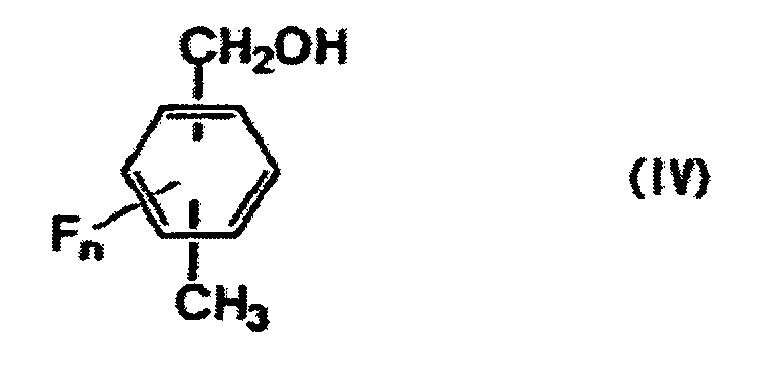
- Procédé pour préparer un alcool méthylbenzylique halogéné sur le noyau selon la revendication 1, où le benzène dicarbaldéhyde halogéné sur le noyau est le tétrafluorobenzène dicarbaldéhyde représenté par la formule (V) suivante,


- Procédé pour préparer un alcool méthylbenzylique halogéné sur le noyau selon la revendication 3, où le tétrafluorobenzène dicarbaldéhyde représenté par la formule (V) est le 2,3,5,6-tétrafluorobenzène-1,4-dicarbaldéhyde et l'alcool tétrafluorométhylbenzylique représenté par la formule (VI) est l'alcool 2,3,5,6-tétrafluoro-4-méthylbenzylique.
- Procédé pour préparer un alcool méthylbenzylique halogéné sur le noyau selon l'une quelconque des revendications 1 à 4, où la réaction d'hydrogénation est conduite dans un solvant.
- Procédé pour préparer un alcool méthylbenzylique halogéné sur le noyau selon la revendication 5, où le solvant est un solvant unique ou un solvant mixte contenant au moins une substance choisie dans le groupe consistant en les hydrocarbures aliphatiques saturés, les hydrocarbures alicycliques, les hydrocarbures aromatiques, les alcools, les éthers d'hydrocarbures aliphatiques, les éthers d'hydrocarbures alicycliques et l'eau.
- Procédé pour préparer un alcool méthylbenzylique halogéné sur le noyau selon la revendication 6, où le solvant est un solvant unique ou un solvant mixte contenant au moins une substance choisie dans le groupe consistant en le toluène, le xylène, le méthanol, l'éthanol, le dioxane, le dioxolane et l'eau.
- Procédé pour préparer un alcool méthylbenzylique halogéné sur le noyau selon l'une quelconque des revendications 1 à 7, où la réaction d'hydrogénation est conduite à une pression partielle d'hydrogène de 0,2 à 5 MPa.
- Procédé pour préparer un alcool méthylbenzylique halogéné sur le noyau selon l'une quelconque des revendications 5 à 8, où la quantité de solvant utilisé dans la réaction d'hydrogénation est dans la plage de 1 à 20 fois en masse la quantité de benzène dicarbaldéhyde halogéné sur le noyau représenté par la formule (I).
- Procédé pour préparer un alcool méthylbenzylique halogéné sur le noyau selon l'une quelconque des revendications 6 à 9, où le rapport de la quantité réelle d'hydrogène absorbé dans la réaction d'hydrogénation à la quantité théorique d'hydrogène absorbé quand tout le benzène dicarbaldéhyde halogéné sur le noyau représenté par la formule (I) est hydrogéné en l'alcool méthylbenzylique halogéné sur le noyau représenté par la formule (II) est dans la plage de 80 à 130 %.
Applications Claiming Priority (2)
| Application Number | Priority Date | Filing Date | Title |
|---|---|---|---|
| JP2005182323 | 2005-06-22 | ||
| PCT/JP2006/312193 WO2006137348A2 (fr) | 2005-06-22 | 2006-06-12 | Procede de production d'alcool methylbenzylique a noyau halogene |
Publications (2)
| Publication Number | Publication Date |
|---|---|
| EP1915331A2 EP1915331A2 (fr) | 2008-04-30 |
| EP1915331B1 true EP1915331B1 (fr) | 2013-07-10 |
Family
ID=39212316
Family Applications (1)
| Application Number | Title | Priority Date | Filing Date |
|---|---|---|---|
| EP06757394.9A Active EP1915331B1 (fr) | 2005-06-22 | 2006-06-12 | Procede de production d'alcool methylbenzylique a noyau halogene |
Country Status (6)
| Country | Link |
|---|---|
| US (1) | US7939695B2 (fr) |
| EP (1) | EP1915331B1 (fr) |
| KR (1) | KR100921598B1 (fr) |
| CN (1) | CN101193843B (fr) |
| IL (1) | IL187329A0 (fr) |
| WO (1) | WO2006137348A2 (fr) |
Families Citing this family (1)
| Publication number | Priority date | Publication date | Assignee | Title |
|---|---|---|---|---|
| CN102659545A (zh) * | 2012-05-03 | 2012-09-12 | 江苏泰特尔化工有限公司 | 一种新型的液晶中间体2,3-二氟对苯二甲醛 |
Family Cites Families (8)
| Publication number | Priority date | Publication date | Assignee | Title |
|---|---|---|---|---|
| DE3065914D1 (en) | 1979-12-21 | 1984-01-19 | Ici Plc | Substituted benzyl esters of cyclopropane carboxylic acids and their preparation, compositions containing them and methods of combating insect pests therewith, and substituted benzyl alcohols |
| BR8008346A (pt) | 1979-12-21 | 1981-07-07 | Ici Ltd | Compostos e composicoes inseticidas a base dos mesmos,bem como processo de sua obtencao |
| JP4399885B2 (ja) | 1999-03-09 | 2010-01-20 | 住友化学株式会社 | 4−メチルテトラフルオロベンジルアルコール誘導体の製造法 |
| KR100681257B1 (ko) * | 1999-05-07 | 2007-02-09 | 쇼와 덴코 가부시키가이샤 | 테트라플루오로벤젠메탄올류의 제조방법 |
| IL154905A0 (en) * | 2000-09-27 | 2003-10-31 | Showa Denko Kk | Process for producing fluorinated methyl-benzyl alcohol |
| JP5028730B2 (ja) | 2000-09-27 | 2012-09-19 | 昭和電工株式会社 | 2,3,5,6−テトラフルオロ−4−メチルベンジルアルコールの製造方法 |
| GB0026349D0 (en) | 2000-10-27 | 2000-12-13 | Zeneca Ltd | Chemical process |
| GB0026348D0 (en) | 2000-10-27 | 2000-12-13 | Zeneca Ltd | Chemical process |
-
2006
- 2006-06-12 CN CN2006800208840A patent/CN101193843B/zh not_active Expired - Fee Related
- 2006-06-12 EP EP06757394.9A patent/EP1915331B1/fr active Active
- 2006-06-12 US US11/917,956 patent/US7939695B2/en not_active Expired - Fee Related
- 2006-06-12 WO PCT/JP2006/312193 patent/WO2006137348A2/fr not_active Ceased
-
2007
- 2007-11-12 IL IL187329A patent/IL187329A0/en unknown
-
2008
- 2008-01-21 KR KR1020087001625A patent/KR100921598B1/ko not_active Expired - Fee Related
Also Published As
| Publication number | Publication date |
|---|---|
| KR20080022209A (ko) | 2008-03-10 |
| IL187329A0 (en) | 2008-04-13 |
| WO2006137348A3 (fr) | 2007-04-26 |
| US20100145106A1 (en) | 2010-06-10 |
| KR100921598B1 (ko) | 2009-10-14 |
| CN101193843B (zh) | 2011-05-04 |
| CN101193843A (zh) | 2008-06-04 |
| US7939695B2 (en) | 2011-05-10 |
| WO2006137348A2 (fr) | 2006-12-28 |
| EP1915331A2 (fr) | 2008-04-30 |
Similar Documents
| Publication | Publication Date | Title |
|---|---|---|
| US10266469B2 (en) | Process for preparing terpinene-4-ol | |
| JP2001010999A (ja) | トリシクロデカンジメタノール及び/又はペンタシクロペンタデカンジメタノールの製造法 | |
| KR20110041470A (ko) | 제조 공정에서 발생하는 고비점 화합물들을 크랙킹시켜 네오펜틸 글리콜을 수득하는 방법 | |
| EP1915331B1 (fr) | Procede de production d'alcool methylbenzylique a noyau halogene | |
| US6828467B2 (en) | Process for producing fluorinated methyl-benzyl alcohol | |
| EP0922687A1 (fr) | Procédé pour la préparation d'alcools | |
| US9434671B2 (en) | Nitrogen monoxide as cis/trans isomerization catalysts for unsaturated compounds | |
| EP1142859B2 (fr) | Procédé de préparation de 3,7-diméthyl-6-octénol optiquement actif et procédé de préparation d'un intermédiaire pour ce procédé | |
| JP5028730B2 (ja) | 2,3,5,6−テトラフルオロ−4−メチルベンジルアルコールの製造方法 | |
| JP2007031430A (ja) | 核ハロゲン化メチルベンジルアルコールの製造方法 | |
| US7790931B2 (en) | Process for preparing tetrafluorobenzene carbaldehyde alkyl acetal | |
| EP0350686B1 (fr) | Procédé de fabrication d'esters de l'acide 6-hydroxycaproique | |
| EP1534665B1 (fr) | Procede de production de benzonitrile fluore | |
| JP2001302650A (ja) | エポキシシクロドデカンの製造法 | |
| EP2479163B1 (fr) | Procédé de fabrication de cyclohexyl alkyl cétones | |
| JP2003055291A (ja) | 3−ヒドロキシアルデヒドの製造方法 | |
| JP2007031429A (ja) | テトラフルオロベンゼンカルバルデヒドアルキルアセタールの製造方法 | |
| KR20090057337A (ko) | 테트라플루오로벤젠 카르발데히드 알킬아세탈의 제조 방법 | |
| EP1401799A1 (fr) | Procede de production de methylamine aromatique halogenee |
Legal Events
| Date | Code | Title | Description |
|---|---|---|---|
| PUAI | Public reference made under article 153(3) epc to a published international application that has entered the european phase |
Free format text: ORIGINAL CODE: 0009012 |
|
| 17P | Request for examination filed |
Effective date: 20080115 |
|
| AK | Designated contracting states |
Kind code of ref document: A2 Designated state(s): AT BE BG CH CY CZ DE DK EE ES FI FR GB GR HU IE IS IT LI LT LU LV MC NL PL PT RO SE SI SK TR |
|
| AX | Request for extension of the european patent |
Extension state: AL BA HR MK RS |
|
| 17Q | First examination report despatched |
Effective date: 20110915 |
|
| GRAP | Despatch of communication of intention to grant a patent |
Free format text: ORIGINAL CODE: EPIDOSNIGR1 |
|
| GRAS | Grant fee paid |
Free format text: ORIGINAL CODE: EPIDOSNIGR3 |
|
| GRAA | (expected) grant |
Free format text: ORIGINAL CODE: 0009210 |
|
| AK | Designated contracting states |
Kind code of ref document: B1 Designated state(s): AT BE BG CH CY CZ DE DK EE ES FI FR GB GR HU IE IS IT LI LT LU LV MC NL PL PT RO SE SI SK TR |
|
| AX | Request for extension of the european patent |
Extension state: AL BA HR MK RS |
|
| REG | Reference to a national code |
Ref country code: GB Ref legal event code: FG4D |
|
| REG | Reference to a national code |
Ref country code: CH Ref legal event code: EP Ref country code: AT Ref legal event code: REF Ref document number: 620907 Country of ref document: AT Kind code of ref document: T Effective date: 20130715 |
|
| REG | Reference to a national code |
Ref country code: IE Ref legal event code: FG4D |
|
| REG | Reference to a national code |
Ref country code: DE Ref legal event code: R096 Ref document number: 602006037242 Country of ref document: DE Effective date: 20130905 |
|
| PG25 | Lapsed in a contracting state [announced via postgrant information from national office to epo] |
Ref country code: SI Free format text: LAPSE BECAUSE OF FAILURE TO SUBMIT A TRANSLATION OF THE DESCRIPTION OR TO PAY THE FEE WITHIN THE PRESCRIBED TIME-LIMIT Effective date: 20130710 |
|
| REG | Reference to a national code |
Ref country code: AT Ref legal event code: MK05 Ref document number: 620907 Country of ref document: AT Kind code of ref document: T Effective date: 20130710 |
|
| REG | Reference to a national code |
Ref country code: NL Ref legal event code: VDEP Effective date: 20130710 |
|
| REG | Reference to a national code |
Ref country code: LT Ref legal event code: MG4D |
|
| PG25 | Lapsed in a contracting state [announced via postgrant information from national office to epo] |
Ref country code: SE Free format text: LAPSE BECAUSE OF FAILURE TO SUBMIT A TRANSLATION OF THE DESCRIPTION OR TO PAY THE FEE WITHIN THE PRESCRIBED TIME-LIMIT Effective date: 20130710 Ref country code: CY Free format text: LAPSE BECAUSE OF FAILURE TO SUBMIT A TRANSLATION OF THE DESCRIPTION OR TO PAY THE FEE WITHIN THE PRESCRIBED TIME-LIMIT Effective date: 20130710 Ref country code: AT Free format text: LAPSE BECAUSE OF FAILURE TO SUBMIT A TRANSLATION OF THE DESCRIPTION OR TO PAY THE FEE WITHIN THE PRESCRIBED TIME-LIMIT Effective date: 20130710 Ref country code: PT Free format text: LAPSE BECAUSE OF FAILURE TO SUBMIT A TRANSLATION OF THE DESCRIPTION OR TO PAY THE FEE WITHIN THE PRESCRIBED TIME-LIMIT Effective date: 20131111 Ref country code: BE Free format text: LAPSE BECAUSE OF FAILURE TO SUBMIT A TRANSLATION OF THE DESCRIPTION OR TO PAY THE FEE WITHIN THE PRESCRIBED TIME-LIMIT Effective date: 20130710 Ref country code: LT Free format text: LAPSE BECAUSE OF FAILURE TO SUBMIT A TRANSLATION OF THE DESCRIPTION OR TO PAY THE FEE WITHIN THE PRESCRIBED TIME-LIMIT Effective date: 20130710 Ref country code: IS Free format text: LAPSE BECAUSE OF FAILURE TO SUBMIT A TRANSLATION OF THE DESCRIPTION OR TO PAY THE FEE WITHIN THE PRESCRIBED TIME-LIMIT Effective date: 20131110 |
|
| PG25 | Lapsed in a contracting state [announced via postgrant information from national office to epo] |
Ref country code: GR Free format text: LAPSE BECAUSE OF FAILURE TO SUBMIT A TRANSLATION OF THE DESCRIPTION OR TO PAY THE FEE WITHIN THE PRESCRIBED TIME-LIMIT Effective date: 20131011 Ref country code: FI Free format text: LAPSE BECAUSE OF FAILURE TO SUBMIT A TRANSLATION OF THE DESCRIPTION OR TO PAY THE FEE WITHIN THE PRESCRIBED TIME-LIMIT Effective date: 20130710 Ref country code: NL Free format text: LAPSE BECAUSE OF FAILURE TO SUBMIT A TRANSLATION OF THE DESCRIPTION OR TO PAY THE FEE WITHIN THE PRESCRIBED TIME-LIMIT Effective date: 20130710 Ref country code: PL Free format text: LAPSE BECAUSE OF FAILURE TO SUBMIT A TRANSLATION OF THE DESCRIPTION OR TO PAY THE FEE WITHIN THE PRESCRIBED TIME-LIMIT Effective date: 20130710 Ref country code: LV Free format text: LAPSE BECAUSE OF FAILURE TO SUBMIT A TRANSLATION OF THE DESCRIPTION OR TO PAY THE FEE WITHIN THE PRESCRIBED TIME-LIMIT Effective date: 20130710 Ref country code: ES Free format text: LAPSE BECAUSE OF FAILURE TO SUBMIT A TRANSLATION OF THE DESCRIPTION OR TO PAY THE FEE WITHIN THE PRESCRIBED TIME-LIMIT Effective date: 20131021 |
|
| PG25 | Lapsed in a contracting state [announced via postgrant information from national office to epo] |
Ref country code: CZ Free format text: LAPSE BECAUSE OF FAILURE TO SUBMIT A TRANSLATION OF THE DESCRIPTION OR TO PAY THE FEE WITHIN THE PRESCRIBED TIME-LIMIT Effective date: 20130710 Ref country code: EE Free format text: LAPSE BECAUSE OF FAILURE TO SUBMIT A TRANSLATION OF THE DESCRIPTION OR TO PAY THE FEE WITHIN THE PRESCRIBED TIME-LIMIT Effective date: 20130710 Ref country code: RO Free format text: LAPSE BECAUSE OF FAILURE TO SUBMIT A TRANSLATION OF THE DESCRIPTION OR TO PAY THE FEE WITHIN THE PRESCRIBED TIME-LIMIT Effective date: 20130710 Ref country code: DK Free format text: LAPSE BECAUSE OF FAILURE TO SUBMIT A TRANSLATION OF THE DESCRIPTION OR TO PAY THE FEE WITHIN THE PRESCRIBED TIME-LIMIT Effective date: 20130710 Ref country code: SK Free format text: LAPSE BECAUSE OF FAILURE TO SUBMIT A TRANSLATION OF THE DESCRIPTION OR TO PAY THE FEE WITHIN THE PRESCRIBED TIME-LIMIT Effective date: 20130710 |
|
| PLBE | No opposition filed within time limit |
Free format text: ORIGINAL CODE: 0009261 |
|
| STAA | Information on the status of an ep patent application or granted ep patent |
Free format text: STATUS: NO OPPOSITION FILED WITHIN TIME LIMIT |
|
| PG25 | Lapsed in a contracting state [announced via postgrant information from national office to epo] |
Ref country code: IT Free format text: LAPSE BECAUSE OF FAILURE TO SUBMIT A TRANSLATION OF THE DESCRIPTION OR TO PAY THE FEE WITHIN THE PRESCRIBED TIME-LIMIT Effective date: 20130710 |
|
| 26N | No opposition filed |
Effective date: 20140411 |
|
| REG | Reference to a national code |
Ref country code: DE Ref legal event code: R097 Ref document number: 602006037242 Country of ref document: DE Effective date: 20140411 |
|
| PGFP | Annual fee paid to national office [announced via postgrant information from national office to epo] |
Ref country code: GB Payment date: 20140625 Year of fee payment: 9 |
|
| PGFP | Annual fee paid to national office [announced via postgrant information from national office to epo] |
Ref country code: DE Payment date: 20140806 Year of fee payment: 9 |
|
| PG25 | Lapsed in a contracting state [announced via postgrant information from national office to epo] |
Ref country code: MC Free format text: LAPSE BECAUSE OF FAILURE TO SUBMIT A TRANSLATION OF THE DESCRIPTION OR TO PAY THE FEE WITHIN THE PRESCRIBED TIME-LIMIT Effective date: 20130710 Ref country code: LU Free format text: LAPSE BECAUSE OF FAILURE TO SUBMIT A TRANSLATION OF THE DESCRIPTION OR TO PAY THE FEE WITHIN THE PRESCRIBED TIME-LIMIT Effective date: 20140612 |
|
| REG | Reference to a national code |
Ref country code: CH Ref legal event code: PL |
|
| REG | Reference to a national code |
Ref country code: IE Ref legal event code: MM4A |
|
| REG | Reference to a national code |
Ref country code: FR Ref legal event code: ST Effective date: 20150227 |
|
| PG25 | Lapsed in a contracting state [announced via postgrant information from national office to epo] |
Ref country code: IE Free format text: LAPSE BECAUSE OF NON-PAYMENT OF DUE FEES Effective date: 20140612 Ref country code: LI Free format text: LAPSE BECAUSE OF NON-PAYMENT OF DUE FEES Effective date: 20140630 Ref country code: CH Free format text: LAPSE BECAUSE OF NON-PAYMENT OF DUE FEES Effective date: 20140630 |
|
| PG25 | Lapsed in a contracting state [announced via postgrant information from national office to epo] |
Ref country code: FR Free format text: LAPSE BECAUSE OF NON-PAYMENT OF DUE FEES Effective date: 20140630 |
|
| REG | Reference to a national code |
Ref country code: DE Ref legal event code: R119 Ref document number: 602006037242 Country of ref document: DE |
|
| GBPC | Gb: european patent ceased through non-payment of renewal fee |
Effective date: 20150612 |
|
| PG25 | Lapsed in a contracting state [announced via postgrant information from national office to epo] |
Ref country code: GB Free format text: LAPSE BECAUSE OF NON-PAYMENT OF DUE FEES Effective date: 20150612 Ref country code: DE Free format text: LAPSE BECAUSE OF NON-PAYMENT OF DUE FEES Effective date: 20160101 |
|
| PG25 | Lapsed in a contracting state [announced via postgrant information from national office to epo] |
Ref country code: BG Free format text: LAPSE BECAUSE OF FAILURE TO SUBMIT A TRANSLATION OF THE DESCRIPTION OR TO PAY THE FEE WITHIN THE PRESCRIBED TIME-LIMIT Effective date: 20130710 |
|
| PG25 | Lapsed in a contracting state [announced via postgrant information from national office to epo] |
Ref country code: HU Free format text: LAPSE BECAUSE OF FAILURE TO SUBMIT A TRANSLATION OF THE DESCRIPTION OR TO PAY THE FEE WITHIN THE PRESCRIBED TIME-LIMIT; INVALID AB INITIO Effective date: 20060612 Ref country code: TR Free format text: LAPSE BECAUSE OF FAILURE TO SUBMIT A TRANSLATION OF THE DESCRIPTION OR TO PAY THE FEE WITHIN THE PRESCRIBED TIME-LIMIT Effective date: 20130710 |