EP1917560B1 - Spielfilm-kopierschutz - Google Patents
Spielfilm-kopierschutz Download PDFInfo
- Publication number
- EP1917560B1 EP1917560B1 EP06766131A EP06766131A EP1917560B1 EP 1917560 B1 EP1917560 B1 EP 1917560B1 EP 06766131 A EP06766131 A EP 06766131A EP 06766131 A EP06766131 A EP 06766131A EP 1917560 B1 EP1917560 B1 EP 1917560B1
- Authority
- EP
- European Patent Office
- Prior art keywords
- movie
- frame
- frames
- projection
- filmed
- Prior art date
- Legal status (The legal status is an assumption and is not a legal conclusion. Google has not performed a legal analysis and makes no representation as to the accuracy of the status listed.)
- Not-in-force
Links
- 238000000034 method Methods 0.000 claims abstract description 38
- 238000010586 diagram Methods 0.000 description 12
- 239000012530 fluid Substances 0.000 description 9
- 230000001360 synchronised effect Effects 0.000 description 8
- 230000003287 optical effect Effects 0.000 description 6
- 230000000295 complement effect Effects 0.000 description 3
- 230000015556 catabolic process Effects 0.000 description 2
- 230000008859 change Effects 0.000 description 2
- 238000006731 degradation reaction Methods 0.000 description 2
- 230000004048 modification Effects 0.000 description 2
- 238000012986 modification Methods 0.000 description 2
- 230000009471 action Effects 0.000 description 1
- 230000000694 effects Effects 0.000 description 1
- 230000004438 eyesight Effects 0.000 description 1
- 230000004927 fusion Effects 0.000 description 1
- 235000019988 mead Nutrition 0.000 description 1
- 230000007246 mechanism Effects 0.000 description 1
- 230000008447 perception Effects 0.000 description 1
- 230000002688 persistence Effects 0.000 description 1
- 230000008569 process Effects 0.000 description 1
- 230000000750 progressive effect Effects 0.000 description 1
- 230000003362 replicative effect Effects 0.000 description 1
- 230000016776 visual perception Effects 0.000 description 1
Images






Classifications
-
- G—PHYSICS
- G03—PHOTOGRAPHY; CINEMATOGRAPHY; ANALOGOUS TECHNIQUES USING WAVES OTHER THAN OPTICAL WAVES; ELECTROGRAPHY; HOLOGRAPHY
- G03B—APPARATUS OR ARRANGEMENTS FOR TAKING PHOTOGRAPHS OR FOR PROJECTING OR VIEWING THEM; APPARATUS OR ARRANGEMENTS EMPLOYING ANALOGOUS TECHNIQUES USING WAVES OTHER THAN OPTICAL WAVES; ACCESSORIES THEREFOR
- G03B21/00—Projectors or projection-type viewers; Accessories therefor
- G03B21/54—Accessories
- G03B21/56—Projection screens
-
- G—PHYSICS
- G03—PHOTOGRAPHY; CINEMATOGRAPHY; ANALOGOUS TECHNIQUES USING WAVES OTHER THAN OPTICAL WAVES; ELECTROGRAPHY; HOLOGRAPHY
- G03B—APPARATUS OR ARRANGEMENTS FOR TAKING PHOTOGRAPHS OR FOR PROJECTING OR VIEWING THEM; APPARATUS OR ARRANGEMENTS EMPLOYING ANALOGOUS TECHNIQUES USING WAVES OTHER THAN OPTICAL WAVES; ACCESSORIES THEREFOR
- G03B21/00—Projectors or projection-type viewers; Accessories therefor
- G03B21/14—Details
- G03B21/32—Details specially adapted for motion-picture projection
-
- G—PHYSICS
- G11—INFORMATION STORAGE
- G11B—INFORMATION STORAGE BASED ON RELATIVE MOVEMENT BETWEEN RECORD CARRIER AND TRANSDUCER
- G11B20/00—Signal processing not specific to the method of recording or reproducing; Circuits therefor
- G11B20/00086—Circuits for prevention of unauthorised reproduction or copying, e.g. piracy
-
- H—ELECTRICITY
- H04—ELECTRIC COMMUNICATION TECHNIQUE
- H04N—PICTORIAL COMMUNICATION, e.g. TELEVISION
- H04N5/00—Details of television systems
- H04N5/76—Television signal recording
- H04N5/91—Television signal processing therefor
- H04N5/913—Television signal processing therefor for scrambling ; for copy protection
-
- H—ELECTRICITY
- H04—ELECTRIC COMMUNICATION TECHNIQUE
- H04N—PICTORIAL COMMUNICATION, e.g. TELEVISION
- H04N9/00—Details of colour television systems
- H04N9/12—Picture reproducers
- H04N9/31—Projection devices for colour picture display, e.g. using electronic spatial light modulators [ESLM]
- H04N9/3179—Video signal processing therefor
-
- H—ELECTRICITY
- H04—ELECTRIC COMMUNICATION TECHNIQUE
- H04N—PICTORIAL COMMUNICATION, e.g. TELEVISION
- H04N5/00—Details of television systems
- H04N5/76—Television signal recording
- H04N5/91—Television signal processing therefor
- H04N5/913—Television signal processing therefor for scrambling ; for copy protection
- H04N2005/91392—Television signal processing therefor for scrambling ; for copy protection using means for preventing making copies of projected video images
Definitions
- the present invention relates to movie copy protection.
- a frustrating problem in the movie industry is the pirating of movies shown in a movie theater.
- Movie pirates typically enter a first run theater, video tape the movie off of the screen and then release pirated versions of the first run movie on video tape to the public.
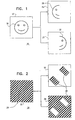
- the system and method of the present invention frustrates movie piracy by splitting each frame of a movie into two or more replacement-frames.
- Each of the replacement-frames is projected one at a time, such that the replacement-frames of an original frame are typically projected one after the other.
- the system and method of the present invention in preferred embodiments thereof, also frustrates movie piracy by changing the frame rate during projection and/or by excluding individual frames from being projected by editing or by using a suitable shutter associated with the movie projector.
- the system of the present invention in preferred embodiments thereof, also includes using a screen having one or more projections and/or depressions over the screen surface, so that the image recorded by a pirate camcorder is degraded due to uneven reflections from the screen, thereby leading to a pirated copy of the movie that is practically useless.
- the human eye has an extraordinary ability to adjust itself to differences in light, so that a viewer generally watches the movie without any noticeable disturbances.
- a method for frustrating piracy of a movie including a plurality of filmed frames, each of the filmed frames including an image
- the method including editing the movie prior to projection such that different regions of the image of one of the filmed frames are in different frames so that the different regions will be projected at different times, and repeating the editing for other ones of the filmed frames.
- the different regions are non-intersecting regions of the image of the one filmed frame.
- the method includes physically duplicating the one filmed frame yielding a first projected frame and a second projected frame, the first projected frame including one of the different regions, the second projected frame including another of the different regions.
- the editing includes editing out at least one region in each of the first projected frame and the second projected frame leaving behind the different regions.
- the method includes analyzing the image of the one filmed frame in order to decide a most suitable way to divide up the image of the one filmed frame thereby determining the different regions.
- a shape of at least one of the different regions changes between the one filmed frame and another one of the filmed frames.
- an orientation of at least one of the different regions changes between the one filmed frame and another one of the filmed frames.
- a method for frustrating piracy of a movie including a sequence of a plurality of frames, each of the frames including an image, the frames including a pair of frames including a first frame and a second frame, the method including preventing projection of a first region of the first frame and a second region of the second frame, the first frame being adjacent to the second frame in the sequence of the frames, the first region covering a different region of the frames than the second region, and repeating the preventing for other adjacent pairs of the filmed frames.
- the image of the first frame is substantially the same as the image of the second frame.
- the preventing includes physically editing out the first region from the first frame and the second region from the second frame prior to projection of the movie.
- a shape of the first region and a shape of the second region changes between the pair and another pair of the frames.
- a movie projector system for frustrating piracy of a movie
- the movie including a sequence of a plurality of frames, each of the frames including an image, the frames including a pair of frames including a first frame and a second frame
- the system including a spool assembly to spool the movie, a lamp and lens assembly mechanically connected to the spool assembly, a shutter mechanically connected to the lamp and lens assembly, the shutter being operative to prevent projection of at least one region of at least one of the frames, and a shutter controller operationally connected to the shutter, the shutter controller being operative to control the shutter such that projection of a first region of the first frame and a second region of the second frame is prevented, the first frame being adjacent to the second frame in the sequence of the frames, the first region covering a different region of the frames than the second region.
- a duration of the projection of the first section at the first projection rate is the same as a duration of the projection of the second section at the second projection rate.
- a movie projector system for frustrating piracy of a movie, the movie including a sequence of a plurality of frames, the system including a spool assembly to spool the movie, a lamp and lens assembly mechanically connected to the spool assembly, a shutter mechanically connected to the lamp and lens assembly, the shutter being operative to selectively exclude individual frames from being projected, and a shutter controller operationally connected to the shutter, the shutter controller being operative to control the shutter such that a first number of the frames of a first section of the movie are excluded from projection, and a second number of the frames of a second section of the movie are excluded from projection, wherein the first number is not equal to the second number.
- a duration of the projection of the first section takes is the same as a duration of the projection of the second section.
- the strips are connected to each other at the edges of the strips, a minimum angle between the strips being greater than 90 degrees and less than 180 degrees.
- the strips are arranged in a plurality of groups, each of the groups forming a pattern, the pattern repeating for each of the groups, different ones of the strips in each group facing in the different directions.
- different ones of the strips in each group face in at least four different directions.
- the strips form a non-continuous surface having gaps between the strips.
- a method for frustrating piracy of a movie including providing a movie screen including a plurality of strips, the strips being arranged in a plurality of groups, each of the groups forming a pattern, the pattern repeating for each of the groups, different ones of the strips in each group facing at least two different directions, providing a synchronized projector arrangement, and arranging the projection arrangement so as to project the movie from a plurality of different orientations relative to the screen on to the strips facing the different directions.
- the method includes synchronizing the projection arrangement so as to selectively project alternately in each one of the different directions.
- the projection arrangement includes a plurality of synchronized projectors, each of the projectors being associated with one of the different directions.
- the method includes projecting from the different orientations on to the strips simultaneously.
- the projecting is performed such that there is no overlap of the movie on the screen from the different orientations.
- the projecting is performed without the overlap using complementary filters disposed on the projection arrangement.
- the projection arrangement includes a plurality of synchronized projectors, each of the projectors being associated with one of the different directions, the projecting is performed without the overlap by editing, for each of the projectors, a copy of the movie in order to remove non-projected parts of the copy.
- the strips form a non-continuous surface having gaps between the strips.
- the human eye does not generally discern the difference between images projected at 24 frames per second and images projected at 100 frames per second, by way of example, since human flicker fusion threshold is usually about 16 frames per second.
- the present invention in preferred embodiments thereof, exploits the occurrence of Human Vision Persistence.
- a critical part of understanding the visual perception phenomena of the human eye is that the human eye is not a video camera: there is no "frame rate” or "scan rate” in the eye.
- each replacement frame 14, 15 is typically projected one at a time, preferably one after another. It will be appreciated that the number of new created frames for each original frame affects the rate of the projection. In the example of Fig. 1 , the projection frame rate needs to be doubled, so that now the movie is projected at 48 frames per second instead of 24 frames per second.
- the human viewer typically does not perceive any difference in the movie, which will be seen as fluid as usual.
- the camcorder will record the movie with substantial degradation, so that an illegal copy will be a very low quality copy, and therefore practically unusable.
- the desired projection frame rate will at least partially determine the number of divisions of each original frame.
- FIG. 2 is a simplified pictorial illustration of asymmetric frame division in the system 10 of Fig. 1 .
- An original frame 21 has an image 24.
- the image 24 of the original frame 21 is preferably divided into a plurality of different regions 36 for disposing among a replacement frame 26 and a replacement frame 28 so that the image 24 is divided asymmetrically between the replacement frame 26 and the replacement frame 28.
- Another original frame (not shown), in the same movie as the original frame 21, is divided into a plurality of different regions 38 among a replacement frame 30 and a replacement frame 32.
- the different regions 38 have the same shape as the different regions 36. However, the different regions 38 are in a different orientation than the orientation of the different regions 36.
- the different regions 38 are based on the same two shapes 40 (two rectangles) as the different regions 36. However, the shapes 40 of the different regions 38 of the replacement frame 30 are in a different location and orientation than the shapes 40 of the different regions 36 of the replacement frame 26.
- the frame division system 10 described above with reference to Figs. 1-3 is typically implemented using the methods described with reference to Figs. 4-7 .
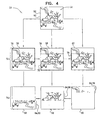
- Fig. 4 is a simplified pictorial illustration showing a preferred method of preparing a movie 50 for use with the system 10 of Fig. 1 .
- the movie 50 preferably includes a plurality of filmed frames 52 (only one filmed frame 60 is shown for the sake of clarity).
- Each of the filmed frames 52 typically includes an image 54.
- the movie is preferably prepared performing the following steps, described by way of example for the filmed frame 60. The steps are repeated for each of the filmed frames 52 of the movie 50.
- Fig. 5 is a simplified pictorial illustration showing another preferred method of preparing the movie 50 for use with the system 10 of Fig. 1 .
- the frame division of the movie 50 is preferably performed by using a module that analyzes the image 54 in each filmed frame 52, and finds the most suitable way to break each filmed frame 52 into two or more replacement frames 78 with parts of each replacement frame concealed as necessary. So for example, the image 54 of the filmed frame 60 is analyzed in order to decide a most suitable way to divide up the image 54 of the filmed frame 60 thereby determining a plurality of different regions 80, 82, 84. Each of the different regions 80, 82, 84 is disposed in a different one of the replacement frames 78 so that when the movie 50 is projected, the different regions 80, 82, 84 are projected at different times, preferably one after the other.
- FIG. 6 is a simplified pictorial illustration showing yet another preferred method of preparing a movie 86 for use with the system 10 of Fig. 1 .
- the movie 86 is filmed at two or more times the normal filming speed yielding a plurality of groups 90 (at least pairs) of frames 88 having substantially the same image 92. Then an appropriate region or regions 94 of each frame 88 is edited out. The method is described in more detail below.
- the movie 86 includes a sequence of the frames 88.
- the movie 86 is shot at three times normal filming speed, so for substantially the same image 92 there are three frames 88, namely a frame 96, a frame 98 and a frame 100 (bracket 102).
- the frames 96, 98, 100 are adjacent to each other in the sequence of the frames 88.
- the regions 94 for removal are shown by a dotted line.
- the regions 94 include a region 104 of the frame 96, two regions 106 of the frame 98 and a region 108 of the frame 100.
- the regions 104, 106, 108 typically cover different regions of the image 92 of the frames 96, 98, 100.
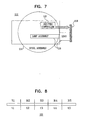
- Fig. 7 is a simplified block diagram view of a movie projector system 112 for use with the anti-piracy system 10 of Fig. 1 .
- the regions 94 of the frames 96, 98, 100 are typically prevented from being projected during projection of the movie 86, as described below in more detail.
- the movie projector system 112 preferably includes: a spool assembly 114 typically to spool the movie 86; a lamp and lens assembly 116 generally mechanically connected to the spool assembly 114; a shutter 118 typically mechanically connected to the lamp and lens assembly 116, the shutter 118 preferably being operative to prevent projection of at least one region 94 of at least one of the frames 88; and a shutter controller 120 typically operationally connected to the shutter 118.
- the shutter controller 120 is preferably operative to control the shutter 118 such that projection of the region 104 of the frame 96, the regions 106 of the frame 98 and the region 108 of the frame 100 is prevented.
- a movie is composed of frames such that when the frames are projected at a constant rate of typically 24 frames per second (fps), a fluid motion is typically perceived by a viewer during projection of the movie.
- fps frames per second
- the system 122 preferably includes changing the projection rate, R, of the movie during the movie projection, so that the camcorder generally cannot synchronize with the movie projection rate, even if an automatic mechanism is provided in the camcorder to perform the synchronization.
- the system 122 preferably projects the movie with varying projection rates, R, throughout the projection of the movie typically at fixed time intervals, t. Therefore, at the end of each time interval, t, the projection rate, R, is typically changed. All of the time intervals, t, preferably have the same duration. In Fig. 8 five time periods are shown (t1 to t5) having corresponding projection rates (R1 to R5).
- a projector (not shown) of the system 122 needs to be instructed how to project the movie as required by the projection rate, R, for each time interval, t.
- the projector is typically instructed regarding the projection rates using a control track, or in any other suitable method that enables synchronization between the projector and the required projection rate, R, for each time interval, t.
- Fig. 9 is a simplified pictorial illustration of duplicating a plurality of frames 124 for use with the system 122 of Fig. 8 .
- Fig. 10 is a simplified pictorial illustration of removing a plurality of frames 126 for use with the system 122 of Fig. ⁇ .
- Fig. 8 It is important to note that for each time interval, t, projected at projection rate, R (each time interval, t, corresponding to different sections of the movie), one or more original frames of the movie typically need to be duplicated or removed at the movie editing stage so that the movie will be perceived by the viewer as being projected at a constant rate.
- a first section 128 of the movie includes a sequence of eight frames 130 to be projected at a faster rate, R1, than the rate at which the movie was filmed. Therefore, the frames 124 (frames 4 and 8) of the first section 128 are duplicated yielding a sequence 132 of ten frames 130, so that the first section 128 can be projected at the projection rate, R1.
- a second section 134 of the movie includes a sequence of 8 frames 130 to be projected at a slower rate, R2, than the rate at which the movie was filmed. Therefore, the frames 126 (frames 4 and 8) of the second section 134 are removed yielding a sequence 136 of six frames 130, so that the second section 134 can be projected at the projection rate, R2. Projection rate R1 is different from the projection rate R2.
- the projection of the first section 128 at the projection rate, R1 and the projection of the second section 134 at the projection rate, R2, is perceived by the viewer as being projected at a constant rate.
- Fig. 11 is a simplified pictorial illustration of a non-fixed time interval changing projection rate for use with the system 122 of Fig. 8 .
- the duration of the time intervals t is preferably varied as shown in Fig. 11 .
- the duration of the projection of the section of time interval t1, projected at the projection rate R1 is different to the duration of the projection of the section of time interval t2, projected at the projection rate R2.
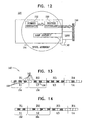
- Fig. 12 is a simplified block diagram view of a movie projector system 138 constructed and operative in accordance with a preferred embodiment of the present invention.
- Fig. 13 is a simplified pictorial illustration of a fixed time interval changing projection rate for use with the system 138 of Fig. 12 .
- the movie projector system 138 preferably projects a movie 140 filmed at a relatively high rate, for example, but not limited to, between 4 and 10 times faster than movies are normally filmed.
- a relatively high rate for example, but not limited to, between 4 and 10 times faster than movies are normally filmed.
- One reason for filming the movie 140 at a higher rate than normal is to allow the movie projector system 138 to exclude selected frames of the filmed movie 140 from being projected, as will be described below in more detail.
- the movie projector system 138 is for frustrating piracy of the movie 140 including a sequence of a plurality of frames 142 (only six frames 142 are labeled in Fig. 13 for the sake of clarity).
- the movie projector system 138 preferably includes: a spool assembly 144 typically to spool the movie 140; a lamp and lens assembly 146 generally mechanically connected to the spool assembly 144; a shutter 148 typically mechanically connected to the lamp and lens assembly 146, the shutter 148 preferably being operative to selectively exclude individual ones of the frames 142 from being projected; a shutter controller 150 typically operationally connected to the shutter 148; and a number generator 152 generally operationally connected to the shutter controller 150.
- the number generator 152 typically generates numbers, preferably randomly (pseudo-randomly or real-random) in order to instruct the shutter controller 150 how many frames 142 to exclude from projection in each time period, t.
- the shutter controller 150 is preferably operative to control the shutter 148 such that: a first number of the frames 142 (for example, a plurality of frames 158) of the section 154 (time period t1) of the movie 140 are excluded from projection; and a second number of the frames 142 (for example, a plurality of frames 160) of the section 156 (time period t2) of the movie 140 are excluded from projection.
- the first number is generally not equal to the second number.
- the shaded frames in Fig. 13 indicate frames 140 excluded from projection by the shutter 148.
- the frames 142 excluded in each time interval, t are preferably randomly spread over the available frames of the time interval.
- the viewer of the movie 140 in the movie theater still perceives fluid motion, since the number of remaining frames is sufficient for fluid motion perception.
- a pirated video copy by a camcorder will generally be of a poor quality as the camcorder will have problems synchronizing throughout the projection of the movie 140.
- the actual projection frame rate (the speed of the projection of the movie 140 by the spool assembly 144) is preferably the same as the rate at which the movie 140 was filmed. However, some of the filmed frames 142 are generally not projected leading to changing the "projected to the screen" frame rate throughout projection of the movie 140.
- Fig. 15 is a schematic orthogonal view of a movie screen apparatus 166 constructed and operative in accordance with a preferred embodiment of the present invention.
- Fig. 16 is a schematic top view of the apparatus 166 of Fig. 15 .
- the movie screen apparatus 166 preferably includes: a projection surface 168 having a plurality of edges 170; and an anti-piracy surface feature 172 typically disposed on the projection surface 168.
- the surface feature 172 preferably includes two strips 174.
- Each of the strips 174 generally includes two edges 176 extending from one of the edges 170 of the projection surface 168 to another of the edges 170 of the projection surface 168.
- One of the edges 176 of the strips 174 is typically connected to the projection surface 168 and another of the edges 176 of the strips 174 preferably connecting the strips 174 together.
- a minimum angle, Y, between the strips 174 is typically greater than 90 degrees and less than 180 degrees.
- Each strip 174 generally has a minimum width, L, of 0.5 cm.
- the surface feature 172 generally causes the center of an image recorded by a pirate camcorder to be degraded due to uneven reflections from the surface feature 172.
- the pirate camcorder therefore typically films images with a darker or lighter patch corresponding to the surface feature 172 so that the pirated copy is practically useless.
- the human eye typically adapts easily to the different light reflections.
- the projection surface 168 and the strips 174 may be formed as separate elements or as a single unitary item.
- the movie screen apparatus 178 preferably includes a projection surface 180 typically having a plurality of edges 182 (top and bottom edge of the projection surface 180).
- the projecting surface 180 preferably includes a plurality of strips 184.
- Each of the strips 184 typically includes two edges 186 (along the elongated direction of the strips 184).
- the edges 186 of the strips 184 generally extend from one edge 182 of the projection surface 180 to another edge 182 of the projection surface 180.
- the strips 184 are preferably connected to each other at the edges 186 of the strips 184.
- the strips 184 are typically mounted on a screen backing 188 to provide extra support for the structure of the strips 184.
- the edges 186 (along the elongated direction) of each strip 184 makes any suitable angle, A, with the top edge 182 of the projection surface 180, as shown in Fig. 17 .
- a minimum angle between the strips 184 is greater than 90 degrees and less than 180 degrees. Therefore, the minimum angle subtended between the strips 184 and the screen' backing 188 (for example, angle B1, B2, B3, B4, B5, B6, B7, B8) is typically greater than 0 degrees and typically less than 90 degrees, preferably less than 45 degrees.
- the strips typically have a minimum width, M, of 0.5cm. All the strips may have the same width, M, or different widths or any other suitable choice of widths. For example, two adjacent strips may have different widths, so that the angle subtended between the adjacent strips and the screen backing 188 is different for each of the adjacent strips.
- angles C1 and C7 are the same, angles C3 and C5 are the same, angles B1, B2, B7 and B8 are the same and angles B3, B4, B5 and B6 are the same.
- each of the minimum angles between the strips 184 or between the screen backing 188 and the strips 184 may be different or any other suitable choice of angles.
- the projections and depressions created by the strips 184 generally causes an image recorded by a pirate camcorder to be degraded due to uneven reflections from the strips 184.
- the pirate camcorder therefore generally films images with a darker or lighter patch corresponding to the projections and depressions so that the pirated copy is practically useless.
- the human eye typically adapts easily to the different light reflections.
- movies are projected by one projector 192 ( Fig. 17 ) onto the movie screen apparatus 178. Therefore, no change is required in standard movie theaters in the projector room.
- movies are projected by a plurality of synchronized projectors, or optical arrangements, onto the screen.
- the number of projectors used is typically equal to the number of different directions, D that the strips 184 face.
- the projectors typically project alternately, one at a time, each projector being adapted to project in each of the directions, D.
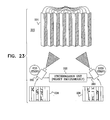
- the projectors project at the same time such that there is preferably no overlapping of the image on the screen as described with reference to Figs. 23 and 24 .
- Projection systems for projecting onto a multi-directional screen are described in more detail with reference to Figs. 21-24 .
- FIG. 20 is a schematic orthogonal view of a movie screen apparatus 194 constructed and operative in accordance with another alternative preferred embodiment of the present invention.
- the projection systems are described with reference to the movie screen apparatus 194 which is a two-directional movie screen.
- the projection systems of Figs. 21-24 may be implemented with a projection screen having strips facing more than two directions.
- Fig. 21 is a partly pictorial, partly block diagram view of a multi-projector anti-piracy system 196 constructed and operative in accordance with a preferred embodiment of the present invention for use with the movie screen apparatus of Fig. 20 .
- the anti-piracy system 196 may be used with other suitable movie screens with suitable modification to the anti-piracy system 196.
- the anti-piracy system 196 preferably includes a synchronized projector arrangement 198.
- the projector arrangement 198 typically includes a plurality of synchronized projectors 200. Each of the projectors 200 is generally associated with one of the different directions, D1 and D2, typically by arranging the projectors 200 so as to project a movie from different orientations relative to the screen 194 on to the strips 184 facing the different directions, D1 and D2.
- the projector arrangement 198 also preferably includes a synchronization unit 202 to synchronize the projectors 200 so as to selectively project alternately in each one of the different directions, D1 and D2.
- the synchronization unit 202 is preferably operationally connected to the projectors 200 either by a wired connection 208 or a wireless connection (not shown).
- one projector 200 typically projects onto the strips 184 facing the direction D1 and the other projector 200 typically projects onto the strips 184 facing the direction D2, alternately.
- Each projector 200 generally projects complete frames 232 (only one shown) of the whole movie in the manner described below.
- one projector 200 starts projecting on the strips 184 facing the direction D1 every other 1/48 second (in other words, the first 1/48 second, the third 1/48 second, and so on) and the other projector 200 then projects on the strips 184 facing the direction D2 every other 1/48 second (in order words, the second 1/48 sec, the forth 1/48, and so on).
- projection every 1/48 of a second by each projector 200 is just given by way of example only.
- the projection rate may be as low as every 1/32 of a second per frame in order for the human eye to perceive fluid movement and typically less than 1/64 of a second so that a pirate camcorder 204 does not record more than 32 complete frames per second.
- the human eye perceives a fluid effect, while a camcorder copy is practically unusable, because even if the projection frame rate is sufficient for fluid movement, only parts of each frame are projected at any one moment for capturing by the camcorder 204, as shown by a sample frame 206 captured by the camcorder 204.
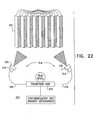
- Fig. 22 is a partly pictorial, partly block diagram view of a single projector anti-piracy system 210 constructed and operative in accordance with a preferred embodiment of the present invention for use with the movie screen apparatus 194 of Fig. 20 .
- the anti-piracy system 210 is substantially the same as the anti-piracy system 196 of Fig. 21 except for the following differences.
- the projectors 200 are preferably replaced by a single projector 212 to simulate the action of the projectors 200 using an optical arrangement 214 typically including one or more of the following optical components: mirrors (not shown), prisms (not shown), lenses 216, beam splitters (not shown), waveguides 218 and shutters 220.
- the optical arrangement 214 is adapted so that a beam projected from the projector 212 is consecutively projected in each of the available directions (for example, D1 and D2). Therefore, the frames of the original movie typically need to be duplicated for each direction (for example, D1 and D2). Alternatively, the movie needs to be filmed at a very high rate, typically equal to a standard shooting rate multiplied by the possible number of different directions (for example, D1 and D2) so that quality and/or fluid motion is not lost.
- Moving from one projection direction (for example, D1 and D2) to another is typically performed by disposing the shutters 220 in the paths of the beams for each direction (for example, D1 and D2) and then selectively operating the shutters 220 so that only one of the paths allows light to pass to the movie screen apparatus 194 at any one time.
- a pirate camcorder records a copy of the movie which has: light and dark patches due to the different reflections from the non-uniform screen; or missing patches typically due to the position of the camcorder in the movie theater in relation to the strips 184 of the screen 194.
- Fig. 25 is a schematic top view of a movie screen apparatus 234 constructed and operative in accordance with another alternative preferred embodiment of the present invention.
- the movie screen apparatus 234 is substantially the same as the movie screen apparatus 178 described with reference to Figs. 17-19 except for the following differences.
- the strips 184 are only connected to the screen backing 188 and not to each other so that the screen surface is non-continuous with gaps between the strips 184.
- the strips 184 are still arranged in the groups 190 facing at least two directions. In the example of Fig. 25 , the strips 184 are facing in three directions, D5, D6, and D7.
Landscapes
- Engineering & Computer Science (AREA)
- Signal Processing (AREA)
- Multimedia (AREA)
- Physics & Mathematics (AREA)
- General Physics & Mathematics (AREA)
- Computer Security & Cryptography (AREA)
- Transforming Electric Information Into Light Information (AREA)
- Non-Silver Salt Photosensitive Materials And Non-Silver Salt Photography (AREA)
- Developing Agents For Electrophotography (AREA)
- Television Signal Processing For Recording (AREA)
- Studio Devices (AREA)
- Color Television Image Signal Generators (AREA)
- Signal Processing Not Specific To The Method Of Recording And Reproducing (AREA)
- Two-Way Televisions, Distribution Of Moving Picture Or The Like (AREA)
Claims (8)
- Verfahren zum Vereiteln von Kinofilmpiraterie, wobei der Kinofilm eine Reihe von gefilmten Frames umfasst, wobei jeder gefilmte Frame ein Bild enthält, wobei das Verfahren Folgendes beinhaltet:Editieren des Kinofilms vor dem Projizieren, so dass sich unterschiedliche Regionen des Bildes von einem der gefilmten Frames in unterschiedlichen Frames befinden, so dass die verschiedenen Regionen zu unterschiedlichen Zeiten projiziert werden; undWiederholen des Editierens für andere der gefilmten Frames.
- Verfahren nach Anspruch 1, wobei die unterschiedlichen Regionen sich nicht überschneidende Regionen des Bildes des einen gefilmten Frame sind.
- Verfahren nach Anspruch 1 oder Anspruch 2, das ferner das physische Duplizieren des einen gefilmten Frame beinhaltet, so das ein erster projizierter Frame und ein zweiter projizierter Frame erhalten werden, wobei der erste projizierte Frame eine der verschiedenen Regionen enthält, wobei der zweite projizierte Frame eine andere der unterschiedlichen Regionen enthält.
- Verfahren nach Anspruch 3, wobei das Editieren das Herauseditieren von wenigstens einer Region in jedem von erstem projiziertem Frame und zweitem projiziertem Frame beinhaltet, so dass die unterschiedlichen Regionen zurückbleiben.
- Verfahren nach einem der Ansprüche 1-4, das ferner das Analysieren des Bildes des einen gefilmten Frame beinhaltet, um den geeignetsten Weg zum Unterteilen des Bildes des einen gefilmten Frame festzulegen, um dadurch die unterschiedlichen Regionen zu ermitteln.
- Verfahren nach einem der Ansprüche 1-5, wobei sich eine Form von wenigstens einer der unterschiedlichen Regionen von dem einen gefilmten Frame zu einem anderen der gefilmten Frames ändert.
- Verfahren nach einem der Ansprüche 1-6, wobei sich ein Ort von wenigstens einer der unterschiedlichen Regionen von dem einen gefilmten Frame zu einem anderen der gefilmten Frames ändert.
- Verfahren nach einem der Ansprüche 1-7, wobei sich eine Orientierung von wenigstens einer der unterschiedlichen Regionen von dem einen gefilmten Frame zu einem anderen der gefilmten Frames ändert.
Priority Applications (1)
| Application Number | Priority Date | Filing Date | Title |
|---|---|---|---|
| EP10177664.9A EP2270591B1 (de) | 2005-08-22 | 2006-07-12 | Kopierschutz für Filme |
Applications Claiming Priority (4)
| Application Number | Priority Date | Filing Date | Title |
|---|---|---|---|
| US71026405P | 2005-08-22 | 2005-08-22 | |
| US71004805P | 2005-08-22 | 2005-08-22 | |
| US71005405P | 2005-08-22 | 2005-08-22 | |
| PCT/IL2006/000809 WO2007023482A2 (en) | 2005-08-22 | 2006-07-12 | Movie copy protection |
Related Child Applications (2)
| Application Number | Title | Priority Date | Filing Date |
|---|---|---|---|
| EP10177664.9A Division EP2270591B1 (de) | 2005-08-22 | 2006-07-12 | Kopierschutz für Filme |
| EP10177664.9 Division-Into | 2010-09-20 |
Publications (3)
| Publication Number | Publication Date |
|---|---|
| EP1917560A2 EP1917560A2 (de) | 2008-05-07 |
| EP1917560A4 EP1917560A4 (de) | 2010-01-27 |
| EP1917560B1 true EP1917560B1 (de) | 2010-12-22 |
Family
ID=37772014
Family Applications (2)
| Application Number | Title | Priority Date | Filing Date |
|---|---|---|---|
| EP06766131A Not-in-force EP1917560B1 (de) | 2005-08-22 | 2006-07-12 | Spielfilm-kopierschutz |
| EP10177664.9A Not-in-force EP2270591B1 (de) | 2005-08-22 | 2006-07-12 | Kopierschutz für Filme |
Family Applications After (1)
| Application Number | Title | Priority Date | Filing Date |
|---|---|---|---|
| EP10177664.9A Not-in-force EP2270591B1 (de) | 2005-08-22 | 2006-07-12 | Kopierschutz für Filme |
Country Status (5)
| Country | Link |
|---|---|
| US (2) | US7907248B2 (de) |
| EP (2) | EP1917560B1 (de) |
| AT (1) | ATE492834T1 (de) |
| DE (1) | DE602006019104D1 (de) |
| WO (1) | WO2007023482A2 (de) |
Families Citing this family (12)
| Publication number | Priority date | Publication date | Assignee | Title |
|---|---|---|---|---|
| US7693330B2 (en) * | 2004-03-15 | 2010-04-06 | Vincent So | Anti-piracy image display methods and systems with sub-frame intensity compensation |
| US7634134B1 (en) * | 2004-03-15 | 2009-12-15 | Vincent So | Anti-piracy image display methods and systems |
| TW200746037A (en) * | 2006-02-14 | 2007-12-16 | Sony Corp | Display control device and display control method |
| DE102007052826A1 (de) * | 2007-11-06 | 2009-05-07 | Giesecke & Devrient Gmbh | Daten verarbeitende Vorrichtung und Verfahren zum Betreiben einer Daten verarbeitenden Vorrichtung |
| WO2009110877A1 (en) * | 2008-03-07 | 2009-09-11 | Thomson Licensing | Apparatus and method for remote monitoring |
| WO2011138627A1 (en) * | 2010-05-06 | 2011-11-10 | Thomson Licensing | Digital cinema anti-piracy method and apparatus for liquid crystal projection systems |
| US9058839B1 (en) * | 2013-12-17 | 2015-06-16 | Telefonaktiebolaget L M Ericsson (Publ) | Secure online pictures |
| US9336405B2 (en) | 2014-09-02 | 2016-05-10 | International Business Machines Corporation | Photographic copy prevention of a screen image |
| US10372023B2 (en) * | 2014-09-05 | 2019-08-06 | The Boeing Company | High efficiency motion blur reduction |
| WO2017184800A1 (en) * | 2016-04-20 | 2017-10-26 | Carnegie Mellon University | System and process for enabling secure, instant, and anonymous communication between physically touching devices |
| TWI686661B (zh) * | 2018-04-20 | 2020-03-01 | 億立材料有限公司 | 可多角度投影成像之投影幕 |
| US11521578B2 (en) * | 2021-01-12 | 2022-12-06 | Lenovo (Singapore) Pte. Ltd. | Securely presenting content on a display |
Family Cites Families (45)
| Publication number | Priority date | Publication date | Assignee | Title |
|---|---|---|---|---|
| US1610423A (en) | 1921-01-22 | 1926-12-14 | Aloysius J Cawley | Daylight-projecting system |
| US1498433A (en) | 1922-01-26 | 1924-06-17 | Bouin Charles | Stereoscopic projection screen |
| US1759777A (en) | 1926-12-15 | 1930-05-20 | Aloysius J Cawley | Projection system |
| US2983190A (en) | 1958-08-08 | 1961-05-09 | Da Lite Screen Company Inc | Projection picture screen |
| US3469837A (en) | 1966-03-09 | 1969-09-30 | Morton L Heilig | Experience theater |
| US3598470A (en) | 1969-11-05 | 1971-08-10 | Prismalite Inc | Projection screen and system |
| US3622223A (en) | 1970-01-16 | 1971-11-23 | Brakell Products Pty Ltd | Projection screens |
| US3712708A (en) * | 1971-09-09 | 1973-01-23 | J Brown | Lenticular projection screen |
| US3964822A (en) * | 1973-10-12 | 1976-06-22 | Mitsui Petrochemical Industries, Ltd. | Projection screen and process for production thereof |
| US4297723A (en) * | 1980-01-28 | 1981-10-27 | The Singer Company | Wide angle laser display system |
| US5121252A (en) * | 1990-05-11 | 1992-06-09 | Mitsubishi Rayon Co., Ltd. | Projection screen and method for producing the same |
| US5651065A (en) * | 1995-03-09 | 1997-07-22 | General Instrument Corporation Of Delaware | Insertion of supplemental burst into video signals to thwart piracy and/or carry data |
| US5680454A (en) | 1995-08-04 | 1997-10-21 | Hughes Electronics | Method and system for anti-piracy using frame rate dithering |
| GB9524220D0 (en) | 1995-11-27 | 1996-01-31 | Nashua Corp | Improvements in or relating to projection screens and the like |
| JP3526157B2 (ja) * | 1996-12-24 | 2004-05-10 | 株式会社日立製作所 | 指向性反射スクリーンおよび画像表示装置 |
| FR2767439B1 (fr) | 1997-08-14 | 1999-10-01 | France Telecom | Procede d'emission d'un signal de television |
| US5959717A (en) | 1997-12-12 | 1999-09-28 | Chaum; Jerry | Motion picture copy prevention, monitoring, and interactivity system |
| US6529600B1 (en) * | 1998-06-25 | 2003-03-04 | Koninklijke Philips Electronics N.V. | Method and device for preventing piracy of video material from theater screens |
| ATE316659T1 (de) | 1998-07-09 | 2006-02-15 | Svyatoslav Ivanovich Arsenich | Projektionssystem |
| DE19902110C2 (de) | 1999-01-20 | 2001-08-30 | Schneider Laser Technologies | Videoprojektionssystem zur Projektion von mehreren Einzelbildern |
| WO2000074366A2 (en) | 1999-05-27 | 2000-12-07 | Digital Electronic Cinema, Inc. | Systems and methods for preventing camcorder piracy of motion picture images |
| FR2800176B1 (fr) | 1999-10-25 | 2002-01-18 | Gerard Debard | Ecran d'image haute definition amplificateur de luminosite |
| US7242850B2 (en) * | 2001-02-23 | 2007-07-10 | Eastman Kodak Company | Frame-interpolated variable-rate motion imaging system |
| US20030169404A1 (en) | 2001-07-16 | 2003-09-11 | Weisgerber Robert C. | Method for exhibiting high-quality three-dimensional motion from a single strip of motion picture film |
| US7630569B2 (en) | 2002-02-26 | 2009-12-08 | Decegama Angel | Real-time software video/audio transmission and display with content protection against camcorder piracy |
| US7030956B2 (en) * | 2002-03-11 | 2006-04-18 | Sony Corporation | Optical intensity modulation method and system, and optical state modulation apparatus |
| US20040098753A1 (en) * | 2002-03-20 | 2004-05-20 | Steven Reynolds | Video combiner |
| DE20206392U1 (de) | 2002-04-22 | 2002-08-08 | ERLAS Erlanger Lasertechnik GmbH, 91056 Erlangen | Projektionswand |
| US20030202576A1 (en) | 2002-04-29 | 2003-10-30 | The Boeing Company | Method and apparatus for decompressing and multiplexing multiple video streams in real-time |
| JP4029279B2 (ja) * | 2002-07-05 | 2008-01-09 | ソニー株式会社 | 投影用スクリーンおよびその製造方法 |
| AU2003253980A1 (en) | 2002-07-22 | 2004-02-09 | Spitz, Inc. | Foveated display system |
| US6741323B2 (en) * | 2002-08-12 | 2004-05-25 | Digital Theater Systems, Inc. | Motion picture subtitle system and method |
| US7302162B2 (en) * | 2002-08-14 | 2007-11-27 | Qdesign Corporation | Modulation of a video signal with an impairment signal to increase the video signal masked threshold |
| US20040033051A1 (en) | 2002-08-16 | 2004-02-19 | Ip Kiril Kun Wan | Method and system for producing and displaying visual presentations which inhibit off-screen duplication |
| US20040091110A1 (en) * | 2002-11-08 | 2004-05-13 | Anthony Christian Barkans | Copy protected display screen |
| US7844072B2 (en) | 2003-01-20 | 2010-11-30 | Civolution B.V. | Watermark embedding and detection of a motion image signal |
| US7197161B2 (en) | 2003-06-20 | 2007-03-27 | Xerox Corporation | Embedding information in images using two-layer conjugate screening |
| US7693330B2 (en) * | 2004-03-15 | 2010-04-06 | Vincent So | Anti-piracy image display methods and systems with sub-frame intensity compensation |
| US7634134B1 (en) * | 2004-03-15 | 2009-12-15 | Vincent So | Anti-piracy image display methods and systems |
| US7262911B2 (en) * | 2004-03-15 | 2007-08-28 | Arisawa Mfg. Co., Ltd. | Reflex-type screen assembly |
| CN1609705A (zh) | 2004-04-28 | 2005-04-27 | 李明 | 观看立体电影的方法和设备 |
| US7110176B2 (en) * | 2004-05-07 | 2006-09-19 | Arisawa Mfg. Co., Ltd. | Reflex-type screen |
| US8018569B2 (en) * | 2005-06-08 | 2011-09-13 | Maxivision Cinema Technology | Method and apparatus for inhibiting the piracy of motion pictures |
| US7470032B2 (en) * | 2005-10-27 | 2008-12-30 | Hewlett-Packard Development Company, L.P. | Projection of overlapping and temporally offset sub-frames onto a surface |
| TW200746037A (en) * | 2006-02-14 | 2007-12-16 | Sony Corp | Display control device and display control method |
-
2006
- 2006-07-12 AT AT06766131T patent/ATE492834T1/de not_active IP Right Cessation
- 2006-07-12 WO PCT/IL2006/000809 patent/WO2007023482A2/en not_active Ceased
- 2006-07-12 US US11/920,900 patent/US7907248B2/en active Active
- 2006-07-12 DE DE602006019104T patent/DE602006019104D1/de active Active
- 2006-07-12 EP EP06766131A patent/EP1917560B1/de not_active Not-in-force
- 2006-07-12 EP EP10177664.9A patent/EP2270591B1/de not_active Not-in-force
-
2011
- 2011-01-31 US US12/931,383 patent/US8243252B2/en not_active Expired - Fee Related
Also Published As
| Publication number | Publication date |
|---|---|
| DE602006019104D1 (de) | 2011-02-03 |
| US7907248B2 (en) | 2011-03-15 |
| EP2270591A1 (de) | 2011-01-05 |
| US8243252B2 (en) | 2012-08-14 |
| EP2270591B1 (de) | 2015-01-07 |
| WO2007023482A2 (en) | 2007-03-01 |
| US20090128779A1 (en) | 2009-05-21 |
| EP1917560A4 (de) | 2010-01-27 |
| ATE492834T1 (de) | 2011-01-15 |
| US20110122369A1 (en) | 2011-05-26 |
| EP1917560A2 (de) | 2008-05-07 |
| WO2007023482A3 (en) | 2007-08-02 |
Similar Documents
| Publication | Publication Date | Title |
|---|---|---|
| US8243252B2 (en) | Movie copy protection | |
| EP1463310B1 (de) | Projektor mit erhöhtem Schutz gegen den unerlaubten Aufnehmen von Bilder mit einem Camcorder | |
| US7693330B2 (en) | Anti-piracy image display methods and systems with sub-frame intensity compensation | |
| US7346185B2 (en) | Optical content modulation for visual copyright protection | |
| US7324646B1 (en) | Method and apparatus for film anti-piracy | |
| EP1467572A2 (de) | Projektor mit CamcorderKopierschutz | |
| EP1040655A2 (de) | Verfahren und vorrichtung zum verhindern von unbefugtem aufnehmen von videomaterial von kinoleinwänden | |
| US7634134B1 (en) | Anti-piracy image display methods and systems | |
| JP2008546038A (ja) | 動画の著作権侵害を阻止する方法と装置 | |
| US20030123663A1 (en) | Method and apparatus for preventing unauthorized copying of screen images | |
| IL187548A (en) | Method for frustrating piracy of a movie | |
| KR20100031541A (ko) | 영상 기록의 방지를 위한 주파수 및 스펙트럼 도메인 솔루션 | |
| ES2354570T3 (es) | Protección de copia de películas. | |
| WO2011138627A1 (en) | Digital cinema anti-piracy method and apparatus for liquid crystal projection systems | |
| JP2010531617A (ja) | ビデオ録画の防止のための周波数領域及びスペクトル領域のソリューション |
Legal Events
| Date | Code | Title | Description |
|---|---|---|---|
| PUAI | Public reference made under article 153(3) epc to a published international application that has entered the european phase |
Free format text: ORIGINAL CODE: 0009012 |
|
| 17P | Request for examination filed |
Effective date: 20080222 |
|
| AK | Designated contracting states |
Kind code of ref document: A2 Designated state(s): AT BE BG CH CY CZ DE DK EE ES FI FR GB GR HU IE IS IT LI LT LU LV MC NL PL PT RO SE SI SK TR |
|
| 111Z | Information provided on other rights and legal means of execution |
Free format text: AT BE BG CH CY CZ DE DK EE ES FI FR GB GR HU IE IS IT LT LU LV MC NL PL PT RO SE SI SK TR Effective date: 20090430 |
|
| A4 | Supplementary search report drawn up and despatched |
Effective date: 20091228 |
|
| RIC1 | Information provided on ipc code assigned before grant |
Ipc: G09G 3/36 20060101ALI20091218BHEP Ipc: G03B 21/32 20060101AFI20071128BHEP |
|
| RAP1 | Party data changed (applicant data changed or rights of an application transferred) |
Owner name: NDS LIMITED |
|
| GRAP | Despatch of communication of intention to grant a patent |
Free format text: ORIGINAL CODE: EPIDOSNIGR1 |
|
| RIC1 | Information provided on ipc code assigned before grant |
Ipc: G03B 21/32 20060101AFI20100729BHEP Ipc: G09G 3/36 20060101ALI20100729BHEP |
|
| DAX | Request for extension of the european patent (deleted) | ||
| GRAS | Grant fee paid |
Free format text: ORIGINAL CODE: EPIDOSNIGR3 |
|
| GRAA | (expected) grant |
Free format text: ORIGINAL CODE: 0009210 |
|
| AK | Designated contracting states |
Kind code of ref document: B1 Designated state(s): AT BE BG CH CY CZ DE DK EE ES FI FR GB GR HU IE IS IT LI LT LU LV MC NL PL PT RO SE SI SK TR |
|
| REG | Reference to a national code |
Ref country code: GB Ref legal event code: FG4D |
|
| REG | Reference to a national code |
Ref country code: CH Ref legal event code: EP |
|
| REG | Reference to a national code |
Ref country code: IE Ref legal event code: FG4D |
|
| REF | Corresponds to: |
Ref document number: 602006019104 Country of ref document: DE Date of ref document: 20110203 Kind code of ref document: P |
|
| REG | Reference to a national code |
Ref country code: DE Ref legal event code: R096 Ref document number: 602006019104 Country of ref document: DE Effective date: 20110203 |
|
| REG | Reference to a national code |
Ref country code: NL Ref legal event code: T3 |
|
| REG | Reference to a national code |
Ref country code: ES Ref legal event code: FG2A Effective date: 20110304 |
|
| PG25 | Lapsed in a contracting state [announced via postgrant information from national office to epo] |
Ref country code: LT Free format text: LAPSE BECAUSE OF FAILURE TO SUBMIT A TRANSLATION OF THE DESCRIPTION OR TO PAY THE FEE WITHIN THE PRESCRIBED TIME-LIMIT Effective date: 20101222 |
|
| LTIE | Lt: invalidation of european patent or patent extension |
Effective date: 20101222 |
|
| PG25 | Lapsed in a contracting state [announced via postgrant information from national office to epo] |
Ref country code: BG Free format text: LAPSE BECAUSE OF FAILURE TO SUBMIT A TRANSLATION OF THE DESCRIPTION OR TO PAY THE FEE WITHIN THE PRESCRIBED TIME-LIMIT Effective date: 20110322 Ref country code: CY Free format text: LAPSE BECAUSE OF FAILURE TO SUBMIT A TRANSLATION OF THE DESCRIPTION OR TO PAY THE FEE WITHIN THE PRESCRIBED TIME-LIMIT Effective date: 20101222 Ref country code: AT Free format text: LAPSE BECAUSE OF FAILURE TO SUBMIT A TRANSLATION OF THE DESCRIPTION OR TO PAY THE FEE WITHIN THE PRESCRIBED TIME-LIMIT Effective date: 20101222 Ref country code: FI Free format text: LAPSE BECAUSE OF FAILURE TO SUBMIT A TRANSLATION OF THE DESCRIPTION OR TO PAY THE FEE WITHIN THE PRESCRIBED TIME-LIMIT Effective date: 20101222 Ref country code: LV Free format text: LAPSE BECAUSE OF FAILURE TO SUBMIT A TRANSLATION OF THE DESCRIPTION OR TO PAY THE FEE WITHIN THE PRESCRIBED TIME-LIMIT Effective date: 20101222 Ref country code: SI Free format text: LAPSE BECAUSE OF FAILURE TO SUBMIT A TRANSLATION OF THE DESCRIPTION OR TO PAY THE FEE WITHIN THE PRESCRIBED TIME-LIMIT Effective date: 20101222 Ref country code: SE Free format text: LAPSE BECAUSE OF FAILURE TO SUBMIT A TRANSLATION OF THE DESCRIPTION OR TO PAY THE FEE WITHIN THE PRESCRIBED TIME-LIMIT Effective date: 20101222 |
|
| PG25 | Lapsed in a contracting state [announced via postgrant information from national office to epo] |
Ref country code: PT Free format text: LAPSE BECAUSE OF FAILURE TO SUBMIT A TRANSLATION OF THE DESCRIPTION OR TO PAY THE FEE WITHIN THE PRESCRIBED TIME-LIMIT Effective date: 20110422 Ref country code: GR Free format text: LAPSE BECAUSE OF FAILURE TO SUBMIT A TRANSLATION OF THE DESCRIPTION OR TO PAY THE FEE WITHIN THE PRESCRIBED TIME-LIMIT Effective date: 20110323 Ref country code: BE Free format text: LAPSE BECAUSE OF FAILURE TO SUBMIT A TRANSLATION OF THE DESCRIPTION OR TO PAY THE FEE WITHIN THE PRESCRIBED TIME-LIMIT Effective date: 20101222 Ref country code: CZ Free format text: LAPSE BECAUSE OF FAILURE TO SUBMIT A TRANSLATION OF THE DESCRIPTION OR TO PAY THE FEE WITHIN THE PRESCRIBED TIME-LIMIT Effective date: 20101222 Ref country code: IS Free format text: LAPSE BECAUSE OF FAILURE TO SUBMIT A TRANSLATION OF THE DESCRIPTION OR TO PAY THE FEE WITHIN THE PRESCRIBED TIME-LIMIT Effective date: 20110422 Ref country code: EE Free format text: LAPSE BECAUSE OF FAILURE TO SUBMIT A TRANSLATION OF THE DESCRIPTION OR TO PAY THE FEE WITHIN THE PRESCRIBED TIME-LIMIT Effective date: 20101222 |
|
| PG25 | Lapsed in a contracting state [announced via postgrant information from national office to epo] |
Ref country code: SK Free format text: LAPSE BECAUSE OF FAILURE TO SUBMIT A TRANSLATION OF THE DESCRIPTION OR TO PAY THE FEE WITHIN THE PRESCRIBED TIME-LIMIT Effective date: 20101222 Ref country code: PL Free format text: LAPSE BECAUSE OF FAILURE TO SUBMIT A TRANSLATION OF THE DESCRIPTION OR TO PAY THE FEE WITHIN THE PRESCRIBED TIME-LIMIT Effective date: 20101222 Ref country code: RO Free format text: LAPSE BECAUSE OF FAILURE TO SUBMIT A TRANSLATION OF THE DESCRIPTION OR TO PAY THE FEE WITHIN THE PRESCRIBED TIME-LIMIT Effective date: 20101222 |
|
| PLBE | No opposition filed within time limit |
Free format text: ORIGINAL CODE: 0009261 |
|
| STAA | Information on the status of an ep patent application or granted ep patent |
Free format text: STATUS: NO OPPOSITION FILED WITHIN TIME LIMIT |
|
| PG25 | Lapsed in a contracting state [announced via postgrant information from national office to epo] |
Ref country code: DK Free format text: LAPSE BECAUSE OF FAILURE TO SUBMIT A TRANSLATION OF THE DESCRIPTION OR TO PAY THE FEE WITHIN THE PRESCRIBED TIME-LIMIT Effective date: 20101222 |
|
| 26N | No opposition filed |
Effective date: 20110923 |
|
| REG | Reference to a national code |
Ref country code: DE Ref legal event code: R097 Ref document number: 602006019104 Country of ref document: DE Effective date: 20110923 |
|
| PG25 | Lapsed in a contracting state [announced via postgrant information from national office to epo] |
Ref country code: MC Free format text: LAPSE BECAUSE OF NON-PAYMENT OF DUE FEES Effective date: 20110731 |
|
| REG | Reference to a national code |
Ref country code: IE Ref legal event code: MM4A |
|
| REG | Reference to a national code |
Ref country code: CH Ref legal event code: NV Representative=s name: MEYER & KOLLEGEN |
|
| PG25 | Lapsed in a contracting state [announced via postgrant information from national office to epo] |
Ref country code: IE Free format text: LAPSE BECAUSE OF NON-PAYMENT OF DUE FEES Effective date: 20110712 |
|
| PG25 | Lapsed in a contracting state [announced via postgrant information from national office to epo] |
Ref country code: LU Free format text: LAPSE BECAUSE OF NON-PAYMENT OF DUE FEES Effective date: 20110712 |
|
| PG25 | Lapsed in a contracting state [announced via postgrant information from national office to epo] |
Ref country code: TR Free format text: LAPSE BECAUSE OF FAILURE TO SUBMIT A TRANSLATION OF THE DESCRIPTION OR TO PAY THE FEE WITHIN THE PRESCRIBED TIME-LIMIT Effective date: 20101222 |
|
| PG25 | Lapsed in a contracting state [announced via postgrant information from national office to epo] |
Ref country code: HU Free format text: LAPSE BECAUSE OF FAILURE TO SUBMIT A TRANSLATION OF THE DESCRIPTION OR TO PAY THE FEE WITHIN THE PRESCRIBED TIME-LIMIT Effective date: 20101222 |
|
| REG | Reference to a national code |
Ref country code: FR Ref legal event code: PLFP Year of fee payment: 11 |
|
| PGFP | Annual fee paid to national office [announced via postgrant information from national office to epo] |
Ref country code: CH Payment date: 20160727 Year of fee payment: 11 |
|
| REG | Reference to a national code |
Ref country code: FR Ref legal event code: PLFP Year of fee payment: 12 |
|
| REG | Reference to a national code |
Ref country code: CH Ref legal event code: PL |
|
| PG25 | Lapsed in a contracting state [announced via postgrant information from national office to epo] |
Ref country code: LI Free format text: LAPSE BECAUSE OF NON-PAYMENT OF DUE FEES Effective date: 20170731 Ref country code: CH Free format text: LAPSE BECAUSE OF NON-PAYMENT OF DUE FEES Effective date: 20170731 |
|
| REG | Reference to a national code |
Ref country code: FR Ref legal event code: PLFP Year of fee payment: 13 |
|
| REG | Reference to a national code |
Ref country code: ES Ref legal event code: PC2A Owner name: SYNAMEDIA LIMITED Effective date: 20190523 |
|
| REG | Reference to a national code |
Ref country code: DE Ref legal event code: R082 Ref document number: 602006019104 Country of ref document: DE Representative=s name: PATENTANWALTSKANZLEI MEYER, DE Ref country code: DE Ref legal event code: R081 Ref document number: 602006019104 Country of ref document: DE Owner name: SYNAMEDIA LIMITED, STAINES, GB Free format text: FORMER OWNER: NDS LTD., STAINES, MIDDLESEX, GB |
|
| REG | Reference to a national code |
Ref country code: NL Ref legal event code: HC Owner name: SYNAMEDIA LIMITED; GB Free format text: DETAILS ASSIGNMENT: CHANGE OF OWNER(S), CHANGE OF OWNER(S) NAME; FORMER OWNER NAME: NDS LIMITED Effective date: 20190805 |
|
| PGFP | Annual fee paid to national office [announced via postgrant information from national office to epo] |
Ref country code: NL Payment date: 20220726 Year of fee payment: 17 |
|
| PGFP | Annual fee paid to national office [announced via postgrant information from national office to epo] |
Ref country code: IT Payment date: 20220721 Year of fee payment: 17 Ref country code: GB Payment date: 20220727 Year of fee payment: 17 Ref country code: ES Payment date: 20220801 Year of fee payment: 17 Ref country code: DE Payment date: 20220727 Year of fee payment: 17 |
|
| PGFP | Annual fee paid to national office [announced via postgrant information from national office to epo] |
Ref country code: FR Payment date: 20220725 Year of fee payment: 17 |
|
| P01 | Opt-out of the competence of the unified patent court (upc) registered |
Effective date: 20230514 |
|
| REG | Reference to a national code |
Ref country code: DE Ref legal event code: R119 Ref document number: 602006019104 Country of ref document: DE |
|
| REG | Reference to a national code |
Ref country code: NL Ref legal event code: MM Effective date: 20230801 |
|
| GBPC | Gb: european patent ceased through non-payment of renewal fee |
Effective date: 20230712 |
|
| PG25 | Lapsed in a contracting state [announced via postgrant information from national office to epo] |
Ref country code: NL Free format text: LAPSE BECAUSE OF NON-PAYMENT OF DUE FEES Effective date: 20230801 |
|
| PG25 | Lapsed in a contracting state [announced via postgrant information from national office to epo] |
Ref country code: NL Free format text: LAPSE BECAUSE OF NON-PAYMENT OF DUE FEES Effective date: 20230801 Ref country code: DE Free format text: LAPSE BECAUSE OF NON-PAYMENT OF DUE FEES Effective date: 20240201 Ref country code: GB Free format text: LAPSE BECAUSE OF NON-PAYMENT OF DUE FEES Effective date: 20230712 |
|
| PG25 | Lapsed in a contracting state [announced via postgrant information from national office to epo] |
Ref country code: FR Free format text: LAPSE BECAUSE OF NON-PAYMENT OF DUE FEES Effective date: 20230731 |
|
| PG25 | Lapsed in a contracting state [announced via postgrant information from national office to epo] |
Ref country code: IT Free format text: LAPSE BECAUSE OF NON-PAYMENT OF DUE FEES Effective date: 20230712 |
|
| REG | Reference to a national code |
Ref country code: ES Ref legal event code: FD2A Effective date: 20240827 |
|
| PG25 | Lapsed in a contracting state [announced via postgrant information from national office to epo] |
Ref country code: ES Free format text: LAPSE BECAUSE OF NON-PAYMENT OF DUE FEES Effective date: 20230713 |
|
| PG25 | Lapsed in a contracting state [announced via postgrant information from national office to epo] |
Ref country code: ES Free format text: LAPSE BECAUSE OF NON-PAYMENT OF DUE FEES Effective date: 20230713 |