EP1917992A2 - Vorrichtung und Verfahren zur Verabreichung von Trockenpulvermedikamenten - Google Patents
Vorrichtung und Verfahren zur Verabreichung von Trockenpulvermedikamenten Download PDFInfo
- Publication number
- EP1917992A2 EP1917992A2 EP08003249A EP08003249A EP1917992A2 EP 1917992 A2 EP1917992 A2 EP 1917992A2 EP 08003249 A EP08003249 A EP 08003249A EP 08003249 A EP08003249 A EP 08003249A EP 1917992 A2 EP1917992 A2 EP 1917992A2
- Authority
- EP
- European Patent Office
- Prior art keywords
- receptacle
- feed tube
- powder
- housing
- assembly
- Prior art date
- Legal status (The legal status is an assumption and is not a legal conclusion. Google has not performed a legal analysis and makes no representation as to the accuracy of the status listed.)
- Withdrawn
Links
- 239000000843 powder Substances 0.000 title claims abstract description 145
- 239000003814 drug Substances 0.000 title claims abstract description 103
- 238000000034 method Methods 0.000 title claims abstract description 49
- 230000007246 mechanism Effects 0.000 claims abstract description 24
- 238000005243 fluidization Methods 0.000 claims description 42
- 239000000443 aerosol Substances 0.000 claims description 16
- 239000002245 particle Substances 0.000 claims description 16
- 238000006073 displacement reaction Methods 0.000 claims description 7
- 239000002184 metal Substances 0.000 claims description 6
- 239000011888 foil Substances 0.000 claims description 3
- 238000012387 aerosolization Methods 0.000 claims 17
- 230000035515 penetration Effects 0.000 abstract description 24
- 230000008878 coupling Effects 0.000 abstract description 4
- 238000010168 coupling process Methods 0.000 abstract description 4
- 238000005859 coupling reaction Methods 0.000 abstract description 4
- 239000003570 air Substances 0.000 description 112
- 239000006185 dispersion Substances 0.000 description 42
- 229940079593 drug Drugs 0.000 description 27
- 230000000149 penetrating effect Effects 0.000 description 27
- 238000012384 transportation and delivery Methods 0.000 description 24
- 238000013519 translation Methods 0.000 description 11
- 102000004169 proteins and genes Human genes 0.000 description 10
- 108090000623 proteins and genes Proteins 0.000 description 10
- 238000003780 insertion Methods 0.000 description 8
- 230000037431 insertion Effects 0.000 description 8
- 229920001184 polypeptide Polymers 0.000 description 8
- 102000004196 processed proteins & peptides Human genes 0.000 description 8
- 108090000765 processed proteins & peptides Proteins 0.000 description 8
- 230000002685 pulmonary effect Effects 0.000 description 8
- 238000010276 construction Methods 0.000 description 7
- 210000004072 lung Anatomy 0.000 description 7
- 238000011144 upstream manufacturing Methods 0.000 description 6
- 238000013459 approach Methods 0.000 description 5
- 238000004891 communication Methods 0.000 description 5
- 230000000994 depressogenic effect Effects 0.000 description 5
- 238000013461 design Methods 0.000 description 5
- 230000009885 systemic effect Effects 0.000 description 5
- 210000003813 thumb Anatomy 0.000 description 5
- 239000012080 ambient air Substances 0.000 description 4
- 238000004140 cleaning Methods 0.000 description 4
- 238000004519 manufacturing process Methods 0.000 description 4
- 238000004064 recycling Methods 0.000 description 4
- 238000010521 absorption reaction Methods 0.000 description 3
- 230000008901 benefit Effects 0.000 description 3
- 239000002775 capsule Substances 0.000 description 3
- 229920001971 elastomer Polymers 0.000 description 3
- 239000012530 fluid Substances 0.000 description 3
- 230000006872 improvement Effects 0.000 description 3
- 239000002991 molded plastic Substances 0.000 description 3
- 238000012383 pulmonary drug delivery Methods 0.000 description 3
- 238000003860 storage Methods 0.000 description 3
- 239000000126 substance Substances 0.000 description 3
- JOYRKODLDBILNP-UHFFFAOYSA-N Ethyl urethane Chemical compound CCOC(N)=O JOYRKODLDBILNP-UHFFFAOYSA-N 0.000 description 2
- 230000000740 bleeding effect Effects 0.000 description 2
- 239000000969 carrier Substances 0.000 description 2
- 239000003085 diluting agent Substances 0.000 description 2
- 238000012377 drug delivery Methods 0.000 description 2
- 239000000428 dust Substances 0.000 description 2
- 230000000694 effects Effects 0.000 description 2
- 239000000806 elastomer Substances 0.000 description 2
- 210000001035 gastrointestinal tract Anatomy 0.000 description 2
- 238000002347 injection Methods 0.000 description 2
- 239000007924 injection Substances 0.000 description 2
- NOESYZHRGYRDHS-UHFFFAOYSA-N insulin Chemical compound N1C(=O)C(NC(=O)C(CCC(N)=O)NC(=O)C(CCC(O)=O)NC(=O)C(C(C)C)NC(=O)C(NC(=O)CN)C(C)CC)CSSCC(C(NC(CO)C(=O)NC(CC(C)C)C(=O)NC(CC=2C=CC(O)=CC=2)C(=O)NC(CCC(N)=O)C(=O)NC(CC(C)C)C(=O)NC(CCC(O)=O)C(=O)NC(CC(N)=O)C(=O)NC(CC=2C=CC(O)=CC=2)C(=O)NC(CSSCC(NC(=O)C(C(C)C)NC(=O)C(CC(C)C)NC(=O)C(CC=2C=CC(O)=CC=2)NC(=O)C(CC(C)C)NC(=O)C(C)NC(=O)C(CCC(O)=O)NC(=O)C(C(C)C)NC(=O)C(CC(C)C)NC(=O)C(CC=2NC=NC=2)NC(=O)C(CO)NC(=O)CNC2=O)C(=O)NCC(=O)NC(CCC(O)=O)C(=O)NC(CCCNC(N)=N)C(=O)NCC(=O)NC(CC=3C=CC=CC=3)C(=O)NC(CC=3C=CC=CC=3)C(=O)NC(CC=3C=CC(O)=CC=3)C(=O)NC(C(C)O)C(=O)N3C(CCC3)C(=O)NC(CCCCN)C(=O)NC(C)C(O)=O)C(=O)NC(CC(N)=O)C(O)=O)=O)NC(=O)C(C(C)CC)NC(=O)C(CO)NC(=O)C(C(C)O)NC(=O)C1CSSCC2NC(=O)C(CC(C)C)NC(=O)C(NC(=O)C(CCC(N)=O)NC(=O)C(CC(N)=O)NC(=O)C(NC(=O)C(N)CC=1C=CC=CC=1)C(C)C)CC1=CN=CN1 NOESYZHRGYRDHS-UHFFFAOYSA-N 0.000 description 2
- 230000013011 mating Effects 0.000 description 2
- 238000012986 modification Methods 0.000 description 2
- 230000004048 modification Effects 0.000 description 2
- 238000011022 operating instruction Methods 0.000 description 2
- 239000004033 plastic Substances 0.000 description 2
- 229920001296 polysiloxane Polymers 0.000 description 2
- 230000002028 premature Effects 0.000 description 2
- 230000002829 reductive effect Effects 0.000 description 2
- 230000002441 reversible effect Effects 0.000 description 2
- 238000012546 transfer Methods 0.000 description 2
- 230000001755 vocal effect Effects 0.000 description 2
- 241000272525 Anas platyrhynchos Species 0.000 description 1
- 229920002799 BoPET Polymers 0.000 description 1
- 102000004877 Insulin Human genes 0.000 description 1
- 108090001061 Insulin Proteins 0.000 description 1
- 239000005041 Mylar™ Substances 0.000 description 1
- 102000035195 Peptidases Human genes 0.000 description 1
- 108091005804 Peptidases Proteins 0.000 description 1
- 206010036595 Premature delivery Diseases 0.000 description 1
- 229960000074 biopharmaceutical Drugs 0.000 description 1
- 230000017531 blood circulation Effects 0.000 description 1
- 238000004364 calculation method Methods 0.000 description 1
- 230000015556 catabolic process Effects 0.000 description 1
- 239000011248 coating agent Substances 0.000 description 1
- 238000000576 coating method Methods 0.000 description 1
- 238000007906 compression Methods 0.000 description 1
- 230000006835 compression Effects 0.000 description 1
- 229920001940 conductive polymer Polymers 0.000 description 1
- 238000006731 degradation reaction Methods 0.000 description 1
- 201000010099 disease Diseases 0.000 description 1
- 208000037265 diseases, disorders, signs and symptoms Diseases 0.000 description 1
- 239000013583 drug formulation Substances 0.000 description 1
- 238000002651 drug therapy Methods 0.000 description 1
- 238000005516 engineering process Methods 0.000 description 1
- 230000002708 enhancing effect Effects 0.000 description 1
- 210000003414 extremity Anatomy 0.000 description 1
- 230000001939 inductive effect Effects 0.000 description 1
- 229940125396 insulin Drugs 0.000 description 1
- 230000002427 irreversible effect Effects 0.000 description 1
- 230000000670 limiting effect Effects 0.000 description 1
- 239000007788 liquid Substances 0.000 description 1
- 238000003754 machining Methods 0.000 description 1
- 239000000203 mixture Substances 0.000 description 1
- 229940126701 oral medication Drugs 0.000 description 1
- 239000004482 other powder Substances 0.000 description 1
- 238000004806 packaging method and process Methods 0.000 description 1
- 239000003208 petroleum Substances 0.000 description 1
- 238000009512 pharmaceutical packaging Methods 0.000 description 1
- 239000006187 pill Substances 0.000 description 1
- 102000040430 polynucleotide Human genes 0.000 description 1
- 108091033319 polynucleotide Proteins 0.000 description 1
- 238000012545 processing Methods 0.000 description 1
- 229940024999 proteolytic enzymes for treatment of wounds and ulcers Drugs 0.000 description 1
- 238000005086 pumping Methods 0.000 description 1
- 230000009467 reduction Effects 0.000 description 1
- 230000029058 respiratory gaseous exchange Effects 0.000 description 1
- 230000000284 resting effect Effects 0.000 description 1
- 238000007790 scraping Methods 0.000 description 1
- 238000007789 sealing Methods 0.000 description 1
- 239000000779 smoke Substances 0.000 description 1
- 239000007787 solid Substances 0.000 description 1
- 238000010254 subcutaneous injection Methods 0.000 description 1
- 239000007929 subcutaneous injection Substances 0.000 description 1
- 238000012385 systemic delivery Methods 0.000 description 1
- 239000012780 transparent material Substances 0.000 description 1
- 239000002699 waste material Substances 0.000 description 1
Images













Classifications
-
- A—HUMAN NECESSITIES
- A61—MEDICAL OR VETERINARY SCIENCE; HYGIENE
- A61M—DEVICES FOR INTRODUCING MEDIA INTO, OR ONTO, THE BODY; DEVICES FOR TRANSDUCING BODY MEDIA OR FOR TAKING MEDIA FROM THE BODY; DEVICES FOR PRODUCING OR ENDING SLEEP OR STUPOR
- A61M15/00—Inhalators
- A61M15/0028—Inhalators using prepacked dosages, one for each application, e.g. capsules to be perforated or broken-up
- A61M15/0045—Inhalators using prepacked dosages, one for each application, e.g. capsules to be perforated or broken-up using multiple prepacked dosages on a same carrier, e.g. blisters
-
- A—HUMAN NECESSITIES
- A61—MEDICAL OR VETERINARY SCIENCE; HYGIENE
- A61M—DEVICES FOR INTRODUCING MEDIA INTO, OR ONTO, THE BODY; DEVICES FOR TRANSDUCING BODY MEDIA OR FOR TAKING MEDIA FROM THE BODY; DEVICES FOR PRODUCING OR ENDING SLEEP OR STUPOR
- A61M15/00—Inhalators
-
- A—HUMAN NECESSITIES
- A61—MEDICAL OR VETERINARY SCIENCE; HYGIENE
- A61M—DEVICES FOR INTRODUCING MEDIA INTO, OR ONTO, THE BODY; DEVICES FOR TRANSDUCING BODY MEDIA OR FOR TAKING MEDIA FROM THE BODY; DEVICES FOR PRODUCING OR ENDING SLEEP OR STUPOR
- A61M15/00—Inhalators
- A61M15/0028—Inhalators using prepacked dosages, one for each application, e.g. capsules to be perforated or broken-up
- A61M15/003—Inhalators using prepacked dosages, one for each application, e.g. capsules to be perforated or broken-up using capsules, e.g. to be perforated or broken-up
- A61M15/0033—Details of the piercing or cutting means
- A61M15/0035—Piercing means
- A61M15/0036—Piercing means hollow piercing means
-
- A—HUMAN NECESSITIES
- A61—MEDICAL OR VETERINARY SCIENCE; HYGIENE
- A61M—DEVICES FOR INTRODUCING MEDIA INTO, OR ONTO, THE BODY; DEVICES FOR TRANSDUCING BODY MEDIA OR FOR TAKING MEDIA FROM THE BODY; DEVICES FOR PRODUCING OR ENDING SLEEP OR STUPOR
- A61M15/00—Inhalators
- A61M15/0028—Inhalators using prepacked dosages, one for each application, e.g. capsules to be perforated or broken-up
- A61M15/003—Inhalators using prepacked dosages, one for each application, e.g. capsules to be perforated or broken-up using capsules, e.g. to be perforated or broken-up
- A61M15/0033—Details of the piercing or cutting means
- A61M15/004—Details of the piercing or cutting means with fixed piercing or cutting means
-
- A—HUMAN NECESSITIES
- A61—MEDICAL OR VETERINARY SCIENCE; HYGIENE
- A61M—DEVICES FOR INTRODUCING MEDIA INTO, OR ONTO, THE BODY; DEVICES FOR TRANSDUCING BODY MEDIA OR FOR TAKING MEDIA FROM THE BODY; DEVICES FOR PRODUCING OR ENDING SLEEP OR STUPOR
- A61M15/00—Inhalators
- A61M15/0028—Inhalators using prepacked dosages, one for each application, e.g. capsules to be perforated or broken-up
- A61M15/003—Inhalators using prepacked dosages, one for each application, e.g. capsules to be perforated or broken-up using capsules, e.g. to be perforated or broken-up
- A61M15/0033—Details of the piercing or cutting means
- A61M15/0041—Details of the piercing or cutting means with movable piercing or cutting means
-
- A—HUMAN NECESSITIES
- A61—MEDICAL OR VETERINARY SCIENCE; HYGIENE
- A61M—DEVICES FOR INTRODUCING MEDIA INTO, OR ONTO, THE BODY; DEVICES FOR TRANSDUCING BODY MEDIA OR FOR TAKING MEDIA FROM THE BODY; DEVICES FOR PRODUCING OR ENDING SLEEP OR STUPOR
- A61M15/00—Inhalators
- A61M15/0028—Inhalators using prepacked dosages, one for each application, e.g. capsules to be perforated or broken-up
- A61M15/0045—Inhalators using prepacked dosages, one for each application, e.g. capsules to be perforated or broken-up using multiple prepacked dosages on a same carrier, e.g. blisters
- A61M15/0046—Inhalators using prepacked dosages, one for each application, e.g. capsules to be perforated or broken-up using multiple prepacked dosages on a same carrier, e.g. blisters characterized by the type of carrier
- A61M15/0051—Inhalators using prepacked dosages, one for each application, e.g. capsules to be perforated or broken-up using multiple prepacked dosages on a same carrier, e.g. blisters characterized by the type of carrier the dosages being arranged on a tape, e.g. strips
-
- A—HUMAN NECESSITIES
- A61—MEDICAL OR VETERINARY SCIENCE; HYGIENE
- A61M—DEVICES FOR INTRODUCING MEDIA INTO, OR ONTO, THE BODY; DEVICES FOR TRANSDUCING BODY MEDIA OR FOR TAKING MEDIA FROM THE BODY; DEVICES FOR PRODUCING OR ENDING SLEEP OR STUPOR
- A61M15/00—Inhalators
- A61M15/0028—Inhalators using prepacked dosages, one for each application, e.g. capsules to be perforated or broken-up
- A61M15/0045—Inhalators using prepacked dosages, one for each application, e.g. capsules to be perforated or broken-up using multiple prepacked dosages on a same carrier, e.g. blisters
- A61M15/0053—Inhalators using prepacked dosages, one for each application, e.g. capsules to be perforated or broken-up using multiple prepacked dosages on a same carrier, e.g. blisters characterized by the type or way of disposal
- A61M15/0055—Inhalators using prepacked dosages, one for each application, e.g. capsules to be perforated or broken-up using multiple prepacked dosages on a same carrier, e.g. blisters characterized by the type or way of disposal the used dosages being coiled
-
- A—HUMAN NECESSITIES
- A61—MEDICAL OR VETERINARY SCIENCE; HYGIENE
- A61M—DEVICES FOR INTRODUCING MEDIA INTO, OR ONTO, THE BODY; DEVICES FOR TRANSDUCING BODY MEDIA OR FOR TAKING MEDIA FROM THE BODY; DEVICES FOR PRODUCING OR ENDING SLEEP OR STUPOR
- A61M15/00—Inhalators
- A61M15/0086—Inhalation chambers
-
- A—HUMAN NECESSITIES
- A61—MEDICAL OR VETERINARY SCIENCE; HYGIENE
- A61M—DEVICES FOR INTRODUCING MEDIA INTO, OR ONTO, THE BODY; DEVICES FOR TRANSDUCING BODY MEDIA OR FOR TAKING MEDIA FROM THE BODY; DEVICES FOR PRODUCING OR ENDING SLEEP OR STUPOR
- A61M2202/00—Special media to be introduced, removed or treated
- A61M2202/06—Solids
- A61M2202/064—Powder
-
- A—HUMAN NECESSITIES
- A61—MEDICAL OR VETERINARY SCIENCE; HYGIENE
- A61M—DEVICES FOR INTRODUCING MEDIA INTO, OR ONTO, THE BODY; DEVICES FOR TRANSDUCING BODY MEDIA OR FOR TAKING MEDIA FROM THE BODY; DEVICES FOR PRODUCING OR ENDING SLEEP OR STUPOR
- A61M2205/00—General characteristics of the apparatus
- A61M2205/02—General characteristics of the apparatus characterised by a particular materials
- A61M2205/0233—Conductive materials, e.g. antistatic coatings for spark prevention
-
- A—HUMAN NECESSITIES
- A61—MEDICAL OR VETERINARY SCIENCE; HYGIENE
- A61M—DEVICES FOR INTRODUCING MEDIA INTO, OR ONTO, THE BODY; DEVICES FOR TRANSDUCING BODY MEDIA OR FOR TAKING MEDIA FROM THE BODY; DEVICES FOR PRODUCING OR ENDING SLEEP OR STUPOR
- A61M2205/00—General characteristics of the apparatus
- A61M2205/07—General characteristics of the apparatus having air pumping means
- A61M2205/071—General characteristics of the apparatus having air pumping means hand operated
- A61M2205/073—Syringe, piston type
-
- A—HUMAN NECESSITIES
- A61—MEDICAL OR VETERINARY SCIENCE; HYGIENE
- A61M—DEVICES FOR INTRODUCING MEDIA INTO, OR ONTO, THE BODY; DEVICES FOR TRANSDUCING BODY MEDIA OR FOR TAKING MEDIA FROM THE BODY; DEVICES FOR PRODUCING OR ENDING SLEEP OR STUPOR
- A61M2205/00—General characteristics of the apparatus
- A61M2205/60—General characteristics of the apparatus with identification means
- A61M2205/6045—General characteristics of the apparatus with identification means having complementary physical shapes for indexing or registration purposes
Definitions
- the present invention relates generally to methods and apparatus for the pulmonary delivery of drugs. More particularly, the present invention relates to a method and apparatus for dispersing dry powder medicaments for inhalation by a patient.
- Effective delivery to a patient is a critical aspect of any successful drug therapy.
- Oral drug delivery of pills, capsules, elixirs, and the like, is perhaps the most convenient method, but many drugs are degraded in the digestive tract before they can be absorbed. Such degradation is a particular problem with modern protein drugs which are rapidly degraded by proteolytic enzymes in the digestive tract.
- Subcutaneous injection is frequently an effective route for systemic drug delivery, including the delivery of proteins, but enjoys a low patient acceptance.
- pulmonary drug delivery relies on inhalation of a drug dispersion or aerosol by the patient so that active drug within the dispersion can reach the distal (alveolar) regions of the lung. It has been found that certain drugs are readily absorbed through the alveolar region directly into blood circulation. Pulmonary delivery is particularly promising for the delivery of proteins and polypeptides which are difficult to deliver by other routes of administration. Such pulmonary delivery is effective both for systemic delivery and for localized delivery to treat diseases of the lungs.
- Pulmonary drug delivery can itself be achieved by different approaches, including liquid nebulizers, metered dose inhalers (MDI's) and dry powder dispersion devices.
- Dry powder dispersion devices are particularly promising for delivering protein and polypeptide drugs which may be readily formulated as dry powders. Many otherwise labile proteins and polypeptides may be stably stored as lyophilized or spray-dried powders by themselves or in combination with suitable powder carriers.
- the ability to deliver proteins and polypeptides as dry powders is problematic in certain respects.
- the dosage of many protein and polypeptide drugs is often critical so it is necessary that any dry powder delivery system be able to accurately, and precisely (repeatedly) deliver the intended amount of drug.
- a particularly promising approach for the pulmonary delivery of dry powder drugs utilizes a hand-held device with a pump or other source of pressurized gas.
- a selected amount of the pressurized gas is abruptly released through a powder dispersion device, such as a Venturi tube, and the dispersed powder made available for patient inhalation.
- a powder dispersion device such as a Venturi tube
- the dispersed powder made available for patient inhalation.
- hand-held devices are problematic in a number of other respects.
- the particles being delivered are very fine, usually being sized in the range from 1 ⁇ m to 5 ⁇ m, making powder handling and dispersion difficult.
- the problems are exacerbated by the relatively small volumes of pressurized gas, typically 2 ml to 25 ml at 20 to 150 psig, which are available in such devices.
- Venturi tube dispersion devices are unsuitable for difficult-to-disperse powders when only small volumes of pressurized gas are available.
- Venturi tube dispersion devices have very small powder inlet orifices which are easily plugged by the powders used for pulmonary delivery.
- Another requirement for hand-held and other powder delivery devices is high dosage concentration. It is important that the concentration of drug in the bolus of gas be relatively high to reduce the number of breaths and/or volume of each breath required to achieve a total dosage. The ability to achieve both adequate dispersion and small dispersed volumes is a significant technical challenge.
- Dry powder dispersion devices for medicaments are described in a number of patent documents.
- U.S. Patent 3,921,637 describes a manual pump with needles for piercing through a single capsule of powdered medicine.
- the use of multiple receptacle disks or strips of medication is described in EP 467172 (where a reciprocatable piercing mechanism is used to piercing mechanism through opposed surfaces of a blister pack); WO91/02558 ; WO93/09832 ; WO94/08522 ; US Patent Nos. 4,627,432 ; 4,811,731 ; 5,035,237 ; 5,048,514 ; 4,446,862 ; and 3,425,600 .
- a pneumatic powder ejector having a suction stage and an injection stage is described in U.S. Patent No. 4,807,814 .
- the device comprises an axial gas venturi tube and a lateral powder inlet.
- SU 628930 (Abstract) describes a hand-held powder disperser having an axial air flow tube.
- SU 1003926 (Abstract) describes a gas thermal coating injector.
- NL 7712041 discloses an ejector pump which creates suction and draws powder into a separator.
- EP 347 779 describes a hand-held powder disperser having a collapsible expansion chamber.
- EP 490 797 describes a hand-held powder disperser having a spring-loaded piston, where the piston carries a dispersion nozzle.
- Pulmonary drug delivery is described in Byron and Patton (1994) J. Aerosol Med. 7:49-75 .
- the present invention provides methods and apparatus for efficient pulmonary delivery of accurate, precise, and repeatable dosages of powdered medicaments.
- the present invention will be particularly useful for the delivery of costly biopharmaceuticals such as protein, polypeptide and polynucleic acid drugs, but will also be useful for the systemic or localized delivery of any powdered medicament through the lungs.
- the delivery system and method produce substantially complete dispersion of the medicament powder with the break-up of any agglomerates of the powder which may have formed prior to delivery.
- the method and apparatus will find particular use in the dispersion of finely powdered medicaments from unit dosage receptacles, such as blister packs or cartridges, where the present invention is able to fluidize and extract substantially the entire amount of powder (usually at least 70% by weight, more usually at least 80%, and preferably at least 90%) within the receptacle, thus minimizing waste and enhancing the accuracy and precision of the dosage.
- the methods and approaches will also find use with the dispersion and delivery of preselected metered amounts (boluses) of powdered medicaments from receptacles containing multiple dosage units, i.e. "bulk" powders contained in a single receptacle.
- the methods and apparatus of the present invention are particularly suitable for the delivery of powders formed from discrete particles in the size range from 1 ⁇ m to 5 ⁇ m.
- powders when properly dispersed in an aerosol, are optimum for delivery into the alveolar regions of the lung. However, they are particularly difficult to handle, and frequently become highly agglomerated during processing, packaging, and handling.
- handling characteristics of such powders have often been enhanced by combining the fine drug particles with larger carrier particles which have easier handling and dispersion characteristics.
- Use of a carrier dilutes the drug, requiring a larger dispersion volume for a given drug dosage.
- the carrier particles can also cause choking when inhaled and serve no purpose other than improving handling characteristics.
- the present invention is able to achieve dispersion of fine drug particles with little or no carrier substances by a two-step dispersion method.
- the present invention will be functional with drug compositions which include such carrier particles, as well as with diluents which may be necessary to achieve desired dosage concentrations.
- the powders are first fluidized within the receptacle, as described above, resulting in fluidized particles and particle agglomerates which are then dispersed in the high velocity gas stream under conditions which break up such agglomerates.
- Such complete dispersion can be achieved with very low volumes of high velocity air and fluidization air, resulting in a well dispersed drug bolus having relatively high drug particle concentrations.
- the present invention is useful as well with drug formulations including a carrier diluent, or the like.
- the advantage of the present invention is that the use of carriers can often be reduced or eliminated altogether.
- the powdered medicament is contained in a receptacle having a puncturable lid or other access surface.
- a powder inlet end of a feed tube is coupled with, i.e. engaged against or inserted through, a penetration in the access surface, and a high velocity airstream (usually sonic which provides sufficient shear forces to separate agglomerates into individual particles) is flowed past a portion of the tube, such as an outlet end, to draw powder from the receptacle, through the tube, and into the flowing airstream to form the desired aerosol.
- a high velocity airstream usually sonic which provides sufficient shear forces to separate agglomerates into individual particles
- at least two spaced-apart discrete penetrations will be formed in the access surface prior to coupling the inlet end of the feed tube with one of the penetrations.
- the other penetration permits a separate stream of fluidization air to enter the receptacle, fluidize the powder, and sweep the receptacle of the fluidized powder to help assure that substantially all powder (preferably at least 70%, more preferably at least 80%, and still more preferably at least 90%) is removed into the flowing air stream.
- the high pressure gas stream will be generated by abruptly releasing a charge of pressurized gas through a flow path which intersects with the outlet end of the feed tube at an angle selected to both (1) induce sufficient fluidization air flow through the feed tube to fluidize and transport powder in the receptacle and (2) break up powder agglomerates which remain as the powder exits from the outlet end of the feed tube.
- the gas pressure prior to release will usually be at least about 15 psig (to achieve sonic velocity), preferably being at least 20 psig, and more preferably being in the range from 20 psig to 150 psig, and usually being in the range from 40 psig to 80 psig.
- the expanded volume of released gas (measured at standard temperature and pressure (STP) of 14.7 psig and 20°C) will thus usually be in the range from 2 ml to 25 ml, preferably being from 4 ml to 15 ml.
- Release of the high pressure gas can be effected by a manual trigger or optionally by sensing negative pressure resulting from the patient's inspiration (i.e., can be breath-activated).
- the high pressure gas stream will combine with the fluidization air stream at a volume ratio (measured at STP) in the range from 1:2 to 1:4 (high pressure gas: fluidization air) to produce the aerosol which is subsequently inhaled by the patient, optionally after capture in a plume capture chamber.
- the method may further comprise the step of capturing the resulting discrete volume of aerosolized powder in a plume capture chamber prior to subsequent inhalation by the patient.
- the patient is then able to inhale the entire aerosolized dose from the chamber, concurrently with and/or followed by inhalation of ambient air which sweeps the capture chamber to further assure efficient delivery of the powder with minimum losses.
- Inhalation of chase air following the initial bolus of medication will drive the medication deep into the alveolar regions of the lung where absorption will occur.
- the method optionally further comprises advancing a plurality of powder-containing receptacles past the feed tube, typically in the form of a strip or disk, so the powder can be sequentially drawn and dispersed from each receptacle.
- discrete quantities of a powdered medicament may be sequentially delivered from a receptacle or reservoir.
- the receptacle will include an amount of powdered medicament which is larger than that intended to be delivered in any single bolus, usually containing an amount which is sufficient for a large number of boluses, usually at least 5, preferably at least 10, and frequently 20 or more.
- the method comprises inserting the inlet end of the feed tube into the receptacle and flowing a high pressure gas stream past an outlet end of the feed tube to induce airflow from the receptacle through the tube.
- the powdered medicament is thus entrained in the airflow passing through the feed tube and combined with the high pressure gas stream at an outlet end of the feed tube.
- the high pressure gas stream can be repeatedly directed past the outlet end of the feed tube while the inlet end remains within the "bulk" powdered medicament receptacle.
- Apparatus according to the present invention comprise a base enclosure having a support for the powder-containing receptacle at a fluidization location.
- the feed tube is mounted within the base enclosure and a mechanism for reciprocating the receptacle relative to the feed tube (or extending the feed tube relative to the receptacle) is optionally provided.
- a source of compressed gas for generating the high pressure gas is also provided, typically in the form of a hand-actuated pump, an electric (usually battery-operated) pump, a compressed gas container, a two-fluid system, or the like.
- the aerosolized powder dosage may thus be formed by reciprocating the receptacle relative to the feed tube so that the inlet end of the tube enters the receptacle.
- the high pressure gas stream is released while the tube is in or adjacent to the receptacle, and the resulting low pressure region at the outlet end of the feed tube draws fluidization air into the receptacle (preferably from the plume capture chamber which subsequently receives the aerosol, thus minimizing net air introduced from outside the device) to fluidize and extract the powder outward from the receptacle through the tube, and into the high velocity gas stream to form the desired dispersion.
- the capture chamber is disposed over and in-line with the outlet end of the feed tube to contain the "plume" of powder aerosol and allow the plume to quiesce prior to inhalation by the patient.
- the feed tube does not have jets or ejector tubes within the flow path, and the clear, undisrupted flow path reduces any tendency for the feed tube to clog or otherwise lose dispersion efficiency.
- Using air from the capture chamber as a source of fluidization gas is advantageous since it reduces the total volume of "new" gas introduced to the chamber, making capture of the dispersion gas stream (i.e., the combination of the high pressure gas stream and the fluidization air stream) easier.
- Such recycling of air from the capture chamber is not an essential feature of the present invention. Fluidization air can also be obtained directly from outside the device.
- the receptacle will be supported in a mechanism for advancing a continuous web (e.g. a strip or disk) which carries a plurality of receptacles past the fluidization location.
- the web advance mechanism includes a cartridge or carriage which holds the web and which is reciprocatably mounted relative to the feed tube so that the receptacles may be sequentially advanced while the cartridge and tube are separated, and the tube thereafter introduced into the receptacle by moving the cartridge and tube together.
- the receptacle lid or other single access surface i.e., a surface on one side of the receptacle
- the access surface can be pierced simultaneously with the insertion of the feed tube.
- the inlet end of the feed tube will usually have a piercing structure and/or additional piercing structures will be provided to form additional penetrations for the entry of the fluidization air.
- the piercing mechanism will produce at least two spaced-apart holes in the lid, where one hole receives or engages the feed tube and the other hole(s) permit entry of displacement air to fluidize the powder and sweep the receptacle as powder is withdrawn through the feed tube.
- a conduit or other path may also be provided for directing air from the plume capture chamber back to the receptacle in order to at least partially provide the necessary displacement air.
- the hole for the feed tube may be formed simultaneously with or at a different time from the displacement air hole(s).
- the displacement air hole(s) could be formed at a piercing station disposed ahead of the dispersion station with the feed tube hole formed at the dispersion station, or vice versa. It also may be desirable to provide a piercing mechanism at the dispersion station where the feed tube piercing structure is reciprocated relative to the receptacle in a separate motion from the displacement air hole piercing structure.
- the present invention further provides apparatus for aerosolizing of powder comprising a feed tube having an inlet end, an outlet end, and a lumen defining an axial flow path between said inlet end and outlet end. At least one conduit is provided for flowing a high velocity gas stream past the outlet end in a direction which converges with the axial flow path at an angle in the range from 12.5° to 65°. It has been found that the angle of convergence in this range induces a sufficient flow of fluidization air in the feed tube to efficiently empty an associated powder receptacle (typically removing and aerosolizing at least 80% and preferably at least 90% of the powder initially present in the receptacle) while also providing sufficient shear energy at the outlet end to substantially break up agglomerates which are present in the powder.
- the aerosolizing apparatus may include two or more separate gas conduits which converge from different, usually opposite (diametrically opposed), sides of the flow path.
- the high pressure gas conduit may terminate in a single annular aperture which circumscribes the outlet end of the feed tube and which creates a gas flow path which converges on the axial flow path. The latter approach however, will generally be less preferred since it is difficult to manufacture annular apertures in the small size required.
- the total lumen area (A 1 ) of the high pressure (dispersion) gas flow conduit(s) will usually be in the range from 0.05 mm 2 to 0.3 mm 2 , while the throat of the feed tube immediately upstream of the gas conduit(s) tube will have a lumen area (A 2 ) in the range from 0.5 mm 2 to 10 mm 2 .
- the area (A 3 ) and length of the mixing volume immediately downstream from the high velocity gas conduits are preferably in the range from the 0.6 mm 2 to 11 mm 2 and 0.5 mm to 3 mm, respectively.
- the feed tube upstream of the throat will usually have an area (A 4 ) in the range from 0.6 mm 2 to 15 mm 2 .
- the aerosolizing apparatus may further include a diffuser tube extending from the outlet end of the mixing volume and having a lumen which is usually but not necessarily coaxially aligned with the feed tube lumen.
- the diameter of the diffuser tube lumen will increase in a direction away from the outlet end of the mixing volume, typically diverging at a half angle of 2° to 10° over a length in the range from 0.5 cm to 5 cm, usually having an outlet area which is about four times the inlet (mixing volume) area.
- the diffuser tube thus causes a reduction in the velocity of the gas stream exhausted from the outlet end of the mixing volume, where velocity is at a maximum, prior to entering the plume capture chamber. The plume continues to slow rapidly as it expands within the chamber and approaches a quiet or quiescent state prior to inhalation.
- the present invention further provides a feed tube assembly comprising a casing, a flow-directing member, and a feed tube.
- the assembly is replaceable within the aerosol dispersion system, facilitating removal and cleaning or exchange of the assembly if it becomes plugged or fouled.
- the invention provides an improved apparatus for aerosolizing a powdered medicament.
- the apparatus is of the type having a housing and a source of pressurized gas for aerosolizing the powder.
- Such an apparatus is improved by providing a pressurization cylinder, a piston slidable within the cylinder, and a release valve in communication with the cylinder.
- a handle assembly having a handle operably attached to the piston and a means for closing the valve. In this manner, translation of the handle closes the valve and axially translates the piston within the cylinder to produce the pressurized gas.
- the release valve comprises a valve stem connected to a valve poppet
- the means for closing the valve comprises a roller cam adjacent the valve stem for translating the valve stem to close the valve as the handle is translated radially outward from the housing.
- the handle assembly further includes a toggle link which moves over-center to hold the roller cam against the valve stem and keep the valve closed. In this way, the valve is held closed while the piston is translated back toward the housing to produce the pressurized gas.
- the handle assembly includes a linkage between the handle and the piston. In this manner, the linkage reciprocally translates the piston between a retracted position and a charged position within the cylinder as the handle is translated radially outward and radially inward relative to the housing. With such a configuration, the handle may be moved radially outward to both close the valve and retract the piston, while inward movement of the handle charges the cylinder with pressurized gas.
- an interlocking means for preventing inward radial translation of the handle until the toggle link has moved over-center to hold the valve closed.
- the interlocking means comprises a rack and a pawl.
- a release button is provided for translating the roller cam from the over-center position to open the valve.
- the cylinder preferably includes a one-way valve for allowing air to enter the cylinder as the piston is translated to the retracted position.
- the powdered medicament is held within a receptacle.
- a feed tube is provided having an inlet end, an outlet end, and a lumen extending therebetween so that the inlet end may be inserted into the receptacle.
- compressed gas exiting the release valve may be flowed past the outlet end of the feed tube, with powder from the receptacle being extracted through the tube and dispersed in the flowing compressed gas to form the aerosol.
- a means is provided for piercing at least one hole in an access surface of the receptacle simultaneously with inserting the inlet end of the feed tube into the receptacle.
- the piercing means comprises a pair of pointed tabs, with the tabs being each disposed at an oblique angle relative to the access surface of the receptacle when the tabs are pierced through the access surface.
- a means for reciprocally translating the receptacle toward and away from the piercing means.
- the translating means preferably includes an over-center linkage for locking the receptacle in place upon insertion of the inlet end of the feed tube into the receptacle.
- a positioning pin is provided for aligning the receptacle in a preferred orientation relative to the piercing means while inserting the inlet end of the feed tube into the receptacle.
- the handle assembly includes four linkages for attaching the handle to the housing.
- the handle may be translated radially outward and radially inward relative to the housing with a generally constant force, and with a more linear motion than with a simple pivot.
- linkages reduce the distance that the handle must be translated away from the housing, thereby making easier hand operation of the handle assembly.
- a means is provided on or in association with the housing for producing verbal operating instructions.
- the invention provides an exemplary apparatus for aerosolizing a powder held in a receptacle having a puncturable access surface.
- the apparatus includes a housing, a source of pressurized gas, a capture chamber attached to the housing, and a transjector assembly removably held within the housing.
- the transjector assembly includes a means for piercing the access surface of the receptacle and for receiving pressurized gas to draw powder from the receptacle and into the capture chamber.
- the transjector assembly receives gas directly from the gas source and delivers powder directly to the capture chamber without powder passing through other portions of the apparatus.
- an interface seal is provided between the transjector assembly and the housing so that pressurized gas may be passed from the housing to the transjector assembly without substantial loss of the gas.
- the interface seal is angled relative to a central axis of the transjector assembly to facilitate easy removal of the transjector assembly from the housing.
- a receptacle seal is provided for forming a seal between the transjector and the receptacle.
- the transjector assembly is keyed to be repeatedly received into the housing in a unique orientation.
- the capture chamber is axially slidable over the housing so that the capture chamber may be placed in a collapsed position substantially covering the housing or an extended position forming an enclosure for receiving aerosolized powder.
- at least one detent is provided in the housing and at least one notch is provided in the capture chamber, with the detent being received into the notch when the capture chamber is in the extended position.
- a spring is preferably provided for outwardly biasing the detent.
- the detent is generally V-shaped in geometry.
- the capture chamber comprises an elongate chamber body having at least one elongate ridge or rib extending longitudinally along the body.
- the chamber body is asymmetrical in cross-sectional geometry and includes a mouthpiece.
- a cap is preferably removably held over the mouthpiece to prevent external dust and particulate from entering the chamber and to hold the powdered medicament within the chamber until ready to be inhaled.
- a seal is preferably provided between the cap and the mouthpiece, with the seal preferably being configured to function as a bleed valve to allow excess gas within the chamber to escape.
- the invention further provides a receptacle for holding a powdered medicament, with the receptacle being adapted to be received into a housing of an aerosolizing apparatus.
- the receptacle includes a receptacle body having a puncturable access surface and a tab extending from the receptacle body. In this manner, the receptacle body may be received into an aperture in the housing with at least a portion of the tab remaining outside the housing.
- the tab includes a keyed hole adapted to receive an alignment pin in the aerosolizing apparatus. By keying the hole in the tab, the receptacle may be configured so that it may only be used with an apparatus having a mating alignment pin. In this way, the apparatus may be configured to receive only certain receptacles having a particular medicament.
- the invention provides an improved method for aerosolizing a powdered medicament.
- the method is of the type wherein the powder is entrained and suspended in a flowing gas stream and comprises providing a housing having a pressurization cylinder, a piston slidable within the cylinder, a release valve in communication with the cylinder, and a handle for axially translating the piston and for closing the release valve.
- the handle is initially translated away from the housing to axially translate the piston within the cylinder to a retracted position and to close the release valve.
- the handle is then translated back toward the housing to translate the piston to a position where it creates a charge of pressurized gas.
- the valve is released following charging to abruptly discharge the pressurized gas.
- the handle is kept generally parallel to the housing when translated.
- the handle is translated toward the housing to pressurize the gas while applying a generally constant force to the handle.
- the powder that is suspended in the released gas is introduced into a capture chamber while simultaneously bleeding off a preselected amount of gas from the capture chamber.
- a transjector assembly is provided for receiving the pressurized gas and aerosolizing the powder. The transjector assembly is removably held in the housing so that it may periodically be removed from the housing for cleaning.
- verbal operating instructions are produced from the housing.
- a receptacle having a puncturable lid for holding the medicament.
- the receptacle is translated toward the transjector assembly until the transjector assembly penetrates the lid.
- the receptacle is guided toward the transjector so that the transjector penetrates the lid at a known and a predictable position.
- the receptacle is preferably held with the transjector assembly penetrating its lid until after the valve is released.
- the invention provides an exemplary method for aerosolizing a powdered medicament.
- receptacles having a receptacle body and a tab extending from the receptacle body, with the powdered medicament being held within the receptacle bodies.
- One of the receptacles is inserted into a housing having an aperture, with the receptacle body being received within the aperture so that at least a portion of the tab remains outside the housing.
- the receptacle body is raised and simultaneously pierced and the powdered medicament in the receptacle is extracted in a gas stream that can be inhaled.
- the receptacle is lower, and the tab is then pulled to remove the receptacle from the housing.
- the housing has a reciprocatable capture chamber for receiving the powder-bearing gas stream, and the chamber is preferably deployed prior to inserting the receptacle. Deploying of the chamber exposes the aperture, and insertion of the receptacle into the aperture prevents the chamber from retracting until the receptacle is removed.
- a method for aerosolizing a powder contained in a receptacle having an access surface comprising: coupling a powder inlet end of a feed tube with a penetration in the access surface; and flowing a high pressure gas stream past a portion of the feed tube, so that predetermined amount of powder in the receptacle is fluidized, drawn axially through the tube, and dispersed in the high velocity air stream to form an aerosol.
- the method further comprises forming the penetration in the access surface prior to or during insertion of the feed tube, wherein the high pressure air stream is flowed past the feed tube at an angle in the range from 12.5° to 65° relative to the axial direction, and wherein the predetermined amount is at least 70% by weight of the amount of powdered medicament initially present in the receptacle.
- the method further comprises forming at least two spaced-apart penetrations in the access surface, wherein the other penetration permits fluidization air to sweep the receptacle as the powder is drawn through the feed tube, further comprises advancing a plurality of powder-containing receptacles past the feed tube, whereby powder may be drawn sequentially and dispersed from each receptacle, wherein a fixed volume of high pressure gas in the range from 2 ml to 25 ml (STP) is flowed past the outlet end, resulting in a discrete volume of aerosolized powder, further comprises capturing substantially the entire volume of aerosolized powder in a plume capture chamber, wherein the powder is available for subsequent inhalation by a patient, and wherein at least a portion of gas in the chamber is directed back to the receptacle to provide fluidization gas as the powder is withdrawn through the feed tube.
- STP 2 ml to 25 ml
- an apparatus for aerosolizing a powder contained in a receptacle having a puncturable access surface comprising: a base enclosure; a holder within the base enclosure for supporting the receptacle at a fluidization location; a feed tube within the base enclosure having an inlet end at a fluidization location; and means for flowing a high pressure gas stream past a portion of the feed tube, wherein powder is fluidized from a receptacle in the holder and extracted axially through the tube and dispersed in the high pressure air stream to form an aerosol.
- the receptacle holder comprises means for advancing a continuous web which carries a plurality of receptacles thereon, whereby individual receptacles can be sequentially moved to the fluidization location, wherein the means for advancing comprises a cartridge which is removably mounted in the base enclosure, said continuous web being movably mounted in said cartridge, and wherein the feed tube is fixedly mounted within the base enclosure and wherein the means for advancing comprises means for reciprocating the cartridge relative to the feed tube.
- the apparatus further comprises means for piercing a hole in the access surface prior to or simultaneously with inserting the inlet end of the feed tube, wherein the piercing means forms at least two spaced-apart holes in the access surface, wherein one hole couples to the feed tube and the other permits the entry of fluidization air to sweep the receptacle as powder is extracted through the feed tube, wherein the piercing means comprises a fixed piercing mechanism which is disposed to piercing mechanism holes in the access surface of a receptacle as the cartridge is reciprocated relative to the feed tube, and further comprises a plume capture chamber in the base enclosure and means for directing air from an interior of the plume capture chamber to the receptacle, whereby said directed air will enter the receptacle to provide fluidization air as powder is drawn therefrom.
- the apparatus further comprises a plume capture chamber disposed on the base to capture powder dispersed in said high velocity air stream, said chamber having a mouth piece at an end remote from the base, and wherein the means for flowing comprises a pump or other pressurized gas source in the base enclosure for abruptly releasing a pressurized volume of air to form the high velocity air stream.
- an apparatus for aerosolizing a powder comprising a feed tube having an inlet end, an outlet end, and a lumen defining an axial flow path therebetween; and means for flowing at least one high pressure gas stream past said outlet end in a direction which converges with the axial flow path at an angle in the range from 12.5° to 65°.
- the flowing means includes at least one gas conduit which converge with the flow path, wherein the flowing means provides a total lumen area (A 1 ) in the range from 0.05mm 2 to 0.3 mm 2 and the feed tube has a lumen area (A 2 ) in the range from 0.5 mm 2 to 10 mm 2 , the apparatus further comprising a diffuser tube extending from the outlet end of the feed tube and having a lumen coaxially aligned with the feed tube lumen, wherein the diameter of the diffuser tube lumen increases in a direction away from the outlet end of the feed tube, and wherein the diffuser tube lumen diverges at a half angle of 2° to 10° over a length in the range from 0.5 cm to 5 cm.
- the apparatus further comprises a mixing volume disposed between the outlet end of the feed tube and the diffuser tube, said mixing volume having a constant diameter along its length, and wherein the mixing volume has a length which is from one to five times its diameter.
- an improved method for aerosolizing a powdered medicament said method being of the type wherein the powder is entrained and suspended in a flowing gas stream
- the improvement comprises inserting an inlet end of the feed tube into a receptacle containing the powdered medicament and flowing a high pressure gas stream past an outlet end of the feed tube to induce air flow from the receptacle, through the tube, and into the flowing gas stream, wherein the powdered medicament is entrained in the air flow through the tube and combined with the high pressure gas stream.
- a feed tube assembly comprising: a casing having a cavity; a flow-directing member received in the cavity of the casing, wherein a flow path is defined between the casing and the member; and a feed tube disposed in an axial passage of the flow-directing member.
- the flow-directing member is a cone having a plurality of discrete flow-directing channels formed in its outer surface, the feed tube assembly further comprising an end piece disposed adjacent an inlet end of the feed tube and having a plurality of orifices which provide fluid access to the flow path, and further comprises a flexible valve element disposed over the end piece to permit gas flow from outside the assembly into the assembly but block flow from inside the assembly to outside the assembly.
- an improved apparatus for aerosolizing a powdered medicament the apparatus being of the type having a housing and a source of pressurized gas for aerosolizing the powder, wherein the improvement comprises: a pressurization cylinder; a piston slidable within the cylinder; a release valve in communication with the cylinder; and a handle assembly having a handle operably attached to the piston and a means for closing the valve, wherein translation of the handle closes the valve and axially translates the piston within the cylinder to produce the pressurized gas.
- the release valve comprises a valve stem connected to a valve poppet
- the means for closing the valve comprises a roller cam adjacent the valve stem for translating the valve stem to close the valve as the handle is translated radially outward from the housing
- the handle assembly further comprises a toggle link which moves over-center to hold the roller cam against the valve stem and keep the valve closed
- the handle assembly further includes a linkage between the handle and the piston, wherein the linkage reciprocally translates the piston between a retracted position and a charged position within the cylinder as the handle is translated radially outward and radially inward relative to the housing, further comprising an interlocking means for preventing inward radial translation of the handle until the toggle link has moved over-center, and wherein the interlocking means comprises a ratchet and a pawl.
- the apparatus further comprises a release button for translating the roller cam from the over-center position to open the valve, wherein the cylinder includes a one-way valve for allowing air to enter the cylinder as the piston is translated to the retracted position, and wherein the handle assembly includes four linkages for attaching the handle to the housing, wherein the handle may be translated radially outward and radially inward relative to the housing with a generally constant force.
- the powdered medicament is held within a receptacle, and the apparatus further comprises a feed tube having an inlet end, an outlet end, and a lumen extending therebetween, wherein the inlet end may be inserted into the receptacle so that compressed gas exiting the release valve may be flowed past the outlet end, wherein powder from the receptacle is extracted through the tube and dispersed in the flowing compressed gas to form the aerosol, the apparatus further comprising means for piercing at least one hole in an access surface of the receptacle simultaneously with inserting the inlet end of the feed tube into the receptacle, wherein the piercing means comprises a pair of pointed tabs, and wherein the tabs are each disposed at an oblique angle relative to the access surface of the receptacle when the tabs are pierced through the access surface.
- the apparatus further comprises means for reciprocally translating the receptacle toward and away from the piercing means, wherein the translating means comprises an over-center linkage for locking the receptacle in place upon insertion of the inlet end of the feed tube into the receptacle, and further comprises a positioning pin for aligning the receptacle in a preferred orientation relative to the piercing means while inserting the inlet end of the feed tube into the receptacle.
- an apparatus for aerosolizing a powder held in a receptacle having a puncturable access surface comprising: a housing; a source of pressurized gas; a capture chamber attached to the housing; and a transjector assembly held within the housing, said transjector assembly having a means for piercing the access surface of the receptacle and for receiving pressurized gas to draw powder from the receptacle and into the capture chamber.
- the transjector assembly receives gas directly from the gas source and delivers powder directly to the capture chamber without powder passing through other portions of the apparatus, the apparatus further comprising an interface seal between the transjector assembly and the housing, whereby pressurized gas may be passed from the housing to the transjector assembly without substantial loss of the gas, and wherein the interface seal is angled relative to a central axis of the transjector assembly.
- the apparatus further comprises a receptacle seal for forming a seal between the transjector and the receptacle, wherein the transjector assembly is keyed to be repeatedly received into the housing in a unique orientation, wherein the capture chamber is axially slidable over the housing, whereby the capture chamber may be placed in a collapsed position substantially covering the housing or an extended position forming an enclosure for receiving aerosolized powder, and further comprises at least one detent pin in the housing and at least one notch in the capture chamber, with the detent pin being received into the notch when the capture chamber is in the extended position.
- the capture chamber further includes a mouthpiece
- the apparatus further comprises a cap removably held over the mouthpiece, and a seal between the cap and the mouthpiece.
- a receptacle for holding a powdered medicament, the receptacle being adapted to be received into an aperture in a housing of an aerosolizing apparatus, the receptacle comprising: a receptacle body having a puncturable access surface; and a tab extending from the receptacle body, wherein the receptacle body may be received into the aperture with at least a portion of the tab remaining outside the housing.
- the tab includes a keyed hole adapted to receive an alignment pin in the aerosolizing apparatus.
- an improved method for aerosolizing a powdered medicament said method being of the type wherein the powder is entrained and suspended in a flowing gas stream
- the improvement comprises: providing a housing having a pressurization cylinder, a piston slidable within the cylinder, a release valve in communication with the cylinder, and a handle for axially translating the piston and for closing the release valve; translating the handle away from the housing to axially translate the piston within the cylinder to a retracted position and to close the release valve; translating the handle back toward the housing to translate the piston to a charged position and create a pressurized gas; and releasing the valve to abruptly discharge the pressurized gas.
- the method further comprises preventing translation of the handle in the direction of the housing until the release valve is closed, further comprises holding the release valve closed while translating the handle back toward the housing, wherein the handle is translated away from and toward the housing with the handle being generally parallel to the housing, and further comprises supplying a generally constant force when translating the handle toward the housing when pressurizing the gas.
- the method further comprises introducing the powder that is suspended in the released gas into a capture chamber while simultaneously bleeding off a preselected amount of gas from the capture chamber, further comprises providing a transjector assembly for receiving the pressurized gas and aerosolizing the powder, and periodically removing the transjector assembly from the housing for cleaning.
- the method further comprises providing a receptacle having a puncturable lid for holding the medicament and translating the receptacle toward the transjector assembly until the transjector assembly penetrates the lid, further comprises guiding the receptacle toward the transjector so that the transjector penetrates the lid at a known and a predictable position, and further comprises holding the receptacle with the transjector assembly penetrating the lid until after the valve is released.
- a method for aerosolizing a powdered medicament comprising: providing receptacles having a receptacle body and a tab extending from the receptacle body, wherein the powdered medicament is held within the receptacle bodies; inserting one receptacle into a housing having an aperture, wherein the receptacle body is received within the aperture and at least a portion of the tab remains outside the housing; piercing the receptacle body and extracting the powdered medicament in a gas stream that can be inhaled; pulling on the tab to remove the receptacle from the housing.
- the housing has a reciprocatable capture chamber for receiving the powder-bearing gas stream, and the method further comprises deploying the chamber prior to inserting the receptacle, and wherein deploying the chamber exposes the aperture and wherein the chamber cannot be retracted until the receptacle is removed.
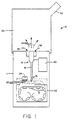
- a system 10 for dispersing a powder medicament from a plurality of receptacles 12 by insertion of a feed tube assembly 14 will be described.
- the receptacles may be in any form that holds and preserves the medicaments and which provides a puncturable access surface.
- receptacles 12 are in a continuous web comprising individual wells covered by a puncturable lid, typically a metal foil or other conventional laminate.
- Each receptacle will include a precise dosage of the powdered medicament to be delivered.
- the amount of powder in each individual receptacle will usually be in the range from about 1 mg to 20 mg, more usually being from 2 mg to 10 mg.
- the continuous web may be in the form of a strip, disk, or molded structure with a closure.
- the manufacture of such containers, often referred to as "blister packs" is well known in the pharmaceutical packaging art and need not be described further.
- the powder dispersion systems of the present invention could also be constructed to receive single dosage packages carrying only one receptacle.
- the user would insert the package so that the receptacle was properly oriented relative to feed tube 40 ( Fig. 2 ) of feed tube assembly 14.
- Necessary piercings in the access surface of the receptacle could be made manually prior to insertion, could be made within the system 10 (either prior to or simultaneous with introduction of the feed tube assembly 14) or could be preformed and exposed by peeling away a cover prior to insertion of the package into the device.
- receptacle packages could also be provided where the package is inserted into the device at different orientations in order to selectively expose individual receptacles to the feed tube.
- a variety of design options are available when the user inserts a single receptacle prior to each use.
- the system 10 further comprises a base enclosure 11, and the feed tube 40 ( Fig. 2 ) of feed tube assembly 14 has an inlet end 16 and an outlet end 18.
- a pressurized gas source 20 is provided within the base enclosure 11 and is connected to the proximal end of the feed tube assembly 14 to provide a high pressure gas stream, as will be described in greater detail in connection with Fig. 2 .
- the receptacles 12 will be mounted within the base enclosure 11 to reciprocate relative to the inlet end 16 of feed tube assembly 14.
- the strip of receptacles 12 will be mounted within a cartridge 22 which is reciprocatably mounted in the base enclosure 11, while the feed tube assembly 14 is fixedly mounted within the base enclosure.
- the receptacles 12 may be sequentially advanced past a fluidization location (defined by the inlet end 16 of feed tube assembly 14) within the cartridge 22, with the receptacle which is at the dispersion or fluidization location being brought proximate the inlet end 16 of the feed tube to permit emptying of its powdered contents, as described in more detail hereinafter.
- Both reciprocation of the cartridge 22, and advance of the receptacles 12 within the cartridge may be accomplished manually by the user.
- a mechanism may be provided within the base enclosure 11 for simultaneously reciprocating the cartridge 22 and advancing the strip of receptacles 12, either as part of a manual advance mechanism or as part of a battery-powered mechanism.
- penetrations will be formed in the lid of the strip of receptacles 12 by a piercing mechanism 24.
- the piercing mechanism 24 will be fixedly mounted within the base enclosure 11 and will include a plurality of sharpened penetrating elements 26 disposed to contact and penetrate the puncturable lid 92 ( Fig. 3 ) of the receptacles 12 when the cartridge 22 is reciprocated, as illustrated in broken line in Fig. 1 .
- the piercing mechanism 24 will be located to contact a receptacle 12 which is located one station prior to the feed tube assembly 14. Thus, each receptacle 12 will be pierced immediately prior to being advanced to the fluidization location.
- the cartridge 22 could be held stationary within the base enclosure 11 while each of the feed tube assembly 14 and piercing mechanism 24 could be reciprocated, either together or separately.
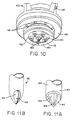
- the inlet end 16 of the feed tube assembly 14 could be configured to be self-penetrating (see Figs. 10 and 11A and 11B below). In the latter case, the desired pattern of penetrations would be formed in the puncturable lid of the receptacle 12 at the same time that the inlet end is engaged against or inserted into the interior of the receptacle.
- the present invention is not limited to any particular puncturing and advance mechanisms which might be employed.
- the gas source 20 will provide a volume of high pressure air or other gas to the outlet end 18 of the feed tube 40 ( Fig. 2 ) of feed tube assembly 14 in order to induce a flow of fluidization air, draw powder from the receptacles 12, and disperse the powder within the flowing gas stream.
- the high velocity air from the gas source will usually be directed past the outlet end 18, it will be appreciated that feed tube 40 could be extended past the high velocity gas stream inlet point, for example by providing side inlets in an elongate tube.
- the high velocity gas could actually combine with the fluidization air carrying the entrained particles within the feed tube itself.
- the feed tube 40 could define the mixing volume 60 ( Fig. 4A ), as described below.
- the gas source 20 will provide gas at a relatively high pressure, usually being sufficient to provide for sonic flow past the outlet end 18 of the feed tube assembly 14, typically being above 15 psig, usually being at least 20 psig, and preferably being in the range from 20 psig to 150 psig, and most preferably being in the range from 40 psig to 80 psig.
- the energy stored in the charge of high pressure gas will be sufficient to induce air flow through the feed tube 40 of feed tube assembly 14 which in turn draws fluidization air into the receptacle to fluidize and extract the expected weight of powdered medicament from the receptacle 12.
- the expanded volume of the charge will typically be in the range from about 2 ml to 25 ml (measured at STP), usually being in the range from about 4 ml to 15 ml.
- the volume of fluidization gas whose flow is induced through the feed tube assembly 14 by the high velocity gas stream will usually be from 2 ml to 100 ml, preferably from 4 ml to 60 ml, measured at STP. The specific manner in which the high pressure gas is flowed past the outlet end 18 of feed tube assembly 14 will be described in greater detail in connection with Fig. 2 .
- Gas source 20 may be in the form of a manual pump, an electric pump, a high pressure gas cylinder, or the like.
- manual pumps in hand-held powder dispersion devices is described in the patent and technical literature. See e.g., WO90/07351 .
- electric gas pumps, gas cylinder supplies, and two-fluid systems is also well within the skill in the art.
- the gas dispersion system 10 further includes a plume capture chamber 30 which is disposed over the outlet end 1 8 of feed tube assembly 14 in order to capture powder released from the tube.
- the plume chamber 30 will include a mouth piece 32 at its distal end and will have an internal volume sufficient to capture substantially all of the powder dispersion which is delivered from the feed tube assembly 14. Usually, the volume will be in the range from 50 ml to 1000 ml, preferably from 100 ml to 750 ml.
- the chamber 30 will also include an ambient air inlet (not shown), optionally a tangential inlet as described in co-pending Application Serial No. 07/910,048, the full disclosure of which is incorporated herein by reference. Alternatively, the air inlet can be axial or spiral, as described in connection with Figs. 7-9 , below.
- the powder dispersion will be introduced into the plume capture chamber 30, as illustrated by arrows 34. Air will be displaced through the mouthpiece 32, and optionally back through an annular lumen in the feed tube assembly 14, as indicated by arrows 36 and as will be described in more detail in connection with Fig. 2 .
- Such recycling of air from the plume capture chamber 30 as the fluidization gas enters greatly reduces the total volume of new gas being introduced to the system. The only new gas introduced (prior to patient inhalation) will be from the gas source 20.
- the patient will inhale the entire aerosolized dose through the mouthpiece 32 chased by ambient air through the chamber to extract all aerosolized medicament from the chamber.
- an orifice plate or other flow limiting element may be placed in the chamber air inlet path to slow inhalation and enhance the penetration depth of the powder particles. Inhalation of the additional air further assures that the powdered medicament will be efficiently dispersed and driven deeply into the alveolar regions of the lung where it is available for systemic absorption or localized delivery.
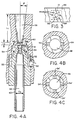
- the feed tube assembly 14 includes an inner tubular feed tube 40 which defines the inlet end 16 of the feed tube assembly 14 at its distal end and an outer coaxial tube member 42 which defines an annular lumen 44 for passing return air from chamber 30 back to the receptacle 12, as described in more detail hereinafter.
- Lumen 46 of the inner tubular feed tube 40 extends from the inlet end 16 to the outlet end 18 where a throat or constriction is optionally formed.
- the throat or constriction is not necessary for operation of the feed tube assembly 14, but it is the area (A 2 ) at the outlet end of the lumen 46 ( Fig. 4A ) which determines the performance characteristics of the feed tube, as described in more detail hereinafter.
- Dispersion gas from gas source 20 enters the feed tube assembly 14 through a port 50 connected to an annular plenum 52.
- the annular plenum 52 is connected to a pair of gas conduits 54 which direct converging gas streams into the flow path defined by lumen 46 of the feed tube 40.
- the angle at which the gas conduits 54 are oriented is chosen to provide a proper balance between the magnitude of the flow velocity induced in the powder stream drawn through lumen 46 and the magnitude of the shear forces which break up agglomerates in the powder as they pass from the outlet end 18 into an expansion section 58.
- the area (A 2 ) ( Fig. 4A ) of the throat 18 of the feed tube lumen 46 will typically be in the range from 0.5 mm 2 to 10 mm 2 , preferably being in the range from 1 mm 2 to 4 mm 2 .
- area (A 4 ) of the upstream portion of lumen 46 ( Fig. 4A ) is greater than A 2 . typically being from 0.6 mm 2 to 15 mm 2 .
- the upstream lumen 46 could have a uniform area along its entire length equal to the outlet end area (A 2 ), although such a construction would be less preferred.
- a mixing volume 60 having a uniform (non-expanding) cross-sectional area (A 3 ) and a length (L 2 ) is located immediately at the outlet end 18 of the feed tube 40.
- the cross-sectional area (A 3 ) is shown to be slightly larger than feed tube throat area( A 2 ) outlet, but this is not necessary.
- the exemplary area( A 3 ) is typically in the range from 0.6 mm 2 to 11 mm 2 .
- the length (L 2 ) is 1-5 times the diameter of the mixing volume 60 (for circular cross-sections), typically being in the range from 0.5 mm to 2 mm.
- a pair of gas conduits 54 Fig.
- FIG. 4B is shown, as illustrated in Fig. 4B . It would also be possible to utilize only a single inlet jet or to provide three, four or more separate inlets, with four inlets 54' being as illustrated in Fig. 4C . Other configurations will also be usable including a continuous annular aperture, as described in connection with Fig. 6 , or combinations of perpendicular jets (to break-up agglomerates) and axially directed jets (to induce fluidization gas flow).
- high pressure gas conduits 72 are arranged around the throat of a feed tube lumen 70 at angles ⁇ 1 , and ⁇ 2 , which will usually but not necessarily be equal.
- the angles ⁇ are important to achieving both adequate mass transfer of powder from the receptacle and adequate "agglomerate break up" as the powder enters the mixing volume immediately downstream from the outlet orifices of the conduits 72.
- the angles ⁇ will be in the range from 12.5° to 65°, preferably being from 25° to 40°.
- the high pressure gas lumens 72 may be formed as a single conical plenum 80 terminating in an annular aperture 82, as illustrated in Fig. 6 .
- the angle of convergence ⁇ will generally be within the range set forth above for ⁇ above, and the total area of the annular lumen 82 will generally be within the total area A 2 for the high pressure gas lumens also set forth above.
- the conical plenum 80 will have a width w in the range from about 0.005 mm to 0.1 mm.
- the feed tube assembly 14 operates by coupling the inlet end 16 of the feed tube 40 with an aperture 90 ( Fig. 3 ) formed into lid 92 over a receptacle 12.
- an aperture 90 ( Fig. 3 ) formed into lid 92 over a receptacle 12.
- the inlet end 16 is inserted through the lid 92 and into the receptacle 12, but is will also be feasible to engage the inlet end over the aperture 90, typically utilizing a sealing gasket as illustrated in Figs. 7-10 , below.
- the aperture 90 will be surrounded by space-apart apertures 94 (illustrated as six) which allow for the entry of fluidizing air as entrained powder is extracted through the inner feed tube 40.
- the aperture 90 is shown to be centered, but that is not necessary.
- At least a portion (and preferably all) of the fluidizing air will be provided through the annular lumen 44 via a port 96 in the feed tube assembly 14 disposal at the bottom of the interior of the plume chamber 30.
- Such "recycled" air from the plume chamber 30 passes through an annular plenum 98 from the port 96 into the annular lumen 44.
- a rubber flange or skirt 95 may be provided to prevent loss of fluidizing air from the lumen 44 to the receptacle 12.
- the recycling of fluidization air from the plume chamber 30 helps contain the plume of dispersed powder within the plume chamber since it limits the amount of air which is displaced and expelled through the mouthpiece 32 or other opening in the chamber.
- inlet end 16 of feed tube 40 of the feed tube assembly 14 into the receptacle 12 is advantageous (but not necessary) since it facilitates substantially complete removal of powder (usually at least 80% and preferably at least 90% by weight) from the interior of the receptacle. Such complete removal is further enhanced by the entry of fluidization air through the space-apart apertures 94, which creates an air flow pattern which can sweep powder from all corners of the receptacle into the dispersion lumen 46.
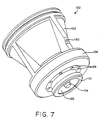
- FIG. 7-9 An alternative embodiment of a feed tube assembly 100 is shown in Figs. 7-9 .
- the feed tube assembly 100 is generally functionally equivalent to the feed tube assembly 14 and can be used in place thereof in the system of Fig. 1 .
- the feed tube 100 is particularly suitable for fabrication from molded plastic parts, or from a combination of molded plastic and fabricated metal parts.
- Feed tube assembly 100 comprises a casing 102, a gas flow-directing cone 104, a feed tube element 106, an end piece 108, a flexible valve element 110, and an end gasket 112.
- the feed tube element 106 is received in an open cavity 114 disposed in a lower end of the flow-directing cone 104.
- the flow passages within feed tube 106 will generally be the same as that described previously for feed tube assembly 14, and feed tube assembly 100 further includes a mixing volume 116 located immediately above the open cavity 114 and an expansion region 118 located above the mixing volume.
- the dimensions of the mixing volume 116 and expansion region 118 will generally be the same as those described previously in connection with the feed tube assembly 14.
- the flow directing cone 104 may include a plurality of air flow channels 120 formed over its exterior surface. Usually, there will be from 1 to 10 channels, having a total cross-sectional area from 5 mm 2 to 150 mm 2 , preferably from 40 mm 2 to 100 mm 2 .
- the air flow channels 120 are shown in a generally spiral pattern in Fig. 8 . The spiral pattern may be preferred since it will impart a vortical flow to replacement air entering the associated plume chamber as the patient inhales.
- the airflow channels 120 could also have a generally straight configuration which would impart a conically expanding, but not spiral, flow pattern to the replacement air.
- the airflow channels 120 are enclosed at their outward extremities by the inner surface 122 ( Fig. 9 ) of the casing 102.
- the air flow channels thus extend from a lower end 124 to an upper end 126, providing flow paths for replacement or "chase" air into a plume chamber, as described in more detail below.
- the flow paths provided by air channels 120 will also provide for recycling of air in the reverse direction from the plume chamber to an associated powder receptacle when the powder is being fluidized. This function will be described in more detail below.
- the end piece 108 includes a plurality of air flow apertures 126 located around a central opening 128.
- the flexible valve 110 lies over the air flow apertures 126 and is secured between the lower end of casing 102 and the upper surface of the end piece, as best seen in Fig. 9 .
- the flexible valve element 110 generally acts as a one-way valve, permitting entry of air from the outside of the feed tube assembly 100 into the region formed between the lower end of casing 102 and the end piece 108.
- High pressure air will be able to enter the open cavity 114 formed at the outlet end of feed tube element 106 through an inlet port 130 formed in the casing 102 ( Fig. 7 ).
- the flow path from port 130 to the cavity 114 is not shown in Fig. 9 .
- Supply of high pressure gas to the cavity 114 acts to induce the flow of fluidization air through the central lumen of the feed tube element 106 in a manner completely analogous to that described previously for feed tube assembly 14.
- a feed tube penetrating element 140 is disposed at the lower end of the feed tube 106. As shown in detail in Fig. 11 , the penetrating element 140 includes a pair of crossing internal walls 142 which terminate in a pointed blade structure 144. The blade structure 144 leaves four separate flow passages 146 arranged in quadrants within the feed tube 104. The flow passages 146 may optionally stop beyond the attachment point of the blade structure 144 to the inside wall of the host tube.
- a plurality of similar penetrating structures 150 are provided for both piercing the receptacle lid and simultaneously providing fluidization air inlet paths.
- the penetrating structures 150 may be provided in a carrier plate 152 or similar supporting structure.
- the penetrating structures 150 will have a similar conical blade structure to that described previously for the feed tube penetrating structure 140.
- the structure of Fig. 10 can provide for both the feed tube penetration and the peripherally arranged fluidization air penetrations in the penetrable lid of a medicament receptacle in a single motion where the lid is drawn against the gasket 112 of the feed tube assembly 100.
- Fig. 11B illustrates an alternative penetrating structure 151 formed by machining the end of a tube along two converging planes. The resulting pointed elements are then pressed together to form the structure having openings 153.
- the penetrating element 151 is advantageous since it peels back the lid as it is penetrated, leaving the openings 153 clear to receive powder.
- the penetrating structure 151 could be fabricated from molded plastic as well as machined metal.
- a medicament receptacle R having preformed feed tube and fluidization air penetrations 200 and 202 is engaged against the gasket 112, as illustrated in Fig. 12A .
- Gasket 112 provides a seal against penetrable lid 204 of the receptacle R.
- the inlet end of feed tube 106 is shown to penetrate the lid 104, but it will be appreciated that such penetration is not essential since a seal will be provided by the gasket 112. Penetration may be desirable, however, since the lid flaps which surround the penetration 200 will be held open.
- a burst of high pressure air is introduced into the open cavity 114, as shown in Fig. 12B .
- the high pressure air flows past outlet end of the feed tube 106, inducing a flow of fluidization air through the receptacle R.
- fluidization air is drawn through the air flow channels 120 from the overlying plume chamber (not illustrated), as shown by arrows 210.
- the air drawn in through the air flow channels 120 enters the receptacle through penetrations 202, thus fluidizing the powder and drawing the powder out through the feed tube 106.
- the air flow through the feed tube thus entrains the powder and combines the powder with high pressure gas flow at the outlet end of the feed tube.
- the combined powder, fluidization air, and high pressure dispersion gas is then introduced into the plume chamber, as shown by arrows 212.
- the apparatus 300 includes a housing 302 and a capture chamber 304 that is slidable over the housing 302. Removably held within the housing 302 is a transjector assembly 306.
- the transjector assembly 306 is similar to the feed tube assembly 100 as shown in Figs. 7-9 and is employed to introduce aerosolized medicament into the capture chamber 304 as described in greater detail hereinafter.
- the apparatus 300 further includes a handle assembly 336 having a handle 338 that in combination with the transjector assembly 306 is employed to aerosolize the medicament and will be described in greater detail hereinafter.
- the housing 302 further includes an aperture 340 for receiving a receptacle 342 (see Fig. 20 ) having the powdered medicament.
- the capture chamber 304 is sized to be slidably received over the housing 302 so that the capture chamber 304 may be removed from the housing 302 for cleaning and also so that chamber 304 can be translated between a deployed position (see Fig. 20 ) and a retracted position (see Fig. 14 ).
- the capture chamber 304 forms an enclosure for receiving aerosolized medicament introduced by the transjector assembly 306 so that it may be inhaled by a patient.
- the capture chamber 304 can be slid over the housing 302 to the retracted position for storing.
- two pairs of detent pins 308 and 310 are provided.
- the detent pins 308, 310 are received into slots 312 and 314 in the housing 302. Springs 316 and 318 are preferably provided to outwardly bias the detent pins 308, 310.
- the capture chamber 304 includes a chamber body 320 having a bottom portion 322 and a top portion 324. Included in the bottom portion 322 are a pair of grooves (not shown) for engaging the detent pins 308, 310.
- the detent pins 308 are received in the grooves when the capture chamber 304 is in the deployed position, and the detent pins 310 are received into the grooves when the capture chamber 304 is in the retracted position.
- the detent pins 308 and 310 each include a V-shaped portion 326 and 328 for engaging the grooves in the bottom portion 322 of the capture chamber 304.
- the particular angle and orientation of the V-shaped portions 326 and 328 can be varied to increase or decrease the amount of force required to deploy or retract the capture chamber 304.
- the mating grooves on the chamber 204 may also be provided with different angles to assist in achieving this effect.
- the detent pins 310 will be configured so that it is easier to translate the chamber 304 downward toward the bottom of the housing 302 than to translate the chamber 304 upward toward the top of the housing 302.
- the chamber 304 may be placed in the retracted or storage position with a relatively small force, while a relatively greater force will be required to retrieve the chamber 304 from the storage position. In this way, the chamber 304 will be configured to not inadvertently slide open during non-use.
- the detent pins 308 will usually be configured so that a greater force is required to altogether remove the chamber 304 from the housing 302 than to slide the chamber 304 down over the housing toward the detent pins 308. In this way, inadvertent removal of the chamber 304 will be prevented when sliding the chamber 304 to the deployed position.
- the capture chamber 304 is preferably asymmetrical in cross-sectional geometry so that the capture chamber 304 may be repeatedly placed over the housing 302 at a known orientation. This is particularly advantageous in insuring that an inhalation port 330 of a mouthpiece 331 (see Fig. 14 ) is properly positioned relative to a fire button 418 (see Fig. 21 ) that is employed to introduce the powdered medicament into the capture chamber 304.
- the chamber body 320 will preferably include at least one elongate ridge 324 extending longitudinally along the length of the interior of the chamber body 320.
- the ridge 334 is provided to contact the housing 302 and to keep the remainder of the chamber body 320 spaced-apart from the housing 302 when the capture chamber 304 is translated to the retracted position. Often, residual powder will remain on the interior walls of the chamber body 320 after use. As the chamber body 320 is slid over the housing 302 to retract the capture chamber 304, the ridge 334 contacts the housing 302 to limit the amount of residual powder that is scraped from the chamber body 320 by the housing 302. Extensive scraping of the accumulated powder from the walls of the chamber body 320 is undesirable in that the scraped powder may become agglomerized and may interfere with the subsequent operation of the apparatus 320.
- a raised portion 335 is provided on the housing 302 to insure a proper fit between the bottom portion 322 and the housing 302.
- the chamber body 320 is preferably constructed of a transparent material and will usually be constructed of plastic.
- the plastic may be an inherently conductive polymer such as that described in U.S. Patent Nos. 5,342,889 , 5,348995 , and 4,719263 , the disclosure of which is herein incorporated by reference, to limit the amount of electric charge built up on the walls of the chamber body 320 during use.
- the capture chamber 304 is shown in the retracted position and will be used to describe operation of the inhalation port 330 in greater detail.
- the capture chamber 304 includes a cover 344 that may be closed over the inhalation port 330.
- the cover 344 is employed to prevent external dust or particulate from entering into the interior of the capture chamber 304 during storage and also to hold the aerosolized medicament introduced by the transjector assembly 306 within the chamber 304 until ready for inhalation.
- the cover 344 may include seal 346 which is received over the inhalation port 330 when the cover 344 is closed. When introducing the aerosolized medicament, the pressure within the capture chamber 304 is increased.
- the seal 346 serves as a bleed valve to allow some of the pressurized gas within the chamber 304 to spontaneously escape. Reducing the chamber pressure in this manner is advantageous in preventing a "puff" of medicament from escaping when the cover 344 is lifted for inhalation.
- the capture chamber 304 will preferably define an enclosed volume of about 50 ml to 750 ml, and more preferably at about 100 ml to 250 ml.
- 8 ml of gas introduced into a 210 ml chamber will amount to a pressure rise of about 0.6 psi.
- the seal 346 is preferably constructed of silicone, urethane or similar flexible elastomers, although a similar functioning valve could be achieved with a spring loaded rigid valve element such as a thin mylar or metal petal or plate.
- the housing 302 includes a cylindrical opening 348 that is sized to receive the transjector assembly 306.
- the opening 348 includes a keyed slot 350 for receiving a keyed portion 352 of the assembly 306.
- the keyed slot 350 is provided so that the transjector assembly 306 may be repeatedly placed in a known orientation when the transjector assembly 306 is inserted into the opening 348.
- a locking nut 354 is provided to secure the transjector assembly 306 into the opening 348.
- the locking nut 354 includes a pair of tabs 356 to allow for easier rotation of the nut 354 when securing or unlocking the nut 354.
- the nut 354 is unscrewed and removed, and the transjector assembly 306 is lifted from the housing 302.
- the nut 354 may be configured to snap fit into the opening 348 to hold the transjector assembly 306 in place.
- the transjector assembly 306 includes a casing 358, a gas flow directing cone 360, a feed tube element 362, an end piece 364, a flexible valve element 366, and an end gasket 368.
- the transjector assembly 306 operates substantially identical to the feed tube assembly 100 as shown in Figs. 7-9 in extracting and aerosolizing the powdered medicament in the receptacle.
- the transjector assembly 306 differs from the feed tube assembly 100 in that the transjector assembly 306 includes an alternative penetrating element 370 and a pair of penetrating structures 372.
- the penetrating element 370 is disposed at the lower end of the feed tube 362 and is employed to extract powder from the receptacle 342 as previously described in connection with the feed tube assembly 100 when the penetrating element 370 is introduced into the receptacle 342.
- the penetrating structures 372 are provided for both piercing the receptacle lid and simultaneously providing fluidization air inlet paths.
- a particular advantage of the penetrating structures 372 is that they are easy to manufacture, thereby reducing the overall cost of the transjector assembly 306.
- the penetrating structures 372 may optionally be provided with a plurality of points rather than a single point to facilitate penetration into the receptacle lid.
- the receptacle 342 includes a receptacle body 374 having a penetrable lid 376 covering an enclosure 378 and a tab 380. Within the tab 380 is a hole 382 for aligning the receptacle 342 with the transjector assembly 306 as described in greater detail hereinafter.
- the receptacle 342 is lifted (or the transjector 306 is lowered) until the penetrating element 370 and the penetrating structures 372 pierce the lid 376 as shown in Fig. 19 .
- the penetrating structures 372 are angled relative to the penetrating element 370 and operate similar to can openers to peel back a portion of the lid 376 and form the air inlet paths.
- a burst of high pressure air is introduced into an open cavity 384 which flows past the outlet end of the feed tube 362 to draw the powdered medicament within the receptacle 342 through the transjector assembly 306 in a manner similar to the feed tube assembly 100 described in Figs. 12-12C .
- the end gasket 368 contacts the receptacle body 374 and forms a seal against the receptacle 342.
- the receptacle 342 is delivered into the aperture 340 by grasping the tab 380 and inserting the receptacle body 374 into the aperture 340 until stop shoulders 375 on the receptacle body 374 engages guide pins 377 (see also Fig. 21 ) on which a carrier 442 (see also Fig. 22 ) rides and prevents further translation.
- the hole 382 is generally aligned with a pin 386.
- the receptacle 342 is then lifted within the aperture 340 until the hole 382 is received over the pin 386 which guides and aligned the receptacle 342 until engaging the end gasket 368 (see Fig. 19 ).
- the tab 380 remains outside the housing 302. In this way, premature closure of the capture chamber 304 is prevented since the tab 380 will prevent retraction of the capture chamber 304.
- the tab 380 thus ensures that the capture chamber 304 will always be in the deployed position when the receptacle 342 is loaded into the apparatus 300. Thus, the capture chamber 304 must always be in the deployed position for the receptacle 342 to be loaded into the apparatus 300.
- the pin 386 may be keyed to fit only a specific hole configuration in the receptacle 342.
- the apparatus may be configured to receive only specific receptacles having a given medicament:
- a plurality of pins and corresponding holes in the receptacle may be provided to key the apparatus 300.
- the handle 338 on the handle assembly 336 is operably connected to a piston 388 that in turn is translatably held within a cylinder 390.
- a linkage 392 is provided to connect the piston 388 to the handle 338.
- the linkage 392 is pulled from the cylinder 390 to lift the piston 388.
- the piston 388 is in a retracted position.
- the piston 388 is translated within the cylinder 390 to pressurize the gas within the cylinder 390.
- the cylinder includes a one-way valve 394 that is held within a retainer 396.
- the one-way valve 394 is preferably a "duck bill" type valve which allows air into the cylinder 390 as the piston 388 is translated to the extended position.
- the valve 394 is closed to prevent air from escaping from the cylinder 390 through the valve 394.
- Pressurized air from the cylinder 390 is passed via a transfer or an outlet tube 398 (see Figs. 21 and 25 ) to a release valve assembly 400.
- the release valve assembly 400 is in turn in communication with the transjector assembly 306 so that pressurized gas may be supplied to the open cavity 384 as previously described in Fig. 19 .
- a seal 402 is provided between the valve assembly 400 and the transjector assembly 306 to prevent high pressure air supplied from the valve assembly 400 from escaping between the interface between the valve assembly 400 and the transjector assembly 306.
- the seal 402 is preferably constructed of urethane, silicone, or a similar elastomer, and is angled relative to a longitudinal axis of the transjector assembly 306. In this way, the transjector assembly 306 may easily be inserted and removed to and from the housing 302 while at the same time allowing for a sufficient interface seal.
- the valve assembly 400 includes a valve stem 404 and a valve poppet 406 for selectively preventing air from flowing through the assembly 400 and will be described in greater detail hereinafter with reference to Figs. 27-29 .
- the valve assembly 400 is shown in the open position, with the poppet 406 being unseated. In such a configuration, gas within the cylinder 390 will not be significantly compressed upon translation of the piston 388 since air within the cylinder 390 will escape through the outlet tube 398.
- the valve assembly 400 is closed, air is prevented from escaping from the outlet tube 398 so that only a "full stroke" of air within the cylinder 390 may be compressed.
- the apparatus 300 is configured to close the valve assembly 400 as the piston 388 reaches the extended position so that air within the cylinder 390 may be compressed when the handle 338 is translated back toward the housing 302.
- the handle assembly 336 includes a linkage 408 (see Fig. 22 ) having rack 410 securely attached thereto.
- the rack 410 includes an elongate slot 412 for receiving a valve reset link 414 (see Figs. 21 and 24 ).
- the reset link 414 is pivotally attached to a roller cam 416.
- the roller cam 416 is pivotally attached to a valve release button 418.
- the linkage 408 pivots about a pin 420 causing the reset link 414 to slide within the slot 412 until reaching a left-hand end of the slot 412.
- the reset link 414 is translated in the direction of the handle 338 to pivot the roller cam 416 about pin 422.
- Further translation of the handle 338 causes the roller cam 416 to lock over center.
- the release button 418 is translated outward from the housing 302 and the valve stem 404 is driven upwards by the roller to seat the poppet 406 against a seat 452 (see Fig. 29 ), thereby closing the valve assembly 400.
- the piston 388 is translated via linkage 392 to the extended position.
- the reset link 414 slides within the slot 412 while the cam 416 remains over center to keep the valve assembly 400 closed.
- the piston 388 is translated within the cylinder 390 to compress the air within the cylinder 390.
- the apparatus 300 may be configured to prevent translation of the handle 338 back toward the housing 302 until the handle 338 is fully extended to place the cam 416 over center and close the valve 400.
- the handle assembly includes an interlock pawl 424 (see Fig. 22 ) for engaging ratchet teeth 426 on the rack 410.
- the pawl 424 engages the teeth 426 of the rack 410 to prevent closure of the handle 338 until the cam 416 moves over center to close the valve assembly 400.
- An interlock pawl spring 425 is provided to bias the pawl 424 against the ratchet teeth 426 until the cam 416 is over center.
- an interlock may be provided to prevent piercing of the receptacle 342 by the transjector assembly 306 until the valve assembly 400 is closed.
- the handle assembly 336 further includes a linkage 430 that is pivotally connected to the housing 302 by pin 432. connecting the handle 338 to linkage 392 and linkage 408 is a linkage 434.
- linkages 392, 408, 430 and 434 provide a four-bar linkage system which allow the handle 338 to be moved radially outward from the housing 302 with the handle 338 being maintained generally parallel to the housing 302. Further, when the valve assembly 400 is closed and the handle 338 is translated back toward the housing 302, a substantially uniform force is required over the handle's range of motion.
- the apparatus 300 further includes a carriage assembly 436 for translating the receptacle 342 within the aperture 340 so that the penetrating element 370 and the penetrating structures 372 may pierce the lid 376 of the receptacle 342.
- the carriage assembly 436 includes a thumb toggle 438 that is pivotally connected to the frame of the housing 302 by a pin 440.
- the receptacle 342 is held within a carrier 442 which in turn is connected to the thumb toggle 438 by a linkage 444. Operation of the carriage assembly 436 is as follows. Initially, the receptacle 342 is inserted into the aperture 340 as previously described with the receptacle 342 resting on the carrier 442.
- the thumb toggle 438 is then depressed to pivot the toggle 438 about pin 440 and to lift the carrier 442 toward the transjector assembly 306.
- the thumb toggle 438 is depressed until the transjector assembly 306 pierces the lid on the receptacle 342 and the linkage 444 moves over center.
- the linkage 444 is over center, the receptacle 342 is locked in place against the end gasket 368 of the transjector assembly 306 (see Fig. 25 ).
- the carriage assembly 436 will be configured to compensate for overtravel of the carrier 442.
- the carrier 442 will be relaxed after the receptacle 342 has been pierced by the transjector assembly 306 but will still provide a sufficient seal between the transjector assembly 306 and the receptacle 342.
- the thumb toggle 438 is lifted to move the linkage 444 from over center.
- the receptacle 342 may then be removed from the aperture 340 by grasping the tab 380 and pulling the receptacle 342 from the aperture 340.
- the valve assembly 400 includes a casing 446 having an inlet port 448 and an outlet port 450.
- the outlet tube 398 which connects the cylinder 390 to the valve assembly 400 passes through the inlet port 448.
- the interface seal 402 is placed between the outlet port 450 and the transjector assembly 306 as previously described.
- the valve assembly 400 is shown in the open state in Fig. 28 .
- the poppet 406 When open, the poppet 406 is spaced apart from an O-ring seat 452.
- the poppet 406 is held within a central chamber 454 which is sealed from the outside environment (except for the outlet port 450) by a diaphragm 456.
- air introduced into the central chamber 454 from the outlet tube 398 freely passes around the poppet 406 and exits the outlet port 450.
- air introduced into the central chamber 454 from the outlet tube 398 forces the poppet 406 against the seat 452 which prevents escape of the compressed air from the central chamber 454.
- the valve assembly 400 is preferably configured so that the seal between the poppet 406 and the seat 452 will hold up to about 120 psi of pressure, and more preferably at about 80 psi.
- the release button 418 is depressed to move the cam 416 from over center and to allow the poppet 406 to be moved away from the seat 452.
- a spring 457 is provided.
- the spring 457 will preferably be selected to provide a force sufficient to overcome the force on the opposite side of the poppet that is produced by the compressed air within the chamber 454. Hence, when the release button 418 is depressed, the spring 457 will overcome the force produced by the compressed air within the chamber 454 and will promptly force the poppet 406 away from the seat 452 and allow the valve to open.
- valve assembly 400 operates in a "snap" acting manner to provide a precise amount of gas to the transjector assembly 306 in a rapid, abrupt and irreversible manner so that the powder may be sufficiently aerosolized in a repeatable and a predictable manner.
- the housing 302 may further include an electronic memory chip along with a speaker for providing audible instructions to a user regarding operation of the apparatus 300.
- the chip will preferably be an EPROM, PROM, or PAL chip having stored electronic information regarding operation of the apparatus 300 and will be configured to be actuated upon deployment of the capture chamber 304. In this way, as a user prepares for a treatment, audible instructions will be given. Preferable instructions include deployment of the chamber 304, charging of the apparatus with the handle assembly 336, breathing instructions, and the like, as well as other pertinent information as determined by the manufacturer.
Landscapes
- Health & Medical Sciences (AREA)
- Engineering & Computer Science (AREA)
- Bioinformatics & Cheminformatics (AREA)
- Pulmonology (AREA)
- Anesthesiology (AREA)
- Biomedical Technology (AREA)
- Heart & Thoracic Surgery (AREA)
- Hematology (AREA)
- Life Sciences & Earth Sciences (AREA)
- Animal Behavior & Ethology (AREA)
- General Health & Medical Sciences (AREA)
- Public Health (AREA)
- Veterinary Medicine (AREA)
- Containers And Packaging Bodies Having A Special Means To Remove Contents (AREA)
- Medicinal Preparation (AREA)
- Infusion, Injection, And Reservoir Apparatuses (AREA)
- Nozzles (AREA)
- Catching Or Destruction (AREA)
Applications Claiming Priority (3)
| Application Number | Priority Date | Filing Date | Title |
|---|---|---|---|
| US08/309,691 US5785049A (en) | 1994-09-21 | 1994-09-21 | Method and apparatus for dispersion of dry powder medicaments |
| US08/487,184 US5740794A (en) | 1994-09-21 | 1995-06-07 | Apparatus and methods for dispersing dry powder medicaments |
| EP95932508A EP0846009B1 (de) | 1994-09-21 | 1995-09-15 | Vorrichtung und verfahren zum dispergieren von trockenen pulvermedikamenten |
Related Parent Applications (1)
| Application Number | Title | Priority Date | Filing Date |
|---|---|---|---|
| EP95932508A Division EP0846009B1 (de) | 1994-09-21 | 1995-09-15 | Vorrichtung und verfahren zum dispergieren von trockenen pulvermedikamenten |
Publications (2)
| Publication Number | Publication Date |
|---|---|
| EP1917992A2 true EP1917992A2 (de) | 2008-05-07 |
| EP1917992A3 EP1917992A3 (de) | 2009-11-25 |
Family
ID=23199254
Family Applications (1)
| Application Number | Title | Priority Date | Filing Date |
|---|---|---|---|
| EP08003249A Withdrawn EP1917992A3 (de) | 1994-09-21 | 1995-09-15 | Vorrichtung und Verfahren zur Verabreichung von Trockenpulvermedikamenten |
Country Status (8)
| Country | Link |
|---|---|
| US (2) | US5785049A (de) |
| EP (1) | EP1917992A3 (de) |
| KR (3) | KR100399844B1 (de) |
| AR (1) | AR042921A2 (de) |
| DE (1) | DE69535725T2 (de) |
| MY (1) | MY113727A (de) |
| TW (1) | TW287110B (de) |
| ZA (1) | ZA957933B (de) |
Cited By (4)
| Publication number | Priority date | Publication date | Assignee | Title |
|---|---|---|---|---|
| WO2010052479A1 (en) * | 2008-11-06 | 2010-05-14 | Medispray Laboratories Pvt. Ltd | Inhaler device |
| WO2010040779A3 (en) * | 2008-10-09 | 2010-07-01 | Vectura Delivery Devices Limited | Inhaler |
| EP3915408A1 (de) * | 2020-05-27 | 2021-12-01 | Joozef | Gerät zum inhalieren einer substanz |
| WO2021239868A1 (fr) | 2020-05-27 | 2021-12-02 | Joozef | Appareil pour inhaler une substance |
Families Citing this family (343)
| Publication number | Priority date | Publication date | Assignee | Title |
|---|---|---|---|---|
| GB9004781D0 (en) * | 1990-03-02 | 1990-04-25 | Glaxo Group Ltd | Device |
| UA26230A (uk) * | 1990-03-02 | 1999-07-19 | Глексо Груп Лімітед | Іhгалятор для спільhого використаhhя з лікувальhим блоком і лікувальhий блок |
| SK280968B6 (sk) | 1990-03-02 | 2000-10-09 | Glaxo Group Limited | Balenie medikamentu na použite v inhalačnom prístroji |
| US6536427B2 (en) | 1990-03-02 | 2003-03-25 | Glaxo Group Limited | Inhalation device |
| DE69230613T2 (de) * | 1991-07-02 | 2000-12-28 | Inhale Inc | Verfahren und vorrichtung zum abgeben von medikamenten in aerosolform |
| US6681767B1 (en) | 1991-07-02 | 2004-01-27 | Nektar Therapeutics | Method and device for delivering aerosolized medicaments |
| US6582728B1 (en) * | 1992-07-08 | 2003-06-24 | Inhale Therapeutic Systems, Inc. | Spray drying of macromolecules to produce inhaleable dry powders |
| US6290991B1 (en) | 1994-12-02 | 2001-09-18 | Quandrant Holdings Cambridge Limited | Solid dose delivery vehicle and methods of making same |
| NZ293163A (en) * | 1994-09-21 | 1998-09-24 | Inhale Therapeutic Syst | Inhalation medicament disperser, aerosol from high pressure gas entrainment of fluidised powder drawn from receptacle feed tube |
| JP4484247B2 (ja) * | 1995-02-24 | 2010-06-16 | エラン ファーマ インターナショナル,リミティド | ナノ粒子分散体を含有するエアロゾル |
| ATE287703T1 (de) * | 1995-04-14 | 2005-02-15 | Nektar Therapeutics | Pulverförmige pharmazeutische formulierungen mit verbesserter dispergierbarkeit |
| US6428771B1 (en) * | 1995-05-15 | 2002-08-06 | Pharmaceutical Discovery Corporation | Method for drug delivery to the pulmonary system |
| US6672304B1 (en) | 1995-06-08 | 2004-01-06 | Innovative Devices, Llc | Inhalation actuated device for use with metered dose inhalers (MDIs) |
| US20040237961A1 (en) * | 1995-06-08 | 2004-12-02 | Snow John Medlin | Inhalation actuated device for use with metered dose inhalers (MDIs) |
| US6209538B1 (en) | 1995-08-02 | 2001-04-03 | Robert A. Casper | Dry powder medicament inhalator having an inhalation-activated flow diverting means for triggering delivery of medicament |
| FR2738152B1 (fr) * | 1995-09-04 | 1998-01-23 | Tebro | Dispositif de pre-dosage de produit pulverulent pour un distributeur de produit |
| SK287878B6 (sk) * | 1996-02-21 | 2012-02-03 | Schering Corporation | Powdered medication inhaler |
| AU720813B2 (en) * | 1996-04-25 | 2000-06-15 | Astrazeneca Ab | Inhaler |
| US6405936B1 (en) | 1996-05-13 | 2002-06-18 | Universidad De Sevilla | Stabilized capillary microjet and devices and methods for producing same |
| US6189803B1 (en) | 1996-05-13 | 2001-02-20 | University Of Seville | Fuel injection nozzle and method of use |
| US6187214B1 (en) | 1996-05-13 | 2001-02-13 | Universidad De Seville | Method and device for production of components for microfabrication |
| US6299145B1 (en) | 1996-05-13 | 2001-10-09 | Universidad De Sevilla | Device and method for fluid aeration via gas forced through a liquid within an orifice of a pressure chamber |
| US6595202B2 (en) | 1996-05-13 | 2003-07-22 | Universidad De Sevilla | Device and method for creating aerosols for drug delivery |
| US6197835B1 (en) | 1996-05-13 | 2001-03-06 | Universidad De Sevilla | Device and method for creating spherical particles of uniform size |
| US6196525B1 (en) | 1996-05-13 | 2001-03-06 | Universidad De Sevilla | Device and method for fluid aeration via gas forced through a liquid within an orifice of a pressure chamber |
| US6386463B1 (en) | 1996-05-13 | 2002-05-14 | Universidad De Sevilla | Fuel injection nozzle and method of use |
| US6792940B2 (en) * | 1996-05-13 | 2004-09-21 | Universidad De Sevilla | Device and method for creating aerosols for drug delivery |
| ES2140998B1 (es) | 1996-05-13 | 2000-10-16 | Univ Sevilla | Procedimiento de atomizacion de liquidos. |
| US6458574B1 (en) | 1996-09-12 | 2002-10-01 | Transkaryotic Therapies, Inc. | Treatment of a α-galactosidase a deficiency |
| GB2318737B (en) * | 1996-10-30 | 2000-06-14 | Bespak Plc | Improved inhalers |
| US20030203036A1 (en) | 2000-03-17 | 2003-10-30 | Gordon Marc S. | Systems and processes for spray drying hydrophobic drugs with hydrophilic excipients |
| SE9700424D0 (sv) * | 1997-02-07 | 1997-02-07 | Astra Ab | Powder inhaler |
| DE19704849B4 (de) * | 1997-02-08 | 2011-02-17 | Ing. Erich Pfeiffer Gmbh | Austragvorrichtung für Medien |
| CA2212430A1 (en) | 1997-08-07 | 1999-02-07 | George Volgyesi | Inhalation device |
| US20060165606A1 (en) * | 1997-09-29 | 2006-07-27 | Nektar Therapeutics | Pulmonary delivery particles comprising water insoluble or crystalline active agents |
| PE56799A1 (es) * | 1997-10-10 | 1999-06-10 | Inhale Therapeutic Syst | Metodo y aparato para transportar polvo |
| EP1037713B1 (de) | 1997-12-17 | 2002-07-10 | Universidad de Sevilla | Verfahren zur erzeugung von hohlen tröpfchen |
| OA11529A (en) | 1998-03-16 | 2004-05-07 | Inhale Therapeutic Syst | Aerosolized active agent delivery. |
| SE9801114D0 (sv) * | 1998-03-30 | 1998-03-30 | Astra Ab | Inhalation device |
| US6257233B1 (en) * | 1998-06-04 | 2001-07-10 | Inhale Therapeutic Systems | Dry powder dispersing apparatus and methods for their use |
| EP1685866A3 (de) * | 1998-06-04 | 2013-07-10 | Nektar Therapeutics | Abgabevorrichtungen für Trockenpulver sowie deren Anwendungsverfahren |
| AU753094B2 (en) * | 1998-06-22 | 2002-10-10 | Astrazeneca Ab | Device for emptying cavities containing powder by means of suction |
| US6593133B1 (en) | 1998-07-06 | 2003-07-15 | Nsgene A/S | Neurotrophic factors |
| DE19831525A1 (de) * | 1998-07-14 | 2000-01-20 | Pfeiffer Erich Gmbh & Co Kg | Spender für Medien |
| US6270747B1 (en) | 1998-08-18 | 2001-08-07 | The University Of California | In vitro and in vivo assay for agents which treat mucus hypersecretion |
| UA73924C2 (en) * | 1998-10-09 | 2005-10-17 | Nektar Therapeutics | Device for delivering active agent formulation to lungs of human patient |
| US7521068B2 (en) | 1998-11-12 | 2009-04-21 | Elan Pharma International Ltd. | Dry powder aerosols of nanoparticulate drugs |
| US20040141925A1 (en) * | 1998-11-12 | 2004-07-22 | Elan Pharma International Ltd. | Novel triamcinolone compositions |
| US6450189B1 (en) | 1998-11-13 | 2002-09-17 | Universidad De Sevilla | Method and device for production of components for microfabrication |
| EP2258183A1 (de) | 1998-12-22 | 2010-12-08 | The University of North Carolina at Chapel Hill | Verbindungen und Verwendungen zur Behandlung von Atemwegeserkrankungen sowie zur Verabreichung von Arzneistoffen für die Atemwege |
| JP2002541213A (ja) | 1999-04-13 | 2002-12-03 | インヘール セラピューティック システムズ, インコーポレイテッド | 不妊症の処置のための乾燥粉末処方物の肺投与 |
| EP1183061B2 (de) * | 1999-06-05 | 2012-10-17 | Innovata Biomed Limited | Verabreichungsystem für medikamente |
| GB2353222B (en) * | 1999-06-23 | 2001-09-19 | Cambridge Consultants | Inhalers |
| DK1808438T3 (da) * | 1999-06-29 | 2014-10-27 | Mannkind Corp | Rensning og stabilisering af peptid og proteiner i lægemidler |
| US9006175B2 (en) * | 1999-06-29 | 2015-04-14 | Mannkind Corporation | Potentiation of glucose elimination |
| US6606992B1 (en) | 1999-06-30 | 2003-08-19 | Nektar Therapeutics | Systems and methods for aerosolizing pharmaceutical formulations |
| US7464706B2 (en) | 1999-07-23 | 2008-12-16 | Mannkind Corporation | Unit dose cartridge and dry powder inhaler |
| US7305986B1 (en) | 1999-07-23 | 2007-12-11 | Mannkind Corporation | Unit dose capsules for use in a dry powder inhaler |
| GB9920839D0 (en) * | 1999-09-04 | 1999-11-10 | Innovata Biomed Ltd | Inhaler |
| US6880555B1 (en) * | 1999-10-12 | 2005-04-19 | Shl Medical Ab | Inhaler |
| NZ518401A (en) * | 1999-10-29 | 2004-01-30 | Nektar Therapeutics | Dry powder compositions having improved dispersivity |
| US20010029947A1 (en) | 1999-12-17 | 2001-10-18 | Steve Paboojian | Receptacles to facilitate the extraction of powders |
| US7304750B2 (en) | 1999-12-17 | 2007-12-04 | Nektar Therapeutics | Systems and methods for non-destructive mass sensing |
| US20010035184A1 (en) | 1999-12-17 | 2001-11-01 | Carlos Schuler | Systems and methods for treating packaged powders |
| KR100773323B1 (ko) | 2000-01-10 | 2007-11-05 | 맥시겐 홀딩스 리미티드 | 지-씨에스에프 접합체 |
| WO2001078817A1 (en) * | 2000-02-25 | 2001-10-25 | Dura Pharmaceuticals, Inc. | Dosing system for a dry powder inhaler |
| NZ521034A (en) | 2000-02-28 | 2004-08-27 | Vectura Ltd | Improvements in or relating to the delivery of oral drugs |
| US6748944B1 (en) | 2000-05-03 | 2004-06-15 | Dellavecchia Michael Anthony | Ultrasonic dosage device and method |
| US7871598B1 (en) | 2000-05-10 | 2011-01-18 | Novartis Ag | Stable metal ion-lipid powdered pharmaceutical compositions for drug delivery and methods of use |
| US8404217B2 (en) | 2000-05-10 | 2013-03-26 | Novartis Ag | Formulation for pulmonary administration of antifungal agents, and associated methods of manufacture and use |
| US20040156792A1 (en) * | 2002-12-31 | 2004-08-12 | Nektar Therapeutics | Pharmaceutical formulation with an insoluble active agent |
| US20030003057A1 (en) * | 2000-07-07 | 2003-01-02 | Jeffry Weers | Methods for administering leuprolide by inhalation |
| US6948494B1 (en) * | 2000-05-10 | 2005-09-27 | Innovative Devices, Llc. | Medicament container with same side airflow inlet and outlet and method of use |
| PT1280520E (pt) | 2000-05-10 | 2014-12-16 | Novartis Ag | Pós à base de fosfolípidos para administração de fármacos |
| AU2001257034A1 (en) * | 2000-05-12 | 2001-11-26 | Dura Pharmaceuticals, Inc. | Compressed gas dry powder inhaler |
| US6668827B2 (en) | 2000-05-16 | 2003-12-30 | Nektar Therapeutics | Systems devices and methods for opening receptacles having a powder to be fluidized |
| US20020000225A1 (en) | 2000-06-02 | 2002-01-03 | Carlos Schuler | Lockout mechanism for aerosol drug delivery devices |
| GB2364919A (en) * | 2000-07-21 | 2002-02-13 | Cambridge Consultants | Inhalers |
| WO2002013897A2 (en) * | 2000-08-14 | 2002-02-21 | Advanced Inhalation Research, Inc. | Inhalation device and method |
| SE517227C2 (sv) * | 2000-09-25 | 2002-05-14 | Microdrug Ag | Inhalator för torrt pulver med folieskärare |
| GB0023654D0 (en) * | 2000-09-27 | 2000-11-08 | Cambridge Consultants | Device for administering doses of particulate material |
| US6722364B2 (en) * | 2001-01-12 | 2004-04-20 | Becton, Dickinson And Company | Medicament inhalation delivery devices and methods for using the same |
| US6443152B1 (en) * | 2001-01-12 | 2002-09-03 | Becton Dickinson And Company | Medicament respiratory delivery device |
| WO2002056948A1 (en) * | 2001-01-17 | 2002-07-25 | Vectura Limited | An inhaler device |
| US7442370B2 (en) | 2001-02-01 | 2008-10-28 | Biogen Idec Ma Inc. | Polymer conjugates of mutated neublastin |
| DE60221640T2 (de) * | 2001-02-06 | 2008-05-21 | Innovata Biomed Ltd., St. Albans | Bimodale trockenpulverzusammensetzung zur inhalation |
| WO2002074806A2 (en) | 2001-02-27 | 2002-09-26 | Maxygen Aps | New interferon beta-like molecules |
| US7276580B2 (en) * | 2001-03-12 | 2007-10-02 | Biogen Idec Ma Inc. | Neurotrophic factors |
| US6887462B2 (en) | 2001-04-09 | 2005-05-03 | Chiron Corporation | HSA-free formulations of interferon-beta |
| US6766799B2 (en) * | 2001-04-16 | 2004-07-27 | Advanced Inhalation Research, Inc. | Inhalation device |
| JP4371660B2 (ja) * | 2001-04-26 | 2009-11-25 | ニユー・イングランド・フアーマシユーテイカルズ・インコーポレイテツド | 液体状および粉末状薬剤のための定量投与デバイス |
| US7905230B2 (en) * | 2001-05-09 | 2011-03-15 | Novartis Ag | Metered dose inhaler with lockout |
| CA2444729A1 (en) * | 2001-05-10 | 2002-11-14 | Vectura Delivery Devices Limited | Inhalers |
| GB0112888D0 (en) * | 2001-05-26 | 2001-07-18 | Innovata Biomed Ltd | Device |
| EG24184A (en) * | 2001-06-15 | 2008-10-08 | Otsuka Pharma Co Ltd | Dry powder inhalation system for transpulmonary |
| JP2004531333A (ja) * | 2001-06-20 | 2004-10-14 | ネクター セラピューティクス | 粉末エアロゾル化装置及び方法 |
| EP1399210B1 (de) | 2001-06-20 | 2013-08-21 | Novartis AG | Aerosolverabreichungsvorrichtung |
| NZ519403A (en) * | 2001-06-21 | 2005-03-24 | Pfizer Prod Inc | Use of insulin in a medicament to reduce weight gain in a diabetic patient who is using exogenous insulin to control blood sugar levels |
| WO2003026559A2 (en) * | 2001-09-28 | 2003-04-03 | Kurve Technology, Inc | Nasal nebulizer |
| US6779520B2 (en) * | 2001-10-30 | 2004-08-24 | Iep Pharmaceutical Devices Inc. | Breath actuated dry powder inhaler |
| GB0128148D0 (en) * | 2001-11-23 | 2002-01-16 | Innovata Biomed Ltd | Assembly |
| US20030099601A1 (en) * | 2001-11-27 | 2003-05-29 | Gordon Marc S. | Inhalation lung surfactant therapy |
| PT1458360E (pt) | 2001-12-19 | 2011-07-13 | Novartis Ag | Derivados de indole como agonistas do recetor s1p1 |
| US20050051453A1 (en) * | 2001-12-21 | 2005-03-10 | Inhale Therapeutic Systems, Inc. | Sealing a pharmaceutical formulation in a package |
| US8777011B2 (en) * | 2001-12-21 | 2014-07-15 | Novartis Ag | Capsule package with moisture barrier |
| US20030129242A1 (en) * | 2002-01-04 | 2003-07-10 | Bosch H. William | Sterile filtered nanoparticulate formulations of budesonide and beclomethasone having tyloxapol as a surface stabilizer |
| WO2003080149A2 (en) | 2002-03-20 | 2003-10-02 | Mannkind Corporation | Inhalation apparatus |
| GR1004350B (el) * | 2002-03-29 | 2003-09-26 | Συσκευη εισπνοων ξηρης σκονης | |
| US20030235538A1 (en) * | 2002-04-09 | 2003-12-25 | Boehringer Ingelheim Pharma Gmbh & Co. Kg | Method for the administration of an anticholinergic by inhalation |
| DK1503788T3 (da) | 2002-04-25 | 2011-10-17 | Shire Human Genetic Therapies | Behandling af alpha-galactosidase A-deficiens |
| AU2003249623A1 (en) * | 2002-05-09 | 2003-12-12 | Kurve Technology, Inc. | Particle dispersion chamber for nasal nebulizer |
| US6889690B2 (en) | 2002-05-10 | 2005-05-10 | Oriel Therapeutics, Inc. | Dry powder inhalers, related blister devices, and associated methods of dispensing dry powder substances and fabricating blister packages |
| US7185651B2 (en) * | 2002-06-18 | 2007-03-06 | Nektar Therapeutics | Flow regulator for aerosol drug delivery and methods |
| US6799571B1 (en) * | 2002-06-19 | 2004-10-05 | Molecular Rotation, Llc | Medicinal powder delivery system |
| US6941980B2 (en) * | 2002-06-27 | 2005-09-13 | Nektar Therapeutics | Apparatus and method for filling a receptacle with powder |
| JP4571776B2 (ja) * | 2002-11-05 | 2010-10-27 | Jx日鉱日石エネルギー株式会社 | 潤滑油組成物 |
| AU2003304239A1 (en) * | 2002-11-13 | 2005-01-13 | Yvonne J. Rosenberg | A pretreatment or post exposure treatment for exposure to a toxic substance by pulmonary delivery (inhaler) of a bioscavenger |
| US7516741B2 (en) * | 2002-12-06 | 2009-04-14 | Novartis Ag | Aerosolization apparatus with feedback mechanism |
| WO2004054606A1 (en) * | 2002-12-13 | 2004-07-01 | Pfizer Products Inc. | Method of decreasing hepatic glucose output in diabetic patients |
| US7708014B2 (en) * | 2002-12-13 | 2010-05-04 | Otsuka Pharmaceutical Co., Ltd. | Inhalation device for transpulmonary administration |
| US20040206350A1 (en) * | 2002-12-19 | 2004-10-21 | Nektar Therapeutics | Aerosolization apparatus with non-circular aerosolization chamber |
| JP2006510432A (ja) * | 2002-12-19 | 2006-03-30 | コーニンクレッカ フィリップス エレクトロニクス エヌ ヴィ | パーソナルケア装置用の離散的な量の流体を分注するシステム |
| US20050236296A1 (en) * | 2002-12-30 | 2005-10-27 | Nektar Therapeutics (Formerly Inhale Therapeutic Systems, Inc.) | Carry case for aerosolization apparatus |
| WO2004058218A2 (en) | 2002-12-30 | 2004-07-15 | Nektar Therapeutics | Prefilming atomizer |
| US7669596B2 (en) * | 2002-12-31 | 2010-03-02 | Novartis Pharma Ag | Aerosolization apparatus with rotating capsule |
| JP2006513235A (ja) * | 2002-12-31 | 2006-04-20 | ネクター セラピューティクス | 真菌感染症療法のためのエアゾール化可能な医薬製剤 |
| US20040187866A1 (en) * | 2003-03-31 | 2004-09-30 | Nathaniel Hughes | Liquid medicament delivery system |
| MXPA05010835A (es) | 2003-04-09 | 2006-03-30 | Nektar Therapeutics | Aparato para aerosolizacion con guia de alineamiento con perforacion capsular. |
| US8869794B1 (en) | 2003-04-09 | 2014-10-28 | Novartis Pharma Ag | Aerosolization apparatus with capsule puncturing member |
| JP4943838B2 (ja) | 2003-04-09 | 2012-05-30 | ネクター セラピューティクス | 空気入口シールドを備えたエアゾール化装置 |
| WO2004094592A2 (en) | 2003-04-18 | 2004-11-04 | Biogen Idec Ma Inc. | Polymer-conjugated glycosylated neublastin |
| AU2004266704B2 (en) | 2003-08-18 | 2012-02-23 | Parion Sciences, Inc. | Capped pyrazinoylguanidine sodium channel blockers |
| US20070131230A1 (en) * | 2003-09-05 | 2007-06-14 | Kurve Technology, Inc. | Nasal adapter for the base of the nose |
| EP1673123A2 (de) * | 2003-09-05 | 2006-06-28 | Kurve Technology, Inc. | Integrierter vernebler und teilchendispersionskammer zur abgabe eines medikaments |
| GB2405798A (en) * | 2003-09-15 | 2005-03-16 | Vectura Ltd | Dry powder inhaler with primary and secondary piercing elements and a medicament pack for use with an inhalation device. |
| GB0322544D0 (en) * | 2003-09-26 | 2003-10-29 | Innovata Biomed Ltd | Apparatus |
| US7338171B2 (en) * | 2003-10-27 | 2008-03-04 | Jen-Chuen Hsieh | Method and apparatus for visual drive control |
| US7451761B2 (en) * | 2003-10-27 | 2008-11-18 | Oriel Therapeutics, Inc. | Dry powder inhalers, related blister package indexing and opening mechanisms, and associated methods of dispensing dry powder substances |
| US7377277B2 (en) * | 2003-10-27 | 2008-05-27 | Oriel Therapeutics, Inc. | Blister packages with frames and associated methods of fabricating dry powder drug containment systems |
| US20050214224A1 (en) * | 2003-11-04 | 2005-09-29 | Nektar Therapeutics | Lipid formulations for spontaneous drug encapsulation |
| SE0303570L (sv) * | 2003-12-03 | 2005-06-04 | Microdrug Ag | Fukt-känslig medicinsk produkt |
| AU2004294889B2 (en) * | 2003-12-03 | 2010-08-26 | Boehringer Ingelheim International Gmbh | Medical product containing tiotropium |
| SE0303569L (sv) * | 2003-12-03 | 2005-06-04 | Microdrug Ag | DPI för avlämning av fuktkänsliga medikament |
| SE0303270L (sv) * | 2003-12-03 | 2005-06-04 | Microdrug Ag | Metod för administration av tiotropium |
| US7159507B2 (en) | 2003-12-23 | 2007-01-09 | Philip Morris Usa Inc. | Piston pump useful for aerosol generation |
| US7192919B2 (en) * | 2004-01-07 | 2007-03-20 | Stelios Tzannis | Sustained release compositions for delivery of pharmaceutical proteins |
| NZ548980A (en) * | 2004-01-12 | 2009-10-30 | Mannkind Corp | Reducing serum proinsulin levels in type 2 diabetics |
| US7624733B2 (en) | 2004-02-09 | 2009-12-01 | Oriel Therapeutics, Inc. | Inhalers with extendable/retractable forward member and associated methods of dispensing inhalant substances |
| EP1713441A2 (de) * | 2004-02-12 | 2006-10-25 | Nektar Therapeutics | Interleukin-13-antagonist-pulver, sprühgetrocknete partikel und verfahren |
| WO2005083947A1 (en) * | 2004-02-26 | 2005-09-09 | Novo Nordisk A/S | A method and a system for safe pairing of wireless communication devices |
| US20080090753A1 (en) | 2004-03-12 | 2008-04-17 | Biodel, Inc. | Rapid Acting Injectable Insulin Compositions |
| US7279457B2 (en) * | 2004-03-12 | 2007-10-09 | Biodel, Inc. | Rapid acting drug delivery compositions |
| JP2007529928A (ja) * | 2004-03-19 | 2007-10-25 | ノボ・ノルデイスク・エー/エス | 医療用デバイスのデータ伝送に使用されるパケットヘッダのフォーマットサイズの削減 |
| EP1735729A2 (de) * | 2004-03-26 | 2006-12-27 | Novo Nordisk A/S | Einrichtung zum anzeigen von für einen diabetischen patienten relevanten daten |
| GB0407627D0 (en) * | 2004-04-02 | 2004-05-05 | Vectura Ltd | Corkscrew pump |
| WO2005102429A1 (en) * | 2004-04-21 | 2005-11-03 | Innovata Biomed Limited | Inhaler |
| GB0409197D0 (en) | 2004-04-24 | 2004-05-26 | Innovata Biomed Ltd | Device |
| US7727962B2 (en) * | 2004-05-10 | 2010-06-01 | Boehringer Ingelheim Pharma Gmbh & Co. Kg | Powder comprising new compositions of oligosaccharides and methods for their preparation |
| US7723306B2 (en) * | 2004-05-10 | 2010-05-25 | Boehringer Ingelheim Pharma Gmbh & Co. Kg | Spray-dried powder comprising at least one 1,4 O-linked saccharose-derivative and methods for their preparation |
| US7611709B2 (en) * | 2004-05-10 | 2009-11-03 | Boehringer Ingelheim Pharma Gmbh And Co. Kg | 1,4 O-linked saccharose derivatives for stabilization of antibodies or antibody derivatives |
| SE530006C2 (sv) * | 2004-06-18 | 2008-02-05 | Mederio Ag | Inhalator som använder balja |
| BE1015883A3 (fr) * | 2004-06-08 | 2005-10-04 | Occhio | Procede et dispositif de dispersion de poudres seches. |
| WO2006002178A1 (en) | 2004-06-18 | 2006-01-05 | Novartis Vaccines And Diagnostics Inc. | Methods of treatment of endobronchial infections |
| US8513204B2 (en) * | 2004-06-21 | 2013-08-20 | Novartis Ag | Compositions comprising amphotericin B, mehods and systems |
| JP2008503586A (ja) * | 2004-06-21 | 2008-02-07 | ネクター セラピューティクス | アンフォテリシンbを含む組成物、方法、およびシステム |
| RU2527893C2 (ru) | 2004-07-19 | 2014-09-10 | Биокон Лимитед | Инсулин-олигомерные конъюгаты, их препараты и применения |
| CA2577690C (en) * | 2004-08-19 | 2013-08-06 | Biogen Idec Ma Inc. | Refolding transforming growth factor beta family proteins |
| DK1786454T3 (da) * | 2004-08-19 | 2010-09-06 | Biogen Idec Inc | Neublastinvarianter |
| PL1786784T3 (pl) | 2004-08-20 | 2011-04-29 | Mannkind Corp | Kataliza syntezy diketopiperazyn |
| KR101644250B1 (ko) | 2004-08-23 | 2016-07-29 | 맨카인드 코포레이션 | 약물 전달용 디케토피페라진염, 디케토모르포린염 또는 디케토디옥산염 |
| US20080270186A1 (en) * | 2004-08-24 | 2008-10-30 | Soren Mikkelsen | Giving a Service to a Patient |
| US9283335B2 (en) | 2004-10-06 | 2016-03-15 | Boehringer Ingelheim International Gmbh | Dispensing device, storage device and method for dispensing powder |
| GB0426780D0 (en) * | 2004-12-07 | 2005-01-12 | 3M Innovative Properties Co | Pressurized inhalation devices |
| GB0427853D0 (en) * | 2004-12-20 | 2005-01-19 | Glaxo Group Ltd | Manifold for use in medicament dispenser |
| GB0427858D0 (en) * | 2004-12-20 | 2005-01-19 | Glaxo Group Ltd | Manifold for use in medicament dispenser |
| GB0428169D0 (en) * | 2004-12-23 | 2005-01-26 | 3M Innovative Properties Co | Pressurized inhalation devices |
| FR2881111B1 (fr) * | 2005-01-25 | 2010-07-30 | Valois Sas | Dispositif de distribution de produit fluide. |
| GB2451769B (en) * | 2005-02-01 | 2009-12-09 | Intelliject Llc | Devices, systems, and methods for medicament delivery |
| US9022980B2 (en) | 2005-02-01 | 2015-05-05 | Kaleo, Inc. | Medical injector simulation device |
| US8206360B2 (en) | 2005-02-01 | 2012-06-26 | Intelliject, Inc. | Devices, systems and methods for medicament delivery |
| US8231573B2 (en) | 2005-02-01 | 2012-07-31 | Intelliject, Inc. | Medicament delivery device having an electronic circuit system |
| US8361026B2 (en) | 2005-02-01 | 2013-01-29 | Intelliject, Inc. | Apparatus and methods for self-administration of vaccines and other medicaments |
| KR20070112164A (ko) | 2005-02-15 | 2007-11-22 | 엘란 파마 인터내셔널 리미티드 | 나노입자형 벤조디아제핀의 에어로졸과 주사가능한 제제 |
| US20070065374A1 (en) * | 2005-03-16 | 2007-03-22 | Elan Pharma International Limited | Nanoparticulate leukotriene receptor antagonist/corticosteroid formulations |
| WO2006102494A2 (en) * | 2005-03-23 | 2006-09-28 | Elan Pharma International Limited | Nanoparticulate corticosteroid and antihistamine formulations |
| GB0507711D0 (en) | 2005-04-15 | 2005-05-25 | Vectura Group Plc | Improved blister piercing |
| UA95446C2 (ru) | 2005-05-04 | 2011-08-10 | Іллюміджен Байосайєнсіз, Інк. | Мутаци в генах oas1 |
| US8546423B2 (en) | 2005-05-18 | 2013-10-01 | Mpex Pharmaceuticals, Inc. | Aerosolized fluoroquinolones and uses thereof |
| EP1893273B1 (de) | 2005-05-18 | 2014-06-25 | Nektar Therapeutics | Adapter zur anwendung mit einer aerosolisierungsvorrichtung für endobronchiale therapie |
| EP2594272B1 (de) | 2005-05-18 | 2018-07-11 | Horizon Orphan LLC | Aerosolierte Fluorchinolone und Verwendungen davon |
| AU2006284922B2 (en) | 2005-08-30 | 2012-01-19 | University Of Miami | Immunomodulating tumor necrosis factor receptor 25 (TNFR25) agonists, antagonists and immunotoxins |
| TWI274641B (en) * | 2005-08-30 | 2007-03-01 | Rexon Ind Corp Ltd | Cutting machine |
| CN104324362B (zh) | 2005-09-14 | 2018-04-24 | 曼金德公司 | 以提高活性试剂对结晶微粒表面的亲和力为基础的药物配制方法 |
| CA2623256A1 (en) * | 2005-09-29 | 2007-04-12 | Nektar Therapeutics | Receptacles and kits, such as for dry powder packaging |
| WO2007041481A1 (en) * | 2005-09-29 | 2007-04-12 | Biodel, Inc. | Rapid acting and prolonged acting insulin preparations |
| US8084420B2 (en) * | 2005-09-29 | 2011-12-27 | Biodel Inc. | Rapid acting and long acting insulin combination formulations |
| US7713929B2 (en) | 2006-04-12 | 2010-05-11 | Biodel Inc. | Rapid acting and long acting insulin combination formulations |
| AR058290A1 (es) * | 2005-12-12 | 2008-01-30 | Glaxo Group Ltd | Dispensador de medicamento |
| AR058289A1 (es) | 2005-12-12 | 2008-01-30 | Glaxo Group Ltd | Colector para ser usado en dispensador de medicamento |
| EP2364735A3 (de) | 2005-12-16 | 2012-04-11 | Nektar Therapeutics | Verzweigte PEG-Kon jugate von GLP-1 |
| IN2015DN00888A (de) | 2006-02-22 | 2015-07-10 | Mannkind Corp | |
| TWI501774B (zh) | 2006-02-27 | 2015-10-01 | Biogen Idec Inc | 神經性病症之治療 |
| ES2450065T3 (es) * | 2006-03-01 | 2014-03-21 | Biogen Idec Ma Inc. | Composiciones y métodos para la administración de proteínas de la familia de ligandos del GDNF |
| AU2011218649B8 (en) * | 2006-03-29 | 2015-11-19 | Kaleo, Inc. | Devices, systems and methods for medicament delivery |
| DE102006016904A1 (de) * | 2006-04-11 | 2007-10-25 | Boehringer Ingelheim Pharma Gmbh & Co. Kg | Inhalator |
| DE102006016901A1 (de) * | 2006-04-11 | 2007-10-25 | Boehringer Ingelheim Pharma Gmbh & Co. Kg | Mundstück für einen Inhalator |
| EP2012817A2 (de) * | 2006-04-12 | 2009-01-14 | Biodel, Inc. | Insulinkombinationsformulierungen mit schneller wirkung und langzeitwirkung |
| EP2106268B1 (de) * | 2006-08-30 | 2018-12-12 | Kurve Technology, Inc. | Vorrichtung zur erzeugung und abgabe eines aerosols |
| EP2077882A2 (de) * | 2006-10-25 | 2009-07-15 | Nektar Therapeutics | Pulverdispersionsvorrichtung, verfahren zur herstellung und verwendung dieser vorrichtung und komponenten zur verwendung mit dieser vorrichtung oder anderen geräten |
| EP1925359A1 (de) | 2006-11-22 | 2008-05-28 | Covaris, Inc. | Verfahren und Vorrichtungen zur Behandlung von Proben mit akustischer Energie zur Bildung von Partikeln |
| WO2008091838A2 (en) | 2007-01-22 | 2008-07-31 | Intelliject, Inc. | Medical injector with compliance tracking and monitoring |
| WO2008091355A2 (en) * | 2007-01-24 | 2008-07-31 | Breathe Pharmaceuticals, Inc. | Drug transfer device |
| WO2008124522A2 (en) * | 2007-04-04 | 2008-10-16 | Biodel, Inc. | Amylin formulations |
| EP2142205B1 (de) | 2007-05-01 | 2014-04-02 | Biogen Idec MA Inc. | Neublastin Peptide für erhöhte Vaskularisierung im Gewebe mit reduzierter Durchblutung |
| AU2008259768B2 (en) * | 2007-06-05 | 2013-08-29 | Paka Pulmonary Pharmaceuticals, Inc. | Compositions for delivering medicaments into the lungs, uses thereof |
| US8496002B2 (en) * | 2007-06-12 | 2013-07-30 | Civitas Therapeutics, Inc. | Powder inhaler devices |
| JP2010533181A (ja) * | 2007-07-13 | 2010-10-21 | アボツト・バイオテクノロジー・リミテツド | TNFα阻害剤の肺投与のための方法及び組成物 |
| EP2020249A1 (de) * | 2007-08-01 | 2009-02-04 | Boehringer Ingelheim Pharma GmbH & Co. KG | Inhalator |
| WO2009020964A2 (en) * | 2007-08-08 | 2009-02-12 | Biogen Idec Ma Inc. | Anti-neublastin antibodies and uses thereof |
| EP2207890A4 (de) * | 2007-10-05 | 2010-12-15 | Barofold Inc | Hochdruckbehandlung aggregierter interferone |
| US8785396B2 (en) | 2007-10-24 | 2014-07-22 | Mannkind Corporation | Method and composition for treating migraines |
| AU2008317307A1 (en) * | 2007-10-25 | 2009-04-30 | Novartis Ag | Powder conditioning of unit dose drug packages |
| EP2234644B1 (de) * | 2008-01-04 | 2013-07-31 | Biodel, Inc. | Insulinformulierungen zur insulinfreisetzung als funktion des gewebeglukosespiegels |
| WO2009139948A1 (en) | 2008-02-26 | 2009-11-19 | Johnson Michael R | Poly aromatic sodium channel blockers |
| WO2009121020A1 (en) * | 2008-03-27 | 2009-10-01 | Mannkind Corporation | A dry powder inhalation system |
| US8021344B2 (en) | 2008-07-28 | 2011-09-20 | Intelliject, Inc. | Medicament delivery device configured to produce an audible output |
| USD994111S1 (en) | 2008-05-12 | 2023-08-01 | Kaleo, Inc. | Medicament delivery device cover |
| MX2010012452A (es) * | 2008-05-15 | 2011-03-15 | Novartis Ag Star | Suministro pulmonar de una fluoro-quinolona. |
| ES2929343T3 (es) | 2008-06-13 | 2022-11-28 | Mannkind Corp | Inhalador de polvo seco accionado por aspiración para la administración de fármacos |
| US8485180B2 (en) | 2008-06-13 | 2013-07-16 | Mannkind Corporation | Dry powder drug delivery system |
| KR101628410B1 (ko) | 2008-06-20 | 2016-06-08 | 맨카인드 코포레이션 | 흡입 활동에 관한 실시간 프로파일링을 위한 대화형 장치 및 방법 |
| TWI614024B (zh) | 2008-08-11 | 2018-02-11 | 曼凱公司 | 超快起作用胰島素之用途 |
| WO2010033240A2 (en) | 2008-09-19 | 2010-03-25 | Nektar Therapeutics | Carbohydrate-based drug delivery polymers and conjugates thereof |
| EP2344200A2 (de) * | 2008-09-19 | 2011-07-20 | Nektar Therapeutics | Modifizierte therapeutische peptide, herstellungsverfahren und verwendung |
| KR101959873B1 (ko) | 2008-10-07 | 2019-03-19 | 랩터 파마슈티컬스 인코포레이티드 | 약동학 개선을 위한 에어로졸 플루오로퀴놀론 제형 |
| CA2739893C (en) | 2008-10-07 | 2016-10-04 | Mpex Pharmaceuticals, Inc. | Inhalation of levofloxacin for reducing lung inflammation |
| WO2010068754A2 (en) | 2008-12-10 | 2010-06-17 | Paka Pulmonary Pharmaceuticals, Inc. | Methods and compositions for delivery of medicaments to the lungs |
| US8314106B2 (en) | 2008-12-29 | 2012-11-20 | Mannkind Corporation | Substituted diketopiperazine analogs for use as drug delivery agents |
| GB0901520D0 (en) * | 2009-01-30 | 2009-03-11 | Vectura Delivery Devices Ltd | Inhaler |
| US9060927B2 (en) * | 2009-03-03 | 2015-06-23 | Biodel Inc. | Insulin formulations for rapid uptake |
| DK2405963T3 (da) | 2009-03-11 | 2013-12-16 | Mannkind Corp | Apparat, system og fremgangsmåde til at måle modstand i en inhalator |
| EP3552602B1 (de) | 2009-03-18 | 2025-03-05 | Incarda Therapeutics, Inc. | Einheitsdosen, aerosole, kits und verfahren zur behandlung von herzleiden mittels pulmonaler verabreichung |
| ES2625260T5 (es) | 2009-03-26 | 2020-07-29 | Pulmatrix Operating Co Inc | Formulaciones de polvo seco y métodos para el tratamiento de enfermedades pulmonares |
| JP2012522798A (ja) | 2009-04-01 | 2012-09-27 | プロメディオール, インコーポレイテッド | 血清アミロイドpの肺および鼻への送達 |
| EP2440251A4 (de) | 2009-06-09 | 2013-01-16 | Defyrus Inc | Verabreichung von interferon zur prophylaxe gegen oder zur behandlung von krankheitserregenden infektionen |
| CN104721825B (zh) | 2009-06-12 | 2019-04-12 | 曼金德公司 | 具有确定比表面积的二酮哌嗪颗粒 |
| JP2012530567A (ja) * | 2009-06-25 | 2012-12-06 | ベーリンガー インゲルハイム フェトメディカ ゲゼルシャフト ミット ベシュレンクテル ハフツング | 吸入器 |
| JP5656996B2 (ja) | 2009-07-13 | 2015-01-21 | ザ ユニバーシティ オブ ノース キャロライナ アット チャペル ヒル | 工学的に作製されたエアロゾル粒子、およびそれに関連した方法 |
| WO2011029059A1 (en) | 2009-09-04 | 2011-03-10 | Mpex Pharmaceuticals, Inc. | Use of aerosolized levofloxacin for treating cystic fibrosis |
| WO2011035140A1 (en) | 2009-09-18 | 2011-03-24 | Paka Pulmonary Pharmaceuticals, Inc. | Methods and compositions for delivery of contrast moieties to the lungs |
| BR112012006268A2 (pt) | 2009-09-21 | 2017-05-23 | Novo Nordisk As | sistema de envio de fármaco e dispositivo com função de tampa |
| WO2011056889A1 (en) | 2009-11-03 | 2011-05-12 | Mannkind Corporation | An apparatus and method for simulating inhalation efforts |
| CA2781313C (en) * | 2009-12-23 | 2019-09-17 | Map Pharmaceuticals, Inc. | Enhanced eductor design |
| IL223742A (en) | 2010-06-21 | 2016-06-30 | Mannkind Corp | A dry powder inhaler and preparation for it |
| PT3012258T (pt) | 2010-06-24 | 2018-12-14 | Gilead Sciences Inc | Composição farmacêutica compreendendo um derivado de pirazolo[1,5-a]pirimidina como agente antiviral |
| ES2524356T3 (es) | 2010-07-22 | 2014-12-05 | Gilead Sciences, Inc. | Métodos y compuestos para tratar infecciones provocadas por virus Paramyxoviridae |
| WO2012030645A1 (en) | 2010-08-30 | 2012-03-08 | Pulmatrix, Inc. | Respirably dry powder comprising calcium lactate, sodium chloride and leucine |
| CN103200938B (zh) | 2010-08-30 | 2018-07-31 | 普马特里克斯营业公司 | 干燥粉末配方及用于治疗肺部疾病的方法 |
| TW201305185A (zh) | 2010-09-13 | 2013-02-01 | 吉李德科學股份有限公司 | 用於抗病毒治療之2’-氟取代之碳-核苷類似物 |
| PT3470057T (pt) | 2010-09-29 | 2021-12-03 | Pulmatrix Operating Co Inc | Pós secos catiónicos compreendendo sais de magnésio |
| BR112013007304B1 (pt) | 2010-09-29 | 2021-12-14 | Pulmatrix, Inc. | Pós secos de cátion de metal monovalente para inalação |
| US8459121B2 (en) * | 2010-10-28 | 2013-06-11 | Covaris, Inc. | Method and system for acoustically treating material |
| US8709310B2 (en) | 2011-01-05 | 2014-04-29 | Hospira, Inc. | Spray drying vancomycin |
| WO2012106382A1 (en) | 2011-01-31 | 2012-08-09 | Genoa Pharmaceuticals, Inc. | Aerosol pirfenidone and pyridone analog compounds and uses thereof |
| JP6339371B2 (ja) * | 2011-03-03 | 2018-06-06 | インペル ニューロファーマ インコーポレイテッド | 経鼻薬物送達デバイス |
| AU2012236150B2 (en) | 2011-04-01 | 2016-03-31 | Mannkind Corporation | Blister package for pharmaceutical cartridges |
| CA2754237A1 (en) | 2011-05-27 | 2012-11-27 | The Regents Of The University Of California | Cyanoquinoline compounds having activity in correcting mutant-cftr processing and increasing ion transport and uses thereof |
| WO2012174472A1 (en) | 2011-06-17 | 2012-12-20 | Mannkind Corporation | High capacity diketopiperazine microparticles |
| HUE032851T2 (en) | 2011-06-27 | 2017-11-28 | Parion Sciences Inc | A chemically and metabolically stable dipeptide having strong sodium channel blocking activity |
| US9004063B1 (en) * | 2011-08-17 | 2015-04-14 | Shane M. Guldbransen | Portable oxygen inhaler device |
| LT5943B (lt) | 2011-10-20 | 2013-06-25 | Vilniaus Universitetas | Plono elektrai laidaus permatomo grafeno sluoksnio gamybos būdas |
| BR112014009686A2 (pt) | 2011-10-24 | 2018-08-07 | Mannkind Corp | composição analgésica inalável, pó seco e método para tratar dor |
| RU2615076C2 (ru) | 2011-12-16 | 2017-04-03 | Новартис Аг | Устройство аэрозолизации для независимой от профиля вдоха доставки лекарственного средства |
| US9603907B2 (en) | 2012-02-01 | 2017-03-28 | Protalix Ltd. | Dry powder formulations of dNase I |
| CN107596518B (zh) | 2012-02-29 | 2021-04-23 | 普马特里克斯营业公司 | 可吸入干粉剂 |
| US20150272988A1 (en) | 2012-03-07 | 2015-10-01 | Advanced Inhalation Therapies (Ait) Ltd. | Inhalation of nitric oxide for treating respiratory diseases |
| MD4496C1 (ro) | 2012-03-13 | 2018-02-28 | Gilead Sciences, Inc. | Analogi carba-nucleozidici 2'-substituiţi pentru tratament antiviral |
| CN104619369B (zh) | 2012-07-12 | 2018-01-30 | 曼金德公司 | 干粉药物输送系统和方法 |
| US10159644B2 (en) | 2012-10-26 | 2018-12-25 | Mannkind Corporation | Inhalable vaccine compositions and methods |
| WO2014106096A1 (en) | 2012-12-27 | 2014-07-03 | Kaleo, Inc. | Devices, systems and methods for locating and interacting with medicament delivery systems |
| GB201301192D0 (en) | 2013-01-23 | 2013-03-06 | Vectura Delivery Devices Ltd | A blister piercing element for a dry powder inhaler |
| HUE050050T2 (hu) | 2013-03-04 | 2020-11-30 | Besins Healthcare Lu Sarl | Hordozórészecskékhez kötõdõ hatóanyag nanorészecskéket tartalmazó száraz gyógyászati kompozíciók |
| AU2014228415B2 (en) | 2013-03-15 | 2018-08-09 | Mannkind Corporation | Microcrystalline diketopiperazine compositions and methods |
| CN104043104B (zh) | 2013-03-15 | 2018-07-10 | 浙江创新生物有限公司 | 含盐酸万古霉素的喷雾干粉及其工业化制备方法 |
| AU2014248455B2 (en) | 2013-04-01 | 2018-12-06 | Pulmatrix Operating Company, Inc. | Tiotropium dry powders |
| MX375448B (es) | 2013-07-18 | 2025-03-06 | Mannkind Corp | Composiciones farmacéuticas en polvo seco estables al calor y métodos. |
| US10850289B2 (en) * | 2013-07-22 | 2020-12-01 | Inhalation Sciences Sweden Ab | Apparatus and method for generating an aerosol |
| EP3782604A1 (de) | 2013-07-31 | 2021-02-24 | Windward Pharma, Inc. | Tyrosinkinase-inhibitor-aerosolverbindungen und verwendungen davon |
| US11446127B2 (en) | 2013-08-05 | 2022-09-20 | Mannkind Corporation | Insufflation apparatus and methods |
| PT3035887T (pt) | 2013-08-20 | 2020-04-02 | Boehringer Ingelheim Vetmedica Gmbh | Inalador |
| HRP20201987T1 (hr) | 2013-08-20 | 2021-02-05 | Boehringer Ingelheim Vetmedica Gmbh | Inhalator |
| EP3035885B1 (de) | 2013-08-20 | 2019-12-25 | Boehringer Ingelheim Vetmedica GmbH | Inhalator |
| US11471618B2 (en) | 2014-11-09 | 2022-10-18 | Sipnose Ltd. | Adjustable dosing delivery and multi sectioned drug compartment |
| US12329902B2 (en) | 2013-08-22 | 2025-06-17 | Sipnose Ltd. | Drug delivery devices and methods for administering substances to a body cavity by heterogenous aerosolization |
| US11116914B2 (en) | 2014-11-09 | 2021-09-14 | Sipnose Ltd. | Device and method for aerosolized delivering of substance to a natural orifice of the body |
| DE202013105715U1 (de) * | 2013-08-22 | 2014-02-19 | Sipnose Ltd. | Vorrichtung zur Abgabe einer vorbestimmten Menge einer Substanz an eine natürliche Öffnung des Körpers |
| US11992604B2 (en) | 2014-11-09 | 2024-05-28 | Sipnose Ltd. | Devices and methods for delivering a substance to a body cavity |
| US12491325B2 (en) | 2013-08-22 | 2025-12-09 | Aptargroup, Inc. | Drug delivery devices and methods for administering substances to a body cavity by heterogenous aerosolization for treatment of binge-eating disorders and/or obesity |
| US12594388B2 (en) | 2013-08-22 | 2026-04-07 | Aptargroup, Inc. | Device to deliver a predetermined amount of a substance to a natural orifice of the body |
| US11278682B2 (en) | 2014-11-09 | 2022-03-22 | Sipnose Ltd. | Device and method for aerosolized delivery of substance to a natural orifice of the body |
| UA119050C2 (uk) | 2013-11-11 | 2019-04-25 | Ґілеад Саєнсиз, Інк. | ПІРОЛО[1.2-f][1.2.4]ТРИАЗИНИ, ЯКІ ВИКОРИСТОВУЮТЬСЯ ДЛЯ ЛІКУВАННЯ РЕСПІРАТОРНО-СИНЦИТІАЛЬНИХ ВІРУСНИХ ІНФЕКЦІЙ |
| AU2015204558B2 (en) | 2014-01-10 | 2020-04-30 | Avalyn Pharma Inc. | Aerosol pirfenidone and pyridone analog compounds and uses thereof |
| NO2709641T3 (de) * | 2014-03-10 | 2018-05-12 | ||
| US10307464B2 (en) | 2014-03-28 | 2019-06-04 | Mannkind Corporation | Use of ultrarapid acting insulin |
| TWI678369B (zh) | 2014-07-28 | 2019-12-01 | 美商基利科學股份有限公司 | 用於治療呼吸道合胞病毒感染之噻吩並[3,2-d]嘧啶、呋喃並[3,2-d]嘧啶及吡咯並[3,2-d]嘧啶化合物類 |
| TWI673283B (zh) | 2014-08-21 | 2019-10-01 | 美商基利科學股份有限公司 | 2’-氯胺基嘧啶酮及嘧啶二酮核苷類 |
| US10561806B2 (en) | 2014-10-02 | 2020-02-18 | Mannkind Corporation | Mouthpiece cover for an inhaler |
| WO2016057693A1 (en) | 2014-10-10 | 2016-04-14 | Alnylam Pharmaceuticals, Inc. | Methods and compositions for inhalation delivery of conjugated oligonucleotide |
| WO2016115520A1 (en) | 2015-01-16 | 2016-07-21 | The J. David Gladstone Institutes | Methods for treating tauopathy |
| AU2016243801B2 (en) | 2015-04-02 | 2020-05-21 | Hill-Rom Services Pte. Ltd. | Manifold for respiratory device |
| KR101722667B1 (ko) * | 2015-06-02 | 2017-04-04 | 주식회사 포에버 | 흑채 자동분사기 |
| CN107921113A (zh) | 2015-08-25 | 2018-04-17 | 巴比塔·阿格拉沃尔 | 免疫调节组合物及其使用方法 |
| CA3010446A1 (en) * | 2016-01-19 | 2017-07-27 | Novartis Ag | Multidose inhaler |
| CN109069495A (zh) | 2016-02-01 | 2018-12-21 | 英凯达治疗公司 | 电子监测联合吸入药理学疗法管理包括心房颤动在内的心律失常 |
| NL2017294B1 (en) | 2016-08-05 | 2018-02-14 | Univ Erasmus Med Ct Rotterdam | Natural cryptic exon removal by pairs of antisense oligonucleotides. |
| WO2018116300A1 (en) * | 2016-12-22 | 2018-06-28 | Kamada Ltd. | Dry powder formulations of alpha-1 antitrypsin |
| AU2018210313A1 (en) | 2017-01-17 | 2019-06-20 | Kaleo, Inc. | Medicament delivery devices with wireless connectivity and event detection |
| AU2018266199A1 (en) | 2017-05-10 | 2019-11-07 | Incarda Therapeutics, Inc. | Unit doses, aerosols, kits, and methods for treating heart conditions by pulmonary administration |
| IL270685B (en) | 2017-05-22 | 2022-09-01 | Insmed Inc | Cleavable derivatives of lipoglycopeptide and their uses |
| JP2020525246A (ja) * | 2017-06-29 | 2020-08-27 | シプノーズ リミテッド | 調整可能な定量供給送達および多区間薬物区室 |
| US10744087B2 (en) | 2018-03-22 | 2020-08-18 | Incarda Therapeutics, Inc. | Method to slow ventricular rate |
| US11929160B2 (en) | 2018-07-16 | 2024-03-12 | Kaleo, Inc. | Medicament delivery devices with wireless connectivity and compliance detection |
| CN114072136B (zh) | 2019-04-29 | 2024-11-29 | 英斯梅德股份有限公司 | 曲前列素前药的干粉组合物及其使用方法 |
| US11007185B2 (en) | 2019-08-01 | 2021-05-18 | Incarda Therapeutics, Inc. | Antiarrhythmic formulation |
| AU2020323594B2 (en) | 2019-08-01 | 2022-02-03 | Incarda Therapeutics, Inc. | Antiarrhythmic formulation |
| IL294032A (en) | 2019-12-24 | 2022-08-01 | Carna Biosciences Inc | Compounds that regulate diacylglycerol kinase |
| KR20250133471A (ko) | 2020-02-18 | 2025-09-05 | 길리애드 사이언시즈, 인코포레이티드 | 항바이러스 화합물 |
| TWI791193B (zh) | 2020-02-18 | 2023-02-01 | 美商基利科學股份有限公司 | 抗病毒化合物 |
| TWI883391B (zh) | 2020-02-18 | 2025-05-11 | 美商基利科學股份有限公司 | 抗病毒化合物 |
| TWI775313B (zh) | 2020-02-18 | 2022-08-21 | 美商基利科學股份有限公司 | 抗病毒化合物 |
| IL297327B2 (en) | 2020-05-01 | 2026-01-01 | Gilead Sciences Inc | 4,2-dioxopyrimidine compounds CD73 inhibitors |
| WO2022094100A1 (en) | 2020-10-28 | 2022-05-05 | Insmed Incorporated | Dry powder compositions of treprostinil prodrugs and methods of use thereof |
| US20240299353A1 (en) | 2021-03-12 | 2024-09-12 | Alvarius Pharmaceuticals Ltd. | Compositions and methods for treating addictions comprising 5-meo-dmt |
| WO2022226407A1 (en) * | 2021-04-24 | 2022-10-27 | Pneuma Respiratory, Inc. | Respiratory droplet delivery device with face seal and methods of use |
| WO2022240897A1 (en) | 2021-05-10 | 2022-11-17 | Sepelo Therapeutics, Llc | Pharmaceutical composition comprising delafloxacin for administration into the lung |
| MX2023014762A (es) | 2021-06-23 | 2024-01-15 | Gilead Sciences Inc | Compuestos moduladores de diacilglicerol quinasa. |
| JP7651018B2 (ja) | 2021-06-23 | 2025-03-25 | ギリアード サイエンシーズ, インコーポレイテッド | ジアシルグリセロールキナーゼ調節化合物 |
| AU2022299051B2 (en) | 2021-06-23 | 2025-03-13 | Gilead Sciences, Inc. | Diacylglyercol kinase modulating compounds |
| JP7686091B2 (ja) | 2021-06-23 | 2025-05-30 | ギリアード サイエンシーズ, インコーポレイテッド | ジアシルグリセロールキナーゼ調節化合物 |
| WO2023028364A1 (en) | 2021-08-27 | 2023-03-02 | Sepelo Therapeutics, Llc | Targeted compositions and uses therof |
| JP7787991B2 (ja) | 2021-10-29 | 2025-12-17 | ギリアード サイエンシーズ, インコーポレイテッド | Cd73化合物 |
| WO2023150747A1 (en) | 2022-02-07 | 2023-08-10 | Insmed Incorporated | Dry powder compositions of bedaquiline and salts and methods of use thereof |
| KR102768557B1 (ko) * | 2022-07-01 | 2025-02-17 | 주식회사 케이티앤지 | 인헤일러 |
Citations (28)
| Publication number | Priority date | Publication date | Assignee | Title |
|---|---|---|---|---|
| US3425600A (en) | 1966-08-11 | 1969-02-04 | Abplanalp Robert H | Pressurized powder dispensing device |
| US3921637A (en) | 1973-07-23 | 1975-11-25 | Bespak Industries Ltd | Inhaler for powdered medicament |
| US3991761A (en) | 1974-03-18 | 1976-11-16 | Salvatore Cocozza | Inhaler for powdered medicaments |
| US3994421A (en) | 1975-09-29 | 1976-11-30 | American Cyanamid Company | Unitary therapeutic aerosol dispenser |
| US4069819A (en) | 1973-04-13 | 1978-01-24 | Societa Farmaceutici S.P.A. | Inhalation device |
| NL7712041A (en) | 1977-11-01 | 1979-05-03 | Handelmaatschappij Voorheen Be | Suction equipment for powdery material - incorporates ejector type suction pump and cyclone type separator |
| US4249526A (en) | 1978-05-03 | 1981-02-10 | Fisons Limited | Inhalation device |
| US4338931A (en) | 1979-04-27 | 1982-07-13 | Claudio Cavazza | Device for the quick inhalation of drugs in powder form by humans suffering from asthma |
| US4446862A (en) | 1979-10-30 | 1984-05-08 | Baum Eric A | Breath actuated devices for administering powdered medicaments |
| US4627432A (en) | 1982-10-08 | 1986-12-09 | Glaxo Group Limited | Devices for administering medicaments to patients |
| US4719263A (en) | 1985-05-10 | 1988-01-12 | The B. F. Goodrich Company | Antistatic plastic materials containing epihalohydrin polymers |
| US4807814A (en) | 1985-01-04 | 1989-02-28 | Saint Gobain Vitrage | Pneumatic powder ejector |
| US4811731A (en) | 1985-07-30 | 1989-03-14 | Glaxo Group Limited | Devices for administering medicaments to patients |
| US4884565A (en) | 1987-08-17 | 1989-12-05 | Miat S.P.A. | Insufflator for the administration of drugs in the form of a powder pre-dosed into opercola |
| US4889114A (en) | 1983-12-17 | 1989-12-26 | Boehringer Ingelheim Kg | Powdered pharmaceutical inhaler |
| EP0347779A2 (de) | 1988-06-22 | 1989-12-27 | CHIESI FARMACEUTICI S.p.A. | Einrichtung zum Abgeben von abgemessenen Mengen Aerosol zur Inhalation |
| WO1990007351A1 (en) | 1989-01-06 | 1990-07-12 | Hans Gernot Schenk | An oral inhaler |
| US4995385A (en) | 1989-02-23 | 1991-02-26 | Phidea S.P.A. | Inhaler with regular complete emptying of the capsule |
| WO1991002558A1 (de) | 1989-08-17 | 1991-03-07 | Boehringer Ingelheim Kg | Inhalator |
| US5048514A (en) | 1989-07-07 | 1991-09-17 | Somova S.P.A. | Inhaler for medicaments contained in capsules |
| EP0467172A1 (de) | 1990-07-16 | 1992-01-22 | Promo Pack Sa | Inhalationsvorrichtung zur mehrfachen Ausgabe von Einzeldosen pulverförmiger Arzneimittel |
| EP0469814A1 (de) | 1990-07-31 | 1992-02-05 | Lilly Industries Limited | Medikamentabgabevorrichtungen |
| EP0490797A1 (de) | 1990-12-13 | 1992-06-17 | Tenax Corporation | Durch Atmung betätigbare Austragvorrichtung |
| WO1993009832A1 (en) | 1991-11-12 | 1993-05-27 | Minnesota Mining And Manufacturing Company | Inhalation device |
| WO1994008522A1 (en) | 1992-10-20 | 1994-04-28 | Premier Laser Systems, Inc. | Methods and apparatus for applying thermal energy to luminal tissue |
| US5342889A (en) | 1990-01-05 | 1994-08-30 | The B. F. Goodrich Company | Chain extended low molecular weight polyoxiranes for electrostatic applications |
| US5348995A (en) | 1993-03-29 | 1994-09-20 | Ppg Industries, Inc. | Amine-free internal antistatic agent |
| US5458135A (en) | 1991-07-02 | 1995-10-17 | Inhale Therapeutic Systems | Method and device for delivering aerosolized medicaments |
Family Cites Families (25)
| Publication number | Priority date | Publication date | Assignee | Title |
|---|---|---|---|---|
| US478744A (en) * | 1892-07-12 | William james evans | ||
| US2603216A (en) * | 1952-07-15 | Powder inhaler | ||
| US513189A (en) * | 1894-01-23 | Powder-blower | ||
| US2307986A (en) * | 1940-02-15 | 1943-01-12 | Bolte | Insufflator |
| US2533065A (en) * | 1947-03-08 | 1950-12-05 | George V Taplin | Micropulverized therapeutic agents |
| US2570774A (en) * | 1947-10-21 | 1951-10-09 | Frank P C Davis | Insufflator |
| US2549303A (en) * | 1949-04-20 | 1951-04-17 | Bristol Lab Inc | Inhaler for crystalline pencilllin or the like |
| US3967761A (en) * | 1974-04-08 | 1976-07-06 | Southwest Research Institute | System for injecting particulate material into the combustion chamber of a repetitive combustion coating apparatus |
| SU628930A1 (ru) * | 1974-11-26 | 1978-10-25 | Московский научно-исследовательский институт туберкулеза | Устройство дл введени порошкообразного лекарственного вещества |
| GB1521000A (en) * | 1975-06-13 | 1978-08-09 | Syntex Puerto Rico Inc | Inhalation device |
| SE408265B (sv) * | 1975-12-12 | 1979-06-05 | Draco Ab | Anordning for koldioxiddriven endosaerosol, avsedd for inhalering |
| SU1003926A1 (ru) * | 1979-01-24 | 1983-03-15 | Всесоюзный Научно-Исследовательский И Конструкторский Институт Автогенного Машиностроения | Порошковый питатель |
| GB8314308D0 (en) * | 1983-05-24 | 1983-06-29 | Matburn Holdings Ltd | Medical administration devices |
| US4984158A (en) * | 1988-10-14 | 1991-01-08 | Hillsman Dean | Metered dose inhaler biofeedback training and evaluation system |
| US5201308A (en) * | 1990-02-14 | 1993-04-13 | Newhouse Michael T | Powder inhaler |
| US5037912A (en) * | 1990-07-26 | 1991-08-06 | The Goodyear Tire & Rubber Company | Polymerization of 1,3-butadiene to trans-1,4-polybutadiene with organolithium and alkali metal alkoxide |
| US5337740A (en) * | 1991-08-01 | 1994-08-16 | New England Pharmaceuticals, Inc. | Inhalation devices |
| US5287850A (en) * | 1991-08-20 | 1994-02-22 | Habley Medical Technology Corporation | Timing and velocity controlled powered pharmaceutical inhaler |
| US5355872B1 (en) * | 1992-03-04 | 1998-10-20 | John H Riggs | Low flow rate nebulizer apparatus and method of nebulization |
| US5186166A (en) * | 1992-03-04 | 1993-02-16 | Riggs John H | Powder nebulizer apparatus and method of nebulization |
| SK51695A3 (en) * | 1992-10-19 | 1995-11-08 | Dura Pharma Inc | Dry powder medicament inhaler |
| US5533502A (en) * | 1993-05-28 | 1996-07-09 | Vortran Medical Technology, Inc. | Powder inhaler with aerosolization occurring within each individual powder receptacle |
| US5349947A (en) * | 1993-07-15 | 1994-09-27 | Newhouse Michael T | Dry powder inhaler and process that explosively discharges a dose of powder and gas from a soft plastic pillow |
| US5388572A (en) * | 1993-10-26 | 1995-02-14 | Tenax Corporation (A Connecticut Corp.) | Dry powder medicament inhalator having an inhalation-activated piston to aerosolize dose and deliver same |
| US5505194A (en) * | 1994-03-23 | 1996-04-09 | Abbott Laboratories | Aerosol inhalation device having slideably and rotatably connected elliptical cylinder portions |
-
1994
- 1994-09-21 US US08/309,691 patent/US5785049A/en not_active Expired - Lifetime
-
1995
- 1995-06-07 US US08/487,184 patent/US5740794A/en not_active Expired - Lifetime
- 1995-09-15 KR KR1019970701806A patent/KR100399844B1/ko not_active Expired - Fee Related
- 1995-09-15 KR KR10-2003-7008881A patent/KR100399845B1/ko not_active Expired - Fee Related
- 1995-09-15 DE DE69535725T patent/DE69535725T2/de not_active Expired - Fee Related
- 1995-09-15 EP EP08003249A patent/EP1917992A3/de not_active Withdrawn
- 1995-09-15 KR KR10-2003-7008880A patent/KR100400063B1/ko not_active Expired - Fee Related
- 1995-09-19 MY MYPI95002772A patent/MY113727A/en unknown
- 1995-09-20 ZA ZA957933A patent/ZA957933B/xx unknown
- 1995-10-24 TW TW084111233A patent/TW287110B/zh active
-
2004
- 2004-01-23 AR ARP040100206A patent/AR042921A2/es unknown
Patent Citations (29)
| Publication number | Priority date | Publication date | Assignee | Title |
|---|---|---|---|---|
| US3425600A (en) | 1966-08-11 | 1969-02-04 | Abplanalp Robert H | Pressurized powder dispensing device |
| US4069819A (en) | 1973-04-13 | 1978-01-24 | Societa Farmaceutici S.P.A. | Inhalation device |
| US3921637A (en) | 1973-07-23 | 1975-11-25 | Bespak Industries Ltd | Inhaler for powdered medicament |
| US3991761A (en) | 1974-03-18 | 1976-11-16 | Salvatore Cocozza | Inhaler for powdered medicaments |
| US3994421A (en) | 1975-09-29 | 1976-11-30 | American Cyanamid Company | Unitary therapeutic aerosol dispenser |
| NL7712041A (en) | 1977-11-01 | 1979-05-03 | Handelmaatschappij Voorheen Be | Suction equipment for powdery material - incorporates ejector type suction pump and cyclone type separator |
| US4249526A (en) | 1978-05-03 | 1981-02-10 | Fisons Limited | Inhalation device |
| US4338931A (en) | 1979-04-27 | 1982-07-13 | Claudio Cavazza | Device for the quick inhalation of drugs in powder form by humans suffering from asthma |
| US4446862A (en) | 1979-10-30 | 1984-05-08 | Baum Eric A | Breath actuated devices for administering powdered medicaments |
| US4627432A (en) | 1982-10-08 | 1986-12-09 | Glaxo Group Limited | Devices for administering medicaments to patients |
| US4889114A (en) | 1983-12-17 | 1989-12-26 | Boehringer Ingelheim Kg | Powdered pharmaceutical inhaler |
| US4807814A (en) | 1985-01-04 | 1989-02-28 | Saint Gobain Vitrage | Pneumatic powder ejector |
| US4719263A (en) | 1985-05-10 | 1988-01-12 | The B. F. Goodrich Company | Antistatic plastic materials containing epihalohydrin polymers |
| US5035237A (en) | 1985-07-30 | 1991-07-30 | Newell Robert E | Devices for administering medicaments to patients |
| US4811731A (en) | 1985-07-30 | 1989-03-14 | Glaxo Group Limited | Devices for administering medicaments to patients |
| US4884565A (en) | 1987-08-17 | 1989-12-05 | Miat S.P.A. | Insufflator for the administration of drugs in the form of a powder pre-dosed into opercola |
| EP0347779A2 (de) | 1988-06-22 | 1989-12-27 | CHIESI FARMACEUTICI S.p.A. | Einrichtung zum Abgeben von abgemessenen Mengen Aerosol zur Inhalation |
| WO1990007351A1 (en) | 1989-01-06 | 1990-07-12 | Hans Gernot Schenk | An oral inhaler |
| US4995385A (en) | 1989-02-23 | 1991-02-26 | Phidea S.P.A. | Inhaler with regular complete emptying of the capsule |
| US5048514A (en) | 1989-07-07 | 1991-09-17 | Somova S.P.A. | Inhaler for medicaments contained in capsules |
| WO1991002558A1 (de) | 1989-08-17 | 1991-03-07 | Boehringer Ingelheim Kg | Inhalator |
| US5342889A (en) | 1990-01-05 | 1994-08-30 | The B. F. Goodrich Company | Chain extended low molecular weight polyoxiranes for electrostatic applications |
| EP0467172A1 (de) | 1990-07-16 | 1992-01-22 | Promo Pack Sa | Inhalationsvorrichtung zur mehrfachen Ausgabe von Einzeldosen pulverförmiger Arzneimittel |
| EP0469814A1 (de) | 1990-07-31 | 1992-02-05 | Lilly Industries Limited | Medikamentabgabevorrichtungen |
| EP0490797A1 (de) | 1990-12-13 | 1992-06-17 | Tenax Corporation | Durch Atmung betätigbare Austragvorrichtung |
| US5458135A (en) | 1991-07-02 | 1995-10-17 | Inhale Therapeutic Systems | Method and device for delivering aerosolized medicaments |
| WO1993009832A1 (en) | 1991-11-12 | 1993-05-27 | Minnesota Mining And Manufacturing Company | Inhalation device |
| WO1994008522A1 (en) | 1992-10-20 | 1994-04-28 | Premier Laser Systems, Inc. | Methods and apparatus for applying thermal energy to luminal tissue |
| US5348995A (en) | 1993-03-29 | 1994-09-20 | Ppg Industries, Inc. | Amine-free internal antistatic agent |
Non-Patent Citations (7)
| Title |
|---|
| BOHNET: "Calculation and Design of Gas/Solid-Injectors", POWDER TECHNOLOGY, 1984, pages 302 - 313 |
| BUBRIK; ZHELONKINA: "Ejector Feeders for Pneumatic Transport systems", CHEMICAL AND PETROLEUM ENGINEERING, 1978 |
| BYRON; PATTON, J. AEROSOL MED, vol. 7, 1994, pages 49 - 75 |
| FOX; WESTAWAG, POWDER AND BULK ENGINEERING, March 1988 (1988-03-01), pages 33 - 36 |
| PITTMAN; MASON, SOLIDS HANDLING CONFERENCE, 1986, pages 41 - 51 |
| WITHAM; GATES: "Dry Dispersion with Sonic Velocity Nozzles", CHEMICAL SYSTEMS LABORATORY, 14 March 1983 (1983-03-14) |
| ZHOLAB; KOVAL, POROSHKOVAYA METALLURGIYA, vol. 6, 1979, pages 13 - 16 |
Cited By (9)
| Publication number | Priority date | Publication date | Assignee | Title |
|---|---|---|---|---|
| WO2010040779A3 (en) * | 2008-10-09 | 2010-07-01 | Vectura Delivery Devices Limited | Inhaler |
| WO2010052479A1 (en) * | 2008-11-06 | 2010-05-14 | Medispray Laboratories Pvt. Ltd | Inhaler device |
| AU2009312611B2 (en) * | 2008-11-06 | 2014-06-19 | Medispray Laboratories Pvt. Ltd | Inhaler device |
| RU2523642C2 (ru) * | 2008-11-06 | 2014-07-20 | Медиспрей Лэборетериз Пвт. Лтд | Ингаляционное устройство |
| EP3915408A1 (de) * | 2020-05-27 | 2021-12-01 | Joozef | Gerät zum inhalieren einer substanz |
| WO2021239868A1 (fr) | 2020-05-27 | 2021-12-02 | Joozef | Appareil pour inhaler une substance |
| BE1028285A1 (fr) | 2020-05-27 | 2021-12-03 | Joozef | Appareil pour inhaler une substance |
| BE1028285B1 (fr) * | 2020-05-27 | 2022-02-11 | Joozef | Appareil pour inhaler une substance |
| CN115666284A (zh) * | 2020-05-27 | 2023-01-31 | 约瑟夫公司 | 用于吸入物质的装置 |
Also Published As
| Publication number | Publication date |
|---|---|
| TW287110B (de) | 1996-10-01 |
| US5785049A (en) | 1998-07-28 |
| AR042921A2 (es) | 2005-07-06 |
| ZA957933B (en) | 1996-08-02 |
| US5740794A (en) | 1998-04-21 |
| EP1917992A3 (de) | 2009-11-25 |
| DE69535725D1 (de) | 2008-04-17 |
| MY113727A (en) | 2002-05-31 |
| KR970706033A (ko) | 1997-11-03 |
| KR100399844B1 (ko) | 2003-12-24 |
| DE69535725T2 (de) | 2009-03-19 |
| KR100399845B1 (ko) | 2003-09-29 |
| KR100400063B1 (ko) | 2003-09-29 |
Similar Documents
| Publication | Publication Date | Title |
|---|---|---|
| AU697676B2 (en) | Apparatus and methods for dispersing dry powder medicaments | |
| US5740794A (en) | Apparatus and methods for dispersing dry powder medicaments | |
| EP1726323B1 (de) | Behälter zur Vereinfachung der Förderung von Pulver | |
| KR100608118B1 (ko) | 건조 분말 살포 장치 및 그것의 사용 방법 | |
| EP1283731A2 (de) | Medikamentenbehälter mit gasflussein- und auslass an derselben seite sowie verwendungsverfahren | |
| AU2001249773A1 (en) | Medicament container with same side airflow inlet and outlet and method of use | |
| US6981660B2 (en) | Shock wave aerosolization apparatus and method | |
| MXPA97002117A (en) | Apparatus and methods for administering drugs in the form of dust s |
Legal Events
| Date | Code | Title | Description |
|---|---|---|---|
| PUAI | Public reference made under article 153(3) epc to a published international application that has entered the european phase |
Free format text: ORIGINAL CODE: 0009012 |
|
| AC | Divisional application: reference to earlier application |
Ref document number: 0846009 Country of ref document: EP Kind code of ref document: P |
|
| AK | Designated contracting states |
Kind code of ref document: A2 Designated state(s): AT BE CH DE DK ES FR GB GR IE IT LI LU MC NL PT SE |
|
| RIN1 | Information on inventor provided before grant (corrected) |
Inventor name: BURR, JOHN D. Inventor name: ETTER, JEFFREY W. Inventor name: LYONS, SHIRLEY W. Inventor name: PLATZ, ROBERT M Inventor name: SMITH, ADRIAN E. Inventor name: AXFORD, GEORGE S. |
|
| RIN1 | Information on inventor provided before grant (corrected) |
Inventor name: PLATZ, ROBERT M Inventor name: SMITH, ADRIAN E. Inventor name: ETTER, JEFFREY W. Inventor name: BURR, JOHN D. Inventor name: AXFORD, GEORGE S. Inventor name: LYONS, SHIRLEY W. |
|
| PUAL | Search report despatched |
Free format text: ORIGINAL CODE: 0009013 |
|
| AK | Designated contracting states |
Kind code of ref document: A3 Designated state(s): AT BE CH DE DK ES FR GB GR IE IT LI LU MC NL PT SE |
|
| AKX | Designation fees paid | ||
| REG | Reference to a national code |
Ref country code: DE Ref legal event code: 8566 |
|
| STAA | Information on the status of an ep patent application or granted ep patent |
Free format text: STATUS: THE APPLICATION IS DEEMED TO BE WITHDRAWN |
|
| 18D | Application deemed to be withdrawn |
Effective date: 20100526 |