EP1919212A1 - Procédé et appareil d'interpolation d'un signal de chrominance pour minimiser un en-tête d'opération - Google Patents
Procédé et appareil d'interpolation d'un signal de chrominance pour minimiser un en-tête d'opération Download PDFInfo
- Publication number
- EP1919212A1 EP1919212A1 EP07118862A EP07118862A EP1919212A1 EP 1919212 A1 EP1919212 A1 EP 1919212A1 EP 07118862 A EP07118862 A EP 07118862A EP 07118862 A EP07118862 A EP 07118862A EP 1919212 A1 EP1919212 A1 EP 1919212A1
- Authority
- EP
- European Patent Office
- Prior art keywords
- pels
- calculated
- integer samples
- quarter
- instances
- Prior art date
- Legal status (The legal status is an assumption and is not a legal conclusion. Google has not performed a legal analysis and makes no representation as to the accuracy of the status listed.)
- Withdrawn
Links
Images




Classifications
-
- H—ELECTRICITY
- H04—ELECTRIC COMMUNICATION TECHNIQUE
- H04N—PICTORIAL COMMUNICATION, e.g. TELEVISION
- H04N9/00—Details of colour television systems
- H04N9/64—Circuits for processing colour signals
-
- G—PHYSICS
- G06—COMPUTING OR CALCULATING; COUNTING
- G06F—ELECTRIC DIGITAL DATA PROCESSING
- G06F17/00—Digital computing or data processing equipment or methods, specially adapted for specific functions
- G06F17/10—Complex mathematical operations
- G06F17/17—Function evaluation by approximation methods, e.g. inter- or extrapolation, smoothing, least mean square method
-
- H—ELECTRICITY
- H04—ELECTRIC COMMUNICATION TECHNIQUE
- H04N—PICTORIAL COMMUNICATION, e.g. TELEVISION
- H04N19/00—Methods or arrangements for coding, decoding, compressing or decompressing digital video signals
- H04N19/10—Methods or arrangements for coding, decoding, compressing or decompressing digital video signals using adaptive coding
- H04N19/169—Methods or arrangements for coding, decoding, compressing or decompressing digital video signals using adaptive coding characterised by the coding unit, i.e. the structural portion or semantic portion of the video signal being the object or the subject of the adaptive coding
- H04N19/186—Methods or arrangements for coding, decoding, compressing or decompressing digital video signals using adaptive coding characterised by the coding unit, i.e. the structural portion or semantic portion of the video signal being the object or the subject of the adaptive coding the unit being a colour or a chrominance component
-
- H—ELECTRICITY
- H04—ELECTRIC COMMUNICATION TECHNIQUE
- H04N—PICTORIAL COMMUNICATION, e.g. TELEVISION
- H04N19/00—Methods or arrangements for coding, decoding, compressing or decompressing digital video signals
- H04N19/42—Methods or arrangements for coding, decoding, compressing or decompressing digital video signals characterised by implementation details or hardware specially adapted for video compression or decompression, e.g. dedicated software implementation
- H04N19/43—Hardware specially adapted for motion estimation or compensation
-
- H—ELECTRICITY
- H04—ELECTRIC COMMUNICATION TECHNIQUE
- H04N—PICTORIAL COMMUNICATION, e.g. TELEVISION
- H04N19/00—Methods or arrangements for coding, decoding, compressing or decompressing digital video signals
- H04N19/50—Methods or arrangements for coding, decoding, compressing or decompressing digital video signals using predictive coding
- H04N19/503—Methods or arrangements for coding, decoding, compressing or decompressing digital video signals using predictive coding involving temporal prediction
- H04N19/51—Motion estimation or motion compensation
- H04N19/523—Motion estimation or motion compensation with sub-pixel accuracy
-
- H—ELECTRICITY
- H04—ELECTRIC COMMUNICATION TECHNIQUE
- H04N—PICTORIAL COMMUNICATION, e.g. TELEVISION
- H04N19/00—Methods or arrangements for coding, decoding, compressing or decompressing digital video signals
- H04N19/50—Methods or arrangements for coding, decoding, compressing or decompressing digital video signals using predictive coding
- H04N19/503—Methods or arrangements for coding, decoding, compressing or decompressing digital video signals using predictive coding involving temporal prediction
- H04N19/51—Motion estimation or motion compensation
- H04N19/577—Motion compensation with bidirectional frame interpolation, i.e. using B-pictures
-
- H—ELECTRICITY
- H04—ELECTRIC COMMUNICATION TECHNIQUE
- H04N—PICTORIAL COMMUNICATION, e.g. TELEVISION
- H04N19/00—Methods or arrangements for coding, decoding, compressing or decompressing digital video signals
- H04N19/60—Methods or arrangements for coding, decoding, compressing or decompressing digital video signals using transform coding
- H04N19/61—Methods or arrangements for coding, decoding, compressing or decompressing digital video signals using transform coding in combination with predictive coding
-
- H—ELECTRICITY
- H04—ELECTRIC COMMUNICATION TECHNIQUE
- H04N—PICTORIAL COMMUNICATION, e.g. TELEVISION
- H04N7/00—Television systems
- H04N7/01—Conversion of standards, e.g. involving analogue television standards or digital television standards processed at pixel level
- H04N7/0135—Conversion of standards, e.g. involving analogue television standards or digital television standards processed at pixel level involving interpolation processes
Definitions
- the present invention relates to compression and restoration of an image, and more particularly to a method and an apparatus for interpolating an image in order to compress and restore the image.
- H.264 next generation moving picture compression standard
- ITU-T International Telecommunication Union
- ISO International Telecommunication Standard
- the H.264 is disadvantageous in that the complexity of an encoder and a decoder is considerably increased as compared to an existing compression scheme. This is because the encoder must determine many more parameters and encoding modes during operation as compared to the existing standard. Further, the decoder's amount of calculation significantly increases due to a deblocking filter and motion compensation in the unit of quarter-pel, etc.
- a portable terminal such as a cell phone, a PDA, a portable game set, etc.
- the data traffic has increased more recently in order to provide multimedia including movies and DMB services through such a terminal.
- a codec such as an H.264 mainly used for portable broadcastings including terrestrial or satellite DMB
- the consumption of battery increases due to a large operation amount. As a result, the usage time of a terminal is shortened.
- FIG. 1 is an exemplary diagram illustrating a conventional prediction interpolation method of chroma signals by an H.264 codec.
- a motion vector of quarter-pel resolution in a luminance component requires 1/8 sample resolution in a chroma component.
- a linear interpolation is used as illustrated in FIG. 1, a sample is generated, which is interpolated in a 1/8 sample interval between integer samples of each chroma component. Respective sub-sample positions are calculated through the linear interpolation of adjacent integer sample positions A to D. In the linear interpolation, the original signals are multiplied by coefficients according to distances so as to implement interpolation.
- the value of a half-pel position is calculated using a 6-tab Finite Impulse Response (FIR) filter in order to remove an aliasing component.
- FIR Finite Impulse Response
- An integer sample and the half-pel component value are averaged to obtain a quarter-pel value.
- all fractional-pel values are calculated through an averaging operation.
- the present invention has been made to solve the above-mentioned problems occurring in the prior art and provides additional advantages below. It is the object of the present invention to provide a method and an apparatus for interpolating chroma signals which minimize the calculation amount in order to efficiently reduce the operation overhead required for the chroma interpolation of an H.264 system.
- a method for interpolating chroma signals to minimize calculation amount includes the steps of: applying an average value of four integer samples to rounding function in one interpolation block, thereby calculating a primary central point located in a center of the integer samples; calculating half-pels located in a row direction and a column direction from among the four integer samples by rounding an average value of integer samples belonging to each row and each column; calculating respective secondary central points located in centers of the four integer samples and the primary central point; calculating quarter-pels by using the integer samples and the calculated half-pels; and calculating eight-pels in a diagonal direction by using the integer samples, the half-pels and the quarter-pels.
- an apparatus for interpolating chroma signals to minimize calculation amount including: a 1/2 interpolation operation unit for applying an average value of four integer samples in one interpolation block to rounding function, thereby calculating a primary central point located in a center of the integer samples, and calculating half-pels located in a row direction and a column direction from among the four integer samples by rounding an average value of integer samples belonging to each row and each column; a 1/4 interpolation operation unit for calculating respective secondary central points located in centers of the four integer samples and the primary central point, and calculating quarter-pels by using the integer samples and the calculated half-pels; and a 1/8 interpolation operation unit for calculating eight-pels in a diagonal direction by using the integer samples, the half-pels and the quarter-pels.
- the present invention discloses a method of interpolating chroma signals with a reduced overhead.
- the teachings of the present invention provides a removal of multiplication requiring a large operation when obtaining a fractional-pel value through chroma interpolation, and uses a simple linear interpolation method in order to reduce the number of operations, such as addition, subtraction, etc.
- ME Motion Estimation
- MC Motion Compensation
- the present invention enables the application of an H.264 system to various fields including a terminal, etc. which was not possible in the prior art.
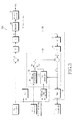
- FIG. 2 is a block diagram illustrating a decoder 200 according to an exemplary embodiment of the present invention
- FIG. 3 is a block diagram illustrating an encoder 300 according to an exemplary embodiment of the present invention.
- the same reference numerals are used to designate the same elements.
- the elements indicated by a reference numeral 100 is commonly included in the decoder 200 and the encoder 300 according to an H.264 standard. Accordingly, in the present invention, the same elements will not be described again to avoid redundancy, and the decoder 200 will be described as an illustrate example for both cases.
- the decoder 200 includes an entropy decoding unit 10, a reordering unit 20, an inverse quantization unit 30, an Inverse Discrete Cosine Transform (IDCT) 40, an intra/inter data prediction unit 50, and an in-loop deblocking filter 90.
- the entropy decoding unit 10 receives a Network Abstraction Layer (NAL), which is a compressed bitstream, and performs entropy decoding.
- NAL Network Abstraction Layer
- the reordering unit 20 reorders the data into groups, and the inverse quantization unit 30 inverse-quantizes the data output from the reordering unit 20, and finally the IDCT 40 performs inverse discrete cosine transform for the inverse-quantized data.
- NAL Network Abstraction Layer
- the intra/inter data prediction unit 50 performs and compensates for intra prediction or inter prediction, and the in-loop deblocking filter 90 removes errors occurring in the inverse quantization process.
- the intra/inter data prediction unit 50 includes an intra prediction unit 60 for performing intra prediction, and a MC unit 70 for performing inter prediction.
- the MC unit 70 includes an interpolator 500 for interpolating an image in order to perform more precise MC.
- the interpolator 500 performs half-pel interpolation, quarter-pel interpolation, and eight-pel interpolation.
- the interpolator 500 When performing chroma interpolation for an ME, the interpolator 500 must use four integer samples, and calculates fractional-pels from the four integer samples.
- FIG. 4 illustrates a method of calculating the central point k value and half-pel values from the four integer samples A to D, and the central point k value is calculated through Equation 1 below.
- K round tg ⁇ A + B + C + D / 4
- the k represents the central point calculated by linearly interpolating the four integer samples. That is, the central point k can be calculated by applying the average value of the four integer samples to rounding function in one interpolation block. The central point k is calculated through three instances of addition and one time of shifting. The operator "round” is an operator used for rounding off the average value of the four integer samples.
- each half-pel value is calculated through Equation 2 below.
- Equation 2 the b, i, m and t each half-pel points.
- the half-pel is calculated through one time of addition and one time of shifting.
- the interpolator 500 calculates half-pels located in a row direction and a column direction of the four integer samples by rounding the average of integer samples belonging to each row and each column.
- a to D denote integer pixels, i.e. pixels obtained through decoding
- b, i, m and t denote pixels obtained through 1/2 interpolation.
- FIG. 5 is a diagram illustrating a method for interpolating values of 1/4 positions.
- the a, c, d, h, n, r, s and u denote pixels calculated through 1/4 interpolation, which will be referred to as quarter-pels. That is, the interpolator 500 performs 1/4 interpolation based on Equation 3 below.
- Equation 3 the e, g, o and q denote secondary central point value, and the f, j, I and p denote quarter-pels.
- the e, g, o and q are calculated by averaging adjacent four points in the same way as that for obtaining the central point k. Otherwise, the e, g, o and q are respectively calculated by applying the average of each of the four integer samples A to D and the primary central point k to rounding function.
- the secondary central points are respectively located in the centers of each of the four integer samples and the primary central point k.
- the e, g, o and q values may also be calculated through interpolation from the upper left to the lower right direction or from the upper right to the lower left direction.
- a process for obtaining the e, g, o and q will be described.
- the b, i and k must be first calculated.
- the b and i are calculated through one time of addition and one time of shifting as expressed by Equation 2, and the k is calculated through three instances of addition and one time of shifting.
- the four A, b, i and k values are averaged to calculate the e.
- averaging the four values a total of eight instances of addition and four instances of shifting are required because three instances of addition and one time of shifting are added.
- the quarter-pels may be classified as the a, c, d, h, n, r, s and u corresponding to the edges of the reference partition, and the f, j, I and p corresponding between the primary central point and the half-pel inside the reference partition.
- the a, c, d, h, n, r, s and u are calculated through the following scheme.
- Such quarter-pels are obtained by performing a linear interpolation by using the integer samples and the calculated half-pels.
- the b must be first calculated in order to calculate the a.
- the b can be calculated through one time of addition and one time of shifting as expressed by Equation 2.
- the a is calculated through a total of two instances of addition and two instances of shifting because one time of addition and one time of shifting are added to calculate the b.
- the f, j, l and p can be respectively calculated by calculating values of the points in both sides and averaging the values. For example, in order to calculate the f, a total of five instances of addition and three instances of shifting are required because the b and k must be calculated, and the two calculated values must be averaged.
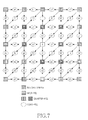
- FIGs. 6 and 7 are diagrams illustrating 1/8 interpolation operation according to the present invention.
- the interpolator 500 can perform the 1/8 interpolation by using one of the methods illustrated in FIGs. 6 and 7.
- FIG. 6 illustrates a method of performing the 1/8 interpolation by using pixels in the diagonal direction from the upper left to lower right
- FIG. 7 illustrates a method for performing the 1/8 interpolation by using pixels in the diagonal direction from the upper right to lower left.
- the quarter-pels the four point values are averaged in consideration of accuracy when calculating the e, g, o and q values.
- the two point values are averaged in a diagonal in order to considerably reduce operation overhead. In order to improve the accuracy, even though the operation amount increases, it may also possible to calculate an average of four adjacent values.
- interpolation for each pixel constituting one reference partition (i.e. interpolation block) illustrated in FIG. 4 may be divided into a total of three stages.
- the present invention can subdivide the construction of the interpolator 500.
- the detailed construction of the interpolator 500 is not shown, but it can be largely divided into three parts according to operation stages. Since the half-pels including the central point k are subjected to a predetermined operation by using only values of given integer pixels, it belongs to the first stage.
- the predetermined operation is performed by a 1/2 interpolation operation unit within the interpolator 500.
- the operation in the second stage using the operation results in the first stage is performed by a 1/4 interpolation operation unit, and the operation in the third stage using the operation results in the second stage is performed by a 1/8 interpolation operation unit. From the results of the operation in the first stage, the 1/2 interpolation operation unit of the interpolator 500 can obtain the central points and half-pels corresponding to the k, b, i, m and t.
- the 1/4 interpolation operation unit of the interpolator 500 can obtain the quarter-pels, which are indicated by the edges a, c, d, h, n, r, s and u of the reference partition and the f, j, I and p corresponding to the inside of the reference partition, and the secondary central points e, g, o and q.
- the 1/8 interpolation operation unit of the interpolator 500 can obtain eight-pels a1, b1, c1, d1, etc., indicated by ovals in FIGs. 6 and 7.
- the eight-pels can be largely classified into 13 types.
- the a1 can be obtained by calculating the a (two instances of addition and two instances of shifting) and then performing averaging (one time of addition and one time of shifting). In short, a total of three instances of addition and three instances of shifting are required.
- the b1 can be obtained by calculating the a (two instances of addition and two instances of shifting), the b (one time of addition and one time of shifting), and then averaging the a and b (one time of addition and one time of shifting). In short, a total of four instances of addition and four instances of shifting are required.
- the i1 can be obtained by calculating the f (five instances of addition and three instances of shifting), the b (one time of addition and one time of shifting), and then averaging the f and b (one time of addition and one time of shifting). In short, a total of seven instances of addition and five instances of shifting are required.
- the g1 can be obtained by calculating the a (two instances of addition and two instances of shifting), the e (eight instances of addition and four instances of shifting), then averaging the g1 and e (one time of addition and one time of shifting). In short, a total of eleven instances of addition and seven instances of shifting are required.
- the o1 can be obtained by calculating the f (five instances of addition and three instances of shifting), the e (eight instances of addition and four instances of shifting), then averaging the o1 and e (one time of addition and one time of shifting). In short, a total of fourteen instances of addition and eight instances of shifting are required.
- the f1 can be obtained by calculating the e (eight instances of addition and four instances of shifting), and then averaging the f1 and A (one time of addition and one time of shifting). In short, a total of nine instances of addition and five instances of shifting are required.
- the h1 can be obtained by calculating the a (two instances of addition and two instances of shifting), the f (five instances of addition and three instances of shifting), then averaging the a and f (one time of addition and one time of shifting). In short, a total of eight instances of addition and six instances of shifting are required.
- the j1 can be obtained by calculating the b (one time of addition and one time of shifting), the g (eight instances of addition and four instances of shifting), then averaging the b and g (one time of addition and one time of shifting). In short, a total of ten instances of addition and six instances of shifting are required.
- the u1 can be obtained by calculating the e (eight instances of addition and four instances of shifting), the k (three instances of addition and one time of shifting), then averaging the e and k (one time of addition and one time of shifting). In short, a total of twelve instances of addition and six instances of shifting are required.
- the w1 can be obtained by calculating the f (five instances of addition and three instances of shifting), the I (five instances of addition and three instances of shifting), then averaging the f and I (one time of addition and one time of shifting). In short, a total of eleven instances of addition and seven instances of shifting are required.
- the 12 can be obtained by calculating the r (two instances of addition and two instances of shifting), the I (five instances of addition and three instances of shifting), then averaging the r and I (one time of addition and one time of shifting). In short, a total of eight instances of addition and six instances of shifting are required.
- the s2 can be obtained by calculating the n (two instances of addition and two instances of shifting), the s (two instances of addition and two instances of shifting), then averaging the n and s (one time of addition and one time of shifting). In short, a total of five instances of addition and five instances of shifting are required.
- the v1 can be obtained by calculating the f (five instances of addition and three instances of shifting), the k (three instances of addition and one time of shifting), then averaging the f and k (one time of addition and one time of shifting). In short, a total of nine instances of addition and five instances of shifting are required.
- the operation amount can be reduced up to maximum 27%.
- the total 904 instances of operation is performed, and the operation amount can be reduced up to maximum 27% based on the total number of operations.
- the multiplication operation of the existing method requires a clock cycle which is at least twice as fast as that used in a simple addition or subtraction in a typical processor, the reduced operation amount reaches about 51%.
- central points are obtained within a reference partition, and a linear interpolation including addition and subtraction is performed using the central points, so that operation amount can be considerably reduced.
- an H.264 system can be expanded and applied to various fields including a terminal, etc.
Landscapes
- Engineering & Computer Science (AREA)
- Multimedia (AREA)
- Signal Processing (AREA)
- Physics & Mathematics (AREA)
- General Physics & Mathematics (AREA)
- Pure & Applied Mathematics (AREA)
- Mathematical Analysis (AREA)
- Mathematical Optimization (AREA)
- Computational Mathematics (AREA)
- Data Mining & Analysis (AREA)
- Mathematical Physics (AREA)
- Theoretical Computer Science (AREA)
- Algebra (AREA)
- Databases & Information Systems (AREA)
- Software Systems (AREA)
- General Engineering & Computer Science (AREA)
- Compression Or Coding Systems Of Tv Signals (AREA)
- Image Processing (AREA)
Applications Claiming Priority (1)
| Application Number | Priority Date | Filing Date | Title |
|---|---|---|---|
| KR1020060102062A KR100800761B1 (ko) | 2006-10-19 | 2006-10-19 | 계산량을 최소화하는 색차 신호의 보간 방법 및 장치 |
Publications (1)
| Publication Number | Publication Date |
|---|---|
| EP1919212A1 true EP1919212A1 (fr) | 2008-05-07 |
Family
ID=39183173
Family Applications (1)
| Application Number | Title | Priority Date | Filing Date |
|---|---|---|---|
| EP07118862A Withdrawn EP1919212A1 (fr) | 2006-10-19 | 2007-10-19 | Procédé et appareil d'interpolation d'un signal de chrominance pour minimiser un en-tête d'opération |
Country Status (3)
| Country | Link |
|---|---|
| US (1) | US20080095471A1 (fr) |
| EP (1) | EP1919212A1 (fr) |
| KR (1) | KR100800761B1 (fr) |
Cited By (1)
| Publication number | Priority date | Publication date | Assignee | Title |
|---|---|---|---|---|
| CN101888558A (zh) * | 2010-06-18 | 2010-11-17 | 北京中星微电子有限公司 | 一种色度插值方法和装置 |
Families Citing this family (3)
| Publication number | Priority date | Publication date | Assignee | Title |
|---|---|---|---|---|
| KR101259576B1 (ko) * | 2009-06-25 | 2013-04-30 | 창원대학교 산학협력단 | Bps 수신장치 |
| CN102026005B (zh) * | 2010-12-23 | 2012-11-07 | 芯原微电子(北京)有限公司 | 用于h.264色度内插计算的操作方法 |
| KR101956284B1 (ko) * | 2011-06-30 | 2019-03-08 | 엘지전자 주식회사 | 보간 방법 및 이를 이용한 예측 방법 |
Citations (2)
| Publication number | Priority date | Publication date | Assignee | Title |
|---|---|---|---|---|
| US6628327B1 (en) | 1997-01-08 | 2003-09-30 | Ricoh Co., Ltd | Method and a system for improving resolution in color image data generated by a color image sensor |
| EP1675406A2 (fr) | 2004-12-21 | 2006-06-28 | STMicroelectronics, Inc. | Méthode et système pour l'éxecution rapide d'interpolation de sous-pixels |
Family Cites Families (7)
| Publication number | Priority date | Publication date | Assignee | Title |
|---|---|---|---|---|
| US5628327A (en) * | 1994-12-15 | 1997-05-13 | Imarx Pharmaceutical Corp. | Apparatus for performing biopsies and the like |
| JP2000165883A (ja) | 1998-11-27 | 2000-06-16 | Matsushita Electric Ind Co Ltd | 動きベクトル検出装置 |
| US6751363B1 (en) * | 1999-08-10 | 2004-06-15 | Lucent Technologies Inc. | Methods of imaging based on wavelet retrieval of scenes |
| US6950469B2 (en) * | 2001-09-17 | 2005-09-27 | Nokia Corporation | Method for sub-pixel value interpolation |
| KR100472476B1 (ko) * | 2002-08-31 | 2005-03-10 | 삼성전자주식회사 | 움직임 보상을 위한 보간 방법 및 그 장치 |
| US6993166B2 (en) * | 2003-12-16 | 2006-01-31 | Motorola, Inc. | Method and apparatus for enrollment and authentication of biometric images |
| KR100656644B1 (ko) * | 2004-12-22 | 2006-12-11 | 엘지전자 주식회사 | 영상압축에서의 움직임 보상을 위한 화면간 보간장치 |
-
2006
- 2006-10-19 KR KR1020060102062A patent/KR100800761B1/ko not_active Expired - Fee Related
-
2007
- 2007-09-26 US US11/904,058 patent/US20080095471A1/en not_active Abandoned
- 2007-10-19 EP EP07118862A patent/EP1919212A1/fr not_active Withdrawn
Patent Citations (2)
| Publication number | Priority date | Publication date | Assignee | Title |
|---|---|---|---|---|
| US6628327B1 (en) | 1997-01-08 | 2003-09-30 | Ricoh Co., Ltd | Method and a system for improving resolution in color image data generated by a color image sensor |
| EP1675406A2 (fr) | 2004-12-21 | 2006-06-28 | STMicroelectronics, Inc. | Méthode et système pour l'éxecution rapide d'interpolation de sous-pixels |
Non-Patent Citations (2)
| Title |
|---|
| SIHVO T ET AL: "H.264/AVC interpolation optimization", SIGNAL PROCESSING SYSTEMS DESIGN AND IMPLEMENTATION, 2005. IEEE WORKSHOP ON ATHENS, GREECE NOVEMBER 2 - 4, 2005, PISCATAWAY, NJ, USA,IEEE, 2 November 2005 (2005-11-02), pages 307 - 312, XP010882587, ISBN: 0-7803-9333-3 * |
| SIHVO, T. ET AL.: "H.264/AVC interpolation optimization," Signal Processing Systems Design and Implementation", IEEE WORKSHOP ON ATHENS, 2005, pages 307 - 312 |
Cited By (2)
| Publication number | Priority date | Publication date | Assignee | Title |
|---|---|---|---|---|
| CN101888558A (zh) * | 2010-06-18 | 2010-11-17 | 北京中星微电子有限公司 | 一种色度插值方法和装置 |
| CN101888558B (zh) * | 2010-06-18 | 2016-02-10 | 无锡中感微电子股份有限公司 | 一种色度插值方法和装置 |
Also Published As
| Publication number | Publication date |
|---|---|
| US20080095471A1 (en) | 2008-04-24 |
| KR100800761B1 (ko) | 2008-02-01 |
Similar Documents
| Publication | Publication Date | Title |
|---|---|---|
| US11107251B2 (en) | Image processing device and method | |
| US6539056B1 (en) | Picture decoding method and apparatus | |
| US6839386B2 (en) | Picture decoding method and apparatus using a 4×8 IDCT | |
| EP2001239B1 (fr) | Appareil de codage d'image et appareil de decodage d'image | |
| US6748018B2 (en) | Picture decoding method and apparatus | |
| US8498338B1 (en) | Mode decision using approximate ½ pel interpolation | |
| US7212573B2 (en) | Method and/or apparatus for determining minimum positive reference indices for a direct prediction mode | |
| EP1766992A1 (fr) | Methode de compensation de mouvement | |
| US20120281765A1 (en) | Motion compensating apparatus | |
| JP5581688B2 (ja) | 画像処理装置および方法、並びにプログラム | |
| US20100086048A1 (en) | System and Method for Video Image Processing | |
| JP2011229145A (ja) | 符号化ユニットにおける動画符号化においてハイブリッド多仮説予測を行う方法、および関連装置 | |
| EP1919213B1 (fr) | Procédé d'interpolation d'un signal de chrominance dans un codeur et décodeur vidéo | |
| EP1919212A1 (fr) | Procédé et appareil d'interpolation d'un signal de chrominance pour minimiser un en-tête d'opération | |
| US20120121019A1 (en) | Image processing device and method | |
| US7958177B2 (en) | Method of parallelly filtering input data words to obtain final output data words containing packed half-pel pixels | |
| US6580830B1 (en) | Picture decoding method and apparatus | |
| US6493391B1 (en) | Picture decoding method and apparatus | |
| US8588305B2 (en) | Two-dimensional interpolation architecture for motion compensation in multiple video standards | |
| US20070133689A1 (en) | Low-cost motion estimation apparatus and method thereof | |
| US6549670B1 (en) | Picture decoding method and apparatus | |
| US20120300844A1 (en) | Cascaded motion compensation | |
| EP1056295B1 (fr) | Dispositif arithmetique de filtrage | |
| US20120300838A1 (en) | Low resolution intra prediction | |
| AU2007237319B2 (en) | Method for sub-pixel value interpolation |
Legal Events
| Date | Code | Title | Description |
|---|---|---|---|
| PUAI | Public reference made under article 153(3) epc to a published international application that has entered the european phase |
Free format text: ORIGINAL CODE: 0009012 |
|
| 17P | Request for examination filed |
Effective date: 20071019 |
|
| AK | Designated contracting states |
Kind code of ref document: A1 Designated state(s): AT BE BG CH CY CZ DE DK EE ES FI FR GB GR HU IE IS IT LI LT LU LV MC MT NL PL PT RO SE SI SK TR |
|
| AX | Request for extension of the european patent |
Extension state: AL BA HR MK RS |
|
| 17Q | First examination report despatched |
Effective date: 20080612 |
|
| AKX | Designation fees paid |
Designated state(s): DE FR GB |
|
| STAA | Information on the status of an ep patent application or granted ep patent |
Free format text: STATUS: THE APPLICATION IS DEEMED TO BE WITHDRAWN |
|
| 18D | Application deemed to be withdrawn |
Effective date: 20100211 |