EP1919308B1 - Kleidungsstück mit verbesserter kniestütze - Google Patents
Kleidungsstück mit verbesserter kniestütze Download PDFInfo
- Publication number
- EP1919308B1 EP1919308B1 EP05855353A EP05855353A EP1919308B1 EP 1919308 B1 EP1919308 B1 EP 1919308B1 EP 05855353 A EP05855353 A EP 05855353A EP 05855353 A EP05855353 A EP 05855353A EP 1919308 B1 EP1919308 B1 EP 1919308B1
- Authority
- EP
- European Patent Office
- Prior art keywords
- person
- garment
- knee
- worn
- load
- Prior art date
- Legal status (The legal status is an assumption and is not a legal conclusion. Google has not performed a legal analysis and makes no representation as to the accuracy of the status listed.)
- Expired - Lifetime
Links
Images


Classifications
-
- A—HUMAN NECESSITIES
- A41—WEARING APPAREL
- A41D—OUTERWEAR; PROTECTIVE GARMENTS; ACCESSORIES
- A41D13/00—Professional, industrial or sporting protective garments, e.g. surgeons' gowns or garments protecting against blows or punches
- A41D13/05—Professional, industrial or sporting protective garments, e.g. surgeons' gowns or garments protecting against blows or punches protecting only a particular body part
- A41D13/06—Knee or foot
- A41D13/065—Knee protectors
-
- A—HUMAN NECESSITIES
- A41—WEARING APPAREL
- A41D—OUTERWEAR; PROTECTIVE GARMENTS; ACCESSORIES
- A41D1/00—Garments
- A41D1/06—Trousers
- A41D1/08—Trousers specially adapted for sporting purposes
-
- A—HUMAN NECESSITIES
- A41—WEARING APPAREL
- A41D—OUTERWEAR; PROTECTIVE GARMENTS; ACCESSORIES
- A41D31/00—Materials specially adapted for outerwear
- A41D31/04—Materials specially adapted for outerwear characterised by special function or use
- A41D31/18—Elastic
-
- A—HUMAN NECESSITIES
- A41—WEARING APPAREL
- A41D—OUTERWEAR; PROTECTIVE GARMENTS; ACCESSORIES
- A41D2400/00—Functions or special features of garments
- A41D2400/38—Shaping the contour of the body or adjusting the figure
Definitions
- the present invention relates to a garment with enhanced knee support.
- the knee is particularly vulnerable to injury. It is the joint between the two longest bones of the body, and the entire weight of the body is transferred to the foot through the knee.
- the knee is also more prone to injury because its stability decreases as it bends.
- the menisci and the ligaments provide less effective support to the bent knee.
- Most sports require walking or running, or some other similar motion like skating, as a component. These sports may require movements that cause lateral shifting of the knee joint (i.e., which may be the femur and tibia shifting relative to one another in opposite directions laterally to the normal plane of motion for the knee joint, or the femur and tibia shifting together laterally to the normal plane of motion of the knee joint), which can lead to injury.
- JP-A-2001-214303 relates to sports equipment comprising cylindrical knitted fabric to reduce muscular fatigue, prevention of a pulled muscle, rapture of or damage to ligament or tendon.
- the equipment comprises a trunk portion and a generally tubular leg portion, these portions comprising load transferring sections and base sections, the load transferring sections having higher resistance to strain than said base sections.
- the present invention endeavors to provide a garment that provides enhanced knee support for reducing such lateral shifting at the knee joint.
- One aspect of the present invention provides a garment for wearing on the lower body portion of a person, the lower body portion including the person's waist, hips, and at least one leg, the leg including an upper leg portion joined at one of the person's hips and a lower leg portion hingedly joined to the upper leg portion by a knee, the garment comprising: a trunk portion configured to be received over the person's waist and hips when the garment is worn by the person; a generally tubular leg portion extending downwardly from the trunk portion and configured to be received over the upper leg portion, knee, and at least a substantial portion of the lower leg portion of the person when the garment is worn by the person; the trunk portion and the leg portion comprising a plurality of load transferring sections separated by base sections, at least the base sections being stretchable and resilient so that the trunk portion and the leg portion are tightly fitted when the garment is worn by the person, the load transferring sections having a substantially higher resistance to tensile strain than the base sections; wherein said load transferring sections comprise:
- These load transferring sections cooperate to resist inward or outward lateral movement of the person's knee when the garment is worn by the person as a result of the connections between the inner and outer lateral portions of the knee load distribution ring and the upper anchor portion and the lower anchor portion.
- a garment 10 for wearing on the lower body portion of a person As is well known, a person's lower body portion includes the person's waist, hips, and one or two legs, and each leg includes an upper leg portion joined at one of the person's hips and a lower leg portion hingedly joined to the upper leg portion at a knee joint.
- This application does not endeavor to detail the anatomical structure of the person's lower body or knee joint, and reference may be made to various anatomical and medical reference texts for a complete description of such anatomical structure.
- the garment 10 is constructed to provide support to one or both of the knees for the person wearing the garment 10.
- the garment 10 is suitable for use by athletes, such as football players, skiers, runners, hockey players, etc., that are exposed to a high potential for knee damage from lateral movement injuries.
- athletes such as football players, skiers, runners, hockey players, etc.
- the garment 10 may find applicability to person's engaging in less physical types of sports or recreational activities, or it may be used by persons engaging in ordinary activities who desire for whatever reason to have enhanced knee support. It may be desirable for activities where repetition motion occurs, such as running.
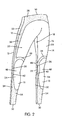
- the illustrated garment 10 includes a trunk portion 12 configured to be received over the person's waist and hips when the garment is worn by the person.
- the garment 10 also includes a pair of generally tubular leg portions 14 (one being for the right leg and one being for the left leg).
- Each leg portion 14 includes an upper leg section 13 and a lower leg portion 15.
- Each leg portion 14 extends downwardly from the trunk portion 12 and is configured to be received over the upper leg portion, knee, and at least a substantial portion of the lower leg portion of the person when the garment 10 is worn by the person.
- the trunk portion 12 may have any shape or configuration suitable to be received over the person's waist and hips.
- the trunk portion 12 has an open topped waist, and the garment 10 is worn similarly to a conventional set of tights.
- the garment 10 may be a full-body suit and the trunk portion 12 may be attached to a part that covers the person's upper body.
- a full-body garment may be desirable for downhill or cross-country skiers, as they are particularly susceptible to lateral movement knee injuries, and also tend to wear more clothing than athletes in other sports because of cold weather conditions.
- figure skaters, hockey players or speed skaters may desire a full body suit, as they also perform in cold conditions.
- the trunk portion 12 and the leg portions 14 include a plurality of load transferring sections separated by base sections.
- the various load transferring sections are discussed below, and in the illustrated embodiment the base sections account for the remainder of the garment 10.
- the area 16 covering the crotch, the areas 18 on the inner lateral part of the upper leg portions, the areas 20 on the rear of the upper leg portions, the open area 22 immediately in front of the knee's patella, and the areas 24 that cover the back of the lower leg portion and the back of the knee are all base sections.
- the base sections are stretchable and resilient so that the trunk portion 12 and the leg portions 14 are tightly fitted when the garment is worn by the person.
- the base sections are made of any stretchable fabric that provides a tight fit.
- An example of such a fabric is LYCRA, which is often used in athletic tights.
- Other examples include woven or knit fabrics designed to have elastic properties during normal use conditions, such as spandex.
- the load transferring sections are designed to have a substantially higher resistance to tensile strain than the base sections.
- the purpose of these load transferring sections is to resist lateral movement of the wearer's knees while minimizing any effect on the wearer's normal leg motion. This is achieved by strategically locating the load transferring sections such that they resist lateral movement of the wearer's knee more effectively than a garment made solely from the material comprising the base sections.
- the strategic placement of the load transferring sections is designed to minimize any detrimental effect on normal leg motion and athletic performance.
- Highly stretchable materials such as LYCRA or any other material that would be used for the base sections, are desirable in athletic garments because they do not impede normal movement of the legs and hence decreased athletic performance, but they are not very effective at providing support. If the entire garment 10, however, were made from a more resistive material, such as is used for the load transferring sections, there would be more resistance to normal leg movement and hence athletic performance.
- the load transferring portions have been strategically located to provide enhanced lateral support to the knee, but the remainder of the garment is still made from the base section material to minimize restriction to normal leg movement.
- the load transferring sections are designed to have a substantially higher resistance to tensile strain than the base sections, they likely will also have a higher resistance to heat transfer than the base sections. Since athletic movements (e.g., running, jumping, skating, etc.) typically generate a high amount of body heat, it is beneficial to use the strategic location of the load transferring sections so that support is provided to the knee, but allowing a substantial portion of the garment 10 to still be constructed of the base sections. This enables the garment 10 to more effectively allow the wearer's body to dissipate heat (this is often referred to as the garment's "breathing ability"). Different weight fabrics may be used for different applications. For example, a heavier weight material may be used for cold weather sports, and a lighter weight fabric may be used in a garment designed for warmer weather use.
- load transferring sections may be provided with this higher resistance to tensile strain either by being made from a different material with a higher Young's modulus, or by using the same material as the base section, but providing the load transferring sections with a thicker cross-sectional area and hence a higher resistance to tensile strain.
- Examples of such a material with a higher Young's modulus include neoprene, nylon non-stretch fabrics, etc.
- the load transferring sections have some resiliency or stretchability to ensure that they tightly fit against the wearer, but not necessarily as much resiliency or stretchability as the base sections.
- the load transferring sections have a low resiliency, the resiliency of the base sections can be used for tightly fitting the load transferring sections against the wearer's body.
- the load transferring sections comprise a knee load distributing ring 26 for each leg portion 14, an upper anchor portion 28, a lower anchor ring 30 for each leg portion 14, lower lateral support portions 32, 34 for each leg portion 14, a main support band 36 for each leg portion 14, and a transverse support band 38 for each leg portion 14.
- the knee load distributing ring 26 is provided on a front portion of the leg portion 14.
- the knee load distributing ring 26 is configured to surround a front of the person's knee as illustrated when the garment 10 is worn by the person.
- inner and outer lateral portions 40, 42 of the ring extend on opposing inner and outer lateral sides of the person's leg adjacent the knee; and upper and lower portions 44, 46 of the ring 26 extend above and below the person's knee, respectively, to connect the inner and outer lateral portions 40, 42.
- the ring 26 is not part of a sleeve that is made entirely of a highly resistive material and surrounds the whole leg just at the knee, which is an approach used in some devices such as knee sleeves made from NEOPRENE.
- the leg portions 14 are preferably devoid of the load transferring sections in the rear knee areas 48 that are positioned directly opposite the person's knee when the garment is worn by the person.
- the central opening in the ring 26 is preferably devoid of the load transferring sections. This construction allows the knee to be bent in a normal manner without the resistance that would be encountered if the load transferring sections occupied these areas.
- open center of the ring 26 allows the patella protrude slightly forward therethough when the leg is bent in a normal running or walking motion (i.e., where the upper and lower flex in essentially the same plane about the knee joint). Likewise, removing any load transferring material from the rear of the knee joint prevents reduces the restriction in motion that are seen in most "sleeve" type devices.
- the upper anchor portion 28 is provided on the trunk portion 12 (or possibly the upper leg section).
- the upper anchor portion 28 is configured to be received tightly on the person's hip when the garment 10 is worn by the person. In the illustrated embodiment, this is achieved by the upper anchor portion 28 including or being part of an upper waist ring 50 configured to surround the person's waist tightly when the garment is worn by the person: A pair of relatively wide connection portions 52 extend downwardly from the upper waist ring 50.
- the purpose of the upper anchor portion 28 is to provide a connection point for the main support band 36 and any other load transferring sections that may be connected to it. This connection allows those sections to resist movement along the wearer's leg better, and when a tensile load is applied to those sections, it can be transferred to the upper anchor portion 28 for increased resistance to movement.
- the tight fit of the upper anchor portion 28 provided by the upper waist ring 50 provides a sufficiently stable connection point.
- the waist ring 50 may be omitted, and separate upper anchor portions could be provided on the opposing lateral side of the wearer's hips. These upper anchor portions would preferably be tightly fitted to the wearer's hips and have a sufficiently large surface area such that free sliding movement of these anchor portions would be reduced or minimized. This alternative arrangement would also provide a suitably stable connection point.
- the lower anchor rings 30 are provided on the leg portion 14 and are configured to tightly surround a portion of the person's lower leg substantially below the knee when the garment 10 is worn by the person. These rings 30 are preferably located to surround the wearer's ankles, but may be located higher up on the wearer's calf. As an alternative, they may be supplemented with stirrups to pass under the wearer's feet to help keep the garment 10 fully stretched and tightly fitted on the wearer. Similarly to the upper anchor portion 28, the purpose of these lower anchor rings 30 is to provide a connection point for the lower lateral support portions 32, 34 and any other load transferring sections that may be connected to it.
- connection allows those sections to resist movement along the wearer's leg better, and when a tensile load is applied to those sections, it can be transferred to the respective lower anchor ring 30 for increased resistance to movement.
- the tight fit of the lower anchor rings 30 provides a sufficiently stable connection point.
- the lower anchor rings may provide support to the wearer's Achilles tendon.
- any suitable lower anchor portion sewn substantially below the knee may be used.
- stirrups secured by passing under a wearer's foot may be used.
- the lower lateral support portions 32, 34 extend downwardly along the inner and outer lateral sides of the person's lower leg portion, respectively, when the garment is worn by the person. They connect the inner and outer lateral portions 40, 42 of the knee load distribution rings 26 to the lower load anchor rings 30. As illustrated, the lower lateral support portions 32, 34 extend along the inner and outer lateral sides of the garment's lower leg portion 15 from the region where the inner and outer lateral portions 40, 42 meet the lower portions 46 of the rings 26. They connect to the lower anchor rings 30 at the laterals sides thereof. Specifically, the lower anchor rings 30 have a rear connection portion 54 that extends upwardly along the rear portion of the garment's lower leg portion 15, and the lower lateral support portions 32, 34 curve slightly rearwardly to connect with those rear connection portions 54.
- the main support bands 36 extend upwardly along the outer lateral side of the person's upper leg portion when the garment 10 is worn by the person. These bands 36 connect the outer later portions 42 of the knee load distribution rings 26 to the upper anchor portion 28. As illustrated, these bands 36 merge with and connect to the connection portions 52 of the upper anchor portion 28 and extend along the outer lateral sides of the garment's upper leg portions 13 to the region where the outer lateral portions 42 meet the upper portions 46 of the knee load distributing 26. In the illustrated embodiment, the transition in this region is such that the main support bands 26, the outer lateral portions 42, and the outer lower lateral support portions 34 are formed continuously together, as can be seen in the Figures.
- the transverse support bands 38 extend generally transversely across a rear portion of the person's upper leg portion when the garment is worn by the person. These transverse support bands 38 connect the inner lateral portions 40 of the knee load distribution rings 26 to the main support bands 36. In the illustrated embodiment, these bands 38 extend from the areas where the inner lateral portions 40 and the upper portions 46 of the knee load distributing ring 26 meet, and traverse across the back of the upper leg portions 13 to join with the main support bands 36 approximately 1/3 of the way up the upper leg portions 13. As illustrated, these bands 38 intersect the main support bands 36 at approximately a 90 degree angle, and have a slight curvature extending upwardly from their connections with the knee load distributing rings 26. This curvature may optionally help to maintain correct positioning of the bands 38 below the hamstring so that the hamstring is not compressed or restricted.
- the knee pushes inward against the inner lateral portion 40 of the knee load distributing ring 26.
- the inward movement of the inner lateral portion 40 is resisted by a portion of the load being transferred in tension to the transverse support band 38 and the inner lower lateral support portion 32, which in turn may transfer that portion of the load to the main support band 36 and the lower anchor ring 30.
- the main support band 36 in turn may transfer that portion of the load from the transverse support band 38 to the upper anchor portion 28.
- the inward movement of the inner lateral portion 40 is also resisted by a portion of the load being transferred in tension to the upper and lower portions 44, 46 of the knee load distributing ring 26, which in turn transfers their portion of the load to the main support band 36 and outer lower lateral support portion 34 by their connections to the ring 26.
- These portions 36 and 34 likewise may transfer that portion of load to the lower anchor ring 30 and the upper anchor portion 28.
- the extent of the load transfer is generally a function of the load applied and the materials used.
- the knee pushes outward against the outer lateral portion 42 of the knee load distributing ring 26.
- the outward movement of the outer lateral portion 42 is resisted by a portion of the load being transferred in tension to the main support band 36 and the outer lower lateral support portion 34, which in turn may transfer that portion of the load to the upper anchor portion 28 and the lower anchor ring 30.
- the outward movement of the outer lateral portion 42 is also resisted by a portion of the load being transferred in tension to the upper and lower portions 44, 46 of the knee load distributing ring 26, which in turn may transfer their portion of the load to the transverse support band 38 and the inner lower lateral support portion 32 by their connections to the ring 26.
- the main support band 36 in turn may transfer that portion of the load from the transverse support band 38 to the upper anchor portion 28.
- the extent of the load transfer is generally a function of the load applied and the materials used.
- these load supporting sections function as a 4-point support system that efficiently and effectively resists either inner or outer lateral shifting movement of the knee by supporting the inner and outer lateral portions 40, 42 of the ring 26 against such lateral movement, and transferring load by various paths to the more stable upper anchor portion 28 and lower anchor ring 30.
- the effectiveness of this supporting function is enhanced and knee injuries resulting from lateral shifting motion can be reduced.
- the remainder of the garment 10 can be made of a more resilient material, thus minimizing any effect on athletic performance.
- connection points for the knee load distributing ring 26 also helps to keep the ring 26 properly positioned (i.e., centered on the knee).
- these load transferring sections may be arranged in any suitable manner to provide support to the knee load distributing ring 26.
- the sections may be thinner or thicker, or otherwise have different configurations, or be arranged on the garment 10 differently from that shown in the figures.
- the arrangement, configuration and/or load bearing characteristics of the load transferring sections may be tailored as desired. In sports such as football, where athletes often change running directions dramatically in mid-stride, and often on unforgiving surfaces such as artificial turf, it may be beneficial to increase the support provided to the knee supporting ring 26.
- the support provided to the knee supporting ring 26 could be reduced by using smaller or less strong transferring sections to allow for freer movement of the legs while still providing some support.
- load transferring sections can be used to provide further support to the knee load distributing ring 26. These are discussed below.
- the load transferring sections may include a plurality of upper supplemental bands 56, 58, 60 spaced apart from one another. These bands 56, 58, 60 extend upwardly along a front of the person's upper leg portions when the garment 10 is worn by the person. Specifically, they extend along the upper leg portions 13 of the garment 10 and connect the upper portions 44 of the knee load distribution rings 26 to the upper anchor portions 28. In the illustrated embodiment, bands 56 and 58 connect directly to the connecting portions 52 of the upper anchor portions 28, and bands 60 are indirectly connected to the connecting portions 52 by being connected to an upper part of each main supporting band 36.
- supplemental bands 56, 58, 60 assist in properly locating the knee supporting rings 26 about the wearer's knees, and keep the upper portions 44 of the rings 26 relatively taut so that they can effectively transfer load between the inner and outer lateral portions 40, 42 as discussed above. Further, when there is lateral knee shifting, and the upper portion 44 is subject to tension, these support bands 56, 58, 60 help prevent the upper portion 44 of the ring 26 from straightening from its curved configuration. That is, if the upper portion 44 were allowed to straighten significantly when subject to tension, it may not effectively transfer the lateral loading to the opposing lateral portion 40 or 42 and to the main support or transverse bands 36, 38 (or the effectiveness may be reduced).
- the load transferring sections may include a plurality of lower supplemental bands 62, 64 spaced apart from one another. These bands 62, 64 extend upwardly along a front of the person's lower leg portions when the garment 10 is worn by the person. Specifically, these bands 62, 64 extend along the front of the garment's lower leg portions 15 and connect the lower portions 46 of the knee load distribution rings 26 to the lower anchor rings 30.
- these lower supplemental bands 62, 64 function to assist in properly locating the knee supporting rings 26 about the wearer's knees, and keep the lower portions 46 of the rings 26 relatively taut so that they can effectively transfer load between the inner and outer lateral portions 40, 42 as discussed above. Further, when there is lateral knee shifting, and the lower portion 46 is subject to tension, these support bands 60, 62 help prevent the lower portion 46 of the ring 28 from straightening from its curved configuration. That is, as with the upper portion 44, if the lower portion 46 were allowed to straighten significantly when subject to tension, it may not effectively transfer the lateral loading and resist lateral movement (or the effectiveness may be reduced).
- this effect could be achieved with one lower supplemental band, and thus this optional feature can encompass any arrangement with at least one lower supplemental band.
- these sections could each be replaced with one continuous load transferring section that extends along the front and lateral sides of the lower leg portion 15 of the garment 10 and connects to the lower anchor ring 30.
- the lateral sides of this section would be regarded as the lower lateral support portions 32, 34, as they would still be the portions transferring the load to the lower anchor ring 30.
- the function of the lower supplemental bands 60, 62 would be performed by the front center portion of such a section, which would still assist with preventing straightening of the lower portion 46 of the ring 26.
- the lower anchor rings 30 may appear to be continuous with that section, and may be not be separately identifiable from an aesthetics standpoint.
- the lower end of the section that encircles the wearer's leg would still be regarded as a lower anchor ring as it still encircles the leg and assists in resisting movement of the remainder of the section, and in turn the knee load distributing ring 28.
- the base sections and load transferring sections of the garment 10 may be assembled together in any suitable way.
- the entire garment 10 may be made from the base section, such as LYCRA, and the load transferring sections would be laminated onto the garment 10 by any suitable heat bonding or chemical bonding operation, or by a mechanical connection such as stitching.
- the base sections and load transferring sections could be provided in individual sections or panels and assembled together at their edges. The first approach is preferred because it is easier and more cost-effective from a manufacturing standpoint, and because garments made entirely of the base sections, such as those made from LYCRA, are widely commercially available.
- the garment 10 illustrated in the Figures has two legs, it is within the scope of the invention to create a one-legged embodiment. This may be desirable for different applications. For example, a person entering rehabilitation after a recent leg amputation may benefit from the knee support provided by the garment to his/her remaining leg, particularly if he/she is in the rehabilitation process and is adjusting to moving about on one leg with the assistance of crutches. Likewise, a football kicker or punter may benefit from a one-legged garment, as he may desire to have one-leg completely free from the garment for kicking purposes.
- kickers and punters occasionally must engage in physical contact in the course of a football game by making tackles, being blocked the opposing team, or executing fake punts or kicks, and may benefit from having the added support on the non-kicking leg.
- kickers and punters place themselves in a very vulnerable position when opposing players attempt to block their kicks, as they are typically supporting themselves only on their non-kicking leg at that time.
- Added knee support can be beneficial if the opposing player inadvertently knocks the kicker or punter off-balance as part of an attempt to block a kick.
Landscapes
- Engineering & Computer Science (AREA)
- Textile Engineering (AREA)
- Health & Medical Sciences (AREA)
- General Health & Medical Sciences (AREA)
- Physical Education & Sports Medicine (AREA)
- Professional, Industrial, Or Sporting Protective Garments (AREA)
- Undergarments, Swaddling Clothes, Handkerchiefs Or Underwear Materials (AREA)
- Details Of Garments (AREA)
Claims (9)
- Kleidungsstück (10) zum Tragen an der Unterkörperpartie einer Person, wobei zu der Unterkörperpartie die Taille, die Hüften und zumindest ein Bein der Person zählt, wobei zu dem Bein eine Oberschenkelpartie, das an einer der Hüften der Person angelenkt ist und eine Unterschenkelpartie, die durch ein Kniescharnier an der Oberschenkelpartie angelenkt ist, zählt, wobei das Kleidungsstück umfasst:- eine Torsopartie (12), die ausgestaltet ist, um über der Taille und den Hüften der Person aufgenommen zu werden, wenn das Kleidungsstück von der Person getragen wird;- eine im Allgemeinen röhrenförmige Beinpartie (14), die sich von der Torsopartie (12) abwärts erstreckt und ausgestaltet ist, um über der Oberschenkelpartie, dem Knie und zumindest einer wesentlichen Partie der Unterschenkelpartie der Person aufgenommen zu werden, wenn das Kleidungsstück (10) von der Person getragen wird;- die Torsopartie (12) und die Beinpartie (14), umfassend eine Vielzahl an Last übertragenden, in Basisabschnitte (16, 18, 20, 22, 24) unterteilte Abschnitten, wobei zumindest die Basisabschnitte (16, 18, 20, 22, 24) dehnbar und nachgiebig sind, so dass die Torsopartie (12) und die Beinpartie (14) formschlüssig sind, wenn das Kleidungsstück von der Person getragen wird, wobei die Last übertragenden Abschnitte einen wesentlich höheren Widerstand bei Zugbeanspruchung aufweisen als die Basisabschnitte (16, 18, 20, 22, 24);
wobei die Last übertragenden Abschnitte umfassen:(a) einen an einer Vorderpartie der Beinpartie (14) vorgesehenen Ring (26) zur Verteilung der Knielast, wobei der Ring (26) zur Verteilung der Knielast so ausgelegt ist, dass er eine Vorderseite des Knies der Person umgibt, wenn das Kleidungsstück (10) von der Person getragen wird, wobei sich innere bzw. äußere Seitenpartien (40, 42) des Rings (26) auf einander entgegengesetzte innere bzw. äußere Seiten des Beins der Person in Knienähe erstrecken und obere bzw. untere Partien (44, 46) des Rings (26) oberhalb bzw. unterhalb des Knies der Person erstrecken, um die inneren und äußeren Seitenpartien (40, 42) zu verbinden:(b) eine auf der Torso- oder der Beinpartie (12, 14) vorgesehene obere Verankerungspartie (28), wobei die obere Verankerungspartie (28) im Wesentlichen oberhalb des Knies der Person gesichert ist, wenn das Kleidungsstück (10) von der Person getragen wird;(c) eine auf der Beinpartie (14) vorgesehene untere Verankerungspartie (30), wobei die untere Verankerungspartie (30) so ausgelegt ist, dass sie im Wesentlichen unterhalb des Knies der Person gesichert ist, wenn das Kleidungsstück (10) von der Person getragen wird;(d) unteren Seitenstützpartien (32, 34), die sich seitlich abwärts entlang der Innen- bzw. Außenseiten der unteren Beinpartie der Person erstrecken, wenn das Kleidungsstück (10) von der Person getragen wird und die die inneren und äußeren Seitenpartien (40, 42) des Rings (26) zur Verteilung der Knielast mit der unteren Verankerungspartie (30) verbinden;(e) ein langgestrecktes Primärstützband (36), das sich auf der Seite aufwärts entlang der seitlichen Oberschenkelpartie der Person erstreckt, wenn das Kleidungsstück von der Person getragen wird und das die äußere Seitenpartie (42) des Rings (26) zur Verteilung der Knielast mit der oberen Verankerungspartie (28) verbindet; und(f) ein langgestrecktes Querstützband (38), das sich im Allgemeinen quer über eine rückseitige Partie der Oberschenkelpartie der Person erstreckt, wenn das Kleidungsstück (10) von der Person getragen wird und das die innere Seitenpartie (40) des Rings (26) zur Verteilung der Knielast mit dem Primärstützband (36) verbindet;
wobei sich die obere Partie (44) des Rings (26) zwischen der Verbindung des Primärstützbandes (36) mit der äußeren Seitenpartie (42) des Rings (26) zur Verteilung der Knielast und die Verbindung des Querstützbandes (38) mit der inneren Seitenpartie (40) des Rings (26) zur Verteilung der Knielast erstreckt;
wobei die Last übertragenden Abschnitte ausgelegt sind, dass sie zusammenwirken, um einer seitlichen Einwärts- oder Auswärtsbewegung des Knies der Person als Folge der Verbindungen zwischen den inneren und äußeren Seitenpartien (40, 42) des Rings (26) zur Verteilung der Knielast sowie der oberen Verankerungspartie (28) und der unteren Verankerungspartie (30) standzuhalten, wenn das Kleidungsstück (10) von der Person getragen wird. - Kleidungsstück (10) nach Anspruch 1, wobei die obere Verankerungspartie (28) ausgestaltet ist, dass sie stramm auf der Hüfte der Person sitzt, wenn das Kleidungsstück (10) von der Person getragen wird.
- Kleidungsstück (10) nach Anspruch 2, wobei die obere Verankerungspartie (28) einen oberen Taillenring (50) einschließt, der ausgestaltet ist, um die Taille der Person stramm zu umgeben, wenn das Kleidungsstück (10) von der Person getragen wird.
- Kleidungsstück (10) nach Anspruch 3, wobei zu den Last übertragenden Abschnitten zumindest ein oberes Zusatzband (56, 58, 60) gehört, das sich aufwärts entlang einer Vorderseite der Oberschenkelpartie der Person erstreckt, wenn das Kleidungsstück (10) von der Person getragen wird und die obere Partie (44) des Rings (26) zur Verteilung der Knielast mit der oberen Verankerungspartie (28) verbindet.
- Kleidungsstück (10) nach Anspruch 4, wobei zu den Last übertragenden Abschnitten eine Vielzahl oberer voneinander beabstandeter Zusatzbänder (56, 58, 60) gehört.
- Kleidungsstück (10) nach einem der Ansprüche 1 bis 5, wobei die unteren Seitenstützpartien (32, 34) umfassen:ein unteres Innenstützband, das sich seitlich abwärts entlang der Innenseite der Unterschenkelpartie der Person erstreckt, wenn das Kleidungsstück (10) von der Person getragen wird und die innere Seitenpartie (40) des Rings (26) zur Verteilung der Knielast mit der unteren Lastverankerungspartie (30) verbindet; undein unteres Außenstützband, das sich seitlich abwärts entlang der Außenseite der Unterschenkelpartie der Person erstreckt, wenn das Kleidungsstück (10) von der Person getragen wird und die äußere Seitenpartie (42) des Rings (26) zur Verteilung der Knielast mit der unteren Lastverankerungspartie (30) verbindet.
- Kleidungsstück (10) nach Anspruch 6, wobei zu den Last übertragenden Partien zumindest ein unteres Zusatzband (62, 64) gehört, das sich abwärts entlang einer Vorderseite der Unterschenkelpartie der Person erstreckt, wenn das Kleidungsstück (10) von der Person getragen wird und die untere Partie (44) des Rings (26) zur Verteilung der Knielast mit der unteren Verankerungspartie (28) verbindet.
- Kleidungsstück (10) nach Anspruch 7, wobei zu den Last übertragenden Abschnitten eine Vielzahl unterer voneinander beabstandeter Zusatzbänder (62, 64) gehört.
- Kleidungsstück (10) nach Anspruch 1 oder Anspruch 6, wobei die untere Verankerungspartie (30) ein unterer Verankerungsring ist, der ausgestaltet ist, um eine Partie des Unterschenkels der Person im Wesentlichen unterhalb des Knies stramm zu umgeben, wenn das Kleidungsstück (10) von der Person getragen wird.
Applications Claiming Priority (2)
| Application Number | Priority Date | Filing Date | Title |
|---|---|---|---|
| US63766304P | 2004-12-21 | 2004-12-21 | |
| PCT/US2005/046776 WO2006069308A1 (en) | 2004-12-21 | 2005-12-21 | Garment with enhanced knee support |
Publications (2)
| Publication Number | Publication Date |
|---|---|
| EP1919308A1 EP1919308A1 (de) | 2008-05-14 |
| EP1919308B1 true EP1919308B1 (de) | 2011-12-07 |
Family
ID=36190657
Family Applications (1)
| Application Number | Title | Priority Date | Filing Date |
|---|---|---|---|
| EP05855353A Expired - Lifetime EP1919308B1 (de) | 2004-12-21 | 2005-12-21 | Kleidungsstück mit verbesserter kniestütze |
Country Status (4)
| Country | Link |
|---|---|
| US (2) | US7516498B2 (de) |
| EP (1) | EP1919308B1 (de) |
| AT (1) | ATE536109T1 (de) |
| WO (1) | WO2006069308A1 (de) |
Families Citing this family (91)
| Publication number | Priority date | Publication date | Assignee | Title |
|---|---|---|---|---|
| US7937771B2 (en) * | 2002-10-31 | 2011-05-10 | Alpinestars Research Srl | Garment for motorcyclists with improved comfort |
| US7730552B2 (en) * | 2003-04-15 | 2010-06-08 | Wacoal Corp. | Pants garment |
| ITTV20040072A1 (it) * | 2004-06-24 | 2004-09-24 | Alpinestars Res Srl | Indumento per attivita' sportiva. |
| EP2193728B1 (de) * | 2004-09-23 | 2019-11-20 | Skins International Trading AG | Kompressionskleidung - Herstellungsverfahren |
| FR2879900B1 (fr) * | 2004-12-24 | 2007-10-12 | Promiles Sa | Collant a effet localise de contention pour la pratique d'un sport |
| JP4294598B2 (ja) * | 2005-01-26 | 2009-07-15 | 有限会社 中澤研究室 | タイツ |
| FR2889033B1 (fr) * | 2005-07-29 | 2007-12-28 | Salomon Sa | Vetement ajuste |
| ATE450162T1 (de) * | 2005-09-13 | 2009-12-15 | Alpinestars Res Srl | Sportkleidung mit mehr bequemlichkeit |
| JP4908025B2 (ja) | 2006-03-16 | 2012-04-04 | 株式会社ワコール | 股付き衣類 |
| US10264828B2 (en) | 2007-05-23 | 2019-04-23 | Intelliskin Usa, Llc | Sensory motor stimulation garments and methods |
| US9125442B2 (en) * | 2007-05-23 | 2015-09-08 | Intelliskin Usa, Llc | Sensory motor stimulation garment and method |
| US9119707B2 (en) * | 2007-05-23 | 2015-09-01 | Intelliskin Usa, Llc | Sensory motor stimulation garment and method |
| US10849779B2 (en) * | 2007-05-23 | 2020-12-01 | Timothy W. Brown | Posture improvement devices and methods for use |
| US7934267B2 (en) | 2007-05-31 | 2011-05-03 | Nike, Inc. | Articles of apparel providing enhanced body position feedback |
| US7996924B2 (en) | 2007-05-31 | 2011-08-16 | Nike, Inc. | Articles of apparel providing enhanced body position feedback |
| US8336118B2 (en) | 2007-05-31 | 2012-12-25 | Nike, Inc. | Articles of apparel providing enhanced body position feedback |
| US9763484B2 (en) * | 2007-07-27 | 2017-09-19 | Zhik Pty Ltd | Watersport hiking support system |
| US9101815B2 (en) * | 2007-07-27 | 2015-08-11 | Zhik Pty Ltd | Watersport hiking support system |
| WO2009034621A1 (ja) * | 2007-09-12 | 2009-03-19 | Wacoal Corp. | 運動用股付き衣類 |
| US8381314B2 (en) * | 2007-10-15 | 2013-02-26 | Asics Corporation | Athletic wear |
| US9433526B2 (en) * | 2008-05-02 | 2016-09-06 | Perfect Cross, Llc | Cutaneous proprioreceptive activation garment system |
| CN102098933A (zh) * | 2008-07-18 | 2011-06-15 | 美津浓株式会社 | 运动服 |
| AU2010200001B2 (en) * | 2009-01-05 | 2016-02-11 | Supacore pty ltd | Support and compression garments |
| US8533864B1 (en) | 2009-03-26 | 2013-09-17 | Kris A. Kostrzewski | Stabilizing garment system |
| US9144252B1 (en) * | 2009-03-26 | 2015-09-29 | Kris A. Kostrzewski | Stabilizing garment system |
| KR101064031B1 (ko) * | 2009-05-15 | 2011-09-08 | 조종대 | 체형교정용 바지 |
| US9656117B2 (en) | 2009-06-19 | 2017-05-23 | Tau Orthopedics, Llc | Wearable resistance garment with power measurement |
| US10004937B2 (en) | 2009-06-19 | 2018-06-26 | Tau Orthopedics Llc | Wearable modular resistance unit |
| US9327156B2 (en) | 2009-06-19 | 2016-05-03 | Tau Orthopedics, Llc | Bidirectional, neutral bias toning garment |
| US8986177B2 (en) | 2009-06-19 | 2015-03-24 | Tau Orthopedics, Llc | Low profile passive exercise garment |
| US9433814B2 (en) | 2009-06-19 | 2016-09-06 | Tau Orthopedics, Llc | Toning garment with integrated damper |
| US10124205B2 (en) * | 2016-03-14 | 2018-11-13 | Tau Orthopedics, Llc | Toning garment with modular resistance unit docking platforms |
| US8214926B2 (en) | 2009-07-06 | 2012-07-10 | Intelliskin Usa, Llc | Posture improving garment |
| USD625900S1 (en) * | 2009-08-12 | 2010-10-26 | Wacoal Corp. | Sport pants |
| WO2011019070A1 (ja) * | 2009-08-13 | 2011-02-17 | 株式会社ワコール | 股付き衣類 |
| USD651379S1 (en) * | 2010-05-28 | 2012-01-03 | 4 What It's Worth, Inc. | Athletic legging stripe for jeans |
| WO2012016292A1 (en) | 2010-08-04 | 2012-02-09 | Gravity Fitness Australia Pty Ltd | Antigravity whole body exercise garments |
| EA027047B1 (ru) * | 2010-12-28 | 2017-06-30 | Кова Компани, Лтд. | Поддерживающее устройство для голени |
| US8656515B2 (en) * | 2011-01-11 | 2014-02-25 | Reebok International Limited | Performance apparel with flexible portion |
| US9345275B2 (en) | 2011-02-18 | 2016-05-24 | Nike, Inc. | Lower body garment with elasticity-reducing panel |
| WO2012114209A1 (en) * | 2011-02-25 | 2012-08-30 | Amarcod Industria Abbigliamento S.R.L. | Garment for the neuro-musculo-skeletal assistance |
| IT1404841B1 (it) * | 2011-02-25 | 2013-12-09 | Amarcod Ind Abbigliamento S R L | Indumento per la coadiuvazione neuro-muscolo-scheletrica |
| US9387353B2 (en) | 2011-03-03 | 2016-07-12 | Gilbert Lloyd | Fitness and exercise device |
| USD654661S1 (en) | 2011-06-30 | 2012-02-28 | Lululemon Athletica Canada Inc. | Pants |
| US20130019371A1 (en) | 2011-07-18 | 2013-01-24 | Austrimm Pty Ltd | Support and Compression Garment |
| US8887315B2 (en) * | 2011-11-02 | 2014-11-18 | Erin Lynn Boynton | Orthopedic support garment |
| ES2549930T3 (es) * | 2011-11-02 | 2015-11-03 | Quiksilver, Inc. | Traje de neopreno técnico |
| JP6151478B2 (ja) * | 2012-03-23 | 2017-06-21 | 株式会社ワコール | 下半身衣類 |
| CN104203019B (zh) * | 2012-04-10 | 2016-08-17 | 株式会社华歌尔 | 运动用带裆的衣服 |
| USD681916S1 (en) | 2012-04-10 | 2013-05-14 | Wacoal Corporation | Sport tights |
| TW201408231A (zh) * | 2012-08-29 | 2014-03-01 | Ming-Yao Luo | 機能褲 |
| DE102012216180A1 (de) | 2012-09-12 | 2014-03-13 | Falke Kgaa | Beinbekleidungsstück |
| USD746552S1 (en) | 2013-03-14 | 2016-01-05 | Intelliskin Usa, Llc | Sports shirt |
| WO2014169335A1 (en) * | 2013-04-19 | 2014-10-23 | Cassie Ashe | Anti-roll knee support |
| FR3007250B1 (fr) * | 2013-06-25 | 2015-09-18 | Rossignol Sa | Vetement textile moulant destine a la pratique sportive |
| WO2015021395A1 (en) | 2013-08-08 | 2015-02-12 | Alignmed, Inc. | Posture control and therapy system |
| USD728111S1 (en) * | 2013-09-30 | 2015-04-28 | Wanetah Walmsley | Rehabilitation garment |
| GB2521757B (en) | 2013-11-25 | 2016-08-24 | Zhik Pty Ltd | Watersport hiking support system |
| CA2844463A1 (en) * | 2013-11-26 | 2015-05-26 | Nygard International Partnership | Pants |
| WO2015117646A1 (en) * | 2014-02-05 | 2015-08-13 | Arena Distribution S.A. | Swim suit, particularly for competition swimming |
| GB201403692D0 (en) | 2014-03-03 | 2014-04-16 | Univ Tartu | Mechanotherapeutic device and measurment method |
| JP6586687B2 (ja) | 2015-01-15 | 2019-10-09 | 岡本株式会社 | 保護衣料 |
| EP3277387B1 (de) * | 2015-03-23 | 2021-01-06 | Tau Orthopedics, Inc. | Tonisierendes kleidungsstück mit andockplattform für modulare widerstandseinheiten |
| WO2016154271A1 (en) | 2015-03-23 | 2016-09-29 | Tau Orthopedics, Llc | Dynamic proprioception |
| WO2016160661A1 (en) | 2015-03-27 | 2016-10-06 | Ossur Iceland Ehf | Orthopedic device for scapulothoracic stabilization |
| USD742096S1 (en) * | 2015-03-27 | 2015-11-03 | Nike, Inc. | Pants |
| USD744198S1 (en) * | 2015-05-26 | 2015-12-01 | Nike, Inc. | Pants |
| CN108024583A (zh) * | 2015-06-25 | 2018-05-11 | 六点钟企业私人有限公司 | 具有整体无缝阻力区的阻力服装 |
| US10555572B2 (en) | 2015-07-21 | 2020-02-11 | On're Sport, Ltd | Athletic garment with pockets |
| USD780406S1 (en) | 2015-09-03 | 2017-03-07 | Intelliskin Usa, Llc | Bodysuit |
| USD798027S1 (en) | 2015-09-03 | 2017-09-26 | Intelliskin Usa, Llc | Tights |
| USD764765S1 (en) | 2015-12-11 | 2016-08-30 | On're Sport, Ltd. | Athletic garment |
| US10905176B2 (en) | 2016-02-22 | 2021-02-02 | Arena Italia S.P.A. | Swimsuits |
| USD817600S1 (en) | 2016-02-25 | 2018-05-15 | Intelliskin Usa, Llc | Shorts |
| US11641897B2 (en) * | 2016-03-10 | 2023-05-09 | Nike, Inc. | Article of clothing including a substrate material and a flocking material |
| USD816300S1 (en) | 2016-03-10 | 2018-05-01 | Intelliskin Usa, Llc | Shirt |
| ES3020012T3 (en) * | 2016-08-22 | 2025-05-21 | Sanko Tekstil Isletmeleri San Ve Tic As | Compression garment with multiple compression forces and method for forming the same |
| JP6334647B2 (ja) * | 2016-11-04 | 2018-05-30 | 豊田通商株式会社 | 運動用タイツ |
| US10231494B2 (en) * | 2016-12-09 | 2019-03-19 | Evogenerate, Llc | Garment with localized circulation boosting feature |
| US11213082B1 (en) * | 2017-05-18 | 2022-01-04 | Paul Yang | Seamless compression garments |
| US10694720B2 (en) | 2017-05-19 | 2020-06-30 | K9 Align, Inc. | Therapeutic garment for animals |
| US20190021410A1 (en) * | 2017-07-19 | 2019-01-24 | Jonathan Cunningham | Knee-acl support breeches system and method |
| US20190082751A1 (en) * | 2017-09-21 | 2019-03-21 | Neil Pryde Limited | Support garment or tape and method of making the same |
| US11627766B2 (en) * | 2017-09-22 | 2023-04-18 | Steven F. Bierman | Lumbar supportive wetsuit |
| IT201700106542A1 (it) * | 2017-09-22 | 2019-03-22 | Tenortho S R L Unipersonale | Indumento ad uso sportivo |
| US11484425B2 (en) * | 2017-12-15 | 2022-11-01 | Stoko Design Inc. | Apparatus and method for stabilizing a human anatomical joint |
| US20210361456A1 (en) * | 2017-12-15 | 2021-11-25 | Stoko Design, Inc. | Apparatus and method for stabilizing a human anatomical joint |
| CN111511237A (zh) | 2017-12-25 | 2020-08-07 | 株式会社身体机能研究所 | 衣服 |
| EP3876879A4 (de) * | 2018-11-10 | 2022-08-24 | Stoko Design Inc. | Kleidungsstück zum stabilisieren eines menschlichen anatomischen gelenks |
| WO2021203191A1 (en) * | 2020-04-06 | 2021-10-14 | Stoko Design, Inc. | Apparatus and method for stabilizing a human anatomical joint |
| US11986028B2 (en) * | 2021-05-06 | 2024-05-21 | Ariat International, Inc. | Equestrian pants garments |
Family Cites Families (75)
| Publication number | Priority date | Publication date | Assignee | Title |
|---|---|---|---|---|
| US3670339A (en) | 1970-12-28 | 1972-06-20 | Barbara T Cooper | Hockey uniform garment |
| CA971703A (en) | 1971-04-27 | 1975-07-29 | James Atack | Trouser-like article of clothing |
| US4089064A (en) | 1976-01-19 | 1978-05-16 | Chandler Jr Franklin Woodrow | Protective athletic pants hose |
| US4091466A (en) | 1977-01-05 | 1978-05-30 | Ronald Kearn | Hockey garment |
| US4216547A (en) | 1979-02-02 | 1980-08-12 | Picchione P Vincent | Injury protection device for athletes |
| US4488314A (en) | 1983-02-14 | 1984-12-18 | Olga Company | Pantlegged garment with knee protection |
| US4525875A (en) | 1983-07-15 | 1985-07-02 | Macgregor Sporting Goods, Inc. | Chest protector with rigid plates |
| DE3326009A1 (de) | 1983-07-19 | 1985-01-31 | Schiesser Ag, 7760 Radolfzell | Sport- oder unterhose mit beinteilen |
| US4625336A (en) * | 1985-05-30 | 1986-12-02 | Nike, Inc. | Athletic garment |
| FR2587617B1 (fr) | 1985-09-26 | 1990-09-21 | Abel Etienne | Chaussette de contention pour membre inferieur |
| US4685153A (en) | 1986-05-27 | 1987-08-11 | Leon Sims | Athletic knee protector |
| US4850056A (en) | 1987-07-24 | 1989-07-25 | Figgie International, Inc. | Athletic pants |
| USD307505S (en) | 1988-01-07 | 1990-05-01 | Schiff Bruce R | Sportsman's undergarment |
| JPH0749602B2 (ja) | 1990-06-19 | 1995-05-31 | 株式会社ワコール | テーピング機能を有するロングガードル等下半身用被服 |
| JP2603769B2 (ja) | 1991-05-22 | 1997-04-23 | 株式会社 ワコール | 人体の体表面に圧接して着用されるテーピング機能を有する下腿部用サポーター |
| US5109546A (en) | 1991-06-10 | 1992-05-05 | Dicker Timothy P | Exercise suit with resilient reinforcing |
| US5134726A (en) | 1991-08-09 | 1992-08-04 | Ross Athletic, Inc. | Sports pants with protective pads |
| USD343496S (en) | 1992-05-04 | 1994-01-25 | Spoor Lisa M | Figure skating legging |
| US5267354A (en) | 1992-07-10 | 1993-12-07 | Grilliot William L | Material construction for improved protective garment and protective garment containing same |
| JP2568362B2 (ja) | 1992-11-24 | 1997-01-08 | 株式会社ワコール | 衣 服 |
| US5659895A (en) | 1993-02-18 | 1997-08-26 | Ford, Jr.; Thomas J. | Full-body stress transfer suit |
| USD359382S (en) | 1993-03-18 | 1995-06-20 | Wiggins Christopher N | Sports leggins |
| US5937441A (en) | 1994-07-27 | 1999-08-17 | Raines; Mark T. | Weighted exercise and therapeutic suit |
| DE69508513T2 (de) | 1994-10-07 | 1999-08-12 | Wacoal Corp., Kyoto | Unterbeinschutzbekleidung |
| JP2721649B2 (ja) | 1994-10-28 | 1998-03-04 | 株式会社ワコール | 上肢および/または下肢部保護用衣料 |
| US5630229A (en) | 1995-10-17 | 1997-05-20 | Billy International, Ltd. | Zipperless wetsuit |
| US5727254A (en) | 1995-11-07 | 1998-03-17 | Dicker; Timothy P. | Resistive exercise pants and hand stirrups |
| US5875491A (en) | 1996-09-20 | 1999-03-02 | Wilkinson; William T. | Energy expenditure garment |
| US5745917A (en) | 1996-12-30 | 1998-05-05 | Dicker; Timothy P. | Energy expenditure garment |
| US5737773A (en) | 1997-02-20 | 1998-04-14 | Dicker; Timothy P. | Aerobic exercise garment |
| US6142965A (en) * | 1997-02-25 | 2000-11-07 | Mathewson; Paul R. | Variably adjustable bi-directional derotation bracing system |
| USD404538S (en) | 1997-03-21 | 1999-01-26 | Wacoal Corporation | Sports pants |
| USD402786S (en) | 1997-03-21 | 1998-12-22 | Wacoal Corporation | Sports pants |
| USD420781S (en) | 1997-03-21 | 2000-02-22 | Wacoal Corporation | Sports pants |
| USD424280S (en) | 1997-03-25 | 2000-05-09 | Wacoal Corporation | Sports pants |
| JP3012819B2 (ja) | 1997-04-01 | 2000-02-28 | 株式会社ワコール | 下肢部保護衣料 |
| US5867826A (en) | 1997-08-25 | 1999-02-09 | Wilkinson; William T. | Energy expenditure/training garment |
| USD404889S (en) | 1997-10-06 | 1999-02-02 | Wacoal Corporation | Sports pants |
| US5829058A (en) | 1997-11-03 | 1998-11-03 | Dicker; Timothy P. | Energy expenditure garment |
| JP3023354B2 (ja) | 1998-04-22 | 2000-03-21 | 株式会社ワコール | 体型補整機能または筋肉サポート機能を有する衣類 |
| JP2000045108A (ja) | 1998-07-23 | 2000-02-15 | Mizuno Corp | 運動用パンツ |
| US5978966A (en) | 1998-09-11 | 1999-11-09 | Dicker; Timothy P. | Energy expenditure garment |
| US5920915A (en) | 1998-09-22 | 1999-07-13 | Brock Usa, Llc | Protective padding for sports gear |
| USD427750S (en) | 1998-09-30 | 2000-07-11 | Wacoal Corp. | Sports shorts |
| US6053852A (en) | 1998-10-19 | 2000-04-25 | Wilkinson; William T. | Energy expenditure garment |
| USD413008S (en) | 1998-11-06 | 1999-08-24 | Wacoal Corp. | Sports pants |
| TW450031U (en) | 1999-10-12 | 2001-08-11 | Chao-Mu Zhou | Trousers of convenience |
| JP3740344B2 (ja) * | 2000-02-03 | 2006-02-01 | 株式会社ワコール | 運動用スパッツ |
| TW475887B (en) | 2000-04-20 | 2002-02-11 | Wacoal Corp | Leg portions supporting wear |
| JP2002030505A (ja) | 2000-07-13 | 2002-01-31 | Chuji Kawada | 膝サポーター装置 |
| JP2002054003A (ja) | 2000-08-08 | 2002-02-19 | Shimazaki Kk | ひじ及びひざの動きをサポートする下着 |
| WO2002019853A2 (en) | 2000-09-07 | 2002-03-14 | Four Girls Llc | Selectively padded wetsuit garment |
| DE60033856T2 (de) * | 2000-12-11 | 2007-12-20 | Wacoal Corp. | Kleidungsstück |
| EP1356745A4 (de) | 2001-01-29 | 2004-04-07 | Wacoal Corp | Bekleidung |
| USD460602S1 (en) | 2001-04-06 | 2002-07-23 | Wacoal Corp. | Sport pants |
| USD466674S1 (en) | 2001-04-17 | 2002-12-10 | Wacoal Corp. | Sport pants |
| USD465900S1 (en) | 2001-04-17 | 2002-11-26 | Wacoal Corp. | Sport pants |
| USD465315S1 (en) | 2001-04-17 | 2002-11-12 | Wacoal Corp. | Sport pants |
| USD465078S1 (en) | 2001-04-17 | 2002-11-05 | Wacoal Corp. | Sport pants |
| US20020152546A1 (en) | 2001-04-23 | 2002-10-24 | William Durkin | Targeted protective clothing patch |
| JP4351422B2 (ja) | 2002-06-06 | 2009-10-28 | 株式会社ワコール | 股付き矯正衣類 |
| CN2549759Y (zh) | 2002-07-11 | 2003-05-14 | 王鹤 | 一种带有护膝的内裤 |
| AU2003279836A1 (en) | 2002-10-03 | 2004-04-23 | Timothy P. Dicker | Exercise garment |
| USD492837S1 (en) | 2002-10-30 | 2004-07-13 | Wacoal Corp. | Under-knee length stars and stripes sports pants |
| USD481523S1 (en) | 2002-10-30 | 2003-11-04 | Wacoal Corp. | Ankle length stars and stripes sports pants |
| USD495469S1 (en) | 2002-10-30 | 2004-09-07 | Wacoal Corp. | Performance up type, ankle length stars & stripes sports pants |
| US7730552B2 (en) | 2003-04-15 | 2010-06-08 | Wacoal Corp. | Pants garment |
| USD512203S1 (en) | 2003-10-22 | 2005-12-06 | Wacoal Corp. | Sport tights |
| USD507858S1 (en) | 2003-10-28 | 2005-08-02 | Wacoal Corp. | Sport pants |
| USD508304S1 (en) | 2003-10-28 | 2005-08-16 | Wacoal Corp. | Sport pants |
| USD505769S1 (en) | 2003-11-26 | 2005-06-07 | Wacoal Corp. | Sport pants |
| USD503259S1 (en) | 2003-11-26 | 2005-03-29 | Wacoal Corp. | Sport pants |
| USD505770S1 (en) | 2003-11-26 | 2005-06-07 | Wacoal Corp. | Sport pants |
| USD504553S1 (en) | 2003-11-26 | 2005-05-03 | Wacoal Corp. | Sport pants |
| USD507857S1 (en) | 2003-11-26 | 2005-08-02 | Wacoal Corp. | Sport pants |
-
2005
- 2005-12-21 EP EP05855353A patent/EP1919308B1/de not_active Expired - Lifetime
- 2005-12-21 WO PCT/US2005/046776 patent/WO2006069308A1/en not_active Ceased
- 2005-12-21 AT AT05855353T patent/ATE536109T1/de active
- 2005-12-21 US US11/312,434 patent/US7516498B2/en not_active Expired - Fee Related
-
2009
- 2009-03-05 US US12/398,723 patent/US7861319B2/en not_active Expired - Fee Related
Also Published As
| Publication number | Publication date |
|---|---|
| US7516498B2 (en) | 2009-04-14 |
| US20060130215A1 (en) | 2006-06-22 |
| EP1919308A1 (de) | 2008-05-14 |
| ATE536109T1 (de) | 2011-12-15 |
| US7861319B2 (en) | 2011-01-04 |
| WO2006069308A1 (en) | 2006-06-29 |
| US20090320180A1 (en) | 2009-12-31 |
Similar Documents
| Publication | Publication Date | Title |
|---|---|---|
| EP1919308B1 (de) | Kleidungsstück mit verbesserter kniestütze | |
| US8296864B2 (en) | Garment with enhanced knee support | |
| CA2584636C (en) | Sports garment | |
| AU720241B2 (en) | Energy expenditure garment | |
| CN103153404B (zh) | 抗重力肌训练器服装及锻炼深姿和抗重力肌的方法 | |
| US6305031B1 (en) | Protective appliance | |
| CN105939694B (zh) | 支撑护具 | |
| US20110247127A1 (en) | Adjustable Weighted Exercise Pants | |
| US20190254852A1 (en) | Sports garment | |
| US20130111646A1 (en) | Sportswear | |
| US10786381B2 (en) | Elastic brace assembly and methods of use | |
| US10675166B2 (en) | Adjustable brace assembly and methods of use | |
| US11241340B2 (en) | Assistive device for hamstring injury rehabilitation | |
| US20160367391A1 (en) | Adjustable brace assembly and methods of use | |
| WO2016192135A1 (zh) | 动态生物功能腿部护具 | |
| GB2328859A (en) | Protective sportswear | |
| JP2006322121A (ja) | 下肢部保護衣料 | |
| US8690811B2 (en) | Knee brace | |
| US20170216074A1 (en) | Multifunctional brace | |
| MXPA99002604A (en) | Energy expenditure garment | |
| CA2990365A1 (en) | Compression shorts |
Legal Events
| Date | Code | Title | Description |
|---|---|---|---|
| PUAI | Public reference made under article 153(3) epc to a published international application that has entered the european phase |
Free format text: ORIGINAL CODE: 0009012 |
|
| 17P | Request for examination filed |
Effective date: 20070629 |
|
| AK | Designated contracting states |
Kind code of ref document: A1 Designated state(s): AT BE BG CH CY CZ DE DK EE ES FI FR GB GR HU IE IS IT LI LT LU LV MC NL PL PT RO SE SI SK TR |
|
| RAP1 | Party data changed (applicant data changed or rights of an application transferred) |
Owner name: ALIGNMED. LLC |
|
| 17Q | First examination report despatched |
Effective date: 20090309 |
|
| GRAP | Despatch of communication of intention to grant a patent |
Free format text: ORIGINAL CODE: EPIDOSNIGR1 |
|
| GRAS | Grant fee paid |
Free format text: ORIGINAL CODE: EPIDOSNIGR3 |
|
| GRAA | (expected) grant |
Free format text: ORIGINAL CODE: 0009210 |
|
| AK | Designated contracting states |
Kind code of ref document: B1 Designated state(s): AT BE BG CH CY CZ DE DK EE ES FI FR GB GR HU IE IS IT LI LT LU LV MC NL PL PT RO SE SI SK TR |
|
| RAP1 | Party data changed (applicant data changed or rights of an application transferred) |
Owner name: SMART FITNESS PRODUCTS, LLC VAIL COLORADO |
|
| REG | Reference to a national code |
Ref country code: GB Ref legal event code: FG4D |
|
| REG | Reference to a national code |
Ref country code: CH Ref legal event code: EP |
|
| REG | Reference to a national code |
Ref country code: IE Ref legal event code: FG4D |
|
| REG | Reference to a national code |
Ref country code: DE Ref legal event code: R096 Ref document number: 602005031597 Country of ref document: DE Effective date: 20120209 |
|
| REG | Reference to a national code |
Ref country code: NL Ref legal event code: VDEP Effective date: 20111207 |
|
| PG25 | Lapsed in a contracting state [announced via postgrant information from national office to epo] |
Ref country code: LT Free format text: LAPSE BECAUSE OF FAILURE TO SUBMIT A TRANSLATION OF THE DESCRIPTION OR TO PAY THE FEE WITHIN THE PRESCRIBED TIME-LIMIT Effective date: 20111207 |
|
| LTIE | Lt: invalidation of european patent or patent extension |
Effective date: 20111207 |
|
| PG25 | Lapsed in a contracting state [announced via postgrant information from national office to epo] |
Ref country code: SI Free format text: LAPSE BECAUSE OF FAILURE TO SUBMIT A TRANSLATION OF THE DESCRIPTION OR TO PAY THE FEE WITHIN THE PRESCRIBED TIME-LIMIT Effective date: 20111207 Ref country code: NL Free format text: LAPSE BECAUSE OF FAILURE TO SUBMIT A TRANSLATION OF THE DESCRIPTION OR TO PAY THE FEE WITHIN THE PRESCRIBED TIME-LIMIT Effective date: 20111207 Ref country code: LV Free format text: LAPSE BECAUSE OF FAILURE TO SUBMIT A TRANSLATION OF THE DESCRIPTION OR TO PAY THE FEE WITHIN THE PRESCRIBED TIME-LIMIT Effective date: 20111207 Ref country code: SE Free format text: LAPSE BECAUSE OF FAILURE TO SUBMIT A TRANSLATION OF THE DESCRIPTION OR TO PAY THE FEE WITHIN THE PRESCRIBED TIME-LIMIT Effective date: 20111207 Ref country code: GR Free format text: LAPSE BECAUSE OF FAILURE TO SUBMIT A TRANSLATION OF THE DESCRIPTION OR TO PAY THE FEE WITHIN THE PRESCRIBED TIME-LIMIT Effective date: 20120308 |
|
| PG25 | Lapsed in a contracting state [announced via postgrant information from national office to epo] |
Ref country code: BE Free format text: LAPSE BECAUSE OF FAILURE TO SUBMIT A TRANSLATION OF THE DESCRIPTION OR TO PAY THE FEE WITHIN THE PRESCRIBED TIME-LIMIT Effective date: 20111207 Ref country code: CY Free format text: LAPSE BECAUSE OF FAILURE TO SUBMIT A TRANSLATION OF THE DESCRIPTION OR TO PAY THE FEE WITHIN THE PRESCRIBED TIME-LIMIT Effective date: 20111207 |
|
| PG25 | Lapsed in a contracting state [announced via postgrant information from national office to epo] |
Ref country code: EE Free format text: LAPSE BECAUSE OF FAILURE TO SUBMIT A TRANSLATION OF THE DESCRIPTION OR TO PAY THE FEE WITHIN THE PRESCRIBED TIME-LIMIT Effective date: 20111207 Ref country code: SK Free format text: LAPSE BECAUSE OF FAILURE TO SUBMIT A TRANSLATION OF THE DESCRIPTION OR TO PAY THE FEE WITHIN THE PRESCRIBED TIME-LIMIT Effective date: 20111207 Ref country code: IS Free format text: LAPSE BECAUSE OF FAILURE TO SUBMIT A TRANSLATION OF THE DESCRIPTION OR TO PAY THE FEE WITHIN THE PRESCRIBED TIME-LIMIT Effective date: 20120407 Ref country code: MC Free format text: LAPSE BECAUSE OF NON-PAYMENT OF DUE FEES Effective date: 20111231 Ref country code: CZ Free format text: LAPSE BECAUSE OF FAILURE TO SUBMIT A TRANSLATION OF THE DESCRIPTION OR TO PAY THE FEE WITHIN THE PRESCRIBED TIME-LIMIT Effective date: 20111207 Ref country code: BG Free format text: LAPSE BECAUSE OF FAILURE TO SUBMIT A TRANSLATION OF THE DESCRIPTION OR TO PAY THE FEE WITHIN THE PRESCRIBED TIME-LIMIT Effective date: 20120307 |
|
| REG | Reference to a national code |
Ref country code: CH Ref legal event code: PL |
|
| PG25 | Lapsed in a contracting state [announced via postgrant information from national office to epo] |
Ref country code: RO Free format text: LAPSE BECAUSE OF FAILURE TO SUBMIT A TRANSLATION OF THE DESCRIPTION OR TO PAY THE FEE WITHIN THE PRESCRIBED TIME-LIMIT Effective date: 20111207 Ref country code: PL Free format text: LAPSE BECAUSE OF FAILURE TO SUBMIT A TRANSLATION OF THE DESCRIPTION OR TO PAY THE FEE WITHIN THE PRESCRIBED TIME-LIMIT Effective date: 20111207 Ref country code: PT Free format text: LAPSE BECAUSE OF FAILURE TO SUBMIT A TRANSLATION OF THE DESCRIPTION OR TO PAY THE FEE WITHIN THE PRESCRIBED TIME-LIMIT Effective date: 20120409 |
|
| REG | Reference to a national code |
Ref country code: AT Ref legal event code: MK05 Ref document number: 536109 Country of ref document: AT Kind code of ref document: T Effective date: 20111207 |
|
| REG | Reference to a national code |
Ref country code: IE Ref legal event code: MM4A |
|
| PLBE | No opposition filed within time limit |
Free format text: ORIGINAL CODE: 0009261 |
|
| STAA | Information on the status of an ep patent application or granted ep patent |
Free format text: STATUS: NO OPPOSITION FILED WITHIN TIME LIMIT |
|
| PG25 | Lapsed in a contracting state [announced via postgrant information from national office to epo] |
Ref country code: IE Free format text: LAPSE BECAUSE OF NON-PAYMENT OF DUE FEES Effective date: 20111221 Ref country code: DK Free format text: LAPSE BECAUSE OF FAILURE TO SUBMIT A TRANSLATION OF THE DESCRIPTION OR TO PAY THE FEE WITHIN THE PRESCRIBED TIME-LIMIT Effective date: 20111207 Ref country code: CH Free format text: LAPSE BECAUSE OF NON-PAYMENT OF DUE FEES Effective date: 20111231 Ref country code: LI Free format text: LAPSE BECAUSE OF NON-PAYMENT OF DUE FEES Effective date: 20111231 |
|
| 26N | No opposition filed |
Effective date: 20120910 |
|
| PG25 | Lapsed in a contracting state [announced via postgrant information from national office to epo] |
Ref country code: IT Free format text: LAPSE BECAUSE OF FAILURE TO SUBMIT A TRANSLATION OF THE DESCRIPTION OR TO PAY THE FEE WITHIN THE PRESCRIBED TIME-LIMIT Effective date: 20111207 |
|
| REG | Reference to a national code |
Ref country code: DE Ref legal event code: R097 Ref document number: 602005031597 Country of ref document: DE Effective date: 20120910 |
|
| PG25 | Lapsed in a contracting state [announced via postgrant information from national office to epo] |
Ref country code: AT Free format text: LAPSE BECAUSE OF FAILURE TO SUBMIT A TRANSLATION OF THE DESCRIPTION OR TO PAY THE FEE WITHIN THE PRESCRIBED TIME-LIMIT Effective date: 20111207 |
|
| PG25 | Lapsed in a contracting state [announced via postgrant information from national office to epo] |
Ref country code: ES Free format text: LAPSE BECAUSE OF FAILURE TO SUBMIT A TRANSLATION OF THE DESCRIPTION OR TO PAY THE FEE WITHIN THE PRESCRIBED TIME-LIMIT Effective date: 20120318 |
|
| PG25 | Lapsed in a contracting state [announced via postgrant information from national office to epo] |
Ref country code: LU Free format text: LAPSE BECAUSE OF NON-PAYMENT OF DUE FEES Effective date: 20111221 |
|
| PG25 | Lapsed in a contracting state [announced via postgrant information from national office to epo] |
Ref country code: FI Free format text: LAPSE BECAUSE OF FAILURE TO SUBMIT A TRANSLATION OF THE DESCRIPTION OR TO PAY THE FEE WITHIN THE PRESCRIBED TIME-LIMIT Effective date: 20111207 |
|
| PG25 | Lapsed in a contracting state [announced via postgrant information from national office to epo] |
Ref country code: TR Free format text: LAPSE BECAUSE OF FAILURE TO SUBMIT A TRANSLATION OF THE DESCRIPTION OR TO PAY THE FEE WITHIN THE PRESCRIBED TIME-LIMIT Effective date: 20111207 |
|
| PG25 | Lapsed in a contracting state [announced via postgrant information from national office to epo] |
Ref country code: HU Free format text: LAPSE BECAUSE OF FAILURE TO SUBMIT A TRANSLATION OF THE DESCRIPTION OR TO PAY THE FEE WITHIN THE PRESCRIBED TIME-LIMIT Effective date: 20111207 |
|
| REG | Reference to a national code |
Ref country code: DE Ref legal event code: R082 Ref document number: 602005031597 Country of ref document: DE Representative=s name: KOHLER SCHMID MOEBUS PATENTANWAELTE, DE Effective date: 20140430 Ref country code: DE Ref legal event code: R081 Ref document number: 602005031597 Country of ref document: DE Owner name: OPEDIX, LLC, US Free format text: FORMER OWNER: SMART FITNESS PRODUCTS, LLC VAIL COLORADO, SCOTTSDALE, US Effective date: 20140430 Ref country code: DE Ref legal event code: R081 Ref document number: 602005031597 Country of ref document: DE Owner name: OPEDIX, LLC, SCOTTSDALE, US Free format text: FORMER OWNER: SMART FITNESS PRODUCTS, LLC VAIL COLORADO, SCOTTSDALE, ARIZ., US Effective date: 20140430 Ref country code: DE Ref legal event code: R082 Ref document number: 602005031597 Country of ref document: DE Representative=s name: KOHLER SCHMID MOEBUS PATENTANWAELTE PARTNERSCH, DE Effective date: 20140430 |
|
| REG | Reference to a national code |
Ref country code: FR Ref legal event code: PLFP Year of fee payment: 11 |
|
| REG | Reference to a national code |
Ref country code: FR Ref legal event code: PLFP Year of fee payment: 12 |
|
| REG | Reference to a national code |
Ref country code: FR Ref legal event code: PLFP Year of fee payment: 13 |
|
| PGFP | Annual fee paid to national office [announced via postgrant information from national office to epo] |
Ref country code: DE Payment date: 20211027 Year of fee payment: 17 Ref country code: FR Payment date: 20211115 Year of fee payment: 17 Ref country code: GB Payment date: 20211028 Year of fee payment: 17 |
|
| REG | Reference to a national code |
Ref country code: DE Ref legal event code: R119 Ref document number: 602005031597 Country of ref document: DE |
|
| REG | Reference to a national code |
Ref country code: GB Ref legal event code: 732E Free format text: REGISTERED BETWEEN 20230706 AND 20230712 |
|
| GBPC | Gb: european patent ceased through non-payment of renewal fee |
Effective date: 20221221 |
|
| PG25 | Lapsed in a contracting state [announced via postgrant information from national office to epo] |
Ref country code: GB Free format text: LAPSE BECAUSE OF NON-PAYMENT OF DUE FEES Effective date: 20221221 Ref country code: DE Free format text: LAPSE BECAUSE OF NON-PAYMENT OF DUE FEES Effective date: 20230701 |
|
| PG25 | Lapsed in a contracting state [announced via postgrant information from national office to epo] |
Ref country code: FR Free format text: LAPSE BECAUSE OF NON-PAYMENT OF DUE FEES Effective date: 20221231 |