EP1920622B1 - Handover-hinweisschema für ein personalisiertes heterogenes netzwerk - Google Patents
Handover-hinweisschema für ein personalisiertes heterogenes netzwerk Download PDFInfo
- Publication number
- EP1920622B1 EP1920622B1 EP06779214.3A EP06779214A EP1920622B1 EP 1920622 B1 EP1920622 B1 EP 1920622B1 EP 06779214 A EP06779214 A EP 06779214A EP 1920622 B1 EP1920622 B1 EP 1920622B1
- Authority
- EP
- European Patent Office
- Prior art keywords
- network
- handover
- subscriber
- mobile communications
- communications device
- Prior art date
- Legal status (The legal status is an assumption and is not a legal conclusion. Google has not performed a legal analysis and makes no representation as to the accuracy of the status listed.)
- Active
Links
Images



Classifications
-
- H—ELECTRICITY
- H04—ELECTRIC COMMUNICATION TECHNIQUE
- H04W—WIRELESS COMMUNICATION NETWORKS
- H04W36/00—Hand-off or reselection arrangements
-
- H—ELECTRICITY
- H04—ELECTRIC COMMUNICATION TECHNIQUE
- H04W—WIRELESS COMMUNICATION NETWORKS
- H04W36/00—Hand-off or reselection arrangements
- H04W36/14—Reselecting a network or an air interface
Definitions
- the present invention relates to a personalised heterogeneous network handover alert scheme and related aspects.
- the invention relates to a scheme for a personalised heterogeneous network handover notification to alert a user to a handover event between different types of networks in a heterogeneous communications system.
- heterogeneous communications system is a wireless communications system comprising a plurality of short-range local area networks and one or more long-range wide-area networks.
- heterogeneous handover events include when a handover request message is generated by a mobile communications device of the user and when the handover has been completed.
- Mobile communications networks are typically used by devices which have different characteristics to the cordless devices provided for use with fixed line communications networks.
- Mobile communications devices for example, cellular telephone handsets, typically use Subscriber Information Module (SIM) cards to provide a unique user identity which associates the communications device with a wireless wide area network, for example, a cellular communications network.
- SIM Subscriber Information Module
- the SIM enables the user of the mobile communications device to be identified by the network associated with the user identity for billing purposes, and other identifiers are also provided to recognise the communications device within the network.
- SIM cards are used in the Global System for Mobile (also known as Group Speciale Mobile) or GSM network, which provides a standard for digital cellular communications within Europe and other territories, which is well known to those of ordinary skill in the art.
- a mobile communications device can perform a handover between different GSM wide-area networks when it leaves an area serviced by one network if the mobile communications device has been enabled by the relevant network operators to "roam" in the other network. Calls made in the different network are typically charged at a more expensive rate than those in the user's home network.
- To alert the user to the presence of the different network it is known to provide a notification when the user is in the new network coverage area. This notification may be provided by means of a change of background display indicating the network operator/service provider of the new network and/or by sending out a small message service (SMS) text message to the user's mobile handset. All alerts are sent in the same generic format to all mobile communications devices in the new network, regardless of whether any specific individual device can use that network or not.
- SMS small message service
- DECT Digital Enhanced Cordless Telecommunications 2 nd generation European cordless standard.
- This standard digital cordless telephony is based on advanced time division multiplex access (TDMA) technology.
- TDMA time division multiplex access
- BluetoothTM is a short range radio technology which was devised to simplify data synchronisation between internet devices and computers and for communications among devices using the Internet.
- DECT telephones are not compatible with mobile telephone networks and vice versa, which results in users having to subscribe to both a mobile network provider and a wired (fixed) network provider and to have both a mobile telephone number and a home number associated with the fixed network (which may be used by a cordless phone).
- a cordless (e.g. DECT-type) telephone device to make a call
- the range of such phones is typically only a few hundred meters at best, and if they were to move out of range of the cordless phone, they must hang up on the call.
- the user must re-call the call recipient using a separate mobile telephone device. This is obviously very burdensome and tedious, and results in duplication of telephony equipment and requires use of two subscriber identities/calling line identities (as subscribers are identified in a mobile communications network by their SIM and in a wired communications network by calling line identity).
- a mobile communications device for use with the invention is capable of transferring calls between homogeneous and/or heterogeneous networks, i.e., networks which have different transmission characteristics, such as range, in which handover alerts are provided which are personalisable by the user of a mobile communications device and/or a subscriber associated with the local area network (LAN) to or from which handover is requested. Whilst such transfers could be performed transparently (particularly if the device is in active use), according to the invention, the user is alerted to the change of networks using alert means which either the user can personalise or which the subscriber has personalised for other users.
- networks which have different transmission characteristics, such as range
- the present invention seeks to provide a communications system and associated aspect which enable a subscriber to personalise the alert provided to other users when the mobile communications devices of said other users enter and/or leave the area covered by the subscriber's LAN.
- the handover alert is personalised by the subscriber selectively controlling the form of the announcement sent to other users of the communications system when their devices request a handover to or from the subscriber's LAN.
- the present invention also seeks to provide a mobile communications device which is associated with an identity which is capable of routing communications over both a short-range network which interfaces a fixed network (in which a calling line identity may be directly or indirectly associated with the user) as well as over a long-range wireless communications network (in which a subscriber identity and/or device identity is associated with the user).
- mobile communications device will be used to refer to any mobile communications device capable of using a communications network such as a telephone, personal digital assistant, computer etc.
- SIM when used in the context of the invention, refers to any suitable form of user identity, including real and virtual and embedded means of user identification providing the necessary means of enabling a device according to the invention to be recognised in more than one type of network may be used.
- alert refers to an alert which is displayed on a communications device capable of communicating using a plurality of communications modes, one mode associated with a short-range network (referred to herein as a LAN) the other mode being associated with a long-range network (referred to herein as a WAN).
- a communications device capable of communicating using a plurality of communications modes, one mode associated with a short-range network (referred to herein as a LAN) the other mode being associated with a long-range network (referred to herein as a WAN).
- the alert is provided as a result of a mobile communications device generating a request for handover between two heterogeneous networks.
- the alert may be provided to the user either when the request is generated or when the handover has been completed and the communications device operates using a differing communications mode to the mode used prior to generating the handover request.
- the invention enables personalisation of alerts associated with one or more events of the handover operation.
- personalising the event associated with the mobile communications device issuing a request message for the network handover, such as may occur automatically when the quality of service (QoS) in the current network is less than acceptable.
- QoS quality of service
- alert may refer to an alert triggered by the request for handover and/or the actual completed handover.
- the invention provides a communication system and a method of providing a network handover alert personalized to a mobile communications device according to the accompanying claims.
- a heterogeneous communications system is shown in Figure 1 of the accompanying drawings, as communications system 1.
- Communications system 1 comprises a wide area network (WAN) 10 and a plurality of local area networks (LANs) 12.
- WAN 10 has differing characteristics to LANs 12, and mobile communications devices 20 (not shown in Figure 1 ) of said heterogeneous communications system operate in differing communications modes depending on whether they are within WAN 10 or in LAN 12.
- a dual mode mobile communications device is capable of performing a handover both on-hook and off-hook (i.e., both when being actively being used for communications and when setting up such communications, or in a state capable of receiving instructions for such communications (i.e., when a dial-tone is generated)).
- An example of such a device is marketed as BT FusionTM.
- the communications mode within WAN 10 is suitable for long-range communications, e.g. a cellular e.g. (Global System for Mobile) GSM network.
- the communications mode within the LAN is typically an unlicensed mobile access (UMA) mode of communication, for example, which is capable of providing access to the WAN 10.
- UMA unlicensed mobile access
- communications may be session based (for example, supported by the session initiation protocol (SIP)).
- SIP session initiation protocol
- WAN 10 covers a sufficiently large geographic region for the network coverage provided by each of the plurality of LANs 12 shown in Figure 1 to be entirely contained within WAN 10.
- a subscriber (i.e., a user) of the communications system will be provided with a mobile communications device associated with a home LAN, i.e., the user will have a unique subscriber identity associated with their own home LAN. This user identity is also associated with the WAN in the communications system shown in Figure 1 .
- This association is achieved in one embodiment of the invention by providing dual subscriber identities on the mobile communications device of the user.
- the user identity may be associated in both the WAN and in the user's home LAN by embedding the user identity for the LAN within the user identity of the WAN (or vice versa).
- a user identity is capable of being associated with both a WAN 10 and one or more LANs 12 (at least the user's own home LAN and preferably, but also in the WAN and in other user's LANs).
- the user's device determines that a handover between a WAN and a LAN (or vice versa) is possible, it will generate a handover request event message, and communicate this either to the router associated with the LAN the device is just entering or leaving, or to a base station associated with the WAN. This request will trigger an alert to be provided to the user.
- the alert is configured by the user in accordance with a particular LAN (i.e., either the user's own LAN or with another user's LAN).
- An alert can be generically personalised by the user (any handover causes a tune to be played), or made specific to a handover request to or from a particular LAN (in which case the mode of alert depends on identifying the LAN and/or the associated subscriber identity for that LAN.
- the alert may be configured by the subscriber and provided to other user's of the communication system who visit the subscriber's LAN (i.e., to devices who generate a request to handover to the subscriber's LAN).
- dual-mode communications system 1 comprises a wireless WAN 10 and a plurality of wireless LANs 12, of which six LANs At to F are shown.
- the characteristics of each LAN 12 include an area of coverage which is associated with a fixed geographic point (i.e., each wireless LAN is supported by a wireless router or wireless home hub platform, shown as router 14 in Figure 2 of the accompanying drawings).
- the LAN located within the area of coverage of the WAN 10 and in one embodiment of the invention comprise short-range wireless LANs, such as might be implemented using a UMA mode of communications, e.g.
- a 802.11 standard e.g., WiFi, or WiMax
- a short-range radio network such as that conforming to the BluetoothTM standard, or any communications protocol which is capable of enabling a mobile communications device operating in such a mode of communications to access WAN 10 when both on-and off- hook.
- An exemplary embodiment will now be described in terms of a path a user may take whilst using a dual-mode mobile communications device 20 in the communications system 1 of the invention. This is shown as a dotted curved line shown in Figure 1 , in which a user of the mobile communications device 20 moves along a path from a first LAN (A) (for example, their own house), to another LAN (E), and on.
- A first LAN
- E another LAN
- Such a path requires the mobile communications device of the user to generate several requests for handover, firstly from LAN A to WAN 10, secondly from WAN 10 to LAN E, from LAN E to WAN 10. to perform This path will be referred to in more detail laterhereinbelow.
- each mobile communications device in a communications system has the capability of receiving and transmitting information in at least two modes of communication, one associated with LANs 12, the other with WAN 10.
- Means for handing over between heterogeneous networks i.e., between LANs 12 and WAN 10 and vice versa
- the capability to "perceive" and/or to "roam” in other LANs 12 is optionally provided in some embodiments of the invention.
- the ability to use a mobile communications device in a plurality of LANs may be a default for a device, and/or require the user to firstly subscribe to a "roaming option" type service.
- "roaming" is optional only if a subscriber associated with the LAN the mobile communications device is to roam in has configured the LAN accordingly.
- Such "visiting" mobile communications devices may receive alerts which are a result of handover requests being generated, but unless the mobile communications device is able to use the LAN to which the handover has been requested to, all the user will receive is an alert signifying they are effectively in a specific geographic area, as they will not be able to use the LAN - i.e., although the user is within the area of coverage provided by the LAN network, their device will continue to communicate using the communications mode associated with WAN 10.
- a handover network event can be personalised in a number of ways.
- a user can program their own device to associate the request network handover event with a personalised alert, such as a particular image or video or audio file to be executed. Examples would be to associate the home network with an image of a family, to play an announcement such as "Welcome Home", or to vibrate. This event message could be associated with all heterogeneous network handovers.
- the user could associate a network handover request message associated with a particular network identity (for example, if they associated the handover to the home network of another user whose number details were stored in association with that network's identity) to personalise the alert in a different manner (e.g., to play a sound saying "You're at Granny's"), or to display an image of "Granny" on the mobile communications device display.
- a network handover request message associated with a particular network identity (for example, if they associated the handover to the home network of another user whose number details were stored in association with that network's identity) to personalise the alert in a different manner (e.g., to play a sound saying "You're at Granny's"), or to display an image of "Granny" on the mobile communications device display.
- the third manner of personalising the heterogeneous network handover is for the user to generate a personalised message to alert other users of similar devices, to the fact that they have entered his or her home network, (i.e., to a network for which the user has a "subscriber status") e.g., to play a sound indicating "You're at Bob & Carol's", and to send automatically a picture say of the family pet to the screen of the visitor's mobile communications device, when the other user's device generates a request to handover to that home network of the user.
- a personalised message to alert other users of similar devices, to the fact that they have entered his or her home network, (i.e., to a network for which the user has a "subscriber status") e.g., to play a sound indicating "You're at Bob & Carol's", and to send automatically a picture say of the family pet to the screen of the visitor's mobile communications device, when the other user's device generates a request to
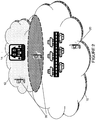
- WAN 10 is shown below a LAN 12.
- the term "home network” is used to refer to all LANs associated with subscribers in the sense they are associated with a geographic area of coverage associated with the subscriber's home (or equivalently with work premises, or with a shop premises, or restaurant, or hospital, or other premises etc). Outside the home network 12 area of coverage, WAN 10 provides one or more communications services to mobile communications device 20, whereas inside the subscriber's home LAN, the LAN provides one or more communications services.
- mobile communications device 20 is also able to receive one or more communications services within the LANs of other subscribers to the communications system.
- mobile communications device 20 On the lower side as shown in Figure 2 , at a first position, mobile communications device 20 is wholly within the WAN 10. On the upper half of Figure 2 , at a third position, mobile communications device 20 is shown wholly within the area covered by LAN 12. In an intermediate position, such as is indicated by the hashed boundary region 16 shown in Figure 2 , mobile communications device 20 is in a state of handover between the two networks.
- a heterogeneous network transfer event has two stages. Firstly, a request is issued by the mobile communications device to request handover. When this request is generated the mobile communications device is still communicating using a mode of communication associated with the pre-handover network. Secondly, after the handover has been completed, a notification is issued to indicate the user is in the second network. After handover, the mobile communications device uses a different mode of communication to the first, the different mode of communication being used within the second network.
- the user is able to personalise an alert which is associated with the request issued by the device for handover to a different network.
- the user is able to personalise an alert indication identifying when the mobile communications device is within the area of cover of the new network. This alert can indicate that either simply that the LAN exists (i.e., it may comprise an advertisement which has been configured either by the user of the mobile communications device, or by the subscriber to the other LAN), or that handover has been successful, or that one or more services and/or characteristics of the LAN are available.
- alerts are activated by associating data with the relevant network event using an appropriate application.
- an alert is dependent on the direction of the handover (i.e., depend on whether the user is arriving into the LAN or leaving it).
- An alert is in one embodiment configured by a user of the mobile communications device using the mobile communications device.
- an alert may be configured remotely and the configuration settings transferred to the mobile communications device when within the subscriber or other user's LAN, by means of data signals such as support file transfer and/or messaging services, or using appropriate means such as are well-known to those skilled in the art.
- the mobile communications device 20 is provided with a user identity (e.g. a SIM code) associated with a LAN mode of communications, e.g., with a short-range radio network such as BluetoothTM, which is capable of being associated directly or indirectly with a user identity for use in a WAN (e.g., within a GSM network).
- a user identity e.g. a SIM code
- a LAN mode of communications e.g., with a short-range radio network such as BluetoothTM
- BluetoothTM short-range radio network
- user identity as referred to herein refers to a single device/user operating a device, regardless of how the identity in practice is recognised within each network.
- user identity associated the LAN "A” may differ from that of WAN 10, but nonetheless the two are associated together, enabling a unique user identity to be provided within both LAN "A" (or any other LAN 12 of the communications system) and WAN 10.
- a handover event generates an alert either indicating when the communications mode of the mobile communications device has changed and/or when the mobile communications device has requested that the communications mode change. For example, along the path shown in Figure 1 , although the route taken is entirely within the network coverage of WAN 10, as mobile communications device 20 is capable of performing a handover between WAN 10 and LAN A, when mobile communications device 20 is within the area of cover provided by LAN A, the mobile communications device will operate using a different mode of communications to that used when it is within WAN 10.
- the GSM network is the only network which can used by their mobile communications device (for example, such as is the case if the "LAN roaming option" has not been subscribed to by the user). This means that when the mobile communications device is in the area covered by other short range network E, the user A of the mobile communications device will continue to use the GSM network even when they are within range of network E.
- LAN E shown in Figure 1 is configured to announce itself to "visitors" (i.e., other users of the communications system, associated with other home LANs), when the mobile communications devices of the "visitors" enters the area covered by LAN E.
- a user associated with LAN E i.e., the subscriber associated with LAN E
- LAN E is provided with an alert when other mobile devices have requested (or completed) a handover to LAN E. This effectively enables a user to monitor visitors to the premises associated with their home LAN.
- a user i.e., a "visitor”
- a user is alerted when their mobile communications device is in the coverage area of LAN E as a result of their mobile communications device requesting to handover to E, regardless of whether such a request is successful or not.
- the alert provided to the user is an indication of the extent of LAN E.
- alerts which are specific to one or more LAN identifiers, i.e., to general a specific alert indicating LAN E, and/or to provide a default alert for all other (non-home) LANs.
- alerts are configured by the user for whom E is the home network. Again, this alert may be specific to user A and their device or be generic to all visitors.
- user A is able to use their mobile communications device in LAN E, this is because the user has automatically rights to use any LAN in the communications system 1.
- user A may subscribe to a roaming option which requires consent from the subscriber for each LAN within which they wish to have roaming rights.
- user E who has a SIM associated with network E, has subscribed to a service which enables network E to allow other SIMs associated with other LANs to use network E if they are within the area covered by network E.
- “Granny” may configure her home network to enable other devices (e.g. in the family) to use her home-network when within it. The availability of the "Granny" home network would be consistent with the announcement that the visiting mobile communications device is within the network coverage of the device.
- a user interface which configures the mobile communications device to appropriately associate a type of handover event with another action such as playing a sound file/displaying an image etc.
- the user interface can be provided on the mobile communications device or another platform which is capable of interfacing with the wireless router of the subscriber's LAN to remotely configure the subscriber's or other user's mobile communications devices who are seeking to handover to the LAN.
- the user-interface can either take a form where a user selects an option (or alternatively a file) which they associate with a particular handover event (see Figure 3A ) or a menu is provided which enables the user to associate an event with a particular file (see Figure 3B ).
- the user associates the network handover request event and/or personalise network identification alerts with an appropriate media file.
- An appropriate file is capable of being executed on the user's mobile communications device. Examples include image files, movie files, audios files (e.g., sound-clips), and files associated with other forms of alert such as activation of light indicators and/or a vibration alert. Examples of different types of files include files of the form .jpg, .mp3, .wav, .wmp, etc.
- the audible alert comprises any suitable audible media such as can be played on the user's mobile communications device, which may vary from a simple tone, or ring-tune to a polyphonic tune.
- the user is able to upload to the mobile communications device a configuration for the heterogeneous handover event notification and/or any subsequent indications of which network the mobile communications device is in from a device with greater storage and/or processing capabilities, such as a home computer.
- FIG. 3A shows schematically a configuration scheme for personalising a heterogeneous handover alert in which a user selects a file (step 30), activates a file menu for that file (step 32), and then selects to associate the file with a network event (step 34). If the user has just a default alert for all network handover events, the process of personalising their network handover event may terminate at that point. If the user has a more sophisticated system, for example, they could access optional menu options, such as might be the case if they wanted to distinguish between different short-wave networks, and/or whether they are entering or leaving a short-wave network etc, then other menu options may be presented or opened in a hierarchical format.
- step 38 The optional steps of opening an event notification menu (36) and selecting a specific heterogeneous network handover event (step 38) are shown within the dotted boundary shown in Figure 3A .
- the ability to associate a file with a network event may be provided whenever a file is selected which is capable of being associated with an alert mode.
- Figure 3B shows in another embodiment the invention (which may be provided in addition or instead of the system shown in Figure 3A ), a configuration scheme for personalising a heterogeneous handover alert in which a user first opens an event notification menu (step 40), selects an event (42), selects mode of alert (44), and then selects a file to associate with a mode of alert (46).
- Figure 4 of the accompanying drawings shows an embodiment of the invention in which a user is able to cause an event listing menu 50 screen to be displayed on mobile communications device 20.
- the user then employs the mobile communications device to associate a particular alert with a heterogeneous handover request event.
- the event heterogeneous handover network event has been selected.
- the user may then select one or more different media files to be associated with the event of the device sending a request to perform a heterogeneous handover.
- an alert is generated only when handover is successful or alternatively, a second alert is provided to indicate successful handover. In one embodiment, this alert indicates the identity of the new network once the handover process has completed.
- handover event screen 52 as displayed enables a user to select which one of a plurality of heterogeneous handovers they want to associated with a particular alert.
- the user has associated different .wav audio files to be played when they enter and leave home, and when they enter Bob's home network.
- Gile's home network a JPEG image file is displayed on their device.
- the alert to the work network coverage is provided by a more discrete vibrate alert. They have a single default message to all visitors who all are able to see their home network "Welcome”. They have not enabled any visitors to use their home network.
- an alert is provided when a mobile communications call is actively taking place and has a form which enables it to be noticeable by the user of the mobile communications device involved in the handover.
- any audio sound may be represented as a tone etc or any other form which is played in such a way that it is not transmitted along with other data when the mobile communications device is being used to place an active call to the far end.
- Such an option may be configurable by the user, and is useful, for example, if the user does not want other persons to be able to associate the user with a particular location when they communicate.
- the user configures different on-hook and off-hook alerts, and these different alerts in one embodiment distinguish between alerts provided to visitors and to the subscriber's mobile communications device.
- any device capable of using a wireless broadband connection is capable of using any subscribers wireless broadband local area network, so that when a handover request is generated it follows by default that handover will follow unless the network overrides this.
- the device may request to handover, but in fact remains communicating using the wide area network mode of communication.
- the alert does not mean that the device is now able to use the local area network, such that the local area network exists and the device is now located within it.
- Such embodiments may provide a selective service, and if so, the router associated with the local area network must be able to associate visitor's user identity as able to use said local area network (and/or to be able to use one or more services available over said local wireless network).
- This configuration may be performed in any appropriate manner already apparent to those skilled in the art.
- the router may be configured to identity the user's identity directly by association with their mobile calling line identity equivalent, i.e., their SIM, or other identity uniquely associated with a user's device.
- the subscriber is able to associate services to be made available when configuring the alert they want to sent to the visitor when they hand over to the user's network (or when they request a handover - which may or may not be granted).
- one or more SIMs is used by a mobile communications device to indicate the subscriber/ user identity for that device.
- the event could cause the router to push out a "Welcome” type of announcement to the user, and if the LAN SIM was in a particular category, the user of that "visiting" LAN SIM could then use the LAN and not the GSM network.
- FIG 6 shows schematically an embodiment of a communications system 1 in which a subscriber configures the alert provided to other users who are visiting their network.
- user of mobile communications device 20a has as their home network local area network 12.
- User of mobile communications device 20a configures alerts to be sent to inform visiting mobile communications devices 20b 20c and 20d using an appropriate computer application.
- this application is able to operate on a mobile communications device to provide the user with means for entering or selecting the communications network identities of the users of devices 20a,b,and c (e.g., their telephone numbers or icons or other displayed identities) and for associating each identity with particular alert modes and/or files which are to be either provided to the visiting user's mobile communications devices via the communications system, or which are to be activated on the visiting user's mobile communications device if previously provided or installed.
- the communications network identities of the users of devices 20a,b,and c e.g., their telephone numbers or icons or other displayed identities
- the configuration application is provided to a platform which is capable of communicating the user's selection to a remote server which receives notification from visiting mobile communications devices of any request to handover from another network to the home network, and which performs a look-up operation to determine if the identity of the user associated with the device which has generated the request to hand-over message has been associated with a specific alert. If so, then the remote platform causes the necessary data to be provided to the visiting device to enable the device to generate an alert as selected. Alerts can also be selected according to a group of identities. In this way, a user can configure their home network to play a particular announcement to "friends" which differs from those provided to "family", and to provide a different announcement to an individual from that used for general visitors etc. A default announcement can be selected.
- the alert may over-ride user preferences for personalised alerts on their mobile communications devices unless the user has selected either not to override visiting device personalised alerts (which means it will only override generic alert modes of handover notification or alerts for which no "don't override" has been configured).
- the alert provided to mobile communications device 20B may comprise a particular greeting
- that to device 20C may comprise another greeting
- the user may have configured their system so that not alert at all is provided to device 20D. In this way, the user of device 20D is either not alerted to home network 12 by the subscriber of home network 12.
- either device 20D may generate their own alert (for example if the user of device 20D has configured that device to recognise when they are within the local area network associated with user identity of 20A), or they may receive a network-wide default alert, or no alert at all.
- the alert configuration application runs on a different platform.
- this association could be done using another device, e.g. a personal computer, again user identities are either entered by the home network user or selected for example, using contact information already available on the personal computer (such as might, for example, be provided in OutlookTM etc..).
- These embodiments enable a user to associate one or more particular user identities each with a form of alert mode, and a particular media form for the alert, in the manner mentioned herein above so that personalised alerts can be provided to individual and groups of visitors of another user's home network.
- the mobile communications device remains operational using the WAN communications mode even when handover to another user's LAN is not successful, information can be communicated to the mobile communications device which cause a personalised alert to be generated.
Landscapes
- Engineering & Computer Science (AREA)
- Computer Networks & Wireless Communication (AREA)
- Signal Processing (AREA)
- Mobile Radio Communication Systems (AREA)
Claims (14)
- Kommunikationssystem, das umfasst:eine Vielzahl von drahtlosen lokalen Kommunikations-Netzwerken undein drahtloses Weitverkehrs-Kommunikations-Netzwerk,eine Einrichtung zum Senden von Kommunikation an mobile Kommunikationsvorrichtungen und zum Empfangen von Kommunikation von mobilen Kommunikationsvorrichtungen, die befähigt ist, in einem drahtlosen lokalen Kommunikations-Netzwerk einer Vielzahl von drahtlosen lokalen Kommunikations-Netzwerken in einem ersten Modus zu arbeiten, und die befähigt ist, in dem drahtlosen Weitverkehrs-Kommunikations-Netzwerk in einem zweiten Modus zu arbeiten, und die befähigt ist, ein Netzwerk-Handover zwischen mindestens einem der drahtlosen lokalen Kommunikations-Netzwerke und dem drahtlosen Weitverkehrs-Kommunikations-Netzwerk durchzuführen,wobei das Kommunikationssystem eine Handover-Einrichtung zur Verarbeitung einer Handover-Anforderung aufweist, die von einer solchen mobilen Kommunikationsvorrichtung empfangen wird, wenn die mobile Kommunikationsvorrichtung die Durchführung eines Netzwerk-Handovers nach beiden Richtungen zwischen dem drahtlosen Weitverkehrs-Kommunikations-Netzwerk und dem mindestens einen der drahtlosen lokalen Kommunikations-Netzwerke verlangt,wobei die Handover-Einrichtung umfasst:eine Einrichtung zum Identifizieren eines drahtlosen lokalen Kommunikations-Netzwerks, das mit der Handover-Anforderung verknüpft ist,eine Einrichtung zur Festlegung einer Identität für einen User der mobilen Kommunikationsvorrichtung, welche die Handover-Anforderung erzeugt,eine Einrichtung zur Übermittlung der Identität an einen Router für das drahtlose lokale Kommunikations-Netzwerk, das mit der Handover-Anforderung verknüpft ist,wobei das Kommunikationssystem so ausgebildet ist, dass es einem ersten Teilnehmer, der mit dem drahtlosen lokalen Kommunikations-Netzwerk in Verbindung steht, ermöglicht wird, für jede einer Vielzahl von mobilen Kommunikationsvorrichtungen an einem für den Router zugänglichen Ort einen für den Teilnehmer individualisierten Hinweis auf ein Netzwerk-Handover zu speichern, der beim Eintreten in einen durch das drahtlose lokale Netzwerk abgedeckten Bereich und/oder beim Verlassen eines durch das drahtlose lokale Netzwerk abgedeckten Bereichs bei der mobilen Kommunikationsvorrichtung, der die User-Identität zugeordnet ist, zu melden ist, wobei die Art des für den Teilnehmer individualisierten Hinweises auf ein Netzwerk-Handover durch den ersten Teilnehmer selektiv bestimmt wird,undeine Einrichtung zum Ermitteln, wenn ein Handover angefordert wird, ob der für den Teilnehmer individualisierte Hinweis auf ein Netzwerk-Handover bei dem Router zur Kommunikation mit der mobilen Kommunikationsvorrichtung konfiguriert wurde, und, falls dies zutrifft, zum Übermitteln des Hinweises an die mobile Kommunikationsvorrichtung.
- Kommunikationssystem wie in Anspruch 1 beansprucht, bei dem
eine mobile Kommunikationsvorrichtung mit einer User-Identität verknüpft und befähigt ist, in zwei Kommunikations-Modi
zu arbeiten, wobei ein Modus mit einem drahtlosen lokalen Kommunikations-Netzwerk verknüpft ist und der andere Modus mit dem drahtlosen Weitverkehrs-Kommunikations-Netzwerk verknüpft ist,
wobei die mobile Kommunikationsvorrichtung umfasst:eine Einrichtung zum Ermitteln des Vorliegens eines anderen drahtlosen Kommunikations-Netzwerks, in dem die mobile Kommunikationsvorrichtung unter Verwendung eines gegenüber einem momentanen Betriebs-Modus der beiden Kommunikations-Modi anderen Kommunikations-Modus der mobilen Kommunikationsvorrichtung in einem drahtlosen Kommunikations-Netzwerk in dem Kommunikationssystem in Betrieb ist,eine Einrichtung zum Ermitteln, ob ein Kriterium oder mehrere Kriterien für die Anforderung eines Netzwerk-Handovers zu einem anderen drahtlosen Kommunikations-Netzwerk erfüllt ist bzw. sind,eine Einrichtung zum Anfordern eines Netzwerk-Handovers zu dem anderen drahtlosen Kommunikations-Netzwerk, wobei das angeforderte Netzwerk-Handover zur Durchführung eines heterogenen Netzwerk-Handovers entweder zu oder von dem drahtlosen lokalen Kommunikations-Netzwerk dient, das mit dem Teilnehmer verbunden ist, wobei der Teilnehmer eine mit einem User verknüpfte Teilnehmer-Identität aufweist, der ein anderer User ist als ein User, der die mit der mobilen Kommunikationsvorrichtung verknüpfte User-Identität besitzt,undeine Einrichtung zum Erzeugen des für den Teilnehmer individualisierten Hinweises auf ein Netzwerk-Handover bei der mobilen Kommunikationsvorrichtung in Verbindung mit einem Vorgang des heterogenen Netzwerk-Handovers des angeforderten Netzwerk-Handovers der mobilen Kommunikationsvorrichtung. - Verfahren zur Bereitstellung eines für eine mobile Kommunikationsvorrichtung (20) in einem Kommunikationssystem (1) individualisierten Hinweises auf ein Netzwerk-Handover, wobei das Kommunikationssystem eine Vielzahl von drahtlosen lokalen Kommunikations-Netzwerken (12) und ein drahtloses Weitverkehrs-Kommunikations-Netzwerk (10) umfasst, wobei die mobile Kommunikationsvorrichtung (20) mit einer entsprechenden User-Identität verknüpft und befähigt ist, in zwei Kommunikations-Modi zu arbeiten, wobei ein erster Modus mit einem drahtlosen lokalen Kommunikations-Netzwerk (12) des Kommunikationssystems (1) verknüpft ist und ein zweiter Modus mit dem drahtlosen Weitverkehrs-Kommunikations-Netzwerk (10) des Kommunikationssystems verknüpft ist, und die ferner befähigt ist, ein Netzwerk-Handover zwischen mindestens einem der drahtlosen lokalen Kommunikations-Netzwerke und dem drahtlosen Weitverkehrs-Kommunikations-Netzwerk durchzuführen,
wobei das Verfahren umfasst:Verarbeiten von Netzwerk-Handover-Anforderungen, die von einer mobilen Kommunikationsvorrichtung empfangen werden, wenn die mobile Kommunikationsvorrichtung die Durchführung eines Netzwerk-Handovers zwischen dem drahtlosen Weitverkehrs-Kommunikations-Netzwerk und einem drahtlosen lokalen Kommunikations-Netzwerk einer Vielzahl der drahtlosen lokalen Kommunikations-Netzwerke verlangt, indem für eine mobile Kommunikationsvorrichtung, die in einem der Netzwerke in Betrieb ist, das Vorliegen eines anderen drahtlosen Kommunikations-Netzwerks ermittelt wird, in dem die mobile Kommunikationsvorrichtung unter Verwendung von einem der Kommunikations-Modi betreibbar ist, der von einem momentanen Betriebs-Modus der mobilen Kommunikationsvorrichtung in dem Kommunikationssystem verschieden ist,Ermitteln, ob ein Kriterium oder mehrerer Kriterien für die Anforderung eines Netzwerk-Handovers zu dem anderen drahtlosen Kommunikations-Netzwerk erfüllt ist bzw. sind,Erzeugen einer Netzwerk-Handover-Anforderung zur Durchführung eines Netzwerk-Handovers zu dem anderen drahtlosen Kommunikations-Netzwerk, wenn das eine Kriterium oder die mehreren Kriterien für die Anforderung eines Netzwerk-Handovers zu dem anderen drahtlosen Kommunikations-Netzwerk erfüllt ist bzw. sind, wobei das angeforderte Netzwerk-Handover ein Handover entweder zu oder von dem drahtlosen lokalen Kommunikations-Netzwerk ist,an einem Ort, der für einen Router zugänglich ist, der mit den drahtlosen lokalen Kommunikations-Netzwerken in Verbindung steht und mit einem ersten Teilnehmer verknüpft ist, dem eine erste User-Identität zugeordnet ist, Speichern eines individualisierten Hinweises auf ein Netzwerk-Handover für eine bestimmte User-Identität oder Gruppe von User-Identitäten, wobei die Art des Hinweises durch den ersten Teilnehmer erzeugt wird,Identifizieren von einem der drahtlosen lokalen Kommunikations-Netzwerke, das mit der Handover-Anforderung verknüpft ist, als das drahtlose lokale Kommunikations-Netzwerk,Übermitteln der mit der User-Vorrichtung verbundenen User-Identität an einen mit dem lokalen Netzwerk in Verbindung stehenden Router,Ermitteln, ob der für den Teilnehmer individualisierte Hinweis auf ein Netzwerk-Handover, der mit der User-Identität verknüpft ist, bei dem Router durch den ersten Teilnehmer konfiguriert wurde, und, falls dies zutrifft, Übermitteln des Hinweises an die mobile KommunikationsvorrichtungundErzeugen des für den Teilnehmer individualisierten Hinweises auf ein Netzwerk-Handover bei der mobilen Kommunikationsvorrichtung in Verbindung mit dem Vorgang des Netzwerk-Handovers. - Verfahren wie in Anspruch 3 beansprucht, bei dem der Vorgang des Netzwerk-Handovers das Erzeugen der Netzwerk-Handover-Anforderung umfasst.
- Verfahren wie in Anspruch 3 beansprucht, bei dem der Vorgang des Netzwerk-Handovers den Abschluss eines Netzwerk-Handovers zu oder von dem drahtlosen lokalen Kommunikations-Netzwerk des Teilnehmers umfasst.
- Verfahren wie in einem der Ansprüche 3, 4 oder 5 beansprucht, das ferner die folgenden Schritte umfasst:Empfangen der Netzwerk-Handover-Anforderung bei einem drahtlosen Router, der das drahtlose lokale Kommunikations-Netzwerk des Teilnehmers unterstützt,undVerarbeiten der Netzwerk-Handover-Anforderung zum Ermitteln der User-Identität, die mit der mobilen Kommunikationsvorrichtung, welche die Netzwerk-Handover-Anforderung erzeugte, verknüpft ist.
- Verfahren wie in einem der Ansprüche 3, 4, 5 oder 6 beansprucht, bei dem die mobile Kommunikationsvorrichtung ferner eine Einrichtung zum Anfordern eines Netzwerk-Handovers zwischen heterogenen drahtlosen Kommunikations-Netzwerken (10, 12) des Kommunikationssystems (1) sowohl in aufgelegtem Zustand als auch in besetztem Zustand aufweist, wobei das Verfahren ferner umfasst, dass eine besetzte mobile Kommunikationsvorrichtung ein Netzwerk-Handover anfordert.
- Verfahren wie in einem der Ansprüche 3, 4, 5, 6 oder 7 beansprucht, bei dem die Art des für den Teilnehmer individualisierten Hinweises auf ein Netzwerk-Handover durch den Teilnehmer zu einer für den Teilnehmer individualisierten Form selektiv kontrolliert wird und in der gleichen für den Teilnehmer individualisierten Art für irgendeine mobile Kommunikationsvorrichtung bereitgestellt wird, die sich in dem Bereich befindet, der durch das drahtlose lokale Kommunikations-Netzwerk des Teilnehmers bedient wird.
- Verfahren wie in einem der Ansprüche 3, 4, 5, 6 oder 7 beansprucht, bei dem die Art des für den Teilnehmer individualisierten Hinweises auf ein Netzwerk-Handover durch den Teilnehmer für eine bestimmte User-Identität oder Gruppe von User-Identitäten festgelegt wird.
- Verfahren wie in einem der Ansprüche 3, 4, 5, 6, 7, 8 oder 9 beansprucht, bei dem die Art des für den Teilnehmer individualisierten Hinweises auf ein Netzwerk-Handover anzeigt, dass es der Teilnehmer der mobilen Kommunikationsvorrichtung des anderen Users ermöglicht hat, auf einen Dienst oder mehrere Dienste des drahtlosen lokalen Netzwerks des Teilnehmers zuzugreifen.
- Verfahren wie in einem der Ansprüche 3, 4, 5, 6, 7, 8, 9 oder 10 beansprucht, bei dem der für den Teilnehmer individualisierte Hinweis auf ein Netzwerk-Handover eine Angabe der Teilnehmer-Identität des ersten Teilnehmers enthält, für den oder von dem die mobile Kommunikationsvorrichtung Handover angefordert hat.
- Verfahren wie in einem der Ansprüche 3 bis 11 beansprucht, bei dem das für den Teilnehmer individualisierte Netzwerk-Handover eine Medien-Datei umfasst, wobei die Medien-Datei, wenn die mobile Kommunikationsvorrichtung eine Anforderung für ein Netzwerk-Handover von oder zu einem drahtlosen lokalen Kommunikations-Netzwerk, das mit der Teilnehmer-Identität verknüpft ist, erzeugt, bei der mobilen Kommunikationsvorrichtung ausgeführt wird.
- Verfahren wie in Anspruch 12 beansprucht, bei dem die ausgeführte Medien-Datei mindestens eine Art der folgenden Medien umfasst:ein Bild oder mehrere Bilder zur Anzeige auf der mobilen Kommunikationsvorrichtung,eine Audio-Datei oder mehrere Audio-Dateien zum Abspielen auf der mobilen Kommunikationsvorrichtung,eine Video-Datei oder mehrere Video-Dateien zum Abspielen auf der mobilen Kommunikationsvorrichtungund/odereine physikalische Antwort in der mobilen Kommunikationsvorrichtung.
- Verfahren wie in einem der Ansprüche 3 bis 13 beansprucht, bei dem ein unterschiedlicher für den Teilnehmer individualisierter Hinweis auf ein Netzwerk-Handover an die mobile Kommunikationsvorrichtung geliefert wird, wenn die mobile Kommunikationsvorrichtung ein Handover von dem drahtlosen Weitverkehrs-Kommunikations-Netzwerk zu dem drahtlosen lokalen Kommunikations-Netzwerk durchführt, als wenn die mobile Kommunikationsvorrichtung ein Handover von dem drahtlosen lokalen Kommunikations-Netzwerk zu dem drahtlosen Weitverkehrs-Kommunikations-Netzwerk durchführt.
Applications Claiming Priority (4)
| Application Number | Priority Date | Filing Date | Title |
|---|---|---|---|
| GB0517715A GB0517715D0 (en) | 2005-08-31 | 2005-08-31 | Personalised home network handover announcement |
| GB0517711A GB0517711D0 (en) | 2005-08-31 | 2005-08-31 | Personalised home network handover announcement |
| GB0517712A GB0517712D0 (en) | 2005-08-31 | 2005-08-31 | Remote device activation by network handover |
| PCT/GB2006/003183 WO2007026133A1 (en) | 2005-08-31 | 2006-08-25 | Personalised heterogeneous network handover alert scheme |
Publications (2)
| Publication Number | Publication Date |
|---|---|
| EP1920622A1 EP1920622A1 (de) | 2008-05-14 |
| EP1920622B1 true EP1920622B1 (de) | 2016-04-06 |
Family
ID=37327481
Family Applications (2)
| Application Number | Title | Priority Date | Filing Date |
|---|---|---|---|
| EP06779214.3A Active EP1920622B1 (de) | 2005-08-31 | 2006-08-25 | Handover-hinweisschema für ein personalisiertes heterogenes netzwerk |
| EP06779227.5A Active EP1920623B1 (de) | 2005-08-31 | 2006-08-25 | Personalisierbares heterogenes netzwerk-handover-schema |
Family Applications After (1)
| Application Number | Title | Priority Date | Filing Date |
|---|---|---|---|
| EP06779227.5A Active EP1920623B1 (de) | 2005-08-31 | 2006-08-25 | Personalisierbares heterogenes netzwerk-handover-schema |
Country Status (4)
| Country | Link |
|---|---|
| US (2) | US20090122761A1 (de) |
| EP (2) | EP1920622B1 (de) |
| GB (2) | GB2443118B (de) |
| WO (2) | WO2007026137A1 (de) |
Families Citing this family (39)
| Publication number | Priority date | Publication date | Assignee | Title |
|---|---|---|---|---|
| US8737349B2 (en) * | 2006-12-01 | 2014-05-27 | Sigram Schindler Beteiligungsgesellschaft Mbh | Handover process and information support for communication transfer between telecommunication networks |
| US20080220878A1 (en) * | 2007-02-23 | 2008-09-11 | Oliver Michaelis | Method and Apparatus to Create or Join Gaming Sessions Based on Proximity |
| US8948757B2 (en) | 2007-03-21 | 2015-02-03 | Qualcomm Incorporated | Methods and apparatus for RF handoff in a multi-frequency network |
| US8737353B2 (en) * | 2007-03-21 | 2014-05-27 | Qualcomm Incorporated | Methods and apparatus for RF handoff in a multi-frequency network |
| US8750248B2 (en) * | 2007-03-21 | 2014-06-10 | Qualcomm Incorporated | Methods and apparatus for RF handoff in a multi-frequency network |
| US8737350B2 (en) * | 2007-03-21 | 2014-05-27 | Qualcomm Incorporated | Methods and apparatus for RF handoff in a multi-frequency network |
| US8457064B2 (en) * | 2007-03-21 | 2013-06-04 | Qualcomm Incorporated | Methods and apparatus for RF handoff in a multi-frequency network |
| US8565799B2 (en) * | 2007-04-04 | 2013-10-22 | Qualcomm Incorporated | Methods and apparatus for flow data acquisition in a multi-frequency network |
| US8224241B1 (en) * | 2007-07-05 | 2012-07-17 | Nextel Communications Inc. | System and method for antenna orientation for mobile applications |
| US8428511B1 (en) | 2007-08-10 | 2013-04-23 | Nextel Communications Inc. | System and method for a high available and survivable communication system |
| EP2217942B1 (de) * | 2007-10-29 | 2017-03-08 | Nokia Technologies Oy | Innen-positionierungssystem und verfahren |
| KR100944772B1 (ko) * | 2007-12-17 | 2010-03-03 | 한국전자통신연구원 | 다중 통신 모드를 지원하는 이동 단말기에서 통신 모드안내 데이터에 의한 인지 무선 접속 지원 장치 및 방법 |
| US8230011B2 (en) * | 2008-03-03 | 2012-07-24 | John Vandenburgh | Networked computer alert system |
| US8570939B2 (en) * | 2008-03-07 | 2013-10-29 | Qualcomm Incorporated | Methods and systems for choosing cyclic delays in multiple antenna OFDM systems |
| JP4894826B2 (ja) * | 2008-07-14 | 2012-03-14 | ソニー株式会社 | 通信装置、通信システム、報知方法、及びプログラム |
| KR101074121B1 (ko) * | 2008-09-23 | 2011-10-17 | 한국전자통신연구원 | 위치 정보를 이용한 이종 망간 핸드오버 제어장치 및 수행방법, 모바일 라우터 |
| US8620295B2 (en) * | 2009-03-05 | 2013-12-31 | Blackberry Limited | Method and apparatus for modifying notification settings on a mobile electronic device |
| CN102036319B (zh) * | 2009-09-30 | 2013-11-06 | 中兴通讯股份有限公司 | 一种带有彩铃的振铃状态会话的切换系统及方法 |
| KR101721225B1 (ko) | 2010-09-28 | 2017-03-29 | 삼성전자주식회사 | 디바이스 제어 방법 및 장치와 컴퓨터로 읽을 수 있는 저장 매체 |
| WO2012170735A2 (en) * | 2011-06-07 | 2012-12-13 | Marvell World Trade Ltd. | Physical layer frame format for long range wlan |
| US8964533B2 (en) * | 2011-12-14 | 2015-02-24 | Verizon Patent And Licensing Inc. | Method and system for providing mobile wireless call failover |
| WO2013093550A1 (en) | 2011-12-19 | 2013-06-27 | Nokia Corporation | An apparatus and associated methods for switching between antennas in a multi-antenna receiver |
| WO2014030199A1 (ja) * | 2012-08-20 | 2014-02-27 | 富士通株式会社 | シームレスアプリプッシュシステム及びその方法 |
| US9674652B2 (en) | 2012-08-31 | 2017-06-06 | Nokia Technologies Oy | Positioning devices |
| US9351203B2 (en) | 2013-09-13 | 2016-05-24 | Microsoft Technology Licensing, Llc | Voice call continuity in hybrid networks |
| US9510251B2 (en) | 2013-12-31 | 2016-11-29 | Microsoft Technology Licensing, Llc | Call handoff initiation in hybrid networks |
| US9560185B2 (en) | 2014-03-19 | 2017-01-31 | Microsoft Technology Licensing, Llc | Hybrid telecommunications network connection indicator |
| US9363711B2 (en) | 2014-04-07 | 2016-06-07 | Microsoft Technology Licensing, Llc | User experiences during call handovers on a hybrid telecommunications network |
| US9456333B2 (en) | 2014-07-09 | 2016-09-27 | Microsoft Technology Licensing, Llc | Centralized routing in hybrid networks |
| CN104270832B (zh) * | 2014-09-26 | 2018-01-05 | 苏州佳世达电通有限公司 | 一种组合通讯终端以及通讯方法 |
| US9736019B2 (en) | 2015-05-14 | 2017-08-15 | Eero Inc. | Methods for dynamic router configuration in a mesh network |
| US10178533B2 (en) | 2015-05-29 | 2019-01-08 | Resolution Products, Inc. | Security systems |
| JP6649132B2 (ja) * | 2016-03-09 | 2020-02-19 | パナソニック インテレクチュアル プロパティ コーポレーション オブ アメリカPanasonic Intellectual Property Corporation of America | 通信端末、通信装置および通信システム |
| US11749078B2 (en) | 2019-04-05 | 2023-09-05 | Resolution Products, Llc | Integrated security system |
| US11508227B2 (en) | 2019-09-30 | 2022-11-22 | Resolution Products, Llc | Mobile device as a security system component |
| US11540354B2 (en) | 2019-09-30 | 2022-12-27 | Resolution Products, Llc | Gateway with backup power and communications system |
| US12476936B2 (en) | 2019-09-30 | 2025-11-18 | Resolution Products, Llc | Non-standard security devices that provide inputs to security systems |
| CN113839918A (zh) * | 2021-07-20 | 2021-12-24 | 广州数智网络科技有限公司 | 一种网络违法平台用户活动预警的方法 |
| US20250184852A1 (en) * | 2023-12-01 | 2025-06-05 | Charter Communications Operating, Llc | Methods and apparatus for using machine learning to facilitate network handoffs between access points |
Family Cites Families (14)
| Publication number | Priority date | Publication date | Assignee | Title |
|---|---|---|---|---|
| US5260988A (en) * | 1992-02-06 | 1993-11-09 | Motorola, Inc. | Apparatus and method for alternative radiotelephone system selection |
| US5913166A (en) * | 1995-12-29 | 1999-06-15 | Lucent Technologies Inc. | Arrangement for providing a call hand-off for a mobile station from a land-line supported private base station to a cellular base station operating in a cellular system |
| US6546253B1 (en) * | 1998-12-30 | 2003-04-08 | At&T Corp. | Neighborhood cordless service call handoff |
| US6507740B2 (en) * | 1999-05-18 | 2003-01-14 | Ericsson Inc. | Adaptive threshold of handoff in mobile telecommunication systems |
| US6920319B2 (en) * | 2000-05-05 | 2005-07-19 | Axis Ab | Method and apparatus for a mobile access system delivering location based information and services |
| US20020056114A1 (en) * | 2000-06-16 | 2002-05-09 | Fillebrown Lisa A. | Transmitter for a personal wireless network |
| JP2002359875A (ja) * | 2001-06-01 | 2002-12-13 | Nec Corp | 携帯型端末装置 |
| JP3895982B2 (ja) * | 2001-12-20 | 2007-03-22 | 株式会社東芝 | 移動通信端末装置 |
| US7672274B2 (en) * | 2002-01-11 | 2010-03-02 | Broadcom Corporation | Mobility support via routing |
| US20040264410A1 (en) | 2003-06-30 | 2004-12-30 | Motorola, Inc. | Method and apparatus for providing a communication unit with a handoff between networks |
| US6993336B2 (en) * | 2003-12-15 | 2006-01-31 | Motorola, Inc. | Roaming indicators for multi-mode wireless communication devices |
| CN101019451B (zh) * | 2004-09-17 | 2011-09-07 | 艾利森电话股份有限公司 | 电话的3g/gsm和无线局域网集成 |
| US7574212B2 (en) * | 2005-06-22 | 2009-08-11 | Sprint Spectrum L.P. | Method and system for managing communication sessions during multi-mode mobile station handoff |
| US8295851B2 (en) * | 2005-08-03 | 2012-10-23 | Michael Edward Finnegan | Realtime, interactive and geographically defined computerized personal matching systems and methods |
-
2006
- 2006-08-25 EP EP06779214.3A patent/EP1920622B1/de active Active
- 2006-08-25 WO PCT/GB2006/003197 patent/WO2007026137A1/en not_active Ceased
- 2006-08-25 US US11/990,270 patent/US20090122761A1/en not_active Abandoned
- 2006-08-25 GB GB0801458A patent/GB2443118B/en active Active
- 2006-08-25 WO PCT/GB2006/003183 patent/WO2007026133A1/en not_active Ceased
- 2006-08-25 GB GB0803002A patent/GB2442923B/en active Active
- 2006-08-25 EP EP06779227.5A patent/EP1920623B1/de active Active
- 2006-08-25 US US11/990,864 patent/US20090233602A1/en not_active Abandoned
Also Published As
| Publication number | Publication date |
|---|---|
| GB2442923B (en) | 2010-06-16 |
| US20090122761A1 (en) | 2009-05-14 |
| WO2007026137A1 (en) | 2007-03-08 |
| GB0801458D0 (en) | 2008-03-05 |
| EP1920623B1 (de) | 2017-01-04 |
| EP1920622A1 (de) | 2008-05-14 |
| WO2007026133A1 (en) | 2007-03-08 |
| US20090233602A1 (en) | 2009-09-17 |
| GB2443118B (en) | 2010-06-16 |
| GB2442923A (en) | 2008-04-16 |
| GB0803002D0 (en) | 2008-03-26 |
| GB2443118A (en) | 2008-04-23 |
| EP1920623A1 (de) | 2008-05-14 |
Similar Documents
| Publication | Publication Date | Title |
|---|---|---|
| EP1920622B1 (de) | Handover-hinweisschema für ein personalisiertes heterogenes netzwerk | |
| CN104823468B (zh) | 重定向通过数据网络的蜂窝电话通信 | |
| US8223794B2 (en) | Method and apparatus for routing a call to a dual mode wireless device | |
| CN100359967C (zh) | 使用有线或无线通信系统的复合无线业务装置 | |
| JP5527977B2 (ja) | 通信ネットワークに関する無線ユニット状態通知システム | |
| US20100248719A1 (en) | Self-configuring man-machine interface for a communication terminal | |
| US7991393B1 (en) | Wireline terminal accessing mobile telephone services | |
| US8494123B2 (en) | On-hold visual menu from a user's communications device | |
| US8626148B2 (en) | Text message transmissions indicating failure of recipient mobile device to connect with a call | |
| WO2005048463A2 (en) | Mobile wireless presence and situation management system and method | |
| US7295847B2 (en) | Method and apparatus for providing location based vendor information to a wireless mobile terminal | |
| US8140061B2 (en) | Telephony system | |
| EP1914969B1 (de) | Verfahren und vorrichtung zur bereitstellung von personalisierter information | |
| US20090170530A1 (en) | Device System and Method for Providing Availability Status and Alternate Contact Information Within a Wireless Keep-Quiet Zone | |
| US20070127409A1 (en) | Method and apparatus for selecting call list numbers based on entry/exit to a WLAN | |
| CN101156427A (zh) | 一种提供实时回铃音的方法、系统及一种终端 | |
| KR100797373B1 (ko) | 화상 통화에서의 영상 안내 서비스 방법 및 시스템과 이를위한 장치 | |
| JP2006074133A (ja) | リングバックトーン制御装置 | |
| JPH10224844A (ja) | 無線通信システム | |
| KR20150003949A (ko) | 사용자 상황 기반 통화 연결음 광고 제공 시스템 및 방법 | |
| JP2005198065A (ja) | 移動通信端末自動呼び出しサービス装置および移動通信端末装置 | |
| JP5302370B2 (ja) | 通信装置の動作特性の遠隔変更方法 | |
| HK1136409A1 (en) | Mobile phone related indirect communication system and method | |
| HK1136409B (en) | Mobile phone related indirect communication system and method | |
| KR20110139500A (ko) | 빠른 음성사서함 서비스를 제공하는 착신 단말기 및 그의 동작방법 |
Legal Events
| Date | Code | Title | Description |
|---|---|---|---|
| PUAI | Public reference made under article 153(3) epc to a published international application that has entered the european phase |
Free format text: ORIGINAL CODE: 0009012 |
|
| 17P | Request for examination filed |
Effective date: 20080128 |
|
| AK | Designated contracting states |
Kind code of ref document: A1 Designated state(s): AT BE BG CH CY CZ DE DK EE ES FI FR GB GR HU IE IS IT LI LT LU LV MC NL PL PT RO SE SI SK TR |
|
| 17Q | First examination report despatched |
Effective date: 20101006 |
|
| DAX | Request for extension of the european patent (deleted) | ||
| REG | Reference to a national code |
Ref country code: DE Ref legal event code: R079 Ref document number: 602006048554 Country of ref document: DE Free format text: PREVIOUS MAIN CLASS: H04Q0007380000 Ipc: H04W0036140000 |
|
| RIC1 | Information provided on ipc code assigned before grant |
Ipc: H04W 36/14 20090101AFI20150806BHEP |
|
| GRAP | Despatch of communication of intention to grant a patent |
Free format text: ORIGINAL CODE: EPIDOSNIGR1 |
|
| GRAJ | Information related to disapproval of communication of intention to grant by the applicant or resumption of examination proceedings by the epo deleted |
Free format text: ORIGINAL CODE: EPIDOSDIGR1 |
|
| GRAP | Despatch of communication of intention to grant a patent |
Free format text: ORIGINAL CODE: EPIDOSNIGR1 |
|
| GRAJ | Information related to disapproval of communication of intention to grant by the applicant or resumption of examination proceedings by the epo deleted |
Free format text: ORIGINAL CODE: EPIDOSDIGR1 |
|
| GRAP | Despatch of communication of intention to grant a patent |
Free format text: ORIGINAL CODE: EPIDOSNIGR1 |
|
| GRAJ | Information related to disapproval of communication of intention to grant by the applicant or resumption of examination proceedings by the epo deleted |
Free format text: ORIGINAL CODE: EPIDOSDIGR1 |
|
| GRAP | Despatch of communication of intention to grant a patent |
Free format text: ORIGINAL CODE: EPIDOSNIGR1 |
|
| INTG | Intention to grant announced |
Effective date: 20150915 |
|
| INTG | Intention to grant announced |
Effective date: 20150924 |
|
| GRAJ | Information related to disapproval of communication of intention to grant by the applicant or resumption of examination proceedings by the epo deleted |
Free format text: ORIGINAL CODE: EPIDOSDIGR1 |
|
| GRAP | Despatch of communication of intention to grant a patent |
Free format text: ORIGINAL CODE: EPIDOSNIGR1 |
|
| INTG | Intention to grant announced |
Effective date: 20151005 |
|
| INTG | Intention to grant announced |
Effective date: 20151014 |
|
| INTG | Intention to grant announced |
Effective date: 20151102 |
|
| GRAS | Grant fee paid |
Free format text: ORIGINAL CODE: EPIDOSNIGR3 |
|
| GRAA | (expected) grant |
Free format text: ORIGINAL CODE: 0009210 |
|
| AK | Designated contracting states |
Kind code of ref document: B1 Designated state(s): AT BE BG CH CY CZ DE DK EE ES FI FR GB GR HU IE IS IT LI LT LU LV MC NL PL PT RO SE SI SK TR |
|
| REG | Reference to a national code |
Ref country code: GB Ref legal event code: FG4D |
|
| REG | Reference to a national code |
Ref country code: AT Ref legal event code: REF Ref document number: 788969 Country of ref document: AT Kind code of ref document: T Effective date: 20160415 Ref country code: CH Ref legal event code: EP |
|
| REG | Reference to a national code |
Ref country code: IE Ref legal event code: FG4D |
|
| REG | Reference to a national code |
Ref country code: DE Ref legal event code: R096 Ref document number: 602006048554 Country of ref document: DE |
|
| REG | Reference to a national code |
Ref country code: LT Ref legal event code: MG4D Ref country code: NL Ref legal event code: MP Effective date: 20160406 |
|
| REG | Reference to a national code |
Ref country code: AT Ref legal event code: MK05 Ref document number: 788969 Country of ref document: AT Kind code of ref document: T Effective date: 20160406 |
|
| REG | Reference to a national code |
Ref country code: FR Ref legal event code: PLFP Year of fee payment: 11 |
|
| PG25 | Lapsed in a contracting state [announced via postgrant information from national office to epo] |
Ref country code: NL Free format text: LAPSE BECAUSE OF FAILURE TO SUBMIT A TRANSLATION OF THE DESCRIPTION OR TO PAY THE FEE WITHIN THE PRESCRIBED TIME-LIMIT Effective date: 20160406 |
|
| PG25 | Lapsed in a contracting state [announced via postgrant information from national office to epo] |
Ref country code: LT Free format text: LAPSE BECAUSE OF FAILURE TO SUBMIT A TRANSLATION OF THE DESCRIPTION OR TO PAY THE FEE WITHIN THE PRESCRIBED TIME-LIMIT Effective date: 20160406 Ref country code: IS Free format text: LAPSE BECAUSE OF FAILURE TO SUBMIT A TRANSLATION OF THE DESCRIPTION OR TO PAY THE FEE WITHIN THE PRESCRIBED TIME-LIMIT Effective date: 20160806 Ref country code: PL Free format text: LAPSE BECAUSE OF FAILURE TO SUBMIT A TRANSLATION OF THE DESCRIPTION OR TO PAY THE FEE WITHIN THE PRESCRIBED TIME-LIMIT Effective date: 20160406 Ref country code: FI Free format text: LAPSE BECAUSE OF FAILURE TO SUBMIT A TRANSLATION OF THE DESCRIPTION OR TO PAY THE FEE WITHIN THE PRESCRIBED TIME-LIMIT Effective date: 20160406 |
|
| PG25 | Lapsed in a contracting state [announced via postgrant information from national office to epo] |
Ref country code: PT Free format text: LAPSE BECAUSE OF FAILURE TO SUBMIT A TRANSLATION OF THE DESCRIPTION OR TO PAY THE FEE WITHIN THE PRESCRIBED TIME-LIMIT Effective date: 20160808 Ref country code: LV Free format text: LAPSE BECAUSE OF FAILURE TO SUBMIT A TRANSLATION OF THE DESCRIPTION OR TO PAY THE FEE WITHIN THE PRESCRIBED TIME-LIMIT Effective date: 20160406 Ref country code: ES Free format text: LAPSE BECAUSE OF FAILURE TO SUBMIT A TRANSLATION OF THE DESCRIPTION OR TO PAY THE FEE WITHIN THE PRESCRIBED TIME-LIMIT Effective date: 20160406 Ref country code: SE Free format text: LAPSE BECAUSE OF FAILURE TO SUBMIT A TRANSLATION OF THE DESCRIPTION OR TO PAY THE FEE WITHIN THE PRESCRIBED TIME-LIMIT Effective date: 20160406 Ref country code: AT Free format text: LAPSE BECAUSE OF FAILURE TO SUBMIT A TRANSLATION OF THE DESCRIPTION OR TO PAY THE FEE WITHIN THE PRESCRIBED TIME-LIMIT Effective date: 20160406 Ref country code: GR Free format text: LAPSE BECAUSE OF FAILURE TO SUBMIT A TRANSLATION OF THE DESCRIPTION OR TO PAY THE FEE WITHIN THE PRESCRIBED TIME-LIMIT Effective date: 20160707 |
|
| PG25 | Lapsed in a contracting state [announced via postgrant information from national office to epo] |
Ref country code: BE Free format text: LAPSE BECAUSE OF FAILURE TO SUBMIT A TRANSLATION OF THE DESCRIPTION OR TO PAY THE FEE WITHIN THE PRESCRIBED TIME-LIMIT Effective date: 20160406 Ref country code: IT Free format text: LAPSE BECAUSE OF FAILURE TO SUBMIT A TRANSLATION OF THE DESCRIPTION OR TO PAY THE FEE WITHIN THE PRESCRIBED TIME-LIMIT Effective date: 20160406 |
|
| REG | Reference to a national code |
Ref country code: DE Ref legal event code: R097 Ref document number: 602006048554 Country of ref document: DE |
|
| PG25 | Lapsed in a contracting state [announced via postgrant information from national office to epo] |
Ref country code: RO Free format text: LAPSE BECAUSE OF FAILURE TO SUBMIT A TRANSLATION OF THE DESCRIPTION OR TO PAY THE FEE WITHIN THE PRESCRIBED TIME-LIMIT Effective date: 20160406 Ref country code: CZ Free format text: LAPSE BECAUSE OF FAILURE TO SUBMIT A TRANSLATION OF THE DESCRIPTION OR TO PAY THE FEE WITHIN THE PRESCRIBED TIME-LIMIT Effective date: 20160406 Ref country code: SK Free format text: LAPSE BECAUSE OF FAILURE TO SUBMIT A TRANSLATION OF THE DESCRIPTION OR TO PAY THE FEE WITHIN THE PRESCRIBED TIME-LIMIT Effective date: 20160406 Ref country code: EE Free format text: LAPSE BECAUSE OF FAILURE TO SUBMIT A TRANSLATION OF THE DESCRIPTION OR TO PAY THE FEE WITHIN THE PRESCRIBED TIME-LIMIT Effective date: 20160406 Ref country code: DK Free format text: LAPSE BECAUSE OF FAILURE TO SUBMIT A TRANSLATION OF THE DESCRIPTION OR TO PAY THE FEE WITHIN THE PRESCRIBED TIME-LIMIT Effective date: 20160406 |
|
| PLBE | No opposition filed within time limit |
Free format text: ORIGINAL CODE: 0009261 |
|
| STAA | Information on the status of an ep patent application or granted ep patent |
Free format text: STATUS: NO OPPOSITION FILED WITHIN TIME LIMIT |
|
| 26N | No opposition filed |
Effective date: 20170110 |
|
| PG25 | Lapsed in a contracting state [announced via postgrant information from national office to epo] |
Ref country code: MC Free format text: LAPSE BECAUSE OF FAILURE TO SUBMIT A TRANSLATION OF THE DESCRIPTION OR TO PAY THE FEE WITHIN THE PRESCRIBED TIME-LIMIT Effective date: 20160406 |
|
| REG | Reference to a national code |
Ref country code: CH Ref legal event code: PL |
|
| PG25 | Lapsed in a contracting state [announced via postgrant information from national office to epo] |
Ref country code: LI Free format text: LAPSE BECAUSE OF NON-PAYMENT OF DUE FEES Effective date: 20160831 Ref country code: CH Free format text: LAPSE BECAUSE OF NON-PAYMENT OF DUE FEES Effective date: 20160831 |
|
| PG25 | Lapsed in a contracting state [announced via postgrant information from national office to epo] |
Ref country code: SI Free format text: LAPSE BECAUSE OF FAILURE TO SUBMIT A TRANSLATION OF THE DESCRIPTION OR TO PAY THE FEE WITHIN THE PRESCRIBED TIME-LIMIT Effective date: 20160406 |
|
| REG | Reference to a national code |
Ref country code: IE Ref legal event code: MM4A |
|
| PG25 | Lapsed in a contracting state [announced via postgrant information from national office to epo] |
Ref country code: IE Free format text: LAPSE BECAUSE OF NON-PAYMENT OF DUE FEES Effective date: 20160825 |
|
| REG | Reference to a national code |
Ref country code: FR Ref legal event code: PLFP Year of fee payment: 12 |
|
| PG25 | Lapsed in a contracting state [announced via postgrant information from national office to epo] |
Ref country code: LU Free format text: LAPSE BECAUSE OF NON-PAYMENT OF DUE FEES Effective date: 20160825 |
|
| PG25 | Lapsed in a contracting state [announced via postgrant information from national office to epo] |
Ref country code: HU Free format text: LAPSE BECAUSE OF FAILURE TO SUBMIT A TRANSLATION OF THE DESCRIPTION OR TO PAY THE FEE WITHIN THE PRESCRIBED TIME-LIMIT; INVALID AB INITIO Effective date: 20060825 Ref country code: CY Free format text: LAPSE BECAUSE OF FAILURE TO SUBMIT A TRANSLATION OF THE DESCRIPTION OR TO PAY THE FEE WITHIN THE PRESCRIBED TIME-LIMIT Effective date: 20160406 |
|
| PG25 | Lapsed in a contracting state [announced via postgrant information from national office to epo] |
Ref country code: TR Free format text: LAPSE BECAUSE OF FAILURE TO SUBMIT A TRANSLATION OF THE DESCRIPTION OR TO PAY THE FEE WITHIN THE PRESCRIBED TIME-LIMIT Effective date: 20160406 |
|
| PG25 | Lapsed in a contracting state [announced via postgrant information from national office to epo] |
Ref country code: BG Free format text: LAPSE BECAUSE OF FAILURE TO SUBMIT A TRANSLATION OF THE DESCRIPTION OR TO PAY THE FEE WITHIN THE PRESCRIBED TIME-LIMIT Effective date: 20160406 |
|
| REG | Reference to a national code |
Ref country code: FR Ref legal event code: PLFP Year of fee payment: 13 |
|
| PGFP | Annual fee paid to national office [announced via postgrant information from national office to epo] |
Ref country code: DE Payment date: 20190822 Year of fee payment: 14 Ref country code: FR Payment date: 20190822 Year of fee payment: 14 |
|
| REG | Reference to a national code |
Ref country code: DE Ref legal event code: R119 Ref document number: 602006048554 Country of ref document: DE |
|
| PG25 | Lapsed in a contracting state [announced via postgrant information from national office to epo] |
Ref country code: DE Free format text: LAPSE BECAUSE OF NON-PAYMENT OF DUE FEES Effective date: 20210302 Ref country code: FR Free format text: LAPSE BECAUSE OF NON-PAYMENT OF DUE FEES Effective date: 20200831 |
|
| P01 | Opt-out of the competence of the unified patent court (upc) registered |
Effective date: 20230623 |
|
| PGFP | Annual fee paid to national office [announced via postgrant information from national office to epo] |
Ref country code: GB Payment date: 20250724 Year of fee payment: 20 |