EP1921108A1 - Verfahren zur Minderung von Schadstoffermissionen und/oder geruchsemittierenden Substanzen in polymeren Wekstoffen - Google Patents
Verfahren zur Minderung von Schadstoffermissionen und/oder geruchsemittierenden Substanzen in polymeren Wekstoffen Download PDFInfo
- Publication number
- EP1921108A1 EP1921108A1 EP07021712A EP07021712A EP1921108A1 EP 1921108 A1 EP1921108 A1 EP 1921108A1 EP 07021712 A EP07021712 A EP 07021712A EP 07021712 A EP07021712 A EP 07021712A EP 1921108 A1 EP1921108 A1 EP 1921108A1
- Authority
- EP
- European Patent Office
- Prior art keywords
- capsule
- odor
- capsules
- additive
- emitting substances
- Prior art date
- Legal status (The legal status is an assumption and is not a legal conclusion. Google has not performed a legal analysis and makes no representation as to the accuracy of the status listed.)
- Granted
Links
- 239000000126 substance Substances 0.000 title claims abstract description 20
- 239000003344 environmental pollutant Substances 0.000 title claims abstract description 15
- 231100000719 pollutant Toxicity 0.000 title claims abstract description 15
- 239000002861 polymer material Substances 0.000 title claims abstract description 8
- 238000000034 method Methods 0.000 title claims description 15
- 239000002775 capsule Substances 0.000 claims abstract description 47
- 239000000463 material Substances 0.000 claims abstract description 25
- 239000000654 additive Substances 0.000 claims abstract description 22
- 230000000996 additive effect Effects 0.000 claims abstract description 21
- 239000003795 chemical substances by application Substances 0.000 claims abstract description 18
- 239000007787 solid Substances 0.000 claims abstract description 5
- 238000011049 filling Methods 0.000 claims description 4
- 230000015572 biosynthetic process Effects 0.000 claims description 3
- 239000002131 composite material Substances 0.000 claims description 3
- 239000006260 foam Substances 0.000 claims description 3
- 239000012768 molten material Substances 0.000 claims description 2
- 239000005445 natural material Substances 0.000 claims description 2
- 239000004793 Polystyrene Substances 0.000 claims 1
- 229920002223 polystyrene Polymers 0.000 claims 1
- 238000001704 evaporation Methods 0.000 abstract description 6
- 238000007872 degassing Methods 0.000 description 12
- 229920000642 polymer Polymers 0.000 description 9
- 239000007788 liquid Substances 0.000 description 8
- 230000008020 evaporation Effects 0.000 description 5
- 239000011159 matrix material Substances 0.000 description 5
- 238000002156 mixing Methods 0.000 description 5
- XLYOFNOQVPJJNP-UHFFFAOYSA-N water Substances O XLYOFNOQVPJJNP-UHFFFAOYSA-N 0.000 description 5
- 229910001868 water Inorganic materials 0.000 description 5
- 239000004480 active ingredient Substances 0.000 description 4
- 238000000576 coating method Methods 0.000 description 3
- 238000005516 engineering process Methods 0.000 description 3
- 239000000945 filler Substances 0.000 description 3
- 238000010348 incorporation Methods 0.000 description 3
- IJGRMHOSHXDMSA-UHFFFAOYSA-N Atomic nitrogen Chemical compound N#N IJGRMHOSHXDMSA-UHFFFAOYSA-N 0.000 description 2
- CURLTUGMZLYLDI-UHFFFAOYSA-N Carbon dioxide Chemical compound O=C=O CURLTUGMZLYLDI-UHFFFAOYSA-N 0.000 description 2
- VYPSYNLAJGMNEJ-UHFFFAOYSA-N Silicium dioxide Chemical compound O=[Si]=O VYPSYNLAJGMNEJ-UHFFFAOYSA-N 0.000 description 2
- 239000011248 coating agent Substances 0.000 description 2
- 230000002028 premature Effects 0.000 description 2
- 238000009849 vacuum degassing Methods 0.000 description 2
- 229920002522 Wood fibre Polymers 0.000 description 1
- 229910021536 Zeolite Inorganic materials 0.000 description 1
- 239000013543 active substance Substances 0.000 description 1
- 239000000853 adhesive Substances 0.000 description 1
- 230000001070 adhesive effect Effects 0.000 description 1
- 230000000844 anti-bacterial effect Effects 0.000 description 1
- 239000003963 antioxidant agent Substances 0.000 description 1
- 239000003899 bactericide agent Substances 0.000 description 1
- 230000005587 bubbling Effects 0.000 description 1
- 229910002092 carbon dioxide Inorganic materials 0.000 description 1
- 239000001569 carbon dioxide Substances 0.000 description 1
- 239000000969 carrier Substances 0.000 description 1
- 239000012876 carrier material Substances 0.000 description 1
- 238000011109 contamination Methods 0.000 description 1
- HNPSIPDUKPIQMN-UHFFFAOYSA-N dioxosilane;oxo(oxoalumanyloxy)alumane Chemical compound O=[Si]=O.O=[Al]O[Al]=O HNPSIPDUKPIQMN-UHFFFAOYSA-N 0.000 description 1
- 238000004090 dissolution Methods 0.000 description 1
- 238000009826 distribution Methods 0.000 description 1
- 239000000806 elastomer Substances 0.000 description 1
- 229920001971 elastomer Polymers 0.000 description 1
- 230000008030 elimination Effects 0.000 description 1
- 238000003379 elimination reaction Methods 0.000 description 1
- 238000001125 extrusion Methods 0.000 description 1
- 239000000835 fiber Substances 0.000 description 1
- 239000012530 fluid Substances 0.000 description 1
- 239000003205 fragrance Substances 0.000 description 1
- 239000000417 fungicide Substances 0.000 description 1
- 238000010438 heat treatment Methods 0.000 description 1
- 239000004615 ingredient Substances 0.000 description 1
- 230000002045 lasting effect Effects 0.000 description 1
- 238000011068 loading method Methods 0.000 description 1
- 238000004519 manufacturing process Methods 0.000 description 1
- 238000010309 melting process Methods 0.000 description 1
- 239000002184 metal Substances 0.000 description 1
- 239000000203 mixture Substances 0.000 description 1
- 239000000178 monomer Substances 0.000 description 1
- 230000003472 neutralizing effect Effects 0.000 description 1
- 229910052757 nitrogen Inorganic materials 0.000 description 1
- 239000002667 nucleating agent Substances 0.000 description 1
- 238000004806 packaging method and process Methods 0.000 description 1
- 239000000575 pesticide Substances 0.000 description 1
- 239000000049 pigment Substances 0.000 description 1
- 239000004033 plastic Substances 0.000 description 1
- 229920003023 plastic Polymers 0.000 description 1
- 239000003380 propellant Substances 0.000 description 1
- 239000002990 reinforced plastic Substances 0.000 description 1
- 239000012779 reinforcing material Substances 0.000 description 1
- 239000000377 silicon dioxide Substances 0.000 description 1
- 239000003381 stabilizer Substances 0.000 description 1
- 230000003068 static effect Effects 0.000 description 1
- 238000003860 storage Methods 0.000 description 1
- 239000000758 substrate Substances 0.000 description 1
- 229920001169 thermoplastic Polymers 0.000 description 1
- 229920001187 thermosetting polymer Polymers 0.000 description 1
- 239000004416 thermosoftening plastic Substances 0.000 description 1
- 239000012855 volatile organic compound Substances 0.000 description 1
- 239000002025 wood fiber Substances 0.000 description 1
- 239000010457 zeolite Substances 0.000 description 1
Images

Classifications
-
- C—CHEMISTRY; METALLURGY
- C08—ORGANIC MACROMOLECULAR COMPOUNDS; THEIR PREPARATION OR CHEMICAL WORKING-UP; COMPOSITIONS BASED THEREON
- C08F—MACROMOLECULAR COMPOUNDS OBTAINED BY REACTIONS ONLY INVOLVING CARBON-TO-CARBON UNSATURATED BONDS
- C08F6/00—Post-polymerisation treatments
- C08F6/001—Removal of residual monomers by physical means
- C08F6/005—Removal of residual monomers by physical means from solid polymers
-
- C—CHEMISTRY; METALLURGY
- C08—ORGANIC MACROMOLECULAR COMPOUNDS; THEIR PREPARATION OR CHEMICAL WORKING-UP; COMPOSITIONS BASED THEREON
- C08K—Use of inorganic or non-macromolecular organic substances as compounding ingredients
- C08K9/00—Use of pretreated ingredients
- C08K9/10—Encapsulated ingredients
Definitions
- the present invention relates to a method for reducing pollutant emissions and / or odor-emitting substances in polymeric materials.
- Polymeric materials primarily thermoplastics, thermosetting plastics, elastomers, adhesives and coatings as well as composites and regenerates, are being subjected to ever higher quality requirements with regard to compliance with the minimum limits for pollutant emissions and fogging as well as odor-emitting substances.
- DE 103 35 486 B4 describes a method for reducing pollutants and / or odor-emitting substances in polymeric materials.
- an additive based on a carrier material of zeolite or silica with a water load for homogeneous incorporation into the polymer melt is developed.
- deaerators are arranged on the extruder up to the vacuum degassing zone, which cause premature evaporation of the entrainer agent liquid and reduce the degassing performance. Furthermore, liquids that are physically powdered are very susceptible to pressure from screw conveyors. Another major problem is the unreliable reproducibility of the Dosage amount determination of these additives Schleppstoffadditive, since they tend by a large surface distribution in open storage or processing systems for evaporation.
- the object of the invention is therefore to develop a method that can be reproducible, uncomplicated and cost-effectively integrated into existing and new extrusion, mixing and manufacturing processes and apply.
- Process-reliable, reproducible and cost-effective metering of the entraining agent "water” is achieved by use as a capsule - also referred to below as additive depot capsule.
- the capsule ensures a homogeneous incorporation in the material polymer matrix with flexible and targeted adjustment of the capsule wall dissolution by pressure or heat and release of the entrainer liquid in the desired vacuum degassing zone and leads here under vacuum pressure by bubble evaporation for deduction or reduction of pollutants and / or odor-emitting substances in the polymer material.
- the additive depot capsule consists of up to 95% by weight of liquid in the core and has a solid capsule shell of up to 5% by weight of wall material consisting of synthetic or natural substances, compatible with the polymer material.
- the capsule size or the diameter of the additive depot capsule can be between 20 and 50,000 ⁇ m, depending on the requirements.
- the additive depot capsules are metered into the polymer-material mixture with 0.2 to 30 percent by weight, depending on the degree of material contamination or requirement.
- the depot capsule can be loaded both with a monocern structure with a single active substance, the entrainer, as well as with Kombiwirkstoffen.
- the capsule can be made with a polykernel structure.
- the monoceramic structure capsules are repeatedly bundled and encapsulated to form a composite polykernel capsule. Through different materials of the capsule shell can be adjusted in conjunction with pressure or heat precisely defined periods or positions for the desired release of the active ingredient in the capsule core.
- the advantages achieved are to be seen in the large, possible variety of solution variations of the entrainer fluid monocapsule to the multi-function or entrainer / functional agent combination capsule.
- the capsule filling and functional agents with polar or non-polar material structure such as
- Stabilizers antioxidants, neutralizing and nucleating agents, color pigments, fragrances, bactericides, fungicides, and pesticides. While the liquid ingredients of the depot capsule contribute to the desired degassing under reduced pressure in the degassing phase with bubble and foam formation, the functional agents remain in the material matrix and exert a quality-improving lasting effect.
- the inventive method is distinguished from previously known degassing by a significantly improved handling.
- the additive deposit capsule can be stored independent of time by the solid capsule wall coating without entrainment agent loss, transported over long distances and incorporated by means of volumetric and gravimetric metering systems precisely by means of pressure or without pressure into the polymer matrix.
- the solid capsule wall coating prevents in the processing process premature unwanted volatilization or elimination of the entrainer liquid by contacting with hot system parts, such as cylinders, screws and mixing shafts.
- the method according to the invention makes it possible for the first time to add the additive depot capsule by means of pressure or without pressure both via the material feed station and also by means of pressure or without pressure via one or more side feeds. This allows the use of degassing aids in the additive depot capsule in the degassing of sensitive natural fiber or wood fiber reinforced plastics.
- the method according to the invention by means of the use of the additive depot capsule allows the exact determination of active ingredient or amount and the time of release, whereby the problem of reproducibility to be handled was also solved.
- FIG. Fig. 1.1 shows the monocapsule with a heat or pressure dissolving capsule shell (A) filled with an entraining agent (B) or combined with a functional agent (B).
- Fig. 1.2 shows an additive depot capsule as a polycapsule consisting of bundled above-described monocapsules.
- Fig. 1.3 shows an additive deposit capsule as a multi-capsule consisting of bundled above-described polycapsules.
- the polymeric Base substances polymer (P), additive depot capsule (A), filler (F) and optionally further active ingredients (W) supplied.
- the substances supplied are drawn in, mixed and melted in a region 5 of the extruder 1, the shell of the additive depot capsule (A) being dissolved by means of pressure or heat, and the liberated entraining agent being homogeneously mixed into the polymer matrix.
- the feed of the additive depot capsules (A) may also or additionally be added via a side feed 9 under pressure or without pressure to the polymer melt.
- the entrainer evaporates in the case of bubble and foam formation with a reduced degree of filling (G) and degasifies / cleans the polymeric material by taking along the volatile pollutants and odor-emitting substances.
- the finished and cleaned polymeric material is received at the nozzle 3 for further processing.
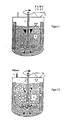
- Fig. 3.1 shows a static or dynamic mixer.
- the polymeric base substances, polymer P, additive-deposit capsules (A), filler (F) and optionally other active ingredients (W) are fed to the stirred tank 2.
- the substances are mixed and melted, whereby the depot-capsule-wrapper dissolves by means of pressure or heat and the released Towing agent is distributed homogeneously in the polymer melt 4.
- a negative pressure is generated after the mixing process described above by means of vacuum 3 in the stirred tank 2. It begins suddenly the evaporation of the entraining agent with bubbling. From the foam-like matrix melt 5, the volatile pollutants and / or odor-emitting substances are removed. After degassing, the purified polymeric material is removed for further processing.
Landscapes
- Chemical & Material Sciences (AREA)
- Health & Medical Sciences (AREA)
- Chemical Kinetics & Catalysis (AREA)
- Medicinal Chemistry (AREA)
- Polymers & Plastics (AREA)
- Organic Chemistry (AREA)
- Manufacturing Of Micro-Capsules (AREA)
- Processing And Handling Of Plastics And Other Materials For Molding In General (AREA)
- Addition Polymer Or Copolymer, Post-Treatments, Or Chemical Modifications (AREA)
- Treating Waste Gases (AREA)
- Processing Of Solid Wastes (AREA)
- Disinfection, Sterilisation Or Deodorisation Of Air (AREA)
Abstract
Description
- Verfahren zur Minderung von Schadstoffemissionen und/oder geruchsemittierenden Substanzen in polymeren Werkstoffen.
- Die vorliegende Erfindung betrifft ein Verfahren zur Minderung von Schadstoff-Emissionen und/oder geruchsemittierenden Substanzen in polymeren Werkstoffen. An polymere Werkstoffe, vornehmlich Thermoplaste, Duroplaste, Elastomere, Kleber und Beschichtungen sowie Composites und Regenerate werden immer höhere QualitätsAnforderungen hinsichtlich der Einhaltung der Minimal-Grenzwerte für Schadstoff-Emissionen und Fogging sowie geruchsemittierenden Substanzen gestellt. Insbesondere werden diese Grenzwerte für Kunststoffe in der Anwendung zur Lebensmittelverpackung, der Medizintechnik, der allgemeinen Technik und in der Transport- und FahrzeugTechnik (Wasser, Luft, Schiene und Straße), hier insbesondere im Interieur-Bereich gefordert.
- Bekannt ist, Wasser, Kohlendioxid oder Stickstoff als Schlepp- und Treibmittel zur Minderung des Restmonomergehaltes und damit die Reduzierung flüchtig organischer Verbindungen und geruchsemittierender Substanzen in der Verarbeitung von polymeren Werkstoffen einzusetzen. Derartige Verfahren wurden in der Forschungsarbeit/Dissertation "Entgasen von Polymeren" im November 2002 an der Universität Hannover untersucht.
-
DE 103 35 486 B4 beschreibt ein Verfahren zur Minderung von Schadstoffen und/oder geruchsemittierenden Substanzen in polymeren Werkstoffen. Hierbei wird ein Additiv basierend auf ein Trägermaterial aus Zeolith oder Kieselsäure mit einer Wasserbeladung zur homogenen Einarbeitung in die Polymerschmelze entwickelt. - Physikalisch gebundene Flüssigkeiten auf mikro- oder nanoskaliertem Trägermaterial, d.h. pulverisiert, trennen sich leicht von dem Trägermaterial vor der homogenen Einarbeitung in der bis zu 350 °C heißen polymeren Werkstoffschmelze und liefern dann kaum einen Beitrag zur Entgasungsverbesserung. Weiterhin führen die hohen Verarbeitungs-Temperaturen zum Aufheizen der Metall-Prozesseinrichtungen, wie Zylinder, Schnecken und Transport- sowie Mischwellen, und führen ebenfalls zu der vorbeschriebenen Verarbeitungs-Behinderung. Eine Beladung der Trägerstoffe ist nur mit polaren Flüssigkeiten möglich und schränkt den Anwendungsbereich stark ein.
- Um während der Verarbeitung Füllstoffe und Verstärkungs-Materialien der Werkstoffschmelze zuzugeben, sind am Extruder auf der Länge bis zur Vakuumentgasungs-Zone Entlüfter angeordnet, die ein vorzeitiges Abdampfen der Schleppmittel-Wirkstoffflüssigkeit bewirken und die Entgasungsleistung mindern. Weiterhin sind physikalisch zu Pulver gebundene Flüssigkeiten sehr anfällig bei Druck durch Förderschnecken. Ein großes Problem stellt auch die unzuverlässige Reproduzierbarkeit bei der Dosiermengenbestimmung dieser Schleppmitteladditive dar, da sie durch eine große Oberflächenverteilung bei offenen Lager- bzw. Verarbeitungssystemen zur Verdunstung neigen.
- Die bei diesem Stand der Technik bekannten und beschriebenen Verfahren weisen einige Nachteile auf. Dies gilt insbesondere für die Additivierungs-Reproduzierbarkeit von Entgasungsverfahren und der damit verbundenen Sicherungsforderung der Qualitäts-Verbesserung von polymeren Werkstoffen.
- Aufgabe der Erfindung ist es daher, ein Verfahren zu entwickeln, das sich reproduzierbar, unkompliziert und kostengünstig in vorhandene und neue Extrusions-, Misch- und Fertigungsprozesse integrieren und anwenden lässt.
- Diese Aufgabe wurde durch ein Verfahren mit den Merkmalen des Anspruchs 1 gelöst. Eine prozesssichere, reproduzierbare und kostengünstige Eindosierung des Schleppmittelwirkstoffes "Wasser" wird durch den Einsatz als Kapsel - im Folgenden auch Additiv-Depot-Kapsel genannt - erreicht. Die Kapsel gewährleistet eine homogene Einarbeitung in der Werkstoff-Polymermatrix bei flexibler und gezielter Einstellung der Kapselwand-Auflösung durch Druck bzw. Wärme und Freisetzung der Schleppmittelflüssigkeit in der gewünschten Vakuumentgasungszone und führt hier unter Vakuumdruck durch Blasenverdampfung zum Abzug bzw. Minderung von Schadstoffen und/oder geruchsemittierenden Substanzen im Polymer-Werkstoff.
- Die Additiv-Depot-Kapsel besteht im Kern aus bis zu 95 Gewichts-Prozent Flüssigkeit und hat eine feste Kapsel-Hülle aus bis zu 5 Gewichts-Prozent Wandmaterial, bestehend aus synthetischen oder natürlichen Stoffen, kompatibel zum Polymer-Werkstoff.
- Die Kapselgröße bzw. der Durchmesser der Additiv-Depot-Kapsel kann je nach den Erfordernissen zwischen 20 und 50000 µm betragen.
- Die Additiv-Depot-Kapseln werden je nach dem Grad der Werkstoff-Verunreinigung bzw. Bedarf mit 0,2 bis 30 Gewichts-Prozent in die Polymer-Werkstoffmischung eindosiert. Die Depot-Kapsel kann sowohl mit einer Monokernstruktur mit einem Einzelwirkstoff, dem Schleppmittel, als auch mit Kombiwirkstoffen beladen sein. Auch kann die Kapsel mit einer Polykernstruktur hergestellt werden. Hierbei werden die Monokernstruktur-Kapseln mehrfach zu einer Verbund-Polykernstruktur-Kapsel gebündelt und kapseliert. Über unterschiedliche Materialien der Kapselhülle lassen sich in Verbindung mit Druck oder Wärme genau definierte Zeiträume bzw. Positionen für die gewünschte Freisetzung des im Kapselkern befindlichen Wirkstoffes einstellen. Die erreichten Vorteile sind in der großen, möglichen Vielzahl an Lösungsvariationen von der Schleppmittel-Flüssigwirkstoff-Monokapsel bis hin zur Multifunktions- oder Schleppmittel-/Funktionswirkstoffkombinations-Kapsel zu sehen. Neben der Basiskapselfüllung Wasser als Schleppmittelwirkstoff zum Abdampfen und Entgasen von Schadstoffen und/oder geruchsemittierenden Substanzen kann die Kapselfüllung auch Funktionswirkstoffe mit polarer oder unpolarer Stoffstruktur, wie z.B.
- Stabilisatoren, Antioxidantien, Neutralisations- und Nukleierungs-Mittel, Farbpigmente, Duftstoffe, Bakterizide, Fungizide, und Pestizide beinhalten. Während die flüssigen Inhaltsstoffe der Depot-Kapsel bei Unterdruck in der Entgasungsphase unter Blasen- und Schaumbildung zur gewünschten Entgasung beitragen, verbleiben die Funktionswirkstoffe in der Werkstoffmatrix und üben eine qualitätsverbessernde Dauerwirkung aus.
- Das erfindungsgemäße Verfahren zeichnet sich gegenüber bisher bekannten Entgasungsverfahren durch eine deutlich verbesserte Handhabung aus.
- Die Additiv-Depot-Kapsel lässt sich durch die feste Kapselwand-Umhüllung ohne Schleppmittelverlust zeitunabhängig lagern, auf weiten Strecken transportieren und mittels volumetrischen und gravimetrischen Dosiersystemen exakt mittels Druck oder drucklos in die Polymermatrix einarbeiten. Die feste Kapselwand-Umhüllung verhindert im Verarbeitungsprozess eine vorzeitige ungewollte Verflüchtigung bzw. Abspaltung der Schleppmittelflüssigkeit durch Kontaktieren mit heißen Anlagenteilen, wie Zylinder, Schnecken und Mischwellen.
- Das erfindungsgemäße Verfahren ermöglicht erstmals die Zugabe der Additiv-Depot-Kapsel mittels Druck oder drucklos sowohl über die Material-Aufgabestation als auch mittels Druck oder drucklos über eine oder mehrere Seitenbeschickungen. Dies ermöglicht den Einsatz von Entgasungshilfsmitteln in der Additiv-Depot-Kapsel bei der Entgasung von empfindlichen Naturfaser- bzw. Holzfaserverstärkten Kunststoffen.
- Weiterhin ermöglicht das erfindungsgemäße Verfahren mittels des Einsatzes der Additiv-Depot-Kapsel die exakte Wirkstoffbestimmung bzw. Menge und den Zeitpunkt der Freisetzung, womit auch das Problem der handzuhabenden Reproduzierbarkeit gelöst wurde.
- Ausführungsbeispiele der Erfindung sind in den Zeichnungen dargestellt und nachfolgend erläutert. Es zeigt:
- Fig. 1
- Querschnitte verschiedener Kapseln,
- Fig. 2
- einen Extruder und
- Fig. 3
- zwei Mischer.
- Schematisch wird in Fig. 1 die Additiv-Depot-Kapsel dargestellt. Fig. 1,1 zeigt die Monokapsel mit einer durch Wärme oder Druck sich auflösender Kapsel-Hülle (A), die mit einem Schleppmittel (B) bzw. kombiniert mit einem Funktions-Wirkstoff (B) gefüllt ist.
Fig. 1.2 zeigt eine Additiv-Depot-Kapsel als Polykapsel bestehend aus gebündelten vorbeschriebenen Monokapseln.
Fig. 1.3 zeigt eine Additiv-Depot-Kapsel als Multikapsel bestehend aus gebündelten vorbeschriebenen Polykapseln.
Dem in Fig. 2 schematisch dargestellten Extruder 1 mit einer durch einen nach links weisenden Pfeil gekennzeichneten Förderrichtung werden bei dem Material-Aufgabetrichter 2 bzw. bei der Einzugszone die polymeren Grundsubstanzen, Polymer (P), Additiv-Depot-Kapsel (A), Füllstoff (F) und gegebenenfalls weitere Wirkstoffe (W) zugeführt. Die zugeführten Substanzen werden in einem Bereich 5 des Extruders 1 eingezogen, vermischt und aufgeschmolzen, wobei die Hülle der Additiv-Depot-Kapsel (A) mittels Druck oder Wärme aufgelöst und das freiwerdende Schleppmittel homogen in die Polymermatrix eingemischt wird. Die Zuführung der Additiv-Depot-Kapseln (A) kann ebenfalls oder zusätzlich über eine Seiten-Beschickung 9 unter Druck oder drucklos der Polymerschmelze zugegeben werden. - Dieser Misch- und Aufschmelzprozess wird in einem Bereich 6 mit erhöhtem Druck (D) fortgesetzt.
- In dem mittels Vakuum 4 erzeugten Unterdruckbereich der Entgasungszone 7 verdampft das Schleppmittel bei Blasen- und Schaumbildung bei abgemindertem Füllgrad (G) und entgast/reinigt unter Mitnahme der flüchtigen Schadstoffe und geruchsemittierenden Substanzen den polymeren werkstoff. Der fertige und gereinigte polymere Werkstoff wird an der Düse 3 zur weiteren Verarbeitung entgegengenommen.
- Fig. 3.1 zeigt einen statischen bzw. dynamischen Mischer. Über einen Aufgabetrichter 1 werden die polymeren Grundsubstanzen, Polymer P, Additiv-Depot-Kapseln (A), Füllstoff (F) und gegebenenfalls weitere Wirkstoffe (W) dem Rührbehälter 2 zugeführt. Die Substanzen werden vermischt und aufgeschmolzen, wobei sich die Depot-Kapsel-Umhüllung mittels Druck oder Wärme auflöst und das freiwerdende Schleppmittel sich homogen in der Polymerschmelze 4 verteilt.
- Dem in Fig. 3.2 dargestellten Mischer wird nach dem vorbeschriebenen Mischvorgang mittels Vakuum 3 im Rührbehälter 2 ein Unterdruck erzeugt. Es setzt schlagartig die Verdampfung des Schleppmittels unter Blasenbildung ein. Aus der schaumförmigen Matrixschmelze 5 werden die flüchtigen Schadstoffe und/oder geruchsemittierenden Substanzen abgezogen. Nach der Entgasung wird der gereinigte polymere Werkstoff zur weiteren Verarbeitung entnommen.
Claims (7)
- Verfahren zur Minderung von Schadstoffemissionen und/oder geruchsemittierenden Substanzen in polymeren Werkstoffen, dadurch gekennzeichnet, dass Schleppmittel enthaltende Kapseln in die polymeren Werkstoffe eingearbeitet werden, dass das Schleppmittel in Verbindung mit Druck und/oder Wärme in der Werkstoffschmelze freigesetzt wird und unter Vakuum-Unterdruck mit Blasen- und Schaumbildung unter Mitnahme von flüchtigen Schadstoffen und/oder geruchsemittierenden Substanzen abdampft.
- verfahren nach Anspruch 1, dadurch gekennzeichnet, dass die Kapseln mit 0,2 bis 30 Gewichts-Prozent in polymere Werkstoffe eingebracht werden.
- Additiv zur Minderung von Schadstoffen und/oder geruchsemittierenden Substanzen in polymeren Werkstoffen, gekennzeichnet durch Kapseln, die mit einem Schleppmittel von bis zu 95 Gewichts-Prozent gefüllt und einer festen Kapsel-Hülle bestehen.
- Additiv nach Anspruch 3, dadurch gekennzeichnet, dass die Kapsel-Hülle aus bis zu 5 Gewichts-Prozent Wandmaterial aus synthetischen oder natürlichen Stoffen, jeweils kompatibel zum Polymer-Werkstoff, besteht.
- Additiv nach einem der Ansprüche 3 oder 4, dadurch gekennzeichnet, dass die Kapsel einen Durchmesser von 20 bis 50000 µm aufweist.
- Additiv nach einem der Ansprüche 3 bis 5, dadurch gekennzeichnet, dass die Füllung der Depot-Kapsel neben dem Schleppmittel auch aus Funktionswirkstoffen, oder aus Kombinationen von beiden besteht.
- Additiv nach einem der Ansprüche 3 bis 6, dadurch gekennzeichnet, dass die Kapsel mit Polystruktur-Kapseln gefüllt ist, wobei mehrere Kapseln mit gleichem oder verschiedenem Inhalt zu einem Verbund gebündelt kapseliert sind.
Applications Claiming Priority (1)
| Application Number | Priority Date | Filing Date | Title |
|---|---|---|---|
| DE102006053258 | 2006-11-11 |
Publications (2)
| Publication Number | Publication Date |
|---|---|
| EP1921108A1 true EP1921108A1 (de) | 2008-05-14 |
| EP1921108B1 EP1921108B1 (de) | 2010-08-18 |
Family
ID=39106078
Family Applications (1)
| Application Number | Title | Priority Date | Filing Date |
|---|---|---|---|
| EP07021712A Not-in-force EP1921108B1 (de) | 2006-11-11 | 2007-11-08 | Verfahren zur Minderung von Schadstoffermissionen und/oder geruchsemittierenden Substanzen in polymeren Wekstoffen |
Country Status (3)
| Country | Link |
|---|---|
| EP (1) | EP1921108B1 (de) |
| AT (1) | ATE478112T1 (de) |
| DE (1) | DE502007004767D1 (de) |
Cited By (1)
| Publication number | Priority date | Publication date | Assignee | Title |
|---|---|---|---|---|
| WO2022063723A1 (de) | 2020-09-24 | 2022-03-31 | Fraunhofer-Gesellschaft zur Förderung der angewandten Forschung e.V. | Kompositbauteil |
Citations (4)
| Publication number | Priority date | Publication date | Assignee | Title |
|---|---|---|---|---|
| DE1946163A1 (de) * | 1969-04-25 | 1970-11-12 | Akesson Ake Bromma | Methode der Wasserzufuehrung zu Wasser benoetigenden Objekten |
| DE10120480A1 (de) * | 2001-04-25 | 2002-10-31 | Basf Ag | Mikrokapseln mit einem wasserlösliche Substanzen enthaltenden Kapselkern |
| WO2004069913A1 (de) * | 2003-02-07 | 2004-08-19 | Schrader Helmut G | Additiv zur einbringung von homogen verteiltem wasser in polymere werkstoffe und verfahren zur anwendung des additivs |
| EP1541594A1 (de) | 2003-12-06 | 2005-06-15 | Bayer MaterialScience AG | Verfahren zur Aufbereitung von Polymerdispersionen in Polyesterpolyolen |
-
2007
- 2007-11-08 DE DE502007004767T patent/DE502007004767D1/de active Active
- 2007-11-08 AT AT07021712T patent/ATE478112T1/de active
- 2007-11-08 EP EP07021712A patent/EP1921108B1/de not_active Not-in-force
Patent Citations (4)
| Publication number | Priority date | Publication date | Assignee | Title |
|---|---|---|---|---|
| DE1946163A1 (de) * | 1969-04-25 | 1970-11-12 | Akesson Ake Bromma | Methode der Wasserzufuehrung zu Wasser benoetigenden Objekten |
| DE10120480A1 (de) * | 2001-04-25 | 2002-10-31 | Basf Ag | Mikrokapseln mit einem wasserlösliche Substanzen enthaltenden Kapselkern |
| WO2004069913A1 (de) * | 2003-02-07 | 2004-08-19 | Schrader Helmut G | Additiv zur einbringung von homogen verteiltem wasser in polymere werkstoffe und verfahren zur anwendung des additivs |
| EP1541594A1 (de) | 2003-12-06 | 2005-06-15 | Bayer MaterialScience AG | Verfahren zur Aufbereitung von Polymerdispersionen in Polyesterpolyolen |
Cited By (1)
| Publication number | Priority date | Publication date | Assignee | Title |
|---|---|---|---|---|
| WO2022063723A1 (de) | 2020-09-24 | 2022-03-31 | Fraunhofer-Gesellschaft zur Förderung der angewandten Forschung e.V. | Kompositbauteil |
Also Published As
| Publication number | Publication date |
|---|---|
| DE502007004767D1 (de) | 2010-09-30 |
| EP1921108B1 (de) | 2010-08-18 |
| ATE478112T1 (de) | 2010-09-15 |
Similar Documents
| Publication | Publication Date | Title |
|---|---|---|
| DE69307073T2 (de) | Aufsprühen von Kunststoffadditive auf Kunststoff | |
| DE2459093C2 (de) | Vorrichtung zur Umhüllung von Pellets aus aufgeschäumtem Polystyrol | |
| DE1220585B (de) | Verfahren zum Herstellen von Kunststoffen aus Polyamiden und hochpolymeren Kohlenwasserstoffen | |
| EP0692353B1 (de) | Verfahren zum kontinuierlichen Dispergieren von feinteiligen Feststoffen in einer Flüssigkeit | |
| DE10150329C2 (de) | Vorrichtung und Verfahren zur Herstellung geschäumter Kunststoff-Formteile im Spritzgießprozess unter Verwendung komprimierter physikalischer Treibfluide | |
| DE2924317C2 (de) | Zweistufige Strangpreßvorrichtung für thermoplastische Formmassen, insbesondere für pulverförmige Kunststoffe | |
| DE2012992C3 (de) | Verfahren und Vorrichtung zum Herstellen eines füllstoffhaltigen Schaumstoffs | |
| CH685931A5 (de) | Verfahren und Vorrichtung zur Herstellung eines vernetzten extrudierten Polymerproduktes. | |
| EP1921108B1 (de) | Verfahren zur Minderung von Schadstoffermissionen und/oder geruchsemittierenden Substanzen in polymeren Wekstoffen | |
| DE60105008T2 (de) | Verfahren und vorrichtung zur bereitstellung eines granulatgemisches, und granulatgemisch | |
| DE2733954A1 (de) | Verfahren zur herstellung eines poroesen formkoerpers, der fluessigkeiten zurueckbehalten kann | |
| DE2017548A1 (de) | Verfahren und Vorrichtung zum kontinuierlichen, dosierten Einbringen von Füllstoffen in Schaumstoffmassen | |
| DE10123885A1 (de) | Verfahren zum Abfüllen von feuchtem, klebrigem Schüttgut | |
| EP2419231B1 (de) | Verfahren zum pulverbesschichten bzw. zur herstellung von verbundwerkstoffen, vorzugsweise bei der verarbeitung von kunststoffen oder beim sprühkompaktieren von metallen | |
| DE102004052929A1 (de) | Verfahren und Vorrichtung zur Herstellung von festem Duftstoff | |
| DE102009034292A1 (de) | Verfahren zur Herstellung von Schaumstoffen | |
| DE2702069C2 (de) | Vorrichtung zum Mischen mindestens eines pulverförmigen Feststoffes mit mindestens einer Flüssigkeit zur Herstellung einer Dispersion | |
| DE102004018436B4 (de) | Verfahren sowie Vorrichtung zur Bereitstellung eines Polymer-Granulats | |
| DE1778779A1 (de) | Verfahren zum kontinuierlichen Mischen von Phenolharz fuer Schaeumzwecke mit nicht loeslichen Feststoffen | |
| EP4094929B1 (de) | Verfahren zum herstellen eines faserverstärkten kunststoffproduktes sowie anlage dafür | |
| DE10335486B4 (de) | Verfahren zur Minderung von Schadstoffen und/oder geruchsemittierenden Substanzen in polymeren Werkstoffen | |
| DE102024105222B3 (de) | Verfahren und Vorrichtung zur Produktion von Polyurethan-Bauteilen | |
| DE3730473A1 (de) | Verfahren zum beschichten von gegenstaenden | |
| DE958773C (de) | Verwendung von Polyisocyanat- oder Polyestergranulaten bei der Herstellung von Kunststoffen aus Polyisocyanaten und Polyestern | |
| DE102005016194B4 (de) | Verfahren zur Herstellung von Polymer-Formteilen aus nicht oder nur schlecht miteinander mischbaren Polymeren |
Legal Events
| Date | Code | Title | Description |
|---|---|---|---|
| PUAI | Public reference made under article 153(3) epc to a published international application that has entered the european phase |
Free format text: ORIGINAL CODE: 0009012 |
|
| AK | Designated contracting states |
Kind code of ref document: A1 Designated state(s): AT BE BG CH CY CZ DE DK EE ES FI FR GB GR HU IE IS IT LI LT LU LV MC MT NL PL PT RO SE SI SK TR |
|
| AX | Request for extension of the european patent |
Extension state: AL BA HR MK RS |
|
| 17P | Request for examination filed |
Effective date: 20081111 |
|
| 17Q | First examination report despatched |
Effective date: 20081215 |
|
| AKX | Designation fees paid |
Designated state(s): AT BE BG CH CY CZ DE DK EE ES FI FR GB GR HU IE IS IT LI LT LU LV MC MT NL PL PT RO SE SI SK TR |
|
| GRAP | Despatch of communication of intention to grant a patent |
Free format text: ORIGINAL CODE: EPIDOSNIGR1 |
|
| GRAS | Grant fee paid |
Free format text: ORIGINAL CODE: EPIDOSNIGR3 |
|
| GRAA | (expected) grant |
Free format text: ORIGINAL CODE: 0009210 |
|
| AK | Designated contracting states |
Kind code of ref document: B1 Designated state(s): AT BE BG CH CY CZ DE DK EE ES FI FR GB GR HU IE IS IT LI LT LU LV MC MT NL PL PT RO SE SI SK TR |
|
| REG | Reference to a national code |
Ref country code: GB Ref legal event code: FG4D Free format text: NOT ENGLISH |
|
| REG | Reference to a national code |
Ref country code: CH Ref legal event code: EP |
|
| REG | Reference to a national code |
Ref country code: IE Ref legal event code: FG4D Free format text: LANGUAGE OF EP DOCUMENT: GERMAN |
|
| REF | Corresponds to: |
Ref document number: 502007004767 Country of ref document: DE Date of ref document: 20100930 Kind code of ref document: P |
|
| REG | Reference to a national code |
Ref country code: NL Ref legal event code: VDEP Effective date: 20100818 |
|
| LTIE | Lt: invalidation of european patent or patent extension |
Effective date: 20100818 |
|
| PG25 | Lapsed in a contracting state [announced via postgrant information from national office to epo] |
Ref country code: FI Free format text: LAPSE BECAUSE OF FAILURE TO SUBMIT A TRANSLATION OF THE DESCRIPTION OR TO PAY THE FEE WITHIN THE PRESCRIBED TIME-LIMIT Effective date: 20100818 Ref country code: LT Free format text: LAPSE BECAUSE OF FAILURE TO SUBMIT A TRANSLATION OF THE DESCRIPTION OR TO PAY THE FEE WITHIN THE PRESCRIBED TIME-LIMIT Effective date: 20100818 |
|
| PG25 | Lapsed in a contracting state [announced via postgrant information from national office to epo] |
Ref country code: CY Free format text: LAPSE BECAUSE OF FAILURE TO SUBMIT A TRANSLATION OF THE DESCRIPTION OR TO PAY THE FEE WITHIN THE PRESCRIBED TIME-LIMIT Effective date: 20100818 Ref country code: IS Free format text: LAPSE BECAUSE OF FAILURE TO SUBMIT A TRANSLATION OF THE DESCRIPTION OR TO PAY THE FEE WITHIN THE PRESCRIBED TIME-LIMIT Effective date: 20101218 Ref country code: PL Free format text: LAPSE BECAUSE OF FAILURE TO SUBMIT A TRANSLATION OF THE DESCRIPTION OR TO PAY THE FEE WITHIN THE PRESCRIBED TIME-LIMIT Effective date: 20100818 Ref country code: SI Free format text: LAPSE BECAUSE OF FAILURE TO SUBMIT A TRANSLATION OF THE DESCRIPTION OR TO PAY THE FEE WITHIN THE PRESCRIBED TIME-LIMIT Effective date: 20100818 Ref country code: PT Free format text: LAPSE BECAUSE OF FAILURE TO SUBMIT A TRANSLATION OF THE DESCRIPTION OR TO PAY THE FEE WITHIN THE PRESCRIBED TIME-LIMIT Effective date: 20101220 Ref country code: BG Free format text: LAPSE BECAUSE OF FAILURE TO SUBMIT A TRANSLATION OF THE DESCRIPTION OR TO PAY THE FEE WITHIN THE PRESCRIBED TIME-LIMIT Effective date: 20101118 |
|
| REG | Reference to a national code |
Ref country code: IE Ref legal event code: FD4D |
|
| PG25 | Lapsed in a contracting state [announced via postgrant information from national office to epo] |
Ref country code: NL Free format text: LAPSE BECAUSE OF FAILURE TO SUBMIT A TRANSLATION OF THE DESCRIPTION OR TO PAY THE FEE WITHIN THE PRESCRIBED TIME-LIMIT Effective date: 20100818 Ref country code: SE Free format text: LAPSE BECAUSE OF FAILURE TO SUBMIT A TRANSLATION OF THE DESCRIPTION OR TO PAY THE FEE WITHIN THE PRESCRIBED TIME-LIMIT Effective date: 20100818 Ref country code: LV Free format text: LAPSE BECAUSE OF FAILURE TO SUBMIT A TRANSLATION OF THE DESCRIPTION OR TO PAY THE FEE WITHIN THE PRESCRIBED TIME-LIMIT Effective date: 20100818 Ref country code: GR Free format text: LAPSE BECAUSE OF FAILURE TO SUBMIT A TRANSLATION OF THE DESCRIPTION OR TO PAY THE FEE WITHIN THE PRESCRIBED TIME-LIMIT Effective date: 20101119 |
|
| PG25 | Lapsed in a contracting state [announced via postgrant information from national office to epo] |
Ref country code: DK Free format text: LAPSE BECAUSE OF FAILURE TO SUBMIT A TRANSLATION OF THE DESCRIPTION OR TO PAY THE FEE WITHIN THE PRESCRIBED TIME-LIMIT Effective date: 20100818 Ref country code: IE Free format text: LAPSE BECAUSE OF FAILURE TO SUBMIT A TRANSLATION OF THE DESCRIPTION OR TO PAY THE FEE WITHIN THE PRESCRIBED TIME-LIMIT Effective date: 20100818 |
|
| BERE | Be: lapsed |
Owner name: SCHRADER, HELMUT G. Effective date: 20101130 |
|
| PG25 | Lapsed in a contracting state [announced via postgrant information from national office to epo] |
Ref country code: IT Free format text: LAPSE BECAUSE OF FAILURE TO SUBMIT A TRANSLATION OF THE DESCRIPTION OR TO PAY THE FEE WITHIN THE PRESCRIBED TIME-LIMIT Effective date: 20100818 Ref country code: SK Free format text: LAPSE BECAUSE OF FAILURE TO SUBMIT A TRANSLATION OF THE DESCRIPTION OR TO PAY THE FEE WITHIN THE PRESCRIBED TIME-LIMIT Effective date: 20100818 Ref country code: CZ Free format text: LAPSE BECAUSE OF FAILURE TO SUBMIT A TRANSLATION OF THE DESCRIPTION OR TO PAY THE FEE WITHIN THE PRESCRIBED TIME-LIMIT Effective date: 20100818 Ref country code: RO Free format text: LAPSE BECAUSE OF FAILURE TO SUBMIT A TRANSLATION OF THE DESCRIPTION OR TO PAY THE FEE WITHIN THE PRESCRIBED TIME-LIMIT Effective date: 20100818 Ref country code: EE Free format text: LAPSE BECAUSE OF FAILURE TO SUBMIT A TRANSLATION OF THE DESCRIPTION OR TO PAY THE FEE WITHIN THE PRESCRIBED TIME-LIMIT Effective date: 20100818 |
|
| PLBE | No opposition filed within time limit |
Free format text: ORIGINAL CODE: 0009261 |
|
| STAA | Information on the status of an ep patent application or granted ep patent |
Free format text: STATUS: NO OPPOSITION FILED WITHIN TIME LIMIT |
|
| PG25 | Lapsed in a contracting state [announced via postgrant information from national office to epo] |
Ref country code: ES Free format text: LAPSE BECAUSE OF FAILURE TO SUBMIT A TRANSLATION OF THE DESCRIPTION OR TO PAY THE FEE WITHIN THE PRESCRIBED TIME-LIMIT Effective date: 20101129 Ref country code: MC Free format text: LAPSE BECAUSE OF NON-PAYMENT OF DUE FEES Effective date: 20101130 |
|
| 26N | No opposition filed |
Effective date: 20110519 |
|
| PG25 | Lapsed in a contracting state [announced via postgrant information from national office to epo] |
Ref country code: BE Free format text: LAPSE BECAUSE OF NON-PAYMENT OF DUE FEES Effective date: 20101130 |
|
| REG | Reference to a national code |
Ref country code: DE Ref legal event code: R097 Ref document number: 502007004767 Country of ref document: DE Effective date: 20110519 |
|
| PG25 | Lapsed in a contracting state [announced via postgrant information from national office to epo] |
Ref country code: MT Free format text: LAPSE BECAUSE OF FAILURE TO SUBMIT A TRANSLATION OF THE DESCRIPTION OR TO PAY THE FEE WITHIN THE PRESCRIBED TIME-LIMIT Effective date: 20100818 |
|
| PG25 | Lapsed in a contracting state [announced via postgrant information from national office to epo] |
Ref country code: HU Free format text: LAPSE BECAUSE OF FAILURE TO SUBMIT A TRANSLATION OF THE DESCRIPTION OR TO PAY THE FEE WITHIN THE PRESCRIBED TIME-LIMIT Effective date: 20110219 Ref country code: LU Free format text: LAPSE BECAUSE OF NON-PAYMENT OF DUE FEES Effective date: 20101108 |
|
| PG25 | Lapsed in a contracting state [announced via postgrant information from national office to epo] |
Ref country code: TR Free format text: LAPSE BECAUSE OF FAILURE TO SUBMIT A TRANSLATION OF THE DESCRIPTION OR TO PAY THE FEE WITHIN THE PRESCRIBED TIME-LIMIT Effective date: 20100818 |
|
| PGFP | Annual fee paid to national office [announced via postgrant information from national office to epo] |
Ref country code: CH Payment date: 20121123 Year of fee payment: 6 |
|
| PGFP | Annual fee paid to national office [announced via postgrant information from national office to epo] |
Ref country code: GB Payment date: 20121122 Year of fee payment: 6 |
|
| PGFP | Annual fee paid to national office [announced via postgrant information from national office to epo] |
Ref country code: AT Payment date: 20121126 Year of fee payment: 6 Ref country code: FR Payment date: 20121217 Year of fee payment: 6 |
|
| REG | Reference to a national code |
Ref country code: CH Ref legal event code: PL |
|
| REG | Reference to a national code |
Ref country code: AT Ref legal event code: MM01 Ref document number: 478112 Country of ref document: AT Kind code of ref document: T Effective date: 20131108 |
|
| GBPC | Gb: european patent ceased through non-payment of renewal fee |
Effective date: 20131108 |
|
| PG25 | Lapsed in a contracting state [announced via postgrant information from national office to epo] |
Ref country code: LI Free format text: LAPSE BECAUSE OF NON-PAYMENT OF DUE FEES Effective date: 20131130 Ref country code: CH Free format text: LAPSE BECAUSE OF NON-PAYMENT OF DUE FEES Effective date: 20131130 |
|
| REG | Reference to a national code |
Ref country code: FR Ref legal event code: ST Effective date: 20140731 |
|
| PG25 | Lapsed in a contracting state [announced via postgrant information from national office to epo] |
Ref country code: AT Free format text: LAPSE BECAUSE OF NON-PAYMENT OF DUE FEES Effective date: 20131108 |
|
| PG25 | Lapsed in a contracting state [announced via postgrant information from national office to epo] |
Ref country code: GB Free format text: LAPSE BECAUSE OF NON-PAYMENT OF DUE FEES Effective date: 20131108 Ref country code: FR Free format text: LAPSE BECAUSE OF NON-PAYMENT OF DUE FEES Effective date: 20131202 |
|
| PGFP | Annual fee paid to national office [announced via postgrant information from national office to epo] |
Ref country code: DE Payment date: 20171013 Year of fee payment: 11 |
|
| REG | Reference to a national code |
Ref country code: DE Ref legal event code: R119 Ref document number: 502007004767 Country of ref document: DE |
|
| PG25 | Lapsed in a contracting state [announced via postgrant information from national office to epo] |
Ref country code: DE Free format text: LAPSE BECAUSE OF NON-PAYMENT OF DUE FEES Effective date: 20190601 |