EP1921567A2 - Procédé de représentation imagée de l'environnement d'un véhicule et système de saisie d'images - Google Patents
Procédé de représentation imagée de l'environnement d'un véhicule et système de saisie d'images Download PDFInfo
- Publication number
- EP1921567A2 EP1921567A2 EP07021756A EP07021756A EP1921567A2 EP 1921567 A2 EP1921567 A2 EP 1921567A2 EP 07021756 A EP07021756 A EP 07021756A EP 07021756 A EP07021756 A EP 07021756A EP 1921567 A2 EP1921567 A2 EP 1921567A2
- Authority
- EP
- European Patent Office
- Prior art keywords
- vehicle
- detected
- area
- objects
- color information
- Prior art date
- Legal status (The legal status is an assumption and is not a legal conclusion. Google has not performed a legal analysis and makes no representation as to the accuracy of the status listed.)
- Ceased
Links
Images

Classifications
-
- G—PHYSICS
- G06—COMPUTING OR CALCULATING; COUNTING
- G06T—IMAGE DATA PROCESSING OR GENERATION, IN GENERAL
- G06T5/00—Image enhancement or restoration
- G06T5/50—Image enhancement or restoration using two or more images, e.g. averaging or subtraction
-
- G—PHYSICS
- G06—COMPUTING OR CALCULATING; COUNTING
- G06V—IMAGE OR VIDEO RECOGNITION OR UNDERSTANDING
- G06V20/00—Scenes; Scene-specific elements
- G06V20/50—Context or environment of the image
- G06V20/56—Context or environment of the image exterior to a vehicle by using sensors mounted on the vehicle
- G06V20/58—Recognition of moving objects or obstacles, e.g. vehicles or pedestrians; Recognition of traffic objects, e.g. traffic signs, traffic lights or roads
Definitions
- the invention relates to a method for the pictorial representation of a vehicle environment in which a first vehicle surroundings area is detected and displayed in multiple colors with a first detection device sensitive in the visible spectral range, and a second vehicle surroundings area is detected with a second detection device sensitive in the infrared spectral range. Furthermore, the invention relates to an image acquisition system, in particular a night vision system, for a vehicle.
- Image acquisition systems for detecting the environment of a vehicle are known. From the DE 103 04 703 A1
- a method and apparatus for visualizing the environment of a vehicle with ambient fusion of an infrared and a visual image is known.
- the visualization of the environment should be done in the dark of the vehicle.
- a weighted superimposition of temporally and spatially identical image pairs from a visual image and an infrared image to form a fusion image is proposed.
- the weighting can be environment-dependent. For example, in the dark, a higher weighting and thus highlighting of the infrared information compared to the visual information in the fusion image may be provided.
- Time- and location-identical image pairs are superimposed on a pixel or area basis and / or averages are formed.
- a visualization of a combination or superposition of a visual image and an infrared image of a largely identical section of the surroundings of a vehicle takes place.
- a method and a device are known in which also a visualization of the substantially same environment of a vehicle with a driving situation-dependent fusion of an infrared and a visual image takes place. Depending on one Vehicle speed, an operation of a low beam or high beam, etc., a colored visual image with the infrared image is fused or combined or superimposed.
- a method and a device for visualizing a vehicle environment in which there is also a fusion between a visual image and made of the same surrounding area infrared image.
- Objects detected in the vehicle environment are weighted with weighting factors with regard to their contrast-enhancing pictorial representation.
- the weighting may be object specific, with object scoring done by object recognition systems that work with an object classification.
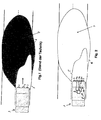
- a situation is shown schematically in which a vehicle 1 with headlights 2 and 3 moves in the direction of the arrow.
- the vehicle 1 comprises an IR sensor 4, which is designed for object detection in the infrared spectral range in advance of the vehicle 1.
- the driver of the vehicle 1 can substantially recognize objects within the vehicle surroundings area 5 illuminated by the front headlamps 2 and 3 also in their color scheme.
- the vehicle surrounding area 6 scanned by the IR sensor 4 has a much greater range than the illuminated vehicle surroundings area 5.
- the IR sensor 4 only enables monochrome image images, which are typically grayscale images or well graded images, the image representation is rendered unrealistic due to lack of color information and unrealistic color representations and difficult to observe the displayed images by a driver in the vehicle.
- the image of the environment, in particular of this subarea 7, thereby appears foreign and tires the driver when viewed for a longer time.
- WO 03/107067 A2 A method is known in which the front environment of the vehicle is recorded by means of infrared and additionally by means of a conventional color camera. The recorded sequences are fused using an algorithm. It is possible to output the directly illuminated by the headlight environment multicolored. However, the environment detected by the infrared sensors is still output only as a gray-scale image or as a green-graded image and thus in the context of the present application as not colored.
- a disadvantage of an overall picture of a surrounding area with colored and gray display areas is that it overstretches rather than relieves the driver.
- a first vehicle surroundings region is detected and displayed in multiple colors with a first detection device that is sensitive in the visible spectral range.
- a second vehicle surroundings area is detected by a second detection device sensitive in the infrared spectral range.
- the second vehicle surroundings region partially overlaps with the first vehicle surroundings region and extends beyond the range of the first vehicle environment region in at least a partial region in one direction.
- the vehicle environment detected in this subarea by the second detection device by means of infrared images is displayed multicolored for a vehicle user. Under a multicolored display The display is understood in different shades and thus as realistic as possible.
- a multicolor representation does not mean a grayscale image with different shades of gray or any other color display represented in a color having different shades of color of that one hue.
- the infra-red infrared images of the second detection device which can in principle only be displayed in monochrome, are also converted by the invention such that a multi-color representation can be made possible.
- the overall image of the detected vehicle environment is thereby more realistic, whereby the attention of an observer of these displayed images can be increased or maintained longer.
- the configured with a much higher range second detection devices then detect an unrecognizable by the vehicle user environment, which, however, can then also be displayed in a realistic realistic corresponding multi-color representation.
- one or more color information for the objects detected in the subarea by means of infrared images is generated from color information of stored and / or detected reference data.
- color information for a very wide variety of objects in the subarea can thus be detected from a multiplicity of known and underlying reference data which can be stored in advance and / or detected as a function of the situation. From known comparison information can be concluded that the color information of the objects in the sub-area.
- a relatively reliable and freely definable information base can be provided, which leads to very precise color information for the objects detected in the subarea.
- the sub-area detected objects are compared with stored reference objects and assigned depending on the comparison predetermined object classes.
- object classes which may include, for example, persons, animals, obstacles, other vehicles, trees and the like.
- a particularly fast and reliable classification of the respectively detected objects in the Subarea to be made By this classification, the same or relatively similar objects can be summarized and a relatively fast and low-effort color information assignment done. By this procedure, a coloring for a detected object in the subarea can be made possible very quickly.
- color information of an object class is transmitted to an object of the sub-domain classified therein.
- all objects assigned to an object class are made with a substantially identical color or a substantially identical color scheme with a plurality of color tones.
- trees and shrubs are all categorized into one class of objects, and that logs and branches are displayed with the same brownish hue and leaves and tree needles with the same greenish hue.
- color information of a specific reference object is transmitted on a partial area by means of infrared object-detected object in the case of an object match.
- infrared object-detected object in the case of an object match.
- a very specified and highly accurate color information analysis is performed.
- the object or object match is high, it is likely that color information for the objects captured by infrared images will be generated from the color information of the reference object.
- the color fastness and realistic image representation can be increased significantly.
- colorations of objects detected in the partial area are preferably extrapolated.
- preferred image processing methods can be used as the basis. With limited computational effort and thus also limited expenditure of time, this makes it possible to produce a very accurate and accurate color representation for one or more objects of the subarea.
- objects detected in the first vehicle surroundings region are compared with objects detected in this specified subregion of the second detection device, and color information is correspondingly transmitted to the objects of the subarea in the case of an object match.
- objects already covered by color can be closed in a limited area, and thus adjacent objects in the subarea can be closed with regard to their coloring.
- a multicolored tree detected in the first vehicle surroundings region can be recognized with regard to its color and a further tree arranged at a distance from it in the subarea can be displayed with a corresponding color scheme. Since the probability is relatively high, since in such a regionally limited area an at least very similar coloration of corresponding objects is given, thereby a very realistic multi-color representation of the objects in the sub-area can be ensured and this relatively low effort.
- information from a satellite navigation system and / or information from digital maps are preferably taken into account.
- the precise object detection and also possibly individually prevailing conditions with regard to the color design of the objects can thereby be taken into account.
- So GPS (Global Positioning System) data and digital map material for environment detection can be considered. So trees, buildings, rivers and the like can be detected. With regard to the assignment of the coloring of objects in the subarea, this information consideration can ensure an improved image representation.
- weather information such as rain, fog, snow, ice, or the like as well as season information may be used as basic data to infer or extrapolate the color information of the objects in the subregion.
- so-called car-to-car communication techniques can also be used. So can to Generation of color information for an object in the vehicle environment, in particular in the sub-area, information transmitted by this object and specifying this object must be taken into account. Thus, in the case of car-to-car communication, information about the object located in the subarea can also be received. If this object is, for example, another vehicle that is approaching, information about the vehicle model, the vehicle color and the like can be transmitted, for example. This can also be a significant improvement in the coloring realistic representation of this object.
- color information for the vehicle environment in the subarea is generated by statistical models. For example, very realistic color information can be generated for background objects such as sky, clouds, forests and the like by such statistical methods. Thus, in the environmental detection, a relatively unimportant surrounding area, such as the sky or clouds, can still be dyed very close to reality.
- an integrated navigation system is used with regard to the object detection, in order to enable, for example, a longer failure of GPS systems bridging this loss of information.
- a location determination based on the last position, the distance covered, an angle and digital map material can be done.
- the vehicle environment detected by the first and the second detection device is preferably displayed in a common image representation, in particular in a common single image, on a display device in multiple colors. Both the information of the first detection device and that of the second detection device are processed by the underlying image processing so that a common image is displayed which displays the information of both detection devices in an image in multiple colors.
- the method proves to be particularly preferred when the vehicle surroundings areas are extended substantially from the vehicle to the front and the first vehicle surroundings area is essentially limited by the surrounding area which can be illuminated by headlights of the vehicle.
- the surrounding area illuminated by the headlights can be detected by means of a conventional color camera, for example a CCD camera or a CMOS camera, and the color information contained therein can be evaluated.
- Image processing algorithms are preferably used which make it possible to generate color representations for the detected objects in the subarea from infrared images, which are generated by the second detection device, by fusion with one or more and also very different color and object information.
- the color and object information generated in this way makes it possible to calculate a color image even in the case of moving objects, such as motor vehicles, in an environment illuminated by infrared sensors.
- the proposed method can also be carried out for laterally or rearwardly of the vehicle located objects.
- a further aspect of the invention relates to an image acquisition system, in particular a night vision system, for a vehicle which is designed to detect the surroundings of the vehicle.
- the image acquisition system is designed to carry out a method according to the invention or an advantageous embodiment thereof.
- the image acquisition system preferably comprises at least one first detection device, which is designed as a camera for capturing images in the visible spectral range.
- the image acquisition system further comprises at least one second detection device which has at least one IR sensor.
- the image acquisition system preferably comprises an IR sensor system with at least one first IR sensor with a sensitivity in the wavelength range between 0.5 ⁇ m and 1.8 ⁇ m, in particular between 0.7 ⁇ m and 1.5 ⁇ m.
- the IR sensor system comprises at least one second IR sensor with a sensitivity in the wavelength range between 2.5 ⁇ m and 35 ⁇ m, in particular between 3 ⁇ m and 30 ⁇ m.
- at least two infrared sensors with different wavelength ranges are thus used.
- the first IR sensor is thus used for residual light amplification and the second IR sensor for thermal imaging.
- the image acquisition system also has an IR headlight which preferably has a sensitivity in the wavelength range between 0.8 ⁇ m and 2.5 ⁇ m.
- an IR headlight which preferably has a sensitivity in the wavelength range between 0.8 ⁇ m and 2.5 ⁇ m.
- the image acquisition system is furthermore preferably designed for data exchange by wireless communication with other road users, in particular other vehicles.
- a car-to-car communication can be provided.
- a car-to-infrastructure communication is preferably provided.
- a vehicle 1 is shown in a schematic representation, which has two headlights 2 and 3.
- the vehicle includes 1, a first detection device 4a, which is designed with a sensitivity in the visible spectral range and is designed to detect a first vehicle surroundings region.
- this detection range of the first detection device 4a which is in particular a color camera, for example a CCD camera or a CMOS camera, substantially equal to the region 5, which can be illuminated by the headlights 2 and 3.
- This first detection device 4a is thus designed to detect and evaluate the objects detected in this first vehicle environment region 5 as well as their color information.
- the vehicle 1 comprises a second detection device 4b, which has a sensitivity in the infrared spectral range.
- the second detection device 4b comprises at least one IR sensor which has a sensitivity in the wavelength range between 0.7 ⁇ m and 1.3 ⁇ m.
- the vehicle 1 comprises a further detection device 4c, which has a sensitivity in the infrared spectral range.
- This detection device 4c comprises at least one IR sensor, which is sensitive in the thermal wavelength range between 3 .mu.m and 30 .mu.m.
- the two detection devices 4b and 4c are designed to detect a second vehicle surroundings region 6, which likewise extends into the apron of the vehicle 1.
- the second vehicle surroundings area 6 has a greater range than the first vehicle surroundings area 5.
- the first vehicle surrounding area 5 is substantially completely contained in the second vehicle surrounding area 6. As the second vehicle surrounding region 6 extends beyond the first vehicle surrounding region 5, a partial region 7 is formed which can not be detected by the first detection device 4 a.
- the vehicle 1 comprises an image acquisition system 8 according to the invention, which in addition to the detection devices 4a to 4c is assigned a control and evaluation electronics 9. This is electrically connected to the detection devices 4a and 4c and, moreover, also has an electrical connection to a display device 10.
- This display device 10 may be, for example, a screen in the vehicle. However, other display devices such as head-up displays, may be provided.
- the image acquisition system 8 makes it possible for the vehicle surroundings 6 detected by the detection devices 4b and 4c and in particular the subarea 8 and the objects detected therein to be displayed on the display device 10 close to reality, preferably even almost or completely in a true color representation.
- the object detection in the vehicle surroundings regions 5 and 6 by the corresponding detection devices 4a to 4c or possibly also by the detection device 4d (FIG. 3) is carried out simultaneously.
- FIG. 3 by way of example another detection device 4b is shown, which may be an infrared headlight. In the exemplary embodiment, this has a sensitivity in the infrared spectral range between 0.8 ⁇ m and 2.5 ⁇ m.
- the information acquired by the detection means 4a to 4c is transmitted to an image editing unit 81. There, digitization and denoising are performed in the respective units 81a, 81b and 81c. The information generated by these units 81a to 81c is then transmitted to an image forming unit 82.
- the objects detected by the detection means 4a to 4d in the respective vehicle surrounding areas 5 and 6 are categorized into object classes.
- an object recognition can be carried out, for example by a comparison with stored reference objects being carried out. If a match or an at least very similar object match is detected, a corresponding classification can be performed. This takes place in the subunit 82a.
- this information is then provided to a subunit 82b of the image generation unit 82, in which a data fusion is performed. For this purpose, among other things, color information of objects from the first vehicle environment area 5 extrapolated into the second vehicle surrounding area 6 detected by at least the detecting means 4b and 4c.
- the data fusion in the subunit 82b can also take place taking into account additional data stored or received in a unit 83.
- additional data stored or received in a unit 83.
- GPS data, car-to-car data, car-to-infrastructure data, further database information with regard to color fastness, information from digital maps and / or data can be taken into account by further sensors, for example radar sensors or ultrasound sensors.
- a further subunit 82c of the image generation unit 82 color images of the objects detected in a subarea 7 are then generated taking into account this information with image processing algorithms from the infrared images of the detection devices 4b and 4c and possibly also from the detection device 4b by fusion with color and object information.
- image processing algorithms from the infrared images of the detection devices 4b and 4c and possibly also from the detection device 4b by fusion with color and object information.
- a multi-colored representation of the detected partial region 7 or of the objects detected in this partial region 7 can thus also take place.
- the units 81 and 82 may be included in the control and evaluation 9.
- a common image is then displayed, which shows both the first and the second vehicle surrounding area 5 or 6 and thus also the partial area 7 multicolored.
Landscapes
- Engineering & Computer Science (AREA)
- Physics & Mathematics (AREA)
- General Physics & Mathematics (AREA)
- Theoretical Computer Science (AREA)
- Multimedia (AREA)
- Traffic Control Systems (AREA)
- Closed-Circuit Television Systems (AREA)
- Image Processing (AREA)
- Image Analysis (AREA)
Applications Claiming Priority (1)
| Application Number | Priority Date | Filing Date | Title |
|---|---|---|---|
| DE102006053109A DE102006053109B3 (de) | 2006-11-10 | 2006-11-10 | Verfahren zur bildhaften Darstellung einer Fahrzeugumgebung und Bilderfassungssystem |
Publications (2)
| Publication Number | Publication Date |
|---|---|
| EP1921567A2 true EP1921567A2 (fr) | 2008-05-14 |
| EP1921567A3 EP1921567A3 (fr) | 2011-05-18 |
Family
ID=38819702
Family Applications (1)
| Application Number | Title | Priority Date | Filing Date |
|---|---|---|---|
| EP07021756A Ceased EP1921567A3 (fr) | 2006-11-10 | 2007-11-09 | Procédé pour la représentation visuelle de l'environnement d'un véhicule et système d'acquisition d'images |
Country Status (2)
| Country | Link |
|---|---|
| EP (1) | EP1921567A3 (fr) |
| DE (1) | DE102006053109B3 (fr) |
Cited By (4)
| Publication number | Priority date | Publication date | Assignee | Title |
|---|---|---|---|---|
| WO2012003943A1 (fr) * | 2010-07-06 | 2012-01-12 | Daimler Ag | Véhicule muni de plusieurs unités d'acquisition d'images destinées à détecter une zone latérale à l'arrière du véhicule |
| US9819925B2 (en) | 2014-04-18 | 2017-11-14 | Cnh Industrial America Llc | Stereo vision for sensing vehicles operating environment |
| DE102017216058A1 (de) * | 2017-09-12 | 2019-03-14 | Bayerische Motoren Werke Aktiengesellschaft | Dynamisch kolorierte Anzeige eines Fahrzeugs |
| EP3553695A1 (fr) * | 2018-04-13 | 2019-10-16 | Alpine Electronics, Inc. | Procédé et système pour afficher des données d'image à partir d'au moins une caméra de vision nocturne d'un véhicule |
Families Citing this family (2)
| Publication number | Priority date | Publication date | Assignee | Title |
|---|---|---|---|---|
| DE102010060807A1 (de) | 2010-11-25 | 2012-05-31 | Dr. Ing. H.C. F. Porsche Aktiengesellschaft | Testvorrichtung |
| DE102013008144A1 (de) * | 2013-05-14 | 2014-11-20 | Ramin Assisi | Verfahren und Vorrichtung zur Bearbeitung von digitalen Bild- und/oder Videosequenzen |
Citations (4)
| Publication number | Priority date | Publication date | Assignee | Title |
|---|---|---|---|---|
| DE10218175A1 (de) | 2002-04-24 | 2003-11-13 | Bayerische Motoren Werke Ag | Verfahren und Vorrichtung zur Sichtbarmachung der Umgebung eines Fahrzeugs mit fahrsituationsabhängiger Fusion eines Infrarot- und eines Visuell-Abbilds |
| WO2003107067A2 (fr) | 2002-06-18 | 2003-12-24 | Bayerische Motoren Werke | Procede et dispositif de visualisation de l'environnement d'un vehicule par la fusion d'une image infrarouge et d'une representation visuelle en fonction de distances |
| DE10304703A1 (de) | 2003-02-06 | 2004-08-19 | Bayerische Motoren Werke Ag | Verfahren und Vorrichtung zur Sichtbarmachung der Umgebung eines Fahrzeugs mit umgebungsabhängiger Fusion eines Infrarot- und eines Visuell-Abbilds |
| DE10348109A1 (de) | 2003-10-16 | 2005-05-19 | Bayerische Motoren Werke Ag | Verfahren und Vorrichtung zur Sichtbarmachung einer Fahrzeugumgebung |
Family Cites Families (4)
| Publication number | Priority date | Publication date | Assignee | Title |
|---|---|---|---|---|
| DE19945588A1 (de) * | 1999-09-23 | 2001-04-19 | Bayerische Motoren Werke Ag | Sensoranordnung |
| DE10124005A1 (de) * | 2001-05-17 | 2002-12-05 | Daimler Chrysler Ag | Verfahren und Vorrichtung zur Verbesserung der Sicht in Fahrzeugen |
| DE10134367A1 (de) * | 2001-07-14 | 2003-01-23 | Daimler Chrysler Ag | Verfahren zur Leithilfe für einen Fahrspurwechsel eines Fahrzeuges |
| DE10359192A1 (de) * | 2003-12-17 | 2005-07-14 | Hella Kgaa Hueck & Co. | Nachtsichtsystem für ein Kraftfahrzeug |
-
2006
- 2006-11-10 DE DE102006053109A patent/DE102006053109B3/de not_active Expired - Fee Related
-
2007
- 2007-11-09 EP EP07021756A patent/EP1921567A3/fr not_active Ceased
Patent Citations (4)
| Publication number | Priority date | Publication date | Assignee | Title |
|---|---|---|---|---|
| DE10218175A1 (de) | 2002-04-24 | 2003-11-13 | Bayerische Motoren Werke Ag | Verfahren und Vorrichtung zur Sichtbarmachung der Umgebung eines Fahrzeugs mit fahrsituationsabhängiger Fusion eines Infrarot- und eines Visuell-Abbilds |
| WO2003107067A2 (fr) | 2002-06-18 | 2003-12-24 | Bayerische Motoren Werke | Procede et dispositif de visualisation de l'environnement d'un vehicule par la fusion d'une image infrarouge et d'une representation visuelle en fonction de distances |
| DE10304703A1 (de) | 2003-02-06 | 2004-08-19 | Bayerische Motoren Werke Ag | Verfahren und Vorrichtung zur Sichtbarmachung der Umgebung eines Fahrzeugs mit umgebungsabhängiger Fusion eines Infrarot- und eines Visuell-Abbilds |
| DE10348109A1 (de) | 2003-10-16 | 2005-05-19 | Bayerische Motoren Werke Ag | Verfahren und Vorrichtung zur Sichtbarmachung einer Fahrzeugumgebung |
Non-Patent Citations (1)
| Title |
|---|
| BUNDESMINISTERIUM DER JUSTIZ ED: "Handbuch der Rechtsförmlichkeit,Teil B: Allgemeine Empfehlungen für das Formulieren von Rechtsvorschriften; 1: Sprachliche Gestaltung von Gesetzen und Rechtsverordnungen", 1 January 2008 (2008-01-01), pages 1 - 38, XP002686041, Retrieved from the Internet <URL:http://hdr.bmj.de/page_b.1.html> [retrieved on 20121025] * |
Cited By (4)
| Publication number | Priority date | Publication date | Assignee | Title |
|---|---|---|---|---|
| WO2012003943A1 (fr) * | 2010-07-06 | 2012-01-12 | Daimler Ag | Véhicule muni de plusieurs unités d'acquisition d'images destinées à détecter une zone latérale à l'arrière du véhicule |
| US9819925B2 (en) | 2014-04-18 | 2017-11-14 | Cnh Industrial America Llc | Stereo vision for sensing vehicles operating environment |
| DE102017216058A1 (de) * | 2017-09-12 | 2019-03-14 | Bayerische Motoren Werke Aktiengesellschaft | Dynamisch kolorierte Anzeige eines Fahrzeugs |
| EP3553695A1 (fr) * | 2018-04-13 | 2019-10-16 | Alpine Electronics, Inc. | Procédé et système pour afficher des données d'image à partir d'au moins une caméra de vision nocturne d'un véhicule |
Also Published As
| Publication number | Publication date |
|---|---|
| DE102006053109B3 (de) | 2008-06-12 |
| EP1921567A3 (fr) | 2011-05-18 |
Similar Documents
| Publication | Publication Date | Title |
|---|---|---|
| EP1019267B1 (fr) | Procede et dispositif pour determiner les conditions de luminosite a l'avant d'un vehicule | |
| DE102018201054A1 (de) | System und Verfahren zur Bilddarstellung durch ein Fahrerassistenzmodul eines Fahrzeugs | |
| DE102013200427B4 (de) | Verfahren und Vorrichtung zum Erzeugen eines Rundumsichtbildes einer Fahrzeugumgebung eines Fahrzeugs, Verfahren zum Bereitstellen zumindest einer Fahrerassistenzfunktion für ein Fahrzeug, Rundumsichtsystem für ein Fahrzeug | |
| DE102007034657B4 (de) | Bildverarbeitungsvorrichtung | |
| WO2009127271A1 (fr) | Système de détection d'objet de circulation, procédé de détection d'un objet de circulation et procédé d'installation d'un système de détection d'objet de circulation | |
| EP1590697A1 (fr) | Procede et dispositif pour rendre visible l'environnement d'un vehicule au moyen d'une fusion dependant de l'environnement, entre une image infrarouge et une image visuelle | |
| EP3296796A2 (fr) | Dispositif d'aide à la conduite pour un véhicule et procédé destiné à rendre visible l'environnement d'un véhicule | |
| EP1921567A2 (fr) | Procédé de représentation imagée de l'environnement d'un véhicule et système de saisie d'images | |
| DE102008046214A1 (de) | Verfahren und Vorrichtung zur Überwachung einer Umgebung eines Fahrzeuges | |
| DE102010042026A1 (de) | Verfahren und Vorrichtung zum Erzeugen eines Abbildes mindestens eines Objekts in einer Umgebung eines Fahrzeugs | |
| DE102009001122B4 (de) | 1 - 15Kameraanordnung und Verfahren zum Ermitteln von Bildsignalen mit Farbwerten | |
| EP1260411B1 (fr) | Procédé et dispositif pour améliorer la visibilité dans un véhicule | |
| DE102017116849A1 (de) | Indirektes Sichtsystem für ein Fahrzeug | |
| DE112016000689T5 (de) | Kameraparametereinstellvorrichtung | |
| DE102006010295B4 (de) | Kamerasystem mit zumindest zwei Bildaufnehmern | |
| DE10016184A1 (de) | Vorrichtung zur Anzeige der Umgebung eines Fahrzeugs | |
| DE10104734A1 (de) | Verfahren zur Steuerung technischer Einrichtungen auf Grundlage von Bilddaten | |
| DE102007024641A1 (de) | Verfahren und Vorrichtung zur Darstellung einer Fahrzeugumgebung | |
| DE10218175A1 (de) | Verfahren und Vorrichtung zur Sichtbarmachung der Umgebung eines Fahrzeugs mit fahrsituationsabhängiger Fusion eines Infrarot- und eines Visuell-Abbilds | |
| DE102005042912A1 (de) | Fahrerassistenzvorrichtung für ein Fahrzeug und Verfahren zur Sichtbarmachung der Umgebung eines Fahrzeuges | |
| DE102011083232A1 (de) | Bilderfassungsvorrichtung für ein Fahrzeug | |
| DE102006037600B4 (de) | Verfahren zur auflösungsabhängigen Darstellung der Umgebung eines Kraftfahrzeugs | |
| DE102013220839B4 (de) | Verfahren zum dynamischen Einstellen einer Helligkeit eines Bilds einer Rückansichts-Anzeigevorrichtung sowie entsprechendes Fahrzeugabbildungssystem | |
| DE102020125232A1 (de) | Verfahren zur Farbkorrektur für ein Kamerasystem sowie ein Kamerasystem | |
| DE102006055905A1 (de) | Verfahren zur Fahrzeugumfelderkennung und Vorrichtung zur Umfelderkennung in einem Kraftfahrzeug |
Legal Events
| Date | Code | Title | Description |
|---|---|---|---|
| PUAI | Public reference made under article 153(3) epc to a published international application that has entered the european phase |
Free format text: ORIGINAL CODE: 0009012 |
|
| AK | Designated contracting states |
Kind code of ref document: A2 Designated state(s): AT BE BG CH CY CZ DE DK EE ES FI FR GB GR HU IE IS IT LI LT LU LV MC MT NL PL PT RO SE SI SK TR |
|
| AX | Request for extension of the european patent |
Extension state: AL BA HR MK RS |
|
| PUAL | Search report despatched |
Free format text: ORIGINAL CODE: 0009013 |
|
| AK | Designated contracting states |
Kind code of ref document: A3 Designated state(s): AT BE BG CH CY CZ DE DK EE ES FI FR GB GR HU IE IS IT LI LT LU LV MC MT NL PL PT RO SE SI SK TR |
|
| AX | Request for extension of the european patent |
Extension state: AL BA HR MK RS |
|
| 17P | Request for examination filed |
Effective date: 20111118 |
|
| AKX | Designation fees paid |
Designated state(s): DE FR GB IT |
|
| 17Q | First examination report despatched |
Effective date: 20121005 |
|
| STAA | Information on the status of an ep patent application or granted ep patent |
Free format text: STATUS: THE APPLICATION HAS BEEN REFUSED |
|
| 18R | Application refused |
Effective date: 20131112 |