EP1921672A2 - Procédé de fabrication d'un substrat SOQ - Google Patents
Procédé de fabrication d'un substrat SOQ Download PDFInfo
- Publication number
- EP1921672A2 EP1921672A2 EP07021588A EP07021588A EP1921672A2 EP 1921672 A2 EP1921672 A2 EP 1921672A2 EP 07021588 A EP07021588 A EP 07021588A EP 07021588 A EP07021588 A EP 07021588A EP 1921672 A2 EP1921672 A2 EP 1921672A2
- Authority
- EP
- European Patent Office
- Prior art keywords
- substrate
- single crystal
- crystal silicon
- soq
- quartz
- Prior art date
- Legal status (The legal status is an assumption and is not a legal conclusion. Google has not performed a legal analysis and makes no representation as to the accuracy of the status listed.)
- Granted
Links
Images
Classifications
-
- H—ELECTRICITY
- H10—SEMICONDUCTOR DEVICES; ELECTRIC SOLID-STATE DEVICES NOT OTHERWISE PROVIDED FOR
- H10P—GENERIC PROCESSES OR APPARATUS FOR THE MANUFACTURE OR TREATMENT OF DEVICES COVERED BY CLASS H10
- H10P90/00—Preparation of wafers not covered by a single main group of this subclass, e.g. wafer reinforcement
- H10P90/19—Preparing inhomogeneous wafers
- H10P90/1904—Preparing vertically inhomogeneous wafers
- H10P90/1906—Preparing SOI wafers
- H10P90/1914—Preparing SOI wafers using bonding
- H10P90/1916—Preparing SOI wafers using bonding with separation or delamination along an ion implanted layer, e.g. Smart-cut
-
- C—CHEMISTRY; METALLURGY
- C30—CRYSTAL GROWTH
- C30B—SINGLE-CRYSTAL GROWTH; UNIDIRECTIONAL SOLIDIFICATION OF EUTECTIC MATERIAL OR UNIDIRECTIONAL DEMIXING OF EUTECTOID MATERIAL; REFINING BY ZONE-MELTING OF MATERIAL; PRODUCTION OF A HOMOGENEOUS POLYCRYSTALLINE MATERIAL WITH DEFINED STRUCTURE; SINGLE CRYSTALS OR HOMOGENEOUS POLYCRYSTALLINE MATERIAL WITH DEFINED STRUCTURE; AFTER-TREATMENT OF SINGLE CRYSTALS OR A HOMOGENEOUS POLYCRYSTALLINE MATERIAL WITH DEFINED STRUCTURE; APPARATUS THEREFOR
- C30B29/00—Single crystals or homogeneous polycrystalline material with defined structure characterised by the material or by their shape
- C30B29/02—Elements
- C30B29/06—Silicon
-
- C—CHEMISTRY; METALLURGY
- C30—CRYSTAL GROWTH
- C30B—SINGLE-CRYSTAL GROWTH; UNIDIRECTIONAL SOLIDIFICATION OF EUTECTIC MATERIAL OR UNIDIRECTIONAL DEMIXING OF EUTECTOID MATERIAL; REFINING BY ZONE-MELTING OF MATERIAL; PRODUCTION OF A HOMOGENEOUS POLYCRYSTALLINE MATERIAL WITH DEFINED STRUCTURE; SINGLE CRYSTALS OR HOMOGENEOUS POLYCRYSTALLINE MATERIAL WITH DEFINED STRUCTURE; AFTER-TREATMENT OF SINGLE CRYSTALS OR A HOMOGENEOUS POLYCRYSTALLINE MATERIAL WITH DEFINED STRUCTURE; APPARATUS THEREFOR
- C30B33/00—After-treatment of single crystals or homogeneous polycrystalline material with defined structure
-
- H—ELECTRICITY
- H10—SEMICONDUCTOR DEVICES; ELECTRIC SOLID-STATE DEVICES NOT OTHERWISE PROVIDED FOR
- H10P—GENERIC PROCESSES OR APPARATUS FOR THE MANUFACTURE OR TREATMENT OF DEVICES COVERED BY CLASS H10
- H10P90/00—Preparation of wafers not covered by a single main group of this subclass, e.g. wafer reinforcement
- H10P90/19—Preparing inhomogeneous wafers
- H10P90/1904—Preparing vertically inhomogeneous wafers
- H10P90/1906—Preparing SOI wafers
- H10P90/1914—Preparing SOI wafers using bonding
-
- H—ELECTRICITY
- H10—SEMICONDUCTOR DEVICES; ELECTRIC SOLID-STATE DEVICES NOT OTHERWISE PROVIDED FOR
- H10W—GENERIC PACKAGES, INTERCONNECTIONS, CONNECTORS OR OTHER CONSTRUCTIONAL DETAILS OF DEVICES COVERED BY CLASS H10
- H10W10/00—Isolation regions in semiconductor bodies between components of integrated devices
- H10W10/10—Isolation regions comprising dielectric materials
- H10W10/181—Semiconductor-on-insulator [SOI] isolation regions, e.g. buried oxide regions of SOI wafers
-
- H—ELECTRICITY
- H10—SEMICONDUCTOR DEVICES; ELECTRIC SOLID-STATE DEVICES NOT OTHERWISE PROVIDED FOR
- H10D—INORGANIC ELECTRIC SEMICONDUCTOR DEVICES
- H10D30/00—Field-effect transistors [FET]
- H10D30/60—Insulated-gate field-effect transistors [IGFET]
- H10D30/67—Thin-film transistors [TFT]
- H10D30/6758—Thin-film transistors [TFT] characterised by the insulating substrates
-
- Y—GENERAL TAGGING OF NEW TECHNOLOGICAL DEVELOPMENTS; GENERAL TAGGING OF CROSS-SECTIONAL TECHNOLOGIES SPANNING OVER SEVERAL SECTIONS OF THE IPC; TECHNICAL SUBJECTS COVERED BY FORMER USPC CROSS-REFERENCE ART COLLECTIONS [XRACs] AND DIGESTS
- Y10—TECHNICAL SUBJECTS COVERED BY FORMER USPC
- Y10S—TECHNICAL SUBJECTS COVERED BY FORMER USPC CROSS-REFERENCE ART COLLECTIONS [XRACs] AND DIGESTS
- Y10S438/00—Semiconductor device manufacturing: process
- Y10S438/967—Semiconductor on specified insulator
-
- Y—GENERAL TAGGING OF NEW TECHNOLOGICAL DEVELOPMENTS; GENERAL TAGGING OF CROSS-SECTIONAL TECHNOLOGIES SPANNING OVER SEVERAL SECTIONS OF THE IPC; TECHNICAL SUBJECTS COVERED BY FORMER USPC CROSS-REFERENCE ART COLLECTIONS [XRACs] AND DIGESTS
- Y10—TECHNICAL SUBJECTS COVERED BY FORMER USPC
- Y10T—TECHNICAL SUBJECTS COVERED BY FORMER US CLASSIFICATION
- Y10T428/00—Stock material or miscellaneous articles
- Y10T428/31504—Composite [nonstructural laminate]
- Y10T428/31551—Of polyamidoester [polyurethane, polyisocyanate, polycarbamate, etc.]
- Y10T428/31609—Particulate metal or metal compound-containing
- Y10T428/31612—As silicone, silane or siloxane
Definitions
- the present invention relates to a technique of manufacturing a Silicon on Quartz (SOQ) substrate where a single crystal silicon thin film is formed on a quartz substrate.
- SOQ Silicon on Quartz
- a Silicon on Sapphire (SOS) substrate has received attentions as a radio-frequency (RF) device substrate because a sapphire lattice constant is close to that of single crystal silicon, so heteroepitaxial growth can proceed and in addition, the substrate is suitable for fabrication of an RF device.
- SOS Silicon on Sapphire
- MOS transistor having an SOS structure is advantageous in that a power of an RF signal that leaks to a ground side through a sapphire substrate (power loss/signal loss) is small because of a small source-ground/drain-ground stray capacitance of the transistor.
- the sapphire substrate has a problem in that the substrate is very expensive and it is difficult to increase its diameter.
- a quartz substrate that is inexpensive and can increase its diameter as compared with the sapphire substrate.
- SOI Silicon on Insulator
- the SOQ substrate prepared by the bonding method has the following problem about a device manufacturing process. Since quartz is transparent in a wide wavelength range including a visible light region and a near infrared region, a sensor used for transfer or alignment of an SOQ wafer during a process (mainly transmission type sensor for monitoring transmitted laser light to detect a wafer) cannot detect a quartz wafer. This problem is involved in an SOQ wafer including a silicon thin film formed on the surface as well.
- the present invention has been accomplished in view of the above problems. It is accordingly an object of the present invention to provide an SOQ substrate that costs low and enables a large diameter compared with an SOS substrate, and is highly adaptable to a semiconductor device manufacturing process.
- a quartz substrate having a carbon concentration of 100 ppm or higher is used as a quartz substrate supporting a single crystal silicon thin film.
- a method for manufacturing the SOQ substrate includes: an ion implantation step of implanting hydrogen ions to a main surface side of a single crystal silicon substrate; a surface treatment step of performing surface activation through plasma treatment or ozone treatment on at least one of a main surface of the single crystal silicon substrate and a main surface of a quartz substrate having a carbon concentration of 100 ppm or higher; a step of bonding the main surface of the single crystal silicon substrate and the main surface of the quartz substrate; and a delamination step of delaminating a single crystal silicon film along a hydrogen ion implanted boundary of the bonded substrate to form a single crystal silicon thin film on the quartz substrate.
- the method further includes a step of performing heat treatment on the single crystal silicon substrate and quartz substrate, which are bonded together, at a temperature of 350°C or lower after the bonding step and before the delamination step.
- the delamination step is preferably carried out by applying a mechanical shock onto a hydrogen ion implanted region at an edge of the single crystal silicon substrate.
- a quartz substrate having a carbon concentration 100 ppm or higher is used as a quartz substrate supporting a single crystal silicon thin film.
- a power loss or signal loss of the device can be reduced similarly to an RF device having an SOS structure.
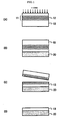
- FIGS. 1 illustrate a process example of a method for manufacturing an SOQ substrate of this embodiment.
- Reference numeral 10 of FIG. 1(A) denotes a single crystal Si substrate.
- the single crystal Si substrate 10 is a commercially available Si substrate grown by a Czochralski method (CZ method), for example. Its electric characteristic value such as a conductivity type or a specific resistance, or crystal orientation or crystal diameter is appropriately determined depending on a design value or process of a device using a semiconductor substrate manufactured by the method of the present invention or a display area of a manufactured device. Further, an oxide film may be formed in advance on a surface (bonding surface) of the single crystal Si substrate 10.
- CZ method Czochralski method
- hydrogen ions are implanted to a surface (main surface) of the single crystal Si substrate 10 to form a hydrogen ion implanted layer (ion-implanted damage layer) 11.
- a hydrogen ion implanted boundary 12 is formed at a predetermined depth (average ion implantation depth L) near the surface of the single crystal Si substrate 10, and a localized “micro bubble layer” is formed in the region (FIG. 1(A)).
- the hydrogen ion implanted boundary 12 serves as a "junction surface” (bonding surface) later.
- the silicon thin film can be delaminated at low temperature, diffusion of hydrogen atoms in the delamination process is considerably suppressed. Therefore, even if hydrogen ions are implanted with a high dosage, surface roughness of the delaminated silicon film never occurs.
- the present inventors have executed implantation of hydrogen ions with varying dosages and examined an influence of the implantation on surface roughness of the delaminated silicon film under the above assumption.
- the examination result shows that surface roughness does not occur with a dosage of 4x10 17 atoms/cm 2 or less as long as a low-temperature delamination process is performed as described below.
- a depth of the ion implanted layer 11 from the single crystal Si substrate 10 (average ion implantation depth L) is controlled in accordance with an acceleration voltage of implanted ions and is determined depending on a thickness of a silicon film to be delaminated.
- the average ion implantation depth L is set to 0.5 ⁇ m or less, and the acceleration voltage is set to 50 to 100 keV.
- an insulator film such as an oxide film may be formed beforehand on an ion implantation surface of the single crystal Si substrate 10 to implant ions through the insulator film.
- the single crystal Si substrate 10 including an ion-implanted damage layer 11 that is formed by implanting hydrogen ions is bonded to a quartz substrate 20 (FIG. 1(B)).
- these substrates have substantially the same diameter. It is advantageous to form orientation flat (OF) also in the quartz substrate 20 similar to OF formed in the single crystal Si substrate 10 and bond the substrates together while aligning the OFs with an aim to facilitate a subsequent device manufacturing process.
- orientation flat also in the quartz substrate 20 similar to OF formed in the single crystal Si substrate 10 and bond the substrates together while aligning the OFs with an aim to facilitate a subsequent device manufacturing process.
- the quartz substrate 20 is added with carbon in a concentration of 100 ppm or higher, and is opaque black as visually observed. Therefore, a problem that a sensor used for transfer or alignment of an SOQ wafer during a process cannot detect a quartz wafer can be solved.
- the RF device substrate may not transmit visible light, for example, insofar as parasitic radio frequency (RF) coupling is suppressed.
- the above carbon-added "black quartz” has a property almost equivalent to transparent quartz in a frequency range around GHz used in the RF device.
- back-surface reflectivity back-surface reflectivity
- the reason the carbon concentration is set to 100 ppm or higher is that a transmittance is insufficient in a concentration lower than the above value with a general wafer thickness.
- the carbon concentration is preferably 200 ppm to 400 ppm.
- a quartz substrate having a carbon concentration of 300 ppm is employed.
- the bonding is performed by subjecting bonding surfaces of both of the single crystal Si substrate 10 and the quartz substrate 20 to plasma treatment or ozone treatment for cleaning or activating the surface.
- This surface treatment is carried out for the purpose of removing an organic material from the surface as the bonding surface or increasing OH groups on the surface to activate the surface, and the treatment is not necessarily performed on both of the bonding surfaces of the single crystal Si substrate 10 and the quartz substrate 20 but may be performed on one of the bonding surfaces.
- a single crystal Si substrate and/or a quartz substrate with the surface being cleaned by RCA cleaning is placed on a sample stage in a vacuum chamber, and a plasma gas is introduced to the vacuum chamber up to a predetermined vacuum degree.
- the usable plasma gas include an oxygen gas, a hydrogen gas, an argon gas, or a mixed gas thereof, which is used for surface treatment of a single crystal Si substrate, or a mixed gas of a hydrogen gas and a helium gas.
- An appropriate gas may be selected in accordance with a surface condition of the single crystal Si substrate or its application.
- the surface treatment aims at oxidizing the single crystal Si surface
- a gas containing at least an oxygen gas is used as the plasma gas.
- the quartz substrate is oxidized, there is not particular limitation on selection of a plasma gas as in the above case.
- an RF plasma having a power of about 100 W is generated and then applied to the surface of the single crystal Si substrate and/or the quartz substrate as a plasma treatment target for about 5 to 10 seconds, and the treatment is completed.
- a single crystal Si substrate and/or a quartz substrate with the surface being cleaned by RCA cleaning is placed on a sample stage in a chamber kept in an atmosphere containing an oxygen, and plasma gas such as a nitrogen gas or an argon gas is introduced into the chamber, after which an RF plasma having a predetermined power is generated, and the oxygen in the atmosphere is turned into an ozone by the plasma to apply the treatment to the surface of the target single crystal Si substrate and/or quartz substrate for a predetermined period.
- plasma gas such as a nitrogen gas or an argon gas
- the surface (bonding surface) of at least one of the two substrates is applied with surface treatment through the plasma treatment or ozone treatment and thus activated, so a bonding strength, which is high enough to withstand mechanical delamination or polishing in a subsequent step even in a closely-attached (bonded) state at room temperatures, can be obtained.
- a mechanical shock is applied to a hydrogen ion implanted region (near the hydrogen ion implanted boundary) at an edge of the single crystal Si substrate.
- the chemical bonds of Si atoms in the ion-implanted damage layer 11 are already weakened through the heat treatment at 350°C.
- a shock level is much lower than that in a conventional method. Therefore, a damage involved in mechanical delamination of the silicon thin film is avoided.
- an SOQ substrate that costs low and enables a large diameter compared with an SOS substrate, and is highly adaptable to a semiconductor device manufacturing process. Further, if an RF device is manufactured with this SOQ substrate, a power loss or signal loss of the device can be reduced similarly to an RF device having an SOS structure.
Landscapes
- Chemical & Material Sciences (AREA)
- Engineering & Computer Science (AREA)
- Crystallography & Structural Chemistry (AREA)
- Materials Engineering (AREA)
- Metallurgy (AREA)
- Organic Chemistry (AREA)
- Crystals, And After-Treatments Of Crystals (AREA)
- Thin Film Transistor (AREA)
- Element Separation (AREA)
- Recrystallisation Techniques (AREA)
Applications Claiming Priority (1)
| Application Number | Priority Date | Filing Date | Title |
|---|---|---|---|
| JP2006305665A JP5044195B2 (ja) | 2006-11-10 | 2006-11-10 | Soq基板の製造方法 |
Publications (3)
| Publication Number | Publication Date |
|---|---|
| EP1921672A2 true EP1921672A2 (fr) | 2008-05-14 |
| EP1921672A3 EP1921672A3 (fr) | 2009-07-22 |
| EP1921672B1 EP1921672B1 (fr) | 2010-07-21 |
Family
ID=39166645
Family Applications (1)
| Application Number | Title | Priority Date | Filing Date |
|---|---|---|---|
| EP20070021588 Active EP1921672B1 (fr) | 2006-11-10 | 2007-11-06 | Procédé de fabrication d'un substrat SOQ |
Country Status (5)
| Country | Link |
|---|---|
| US (1) | US7732867B2 (fr) |
| EP (1) | EP1921672B1 (fr) |
| JP (1) | JP5044195B2 (fr) |
| CN (1) | CN101179054B (fr) |
| DE (1) | DE602007007871D1 (fr) |
Families Citing this family (4)
| Publication number | Priority date | Publication date | Assignee | Title |
|---|---|---|---|---|
| JP5496598B2 (ja) * | 2008-10-31 | 2014-05-21 | 信越化学工業株式会社 | シリコン薄膜転写絶縁性ウェーハの製造方法 |
| JP2012250907A (ja) * | 2011-06-02 | 2012-12-20 | Samsung Corning Precision Materials Co Ltd | 自立基板の製造方法 |
| GB201114365D0 (en) | 2011-08-22 | 2011-10-05 | Univ Surrey | Method of manufacture of an optoelectronic device and an optoelectronic device manufactured using the method |
| CN102779739B (zh) * | 2012-07-12 | 2015-04-15 | 清华大学 | 功率半导体器件背面制造工艺 |
Family Cites Families (12)
| Publication number | Priority date | Publication date | Assignee | Title |
|---|---|---|---|---|
| US5395788A (en) | 1991-03-15 | 1995-03-07 | Shin Etsu Handotai Co., Ltd. | Method of producing semiconductor substrate |
| FR2681472B1 (fr) | 1991-09-18 | 1993-10-29 | Commissariat Energie Atomique | Procede de fabrication de films minces de materiau semiconducteur. |
| JPH11307747A (ja) * | 1998-04-17 | 1999-11-05 | Nec Corp | Soi基板およびその製造方法 |
| JP4540160B2 (ja) * | 1999-12-27 | 2010-09-08 | 京セラ株式会社 | 黒色系焼結石英 |
| KR100913116B1 (ko) | 2002-04-04 | 2009-08-19 | 토소가부시키가이샤 | 석영유리 용사부품 및 그 제조방법 |
| JP4204398B2 (ja) * | 2002-07-31 | 2009-01-07 | 信越石英株式会社 | 石英ガラスの製造方法 |
| JP4403082B2 (ja) | 2002-11-29 | 2010-01-20 | 信越石英株式会社 | 合成石英ガラスの製造方法及び合成石英ガラス体 |
| US7176528B2 (en) * | 2003-02-18 | 2007-02-13 | Corning Incorporated | Glass-based SOI structures |
| DE602004013292T2 (de) * | 2004-06-11 | 2009-05-28 | S.O.I. Tec Silicon On Insulator Technologies S.A. | Verfahren zur Herstellung eines Verbundsubstrats |
| JP5183874B2 (ja) * | 2004-12-28 | 2013-04-17 | 信越化学工業株式会社 | Soiウエーハの製造方法 |
| JP2007081145A (ja) * | 2005-09-14 | 2007-03-29 | Tosoh Corp | ダミーウエハー |
| FR2896619B1 (fr) * | 2006-01-23 | 2008-05-23 | Soitec Silicon On Insulator | Procede de fabrication d'un substrat composite a proprietes electriques ameliorees |
-
2006
- 2006-11-10 JP JP2006305665A patent/JP5044195B2/ja not_active Expired - Fee Related
-
2007
- 2007-11-02 US US11/979,447 patent/US7732867B2/en active Active
- 2007-11-06 EP EP20070021588 patent/EP1921672B1/fr active Active
- 2007-11-06 DE DE200760007871 patent/DE602007007871D1/de active Active
- 2007-11-09 CN CN2007101700665A patent/CN101179054B/zh not_active Expired - Fee Related
Also Published As
| Publication number | Publication date |
|---|---|
| EP1921672B1 (fr) | 2010-07-21 |
| JP2008124208A (ja) | 2008-05-29 |
| US20080118757A1 (en) | 2008-05-22 |
| DE602007007871D1 (fr) | 2010-09-02 |
| CN101179054B (zh) | 2012-05-30 |
| EP1921672A3 (fr) | 2009-07-22 |
| US7732867B2 (en) | 2010-06-08 |
| JP5044195B2 (ja) | 2012-10-10 |
| CN101179054A (zh) | 2008-05-14 |
Similar Documents
| Publication | Publication Date | Title |
|---|---|---|
| EP1983553B1 (fr) | Procede de fabrication d'un substrat soi | |
| US8263478B2 (en) | Method for manufacturing semiconductor substrate | |
| EP1986218A1 (fr) | Procédé de fabrication d'un substrat soi | |
| US7588997B2 (en) | Method of fabricating a thin film | |
| EP2770525A1 (fr) | Procédé de fabrication de tranche transparente de silicium sur isolant | |
| EP2686878A1 (fr) | Structures silicium sur isolant à régions à résistivité élevée dans tranche de traitement et procédés de fabrication de telles structures | |
| EP2589067A1 (fr) | Procédé de conversion assistée par plasma d'oxygène pour préparation d'une surface au collage | |
| KR20150033687A (ko) | 하이브리드 기판의 제조 방법 및 하이브리드 기판 | |
| JP2008153411A (ja) | Soi基板の製造方法 | |
| EP1926139B1 (fr) | Substrat SOQ et son procédé de fabrication | |
| EP2053650B1 (fr) | Procédé de production d'un substrat à semi-conducteur | |
| EP1981083A2 (fr) | Procédé de fabrication d'un substrat SOI | |
| EP1921672B1 (fr) | Procédé de fabrication d'un substrat SOQ | |
| JP5220335B2 (ja) | Soi基板の製造方法 | |
| KR20090042139A (ko) | 반도체 기판의 제조 방법 |
Legal Events
| Date | Code | Title | Description |
|---|---|---|---|
| PUAI | Public reference made under article 153(3) epc to a published international application that has entered the european phase |
Free format text: ORIGINAL CODE: 0009012 |
|
| AK | Designated contracting states |
Kind code of ref document: A2 Designated state(s): AT BE BG CH CY CZ DE DK EE ES FI FR GB GR HU IE IS IT LI LT LU LV MC MT NL PL PT RO SE SI SK TR |
|
| AX | Request for extension of the european patent |
Extension state: AL BA HR MK RS |
|
| PUAL | Search report despatched |
Free format text: ORIGINAL CODE: 0009013 |
|
| AK | Designated contracting states |
Kind code of ref document: A3 Designated state(s): AT BE BG CH CY CZ DE DK EE ES FI FR GB GR HU IE IS IT LI LT LU LV MC MT NL PL PT RO SE SI SK TR |
|
| AX | Request for extension of the european patent |
Extension state: AL BA HR MK RS |
|
| RIC1 | Information provided on ipc code assigned before grant |
Ipc: H01L 21/762 20060101AFI20080318BHEP Ipc: H01L 21/20 20060101ALI20090612BHEP Ipc: H01L 27/12 20060101ALI20090612BHEP |
|
| GRAP | Despatch of communication of intention to grant a patent |
Free format text: ORIGINAL CODE: EPIDOSNIGR1 |
|
| 17P | Request for examination filed |
Effective date: 20090820 |
|
| GRAS | Grant fee paid |
Free format text: ORIGINAL CODE: EPIDOSNIGR3 |
|
| AKX | Designation fees paid |
Designated state(s): BE DE FR GB |
|
| GRAA | (expected) grant |
Free format text: ORIGINAL CODE: 0009210 |
|
| AK | Designated contracting states |
Kind code of ref document: B1 Designated state(s): BE DE FR GB |
|
| REG | Reference to a national code |
Ref country code: GB Ref legal event code: FG4D |
|
| REF | Corresponds to: |
Ref document number: 602007007871 Country of ref document: DE Date of ref document: 20100902 Kind code of ref document: P |
|
| PLBE | No opposition filed within time limit |
Free format text: ORIGINAL CODE: 0009261 |
|
| STAA | Information on the status of an ep patent application or granted ep patent |
Free format text: STATUS: NO OPPOSITION FILED WITHIN TIME LIMIT |
|
| 26N | No opposition filed |
Effective date: 20110426 |
|
| REG | Reference to a national code |
Ref country code: DE Ref legal event code: R097 Ref document number: 602007007871 Country of ref document: DE Effective date: 20110426 |
|
| PGFP | Annual fee paid to national office [announced via postgrant information from national office to epo] |
Ref country code: BE Payment date: 20131113 Year of fee payment: 7 |
|
| PG25 | Lapsed in a contracting state [announced via postgrant information from national office to epo] |
Ref country code: BE Free format text: LAPSE BECAUSE OF NON-PAYMENT OF DUE FEES Effective date: 20141130 |
|
| REG | Reference to a national code |
Ref country code: FR Ref legal event code: PLFP Year of fee payment: 9 |
|
| REG | Reference to a national code |
Ref country code: FR Ref legal event code: PLFP Year of fee payment: 10 |
|
| REG | Reference to a national code |
Ref country code: FR Ref legal event code: PLFP Year of fee payment: 11 |
|
| REG | Reference to a national code |
Ref country code: FR Ref legal event code: PLFP Year of fee payment: 12 |
|
| PGFP | Annual fee paid to national office [announced via postgrant information from national office to epo] |
Ref country code: GB Payment date: 20201028 Year of fee payment: 14 |
|
| GBPC | Gb: european patent ceased through non-payment of renewal fee |
Effective date: 20211106 |
|
| PG25 | Lapsed in a contracting state [announced via postgrant information from national office to epo] |
Ref country code: GB Free format text: LAPSE BECAUSE OF NON-PAYMENT OF DUE FEES Effective date: 20211106 |
|
| PGFP | Annual fee paid to national office [announced via postgrant information from national office to epo] |
Ref country code: FR Payment date: 20250930 Year of fee payment: 19 |
|
| REG | Reference to a national code |
Ref country code: DE Ref legal event code: R079 Ref document number: 602007007871 Country of ref document: DE Free format text: PREVIOUS MAIN CLASS: H01L0021762000 Ipc: H10W0010100000 |
|
| PGFP | Annual fee paid to national office [announced via postgrant information from national office to epo] |
Ref country code: DE Payment date: 20250930 Year of fee payment: 19 |