EP1921776A1 - Aktualisierungsverfahren eines mobilen Empfängers von digitalen Rundfunkdiensten, mobiler Empfänger, Hauptaktualisierungsnachricht und Kommunikationssystem - Google Patents
Aktualisierungsverfahren eines mobilen Empfängers von digitalen Rundfunkdiensten, mobiler Empfänger, Hauptaktualisierungsnachricht und Kommunikationssystem Download PDFInfo
- Publication number
- EP1921776A1 EP1921776A1 EP06291965A EP06291965A EP1921776A1 EP 1921776 A1 EP1921776 A1 EP 1921776A1 EP 06291965 A EP06291965 A EP 06291965A EP 06291965 A EP06291965 A EP 06291965A EP 1921776 A1 EP1921776 A1 EP 1921776A1
- Authority
- EP
- European Patent Office
- Prior art keywords
- receiver device
- master update
- master
- mobile receiver
- update message
- Prior art date
- Legal status (The legal status is an assumption and is not a legal conclusion. Google has not performed a legal analysis and makes no representation as to the accuracy of the status listed.)
- Withdrawn
Links
- 238000000034 method Methods 0.000 title claims abstract description 30
- 238000004891 communication Methods 0.000 title claims description 12
- 238000012545 processing Methods 0.000 claims abstract description 30
- 230000011664 signaling Effects 0.000 claims description 42
- 238000012544 monitoring process Methods 0.000 claims description 3
- 230000003213 activating effect Effects 0.000 claims 2
- 238000010586 diagram Methods 0.000 description 4
- 206010036618 Premenstrual syndrome Diseases 0.000 description 2
- 238000013507 mapping Methods 0.000 description 2
- 238000013461 design Methods 0.000 description 1
- 230000001627 detrimental effect Effects 0.000 description 1
- 238000005538 encapsulation Methods 0.000 description 1
- 239000000284 extract Substances 0.000 description 1
- 238000001914 filtration Methods 0.000 description 1
- 230000006870 function Effects 0.000 description 1
Images


Classifications
-
- H—ELECTRICITY
- H04—ELECTRIC COMMUNICATION TECHNIQUE
- H04H—BROADCAST COMMUNICATION
- H04H60/00—Arrangements for broadcast applications with a direct linking to broadcast information or broadcast space-time; Broadcast-related systems
- H04H60/09—Arrangements for device control with a direct linkage to broadcast information or to broadcast space-time; Arrangements for control of broadcast-related services
- H04H60/14—Arrangements for conditional access to broadcast information or to broadcast-related services
- H04H60/16—Arrangements for conditional access to broadcast information or to broadcast-related services on playing information
Definitions
- This disclosure relates to a method of updating a mobile receiver device for accessing digital video broadcast services, a mobile receiver device, a master update message for providing information to a mobile receiver device for accessing digital video broadcast services, a digital video broadcast network for providing a master update message for providing information to a mobile receiver device for accessing digital video broadcast services and a communication system.
- DVB-H Digital Video Broadcast for Handheld devices
- IP Internet
- DVB services whether DVB-T MPEG-2 or DVB-H IP-based services, are multiplexed together and the multiplex is carried on a Transport Stream (TS).
- the TS may be carried on different radio signals (DVB) signals within a DVB network.
- DVD radio signals
- the DVB-H standards specify a set of messages which are to be broadcast to the DVB-H devices and which provide signalling information.
- the set of messages are known as Program Specific Information (PSI) tables and Service Information (SI) tables.
- PSI tables provide information enabling the DVB-H device to de-multiplex the DVB services and the SI tables provide information enabling the DVB-H device to identify the DVB services and information about the DVB network(s) providing the services.
- PSI and SI tables are segmented into Multiprotocol Encapsulation (MPE) sections as defined in the DVB-H standard and are inserted into Transport Stream packets, some of the tables with predetermined packet identifiers (PIDs) and others with network operator defined PIDs.
- MPE Multiprotocol Encapsulation
- PSI tables include:
- PAT Program Association Table
- PMT Program Map Table
- Program Map Table which table provides mappings between program numbers and the program elements which are associated with the program numbers (i.e. the program elements which form the DVB service);
- Transport Stream Description Table which table provides information about the entire Transport Stream, for example the type of target receiver (DVB, Advanced Television System Committee (ATSC) digital television) or the kind of application (e.g. satellite contribution link).
- TSDT Transport Stream Description Table
- PSI tables are defined in the DVB-H standard. See for example, section 4.4 of the IP Datacast over DVB-H:PSI/SI specification, DVB Document A079 Rev. 1, November 2005.
- SI tables include:
- NIT Network Information Table
- IP/MAC Notification Table which table is used to signal the availability and location of IP streams within the Transport Streams in DVB networks.
- the INT is considered as a service and so it has its own PMT.
- a DVB-H device has set up communication in a DVB network by tuning to the appropriate frequency and starting to receive PSI/SI tables, the device has to regularly check for any update of or changes in the PSI/SI tables.
- Changes to PSI/SI tables could indicate a change in the DVB services available to the DVB-H device. For example, there may be a change in how the device accesses the DVB services, new DVB services may be available, there may be a change in the IP/MAC address of a service, the start time of a given service may change, and/or there may be a network change such as in the radio interface.
- the DVB-H receiver comprises PID filters each of which are assigned to monitor a particular PID of a PSI or SI table.
- PID filters each of which are assigned to monitor a particular PID of a PSI or SI table.
- PID filters are also required to monitor for DVB service messages as well as other signalling messages.
- the DVB-H receiver is limited in the number of PID filters that can be active at the same time. If a sub-set of the receiver PID filtering capabilities was to be reserved permanently for monitoring the PSI/SI tables, this could have a detrimental effect on the DVB services themselves.
- the PID filters are not permanently reserved for the PSI/SI signalling information which can result in missing updates and changes to the PSI/SI tables.
- the DVB-H receiver is arranged to monitor for the PSI/SI tables and then parse regularly each of the received PSI/SI tables in order to determine whether updates to the tables has occurred. For example, every 100 milliseconds a PAT table is monitored and the PAT version number checked in order to determine whether the PAT table has been updated since the PAT table last received by the DVB-H receiver. If the version number has changed, the entire PAT table should be parsed and each PMT table referenced in the PAT should be acquired and their version numbers checked to localise precisely the reason for the PAT version number change.
- the parsing of each of the PSI/SI tables requires processing overhead. For battery operated devices, it is desirable to reduce processing overhead in order to save battery power.
- a DVB communication system 2 comprises a DVB network 3 and DVB receivers 14, 16 and 18.
- the DVB network 3 comprises a television content provider 4 for providing DVB services for digital televisions in the form of MPEG-2 Transport Streams, and a DVB-H content provider which provides DVB services for mobile receiver devices in the form of IP datagrams conveyed onTransport Streams.
- the DVB-H services are multiplexed with the DVB-T services at multiplexer 8, which may be a broadcast provider, and the multiplexes are provided to a broadcast network operator 10 which distributes the multiplexes on Transport Streams to DVB-T/H transmitters 12.
- the DVB-T/H transmitters 12 transmits the DVB services and associated signalling information on Transport Streams carried on radio links 13 to DVB-T receivers such as a set-top box 16, and a digital television 14 and to DVB-H mobile receiver devices 18.
- the mobile receiver device 18 may be a portable or handheld or mobile telephone, a Personal Digital Assistant (PDA), a portable computer, portable television and/or similar devices.
- PDA Personal Digital Assistant
- FIG. 1 shows a shared DVB communication system in which a network of DVB-T transmitters is serving both DVB-H and DVB-T receivers.
- the MPEG-2 services from the television content provider 4 and the DVB-H IP services from the DVB-H content provider 6 may be provided separately and directly to the DVB-T transmitters.
- a dedicated DVB-H communication system having DVB-H transmitters may provide DVB-H services to DVB-H receivers. It will be appreciated that it is not intended to limit the disclosure to the particular arrangement of the DVB communication system of FIG. 1 .
- FIG. 2 is a partial schematic block diagram of an exemplary mobile receiver device 18. As will be apparent to a skilled person, only those functional components of the mobile receiver device that are necessary for an understanding of the disclosure have been shown and will be described.
- the mobile receiver device 18 comprises a control unit 20 for configuration and control of the mobile receiver device 18.
- the control unit 20 is communicably coupled to a receiver unit 22 and in the example shown in FIG. 2 , also to a transmitter unit 24, to a modulation/demodulation section 34, to a coding/decoding section 36, to a memory 21 and to a Man Machine Interface (MMI) 26.
- MMI 26 includes elements such as a key pad, microphone, speaker, display screen, for providing an interface between the mobile receiver device 18 and the user of the mobile receiver device 18.
- the receiver unit 22 and the transmitter unit 24 are shown in FIG. 2 as part of a transceiver 28 coupled to an antenna 29 but it will be appreciated that the receiver unit 22 and the transmitter unit 24 may be separate components of the mobile receiver device 18.
- the control unit 20 may be a single processor or may comprise two or more processors carrying out all processing required for the operation of the mobile receiver device 18.
- the memory 21 may be part of the control unit 20 or a separate element.
- the number of processors and the allocation of processing functions to the processor is a matter of design choice for a skilled person.
- the mobile receiver device 18 also has a program memory 30 in which is stored a program 32 containing processor instructions for operation of the mobile receiver device 18.
- the program 32 may contain a number of different program elements or subroutines containing processor instructions for a variety of different tasks, for example, for: communicating with the user via the MMI 26; and processing signalling messages received from the DVB-T/H transmitters 12.
- a specific PID filter program element 33 is arranged to assign PID filters to monitor for specific PID in received messages.
- the mobile receiver device 18 is arranged to monitor signalling messages, such as the PSI/SI tables, transmitted by the DVB-T/H transmitters 12.
- signalling messages such as the PSI/SI tables
- the PID filter program element 33 activates a PID filter for a specific PID associated with the signalling message so that the mobile receiver device 18 can monitor for the signalling message having the specific PID.
- the signalling message When a signalling message is received by the mobile receiver device 18, the signalling message is demodulated in modulation/demodulation section 34, the PID of the received signalling message is identified and when a received signalling message having the specific PID is identified, the received signalling message is then decoded in coding/decoding section 36 and passed to the control unit 20 for further processing, including parsing of the message to extract data from the signalling message.
- the extracted data is stored in memory 21 and will be used to configure the mobile receiver device 18 to receive the DVB service.
- the operation of the mobile receiver device 18 may need to be updated or reconfigured whenever there is a change to the DVB services available to the mobile receiver device 18 in order for the mobile receiver device 18 to receive the DVB services.
- a change to the digital video broadcast services available to the mobile receiver device may include a change to the DVB services themselves or a change in how the mobile receiver device 18 is to access the DVB services.
- a change may include for example, new DVB services being made available, existing DVB services being terminated, the start time of a given service being changed, changes in any of the parameters for accessing the existing services, such as changes in PIDs for DVB services and/or PSI/SI tables, changes in the radio links between the DVB-T/H transmitters 12 and the mobile receiver device 18, such as a change in communication channel, other changes in the network 3, such as new neighbour network descriptions when the mobile receiver device 18 roams.
- Changes in the available DVB services will result in changes in the signalling messages.
- new versions of the PSI/SI tables associated with the DVB service will be transmitted by the DVB-T/H transmitters 12.
- the new versions of the PSI/SI tables need to be received, decoded and acted upon in order that the mobile receiver 18 can be reconfigured to receive the changed DVB services.
- the inventors of the present disclosure have created a new signalling message or a master update message which indicates whether the transmitted signalling messages, such as the PSI/SI tables, have been changed or updated.
- the master update message is a SI table, called the Master Version Table (MVT), that is generated by the network 3 by, for example, the broadcast network operator 10, and transmitted on a known PID, such as the PID of the NIT table or the PAT table, periodically at a predetermined time. For example, every 100 milliseconds.
- MVT Master Version Table
- the master update message or MVT comprises master update information that is used to determine whether there have been any changes to the digital video broadcast services available to the mobile receiver device 18: in other words to indicate whether there have been any changes to the PSI/SI tables previously received by the mobile receiver device.
- the master update information comprises a master version number. If the master version number of the MVT previously received by the mobile receiver device 18 matches the master version number of the most recently received MVT then the mobile receiver device 18 determines that no changes have been made. If there is a match, the processing of the MVT can then be stopped to save processing overhead.
- the master update information of the MVT further comprises update parameters for each of the transmitted signalling messages, such as the broadcasted PSI/SI tables.
- the MVT includes the version numbers for all the PSI/SI tables indicated as mandatory in the DVB-H Technical Specification (see above): that is, the NIT, PAT, certain PMTs and INT.
- the version numbers for the optional PSI/SI tables may or may not be included in the MVT at the option of the broadcast network operator 10.
- the update parameter of a PSI/SI table is a version number for that table.
- the mobile receiver device 18 determines that no changes have been made to that PSI/SI table. The mobile receiver device 18 need not then monitor for and update that particular PSI/SI table.
- the descriptor appearing in the descriptor loop of the MVT is a new descriptor, known as the table_version_descriptor.
- An example is given below.
- the MVT only references PMT tables that have been updated/removed/added between the MVT previously (i.e. version n-1) received and the MVT most recently received (i.e. version n). If no change occurred at all to the PMT tables, there will be no mention of any PMT table in the MVT.
- the MVT also includes a PID for each of the PSI/SI tables so that in the event a change has occurred and the mobile receiver device 18 is required to acquire the updated version of the PSI/SI table, the PID of the updated PSI/SI table is known and so the mobile receiver device 18 can active the appropriate PID filter at the appropriate time.
- version numbers of the optional PSI/SI tables are included in the MVT, they may be included as an optional descriptor that would include an optional table loop descriptor.
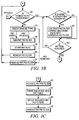
- FIGs. 1-3a-3c A method of updating a mobile receiver device 18 in accordance with an embodiment of the disclosure will now be described with reference to FIGs. 1-3a-3c .
- the steps of the method of FIGs. 3a-3c will be performed in the mobile receiver device 3 under the control of one or more program elements or sub routines of the program 32.
- the method starts at block 40 with the mobile receiver device 18 powering up.
- the mobile receiver device 18 acquires the PSI/SI tables, including the MVT, transmitted by the network 13 and stores the data extracted from the tables in memory 21.
- the extracted data includes the version numbers of the PSI/SI tables, including the master version number of the MVT and the PID of the MVT.
- the PID filter for the PID of the MVT is activated at block 44.
- the mobile receiver device 18 removes the PID filters for all the PSI/SI tables other than the MVT PID filter. In other words, the mobile receiver device 18 sets a PID filter to monitor for the PID of the MVT and is further arranged so that it does not monitor the PIDs of the other PSI/SI tables.
- a new MVT is received by the mobile receiver device 18.
- the new MVT comprises master update information comprising a master version number, and the update parameters or version numbers of the PSI/SI tables, other than the MVT, being transmitted currently by the network 3.
- the mobile receiver device 18 processes the new MVT to determine the master version number of the new MVT. If the determined master version number of the new MVT matches the master version number of the MVT previously received by the mobile receive device 18, as determined in block 48, there has been no change in the PSI/SI tables and the mobile receiver device 18 stops processing the new MVT and waits 100 milliseconds at block 50 before returning to block 46 to receive a new MVT. During this 100 millisecond period, the mobile receiver device 18 may be powered off to conserve battery power.
- the mobile receiver device 18 processes further, at block 52, the MVT to identify the changes to the available DVB services and to obtain information (that is signalling information relating to the changes to the PSI/SI tables) in order to update or reconfigure the mobile receiver device 18.
- the mobile receiver device 18 identifies the changes by going through the table_version_descriptor loop in the MVT. More particularly, at block 52, the mobile receiver device 18 begins parsing the MVT in order to determine the version numbers of the PSI/SI, other than the MVT, being transmitted by the network 3.
- the mobile receiver device 18 determines whether there is a change in the version number of the NIT table by determining whether the version number of the NIT table in the MVT matches the version number of the NIT table previously received by the mobile receiver device 18, at block 54. If there is a match, there is no change and the flow proceeds to block 56. If there is no match, there is a change in the NIT table and the flow returns to block 42 without processing the rest of the MVT so that the mobile receiver device 13 acquires the PSI/SI tables, including the MVT, currently being transmitted by the network 13 and stores the data extracted from the tables in memory 21 and the process continues to block 44.
- the mobile receiver device 18 determines whether there is a change in the version number of the PAT table by determining whether the version number of the PAT table in the MVT matches the version number of the PAT table previously received by the mobile receiver device 18. If there is a match, there is no change and the flow proceeds to block 58. If there is no match, there is a change in the PAT table and there are two options: in option 1, the flow proceeds to block 60 and in option 2, the flow proceeds to block 58. In option 1, the mobile receiver device 18 activates a PID filter for the PID of the PAT table as indicated in the MVT, block 62. The PAT table is received, parsed and the data extracted from the PAT table is stored in memory 21, block 64. The mobile receiver device 18 then activates the PID filters for the PIDs of the required PMT tables as indicated in the parsed PAT table, block 66. The activated PID filter for the PAT table is then removed, block 68.
- the mobile receiver device 18 determines whether the end of the PMT loop in the MVT has been reached. If the end has been reached (this will include the situation when there has been no change to the PMT table), the flow proceeds to block 70. If the end has not been reached, the flow proceeds to block 72.
- the type of change to the PMT table is determined from the parameter change_type in the MVT. If the change_type parameter indicates that the PMT table has been removed, then the PID filter is removed, block 74. If the change_type parameter indicates that a new PMT table has been added or the existing PMT table has been updated, then first a PID filter for the PID of the PMT table as indicated in the MVT is activated, at block 76. The PMT table is received, parsed and the data extracted from the PMT table is stored in memory 21, block 78. The activated PID filter for the PMT table is then removed, block 80.
- the mobile receiver device 18 determines whether there is a change in the version number of a PSI/SI table other than a NIT, PAT, PMT table by determining whether the version number of the PSI/SI table in the MVT matches the version number of the PSI/SI table previously received by the mobile receiver device 18. If there is a match, there is no change and the flow proceeds to block 82 at which point it is determined whether the end of the MVT has been reached. If the end has been reached, the flow returns to block 46 after waiting 100 milliseconds at block 50. During this 100 millisecond period, the mobile receiver device 18 may be powered off.
- the flow returns to block 70 to determine whether there is a change in the version number of a PSI/SI table other than a NIT, PAT, PMT table by determining whether the version number of the PSI/SI table in the MVT matches the version number of the PSI/SI table previously received by the mobile receiver device 18.
- the flow moves to block 84 in which the mobile receiver device 13 activates the PID filter for the PID of the relevant PSI/SI table as indicated in the MVT, receives, parses and extracts data from the relevant PSI/SI table and removes the activated PID filter for the relevant PSI/SI table.
- the flow proceeds to block 82.
- the PSI/SI tables are considered in a particular order.
- the NIT table is considered first due to the fact that a change in the NIT table identifies a network change which means that all the PSI/SI tables are required to be updated. It will be appreciated that the disclosure is not limited to the particular order shown in FIGs 3a-3c .
- the mobile receiver in accordance with the present disclosure is only required to monitor one master update message in order to keep track of updates to signalling information associated with the available DVB services instead of keeping track of several signalling messages.
- the master update message includes master update information for the master update message
- the master update information indicates there has been no change in the DVB services
- the processing of the master update message can be stopped which saves on processing overhead.
- the master update information includes update parameters for each of the signalling messages
- appropriate steps can be taken which may not require the signalling messages themselves to be fully processed (e.g. parsed). This saves on processing overhead.
Landscapes
- Engineering & Computer Science (AREA)
- Signal Processing (AREA)
- Mobile Radio Communication Systems (AREA)
- Circuits Of Receivers In General (AREA)
Priority Applications (1)
| Application Number | Priority Date | Filing Date | Title |
|---|---|---|---|
| EP06291965A EP1921776A1 (de) | 2006-11-09 | 2006-11-09 | Aktualisierungsverfahren eines mobilen Empfängers von digitalen Rundfunkdiensten, mobiler Empfänger, Hauptaktualisierungsnachricht und Kommunikationssystem |
Applications Claiming Priority (1)
| Application Number | Priority Date | Filing Date | Title |
|---|---|---|---|
| EP06291965A EP1921776A1 (de) | 2006-11-09 | 2006-11-09 | Aktualisierungsverfahren eines mobilen Empfängers von digitalen Rundfunkdiensten, mobiler Empfänger, Hauptaktualisierungsnachricht und Kommunikationssystem |
Publications (1)
| Publication Number | Publication Date |
|---|---|
| EP1921776A1 true EP1921776A1 (de) | 2008-05-14 |
Family
ID=37820659
Family Applications (1)
| Application Number | Title | Priority Date | Filing Date |
|---|---|---|---|
| EP06291965A Withdrawn EP1921776A1 (de) | 2006-11-09 | 2006-11-09 | Aktualisierungsverfahren eines mobilen Empfängers von digitalen Rundfunkdiensten, mobiler Empfänger, Hauptaktualisierungsnachricht und Kommunikationssystem |
Country Status (1)
| Country | Link |
|---|---|
| EP (1) | EP1921776A1 (de) |
Cited By (1)
| Publication number | Priority date | Publication date | Assignee | Title |
|---|---|---|---|---|
| WO2010005904A3 (en) * | 2008-07-07 | 2010-07-01 | Qualcomm Incorporated | Enhanced notification mechanism for broadcast networks using bit-map vectors |
Citations (2)
| Publication number | Priority date | Publication date | Assignee | Title |
|---|---|---|---|---|
| EP1475969A1 (de) * | 2003-02-20 | 2004-11-10 | Matsushita Electric Industrial Co., Ltd. | Digitale Rundsendeeinrichtung und Verfahren dafür, digitale Rundempfangseinrichtung und Verfahren dafür |
| WO2006080804A1 (en) * | 2005-01-25 | 2006-08-03 | Samsung Electronics Co., Ltd. | Method and apparatus for sending notification about broadcast service in a mobile broadcast system |
-
2006
- 2006-11-09 EP EP06291965A patent/EP1921776A1/de not_active Withdrawn
Patent Citations (2)
| Publication number | Priority date | Publication date | Assignee | Title |
|---|---|---|---|---|
| EP1475969A1 (de) * | 2003-02-20 | 2004-11-10 | Matsushita Electric Industrial Co., Ltd. | Digitale Rundsendeeinrichtung und Verfahren dafür, digitale Rundempfangseinrichtung und Verfahren dafür |
| WO2006080804A1 (en) * | 2005-01-25 | 2006-08-03 | Samsung Electronics Co., Ltd. | Method and apparatus for sending notification about broadcast service in a mobile broadcast system |
Cited By (4)
| Publication number | Priority date | Publication date | Assignee | Title |
|---|---|---|---|---|
| WO2010005904A3 (en) * | 2008-07-07 | 2010-07-01 | Qualcomm Incorporated | Enhanced notification mechanism for broadcast networks using bit-map vectors |
| CN102090089A (zh) * | 2008-07-07 | 2011-06-08 | 高通股份有限公司 | 使用位图矢量用于广播网络的增强的通知机制 |
| US8554131B2 (en) | 2008-07-07 | 2013-10-08 | Qualcomm Incorporated | Enhanced notification mechanism for broadcast networks using bit-map vectors |
| CN102090089B (zh) * | 2008-07-07 | 2015-09-02 | 高通股份有限公司 | 使用位图矢量用于广播网络的增强的通知机制 |
Similar Documents
| Publication | Publication Date | Title |
|---|---|---|
| US11528519B2 (en) | Method and apparatus for transmitting and receiving signaling information associated with multimedia content | |
| EP1501222B1 (de) | Vorrichtung und Verfahren zum Senden/Empfangen von Informationen in einem digitalen multimedia Rundfunkdienst | |
| US9749681B2 (en) | Non-real-time broadcast service processing system and processing method thereof | |
| EP1887803A1 (de) | System und Verfahren zum Empfangen und Senden von Aktualisierungsinformationen für ESG-Daten in einem DVB-H-System | |
| WO2012099399A2 (ko) | 방송통신 융합형 서비스를 위한 전송 방법 및 장치 | |
| KR20110031363A (ko) | 캐시저장된 서비스 획득 데이터 내에서의 동적 서비스에 대한 필터링 | |
| US9998774B2 (en) | Signal transmission and reception device and signal transmission and reception method | |
| WO2010060371A1 (zh) | 一种数据广播实现方法和系统 | |
| EP1921776A1 (de) | Aktualisierungsverfahren eines mobilen Empfängers von digitalen Rundfunkdiensten, mobiler Empfänger, Hauptaktualisierungsnachricht und Kommunikationssystem | |
| KR100986990B1 (ko) | 다중표준 모바일 방송 스트림 수신장치 및 그 방법 | |
| US8484672B2 (en) | Method and device for updating regional rating table | |
| KR20080083173A (ko) | 무선 통신 디바이스에서의 디지털 비디오 브로드캐스트를위한 프리뷰 서비스 관리 | |
| KR100790194B1 (ko) | Ip/mac 플랫폼의 재배열 알림 방법 및 그 dvb시스템 | |
| KR100800826B1 (ko) | 디지털 방송 시스템에서 프로그램 고유 정보/서비스 정보를이용한 전자 서비스 가이드 갱신 통보를 수행하기 위한방법 및 장치 | |
| WO2008016212A1 (en) | Digital broadcasting system and method | |
| CA2600333C (en) | Digital television receiver and method for processing a digital television signal | |
| WO2009150006A1 (en) | System and devices for distributing content in a hierarchical manner | |
| JP2025134357A (ja) | 受信装置、放送システム、および、受信方法 | |
| KR100755838B1 (ko) | 이동형 방송수신기 및 부가 데이터 서비스 방법 | |
| WO2010067992A2 (en) | Method for receiving and displaying service guide in broadcast receiver |
Legal Events
| Date | Code | Title | Description |
|---|---|---|---|
| PUAI | Public reference made under article 153(3) epc to a published international application that has entered the european phase |
Free format text: ORIGINAL CODE: 0009012 |
|
| AK | Designated contracting states |
Kind code of ref document: A1 Designated state(s): AT BE BG CH CY CZ DE DK EE ES FI FR GB GR HU IE IS IT LI LT LU LV MC NL PL PT RO SE SI SK TR |
|
| AX | Request for extension of the european patent |
Extension state: AL BA HR MK RS |
|
| 17P | Request for examination filed |
Effective date: 20081113 |
|
| AKX | Designation fees paid |
Designated state(s): AT BE BG CH CY CZ DE DK EE ES FI FR GB GR HU IE IS IT LI LT LU LV MC NL PL PT RO SE SI SK TR |
|
| RAP1 | Party data changed (applicant data changed or rights of an application transferred) |
Owner name: MOTOROLA MOBILITY, INC. |
|
| RAP1 | Party data changed (applicant data changed or rights of an application transferred) |
Owner name: MOTOROLA MOBILITY LLC |
|
| 17Q | First examination report despatched |
Effective date: 20151123 |
|
| RAP1 | Party data changed (applicant data changed or rights of an application transferred) |
Owner name: GOOGLE TECHNOLOGY HOLDINGS LLC |
|
| STAA | Information on the status of an ep patent application or granted ep patent |
Free format text: STATUS: THE APPLICATION IS DEEMED TO BE WITHDRAWN |
|
| 18D | Application deemed to be withdrawn |
Effective date: 20160604 |
|
| P01 | Opt-out of the competence of the unified patent court (upc) registered |
Effective date: 20230524 |