EP1921866A2 - Classification de contenu pour traitement multimédia - Google Patents
Classification de contenu pour traitement multimédia Download PDFInfo
- Publication number
- EP1921866A2 EP1921866A2 EP08000729A EP08000729A EP1921866A2 EP 1921866 A2 EP1921866 A2 EP 1921866A2 EP 08000729 A EP08000729 A EP 08000729A EP 08000729 A EP08000729 A EP 08000729A EP 1921866 A2 EP1921866 A2 EP 1921866A2
- Authority
- EP
- European Patent Office
- Prior art keywords
- multimedia data
- complexity
- determining
- temporal
- spatial
- Prior art date
- Legal status (The legal status is an assumption and is not a legal conclusion. Google has not performed a legal analysis and makes no representation as to the accuracy of the status listed.)
- Withdrawn
Links
- 238000012545 processing Methods 0.000 title claims abstract description 49
- 238000000034 method Methods 0.000 claims abstract description 231
- 230000002123 temporal effect Effects 0.000 claims abstract description 171
- 230000008569 process Effects 0.000 claims abstract description 75
- 239000013598 vector Substances 0.000 claims description 37
- 238000012805 post-processing Methods 0.000 claims description 6
- 230000000007 visual effect Effects 0.000 description 30
- 238000004891 communication Methods 0.000 description 28
- 238000004422 calculation algorithm Methods 0.000 description 21
- 238000007906 compression Methods 0.000 description 17
- 230000006835 compression Effects 0.000 description 17
- 230000008859 change Effects 0.000 description 16
- 238000010586 diagram Methods 0.000 description 13
- 230000006870 function Effects 0.000 description 12
- 230000005540 biological transmission Effects 0.000 description 11
- 238000001514 detection method Methods 0.000 description 11
- 230000000694 effects Effects 0.000 description 8
- 238000013459 approach Methods 0.000 description 7
- 230000035945 sensitivity Effects 0.000 description 5
- 230000008901 benefit Effects 0.000 description 4
- 238000013139 quantization Methods 0.000 description 4
- 238000012360 testing method Methods 0.000 description 4
- 241000282412 Homo Species 0.000 description 3
- 230000002457 bidirectional effect Effects 0.000 description 3
- 238000004364 calculation method Methods 0.000 description 3
- 238000010276 construction Methods 0.000 description 3
- 238000005516 engineering process Methods 0.000 description 3
- 238000004020 luminiscence type Methods 0.000 description 3
- 238000007726 management method Methods 0.000 description 3
- 238000007781 pre-processing Methods 0.000 description 3
- 238000013442 quality metrics Methods 0.000 description 3
- 230000004044 response Effects 0.000 description 3
- 238000004088 simulation Methods 0.000 description 3
- 238000004458 analytical method Methods 0.000 description 2
- 230000003466 anti-cipated effect Effects 0.000 description 2
- 238000007635 classification algorithm Methods 0.000 description 2
- 238000012937 correction Methods 0.000 description 2
- 230000003247 decreasing effect Effects 0.000 description 2
- 230000006735 deficit Effects 0.000 description 2
- 238000005538 encapsulation Methods 0.000 description 2
- 238000005562 fading Methods 0.000 description 2
- 239000000835 fiber Substances 0.000 description 2
- 230000000873 masking effect Effects 0.000 description 2
- 230000003287 optical effect Effects 0.000 description 2
- 239000002245 particle Substances 0.000 description 2
- 238000012952 Resampling Methods 0.000 description 1
- 230000009286 beneficial effect Effects 0.000 description 1
- 230000015556 catabolic process Effects 0.000 description 1
- 238000006243 chemical reaction Methods 0.000 description 1
- 230000001186 cumulative effect Effects 0.000 description 1
- 238000011157 data evaluation Methods 0.000 description 1
- 230000006837 decompression Effects 0.000 description 1
- 238000006731 degradation reaction Methods 0.000 description 1
- 230000001419 dependent effect Effects 0.000 description 1
- 238000013461 design Methods 0.000 description 1
- 238000011156 evaluation Methods 0.000 description 1
- 238000002474 experimental method Methods 0.000 description 1
- 210000003128 head Anatomy 0.000 description 1
- 238000003709 image segmentation Methods 0.000 description 1
- 230000001771 impaired effect Effects 0.000 description 1
- 238000012804 iterative process Methods 0.000 description 1
- 238000002156 mixing Methods 0.000 description 1
- 238000012986 modification Methods 0.000 description 1
- 230000004048 modification Effects 0.000 description 1
- 238000010606 normalization Methods 0.000 description 1
- 230000002093 peripheral effect Effects 0.000 description 1
- 230000003595 spectral effect Effects 0.000 description 1
- 238000000101 transmission high energy electron diffraction Methods 0.000 description 1
- 238000005303 weighing Methods 0.000 description 1
Images





Classifications
-
- H—ELECTRICITY
- H04—ELECTRIC COMMUNICATION TECHNIQUE
- H04N—PICTORIAL COMMUNICATION, e.g. TELEVISION
- H04N21/00—Selective content distribution, e.g. interactive television or video on demand [VOD]
- H04N21/40—Client devices specifically adapted for the reception of or interaction with content, e.g. set-top-box [STB]; Operations thereof
- H04N21/43—Processing of content or additional data, e.g. demultiplexing additional data from a digital video stream; Elementary client operations, e.g. monitoring of home network or synchronising decoder's clock; Client middleware
- H04N21/434—Disassembling of a multiplex stream, e.g. demultiplexing audio and video streams, extraction of additional data from a video stream; Remultiplexing of multiplex streams; Extraction or processing of SI; Disassembling of packetised elementary stream
- H04N21/4347—Demultiplexing of several video streams
-
- H—ELECTRICITY
- H04—ELECTRIC COMMUNICATION TECHNIQUE
- H04N—PICTORIAL COMMUNICATION, e.g. TELEVISION
- H04N19/00—Methods or arrangements for coding, decoding, compressing or decompressing digital video signals
- H04N19/10—Methods or arrangements for coding, decoding, compressing or decompressing digital video signals using adaptive coding
- H04N19/102—Methods or arrangements for coding, decoding, compressing or decompressing digital video signals using adaptive coding characterised by the element, parameter or selection affected or controlled by the adaptive coding
- H04N19/103—Selection of coding mode or of prediction mode
-
- H—ELECTRICITY
- H04—ELECTRIC COMMUNICATION TECHNIQUE
- H04N—PICTORIAL COMMUNICATION, e.g. TELEVISION
- H04N19/00—Methods or arrangements for coding, decoding, compressing or decompressing digital video signals
- H04N19/10—Methods or arrangements for coding, decoding, compressing or decompressing digital video signals using adaptive coding
- H04N19/102—Methods or arrangements for coding, decoding, compressing or decompressing digital video signals using adaptive coding characterised by the element, parameter or selection affected or controlled by the adaptive coding
- H04N19/103—Selection of coding mode or of prediction mode
- H04N19/107—Selection of coding mode or of prediction mode between spatial and temporal predictive coding, e.g. picture refresh
-
- H—ELECTRICITY
- H04—ELECTRIC COMMUNICATION TECHNIQUE
- H04N—PICTORIAL COMMUNICATION, e.g. TELEVISION
- H04N19/00—Methods or arrangements for coding, decoding, compressing or decompressing digital video signals
- H04N19/10—Methods or arrangements for coding, decoding, compressing or decompressing digital video signals using adaptive coding
- H04N19/102—Methods or arrangements for coding, decoding, compressing or decompressing digital video signals using adaptive coding characterised by the element, parameter or selection affected or controlled by the adaptive coding
- H04N19/115—Selection of the code volume for a coding unit prior to coding
-
- H—ELECTRICITY
- H04—ELECTRIC COMMUNICATION TECHNIQUE
- H04N—PICTORIAL COMMUNICATION, e.g. TELEVISION
- H04N19/00—Methods or arrangements for coding, decoding, compressing or decompressing digital video signals
- H04N19/10—Methods or arrangements for coding, decoding, compressing or decompressing digital video signals using adaptive coding
- H04N19/134—Methods or arrangements for coding, decoding, compressing or decompressing digital video signals using adaptive coding characterised by the element, parameter or criterion affecting or controlling the adaptive coding
- H04N19/136—Incoming video signal characteristics or properties
- H04N19/137—Motion inside a coding unit, e.g. average field, frame or block difference
-
- H—ELECTRICITY
- H04—ELECTRIC COMMUNICATION TECHNIQUE
- H04N—PICTORIAL COMMUNICATION, e.g. TELEVISION
- H04N19/00—Methods or arrangements for coding, decoding, compressing or decompressing digital video signals
- H04N19/10—Methods or arrangements for coding, decoding, compressing or decompressing digital video signals using adaptive coding
- H04N19/134—Methods or arrangements for coding, decoding, compressing or decompressing digital video signals using adaptive coding characterised by the element, parameter or criterion affecting or controlling the adaptive coding
- H04N19/136—Incoming video signal characteristics or properties
- H04N19/137—Motion inside a coding unit, e.g. average field, frame or block difference
- H04N19/139—Analysis of motion vectors, e.g. their magnitude, direction, variance or reliability
-
- H—ELECTRICITY
- H04—ELECTRIC COMMUNICATION TECHNIQUE
- H04N—PICTORIAL COMMUNICATION, e.g. TELEVISION
- H04N19/00—Methods or arrangements for coding, decoding, compressing or decompressing digital video signals
- H04N19/10—Methods or arrangements for coding, decoding, compressing or decompressing digital video signals using adaptive coding
- H04N19/134—Methods or arrangements for coding, decoding, compressing or decompressing digital video signals using adaptive coding characterised by the element, parameter or criterion affecting or controlling the adaptive coding
- H04N19/136—Incoming video signal characteristics or properties
- H04N19/14—Coding unit complexity, e.g. amount of activity or edge presence estimation
-
- H—ELECTRICITY
- H04—ELECTRIC COMMUNICATION TECHNIQUE
- H04N—PICTORIAL COMMUNICATION, e.g. TELEVISION
- H04N19/00—Methods or arrangements for coding, decoding, compressing or decompressing digital video signals
- H04N19/10—Methods or arrangements for coding, decoding, compressing or decompressing digital video signals using adaptive coding
- H04N19/134—Methods or arrangements for coding, decoding, compressing or decompressing digital video signals using adaptive coding characterised by the element, parameter or criterion affecting or controlling the adaptive coding
- H04N19/142—Detection of scene cut or scene change
-
- H—ELECTRICITY
- H04—ELECTRIC COMMUNICATION TECHNIQUE
- H04N—PICTORIAL COMMUNICATION, e.g. TELEVISION
- H04N19/00—Methods or arrangements for coding, decoding, compressing or decompressing digital video signals
- H04N19/10—Methods or arrangements for coding, decoding, compressing or decompressing digital video signals using adaptive coding
- H04N19/134—Methods or arrangements for coding, decoding, compressing or decompressing digital video signals using adaptive coding characterised by the element, parameter or criterion affecting or controlling the adaptive coding
- H04N19/146—Data rate or code amount at the encoder output
- H04N19/147—Data rate or code amount at the encoder output according to rate distortion criteria
-
- H—ELECTRICITY
- H04—ELECTRIC COMMUNICATION TECHNIQUE
- H04N—PICTORIAL COMMUNICATION, e.g. TELEVISION
- H04N19/00—Methods or arrangements for coding, decoding, compressing or decompressing digital video signals
- H04N19/10—Methods or arrangements for coding, decoding, compressing or decompressing digital video signals using adaptive coding
- H04N19/134—Methods or arrangements for coding, decoding, compressing or decompressing digital video signals using adaptive coding characterised by the element, parameter or criterion affecting or controlling the adaptive coding
- H04N19/154—Measured or subjectively estimated visual quality after decoding, e.g. measurement of distortion
-
- H—ELECTRICITY
- H04—ELECTRIC COMMUNICATION TECHNIQUE
- H04N—PICTORIAL COMMUNICATION, e.g. TELEVISION
- H04N19/00—Methods or arrangements for coding, decoding, compressing or decompressing digital video signals
- H04N19/10—Methods or arrangements for coding, decoding, compressing or decompressing digital video signals using adaptive coding
- H04N19/169—Methods or arrangements for coding, decoding, compressing or decompressing digital video signals using adaptive coding characterised by the coding unit, i.e. the structural portion or semantic portion of the video signal being the object or the subject of the adaptive coding
- H04N19/17—Methods or arrangements for coding, decoding, compressing or decompressing digital video signals using adaptive coding characterised by the coding unit, i.e. the structural portion or semantic portion of the video signal being the object or the subject of the adaptive coding the unit being an image region, e.g. an object
- H04N19/172—Methods or arrangements for coding, decoding, compressing or decompressing digital video signals using adaptive coding characterised by the coding unit, i.e. the structural portion or semantic portion of the video signal being the object or the subject of the adaptive coding the unit being an image region, e.g. an object the region being a picture, frame or field
-
- H—ELECTRICITY
- H04—ELECTRIC COMMUNICATION TECHNIQUE
- H04N—PICTORIAL COMMUNICATION, e.g. TELEVISION
- H04N19/00—Methods or arrangements for coding, decoding, compressing or decompressing digital video signals
- H04N19/10—Methods or arrangements for coding, decoding, compressing or decompressing digital video signals using adaptive coding
- H04N19/169—Methods or arrangements for coding, decoding, compressing or decompressing digital video signals using adaptive coding characterised by the coding unit, i.e. the structural portion or semantic portion of the video signal being the object or the subject of the adaptive coding
- H04N19/17—Methods or arrangements for coding, decoding, compressing or decompressing digital video signals using adaptive coding characterised by the coding unit, i.e. the structural portion or semantic portion of the video signal being the object or the subject of the adaptive coding the unit being an image region, e.g. an object
- H04N19/176—Methods or arrangements for coding, decoding, compressing or decompressing digital video signals using adaptive coding characterised by the coding unit, i.e. the structural portion or semantic portion of the video signal being the object or the subject of the adaptive coding the unit being an image region, e.g. an object the region being a block, e.g. a macroblock
-
- H—ELECTRICITY
- H04—ELECTRIC COMMUNICATION TECHNIQUE
- H04N—PICTORIAL COMMUNICATION, e.g. TELEVISION
- H04N19/00—Methods or arrangements for coding, decoding, compressing or decompressing digital video signals
- H04N19/10—Methods or arrangements for coding, decoding, compressing or decompressing digital video signals using adaptive coding
- H04N19/169—Methods or arrangements for coding, decoding, compressing or decompressing digital video signals using adaptive coding characterised by the coding unit, i.e. the structural portion or semantic portion of the video signal being the object or the subject of the adaptive coding
- H04N19/177—Methods or arrangements for coding, decoding, compressing or decompressing digital video signals using adaptive coding characterised by the coding unit, i.e. the structural portion or semantic portion of the video signal being the object or the subject of the adaptive coding the unit being a group of pictures [GOP]
-
- H—ELECTRICITY
- H04—ELECTRIC COMMUNICATION TECHNIQUE
- H04N—PICTORIAL COMMUNICATION, e.g. TELEVISION
- H04N19/00—Methods or arrangements for coding, decoding, compressing or decompressing digital video signals
- H04N19/10—Methods or arrangements for coding, decoding, compressing or decompressing digital video signals using adaptive coding
- H04N19/189—Methods or arrangements for coding, decoding, compressing or decompressing digital video signals using adaptive coding characterised by the adaptation method, adaptation tool or adaptation type used for the adaptive coding
- H04N19/196—Methods or arrangements for coding, decoding, compressing or decompressing digital video signals using adaptive coding characterised by the adaptation method, adaptation tool or adaptation type used for the adaptive coding being specially adapted for the computation of encoding parameters, e.g. by averaging previously computed encoding parameters
-
- H—ELECTRICITY
- H04—ELECTRIC COMMUNICATION TECHNIQUE
- H04N—PICTORIAL COMMUNICATION, e.g. TELEVISION
- H04N19/00—Methods or arrangements for coding, decoding, compressing or decompressing digital video signals
- H04N19/10—Methods or arrangements for coding, decoding, compressing or decompressing digital video signals using adaptive coding
- H04N19/189—Methods or arrangements for coding, decoding, compressing or decompressing digital video signals using adaptive coding characterised by the adaptation method, adaptation tool or adaptation type used for the adaptive coding
- H04N19/196—Methods or arrangements for coding, decoding, compressing or decompressing digital video signals using adaptive coding characterised by the adaptation method, adaptation tool or adaptation type used for the adaptive coding being specially adapted for the computation of encoding parameters, e.g. by averaging previously computed encoding parameters
- H04N19/198—Methods or arrangements for coding, decoding, compressing or decompressing digital video signals using adaptive coding characterised by the adaptation method, adaptation tool or adaptation type used for the adaptive coding being specially adapted for the computation of encoding parameters, e.g. by averaging previously computed encoding parameters including smoothing of a sequence of encoding parameters, e.g. by averaging, by choice of the maximum, minimum or median value
-
- H—ELECTRICITY
- H04—ELECTRIC COMMUNICATION TECHNIQUE
- H04N—PICTORIAL COMMUNICATION, e.g. TELEVISION
- H04N19/00—Methods or arrangements for coding, decoding, compressing or decompressing digital video signals
- H04N19/44—Decoders specially adapted therefor, e.g. video decoders which are asymmetric with respect to the encoder
-
- H—ELECTRICITY
- H04—ELECTRIC COMMUNICATION TECHNIQUE
- H04N—PICTORIAL COMMUNICATION, e.g. TELEVISION
- H04N19/00—Methods or arrangements for coding, decoding, compressing or decompressing digital video signals
- H04N19/50—Methods or arrangements for coding, decoding, compressing or decompressing digital video signals using predictive coding
- H04N19/503—Methods or arrangements for coding, decoding, compressing or decompressing digital video signals using predictive coding involving temporal prediction
- H04N19/51—Motion estimation or motion compensation
- H04N19/57—Motion estimation characterised by a search window with variable size or shape
-
- H—ELECTRICITY
- H04—ELECTRIC COMMUNICATION TECHNIQUE
- H04N—PICTORIAL COMMUNICATION, e.g. TELEVISION
- H04N19/00—Methods or arrangements for coding, decoding, compressing or decompressing digital video signals
- H04N19/60—Methods or arrangements for coding, decoding, compressing or decompressing digital video signals using transform coding
- H04N19/61—Methods or arrangements for coding, decoding, compressing or decompressing digital video signals using transform coding in combination with predictive coding
-
- H—ELECTRICITY
- H04—ELECTRIC COMMUNICATION TECHNIQUE
- H04N—PICTORIAL COMMUNICATION, e.g. TELEVISION
- H04N19/00—Methods or arrangements for coding, decoding, compressing or decompressing digital video signals
- H04N19/85—Methods or arrangements for coding, decoding, compressing or decompressing digital video signals using pre-processing or post-processing specially adapted for video compression
- H04N19/87—Methods or arrangements for coding, decoding, compressing or decompressing digital video signals using pre-processing or post-processing specially adapted for video compression involving scene cut or scene change detection in combination with video compression
-
- H—ELECTRICITY
- H04—ELECTRIC COMMUNICATION TECHNIQUE
- H04N—PICTORIAL COMMUNICATION, e.g. TELEVISION
- H04N21/00—Selective content distribution, e.g. interactive television or video on demand [VOD]
- H04N21/20—Servers specifically adapted for the distribution of content, e.g. VOD servers; Operations thereof
- H04N21/23—Processing of content or additional data; Elementary server operations; Server middleware
- H04N21/236—Assembling of a multiplex stream, e.g. transport stream, by combining a video stream with other content or additional data, e.g. inserting a URL [Uniform Resource Locator] into a video stream, multiplexing software data into a video stream; Remultiplexing of multiplex streams; Insertion of stuffing bits into the multiplex stream, e.g. to obtain a constant bit-rate; Assembling of a packetised elementary stream
- H04N21/2365—Multiplexing of several video streams
Definitions
- the field of the invention relates to multimedia data processing by compression algorithms to analyze, classify, quantify and represent multimedia data based upon the content of the multimedia data.
- IP Internet Protocol
- multimedia data can be provided by a server and can be streamed by one or more wired or wireless clients.
- Wired connections include dial-up, integrated services digital network (ISDN), cable, digital subscriber line protocols (collectively referred to as xDSL), fiber, local area networks (LAN), wide area networks (WAN) and others.
- ISDN integrated services digital network
- xDSL digital subscriber line protocols
- LAN local area networks
- WAN wide area networks
- Electronic devices utilizing wireless communications include telephones (e.g., cell phones), personal data assistants (PDAs), hand-held and portable computers and others.
- multimedia data processing utilize a source encoder incorporating multimedia compression algorithms to analyze, quantify and represent multimedia data to convey the maximum information by expending a "minimum" number of bits.
- Characteristics of such algorithms vary significantly which leads to large scale variations in their performance (such as compression efficiency and bit rate).
- Characteristics of multimedia processing using compressions algorithms can vary significantly based on content, which can lead to large scale variations in their performance (such as compression efficiency and bit rate).
- Some multimedia data processing schemes use certain types of information to classify the multimedia data.
- image classification algorithms are based on some form of image segmentation methods.
- Image clustering algorithms have been proposed in MPEG for MPEG-7 (photo clustering).
- Image classification algorithms currently proposed and described in literature have been based on mathematical and statistical aspects of the multimedia data.
- Improved methods and devices for processing and encoding multimedia data could have a wide range of applications in both wired and wireless communications, and it would be beneficial in the art to utilize and/or modify the characteristics of such processing so that its features can be exploited in improving existing products and creating new products that have not yet been developed.
- a method of processing multimedia data includes determining complexity of multimedia data, classifying the multimedia data based on the determined complexity, and determining a bit rate for encoding the multimedia data based on its classification.
- the method can also include determining spatial complexity and temporal complexity of the multimedia data, and classifying the multimedia data can include associating the spatial complexity with a texture value, associating the temporal complexity with a motion value, and assigning a content classification to the multimedia data based on the texture value and the motion value.
- an apparatus for processing multimedia data includes means for determining complexity of multimedia data, means for classifying the multimedia data based on the determined complexity, and means for determining a bit rate for encoding the multimedia data based on its classification.
- a device configured to process multimedia data includes a processor configured to determine complexity of multimedia data, configured to classify the multimedia data based on the determined complexity, and further configured to determine a bit rate for encoding the multimedia data based on its classification.
- a computer readable medium for embodying a method for processing multimedia data includes determining complexity of multimedia data, classifying multimedia data based on the determined complexity, and determining a bit rate for encoding the multimedia data based on its classification.
- an apparatus for processing multimedia data includes a first determiner to determine complexity of multimedia data, a content classifier to classify the multimedia data based on the determined complexity, and a second determiner for determining a bit rate for encoding the multimedia data based on its classification.
- the complexity includes a spatial complexity of the multimedia data and/or a temporal complexity of the multimedia data, and the classification of the multimedia data can be based on the spatial complexity and/or the temporal complexity.
- a method and apparatus for processing multimedia data comprises method or means for determining complexity of multimedia data; and classifying the multimedia data based on the determined complexity.
- a method and apparatus for processing multimedia data may comprise method or means for determining complexity of multimedia data; and selecting from at least one multimedia processes based on the determined complexity.
- a method and apparatus for processing multimedia data may comprise method or means for determining complexity of multimedia data; and selecting a set of encoding processes based on the complexity of the multimedia data.
- a method and apparatus for processing multimedia data may comprise method or means for classifying the multimedia data based on the determined complexity; and determining a bit rate for encoding the multimedia data based on its classification.
- a method and apparatus for processing multimedia data may comprise method or means for determining complexity of multimedia data; and selecting a set of decoding processes based on the complexity of the multimedia data.
- a method and apparatus for processing multimedia data may comprise method or means for determining complexity of multimedia data; classifying the multimedia data based on the determined complexity; and selecting a set of decoding processes based on the classification of the multimedia data. It should be noted that the method and apparatus may be implemented by a computer readable medium and/ a processor.
- FIG. 1 is a block diagram of a general communications system for encoding and decoding streaming multimedia data
- FIG. 2 is a diagram illustrating a conventional MPEG-4 Simple Profile data stream
- FIG. 3 is an illustration of an example of a P Frame construction process in MPEG-4
- FIG. 4 is a block diagram of a content classifying component
- FIG. 5 is a schematic of a group of macroblocks in a video frame illustrating mean values for each macroblock
- FIG. 6 is a chart illustrating an example of image classification based on a texture and a motion value
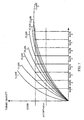
- FIG. 7 is a graph illustrating examples of determining a bit rate using content classification curves and a visually perceived quality value
- FIG. 8 is a flowchart illustrating a process for classifying multimedia data
- FIG. 9 is a flowchart illustrating a process for encoding multimedia data based on its content classification.
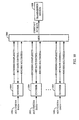
- FIG. 10 is a system diagram illustrating the encoding of multiple multimedia streams or channels.
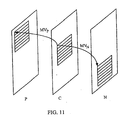
- FIG. 11 is a diagram illustrating motion compensation.
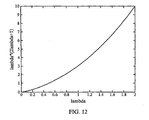
- FIG. 12 is a graph illustrating pre-emphasis of large lambda
- Examples of apparatus and methods for encoding multimedia data that utilize classifying the multimedia data into categories based on its content are described herein.
- the methods and apparatus described offer techniques for encoding multimedia data based on determining spatial and temporal characteristics of the multimedia data, and classifying the multimedia data based on one or more of its complexity characteristics.
- These methods and apparatus enable multimedia data processing and compression algorithms to be "tuned” based on the content category of the multimedia data to optimize the method and apparatus used to encode multimedia data using content information and efficiently deliver a desired quality level of multimedia data as perceived by the human eye, or another measure of the quality level.
- Multimedia data is a broad term that includes video data (which can include audio data), audio data, or both video data and audio data.
- Video data or “video” as used herein as a broad term, referring to sequences of images containing text or image information and/or audio data, and can be used to refer to multimedia data (e.g., the terms can be used interchangeably) unless otherwise specified.
- Multimedia codec systems generally do not take into account the different types of content. Instead, encoding is done in a similar fashion for all the content types.
- multimedia data is encoded at either a constant quality or a constant bit rate.
- Encoding at a constant bit rate leads to discrepancies in the quality of the video encoded for low activity sections and high activity sections. For example, a news sequence containing a sports clip may be encoded with the same number of bits allocated for each section. When viewed, the sports clip section would be perceived to be at a lower quality than the talking head section and the overall results may not be acceptable.
- Encoding at a constant quality leads to inefficient use of bit rates. Encoding low activity video at a high quality uses an unnecessarily high bit rate resulting in wasted bandwidth.
- the bit rate can be adjusted over the sequence based on the actual textured motion for that particular data.
- Content classification can be used in a variety of applications that can result in better bit management and more intelligent use of the available bit budget. For example, in some embodiments one content classification can be used for video data scene-change detection.
- Multimedia data communicated to a client device is typically compressed.
- a pair of video coding standards known as MPEG-x and H.26x, describe data processing and manipulation techniques (referred to herein as hybrid coding) that are well suited to the compression and delivery of video, audio and other information using fixed or variable length source coding techniques.
- the above-referenced standards, and other hybrid coding standards and techniques compress, illustratively, multimedia information using intra-frame coding techniques (such as, for example, run-length coding, Huffman coding and the like) and inter-frame coding techniques (such as, for example, forward and backward predictive coding, motion compensation and the like).
- hybrid multimedia coding systems are characterized by prediction-based compression encoding of multimedia frames with intra- and/or inter-frame motion compensation encoding. Encoding based at least in part on content classification can be incorporated into such compression algorithms to further optimize multimedia processing.
- content classification can be incorporated into such compression algorithms to further optimize multimedia processing.
- Intra-frame coding refers to encoding a picture (a field or a frame) without reference to any other picture, but the Intra-coded picture can be used as a reference for other pictures.
- the terms intra-frame, intra-coded frame and I Frame are all examples of video-objects formed with intra-coding that are used throughout this application.
- Inter or predictive coding refers to encoding a picture (a field or a frame) with reference to another picture. Compared to the Intra-coded picture, the Inter-coded or predicted picture may be coded with greater efficiency. Examples of inter-coded pictures that will be used throughout this application are predicted frames (either forward or backward predicted, also referred to as P frames), and bi-directional predicted frames (also referred to as B Frames). Other terms for inter-coding include high-pass coding, residual coding, motion compensated interpolation and others that are well known to those of ordinary skill in the art.
- a technique known as scalable coding, can divide Intra-coded pictures and the different inter-coded pictures (such as P Frames or B Frames) into different layers in the bitstream such as, for example, a base layer and an enhancement layer.
- Scalable coding is useful in dynamic channels, where scalable bitstreams can be adapted to match fluctuations in network bandwidth.
- scalable coding can add robustness through unequal error protection of the base layer and the enhancement layer. Better error protection can be applied to the more important layer.
- FIG. 1 is a block diagram of a general communications system for classifying the content of multimedia data, encoding, communicating, and decoding such data.
- the system 100 includes encoder device 105 and decoder device 110.
- Encoder device 105 includes encoder component 185 which includes intra encoder component 115, and predictive encoder component 120.
- Encoder device 105 further includes memory component 130, communications component 175, and content classifier component 190.
- Encoder device 105 is able to receive data from external source 135 using communication logic contained in communications component 175.
- External source 135 could be, for example, external memory, the Internet, a live video and/or audio feed, and receiving the data can include wired and/or wireless communications.
- the data contained in external source 135 can be in a raw (not encoded) format or encoded state.
- Intra encoder component 115 is used to encode intra-coded portions of frames (slices, macroblocks and sub-macroblocks).
- Predictive encoder component 120 is used to encode predicted portions of frames, including forward prediction, backward prediction and bi-directional prediction. After encoding, the encoded frames are stored in memory component 130 or external memory.
- the external memory can be contained within external source 135 or a separate memory component (not shown).
- the encoder device 105 includes a processor 187 which is in communication with the memory component 130 and one or more of the other components in encoder device 105.
- the processor 187 can perform processing for any of the other components of the encoder and can contain a main encoding process.
- the processor 187 may not be a separate component (as shown) but instead the processor functionality can be incorporated into one or more of the other components of the encoder 105.
- Communications component 175 contains logic used for data transmission (Tx) in conjunction with network 140.
- Network 140 can be part of a wired system such as telephone, cable, and fiber optic, or a wireless system.
- network 140 can comprise, for example, part of a code division multiple access (CDMA or CDMA2000) communication system or alternately, the system can be a frequency division multiple access (FDMA) system, an orthogonal frequency division multiplex (OFDM) system, a time division multiple access (TDMA) system such as GSM/GPRS (General Packet Radio Service)/EDGE (enhanced data GSM environment) or TETRA (Terrestrial Trunked Radio) mobile telephone technology for the service industry, a wideband code division multiple access (WCDMA), a high data rate (1xEV-DO or 1xEV-DO Gold Multicast) system, or in general any wireless communication system employing a combination of techniques.
- the encoded frames are transmitted (Tx) over network 140.
- the encoding processes performed by encoder device 105 are
- Content classifying component 190 contains logic for determining a classification of the data content of multimedia data received from the external source 135.
- a human visual model may be used to quantify the sensitivity of the human eye to perturbations in luminance of a visual signal with respect to its spatial and/or temporal context in the image and/or motion image sequence. Spatial and temporal masking effects of the eye are also taken into consideration.
- One aspect includes using motion estimation or block matching algorithms to represent the temporal aspects of the video.
- Information relating to the multimedia data e.g., spatial and temporal complexity values of the video data, can be determined by one or more components of the encoder 105 and used in conjunction with the perceptibility of spatial and motion effects in video are used to classify content of the video data into two or more categories.
- Such classification can be used in pre-/post processing and compression (e.g. scene-change detection, rate control, FRUC) algorithms.
- Content classification provides the encoder 105 with a reliable estimate of what type of content to expect in upcoming video data (e.g., a superframe), so the encoder 105 can determine the appropriate bit rate allocation to achieve a particular level of visually perceived quality based on the content classification, and for other frame-type decision purposes.
- a superframe is a set of media data for a predetermined time period or window, typically equal to one second worth of data, that are used as a unit for determining the content class, transmitting and for any other purposes.
- the content classifications can be based on characteristics of multimedia data as perceived by the human eye, for example, spatial complexity and temporal complexity. Multimedia processing algorithms can be optimized for various content types and provide stability and control with respect to their performance in encoding and communicating the multimedia data.
- Encoder component 185 can provide processing information (e.g., of macroblocks) for use by the content classifying component 190.
- the encoder component 185 can calculate information from the multimedia data, including a human visual sensitivity metric such as a D csat value, contrast ration value, motion vectors (MVs), and the sum of the absolute pixel differences (SADs).
- the encoder component 185 can store this information to the memory component 130 so it is available to be retrieved by the content classifying component 190 to determine the spatial and temporal complexity of the multimedia data, determine, the texture and motion of the data, and then determine the resulting content classification.
- the content classifying component 190, or another component such as processor 187 calculates at least part of this information from the multimedia data.
- Decoder device 110 contains similar components to some of the components in the encoder device 105, including, intra decoder component 145, predictive decoder component 150, memory component 160, processor 167, and communications component 180. Decoder device 110 receives encoded data that has been transmitted over network 140 or from external storage 165. Communications component 180 contains logic used for receiving (Rx) encoded data in conjunction with network 140, as well as logic for receiving encoded data from external storage 165. External storage 165 could be, for example, external RAM or ROM, or a remote server. Intra decoder component 145 is used to decode intra-coded data. Predictive decoder component 150 is used to decode inter-coded data.
- the processor 167 is in communication with the memory component 160 and one or more of the other components in decoder device 110.
- the processor 167 can perform processing for any of the other components of the decoder and can contain a main decoding process.
- Predictive decoder component 150 decodes both P frames (forward or backward predicted) as well as B frames.
- the same sub-components used for decoding P frames can be utilized in series to decode B frames with multiple references.
- Multiple references for B frames can be in forward and backward reference frames, both in the same reference frame, both in separate forward reference frames or both in backward reference frames.
- the decoded frames can be displayed with display component 170 or stored in internal memory 160 or external storage 165.
- Display component 170 can be an integrated part of the decoding device that contains such parts as video display hardware and logic, including a display screen, or it can be an external peripheral device.
- the decoding processes performed by decoder device 110 are more fully described below.
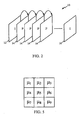
- FIG. 2 is a diagram illustrating a conventional MPEG-4 Simple Profile data stream, which depicts frame dependencies for a Group of Pictures (GOP).
- GOP 10 is made up of initial I Frame 12, followed by several forward predicted P frames 14. Due to the dependency of P frames on a previous I or P frame, loss of any of the P frames 14 may result in a loss of information that may be crucial in decoding other P frames. P frame loss or removal may result in, for example, video jitter or the inability of the decoder to continue decoding until the next I frame 16, which marks the beginning of the next GOP.
- P Frames can exploit temporal redundancy between a region in a current picture and a best matching prediction region in a reference picture.
- the difference between the current region and the best matching reference prediction region is known as residual error (or prediction error).
- residual error or prediction error
- the location of the best matching prediction region in the reference frame can be encoded in a motion vector.
- the processor 167 can perform processing for any of the other components of the decoder 110 and can contain a main decoding process. In some embodiments, the processor 167 may not be a separate component, but instead the processor functionality can be incorporated into one or more of the other components of the decoder 110.
- FIG. 3 is an illustration of an example of a P Frame construction process in, for example, MPEG-4.
- Process 300 includes current picture 305 made up of 5 x 5 macroblocks, where the number of macroblocks in this example is arbitrary.
- a macroblock is a group of associated pixels, and in this example is made up of 16 x 16 pixels. Pixels can be defined by an 8-bit luminance value (Y) and two 8-bit chrominance values (Cr and Cb).
- Y, Cr and Cb components can be stored in a 4:2:0 format, where the Cr and Cb components are down-sampled by 2 in the X and the Y directions.
- each macroblock would consist of 256 Y components, 64 Cr components and 64 Cb components.
- Macroblock 315 of current picture 305 is predicted from reference picture 310 at a different time point than current picture 305.
- a search is made in reference picture 310 to locate best matching macroblock 320 that is closest, in terms of Y, Cr and Cb values to current macroblock 315 being encoded.
- Methods of searching for best matching macroblock 320 include a) minimizing SAD (sum of absolute pixel differences) between current macroblock 315 and reference picture 310 macroblocks, b) minimizing SSD (sum of squared pixel differences), and c) minimum cost in a rate distortion sense, and others.
- the location of best matching macroblock 320 in reference picture 310 is encoded in motion vector 325.
- Reference picture 310 can be an I Frame or P Frame that the decoder would have reconstructed prior to the construction of current picture 305.
- Best matching macroblock 320 is subtracted from current macroblock 315 (a difference for each of the Y, Cr and Cb components is calculated) resulting in residual error 330.
- Residual error 330 is encoded with 2D Discrete Cosine Transform (DCT) 335 and then quantized 340.
- DCT Discrete Cosine Transform
- Quantization 340 can be performed to provide spatial compression by, for example, allotting fewer bits to the high frequency coefficients while allotting more bits to the low frequency coefficients.
- the quantized coefficients of residual error 330, along with motion vector 325 and reference picture 310 identifying information, are encoded information representing current macroblock 315.
- the encoded information can be stored in memory for future use or operated on for purposes of, for example, error correction or image enhancement, or transmitted over network 345.
- the encoded quantized coefficients of residual error 330, along with encoded motion vector 325 can be used to reconstruct current macroblock 315 in the encoder for use as part of a reference frame for subsequent motion estimation and compensation.
- the encoder can emulate the procedures of a decoder for this P Frame reconstruction.
- the emulation of the decoder can result in both the encoder and decoder working with the same reference picture.
- the reconstruction process whether done in an encoder, for further inter-coding, or in a decoder, is presented here. Reconstruction of a P Frame can be started after the reference frame (or a portion of a picture or frame that is being referenced) is reconstructed.
- the encoded quantized coefficients are dequantized 350 and then 2D Inverse DCT, or IDCT, 355 is performed resulting in decoded or reconstructed residual error 360.
- Encoded motion vector 325 is used to locate the already reconstructed best matching macroblock 365 in the already reconstructed reference picture 310.
- Reconstructed residual error 360 is then added to reconstructed best matching macroblock 365 to form reconstructed macroblock 370.
- Reconstructed macroblock 370 can be stored in memory, displayed independently or in a picture with other reconstructed macroblocks, or processed further for image enhancement.
- FIG. 4 is a block diagram of a content classifying component 190 illustrated in FIG. 1 .
- the content classifying component 190 includes a complexity component 192 configured to determine spatial complexity and temporal complexity of multimedia data, and also to associate a texture value to the spatial complexity and a motion value to the temporal complexity.
- the content classifying component 190 retrieves preprocessed information relating to the contents of the data from the memory 130. This information can include, for example, one or more D csat values, contrast ratio values, motion vectors (MVs), and sum of absolute differences (SADs).
- this information is not determined by a preprocessor (for example, the encoder component 185 or processor 187 in Fig. 1 ), the classifying component 190 can include functionality to calculate this information.
- multimedia data includes one or more sequences of images, or frames. Each frame can be broken up into blocks of pixels for processing.
- Spatial complexity is a broad term which generally describes a measure of the level of spatial details within a frame. Scenes with mainly plain or unchanging or low changing areas of luminance and chrominance may have low spatial complexity. The spatial complexity is associated with the texture of the video data. Spatial complexity is based on, in this aspect, a human visual sensitivity metric called D csat , which is calculated for each block as a function of local spatial frequency and ambient lighting. Ordinary skilled artisans are aware of techniques for using spatial frequency patterns and lighting and contrast characteristics of visual images to take advantage of the human visual system. A number of sensitivity metrics are known for taking advantage of the perspective limitations of the human visual system and could be used with method described herein.
- Temporal complexity is a broad term which is used to generally describe a measure of the level of motion in multimedia data as referenced between frames in a sequence of frames. Scenes (e.g., sequences of frames of video data) with little or no motion have a low temporal complexity. Temporal complexity can be calculated for each macroblock, and can be based on the D csat value, motion vectors and the sum of absolute pixel differences between one frame and another frame (e.g., a reference frame).
- Scene Change detection is a necessary step for any video coding system for it to intelligently conserve bits without wasting bits by inserting an I frame at a fixed interval.
- the following description shows how a scene change can be detected and its consequent use in the content classification.
- the length of a GOP can be long enough to reduce the efficient loss from big I frames, and short enough to fight mismatch between encoder and decoder, or channel impairment.
- macro blocks (MB) in P frames can be INTRA coded for the same reason.
- the communication channel is usually impaired by bit errors or packet losses.
- I frames or I MBs may significantly impact decoded video quality and viewing experience.
- a rule of thumb is to use INTRA coding for pictures or portions of pictures that has significant change from collocated previous pictures or picture portions. These regions cannot be predicted effectively and efficiently with motion estimation. Therefore, they may be exempted from INTER coding techniques. In the context of channel impairment, those regions are likely to suffer from error propagation. INTRA coding can be used to reduce error propagation.
- the regions that need to be INTRA updated can be classified as three categories.
- Shot detection is not only useful to improve encoding quality; it can also aid video content search / indexing.
- One detection algorithm is described hereinbelow.
- the sequence is preprocessed with a bi-directional motion compensator. It matches every 8x8 block of the current frame with blocks in two of this frames most adjacent neighboring frames, one in the past, and one in the future, as illustrated in FIG. 11 .
- the motion compensator produces motion vectors and difference metrics for every block.
- the difference metric can be sum of square difference (SSD) or sum of absolute difference (SAD). Without loss of generality, we use SAD as an example in this document.
- the denominator contains a small positive number ⁇ to prevent the "divide-by-zero" error.
- the above criterion uses the luminance histogram difference ⁇ in a non-linear way. Referring to FIG. 12 , it can be seen that this is a convex function. When ⁇ is small (close to zero), it is barely pre-emphasis. The larger ⁇ becomes, the more emphasis is conducted by the function. With this pre-emphasis, for any ⁇ larger than 1.4, an abrupt scene change is detected if the threshold T 1 is set to be 5.
- a flashlight event usually causes the luminance histogram to shift to brighter side.
- the reason to include SAD values is that camera flashes typically take one frame, and due to the luminance difference, this frame cannot be predicted well using motion compensation from both the forward and the backward direction.
- the content classification component 190 can include functionality to calculate motion vectors and the sum of absolute pixel differences, typically other encoder components can calculate this information and provide this data to the content classification component 190.
- the D csat values may also be calculated by the complexity component 192 or another component of the encoder 105 or the processor 187.
- contrast ratios can be used in determining the spatial complexity of a frame.
- contrast ratios for each macroblock in a frame are calculated.
- the contrast ratio for a given macroblock is calculated based on its average luminance with respect to its neighboring macroblocks.
- FIG. 5 illustrates a group of nine macroblocks in a video frame where each macroblock is 16x16 pixels.
- ⁇ i represents the mean for a given macroblock 1-9.
- the contrast ratio for macroblocks 1-4 and 6-9 are calculated in a similar manner.
- the contrast ratio of a frame is obtained by taking the mean of the contrast ratio values of each of the nine macroblocks in the frame.
- the standard deviation of the contrast ratios of the nine macroblocks is also calculated and provides an indication of the amount of variation of texture within each frame.
- a content classification metric can be determined using contrast ratio values, their standard deviation, and a frame difference metric.
- the other input for the content classification module is the Frame Difference metric calculated in the preprocessor.
- the Frame difference metric gives a measure of the difference between two consecutive frames taking into account the amount of motion (example, motion vector or MV) along with the residual energy represented as sum of absolute difference (SAD) between the predictor and the current macroblock ( FIG. 3 , component 325).
- SAD sum of absolute difference
- Frame difference also provides a measure of bidirectional or unidirectional prediction efficiencies.
- One example of a frame difference metric based on the motion information received from a pre-processor potentially performing motion compensated de-interlacing is as follows.
- the deinterlacer performs a bidirectional motion estimation and thus bidirectional motion vector and SAD information is available.
- ⁇ ⁇ + SAD P ⁇ + SAD N
- SAD P and SAD N are the SAD of the forward and the backward difference metric respectively.
- the denominator contains a small positive number ⁇ to prevent the "divide-by-zero" error.
- the nominator also contains an ⁇ to balance the effect of the unity in the denominator.
- the Contrast Ratio values and the Frame Difference values are utilized in the following manner to obtain a final video content classification metric, which could reliably predict the features in a given video sequence.
- the proposed algorithm can be able to classify the content into eight possible classes, similar to the classification obtained from the R-D curve based analysis.
- the algorithm outputs a value in the range between 0 and 1 for each superframe depending on the complexity of the scene and the number of scene change occurrences in that superframe.
- the content classification module in the preprocessor would execute the following steps for each superframe to obtain the content classification metric from the frame contrast and frame difference values.
- the complexity component 192 uses the D csat value, motion vectors and the sum of absolute differences to determine a value indicating a spatial complexity for the macroblock (or designated amount of video data).
- the temporal complexity is determined by a measure of the Frame Difference Metric.
- the Frame Difference Metric measures the difference between two consecutive frames taking into account the amount of motion (with motion vectors) and the sum of absolute differences between the frames.
- Human visual quality V can be a function of both encoding complexity C and allocated bits B (also referred to as bandwidth). It should be noted that the encoding complexity metric C considers spatial and temporal frequencies from the human vision point of view. For distortions more sensitive to human eyes, the complexity value is correspondingly higher. It can typically be assume that V is monotonically decreasing in C , and monotonically increasing in B .
- a bandwidth ( B i ) is assigned to the i th object (frame or MB) to be encoded that satisfies the criteria expressed in Equations 15 and 16.
- the encoding complexity is affected by human visual sensitivity, both spatial and temporal.
- Girod's human vision model is an example of a model that can be used to define the spatial complexity. This model considers the local spatial frequency and ambient lighting. The resulting metric is called D csat .
- D csat The resulting metric is called D csat .
- ⁇ INTRA ⁇ 0 ⁇ INTRA ⁇ log 10 ⁇ 1 + ⁇ INTRA ⁇ Y 2 ⁇ D csat
- Y is the average luminance component of an MB
- ⁇ INTRA is a weighing factor for the luminance square and D csat term following it
- ⁇ OINTRA is a normalization factor to guarantee 1 - ⁇ i ⁇ i .
- ⁇ INTRA 4 achieves good visual quality.
- the value of scaling factor ⁇ OINTRA is not important so long as bits are allocated according to the ratio between ⁇ INTRA of different video objects.
- bandwidth is allocated logarithmically with encoding complexity.
- the luminance squared term reflects the fact that coefficients with larger magnitude use more bits to encode. To prevent the logarithm from getting negative values, unity is added to the term in the parenthesis. Logarithms with other bases can also be used.
- the temporal complexity is determined by a measure of the Frame Difference Metric.
- the Frame Difference Metric measures the difference between two consecutive frames taking into account the amount of motion (with motion vectors) along with the SAD.
- Equation 20 MV P and MV N are the forward and the backward motion vectors for the current MB. It can be noted that Y 2 in the INTRA formula is replaced by SSD, which stands for sum of squared difference.
- the classification component 194 For each macroblock in the multimedia data, the classification component 194 associates a texture value with the spatial complexity and a motion value with the temporal complexity.
- the texture value relates to the luminescence values of the multimedia data, where a low texture value indicates small changes in luminescence values of neighboring pixels of the data, and a high texture value indicates large changes in the luminescence values of neighboring pixels of the data.
- a classification component 194 determines a content classification metric (e.g., a content classification) by considering both the motion and texture information.
- the classification component 194 associates the texture for the video data being classified with a relative texture value, for example, "Low” texture, “Medium” texture, or “High” texture, which generally indicates the complexity of luminance values of the macroblocks. Also, the classification component 194 associates the motion value calculated for the video data being classified with a relative motion value, for example, "Low” motion, “Medium” motion, or “High” motion which generally indicates the amount of motion of the macroblocks. In alternative embodiments, fewer or more categories for motion and texture can be used. Then, a content classification metric is then determined by considering the associated texture and motion values.
- FIG. 6 illustrates an example of a classification chart that illustrates how texture and motion values are associated with an content classification.
- a person of ordinary skill in the art is familiar with many ways to implement such a classification chart, for example, in a look-up table or a database.
- the classification chart is generated based on predetermined evaluations of video data content. To determine the video data classification, a texture value of "Low,” “Medium,” or “High” (on the “x-axis”) is cross-referenced with a motion value of "Low,” “Medium,” or “High” (on the "y-axis”).
- a content classification indicated in the intersecting block is assigned to the video data.
- FIG. 6 illustrates various combinations of relative texture and motion values that are associated with eight different content classifications, in this example. In some other embodiments, more or fewer classifications can be used.
- the resulting multimedia data content classification can be used in pre-/post processing and compression algorithms to effectively improve the bit management while maintaining a constant the perceptive quality of video.
- the classification metric can be used in algorithms for scene-change detection, encoding bit rate allocation control, and frame rate up conversion (FRUC).
- Compressor/decompressor (codec) systems and digital signal processing algorithms are commonly used in video data communications, and can be configured to conserve bandwidth, but there is a trade-off between quality and bandwidth conservation. The best codecs provide the most bandwidth conservation while producing the least degradation of video quality.
- a bit rate component 196 uses the content classification to determine a bit rate (e.g., the number of bits allocated for encoding the multimedia data) and stores the bit rate into memory for use by other process and components, for example, encoder component 185 in FIG. 1 .
- a bit rate determined from the classification of the video data can help conserve bandwidth while providing multimedia data at a consistent quality level.
- a different bit rate can be associated with each of the eight different content classifications and then that bit rate is used to encode the multimedia data. The resulting effect is that although the different content classifications of multimedia data are allocated a different number of bits for encoding, the perceived quality is similar or consistent when viewed on a display.
- multimedia data with a higher content classification are indicative of a higher level of motion and/or texture and is allocated more bits when encoded.
- Multimedia data with a lower classification (indicative of less texture and motion) is allocated less bits.
- the bit rate can be determined based on a selected target perceived quality level for viewing the multimedia data. Determining multimedia data quality can be determined by humans viewing and grading the multimedia data. In some alternative embodiments, estimates of the multimedia data quality can be made by automatic test systems using, for example, signal to noise ratio algorithms.
- a set of standard quality levels e.g., five
- a corresponding bit rate needed to achieve each particular quality level are predetermined for multimedia data of each content classification.
- multimedia data of a particular content classification can be evaluated by generating a Mean Opinion Score (MOS) that provides a numerical indication of a visually perceived quality of the multimedia data when it is encoded using a certain bit rate.
- MOS can be expressed as a single number in the range 1 to 5, where 1 is lowest perceived quality, and 5 is the highest perceived quality. In other embodiments, the MOS can have more than five or fewer than five quality levels, and different descriptions of each quality level can be used.
- Determining multimedia data quality can be determined by humans viewing and grading the multimedia data.
- estimates of the multimedia data quality can be made by automatic test systems using, for example, signal to noise ratio algorithms.
- a set of standard quality levels e.g., five
- a corresponding bit rate needed to achieve each particular quality level are predetermined for multimedia data of each content classification.
- Knowing the relationship between the visually perceived quality level and a bit rate for multimedia data of a certain content classification can be determined by selecting a target (e.g., desired) quality level.
- the target quality level used to determine the bit rate can be preselected, selected by a user, selected through an automatic process or a semi-automatic process requiring an input from a user or from another process, or be selected dynamically by the encoding device or system based on predetermined criteria.
- a target quality level can be selected based on, for example, the type of encoding application, or the type of client device that would be receiving the multimedia data.
- the acceptable bit rate is determined by finding the point of intersection of the target quality level with the particular rate distortion quality curve for the particular classification of video data.
- the bit rate is the point that corresponds to the intersection point, and the bit rate may decrease as a lower target quality level is selected. For example, if the target quality level was selected to be "Acceptable” instead of "Good,” encoding video data classified as, for example, class 6 with a bit rate of Rate 5, may now require a bit rate of about Rate 4.
- multimedia data sequences containing varying types of content can be used to obtain average bit rates and average luminance peak signal-to-noise ratio (PSNR).
- PSNR signal-to-noise ratio
- the average bit rates for the sequences are plotted against the average PSNR forming rate-distortion (R-D) curves.
- R-D curves for numerous multimedia data sequences can be depicted in graphical format where the x-axis is the average bit rate (kbps), and the y-axis is average luminance PSNR (db).
- the R-D curves for the sequences fall into several different clusters, and the multimedia data sequences are then classified into different groups (also curves) based on the clusters of the R-D curves.
- five groups are initially formed with each group obtained by taking the mean of all the sequences falling into that cluster.
- the clusters can each include one or more sequences. The standard deviation for each group can also be calculated from the particular sequences forming the group.
- the video data sequences may cluster to form less than five groups or more than five groups depending on the sequences used.
- the number of groups (five) are subsequently increased based on further analysis of the video data.
- such aspects may also include further increasing or decreasing the number of groups based on evaluating additional sequences.
- the five initial groups correspond to five classes which represent varying levels of motion and texture in a given superframe.
- class 1 represents a superframe having low motion and low texture (LM,LT)
- class 2 represents a superframe having medium motion and low texture (MM,LT)
- class 3 represents a superframe having medium motion and medium texture (MM, LT)
- class 4 represents a superframe having high motion and medium texture (HM, MT)
- class 5 represents a superframe having high motion and high texture (HM,HT).
- each superframe from all the available source sequences is classified to test if each superframe falls into its respective class.
- the initial classification can be refined by testing various sequences of multimedia data and using an iterative process to accommodate the various other sequences that do not fit into the previously defined five groups, and a new set modified R-D curves can be obtained.
- the number of clusters was increased from five to eight and additional classes were formed, where the larger class number represents increasing motion and a higher level of texture in the multimedia data.
- a quality metric e.g., PSNR
- PSNR quality metric
- the existing classes were modified based on another quality metric, other than PSNR.
- the content classification curves were modified by adding corresponding offsets so that all the classes have a similar quality metric.
- the offset values for each of the eight content classes are - 9.833, -5.831, -4.335, -2.064, -0.127, 0.361, 4.476 and 6.847.
- One use of content classification is for video data scene-change detection. If the frame difference metric or the contrast ratio value or the content classification metric are relatively high with respect to the previous and future frame in a sequence of frames, we determine that the particular frame is a scene change or a new shot.
- FIG. 8 is a flowchart illustrating one example of a process 200 for determining a bit rate based on classifying multimedia data. It is also noted that examples may be described as a process which can be depicted as a flowchart, a flow diagram, a structure diagram, or a block diagram. Although a flowchart may describe the operations as a sequential process, many of the operations can be performed in parallel or concurrently and the process can be repeated. In addition, the order of the operations may be re-arranged, operations not shown may be performed, or operations shown may be omitted depending on circumstances of an application of the process.
- a process described herein may correspond to a method, a function, a procedure, a software program, or part of a software program.
- a process corresponds to a function
- its termination corresponds to a return of the function to the calling function or the main function.
- the description of a process as a software program, module, component, subroutine, or a subprogram is a broad description and is not intended to require all embodiments to be implemented identically, unless expressly stated as such. Instead, one skilled in the art will recognize that such operations can typically be implemented in hardware, software, middleware, firmware, or microcode. Functionality or an operation that is described as a single component, program, or module may also be implemented in two or more components, modules, programs, e.g., submodules, subprograms or subroutines.
- Process 200 can be carried out by, for example, encoder device 105, and the components thereof, shown in FIG. 1 .
- Encoded or non-encoded video data is received by the encoder device 105 from the external source 135.
- step 205 determines the complexity of the video data.
- the encoder component 185 calculates information used to determine the spatial complexity and the temporal complexity of the video data, for example, motion vectors, at least one D csat values, and sum of the absolute differences of macroblocks.
- the content classifying component 190 calculates at least part of the information needed to determine the multimedia data temporal and spatial complexity. Classifying means such as the content classifying component 190 can classify the multimedia data based on the determined complexity, step 210.
- the multimedia data is classified in one of several content classifications (e.g., one of eight content classifications).
- the process 200 determines a quality value for viewing multimedia data at a plurality of content classifications, which is typically done prior to the start of process 200. Determining a data quality level can be determined by humans viewing and grading the multimedia data, or, in some alternative embodiments, estimates of the multimedia data quality can be made by automatic data evaluation systems using, for example, signal to noise ratio algorithms.
- the quality level can be preselected, selected by a user, selected through an automatic process or a semi-automatic process requiring an input from a user or from another process. Alternatively the quality level can be selected dynamically by the encoding device or system during the operation of the system, based on, for example, predetermined criteria relating to a desired or required quality level for viewing the multimedia data.
- the process 200 determined a bit rate for encoding the video data based on its classification and desired target quality level.
- the bit rate for encoding the video data can be determined by adding the individual frame size estimates belonging to that superframe.
- the individual frame size estimates can be computed in two ways. In one approach, the estimate of the sizes of each frame in the superframe is computed based on the bandwidth ratios and then the size of the superframe can be estimated as a linear combination of the frame sizes.
- the frame sizes are estimated depending on the previously encoded frames and the Bandwidth ratios of the frame.
- IIR Infinite Impulse Response
- the Bandwidth ratios (BWR) are calculated in the preprocessor based on the motion vectors and the SAD in the MPEG-2 decoder.
- Frame Estimate i Grammap i * Temporal_BWR i
- Temporal_BWR may be the sum of Beta_inter (described above) for all macroblocks in the frame.
- I frames it is observed that an FIR filter provides a more accurate results than with an IIR filter.
- the superframe size is the sum of all the frame estimates in that superframe.
- the super frame size can be estimated as a whole.
- the superframe size can be estimated depending on the previously encoded super frames and the Bandwidth ratios of the super frame as a whole.
- An Infinite Impulse Response (IIR) filter as described for the first approach above can be used to estimate the super frame sizes.
- the bandwidth ratio for a given superframe is estimated using a linear combination of the bandwidth ratios for the individual frames in that superframe.
- Frame types in a superframe can be based on a fixed GOP structure such as IBP or IBBP etc.
- the frame types in a superframe are determined based on the frame difference metric described above.
- An intra threshold and an inter threshold are determined based on classification of the content type in this given superframe. Based on these thresholds, a frame is declared as an I-frame if its frame difference exceeds intra_threshold or a P-frame if its frame difference is between the intra and inter thresholds and a B-frame if the frame difference is below the inter_threshold.
- Spatial bandwidth ratio described as Beta_Intra derived using Dcsat and Girod's model described above is used to estimate the size of Intra frames. Another approach is where the spatial bandwidth ratio is based on the contrast ratio described above or any other metric that represents the amount
- Temporal bandwidth ratio described as Beta_Inter derived using Dcsat and Girod's model and MV and SAD described above is used to estimate the size of inter. Another approach is where the temporal bandwidth ratio is based on the SAD_MV metric described above or any other metric that represents the amount or level of motion in the frame.
- step 221 uses the bit rate determined in step 215 for further processing of the multimedia data, for example, to encode the multimedia data for communication along a wireless network.
- FIG. 9 is a flowchart illustrating a process 201 for further operations of processing multimedia data between the points "A" and the "B" shown in FIG. 8 .
- Process 201 determines the spatial complexity of the multimedia data in step 206. Determining the spatial complexity requires the process 201 to calculate at least one D csat value for blocks of the multimedia data, which is performed in step 207. Step 207 can be performed by the encoder component 185 or the content classifying component 190, both shown in FIG. 1 . The process of calculating a D csat value is described hereinabove. Proceeding to step 240, the process 201 now determines the temporal complexity of the multimedia data.
- Step 209 determines at least one motion vector for at least one block of data, which is typically done by the encoder component 185.
- process 201 also determines the sum of absolute differences (SAD) associated with at least one block of the multimedia data and a reference block. The calculations in step 211 are also typically done by the encoder component 185.
- the process 201 classifies the multimedia data based on the determined complexity. To classify the multimedia data, the spatial complexity is associated with a texture value, in step 255. Also, the temporal complexity is associated with a motion value, as shown in step 260. Finally, in step 265 the process 201 assigns an content classification to the multimedia data based on the texture value and the motion value, determined in step 255 and 260, respectively. The steps of process 201 end at "B" which is where the process 200 would continue on to determine a bit rate, as shown in step 215 in FIG. 9 .
- a multiplexer may be used for the bit management discussed above.
- a multiplexer may be implemented to provide the bit rate allocation control.
- the estimated complexity can be provided to the multiplexer, which can then allocate the available bandwidth for a collection of multiplexed video channels according to the encoding complexity anticipated for those video channels, which then permits the quality of a particular channel to remain relatively constant even if the bandwidth for the collection of multiplexed video streams is relatively constant. This provides a channel within a collection of channels to have a variable bit rate and relatively constant visual quality, rather than a relatively constant bit rate and a variable visual quality.
- FIG. 10 is a system diagram illustrating the encoding of multiple multimedia streams or channels 1002.
- the multimedia streams 1002 are encoded by respective encoders 1004, which are in communication when a multiplexer (MUX) 1006, which in turn is in communication with a transmission medium 1008.
- the multimedia streams 1002 can correspond to various content channels, such as news channels, sports channels, movie channels, and the like.
- the encoders 1004 encode the multimedia streams 1002 to the encoding format specified for the system. While described in the context of encoding of video streams, the principles and advantages of the disclosed techniques are generally applicable to multimedia streams including, for example, audio streams.
- the encoded multimedia streams are provided to a multiplexer 1006, which combines the various encoded multimedia streams and sends the combined stream to the transmission medium 1008 for transmission.
- the transmission medium 1008 can correspond to a variety of mediums, such as, but not limited to, digital satellite communication, such as DirecTV®, digital cable, wired and wireless Internet communications, optical networks, cell phone networks, and the like.
- the transmission medium 1008 can include, for example, modulation to radio frequency (RF).
- RF radio frequency
- the transmission medium has a limited bandwidth and the data from the multiplexer 1006 to the transmission medium is maintained at a relatively constant bit rate (CBR).
- CBR constant bit rate
- two or more of the encoders 1004 communicate an anticipated encoding complexity of input data.
- One or more of the encoder 1004 may receive adapted bit rate control from the multiplexer 1006 in response. This permits an encoder 1004 that expects to encode relatively complex video to receive a higher bit rate or higher bandwidth (more bits per frame) for those frames of video in a quasi-variable bit rate manner. This permits the multimedia stream 1002 to be encoded with more consistent visual quality.
- the extra bandwidth that is used by a particular encoder 1004 encoding relatively complex video comes from the bits that would otherwise have been used for encoding other video streams 1004 if the encoders were implemented to operate at constant bit rates. This maintains the output of the multiplexer 1006 at the constant bit rate (CBR).
- CBR constant bit rate
- While an individual multimedia stream 1002 can be relatively "bursty," that is, vary in used bandwidth, the cumulative sum of multiple video streams can be less bursty.
- the bit rate from channels that are encoding less complex video that can be reallocated by, for example, the multiplexer 1006, to channels that are encoding relatively complex video, and this can enhance the visual quality of the combined video streams as whole.
- the encoders 1004 provide the multiplexer 1006 with an indication of the complexity of a set of video frames to be encoded and multiplexed together.
- the output of the multiplexer 1006 should provide an output that is no higher than the bit rate specified for the transmission medium 1008.
- the indications of the complexity can be based on the content classification as discussed above to provide a selected level of quality.
- the multiplexer 1006 analyzes the indications of complexity, and provides the various encoders 1004 with an allocated number of bits or bandwidth, and the encoders 1004 use this information to encode the video frames in the set. This permits a set of video frames to individually be variable bit rate, and yet achieve constant bit rate as a group.
- Content Classification can also be used in enabling quality based compression of multimedia in general for any generic compressor.
- Content Classification and the methods and apparatuses described here may be used in quality based and/or content based multimedia processing of any multimedia data.
- One example is its use in compression of multimedia in general for any generic compressor.
- Another example is in decompression or decoding in any decompressor or decoder or post-processor such as interpolation, resampling, enhancement, restoration and presentation operations.
- aspects of the various embodiments may be implemented in any device that is configured to encode multimedia data for subsequent display, including multimedia data where the frames exhibited display an image in motion (e.g., a sequence of associated frames portraying a moving or changing image) or a stationary image (e.g., unchanging or slow changing image), and whether textual or pictorial. More particularly, it is contemplated that some embodiments may be implemented in or associated with a variety of electronic devices that can be used for communication such as, but not limited to, mobile telephones, wireless devices, personal data assistants (PDAs), hand-held or portable computers, and other such wired or wireless communication devices configured to receive multimedia data for display.
- PDAs personal data assistants
- Communicating multimedia data to client devices involves transmitting and processing large amounts of data.
- Most multimedia applications could have increased benefits in quality if the sequence of multimedia frames provided to the encoder is classified based on its content.
- content classification if available, can be useful.
- the content classification can be useful in determining a bit rate needed to encode multimedia data for obtaining a predetermined viewing quality, and it can also be used to determine the best frame type for a given frame.
- DSP digital signal processor
- ASIC application specific integrated circuit
- FPGA field programmable gate array
- a general purpose processor may be a microprocessor, but in the alternative, the processor may be any conventional processor, controller, microcontroller, or state machine.
- a processor may also be implemented as a combination of computing devices, e.g., a combination of a DSP and a microprocessor, a plurality of microprocessors, one or more microprocessors in conjunction with a DSP core, or any other such configuration.
- a software module may reside in RAM memory, flash memory, ROM memory, EPROM memory, EEPROM memory, registers, hard disk, a removable disk, a CD-ROM, or any other form of storage medium known in the art.
- An example storage medium is coupled to the processor such that the processor can read information from, and write information to, the storage medium.
- the storage medium may be integral to the processor.
- the processor and the storage medium may reside in an Application Specific Integrated Circuit (ASIC).
- the ASIC may reside in a wireless modem.
- the processor and the storage medium may reside as discrete components in the wireless modem.
Landscapes
- Engineering & Computer Science (AREA)
- Multimedia (AREA)
- Signal Processing (AREA)
- Computing Systems (AREA)
- Theoretical Computer Science (AREA)
- Compression Or Coding Systems Of Tv Signals (AREA)
- Two-Way Televisions, Distribution Of Moving Picture Or The Like (AREA)
Applications Claiming Priority (2)
| Application Number | Priority Date | Filing Date | Title |
|---|---|---|---|
| US66067705P | 2005-03-10 | 2005-03-10 | |
| EP06737643A EP1867173A2 (fr) | 2005-03-10 | 2006-03-10 | Classification de contenus pour traitement multimedia |
Related Parent Applications (2)
| Application Number | Title | Priority Date | Filing Date |
|---|---|---|---|
| EP06737643.4 Division | 2006-03-10 | ||
| EP06737643A Division EP1867173A2 (fr) | 2005-03-10 | 2006-03-10 | Classification de contenus pour traitement multimedia |
Publications (2)
| Publication Number | Publication Date |
|---|---|
| EP1921866A2 true EP1921866A2 (fr) | 2008-05-14 |
| EP1921866A3 EP1921866A3 (fr) | 2010-07-28 |
Family
ID=39276980
Family Applications (1)
| Application Number | Title | Priority Date | Filing Date |
|---|---|---|---|
| EP08000729A Withdrawn EP1921866A3 (fr) | 2005-03-10 | 2006-03-10 | Classification de contenu pour traitement multimédia |
Country Status (1)
| Country | Link |
|---|---|
| EP (1) | EP1921866A3 (fr) |
Cited By (3)
| Publication number | Priority date | Publication date | Assignee | Title |
|---|---|---|---|---|
| US10847116B2 (en) | 2009-11-30 | 2020-11-24 | Semiconductor Energy Laboratory Co., Ltd. | Reducing pixel refresh rate for still images using oxide transistors |
| US11481791B2 (en) * | 2015-11-19 | 2022-10-25 | Realeyes Oü | Method and apparatus for immediate prediction of performance of media content |
| WO2026021500A1 (fr) * | 2024-07-23 | 2026-01-29 | Douyin Vision Co., Ltd. | Procédé, appareil et support de traitement vidéo |
Family Cites Families (9)
| Publication number | Priority date | Publication date | Assignee | Title |
|---|---|---|---|---|
| DE69535553T2 (de) * | 1994-06-17 | 2007-12-06 | Snell & Wilcox Ltd., Havant | Videokompression |
| EP1209624A1 (fr) * | 2000-11-27 | 2002-05-29 | Sony International (Europe) GmbH | Procédé pour la réduction d'artefacts dans une image comprimée |
| US6947598B2 (en) * | 2001-04-20 | 2005-09-20 | Front Porch Digital Inc. | Methods and apparatus for generating, including and using information relating to archived audio/video data |
| US6909745B1 (en) * | 2001-06-05 | 2005-06-21 | At&T Corp. | Content adaptive video encoder |
| JP3926203B2 (ja) * | 2002-05-15 | 2007-06-06 | シャープ株式会社 | コンテンツ表示装置、コンテンツ表示プログラム、該プログラムを記録した記録媒体、およびコンテンツ表示方法 |
| FR2840495B1 (fr) * | 2002-05-29 | 2004-07-30 | Canon Kk | Procede et dispositif de selection d'une methode de transcodage parmi un ensemble de methodes de transcodage |
| EP1537575A1 (fr) * | 2002-08-21 | 2005-06-08 | Thomson Licensing S.A. | Filigranage de donnees numeriques au niveau d'un dispositif utilisateur |
| KR20050084266A (ko) * | 2002-12-10 | 2005-08-26 | 코닌클리케 필립스 일렉트로닉스 엔.브이. | 디지털 비디오 처리용 통합 규준 |
| EP1615447B1 (fr) * | 2004-07-09 | 2016-03-09 | STMicroelectronics Srl | Méthode et système de livraison des flux d'informations et reseau et programme informatique associés |
-
2006
- 2006-03-10 EP EP08000729A patent/EP1921866A3/fr not_active Withdrawn
Non-Patent Citations (1)
| Title |
|---|
| None * |
Cited By (5)
| Publication number | Priority date | Publication date | Assignee | Title |
|---|---|---|---|---|
| US10847116B2 (en) | 2009-11-30 | 2020-11-24 | Semiconductor Energy Laboratory Co., Ltd. | Reducing pixel refresh rate for still images using oxide transistors |
| US11282477B2 (en) | 2009-11-30 | 2022-03-22 | Semiconductor Energy Laboratory Co., Ltd. | Liquid crystal display device, method for driving the same, and electronic device including the same |
| US11636825B2 (en) | 2009-11-30 | 2023-04-25 | Semiconductor Energy Laboratory Co., Ltd. | Liquid crystal display device, method for driving the same, and electronic device including the same |
| US11481791B2 (en) * | 2015-11-19 | 2022-10-25 | Realeyes Oü | Method and apparatus for immediate prediction of performance of media content |
| WO2026021500A1 (fr) * | 2024-07-23 | 2026-01-29 | Douyin Vision Co., Ltd. | Procédé, appareil et support de traitement vidéo |
Also Published As
| Publication number | Publication date |
|---|---|
| EP1921866A3 (fr) | 2010-07-28 |
Similar Documents
| Publication | Publication Date | Title |
|---|---|---|
| US9197912B2 (en) | Content classification for multimedia processing | |
| US8654848B2 (en) | Method and apparatus for shot detection in video streaming | |
| EP2227019B1 (fr) | Procédés et dispositif de codage de données redondantes | |
| CN101313592B (zh) | 用于与时域边界进行数据对准的方法和装置 | |
| EP1921866A2 (fr) | Classification de contenu pour traitement multimédia | |
| HK1113626A (en) | Content classification for multimedia processing |
Legal Events
| Date | Code | Title | Description |
|---|---|---|---|
| PUAI | Public reference made under article 153(3) epc to a published international application that has entered the european phase |
Free format text: ORIGINAL CODE: 0009012 |
|
| AC | Divisional application: reference to earlier application |
Ref document number: 1867173 Country of ref document: EP Kind code of ref document: P |
|
| AK | Designated contracting states |
Kind code of ref document: A2 Designated state(s): AT BE BG CH CY CZ DE DK EE ES FI FR GB GR HU IE IS IT LI LT LU LV MC NL PL PT RO SE SI SK TR |
|
| AX | Request for extension of the european patent |
Extension state: AL BA HR MK YU |
|
| RIN1 | Information on inventor provided before grant (corrected) |
Inventor name: BHAMIDIPATI, PHANIKUMAR Inventor name: WALKER, GORDON KENT Inventor name: RAVEENDRAN, VIJAYALAKSHMI R. |
|
| PUAL | Search report despatched |
Free format text: ORIGINAL CODE: 0009013 |
|
| AK | Designated contracting states |
Kind code of ref document: A3 Designated state(s): AT BE BG CH CY CZ DE DK EE ES FI FR GB GR HU IE IS IT LI LT LU LV MC NL PL PT RO SE SI SK TR |
|
| AX | Request for extension of the european patent |
Extension state: AL BA HR MK RS |
|
| RTI1 | Title (correction) |
Free format text: CONTENT ADAPTIVE MULTIMEDIA PROCESSING |
|
| 17P | Request for examination filed |
Effective date: 20101221 |
|
| AKX | Designation fees paid |
Designated state(s): AT BE BG CH CY CZ DE DK EE ES FI FR GB GR HU IE IS IT LI LT LU LV MC NL PL PT RO SE SI SK TR |
|
| 17Q | First examination report despatched |
Effective date: 20150209 |
|
| STAA | Information on the status of an ep patent application or granted ep patent |
Free format text: STATUS: EXAMINATION IS IN PROGRESS |
|
| STAA | Information on the status of an ep patent application or granted ep patent |
Free format text: STATUS: THE APPLICATION IS DEEMED TO BE WITHDRAWN |
|
| 18D | Application deemed to be withdrawn |
Effective date: 20180926 |