EP1921875A1 - Système et procédé pour l'interrogation d'un identificateur de réseau - Google Patents
Système et procédé pour l'interrogation d'un identificateur de réseau Download PDFInfo
- Publication number
- EP1921875A1 EP1921875A1 EP06122779A EP06122779A EP1921875A1 EP 1921875 A1 EP1921875 A1 EP 1921875A1 EP 06122779 A EP06122779 A EP 06122779A EP 06122779 A EP06122779 A EP 06122779A EP 1921875 A1 EP1921875 A1 EP 1921875A1
- Authority
- EP
- European Patent Office
- Prior art keywords
- polling
- network identifier
- identifier value
- value
- event
- Prior art date
- Legal status (The legal status is an assumption and is not a legal conclusion. Google has not performed a legal analysis and makes no representation as to the accuracy of the status listed.)
- Granted
Links
Images


Classifications
-
- H—ELECTRICITY
- H04—ELECTRIC COMMUNICATION TECHNIQUE
- H04W—WIRELESS COMMUNICATION NETWORKS
- H04W48/00—Access restriction; Network selection; Access point selection
- H04W48/16—Discovering, processing access restriction or access information
-
- H—ELECTRICITY
- H04—ELECTRIC COMMUNICATION TECHNIQUE
- H04W—WIRELESS COMMUNICATION NETWORKS
- H04W52/00—Power management, e.g. Transmission Power Control [TPC] or power classes
- H04W52/02—Power saving arrangements
- H04W52/0209—Power saving arrangements in terminal devices
- H04W52/0261—Power saving arrangements in terminal devices managing power supply demand, e.g. depending on battery level
-
- H—ELECTRICITY
- H04—ELECTRIC COMMUNICATION TECHNIQUE
- H04W—WIRELESS COMMUNICATION NETWORKS
- H04W60/00—Affiliation to network, e.g. registration; Terminating affiliation with the network, e.g. de-registration
- H04W60/04—Affiliation to network, e.g. registration; Terminating affiliation with the network, e.g. de-registration using triggered events
-
- Y—GENERAL TAGGING OF NEW TECHNOLOGICAL DEVELOPMENTS; GENERAL TAGGING OF CROSS-SECTIONAL TECHNOLOGIES SPANNING OVER SEVERAL SECTIONS OF THE IPC; TECHNICAL SUBJECTS COVERED BY FORMER USPC CROSS-REFERENCE ART COLLECTIONS [XRACs] AND DIGESTS
- Y02—TECHNOLOGIES OR APPLICATIONS FOR MITIGATION OR ADAPTATION AGAINST CLIMATE CHANGE
- Y02D—CLIMATE CHANGE MITIGATION TECHNOLOGIES IN INFORMATION AND COMMUNICATION TECHNOLOGIES [ICT], I.E. INFORMATION AND COMMUNICATION TECHNOLOGIES AIMING AT THE REDUCTION OF THEIR OWN ENERGY USE
- Y02D30/00—Reducing energy consumption in communication networks
- Y02D30/70—Reducing energy consumption in communication networks in wireless communication networks
Definitions
- the application relates generally to wireless devices, and more particularly to polling for network identifier values.
- a wireless device typically has a radio layer, a transport layer, and an application layer.
- the radio layer includes a protocol stack and is typically aware of the network identifier of the zone in which the wireless device resides.
- the network identifier is a SID (system identifier).
- the network identifier includes both an mcc (mobile country code) and an mnc (mobile network code).
- the radio layer does not always inform the transport layer. Therefore, the transport layer periodically polls the radio layer for the network identifier value. A high frequency of polls allows the transport layer to maintain an accurate network identifier value. However, polling the radio layer for network identifier values at a high frequency consumes battery power of the wireless device.
- a method comprising: polling for a network identifier value on a first basis; polling for the network identifier value on a more frequent basis than the first basis; and at some later time, polling for the network identifier value on the first basis.
- a computer readable medium having computer executable instructions stored thereon for execution on a processor so as to implement the method summarized above.
- a wireless device comprising a network identifier polling function adapted to implement the method summarized above.
- the wireless device 10 has a processor 19 coupled to a wireless access radio 11, a radio layer 12, a transport layer 14, and an application layer 17.
- the radio layer 12 has a protocol stack 13, while the application layer 17 has a plurality of applications 18.
- the transport layer 14 has a transport stack 15 and a network identifier polling function 16.
- the wireless device 10 may have other components, but they are not shown for sake of simplicity.
- the network identifier polling function 16 is shown as part of the transport layer 14. In other embodiments, the network identifier polling function is in the application layer. In some embodiments, the application wraps the transport stack so all interaction between the radio and transport stack goes through the application layer (Radio ⁇ ->App ⁇ ->Transport). In this case, since the notifications of network identifier change are expected to come from the application layer, it is the application layer that is doing the polling.
- the wireless device 10 is adapted to communicate with a wireless network (not shown) via the wireless access radio 11. Such communication may be in respect of one or more of the applications 18 of the application layer 17.
- the radio layer 12 uses the protocol stack 13 to facilitate protocol communications over the wireless access radio 11.
- the radio layer 12 is aware of the network identifier value of the zone in which the wireless device 10 resides.
- the transport layer 14 polls for network identifier values from the radio layer 12. In some implementations, if there has been a change in the network identifier value, then the transport layer 14 initiates a registration to ensure that the wireless device 10 is "always-on". Always-on connectivity may be important to one or more of the applications 18 of the application layer 17.
- the network identifier polling function 16 implements a polling scheme whereby the frequency of polling is dependent upon one or more predefined events.
- the transport layer 14 polls for a network identifier value on a first basis; however, upon occurrence of an event of a predefined type, the transport layer 14 polls for the network identifier value on a more frequent basis than the first basis.
- the higher frequency of polls allows for any changes to the network identifier value to be detected more quickly than if a slower frequency of polling was used.
- the transport layer 14 resumes polling on the first basis so as to conserve battery power.
- the polling on the first basis involves any appropriate polling scheme such that polling is performed at a relatively low frequency or range of frequencies so as to conserve battery power.
- the polling on the more frequent basis involves any appropriate polling scheme such that polling is performed on a more frequent basis than the polling on the first basis. Example implementation details of the polling schemes are provided with reference to the subsequent Figures.
- the network identifier polling function 16 is implemented as software and is executed on the processor 19. However, more generally, the network identifier polling function 16 may be implemented as software, hardware, firmware, or any appropriate combination thereof.
- the network identifier being polled is implementation-specific and typically depends on the type of wireless system in which the wireless device 10 resides. There are many possibilities for the wireless system.
- the wireless device 10 is in a CDMA (Code Division Multiple Access) system and the network identifier is a SID (system identifier).
- CDMA Code Division Multiple Access
- SID system identifier
- always-on connectivity involves PPP (point-to-point protocol) connectivity.
- the wireless system includes an EVDO (Evolution Data Optimised) network.
- EVDO is an overly to CDMA 1X. From data connectivity point of view, EVDO and CDMA share the same PCF (Packet Control Function) box on the network side, which the wireless device connects to in order to establish a new connection.
- PCF Packet Control Function
- PCF is sitting behind the PDSN (Packet Data Serving Node) in network topology.
- PDSN Packet Data Serving Node
- EVDO overlay goes further than CDMA signal so there is coverage by EVDO signals but not CDMA signals. For such areas, monitoring network identifier change of EVDO network will allow reestablishment of service if EVDO network identifier changes.
- the network identifier for EVDO includes a Sector ID and/or a Color Code.
- the wireless device 10 is in a GPRS (General Packet Radio Service) system and the network identifier includes both an mcc (mobile country code) and mnc (mobile network code).
- GPRS General Packet Radio Service
- always-on connectivity involves PDP (Packet Data Protocol) connectivity.
- the wireless system includes an EDGE (Evolution Data Optimised) network. Implementations with EDGE follow similar principles discussed above for EVDO, as EDGE is an enhancement to GPRS, which is an overlay to GSM.
- the wireless device 10 is in a UMTS (Universal Mobile Telecommunications System) and the network identifier includes both an mcc and an mnc.
- UMTS Universal Mobile Telecommunications System
- the network identifier includes both an mcc and an mnc.
- Other wireless systems and associated network identifiers are possible. More generally, embodiments of the application are applicable to any wireless system whereby the radio layer does not provide network identification change notifications to the transport or application layer.
- the wireless device 10 is shown with a very specific arrangement of components and is for example purposes only. Different arrangements of components are possible.
- the wireless device 10 is shown with "layers" such as the radio layer 12 for implementing various functionality; however, more generally, any "function", whether layered or not layered, may be implemented.
- components that are shown separately may be combined as a single component.
- the network identifier polling function 16 is combined with the transport stack 15 as a single component. Other combinations are possible.
- FIGS. 2 through 6 shown are flowcharts of an example method of polling for a network identifier in which an event triggers polling on a more frequent basis.
- This method may be implemented in a wireless device, for example by the network identifier polling function 16 of the transport layer 14 shown in Figure 1.
- the transport layer polls for a network identifier value on a first basis.
- the transport layer polls for the network identifier value on a more frequent basis than the first basis. Further details of the event are provided below with reference to Figures 4 and 5; further details of the polling on the more frequent basis are provided below with reference to Figures 6 and 7.
- the transport layer polls for the network identifier value on the first basis.
- the transport layer if the transport layer receives the network identifier value from the radio layer and observes that there has been a network identifier change, then the transport layer initiates a registration.
- FIG 3 shown is a flowchart of an example method of initiating a registration based on an observed network identifier change.
- the transport layer receives a network identifier value.
- the transport layer initiates a registration so as to maintain always-on connectivity.
- Suitable events are those that may occur when the network identifier changes, the logic being that if such an event has occurred, then maybe the network identifier has changed so it is a good time to check. Since "always-on" connectivity is relevant when sending/receiving data, it is a more relevant event to check for network identifier changes instead of a user tapping a button for example.
- the polling on the more frequent basis is performed in a manner that is dependent upon the event that has occurred.
- FIG 5 shown is a flowchart of an example method of polling in a manner that is dependent upon the event that has occurred.
- an event triggering polling on the more frequent basis occurs.
- Example events that may trigger the polling on the more frequent basis have been provided above and are therefore not repeated here.
- the transport layer polls for the network identifier value in a manner that is dependent upon the event that has occurred.
- the transport layer polls for the network identifier value for a time duration that is dependent upon the event that has occurred. In other implementations, the transport layer polls for the network identifier value with a constant frequency that is dependent upon the event that has occurred. In other implementations, the transport layer polls for the network identifier value with a variable frequency that is dependent upon the event that has occurred. Other implementations are possible.
- step 6-1 the transport layer receives the network identifier value at some time during the polling on the more frequent basis, then the transport layer determines at step 6-2 whether or not the network identifier value has changed. In some implementations, if the network identifier value has changed, then the transport layer initiates a registration. At step 6-2 the transport layer determines whether or not it should restart polling on the more frequent basis. Restarting the polling on the more frequent basis may lengthen the time during which polling on the more frequent basis is performed. It may also change the frequency of polling in the event that the polling on the more frequent basis is implemented with a variable frequency of polling.
- the transport layer determines that it should restart polling on the more frequent basis, then at step 6-4 the transport layer restarts the polling on the more frequent basis. Otherwise, at step 6-5 the transport layer polls for the network identifier value on the first basis. However, if there has been no change in the network identifier value upon expiry of a time duration during the polling on the more frequent basis, then at step 6-6 the transport layer polls for the network identifier value on the first basis. This is known as a timeout.
- the transport layer may determine whether or not the polling on the more frequent basis should be restarted.
- the transport layer makes this determination based on user input. For example, the user of the wireless device can input their preference for PPP connectivity versus preserving battery power. If the user prefers to conserve battery power, then the transport layer does not restart the polling on the more frequent basis. However, if the user has a stronger preference for PPP connectivity, then the transport layer restarts the polling on the more frequent basis. In other implementations, the transport layer determines whether or not to restart polling based on a hard-coded setting that cannot be manipulated by the user. Other implementations are possible.
- the transport layer polls for the network identifier only if the wireless access radio of the wireless device is on. If the wireless access radio is not on, then PPP connectivity is no longer possible. Therefore, there is little or no use in polling for the network identifier when the wireless access radio is off.
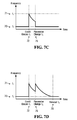
- FIGS 7A through 7C shown are graphs providing examples of the polling by the transport layer on the more frequent basis.
- Each graph compares frequency of polling versus time and illustrates example results that may be achieved by various implementations of the method described above with reference to Figures 2 through 6. It is to be understood that these graphs are very specific and are for example purposes only.
- references to an event triggering the polling on the more frequent basis are made.
- References to observing network identifier changes, and timeouts while waiting for a change in a network identifier are also made. Example details of these topics have been provided above and therefore are not repeated here.
- the polling frequency starts at f 1 70 and remains constant until an event occurs at t 1 72.
- the frequency of polling increases to f 2 71.
- the frequency of polling remains constant at f 2 71 until a timeout occurs at t 2 74 at which time the frequency of polling decreases back down to f 1 70.
- the polling for the network identifier value on the more frequent basis, f 2 71 is done so with a constant frequency of polling.
- a variable frequency of polling is accomplished.
- Figure 7B provides an example of this.
- the polling frequency starts at f 1 70 and remains constant until an event occurs at t 1 72.
- the frequency of polling increases to f 2 71.
- the frequency of polling decreases in a non-linear manner until a timeout at t 2 74. At this time, the frequency of polling has decreased to f 1 70.
- the decrease in frequency is non-linear.
- the decrease in frequency is linear. More generally, the decrease in frequency may be linear, non-linear, or an appropriate combination thereof (i.e. portions that are linear and portions that are non-linear).
- the frequency of polling decreases to f 1 70 at the same time as the timeout at t 2 74.
- the frequency of polling is greater than f 1 70 at the timeout at t 2 74.
- the frequency of polling decreases to f 1 70 upon the timeout at t 2 74.
- the polling frequency starts at f 1 70 and remains constant until an event occurs at t 1 72.
- the frequency of polling increases to f 2 71.
- the frequency of polling decreases in a non-linear manner until a parameter change is observed at t 2 75. At this time, the frequency of polling decreases to f 1 70.
- the observing of a network identifier change prompts the polling on the more frequent basis to end.
- the polling on the more frequent basis is restarted. An example of this is provided below with reference to Figure 7D.
- the polling frequency starts at f 1 70 and remains constant until an event occurs at t 1 72.
- the frequency of polling increases to f 2 71.
- the frequency of polling decreases in a non-linear manner until a parameter change is observed at t 2 75.
- the frequency of polling increases back to f 1 71.
- the polling on the more frequent basis is restarted.
- the frequency of polling decreases in a non-linear manner until a timeout at t 3 76.
- the timeout at t 3 76 occurs because the transport layer does not observe another network identifier value change.
- the polling on the more frequent basis is restarted a second time.
- the polling on the more frequent can be restarted many times so long as network identifier changes are observed before a timeout period.
- the transport layer determines f 1 70 and f 2 71 based on a time period between polls.
- the polls during the first basis are separated by a first time period while the polls during the more frequent basis are separated by a variable time period between polls, the variable time period between polls starting at a minimum value and being incremented with each poll unless the variable time period reaches a maximum value.
- the first time period is equal to the maximum value of the variable time period during the polling on the more frequent basis.
- the minimum value is 5 seconds and the maximum value is 15 minutes. Other implementations are possible. Numerous modifications and variations of the present application are possible in light of the above teachings. It is therefore to be understood that within the scope of the appended claims, the application may be practised otherwise than as specifically described herein.
Landscapes
- Engineering & Computer Science (AREA)
- Computer Security & Cryptography (AREA)
- Computer Networks & Wireless Communication (AREA)
- Signal Processing (AREA)
- Mobile Radio Communication Systems (AREA)
- Small-Scale Networks (AREA)
Priority Applications (3)
| Application Number | Priority Date | Filing Date | Title |
|---|---|---|---|
| AT06122779T ATE535117T1 (de) | 2006-10-23 | 2006-10-23 | System und verfahren zum abfragen einer netzwerkkennung |
| EP06122779A EP1921875B1 (fr) | 2006-10-23 | 2006-10-23 | Système et procédé pour l'interrogation d'un identificateur de réseau |
| CA002607456A CA2607456A1 (fr) | 2006-10-23 | 2007-10-23 | Systeme et methode d'interrogation permettant d'obtenir un identificateur reseau |
Applications Claiming Priority (1)
| Application Number | Priority Date | Filing Date | Title |
|---|---|---|---|
| EP06122779A EP1921875B1 (fr) | 2006-10-23 | 2006-10-23 | Système et procédé pour l'interrogation d'un identificateur de réseau |
Publications (2)
| Publication Number | Publication Date |
|---|---|
| EP1921875A1 true EP1921875A1 (fr) | 2008-05-14 |
| EP1921875B1 EP1921875B1 (fr) | 2011-11-23 |
Family
ID=37909607
Family Applications (1)
| Application Number | Title | Priority Date | Filing Date |
|---|---|---|---|
| EP06122779A Active EP1921875B1 (fr) | 2006-10-23 | 2006-10-23 | Système et procédé pour l'interrogation d'un identificateur de réseau |
Country Status (3)
| Country | Link |
|---|---|
| EP (1) | EP1921875B1 (fr) |
| AT (1) | ATE535117T1 (fr) |
| CA (1) | CA2607456A1 (fr) |
Cited By (1)
| Publication number | Priority date | Publication date | Assignee | Title |
|---|---|---|---|---|
| CN113581950A (zh) * | 2020-04-30 | 2021-11-02 | 通力股份公司 | 电梯通信系统中的安全通信 |
Families Citing this family (1)
| Publication number | Priority date | Publication date | Assignee | Title |
|---|---|---|---|---|
| US9473953B2 (en) * | 2012-03-30 | 2016-10-18 | Aetherpal Inc. | Roaming detection and session recovery during VMM-RC |
Citations (5)
| Publication number | Priority date | Publication date | Assignee | Title |
|---|---|---|---|---|
| EP1113690A2 (fr) | 1999-12-28 | 2001-07-04 | Kabushiki Kaisha Toshiba | Appareil de communication et procédé pour la gérer |
| US20050007275A1 (en) | 2003-07-11 | 2005-01-13 | The Boeing Company | Method and apparatus for reducing quantization-induced beam errors by selecting quantized coefficients based on predicted beam quality |
| US20050070275A1 (en) * | 2003-09-30 | 2005-03-31 | Intel Corporation | Wireless network roaming timer method and apparatus |
| GB2413737A (en) | 2004-08-19 | 2005-11-02 | Nec Technologies | Reducing frequency of network search if no network is detected |
| EP1610507A1 (fr) | 2004-06-22 | 2005-12-28 | NEC Corporation | Fréquence de balayage variable pour connexions dans un réseau local sans fil |
-
2006
- 2006-10-23 AT AT06122779T patent/ATE535117T1/de active
- 2006-10-23 EP EP06122779A patent/EP1921875B1/fr active Active
-
2007
- 2007-10-23 CA CA002607456A patent/CA2607456A1/fr not_active Abandoned
Patent Citations (5)
| Publication number | Priority date | Publication date | Assignee | Title |
|---|---|---|---|---|
| EP1113690A2 (fr) | 1999-12-28 | 2001-07-04 | Kabushiki Kaisha Toshiba | Appareil de communication et procédé pour la gérer |
| US20050007275A1 (en) | 2003-07-11 | 2005-01-13 | The Boeing Company | Method and apparatus for reducing quantization-induced beam errors by selecting quantized coefficients based on predicted beam quality |
| US20050070275A1 (en) * | 2003-09-30 | 2005-03-31 | Intel Corporation | Wireless network roaming timer method and apparatus |
| EP1610507A1 (fr) | 2004-06-22 | 2005-12-28 | NEC Corporation | Fréquence de balayage variable pour connexions dans un réseau local sans fil |
| GB2413737A (en) | 2004-08-19 | 2005-11-02 | Nec Technologies | Reducing frequency of network search if no network is detected |
Cited By (1)
| Publication number | Priority date | Publication date | Assignee | Title |
|---|---|---|---|---|
| CN113581950A (zh) * | 2020-04-30 | 2021-11-02 | 通力股份公司 | 电梯通信系统中的安全通信 |
Also Published As
| Publication number | Publication date |
|---|---|
| CA2607456A1 (fr) | 2008-04-23 |
| EP1921875B1 (fr) | 2011-11-23 |
| ATE535117T1 (de) | 2011-12-15 |
Similar Documents
| Publication | Publication Date | Title |
|---|---|---|
| US8983532B2 (en) | Method and system for a wireless communication device to adopt varied functionalities based on different communication systems by specific protocol messages | |
| CN101911817B (zh) | 用于状态/模式转移的方法和设备 | |
| US9119208B2 (en) | Method and apparatus for state/mode transitioning | |
| EP2341687B1 (fr) | Procédé et système pour permettre une fonctionnalité variée basée sur des transmissions multiples | |
| JP4777300B2 (ja) | Umtsネットワークで解放理由指示を信号伝達する方法およびシステム | |
| CN104885033B (zh) | 多重射频接入技术装置中的优化的资源管理 | |
| RU2612606C2 (ru) | Системы и способы для блокировки избыточной передачи сигналов в сообщениях передатчика | |
| US20110182193A1 (en) | Method and apparatus for state/mode transitioning | |
| MX2012005871A (es) | Metodo y aparato para transicion de estado/modo. | |
| JP2013066222A (ja) | Umtsネットワークで解放理由指示を信号伝達する方法およびシステム | |
| MX2012005874A (es) | Metodo y aparato para transicion de estado/modo. | |
| CN112136346B (zh) | 增加使用省电特征的设备的电池性能 | |
| US7961703B2 (en) | System and method for maintaining packet protocol context | |
| JP4484918B2 (ja) | パケットプロトコルコンテクストを維持するシステムおよび方法 | |
| US11057833B2 (en) | Cross-layer sleep control in a wireless device | |
| EP1921875A1 (fr) | Système et procédé pour l'interrogation d'un identificateur de réseau | |
| CA3003391A1 (fr) | Extension de temporisateurs pour une couverture etendue | |
| US20080095130A1 (en) | System and method of network identifier polling | |
| CN115150900B (zh) | 资源的处理方法及装置、终端和可读存储介质 | |
| EP1890503A1 (fr) | Procédé et système de coordination des événements de transmission radio nécessaires avec des événements opportunistes sans rapport pour optimiser la vie d'une batterie et resources réseau | |
| JP2013258625A (ja) | 無線アクセスポイント装置および無線通信制御方法 | |
| GB2475057A (en) | A traffic controller component to synchronise packet based communication | |
| JP7760580B2 (ja) | ネットワークへの端末のアクセス方法、装置、機器及び可読記憶媒体 | |
| US20230209508A1 (en) | Information transmission method, resource selection method, apparatus, and electronic device | |
| HK1113036B (en) | System and method for maintaining packet protocol context |
Legal Events
| Date | Code | Title | Description |
|---|---|---|---|
| PUAI | Public reference made under article 153(3) epc to a published international application that has entered the european phase |
Free format text: ORIGINAL CODE: 0009012 |
|
| 17P | Request for examination filed |
Effective date: 20061023 |
|
| AK | Designated contracting states |
Kind code of ref document: A1 Designated state(s): AT BE BG CH CY CZ DE DK EE ES FI FR GB GR HU IE IS IT LI LT LU LV MC NL PL PT RO SE SI SK TR |
|
| AX | Request for extension of the european patent |
Extension state: AL BA HR MK RS |
|
| 17Q | First examination report despatched |
Effective date: 20081110 |
|
| AKX | Designation fees paid |
Designated state(s): AT BE BG CH CY CZ DE DK EE ES FI FR GB GR HU IE IS IT LI LT LU LV MC NL PL PT RO SE SI SK TR |
|
| AXX | Extension fees paid |
Extension state: AL Payment date: 20061023 Extension state: BA Payment date: 20061023 Extension state: MK Payment date: 20061023 Extension state: HR Payment date: 20061023 Extension state: RS Payment date: 20061023 |
|
| REG | Reference to a national code |
Ref country code: DE Ref legal event code: R079 Ref document number: 602006025980 Country of ref document: DE Free format text: PREVIOUS MAIN CLASS: H04Q0007320000 Ipc: H04W0048160000 |
|
| RIC1 | Information provided on ipc code assigned before grant |
Ipc: H04W 48/16 20090101AFI20110208BHEP |
|
| GRAP | Despatch of communication of intention to grant a patent |
Free format text: ORIGINAL CODE: EPIDOSNIGR1 |
|
| GRAS | Grant fee paid |
Free format text: ORIGINAL CODE: EPIDOSNIGR3 |
|
| GRAA | (expected) grant |
Free format text: ORIGINAL CODE: 0009210 |
|
| AK | Designated contracting states |
Kind code of ref document: B1 Designated state(s): AT BE BG CH CY CZ DE DK EE ES FI FR GB GR HU IE IS IT LI LT LU LV MC NL PL PT RO SE SI SK TR |
|
| AX | Request for extension of the european patent |
Extension state: AL BA HR MK RS |
|
| REG | Reference to a national code |
Ref country code: GB Ref legal event code: FG4D |
|
| REG | Reference to a national code |
Ref country code: CH Ref legal event code: EP |
|
| REG | Reference to a national code |
Ref country code: IE Ref legal event code: FG4D |
|
| REG | Reference to a national code |
Ref country code: DE Ref legal event code: R096 Ref document number: 602006025980 Country of ref document: DE Effective date: 20120202 |
|
| REG | Reference to a national code |
Ref country code: NL Ref legal event code: VDEP Effective date: 20111123 |
|
| LTIE | Lt: invalidation of european patent or patent extension |
Effective date: 20111123 |
|
| PG25 | Lapsed in a contracting state [announced via postgrant information from national office to epo] |
Ref country code: IS Free format text: LAPSE BECAUSE OF FAILURE TO SUBMIT A TRANSLATION OF THE DESCRIPTION OR TO PAY THE FEE WITHIN THE PRESCRIBED TIME-LIMIT Effective date: 20120323 Ref country code: LT Free format text: LAPSE BECAUSE OF FAILURE TO SUBMIT A TRANSLATION OF THE DESCRIPTION OR TO PAY THE FEE WITHIN THE PRESCRIBED TIME-LIMIT Effective date: 20111123 |
|
| PG25 | Lapsed in a contracting state [announced via postgrant information from national office to epo] |
Ref country code: SI Free format text: LAPSE BECAUSE OF FAILURE TO SUBMIT A TRANSLATION OF THE DESCRIPTION OR TO PAY THE FEE WITHIN THE PRESCRIBED TIME-LIMIT Effective date: 20111123 Ref country code: LV Free format text: LAPSE BECAUSE OF FAILURE TO SUBMIT A TRANSLATION OF THE DESCRIPTION OR TO PAY THE FEE WITHIN THE PRESCRIBED TIME-LIMIT Effective date: 20111123 Ref country code: SE Free format text: LAPSE BECAUSE OF FAILURE TO SUBMIT A TRANSLATION OF THE DESCRIPTION OR TO PAY THE FEE WITHIN THE PRESCRIBED TIME-LIMIT Effective date: 20111123 Ref country code: NL Free format text: LAPSE BECAUSE OF FAILURE TO SUBMIT A TRANSLATION OF THE DESCRIPTION OR TO PAY THE FEE WITHIN THE PRESCRIBED TIME-LIMIT Effective date: 20111123 Ref country code: PT Free format text: LAPSE BECAUSE OF FAILURE TO SUBMIT A TRANSLATION OF THE DESCRIPTION OR TO PAY THE FEE WITHIN THE PRESCRIBED TIME-LIMIT Effective date: 20120323 Ref country code: BE Free format text: LAPSE BECAUSE OF FAILURE TO SUBMIT A TRANSLATION OF THE DESCRIPTION OR TO PAY THE FEE WITHIN THE PRESCRIBED TIME-LIMIT Effective date: 20111123 Ref country code: GR Free format text: LAPSE BECAUSE OF FAILURE TO SUBMIT A TRANSLATION OF THE DESCRIPTION OR TO PAY THE FEE WITHIN THE PRESCRIBED TIME-LIMIT Effective date: 20120224 |
|
| PG25 | Lapsed in a contracting state [announced via postgrant information from national office to epo] |
Ref country code: CY Free format text: LAPSE BECAUSE OF FAILURE TO SUBMIT A TRANSLATION OF THE DESCRIPTION OR TO PAY THE FEE WITHIN THE PRESCRIBED TIME-LIMIT Effective date: 20111123 |
|
| PG25 | Lapsed in a contracting state [announced via postgrant information from national office to epo] |
Ref country code: SK Free format text: LAPSE BECAUSE OF FAILURE TO SUBMIT A TRANSLATION OF THE DESCRIPTION OR TO PAY THE FEE WITHIN THE PRESCRIBED TIME-LIMIT Effective date: 20111123 Ref country code: BG Free format text: LAPSE BECAUSE OF FAILURE TO SUBMIT A TRANSLATION OF THE DESCRIPTION OR TO PAY THE FEE WITHIN THE PRESCRIBED TIME-LIMIT Effective date: 20120223 Ref country code: CZ Free format text: LAPSE BECAUSE OF FAILURE TO SUBMIT A TRANSLATION OF THE DESCRIPTION OR TO PAY THE FEE WITHIN THE PRESCRIBED TIME-LIMIT Effective date: 20111123 Ref country code: DK Free format text: LAPSE BECAUSE OF FAILURE TO SUBMIT A TRANSLATION OF THE DESCRIPTION OR TO PAY THE FEE WITHIN THE PRESCRIBED TIME-LIMIT Effective date: 20111123 Ref country code: EE Free format text: LAPSE BECAUSE OF FAILURE TO SUBMIT A TRANSLATION OF THE DESCRIPTION OR TO PAY THE FEE WITHIN THE PRESCRIBED TIME-LIMIT Effective date: 20111123 |
|
| PG25 | Lapsed in a contracting state [announced via postgrant information from national office to epo] |
Ref country code: PL Free format text: LAPSE BECAUSE OF FAILURE TO SUBMIT A TRANSLATION OF THE DESCRIPTION OR TO PAY THE FEE WITHIN THE PRESCRIBED TIME-LIMIT Effective date: 20111123 Ref country code: IT Free format text: LAPSE BECAUSE OF FAILURE TO SUBMIT A TRANSLATION OF THE DESCRIPTION OR TO PAY THE FEE WITHIN THE PRESCRIBED TIME-LIMIT Effective date: 20111123 Ref country code: RO Free format text: LAPSE BECAUSE OF FAILURE TO SUBMIT A TRANSLATION OF THE DESCRIPTION OR TO PAY THE FEE WITHIN THE PRESCRIBED TIME-LIMIT Effective date: 20111123 |
|
| REG | Reference to a national code |
Ref country code: AT Ref legal event code: MK05 Ref document number: 535117 Country of ref document: AT Kind code of ref document: T Effective date: 20111123 |
|
| PLBE | No opposition filed within time limit |
Free format text: ORIGINAL CODE: 0009261 |
|
| STAA | Information on the status of an ep patent application or granted ep patent |
Free format text: STATUS: NO OPPOSITION FILED WITHIN TIME LIMIT |
|
| 26N | No opposition filed |
Effective date: 20120824 |
|
| REG | Reference to a national code |
Ref country code: DE Ref legal event code: R097 Ref document number: 602006025980 Country of ref document: DE Effective date: 20120824 |
|
| PG25 | Lapsed in a contracting state [announced via postgrant information from national office to epo] |
Ref country code: AT Free format text: LAPSE BECAUSE OF FAILURE TO SUBMIT A TRANSLATION OF THE DESCRIPTION OR TO PAY THE FEE WITHIN THE PRESCRIBED TIME-LIMIT Effective date: 20111123 |
|
| PG25 | Lapsed in a contracting state [announced via postgrant information from national office to epo] |
Ref country code: ES Free format text: LAPSE BECAUSE OF FAILURE TO SUBMIT A TRANSLATION OF THE DESCRIPTION OR TO PAY THE FEE WITHIN THE PRESCRIBED TIME-LIMIT Effective date: 20120305 |
|
| PG25 | Lapsed in a contracting state [announced via postgrant information from national office to epo] |
Ref country code: MC Free format text: LAPSE BECAUSE OF NON-PAYMENT OF DUE FEES Effective date: 20121031 |
|
| REG | Reference to a national code |
Ref country code: CH Ref legal event code: PL |
|
| PG25 | Lapsed in a contracting state [announced via postgrant information from national office to epo] |
Ref country code: FI Free format text: LAPSE BECAUSE OF FAILURE TO SUBMIT A TRANSLATION OF THE DESCRIPTION OR TO PAY THE FEE WITHIN THE PRESCRIBED TIME-LIMIT Effective date: 20111123 |
|
| REG | Reference to a national code |
Ref country code: IE Ref legal event code: MM4A |
|
| PG25 | Lapsed in a contracting state [announced via postgrant information from national office to epo] |
Ref country code: LI Free format text: LAPSE BECAUSE OF NON-PAYMENT OF DUE FEES Effective date: 20121031 Ref country code: IE Free format text: LAPSE BECAUSE OF NON-PAYMENT OF DUE FEES Effective date: 20121023 Ref country code: CH Free format text: LAPSE BECAUSE OF NON-PAYMENT OF DUE FEES Effective date: 20121031 |
|
| PG25 | Lapsed in a contracting state [announced via postgrant information from national office to epo] |
Ref country code: TR Free format text: LAPSE BECAUSE OF FAILURE TO SUBMIT A TRANSLATION OF THE DESCRIPTION OR TO PAY THE FEE WITHIN THE PRESCRIBED TIME-LIMIT Effective date: 20111123 |
|
| PG25 | Lapsed in a contracting state [announced via postgrant information from national office to epo] |
Ref country code: LU Free format text: LAPSE BECAUSE OF NON-PAYMENT OF DUE FEES Effective date: 20121023 |
|
| PG25 | Lapsed in a contracting state [announced via postgrant information from national office to epo] |
Ref country code: HU Free format text: LAPSE BECAUSE OF FAILURE TO SUBMIT A TRANSLATION OF THE DESCRIPTION OR TO PAY THE FEE WITHIN THE PRESCRIBED TIME-LIMIT Effective date: 20061023 |
|
| REG | Reference to a national code |
Ref country code: DE Ref legal event code: R082 Ref document number: 602006025980 Country of ref document: DE Representative=s name: MATIAS ERNY REICHL HOFFMANN PATENTANWAELTE, DE |
|
| REG | Reference to a national code |
Ref country code: DE Ref legal event code: R081 Ref document number: 602006025980 Country of ref document: DE Owner name: BLACKBERRY LIMITED, WATERLOO, CA Free format text: FORMER OWNER: RESEARCH IN MOTION LIMITED, WATERLOO, ONTARIO, CA Effective date: 20140925 Ref country code: DE Ref legal event code: R082 Ref document number: 602006025980 Country of ref document: DE Representative=s name: MATIAS ERNY REICHL HOFFMANN PATENTANWAELTE, DE Effective date: 20140925 |
|
| REG | Reference to a national code |
Ref country code: FR Ref legal event code: PLFP Year of fee payment: 10 |
|
| REG | Reference to a national code |
Ref country code: FR Ref legal event code: PLFP Year of fee payment: 11 |
|
| REG | Reference to a national code |
Ref country code: FR Ref legal event code: PLFP Year of fee payment: 12 |
|
| REG | Reference to a national code |
Ref country code: FR Ref legal event code: PLFP Year of fee payment: 13 |
|
| REG | Reference to a national code |
Ref country code: DE Ref legal event code: R082 Ref document number: 602006025980 Country of ref document: DE Ref country code: DE Ref legal event code: R081 Ref document number: 602006025980 Country of ref document: DE Owner name: MALIKIE INNOVATIONS LTD., IE Free format text: FORMER OWNER: BLACKBERRY LIMITED, WATERLOO, ONTARIO, CA |
|
| PGFP | Annual fee paid to national office [announced via postgrant information from national office to epo] |
Ref country code: DE Payment date: 20251028 Year of fee payment: 20 |
|
| PGFP | Annual fee paid to national office [announced via postgrant information from national office to epo] |
Ref country code: GB Payment date: 20251023 Year of fee payment: 20 |
|
| PGFP | Annual fee paid to national office [announced via postgrant information from national office to epo] |
Ref country code: FR Payment date: 20251027 Year of fee payment: 20 |