EP1923351A1 - Procédé et dispositif destinés à la production d'hydrogène à partir de matériaux contenant de la glycérine - Google Patents
Procédé et dispositif destinés à la production d'hydrogène à partir de matériaux contenant de la glycérine Download PDFInfo
- Publication number
- EP1923351A1 EP1923351A1 EP07019367A EP07019367A EP1923351A1 EP 1923351 A1 EP1923351 A1 EP 1923351A1 EP 07019367 A EP07019367 A EP 07019367A EP 07019367 A EP07019367 A EP 07019367A EP 1923351 A1 EP1923351 A1 EP 1923351A1
- Authority
- EP
- European Patent Office
- Prior art keywords
- pyrolysis
- glycerol
- feedstock
- water
- thermal drying
- Prior art date
- Legal status (The legal status is an assumption and is not a legal conclusion. Google has not performed a legal analysis and makes no representation as to the accuracy of the status listed.)
- Ceased
Links
Images
Classifications
-
- C—CHEMISTRY; METALLURGY
- C01—INORGANIC CHEMISTRY
- C01B—NON-METALLIC ELEMENTS; COMPOUNDS THEREOF; METALLOIDS OR COMPOUNDS THEREOF NOT COVERED BY SUBCLASS C01C
- C01B3/00—Hydrogen; Gaseous mixtures containing hydrogen; Separation of hydrogen from mixtures containing it; Purification of hydrogen; Reversible storage of hydrogen
- C01B3/02—Production of hydrogen; Production of gaseous mixtures containing hydrogen
- C01B3/32—Production of hydrogen; Production of gaseous mixtures containing hydrogen by reaction of gaseous or liquid organic compounds with gasifying agents, e.g. water, carbon dioxide or air
- C01B3/34—Production of hydrogen; Production of gaseous mixtures containing hydrogen by reaction of gaseous or liquid organic compounds with gasifying agents, e.g. water, carbon dioxide or air by reaction of hydrocarbons with gasifying agents
- C01B3/38—Production of hydrogen; Production of gaseous mixtures containing hydrogen by reaction of gaseous or liquid organic compounds with gasifying agents, e.g. water, carbon dioxide or air by reaction of hydrocarbons with gasifying agents using catalysts
-
- C—CHEMISTRY; METALLURGY
- C01—INORGANIC CHEMISTRY
- C01B—NON-METALLIC ELEMENTS; COMPOUNDS THEREOF; METALLOIDS OR COMPOUNDS THEREOF NOT COVERED BY SUBCLASS C01C
- C01B3/00—Hydrogen; Gaseous mixtures containing hydrogen; Separation of hydrogen from mixtures containing it; Purification of hydrogen; Reversible storage of hydrogen
- C01B3/02—Production of hydrogen; Production of gaseous mixtures containing hydrogen
- C01B3/32—Production of hydrogen; Production of gaseous mixtures containing hydrogen by reaction of gaseous or liquid organic compounds with gasifying agents, e.g. water, carbon dioxide or air
- C01B3/34—Production of hydrogen; Production of gaseous mixtures containing hydrogen by reaction of gaseous or liquid organic compounds with gasifying agents, e.g. water, carbon dioxide or air by reaction of hydrocarbons with gasifying agents
- C01B3/48—Production of hydrogen; Production of gaseous mixtures containing hydrogen by reaction of gaseous or liquid organic compounds with gasifying agents, e.g. water, carbon dioxide or air by reaction of hydrocarbons with gasifying agents followed by reaction of water vapour with carbon monoxide
-
- C—CHEMISTRY; METALLURGY
- C01—INORGANIC CHEMISTRY
- C01B—NON-METALLIC ELEMENTS; COMPOUNDS THEREOF; METALLOIDS OR COMPOUNDS THEREOF NOT COVERED BY SUBCLASS C01C
- C01B2203/00—Integrated processes for the production of hydrogen or synthesis gas
- C01B2203/02—Processes for making hydrogen or synthesis gas
- C01B2203/0205—Processes for making hydrogen or synthesis gas containing a reforming step
- C01B2203/0227—Processes for making hydrogen or synthesis gas containing a reforming step containing a catalytic reforming step
- C01B2203/0233—Processes for making hydrogen or synthesis gas containing a reforming step containing a catalytic reforming step the reforming step being a steam reforming step
-
- C—CHEMISTRY; METALLURGY
- C01—INORGANIC CHEMISTRY
- C01B—NON-METALLIC ELEMENTS; COMPOUNDS THEREOF; METALLOIDS OR COMPOUNDS THEREOF NOT COVERED BY SUBCLASS C01C
- C01B2203/00—Integrated processes for the production of hydrogen or synthesis gas
- C01B2203/02—Processes for making hydrogen or synthesis gas
- C01B2203/0205—Processes for making hydrogen or synthesis gas containing a reforming step
- C01B2203/0227—Processes for making hydrogen or synthesis gas containing a reforming step containing a catalytic reforming step
- C01B2203/0244—Processes for making hydrogen or synthesis gas containing a reforming step containing a catalytic reforming step the reforming step being an autothermal reforming step, e.g. secondary reforming processes
-
- C—CHEMISTRY; METALLURGY
- C01—INORGANIC CHEMISTRY
- C01B—NON-METALLIC ELEMENTS; COMPOUNDS THEREOF; METALLOIDS OR COMPOUNDS THEREOF NOT COVERED BY SUBCLASS C01C
- C01B2203/00—Integrated processes for the production of hydrogen or synthesis gas
- C01B2203/06—Integration with other chemical processes
-
- C—CHEMISTRY; METALLURGY
- C01—INORGANIC CHEMISTRY
- C01B—NON-METALLIC ELEMENTS; COMPOUNDS THEREOF; METALLOIDS OR COMPOUNDS THEREOF NOT COVERED BY SUBCLASS C01C
- C01B2203/00—Integrated processes for the production of hydrogen or synthesis gas
- C01B2203/10—Catalysts for performing the hydrogen forming reactions
- C01B2203/1041—Composition of the catalyst
-
- C—CHEMISTRY; METALLURGY
- C01—INORGANIC CHEMISTRY
- C01B—NON-METALLIC ELEMENTS; COMPOUNDS THEREOF; METALLOIDS OR COMPOUNDS THEREOF NOT COVERED BY SUBCLASS C01C
- C01B2203/00—Integrated processes for the production of hydrogen or synthesis gas
- C01B2203/10—Catalysts for performing the hydrogen forming reactions
- C01B2203/1041—Composition of the catalyst
- C01B2203/1047—Group VIII metal catalysts
- C01B2203/1052—Nickel or cobalt catalysts
- C01B2203/1058—Nickel catalysts
-
- C—CHEMISTRY; METALLURGY
- C01—INORGANIC CHEMISTRY
- C01B—NON-METALLIC ELEMENTS; COMPOUNDS THEREOF; METALLOIDS OR COMPOUNDS THEREOF NOT COVERED BY SUBCLASS C01C
- C01B2203/00—Integrated processes for the production of hydrogen or synthesis gas
- C01B2203/10—Catalysts for performing the hydrogen forming reactions
- C01B2203/1041—Composition of the catalyst
- C01B2203/1047—Group VIII metal catalysts
- C01B2203/1064—Platinum group metal catalysts
-
- C—CHEMISTRY; METALLURGY
- C01—INORGANIC CHEMISTRY
- C01B—NON-METALLIC ELEMENTS; COMPOUNDS THEREOF; METALLOIDS OR COMPOUNDS THEREOF NOT COVERED BY SUBCLASS C01C
- C01B2203/00—Integrated processes for the production of hydrogen or synthesis gas
- C01B2203/10—Catalysts for performing the hydrogen forming reactions
- C01B2203/1041—Composition of the catalyst
- C01B2203/1047—Group VIII metal catalysts
- C01B2203/1064—Platinum group metal catalysts
- C01B2203/107—Platinum catalysts
-
- C—CHEMISTRY; METALLURGY
- C01—INORGANIC CHEMISTRY
- C01B—NON-METALLIC ELEMENTS; COMPOUNDS THEREOF; METALLOIDS OR COMPOUNDS THEREOF NOT COVERED BY SUBCLASS C01C
- C01B2203/00—Integrated processes for the production of hydrogen or synthesis gas
- C01B2203/12—Feeding the process for making hydrogen or synthesis gas
- C01B2203/1205—Composition of the feed
- C01B2203/1211—Organic compounds or organic mixtures used in the process for making hydrogen or synthesis gas
- C01B2203/1235—Hydrocarbons
- C01B2203/1241—Natural gas or methane
-
- C—CHEMISTRY; METALLURGY
- C01—INORGANIC CHEMISTRY
- C01B—NON-METALLIC ELEMENTS; COMPOUNDS THEREOF; METALLOIDS OR COMPOUNDS THEREOF NOT COVERED BY SUBCLASS C01C
- C01B2203/00—Integrated processes for the production of hydrogen or synthesis gas
- C01B2203/12—Feeding the process for making hydrogen or synthesis gas
- C01B2203/1205—Composition of the feed
- C01B2203/1211—Organic compounds or organic mixtures used in the process for making hydrogen or synthesis gas
- C01B2203/1235—Hydrocarbons
- C01B2203/1252—Cyclic or aromatic hydrocarbons
Definitions
- the invention relates to a process for producing at least one hydrogen-containing product stream from a glycerol-containing feedstock and to an apparatus for carrying out the process.
- Biodiesel is a standardized Krafftstoff, which is obtained mainly from rapeseed oil, but also from other vegetable oils and fats.
- Vegetable oils and fats are composed of triglycerides, i. Fatty acids, each of which is bound to three glycerol. This structure has the consequence that vegetable oils and fats are viscous to solid at normal ambient temperatures, ie have a much higher viscosity than the fuels for which a commercially available diesel engine is designed. Vegetable oils and fats behave differently during the injection process, and the combustion also runs less cleanly. These disadvantages can also be compensated only imperfectly by motor interventions - such as the preheating of the vegetable oil.
- Biodiesel is made from vegetable oils and fats by replacing glycerine with methanol. Its viscosity corresponds to that of commercial diesel fuel, which is why it can be easily burned in unmodified diesel engines.
- the glycerine separated from the vegetable oils and fats in biodiesel production is not recovered in pure form, but is obtained as part of mixtures of substances which In addition to glycerol contain larger amounts of impurities. Such a mixture is, for example, so-called.
- Rohglycerin which has a glycerol content of 80-85%, but in addition also contains in larger quantities water and salts and residues from the production process.
- the crude glycerol is purified in elaborate process steps by vacuum distillation, deodorization and filtration to the extent that it meets the stringent requirements of the European Pharmacopeia (European Pharmacopeion), and with a purity of at least 99.5% as pharmaceutical glycerol to the pharmaceutical industry can be sold.
- the object of the present invention is therefore to specify a method of the generic type that makes it possible to supply byproducts obtained in the production of biodiesel to glycerol for economic recovery.
- a preferred variant of the method according to the invention provides that the crude synthesis gas produced by steam reforming is subjected to a water gas shift in which preferably the entire carbon monoxide contained in the synthesis crude gas is reacted with water to form hydrogen and carbon dioxide.
- the energy consumption of the process according to the invention is significantly influenced by the amount of water to be heated in the steam reformer: the larger this amount of water, the higher the energy requirement.
- the use fed to the steam reformer therefore expediently only has a minimum water content whose Size is determined by the subsequent process steps.
- the minimum water content results from the requirement that soot formation in the steam reformer is completely suppressed and at the same time sufficient water remains in the synthesis gas to be able to carry out water-consuming process steps (eg a water gas shift) without further supply of water, possibly following the steam reforming , Appropriately, therefore, the water or the steam content of the intermediate product is adjusted to the minimum water content by adding or removing water or steam before steam reforming.
- the invention is based on the experience that occur in a direct utilization of glycerol-containing feedstocks, such as crude glycerol, by gasification and / or steam reforming due to the high proportion of impurities present in the feedstock problems that can not be overcome or only with great effort , For example, salts lead to the corrosion of plant components and to the premature deactivation of catalysts. Also organic impurities are difficult to control, and can lead to deposits and the formation of soot.
- An embodiment of the method according to the invention provides that the removal of undesired substances - already present in the starting material and / or produced in carrying out the process according to the invention - and the pyrolysis of glycerol are carried out simultaneously in one process step.
- Another embodiment of the method according to the invention provides that an intermediate product is obtained from the starting material in at least two successive process steps, wherein in each of the process steps undesirable substances are separated off and / or glycerol is reacted by pyrolysis.
- the second process step involves pure pyrolysis (without the separation of undesired substances)
- a preferred variant of the process according to the invention provides that the pyrolysis is carried out in the so-called convection zone of the steam reformer, which is designed as a pyrolysis reactor for this purpose ,
- the starting material according to the invention is preferably a distillation or / and a thermal drying and / or filtration through activated carbon and / or membrane and / or chromatography and / or ion exchange and / or ion exclusion.
- the water or water vapor content in the fraction obtained by separating unwanted substances from the starting material is expediently adjusted by addition or removal of water or steam to a value which permits the implementation of a subsequent pyrolysis without soot formation and at the same time a minimal pyrolysis Energy use allows.
- Another embodiment of the method according to the invention provides for the water required for the pyrolysis in more than one step (staged) to be supplied, wherein the water is supplied before and / or during the pyrolysis at a suitable location. If the pyrolysis is carried out in several successive steps (pyrolysis steps), the water supply is expediently carried out in each case before a pyrolysis step.
- water is preferably supplied in the form of water vapor, wherein the water vapor in the glycerol-containing fraction or the glycerol-containing fraction is injected into the water vapor.
- the feedstock is introduced into a thermal drying device and subjected there to a thermal treatment.
- Volatiles such as water and glycerin
- a gas fraction is vaporized to form, with other gaseous species, a gas fraction, while solids, such as salts, are converted to a substantially anhydrous solid fraction.
- Solid and gas fractions are then removed substantially separately from the thermal drying device, which is equipped for this purpose with a suitable device for separating dust and gas, such as a gravity separator and / or a cyclone and / or a filtration device and / or a water wash.
- glycerol is thermally decomposed, i. pyrolyzed.
- the process according to the invention is therefore proposed to carry out the thermal drying of the starting material at temperatures at which at least partial conversion of the glycerol contained in the starting material takes place by pyrolysis.
- the gas fraction is subjected to a further pyrolysis after the thermal drying or fed directly to the steam reforming.
- An advantageous embodiment of the method according to the invention provides that the heat required for the thermal drying of the starting material is withdrawn from a hot gas stream whose temperature is between 100 and 1000 ° C, preferably between 100 and 250 ° C, and which is preferably a immediately after the steam reforming branched synthesis gas gas stream is. If the heat is transferred in indirect heat exchange from a synthesis crude gas stream to the feedstock, then the cooled synthesis crude gas stream is advantageously recycled back behind the steam reforming and fed into the synthesis crude gas stream.
- fluid bed granulators and / or fluidized bed dryers and / or drum dryers and / or fluidized-bed dryers and / or suspension dryers and / or paste dryers are used for the thermal drying of the feedstock.
- Variants of the method according to the invention provide that the pyrolysis is carried out with the supply of water and / or steam and / or an oxidizing agent, wherein the oxidizing agent is air or oxygen-enriched air or oxygen.
- wastewater is a waste material that has to be disposed of as hazardous waste in a landfill.
- the aim is to keep the volume of waste to be landfilled as small as possible.
- An embodiment of the method according to the invention therefore provides that the wastewater is subjected to a treatment in which the waste volume to be dumped is reduced.
- the wastewater is subjected to a drying in a thermal drying device, wherein a substantially anhydrous solids fraction and a gas fraction are generated.
- the solid fraction thus obtained can be utilized economically (eg as fertilizer) so that the volume of waste to be dumped drops to zero.
- An advantageous embodiment of the method according to the invention provides that the heat required for the thermal drying of wastewater is withdrawn from a hot gas stream whose temperature is between 100 and 1000 ° C, preferably between 100 and 250 ° C, and which is preferably a immediately after the steam reforming is branched synthesis crude gas stream. Due to the heat that is released from the hot gas stream to the wastewater, volatiles from the waste water go into the gas phase, whereby a gas fraction and a substantially anhydrous solids fraction, which is present depending on the drying method used, for example as granules or powder ,
- the hot gas stream used for the thermal drying of wastewater is a hot synthesis crude gas stream and the heat is transferred directly to the wastewater to be dried by direct heat exchange
- the gas fraction produced during the drying preferably in subjected to a water wash a water wash, then returned to the steam reformer and this is fed as an insert.
- the loaded Washed water from the water scrubber and mixed with the glycerol-containing feed is fed as an insert.
- fluid bed granulators and / or fluidized bed dryers and / or drum dryers and / or fluidized bed dryers and / or suspension dryers and / or paste dryers are used for the thermal drying of waste water.
- the invention further relates to a device for carrying out the method according to the invention.
- a pyrolysis in which from the starting material by separation of impurities and pyrolysis of the glycerol contained in the starting material, an intermediate product can be generated, and heated from the outside steam reforming reactor (steam reformer), in which from the in the pyrolysis produced intermediate product containing a hydrogen and carbon monoxide synthesis gas can be produced, are arranged one behind the other.
- the pyrolysis device consists of a thermal drying device in which a gas and a substantially water-free solid fraction can be produced from the starting material, wherein due to the prevailing in the thermal drying device temperatures present in the gas fraction glycerol at least partially is pyrolyzed.
- the thermal drying device comprises a suitable device for separating dust from the gas fraction, so that a substantially dust-free intermediate product can be produced and supplied to the steam reformer.
- the thermal drying device is preferably a fluid bed granulator or / and a fluid bed dryer and / or a drum dryer and / or a fluidized-bed dryer and / or a suspension dryer or / and a paste dryer.
- thermal drying devices have been known to the skilled person for years and available on the market.
- the pyrolysis device a cleaning device and a downstream Pyrolysis reactor comprises, wherein in the cleaning device from the feedstock by separation of impurities, a pyrolysis is generated, which is in the pyrolysis reactor by pyrolysis in an intermediate product can be implemented.
- the cleaning device is preferably designed as a vacuum distillation device and / or thermal drying device and / or filter device with activated carbon or membrane and / or chromatography device and / or ion exchanger and / or ion exclusion device.
- An expedient embodiment of the device according to the invention provides for a suitable device with which the water or water vapor content of the glycerol-containing fraction obtained by separating unwanted substances from the starting material by adding or removing water or water vapor preferably to one for carrying out a subsequent Pyrolysis favorable value is adjustable.
- Another embodiment of the device according to the invention provides a suitable device with which the water required for the pyrolysis in more than one step (stepped) before the pyrolysis reactor and / or in the pyrolysis reactor at a suitable location can be fed. If the pyrolysis is carried out in a plurality of pyrolysis reactors arranged in series, it is advisable to supply water in each case in front of a pyrolysis reactor.
- the device according to the invention preferably comprises a device for mixing water vapor with the glycerol-containing fraction (mixer), wherein water vapor in the fraction containing glycerol or the fraction containing glycerol can be injected into the water vapor ,
- a nozzle is provided at a suitable location, via which the glycerol-containing fraction is sprayed as a fine mist in the highly turbulent flowing steam.
- the steam reformer is preferably a tubular reactor known to the person skilled in the art for many years, as it is also used for the steam reforming of methane.
- the feedstocks are in tubes through the steam reformer where they are first preheated in the so-called convection zone before they are reacted in the subsequent so-called radiation zone, with catalytic support.
- steam reformer comprises a catalyst material consisting of nickel (Ni) or platinum (Pt) or palladium (Pd) or iron (Fe) or rhodium (Rh) or ruthenium (Ru) or iridium (Ir) or Ni and / or Pt and / or Pd and / or Fe and / or Rh and / or Ru and / or Ir.
- the catalyst material is particularly preferably a catalyst material which is also suitable for the catalytically assisted steam reforming of naphtha or methane.
- the pyrolysis reactor and steam reformer form a structural unit.
- the convection zone of the steam reformer is designed as a pyrolysis reactor.
- an advantageous variant of the device according to the invention provides a device for reducing the water content of an obtained during the purification of the glycerol-containing feed, not further material usable aqueous mixture (wastewater) before.
- this device is a thermal drying device, such as a fluidized bed granulator and / or a fluidized bed dryer and / or a drum dryer and / or a fluidized bed dryer and / or a suspension dryer and / or a paste dryer.
- thermal drying devices have been known to the skilled person for years and available on the market.
- the thermal drying device is designed so that from the wastewater a largely water-free solid and a largely dust-free gas fraction can be generated.
- the thermal drying device is a device in which energy can be supplied to the wastewater to be dried in direct contact with hot synthesis gas
- an advantageous embodiment of the device according to the invention provides a water washing device into which the dust leaving the thermal drying device enters loaded gas stream can be introduced and there by water washing of dust is liberated before it is returned and fed to the steam reformer as an insert.
- the loaded wash water from the water scrubbing off and the raw glycerin is immiscible.
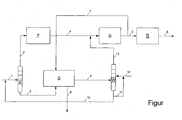
- the crude glycerol is introduced into the vacuum distillation device V, where it is separated into the two streams 2 and 3. Subsequently, the stream 2, which consists almost exclusively of glycerol, fed to the pyrolysis reactor P as an insert and converted there to a pyrolysis product.
- the pyrolysis product is withdrawn via line 4 from the pyrolysis reactor P and forwarded to the steam reformer D, where it is reacted with catalytic support in a predominantly hydrogen and carbon monoxide containing synthesis crude.
- the synthesis hydrogen gas containing predominantly hydrogen and carbon monoxide is withdrawn from the steam reformer D and fed to the shift reactor S.
- a predominantly hydrogen-containing product gas is withdrawn via line 6 and fed to a treatment (not shown).
- the stream 3 from the vacuum distillation device V which mainly consists of water and salts and residues from the production of biodiesel, is fed to the granulator G and dried there by means of the hot syngas stream 7, which is branched off behind the steam reformer D.
- the salts and other solids contained in the stream 3 are transferred to a granulate and withdrawn via line 8 from the granulator G.
- Via line 9 is a stream, which mainly consists of gases and vapors, but also contains solids in dust form, the water washing device W supplied and cleaned there.
- a portion of the laden wash water from the water scrubber W is withdrawn via line 10 and together with the crude glycerin via line 1 in the Vacuum distillation device V introduced while the other part 11 is mixed with fresh water 12 and recycled as washing water in the water washing device W.
- Via line 13 a material consisting largely of synthesis gas and water vapor stream is withdrawn from the water washing device W and fed together with the pyrolysis 4 to the steam reformer D.
Landscapes
- Chemical & Material Sciences (AREA)
- Chemical Kinetics & Catalysis (AREA)
- Organic Chemistry (AREA)
- Health & Medical Sciences (AREA)
- General Health & Medical Sciences (AREA)
- Engineering & Computer Science (AREA)
- Combustion & Propulsion (AREA)
- Inorganic Chemistry (AREA)
- Hydrogen, Water And Hydrids (AREA)
- Organic Low-Molecular-Weight Compounds And Preparation Thereof (AREA)
Applications Claiming Priority (3)
| Application Number | Priority Date | Filing Date | Title |
|---|---|---|---|
| DE102006051262 | 2006-10-31 | ||
| DE102007004626 | 2007-01-30 | ||
| DE102007022962A DE102007022962A1 (de) | 2006-10-31 | 2007-05-16 | Verfahren und Vorrichtung zur Erzeugung von Wasserstoff aus glycerinhaltigen Stoffen |
Publications (1)
| Publication Number | Publication Date |
|---|---|
| EP1923351A1 true EP1923351A1 (fr) | 2008-05-21 |
Family
ID=39232817
Family Applications (1)
| Application Number | Title | Priority Date | Filing Date |
|---|---|---|---|
| EP07019367A Ceased EP1923351A1 (fr) | 2006-10-31 | 2007-10-02 | Procédé et dispositif destinés à la production d'hydrogène à partir de matériaux contenant de la glycérine |
Country Status (3)
| Country | Link |
|---|---|
| US (1) | US20080283798A1 (fr) |
| EP (1) | EP1923351A1 (fr) |
| DE (1) | DE102007022962A1 (fr) |
Cited By (1)
| Publication number | Priority date | Publication date | Assignee | Title |
|---|---|---|---|---|
| CN102597181A (zh) * | 2009-08-06 | 2012-07-18 | 格雷特波因特能源公司 | 碳质原料的氢化甲烷化方法 |
Families Citing this family (4)
| Publication number | Priority date | Publication date | Assignee | Title |
|---|---|---|---|---|
| DE102007045360A1 (de) | 2007-09-22 | 2009-04-02 | Linde Ag | Verfahren und Vorrichtung zur Vergasung von Rohglycerin |
| DE102010010738A1 (de) | 2010-03-09 | 2011-09-15 | Linde Ag | Vergasung von Rohglycerin |
| KR101764924B1 (ko) * | 2010-06-14 | 2017-08-04 | 에스케이이노베이션 주식회사 | 글리세롤 수상개질용 촉매 및 촉매 제조 방법 |
| DE102010053290A1 (de) | 2010-12-02 | 2012-06-06 | Linde Ag | Verfahren und Vorrichtung zur Erzeugung von Wasserstoff aus Glycerin |
Citations (3)
| Publication number | Priority date | Publication date | Assignee | Title |
|---|---|---|---|---|
| US20030099593A1 (en) * | 2001-11-29 | 2003-05-29 | Cortright Randy D. | Low-temperature hydrogen production from oxygenated hydrocarbons |
| EP1698681A1 (fr) * | 2003-11-27 | 2006-09-06 | Revo International Inc. | Procede de production d'huile combustible pour diesel a partir de graisse |
| EP1845063A2 (fr) * | 2006-04-13 | 2007-10-17 | Linde Aktiengesellschaft | Procédé et dispositif destinés à la production d'hydrogène à partir de composés d'oxygène organiques |
Family Cites Families (1)
| Publication number | Priority date | Publication date | Assignee | Title |
|---|---|---|---|---|
| US6299994B1 (en) * | 1999-06-18 | 2001-10-09 | Uop Llc | Process for providing a pure hydrogen stream for use with fuel cells |
-
2007
- 2007-05-16 DE DE102007022962A patent/DE102007022962A1/de not_active Withdrawn
- 2007-10-02 EP EP07019367A patent/EP1923351A1/fr not_active Ceased
- 2007-10-30 US US11/928,969 patent/US20080283798A1/en not_active Abandoned
Patent Citations (3)
| Publication number | Priority date | Publication date | Assignee | Title |
|---|---|---|---|---|
| US20030099593A1 (en) * | 2001-11-29 | 2003-05-29 | Cortright Randy D. | Low-temperature hydrogen production from oxygenated hydrocarbons |
| EP1698681A1 (fr) * | 2003-11-27 | 2006-09-06 | Revo International Inc. | Procede de production d'huile combustible pour diesel a partir de graisse |
| EP1845063A2 (fr) * | 2006-04-13 | 2007-10-17 | Linde Aktiengesellschaft | Procédé et dispositif destinés à la production d'hydrogène à partir de composés d'oxygène organiques |
Non-Patent Citations (1)
| Title |
|---|
| VALLIYAPPAN T.: "Hydrogen or Syn Gas Production from Glycerol Using Pyrolysis and Steam Gasification Processes", THESIS, 1 December 2004 (2004-12-01), pages 1 - 107, XP002419885 * |
Cited By (1)
| Publication number | Priority date | Publication date | Assignee | Title |
|---|---|---|---|---|
| CN102597181A (zh) * | 2009-08-06 | 2012-07-18 | 格雷特波因特能源公司 | 碳质原料的氢化甲烷化方法 |
Also Published As
| Publication number | Publication date |
|---|---|
| US20080283798A1 (en) | 2008-11-20 |
| DE102007022962A1 (de) | 2008-07-31 |
Similar Documents
| Publication | Publication Date | Title |
|---|---|---|
| DE3121206C2 (de) | Verfahren zum Vergasen fester Abfälle | |
| DE2532198C3 (de) | Verfahren zur Erzeugung heizwertreicher Gase | |
| DE102014007001B4 (de) | Verfahren und Anlage zur Herstellung von H2-reichem Synthesegas | |
| WO2010015316A2 (fr) | Procédé et dispositif de production de gaz de synthèse à partir de biomasse | |
| WO2022223458A1 (fr) | Système et procédé de production de combustibles synthétiques sans émission de dioxyde de carbone | |
| EP2310476A2 (fr) | Dispositif et procédé de gazéification électro-thermo-chimique de biomasse | |
| EP4031640B1 (fr) | Installation et procédé de fabrication de combustibles synthétiques sans eau douce | |
| DE2024301C3 (de) | Verfahren zur Herstellung von Methanol | |
| EP1923351A1 (fr) | Procédé et dispositif destinés à la production d'hydrogène à partir de matériaux contenant de la glycérine | |
| EP1724325B1 (fr) | Procédé pour la conversion en continu ou partiellement en continu de matières premières ou de déchets contenant des graisses ou des huiles en des mélanges avec taux élevé d'hydrocarbures | |
| EP1845063A2 (fr) | Procédé et dispositif destinés à la production d'hydrogène à partir de composés d'oxygène organiques | |
| EP1942076A1 (fr) | Procédé et dispositif destinés à la synthèse d'oxygène à partir de substances contenant de la glycérine | |
| DE102007045360A1 (de) | Verfahren und Vorrichtung zur Vergasung von Rohglycerin | |
| EP3102309B1 (fr) | Méthode pour produire des composes à poids moléculaire élevés en utilisant un tsa-co2 indirectement chauffé | |
| DE102007060166A1 (de) | Verfahren zur Pyrolyse von Glycerin enthaltenden Einsatzstoffen | |
| EP2014614A1 (fr) | Procédé et dispositif d'utilisation de suie dans des installations POX | |
| DE102014202803B4 (de) | Verfahren zur Herstellung flüssiger und/oder fester Kohlenwasserstoffverbindungen | |
| DE102010010738A1 (de) | Vergasung von Rohglycerin | |
| WO2012072199A1 (fr) | Procédé et dispositif de production d'hydrogène à partir de glycérine | |
| DE2929316A1 (de) | Kontinuierliches verfahren zur hydrierung von kohle | |
| DE102008021630A1 (de) | Kreisgasbehandlung zur direkten thermochemischen Umwandlung von hochmolekularen organischen Substanzen in niederviskose flüssige Roh-, Brenn- und Kraftstoffe | |
| EP4653517A1 (fr) | Installation et procédé utilisant un reformeur autothermique pour la production de carburants synthétiques sans émission de dioxyde de carbone | |
| DE2422442A1 (de) | Verfahren zur erzeugung von brennbaren gasen, insbesondere erdgasersatz | |
| DE102006020985A1 (de) | Verfahren und Vorrichtung zur Erzeugung von Wasserstoff aus organischen Sauerstoffverbindungen | |
| DE102024202675A1 (de) | Verfahren und Anlage zum Herstellen eines synthetischen Kraftstoffs aus Biomasse |
Legal Events
| Date | Code | Title | Description |
|---|---|---|---|
| PUAI | Public reference made under article 153(3) epc to a published international application that has entered the european phase |
Free format text: ORIGINAL CODE: 0009012 |
|
| AK | Designated contracting states |
Kind code of ref document: A1 Designated state(s): AT BE BG CH CY CZ DE DK EE ES FI FR GB GR HU IE IS IT LI LT LU LV MC MT NL PL PT RO SE SI SK TR |
|
| AX | Request for extension of the european patent |
Extension state: AL BA HR MK RS |
|
| 17P | Request for examination filed |
Effective date: 20081030 |
|
| 17Q | First examination report despatched |
Effective date: 20081204 |
|
| AKX | Designation fees paid |
Designated state(s): AT BE BG CH CY CZ DE DK EE ES FI FR GB GR HU IE IS IT LI LT LU LV MC MT NL PL PT RO SE SI SK TR |
|
| RAP1 | Party data changed (applicant data changed or rights of an application transferred) |
Owner name: LINDE AG |
|
| STAA | Information on the status of an ep patent application or granted ep patent |
Free format text: STATUS: THE APPLICATION HAS BEEN REFUSED |
|
| 18R | Application refused |
Effective date: 20101018 |