EP1925177B1 - Verbesserte dimensionierungsverfahren für hsdpa-verkehr - Google Patents
Verbesserte dimensionierungsverfahren für hsdpa-verkehr Download PDFInfo
- Publication number
- EP1925177B1 EP1925177B1 EP06784233.6A EP06784233A EP1925177B1 EP 1925177 B1 EP1925177 B1 EP 1925177B1 EP 06784233 A EP06784233 A EP 06784233A EP 1925177 B1 EP1925177 B1 EP 1925177B1
- Authority
- EP
- European Patent Office
- Prior art keywords
- hsdpa
- traffic
- bandwidth
- method recited
- capacity
- Prior art date
- Legal status (The legal status is an assumption and is not a legal conclusion. Google has not performed a legal analysis and makes no representation as to the accuracy of the status listed.)
- Not-in-force
Links
- 238000000034 method Methods 0.000 title claims description 65
- 230000000694 effects Effects 0.000 claims description 27
- 230000005540 biological transmission Effects 0.000 claims description 6
- 230000006978 adaptation Effects 0.000 description 7
- 230000000903 blocking effect Effects 0.000 description 2
- 230000003247 decreasing effect Effects 0.000 description 2
- 238000004458 analytical method Methods 0.000 description 1
- 238000010276 construction Methods 0.000 description 1
- 230000007423 decrease Effects 0.000 description 1
- 230000007812 deficiency Effects 0.000 description 1
- 238000005259 measurement Methods 0.000 description 1
- 238000010606 normalization Methods 0.000 description 1
- 238000013468 resource allocation Methods 0.000 description 1
- 208000037918 transfusion-transmitted disease Diseases 0.000 description 1
Images



Classifications
-
- H—ELECTRICITY
- H04—ELECTRIC COMMUNICATION TECHNIQUE
- H04W—WIRELESS COMMUNICATION NETWORKS
- H04W28/00—Network traffic management; Network resource management
- H04W28/16—Central resource management; Negotiation of resources or communication parameters, e.g. negotiating bandwidth or QoS [Quality of Service]
- H04W28/24—Negotiating SLA [Service Level Agreement]; Negotiating QoS [Quality of Service]
-
- H—ELECTRICITY
- H04—ELECTRIC COMMUNICATION TECHNIQUE
- H04W—WIRELESS COMMUNICATION NETWORKS
- H04W16/00—Network planning, e.g. coverage or traffic planning tools; Network deployment, e.g. resource partitioning or cells structures
- H04W16/18—Network planning tools
-
- H—ELECTRICITY
- H04—ELECTRIC COMMUNICATION TECHNIQUE
- H04W—WIRELESS COMMUNICATION NETWORKS
- H04W16/00—Network planning, e.g. coverage or traffic planning tools; Network deployment, e.g. resource partitioning or cells structures
- H04W16/22—Traffic simulation tools or models
-
- H—ELECTRICITY
- H04—ELECTRIC COMMUNICATION TECHNIQUE
- H04W—WIRELESS COMMUNICATION NETWORKS
- H04W92/00—Interfaces specially adapted for wireless communication networks
- H04W92/04—Interfaces between hierarchically different network devices
- H04W92/12—Interfaces between hierarchically different network devices between access points and access point controllers
Definitions
- the invention is related, in general, to the field of communications and, in particular, to improved dimensioning methods for High-Speed Downlink Packet Access (HSDPA) traffic.
- HSDPA High-Speed Downlink Packet Access
- Dedicated Channel (DCH) traffic i.e ., user traffic
- DCH Dedicated Channel
- HSDPA High-Speed Downlink Packet Access
- RNC Radio Network Controller
- HSDPA traffic only uses lub interface capacity that is not used by DCH traffic.
- Typical dimensioning methods for the lub interface can cause HSDPA traffic flows to fail to meet desired Grade of Service (GoS) requirements.
- GoS Grade of Service
- US 2004/0090934 A1 discloses a method for dynamically varying allocation and distribution of the resources on the interface between a base station and wireless users in response to fluctuations in the demand for services by the wireless users.
- the present invention discloses methods for determining a capacity that is needed on an lub link to fulfill Grade of Service (GoS) requirements in a Universal Mobile Telecommunications System (UMTS) Terrestrial Radio Access Network (UTRAN) for both Dedicated Channel (DCH) traffic and High-Speed Downlink Packet Access (HSDPA) traffic, the method comprising the steps of determining a bandwidth demand of the HSDPA traffic ( ElasticDim ); calculating an average bandwidth of the DCH traffic on the lub interface ( BW use,avg ) setting an initial capacity to the capacity need of the DCH traffic ( CapacityDCH ), wherein at least the initial capacity will be provided for the DCH traffic on the lub link; and, increasing value of the initial capacity until a quality requirement of the HSDPA traffic is fulfilled, the maximum value of the initial capacity reached being a capacity that is needed for DCH and HSDPA traffic for the lub interface.
- GoS Grade of Service
- UMTS Universal Mobile Telecommunications System
- UTRAN Universal Mobile Telecommunications System
- the step of determining the bandwidth demand of the HSDPA traffic comprises using an external tool to determine the bandwidth demand.
- the demand is determined based on an elastic user model, wherein the bandwidth need of HSDPA traffic is determined to provide a required target average ( TargetAvg ) download rate.
- ElasticDim MAX(AvgLoad + TargetAvg, TargetPeak), where AvgLoad is the average busy hour load, TargetAvg is the average user data download rate experienced during busy hour load conditions, and TargetPeak equals the target peak download rate for a single active HSDPA user.
- the available bandwidth on the lub interface is shared among the ongoing flows and the length (i.e., download time) of a HSDPA flow depends on its received bit rate. If ElasticDim is less than a target peak rate ( TargetPeak ), then the value of ElasticDim is set to TargetPeak.
- TargetPeak a target peak rate
- BW use,avg is the average bandwidth use of different Radio Bearer (RB) types on the lub interface.
- BW use,avg is a vector, wherein the i-th element contains the average bandwidth use of an i-th RB type;
- BW use,avg (i) fEfficiency(i) x Activity(i) x PacketSize(i) / TTI(i), where fEfficiency is an efficiency factor, Activity is an activity factor that describes the fraction of time the connection is active, PacketSize is the lub packet size, and TTI is the transmission time interval.
- the step of increasing the value of the initial capacity until a quality requirement of the HSDPA traffic is fulfilled includes the steps of determining what fraction of time ( actualGoS HSDPA ) the bandwidth demand of the HSDPA traffic (ElasticDim) is not available and, if actualGoS HSDP , is larger than a target value (targetGoS ), increasing the initial capacity by one predetermined bandwidth unit.
- the step of determining what fraction of time ( actualGoS HSDPA ) the bandwidth demand of the HSDPA traffic ( ElasticDim ) is not available includes the step of using an external tool to determine actualGoS HSDPA ; alternatively, this determination can be based on a multi-rate loss model. In the exemplary embodiment described herein, such multi-rate loss model is based on the Kaufman-Roberts algorithm.
- the dimensioning method starts from the description of traffic demands and the required Grade of Service (GoS).
- the classes of different Dedicated Channels (DCHs) are described by the bandwidth demand on the lub interface ( BW ) , the offered load ( offeredLoad ) in Erlang ( E ), and the target blocking probability ( GoS ).
- the High-Speed Downlink Packet Access (HSDPA) traffic is described by the average traffic ( AvgLoad ), the peak user data throughput for single active HSDPA user ( TargetPeak ), and the target average download rate (TargetAvg).
- the output of the method is the required minimum link capacity. Using this capacity, both the GoS requirement of DCH traffic and the GoS requirement of HSDPA traffic ( i.e., target average download rate) can be fulfilled.
- the DCH traffic has priority over HSDPA traffic and the HSDPA traffic can use the capacity that is not used by DCH traffic.
- This resource sharing method allows a reduction in the required link capacity compared to the separate dimensioning of DCH and HSDPA traffic, as illustrated in FIGURE 1 .
- the bandwidth demand of HSDPA traffic can be determined by an external method/tool. Practically, the bandwidth demand of HSDPA traffic is an input parameter of the proposed method. Using this case a designer can take into account the resource sharing method on Uu interface more precisely. Probably, Round Robin (RR), Maximum Carrier-to-Interference (max C/I) ratio, or Proportional fair (PF) scheduling algorithm results in different achievable bandwidth for HSDPA traffic; therefore, the bandwidth demand of HSDPA traffic on lub interface is also different.
- RR Round Robin
- max C/I Maximum Carrier-to-Interference
- PF Proportional fair
- HSDPA traffic can be modeled as elastic traffic, wherein the available bandwidth is shared among ongoing flows and the length (i.e ., download time) of a HSDPA flow depends on its received bit rate.
- the bandwidth need of HSDPA traffic is determined to provide the required TargetAvg. If this bandwidth need, denoted by ElasticDim , is smaller than TargetPeak, then ElasticDim is set equal to TargetPeak.
- the capacity that is required to fulfill the GoS requirement of DCHs and to assure the bandwidth need of HSDPA (ElasticDim) with high probability (e.g., TargetCapacityAvailability is 90%) is determined.
- a dimensioning method based on the Kaufman-Roberts (KR) formula can be used.
- HSDPA the "1 -TargetCapacityAvailability" as blocking probability target and ElasticDim as its bandwidth need can be used.
- This HSDPA class has low priority and in this way does not have effect on DCHs; therefore, the offered load of this class can be set to zero.
- the bandwidth demand of the DCH classes is set to the average bandwidth use of the DCH classes instead of setting it to the bandwidth reserved by the Connection Admission Control (CAC) for DCH classes.
- CAC Connection Admission Control
- the capacity need of DCHs with the bandwidth need reserved by the CAC (which is larger than the bandwidths used during the joint dimensioning of DCHs and HSDPA) is higher than the capacity calculated in this second step, then the larger capacity need should be used.
- GoS like strict delay bounds, it is necessary to give more bandwidth for a DCH connection than its average bandwidth.
- the DCH connections occupy only their average bandwidth on a longer time-scale and in this way the unused bandwidth can be utilized by HSDPA connections.
- the offered load of DCHs are input parameters of the dimensioning.
- the Kaufman-Roberts dimensioning formula provides the required capacity for DCHs and HSDPA traffic, assuming resource sharing between them. If the capacity need of DCHs with the bandwidth need reserved by the CAC (which is larger than the average bandwidth used during the joint dimensioning of DCHs and HSDPA) is higher, then the larger capacity is used for the required capacity.
- the capacity need of DCHs with the bandwidth need reserved by the CAC is an input parameter of the dimensioning.
- the resource-sharing scenario has the following attributes: class A/B and class C traffic is on the same Constant Bit Rate (CBR) Virtual Channel (VC), wherein class A/B has priority over class C; and resources not used by class A/B can be used by class C.
- CBR Constant Bit Rate
- VC Virtual Channel
- DCH connections are mapped into class A/B and HSDPA connections are mapped into Class C.
- the dimensioning procedure takes into account these attributes in several ways.
- the class A/B traffic typically does not load to peak and the resources allocated for class A/B vary in time.
- Class C can use the resources not used by class A/B, but the speed of the adaptation of class C resource allocation is limited by the dynamics of the protocols that control the amount of HSDPA traffic (such as Transmission Control Protocol (TCP) and the flow control between the RNC and the Node B).
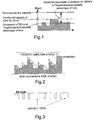
- FIGURE 2 shows an example of how class C traffic adapts to the varying available bandwidth (Effect "A").
- the adaptation slowly explores the additionally available bandwidth.
- the adaptation cuts the rate of the flows fast then slowly explores the available capacity. This adaptation takes time in both cases, which results in not all the capacity remaining from class A/B traffic being used by low priority traffic.
- PS DCHs Packet Switched Dedicated Channels
- FIGURE 3 Event "B”
- the activity factor for these connections is still set to 1 (i.e., it is a conservative assumption).
- the dimensioning procedure disclosed herein assumes that the utilization of PS DCHs is less than 100%.
- the resources reserved for a DCH by the CAC may well be above the DCH rate (e.g., 64k or 384k).
- the bandwidth reserved by the CAC for a 384k bearer increases as the delay requirement, D ⁇ , of packets between the RNC and Node-B is decreased.
- the capacity of the shared VC is small, the statistical multiplexing cannot be effective because only a few ( e.g. , 1 or 2) 384k connections can be multiplexed on the link.
- the dimensioning procedure takes into account that the DCH rate can be smaller than the bandwidth allocated for it by the CAC. This difference between the DCH rate and the allocated bandwidth can be large only for "small systems," where the maximum number of connections of a certain DCH type that can be accepted is small and the delay requirement is strict.
- AAL2 Asynchronous Transfer Mode
- AAL2 Asynchronous Transfer Mode
- FIFO First In First Out
- D ⁇ the delay requirement
- TTI Transmission Time Interval
- Effect "C” the delay requirement
- the dimensioning is done using the Kaufmann-Roberts dimensioning method.
- the low priority traffic demand is included in the dimensioning as a new traffic class.
- the bandwidth demand of this traffic class equals to the dimensioned capacity need of low priority traffic as illustrated in FIGURE 5 ; the portion 501 represents the bandwidth gain because of resource sharing.
- Effect "A” is addressed, for example, by using a 10% GoS target value for the newly added traffic class representing the low priority traffic demand. This means that the capacity needed for low priority traffic will be available 90% of the time. (In case of ideal adaptation to the varying bandwidth, the average bandwidth use of the high priority sources could be used. The use of 90% is an educated guess for including the effect of non-ideal adaptation.)
- Effect "B” is addressed by applying a PS efficiency factor ( fEfficiency ) to the bandwidth need of PS traffic classes when dimensioning the common VC.
- FIGURE 5 depicts the different dimensioned capacities.
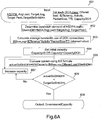
- FIGURES 6A and 6B illustrated is an exemplary dimensioning method in accordance with the principles of the invention ( FIGURE 6A ), including a method according to the Kaufman-Roberts algorithm ( FIGURE 6B ) utilized in the exemplary dimensioning method.
- all bandwidths should be transformed to a common bandwidth unit (e.g., 1 kbps); all bandwidths expressed in bandwidth units are integer numbers.
- the dimensioning starts with the collection of required input parameters.
- the input of the method can be divided into two parts:, (i) DCH related, and (ii) HSDPA related.
- DCH related a DCH related
- HSDPA related a DCH traffic class
- the HSDPA related inputs are the following:
- the required capacity for DCH and HSDPA traffic can be determined.
- the capacity need of HSDPA traffic ( ElasticDim ) is determined. This capacity would be needed when a dedicated fixed capacity resource is used on the lub for HSDPA traffic.
- the bandwidth demand of HSDPA traffic is an input parameter of the method; in this case, the designer can take into account the resource sharing method on Uu interface more precisely.
- the elastic model method can be used for HSDPA traffic dimensioning.
- the HSDPA traffic can be modeled as elastic traffic. This means that the available bandwidth on lub interface is shared among the ongoing flows near equally and the length ( i.e. , download time) of a HSDPA flow depends on its receive rate. The bandwidth need of HSDPA traffic is determined to provide the required TargetAvg.
- the TaregtAvg amount of additional capacity is needed over the AvgLoad to fulfill the GoS requirement of the "target average download rate" ( TargetAvg ) .
- This ElasticDim can be increased with a factor (e.g., multiply by a number greater than 1) that describes the transport efficiency of the system. The protocols overhead also can be taken into account in this factor.
- ElasticDim has been determined.
- Step 603 the average bandwidth use of different Radio Bearers (RBs) on the lub interface is determined. Because the system supports more than one RB type, the bandwidth use of all possible RB types is determined. This average bandwidth is denoted by BW use , avg , where BW use,avg is a vector and its i-th element contains the average bandwidth use of the i-th RB type.
- BW use,avg is a vector and its i-th element contains the average bandwidth use of the i-th RB type.
- the average bandwidth use on an lub interface of an A/B ALL2 class connection that carries the packets of the RBs of DCHs is the packet size divided by the TTI; i.e. , the inter arrival time of packets when the connection is active (there is data to send).
- the activity of the connection i.e., there are time intervals when there is no data to send
- Activity an activity factor
- Each RB type has its own activity and efficiency factors.
- the TTIs and the packet sizes are system specific values.
- the activity and efficiency factors are traffic and system related and can be determined by measurement or based on some analytical method or other external tool.
- the vector BW use,avg of that i-th element contains the average bandwidth use of the i-th RB type has been determined.
- Step 604 the capacity ( Capacity ) is set to the capacity need of DCHs ( capacityDCH ), because at least this capacity will be put for the DCHs in the dimensioned system. Subsequently, the method will increase the capacity until the quality requirement of HSDPA traffic is fulfilled.
- Step 605 the capacity is increased until the quality requirement of HSDPA traffic is fulfilled.
- the system is evaluated for the actual capacity; i.e. determine during what fraction of time the ElasticDim is not available for the HSDPA traffic. If this fraction of time, denoted by actualGoS HSDP , is larger than the required value targetGoS, the capacity is increased by one bandwidth unit.
- the method to determine actualGoS HSDP based on multi-rate loss model is based on the Kaufman-Roberts algorithm as known to those of skill in the art.
- the input parameters are: Capacity, the vector BW use,avg , the vector offeredLoad, and ElasticDim, which were described hereinabove.
- a vector g is initialized; the vector g contains the link occupancy distribution at the end of the method. The first element is set to 1 and the remaining elements are set to zero. During this method, the value of g is not required to be normalized to 1.
- step 612 the sum of the vector g is determined. This sum will be used in the normalization of the occupancy distribution to 1.
- step 614 actualGoS HSDP is determined; this is the HSDPA traffic that is the sum of occupancy distribution (i.e., the vector g ) from Capacity-ElasticDim-1 to Capacity.
- This actualGoS HSDP is the probability of the event the capacity left by DCH is less than the ElasticDim capacity.
- This value of actualGOS HSDP is output in step 615.
- FIGURES 7 and 8 show that using resource sharing can save a significant amount of capacity.
- the two examples illustrated have equal traffic load or traffic pattern/model.
- E1 European digital transmission format 1
- IMA Inverse Multiplexing for ATM
- VPC Virtual Path Connection
Landscapes
- Engineering & Computer Science (AREA)
- Computer Networks & Wireless Communication (AREA)
- Signal Processing (AREA)
- Quality & Reliability (AREA)
- Mobile Radio Communication Systems (AREA)
- Data Exchanges In Wide-Area Networks (AREA)
Claims (18)
- Verfahren zum Bestimmen einer Kapazität, die auf einem lub-Link erforderlich ist, um Dienstgrad-Anforderungen, GoS-Anforderungen, in einem universalen terrestrischen Mobilfunktelekommunikationssystem-, UMTS, Funkzugangsnetzwerk, UTRAN, sowohl für den Verkehr im dedizierten Kanal, DCH-Verkehr, als auch für den Hochgeschwindigkeitsabwärtspaketzugangsverkehr, HSDPA-Verkehr, zu erfüllen, wobei der lub-Link einen Link zwischen einer Funknetzwerksteuerung, RNC, und einem Node-B umfasst, wobei das Verfahren die folgenden Schritte umfasst:Bestimmen (602) eines Bandbreitenbedarfs des HSDPA-Verkehrs, ElasticDim;Berechnen (603) einer durchschnittlichen Bandbreite des DCH-Verkehrs auf der lub-Schnittstelle, BWuse,avg;Festlegen (604) einer Anfangskapazität auf ein Kapazitätserfordernis des DCH-Verkehrs, CapacityDCH, wobei mindestens die Anfangskapazität für den DCH-Verkehr auf dem lub-Link bereitgestellt wird; undErhöhen (607) eines Werts der Anfangskapazität, bis eine Qualitätsanforderung des HSDPA-Verkehrs erfüllt ist, wobei ein erreichter Maximalwert der Anfangskapazität eine Kapazität, DimensionedCapacity, ist, die für DCH- und HSDPA-Verkehr für die lub-Schnittstelle erforderlich ist.
- Verfahren nach Anspruch 1, wobei der Schritt des Bestimmens (602) des Bandbreitenbedarfs des HSDPA-Verkehrs das Verwenden eines externen Werkzeugs umfasst, um den Bandbreitenbedarf zu bestimmen.
- Verfahren nach Anspruch 1, wobei der Schritt des Bestimmens (602) des Bandbreitenbedarfs des HSDPA-Verkehrs das Bestimmen (602) des Bedarfs auf Basis eines elastischen Benutzermodells umfasst.
- Verfahren nach Anspruch 3, wobei die verfügbare Bandbreite auf der lub-Schnittstelle von den laufenden Strömen gemeinsam genutzt wird und die Länge, das heißt die Downloadzeit, eines HSDPA-Stroms von dessen empfangener Bitrate abhängt.
- Verfahren nach Anspruch 3, das den Schritt des Bestimmens (602) des Bandbreitenerfordernisses des HSDPA-Verkehrs umfasst, um einen erforderlichen vorbestimmten Zieldurchschnitt, TargetAvg, der Downloadrate bereitzustellen.
- Verfahren nach Anspruch 5, wobei, wenn ElasticDim geringer ist als eine vorbestimmte Zielspitzenrate, TargetPeak, der Wert von ElasticDim auf TargetPeak festgelegt wird.
- Verfahren nach Anspruch 1, wobei ElasticDim = MAX(AvgLoad + TargetAvg, TargetPeak), wo AvgLoad eine vorbestimmte durchschnittliche Hauptverkehrsstundenlast, TargetAvg eine vorbestimmte durchschnittliche Benutzerdatendownloadrate, die unter Hauptverkehrsstundenlastbedingungen erfahren wird, und TargetPeak gleich einer vorbestimmten Zielspitzendownloadrate für einen einzelnen aktiven HSDPA-Benutzer ist.
- Verfahren nach Anspruch 1, wobei BWuse,avg die durchschnittliche Bandbreitennutzung verschiedener Funkträgertypen, -RB-Typen, auf der lub-Schnittstelle ist.
- Verfahren nach Anspruch 8, wobei BWuse,avg ein Vektor ist, wobei das i-te Element, BWuse,avg(i), die durchschnittliche Bandbreitennutzung eines i-ten RB-Typs enthält.
- Verfahren nach Anspruch 9, wobei BWuse,avg (i) = fEfficiency(i) x Activity(i) x PacketSize(i) / TT(i), wo fEfficiency ein vorbestimmter Effizienzfaktor, Activity ein vorbestimmter Aktivitätsfaktor, der die Bruchteilzeit beschreibt, in der die Verbindung aktiv ist, PacketSize eine vorbestimmte lub-Paketgröße und TTI ein vorbestimmtes Übertragungszeitintervall ist.
- Verfahren nach Anspruch 1, wobei der Schritt des Erhöhens (607) des Werts der Anfangskapazität, bis eine Qualitätsanforderung des HSDPA-Verkehrs erfüllt ist, die folgenden Schritte umfasst:Bestimmen (605), welche Bruchteilzeit, actualGoSHSDPA, der Bandbreitenbedarf des HSDPA-Verkehrs, ElasticDim, nicht verfügbar ist;wenn actualGoSHSDPA größer ist als ein vorbestimmter GoS-Zielwert, targetGoS, Erhöhen (607) der Anfangskapazität um eine vorbestimmte Bandbreiteneinheit.
- Verfahren nach Anspruch 11, wobei der Schritt des Bestimmens (605), welche Bruchteilzeit, actualGoSHSDPA, der Bandbreitenbedarf des HSDPA-Verkehrs, ElasticDim, nicht verfügbar ist, den Schritt des Verwendens eines externen Werkzeugs umfasst, um actualGoSHSDPA zu bestimmen.
- Verfahren nach Anspruch 11, wobei der Schritt des Bestimmens (605), welche Bruchteilzeit, actualGoSHSDPA, der Bandbreitenbedarf des HSDPA-Verkehrs, ElasticDim, nicht verfügbar ist, den Schritt des Bestimmens von actualGoSHSDPA auf Basis eines Multiratenverlustmodells umfasst.
- Verfahren nach Anspruch 13, wobei das Multiratenverlustmodell auf dem Kaufman-Roberts-Algorithmus, KR-Algorithmus, basiert.
- Verfahren nach Anspruch 14, wobei actualGoSHSDPA = KR(Anfangskapazität, BWuse,avg, OfferedLoad, ElasticDim), wobei OfferedLoad ein vorbestimmter Vektor ist und sein i-tes Element die angebotene Last der i-ten DCH-Verkehrsklasse enthält.
- Verfahren nach Anspruch 5, wobei der vorbestimmte Zieldurchschnitt, TargetAvg, der Downloadrate einer gewünschten durchschnittlichen Benutzerdatendownloadrate innerhalb einer Sitzung entspricht, die von einem HSDPA-Benutzer durchschnittlich unter Hauptverkehrsstundenlastbedingungen erfahren werden soll.
- Verfahren nach Anspruch 6, wobei die vorbestimmte Zielspitzenrate, TargetPeak, einer gewünschten Downloadrate entspricht, die ein Benutzer erfahren sollte, wenn sich in der Funkbasisstation, RBS, nur ein aktiver HSDPA-Benutzer befindet, das heißt ein Node-B.
- Verfahren nach Anspruch 11, wobei der vorbestimmte GoS-Zielwert, targetGoS, gleich x % ist, wobei die für HSDPA-Verkehr erforderliche Kapazität 100-x % verfügbar sein wird.
Applications Claiming Priority (2)
| Application Number | Priority Date | Filing Date | Title |
|---|---|---|---|
| US71797805P | 2005-09-16 | 2005-09-16 | |
| PCT/SE2006/050320 WO2007032733A2 (en) | 2005-09-16 | 2006-09-11 | Improved dimensioning methods for hsdpa traffic |
Publications (3)
| Publication Number | Publication Date |
|---|---|
| EP1925177A2 EP1925177A2 (de) | 2008-05-28 |
| EP1925177A4 EP1925177A4 (de) | 2012-05-30 |
| EP1925177B1 true EP1925177B1 (de) | 2017-07-19 |
Family
ID=37865400
Family Applications (1)
| Application Number | Title | Priority Date | Filing Date |
|---|---|---|---|
| EP06784233.6A Not-in-force EP1925177B1 (de) | 2005-09-16 | 2006-09-11 | Verbesserte dimensionierungsverfahren für hsdpa-verkehr |
Country Status (6)
| Country | Link |
|---|---|
| US (1) | US7746806B2 (de) |
| EP (1) | EP1925177B1 (de) |
| JP (1) | JP4988743B2 (de) |
| CN (1) | CN101263731B (de) |
| CA (1) | CA2619134A1 (de) |
| WO (1) | WO2007032733A2 (de) |
Families Citing this family (8)
| Publication number | Priority date | Publication date | Assignee | Title |
|---|---|---|---|---|
| EP1770918A1 (de) * | 2005-09-30 | 2007-04-04 | Evolium Sas | Datenflusssteuerung für Schnittstellen eines Funkzugangsnetzes |
| US20070171830A1 (en) * | 2006-01-26 | 2007-07-26 | Nokia Corporation | Apparatus, method and computer program product providing radio network controller internal dynamic HSDPA flow control using one of fixed or calculated scaling factors |
| WO2008059361A2 (en) * | 2006-11-16 | 2008-05-22 | Nokia Corporation | Apparatus, methods and computer program products providing estimation of activity factor and enhanced radio resource management |
| US8406129B2 (en) * | 2009-12-23 | 2013-03-26 | At&T Intellectual Property I, L.P. | Technique for determining transport capacity required to achieve controllable worst case throughput |
| WO2011085822A1 (en) | 2010-01-18 | 2011-07-21 | Telefonaktiebolaget Lm Ericsson (Publ) | Method for reserving capacity on a communication network link |
| EP2456136A1 (de) * | 2010-11-17 | 2012-05-23 | Thomson Licensing | Vorrichtung und Verfahren zur Bestimmung der Kommunikationswege zwischen einem Gerät mit mehreren Kommunikationsschnittstellen und einem anderen Gerät mit mindestens einer Kommunikationsschnittstelle |
| US8595374B2 (en) * | 2010-12-08 | 2013-11-26 | At&T Intellectual Property I, L.P. | Method and apparatus for capacity dimensioning in a communication network |
| CN111200821B (zh) * | 2018-11-16 | 2021-12-03 | 华为技术有限公司 | 一种容量规划方法及装置 |
Family Cites Families (18)
| Publication number | Priority date | Publication date | Assignee | Title |
|---|---|---|---|---|
| CA2310188A1 (en) * | 2000-05-30 | 2001-11-30 | Mark J. Frazer | Communication structure with channels configured responsive to reception quality |
| CN1173500C (zh) * | 2001-12-05 | 2004-10-27 | 华为技术有限公司 | 高速下行数据包接入系统对不同服务质量业务的支持方法 |
| ATE299630T1 (de) * | 2002-02-14 | 2005-07-15 | Matsushita Electric Industrial Co Ltd | Verfahren zum steuern der datenrate in einem drahtlosen paketdatenkommunikationssystem, sender und empfänger zu seiner verwendung |
| US8619718B2 (en) * | 2002-04-05 | 2013-12-31 | Interdigital Technology Corporation | Method and apparatus for coordinating a radio network controller and node B resource management for high speed downlink packet data service |
| SE0202845D0 (sv) * | 2002-05-13 | 2002-09-23 | Ericsson Telefon Ab L M | Measurements for radio resource management for high-speed downlink shared channel (HS-DSCH) |
| US7453845B2 (en) * | 2002-11-08 | 2008-11-18 | Lucent Technologies Inc. | Distributed call control |
| ITTO20021009A1 (it) * | 2002-11-20 | 2004-05-21 | Telecom Italia Lab Spa | Procedimento, sistema e prodotto informatico per la |
| US7400889B2 (en) * | 2003-04-01 | 2008-07-15 | Telefonaktiebolaget Lm Ericsson (Publ) | Scalable quality broadcast service in a mobile wireless communication network |
| CN1279770C (zh) * | 2003-04-11 | 2006-10-11 | 华为技术有限公司 | 无线接入网中的业务优先级的传输方法 |
| WO2005004409A1 (en) * | 2003-07-07 | 2005-01-13 | Utstarcom (China) Co. Ltd. | A method for achieving differentiated service code point tag based on ip in umts radio access network |
| GB2405289B (en) * | 2003-08-20 | 2006-10-25 | Ipwireless Inc | Method,base station,remote station and system for HSDPA communication |
| FR2861529B1 (fr) * | 2003-10-24 | 2006-02-03 | Evolium Sas | Procede de gestion de ressources de traitement dans un systeme de radiocommunications mobiles |
| FI20031688A0 (fi) * | 2003-11-20 | 2003-11-20 | Nokia Corp | Radiojärjestelmän hallinta |
| CN100508437C (zh) * | 2003-12-22 | 2009-07-01 | 上海贝尔阿尔卡特股份有限公司 | 高速下行链路共享信道的信道码动态管理方法 |
| CN101065914A (zh) * | 2004-07-26 | 2007-10-31 | 美商内数位科技公司 | 升级现存数据主机能力的高速下链封包存取共处理器 |
| US7492752B2 (en) * | 2005-05-25 | 2009-02-17 | Motorola, Inc. | Method and apparatus for improved channel maintenance signaling |
| WO2008059361A2 (en) * | 2006-11-16 | 2008-05-22 | Nokia Corporation | Apparatus, methods and computer program products providing estimation of activity factor and enhanced radio resource management |
| US7839859B2 (en) * | 2007-12-03 | 2010-11-23 | Nec Laboratories America, Inc. | Voice adaptive gateway pacing methods and systems for wireless multi-hop networks |
-
2006
- 2006-09-11 EP EP06784233.6A patent/EP1925177B1/de not_active Not-in-force
- 2006-09-11 CA CA002619134A patent/CA2619134A1/en not_active Abandoned
- 2006-09-11 WO PCT/SE2006/050320 patent/WO2007032733A2/en not_active Ceased
- 2006-09-11 CN CN2006800337926A patent/CN101263731B/zh not_active Expired - Fee Related
- 2006-09-11 JP JP2008531060A patent/JP4988743B2/ja not_active Expired - Fee Related
- 2006-09-11 US US12/066,928 patent/US7746806B2/en active Active
Non-Patent Citations (1)
| Title |
|---|
| None * |
Also Published As
| Publication number | Publication date |
|---|---|
| EP1925177A2 (de) | 2008-05-28 |
| EP1925177A4 (de) | 2012-05-30 |
| WO2007032733A2 (en) | 2007-03-22 |
| CN101263731A (zh) | 2008-09-10 |
| JP4988743B2 (ja) | 2012-08-01 |
| CA2619134A1 (en) | 2007-03-22 |
| US7746806B2 (en) | 2010-06-29 |
| WO2007032733A3 (en) | 2007-05-03 |
| JP2009509397A (ja) | 2009-03-05 |
| CN101263731B (zh) | 2013-01-02 |
| US20080259812A1 (en) | 2008-10-23 |
Similar Documents
| Publication | Publication Date | Title |
|---|---|---|
| US6091708A (en) | Traffic shaper with multiply queued virtual paths | |
| US7804798B2 (en) | Method, system and computer program product for managing the transmission of information packets in a telecommunication network | |
| EP1787436B1 (de) | Verfahren und system zur verwaltung von funkbetriebsmitteln in mobilkommunikationsnetzen, diesbezügliches netz und computerprogrammprodukt dafür | |
| US7031254B2 (en) | Rate control system and method for a link within a wireless communications system | |
| KR100798854B1 (ko) | 광대역 이동 액세스 시스템에서 실시간 및 비실시간 통합서비스를 지원하기 위한 적응적 지연 임계값 기반 패킷스케줄링 방법 | |
| EP1436953B1 (de) | Verfahren zur plannung von packetdatenübertragung und paketablaufsteuerung | |
| US20050163103A1 (en) | Connection admission control in packet-oriented, multi-service networks | |
| US7397818B2 (en) | Asymmetric bandwidth allocation | |
| EP1925177B1 (de) | Verbesserte dimensionierungsverfahren für hsdpa-verkehr | |
| US7113478B2 (en) | Radio telecommunications system with improved use of air interface (II) | |
| JP2004080768A (ja) | 無線通信システムにおけるアドミッション制御アルゴリズムの利用方法 | |
| EP1832015B1 (de) | Verfahren zur zeitplanung von ressourcen auf paketebene für integrierte ebenen für integrierten verkehr sowie vorrichtung dafür | |
| Yu | End-to-end adaptive QoS provisioning over GPRS wireless mobile network | |
| Malomsoky et al. | Connection admission control in UMTS radio access networks | |
| EP1832045B1 (de) | Verbindungsreservierung in einer kommunikationsschnittstelle | |
| Ajib et al. | Service disciplines performance for best-effort policies in packet-switching wireless cellular networks | |
| AJIB et al. | SERVICE DISCIPLINES PERFORMANCE FOR BEST-EFFORT POLICIES IN WWW TRAFFIC OVER PACKET-SWITCHED WIRELESS CELLULAR NETWORKS | |
| Ajib et al. | Effects of circuit switched transmissions over GPRS performance | |
| Bang et al. | A novel capacity maximization scheme for multimedia wireless ATM systems providing QoS guarantees for handoffs | |
| Passas et al. | Improving traffic scheduling in wireless ATM networks | |
| Habaebi et al. | Adaptive Reservation TDMA Protocol for Wireless Multimedia Traffic | |
| Malomsoky et al. | Performance Evaluation of UMTS Terrestrial Radio Access Networks |
Legal Events
| Date | Code | Title | Description |
|---|---|---|---|
| PUAI | Public reference made under article 153(3) epc to a published international application that has entered the european phase |
Free format text: ORIGINAL CODE: 0009012 |
|
| 17P | Request for examination filed |
Effective date: 20080205 |
|
| AK | Designated contracting states |
Kind code of ref document: A2 Designated state(s): AT BE BG CH CY CZ DE DK EE ES FI FR GB GR HU IE IS IT LI LT LU LV MC NL PL PT RO SE SI SK TR |
|
| REG | Reference to a national code |
Ref country code: DE Ref legal event code: R079 Ref document number: 602006053071 Country of ref document: DE Free format text: PREVIOUS MAIN CLASS: H04Q0007380000 Ipc: H04W0028160000 |
|
| A4 | Supplementary search report drawn up and despatched |
Effective date: 20120503 |
|
| RIC1 | Information provided on ipc code assigned before grant |
Ipc: H04W 28/16 20090101AFI20120425BHEP |
|
| DAX | Request for extension of the european patent (deleted) | ||
| GRAP | Despatch of communication of intention to grant a patent |
Free format text: ORIGINAL CODE: EPIDOSNIGR1 |
|
| STAA | Information on the status of an ep patent application or granted ep patent |
Free format text: STATUS: GRANT OF PATENT IS INTENDED |
|
| INTG | Intention to grant announced |
Effective date: 20170510 |
|
| GRAS | Grant fee paid |
Free format text: ORIGINAL CODE: EPIDOSNIGR3 |
|
| GRAA | (expected) grant |
Free format text: ORIGINAL CODE: 0009210 |
|
| STAA | Information on the status of an ep patent application or granted ep patent |
Free format text: STATUS: THE PATENT HAS BEEN GRANTED |
|
| AK | Designated contracting states |
Kind code of ref document: B1 Designated state(s): AT BE BG CH CY CZ DE DK EE ES FI FR GB GR HU IE IS IT LI LT LU LV MC NL PL PT RO SE SI SK TR |
|
| REG | Reference to a national code |
Ref country code: GB Ref legal event code: FG4D |
|
| REG | Reference to a national code |
Ref country code: CH Ref legal event code: EP |
|
| REG | Reference to a national code |
Ref country code: IE Ref legal event code: FG4D |
|
| REG | Reference to a national code |
Ref country code: AT Ref legal event code: REF Ref document number: 911507 Country of ref document: AT Kind code of ref document: T Effective date: 20170815 |
|
| REG | Reference to a national code |
Ref country code: NL Ref legal event code: FP |
|
| REG | Reference to a national code |
Ref country code: DE Ref legal event code: R096 Ref document number: 602006053071 Country of ref document: DE |
|
| REG | Reference to a national code |
Ref country code: LT Ref legal event code: MG4D |
|
| REG | Reference to a national code |
Ref country code: AT Ref legal event code: MK05 Ref document number: 911507 Country of ref document: AT Kind code of ref document: T Effective date: 20170719 |
|
| PG25 | Lapsed in a contracting state [announced via postgrant information from national office to epo] |
Ref country code: FI Free format text: LAPSE BECAUSE OF FAILURE TO SUBMIT A TRANSLATION OF THE DESCRIPTION OR TO PAY THE FEE WITHIN THE PRESCRIBED TIME-LIMIT Effective date: 20170719 Ref country code: SE Free format text: LAPSE BECAUSE OF FAILURE TO SUBMIT A TRANSLATION OF THE DESCRIPTION OR TO PAY THE FEE WITHIN THE PRESCRIBED TIME-LIMIT Effective date: 20170719 Ref country code: AT Free format text: LAPSE BECAUSE OF FAILURE TO SUBMIT A TRANSLATION OF THE DESCRIPTION OR TO PAY THE FEE WITHIN THE PRESCRIBED TIME-LIMIT Effective date: 20170719 Ref country code: LT Free format text: LAPSE BECAUSE OF FAILURE TO SUBMIT A TRANSLATION OF THE DESCRIPTION OR TO PAY THE FEE WITHIN THE PRESCRIBED TIME-LIMIT Effective date: 20170719 |
|
| PG25 | Lapsed in a contracting state [announced via postgrant information from national office to epo] |
Ref country code: LV Free format text: LAPSE BECAUSE OF FAILURE TO SUBMIT A TRANSLATION OF THE DESCRIPTION OR TO PAY THE FEE WITHIN THE PRESCRIBED TIME-LIMIT Effective date: 20170719 Ref country code: ES Free format text: LAPSE BECAUSE OF FAILURE TO SUBMIT A TRANSLATION OF THE DESCRIPTION OR TO PAY THE FEE WITHIN THE PRESCRIBED TIME-LIMIT Effective date: 20170719 Ref country code: IS Free format text: LAPSE BECAUSE OF FAILURE TO SUBMIT A TRANSLATION OF THE DESCRIPTION OR TO PAY THE FEE WITHIN THE PRESCRIBED TIME-LIMIT Effective date: 20171119 Ref country code: GR Free format text: LAPSE BECAUSE OF FAILURE TO SUBMIT A TRANSLATION OF THE DESCRIPTION OR TO PAY THE FEE WITHIN THE PRESCRIBED TIME-LIMIT Effective date: 20171020 Ref country code: PL Free format text: LAPSE BECAUSE OF FAILURE TO SUBMIT A TRANSLATION OF THE DESCRIPTION OR TO PAY THE FEE WITHIN THE PRESCRIBED TIME-LIMIT Effective date: 20170719 Ref country code: BG Free format text: LAPSE BECAUSE OF FAILURE TO SUBMIT A TRANSLATION OF THE DESCRIPTION OR TO PAY THE FEE WITHIN THE PRESCRIBED TIME-LIMIT Effective date: 20171019 |
|
| REG | Reference to a national code |
Ref country code: DE Ref legal event code: R097 Ref document number: 602006053071 Country of ref document: DE |
|
| PG25 | Lapsed in a contracting state [announced via postgrant information from national office to epo] |
Ref country code: DK Free format text: LAPSE BECAUSE OF FAILURE TO SUBMIT A TRANSLATION OF THE DESCRIPTION OR TO PAY THE FEE WITHIN THE PRESCRIBED TIME-LIMIT Effective date: 20170719 Ref country code: RO Free format text: LAPSE BECAUSE OF FAILURE TO SUBMIT A TRANSLATION OF THE DESCRIPTION OR TO PAY THE FEE WITHIN THE PRESCRIBED TIME-LIMIT Effective date: 20170719 Ref country code: CZ Free format text: LAPSE BECAUSE OF FAILURE TO SUBMIT A TRANSLATION OF THE DESCRIPTION OR TO PAY THE FEE WITHIN THE PRESCRIBED TIME-LIMIT Effective date: 20170719 |
|
| REG | Reference to a national code |
Ref country code: CH Ref legal event code: PL |
|
| PLBE | No opposition filed within time limit |
Free format text: ORIGINAL CODE: 0009261 |
|
| STAA | Information on the status of an ep patent application or granted ep patent |
Free format text: STATUS: NO OPPOSITION FILED WITHIN TIME LIMIT |
|
| PG25 | Lapsed in a contracting state [announced via postgrant information from national office to epo] |
Ref country code: SK Free format text: LAPSE BECAUSE OF FAILURE TO SUBMIT A TRANSLATION OF THE DESCRIPTION OR TO PAY THE FEE WITHIN THE PRESCRIBED TIME-LIMIT Effective date: 20170719 Ref country code: EE Free format text: LAPSE BECAUSE OF FAILURE TO SUBMIT A TRANSLATION OF THE DESCRIPTION OR TO PAY THE FEE WITHIN THE PRESCRIBED TIME-LIMIT Effective date: 20170719 Ref country code: IT Free format text: LAPSE BECAUSE OF FAILURE TO SUBMIT A TRANSLATION OF THE DESCRIPTION OR TO PAY THE FEE WITHIN THE PRESCRIBED TIME-LIMIT Effective date: 20170719 Ref country code: MC Free format text: LAPSE BECAUSE OF FAILURE TO SUBMIT A TRANSLATION OF THE DESCRIPTION OR TO PAY THE FEE WITHIN THE PRESCRIBED TIME-LIMIT Effective date: 20170719 |
|
| 26N | No opposition filed |
Effective date: 20180420 |
|
| REG | Reference to a national code |
Ref country code: IE Ref legal event code: MM4A |
|
| REG | Reference to a national code |
Ref country code: BE Ref legal event code: MM Effective date: 20170930 |
|
| PG25 | Lapsed in a contracting state [announced via postgrant information from national office to epo] |
Ref country code: LU Free format text: LAPSE BECAUSE OF NON-PAYMENT OF DUE FEES Effective date: 20170911 |
|
| REG | Reference to a national code |
Ref country code: FR Ref legal event code: ST Effective date: 20180531 |
|
| PG25 | Lapsed in a contracting state [announced via postgrant information from national office to epo] |
Ref country code: CH Free format text: LAPSE BECAUSE OF NON-PAYMENT OF DUE FEES Effective date: 20170930 Ref country code: LI Free format text: LAPSE BECAUSE OF NON-PAYMENT OF DUE FEES Effective date: 20170930 Ref country code: IE Free format text: LAPSE BECAUSE OF NON-PAYMENT OF DUE FEES Effective date: 20170911 |
|
| PG25 | Lapsed in a contracting state [announced via postgrant information from national office to epo] |
Ref country code: FR Free format text: LAPSE BECAUSE OF NON-PAYMENT OF DUE FEES Effective date: 20171002 Ref country code: BE Free format text: LAPSE BECAUSE OF NON-PAYMENT OF DUE FEES Effective date: 20170930 Ref country code: SI Free format text: LAPSE BECAUSE OF FAILURE TO SUBMIT A TRANSLATION OF THE DESCRIPTION OR TO PAY THE FEE WITHIN THE PRESCRIBED TIME-LIMIT Effective date: 20170719 |
|
| PGFP | Annual fee paid to national office [announced via postgrant information from national office to epo] |
Ref country code: DE Payment date: 20180927 Year of fee payment: 13 |
|
| PGFP | Annual fee paid to national office [announced via postgrant information from national office to epo] |
Ref country code: GB Payment date: 20180927 Year of fee payment: 13 Ref country code: NL Payment date: 20180926 Year of fee payment: 13 |
|
| PG25 | Lapsed in a contracting state [announced via postgrant information from national office to epo] |
Ref country code: HU Free format text: LAPSE BECAUSE OF FAILURE TO SUBMIT A TRANSLATION OF THE DESCRIPTION OR TO PAY THE FEE WITHIN THE PRESCRIBED TIME-LIMIT; INVALID AB INITIO Effective date: 20060911 |
|
| PG25 | Lapsed in a contracting state [announced via postgrant information from national office to epo] |
Ref country code: CY Free format text: LAPSE BECAUSE OF NON-PAYMENT OF DUE FEES Effective date: 20170719 |
|
| PG25 | Lapsed in a contracting state [announced via postgrant information from national office to epo] |
Ref country code: TR Free format text: LAPSE BECAUSE OF FAILURE TO SUBMIT A TRANSLATION OF THE DESCRIPTION OR TO PAY THE FEE WITHIN THE PRESCRIBED TIME-LIMIT Effective date: 20170719 |
|
| REG | Reference to a national code |
Ref country code: DE Ref legal event code: R119 Ref document number: 602006053071 Country of ref document: DE |
|
| REG | Reference to a national code |
Ref country code: NL Ref legal event code: MM Effective date: 20191001 |
|
| PG25 | Lapsed in a contracting state [announced via postgrant information from national office to epo] |
Ref country code: PT Free format text: LAPSE BECAUSE OF FAILURE TO SUBMIT A TRANSLATION OF THE DESCRIPTION OR TO PAY THE FEE WITHIN THE PRESCRIBED TIME-LIMIT Effective date: 20170719 |
|
| PG25 | Lapsed in a contracting state [announced via postgrant information from national office to epo] |
Ref country code: DE Free format text: LAPSE BECAUSE OF NON-PAYMENT OF DUE FEES Effective date: 20200401 Ref country code: NL Free format text: LAPSE BECAUSE OF NON-PAYMENT OF DUE FEES Effective date: 20191001 |
|
| GBPC | Gb: european patent ceased through non-payment of renewal fee |
Effective date: 20190911 |
|
| PG25 | Lapsed in a contracting state [announced via postgrant information from national office to epo] |
Ref country code: GB Free format text: LAPSE BECAUSE OF NON-PAYMENT OF DUE FEES Effective date: 20190911 |