EP1925594A1 - Verwendung von Rhizomucor pusillus (Lindt) Schipper zur Behandlung farbstoffhaltiger Industrieabwässer - Google Patents
Verwendung von Rhizomucor pusillus (Lindt) Schipper zur Behandlung farbstoffhaltiger Industrieabwässer Download PDFInfo
- Publication number
- EP1925594A1 EP1925594A1 EP20070118905 EP07118905A EP1925594A1 EP 1925594 A1 EP1925594 A1 EP 1925594A1 EP 20070118905 EP20070118905 EP 20070118905 EP 07118905 A EP07118905 A EP 07118905A EP 1925594 A1 EP1925594 A1 EP 1925594A1
- Authority
- EP
- European Patent Office
- Prior art keywords
- fungal biomass
- dye
- fungal
- dyes
- biomass
- Prior art date
- Legal status (The legal status is an assumption and is not a legal conclusion. Google has not performed a legal analysis and makes no representation as to the accuracy of the status listed.)
- Granted
Links
Images
Classifications
-
- C—CHEMISTRY; METALLURGY
- C02—TREATMENT OF WATER, WASTE WATER, SEWAGE, OR SLUDGE
- C02F—TREATMENT OF WATER, WASTE WATER, SEWAGE, OR SLUDGE
- C02F1/00—Treatment of water, waste water, or sewage
- C02F1/28—Treatment of water, waste water, or sewage by sorption
- C02F1/286—Treatment of water, waste water, or sewage by sorption using natural organic sorbents or derivatives thereof
-
- B—PERFORMING OPERATIONS; TRANSPORTING
- B01—PHYSICAL OR CHEMICAL PROCESSES OR APPARATUS IN GENERAL
- B01J—CHEMICAL OR PHYSICAL PROCESSES, e.g. CATALYSIS OR COLLOID CHEMISTRY; THEIR RELEVANT APPARATUS
- B01J20/00—Solid sorbent compositions or filter aid compositions; Sorbents for chromatography; Processes for preparing, regenerating or reactivating thereof
- B01J20/22—Solid sorbent compositions or filter aid compositions; Sorbents for chromatography; Processes for preparing, regenerating or reactivating thereof comprising organic material
- B01J20/24—Naturally occurring macromolecular compounds, e.g. humic acids or their derivatives
-
- B—PERFORMING OPERATIONS; TRANSPORTING
- B01—PHYSICAL OR CHEMICAL PROCESSES OR APPARATUS IN GENERAL
- B01J—CHEMICAL OR PHYSICAL PROCESSES, e.g. CATALYSIS OR COLLOID CHEMISTRY; THEIR RELEVANT APPARATUS
- B01J2220/00—Aspects relating to sorbent materials
- B01J2220/40—Aspects relating to the composition of sorbent or filter aid materials
- B01J2220/48—Sorbents characterised by the starting material used for their preparation
- B01J2220/4812—Sorbents characterised by the starting material used for their preparation the starting material being of organic character
- B01J2220/485—Plants or land vegetals, e.g. cereals, wheat, corn, rice, sphagnum, peat moss
-
- C—CHEMISTRY; METALLURGY
- C02—TREATMENT OF WATER, WASTE WATER, SEWAGE, OR SLUDGE
- C02F—TREATMENT OF WATER, WASTE WATER, SEWAGE, OR SLUDGE
- C02F2101/00—Nature of the contaminant
- C02F2101/30—Organic compounds
- C02F2101/308—Dyes; Colorants; Fluorescent agents
-
- C—CHEMISTRY; METALLURGY
- C02—TREATMENT OF WATER, WASTE WATER, SEWAGE, OR SLUDGE
- C02F—TREATMENT OF WATER, WASTE WATER, SEWAGE, OR SLUDGE
- C02F3/00—Biological treatment of water, waste water, or sewage
- C02F3/34—Biological treatment of water, waste water, or sewage characterised by the microorganisms used
- C02F3/347—Use of yeasts or fungi
-
- Y—GENERAL TAGGING OF NEW TECHNOLOGICAL DEVELOPMENTS; GENERAL TAGGING OF CROSS-SECTIONAL TECHNOLOGIES SPANNING OVER SEVERAL SECTIONS OF THE IPC; TECHNICAL SUBJECTS COVERED BY FORMER USPC CROSS-REFERENCE ART COLLECTIONS [XRACs] AND DIGESTS
- Y02—TECHNOLOGIES OR APPLICATIONS FOR MITIGATION OR ADAPTATION AGAINST CLIMATE CHANGE
- Y02W—CLIMATE CHANGE MITIGATION TECHNOLOGIES RELATED TO WASTEWATER TREATMENT OR WASTE MANAGEMENT
- Y02W10/00—Technologies for wastewater treatment
- Y02W10/30—Wastewater or sewage treatment systems using renewable energies
- Y02W10/37—Wastewater or sewage treatment systems using renewable energies using solar energy
-
- Y—GENERAL TAGGING OF NEW TECHNOLOGICAL DEVELOPMENTS; GENERAL TAGGING OF CROSS-SECTIONAL TECHNOLOGIES SPANNING OVER SEVERAL SECTIONS OF THE IPC; TECHNICAL SUBJECTS COVERED BY FORMER USPC CROSS-REFERENCE ART COLLECTIONS [XRACs] AND DIGESTS
- Y10—TECHNICAL SUBJECTS COVERED BY FORMER USPC
- Y10S—TECHNICAL SUBJECTS COVERED BY FORMER USPC CROSS-REFERENCE ART COLLECTIONS [XRACs] AND DIGESTS
- Y10S210/00—Liquid purification or separation
- Y10S210/902—Materials removed
- Y10S210/917—Color
Definitions
- the present invention relates in general to methods for treating industrial wastewaters containing dyes. More particularly, the present invention relates to the use of fungal species in methods for treating industrial wastewaters containing dyes.
- dyes can be classed into anionic (acid), cationic (basic) and non-ionic dyes.
- anionic (acid) cationic (basic)
- non-ionic dyes ionic dyes
- chromophore group they can be classed into azo, anthraquinone, indigo, stilbene dyes etc., or depending on their applications.
- Azo and anthraquinone dyes represent the most widespread classes of dyes for industrial applications (Soares et al. , 2001).
- Anthraquinone dyes represent the second class for industrial relevance and can be divided into dyes derived from indigo and from anthraquinone. They are prepared by successive introduction of the substituents on the pre-formed skeleton of anthraquinone.
- Dyes are toxic substances as shown by ETAD (1989) in a test on animals for 4,000 dyes. They can also have a carcinogenic and mutagenic action, due to the formation of aromatic amines when they are degraded under anaerobiosis from bacteria, as was shown in several researches on fishes, mice and other animals (Weisburger et al. , 2002). Genotoxic and carcinogenic effects are also possible on men, on whom dyes cause at least short-term phenomena of contact and inhaling irritation (Yesilada et al. , 2003).
- Toxic substances contained in waste of industries using dyes should therefore be completely removed before being released into the environment (Knapp et al ., 2001).
- Physical and chemical purification methods are not always applicable and/or effective and always involve high costs for firms (Fu and Viraraghavan, 2001, Robinson et al ., 2001).
- biosorption can be regarded as a valid alternative to chemical-physical methods and to microbial and/or enzymatic biodegradation.
- Such researches have pointed out the capacity of various microbial biomasses (bacteria, yeasts, fungi and algae) to absorb or accumulate dyes (Polman et al ., 1996, Crini, 2006), and among the various types of biomass the fungal biomass has proved to be particularly suitable, even if the mechanisms regulating absorption have not yet been fully explained (Knapp et al ., 2001, Crini, 2006).
- biosorption has indubitable advantages such as a highly rapid treatment and the possibility of recovering absorbed dye for future use. Moreover, it can be carried out also with deactivated biomasses; this has huge advantages both thanks to the lower environmental impact and because it is not necessary to monitor the various factors affecting the growth of a living organism.
- the invention aims at identifying/selecting fungal species to be used in methods for treating industrial wastewaters containing dyes.
- the invention relates to the use of the fungal species Rhizomucor pusillus (Lindt) Schipper in a method for the biosorption of industrial dyes, e.g. of the dyeing or tanning industry.
- the fungal biomass used includes the fungal species Rhizomucor pusillus (Lindt) Schipper. More specifically, the present invention relates to the use of the fungal strain Rhizomucor pusillus (Lindt) Schipper MUT 2229 deposited at the DSMZ (Deutsche Sammlung von Mikroorganismen und Zellkulturen GmbH) Braunschweig, Germany, under access number DSMZ 18656 on September 15 th 2006.
- DSMZ Deutsche Sammlung von Mikroorganismen und Zellkulturen GmbH
- deactivated biomasses have important application advantages: they do not require a continuous introduction of nutrients, they are not affected by high levels of toxic compounds that are often present in wastewaters to be treated, and in some cases they can be regenerated and/or used for following treatment cycles (Aksu, 2005).
- biomasses pre-grown on different culture media have significantly different sorption capacities with respect to the same dye.
- the culture medium can modify both the chemical structure and the structure of cell wall (Bartniki-Garcia and Nickerson, 1962; Farkas, 1980; Krystofova et al., 1998; El-Mougith et al., 1999; Hefnavy et al., 1999; Znidarsic et al, 1999; Nemcovic and Farkas, 2001) as well as colony morphology (Pessoni et al., 2005). According to Znidarsic et al. (1999) the amount and quality of carbon and nitrogen sources can affect the amount of structural compounds, such as chitin and chitosane, and of other chemical groups that are present in cell wall.
- Rhizomucor pusillus grown on Malt Extract Agar at 30°C. Colonies having first a white color, then turning with maturity to neutral gray or sepia, woolly, 2-3 mm of height. Heterothallic species; brownish red or black zygospores, diameter of 45-63(70) microns, irregularly verrucose. Rhizoids present at the base of sporangiophores. Colorless or brownish yellow sporangiophores, diameter of 10 microns, with simpodial ramifications and end-side umbelliform ramifications. Sporangia with diameter of 50-80 microns, with spinulous wall breaking at maturity stage.
- Subglobous or slightly oblong columella diameter of 15-35 microns, up to 60 microns of height.
- Optimal growth temperature 50°C.
- Rhizomucor pusillus (Lindt) Schipper MUT 2229 (deposited at DSMZ under access number 18656) kept at Mycotheca Universitatis Taurinensis (MUT, Università di Torino, Dipartimento di Biologia Vegetale) as colony in active growth, on Agar Malt medium at a temperature of 4°C.
- a stock solution at a concentration of 20,000 ppm has been prepared by dissolving the dye powder in distilled water.
- Such solutions have been sterilized by filtration (disposable cellulose acetate filters with pores having a diameter of 0.2 ⁇ m - Schleicher & Schuell GmbH, Dassel, Germany) and stored at 4°C up to the preparation of the simulated wastewaters.
- the industrial dyes used in these wastewater models were selected because of representative of the most structural dye types, commercially important and with a wide range of applications across the textile industries and were purchased from Town End (Leeds) plc.
- the chemical-physical properties and the structural formula of the 10 dyes are listed in Table 3.
- these effluent models mimic the industrial ones also for the presence of different salts, often in high concentrations, and for the pH values.
- the first wastewater (R1) contained a mix of 3 acid dyes (300 ppm in total), and has an ionic strength of 4.23.10 -2 and pH 5.
- the second wastewater (R2) contained a mix of 4 reactive dyes previously hydrolized (5000 ppm total), and has an ionic strength of 1.26.10 -1 and pH 10.
- the third wastewater (R3) contained a mix of 3 direct dyes (3000 ppm total) and has an ionic strength of 1.48 and pH 9.
- the exact composition of the 3 effluent models is listed in table 4. All the mimed effluents were sterilized by tindalization (three 1 hour cycles at 60°C with 24 hr interval between cycles at room temperature).
- the reproductive propagules have been taken from colonies in active growth aged 7 days, and suspensions have been prepared at the known concentration of 2.5 ⁇ 10 5 conidia ml -1 in sterile deionized water using a hemocytometer (Burker's chamber).
- One ml of such suspension has been inoculated into 500 ml flasks containing 250 ml of culture medium.
- the following culture media have been used for producing the biomasses:
- starch glucose, sucrose or mixtures thereof is necessary as carbon source for growing the fungal culture.
- Such components can be used both as pure substances and as by-products of industrial productions.
- starch potato peels can be used; instead of glucose molasses, bagasse, black liquors deriving from spirits or sugar cane industry can be used.
- Incubation has been carried out under stirring at 110 rpm and at a temperature of 30°C (thermostatic planetary stirrer Minitron Infors, Bottmingen, CH). After 7-8 days of incubation the biomasses have been taken from the culture medium by filtration, using a metal sieve with pores having a diameter of 150 ⁇ m, and have been rinsed several times with saline solution (9 g l -1 NaCl) so as to remove residues of culture medium that might have interfered with following test stages. The biomasses have been divided into two parts: one part has been kept alive, the other one has been deactivated, and both parts have been used in the following biosorption tests.
- Living and deactivated biomasses have been divided into 3 g aliquots (living weight) and incubated in 50 ml flasks containing 30 ml of simulated wastewater. 3 repetitions have been prepared for each test.
- Incubation has been carried out under stirring at 110 rpm and at a temperature of 30°C (thermostatic planetary stirrer Minitron Infors, Bottmingen, CH). After 2, 6 and 24 hours of incubation 300 ⁇ l of simulated wastewater have been taken for each sample and centrifuged at 14,000 rpm for five minutes, so as to remove biomass fragments that might have interfered with following spectrophotometric measures.
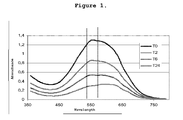
- the DP values were calculated as the extent of decrease of the spectrum area from 360 nm to 790 nm, respect to that of the abiotic control.
- Samples of simulated wastewaters without biomass have been used as abiotic controls and for detecting the presence, if any, of bleaching phenomena not related to biosorption, such as photodegradation and complexing.
- Decolourization percentages (averages and standard deviations of 3 repetitions) of simulated wastewaters containing dyes R80, B214 at a concentration of 200 ppm, after 2, 6 and 24 hours of incubation with living biomasses of Rhizomucor pusillus MUT 2229 pre-grown in EQ, GN1 and GN4, are shown in Table 5.
- Table 5 Decolourization percentages (averages and standard deviations of 3 repetitions) of simulated wastewaters containing dyes R80, B214 at a concentration of 200 ppm, after 2, 6 and 24 hours of incubation with living biomasses of Rhizomucor pusillus MUT 2229 pre-grown in EQ, GN1 and GN4, are shown in Table 5. Table 5.
- Table 6 shows decolourization percentages of simulated wastewaters containing dyes R80, B214 at a concentration of 1,000 ppm, after 2, 6 and 24 ore of incubation with living biomasses of Rhizomucor pusillus MUT 2229 pre-grown in EQ, GN1 e GN4. The values contained therein represent averages ⁇ standard deviations of three repetitions. Table 6.
- Dye Culture medium Decolourization percentage (%) 2 hours 6 hours 24 hours EQ 55.7 ⁇ 1.6 66.8 ⁇ 1.9 92.0 ⁇ 1.1 R80 GN1 48.9 ⁇ 1.7 60.4 ⁇ 1.3 83.9 ⁇ 2.3 GN4 52.2 ⁇ 4.5 65.4 ⁇ 5.7 88.6 ⁇ 6.9 EQ 98.6 ⁇ 0.1 98.2 ⁇ 0.9 99.1 ⁇ 0.2 B214 GN1 96.8 ⁇ 0.7 97.0 ⁇ 0.3 97.8 ⁇ 0.6 GN4 96.9 ⁇ 0.5 97.2 ⁇ 0.6 97.8 ⁇ 0.4
- the dye B214 has been removed more effectively than R80 with decolourization percentages, after 24 hours, that are always above 97.8%. Moreover, already after 2 hours of treatment the decolourization percentages observed were in all cases above 96.8%.
- the dye R80 has been the most difficult to remove from the simulated wastewater, although it reached after 24 hours of treatment decolourization percentages that are always above 83.9% (Table 6).
- Table 7 shows sorption capacities of biomasses of Rhizomucor pusillus MUT 2229 pre-grown in EQ, GN1 and GN4 towards simulated wastewaters containing dyes R80 and B214 at a concentration of 1,000 ppm.
- the values contained therein represent the averages of three repetitions ⁇ standard deviations; different letters indicate significant differences (p ⁇ 0.05) among SCs of biomasses pre-grown on the different media with the same simulated wastewater.
- Table 7. Dye Sorption capacity mg of dye g -1 of biomass EQ GN1 GN4 R80 142.0 ⁇ 2.6 A 179.1 ⁇ 2.
- Decolourization percentages (averages and standard deviations of 3 repetitions) of simulated wastewaters containing dyes R80, B214 and RBBR at a concentration of 1,000 ppm, after 2, 6 and 24 hours of treatment with deactivated biomasses of R. pusillus MUT 2229 pre-grown in EQ, GN1 and GN4, are shown in Table 8. Table 8.
- Table 9 shows decolourization percentages of simulated wastewaters containing dyes R80, B214, RBBR and mix at a concentration of 5,000 ppm, after 2, 6 and 24 hours of incubation with deactivated biomasses of Rhi zomucor pusillus MUT 2229 pre-grown in EQ, GN1 and GN4. The values contained therein represent averages ⁇ standard deviations of three repetitions. Table 9.
- Table 10 contains SC values of deactivated biomasses of R. pusillus MUT 2229 (averages ⁇ standard deviations of 3 repetitions) pre-grown in EQ, GN1, GN4 and AM towards simulated wastewaters containing dyes R80, B214 and RBBR as well as the mixture of 10 dyes at a concentration of 5,000 ppm. SC values obtained with dyes at 1,000 ppm are not shown therein since decolourization percentage was so high (close to 100%) to prevent a correct calculation of this parameter. Table 10.
- Dye Sorption capacity (mg of dye g -1 of biomass) EQ GN1 GN4 AM R80 365.4 ⁇ 20.0 Aa 211.9 ⁇ 14.5 Ab 283.7 ⁇ 28.9 Ac 386.8 ⁇ 59.8 Aa B214 532.8 ⁇ 14.5 Ba 468.4 ⁇ 19.6 Bb 520.8 ⁇ 51.4 Bab 403.9 ⁇ 37.8 Ac RBBR 167.9 ⁇ 35.8 Ca 300.9 ⁇ 21.6 Ab Mix 410.5 ⁇ 35.4 Aa 785.1 ⁇ 53.8 Cb 737.5 ⁇ 59.2 Cb 453.8 ⁇ 12.4 Ba a,b,c refer to significant differences (p ⁇ 0.05) among values of sorption capacity obtained with biomasses pre-grown in different culture media for the same simulated wastewater. A,B,C refer to significant differences (p ⁇ 0.05) among values of sorption capacity towards different simulated wastewaters in the same culture medium.
- Table 11 shows decolourization percentages (average ⁇ standard deviations of 3 replicates) of effluent models, after 2, 6 and 24 hours of incubation with the biomass of Rhizomucor pusillus MUT 2229 pre-grown in EQ and AM. Table 11.
- Substantial decolourization of R1 was obtained by the biomass pre-grown in EQ (DP value higher than 93% within 24 hours); more than 96% of the total decolourization was achieved within 2 hours.
- the highest DP was recorded after 2 hours and no significative differences were noted during the following 18 hours.
- the DP values for R3 were higher than 87% after 24 hours. In comparison to the other simulated effluents, lower percentages (67% and 46%) of the total decolourization obtained at the end of the experiments were attained within 2 hours and significant differences were observed among the DP values at 2, 6 and 24 hours.
Landscapes
- Chemical & Material Sciences (AREA)
- Organic Chemistry (AREA)
- Life Sciences & Earth Sciences (AREA)
- Hydrology & Water Resources (AREA)
- Engineering & Computer Science (AREA)
- Environmental & Geological Engineering (AREA)
- Water Supply & Treatment (AREA)
- Analytical Chemistry (AREA)
- Chemical Kinetics & Catalysis (AREA)
- Solid-Sorbent Or Filter-Aiding Compositions (AREA)
- Micro-Organisms Or Cultivation Processes Thereof (AREA)
- Water Treatment By Sorption (AREA)
Applications Claiming Priority (1)
| Application Number | Priority Date | Filing Date | Title |
|---|---|---|---|
| ITTO20060810 ITTO20060810A1 (it) | 2006-11-13 | 2006-11-13 | "uso di rhizomucor pusillus (lindt) schipper in procedimenti per il trattamento di reflui industriali contenenti coloranti" |
Publications (2)
| Publication Number | Publication Date |
|---|---|
| EP1925594A1 true EP1925594A1 (de) | 2008-05-28 |
| EP1925594B1 EP1925594B1 (de) | 2015-01-28 |
Family
ID=38988255
Family Applications (1)
| Application Number | Title | Priority Date | Filing Date |
|---|---|---|---|
| EP20070118905 Not-in-force EP1925594B1 (de) | 2006-11-13 | 2007-10-19 | Verwendung von Rhizomucor pusillus (Lindt) Schipper zur Behandlung farbstoffhaltiger Industrieabwässer |
Country Status (5)
| Country | Link |
|---|---|
| US (1) | US7935257B2 (de) |
| EP (1) | EP1925594B1 (de) |
| CA (1) | CA2609273A1 (de) |
| IL (1) | IL186934A0 (de) |
| IT (1) | ITTO20060810A1 (de) |
Cited By (1)
| Publication number | Priority date | Publication date | Assignee | Title |
|---|---|---|---|---|
| CN105309388A (zh) * | 2014-07-28 | 2016-02-10 | 蓝志娟 | 一种水溞耐温驯化方法及利用水溞对水体进行生态修复的方法 |
Families Citing this family (4)
| Publication number | Priority date | Publication date | Assignee | Title |
|---|---|---|---|---|
| CA2746067C (en) * | 2008-12-09 | 2017-07-25 | Crc Care Pty Ltd | Modified clay sorbents |
| US10252926B2 (en) * | 2015-08-31 | 2019-04-09 | Ecolab Usa Inc. | Wastewater treatment process for removing chemical oxygen demand |
| CN116064250B (zh) * | 2023-02-03 | 2023-08-04 | 苏陀科技(北京)有限公司 | 一种微小根毛霉菌株及其在替代蛋白中的应用 |
| CN120964997A (zh) * | 2025-09-18 | 2025-11-18 | 菏泽学院 | 一种去除水体中染料的方法 |
Family Cites Families (2)
| Publication number | Priority date | Publication date | Assignee | Title |
|---|---|---|---|---|
| US20030167513A1 (en) * | 2001-11-30 | 2003-09-04 | Mourad George S. | Selection and use of isopropylmalate synthase (IPMS) mutants desensitized in L-leucine negative feedback control |
| US20070254346A1 (en) * | 2006-04-14 | 2007-11-01 | Ecopia Biosciences Inc. | Process for producing farnesylated dibenzodiazepinone by fermentation |
-
2006
- 2006-11-13 IT ITTO20060810 patent/ITTO20060810A1/it unknown
-
2007
- 2007-10-19 EP EP20070118905 patent/EP1925594B1/de not_active Not-in-force
- 2007-10-25 IL IL186934A patent/IL186934A0/en unknown
- 2007-10-29 CA CA 2609273 patent/CA2609273A1/en not_active Abandoned
- 2007-11-08 US US11/979,843 patent/US7935257B2/en not_active Expired - Fee Related
Non-Patent Citations (7)
| Title |
|---|
| BRIAN VAN DRIESSEL, LEW CHRISTOV: "Decolorization of Bleach Plant Effluent by Mucoralean and White-Rot Fungi in a Rotating Biological Contactor Reactor", JOURNAL OF BIOSCIENCE AND BIOENGINEERING, vol. 92, no. 3, 2001, pages 271 - 276, XP002467943 * |
| JOURNAL OF BIOSCIENCE AND BIOENGINEERING, vol. 92, no. 3, 2001, pages 271 - 276 |
| KNAPP ET AL., CRINI, 2001, pages 2006 |
| L. P. CHRISTOV, B. VAN DRIESSEL, C. A. DU PLESSIS: "Fungal biomass from Rhizomucor pusillus as adsorbent of chromophores from a bleach plant effluent", PROCESS BIOCHEMISTRY, vol. 35, 1999, pages 91 - 95, XP002467944 * |
| POLMAN ET AL., CRINI, 1996, pages 2006 |
| POLMAN J K ET AL: "BIOMASS-MEDIATED BINDING AND RECOVERY OF TEXTILE DYES FROM WASTE EFFLUENTS", TEXTILE CHEMIST AND COLORIST, AM. ASSOC. OF TEXTILE CHEMISTS AND COLORISTS. NORT CAROLINA, US, vol. 28, no. 4, April 1996 (1996-04-01), pages 31 - 35, XP000589145, ISSN: 0040-490X * |
| YUZHU FU, T. VIRARAGHAVAN: "Fungal decolorization of dye wastewaters: a review", BIORESOURCE TECHNOLOGY, vol. 79, 2001, pages 251 - 262, XP002467923 * |
Cited By (2)
| Publication number | Priority date | Publication date | Assignee | Title |
|---|---|---|---|---|
| CN105309388A (zh) * | 2014-07-28 | 2016-02-10 | 蓝志娟 | 一种水溞耐温驯化方法及利用水溞对水体进行生态修复的方法 |
| CN105309388B (zh) * | 2014-07-28 | 2018-03-13 | 蓝志娟 | 一种水溞耐温驯化方法及利用水溞对水体进行生态修复的方法 |
Also Published As
| Publication number | Publication date |
|---|---|
| IL186934A0 (en) | 2008-12-29 |
| US20080110826A1 (en) | 2008-05-15 |
| US7935257B2 (en) | 2011-05-03 |
| EP1925594B1 (de) | 2015-01-28 |
| CA2609273A1 (en) | 2008-05-13 |
| ITTO20060810A1 (it) | 2008-05-14 |
Similar Documents
| Publication | Publication Date | Title |
|---|---|---|
| Wang et al. | A novel biosorbent formed of marine-derived Penicillium janthinellum mycelial pellets for removing dyes from dye-containing wastewater | |
| Kumari et al. | Biosorption of anionic textile dyes by nonviable biomass of fungi and yeast | |
| Rajhans et al. | Degradation of dyes by fungi: an insight into mycoremediation | |
| Pavan et al. | Statistical design of experiments as a tool for optimizing the batch conditions to methylene blue biosorption on yellow passion fruit and mandarin peels | |
| Nilsson et al. | Decolorization of synthetic and real textile wastewater by the use of white-rot fungi | |
| Prigione et al. | Decolourisation and detoxification of textile effluents by fungal biosorption | |
| Prigione et al. | Biosorption of simulated dyed effluents by inactivated fungal biomasses | |
| Priya et al. | Water hyacinth (Eichhornia crassipes)–An efficient and economic adsorbent for textile effluent treatment–A review | |
| Mahmoud et al. | Bioremediation of red azo dye from aqueous solutions by Aspergillus niger strain isolated from textile wastewater | |
| Akar et al. | Biosorption of a reactive textile dye from aqueous solutions utilizing an agro-waste | |
| Yaneva | Insights into Congo Red adsorption on agro-industrial materials-spectral, equilibrium, kinetic, thermodynamic, dynamic and desorption studies. A review | |
| Blánquez et al. | Mechanism of textile metal dye biotransformation by Trametes versicolor | |
| Fu et al. | Removal of a dye from an aqueous solution by the fungus Aspergillus niger | |
| Azin et al. | Efficient mycosorption of anionic azo dyes by Mucor circinelloides: Surface functional groups and removal mechanism study | |
| Kanwal et al. | Phytoremediative adsorption methodologies to decontaminate water from dyes and organic pollutants | |
| Jebapriya et al. | Bioremediation of textile dye using white rot fungi: a review | |
| Wong et al. | Removal of methylene blue and malachite green dye using different form of coconut fibre as absorbent | |
| Sharma et al. | Study of removal techniques for azo dyes by biosorption: a review | |
| EP1925594B1 (de) | Verwendung von Rhizomucor pusillus (Lindt) Schipper zur Behandlung farbstoffhaltiger Industrieabwässer | |
| Ekanayake et al. | Mycoremediation Potential of Synthetic Textile Dyes by Aspergillus niger via Biosorption and Enzymatic Degradation. | |
| Semião et al. | Synergistic treatment of textile wastewaters using spent diatomaceous earth loaded with laccases: A cost-effective and eco-friendly approach | |
| Módenes et al. | Adsorption of direct of yellow ARLE dye by activated carbon of shell of coconut palm: Diffusional effects on kinetics and equilibrium states | |
| Upadhyay et al. | An evaluation of decolorization mechanism of synthetic dyes belonging to the azo, anthraquinone, and triphenylmethane group, as a sustainable approach, by immobilized CB8 strain (Trametes versicolor) | |
| Ardiati et al. | Evaluation of batch and fed-batch rotating drum biological contactor using immobilized Trametes hirsuta EDN082 for non-sterile real textile wastewater treatment | |
| EP1921045B1 (de) | Verwendung von Cunninghamella elegans (Lendner) zur Behandlung farbstoffhaltiger Industrieabwässer |
Legal Events
| Date | Code | Title | Description |
|---|---|---|---|
| PUAI | Public reference made under article 153(3) epc to a published international application that has entered the european phase |
Free format text: ORIGINAL CODE: 0009012 |
|
| AK | Designated contracting states |
Kind code of ref document: A1 Designated state(s): AT BE BG CH CY CZ DE DK EE ES FI FR GB GR HU IE IS IT LI LT LU LV MC MT NL PL PT RO SE SI SK TR |
|
| AX | Request for extension of the european patent |
Extension state: AL BA HR MK RS |
|
| 17P | Request for examination filed |
Effective date: 20080916 |
|
| 17Q | First examination report despatched |
Effective date: 20081015 |
|
| RAP1 | Party data changed (applicant data changed or rights of an application transferred) |
Owner name: UNIVERSITA' DEGLI STUDI DI TORINO Owner name: PAN-ECO S.A. |
|
| AKX | Designation fees paid |
Designated state(s): AT BE BG CH CY CZ DE DK EE ES FI FR GB GR HU IE IS IT LI LT LU LV MC MT NL PL PT RO SE SI SK TR |
|
| RAP1 | Party data changed (applicant data changed or rights of an application transferred) |
Owner name: UNIVERSITA' DEGLI STUDI DI TORINO Owner name: PAN-ECO S.R.L. |
|
| GRAP | Despatch of communication of intention to grant a patent |
Free format text: ORIGINAL CODE: EPIDOSNIGR1 |
|
| RIC1 | Information provided on ipc code assigned before grant |
Ipc: C02F 3/34 20060101ALN20140515BHEP Ipc: C02F 1/28 20060101AFI20140515BHEP Ipc: C02F 101/30 20060101ALN20140515BHEP |
|
| INTG | Intention to grant announced |
Effective date: 20140602 |
|
| GRAS | Grant fee paid |
Free format text: ORIGINAL CODE: EPIDOSNIGR3 |
|
| GRAA | (expected) grant |
Free format text: ORIGINAL CODE: 0009210 |
|
| AK | Designated contracting states |
Kind code of ref document: B1 Designated state(s): AT BE BG CH CY CZ DE DK EE ES FI FR GB GR HU IE IS IT LI LT LU LV MC MT NL PL PT RO SE SI SK TR |
|
| REG | Reference to a national code |
Ref country code: GB Ref legal event code: FG4D |
|
| REG | Reference to a national code |
Ref country code: CH Ref legal event code: EP |
|
| REG | Reference to a national code |
Ref country code: IE Ref legal event code: FG4D |
|
| REG | Reference to a national code |
Ref country code: AT Ref legal event code: REF Ref document number: 708160 Country of ref document: AT Kind code of ref document: T Effective date: 20150315 |
|
| REG | Reference to a national code |
Ref country code: DE Ref legal event code: R096 Ref document number: 602007040173 Country of ref document: DE Effective date: 20150319 |
|
| REG | Reference to a national code |
Ref country code: AT Ref legal event code: MK05 Ref document number: 708160 Country of ref document: AT Kind code of ref document: T Effective date: 20150128 |
|
| REG | Reference to a national code |
Ref country code: NL Ref legal event code: VDEP Effective date: 20150128 |
|
| REG | Reference to a national code |
Ref country code: LT Ref legal event code: MG4D |
|
| PG25 | Lapsed in a contracting state [announced via postgrant information from national office to epo] |
Ref country code: FI Free format text: LAPSE BECAUSE OF FAILURE TO SUBMIT A TRANSLATION OF THE DESCRIPTION OR TO PAY THE FEE WITHIN THE PRESCRIBED TIME-LIMIT Effective date: 20150128 Ref country code: SE Free format text: LAPSE BECAUSE OF FAILURE TO SUBMIT A TRANSLATION OF THE DESCRIPTION OR TO PAY THE FEE WITHIN THE PRESCRIBED TIME-LIMIT Effective date: 20150128 Ref country code: LT Free format text: LAPSE BECAUSE OF FAILURE TO SUBMIT A TRANSLATION OF THE DESCRIPTION OR TO PAY THE FEE WITHIN THE PRESCRIBED TIME-LIMIT Effective date: 20150128 Ref country code: ES Free format text: LAPSE BECAUSE OF FAILURE TO SUBMIT A TRANSLATION OF THE DESCRIPTION OR TO PAY THE FEE WITHIN THE PRESCRIBED TIME-LIMIT Effective date: 20150128 Ref country code: BG Free format text: LAPSE BECAUSE OF FAILURE TO SUBMIT A TRANSLATION OF THE DESCRIPTION OR TO PAY THE FEE WITHIN THE PRESCRIBED TIME-LIMIT Effective date: 20150428 |
|
| PG25 | Lapsed in a contracting state [announced via postgrant information from national office to epo] |
Ref country code: GR Free format text: LAPSE BECAUSE OF FAILURE TO SUBMIT A TRANSLATION OF THE DESCRIPTION OR TO PAY THE FEE WITHIN THE PRESCRIBED TIME-LIMIT Effective date: 20150429 Ref country code: IS Free format text: LAPSE BECAUSE OF FAILURE TO SUBMIT A TRANSLATION OF THE DESCRIPTION OR TO PAY THE FEE WITHIN THE PRESCRIBED TIME-LIMIT Effective date: 20150528 Ref country code: PL Free format text: LAPSE BECAUSE OF FAILURE TO SUBMIT A TRANSLATION OF THE DESCRIPTION OR TO PAY THE FEE WITHIN THE PRESCRIBED TIME-LIMIT Effective date: 20150128 Ref country code: LV Free format text: LAPSE BECAUSE OF FAILURE TO SUBMIT A TRANSLATION OF THE DESCRIPTION OR TO PAY THE FEE WITHIN THE PRESCRIBED TIME-LIMIT Effective date: 20150128 Ref country code: AT Free format text: LAPSE BECAUSE OF FAILURE TO SUBMIT A TRANSLATION OF THE DESCRIPTION OR TO PAY THE FEE WITHIN THE PRESCRIBED TIME-LIMIT Effective date: 20150128 Ref country code: NL Free format text: LAPSE BECAUSE OF FAILURE TO SUBMIT A TRANSLATION OF THE DESCRIPTION OR TO PAY THE FEE WITHIN THE PRESCRIBED TIME-LIMIT Effective date: 20150128 |
|
| REG | Reference to a national code |
Ref country code: DE Ref legal event code: R097 Ref document number: 602007040173 Country of ref document: DE |
|
| PG25 | Lapsed in a contracting state [announced via postgrant information from national office to epo] |
Ref country code: DK Free format text: LAPSE BECAUSE OF FAILURE TO SUBMIT A TRANSLATION OF THE DESCRIPTION OR TO PAY THE FEE WITHIN THE PRESCRIBED TIME-LIMIT Effective date: 20150128 Ref country code: RO Free format text: LAPSE BECAUSE OF FAILURE TO SUBMIT A TRANSLATION OF THE DESCRIPTION OR TO PAY THE FEE WITHIN THE PRESCRIBED TIME-LIMIT Effective date: 20150128 Ref country code: CZ Free format text: LAPSE BECAUSE OF FAILURE TO SUBMIT A TRANSLATION OF THE DESCRIPTION OR TO PAY THE FEE WITHIN THE PRESCRIBED TIME-LIMIT Effective date: 20150128 Ref country code: EE Free format text: LAPSE BECAUSE OF FAILURE TO SUBMIT A TRANSLATION OF THE DESCRIPTION OR TO PAY THE FEE WITHIN THE PRESCRIBED TIME-LIMIT Effective date: 20150128 Ref country code: SK Free format text: LAPSE BECAUSE OF FAILURE TO SUBMIT A TRANSLATION OF THE DESCRIPTION OR TO PAY THE FEE WITHIN THE PRESCRIBED TIME-LIMIT Effective date: 20150128 |
|
| PLBE | No opposition filed within time limit |
Free format text: ORIGINAL CODE: 0009261 |
|
| STAA | Information on the status of an ep patent application or granted ep patent |
Free format text: STATUS: NO OPPOSITION FILED WITHIN TIME LIMIT |
|
| PG25 | Lapsed in a contracting state [announced via postgrant information from national office to epo] |
Ref country code: IT Free format text: LAPSE BECAUSE OF FAILURE TO SUBMIT A TRANSLATION OF THE DESCRIPTION OR TO PAY THE FEE WITHIN THE PRESCRIBED TIME-LIMIT Effective date: 20150128 |
|
| 26N | No opposition filed |
Effective date: 20151029 |
|
| PG25 | Lapsed in a contracting state [announced via postgrant information from national office to epo] |
Ref country code: SI Free format text: LAPSE BECAUSE OF FAILURE TO SUBMIT A TRANSLATION OF THE DESCRIPTION OR TO PAY THE FEE WITHIN THE PRESCRIBED TIME-LIMIT Effective date: 20150128 |
|
| REG | Reference to a national code |
Ref country code: DE Ref legal event code: R119 Ref document number: 602007040173 Country of ref document: DE |
|
| PG25 | Lapsed in a contracting state [announced via postgrant information from national office to epo] |
Ref country code: LU Free format text: LAPSE BECAUSE OF FAILURE TO SUBMIT A TRANSLATION OF THE DESCRIPTION OR TO PAY THE FEE WITHIN THE PRESCRIBED TIME-LIMIT Effective date: 20151019 Ref country code: BE Free format text: LAPSE BECAUSE OF FAILURE TO SUBMIT A TRANSLATION OF THE DESCRIPTION OR TO PAY THE FEE WITHIN THE PRESCRIBED TIME-LIMIT Effective date: 20150128 |
|
| REG | Reference to a national code |
Ref country code: CH Ref legal event code: PL |
|
| GBPC | Gb: european patent ceased through non-payment of renewal fee |
Effective date: 20151019 |
|
| PG25 | Lapsed in a contracting state [announced via postgrant information from national office to epo] |
Ref country code: MC Free format text: LAPSE BECAUSE OF FAILURE TO SUBMIT A TRANSLATION OF THE DESCRIPTION OR TO PAY THE FEE WITHIN THE PRESCRIBED TIME-LIMIT Effective date: 20150128 |
|
| REG | Reference to a national code |
Ref country code: IE Ref legal event code: MM4A |
|
| PG25 | Lapsed in a contracting state [announced via postgrant information from national office to epo] |
Ref country code: CH Free format text: LAPSE BECAUSE OF NON-PAYMENT OF DUE FEES Effective date: 20151031 Ref country code: DE Free format text: LAPSE BECAUSE OF NON-PAYMENT OF DUE FEES Effective date: 20160503 Ref country code: GB Free format text: LAPSE BECAUSE OF NON-PAYMENT OF DUE FEES Effective date: 20151019 Ref country code: LI Free format text: LAPSE BECAUSE OF NON-PAYMENT OF DUE FEES Effective date: 20151031 |
|
| REG | Reference to a national code |
Ref country code: FR Ref legal event code: ST Effective date: 20160630 |
|
| PG25 | Lapsed in a contracting state [announced via postgrant information from national office to epo] |
Ref country code: FR Free format text: LAPSE BECAUSE OF NON-PAYMENT OF DUE FEES Effective date: 20151102 |
|
| PG25 | Lapsed in a contracting state [announced via postgrant information from national office to epo] |
Ref country code: IE Free format text: LAPSE BECAUSE OF NON-PAYMENT OF DUE FEES Effective date: 20151019 |
|
| PG25 | Lapsed in a contracting state [announced via postgrant information from national office to epo] |
Ref country code: HU Free format text: LAPSE BECAUSE OF FAILURE TO SUBMIT A TRANSLATION OF THE DESCRIPTION OR TO PAY THE FEE WITHIN THE PRESCRIBED TIME-LIMIT; INVALID AB INITIO Effective date: 20071019 |
|
| PG25 | Lapsed in a contracting state [announced via postgrant information from national office to epo] |
Ref country code: CY Free format text: LAPSE BECAUSE OF FAILURE TO SUBMIT A TRANSLATION OF THE DESCRIPTION OR TO PAY THE FEE WITHIN THE PRESCRIBED TIME-LIMIT Effective date: 20150128 |
|
| PG25 | Lapsed in a contracting state [announced via postgrant information from national office to epo] |
Ref country code: MT Free format text: LAPSE BECAUSE OF FAILURE TO SUBMIT A TRANSLATION OF THE DESCRIPTION OR TO PAY THE FEE WITHIN THE PRESCRIBED TIME-LIMIT Effective date: 20150128 Ref country code: TR Free format text: LAPSE BECAUSE OF FAILURE TO SUBMIT A TRANSLATION OF THE DESCRIPTION OR TO PAY THE FEE WITHIN THE PRESCRIBED TIME-LIMIT Effective date: 20150128 |
|
| PG25 | Lapsed in a contracting state [announced via postgrant information from national office to epo] |
Ref country code: PT Free format text: LAPSE BECAUSE OF FAILURE TO SUBMIT A TRANSLATION OF THE DESCRIPTION OR TO PAY THE FEE WITHIN THE PRESCRIBED TIME-LIMIT Effective date: 20150128 |